

Key Takeaways
- For developing a prediction market, choose a company that knows blockchain, understands regulation, and has proof of security audits.
- Ask the company to show an example of their live prediction market project, and check whether the smart contracts have been audited by any third-party firms.
- See whether they can understand your target market. Also check whether they can handle live data feeds, oracles, and secure payment flows.
- Compare their post-launch support and pricing. Check their client reviews. Don’t fall for big promises without any proof.
- See why Idea Usher is the best prediction market development company for building secure, compliant, and scalable platforms.
While choosing a prediction market development company, you need to see three things. You need to check their experience in blockchain, whether they can handle regulatory compliance, and also their record on security audits. These platforms have to work with live data feeds and handle real money, and they have to follow strict legal guidelines. So, if you choose an incompetent partner, it can leave your platform open to costly security flaws or get it shut down by regulators.
The trouble is that most company websites look nearly identical. Every one of them claims years of experience and a strong portfolio, so the sites alone won’t tell you which team can deliver a secure, compliant product. If you know what to verify and which warning signs should make you walk away, you can save months of work and a good deal of money. In this post, we’ll cover what to check when you vet a company and which red flags to watch for, so you can compare your options with less guesswork.
What Drives Prediction Market Demand?
People like to trade on things they already follow, and apps have made that easy. Sports, politics, and crypto bring in the most traders, and platforms keep adding new topics. Market Research Future says the Mobile Gambling Market was worth 74.5 million USD in 2024. It is expected to grow from 82.85 to 239.55 between 2025 and 2035, which is a CAGR of 11.2%. Phones mean anyone can place a quick trade from anywhere now.
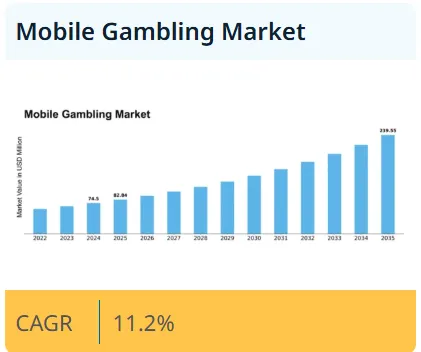
Source: Market Research Future
Prediction markets are growing fast too. Monthly trading on Kalshi and Polymarket was 810 million dollars in July 2024. This July, it hit $ 53 billion.
Why People Like Event-Based Trading
The idea is simple. You pick yes or no on something like a game or an election. You don’t need to read a company report first, so it feels easy for new people. When a big event happens, they show up in big groups. NBC said the midterm markets on Kalshi and Polymarket saw about 197 million dollars in trades. CNN called it the first prediction-market election.
- Polymarket had 840,000 monthly active wallets in February.
- Kalshi had 564 live trading markets in January 2025. By September it had 32,835.
Kalshi Went Where Users Are
Kalshi grew by teaming up with apps people already use. Robinhood launched its Prediction Markets Hub, powered by Kalshi, on March 17, 2025. Robinhood says more than 1 million customers traded 11 billion contracts in 2025. Then on January 28, Coinbase opened Kalshi-powered markets across the country. Kalshi has also teased a new product called Timeless. It will have crypto perpetual futures and is set to launch on April 27.
Use is Growing in Bigger Areas
Sports leads by a lot, but each platform has a different mix. Pew found that since July 2024, 91% of Kalshi’s volume and 90% of Polymarket’s volume came from sports, politics, and crypto.
| Category | Kalshi share | Polymarket share |
| Sports | 80% | 39% |
| Crypto | 7% | 20% |
| Politics | 4% | 32% |
People are using these markets for other things too. Talk about oil went up after the Strait of Hormuz trouble started. Polymarket had 115 active crude oil markets at that time, with more than 94.7 million dollars in total volume. Finance companies want the odds as well. ICE will be the global distributor of Polymarket data, so traders at big firms can see these odds right next to normal market data.
Liquidity and More People Trading
When more people trade, it is easier to get a fair price at a low cost. Earlier this year, open interest across prediction markets passed 1 billion dollars for the first time. In 2025, Kalshi and Polymarket together held about 97.5% of the market, so most of the action happens in those two places. Kalshi reached 100 billion dollars in lifetime volume in May. Bernstein thinks the whole sector could reach 1 trillion dollars in yearly volume by 2030.
Big Money Behind Polymarket
ICE, the owner of the NYSE, said on October 7, 2025, that it would invest 2 billion dollars in Polymarket. Polymarket’s World Cup winner market is now its most liquid sports market, with more than 3 billion dollars in total volume as of June 26. On April 21, Polymarket launched perpetual futures, so users can go long or short 24 hours a day. Its US arm is growing fast too. Polymarket US was only 4% of total volume in January. By July, it was 39%.
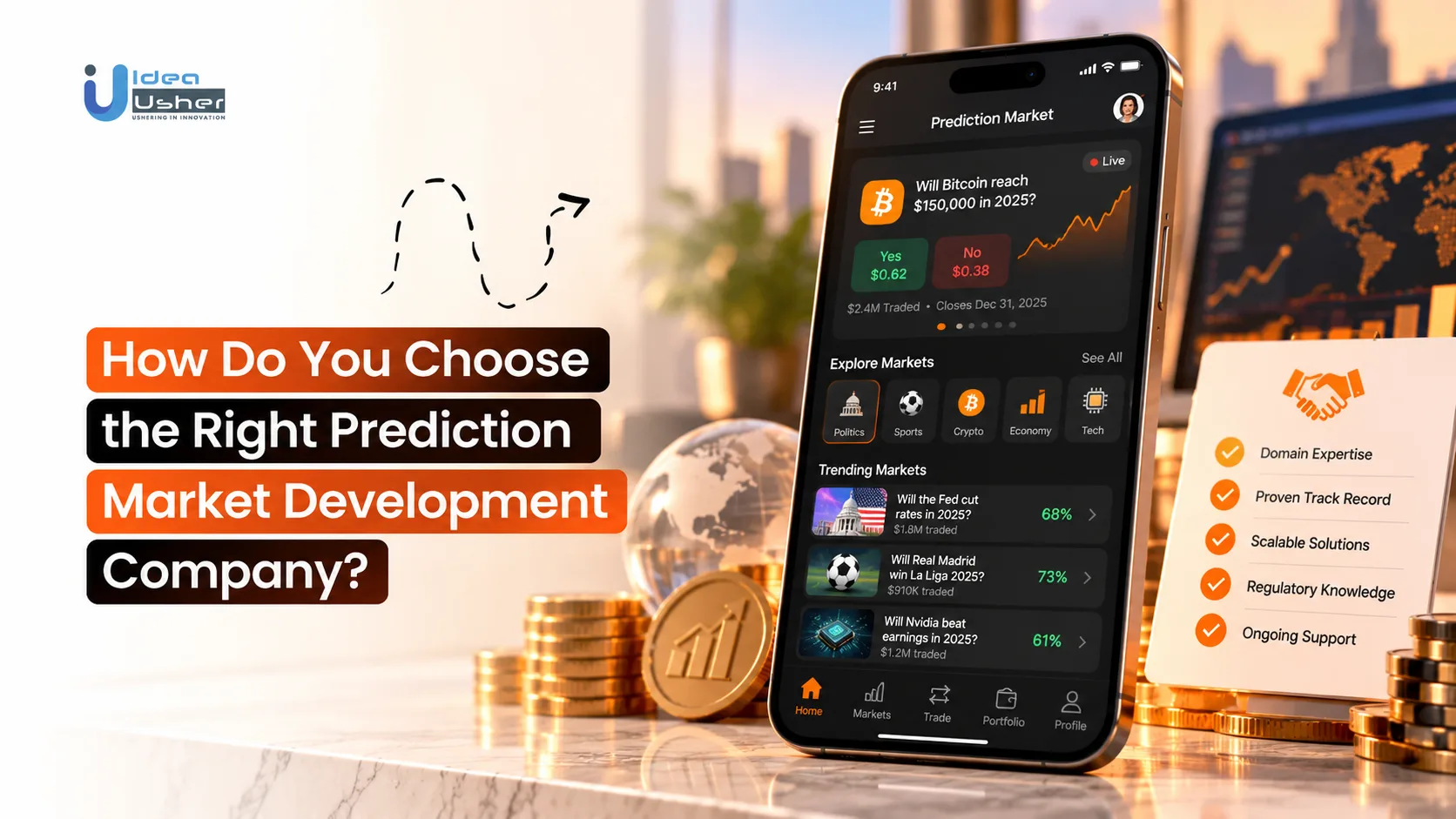
How Do You Choose the Right Prediction Market Development Company?
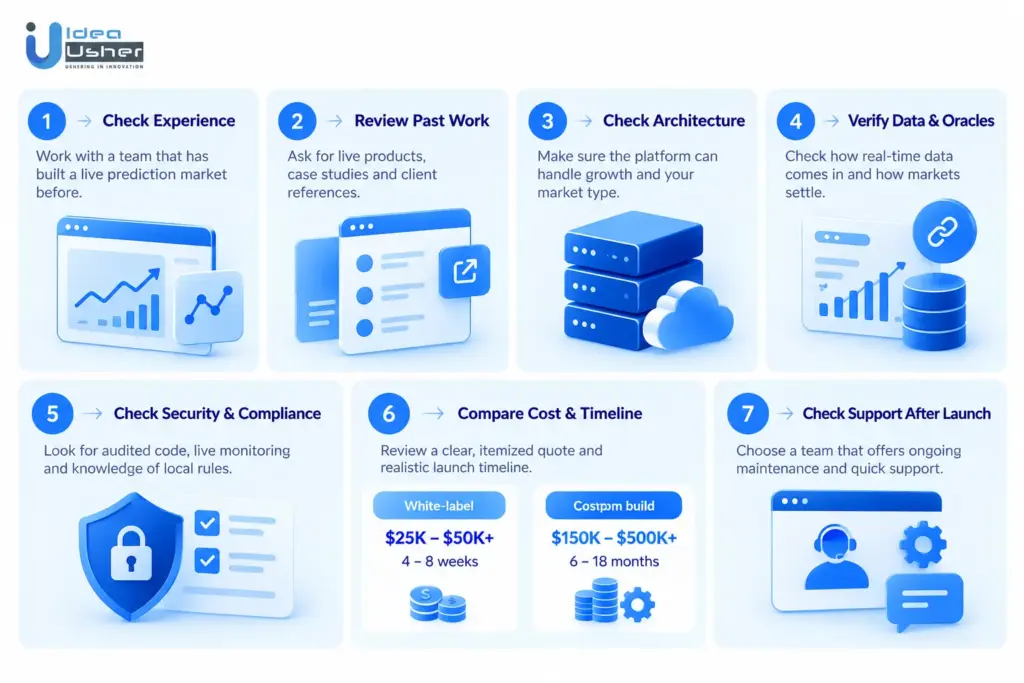
Choose a team that has built a live prediction market before and can show it to you. They should know how a market settles and how real-time data comes in. They should also understand the rules of the place where you want to launch. You will want audited code and a full plan for support after launch. A low price gives no benefit if the platform’s security is weak or if it breaks any rule. The seven checks below make the choice easy.
1. Check Prediction Market Experience
A team that built a normal trading app may still not get prediction markets. A market needs creation, pricing, settlement, and dispute handling to work as one system. Ask who on the team has built binary, scalar, or multi-outcome markets. Ask how they keep a new market busy when only a few people trade.
At Idea Usher, we talk about this before we write any code. We go over the market type and the liquidity plan, and we look at how traders will get rewarded. A team that can explain this in simple words usually knows the work.
2. Review Past Projects and Case Studies
Screenshots are easy to make, but a live product is hard to fake. Ask for links you can open and clients you can phone. Our own work includes a sports prediction exchange where users trade with each other and not against the house. Whoever you talk to should have something like that to show.
What to look for
- A live product you can test
- A late or disputed result and how the team fixed it
- Proof the platform stayed up when lots of users came for a big event
- A client who will talk to you
3. Check Architecture and Scalability
Good architecture decides how the platform feels when traffic jumps. Some teams build on blockchain settlement and order-book speed. Others use automated market makers and Layer-2 networks. Neither is always better. It depends on your users and how much liquidity you expect on day one. Ask the team to show how the system will grow and not just how it will launch.
Questions to ask
| Part | What to ask |
| Matching engine | How many orders can it take each second? |
| Pricing | Order book or market maker, and why? |
| Network | Which chain or Layer-2 does settlement happen on? |
| Load | How was it tested for big events? |
4. Check Real-Time Data Setup
Every market needs a trusted way to know who won. This is called an oracle, and it often gets too little attention. The oracle part alone is estimated to cost 15,000 to 40,000 dollars. The settlement and dispute part is estimated at 20,000 to 40,000 dollars. The risk is real too. Once, a governance attack on one oracle caused a wrong settlement in a pool worth 7 million dollars.
Some platforms are now fast. They use Chainlink Data Streams for prices with timestamps. They use Chainlink Automation to settle onchain at a fixed time. The voting system has its own problem. On one big platform, about 95 percent of the voting tokens were held by a small group of big holders. Ask the team which data source they use. Also ask what happens when two sources do not agree.
5. Check Security and Compliance
The code needs to be checked both before and after launch. Anthropic’s researchers made a benchmark of 405 smart contracts that were really exploited. It shows how many real flaws exist.Ask for an independent audit report and a bug bounty. Also ask about live monitoring. Tools like Forta and Tenderly watch the contracts for 24 hours a day. They send a warning if tokens move in an unexpected way.
Compliance
PredictIt shows why the rules matter. It ran for years under a no-action letter with a limit of 850 dollars per contract and 5,000 traders per market. Its operator later got approval to run as a full exchange. That exchange is Aristotle Exchange, and it has held exchange and clearing status since September. Underdog bought it in March. The terms are hard. A new exchange has to show it follows 23 federal core principles. It also has to keep more than 12 months of operating costs in reserve. Your development partner should know this path well.
6. Compare Cost and Timeline
Ask for the quote line by line. Oracle, settlement, and licensing should each have their own price. Licensing can add both cost and time. ProphetX is one example. It got CFTC approval to run as both an exchange and a clearing organization, and getting that status takes real work and money. We cover these parts in our own build or buy guide so you can see where the budget goes.
| Path | Cost | Time to launch |
| White-label platform | 2,000 to 10,000 dollars a month, or 25,000 to 50,000 dollars for a basic setup | 4 to 8 weeks |
| Custom build | 150,000 to 500,000 dollars or more | 6 to 18 months |
7. Check Support After Launch
Launch day is not the end of the work. The rules keep changing. The CFTC has filed cases against nine states over who will control prediction markets. One analysis says each new state case could split the market into small geofenced parts. To follow these rules, your platform may need quick changes. The oracle needs updates too, and the liquidity needs tuning. Ask the team for a written response time. Also ask who watches the system at night. After launch, we stay on for scaling work. A platform that holds real money needs regular care.
What Should a Prediction Market Vendor Demo Before You Sign?
A vendor should show one market from start to finish on a live system. That means creating the market, trading on it, settling the result, and then opening the admin panel. Near the end, ask them to break something on purpose. A team that built the product will stay calm and explain what happened. A team with only a sales deck will click around in screens that were set up ahead of time. Use the five checks below as your list.
1. Market Creation and Setup
Ask the vendor to create a new market while you watch. They should write the question and set the closing time. They should also say which source decides who won and what “yes” really means. Don’t accept vague rules. Fights over wording are what make users stop trusting a platform later. At Idea Usher, we build market logic so the smart contract is the only source of truth for settlement. This is the setup we like to show live first.
2. A Live Product Beats a Plan
Trump Media announced Truth Predict with big promises. It was meant to have contracts on elections, rates, commodities, and sports, with prices updated in real time through Crypto.com’s US exchange arm. The plan changed later. Trump Media dropped the idea of building it inside Truth Social and decided to promote Crypto.com’s existing product instead. The lesson is simple. A product that already runs is worth more than a big roadmap, so ask to see a live build.
3. Trading and Position Tracking
Ask for two test accounts that trade against each other. One buys and one sells. You should see the order book change and the price move right away. Then check that each account shows its position, cost, and profit or loss. Cancel one order halfway and check it again. Small gaps here become big complaints after launch.
What to watch for
| Step | What you should see |
| Buy order placed | Shows in the order book right away |
| Matched with a sell | Both accounts show the filled amount |
| Partial fill | The rest stays open and is easy to see |
| Order canceled | Funds go back to the balance right away |
| Price changes | Chart and position value update together |
4. Resolving Results and Paying Out
Weak systems fail at resolution. One market asked whether a head of state would wear a suit, and it saw more than 237 million dollars in trading volume. It first settled as yes. After nine days of dispute it flipped to no. Vague wording and a hard-to-follow process made a lot of traders angry. Ask the vendor to settle one market cleanly and then one with a dispute. We build payout flows where winners claim their earnings in USDC or the platform token with no manual steps.
What to look for
- The payout matches each position to the cent
- How long it takes for the result to reach the account
- The dispute time limit and who makes the final call
- A fair refund for everyone when a market is voided
5. Admin Controls and Risk Limits
The admin panel shows how much control you really have. Ask the vendor to pause a market and void a trade. Ask them to freeze an account and set a position limit. Then ask who is allowed to do each of these things. Fake volume is a real risk. A Columbia University paper, which has not been peer-reviewed yet, estimated that about 25% of the volume on one big platform could be wash trading.
Novig as an example
On 19 October, Novig extended its deal with IC360. The deal covers market watching, banned trading, national self-exclusion, and protection from athlete harassment on its 21+ exchange. A user can start a cooling-off period that stops trading on every market on the platform, not just one. Ask the vendor which of these tools they can add.
6. Audit Logs and Failure Tests
Logs prove the vendor can explain what happened. Ask for an export of every action in the demo that shows who did it, what changed, and when. Then follow one trade through its whole story. A pattern can hide in plain sight. Columbia researchers found a cluster of more than 43,000 wallets that made about 1 million dollars in volume and mostly traded at less than one cent. With good logs, a cluster like that is easy to catch. We are happy to run this walkthrough on a staging build before you sign. Then ask the vendor to fail on purpose.
Failure tests to run
| What to break | What good looks like |
| Data feed goes down | The market waits and no wrong result is set |
| Payout stops halfway | It restarts and nobody gets paid twice |
| Same order sent twice | Only one order goes through |
| Admin changes a rule after a trade | The change is blocked or fully logged |
| Server restarts | Open orders and balances stay correct |
How Much Does It Cost to Build a Prediction Market Platform?
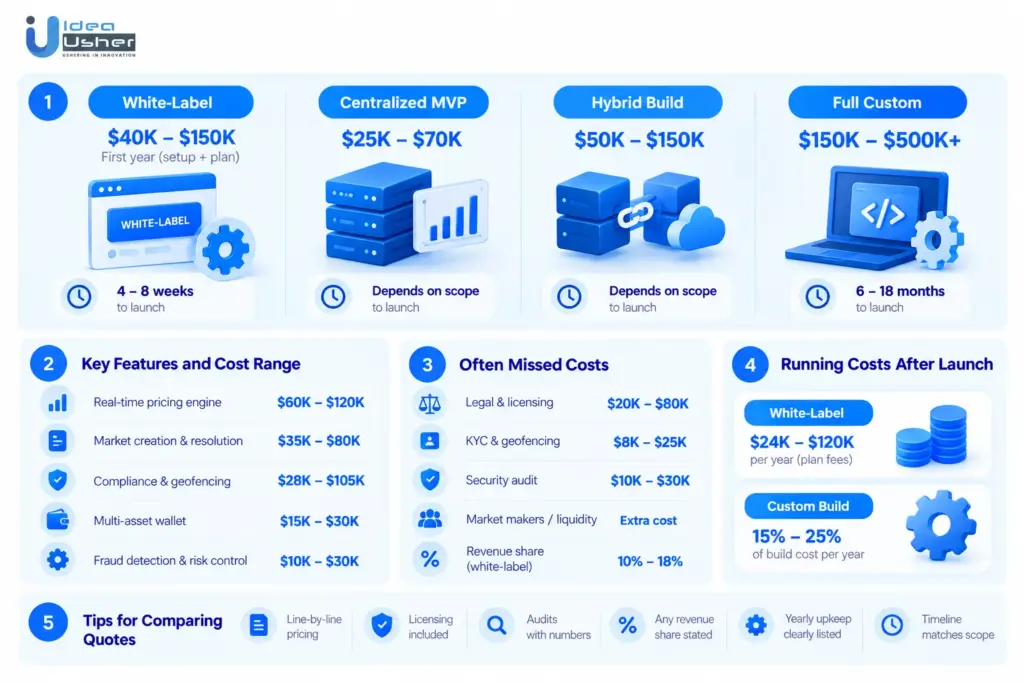
A prediction market platform costs about 40,000 to 150,000 dollars in the first year if you use white-label. A custom build usually costs 150,000 to 500,000 dollars or more. The price changes a lot depending on what you build yourself and what you rent. On top of the software, you pay for licences, liquidity and yearly upkeep. Use the ranges below to check a quote, and if a price is far below a range, ask what was left out.
1. MVP, White-Label, and Custom Costs
An MVP is a small first version with just a few markets. It costs less than a full exchange, but the price goes up as you pick more design options. These numbers are estimates from Idea Usher’s own cost guide and the sources it quotes. A real quote will be different. We usually start clients with the smallest version that can test their idea. Everything else can be added later.
| Path | What you pay | Time to first trade |
| White-label | 2,000 to 10,000 dollars a month, plus 15,000 to 60,000 dollars setup | 4 to 8 weeks |
| Centralized MVP | 25,000 to 70,000 dollars | Depends on scope |
| Hybrid build | 50,000 to 150,000 dollars | Depends on scope |
| Full custom | 150,000 to 500,000 dollars or more | 6 to 18 months |
2. Features That Raise the Cost
The parts that handle money and trust cost the most. A mistake there is expensive. Features that only look nice cost much less. Pick what your idea needs and add the rest later. These are the core features from the same guide:
- Real-time pricing engine: 60,000 to 120,000 dollars
- Market creation and resolution: 35,000 to 80,000 dollars
- Compliance automation and geofencing: 28,000 to 105,000 dollars
- Multi-asset wallet: 15,000 to 30,000 dollars
- Fraud detection and risk control: 10,000 to 30,000 dollars
ForecastEx as an example
Interactive Brokers runs ForecastEx through its own company. That company has CFTC approval to run a contract market and a clearinghouse. Trades on ForecastEx have no commission. Clients trade contracts in IBKR Desktop with ForecastTrader. They can also use tools like ScaleTrader and Accumulate/Distribute. A beta even added ForecastEx contracts on select CME futures. Each new link like this takes more work to build and test, so add-ons can make a budget grow fast.
3. What Quotes Often Leave Out
Many quotes only show the code. The big bills sit outside the code. Legal review can add 20,000 to 80,000 dollars. Identity checks and geofencing add 8,000 to 25,000 dollars. A security audit adds 10,000 to 30,000 dollars. Market makers cost extra too. A white-label deal may also take 10% to 18% of your net gaming revenue. Leaving a vendor later can take 3 to 6 months and cost 50,000 to 100,000 dollars in consulting and legal fees.
Gemini Waited Years for Licensing
Gemini shows that a license can move slower than software. Its affiliate, Gemini Titan, first applied for an exchange license on March 10, 2020, and got approval in December. Its CEO called it a five-year process. Things went fast after that. Gemini Predictions launched one week after the license came in. US customers trade with USD from their Gemini account. Gemini also says it can work on crypto futures, options, and perpetual contracts. Ask every vendor who will handle the license and how long it will take.
4. Running Costs After Launch
The bills keep coming after launch. A custom platform needs upkeep, a new audit after each fix, and money for liquidity. White-label upkeep is the plan fee you already pay, and the provider handles security updates. The gap between the two shrinks each year, because a plan fee never ends. A 200,000 dollar custom build costs 30,000 to 50,000 dollars a year even with no new features.
| Cost | White-label | Custom |
| First-year total | 40,000 to 150,000 dollars | 300,000 to 600,000 dollars or more |
| Yearly upkeep | 24,000 to 120,000 dollars as plan fees | 15 to 25 percent of the build cost |
| Re-audit after a fix | Handled by the provider | 5,000 to 15,000 dollars each time |
5. Comparing Vendor Quotes Fairly
Make sure every quote covers the same things before you compare them. A lower price that skips licensing can fool you into thinking it is cheaper. Vendors have their own bias too. A vendor selling custom builds may say hidden costs like revenue share and lock-in can double your total cost within 24 months. A vendor selling white-label may show only the low end of the first-year range. Both could be right about their own side.
At Idea Usher, we write quotes line by line and help clients decide what to build first. Check that your quotes do these things:
- Each part has its own price, such as the matching engine, oracle, and settlement.
- Licensing and legal review are listed in the quote.
- Audits and re-audits are written with numbers.
- Any revenue share is written as a percentage.
- Yearly upkeep after launch is stated.
- The timeline matches the scope.
Can the Company Handle Regulatory and Compliance Requirements?
Yes, but only if the company can show real compliance work and not just talk. A good vendor knows which license your target region needs. They build identity checks and location rules inside the product. They also keep records a regulator can read. They say clearly what the code can do and what your lawyer has to approve. Ask for proof of each of these before you sign.
1. Licensing Map by Region
Rules change from place to place, so a vendor should start with a map. In the US, a platform that runs its own exchange has to meet 23 core principles to get CFTC approval. The review follows a legal process of 180 days. Then come the states. The CFTC has sued nine states that say prediction markets fall under their gambling powers. Outside the US the picture is different again. Tell the vendor where you want to launch and ask for a clear list for each place.
| Region | What can trip you up |
| US federal | Exchange approval under 23 core principles, or a partner who already has it |
| US state | Nine state cases over who controls the markets |
| France | Fines up to 100,000 euros (114,000 dollars) for advertising a site without approval |
| Brazil | An effort to shut down 27 platforms |
2. Setting Up KYC, AML, and Geofencing
KYC checks who the user is. AML watches what the user does with the money. Geofencing checks where the user is. All three should be inside the product from the start and not added later. KYC and geofencing work is estimated at 8,000 to 25,000 dollars. The money rules matter too. FinCEN tells money services businesses to report cash transactions over 10,000 dollars and suspicious ones of 5,000 dollars or more. Idea Usher adds identity and location checks while we build the platform. We also set the rules for which actions get flagged for a human to review.
Controls to ask for
- An identity check at sign-up that stops users until they pass
- Sanctions screening for new and existing users
- Flags for odd deposits and withdrawals, with a review queue
- A location check at every login and trade, not only sign-up
- An easy way to update the blocked list when rules change
3. Limiting Markets by Eligibility and Location
One menu should not show up everywhere. Age, state, and market type decide who can trade what. The product needs rules that turn markets on or off for each user. A weak setup shows everyone everything and hopes for the best. A strong setup checks each person first.
FanDuel Predicts as an example
FanDuel Predicts launched with CME Group on December 22. It began in Alabama, Alaska, South Carolina, North Dakota, and South Dakota. Sports contracts only show up in states where online sports betting is not legal yet, and never on tribal land. The app is now in all 50 states. It offers sports contracts in 18 states and non-sports markets in 32 states.
If a state legalizes betting, sports contracts there stop. Users must be 18 or older, and they can set deposit limits, get deposit alerts, or block themselves. Your vendor should be able to build switches like these.
4. Audit Trails and Regulatory Reports
Regulators want to see what happened and who did it. An exchange has to keep an audit trail, run surveillance, and enforce its rules. Records are usually kept for five years, which means logs cannot be changed later. Idea Usher says it uses WORM-compliant storage. It records order status and trade events with microsecond timestamps under CFTC Rules 1.31 and 1.35. Ask the vendor to show you a report from a test run.
| Record | Why it matters |
| Orders and cancels | Shows how prices moved |
| Account and limit changes | Shows who changed what |
| Admin actions | Proves nothing was edited in secret |
| Settlement and payouts | Backs up every result |
| Alerts and reviews | Shows the team acted on warnings |
5. Keep Tech and Legal Approval Apart
Code can follow rules, but it cannot give you a license. A vendor can build identity checks, logs, and surveillance tools. Only regulators can approve an exchange, and only your lawyer can say if a market is allowed. Be careful if a vendor says the platform is compliant and gives no details. We build the controls and the records, and your counsel signs off on the rules and filings. When both sides know their part, nothing gets missed.
DraftKings as an example
DraftKings shows how this can work. Its product, DraftKings Predictions, is registered with the CFTC as an introducing broker, and it is a member of the National Futures Association. On October 21 it bought Railbird, a licensed exchange. Railbird got its license in July after an approval process that began in 2022. DraftKings also says the product may connect to more than one exchange. Each piece has its own rules and its own approval. Ask your vendor which pieces they handle and which ones need a regulator.
Federal vs. State Rules Matter to Pick a Prediction Market Development Partner
Pick a partner who treats federal and state rules as two separate layers. Having a federal license does not stop a state from stepping in. Sports and political contracts also face different pressure. A good partner builds location rules and market switches inside the product. They also have a quick way to respond when a court rules. Ask them to show you how each of these works before you sign.
1. The Federal and State Map
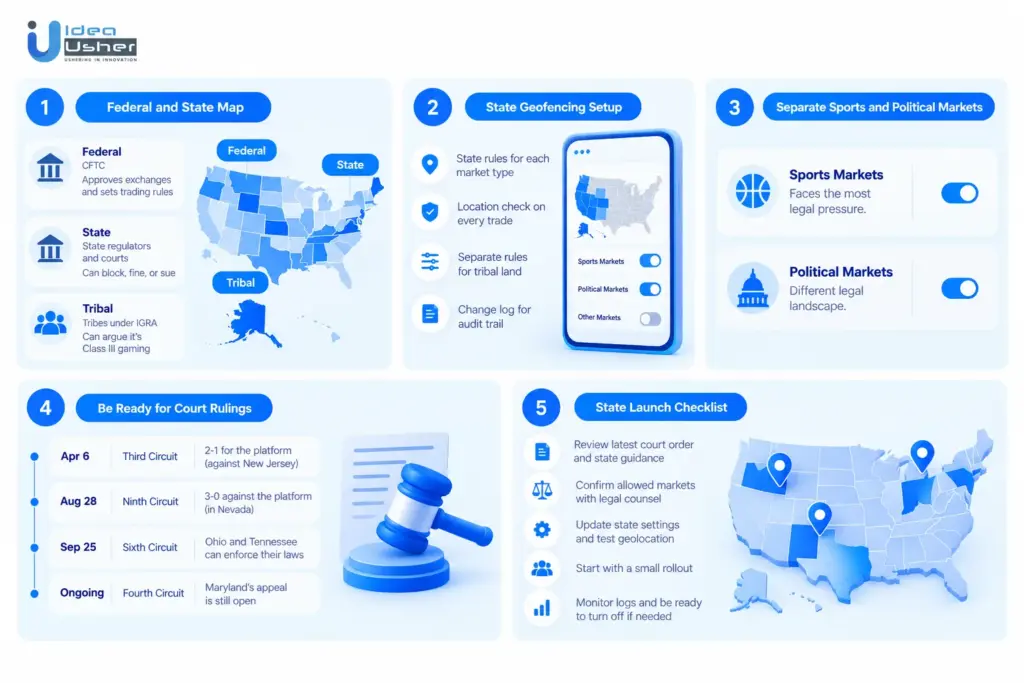
The CFTC says event contracts on its licensed exchanges fall under federal law. Many states say sports contracts are gambling and need a state license. The CFTC has sued nine states to defend its view. A vendor should be able to explain both sides and not just pick one. They should also show you where your product could get hit from each direction.
| Layer | Who decides | What it can do to you |
| Federal | CFTC | Can approve an exchange and set trading rules |
| State | Gaming regulator and courts | Can send a cease-and-desist letter, sue, or order a block |
| Tribal | Tribes under IGRA | Can argue that sports contracts on tribal land are Class III gaming |
2. Setting Up State Geofencing
Your platform needs to know where each user is and what they can trade there. Court orders limit sports contracts in Massachusetts, Michigan, Nevada, and Washington. Ohio, Tennessee, and Utah are at risk, and at least ten more states are in dispute. On September 1, a Michigan state court ordered one big exchange to geofence sports contracts. A good setup lets your team change these rules as a setting. At Idea Usher, we build the state map as an admin control, so a new order does not mean a new build.
What to ask the vendor for
- A list of states with one switch for each market type
- A location check on every trade, not only at sign-up
- Separate rules for tribal land
- A log that shows when a rule changed and who changed it
3. Splitting Sports and Political Markets
Sports contracts face the most legal pressure. So far, the appeals rulings have not covered non-sports event contracts. A state can limit sports and still leave politics and economics open. Political markets are not risk-free either. After the Nevada ruling, a court sent the election contract question back to the district court. Treat each category as its own product with its own switch. That way one ruling does not shut down the rest.
PrizePicks as an example
PrizePicks shows how this looks in an app. It sells Team Picks for sports and Culture Picks for other events, and each one has its own state list. Team Picks is in 30 states and D.C. Culture Picks is in 48 states. At launch it was in 38 states, and only 15 of them had sports contracts. Over time the sports list doubled while the other one stayed wide. Ask your vendor if they can build two lists like this.
4. Keeping Up With Court Rulings
The courts do not agree with each other, so you cannot set your trading rules once and forget them. The platform should let you change a market list or a state list within hours. Here is where the main rulings stand:
| Date | Court | Result |
| April 6 | Third Circuit | 2-1 for the platform, against New Jersey |
| August 28 | Ninth Circuit | 3-0 against the platform in Nevada |
| September 25 | Sixth Circuit | Said Ohio and Tennessee can enforce their sports betting laws |
| Ongoing | Fourth Circuit | Maryland’s appeal is still open |
New Jersey filed a petition with the Supreme Court on September 2. The final answer could redraw the map again. Ask your vendor how fast they can pause a market in one state without touching the others.
5. Checking Compliance Before Entering a State
Every new state needs a check before it goes live. A short list does the job:
- Read the newest court order and the state’s letter.
- Ask your lawyer which markets are allowed there.
- Update the state switch and test the location check.
- Launch with a small group first.
- Watch the logs and be ready to turn it back off.
Fanatics Markets as an example
Fanatics Markets has rolled out in steps. It launched in 24 states and started with just 10 of them. The rest came a few days later. The first day included Alaska, Delaware, and eight more states, and California and Texas came on day three. Its prices come from an outside exchange partner, and customers use a shared wallet inside the Fanatics ecosystem. A step-by-step plan lets the team fix problems before the biggest states open. We help clients plan rollouts like this, with one owner and a clear test for each state.
What Do CFTC Rules Mean for Your Prediction Market Architecture?
CFTC rules decide how much of the exchange you have to build. If you list contracts on your own exchange, you need DCM-level controls. These include contract checks, trade surveillance, audit records, and position limits. If you plug into a partner that already has a license, you build less. You still have to follow the partner’s rules. Pick your path first, because it shapes every other technical choice.
1. Decide If You Need Registration
The first question is what role your company will play. Running an exchange needs a license. If you send users to someone else’s exchange, you may only need a broker setup. A DCM has to meet 23 core principles and go through a 180-day review. A full exchange also needs an order book, a matching engine, contract resolution logic, surveillance, an audit trail, and disaster recovery. At Idea Usher, we start by asking which role you want. Your answer sets the size of the build.
| Role | What it does | What it adds to the build |
| Exchange (DCM) | Lists contracts and matches trades | Matching engine, surveillance, and rule enforcement |
| Clearinghouse (DCO) | Holds collateral and settles trades | Collateral and settlement systems |
| Broker or partner | Brings users to the exchange | Accounts, KYC, and routing to the exchange |
Kraken as an example
Kraken found a way around the long wait. It bought Small Exchange, a CFTC-licensed exchange, from IG Group for 100 million dollars. The goal was to build a US derivatives suite on a licensed base. For architecture, the lesson is easy. When you buy a license, you also take on its rules. You get the right to list contracts and the job of keeping control over them.
2. Building Contract Eligibility Checks
Every contract should pass a check before it goes live. Federal Rule 40.11 lets the CFTC block event contracts tied to terrorism, assassination, war, gaming, or illegal acts. The rule also gives the CFTC a 90-day review process for contracts it wants to look at more closely. A new proposal from June 10 adds one more test. It asks whether the market can run the contract with the surveillance and compliance setup it already has. Comments closed on July 27. This check should be a built-in step in your system.
What a good listing flow asks
- Which category the contract belongs to
- Whether it ties to any banned activity
- Who decides the result, and whether traders can change it
- Whether our surveillance can watch this market
- Whether a person approved it and the approval is saved in the log
3. Adding Trade Surveillance and Alerts
Surveillance should be part of the system from day one. Prediction markets don’t fit in one neat box. A sports contract can have many people who might affect the result. Some platforms add outside tools. One exchange added Solidus Labs surveillance to more than 4,000 markets. Sports data firms offer tools too. Sportradar has an AI system that spots suspicious activity in real time, plus a network where operators share threat information.
The focus is moving from catching bad trades to stopping them. Some platforms check users against identity data and encrypted lists of banned people before a trade happens. We plan the data feeds for these tools while we design the platform. Ask your vendor to show you these alerts:
- Wash trading and self-trading across linked accounts
- Odd price jumps near the end of a market
- Trades by people on a banned list
- A sudden jump in one account’s position
4. Keeping Auditable Trading Records
Regulators want records that cannot be changed and are easy to find. An exchange has to keep an audit trail, run surveillance, and enforce its rules. Filings call for records to be kept for five years. We store order status with exact timestamps, so a team can replay any trade later. Settlement needs the same care, since that is when money moves from one place to another.
Bitnomial as an example
Bitnomial has an exchange, a clearinghouse, and a broker. Its clearinghouse got CFTC approval to clear fully collateralized swaps, which makes prediction markets possible. It also said it will offer clearing to partner prediction markets. Fully collateralized means the money for winners is already held in advance. That design makes settlement records easier to trust. Ask your vendor where the collateral sits and who can see its history.
5. Position Limits and Risk Controls
Limits stop one trader from pushing a market too far. The CFTC is still working out how this should work. It has asked whether position limits or accountability levels should apply, and how to apply the same limits to similar event contracts. It also asked whether event contracts should require margin. The rules could change, so limits should be settings and not hard-coded values. One safeguard is already built in. A contract trades between 0.01 and 0.99 dollars and settles at 1 dollar if it is right and 0 if it is wrong. A trader can never lose more than the price they paid. Ask your vendor to show you these controls:
| Control | What it does |
| Per-user position cap | Stops one account from owning too much of a market |
| Linked-account grouping | Counts related accounts together |
| Market-level exposure view | Shows the total risk on the platform |
| Emergency pause | Stops trading on one market in a few seconds |
Can the Prediction Market Development Company Solve Liquidity Problem?
A good development company can build the tools that create liquidity, like an AMM, an order book, and links to market makers. But it cannot make people trade. Without liquidity, users leave a market fast, so ask about all three before you sign. The best teams also help you plan where your first traders and market makers will come from.
1. AMM vs Order Book
An AMM uses a pricing formula, so you can always buy or sell, even in a thin market. An order book stays empty until someone posts the first quote. An AMM costs the operator a limited subsidy. A popular AMM method called LMSR caps the most a market maker can lose. Polymarket is a good example.
It started with an LMSR AMM and later moved to an order book, so market makers could add liquidity in the busiest price ranges. Many platforms now use a hybrid. An AMM quotes the market at the start, and big markets move to a pure order book once there is enough depth.
| Topic | AMM | Order book |
| Liquidity at the start | There is always a price | Empty until the first quote |
| Your cost | A limited subsidy | A deal with market makers |
| Spread | Wider | Tighter once makers join |
| Best for | New or thin markets | Busy markets |
2. Building Liquidity Before Launch
Every new market needs seeding, since each one starts empty. This is called the cold-start problem. The usual fix is to bring in professional market makers early. A development company should plan this before the code is finished. Who seeds which market, and with how much money, is a design question. At Idea Usher we raise this in the first design talk, so the AMM or order book choice matches the seeding plan.
Novig as an example
Before launch, Novig ran a two-week trading tournament with 200 beta users. Peers trade against each other on its commission-free order book. It earns money by taking fees from institutional market makers. Its 75 million dollar Series B goes toward more markets and deeper liquidity. Novig then launched nationwide on August 4 as a federally regulated sports prediction market. It has raised 105 million dollars across two rounds.
3. Checking Market-Making Tools
Ask any development company to show these tools working, not just describe them:
- Can professional market makers connect through an API?
- Do small makers earn rewards? On Polymarket, hundreds of market makers earn rewards every day.
- Can the AMM be tuned so spreads stay tradable and the subsidy stays affordable?
- If the money behind the AMM runs low, can the platform cut depth or cap order size?
Market makers earn small profits from the spread, so slow or risky tools make them leave. Integration work matters as much as the matching engine. We treat market-maker links as a core part of the first design.
4. Fixing Thin Books and Wide Spreads
A thin book can fool people. If one person offers to sell at 60 cents and nobody bids, the price is just that one offer. Makers widen the spread in uncertain markets. Long-tail markets are often thin, because few people know the topic well enough to quote it. With makers around, a healthy order book can keep the spread at 1 to 2 cents on a 0 to 100 scale.
| Problem | Fix |
| One lonely offer sets the price | Add an AMM as a backup quote |
| Wide spreads in unsure markets | Pay rewards for tight quotes |
| No makers on long-tail topics | Seed only the big markets |
| Sudden costly trades | Cap the order size |
5. Handling Liquidity Across Many Markets
More markets mean more places to go thin. One plan is to give a dedicated market maker to each headline market and leave the long tail thin, or seed it when needed. A better plan may be to share one pool across all markets. We explore this idea with clients who want to run many markets at once.
Hyperliquid as an example
Hyperliquid launched its HIP-4 outcome markets on May 2, on the same order book that already handles perpetuals. Each new market type deepens one pool and does not split it. Market makers can reuse their old order system and data feeds. Pooling YES and NO liquidity together cuts the thin-book problem on the NO side by about half. An upgrade is coming that lets anyone stake 500,000 HYPE to deploy a market, and deployers can take up to 50% of the fees.
Technical Capabilities to Look For in a Prediction Market Development Company
Look for a team that can show a working oracle integration, audited smart contracts, fast data feeds, an engine that holds up on big days, safe wallets, a good API, and tools that catch failed trades. Ask for proof of each one and not just promises. A company that can explain all seven has probably built this before. Use the parts below as a checklist when you talk to a vendor.
1. Oracle Integration for Reliable Results
The oracle decides who won, so a weak oracle can break the whole platform. Polymarket uses the UMA Optimistic Oracle. A proposer puts up a bond of about 750 dollars, and anyone can dispute the answer within 2 hours. With no dispute, a market usually resolves after 2 hours. With a dispute, it can take 4 to 6 days.
Polymarket doesn’t rely on UMA alone. Chainlink Data Streams automates crypto price markets, and Pyth gives fast data for traditional assets. At Idea Usher we like to pair a fast data oracle for number-based markets with a dispute-based oracle for judgment-based ones, so each market gets the right path.
| Oracle | Best for | Speed |
| UMA | Events that need a human decision | A few hours |
| Chainlink Data Streams | Numbers you can verify onchain | A few seconds |
| Pyth | Fast financial prices | Low delay |
Myriad as an example
Myriad launched Automated Markets, built around auto-resolution, short time limits, and a steady flow of new markets. The update launched on BNB Chain, after earlier launches on Abstract and Linea. Myriad shows markets next to articles and tweets and sets prices with an AMM. Ask any vendor if they can build auto-resolved markets like this.
2. Smart Contracts for Settlement and Payout
Smart contracts hold the money, so the settlement rules must be simple and well tested. On Polymarket, each YES and NO token pair is backed by exactly 1 dollar of collateral. When a market resolves, winners redeem. Orders match off-chain and settle on-chain, and Polymarket does not hold user funds itself. ChainSecurity audited its exchange contract, and two more firms, Quantstamp and Cantina, audited the new version. Ask your vendor these questions:
- Who audited the contract, and can I read the report?
- Is every share backed 1 to 1 by locked collateral?
- If your servers go down, can users still pull their winnings straight from the contract?
3. Real-Time Data and Price Updates
Late odds cost users money and trust. Networks like Chainlink and Pyth blend data from many independent publishers and bring asset prices onchain. Your platform also has to push those updates to the screen fast. A good setup streams price changes and order book updates to users so nobody has to refresh the page. Ask your vendor what happens if a feed stops or sends a strange number.
Limitless as an example
Limitless runs on Base and uses an order book with Pyth oracles. It offers hourly and daily markets on crypto and stock prices and plans to add 15-minute, 10-minute, and 1-minute markets. Its API streams price changes and order book updates live, and hourly markets resolve in 30 or 60 minutes. Markets this short only work when the data feed is fast and resolution is automatic.
4. Trading Engine Performance at Peak
Big events break weak engines. On Super Bowl Sunday, traffic delayed Kalshi deposits, and its co-founder said the spike was far bigger than their best guess. Kalshi also set a record that day, with more than 1 billion dollars in daily trading volume. We think load tests should aim at the biggest day you can imagine, and not at an average day.
| Platform | What went wrong | The lesson |
| Kalshi on Super Bowl day | Traffic delayed deposits | Test payments at peak |
| Kalshi on a college football Saturday | App and site failed while API trading kept running | Keep the layers separate |
| Polymarket after a restart | A planned 5-minute restart ran over an hour | Rehearse every deploy |
| Polymarket on Polygon | Election trading put pressure on the chain | Plan node capacity |
5. Wallet Security and Transaction Integrity
Wallets hold the most risk, since user money sits there. Polymarket trades through Gnosis Safe wallets. Users sign orders with embedded wallets from providers like Privy or Turnkey. A relayer pays the gas fee, so users don’t need extra tokens. The Safe address comes from the user’s key the same way every time, so it is easy to check. Polymarket’s own demo code also warns that builder credentials in its example are exposed in the browser. Keep secrets like these on the server, and ask the vendor how they handle keys and signing.
6. APIs for Data and Integration
A good API lets partners and traders connect without breaking anything. Look for these:
- Live data: WebSocket feeds for price and order book changes.
- Signed orders: orders go in as signed messages, so nobody can fake a trade.
- Builder tools: credentials and a relayer, so partner apps can offer gasless trading.
An API also needs guardrails. When Kalshi’s app failed on that Saturday, API trading kept running. Kalshi later refunded users whose resting orders were filled by API traders while the app was down. A stable API is good, but it has to follow the same safety rules as the app.
7. Tools to Catch Failed Trades
You should hear about a failed trade before your user does. Polymarket’s relayer reports a clear status for each transaction, including Failed and Invalid, so the system can send alerts and retry. After the Super Bowl delay, Kalshi refunded processing fees on affected deposits and gave users credits. We think alert and refund rules belong in the first plan and not in a fix after launch.
| What to watch | What to do |
| Failed onchain transaction | Alert the team and retry |
| Delayed deposit | Tell the user and refund the fee |
| Orders filled during downtime | Follow a clear refund rule |
| Oracle dispute | Alert operations right away |
Red Flags to Watch for When Evaluating Prediction Market Vendors
The biggest red flag is any promise that can’t be proven. Examples are guaranteed liquidity, vague prices, loud compliance claims, no audits, and a fast launch date with no plan. A good vendor shows a live demo, gives clear numbers, and lets you check the code and contracts. If a vendor dodges these questions, you already have your answer. Use the seven flags below to weed out a bad match before you spend money.
1. Guaranteed Liquidity With No Plan
No vendor can promise liquidity. The platform gives you tools, but traders still have to show up. A custom build starts with no users and no order flow, so it needs its own market-making effort. Every new market needs seeding too, since each design starts empty. Polymarket pays hundreds of market makers every day, and many long-tail markets are still thin, because few people know a topic well enough to quote it. A real plan names these things:
- Which markets get a dedicated market maker
- Whether an AMM gives backup quotes when the book is empty
- Who pays the subsidy and how much
- What rewards small makers can earn
2. No Live Demo of Resolution
Ask to watch one market go from start to finish. Polymarket learned this on a 7 million dollar market that asked if Ukraine would agree to a minerals deal. One holder of UMA tokens used three accounts with 5 million tokens, about 25% of the votes, and had already bet yes. Polymarket said this was not a market failure and refused to refund anyone.
Vague rules cause trouble too. On a Kalshi Super Bowl halftime market, people argued over whether a guest’s appearance counted as a performance. Kalshi settled at the last price before trading stopped. No holders got 0.74 dollars and Yes holders got 0.26 dollars.
What the demo should show
| Demo step | What to look for |
| Proposal | A bond is put up (about 750 dollars on Polymarket) |
| Challenge window | Anyone can dispute within 2 hours |
| Dispute path | A vote that can take 4 to 6 days |
| Vague rules | A clear written fallback |
3. Vague Pricing and Hidden Fees
A good quote lists every fee. We estimated these numbers from public price lists. If something is missing from a monthly price, that is a red flag. Ask what changes when your volume grows and what was left out. At Idea Usher we think setup, upkeep, and audits should each have their own line, so nothing surprises you six months later.
| Cost | Our estimate |
| Setup and configuration | 15,000 to 60,000 dollars, one time |
| SaaS plan | 2,000 to 10,000 dollars a month |
| Self-hosted license | 15,000 to 40,000 dollars, plus 300 to 800 dollars a month |
| Custom build upkeep | 15 to 25 percent of the build cost a year |
| Re-audit after a fix | 5,000 to 15,000 dollars each time |
| Compliance review | 20,000 to 80,000 dollars |
4. Compliance Claims With No Proof
The word “compliant” is not a license. The CFTC fined Polymarket 1.4 million dollars after finding that its event contracts were swaps, which only a registered exchange can offer. It also had to shut down the markets that broke the rules. Legal and filing fees alone for DCM registration run 20,000 to 80,000 dollars, and the review time is never certain.
Federal approval does not end the state fights either. Kalshi has had to defend cases in Nevada and Maryland. Ask the vendor whose license covers which state.
Fanatics Markets as an example
Fanatics Markets launched with Crypto.com supplying prices and the market engine. Trades run through Crypto.com Derivatives North America, a CFTC-registered exchange and clearinghouse. In July, Fanatics also bought an introducing broker called Paragon Global Markets.
It started in 10 states, added 14 more within days, and stayed out of the states with active cases about prediction markets. Users must be 21 or older. Each step had a named license behind it, and that is what a good answer sounds like.
5. No Independent Smart Contract Audit
Ask who audited the contract and ask to read the report. ChainSecurity audited Polymarket’s exchange contract, and two more firms, Quantstamp and Cantina, audited the new V2 version. We estimate an independent audit costs 10,000 to 30,000 dollars, and each re-audit costs 5,000 to 15,000 dollars. That is small next to the cost of bad settlement, which can go well over your whole build budget. Watch for these signs:
- The audit is always “in progress”
- There is no report you can read
- The audit covers an old version and not the live one
- The vendor audited its own code
- Ownership of the source code and IP is vague
6. Unclear Code and IP Ownership
Deals fall apart quietly over ownership. Polymarket built on Gnosis’s open Conditional Token Framework and published its contract addresses and audit reports so anyone can check. A vendor doesn’t have to be that open, but your contract should say who owns what. At Idea Usher, we think the contract should say in plain words who owns the code and the data, and what happens if you leave.
| Option | What you get | Our estimate |
| SaaS | You rent the platform | 2,000 to 10,000 dollars a month |
| Self-hosted license | You run it on your own server | 15,000 to 40,000 dollars, plus 300 to 800 dollars a month |
| Custom build | You own the code | 150,000 to 360,000 dollars or more |
7. Unrealistic Launch and Scale Promises
A white-label platform can go live in 4 to 8 weeks, and a custom build takes 6 to 18 months. The compliance review alone can take 8 to 24 weeks. Be careful with any date that has no audit and no license behind it. Ask for proof of scale too. Kalshi said its Super Bowl traffic was far bigger than its best guess, and deposits ran late.
Polymarket’s planned 5-minute restart ran for over an hour. Ask for load test results. We like to split a timeline into build, audit, and license so you can see which part can really be sped up.
PrizePicks as an example
PrizePicks registered with the National Futures Association as a Futures Commission Merchant and then partnered with Kalshi and Polymarket. Polymarket’s US launch ran late, so Kalshi’s deal let PrizePicks go live right away. It started in 38 states, with sports contracts in only 15. It later reached 48 states, with sports contracts in 30. The quick start came from a partner that already had a license, and nobody built it in a rush.
Questions to Ask Before You Hire a Prediction Market Development Company
Ask seven questions: what they have built, how they handle disputes, which trading and liquidity models they support, how they deal with regulation, what the quote covers, who owns the code and data, and what help you get after launch. Ask for proof with every answer such as a live link or a demo or a contract clause. A company that answers clearly is a good sign and one that dodges is a warning. Print this list and take it to every call.
1. Which Platforms Have You Built?
Ask for live links and not only screenshots. A real portfolio lets you open the product and try a trade. Ask which parts the company built itself and which parts came from partners like an oracle or an exchange. A custom build usually takes 6 to 18 months and a team of 5 to 14 engineers so a company that claims many finished platforms in a short time should explain how. At Idea Usher we are happy to walk clients through the parts we built and the parts we plugged in because that split decides the cost and the risk.
- A live product you can use
- One resolved market you can inspect
- Audit reports for the contracts
- A past client you can call
2. How Do You Handle Disputes?
A good answer names who proposes the result, how long others can challenge it, and who decides when there is a fight. On Polymarket a proposer posts a bond of about $750, and anyone can challenge within 2 hours. A fight can take 4 to 6 days and ends in a vote by token holders. That vote failed in a $7 million market when one holder used 5 million tokens to force an early yes. Rules matter too.
Kalshi once settled a market at the last price before trading paused and paid $0.74 to No holders and $0.26 to Yes holders. Ask what your platform will do when the rules are unclear.
3. Which Trading and Liquidity Models?
Ask which models the company can build and why it would pick one for you. Polymarket started with an AMM and later moved to an order book so market makers could place liquidity in the busiest price ranges. Many platforms now start with AMM quotes and switch their biggest markets to an order book as depth grows.
| Model | How it works | Ask the vendor |
| AMM | A formula always quotes a price | Who pays the subsidy? |
| Order book | Buyers and sellers post offers | Who are the market makers? |
| Hybrid | AMM first, then an order book | When does the switch happen? |
4. How Do You Address Regulatory Requirements?
A good answer names the license and who holds it. A DCM registration costs $20,000 to $80,000 in legal and filing fees alone and the review time is not guaranteed. Buying a license is another route. Polymarket paid $112 million for the exchange QCEX. Also ask how the company handles state rules and geoblocking.
Kraken Bought a DCM
Kraken bought Small Exchange from IG Group for $100 million. The price was $32.5 million in cash and $67.5 million in Kraken parent company stock. Small Exchange is licensed by the CFTC as a designated contract market. Kraken said the deal lays the foundation for a fully US-native derivatives suite and confirmed it was considering a regulated prediction market. IG keeps its partnership and will still distribute products through Small Exchange.
5. What Does Your Quote Include?
A clear quote lists every part. We estimate the usual items like this based on public price lists.
| Item | Our estimate |
| Core custom build | $150,000 to $360,000 or more |
| Security audits | $10,000 to $30,000 |
| Compliance review | $20,000 to $80,000 |
| White-label setup | $15,000 to $60,000 |
| White-label plan | $2,000 to $10,000 per month |
| Yearly upkeep on a custom build | 15 to 25 percent of build cost |
Also ask what is not in the price. A custom build starts with no users and no order flow so liquidity is a separate budget. Licensing and re-audits are separate too. At Idea Usher, we try to show these on their own lines so nothing is a surprise later.
6. Who Owns the Code and Data?
Ownership should be in the contract and not in a sales call. Some parts of a platform are open. Polymarket for example builds on the open Conditional Token Framework from Gnosis. A self-hosted license at $15,000 to $40,000 plus $300 to $800 a month gives you more control than a SaaS plan. Ask to put these in writing:
- Who owns the code you paid for
- Who owns the user and trade data
- Whether you can host it somewhere else
- What happens to the platform if you stop paying
- Which open-source parts are used and under what license
7. What Support Comes After Launch?
Launch day is the start. A custom build needs upkeep every year at about 15 to 25 percent of its build cost. Each re-audit after a fix adds $5,000 to $15,000. Support should cover monitoring and security updates and new features. When Kalshi had deposit delays at the Super Bowl, it refunded processing fees and added credits for affected users. Ask who answers the phone when something breaks.
Webull Kept Shipping
Webull launched with short-term cash-settled event contracts from Kalshi and then kept adding to them. It added hourly crypto contracts and monthly economic markets. It also built a Prediction Market Hub with community features that show market sentiment and offers $0 commission, though exchange fees apply. Webull also plans to become a clearing member of Kalshi. A platform that grows like this needs a team that stays after launch. You are welcome to bring this same list to us at Idea Usher.
Build a Custom Prediction Market with Idea Usher
At IdeaUsher, we help businesses turn prediction market concepts into scalable digital platforms built around their trading models, target audiences, and operational requirements. With 500,000+ hours of coding experience and a team that includes ex-MAANG/FAANG developers, we bring deep engineering expertise to complex platform development projects.
Custom Trading Engines and Architecture
We develop prediction market architectures tailored to your business model, including market creation, order matching, position tracking, and trade execution. Our team helps you evaluate order book and automated market maker or AMM models based on your liquidity strategy and trading requirements.
Secure Contracts and Oracle Integrations
We integrate smart contracts and reliable data sources to support transparent market resolution, automated settlements, and payouts. We also account for contract security, oracle failure scenarios, and transaction verification to help reduce operational risks.
Scalable Platforms for Your Business
Whether you’re launching an MVP or planning a multi-market platform, we design systems around your expected trading activity, integrations, and future expansion. From backend infrastructure to administrative controls, we help establish a foundation that can evolve as your business grows.
Conclusion
Pick the company that can prove its answers. Ask to see a live platform and a market resolving and the audit reports. Get every cost and every ownership term in writing. A good team will talk openly about liquidity and licensing and the limits of what it can promise. Weak answers on those topics are your signal to walk away. If you want to test this list on us, Idea Usher offers a free 30-minute scoping call where you can ask every question above
FAQs
A1: It depends on how much you build yourself. We estimate an API-first build at $15,000 to $40,000 and a custom MVP at $50,000 to $100,000. A full production platform runs $100,000 to $250,000 and an enterprise build ready for a regulated exchange costs $250,000 to $400,000 or more. A white-label plan costs about $2,000 to $10,000 a month plus a one-time setup of $15,000 to $60,000. Upkeep on a custom build is about 15 to 20 percent of the build cost each year and legal and liquidity costs come on top.
A2: A white-label platform can go live in 4 to 8 weeks. A custom MVP takes about 3 to 6 months and a full production platform takes 6 to 12 months. An enterprise build can take 12 to 18 months. These times do not always include the license. A compliance review alone can take 8 to 24 weeks so ask any company to show build and audit and licensing as separate dates.
A3: Choose white-label if you want to launch fast and test demand without a big build bill. Choose custom if the platform itself is your product and you need your own market types and full control of the code. White-label costs less at the start but the monthly fee never stops. Custom costs more up front and needs yearly upkeep. Many teams start on white-label and move the parts that make them different into custom features later.
A4: A prediction market needs seven main parts. It needs an oracle to resolve outcomes such as UMA for judgment calls and Chainlink or Pyth for fast price data. It needs audited smart contracts that hold collateral and pay winners. It needs a matching engine or an AMM and a live data feed that streams prices to users. It also needs safe wallets and KYC with geofencing and monitoring tools that catch failed trades. Polymarket shows how these fit together. Each YES and NO pair is backed by exactly $1 of collateral and users trade through Safe wallets while a relayer pays the gas.