

Key Takeaways
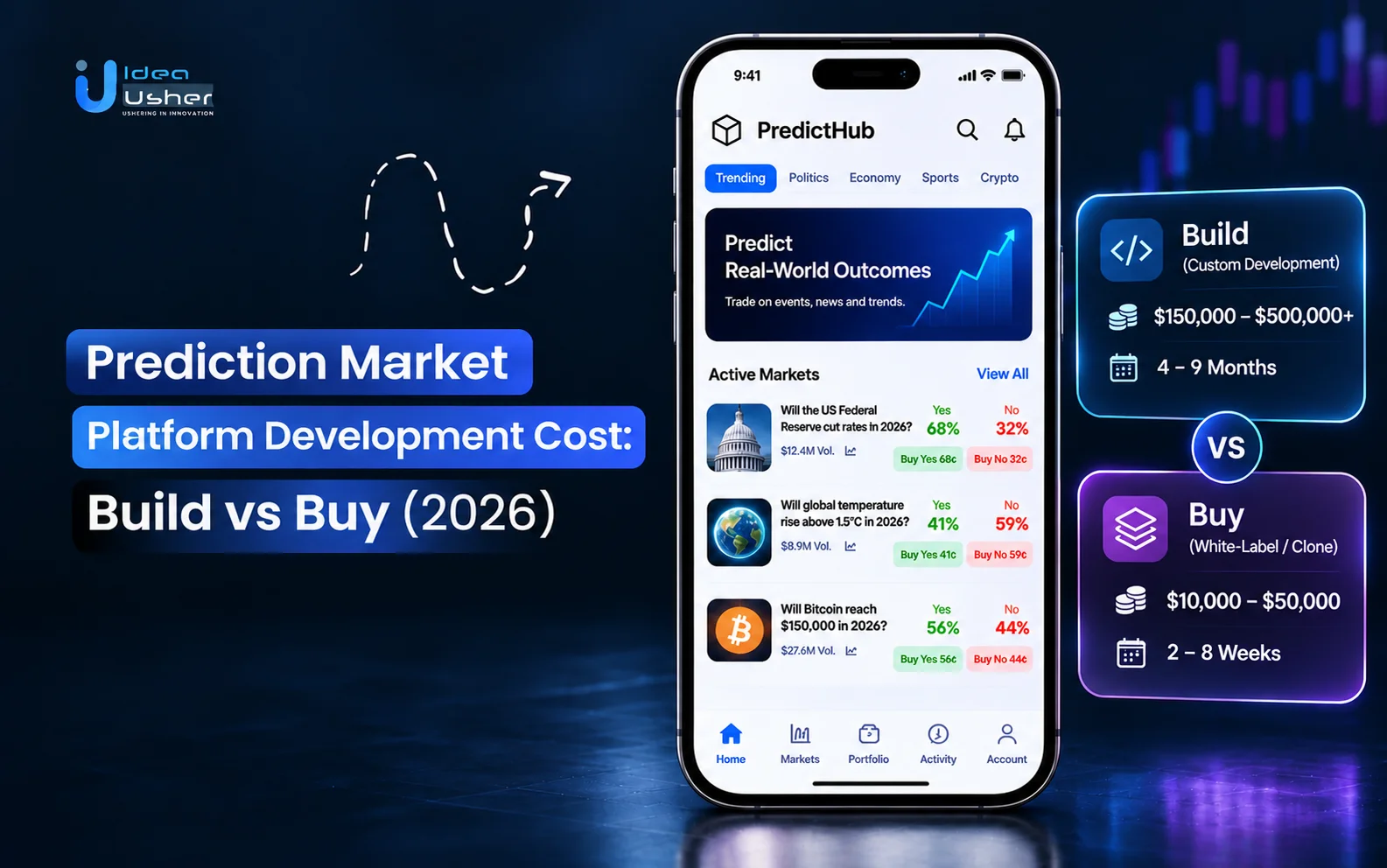
- Buying a white-label platform is cheaper and faster. It usually costs between 10,000 to 50,000 dollars. It takes 2 to 8 weeks to get it up and running.
- A custom platform can cost a lot more. The price ranges between 150k to 500k dollars or more. You get complete control over trading system, the features and the source code.
- A hybrid approach is another approach. It uses existing tools, adds custom features. This helps businesses keep costs lower while still having some flexibility.
- Development is only part of the budget. Legal fees, licensing, market makers, hosting and ongoing compliance also need to be considered.
Building a prediction market platform can cost $10,000-$40,000 for a white-label solution to over $500,000 for a custom exchange. The prediction market platform development cost depends on trading architecture, liquidity, settlement mechanisms, regulatory requirements and customization. While buying reduces initial development work, building from the beginning gives more control over the special trading rules and the way everything works.
There is another option in the middle. A hybrid method uses known third-party services along with some parts that are built specifically for the business. This lets companies manage the parts that make them different without having to build everything from scratch.
In this guide, we compare the cost to build a prediction market platform across white-label, hybrid and custom development models. We also examine infrastructure expenses, liquidity, regulatory requirements and long-term maintenance to help you choose an prediction market app development approach that fits your business objectives.
Prediction Market Platform Development Cost: At a Glance
Prediction market platform development costs range from $10,000 for a clone script or white-label solution to $2.5 million or more for a regulated institutional venue.
A custom MVP typically costs $40,000–$100,000, while production-grade custom platforms range from $150,000–$500,000.
Total investment depends on scope, trading architecture, liquidity, integrations and regulatory requirements.
| Approach | Estimated Cost | Timeline | Best For |
| Clone Script / White-Label | $10,000 – $50,000 | 2 to 8 weeks | Startups validating an idea quickly with pre-audited matching engines and basic branding. |
| Custom MVP | $40,000 – $100,000 | 3 to 6 months | Crypto-native platforms needing custom UI/UX, wallet integrations, and core smart contracts. |
| Production-Grade Custom | $150,000 – $500,000 | 4 to 9 months | High-volume platforms like Polymarket requiring custom order books, liquidity mechanisms, and deep analytics. |
| Regulated Institutional Venue | $900,000 – $2.5M+ | 12 to 18 months | Licensed exchanges like Kalshi with strict compliance, surveillance, and fiat banking rails. |
Note: The estimated figures above cover software development, platform setup and core engineering. Expenses such as regulatory licensing, legal retainers, AMM liquidity, market-maker arrangements and ongoing infrastructure hosting require separate operational budgets.
Core Cost Drivers & Architectural Components
When budgeting a prediction market engine (modeled after platforms like Polymarket or Kalshi), capital allocation breaks down across several critical subsystem modules:
1. Core Matching & Pricing Engine ($30,000 – $80,000)
This layer establishes the market’s execution logic, determining how participant positions interact and how available liquidity responds to changing trading activity.
- Automated Market Makers (AMM): Implementation of algorithmic pricing formulas such as Logarithmic Market Scoring Rules (LMSR) or Constant Product Market Makers (CPMM) to ensure continuous liquidity and dynamic price discovery for binary (Yes/No) or categorical outcomes.
- Order Book Architecture: Central Limit Order Book (CLOB) infrastructure for traditional financial-style matching with low latency.
2. Resolution & Oracle Pipeline ($15,000 – $50,000)
Accurate event outcomes require a reliable verification framework that minimizes disputes and establishes clear settlement triggers for every listed market.
- Centralized / Admin Resolution: Standard back-office resolution portals for curated binary events.
- Decentralized Oracles: Integration with cryptographic oracle networks (e.g., UMA’s Optimistic Oracle, Chainlink) or decentralized consensus voting workflows to resolve real-world outcomes deterministically.
3. Wallet, Ledger & Settlement Infrastructure ($20,000 – $60,000)
Financial integrity relies on consistent transaction records, synchronized account balances and dependable processing of funds throughout the platform lifecycle.
- Dual-Outcome Tokenization: Minting and burning mechanisms for conditional outcome tokens (e.g., 1 $YES + 1 $NO = $1.00 collateral vault).
- Payment Gateways & Web3 On-Ramps: Fiat payment processing (credit card/ACH), non-custodial crypto wallet connectivity (Privy, Web3Auth, WalletConnect), and stablecoin collateral management (USDC/USDT).
4. Compliance & Risk Controls ($15,000 – $40,000)
This layer protects platform operations by enforcing participation safeguards, monitoring exposure and maintaining controls across regulated market activities.
- Dynamic Geofencing: Real-time IP and location telemetry filtering to enforce jurisdiction-level access blocks based on local derivatives and gaming laws.
- Automated KYC/AML Integrations: Multi-tiered identity checks and sanctions list screening prior to market participation and withdrawal settlement.

Is the Prediction Market Business Model Sustainable?
A prediction market business is sustainable when trading revenue can cover liquidity, technology, compliance and customer acquisition costs.
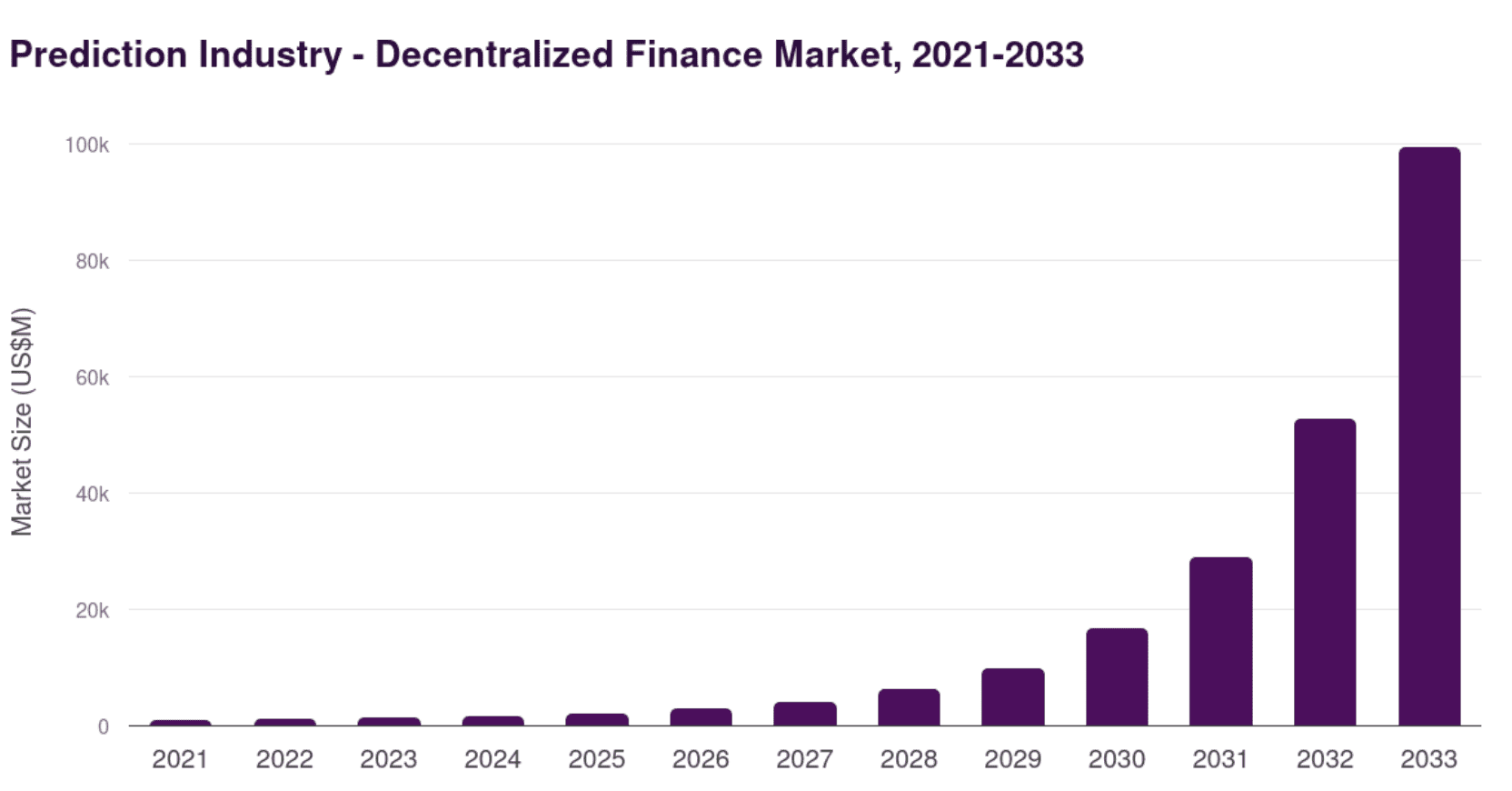
The global prediction industry market was valued at $2.03 billion in 2025 and is projected to grow at a 66.7% CAGR through 2033. This growth is driving demand for scalable prediction market platform development with secure trading engines, liquidity management and automated market resolution.
However, high trading volume does not automatically translate into profitability. Platforms also need recurring trader participation, competitive fee structures and a regulatory strategy that supports continued operations.
A. Revenue Streams and Platform Margins
Prediction market platforms generate revenue through transaction fees, profit-based charges and, where permitted, income from eligible cash-management arrangements. The revenue model influences trading frequency, user acquisition and the platform’s ability to maintain healthy margins.
Common revenue streams include:
- Trading Fees: Platforms charge users to buy or sell event contracts based on volume, price or market type such as Kalshi’s fee formula tied to contract probabilities.
- Profit-Based Fees: Some platforms take a cut of net winnings rather than per-trade commissions, aligning revenue with trader success.
- Interest Income: Subject to regulations and account structures, platforms can earn interest on eligible customer cash balances.
- Maker-Taker Fees: Taker fees apply to orders that remove liquidity, while maker fees or rebates reward liquidity providers to manage order-book depth.
A platform must balance fee competitiveness with revenue generation. Lower fees may attract more traders, but they also reduce earnings per transaction. Sustainable margins therefore depend on trading volume, repeat participation and control over operating expenses.
B. Liquidity Costs and User Acquisition
Liquidity determines how easily users can execute trades. Thin order books create wider spreads, higher slippage and weaker trading experiences. Platforms therefore invest in market makers and incentives to maintain market depth. Key considerations include:
- Market Depth: Sufficient orders improve execution and reduce price impact.
- Market-Maker Incentives: Rebates and commercial agreements attract liquidity providers but add recurring costs.
- User Acquisition: Marketing must generate active traders, not just registrations.
- Repeat Participation: Popular events, fair pricing and timely resolution encourage continued trading.
Large platforms demonstrate how liquidity and infrastructure require investment beyond software development.
| Platform | Liquidity or Infrastructure Strategy | Business Consideration |
| Polymarket | Acquired QCEX, a CFTC-licensed exchange and clearinghouse, for approximately $112 million in July 2025. | Demonstrates the capital required to obtain regulated market infrastructure and support US market access. |
| Robinhood | Established a joint venture with Susquehanna, which became a key liquidity provider, and completed the acquisition of MIAXdx in January 2026. | Combines an established retail distribution channel with institutional liquidity and exchange infrastructure. |
These examples show why a platform’s financial model should account for liquidity arrangements, market access and infrastructure costs separately from its initial development budget. A new operator may not need to acquire an exchange, but it still needs a realistic plan for attracting market makers and maintaining sufficient trading activity.
C. Long-Term Profitability and Market Risks
The regulatory treatment of prediction markets in the United States remains contested. The CFTC asserts federal authority over event contracts traded on registered designated contract markets (DCMs), while several states argue that certain offerings, particularly sports-related contracts, fall under state gambling laws.
Key regulatory developments include:
- Federal vs. State Litigation: In April 2026, the CFTC challenged actions by Arizona, Connecticut, Illinois and Wisconsin against registered contract markets. It also sued New Mexico in June 2026 over state action involving Kalshi.
- State-Level Enforcement: Novig challenged Wisconsin’s actions in August 2026, while Novig and Crypto.com challenged Missouri’s actions in October 2026.
- Changing CFTC Rules: The CFTC withdrew its 2024 event-contract proposal in February 2026 and published a new proposed framework, Prediction Markets; Public Interest Determinations, on June 12, 2026.
The June framework remains a proposal, not a final rule. These developments make contract eligibility, market surveillance and compliance planning important ongoing expenses.
What these risks mean for platform operators:
- Market Availability: State restrictions may limit where specific contracts can be offered.
- Legal Expenses: Litigation and regulatory responses increase operating costs.
- Expansion Risks: New market launches require jurisdiction-specific legal reviews.
- Compliance Requirements: Changes in contract rules may require stronger surveillance and internal review processes.
A sustainable prediction market business needs more than a profitable fee model. It requires recurring trading activity, sufficient liquidity and adaptable compliance systems.
These factors also influence the build-versus-buy decision: white-label platforms reduce initial engineering costs, while custom development offers greater control over trading logic, integrations and compliance workflows.
Prediction Market Platform Development Cost: Build vs Buy
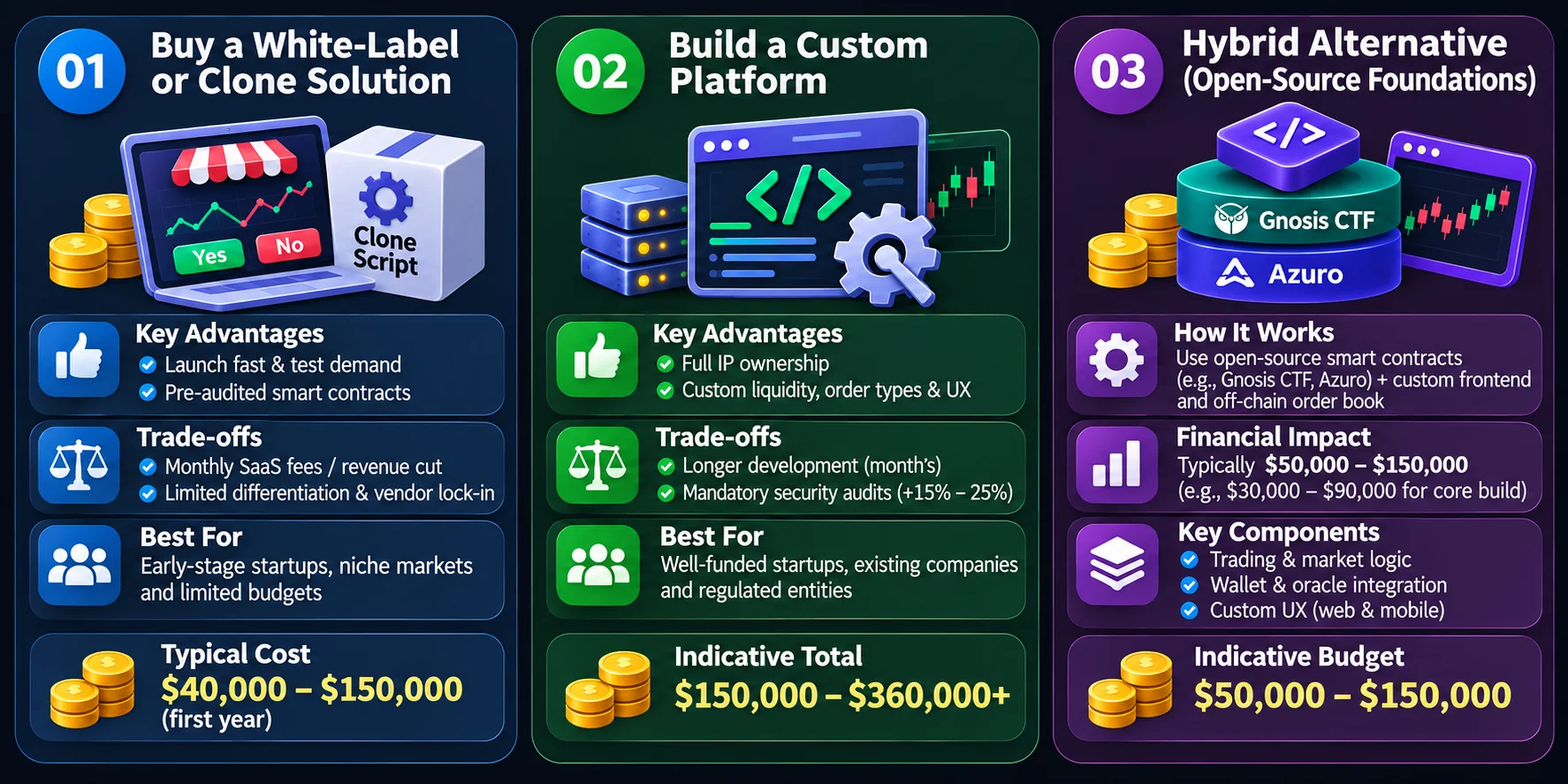
Choosing between building a custom prediction market platform and buying a white-label solution comes down to a trade-off between upfront cost and speed versus long-term ownership and differentiation. Buying a ready-made script typically costs $10,000 to $50,000 upfront, while building a custom platform from scratch ranges from $40,000 to $500,000+.
Side-by-Side Buy vs. Build Comparison
Buying a prediction market platform prioritizes speed, while custom development offers greater independence. The following comparison highlights how both approaches differ across key business and technical considerations.
| Factor | Buy (White-Label / Clone Script) | Build (Custom Development) |
| Upfront Cost | $10,000 – $50,000 | $40,000 – $500,000+ |
| Time to Market | 2 to 8 weeks | 3 to 9+ months (institutional: 12–18 months) |
| Ongoing Fees | Monthly licensing fees ($1,000–$5,000+) or revenue share (5%–15%). | Zero licensing fees; only server, oracle, and maintenance costs. |
| Customization | Limited to UI branding, color schemes, and basic settings. | Complete control over matching engines, fee structures, and UX. |
| IP Ownership | Usually leased; vendor retains core code ownership. | 100% ownership of all source code and smart contracts. |
| Scalability | Capped by the vendor’s underlying architecture. | Built to handle custom high-frequency trading and massive traffic spikes. |
These are project-planning estimates, not fixed vendor quotations. They cover different levels of software scope and should not be interpreted as including every licensing, liquidity, legal or capital requirement.
A. Option 1: Buying a White-Label or Clone Solution
Buying a pre-built platform such as a Polymarket or Augur clone script gives you a tested framework with basic matching engines, wallet integrations, and admin dashboards already in place.
- Key Advantages. You get to market fast to test user demand without heavy upfront capital. Core smart contracts are often pre-audited, reducing immediate technical risk.
- Hidden Costs and Trade-offs. Providers often charge monthly SaaS fees or take a revenue cut. Using identical base code limits differentiation, while custom features require costly vendor-locked work.
- Best For. Early-stage startups validating a niche market, community-driven crypto projects, or teams with limited initial funding who need to launch quickly.
Typical white-label cost components include
White-label prediction market pricing varies by vendor, deployment model and operational scope. Evaluating the underlying cost structure helps estimate the financial commitment before selecting a platform.
| Cost Component | Estimated Cost | Cost Coverage & Scope |
| SaaS Subscription | $2,000–$10,000/month | Recurring fees for hosted infrastructure, platform access, support and updates. Enterprise pricing is usually quote-based. |
| Self-Hosted License | $15,000–$40,000 upfront | Upfront licensing or deployment fees for greater hosting control. Source-code rights depend on the contract. |
| Setup and Configuration | $15,000–$60,000 | Covers branding, user onboarding, market categories, fee settings, administrative permissions & deployment configuration. |
| Infrastructure and Integrations | Billed separately | Covers hosting, payments, wallets, KYC, market data & oracle services. |
| Customization | Scope-dependent | Additional expenses may arise for custom interfaces, reporting, risk controls or new market types. |
| Indicative First-Year Budget | $40,000–$150,000 | Overall estimated first-year budget, depending on licensing, setup, integrations and customization requirements. |
Note: The initial white-label acquisition or setup cost is typically $10,000–$50,000. The $40,000–$150,000 first-year budget includes additional setup, integrations and recurring expenses. These are different cost estimates and should not be treated interchangeably.
Example: FanDuel’s exchange partnership model
FanDuel’s partnership with CME Group combines its consumer-facing platform and distribution capabilities with CME’s established exchange infrastructure and derivatives expertise, offering an alternative to building an exchange independently.
Launched in December 2025, FanDuel Predicts expanded its event-contract offering in June 2026 through Crypto.com’s CFTC-regulated exchange and clearinghouse, OG Prediction Markets.
Rather than a conventional white-label purchase, this institutional partnership shows how businesses can leverage existing exchange infrastructure without developing every regulated component in-house.
B. Option 2: Building a Custom Prediction Market Platform
Building from scratch involves hiring an in-house engineering team or an external development agency to architect your own trading engine, smart contracts, and frontend interface.
- Key Advantages. You own the intellectual property outright, which is critical if you plan to raise venture capital. You can engineer proprietary liquidity mechanisms, unique order types, and a distinct user experience tailored to your audience.
- Hidden Costs and Trade-offs. Development takes months of engineering, followed by mandatory third-party security audits that add 15% to 25% to your budget. You also bear full responsibility for ongoing maintenance, bug fixes, and server scaling during high-traffic events.
- Best For. Well-funded startups, established companies adding prediction markets to an existing ecosystem, and regulated entities requiring strict compliance workflows.
Major custom development cost components include
Custom prediction market development cost involves several interconnected engineering and security components. The following breakdown outlines their estimated costs and the technical scope covered within each investment category.
| Component | Estimated Cost | Cost Coverage & Scope |
| Matching Engine or AMM | $40,000–$80,000 | Order matching, contract pricing, order books, and automated liquidity. CLOB and AMM systems differ in engineering requirements. |
| Oracle and Data Layer | $15,000–$40,000 | External data integrations, resolution inputs, validation rules, and fallbacks. |
| Settlement and Dispute Management | $20,000–$40,000 | Expiration, verification, automated payouts, cancellations, and disputes. |
| Custody and Wallet Infrastructure | $15,000–$30,000 | Deposits, withdrawals, signing, wallets, and assets. Custodial and non-custodial designs carry distinct security needs. |
| Fee and Revenue Management | $10,000–$20,000 | Trading fees, maker incentives, commissions, settlement fees, and revenue reporting. |
| Live Data and Interfaces | $20,000–$40,000 | Real-time prices, charts, order entry, portfolios, alerts, and admin tools. |
| Security Audits | $10,000–$30,000 | Pre-deployment code reviews of smart contracts, logic, access, and security. |
| Compliance-Related Technical Review | $20,000–$80,000 | Technical controls for KYC/AML, screening, market surveillance, and compliance. |
| Indicative Total | $150,000–$360,000+ | Estimated total core investment. Final costs depend on architecture, complexity, security, and compliance. |
First-year budget considerations
The core development estimate does not necessarily cover the entire first year of operation. Businesses should separately budget for:
- Cloud hosting and infrastructure scaling
- External data feeds and API subscriptions
- Wallet, payment and identity-verification provider charges
- Liquidity provision and market-maker agreements
- Security monitoring and additional audits
- Legal advice, licensing and regulatory filings
For a regulated exchange, licensing and operational capital requirements can be substantially different from the software development budget. These should be assessed separately with qualified legal and regulatory advisers.
C. Hybrid Alternative: Open-Source Foundations
If neither extreme fits, you can build on top of established open-source protocols like Gnosis Conditional Token Framework (CTF) or Azuro.
- How It Works. You use battle-tested, open-source smart contracts for market creation and payouts while building a custom frontend and off-chain order book on top.
- Financial Impact. This approach typically costs $30,000 to $90,000, cutting smart contract development and audit expenses while still giving you full ownership of your brand and user interface.
Typical hybrid architecture expenses include
Hybrid architecture combines proprietary platform components with established third-party services. The following prediction market platform development cost breakdown highlights the typical development expenses involved in connecting both environments efficiently.
| Cost Component | Estimated Cost | Cost Coverage and Scope |
| Third-party infrastructure and API integration | $10,000–$25,000 | Integrating hosted trading services, cloud infrastructure and managed backend components. |
| Custom trading and market logic | $15,000–$40,000 | Building proprietary order routing, market creation rules, pricing mechanisms and fee structures. |
| Wallet and oracle integration | $5,000–$15,000 | Leveraging established wallet, blockchain, and event-resolution services rather than custom-building each component. |
| Custom user experience | $10,000–$25,000 | Developing branded web and mobile interfaces, portfolio dashboards and trading workflows. |
| On-chain and off-chain integration | $5,000–$20,000 | Connecting smart contracts with off-chain order books, databases, event data and settlement services. |
| Security and smart contract review | $5,000–$25,000 | Reviewing custom contracts and integration points, especially where user funds or settlement logic are involved. |
| Indicative architecture budget | $50,000–$150,000 | Overall estimated budget for the combined architecture and development scope. |
Financial Impact: A hybrid prediction market platform typically costs $50,000–$150,000, depending on the level of customization, third-party infrastructure reuse, smart contract integration and security requirements.
A hybrid model lets businesses test trading concepts before building a full proprietary exchange. However, API limits, availability, transaction fees, and vendor dependencies must be evaluated first.
D. Feature Ownership and Customization Costs
The initial prediction market platform development cost does not reveal how much control a business will have over its prediction market platform. Ownership rights, customization permissions and vendor dependencies can significantly affect long-term costs.
Key factors to evaluate include:
- White-Label Customization Limits: Some vendors allow branding and configuration but restrict changes to the matching engine, settlement logic or market creation workflows.
- Source-Code Ownership: A licensing agreement does not automatically transfer ownership of the underlying software. Businesses should clarify whether they receive source code, modification rights or deployment access.
- API and Integration Restrictions: Rate limits, restricted endpoints and additional API charges can affect the ability to integrate external data, wallets, payment providers and analytics tools.
- Custom Market Types: Adding new contract categories, pricing mechanisms or resolution rules may require vendor approval or additional development fees.
- Vendor Dependencies: Hosted infrastructure, proprietary settlement systems and third-party data services can make migration expensive if the provider changes its pricing or discontinues a service.
Example: Interactive Brokers and ForecastEx
The relationship between Interactive Brokers (IBKR) and ForecastEx illustrates how exchange infrastructure and distribution can operate through separate organizations.
ForecastEx is a CFTC-registered Designated Contract Market (DCM) and Derivatives Clearing Organization (DCO). Interactive Brokers provides eligible customers with access to exchange-listed event contracts through its existing brokerage platform.
This model allows IBKR to offer prediction market access without independently building and operating every exchange function. It also demonstrates why access to an exchange’s infrastructure is different from owning the exchange’s underlying technology.
Before signing a white-label or infrastructure agreement, businesses should review source-code rights, data portability, service-level agreements, API access, exit clauses and the cost of migrating users and open positions.
E. Strategic Recommendation
The right prediction market platform development cost depends on your business model, available resources and long-term growth objectives. Evaluate technical requirements, operational complexity and differentiation before committing capital.
- Choose “Buy” if your primary goal is validating market demand with minimal risk and you plan to use standard binary (Yes/No) crypto markets.
- Choose “Build” (or Hybrid) if your competitive edge relies on unique market mechanics, regulatory compliance, high-volume institutional trading, or attracting institutional investors.
Features of a Custom Prediction Market Platform and Their Cost Impact
A custom prediction market platform requires a combination of user-facing trading features and operator tools. The MVP establishes the essential trading experience, while advanced features improve market discovery, liquidity, analytics and user engagement.
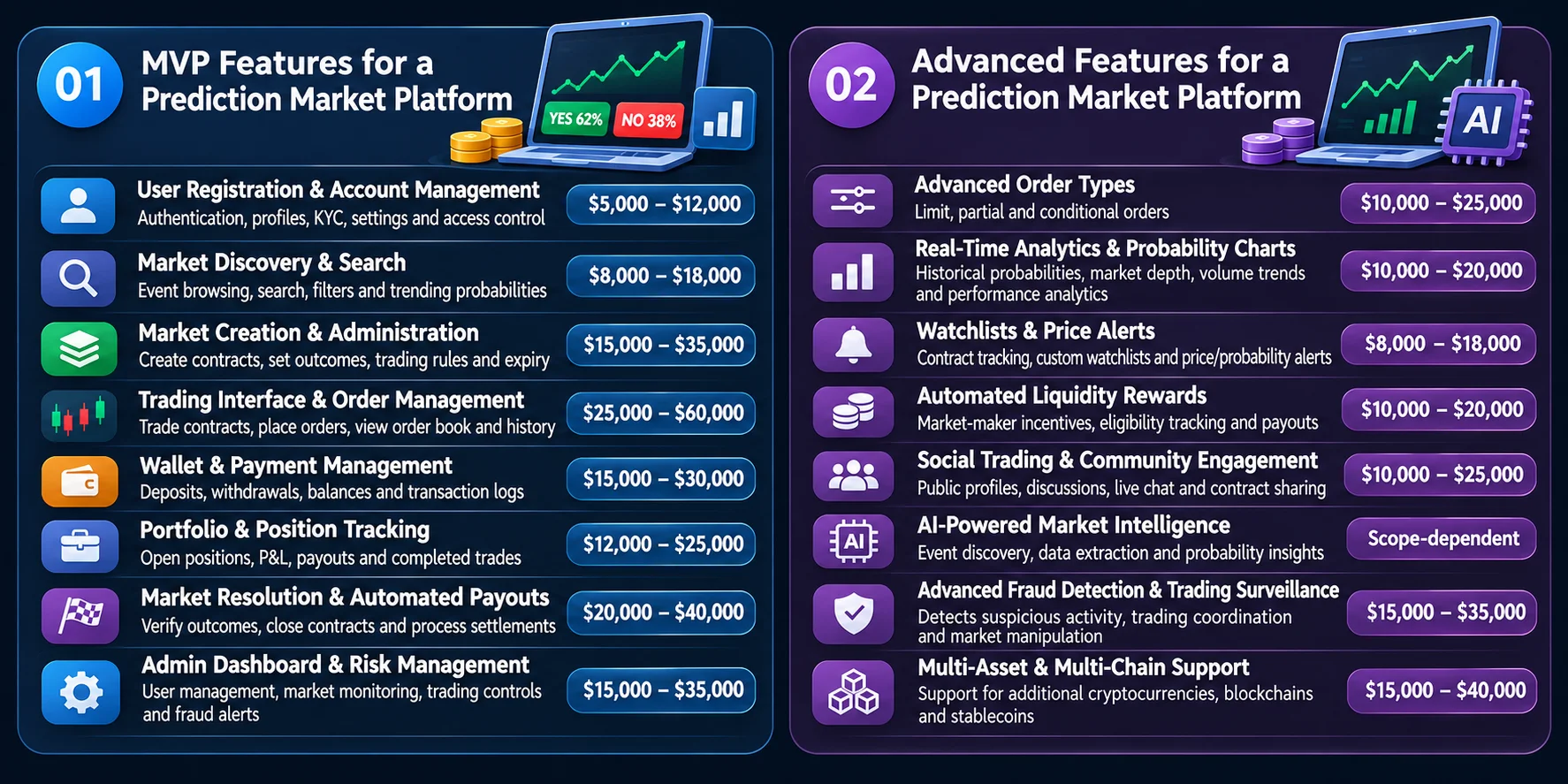
Building these capabilities in stages helps control prediction market platform development cost without compromising core functionality.
A. MVP Features for a Prediction Market Platform
An MVP should include the functionality required to register users, publish event contracts, execute trades, manage positions and settle market outcomes. These features form the operational foundation of a prediction market platform.
| MVP Feature | Estimated Cost | What the Feature Does |
| User Registration and Account Management | $5,000–$12,000 | Manages authentication, profiles, identity verification, account settings and access permissions. |
| Market Discovery and Search | $8,000–$18,000 | Supports event browsing, market search, contract filters and trending probabilities. |
| Market Creation and Administration | $15,000–$35,000 | Lets operators create contracts, define Yes/No outcomes, set trading rules and expiry dates, and publish markets. |
| Trading Interface and Order Management | $25,000–$60,000 | Handles contract trading, order placement, order-book visibility, execution, cancellations and trade history. |
| Wallet and Payment Management | $15,000–$30,000 | Manages deposits, withdrawals, balances, transaction logs and fiat or crypto payments. |
| Portfolio and Position Tracking | $12,000–$25,000 | Displays open positions, balances, payouts, P&L and completed trades. |
| Market Resolution and Automated Payouts | $20,000–$40,000 | Verifies event outcomes, closes contracts, calculates winnings and processes settlements. |
| Admin Dashboard & Risk Management | $15,000–$35,000 | Supports user management, market monitoring, trading controls, account restrictions, fraud alerts and reporting. |
These estimates cover individual feature implementation, not the complete cost of launching a production-ready exchange. Shared backend services, third-party integrations, security audits, liquidity provision, licensing and regulatory expenses may require separate budgets. Actual prediction market platform development cost depend on trading architecture, supported assets, jurisdiction and integration scope.
B. Advanced Features for a Prediction Market Platform
Once the core platform is operational, advanced features can improve trading flexibility, user retention and market activity. These capabilities are not essential for every MVP but can help differentiate the platform as its user base and trading volume grow.
| Features | Estimated Cost | What the Feature Does |
| Advanced Order Types | $10,000–$25,000 | Adds limit, partial, and conditional orders for advanced trading execution. |
| Real-Time Analytics and Probability Charts | $10,000–$20,000 | Delivers historical probabilities, market depth, volume trends, price charts, and performance analytics. |
| Watchlists and Price Alerts | $8,000–$18,000 | Enables contract tracking, custom watchlists, and alerts for price or probability changes. |
| Automated Liquidity Rewards | $10,000–$20,000 | Handles market-maker incentives, reward eligibility, contribution tracking, and payouts. |
| Social Trading and Community Engagement | $10,000–$25,000 | Includes public profiles, discussions, live chat, contract sharing, and community moderation. |
| AI-Powered Market Intelligence | Scope-dependent | Automates event discovery, data extraction, market research, and probability insights. |
| Advanced Fraud Detection and Trading Surveillance | $15,000–$35,000 | Detects suspicious activity, trading coordination, market manipulation, and insider risks. |
| Multi-Asset and Multi-Chain Support | $15,000–$40,000 | Expands support for additional cryptocurrencies, blockchains, stablecoins, and payment rails. |
Advanced feature estimates assume the core platform and its underlying services already exist. AI models, institutional surveillance, additional blockchain networks like Base, Solana, Polygon and real-time analytics can require separate data subscriptions, infrastructure and security reviews. Market-maker payments, liquidity capital and ongoing service fees are operating expenses, not included development costs.
C. How Should These Features Be Prioritized?
A prediction market platform does not need every feature at launch. Prioritizing development based on business goals, available budget and expected trading activity helps control initial investment while leaving room for future expansion.
- MVP Launch: Prioritize user registration, market discovery, trading, wallet management, portfolio tracking and automated settlement to establish the core trading experience.
- Early Growth: Introduce watchlists, price alerts, advanced order types and real-time analytics to improve user retention and trading flexibility.
- Platform Differentiation: Add social trading, liquidity rewards and personalized market recommendations to encourage participation and strengthen user engagement.
- Enterprise Expansion: Consider AI-powered market intelligence, advanced fraud detection and multi-chain support when trading volume, operational requirements and business objectives justify the additional investment.
This phased approach allows businesses to launch with essential functionality, validate market demand and expand the platform based on actual user needs rather than spending heavily on advanced features before they are necessary.
Which Prediction Market Architecture Costs Less to Build?
Centralized architecture generally has the lowest initial development cost because trading, user accounts and settlement run through one operator.
Decentralized platforms cost more due to smart contracts, audits, oracles and liquidity requirements.
Hybrid models fall between them, but integration and cross-system testing can further increase costs as the platform scales.
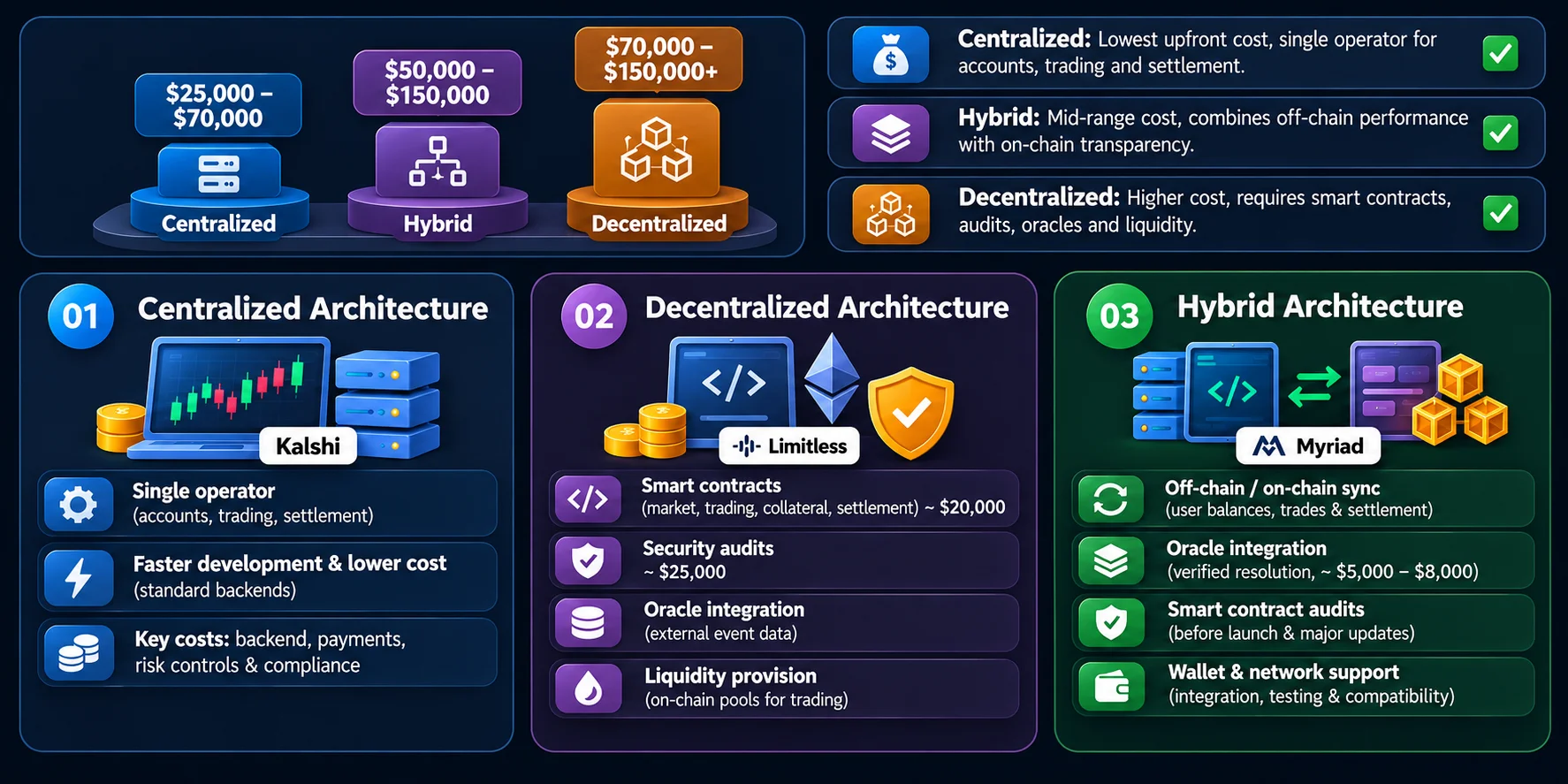
The following table compares estimated prediction market platform development cost across centralized, hybrid and decentralized prediction market architectures, highlighting how infrastructure choices influence initial investment requirements.
| Architecture | Estimated Development Cost |
| Centralized | $25,000–$70,000 |
| Hybrid | $50,000–$150,000 |
| Decentralized | $70,000–$150,000+ |
1. Centralized Market Architecture: Lower Initial Development Costs
A centralized prediction markets use a single operator for accounts, trading, and settlement. Using standard backends speeds up development and cuts blockchain engineering needs.
This makes centralized architecture suitable for businesses testing a prediction market concept or launching with a controlled feature set. The estimated development costs vary by project scope and vendor.
Kalshi is a prime example of a centralized prediction market, using a central order book and institutional market makers while managing regulatory compliance and contract-listing requirements.
Centralized architecture lowers costs by avoiding extensive smart contract development and audits, though operators must still budget for backend infrastructure, payments, risk controls, compliance, and ongoing operations.
2. Decentralized Architecture: Smart Contract and Security Costs
A decentralized prediction market uses blockchain-based smart contracts to execute transactions, enforce trading rules and distribute payouts. This reduces reliance on a central operator for certain functions but introduces additional development and security requirements.
The main prediction market platform development cost components include:
- Smart Contract Development: Contracts for creation, trading, collateral, and settlement cost ~$20,000.
- Security Audits: Audits cost ~$25,000. Post-fix re-reviews add expenses.
- Oracle Integration: External data feeds for outcome verification increase build and operational costs.
- Liquidity Provision: On-chain pools require capital to enable trading, raising launch costs.
Limitless Exchange shows how decentralized platforms choose infrastructure. Operating on Base, it uses a central limit order book instead of an automated market maker and integrates Pyth for oracle and market data. Its multi-timeframe crypto markets highlight how trading architecture, data integrations, and market types shape platform scope.
3. Hybrid Architecture: Integration and Infrastructure Costs
A hybrid prediction market combines an off-chain application layer with blockchain-based components. For example, the platform may process parts of the trading experience through conventional backend infrastructure while using smart contracts for collateral management or settlement.
This approach can balance application performance with on-chain transparency, but connecting the two environments adds engineering complexity. The main cost drivers include:
- Off-Chain/On-Chain Sync: Maintaining consistent user balances, trade records, and settlement states across both systems.
- Oracle Integration: Linking external event data to smart contracts for verified resolution (est. $5,000–$8,000).
- Smart Contract Audits: Auditing blockchain components before launch and following major contract updates.
- Wallet & Network Support: Integrating wallets, handling transactions, and testing compatibility across supported networks.
- Ongoing Maintenance: Monitoring conventional backend and blockchain infrastructure to resolve transaction failures and sync issues.
Myriad provides an example of a multi-chain, on-chain prediction market. It uses an automated market maker model and supports networks including Ethereum, Arbitrum and Base. Supporting multiple networks can expand user access, but it also increases the work involved in wallet integration, testing, liquidity management and maintenance.
For a new platform, launching on one blockchain can help limit initial integration costs. Additional networks can be introduced later when user demand and business requirements justify the investment.
How Do CLOB vs AMM Models Affect Prediction Market Development Costs?
CLOB and AMM architectures create different development and operating expenses. A Central Limit Order Book (CLOB) requires a sophisticated matching engine and external liquidity, while an Automated Market Maker (AMM) needs pricing algorithms and capital to support trades. Supporting both models increases engineering complexity and infrastructure costs.
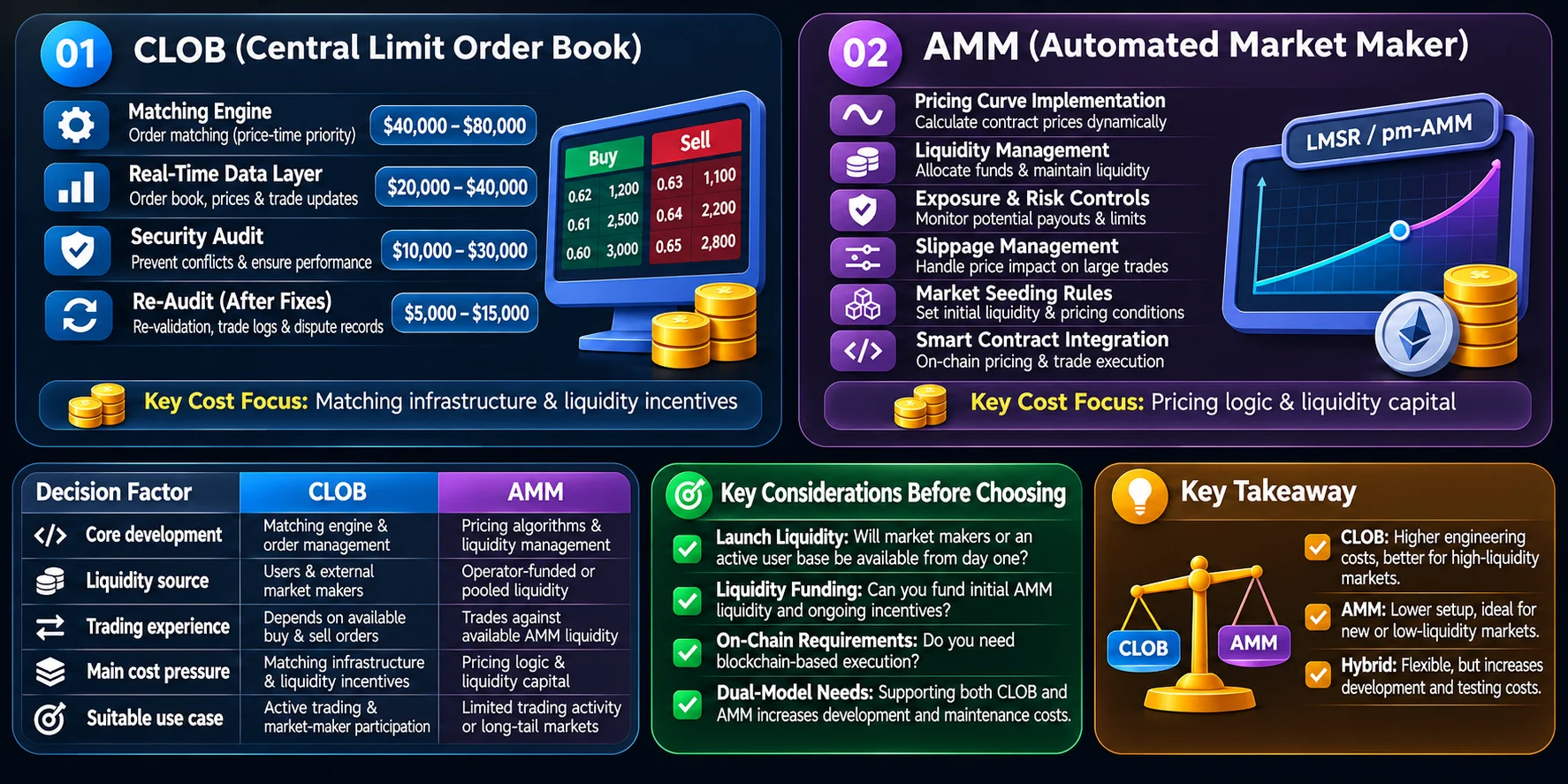
1. CLOB Development Costs
A Central Limit Order Book (CLOB) matches buy and sell orders submitted by users or market makers. Building one requires reliable backend systems for order processing, trade execution and real-time updates.
Key development components include:
| Component | Estimated Cost | Cost Coverage and Scope |
| Matching engine or AMM | $40,000–$80,000 | Executes trades using matching rules such as price-time priority. |
| Real-time data layer and interfaces | $20,000–$40,000 | Uses WebSockets to stream order book updates, prices and trade data. |
| Independent security audit | $10,000–$30,000 | Prevents conflicting transactions and maintains execution speed during high trading activity. |
| Each re-audit after a fix | $5,000–$15,000 | Records order submissions, cancellations and completed trades for monitoring and dispute resolution. |
The source groups the matching engine and AMM into one estimate, so a separate CLOB-only cost is unavailable.
Liquidity is another major expense. A new CLOB starts with an empty order book. Without enough users or professional market makers, traders may face wide spreads and poor execution.
Polymarket addresses this through market-making participation and liquidity incentives. Its Maker Rebates Program returns a portion of taker fees to eligible liquidity providers, with additional rewards for qualifying limit orders near the market midpoint. This shows why CLOB budgets must account for liquidity incentives alongside engineering costs.
2. AMM Development Costs: Pricing Algorithms and Liquidity Provision
An Automated Market Maker (AMM) uses mathematical formulas to calculate contract prices and execute trades without requiring a direct match between buyers and sellers. This makes it useful for markets with limited or inconsistent trading activity. Its main development components include:
- Pricing Curve Implementation: Calculates contract prices as market positions change.
- Liquidity Management: Allocates funds to support trades and maintain available liquidity.
- Exposure and Risk Controls: Monitors potential payouts and limits financial exposure.
- Slippage Management: Calculates how trade size affects execution prices.
- Market Seeding Rules: Establishes initial liquidity and pricing conditions.
- Smart Contract Integration: Enables on-chain pricing and trade execution where required.
Costs depend on the pricing model, contract types, trading volume and whether the AMM operates on-chain or off-chain.
Who Pays for AMM Liquidity?
Under the Logarithmic Market Scoring Rule (LMSR), the platform acts as the market maker and absorbs bounded losses as users trade against its pricing function.
The liquidity budget depends on several factors:
- Number of Outcomes: LMSR collateral requirements grow logarithmically with the number of possible outcomes.
- Liquidity Parameter: Controls price sensitivity and the amount of liquidity required.
- Trading Volume: High-volume markets may expose pricing limitations compared with deep CLOBs.
- Market-Maker Exposure: The operator must account for potential losses when users trade against the AMM.
Newer models such as Liquidity-Sensitive LMSR (LS-LMSR) adjust liquidity more dynamically but introduce mathematical and computational complexity. Paradigm’s pm-AMM is another pricing model designed specifically for prediction markets.
Manifold Markets: An Example of AMM-Based Liquidity
Manifold Markets demonstrates why AMMs suit platforms with numerous low-volume markets. Its user-created questions may not attract enough buyers and sellers to sustain active order books.
The platform uses play-money rather than real-money trading, making liquidity subsidies less financially significant. A real-money platform, however, must account for actual capital exposure when funding AMM liquidity.
3. CLOB vs AMM: Which Trading Model Fits Your Development Budget?
The right architecture depends on launch liquidity, expected trading volume, financial exposure and technical requirements. A CLOB suits platforms with access to market makers, while an AMM can support markets with limited natural liquidity.
| Decision Factor | CLOB | AMM |
| Core development requirement | Matching engine and order management | Pricing algorithms and liquidity management |
| Liquidity source | Users and external market makers | Operator-funded or pooled liquidity |
| Trading experience | Depends on available buy and sell orders | Trades execute against available AMM liquidity |
| Main cost pressure | Matching infrastructure and liquidity incentives | Pricing logic and liquidity capital |
| Suitable use case | Markets with active trading and market-maker participation | Markets with limited trading activity |
Before selecting an architecture, consider:
- Launch Liquidity: Will market makers or an active user base be available from day one?
- Liquidity Funding: Can the business fund initial AMM liquidity and ongoing incentives?
- On-Chain Requirements: Does the platform need blockchain-based execution? On-chain order books are possible but require careful evaluation of transaction and implementation costs.
- Dual-Model Requirements: Supporting both CLOB and AMM increases development, testing and maintenance costs due to separate execution systems and order-routing requirements.
Some platforms start with an AMM to support early trading and introduce a CLOB as activity grows. However, this transition requires additional engineering for order routing, liquidity migration and balance synchronization.
Augur illustrates the on-chain approach. Its early design used LMSR to support market pricing and trading through smart contracts without a conventional off-chain matching engine. The trade-off involved pricing efficiency and liquidity as trading activity increased.
For startups, the practical choice is to select the model that matches available liquidity and expected trading activity. A second execution model should be introduced when demand justifies its additional cost.
Which Prediction Market Platform Components Should You Build or Buy?
The most cost-effective approach is to buy standardized infrastructure and build proprietary trading features. Services such as KYC, wallets and payment processing are widely available, while market rules, pricing logic and liquidity strategies shape product differentiation. Combining third-party services with custom development helps control costs while retaining ownership of core capabilities.
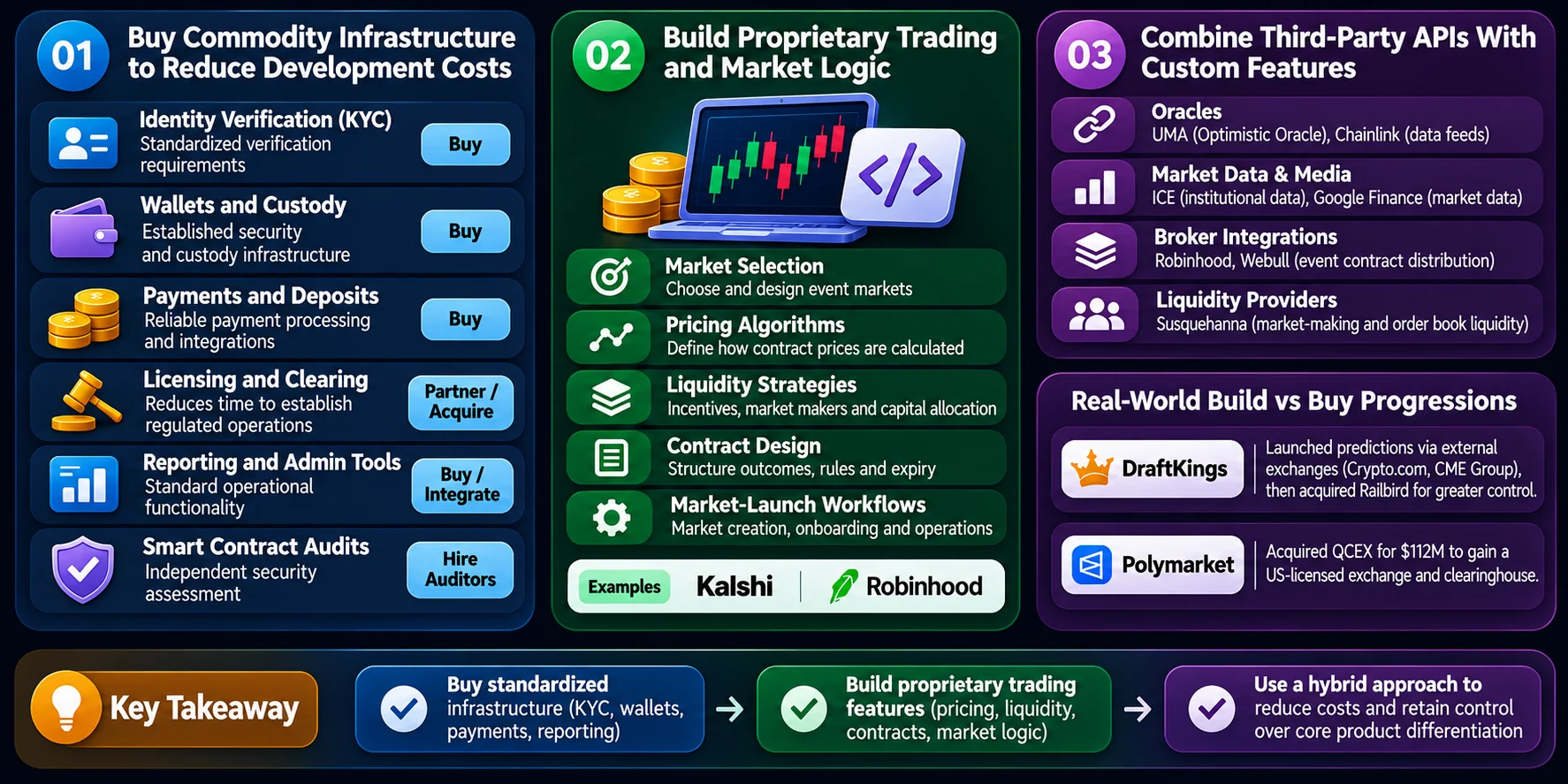
1. Buy Commodity Infrastructure to Reduce Development Costs
Commodity components provide essential functionality but rarely differentiate one prediction market from another. Buying established services for identity verification, payments, wallets and reporting reduces development time and avoids rebuilding standard infrastructure.
Regulatory access can also be acquired through partnerships or purchases. For instance, Polymarket bought QCEX for $112 million to secure access to a US-licensed derivatives exchange and clearinghouse. This shows that acquiring existing infrastructure is often faster than building a regulated venue from scratch.
Security audits are another area best handled by independent specialists. Providers such as CertiK and OpenZeppelin offer smart contract security auditing services.
| Component | Build or Buy | Why |
| Identity verification (KYC) | Buy | Standardized verification requirements |
| Wallets and custody | Buy | Established security and custody infrastructure |
| Payments and deposits | Buy | Reliable payment processing and integrations |
| Licensing and clearing | Partner or acquire | Can reduce the time required to establish regulated operations |
| Reporting and admin tools | Buy or integrate | Standard operational functionality |
| Smart contract audits | Hire external auditors | Independent security assessment |
2. Build Proprietary Trading and Market Logic
Proprietary features determine how a prediction market operates and competes. These include market selection, pricing algorithms, liquidity strategies, contract design and market-launch workflows. Outsourcing this layer can limit control over the trading experience and make the platform less distinctive.
A. What Kalshi Keeps In-House
Kalshi develops its own event contracts and controls its exchange product. Its market selection and contract design allow it to serve use cases beyond retail trading, including potential risk-management applications for businesses.
Reuters reported Kalshi’s $1 billion funding round at an $11 billion valuation in December 2025. The company also partnered with CNN to display live market probabilities across news content and tickers, demonstrating how custom market offerings and strategic partnerships can differentiate an exchange.
B. Why Robinhood Moved Beyond Exchange Integration
Robinhood initially partnered with Kalshi to offer event contracts through its app. It later partnered with Susquehanna and acquired a 90% stake in MIAXdx, with MIAX retaining 10%.
Susquehanna became the initial liquidity provider, while exchange ownership gave Robinhood greater control over its trading infrastructure and product expansion. The venue was subsequently renamed Rothera Exchange and Clearing.
This strategic difference between integrating with an external exchange and owning the infrastructure needed to control product development, liquidity and market operations.
3. Combine Third-Party APIs With Custom Prediction Market Features
A hybrid development strategy integrates established third-party services while keeping proprietary product capabilities under internal control. This reduces the time spent building standard infrastructure and allows development teams to focus on features that differentiate the platform.
Common integrations include:
- Oracles: Polymarket leverages UMA’s Optimistic Oracle for resolution and Chainlink for data feeds.
- Market Data & Media: ICE distributes Polymarket data institutionally, while Google Finance integrates data from Polymarket and Kalshi.
- Broker Integrations: Kalshi distributes event contracts via Robinhood and Webull.
- Liquidity Providers: Market makers like Susquehanna supply quotes to maintain order-book liquidity.
These integrations reduce the need to develop every capability internally, but the platform still needs custom logic for market operations, pricing, trading rules and user workflows.
DraftKings: From Third-Party Exchanges to Exchange Ownership
DraftKings Predictions initially launched using event contracts listed through external exchanges including Crypto.com and CME Group. It also acquired Railbird, which obtained its CFTC designation before the acquisition was announced on October 21.
This progression illustrates a practical build-vs-buy strategy: use external exchanges to enter the market, then acquire or develop proprietary infrastructure when greater control and product expansion become priorities.
Does a Prediction Market Need a CFTC DCM License to Operate in the US?
A prediction market offering regulated event contracts to US users generally needs to operate through a CFTC-registered Designated Contract Market (DCM), unless an exemption or exclusion applies. Businesses can obtain their own registration or partner with an eligible registered exchange. Both routes involve legal, compliance and operational costs.
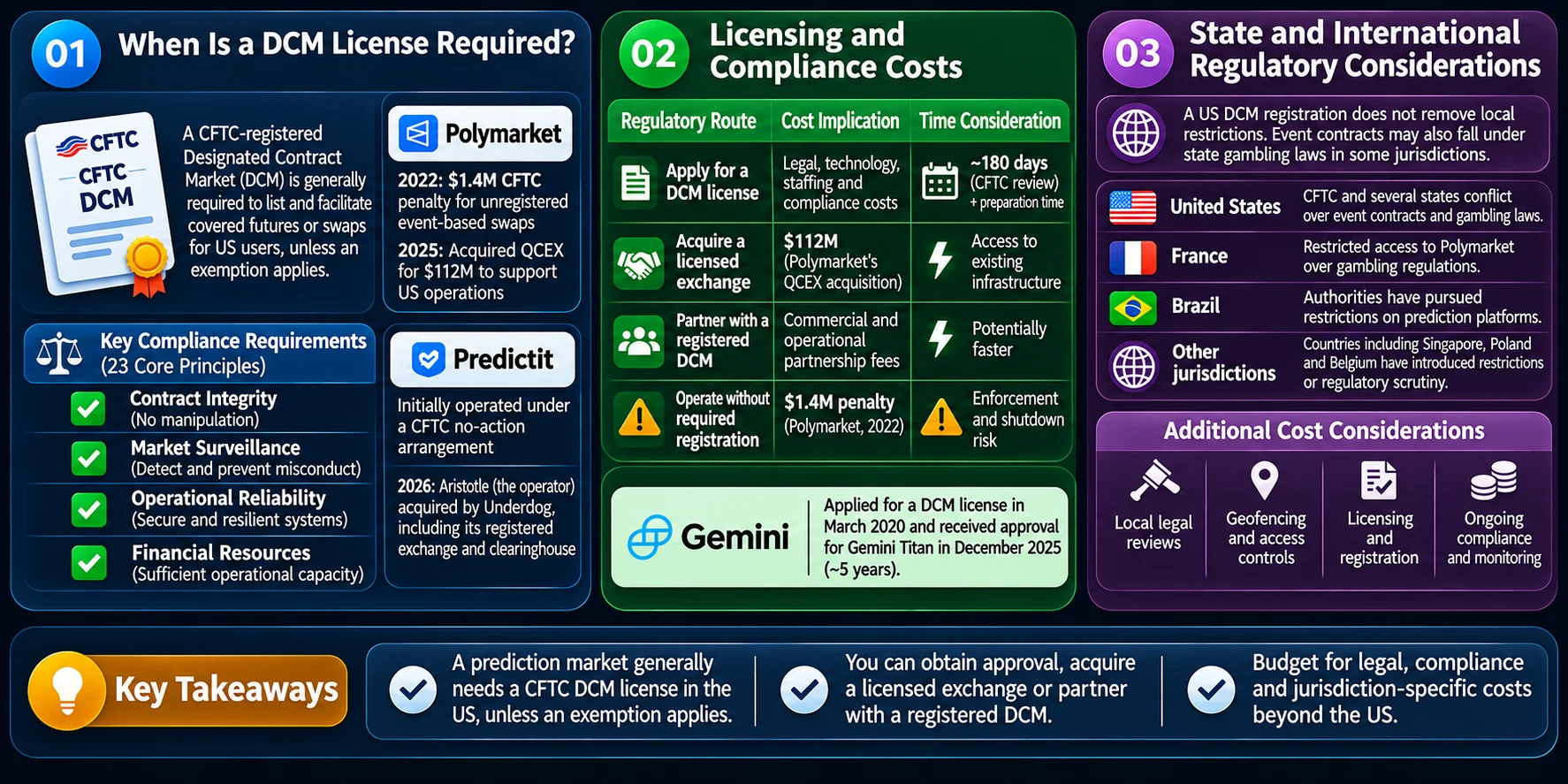
1. When Is a DCM License Required?
A Designated Contract Market (DCM) is a CFTC-regulated exchange. Platforms listing and facilitating covered futures or swaps for US customers generally need registration unless an applicable exemption applies.
Applicants submit Form DCM and demonstrate compliance with 23 core principles including:
- Contract Integrity: Listed contracts must not be readily susceptible to manipulation.
- Market Surveillance: Exchanges must detect and prevent market manipulation.
- Operational Reliability: Trading systems must maintain security and resilience.
- Financial Resources: Exchanges must demonstrate sufficient operational and financial capacity.
A. Polymarket’s $1.4 Million Penalty
In 2022, the CFTC found that Polymarket offered event-based swaps without the required registration. It received a $1.4 million penalty and had to wind down non-compliant markets. In 2025, Polymarket acquired the licensed exchange QCEX for $112 million to support its US expansion.
B. PredictIt’s Alternative Regulatory Route
PredictIt initially operated under a CFTC staff no-action arrangement with restrictions on participation and investment limits. Its operator, Aristotle, later obtained exchange and clearinghouse registrations. In 2026, Underdog acquired Aristotle Exchange and its registered entities.
This demonstrates how partnerships and acquisitions can provide access to established regulatory infrastructure.
2. What Are the Licensing and Compliance Costs?
The CFTC does not prescribe one fixed DCM licensing price. Major expenses include legal support, application preparation, compliance staff, market surveillance and secure trading infrastructure.
| Regulatory Route | Cost Implication | Time Consideration |
| Apply for a DCM license | Legal, technology, staffing and compliance expenses | CFTC review framework: 180 days; preparation may take longer |
| Acquire a licensed exchange | $112 million for Polymarket’s QCEX acquisition | Access to existing infrastructure |
| Partner with a registered DCM | Commercial and operational partnership fees | Potentially faster |
| Operate without required registration | $1.4 million Polymarket penalty in 2022 | Enforcement and shutdown risk |
A partnership does not automatically transfer a DCM license. The operating arrangement must comply with applicable regulations.
Gemini’s Five-Year Licensing Process
Gemini Exchange applied for a DCM license in March 2020 and received approval for Gemini Titan in December 2025. The company described the process as taking five years. This illustrates the time and regulatory preparation involved in establishing an independently registered exchange.
3. How Do State and International Regulations Affect Costs?
A federal DCM registration does not eliminate every jurisdictional restriction. US states and federal regulators continue to dispute whether certain event contracts fall under derivatives regulation or state gambling laws.
- United States: The CFTC and several states conflict over event contracts and unlicensed gambling, requiring local legal reviews.
- France: Authorities have restricted access to Polymarket over gambling regulations.
- Brazil: Authorities have pursued restrictions against prediction market platforms.
- Other jurisdictions: Countries including Singapore, Poland and Belgium have introduced restrictions or regulatory scrutiny.
These differences create additional expenses for:
- Local legal reviews to assess market eligibility.
- Geofencing to restrict access in prohibited jurisdictions.
- Licensing and registration where local approvals are required.
- Ongoing compliance to monitor regulatory changes.
A single US registration does not authorize global operations. Businesses should budget for regulatory reviews and market-access controls separately for each target jurisdiction.
How Idea Usher can Help to Build a Custom Prediction Market Platform?
Enterprise prediction market platforms require low-latency routing, deterministic resolution, and auditable ledgers. Supporting Web3 protocols, CFTC-regulated exchanges, or sweepstakes platforms demands reliable matching, precise settlement, and secure balance isolation.
IdeaUsher operates as an enterprise product engineering partner, backed by 11+ years of software expertise and a 4.9/5 Clutch rating across 1,000+ delivered builds. We architect custom prediction market ecosystems designed for continuous liquidity, institutional security and multi-jurisdictional compliance readiness.
A. High-Throughput Trading Architecture & Market Mechanics
Our developers engineer scalable trading infrastructure supporting diverse event contracts, efficient order execution and real-time market operations.
- Deterministic Matching Engines: In-memory CLOBs with Price-Time Priority (FIFO) matching and AMM bonding curves (CPMM, LMSR) for automated liquidity.
- Event Contract Structuring: Binary, categorical and scalar markets with configurable tick sizes, collateral locks and automated protocol fees.
- Real-Time Market Operations: WebSocket and Kafka pipelines for live order books and tick charts, supported by administrative controls for market creation, trading halts and exposure monitoring.
B. Integrated Oracles, Settlement & Financial Ledgers
We develop integrated oracle and financial systems connecting verified event outcomes with secure collateral management, automated payouts and auditable transactions.
- Oracle Aggregation: Chainlink, Pyth, UMA and enterprise data APIs with challenge periods, dispute arbitration and fallback resolution mechanisms.
- Double-Entry Collateral Ledgers: Atomic balance reservations lock user stakes and counterparty liabilities, preventing negative balances and settlement defaults.
- Payments and Settlement: Fiat gateways, multi-chain crypto rails and MPC or multisignature custody support automated payouts, protocol fees and immutable accounting logs.
C. Enterprise Compliance, Surveillance & Scalability
Our engineering teams implement regulatory controls, transaction surveillance and scalable infrastructure to support secure operations across jurisdictions and high-volume trading periods.
- Geolocation and Identity Verification: GeoComply, Xpoint and KYC/AML integrations with OFAC and PEP screening enforce jurisdiction-specific access controls.
- Market Surveillance: Algorithmic monitoring detects spoofing, wash trading, layering, front-running and anomalous trading volumes.
- Scalability and Platform Ownership: Kubernetes-based microservices and auto-scaling clusters support high concurrency, while modular source code ensures auditability, full IP ownership and zero mandatory revenue sharing.
Planning to launch an institutional event-contract market or decentralized prediction exchange?
Connect with Idea Usher’s blockchain software architects to evaluate your market mechanics, oracle resolution workflows, clearing infrastructure and technical development roadmap.
Conclusion
The right investment in a prediction market platform depends on more than its initial development price. Businesses must evaluate trading architecture, liquidity requirements, regulatory obligations and long-term ownership before choosing between a white-label solution, hybrid infrastructure or custom development. A well-planned prediction market platform development cost strategy balances upfront investment with scalability and product differentiation. The most practical approach is to prioritize essential features, leverage proven infrastructure and invest in proprietary capabilities that support sustainable growth.
FAQs
A.1. Prediction market platform development cost vary by approach: white-label solutions cost $10,000–$50,000, custom MVPs cost $40,000–$100,000, production-grade custom platforms cost $150,000–$500,000, and regulated institutional venues can cost $900,000–$2.5 million or more.
A.2. Yes, a white-label prediction market platform typically costs $10,000–$50,000, compared with $40,000–$500,000 for custom development. White-label solutions reduce initial engineering costs, while custom platforms offer greater control over intellectual property, trading mechanisms and integrations.
A.3. A white-label prediction market platform development cost typically $10,000–$50,000 for initial acquisition or setup. The estimated first-year budget can reach $40,000–$150,000, including configuration, integrations, licensing and recurring expenses.
A.4. A white-label platform typically takes 2–8 weeks. A custom MVP requires 3–6 months, while production-grade custom development takes 4–9 months. Regulated institutional platforms can require 12–18 months, excluding additional regulatory delays.
A.5. Major prediction market platform development cost drivers include trading engines, order books or AMMs, market resolution, oracle integrations, wallet infrastructure, payment processing, security audits and compliance automation. Architecture and liquidity requirements also affect costs.
A.6. Prediction market platform development cost estimates generally cover engineering and technical integrations, not regulatory expenses. Depending on jurisdiction, businesses may need legal consultation, KYC/AML systems, geofencing, market surveillance and exchange registration.
A.7. Businesses can reduce costs by launching an MVP, using third-party infrastructure for standard functions, prioritizing proprietary features and adopting phased development to validate user demand before expanding functionality.