

Key Takeaways
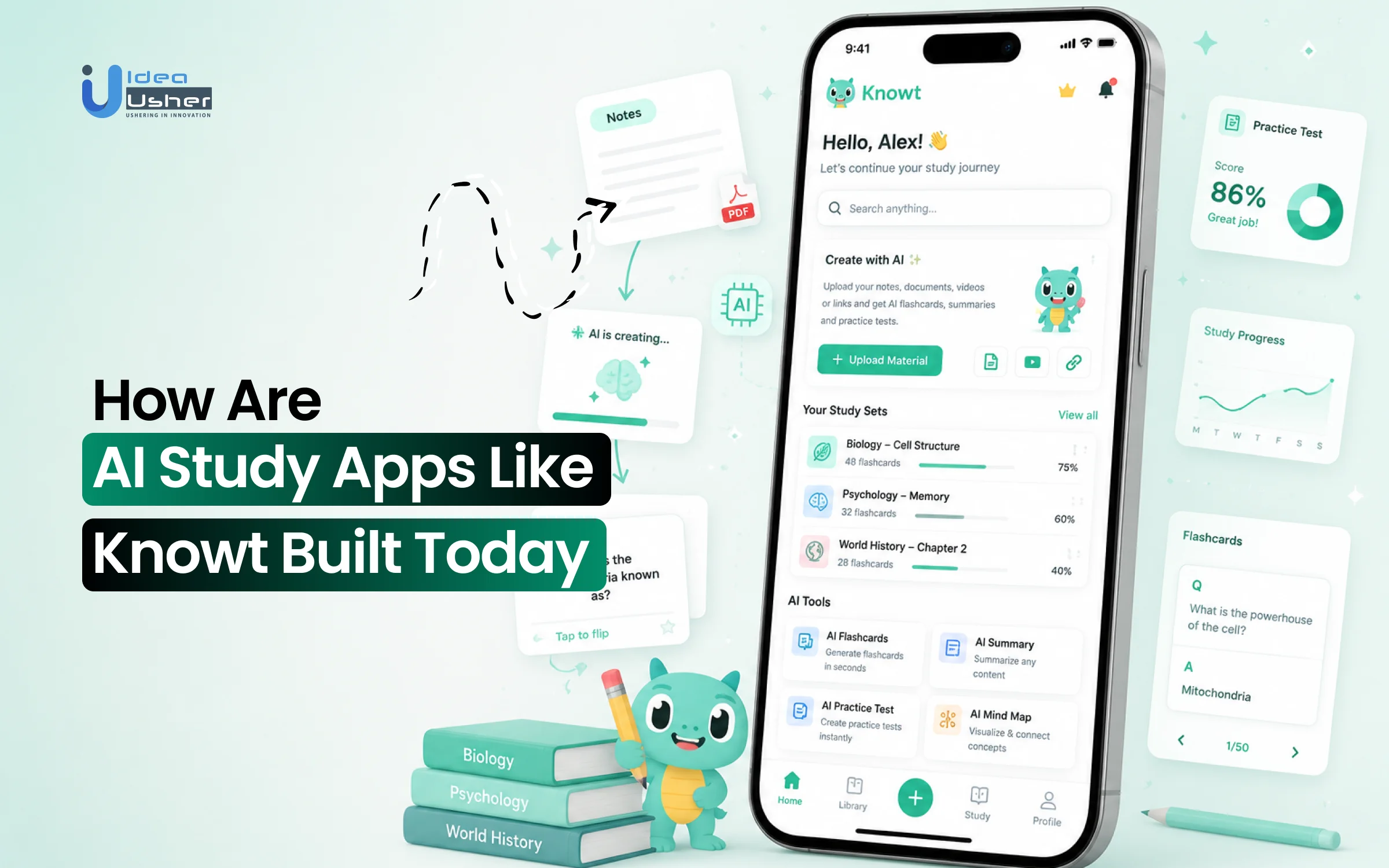
- Knowt automates study preparation by turning notes, PDFs, videos and lectures into flashcards, summaries and quizzes.
- Core features include AI flashcard generation, study guides, practice tests, spaced repetition and AI tutoring.
- The platform improves learning through active recall, personalized revision schedules and adaptive study experiences.
- Its growth is driven by all-in-one learning workflows, Quizlet migration tools and AI-powered automation.
- How IdeaUsher can help you build AI study app like Knowt with content-processing engines, adaptive learning systems.
The biggest inefficiency in education is often not learning itself. It is the time students spend organizing notes, creating study materials and preparing for revision. This shift is driving interest in Knowt app development, where AI-powered automation is transforming study preparation from a manual process into an intelligent, personalized experience.
Traditional study platforms relied on students to manually create flashcards, summarize notes and organize learning resources. Modern learners increasingly expect AI-generated flashcards, note summarization, automated practice tests, study guides, spaced repetition learning and adaptive revision plans. The value is no longer just storing educational content. It is helping students transform information into effective study experiences while reducing preparation time and effort.
In this blog, we will talk about the technologies, AI architecture, core features, development process, costs and how IdeaUsher can help with Knowt app development, reflecting a broader evolution toward AI-powered study ecosystems that combine automation, active recall and personalized learning.
Why AI-Powered Study Platforms Are Growing Fast
The landscape of modern education is undergoing a massive structural shift, driven by exponential market growth and a foundational change in how students interact with information.
The global AI in education market size reached $8.3 billion and is projected to expand rapidly, hitting $11.4 billion, before surging to an estimated $57.2 billion with a compound annual growth rate (CAGR) of 25.9%.
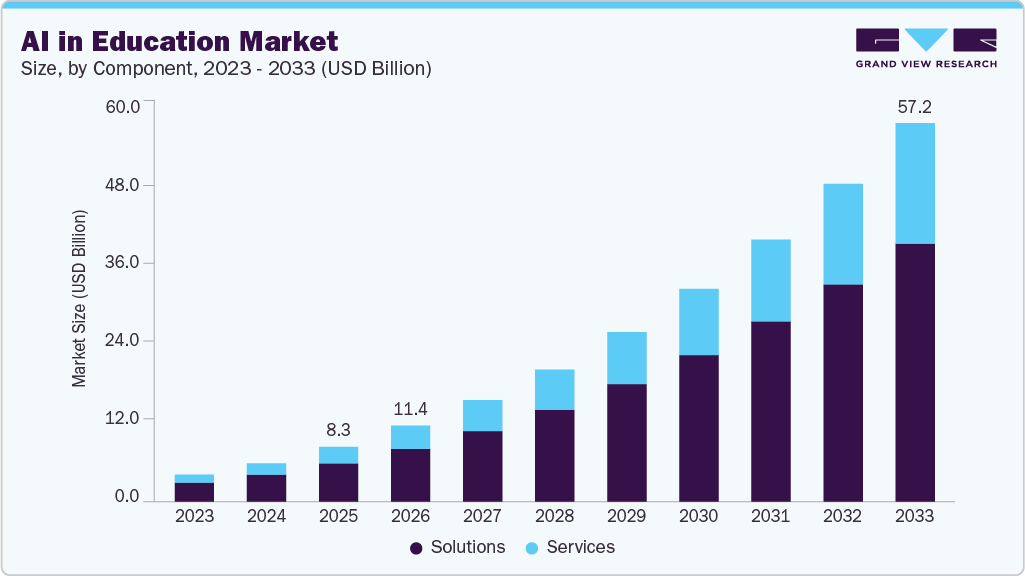
This explosive growth is largely fueled by digital education transitioning from a pandemic-era supplement into a permanent pillar of the $10 trillion global learning ecosystem, according to Infosys.
A. The Shift From Static Study Tools To AI Learning
Traditional study methods relied heavily on static materials such as linear PDFs, physical textbooks, and manual flashcard decks which require immense prep time and offer no active feedback.
- The Death of Manual Prep: With the “solutions” segment commanding over a 68.4% share of the market, students are abandoning manual study guides.
- Algorithmic Automation: With machine learning holding a 64% market share, students are using AI to instantly convert notes, PDFs, and audio into practice exams and spaced-repetition modules instead of manual flashcard creation.
- Active vs. Passive: The focus has shifted entirely from passive reading to dynamic, high-retention retrieval practice that takes seconds to generate.
B. How Students Now Expect Personalized Learning
Modern learners no longer accept a one-size-fits-all approach to education. They expect digital platforms to immediately conform to their specific learning speeds, weaknesses, and academic schedules.
- AI Tutoring Demand: Demand for on-demand private tutoring is driving adoption of Intelligent Tutoring Systems (ITS), which account for 29.6% of the application market.
- Real-Time Learning Feedback: Natural Language Processing (NLP), the fastest-growing technology segment, enables instant, granular feedback on student mistakes, eliminating delays associated with traditional grading.
- Higher-Education Leadership: Higher education represents 44.3% of the end-user market, driven by students seeking adaptive, time-efficient learning pathways to manage demanding academic workloads.
C. Why Platforms Like Knowt Are Seeing Massive Adoption
AI-native platforms like Knowt are experiencing rapid, large-scale adoption by directly capitalizing on the financial and functional limitations of legacy edtech companies.
- Paywall-Driven Market Disruption: The migration of features such as unlimited practice tests and adaptive learning modes behind premium subscriptions created friction among price-sensitive student users.
- Low-Cost AI Alternatives: Platforms such as Knowt gained traction by offering AI-powered study tools at little or no cost compared to legacy providers.
- Frictionless User Migration: Support for importing existing study sets and converting videos, documents, and URLs into flashcards reduced switching costs and accelerated adoption of AI-first learning platforms.
What Is Knowt And Why Is It Popular
Knowt is an AI-powered learning platform that helps students create flashcards, take notes, prepare for exams, and study more efficiently through automation and personalized learning tools. Trusted by over 7 million students globally and positioned as an all-in-one alternative to traditional study apps, Knowt combines AI-driven content generation, note-taking, practice testing, and collaborative learning within a single platform used by millions of students worldwide.
Operating as an “AI-powered study and revision ecosystem,” the platform enables students to convert uploaded materials like PDFs, videos, and notes into instant flashcards, summaries, and practice tests. A key highlight is Knowt’s Quizlet import feature, which lets users easily migrate and upgrade their existing study sets with AI.
A. How Knowt improves Learning than Traditional Study Apps
Knowt enhances learning by combining AI automation, personalization, and collaboration features that streamline study workflows. The table below highlights its key capabilities and their impact on student outcomes.
| Feature | How It Improves Learning |
| AI Flashcard Generation | Converts notes, PDFs, and lectures into flashcards automatically in less than 30 seconds. |
| AI Note Summarization | Creates concise, study-ready notes and concept breakdowns from massive, unstructured content sets. |
| Practice Test Automation | Generates real-time quizzes and mock tests instantly from any raw lecture file or video URL. |
| Quizlet Set Import | Allows students to migrate and enhance existing legacy study sets with a single-click script. |
| Adaptive Revision & Spaced Repetition | Improves long-term retention through an algorithmic, personalized review schedule based on forgetting curves. |
| Collaborative Learning Workspaces | Enables seamless peer-to-peer sharing and group-based studying within centralized digital folders. |
B. How Knowt Transforms Study Materials Into Learning Assets
Knowt’s biggest differentiator is its ability to strip away data passivity, converting unstructured, static files into an interactive study suite. Instead of forcing students to spend hours rewriting documents, the platform automates the pipeline from raw ingestion to active retrieval in four distinct steps:
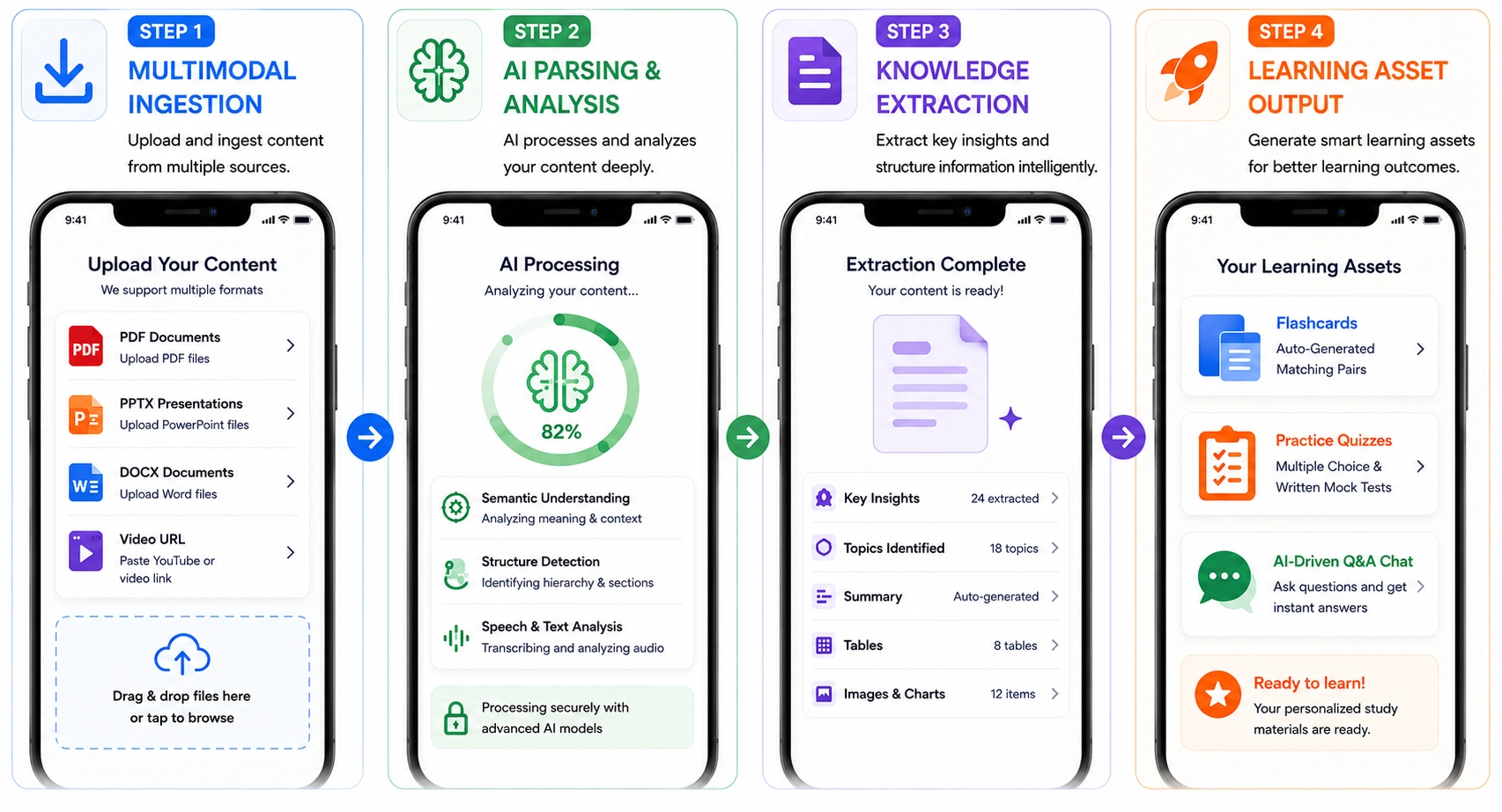
Step 1: Uploading Raw Content.
The user feeds raw data directly into the system and Knowt’s pipeline ingests a highly diverse array of formats, including PDF textbooks, handwritten lecture notes, presentation slides (.pptx), documents, and audio files. It can even process YouTube links or recorded Zoom lecture URLs directly through its integrated Chrome extension.
Step 2: AI Parsing by Kai
Once uploaded, Knowt’s proprietary AI assistant, Kai, scans the material to analyze its core hierarchy. In less than 30 seconds, the engine maps out titles, bulleted patterns, bolded vocabulary terms, and core structural arguments. For videos, it transcribes the audio data and syncs the timestamped text to isolate high-priority topics.
Step 3: Core Knowledge Extraction
Before generating study sets, the AI distills massive, unstructured content blocks into concise, study-ready notes. It automatically captures speaker notes from slide presentations and filters out verbal filler from lecture videos, organizing the remaining content into a structured outline built around clear headings and subheadings.
Step 4: Active Retrieval Output
With the core data structure mapped out, Knowt instantly exports the content into multiple interactive study engines. With a single click, a 60-slide PowerPoint or 20-page PDF is instantly transformed into three distinct, high-utility learning assets:
- Custom Flashcard Decks: Key vocabulary and conceptual pairs are isolated onto front-and-back review cards.
- Practice Quizzes: The system builds adaptive multiple-choice, matching, and written mock exams that mimic actual classroom testing formats.
- AI-Driven Q&A: The material is linked to an interactive chat interface, allowing students to ask clarifying questions directly about their uploaded text.
C. The Growth Strategies Behind Knowt’s Adoption
Knowt’s market expansion is driven by a highly strategic user acquisition framework designed to target the exact pain points felt by Gen Z and higher-education demographics.
- Frictionless Quizlet Migration: Knowt’s one-click Quizlet import eliminates switching costs by allowing students to transfer existing flashcard libraries and enhance them with AI-powered features.
- Free-Learn Competitive Positioning: While competitors moved adaptive learning and unlimited testing behind paywalls, Knowt maintained a robust Free Learn Mode, appealing to price-sensitive students.
- All-in-One Study Ecosystem: Consolidates note-taking, AI content generation, flashcards, and learning analytics into a single platform, reducing reliance on multiple tools.
- Spaced-Repetition Retention Engine: Uses spaced repetition and cognitive decay modeling to deliver targeted review reminders, reinforcing long-term learning habits and improving retention.
The AI Systems Powering Knowt-Style Learning Apps
Modern AI study platforms rely on multiple AI systems working together to automate content creation, personalize learning experiences, improve knowledge retention, and deliver real-time academic assistance. Each AI layer performs a specific role within the learning ecosystem.
| AI System | Purpose Within The Platform | What It Powers |
| Large Language Models (LLMs) | Generate educational content from uploaded learning materials. | Flashcards, study guides, quizzes, notes, and explanations. |
| Retrieval-Augmented Generation (RAG) | Retrieves relevant source content before generating responses. | Accurate study assistance, contextual Q&A, and content-grounded explanations. |
| AI Summarization Models | Condense large volumes of educational content into digestible formats. | Chapter summaries, revision notes, key concepts, and study guides. |
| Semantic Search Engine | Understands meaning and context instead of keyword matching. | Intelligent content discovery, study material retrieval, and knowledge search. |
| Recommendation Models | Analyze learning behavior and engagement patterns. | Personalized study plans, content suggestions, and revision recommendations. |
| Spaced Repetition Algorithms | Determine optimal review timing based on retention patterns. | Adaptive revision schedules and long-term memory reinforcement. |
| Learning Analytics Models | Evaluate learner progress and identify performance trends. | Mastery tracking, progress dashboards, and personalized learning insights. |
| Conversational AI Assistants | Provide real-time educational support and tutoring assistance. | AI tutors, concept explanations, doubt solving, and interactive learning. |
Note: MVP study platforms typically use third-party APIs like Google AI, Anthropic, or OpenAI. To increase personalization and lower costs at scale, organizations eventually transition to proprietary AI, learning analytics, and custom recommendation engines.
AI Workflow For Generating Flashcards And Quizzes
Behind the seamless user interface of AI study platforms lies a highly sophisticated backend data pipeline. Transforming an unstructured, 50-page textbook chapter or a chaotic lecture transcript into mathematically sound flashcards and adaptive quizzes requires a multi-tiered engineering workflow.
Rather than simply guessing at text matching, modern edtech platforms pass data through a structured pipeline that runs from raw character ingestion to long-term memory calculation.
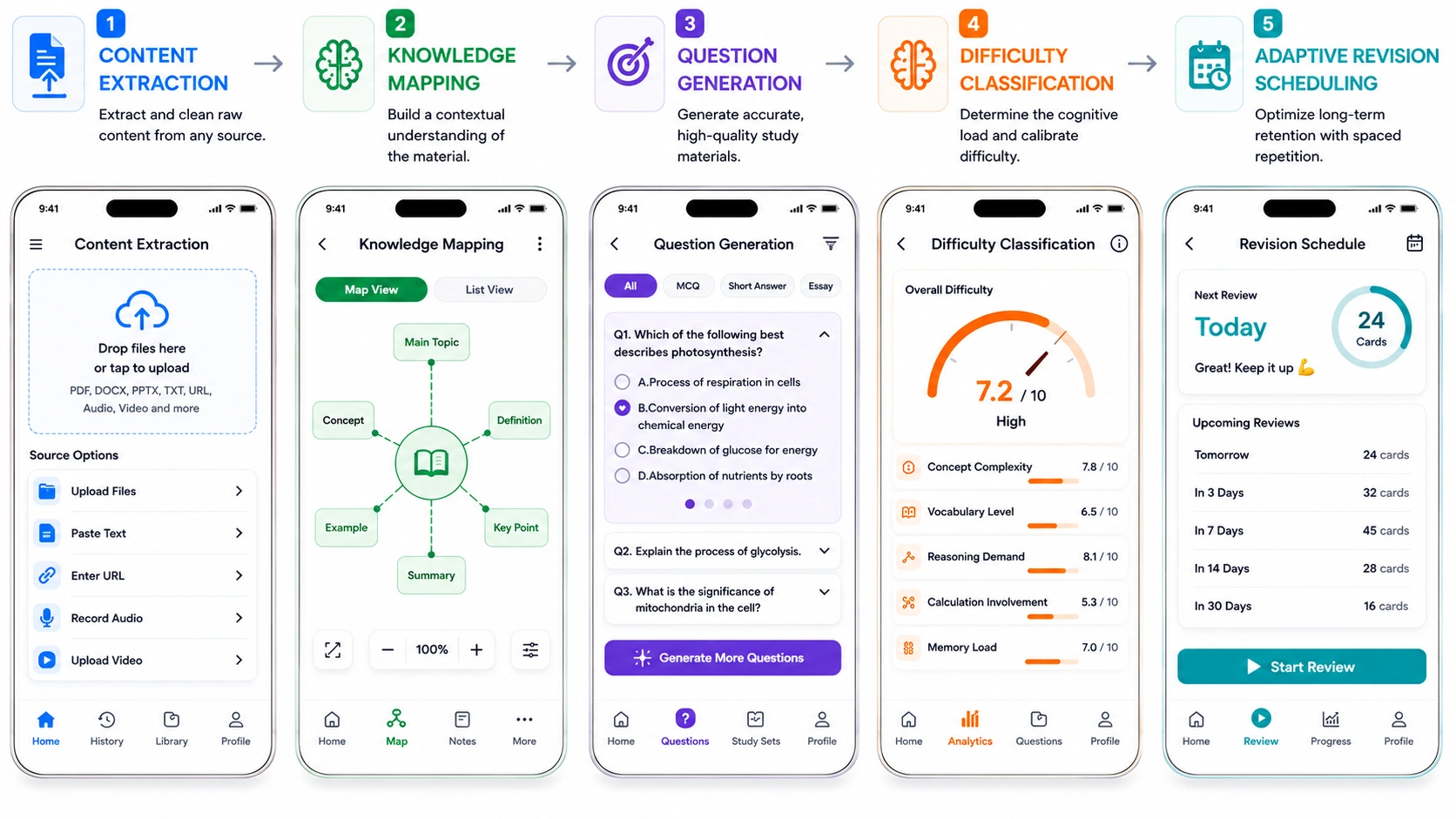
1. Content Extraction
The process begins at the ingestion layer, where the platform faces a highly varied data landscape. Users upload clean text, heavily formatted presentation slides, locked PDFs, or audio/video streams.
- Multimodal OCR Processing: Advanced OCR engines extract text from flattened PDFs, presentation slides, and handwritten annotations, correcting for layout distortions and non-standard document formats.
- Audio & Video Transcription: Speech-to-text (STT) pipelines convert lecture recordings, video content, and sources such as YouTube links into searchable text transcripts.
- Denoising & Content Normalization: Removes verbal fillers (“um,” “like”), web trackers, HTML artifacts, page numbers, and formatting noise, producing clean, structured text optimized for downstream language-model processing.
2. Knowledge Mapping
Once raw text is isolated, the AI engine builds an internal map of what the material is actually about. This is where simple text storage turns into contextual understanding.
- Named Entity Recognition (NER): Identifies core academic entities such as formulas, historical dates, key figures, definitions, and domain-specific legal or medical terminology.
- Semantic Graph Construction: Links extracted entities based on conceptual relationships. For example, in pharmacology, Beta-blockers are connected to Beta-1 receptors and their therapeutic effect of decreased heart rate, creating a structured knowledge graph.
- Informational Weight Assessment: Scores content based on the density of testable facts, entity relationships, and conceptual significance, filtering out low-value sentences and prioritizing high-yield study material.
3. Question Generation
With a clear knowledge map in place, the core Large Language Model (LLM) takes over to build the actual study materials. It relies on specific prompts designed around pedagogical frameworks.
- Distractor Engineering: Generates semantically plausible distractors rather than random incorrect answers, mirroring the challenge level of real standardized exams and testing true subject mastery.
- Syntactic Restructuring: Rewrites content across different sentence structures, active/passive voice, and contextual scenarios to reduce rote memorization and assess conceptual understanding.
- Validation & Knowledge-Map Verification: Cross-checks generated questions against the original knowledge map through programmatic validation to minimize hallucinations and ensure answer-key accuracy.
4. Difficulty Classification
Not all facts are created equal. To build an intelligent test, the platform must categorize the exact cognitive load required to answer each item.
- Bloom’s Taxonomy Classification: Algorithms analyze question phrasing to map content across Bloom’s Taxonomy levels. For example, “What year did X happen?” is classified as Low Complexity (Remembering), while “How does X mechanism impact Y system?” is classified as High Complexity (Analyzing).
- Static Difficulty Scoring: Establishes a baseline complexity score using factors such as sentence length, vocabulary abstractness, and knowledge-map connectivity.
- Dynamic Difficulty Calibration: Continuously refines difficulty ratings using real student performance data. For example, if 85% of learners miss a question, its classification can be automatically upgraded from Medium to Hard.
5. Adaptive Revision Scheduling
The final layer of the workflow integrates the generated content into a continuous cognitive engine, moving the platform from a simple creation tool to a long-term retention hub.
- SuperMemo-2 (SM2) Algorithm Mapping: Every flashcard and quiz question is assigned a unique tracking ID linked to a variant of the SM2 spaced-repetition algorithm, enabling individualized review scheduling.
- Personalized Forgetting Curve Modeling: The system tracks pass/fail history, response accuracy, and answer speed to calculate each learner’s personal forgetting curve and memory-retention profile.
- Dynamic Review Intervals: Correct responses progressively extend review intervals (e.g., 1 day → 4 days → 12 days), while incorrect answers reset the repetition cycle, bringing concepts back into immediate review to reinforce long-term memory retention.
Core Features Required To Build An AI Study App like Knowt
Knowt’s popularity stems from simplifying exam preparation through AI-powered automation, instant study material generation, and active-recall learning tools. The platform’s effectiveness is driven by several interconnected capabilities that form the foundation of a modern AI-powered study experience:
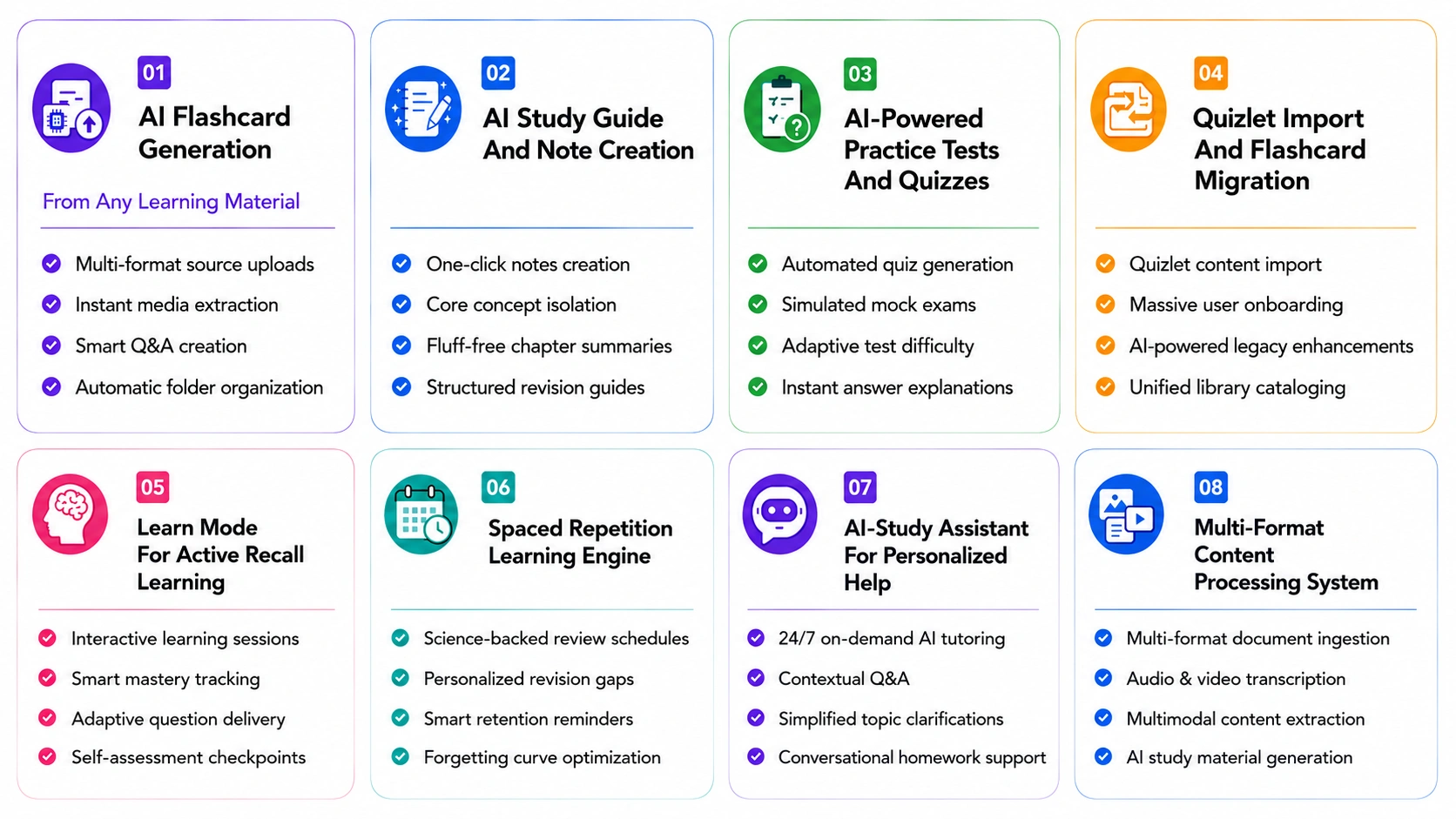
1. AI Flashcard Generation
To save students hours of manual study preparation, the application features an instant asset creation tool. This feature lets users turn their raw learning materials into complete, interactive flashcard decks with a single click, taking the friction out of self-testing.
- Multi-Format Source Uploads: Allows students to drop in textbook PDFs, PowerPoint presentation slides, handwritten lecture notes, and web articles effortlessly.
- Instant Media Extraction: Scans digital media layouts and video transcripts to immediately pull out the most important academic talking points.
- Smart Question-Answer Creation: Uses advanced AI to read the uploaded files and automatically write clean, ready-to-use active-recall question pairs.
- Automatic Folder Organization: Files and groups newly generated flashcard decks into organized subject folders so the workspace remains perfectly clean.
2. AI Study Guide And Note Creation
Students are frequently overwhelmed by hundreds of pages of unorganized classroom materials right before final exams. This feature acts as an automated editorial assistant, distilling massive, cluttered reading files into beautifully structured reference sheets.
- One-Click Notes Creation: Transforms heavy textbook chapters and long lecture transcripts into clear, scannable master notes in seconds.
- Core Concept Isolation: Pulls out essential historical dates, mathematical formulas, definitions, and formulas so students can skip the filler text.
- Fluff-Free Chapter Summaries: Automatically condenses long, complex book chapters into bite-sized summaries optimized for rapid reading and review.
- Structured Revision Guides: Formats all extracted study highlights into clean document layouts with clear headings and organized bullet points.
3. AI-Powered Practice Tests And Quizzes
True exam confidence requires active self-evaluation long before entering the physical testing hall. This feature acts as a personal academic evaluator, generating custom practice assignments that challenge a student’s actual concept retention.
- Automated Quiz Generation: Reads a user’s uploaded class notes to instantly build relevant multiple-choice questions, writing prompts, and true/false blocks.
- Simulated Mock Exams: Mimics real standardized test rules and formats to give students a realistic practice run under timed conditions.
- Adaptive Test Difficulty: Automatically shifts the complexity of incoming questions based on the user’s performance to keep them appropriately challenged.
- Instant Answer Explanations: Delivers helpful, immediate text breakdowns the exact second a question is answered, explaining the underlying logic behind correct and incorrect options.
4. Quizlet Import And Flashcard Migration
A major barrier for students switching to a new EdTech app is the fear of losing their older study materials. This data bridge serves as a major user acquisition tool, letting students move their entire historical study library onto your app seamlessly.
- Quizlet content import: Pulling existing flashcard sets from older platforms instantly via simple link-pasting tools or a browser extension without breaking card formatting.
- Massive User Acquisition Onboarding: Removing the friction of rebuilding thousands of study cards from scratch, making it highly attractive for students to ditch paid alternatives.
- AI-Powered Legacy Enhancements: Upgrading imported text-only cards automatically by appending contextual descriptions, related practice questions, and memory-anchoring images.
- Unified Historical Library Cataloging: Indexing migrated study sets directly into the student’s new workspace folders under the correct subject tracks immediately upon arrival.
5. Learn Mode For Active Recall Learning
Rote memorization often fails when students face unpredictable exam questions. This interactive practice mode converts static card flipping into an adaptive learning journey that ensures students thoroughly understand the material.
- Interactive Learning Sessions: Guides students through a systematic review process that mixes flashcards, multiple-choice options, and typing challenges.
- Smart Mastery Tracking: Monitors individual card answers in real time, moving items along from “learning” to “mastered” status as the student proves retention.
- Adaptive Question Delivery: Automatically prioritizes a student’s weakest cards, serving them more frequently until the student remembers the correct answer.
- Self-Assessment Checkpoints: Prompts students to rate their own confidence on open-ended written questions to reinforce deep mental recall.
6. Spaced Repetition Learning Engine
Sustaining long-term data retention requires moving academic insights from short-term memory into permanent cognitive storage. This framework acts as an automated memory manager, calculating optimal review windows to ensure concepts are reinforced right before they slip away.
- Science-Backed Review Schedules: Predicts exactly when a student is about to forget a previously learned concept based on their individual learning curve.
- Personalized Revision Gaps: Automatically stretches out the time between review reminders for easy cards while keeping high-friction cards close in the queue.
- Smart Retention Reminders: Sends timely push notifications alerting students precisely when an older flashcard deck is ripe for a quick memory refresher.
- Forgetting Curve Optimization: Eliminates wasted study time by keeping students focused on vulnerable information rather than topics they already know perfectly.
7. AI Study Assistant For Personalized Help
When a student hits a roadblock while studying late at night, searching through a search engine often provides overwhelming walls of text. This module introduces an active, conversational study companion that provides instant, clear explanations on demand.
- 24/7 On-Demand AI Tutoring: Provides a round-the-clock text workspace where students can ask open-ended questions about tough concepts in their notes.
- Contextual Question Answering: Remembers the exact document the student is currently studying, letting them ask follow-up questions naturally without re-uploading files.
- Simplified Topic Clarifications: Breaks down dense academic jargon into simple everyday analogies and language tailored to the student’s grade level.
- Conversational Homework Support: Walks students through multi-stage math equations or logic puzzles step-by-step rather than just blurting out the final answer.
8. Multi-Format Content Processing System
A truly modern study hub must adapt to the fragmented ways students absorb information, which ranges from traditional reading to video lectures. This processing pipeline acts as a universal document translator, normalizing messy media types into neat text data.
- Multi-Format Document Ingestion: Supports high-speed uploads of PDFs, PowerPoint presentations, Word documents, and other academic materials.
- Audio & Video Transcription: Converts lecture recordings and audio content into synchronized, searchable text transcripts.
- Multimodal Content Extraction: Links visual slides, document content, and audio timestamps within a unified knowledge asset to preserve context.
- AI Study Material Generation: Transforms uploaded content into chapter summaries, flashcards, quizzes, and other interactive study resources with minimal user effort.
How to Build an AI Study App like Like Knowt
A high-performance AI study app like Knowt app development requires combining multi-format media processors with adaptive retention models. We systematically transform your EdTech concept into a frictionless cross-device platform that automates asset curation, drives high user retention, and scales digital subscription channels.
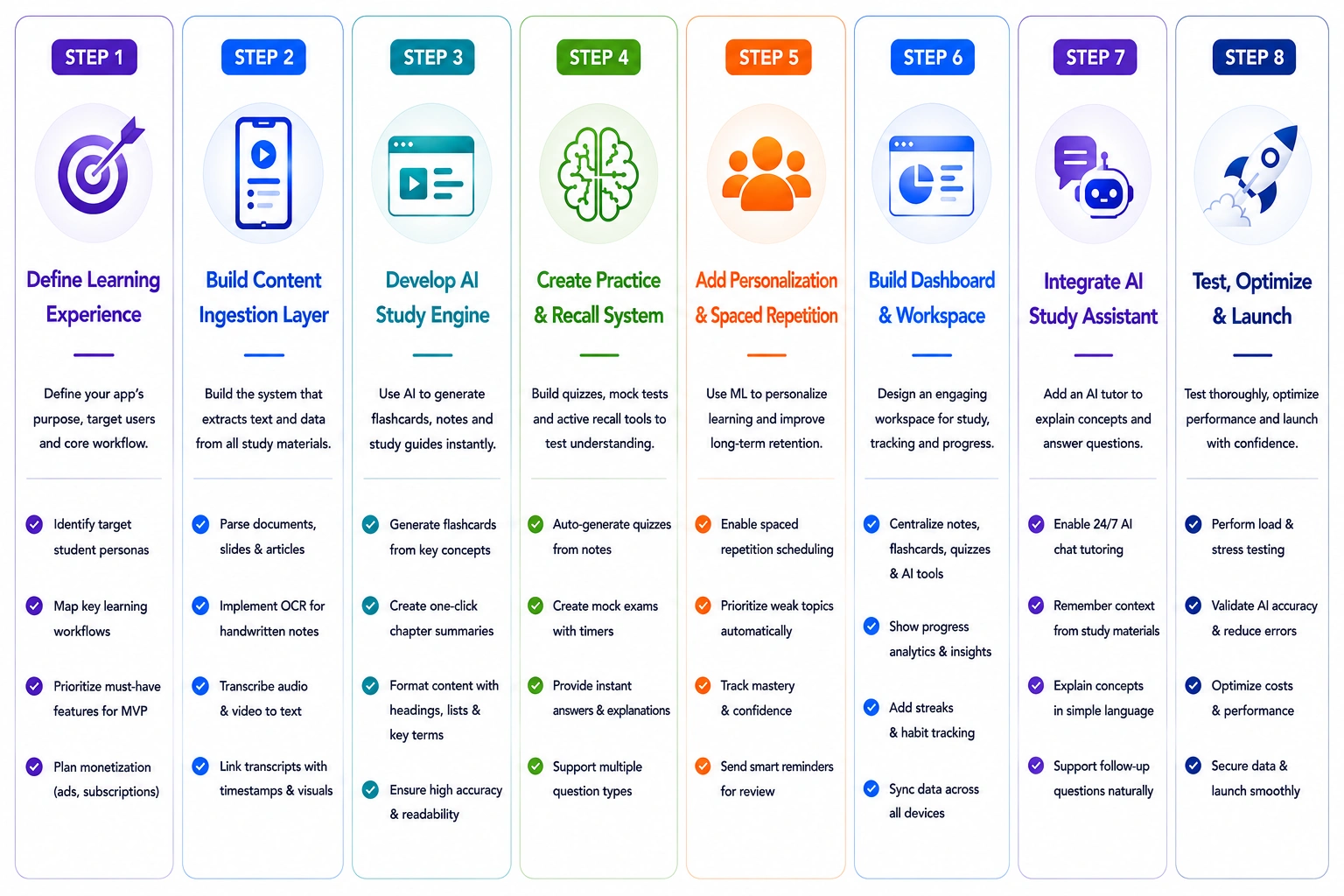
1. Defining The Learning Experience And Product Scope
Our product strategists blueprint your app’s core business logic long before writing code. We define target student personas, map multi-format study workflows, prioritize viral feature sets like external library importers, and structure high-yield MVP parameters to ensure rapid initial market traction.
- Target Workflow Alignment: Grouping critical system components based on how modern students naturally toggle between video lectures, textbook reading, and active test preparation.
- MVP Priority Tracking: Isolating essential, crowd-pleasing tools like instant flashcard synthesis to accelerate your product launch while keeping early development overhead lean.
- Monetization Blueprint Setup: Integrating flexible, non-intrusive ad mediation paths alongside premium subscription tiers to capture immediate, scalable recurring revenue streams.
2. Building The Content Ingestion And Processing Layer
Our software engineers build a robust media processing pipeline to serve as the Knowt app development foundation. We construct high-speed text extraction microservices for textbook PDFs and presentation slides while deploying cloud-native audio-to-text transcription networks to handle heavy video lectures smoothly.
- Frictionless Multi-Format Parsing: Coding automated backend bridges that seamlessly ingest and extract core academic details from documents, slideshows, and articles.
- Handwriting OCR Pipelines: Integrating visual character recognition models to accurately scan and convert handwritten student notebook pictures into clean, searchable digital text.
- Video and Audio Transcription: Deploying high-fidelity speech-processing models that transcribe recorded lecture tracks, automatically linking verbal timestamps with visual presentation data.
3. Developing AI Engines For Flashcards And Study Guides
Our artificial intelligence engineers integrate advanced large language models to remove the tedious administrative barriers of studying. We design custom prompt engineering matrices that automatically generate active-recall question pairs and draft beautifully structured, fluff-free master notes.
- Automated Card Synthesis: Programming language models to instantly parse uploaded lecture files and extract key terms into interactive flashcard decks.
- One-Click Study Summaries: Coding text-simplification routines that strip away textbook filler language, delivering punchy, high-retention reference sheets in seconds.
- Structured Data Formatting: Developing custom parsing rules that organize AI text outputs using clear markdown headings, bold terms, and scannable list boxes.
4. Creating Practice Tests And Active Recall Systems
Our application developers build interactive knowledge evaluation modules during Knowt app development to verify actual student comprehension. We code automated multiple-choice and short-answer quiz builders, program realistic timed mock exam templates, and deploy immediate, logic-driven answer validation networks.
- Instant Quiz Generation: Building backend triggers that scan a user’s uploaded class notes to immediately generate relevant, curriculum-matched testing challenges.
- Simulated Test Environments: Developing timed exam screens that mimic the strict rules and formatting layouts of real-world standardized test boards.
- Explanatory Review Overlays: Programming immediate feedback windows that display helpful logic explanations for correct and incorrect answers the millisecond a choice is made.
5. Implementing Personalized Learning And Spaced Repetition
Our machine learning specialists deploy predictive analytics to map every student’s long-term memory performance. We construct personalized review scheduling engines that optimize learning curves, write automated mastery scoring systems, and build data-driven personal study roadmaps.
- Spaced Repetition Scheduling: Programming modified cognitive memory algorithms that calculate individual forgetting thresholds to surface past review materials at perfect intervals.
- Dynamic Material Prioritization: Adjusting daily study check-list priorities automatically based on a student’s ongoing performance, moving weak areas to the front.
- Adaptive Progress Tracking: Designing predictive user scoring loops that translate daily quiz metrics into an accurate confidence rating ahead of actual school exams.
6. Building The Student Dashboard And Learning Workspace
Our frontend teams design an intuitive, central workspace optimized for daily student engagement. We construct beautiful progress tracking wheels, code active study-time counters, build clean note-management systems, and organize saved resource folders into an all-in-one platform.
- Unified Workspace Management: Bundling note summaries, active flashcards, AI helpers, and quiz modules into a single, seamless user interface that limits distractions.
- Habit-Building Streak Trackers: Creating time-zone-aware activity monitors that reward continuous daily app check-ins to maximize your daily active user count.
- Cross-Device Sync Infrastructure: Structuring real-time cloud database synchronizations to keep study files and calendars perfectly matched between mobile and desktop apps simultaneously.
7. Integrating AI Study Assistants And Conversational Learning
Our AI engineers implement an interactive, context-aware conversational learning assistant. We build secure 24/7 text dialogue workspaces, program natural language concept explanation workflows, and optimize background search loops during Knowt app development to provide instant, clear answers on demand.
- 24/7 On-Demand AI Tutoring: Developing a round-the-clock chat environment where students can type or speak open-ended questions about complex study topics.
- Contextual Document Memory: Engineering conversation retention loops that allow the AI assistant to remember the specific page or textbook the student is currently reading.
- Simplified Analogical Explanations: Designing language routing logic that automatically translates dense academic jargon into simple everyday stories matched to the student’s age group.
8. Testing, Optimization, And Platform Launch
Our DevSecOps department subjects your application to exhaustive pre-production stress tests after Knowt app development to ensure absolute server stability. We evaluate AI factual accuracy, run hallucination reduction routines, implement strong data protection frameworks, and coordinate smooth global cloud rollouts.
- High-Volume Load Stressing: Flooding global server layers with massive simulated user queries to ensure the system handles viral, exam-season traffic spikes flawlessly.
- Factual Accuracy Audits: Running automated validation scripts over generative text outputs to eliminate hallucinations and secure 100% academic correctness before public launch.
- Token Cost Management: Optimizing model prompt sizes and cloud storage pipelines to drastically minimize third-party API processing overheads and protect your business margins.
How Much AI Study App Like Knowt Development Cost
An AI study app like Knowt app development requires investment across product strategy, AI-powered learning features, content management systems, user engagement tools, cloud infrastructure, and platform development. The overall budget depends on feature complexity, AI capabilities, scalability requirements, and the level of personalization offered to learners.
An AI study platform is typically developed in phases, with each stage contributing to the overall learning experience, performance, and long-term scalability.
| Development Phase | Estimated Cost | What the Phase Covers |
| Discovery & Planning | $5,000 – $40,000 | Requirement gathering, learning workflow mapping, feature planning, AI strategy, and technical architecture definition. |
| UI/UX Design | $5,000 – $50,000 | Student-focused interface design, accessibility optimization, wireframing, prototyping, and user experience validation. |
| Core Platform Development | $15,000 – $180,000 | User accounts, flashcards, study sets, note-taking tools, quizzes, progress tracking, and content management. |
| AI Integration & Development | $10,000 – $180,000 | AI-powered study assistance, content generation, summarization, personalized recommendations, and learning automation. |
| Security & Infrastructure | $5,000 – $80,000 | Data protection, user authentication, cloud infrastructure setup, access controls, and performance optimization. |
| Testing & Deployment | $10,000 – $70,000+ | Quality assurance, performance testing, AI model validation, cloud deployment, and launch preparation. |
| Total Estimated Cost | $50,000 – $600,000+ | Overall development investment based on platform scope and feature complexity. |
Note: Actual Knowt app development costs may vary depending on AI model complexity, third-party integrations, user volume expectations, content generation requirements, and long-term scalability goals.
A. Why AI Costs Are Lower in MVPs and Higher in Enterprise Platforms
AI development costs vary significantly between MVP and enterprise-level study apps because the scope, intelligence, infrastructure, and customization requirements are fundamentally different.
| Platform Level | Why AI Costs Differ |
| MVP | MVPs usually use pre-trained APIs like OpenAI or Google AI for flashcards and Q&A. Implementation typically costs $10,000–$30,000, with monthly fees between $100–$1,000 for several thousand users. |
| Mid-Level | This tier adds personalized analytics, AI study plans, and behavioral workflows. Development typically costs $30,000–$100,000, with monthly infrastructure and model fees reaching $1,000–$5,000 as the user base expands. |
| Enterprise | Enterprise platforms necessitate complex AI tutoring, adaptive engines, and custom fine-tuning. AI development ranges from $100,000–$300,000+, with monthly operational costs between $5,000–$25,000+ based on complexity and volume. |
Key Reason: Using existing AI services allows MVPs to validate ideas while cutting costs by 60%–80% compared to custom systems. Enterprise platforms, however, prioritize proprietary AI, personalization, and scalability for long-term advantage.
For example, an MVP may serve 1,000–10,000 monthly users via third-party APIs. Conversely, enterprise platforms often manage 100,000+ users and millions of interactions with sub-2-second response times, greatly increasing infrastructure and optimization expenses.
B. Development Cost Based on Platform Level
The following Knowt app development estimates reflect current market rates for developing AI-powered educational platforms with varying levels of functionality and scalability.
| Platform Level | Estimated Cost | Features Included |
| MVP | $50,000 – $120,000 | User registration, flashcards, study sets, note-taking, quizzes, basic AI assistance, progress tracking, and cloud hosting. |
| Mid-Level | $120,000 – $250,000 | AI-generated flashcards, study recommendations, collaborative learning tools, advanced analytics, content sharing, and personalized learning paths. |
| Enterprise | $250,000 – $600,000+ | Advanced AI tutoring, adaptive learning algorithms, real-time collaboration, multilingual support, predictive analytics, LMS integrations, and scalable cloud infrastructure. |
Note: The Knowt app development costs can exceed $750,000 for large-scale educational platforms that require advanced AI models, extensive content libraries, enterprise integrations, global user support, and highly scalable infrastructure.
C. Factors That Influence Development Budget
The AI study app like Knowt app development cost can vary significantly depending on platform scope, AI capabilities, integrations, content management requirements, and scalability objectives. Several technical and business factors directly impact the final investment.
- Feature Complexity: Advanced study tools, collaborative learning features, adaptive learning systems, and personalized study experiences can add $15K–$100K+ depending on customization requirements.
- AI Capabilities: AI-generated flashcards, automated note summarization, intelligent tutoring, content recommendations, and learning analytics can increase costs by $20K–$200K+ depending on model complexity.
- Third-Party Integrations: LMS platforms, cloud storage services, educational content providers, analytics tools, and payment gateways can add $10K–$100K+.
- Content Management System: Robust content creation, organization, sharing, and moderation capabilities can add $10K–$75K+ to development costs.
- Scalability Requirements: Supporting large numbers of students and AI-powered interactions often requires enhanced cloud infrastructure and backend optimization, adding $10K–$100K+.
- Cross-Platform Accessibility: Supporting web, iOS, Android, tablets, and accessibility standards can add $10K–$60K+ in design, testing, and maintenance expenses.
Monetization Models of AI Study Apps
AI study platforms earn revenue through subscriptions, premium AI tools, educational partnerships, licensing, and exam-preparation content. Successful platforms monetize both individual learners and institutions, creating recurring income streams while increasing user lifetime value through diverse offerings.
| Monetization Model | Primary Customers | Revenue Potential |
| Freemium Subscription Plans | Individual learners | $5–$20/month per subscriber or $60–$240/year |
| Premium AI-Powered Learning Features | Power users and students seeking advanced support | Can increase ARPU by 20–50% |
| Institutional And Educational Licensing | Schools, universities, and training organizations | $500–$10,000+ annually per contract |
| Exam Preparation And Premium Study Resources | Students preparing for exams and certifications | $25–$200 per study package or course |
The table highlights the most common revenue streams. Below is a closer look at how each monetization model works in practice.
1. Freemium Subscription Plans
Most users access flashcards, notes, and study tools for free, while advanced AI capabilities, unlimited usage, premium study modes, and enhanced learning features are offered through monthly or annual subscriptions. Premium plans often range from $5 to $20 per month, with annual plans providing discounts of 15–30%.
2. Premium AI-Powered Learning Features
Platforms often charge for high-value AI functionality such as AI tutoring, unlimited flashcard generation, advanced study guides, personalized learning plans, AI explanations, and practice test generation. AI-powered features can increase average revenue per user (ARPU) by 20–50% compared to basic subscription plans.
3. Institutional And Educational Licensing
Schools, universities, coaching centers, and educational organizations purchase platform licenses that provide centralized administration, student access management, analytics dashboards, and collaborative learning capabilities. Institutional contracts can range from a few hundred dollars annually for small organizations to $10,000+ per year for larger educational institutions.
4. Exam Preparation And Premium Study Resources
Many platforms generate revenue through premium exam-specific content, practice question banks, certification preparation materials, study packs, and specialized learning resources for competitive examinations. Dedicated exam-prep packages often sell for $25–$200 depending on the exam type, content depth, and level of support provided.
Key Challenges During AI Study Apps Development
Developing AI study apps like Knowt involves more than integrating AI models into a learning platform. Developers must overcome challenges related to educational accuracy, content processing, personalization, and scalability while ensuring students receive reliable, engaging, and effective learning experiences.
1. AI-Generated Learning Content Accuracy Maintain
Challenge: AI models can generate inaccurate flashcards, misleading explanations, or incorrect quiz answers when processing complex educational content.
Solution: Our developers implement retrieval-augmented generation (RAG), source validation pipelines, prompt engineering, and human-reviewed testing frameworks to ensure generated study materials remain accurate, contextually relevant, and educationally reliable.
2. Multiple Learning Formats Processing
Challenge: Students upload PDFs, lecture notes, presentations, videos, and audio files that require accurate extraction and understanding.
Solution: We build multi-format content ingestion pipelines using OCR, transcription engines, document parsers, and AI preprocessing workflows that transform diverse learning materials into structured educational content.
3. Delivering Meaningful Personalized Learning Experiences
Challenge: Creating genuinely personalized study recommendations requires understanding learning behavior, retention patterns, strengths, and weaknesses.
Solution: Our team develops recommendation engines, learner profiling systems, progress tracking frameworks, and adaptive learning algorithms that continuously personalize revision schedules, study plans, and content suggestions.
4. Scaling AI Systems For Growing User Demand
Challenge: As user activity increases, AI-powered study apps must handle larger workloads without compromising speed, reliability, or user experience.
Solution: We design scalable AI architectures using cloud-native infrastructure, load balancing, intelligent resource allocation, and performance optimization techniques to ensure consistent application performance as usage grows.
Partner With IdeaUsher to Build AI Study App Like Knowt
IdeaUsher is a premier global technology solutions provider with 11+ years of industry experience engineering disruptive mobile and web applications across 50+ countries. Backed by a dedicated powerhouse of 250+ niche experts, over 1,000+ completed projects, and an exceptional 4.9/5 Clutch rating, we excel at building advanced AI-driven EdTech software.
By combining streamlined data-import with multimodal AI parsing, automated note-to-flashcard conversion, and responsive study tools, we create scalable digital ecosystems that capture market share and drive enterprise growth.
Why Enterprises Partner With Us
Forward-thinking entrepreneurs choose IdeaUsher because we smoothly bridge fast, user-centric frontends with highly complex, automated cross-platform document ingestion and predictive machine learning architectures.
- Frictionless Multimodal AI Processing: Our engineers design high-performance data processing pipelines that effortlessly convert uploaded text notes, textbooks, and multimedia lecture videos into structured summaries and active-recall flashcard decks in seconds.
- Frictionless External Platform Synchronization: We build robust, secure API integrations and Chrome extensions that allow students to seamlessly import existing study sets and data from external platforms without losing formatting or content structure.
- Science-Backed Adaptive Learning Matrices: We build predictive review schedules powered by customized spaced repetition algorithms, tracking individual student learning curves to surface materials at optimal intervals for maximum memory retention.
- Scalable Cross-Device Synchronizations: Our development teams specialize in structuring real-time, cloud-native database architectures that perfectly synchronize notes, practice tests, and study analytics between mobile and web app versions concurrently.
Ready to disrupt the global educational market with a high-speed, AI-powered flashcard and note-taking utility? Partner with IdeaUsher’s principal EdTech software architects to map your technical product development strategy today.
Conclusion
An AI study apps like Knowt are changing the way students learn by bringing content creation, personalized learning, active recall, and exam preparation together in one easy-to-use platform. Building a successful app involves much more than adding AI models. It requires strong content processing, adaptive learning features, scalable infrastructure, and an engaging user experience. As interest in AI-powered education continues to grow, businesses that invest in innovative, learner-focused study platforms have a great opportunity to reach a growing EdTech market and build long-term value.
Things to Know
Q.1. What Features Are Essential In An AI Study App?
A.1. Successful AI study apps typically combine AI flashcard generation, study guides, practice tests, spaced repetition, personalized learning recommendations, and content processing capabilities that transform educational materials into interactive learning experiences.
Q.2. What Is The Cost To Build An AI Study App Like Knowt?
A.2. Development costs typically range from $50,000 for an MVP to over $600,000 for enterprise platforms, depending on AI capabilities, feature complexity, integrations, scalability requirements, and customization needs.
Q.3. Why Is Spaced Repetition Important In AI Learning Apps?
A.3. Spaced repetition helps learners review information at optimal intervals, improving knowledge retention, reducing forgetting rates, and creating more effective long-term learning outcomes through personalized revision schedules.
Q.4. How Do AI Study Apps Generate Revenue?
A.4. AI study platforms commonly generate revenue through freemium subscriptions, premium AI features, institutional licensing, exam preparation resources, and educational partnerships that create recurring and scalable income streams.