

Key Takeaways
- You bootstrap liquidity by seeding a small number of popular markets with your own capital and an AMM that always quotes prices.
- Start with a loss-capped model like LMSR, so you know your worst-case cost before launch.
- Now, bring in the professional market makers. Give them fast APIs and live pricing feeds. If you can also get them rebates, they might be more eager to join.
- Limit your exposure, and keep the collateral. State the rules of settlement clearly. All of this will increase the credibility of your platform.
- See how Idea Usher can help businesses build a prediction market and manage its liquidity from day one.
While launching a new prediction market, businesses usually face a liquidity issue. Traders like to trade with smaller spreads, whereas liquidity providers like to see some volume in the market before they start quoting any prices. To solve this issue, businesses will need a built-in incentive, a specialist market maker, and the right people to get early participation.
In most cases, new prediction markets stay at a standstill. Order books look empty, and those who come generally leave after watching a bigger spread. Teams that get past it tend to treat liquidity as something they build deliberately before launch, not something that shows up on its own once the market goes live. In this blog, we’ll discuss how that works in practice, from seeding the first prices to keeping traders around once the volume starts coming in.
Why Are New Prediction Markets Booming?
All new prediction markets are booming because people can easily bet their money on any future events, and businesses have found they can use the same prices to plan ahead. The trend sits inside a bigger story about data. According to Fortune Business Insights, the value of the global predictive analytics market was around USD 22.22 billion in 2025, and in the very next year, the value went up to USD 27.56 billion. It is very possible that this can reach up to USD 116.65 billion by 2034.

Source: Fortune Business Insights
That is a lot of money chasing better forecasts, and prediction markets are one of the easiest ways for normal people to join in. In 2025, Kalshi and Polymarket had less than 2 billion in monthly volume, but by July this year, the figure went up to 53 billion dollars.
Growing Demand for Event Trading
A lot of people don’t just want to sit around and watch the events happen. They want to take part in those events, and prediction markets make this thing possible. In these markets, people can set a clear yes-or-no price for any event they want. Sports are actually the biggest contributors to the growth of this sector. For Kashi, around 80% of its volume came from sports in July, 2024. When the World Cup started, Kashi got a volume of 30 billion dollars in June 2024. New platforms can also jump in fast when the crowd is already there.
Rothera Shows How Fast Demand Moves
Rothera can be a great example, as it runs through a joint venture with Robinhood’s Susquehanna International Group. This company was just started in June this year, and it already has a trading volume of around 2 billion dollars. For any new prediction, this is a pretty big number.
Better Real-Time Information Access
Polls usually take time. Somebody has to ask the questions, collect the answers, and add them up. But for prediction markets, the price of Yes and No fluctuates in real time, as there’s real money on the line. Kalshi has made partnerships with CNN and CNBC, which allow them to show real-time prediction data on their platform.
The numbers look good too, but they are not perfect. Here is what researchers found:
So the speed is real, but accuracy depends a lot on the platform and how many people are trading. Thin markets can still swing around.
New Revenue Opportunities for Businesses
Many businesses have started to view prediction markets as a cheaper alternative for insurance. A restaurant from Los Angeles traded $60,000 on Kalshi to hedge against the Dodgers missing the World Series. If the team loses early, there will be fewer fans coming to see the match, which means less business for the restaurant. Traditional insurance would not cover these types of risks.
Crypto.com’s OG Platform
Crypto.com is another player pushing into this space. It launched a standalone prediction platform called OG in February, after offering similar contracts through its derivatives arm since late 2024. It has also been in talks to add its markets to Robinhood’s hub, and it announced a deal with a Trump-linked media business to bring prediction markets to Truth Social. Big money is moving in as well. ICE put $2 billion into Polymarket. When brokers, exchanges, and media companies all want a piece, it is easy to see why new markets keep popping up.
Why Can’t a New Prediction Market Find Its First Traders?
A new prediction market struggles to find its first trader because nobody wants to go first. Traders look at the order book and see a wide gap between the buying and selling prices. A single trade can also move the price a long way. They read that as a cost and leave. Market makers look at the same empty book. With no trades, there are no orders to fill and nothing to earn, so they stay away too.
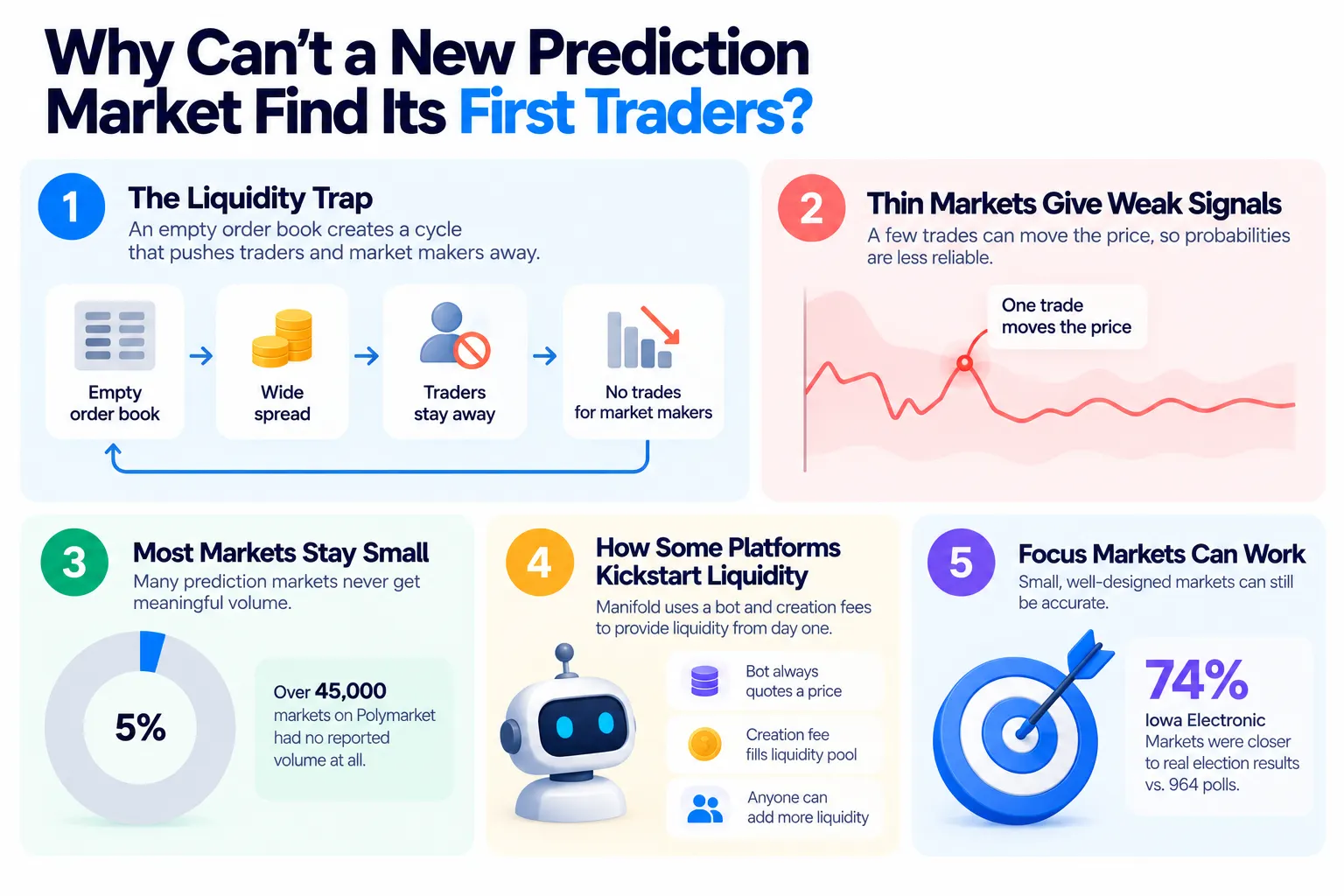
Each side waits for the other. If the first trader doesn’t show up, neither does the second, and the market stays quiet. Any prices that are posted are hard to trust. Serious traders see that as one more reason to hold off for now.
1. How Empty Order Books Trap Liquidity
The trap works like a loop that feeds itself:
- The order book is empty, so the spread is wide.
- A wide spread makes trading expensive, so traders stay away.
- With no trades, market makers see no reason to quote.
- With no quotes, the order book stays empty.
Most of the industry lives with this problem every day. Over 45,000 markets on Polymarket, nearly 5% of all closed markets, had no reported volume at all. Evercore ISI strategists found that just 8% of markets on Kalshi and Polymarket ever reached $1 million in volume. A new market starts out in that same crowd. It has to stand out before anyone will bother with it.
Empty books hurt traders in a real way. Constantin Bürgi, an economics professor at University College Dublin, said a single trade can move prices a lot more in a thin market than in a heavily traded one. Volume in these shallow markets is also dominated by bots. A regular person who walks in gets a bad price and leaves. That is the trap closing shut.
Manifold Fills the Book on Day One
Manifold Markets solves this a different way. It uses a bot that always quotes a price, so a trader is never facing an empty book. When a market is created, the creation fee is used to fill the liquidity pool. Anyone can add more liquidity to a market, and the site describes it as a subsidy for getting your question answered. The idea is simple. Someone pays to get the first trades going so the rest can follow.
2. Thin Markets Produce Unreliable Probabilities
Even when a thin market has a price, it is a weak one. A few trades can set it, so it shows what a tiny group thinks and not what lots of people think. One research paper found that probabilities can move a lot when the displayed liquidity is thin. Evercore ISI studied five years of completed markets on Polymarket and Kalshi and found that high-volume markets give more reliable probabilities, while most quoted probabilities sit in the thinly traded tail where calibration is weakest. That is a bad starting point for a new market trying to earn trust.
Experts do not fully agree, though. Here is how they see it:
So a thin market is not always wrong. You just cannot lean on it as much, and traders know that.
The Iowa Electronic Markets Stay Small on Purpose
The Iowa Electronic Markets show that small does not have to mean bad. It is a small-scale, real-money market where investments are typically capped at $500 per trader and usually average less than a tenth of that. Even so, in a comparison with 964 national polls, it was closer to the real election result 74% of the time.
The trick is design. The market sticks to election outcomes, and its director says too many markets spread expertise too thin. A new market can learn from that. Focus on a few questions people really care about, and the small crowd can still give you a useful price.
Where Should Your First Liquidity Dollars Go?
Your first liquidity dollars should go into a small number of events that people already want to trade, with a hard cap on how much you can lose on each contract. Spreading money thin across lots of markets is the fastest way to end up with empty order books everywhere. Kalshi’s own incentive program shows how small this can start.
The targets of reward periods are usually an order size of 100 to 20,000 contracts, while the daily rewards can be around 10$ to 1,000$. So, you won’t need a huge budget to start. You need to pick the right markets and protect yourself while you learn.
Rank Events by Demand First
Before spending any type of money, first you need to observe what type of events people will trade on. The demand will obviously not be the same for all the topics. Sports are the clearest example. Sports made up about 80% of Kalshi’s volume and 39% of Polymarket’s since July 2024. Big events make it even clearer. Kalshi did more than $30 billion in volume in June while the World Cup was on, and Polymarket hit a record $10.8 billion. If you fund a market that nobody cares about, the money just sits there.
A quick way to rank your list:
- Check the calendar first. Big tournaments and big votes bring crowds.
- Look at what already trades well on other platforms.
- Instead of uncommon niches, people prefer simple questions with one clear answer.
Concentrate Capital, Not Hundreds of Markets
It feels smart to list hundreds of markets so there is something for everyone. Having said that, things might not work out well if you do that. According to a review of more than 21,000 mid-term markets, it was found that a lot of volume was going to popular markets, while the smaller markets barely get any attention.
That means money spread across the narrow ones will mostly be wasted. Pick a few markets and make the order book thick enough that a trader can actually get in and out.
How you pay people matters too. Polymarket tried automated market makers, found them lacking, and switched to paying providers to post quotes. Kalshi is ending its volume-based rewards, but it keeps a separate liquidity program that pays for resting orders that improve the order book. The lesson is simple. Pay for good quotes, not just for trading activity.
How Limitless Stayed Focused
After that, it closed a 10M dollar seed round, and it also crossed a total volume of 500M dollar. Next, Limitless Exchange is thinking about adding smaller markets of 1, 10, and 15 mins into its platform. It did not try to list everything. It went deep on one thing people already wanted.
Set Maximum Exposure per Contract
Even if you choose the markets correctly, things can go wrong. So, you should place a ceiling for every contract. Market makers can get stuck if one side of their quote fills and the other side doesn’t. Good ones set hard inventory limits on how much one-way risk they will take before they pull quotes or hedge. You can do the same for your own liquidity budget by deciding the most you will lose on any single contract before you start.
Exchanges use caps like this too:
| Platform | Cap per contract |
| Kalshi | The rulebook once set a $25,000 position limit on all contracts, and now allows higher limits where that makes sense. |
| PredictIt | Raised from $850 to $3,500 per client. |
Why PredictIt Picked $3,500
PredictIt’s new limit has a clever reason behind it. It matches the federal individual campaign contribution limit, which also helps with worries that rich bettors might try to push a market toward their own candidate. The change came with a new deal with the CFTC, and the old limit of 5,000 traders per contract was lifted.
How Do You Recruit Market Makers Before Launch?
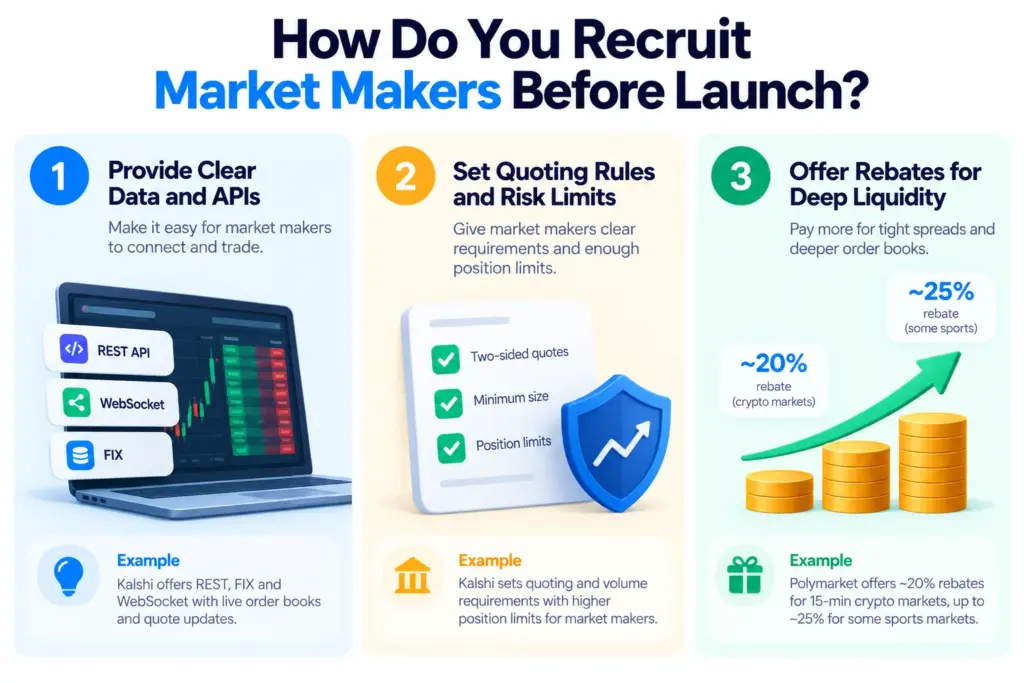
To recruit market makers, make their job simple and keep their risk low. Give them clean data and a good API. You can also pay them more for quotes that deepen the order book. Your pitch should mention the money, but it shouldn’t be the main part. Polymarket pays market makers a rebate of roughly 20% on its 15-minute crypto markets, and on some sports markets it can reach 25%.
1. Build the Data and API Access
Most market makers are bots, so they will look at your tech before they hear your story. They want live prices, the order book, and fills that feed straight into their own systems. Kalshi is a good model here. Its request-for-quote system runs over REST, FIX and WebSocket, and quote updates arrive on a separate WebSocket channel.
Polymarket works the same way for developers. Its official clients pull in each market’s fee rate and add it to signed orders. If your docs are messy, a good market maker will move on.
ForecastEx Went Where Traders Already Were
ForecastEx, the prediction market run by Interactive Brokers, took a practical route. Its Forecast Contracts can now be traded through the TWS API, which Interactive Brokers clients already use. A trading firm doesn’t have to build anything new to quote them. The contracts are commission-free, and they also pay an incentive coupon similar to interest, at 3.83% APY. Making it cheap and easy to connect is a good selling point, and a small platform can borrow the idea.
2. Agree on Quoting and Risk Limits
Once the tech works, you need an agreement. The market maker says it will quote both sides, and you say you will protect it. Kalshi’s designated market makers promise consistent two-sided liquidity. The terms differ in places, as the table shows.
| Platform | What the market maker promises | What it gets |
| Kalshi | Set quoting and volume requirements | Lower fees and some adjusted position limits |
| Polymarket US | A minimum spread and minimum displayed size on assigned contracts | A per-contract rebate on each day the requirements are met |
Risk matters as much as pay. Kalshi gives market makers with quoting obligations a higher position accountability level, so they can keep their quotes up without hitting a limit. Without that room, a market maker has to pull its quotes at the worst possible moment.
CME Group and FanDuel
CME Group and FanDuel have taken a different route on who does the quoting. Duffy of CME has said the exchange has many market makers, though some competitors rely on a single one. FanDuel formed a joint venture with CME Group for event contracts, and the partnership became FanDuel Predicts, a branded prediction market app.
One question stayed open. Analysts wondered whether FanDuel would supply liquidity itself. Relying on several professional quoters spreads the risk, so one firm leaving doesn’t break your market.
3. Reward Deep Markets With Rebates
A rebate is the best way to say thank you to the ones who actually show up. The best designs pay for good quotes and not just for activity. Polymarket redistributes taker fees daily to market makers to encourage deeper liquidity and tighter spreads. Rebates are shared out in proportion to each maker’s share of filled maker liquidity, and they are worked out per market, so makers only compete with others in the same market. That is fair because someone quoting in a quiet market is not beaten by a giant in a busy one.
Should Your First Market Use an AMM or a Market Maker?
Start with an AMM, and bring in professional market makers once people begin to trade. An AMM quotes prices from day one, even when nobody else shows up. It costs your own money, though, and it works poorly at larger sizes. Professional makers cost nothing up front, but they won’t quote an empty market. Use the two in overlapping phases. The order book gradually takes over the load, and the AMM steps back.
1. Use LMSR to Quote Early
LMSR stands for logarithmic market scoring rule. A professor named Robin Hanson devised this simple formula for running prediction markets. Under LMSR, buying or selling shares of an outcome doesn’t require another party on the other side, which is what a new market needs. It also caps your loss. The market maker’s maximum loss equals the liquidity parameter b times the natural log of the number of outcomes. With two outcomes, that is b times ln 2.
The catch is that you have to choose b yourself. A larger b makes the market deeper but raises the maker’s potential loss. A very small b lets a small trade move the price a lot. A very large b makes the possible loss big. Treat b as an estimate, start small, and adjust it gradually.
Delphi Lets the Community Cover the Loss
Gensyn’s Delphi runs a fully on-chain LMSR market maker. It has an LMSR Vault where community members deposit funds, and the Vault backs the market maker. The team sets b so that the maximum loss stays inside the Vault. They publish the fee, b and the Vault’s coverage ratio. The operator therefore doesn’t carry the whole subsidy alone, and spreading the cost this way is a sound approach.
2. Professional Makers Give Two-Sided Quotes
An AMM gives one price. A professional maker gives a better one. Reliable institutional market makers help a platform keep spreads tight. They follow the news, reprice quickly, and quote both sides in large size. Kalshi learned this by doing it. It built its own trading team first, then partnered with SIG. Still, no maker quotes without a reason.
At the start, they usually want some real trading interest so their quotes get filled. They also want a fast, stable API for connecting bots, and clear rules on how much risk they can take.
Hyperliquid Built HIP-4 Around the Order Book
When Hyperliquid launched HIP-4 outcome markets, it left out the AMM entirely. The markets run on the same on-chain order book as its perpetual futures, so the existing market maker network can be reused. There is also a merged order book that combines orders from both sides in one place, which cuts the thin-liquidity problem on the NO side roughly in half. On launch day, 6.05 million contracts traded, with about $6.2 million in notional value.
Anyone who wants to create a market has to stake 1 million HYPE. The stake is meant to stop the book from filling with low-quality markets. Hyperliquid’s makers were already there, so it didn’t need an AMM.
3. Combine AMM Backstop With Order Book
You don’t have to stay with one model forever. The AMM starts the market, the order book handles larger volume, and a hybrid runs both in turn. First the AMM arrives, so traders can always get a price. Then professional makers place limit orders inside the AMM’s spread. Once the book is deep, the AMM becomes a backstop that fills only when the book has nothing good. Polymarket took this path. It began with an AMM and later moved trading to an order book.
Builders should watch for one issue. A bug report on an open-source hybrid router showed that sending orders to the book first can give the taker a worse price than the AMM would have. The router should always compare the book price with the AMM price and pick whichever is better for the trader.
4. Compare Capital Efficiency and Downside Risk
The two models cost very different things. This table shows the main trade-offs:
An AMM burns your own capital to get things moving, and some researchers think that is a real cost. Typically, the market maker is expected to take a loss to subsidize more liquidity and faster price discovery, and that loss can be large. An order book keeps your money safe, but it can sit empty. So spend small on an AMM at the start, cap the loss with b, and let professional makers take over the heavy lifting once the traders arrive.
How Do You Attract Traders Without Buying Fake Volume?
You attract real traders by going to where the crowd already is and by paying only for things that help the market. Launch around events people already follow. Build your audience before each market opens. Reward orders that sit on the book and give other traders better prices. Then check how many people come back after the rewards end. Volume you buy fades fast, but traders who return on their own are the ones who stay.
1. Launch Around Events People Follow
The easiest traders to win are people who already care about something. Big events bring them in all at once. When the World Cup kicked off, Kalshi did more than $30 billion in volume in June, and Polymarket hit a record $10.8 billion. Sports have made up about 80% of Kalshi’s volume since July 2024. If you launch a market on something nobody is talking about, you have to pay people to care. If you launch it during a big match or vote, they show up on their own.
Underdog Started With Its Own Fans
Underdog is a good example because it already had an audience from fantasy sports. It launched a prediction market product through a partnership with Crypto.com, offering sports event contracts in 16 states, mostly where sports betting has not been legalized. Eilers & Krejcik data cited by DraftKings shows nearly 70% of sports prediction market consumer volume comes from states without legal sportsbook access. Underdog did not have to hunt for people. It put a new product in front of fans who were already there.
2. Build Distribution Before Opening Markets
Opening a market is easy. Getting people to see it is hard. So build your reach first, then open the market. Kalshi signed deals with CNN and CNBC to show real-time prediction data on their channels. A market that gets space on a big screen or in a big app doesn’t have to beg for its first trade.
Settle these things before opening:
- A partner with a real audience, such as a news channel or an app people open every day.
- A specific event date, so people know when to show up.
- A simple path to sign up and place a first trade.
DraftKings Bought Its Way to an Audience
DraftKings Predictions shows how far distribution can go. The Railbird deal reportedly involved $50 million up front and another possible $200 million in incentives. The app launched in 38 states and started out using outside exchanges before weaving in Railbird later. It launched in December and relies on contracts listed by Crypto.com and CME Group. The lesson is that the app and the audience came first. The exchange behind it could follow.
3. Reward Resting Liquidity, Not Wash Trades
Paying for volume sounds sensible, but it is easy to cheat. Someone can trade with themselves and collect the reward. A Columbia University study found this on Polymarket. It estimated that about 25% of trading volume may be wash trading, roughly $4.5 billion out of $18 billion. The researchers said a large driver was probably users trying to game a planned airdrop. Fake volume does no good, because it adds no real depth and gives no real information.
How much of it there was depended on the type of market:
A safer way to pay is for orders that sit on the book. Kalshi’s liquidity program rewards resting orders that give other traders better prices, even if the orders never get filled. Kalshi also took a hard look at its older volume program. It decided to end its Volume Incentive Program amid wash trading allegations, although Kalshi says wash trading does not occur on its platform.
4. Measure Repeat Trading After Incentives
A bonus can make almost anything look busy. The real question is what happens when you turn it off. Many platforms hand out promotional credit only after qualifying trades, in stages, or with an expiry date, so that only active accounts benefit and dormant ones don’t. Do the same, and when the credit runs out, watch who stays.
Here is a simple way to check:
If your numbers only look good while you are paying, you bought attention and did not earn it.
When Should You Change Your Liquidity Model?
You should change your liquidity model when your numbers tell you the old setup has stopped working. Watch your spreads and depth every day, then change the plan when something clear happens. If professional makers start quoting, move toward an order book. If real traders can pay for the depth on their own, cut your subsidies. If a market can never hold liquidity, shut it down. Do not change things just because it feels like time. Change them when the data says so.
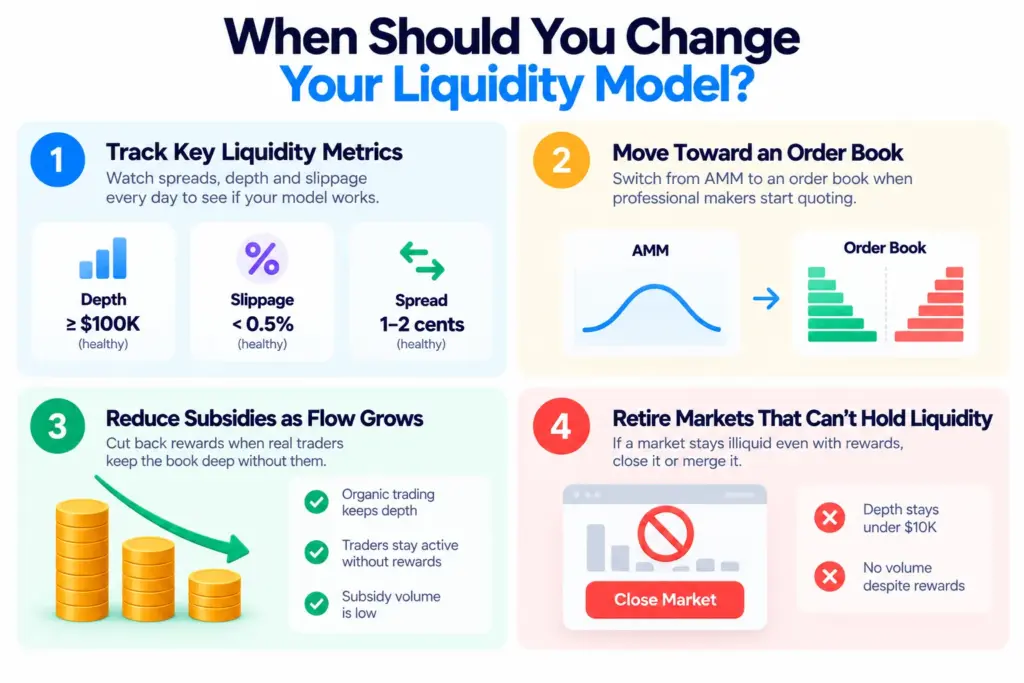
1. Track Spreads, Depth, Slippage by Size
You need one fixed test before you can spot a change. Pick a few order sizes and check the same ones every day. Realized slippage for standardized order sizes gives the most direct evidence of how well trades actually get filled. A quoted spread can look fine while a real order still pays a lot more. Here is a simple scale to start with:
If your numbers sit in the weak column for several days in a row, your current model is not enough. If they sit in the healthy column even when you pull back, you may not need as much help as you thought.
2. Move Toward an Order Book
Most markets do not stay on one model for life. A common path is to bootstrap new contracts with an automated market maker, then move active flow to an order book as volume grows. The signal to look for is simple. Market makers start posting limit orders inside the AMM’s spread, and the AMM then turns into a backstop that fills only when the book has nothing better. Polymarket followed this path, starting on an AMM and later moving to an order book.
You know it is time when:
- Professional makers quote tighter than your AMM does
- Most trades fill against the book and not against the AMM
- Your AMM is barely getting used
Fanatics Markets Moved From Borrowing to Owning
Fanatics Markets is a good example of changing models as things grow. It launched on markets and pricing provided by Crypto.com | Derivatives North America. That meant it could skip the hard work of building depth and use Crypto.com’s. Later, as it grew, it decided to own more. Fanatics agreed to acquire Water Street Labs and CX Clearinghouse from BGC Group so it could list and clear prediction markets itself. By then it was available in 23 states and four US territories. It borrowed first and built later, which is a smart order to do it in.
3. Reduce Subsidies as Organic Flow Grows
Subsidies are like training wheels. You do not want to leave them on forever. The best sign that you can cut back is that real traders keep the book deep even on days when you are not paying. Kalshi has changed its own rewards over time. It filed to retire its volume-based rewards, but kept a separate Liquidity Incentive Program that pays for resting orders that improve the order book. That program pays $10 to $1,000 a day, and Kalshi can end or change it at any time. So even the biggest names treat rewards as something that can shrink.
Polymarket’s rebates show another smart way to do it. The vast majority of its markets have no trading fees, but certain markets charge a small taker fee that funds the rebates. Those fees are redistributed daily to market makers to encourage deeper liquidity and tighter spreads. The money comes from real traders, so the subsidy grows when there is activity and shrinks when there is not.
Coinbase Borrowed Depth Instead of Paying for It
Coinbase never had to build its own depth. When it launched prediction markets, all of the market flow came from Kalshi, with plans to add contracts from other platforms later. It made thousands of Kalshi contracts available to trade. Coinbase plugged into depth that already existed, so it did not need to pay anyone to quote. That works when a partner already has strong flow, and it is worth checking before you spend money of your own.
4. Retire Markets That Cannot Hold Liquidity
Not every market will make it, and keeping dead ones open costs you attention and money. Over 45,000 markets on Polymarket, nearly 5% of all closed markets, had no reported volume at all. Just 8% of markets on Kalshi and Polymarket ever reached $1 million in volume. Many narrower markets barely trade, even when the big winner markets are busy. That shows how normal it is for a market to fail.
A simple rule can keep things clean:
- Set a floor, like the $10,000 depth line from the table above.
- If a market stays under it for a set number of days even with rewards on, stop the rewards.
- If it still does not recover, close it or fold it into a bigger market on the same topic.
Take the money you save and put it into the markets that are actually working.
What Must Your Platform Handle Before Launch?
A new prediction market must do four things well before it goes live. It needs fresh prices from live data and bots. It needs a way to stop one trader or one event from putting the whole platform at risk. It needs fair settlement even when the answer is messy. And it needs to stay smooth when a lot of people show up at once. If any of these fail early, traders stop trusting you, and that trust is very hard to win back.
1. Connect Bots to Live Pricing
A market maker starts with a fair probability, but the price they show also has to reflect inventory, capital, costs and the risk of a sudden resolution. So your platform must let them plug in their own models. They also need to update quotes as news changes and watch exposure across contracts tied to the same event. If your system can’t do this, good market makers will leave or quote very wide spreads.
Kalshi is a good example. When Susquehanna joined as its first major institutional market maker, Kalshi said the firm would give close to 30x the liquidity in select markets. Traders could then move about 100,000 shares at a time in some major markets. More recently, Cantor Fitzgerald opened block trading to roughly 3,000 institutional clients, with Susquehanna as the flagship market maker. Big firms only show up when the plumbing is ready.
What your bot connection needs:
- An API for placing orders, pricing, trade execution and market data
- Webhooks and real-time feeds for market updates
- A clear pricing model, either an order book or an AMM
- A view of exposure across linked contracts
2. Enforce Exposure Limits and Collateral
Some events pull in a huge crowd in a very short time. That creates concentrated exposure, so you need tools to watch live positions, set limits, pause markets and review odd activity. You also have to decide who pays when a trade goes wrong. The safest rule is that every trader funds the full possible loss up front.
Kalshi shows how this can loosen over time. Its clearinghouse, Kalshi Klear, filed to use risk-based margin on some event contracts. The margin would follow a one-day price move, stay capped at the maximum loss, and meet the CFTC’s 99% confidence standard. Sports markets and brand-new markets would stay fully collateralized. A new platform should do the same and start fully funded.
3. Test Settlement Under Bad Conditions
Every event needs clear settlement rules before anyone trades. For operators, the settlement engine is one of the most important parts of the whole system. Most platforms test the easy case where the answer is obvious. The real danger is the messy case where people argue about what the words mean. That is where users decide if your platform is fair.
When Resolution Goes Wrong
Polymarket learned this the hard way. A market asking if Zelenskyy would wear a suit drew more than $237 million in volume and ended as “No” even though many people thought otherwise. The price of “Yes” fell from $0.19 to $0.04 after the vote closed. Fewer than ten UMA holders supplied nearly all of the roughly 18 million UMA staked, and three addresses had over 70% of the vote weight. Earlier, a $7 million market on a Ukraine mineral deal resolved to “yes” even though no deal was signed.
Recent Polymarket Product Updates
Polymarket keeps building anyway. It bought the licensed exchange QCEX to operate under the CFTC and then launched Polymarket US. It added Combos, where market makers compete to price multi-leg trades through a request-for-quote system. It also launched Squads for group trading, Polymarket Perps, and a Trust & Safety program with new user protections. The lesson is simple. New features are fun, but settlement trust comes first.
4. Stress-Test Matching Under Sudden Demand
Your platform must process orders quickly, update prices in real time and handle large volumes during peak events. Kalshi shows both sides of this. It had a record $21.5 billion week and crossed 100 million trades for the first time, at 106.6 million. But it also had rough nights. On one college football Saturday, its direct platform had data loading lag from extreme demand, while API and Robinhood trading kept running.
The Super Bowl hurt in a different way. Payment infrastructure became a point of failure and some deposits were delayed because of the traffic. Kalshi later refunded users whose resting orders were filled by API traders during the downtime. So the app, the payments and the matching engine can each fail on their own. Test them one by one.
How to run your stress test:
- Send far more traffic than you expect on your biggest day.
- Test deposits and withdrawals separately from trading.
- Check what happens to resting orders when the front end lags.
- Practice the pause switch and a refund plan before you need them.
Develop a New Prediction Market with Idea Usher
IdeaUsher helps businesses build prediction market platforms with custom trading features, real-time liquidity solutions, and secure transaction systems. With 500,000+ hours of coding experience and a team that includes ex-MAANG and FAANG developers, we help turn your prediction market idea into a scalable platform. Our team focuses on your business goals and the technology needed to support long-term growth.
Custom Prediction Market Development
Build a platform with custom markets, user dashboards, order books, and trading features tailored to your business model. We can develop features for different event categories and user needs. This helps you create a platform that fits your target audience and market strategy.
Real-Time Trading and Liquidity
Integrate real-time price updates, market-making systems, and liquidity mechanisms to support smoother trading and better market participation. We can help design order-matching workflows and trading interfaces that respond to market activity. The goal is to create a more reliable experience for traders and liquidity providers.
Secure and Scalable Architecture
Develop a secure architecture with reliable transaction processing, wallet integration, and infrastructure designed to handle growing trading activity. We focus on access controls, data protection, and system reliability as the platform expands. This gives your business a stronger technical foundation for future features and higher user demand.
Conclusion
Bootstrapping liquidity on a new prediction market takes more than a few good markets and a launch day push. You need real market makers and a pricing setup they can plug into. You need clear limits and collateral rules so one big trade can’t hurt the platform. You also need fair settlement and a system that stays up when traffic jumps. Get these right before launch and traders will trust you and keep coming back. If you want help building this the right way, our team can walk you through a liquidity plan made for your market.
FAQs
A1: There is no single number that works for every market. The better way is to decide how much you can afford to lose and set your liquidity from that. With the common LMSR automated market maker, the worst loss is the liquidity setting b times the natural log of the number of outcomes. A yes-or-no market has two outcomes, so the most you can lose is roughly 0.69 times b. If you set b at $1,000, you know your risk tops out near $693. This keeps the cost clear and fixed. It is also smarter to put that money into a few popular markets than to spread it thin across many.
A2: Yes, you can. An automated market maker always stands ready to quote prices and fill orders, so traders never wait for someone on the other side. Some platforms also let anyone fund a reward pot in a chosen market so liquidity providers get paid over a set time. Community vaults are another route where regular users supply the money that backs the pricing. The catch is that spreads stay wide in quiet markets because makers cannot offset their positions easily. So this works well for launch but most platforms bring in pros as volume grows.
A3: LMSR is the best place to start for most new platforms. It always provides liquidity and it caps the worst loss no matter what traders do. That makes the launch budget easy to plan. The downside is that the liquidity setting is fixed when the market is created, and it can get too costly to subsidize at scale. Newer designs like concentrated-liquidity AMMs can use capital better. A smart path is to launch with LMSR and move to an order book or a hybrid when your volume is ready.
A4: Market makers post both buy and sell prices and keep the gap between them as the spread. Many platforms add extras on top. Polymarket pays rebates and runs a liquidity rewards program where USDC goes straight to maker addresses. Kalshi has a designated market maker program for approved firms that can come with rebates or better fee deals. Some firms even get equity. Jump Trading was reported to be taking small stakes in Kalshi and Polymarket in return for providing liquidity. The risks are real, though. Informed traders can pick off stale quotes and a maker can get stuck with a position that is about to resolve to $0 or $1.
A5: The goal is to move from paying for liquidity to earning it. One way is to fund maker rebates from taker fees so the trading itself pays the bills. Polymarket works this way and redirects fees from takers to makers. Another way is to bring in a big institutional maker so you rely less on your own money. When Susquehanna joined Kalshi it gave close to 30x the liquidity in select markets. You can also let market creators or partners fund their own reward pots. And as more makers compete the spreads get tighter on their own so you can cut your rewards step by step.