


Key Takeaways
- Short-term expenses can be a lot easier to handle when people can use a part of their paycheck before payday using cash advance platforms.
- The best options usually stand out through faster transfers, flexible limits, and a simpler overall experience.
- Some apps work directly with users, while others connect with employers to provide early access to wages.
- For businesses, there is growing potential in payroll-linked products and financial wellness solutions.
Sometimes, getting money at the right moment matters the most. We all know that paychecks follow a fixed schedule, but there can be times when people might face some unexpected bills. This gap has created demand for earned wage access apps that let employees access part of their income before payday. EarnIn is one of the better-known names in this space, but newer platforms are taking different approaches to how users access funds and manage short-term cash needs. For businesses entering this market, the bigger opportunity is to create a simple and trustworthy experience that helps users handle cash flow without turning every financial challenge into long-term debt.
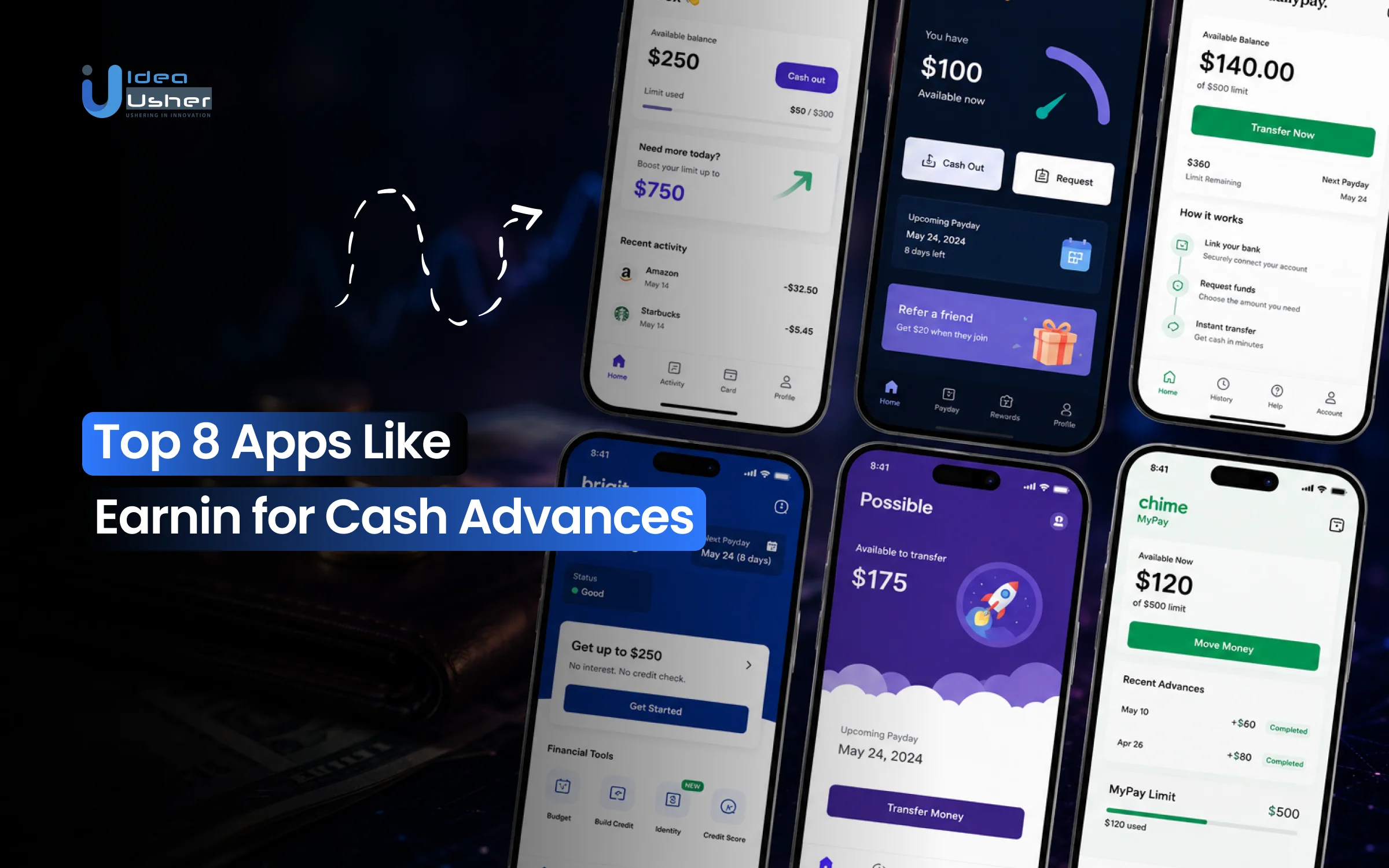
Earned wage access has changed how employees manage short-term financial needs by giving them more flexibility between paydays. We’ve worked on cash advance solutions that use real-time payroll integration and secure financial data analytics to support faster and more reliable access to earned income. In this blog, we look at the top 8 apps like EarnIn for cash advances and examine the features, technology, and business models that make these platforms useful to their users.
Market Demand for Wage Access Apps
According to Research And Markets, the mobile wage access apps market is projected to grow from $4.77 billion to $6.66 billion, reflecting a strong 39.4% CAGR. This growth highlights the increasing demand for flexible access to earned wages. Workers are looking for faster ways to manage expenses before payday, while employers are exploring wage access as a valuable financial wellness benefit.

Source: Research And Markets
Rising Demand for Early Wage Access
Traditional payroll schedules do not always match the timing of everyday expenses. Wage access apps address this gap by letting eligible workers access part of their earned income before payday. The scale of usage shows how quickly the category has developed:
- 7.2 million workers used employer-partnered earned wage products in 2022.
- These platforms facilitated around $22.8 billion across 214 million transactions.
- Direct-to-consumer providers facilitated another $9.1 billion for roughly 3 million consumers.
DailyPay is one example of how this demand has translated into business growth. The company reported 351% revenue growth over the period measured for Deloitte’s Technology Fast 500 ranking. DailyPay does not publicly disclose the corresponding revenue amount in dollars, so presenting an estimated dollar figure as company revenue would be misleading.
Growing Adoption of Earned Wage
Employers are increasingly looking at wage access as an employee benefit rather than simply another payment option. It can give workers greater flexibility while helping businesses strengthen their overall benefits package. A survey of employers offering DailyPay found that 44% said employees specifically requested earned wage access. Around 67% said EWA made the greatest day-to-day impact among the financial wellness benefits they offered.
Payactiv provides another example. The company works with employers to give workers access to earned wages through payroll-connected services. Payactiv reported processing more than $2.5 billion in 2019 alone. This is transaction volume rather than company revenue, and Payactiv does not publicly disclose a verified annual revenue figure in dollars.
What this means for employers: Wage access can become part of a broader strategy around financial wellness, recruitment and employee retention rather than operating as a standalone payroll feature.
Opportunities for Fintech Businesses
Growing usage creates opportunities for businesses that can offer something beyond basic early wage access. A new platform could focus on a particular workforce or solve gaps that larger providers do not address well.
Potential directions include:
- Wage access platforms designed for gig and hourly workers
- Employer-sponsored EWA solutions
- Payroll-connected financial wellness platforms
- Wage access combined with savings and budgeting tools
- Industry-specific platforms for retail, hospitality or healthcare
For fintech businesses, the opportunity is therefore not limited to building another EarnIn alternative. A stronger approach is to identify an underserved user group and develop a wage access model around its payroll patterns, financial needs, and employer requirements.

What Is EarnIn and How Does It Work?
EarnIn is an earned wage access platform that allows eligible workers to access part of their pay before their regular payday. Instead of taking a traditional loan, users access wages they have already earned. The platform verifies earnings through connected financial and employment information and then determines how much the user can access. EarnIn says it has processed more than 125 million transactions and provided access to $10 billion in earnings for more than 2.5 million active users.

How EarnIn Gives Users Early Access to Wages
EarnIn connects with a user’s bank account and work information to estimate available earnings. As the user works, the available amount increases based on their verified income.
The basic process:
- Connect: Users link their bank account and provide employment information.
- Verify: EarnIn verifies earnings using direct deposit and account information.
- Track: Available earnings increase as the user works.
- Cash Out: Eligible users can transfer part of those earnings before payday.
- Repayment: The amount is generally collected automatically when the user’s next income arrives.
EarnIn currently allows eligible users to access up to $150 per day and $1,000 per pay period through Cash Out. The actual limit is personalized and can change based on factors such as account activity and income patterns.
EarnIn Cash Out Limits
The standard Cash Out limit is up to $150 per day, with a maximum of $1,000 per pay period. However, users do not automatically receive the maximum amount. EarnIn calculates a personalized limit based on available earnings and other eligibility factors. In New York, for example, the daily maximum can be $100.
Users who need their money quickly can use Lightning Speed, which can transfer funds within minutes. Pricing starts at around $3.99 per transfer, while standard transfers generally take 1–2 business days without a mandatory transfer fee.
EarnIn also offers other ways to access pay. Its EarnIn Card can provide access to up to $1,500 per pay period, while eligible users can withdraw up to $300 per day from ATMs through the card.
How Does EarnIn Make Money?
EarnIn’s model is different from traditional lenders because it does not charge interest on Cash Out and does not require mandatory fees for standard transfers. Instead, users can leave an optional tip when using the service. EarnIn also generates revenue through paid expedited transfer services such as Lightning Speed, which start at a few dollars per transfer.
This model is particularly interesting for fintech businesses because it shows that an earned wage access platform can generate revenue without relying solely on traditional interest-based lending. A new platform could explore transaction fees, premium services, employer partnerships or additional financial products depending on its business model and regulatory requirements.
Is EarnIn a Loan or Earned Wage Access Platform?
EarnIn’s Cash Out product is positioned as earned wage access rather than a traditional loan. Users access money they have already earned instead of borrowing against future income. As a result, EarnIn states that Cash Out has no interest, no mandatory fees and no credit check.
| Feature | EarnIn Cash Out |
| Model | Earned wage access |
| Daily limit | Up to $150 |
| Pay period limit | Up to $1,000 |
| Interest | None |
| Mandatory fees | None for standard transfers |
| Credit check | No |
| Standard transfer | Usually 1–2 business days |
| Faster transfer | Minutes with Lightning Speed |
| Repayment | Generally collected around payday |
8 Best Apps Like EarnIn for Cash Advances
These 8 apps like EarnIn show how businesses can approach wage access in different ways, from direct cash advances to employer-linked earned wage access. Comparing their limits, fees, transfer speeds and core models can help users find the right option while giving fintech businesses a clearer view of the features and business models worth considering when building an EarnIn-like app.
1. Dave

Dave is a fintech app that combines banking services with its ExtraCash advance product. Eligible users can access between $25 and $500, with advances typically authorized within about 5 minutes. The actual limit depends on factors such as direct deposit and account activity.
Key details:
- Maximum advance: Up to $500
- Typical approval: Around 5 minutes
- Interest: No interest
- Credit check: No traditional credit check for ExtraCash
- Cost: Fees can apply depending on the service and transfer option
- Best for: Users who want cash advances alongside banking tools
Key difference from EarnIn: Dave’s ExtraCash is structured as an advance through its own banking ecosystem, while EarnIn primarily focuses on accessing earned wages before payday.
2. MoneyLion

MoneyLion offers Instacash, which lets eligible users access up to $500. There is no interest and no mandatory fee. Users can receive funds within minutes for a fee or choose a standard transfer that generally takes 1–5 business days without a fee. MoneyLion also combines its cash advance product with credit-building, investing and personal finance services. Its broader platform offers personal loans of up to $100,000 to qualifying users.
Key details:
- Maximum Instacash: Up to $500
- Interest: 0%
- Credit check: No credit check for Instacash
- Standard transfer: 1–5 business days
- Fast transfer: Available for a fee
- Best for: Users looking for cash advances plus broader financial tools
Key difference from EarnIn: MoneyLion combines cash advances with a much wider set of financial products, making it more of an all-in-one financial platform.
3. Brigit

Brigit combines cash advances with budgeting and financial management features. Its advances range from $25 to $500, although not every user qualifies for the maximum. Brigit reports that its average advance was $72 between February 2018 and January 2026. The platform currently offers plans starting at $8.99 per month, while its Premium plan costs $14.99 per month and can provide access to advances of up to $500. Express transfers can cost between $0.99 and $3.99 depending on the plan and transfer.
Key details:
- Advance range: $25–$500
- Average advance: $72
- Credit check: No
- Monthly plans: From $8.99
- Premium plan: $14.99/month
- Best for: Users who want cash advances with budgeting tools
Key difference from EarnIn: Brigit places more emphasis on budgeting, financial management and credit-building alongside its cash advance service.
4. Albert

Albert positions itself as an all-in-one personal finance app with budgeting, saving, banking and cash advance features. Its Instant Advance product currently ranges from $25 to $1,000, although Albert notes that relatively few users qualify for the $1,000 maximum. An Albert subscription is not required to use Instant Advance. Draw fees may apply depending on the advance.
Key details:
- Advance range: $25–$1,000
- Maximum: $1,000
- Subscription required: No
- Late fees: None
- Interest: None on Instant Advance
- Best for: Users seeking larger advances with broader financial tools
Key difference from EarnIn: Albert combines advances with budgeting, saving, investing and other personal finance features.
5. Chime

Chime’s MyPay gives eligible members access to part of their expected income before payday. Current limits can reach $1,000 per pay period, although many members initially receive limits between $40 and $100. The amount depends largely on factors such as direct deposit history.
Users can receive funds without an instant transfer fee within the standard timeframe. Faster access costs $2 to $5 per advance, while Chime’s current disclosures also describe a 3% fee for certain MyPay advances, subject to the applicable terms.
Key details:
- Credit limit: Up to $1,000 per pay period
- Typical starting limit: $40–$100 for many users
- Instant transfer: $2–$5
- Eligibility: Requires an eligible Chime account
- Best for: Existing Chime users who want early access to pay
Key difference from EarnIn: MyPay is integrated directly into Chime’s banking ecosystem, while EarnIn operates as a standalone earned wage access platform.
6. Varo

Varo offers Varo Advance, a small-dollar line of credit designed for short-term cash needs. Initial limits range from $20 to $250, with qualifying users able to unlock higher limits of up to $700 over time. Fees vary based on the advance amount and currently range from $1.60 to $100. Varo also considers consumer reports and account activity when determining eligibility.
Key details:
- Initial advance: $20–$250
- Potential higher limit: Up to $700
- Fees: $1.60–$100
- Eligibility: Based on account activity and other factors
- Best for: Existing Varo customers who need short-term funds
Key difference from EarnIn: Varo Advance is structured as a small-dollar line of credit rather than EarnIn’s earned wage access model.
7. Klover

Klover provides cash advances alongside financial tools designed to help users manage their money. Its current website advertises access of up to $750, although the product pages also show a standard advance amount of up to $200, so the amount available can depend on eligibility and the specific product offer.
Klover does not charge interest or late fees and does not require a traditional credit check for its standard cash advance. Instant transfers carry a variable fee that can range from $1.49 to $19.99.
Key details:
- Potential advance: Up to $750
- Standard advance shown: Up to $200
- Interest: None
- Late fees: None
- Credit check: No
- Instant transfer: $1.49–$19.99
- Best for: Users seeking short-term advances without interest
Key difference from EarnIn: Klover combines cash advances with financial tools and offers different advance tiers based on user eligibility.
8. Payactiv

Payactiv takes a different approach from many consumer cash advance apps. It focuses primarily on earned wage access through employers, using time and attendance information to determine how much of an employee’s earned pay is available. The platform can let employees transfer available wages to a bank account or debit card. Payactiv also supports options such as bill payments and access through its own card.
Its employer integrations allow businesses to offer wage access as an employee benefit without a direct cost to the employer for offering the service. For example, one Payactiv integration allows employees to access up to $750 per pay period, although employer-specific limits can be lower.
Key details:
- Model: Earned wage access
- Example maximum: Up to $750 per pay period
- Employer integration: Yes
- Data used: Time and attendance information
- Transfer options: Bank account, debit card and cash pickup
- Best for: Employers and employees seeking payroll-connected wage access
Key difference from EarnIn: Payactiv is strongly focused on employer-integrated earned wage access, making it particularly relevant to businesses exploring the B2B2C side of the market.
Best EarnIn Alternatives Based on Your Needs
The best EarnIn alternative depends on what the user actually needs. Some apps focus on fast cash while others are built around budgeting, employer payroll systems or overdraft protection. For businesses researching the space, these differences also show how an EarnIn-like product can be positioned around a specific user need.
1. Best EarnIn Alternative for Instant Cash
Dave is a strong option for users who want a small advance quickly. Its ExtraCash product currently offers $25 to $500, with an average advance of about $212. Dave says decisions are based on linked bank-account cash flow rather than a credit score.
Why it stands out: The product is designed around short-term liquidity. Dave reported average revenue of $13.50 per ExtraCash advance in Q1 2026, showing how transaction-based pricing can support the business model.
For businesses, this makes Dave an interesting example of how a cash advance product can become an entry point into a wider financial platform.
2. Best EarnIn Alternative for Low Fees
MoneyLion Instacash is worth considering for users who want to avoid interest and mandatory advance fees. Users can access up to $500, while qualifying MoneyLion Spend customers can increase the limit to $1,000. Standard delivery is available within 1 to 5 business days without a fee, while faster delivery comes with an optional fee.
Why it stands out: There is no interest, no credit check and no mandatory fee for the standard Instacash service. This model also shows how fintech businesses can combine a low-cost cash access product with banking, credit and other financial services.
3. Best EarnIn Alternative for Gig Workers
Chime MyPay can be useful for workers receiving income from different sources. Chime specifically lists income from gig economy payers among the qualifying direct deposits for MyPay. Eligible members can receive a credit limit of $20 to $1,000 per pay period. Users generally need 1 to 2 qualifying direct deposits of at least $200 within 36 days, along with other eligibility requirements.
Why it stands out: Its support for gig-economy income shows how wage access platforms can expand beyond traditional full-time employment. For a new fintech product, gig workers could therefore be a specific market instead of trying to serve every type of employee.
4. Best EarnIn Alternative for Budgeting
MoneyLion is a strong choice for users who want cash access alongside broader money-management features. Its platform combines Instacash with spending tools, credit-building products, investing and savings features. Instacash itself offers up to $500, with qualifying direct deposits potentially increasing access to $1,000.
Why it stands out: The advance is only one part of the product. This creates a broader relationship with the user instead of relying entirely on cash advances.
For businesses building an EarnIn-like platform, this is an important product strategy. Adding budgeting or savings tools can create more reasons for users to keep returning to the app.
5. Best EarnIn Alternative for Employer Wage Access
Payactiv is particularly relevant for employer-sponsored earned wage access. Rather than relying only on a direct-to-consumer model, it connects wage access with employer payroll and time-and-attendance systems. Some Payactiv employer integrations allow workers to access up to $750 per pay period, although actual limits depend on the employer and the user’s circumstances.
Why it stands out: The employer becomes an important part of the product. This creates a B2B2C model where a fintech platform can generate value for both businesses and employees.
For entrepreneurs, this is one of the clearest opportunities to build a differentiated EarnIn-like product rather than simply creating another consumer cash advance app.
6. Best EarnIn Alternative for Overdraft Protection
Dave can be useful for users trying to manage short-term gaps before they trigger overdraft problems. Its ExtraCash advances range from $25 to $500 and are designed to help cover expenses between paychecks. Dave reported an average ExtraCash amount of $212 in Q1 2026.
Why it stands out: The product addresses a specific cash-flow problem rather than functioning as a traditional long-term borrowing option.
This is also a useful product direction for fintech businesses. An EarnIn-like platform could combine early wage access with balance monitoring and alerts to help users avoid overdrafts before they happen.
7. Best EarnIn Alternative for Accessing Pay Early
Chime MyPay is a strong option for users who want access to part of their expected income before payday. Eligible members can receive $20 to $1,000 per pay period, with limits based on income, direct deposit history and other risk factors. Users can receive funds for free within 24 hours or choose instant access for a fee of 3% of the advance, with a $2 minimum and $5 maximum.
Why it stands out: MyPay is integrated directly into Chime’s banking ecosystem. This makes it a useful example for businesses considering a broader financial platform where early pay is part of the overall banking experience.
EarnIn vs Other Cash Advance Apps
EarnIn and other cash advance apps solve a similar short-term money problem. However, their advance limits, pricing and underlying models differ. These comparisons also show how fintech businesses can position an EarnIn-like product around a specific customer need. The differences can also help founders identify gaps in the market and build a more focused wage access solution.
1. EarnIn vs Dave
EarnIn focuses on earned wage access. Eligible users can access up to $150 per day and $1,000 per pay period through Cash Out. Dave’s ExtraCash offers $25 to $500, with an average advance of about $212. This makes Dave a useful alternative for users who want a broader cash advance option rather than direct access to earned wages.
| Feature | EarnIn | Dave |
| Maximum | $1,000/pay period | $500 |
| Model | Earned wages | Cash advance |
| Interest | None | None |
| Credit check | No | No traditional credit check |
| Best for | Early wage access | Short-term cash |
Best choice: EarnIn is more suitable for accessing earned pay. Dave may appeal to users who want a broader financial app with cash advances.
2. EarnIn vs MoneyLion
MoneyLion’s Instacash provides up to $500, while eligible users with qualifying direct deposits can access up to $1,000. Standard delivery takes 1 to 5 business days and does not carry a mandatory fee. Faster delivery is available for an additional charge. EarnIn offers up to $150 per day and $1,000 per pay period. Its standard transfer can take 1 to 2 business days, while Lightning Speed can deliver funds within minutes for a fee.
Best choice: EarnIn is a better fit for earned wage access. MoneyLion is stronger for users who want cash advances alongside banking and financial management tools.
3. EarnIn vs Brigit
Brigit offers advances from $25 to $500. Its average advance was $72 based on data covering February 2018 through January 2026. Its plans start at $8.99 per month, while its Premium plan costs $14.99 per month. EarnIn does not require a monthly membership for Cash Out. Users can access up to $150 per day and $1,000 per pay period when eligible.
Best choice: EarnIn works well for users who want early access to earned wages. Brigit may suit users who want advances with budgeting and financial management features.
4. EarnIn vs Albert
Albert’s Instant Advance ranges from $25 to $1,000. Users do not need an Albert subscription to access the product. The company does not charge interest on Instant Advance. EarnIn offers a lower daily limit of $150 but can provide up to $1,000 per pay period. Its model is based on accessing wages already earned rather than taking a conventional advance.
| Feature | EarnIn | Albert |
| Maximum | $1,000/pay period | $1,000 |
| Interest | None | None |
| Credit check | No | No traditional credit check |
| Monthly subscription | Not required | Not required for Instant Advance |
| Main focus | Earned wages | Personal finance |
Best choice: Albert may appeal to users seeking a broader financial management platform. EarnIn is more focused on accessing earned income.
5. EarnIn vs Chime
Chime’s MyPay allows eligible members to access between $20 and $1,000 per pay period. Many users initially receive limits between $40 and $100. Instant access costs 3% of the advance, with a $2 minimum and $5 maximum. EarnIn provides up to $150 per day and $1,000 per pay period. Its Lightning Speed option provides faster transfers for a separate fee.
Best choice: Chime is attractive for users already using its banking ecosystem. EarnIn is more focused on wage access as a standalone service.
Earned Wage Access vs Cash Advance: What’s the Difference?
Earned wage access and cash advances can look similar because both give users access to money before their regular payday. The underlying models are different, though. Understanding that difference is important for users and for businesses planning to build an EarnIn-like fintech product.
What Is Earned Wage Access?
Earned wage access, or EWA, lets employees access a portion of the wages they have already earned before the normal payroll date. The money is not based on future income that the worker has not earned yet. The market has already reached significant scale. CFPB research found that about 7.2 million workers used employer-partnered EWA products in 2022. These services provided around $22.8 billion through approximately 214 million transactions.
Typical EWA model:
- Income is earned first
- The platform verifies available wages
- The user requests an early payout
- Funds are transferred before payday
- The amount is settled when payroll is processed
EarnIn is an example of a direct-to-consumer product that uses this model. Its Cash Out feature currently allows eligible users to access up to $150 per day and $1,000 per pay period.
What Is a Cash Advance?
A cash advance gives users access to a small amount of money that they repay later. Unlike EWA, the amount does not necessarily represent wages the user has already earned. Cash advance apps can use different eligibility models. Some look at bank-account activity and income patterns. Others use recurring deposits or account history to determine how much a user can receive.
Typical cash advance model:
- User applies for an advance
- Platform reviews eligibility
- Advance amount is determined
- Funds are transferred
- User repays the amount later
The limits can vary significantly. For example, Dave’s ExtraCash offers $25 to $500, while MoneyLion’s Instacash can provide up to $500 and up to $1,000 for qualifying users.
For fintech businesses, this model can offer more flexibility in product design. However, the applicable legal and regulatory requirements depend on how the product is structured.
How Are They Different?
The biggest difference is where the money comes from. EWA provides access to wages that have already been earned. A cash advance provides money that the user agrees to repay later.
| Feature | Earned Wage Access | Cash Advance |
| Main purpose | Access earned pay early | Cover short-term cash needs |
| Funding basis | Earned wages | Advance against future repayment |
| Typical repayment | Linked to payroll | Repaid according to product terms |
| Employer involvement | Often involved | Usually not required |
| Credit check | Often not required | Depends on provider |
| Typical use | Before payday expenses | Short-term financial gaps |
| Example | EarnIn | Dave ExtraCash |
The distinction also affects the user experience. An EWA platform needs reliable wage and employment data. A cash advance app may depend more heavily on bank-account activity, income patterns, and risk assessment.
Which Model Is Better for a Fintech Business?
There is no single model that works for every business. EWA can be attractive for companies that want to build employer or payroll relationships, while a direct-to-consumer cash advance model may provide more flexibility in reaching users independently. The choice depends on the target market and business model.
EWA may be suitable for:
- Employer-sponsored platforms
- Hourly workforce solutions
- Payroll-connected products
- Employee financial wellness platforms
Cash advances may suit:
- Direct-to-consumer apps
- Gig worker platforms
- Short-term liquidity products
- Broader personal finance apps
For businesses entering this market, the opportunity is not simply to copy EarnIn. A focused product could target a specific workforce, connect with payroll providers, or combine wage access with budgeting and savings features.
Business Opportunities Behind Apps Like EarnIn
The growth of earned wage access is creating opportunities beyond traditional cash advance apps. In 2022, around 10 million workers used earned wage products to access more than $31.9 billion before payday. The market is also expanding into employer benefits, payroll technology and financial wellness. For fintech businesses, this creates several ways to build a differentiated product rather than simply copying EarnIn.
1. Build Earned Wage Access Platform
An EWA platform can let employees access part of their earned pay before the regular payday. The opportunity is already sizeable. Employer-partnered EWA providers advanced $22.8 billion across 214 million transactions in 2022, serving about 7.2 million workers. A new platform could focus on a specific industry or offer faster access, better budgeting tools or deeper payroll integration.
Potential features:
- Earned wage tracking
- Income verification
- Payroll integration
- Early wage transfers
- Employer dashboard
- Employee financial tools
2. Build Cash Advance App
A cash advance app can serve users who need smaller amounts to manage short-term expenses. Unlike an EWA platform, the product can operate directly with consumers without requiring an employer relationship. The direct-to-consumer segment already accounted for about $9.1 billion in advances for roughly 3 million consumers in 2022.
For fintech businesses, there is room to differentiate through advance limits, faster transfers, transparent pricing or additional financial services.
3. Build Payroll-Linked Financial Platform
Payroll integration can turn wage access into a broader financial product. A platform could connect payroll data with early pay, savings, budgeting and financial planning tools. The infrastructure opportunity is significant. DailyPay says its platform can integrate with 180+ payroll and timekeeping systems.
A payroll-linked platform could offer:
- Real-time earned wage tracking
- Early salary access
- Automated savings
- Budgeting tools
- Employee benefits
- Employer analytics
This model can create value for both workers and employers while giving fintech businesses a recurring B2B relationship.
4. Build EWA Platform for Gig Workers
Gig workers often have less predictable income and may not follow a traditional payroll cycle. This creates an opportunity for platforms designed around delivery drivers, freelancers, and other independent workers. A gig-focused product could connect with platforms that track completed jobs or earnings. It could then calculate available income and allow users to access eligible funds.
Product opportunities include:
- Real-time earnings tracking
- Gig-platform integrations
- Flexible payout schedules
- Income forecasting
- Tax and savings tools
This approach gives fintech businesses a clear niche instead of competing directly with broad consumer apps.
5. Build Financial Wellness Platform
Wage access can also become the entry point for a broader financial wellness product. Users could access earned wages while managing budgets, savings and recurring expenses from the same platform. Employer research supports this opportunity. In a DailyPay survey, 67% of employers said EWA had the greatest day-to-day impact among their financial wellness benefits. 44% said employees specifically requested the benefit.
A platform could therefore combine:
- Early wage access
- Automated savings
- Budgeting
- Bill management
- Financial education
- Spending insights
This gives businesses more opportunities to generate revenue beyond individual wage-access transactions.
6. Build B2B2C Employee Financial Platform
A B2B2C model allows a fintech company to serve employers while giving employees access to the platform. The employer provides the distribution channel and employees become the end users. The model already shows strong employer interest. A 2025 DailyPay survey found that 97% of surveyed employers considered its EWA solution an important financial wellness benefit, while 55% ranked it among their top three most-engaged benefits.
The platform could combine EWA with payroll integrations, financial wellness tools, savings and employee benefits. This creates a stronger proposition than building another standalone cash advance app.
Why Choose Idea Usher to Build an EarnIn-Like App?
Building an EarnIn-like platform requires more than developing a consumer-facing app. The product needs reliable financial integrations, secure data handling, and a backend that can manage transactions as the user base grows. Idea Usher combines fintech development experience with a team that brings 500,000+ hours of coding experience and ex-MAANG and FAANG developers.
Fintech Product Development
We help turn fintech concepts into functional products with the core workflows users expect from wage access and cash advance platforms. Our team can work across user apps, admin panels, eligibility systems, payment flows and financial dashboards while aligning the product with your target business model.
Banking and Payment Integrations
An EarnIn-like app needs reliable connections with banking, payroll, payment and identity verification services. We can integrate the APIs and infrastructure required to support account linking, income verification, fund transfers and repayment workflows.
Scalable Architecture
A financial platform needs to handle growing users and transaction volumes without compromising performance. We design scalable backend architecture that can support an MVP initially and expand as your customer base, integrations and transaction volume increase.
Secure Development
Security is central to any fintech product that handles financial and personal data. We build with secure authentication, data protection, access controls, and fraud prevention in mind. Our development approach is designed to help businesses build a stronger foundation for security and compliance from the beginning.
Conclusion
The best apps like EarnIn vary in how they provide early access to money. Some focus on earned wage access while others offer cash advances, budgeting tools, or employer-linked solutions. For businesses, these differences also highlight opportunities to build a more focused fintech product around a specific workforce or financial need. If you are planning to build an EarnIn-like app, choosing the right business model, features, and integrations can help create a product that stands apart from existing platforms.
FAQs
A1: Popular apps like EarnIn include Dave, MoneyLion, Brigit, Albert, Chime, Varo, Klover and Payactiv. The right choice depends on what you need. Some focus on cash advances while others provide earned wage access, budgeting tools or employer-linked services. Comparing fees, access limits and eligibility can help you find the most suitable option.
A2: There is no single best alternative for everyone. Dave can be useful for short-term cash advances, MoneyLion combines cash access with financial tools, and Payactiv focuses on employer-sponsored wage access. Your choice should depend on fees, access limits, transfer speed, and eligibility. The best option is usually the one that matches how you receive income and when you need access to it.
A3: Yes. Several cash advance and wage access apps do not rely on a traditional credit check when determining eligibility. Instead, they may review income, bank activity, direct deposits, or employment information. Requirements vary between providers, so users should check the current terms before applying. No credit check does not mean automatic approval since each platform has its own eligibility criteria.
A4: EarnIn, Payactiv, and Chime are examples of platforms that can give eligible users access to income before their regular payday. The way each service works is different. Some connect to employment or payroll information while others use direct deposit and account history to determine eligibility. This makes it important to check whether an app supports your employer and income type.


