


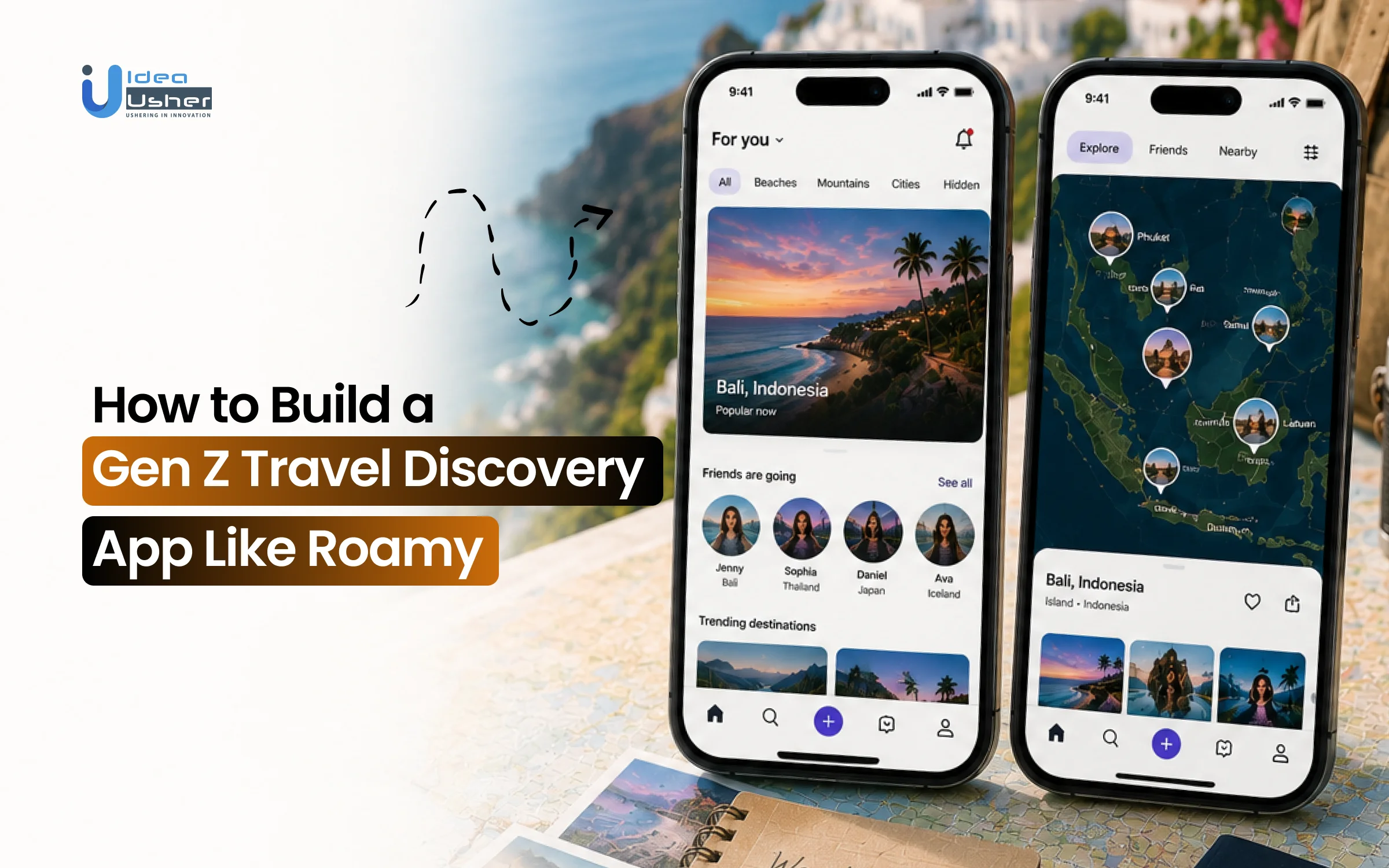
Key Takeaways
- Gen Z travel apps turn social media inspiration into actionable trips through AI-powered discovery and planning.
- Core features include AI itineraries, social content saving, interactive maps and route optimization.
- Modern platforms use creator content, personalization and location intelligence to improve travel discovery.
- Revenue comes from travel bookings, subscriptions, creator commerce and brand partnerships.
- How IdeaUsher can help you build Gen Z travel apps with AI recommendations, travel integrations and scalable cloud infrastructure.
Travel discovery is no longer happening primarily on travel websites. It is happening through short-form videos, creator content and social recommendations that influence travel decisions long before bookings occur. That shift is creating new opportunities in Gen Z travel discovery app development, where the focus is on turning inspiration into action through personalized and engaging digital experiences.
Traditional travel platforms were built around search, filters and destination databases. Gen Z travelers increasingly expect social discovery feeds, AI-powered recommendations, creator-driven content and seamless trip planning workflows that connect travel inspiration directly to decision-making. The challenge is no longer providing more travel options. It is helping users navigate content overload and discover experiences that match their interests.
In this blog, we will talk about core features, architecture, AI capabilities, monetization opportunities and how IdeaUsher can help with Gen Z travel discovery app development like Roamy by combining travel inspiration, personalization and planning into one connected experience.
How Gen Z Is Changing Travel Discovery Through AI and Social Media
The traditional travel funnel is characterized by programmatic Google searches, rigid guidebook itineraries, and cold star-rating aggregates, experiencing a massive generational shift. Gen Z now accounts for nearly 40% of global travelers, and their approach to exploring the world is entirely digital-first, heavily visual, and deeply experiential.
The travel planning industry continues to expand as travelers increasingly rely on digital tools for trip discovery and organization. The global travel planner app market is projected to grow from $544.1 billion in 2023 to $1,445.1 billion by 2032 with a CAGR value of 11.9%, creating significant opportunities for innovative travel apps.

Gen Z travelers increasingly rely on mobile experiences and are driven by an average of 2 hours and 43 minutes of daily social media consumption, reports that 37% of travelers already use AI to create itineraries, while 84% report better travel experiences after using generative AI tools.
A. Social Media Has Replaced Traditional Travel Search
Traditional search bars are becoming obsolete for young travelers as social media morphs into a primary search engine. TikTok, Instagram, and YouTube now drive over 60% of discovery, while Google’s share has dropped to 34.5%. Notably, 41% of Gen Z now prioritize social networks for online information.
Young travelers prefer vertical video over static search for immediate, atmospheric context. Digital content showing crowd density and lighting is more engaging than text. Industry data confirms social media dominates their planning:
- The Inspiration Engine: A staggering 90% of Gen Z travelers rely on social media for their primary travel inspiration, and 50% ultimately select their final vacation destination based entirely on what they see on their feeds.
- Platform Preference: For young travelers, TikTok reigns as the top source of travel inspiration at 59%, followed closely by Instagram at 51%.
- The “Aesthetic” Premium: The visual appeal of a trip is deeply tied to their digital identity. Approximately 46% of Gen Z document their travels on social media, and 43% explicitly prioritize destinations based on how good they will look on their profiles.
B. The Rise of Creator-Led Destination Discovery
Traditional travel agents and sponsored billboard ads are losing ground to digital creators. Today, only 38% of Gen Z travelers globally utilize traditional travel agents. Instead, they look to decentralized peer networks and niche influencers to build their itineraries.
The Trust Shift: Over 88% of Gen Z travelers follow at least one dedicated travel influencer, and 45% actively trust influencer recommendations over traditional brand advertisements.
This behavior has given rise to highly specified micro-trends that creators are uniquely positioned to capture:
| Travel Trend Pillar | Statistical Impact | Gen Z Behavioral Focus |
| Authentic Immersive Experiences | 95% of Gen Z state local activities contribute to better trips | Trading standard sightseeing tours for hands-on, adventure-based cultural immersion. |
| Scripted Tourism | Driven by viral pop-culture, e.g., K-pop spikes 300M+ views | Choosing destinations based on movies, music videos, TV shows, and viral media. |
| Solo Travel Safety | 83% of Gen Z women inspired by solo travel content | Relying on creator community safety tips to confidently book independent journeys. |
B. Why Travelers Save Content but Never Organize It
While Gen Z is highly efficient at discovering travel content, the actual consolidation of that content remains chaotic. The modern travel discovery process is highly fragmented: a user might save a restaurant recommendation from an Instagram Reel, a hidden beach from a TikTok, a packing list from a YouTube Short, and a flight deal from an AI chatbot.
This cross-platform hopping means the average user bounces between 6.75 different social networks every month. Because content is saved natively within individual app architectures such as Instagram Collections, TikTok Saved folders, or bookmarked links but it rarely gets exported into a cohesive itinerary.
Although 62% of Gen Z use digital platforms to find travel deals, the organization phase suffers from “digital hoarding.” High volumes of saved clips often remain unused in separate app folders because travelers lack a unified tool to transform this algorithmic inspiration into actionable plans.

What Is Gen Z Travel Discovery App, Roamy?
Roamy is a Gen Z-focused AI travel discovery app that transforms travel inspiration from social media into personalized, actionable trip plans. Designed for users who discover destinations through platforms like TikTok and Instagram, it combines AI-powered itinerary generation, map-based planning, route optimization, and collaborative trip management within a single experience. By bridging the gap between travel inspiration and execution, Roamy enables users to organize saved locations, build customized itineraries, and explore destinations through a social-first, creator-driven travel planning approach.
A. How Roamy Turns Social Content Into Travel Plans
The core mechanic of Roamy centers on mitigating “digital hoarding”, the common habit of saving hundreds of travel clips across disparate apps only for them to sit forgotten. Roamy streamlines this transition through a direct, cross-platform aggregation pipeline:
- Single-Tap Ingestion: Using the native mobile share sheet, users send an Instagram Reel, TikTok video, or Google Maps link directly into the Roamy app.
- Geographic Identification: The app parses the incoming URL or video metadata, automatically extracts the physical business or landmark identity, and drops a geographic pin onto the user’s master map collection.
- Visual Continuity: Each saved spot links directly back to the original source video, allowing travelers to instantly review why they saved the location without having to manually search through native social folders.
B. How AI Generates Personalized Itineraries
Once a traveler accumulates a localized collection of saved spots (e.g., a list of coffee shops, vintage clothing stores, and hidden lookouts in Tokyo), Roamy’s algorithmic backend handles the logistical layout.

Roamy’s AI builds custom routes using a traveler’s saved collection by analyzing spatial density and distances, the engine groups pins into optimized daily blocks. This algorithmic clustering ensures sequential visits to niche spots, eliminating transit inefficiencies across cities.
C. Why Gen Z Travelers Prefer Social-First Planning
The rapid adoption of apps like Roamy highlights a broader cultural shift away from traditional travel search infrastructure. Gen Z digital habits display clear deviations from older demographics:
- Visual Proof Over Star Ratings: Static, text-heavy text reviews or star-aggregators are largely mistrusted or ignored. A 15-second unedited panning video of a cafe provides immediate, atmospheric context on crowd density, interior styling, and actual product quality.
- Algorithmic Personalization: Legacy platforms require users to know what to search for beforehand. Social feeds dynamically feed highly targeted, niche subcultures directly to the user’s interface based on precise behavioral alignment.
- Community-Led Curation: Travel planning has shifted from institutional authorities to decentralized peer networks. Roamy leverages this by enabling users to instantly clone and customize itineraries created by peers or niche creators.
D. How the Gen Z AI Travel Planner Works
A Gen Z AI travel planner app uses artificial intelligence to turn social media travel inspiration into organized trips. It captures content, maps locations, generates itineraries, and enables real-time trip collaboration.

1. Capturing Travel Inspiration from Social Media
While scrolling TikTok or Instagram Reels, users can save a travel spot by tapping the native Share button and selecting Roamy. The app’s ingestion API instantly captures the post URL through the mobile OS share sheet without requiring users to copy links, type notes, or leave the platform.
2. AI-Powered Travel Location Mapping
After sharing, Roamy automatically extracts information from captions, hashtags, and geotags using NLP, identifies the business, and matches it with mapping databases. Within seconds, users receive a map pin containing the location’s name, address, opening hours, GPS coordinates, and source video link.
3. AI Travel Itinerary Generation
When planning a trip (e.g., “3 days in Rome”), users select their travel dates and tap “Generate Trip”. Roamy uses spatial clustering algorithms to analyze saved locations, group nearby attractions into daily routes, and create an itinerary that minimizes travel time between destinations.
4. Real-Time Collaborative Trip Planning
During the trip, users access a live map displaying their itinerary and saved locations. Cloud-based synchronization enables friends to add places, vote on activities, and update plans in real time. Users can also duplicate and customize itineraries created by travel influencers.
How AI Personalizes Travel Discovery and Planning
The Gen Z travel discovery app development requires moving past rigid, rule-based programming. To capture and retain digital-native travelers, your application must process chaotic, multi-platform media inputs and translate them into structured logistics in real time.
1. Recommendation and Personalization Models
This layer shifts the user experience from a generic search interface to a highly tailored discovery feed. Rather than showing identical destinations to every user, the system continuously learns from individual behavioral signals.
- Collaborative & Content-Based Filtering: Cross-analyzes a user’s explicit choices (saved reels, folders) with implicit actions (watch duration, clicks) to find hidden patterns. If a traveler saves 5 minimalist design cafes in Tokyo, the system isolates that specific subculture.
- Vector Embeddings via Neural Networks: Converts user profiles and destinations into multi-dimensional vectors. This mathematical alignment allows the app to surface highly accurate recommendations that share a similar “vibe” across entirely different cities, boosting user click-through rates by up to 30%.
2. Location Intelligence and POI Mapping
A premier travel app cannot rely on static address directories. This system establishes a dynamic, living knowledge base of global Points of Interest (POIs) that continuously verifies real-world geographic data.
- Geospatial Vector Indexing: Utilizes specialized databases (like PostGIS or H3 spatial indexes) to handle millions of location coordinates concurrently with ultra-low latency, ensuring fluid map interactions.
- Automated Metadata Reconciliation: Connects to multiple mapping APIs to monitor live operational statuses. If an independent vintage shop in London moves or closes permanently, the system updates the master database asynchronously, reducing broken itinerary pins by 95%.
3. Generative AI Trip Planning Workflows
This system acts as the automated concierge, taking raw pools of user-saved locations and assembling them into a coherent, highly realistic daily schedule with a single tap.
- Heuristic Routing Algorithms: Solves complex variations of the Traveling Salesperson Problem (TSP). The AI calculates distance matrices between dozens of saved spots to group them into tight, localized geographical zones.
- Logistical Constraint Satisfaction: Cross-references daily routes against real-world business operating hours, seasonal weather patterns, and average visit durations, ensuring users never arrive at a museum on a day it is closed.
4. NLP for Travel Content Understanding
Because Gen Z discovers travel through unstructured social media content, this system serves as the primary data ingestion pipeline, turning chaotic text, captions, and comments into clean data points.
- Named Entity Recognition (NER): Custom NLP models scan raw text captions and comments to isolate proper nouns, immediately separating actual business venues from generic slang or emojis.
- Contextual Sentiment Parsing: Analyzes text context to determine accuracy. If a video caption says, “Avoid this tourist trap, go to Café X down the block instead,” the AI correctly identifies “Café X” as the high-value target location rather than the initial tourist trap.
5. Predictive Travel Preference Analysis
To maximize high-margin booking conversions, the platform must understand user intent before the user explicitly spells it out, moving from reactive planning to proactive forecasting.
- Forward-Looking Intent Forecasting: Analyzes sudden spikes in localized content saving to predict macro-tourism trends 30 to 60 days before traditional booking data reflects them.
- Dynamic Budget & Pacing Elasticity: Evaluates past travel behavior to categorize users into distinct logistical buckets (e.g., fast-paced luxury, relaxed budget). The system uses this profile to predict whether a user prefers a 4-star hotel booking or a local transit pass, increasing native in-app transaction conversions by 22%.
Key Features of Roamy-Like Gen Z Travel Discovery App
The Gen Z travel discovery app development that appeals to modern, digital-native consumers requires moving past old-school booking forms and database-heavy search. Successful applications in this space succeed by prioritizing a visually fluid user experience backed by powerful automated workflows.
The essential features required to develop a market-leading, social-first travel planning ecosystem include:

1. AI-Powered Travel Itinerary Generation Engine
The central value proposition of the app relies on eliminating manual scheduling. Users simply specify their destination and vacation length, and the artificial intelligence system instantly synthesizes a complete, customized travel plan.
Rather than serving up generic, pre-written travel articles, the engine tailors activities around individual user behavior, pacing preferences, and chosen lifestyle “vibes” such as budget backpacker, luxury wellness, or cafe culture.
2. Social Travel Content Saving and Organization
Consumers continuously save media inspiration across multiple social applications. This feature acts as a centralized “digital bucket list” vault. Users organize their accumulated content into custom, shareable folders segregated by city, trip, or theme (e.g., “Tokyo Vintage Shopping” or “Paris Bakeries”).
Every single saved item maintains a direct back-link to the original social source post, allowing the user to easily revisit the exact video or image that originally sparked their interest.
3. Smart Location Extraction From Social Media
To make saving frictionless, users do not need to type in addresses or copy complex venue names. By using the mobile device’s native sharing capabilities, a user can send a TikTok video or Instagram Reel straight into the app.
The software’s background system automatically reads the video’s text caption, hashtags, and digital metadata. It isolates the specific business or geographic landmark mentioned and instantly drops a pin onto the user’s master map profile.
4. Interactive Destination Maps and Visualization
A clean, visual interface replaces text-heavy itinerary spreadsheets. All saved locations and generated trip days populate automatically onto a high-performance interactive map.
Users can toggle view settings to filter their pins by specific custom lists, daily schedules, or categories (such as lodging, restaurants, and sights). This visual layout lets travelers understand where their desired destinations are located in relation to one another at a single glance.
5. Route and Schedule Optimization Engine
To maximize time on the ground, the software features a logistical routing engine. Once a traveler confirms a list of spots they want to visit in a day, the system evaluates their spatial positions and automatically re-orders the list into the shortest possible logical path.
By grouping clustered attractions into tight geographical neighborhoods, the app systematically prevents cross-town zig-zagging and provides integrated estimates for walking, driving, or public transit times.
6. Collaborative Trip Planning Workspaces
Group travel historically involves chaotic group chats and disconnected notes documents. The application solves this problem by providing live, shared collaborative workspaces.
Multiple users can join a single trip file to add locations to a shared pool, comment on specific spots, build day schedules together, and seamlessly vote on group dinners or excursions in real time.
7. Creator-Curated Travel Collections
Modern travelers look to peers and micro-influencers for authentic recommendations over corporate travel agencies. The platform hosts a public marketplace of curated community guides.
Users can browse verified itineraries designed by trusted content creators, digital nomads, and local experts. If they find a guide they love, they can duplicate the entire itinerary with a single tap and immediately customize it to fit their own travel dates.
8. Travel Booking and Reservation Integrations
To complete the loop from discovery to execution, the platform features streamlined booking pathways. Once the itinerary is set, the app connects chosen hot-spots directly to booking partner systems.
Users can seamlessly reserve hotel accommodations, secure flight tickets, rent vehicles, or purchase local excursion passes directly through the application interface, creating a highly cohesive, end-to-end purchasing experience.
How to Build a Gen Z Travel Discovery App Like Roamy
The Gen Z travel discovery app development requires blending engaging visual interfaces with smart automation. At IdeaUsher, we engineer platforms that capture high-intent users directly at the point of inspiration and convert that curiosity into actionable bookings.

1. Define the Discovery-to-Booking User Journey
Our development team maps the complete user experience by engineering an ultra-low-friction digital pipeline that captures users browsing external social media apps and smoothly guides them down to final e-commerce checkout.
- Frictionless Social Media Sharing: Captures high-intent leads instantly using native mobile share sheets directly from short-form video apps without disrupting user browsing.
- Instant URL Schema Extraction: Converts messy, raw external links into structured, actionable database spots on an internal travel map in seconds.
- Unified Single-Screen Transaction Checkout: Drives platform revenue by keeping consumers inside a native marketplace for all flight, hotel, and activity purchases.
- Behavior-Triggered Push Notifications: Re-engages passive app browsers by sending timely updates when saved destinations experience sudden drops in price.
2. Design a Social-First Travel Discovery Interface
Our design squad constructs a highly interactive, visually immersive mobile frontend that naturally mirrors modern scrolling habits, utilizing creator-centric media layouts to dramatically maximize daily active app usage metrics.
- Algorithmic Short-Form Video Feeds: Maximizes initial app engagement by serving curated, high-definition travel reels tailored directly to unique user subcultures.
- One-Tap Itinerary Cloning Mechanics: Boosts community virality by letting users instantly duplicate creator-led travel boards straight into their personal profiles.
- Aesthetic Visual Scrapbook Boards: Prolongs user session duration through drag-and-drop mood boards that allow travelers to organize ideas creatively.
- Native Cross-Platform Link Exporting: Fuels organic viral user acquisition by generating highly shareable, visually striking web links for external platforms.
3. Build the Location Intelligence and Mapping Layer
Our database architects deploy a robust geospatial infrastructure that continuously ingests, cleans, and structures global point-of-interest information, creating a comprehensive and deeply enriched travel knowledge directory.
- High-Performance Geospatial Vector Databases: Stores millions of international venue coordinates with ultra-low latency, ensuring instantaneous map rendering during searches.
- Automated Linguistic Place Tagging: Filters out contextual social media caption clutter using smart algorithms to isolate definitive business names.
- Dynamic Regional Pin Clustering: Simplifies dense city maps by grouping nearby locations into clean, expandable visual counters based on zoom.
- Asynchronous API Metadata Enrichment: Enhances mapping depth by automatically pulling real-time business hours, contact numbers, and live operational statuses.
4. Develop the AI Recommendation and Itinerary Engine
Our AI specialists build and train custom machine learning models that analyze user habits, saved feeds, and historical data to generate hyper-personalized, tailored vacation schedules automatically.
- Collaborative Filtering Preference Matching: Delivers highly accurate restaurant and landmark suggestions by cross-analyzing behavioral trends across similar user profiles.
- Dynamic Financial Tier Filtering: Tailors customized activity suggestions smoothly around the traveler’s real-time budget boundaries and spending comfort levels.
- Contextual Historical Travel Profiling: Optimizes future recommendation accuracy by learning from past destination reviews, trip pacing, and skipped attractions.
- Predictive Day-Schedule Generation: Synthesizes fully customized itineraries based on user-selected trip durations, travel dates, and personal lifestyle interests.
5. Implement Route Optimization and Trip Visualization
Our technical squad implements advanced logistical routing algorithms to solve complex multi-stop transit coordination, ensuring travelers move efficiently between daily destinations without wasting time.
- Heuristic Traveling Salesperson Calculations: Computes the absolute shortest, most efficient physical path between multiple scattered city spots automatically.
- Multi-Modal Transit Time Syncing: Pulls real-time live data for walking, driving, and public subways to display accurate travel durations.
- Geographic Neighborhood Neighborhood Locking: Eliminates frustrating cross-town backtracking by strictly anchoring single-day schedules to localized urban zones.
- Linear Calendar Timeline Interfaces: Translates complex spatial map points into an intuitive, scrollable day-by-day itinerary chart for easy tracking.
6. Enable Collaborative Travel Planning Features
We integrate real-time synchronization features during Gen Z travel discovery app development that transform trip planning from an isolated chore into an engaging, collaborative group experience where friends can build itineraries together.
- Conflict-Free Operational Sync Workspaces: Allows multi-user groups to modify shared travel files simultaneously with zero data lag or overwriting.
- In-App Upvote/Downvote Polling Infrastructure: Resolves group dining and lodging disputes quickly through integrated, real-time consensus and voting widgets.
- Native Group Ledger Split-Billing: Simplifies travel economics by tracking shared vacation costs and calculating balances directly within the itinerary.
- WebSocket-Powered Live Party Alerts: Keeps the entire travel group aligned by broadcasting instant popups when plans are altered.
7. Integrate Travel Commerce and Booking APIs
Our integration experts connect your platform to major global distribution systems and aggregators, unlocking high-margin affiliate revenue channels through native, one-click in-app checkouts.
- Global Distribution System API Gateways: Grants users live, real-time access to seat inventories and room availability for global airlines and hotels.
- Tokenized One-Click Payment Tokenization: Minimizes cart abandonment rates by supporting secure, encrypted transactions through Apple Pay and credit networks.
- Experience Aggregator Webhook Webhooks: Facilitates instant ticket booking for local tours and excursions without redirecting users to third-party sites.
- Automated Affiliate Commission Tracking: Secures consistent platform monetization by automatically capturing business referral payouts on every completed reservation.
8. Launch an MVP and Scale With User Insights
We strategically isolate high-value core components to launch a lean Minimum Viable Product, establishing a highly scalable cloud architecture driven continuously by real-world user data.
- Core Value Feature Isolation: Accelerates time-to-market by launching essential social saving and basic mapping features in the initial release.
- Granular Event-Driven Analytics Tracking: Measures product-market fit using detailed interaction heatmaps to monitor exact feature usage and retention.
- In-App Qualitative Feedback Loops: Captures constructive user bug reports and feature requests directly inside the interface to guide upgrades.
- Containerized Cloud Microservices Architecture: Ensures the backend infrastructure handles rapid spikes in concurrent user traffic smoothly without downtime.
Cost to Build Gen Z Travel Discovery App like Roamy
The Gen Z travel discovery app development like Roamy involves investments across AI development, location intelligence, social content integration, mapping technologies, and travel booking systems.
The following table provides an estimated cost breakdown according to the above development steps of a Roamy-like travel discovery app.
| Development Phase | What the Phase Covers | Estimated Cost (USD) |
| Discovery-to-Booking Strategy | Mapping user journeys from social media link capture to final checkout and conversion funnels. | $3,500 – $6,500 |
| Social-First UI/UX Design | Creating interactive, visual mobile prototypes with creator feeds, mood boards, and swipe mechanics. | $6,000 – $12,000 |
| Location Intelligence Layer | Deploying geospatial databases to parse social media links and auto-tag points of interest. | $8,500 – $16,000 |
| AI Recommendation Engine | Engineering machine learning models to analyze user habits and synthesize personalized daily travel schedules. | $12,000 – $25,000 |
| Route Optimization Mapping | Implementing algorithms to group nearby locations into tight zones and calculate efficient travel paths. | $7,000 – $14,000 |
| Collaborative Planning Tools | Integrating live multi-user synchronization, group voting widgets, and real-time push notification alerts. | $6,500 – $12,000 |
| Commerce & Booking APIs | Connecting flight, hotel, and local excursion global distribution systems with secure payment gateways. | $8,000 – $15,000 |
| MVP Launch & Analytics Scaling | Deploying a lean backend microservices infrastructure equipped with granular event-driven behavior tracking. | $5,000 – $10,000 |
| Project Management & QA | Conducting rigorous continuous end-to-end testing while managing sprint cycles and agile delivery timelines. | $7,500 – $22,500 |
| TOTAL ESTIMATED BUDGET | Building a fully functional, market-ready social travel MVP from discovery to booking. | $64,000 – $133,000 |
Entrepreneurial Insight: This MVP Gen Z travel discovery app development budget targets the sweet spot for a high-performance application. By prioritizing the automated social link capture and smart mapping over complex custom video hosting, your clients can validate product-market fit rapidly without burning excessive capital early on.
Gen Z Travel Discovery App Development Cost by Platform Tier
The Gen Z travel discovery app development cost depends on the platform’s feature set, AI sophistication, mapping capabilities, social content integrations, and scalability goals. The following table outlines the estimated development cost across different platform tiers from an MVP to a full-scale enterprise solution.
| Platform Tier | Features Included in That Tier | Estimated Cost |
| MVP Platform | AI itinerary generation, social content saving, destination bookmarking, interactive maps, route optimization, trip planning workflows, user accounts, analytics. | $64,000 – $133,000 |
| Mid-Scale Platform | Advanced AI personalization, creator-curated travel guides, collaborative trip planning, social sharing, location extraction from videos and screenshots, enhanced recommendations and expanded booking integrations. | $145,000 – $250,000 |
| Enterprise Platform | Multimodal AI travel assistants, real-time collaboration, predictive travel intelligence, large-scale geospatial processing, enterprise analytics, global booking integrations, and multi-region deployment. | $270,000 – $420,000+ |
Cost-Affecting Factors of a Gen Z Travel Discovery App Development
When launching a social-first AI travel planner, the final Gen Z travel discovery app development invoice isn’t arbitrary. It hinges on explicit choices regarding feature density, third-party data dependencies, and engineering complexity.
- AI Architecture & NLP Complexity: Advanced NLP models that convert short-form travel content into structured location data are a major cost driver. Features like entity recognition, content extraction, and location mapping can add $10,000–$30,000+, representing 20%–30% of total development costs.
- Mapping APIs & Location Infrastructure: Accurate destination mapping requires mapping APIs, GPS tracking, geospatial databases, and business metadata services. These integrations typically add $5,000–$15,000 in upfront costs, plus ongoing API usage fees.
- GDS & Travel Commerce Integrations: Integrating flight, hotel, and activity booking systems through GDS and travel APIs requires significant backend development. Depending on the number of providers, these integrations can add $10,000–$50,000 to the project budget.
- Native vs Cross-Platform Development: Building separate iOS and Android apps increases development time and costs. Using Flutter or React Native enables a shared codebase, reducing development expenses by 30%–40% while accelerating time to market.
The Long-Term Budget Note: Launching the app is only the initial step. Entrepreneurs must allocate roughly 15% to 20% of their initial development capital annually to cover cloud infrastructure hosting, ongoing security patch compliance, and essential OS updates.
Revenue Models for a Roamy-Like Travel Platform
Gen Z travel platforms diverge from traditional booking models by monetizing the entire ecosystem such as discovery, planning, commerce, and creators. By integrating AI-driven planning with social discovery and seamless bookings, businesses can generate recurring revenue while prioritizing user experience.
| Revenue Stream | Monetization Method | Potential Revenue Range |
| Affiliate Travel Bookings | Commission on flights, hotels, tours, and activities | 3%–15% per transaction |
| Premium AI Planning Subscriptions | Monthly or annual subscription plans | $8–$30/month per user |
| Creator-Led Travel Commerce | Revenue sharing on creator-generated bookings | 5%–20% platform commission |
| Sponsored Destinations and Brand Partnerships | Paid destination placements and campaigns | $5,000–$100,000+ per campaign |
| Travel Marketplace Commissions | Booking fees and marketplace transactions | 5%–25% commission |
1. Affiliate Travel Bookings
By integrating third-party global distribution systems (GDS), the platform acts as an organic affiliate referral channel. When a user generates an AI itinerary, the system automatically embeds contextual purchase links for the specific airlines, hotels, and tours mentioned.
- Industry Payout Benchmarks: Secures standard commissions ranging from 4% to 10% on hotel bookings and up to 8% on local city experiences via networks like Viator or GetYourGuide.
- Volume Revenue Multipliers: Capitalizes on the travel industry’s multi-billion dollar shift toward digital checkouts, turning everyday social media content scraping into automated, passive affiliate payouts.
2. Premium AI Planning Subscriptions
While the core social saving mapping features remain free to maximize organic user acquisition, advanced analytical tools are locked behind a tiered Software-as-a-Service (SaaS) subscription model.
- Tiered Pricing Architecture: Drives predictable monthly recurring revenue (MRR) through $4.99/month basic tiers or $49.99/annually premium packages.
- Exclusive Pro-Feature Access: Incentivizes power-travelers with unlimited monthly AI itinerary generations, multi-modal offline map syncing, and hyper-personalized budget optimization metrics.
3. Creator-Led Travel Commerce
The platform acts as a decentralized marketplace where content creators and travel influencers can directly monetize their digital audiences by selling premium, highly curated custom guides.
- Split-Revenue Ecosystem Setup: Implements a 70/30 revenue-share split where creators pocket 70% of their self-priced guide sales while your platform captures a clean 30% marketplace facilitation fee.
- Scalable Micro-Transaction Model: Turns passive video viewers into high-intent buyers who willingly pay $5.00 to $25.00 to instantly clone a trusted creator’s complete, pre-optimized city itinerary.
4. Sponsored Destinations and Brand Partnerships
Local tourism boards, boutique hotel chains, and independent attractions pay a premium to position themselves organically inside user feeds and regional map views based on traveler proximity.
- Targeted Impression Pay-Outs: Generates consistent business cash flow utilizing cost-per-thousand (CPM) models averaging $25 to $70 per localized ad campaign placement.
- Contextual Map Pin Boosting: Allows local businesses to purchase high-visibility sponsored pins, boosting their physical discovery rates by 40% when users generate nearby itineraries.
5. Travel Marketplace Commissions
By moving past simple external link redirection, the platform houses a native checkout marketplace that facilitates direct, end-to-end hotel room and activity reservation processing.
- Transaction Processing Margins: Captures merchant-of-record transaction fees ranging from 2% to 5% on every booking finalized directly within the application architecture.
- Cart Abandonment Optimization: Boosts overall checkout conversions by up to 25% through tokenized single-screen checkouts utilizing integrated payment systems like Apple Pay.
Tech Stack for a Roamy-Like Travel Discovery Platform
A Roamy-like Gen Z travel discovery app development requires a carefully selected technology stack that supports AI-powered recommendations, location intelligence, social content processing, real-time collaboration, and scalable travel booking experiences.
The following table highlights the recommended tech stack for developing a modern travel discovery platform.
| Platform Layer | Technologies | Purpose |
| Frontend Architecture | React Native, Flutter, Next.js, TypeScript | Build responsive web and mobile interfaces with real-time itinerary updates, social content feeds, and interactive travel experiences. |
| Backend and Cloud Infrastructure | Node.js, Python, NestJS, AWS, Google Cloud, Microsoft Azure | Manage user authentication, trip data, itinerary generation, content processing, and scalable cloud deployment. |
| AI and Machine Learning Layer | OpenAI, Gemini, Claude, LangChain, Vector Databases, TensorFlow | Power itinerary generation, travel recommendations, preference analysis, location extraction, and conversational trip planning. |
| Mapping and Geospatial Technologies | Google Maps Platform, Mapbox, OpenStreetMap, PostGIS | Enable destination visualization, route optimization, location clustering, distance calculations, and interactive trip maps. |
| Databases and Storage | PostgreSQL, MongoDB, Redis, Pinecone | Store user profiles, saved destinations, travel collections, itinerary data, and AI memory layers. |
| Third-Party APIs and Integrations | Amadeus, Skyscanner, Booking.com, Expedia, Stripe, Twilio | Support flight searches, hotel bookings, payment processing, notifications, and travel commerce functionality. |
| Analytics and User Insights | Mixpanel, Amplitude, Google Analytics, Firebase Analytics | Track user engagement, destination saves, itinerary usage, retention metrics, and product performance. |
| Security and Authentication | OAuth 2.0, Auth0, Firebase Auth, JWT | Secure user accounts, social logins, API access, and personal travel data. |
Challenges in AI Travel Discovery Apps Development
The Gen Z travel discovery app development introduces complex technical hurdles, from decoding chaotic internet media to managing live global location pipelines. At IdeaUsher, we deploy advanced machine learning and cloud architectures to solve these operational bottlenecks before they impact your users.

1. Processing Unstructured Social Content
Challenge: Social media posts lack uniform data structures, containing chaotic slang, emojis, and un-geotagged video files that traditional databases cannot decode.
Solution: Our developers deploy custom Natural Language Processing (NLP) models and computer vision pipelines to scrub captions, transcribe audio, and instantly isolate clean business entities.
2. Maintaining Itinerary Accuracy
Challenge: Venues constantly change their operational hours, close permanently, or alter names, causing AI-generated schedules to accidentally recommend inaccessible or nonexistent spots.
Solution: We implement asynchronous API webhooks that cross-reference user-saved locations against live global mapping registries, validating data freshness before any route planning occurs.
3. Scaling Geospatial Data Systems
Challenge: Processing millions of concurrent geographic coordinates alongside real-time user traffic causes massive server strain and severe mobile application mapping lag.
Solution: Our database architects build containerized microservices and implement spatial vector indexing, ensuring the platform groups and renders millions of global map pins instantly.
4. Balancing Personalization and Privacy
Challenge: Gathering granular user location histories and social media browsing habits to optimize recommendations risks violating stringent international data protection laws.
Solution: We integrate secure, decentralized data anonymization layers and end-to-end tokenization protocols, ensuring absolute privacy compliance while training your localized recommendation algorithms safely.
Partner with Idea Usher for Your GenZ Travel Discovery App
The travel industry has permanently decoupled from legacy search engines. Capitalizing on the Gen Z travel revolution means launching a product that is social-first, highly visual, and backed by automated intelligence.
Idea Usher bridges technical gaps for global entrepreneurs. With a 250+ expert team, we have delivered 1,000+ projects in 50+ countries. We specialize in converting complex data such as unstructured video metadata and route optimization into scalable mobile products.
Ready to Turn Social Media Inspiration Into a High-Yield Digital Venture?
Don’t let your travel app concept get left behind in the draft folder. Partner with our experienced ex-FAANG AI-native engineering team that builds with transparent, glass-box project management and delivers market-ready MVPs 30% to 40% faster than standard development pipelines.
Claim Your Free Consultation with our solutions architects. We will jump on a discovery call to review your app vision, target audience demographics, and core feature priorities.
Conclusion
The future of travel discovery is shifting from search-driven planning to AI-powered, social-first experiences. Platforms like Roamy demonstrate how creator content, location intelligence, and personalized itinerary generation can transform scattered travel inspiration into actionable trips. For entrepreneurs and travel businesses, this presents a significant opportunity to build engaging, revenue-generating platforms that align with modern traveler behavior. By combining the right AI technologies, travel integrations, and user-centric design, you can create a scalable travel discovery app that stands out in an increasingly competitive market.
Things to Know
Q.1. How do AI travel discovery apps make money?
A.1. AI travel discovery apps typically generate revenue through affiliate travel bookings, premium subscriptions, creator partnerships, sponsored destinations, and marketplace commissions. Combining recurring subscription revenue with transaction-based income creates a scalable business model.
Q.2. What are the core features of GenZ travel discovery app?
A.2. A Roamy-like travel discovery app requires AI itinerary generation, social content integration, location intelligence, interactive maps, route optimization, collaborative planning tools, and travel booking integrations to deliver a complete user experience.
Q.3. How does AI power travel discovery and trip planning apps?
A.3. AI analyzes traveler preferences, saved destinations, budgets, and trip goals to recommend places, generate personalized itineraries, optimize routes, and transform travel inspiration into actionable trip plans with minimal manual effort.
Q.4. How much does It cost to develop a travel discovery app?
A.4. The cost of developing a travel discovery app ranges from $64,000–$133,000 for an MVP, $145,000–$250,000 for a mid-scale platform, and $270,000–$420,000+ for an enterprise-grade solution with advanced AI and travel integrations.


