


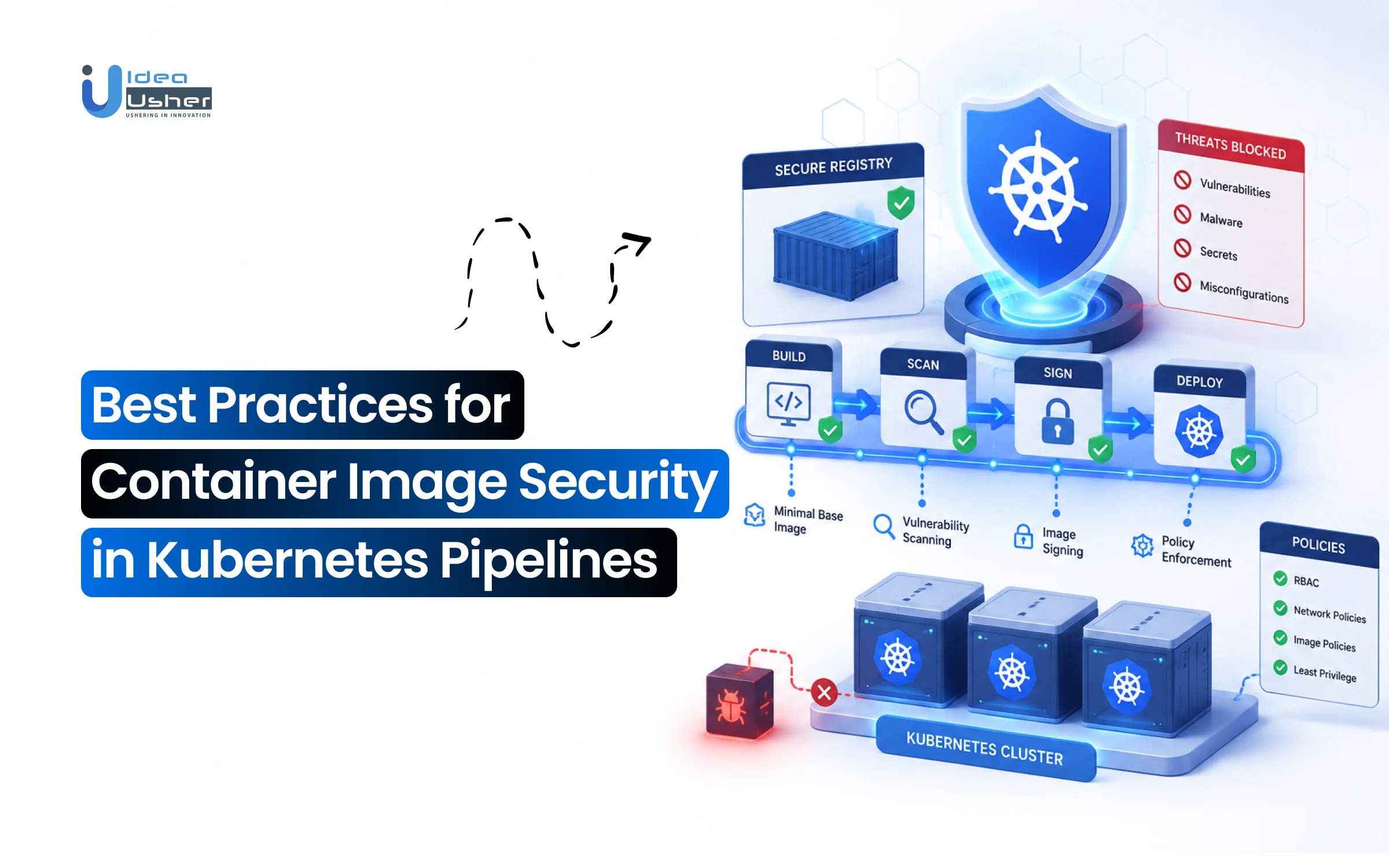
Key Takeaways
- Container image security in Kubernetes starts before deployment, as insecure images often introduce vulnerabilities directly into production pipelines.
- Strong security requires continuous image scanning, image signing, SBOM validation and admission policy enforcement across the CI/CD lifecycle.
- Risks like unverified base images, embedded secrets, weak registry access and missing runtime monitoring can lead to cluster-wide compromise.
- Modern enterprises are adopting Zero Trust container security, automated policy enforcement and runtime threat detection to secure Kubernetes workloads at scale.
- How IdeaUsher helps businesses secure Kubernetes pipelines with pre-vetted DevSecOps experts, automated security workflows and scalable container security implementation.
Most Kubernetes breaches do not begin in production. They begin much earlier in insecure container images that move through pipelines without proper validation. That is why container image security kubernetes has become a critical focus for modern DevSecOps teams as deployment velocity increases, insecure images can spread vulnerabilities across environments faster than teams can respond.
Traditional security approaches treated image scanning as a final checkpoint before deployment. That model no longer works in containerized ecosystems where images are constantly built, updated and reused across pipelines. Teams now need continuous vulnerability scanning, image signing, minimal base images and policy-driven enforcement integrated throughout the CI/CD lifecycle.
In this blog, we will talk about how insecure container images create hidden risks across Kubernetes pipelines, the strategies leading teams use to secure images before deployment and how IdeaUsher provides pre-vetted Kubernetes security experts to strengthen container image security at scale.
Why Kubernetes Image Security Is Failing Enterprises
The global Kubernetes Solutions Market is estimated at USD 3.46 billion in 2026 and is projected to reach USD 14.36 billion by 2035, growing at a CAGR of 17.3% over the forecast period. This rapid market growth highlights the increasing demand for stronger Kubernetes security as businesses manage more complex and large-scale containerized infrastructures.
Enterprises frequently secure cluster networks but neglect image security, treating it as an afterthought rather than an integrated process. With images containing numerous open-source dependencies, a lack of Software Bill of Materials (SBOM) visibility prevents effective vulnerability tracking and patching at scale.

Gartner estimates that over 90% of global organizations now run containerized applications in production, the “cluster” is the new perimeter. Unlike traditional servers, a single Kubernetes misconfiguration can expose an entire fleet of microservices in seconds.
A. How Vulnerable Images Reach Kubernetes Production
Vulnerabilities typically sneak into production through three primary avenues:
- Public Repositories: Developers often pull base images from public registries that may contain outdated libraries or even malicious backdoors.
- Image Bloat: Using fat base images (like full Ubuntu or Debian distros) includes unnecessary tools (like curl or ssh) that attackers can use once they gain a foothold.
- Lack of Admission Control: Without an Admission Controller, Kubernetes will happily pull and run any image it is told to, even if that image hasn’t been scanned or is known to be critical.
B. Why Fast CI/CD Pipelines Create Security Gaps
Security is often bypassed to avoid breaking the build in the race to achieve high deployment frequency.
- The Velocity Trap: Automated pipelines prioritize speed. If a security scan takes 10 minutes but the code build takes 2, teams often configure scans to be non-blocking, meaning vulnerabilities are flagged but the image is pushed to the registry anyway.
- Scanning at Rest vs. Runtime: Many CI/CD tools only scan images when they are built. They fail to account for drift or new vulnerabilities (Zero-Days) discovered after the image has already been approved and stored.
C. The Hidden Cost of Insecure Kubernetes Containers
The cost of a breach in Kubernetes isn’t just lost data; it’s the operational chaos that follows:
- Resource Hijacking: Insecure images are frequently exploited for cryptojacking, where attackers use your cluster’s CPU power to mine cryptocurrency, leading to massive cloud billing spikes.
- Compliance Violations: For regulated industries (FinTech, Healthcare), running vulnerable images can lead to heavy fines under GDPR or SOC2.
- Lateral Movement: One compromised container can serve as a pivot point to attack the Kubernetes API or extract secrets from other pods in the same namespace.
D. Why DevOps Teams Struggle With Image Security
DevOps teams are often overwhelmed by vulnerability fatigue.
- Contextless Alerts: Standard scanners often produce a sea of red, flagging hundreds of CVEs without indicating which ones are actually reachable or exploitable in the specific way the container is configured.
- Tool Sprawl: Managing separate tools for static analysis, secret detection, and runtime monitoring creates silos.
- The Shift Left Gap: While everyone agrees on shifting security left, DevOps teams often lack the security expertise to interpret scan results, while Security teams lack the context of the application’s architecture to provide helpful guidance.
Why Container Image Security Matters in Kubernetes
Container images serve as Kubernetes blueprints; flaws inherit across all pods and nodes. Kubernetes’ automatic scaling allows one compromised image to replicate rapidly, making image security a critical defense against cluster-wide breaches.

A. How Kubernetes Expands Container Attack Surfaces
Orchestration tools like Kubernetes provide immense power, but they also introduce new vectors for exploitation:
- Cluster-Wide Visibility: Once an attacker compromises a container via a vulnerability in its image, they can exploit the Kubernetes API or weak service account permissions to move laterally across the entire cluster.
- Shared Kernel Risks: Unlike Virtual Machines, containers share the host’s OS kernel. An image containing a kernel-level exploit can potentially allow an attacker to escape the container and gain control of the underlying physical or virtual server.
- Insecure Defaults: Many images are configured to run as the root user by default. If an attacker gains access to a root-run container, they have significantly higher privileges to modify system files or disable security monitoring.
B. Where Image Security Validation Happens in the CI/CD Lifecycle
Security validation must be treated as a continuous loop rather than a single checkpoint. By embedding security into each phase of the lifecycle, organizations can catch vulnerabilities before they reach the orchestration layer.
- Code Commit: Validation begins at the workstation. SAST and Secret Scanning check code and configurations (like Helm charts) upon pushing to block hardcoded credentials or insecure settings.
- Build and Packaging: Post-compilation, SCA and CVE Scanning generate an SBOM. This identifies all dependencies to ensure no known vulnerabilities are included in the image.
- Registry and Distribution: Images at rest undergo Continuous Re-scanning for new Zero-Day threats. Image Signing (e.g., Cosign) prevents tampering during distribution.
- Kubernetes Deployment: As the final gate, Admission Controllers enforce policies, rejecting unsigned images or those with Critical vulnerabilities.
- Runtime Monitoring: Runtime Security tools provide a safety net by detecting anomalous behavior or drift, such as unauthorized system file modifications or suspicious outbound connections, in running containers.
C. Why Supply Chain Attacks Target CI/CD Pipelines
Attackers have shifted their focus from the final product to the factory that builds it. By targeting the CI/CD pipeline, they can inject malicious code directly into images before they are even deployed.
- Poisoning Base Images: Hackers often upload malicious versions of popular images to public registries, hoping developers will pull them as a shortcut.
- Dependency Confusion: Modern images rely on thousands of third-party libraries. If an attacker can inject a malicious package into a public repository with the same name as an internal one, the automated pipeline may pull the poisoned version.
- Automated Trust: Because pipelines are automated, they often possess high-level credentials to push images to production. Compromising a CI/CD tool can give an attacker a straight shot into an enterprise’s most sensitive environments.
D. The Business Risks of Unsecured Container Images
For an enterprise, the fallout of a container breach goes far beyond technical downtime:
- Data Exfiltration and Privacy Fines: Vulnerabilities in web-facing images are the primary entry points for data breaches. This can result in massive legal liabilities and fines under regulations like GDPR or CCPA.
- Intellectual Property Theft: If your proprietary code is baked into an insecure image that is leaked or compromised, your core business value is at risk.
- Brand Erosion: A security breach involving customer data leads to a loss of trust that can take years to recover. In the era of Shift Left, customers expect companies to prove their security posture before they sign a contract.
E. Why Enterprises Need Kubernetes Security Experts
Securing Kubernetes is not a set it and forget it task; it requires a specialized skill set that bridges the gap between traditional security and modern DevOps.
- Complexity Management: Kubernetes has a steep learning curve. Experts are needed to configure complex Network Policies, Admission Controllers, and Security Contexts that prevent images from acting maliciously.
- Continuous Monitoring: Unlike static servers, containers are ephemeral. Security experts implement Runtime Security to detect weird behavior (like a container suddenly trying to scan the local network) that standard image scanners miss.
- Strategic Tooling: There are hundreds of security tools in the CNCF landscape. An expert helps the organization choose the right stack to provide a clear Software Bill of Materials (SBOM) without slowing down the development team.

Business Risks of Weak Container Image Security Practices
Security works as a continuous chain across the entire image lifecycle in Kubernetes where even a small weakness can expose not just a single container but the broader orchestration environment. The sections below highlight the most common security gaps and the operational challenges they create in real-world Kubernetes pipelines.
1. Using Unverified Base Images in CI/CD Pipelines
The Risk: When developers pull node:latest or a random alpine build from a public registry, they are importing thousands of lines of code they didn’t write and haven’t audited.
The Impact: You aren’t just deploying your app; you’re deploying every outdated library and hidden utility (like netcat or curl) that an attacker can use to scout your internal network once they get inside.
2. Storing Secrets Directly Inside Container Images
The Risk: Hardcoding API keys or DB passwords into a Dockerfile is the security equivalent of leaving your house keys under the mat, except the mat is transparent.
The Impact: Because image layers are cached and stored, even if you delete the secret in a later layer, it persists in the image history. Anyone with pull access to your registry now has the keys to your production database.
3. Missing Security Policies Across Deployments
The Risk: Kubernetes is designed to be open by default. Without explicit Pod Security Standards (PSS) or Network Policies, a pod is essentially a privileged citizen.
The Impact: A compromised pod without a security context can mount the host’s file system or communicate with the Kubernetes API server, escalating a simple container breach into a full cluster takeover.
4. Weak Access Controls in Container Registries
The Risk: Your registry is the Source of Truth. If the permissions are broad, it becomes the easiest target for Tag-Jacking.
The Impact: An attacker doesn’t need to hack your cluster; they just need to overwrite your production-v2 tag in the registry with a malicious image. Your CI/CD pipeline will then faithfully deploy the malware for them.
4. Delayed Vulnerability Fixes Across Clusters
The Risk: Finding a CVE (Common Vulnerabilities and Exposures) is easy; fixing it is hard. The weakness here is the time elapsed between a vulnerability being announced and the new, patched image being rolled out.
The Impact: Attackers automate scripts to find low-hanging fruit like old Log4j or OpenSSL bugs. Every hour an unpatched image sits in your cluster is an open invitation for automated exploitation.
5. Lack of Runtime Monitoring After Deployment
The Risk: Static scanning only tells you if an image is safe at the moment it was built. It cannot tell you what the container is doing now.
The Impact: Without runtime visibility (e.g., using eBPF-based tools), you won’t know if a container has started a reverse shell, modified a binary in /bin, or is suddenly mining Monero. By the time you notice the bill, the data is already gone.
The Security Weakness Matrix
| Weakness | Primary Victim | Remediation Strategy |
| Unverified Bases | Application Integrity | Use Distroless or Private Curated Base Images |
| Embedded Secrets | Data Privacy | Use K8s Secrets or Vault Injection |
| Missing Policies | Cluster Stability | Implement OPA Gatekeeper or Kyverno |
| Weak Registry Auth | Supply Chain | Enable Image Signing (Cosign) & RBAC |
| Patching Latency | Long-term Security | Automated Re-builds on CVE Detection |
| No Runtime Vision | Incident Response | Deploy eBPF Observability (Falco/Tetragon) |
Best Practices for Container Image Security in Kubernetes Pipelines
Organizations must replace manual checklists with automated, policy-driven enforcement to achieve Kubernetes Resilience. This multi-layered strategy secures production without sacrificing development speed. Modern pipelines establish a Golden Path where security is inherent. These practices transition enterprises from reactive firefighting to proactive governance.

1. Use Hardened and Minimal Base Container Images
The first rule of container security is to reduce the attack surface. Avoid using general-purpose OS images (like full Ubuntu) that include shells, package managers, and SSH.
The Strategy: Utilize Distroless or Alpine images. These contain only your application and its minimal runtime dependencies. If an attacker gains access, they find no tools (like ls, cd, or curl) to facilitate lateral movement.
2. Automate Image Scanning Across CI/CD Pipelines
Scanning should be a non-negotiable step in every build. Integrate scanners (like Trivy, Grype, or Snyk) directly into the CI pipeline to flag vulnerabilities at the moment of creation.
The Strategy: Configure Break the Build thresholds. For example, if an image contains a Critical CVE with a known fix, the pipeline should automatically fail, forcing immediate remediation before the image ever reaches the registry.
3. Implement Container Image Signing and Validation
Trust is the currency of the supply chain. You must ensure that the image running in production is the exact same one that passed your CI tests.
The Strategy: Use tools like Cosign (from the Sigstore project) to digitally sign images after they pass security checks. This creates a cryptographic proof of integrity that Kubernetes can verify before execution.
4. Block Vulnerable Images Before Deployment
Prevention is more efficient than cure. You shouldn’t rely on humans to check if an image is safe before a kubectl apply.
The Strategy: Integrate your scanner with an Admission Controller. If an image has high-severity vulnerabilities or lacks a valid signature, the cluster should automatically reject the deployment request, preventing the risk from entering the environment.
5. Enforce Kubernetes Admission Security Policies
Kubernetes Admission Controllers (like Kyverno or OPA Gatekeeper) act as the cluster’s bouncer. They evaluate every request against your organization’s security guardrails.
The Strategy: Enforce policies that require all images to come from trusted private registries and forbid containers from running as the Root User. This ensures that even if a developer makes a mistake, the cluster’s configuration remains secure.
6. Automate SBOM Validation Across Pipelines
A Software Bill of Materials (SBOM) is a comprehensive list of every component, library, and dependency within your image.
The Strategy: Automatically generate an SBOM during the build phase. Use validation tools to cross-reference this list against known vulnerability databases and license compliance policies. This provides 100% transparency into your software supply chain.
7. Secure Container Registries With RBAC Controls
Your registry is the vault for your intellectual property. It must be guarded with strict Role-Based Access Control (RBAC).
The Strategy: Implement the Principle of Least Privilege. CI/CD bots should have write-only access to specific repositories, while Kubernetes nodes should have read-only access. Enable Multi-Factor Authentication (MFA) for all human users and audit access logs regularly.
8. Monitor Runtime Container Threats Continuously
Static scanning cannot catch a Zero-Day exploit or a configuration drift that happens after a container is live.
The Strategy: Deploy eBPF-powered tools like Falco or Tetragon. These tools monitor system calls at the kernel level to detect suspicious activity such as an unexpected process spawn or an unauthorized file modification, providing real-time alerts for active threats.
The Image Security Lifecycle Checklist
| Lifecycle Phase | Key Best Practice | Essential Tooling |
| Build | Minimal Base Images & SBOM Generation | Distroless, Syft |
| Test | Automated CVE & Secret Scanning | Trivy, Snyk, Gitleaks |
| Store | Image Signing & Registry RBAC | Cosign, Harbor, AWS ECR |
| Deploy | Admission Control Enforcement | Kyverno, OPA Gatekeeper |
| Run | Kernel-level Runtime Monitoring | Falco, Aqua Security |
How Idea Usher Solves Kubernetes Image Security Challenges
Enterprises need more than just tools to solve the Security vs. Velocity paradox, they need a specialized operational framework. At Idea Usher, we bridge the gap between complex orchestration and ironclad security by providing the human capital and technical blueprints necessary to harden your container lifecycle from day one.
A. Access Pre-Vetted Kubernetes Security Developers
The talent war for DevSecOps is real. Instead of spending months vetting candidates who may lack specialized Kubernetes experience, you gain immediate access to our pool of seasoned experts.
The Advantage: Our top 1% 250+ developers are already proficient in the modern CNCF landscape from Kyverno and OPA Gatekeeper to eBPF-based runtime security. We bring the lessons learned from dozens of enterprise deployments directly to your project.
B. Scale DevSecOps Teams Without Hiring Delays
Your security posture shouldn’t be held hostage by a recruitment cycle. Idea Usher allows you to scale your security operations vertically or horizontally as your project demands.
The Advantage: Whether you are launching a single microservice or managing a global multi-cluster environment, we provide the specialized headcount to manage vulnerability triage, policy authorship, and compliance auditing without the overhead of traditional hiring.
C. Reduce Kubernetes Security Deployment Timelines
Most internal teams get bogged down in the research and trial phase of security tooling. We accelerate this by deploying proven, hardened templates for your image pipelines.
The Advantage: We implement Policy-as-Code from the start. By using pre-configured security manifests and admission controllers, we cut the time it takes to secure a production-ready cluster by weeks, ensuring your time-to-market isn’t compromised by security debt.
D. Secure Enterprise CI/CD Pipelines Faster
A pipeline is only as fast as its slowest manual check. We automate the entire trust chain, moving security validation from a human review to a machine-speed gate.
The Advantage: We specialize in automating the Software Bill of Materials (SBOM) generation and image signing (via Cosign). This ensures that every image in your registry has a cryptographic identity and a clean bill of health before Kubernetes ever attempts to pull it.
E. Get Dedicated Kubernetes Security Expertise
Generic cloud security isn’t enough for the intricacies of a containerized world. You need experts who understand how a container interacts with the Linux kernel and the Kubernetes API.
The Advantage: Idea Usher provides dedicated specialists focused exclusively on Container Escape Prevention, Secret Management (Vault/KMS), and Network Micro-segmentation. We don’t just find vulnerabilities; we re-architect your images and manifests to ensure those vulnerabilities are never exploitable in the first place.
The Idea Usher Shift Left Impact
| Challenge | The Industry Standard (Slow) | The Idea Usher Approach (Fast) |
| Hiring | 4–6 months to find a lead | Immediate deployment of experts |
| Tooling | Trial and error with 5+ scanners | Implementation of a unified Golden Stack |
| Policy | Manual, reactive manifest reviews | Automated Admission Controllers (Gatekeeper) |
| Validation | Ad-hoc spreadsheet tracking | Automated SBOM & Signature Verification |
| Response | Log-based post-mortem | eBPF-powered real-time threat blocking |
In-House Teams vs. Staff Augmentation DevSecOps Experts
Choosing between an in-house team and staff augmentation determines the long-term agility of a Kubernetes environment. While internal teams offer deep institutional knowledge, specialized experts provide the immediate, high-impact security muscle required to harden complex pipelines without the typical recruitment delays.
1. Comparing Kubernetes Security Hiring Costs
Building a specialized security unit internally involves more than just a salary. It includes recruitment fees, equity, benefits, and the Hidden Cost of Vacancy while a position remains unfilled.
Research Insight: A senior DevSecOps engineer in the current market commands a premium, and the average time-to-hire for this niche role is currently 4.5 to 7 months.
| Expense Category | In-House Senior DevSecOps | Idea Usher Expert Team |
| Annual Base Salary | $160,000 – $210,000 | Included in Service |
| Recruitment Fees (20%) | $32,000 – $42,000 | $0 |
| Onboarding & Training | $15,000 (Avg. 3 months) | $0 (Pre-vetted) |
| Tooling & Licenses | Variable (Internal overhead) | Optimized Stack Advice |
| Total Year 1 Cost | $207,000 – $267,000+ | Up to 40% Cost Reduction |
B. Time-to-Deployment Differences Explained
The velocity of your security maturity is the strongest indicator of risk reduction. Internal teams typically spend the initial 90 days in Discovery Mode researching tools and drafting policies, leaving infrastructure vulnerable.
Idea Usher (The Plug-and-Play Model): Idea Usher utilizes a pre-configured security library to resolve Image Trust issues for enterprises. By deploying hardened CI/CD gates and Admission Controllers in 7–14 days, we reduce your exposure window by months.
C. Access to Specialized Kubernetes Expertise
Standard security professionals often lack the Cloud-Native nuance required for orchestration.
Deep-Tech Focus: Our experts specialize in the intersection of the Linux Kernel and Kubernetes. We provide high-impact configurations like eBPF-driven runtime alerts and Distroless build migrations skills that are typically fragmented across multiple roles in an internal team.
D. Faster Scaling With Staff Augmentation Teams
Internal hiring operates as a step function, where organizations either have the required talent in place or they do not.
Elastic Resourcing: If you are launching a major product update or undergoing a SOC2 audit, Idea Usher allows you to scale your security headcount overnight. Once the peak demand passes, you can scale back, ensuring you never pay for idle expertise.
E. Long-Term Kubernetes Security Maintenance Support
Kubernetes security requires continuous monitoring, governance, and timely remediation rather than one-time implementation efforts.
Automated Governance: While an in-house team might move on to the next new feature, Idea Usher provides dedicated maintenance. We manage the Continuous Re-scanning of your image registry, ensuring that as new CVEs (like Log4j) emerge, your production pods are updated and patched automatically.
F. Why Enterprises Prefer External Security Experts
Enterprises are increasingly choosing a Partner-Led security model to achieve Compliance Reliability.
Liability & Objectivity: Internal teams often have blind spots from delivery pressure. We offer objective, third-party validation of your security posture. This independent verification often fulfills requirements for high-stakes contracts and insurance, providing stakeholders with full confidence in cluster integrity.
Signs Your Kubernetes Pipeline Needs Better Image Security
The shift to containerized orchestration often exposes hidden architectural flaws that traditional security tools simply cannot catch. Recognizing these red flags early is the only way to prevent a minor misconfiguration from escalating into a full-scale cluster compromise and data breach.
1. Rising Container Vulnerability Backlogs
When your image scanners produce thousands of unaddressed alerts, your team is likely suffering from alert fatigue, leading to high-risk vulnerabilities being ignored in the noise of low-impact reports.
- The Sea of Red: Massive lists of CVEs without reachability analysis.
- Patching Paralysis: Teams stop patching because they cannot prioritize what actually matters.
- Stale Images: Production environments running versions with known, exploitable critical bugs.
2. Frequent Compliance Audit Failures
If preparing for a SOC2 or HIPAA audit feels like a manual disaster recovery exercise, your pipeline lacks the automated Proof of Governance required for modern enterprise regulatory standards.
- Traceability Gaps: Inability to prove who authorized a specific production image.
- Missing SBOMs: Lack of a comprehensive manifest for third-party software components.
- Manual Evidence Gathering: Scrambling to compile security logs days before an audit deadline.
3. Poor Visibility Into Container Runtime Activity
Static scanning only protects the blueprint, but if you have no insight into what a container is doing after deployment, you are blind to zero-day exploits and active lateral movement.
- Post-Deployment Blindness: No alerts when a clean image suddenly executes a shell.
- Drift Detection Failures: Inability to see if a container’s filesystem has been modified.
- Network Obscurity: Lack of visibility into unauthorized pod-to-pod communication attempts.
4. Manual Security Reviews Slowing Release Cycles
When your CI/CD pipeline is technically fast but stalls for days waiting for human sign-offs, your security process is an operational blocker that invites developers to bypass critical safety protocols.
- The Approval Bottleneck: Deployments waiting in queues for manual vulnerability triage.
- Velocity Friction: Developers viewing security as the enemy of their delivery KPIs.
- Policy Inconsistency: Human-led reviews that vary in quality and strictness between different teams.
5. Third-Party Dependency Risks
With over 90% of container code originating from external libraries, relying on unverified base images or obscure open-source packages creates a massive, unmanaged surface area for supply chain attacks.
- Dependency Bloat: Images containing unnecessary tools like curl or wget that assist attackers.
- Hidden Malware: Malicious code injected into popular upstream open-source projects.
- Update Lag: Running libraries that have been deprecated or have existing, unpatched security flaws.
Real-World Example of Securing Container Images in a Kubernetes Pipeline
Securing container images in a Kubernetes pipeline is essential for reducing vulnerabilities, maintaining compliance, and protecting workloads throughout the software delivery lifecycle.
To understand its real-world impact, let’s examine a mid-sized fintech platform that faced rising security debt and PCI-DSS compliance challenges while rapidly scaling its digital payment infrastructure.
1. Initial Security Gaps Across the Existing CI/CD Workflow
The organization’s legacy pipeline prioritized “Developer Velocity” over “Image Integrity,” leading to several high-risk entry points.
- The “Latest” Tag Fallacy: Developers pulled node:latest for builds, causing production pods to run different versions than staging.
- Blind Registries: Any developer could push images to the production registry without a vulnerability scan.
- Shared Secrets: Database credentials were baked into Dockerfiles as environment variables for “ease of access.”
2. Security Controls Introduced Across the Container Lifecycle
The team implemented a “Defense-in-Depth” strategy that treated the container image as a verifiable unit of trust.
- Golden Base Images: Replaced bloated OS images with Distroless versions, reducing the image size by 70% and removing shells used by attackers.
- Cryptographic Signing: Integrated Cosign into the GitHub Actions workflow, ensuring only images signed by the “Build Bot” could be deployed.
- Dynamic Secret Injection: Moved all hardcoded credentials to HashiCorp Vault, injecting them into pods at runtime via a sidecar.
3. How Automated Policy Enforcement Reduced Deployment Risks
The company removed the “Human Element” from security decisions by deploying Kyverno as an Admission Controller
- Automatic Rejection: Any deployment request referencing an image with a “Critical” CVE or a missing signature was instantly blocked by the Kubernetes API.
- Non-Root Enforcement: A cluster-wide policy was enforced that forbid any container from running with UID 0 (Root), mitigating the risk of container escape.
- Provenance Verification: The cluster only allowed pulls from the company’s private, hardened registry, blocking all public Docker Hub requests.
4. Business Outcomes After Implementing Secure Kubernetes Pipelines
The transition moved security from an “Insurance Cost” to a “Business Accelerator.”
- 95% Reduction in Critical CVEs: By enforcing minimal base images, the total number of vulnerabilities dropped from thousands to double digits.
- Audit Readiness in Minutes: Compliance reports that previously took two weeks to compile were now generated instantly via automated SBOM exports.
- Faster Release Cycles: While it sounds counter-intuitive, automating security gates actually increased deployment frequency by 30%, as developers no longer had to wait for manual security sign-offs.
The Transformation Quickview
| Metric | Pre-Security Transformation | Post-Security Transformation |
| Base Image Size | 850MB (Ubuntu) | 42MB (Distroless) |
| Vulnerability Triage | Manual / Weekly | Automated / Instant |
| Secret Management | Hardcoded in YAML | Vault-Injected at Runtime |
| Trust Model | Perimeter-based | Zero-Trust (Signed Images) |
| Compliance Status | High-Risk / Manual | Always-On / Audit-Ready |
Future Trends Shaping Container Image Security in Kubernetes
The evolution of cloud-native infrastructure is forcing a transition from periodic security checks to continuous, automated governance. These trends represent a fundamental shift in how enterprises protect their most critical containerized assets.
1. AI-Driven Threat Detection for Kubernetes Workloads
AI is revolutionizing how we identify anomalies within the kernel and network layers. By baselining “normal” container behavior, machine learning models can detect sophisticated attacks, like fileless malware, that bypass traditional signature-based scanners in real-time.
Real-World Example: Tools like Aqua Security’s Tracy use AI to identify suspicious system calls, while Microsoft’s Defender for Containers uses ML to flag unusual pod-to-pod communication patterns that indicate a potential lateral movement attempt.
2. Rise of Zero Trust Container Security Models
Zero Trust principles are moving inside the cluster, treating every service-to-service interaction as potentially hostile. This model mandates that every image must prove its identity, integrity, and authorization before it is allowed to execute on any node.
Real-World Example: Organizations are implementing Istio or Linkerd Service Meshes to enforce mTLS encryption. Combined with Kyverno, these models ensure that only cryptographically verified images can communicate with sensitive internal databases or payment gateways.
3. Growth of Supply Chain Security Regulations
Governments and regulatory bodies are now mandating transparency in the software supply chain. Enterprises must provide a “Digital Birth Certificate” for every container, ensuring that no unauthorized or malicious third-party code has been injected during the build.
Real-World Example: The US Executive Order 14028 has pushed federal agencies and their vendors to adopt rigorous transparency standards. This has led to the widespread enterprise adoption of the SLSA (Supply-chain Levels for Software Artifacts) framework.
4. Shift Toward Fully Automated Kubernetes Security Pipelines
The industry is moving toward “No-Ops” security, where the pipeline automatically fixes vulnerabilities without developer intervention. Automated patching and re-deployment allow clusters to stay secure against new Zero-Day threats without slowing down the release cycle.
Real-World Example: Platforms like Mend.io or Snyk now offer automated pull requests that update vulnerable base images and dependencies. When coupled with automated canary deployments, the system patches itself and verifies stability without human oversight.
5. Increasing Adoption of SBOM and Provenance Standards
The Software Bill of Materials (SBOM) is becoming the standard for container transparency. By documenting every library and licensing detail, organizations can instantly identify their exposure when a new high-profile vulnerability is discovered in an open-source component.
Real-World Example: After the Log4j crisis, companies like Google and Red Hat began providing standardized SBOMs for all their container images using the SPDX or CycloneDX formats, allowing users to verify security instantly via automated tools.
Build Secure Kubernetes Pipelines With Idea Usher
Building a secure Kubernetes infrastructure requires more than just high-end tooling; it demands the specialized human capital to execute complex remediation workflows. Idea Usher provides the elite engineering talent needed to bridge the gap between vulnerability detection and production hardening.
A. Hire Kubernetes Security Developers Faster
Skip the grueling 4-month recruitment cycles and access a pre-vetted pool of the top 1% of security engineers. We enable you to deploy specialized talent in as little as 48 hours.
- Rapid Deployment: Get Ex-MAANG level engineers onboarded within 24 to 48 hours.
- Pre-Vetted Excellence: Every developer undergoes rigorous technical and security background checks.
- Immediate Integration: Engineers adapt to your specific Git workflows and communication tools instantly.
B. Secure Container Pipelines Without Hiring Delays
Eliminate the bottleneck of “waiting for the right hire.” Our flexible engagement models allow you to start securing your CI/CD pipelines immediately, protecting your code from commit to cluster.
- No Upfront Commitments: Starting options for companies with 50+ employees include no upfront payment for resources.
- Zero-Day Readiness: Our experts implement automated remediation workflows that patch vulnerabilities as they are discovered.
- Proven Tech Stack: Expertise across 35+ tools including Kyverno, OPA, and eBPF-based monitors.
C. Scale DevSecOps Operations With Expert Engineers
As your cluster grows, your security needs evolve. Idea Usher provides the elastic capacity to scale your security team up or down based on your current sprint priorities and audit requirements.
- Dynamic Scaling: Increase or decrease your engineering throughput without the administrative burden of traditional HR.
- Cost Efficiency: Save up to 70% compared to traditional in-house hiring costs while maintaining elite quality.
- Dedicated Oversight: Optional Project Managers ensure that security milestones are met alongside feature deadlines.
D. Protect Kubernetes Workloads Across Environments
Whether you are operating on AWS, Azure, or GCP, our multi-cloud security specialists ensure consistent policy enforcement and threat detection across your entire hybrid or public cloud infrastructure.
- Multi-Cloud Mastery: Unified security architecture for complex, cross-provider Kubernetes deployments.
- Zero-Trust Implementation: Engineering-led RBAC hardening, network segmentation, and identity-based access controls.
- Compliance-First Coding: Built-in adherence to GDPR, HIPAA, and PCI-DSS standards within your container manifests.
E. Start Securing Kubernetes Pipelines With Idea Usher
Turn your security vision into a measurable ROI. By partnering with us, you gain a dedicated execution engine that owns the full vulnerability lifecycle, reducing your MTTR and attack surface.
- 11+ Years of Expertise: Over a decade of experience delivering 1,000+ high-security digital projects.
- IP & Data Protection: Strict NDA-governed engagements with all work performed directly inside your infrastructure.
- Global Presence: Strategically located offices in the US, UK, Canada, UAE, and India for 24/7 support.
Conclusion
Container image security can no longer function as an isolated checkpoint in Kubernetes environments. It must be embedded directly into CI/CD and deployment pipelines to prevent vulnerable workloads from reaching production. Automated, policy-driven security controls help enterprises maintain compliance, reduce operational risks, and scale deployments without slowing delivery cycles. However, implementing and managing these controls requires deep Kubernetes and DevSecOps expertise. This is why many enterprises rely on specialized partners like Idea Usher to accelerate secure Kubernetes adoption and strengthen container security posture.
FAQs
A.1. Container images often harbor hidden vulnerabilities, hardcoded credentials, and unverified third-party libraries. These flaws allow attackers to bypass cluster perimeters, execute lateral movement, and compromise sensitive production data across orchestration layers.
A.2. Automated scanning identifies known vulnerabilities and misconfigurations during the build phase. By integrating these checks into CI/CD workflows, enterprises prevent compromised code from reaching registries, ensuring only hardened images enter production.
A.3. An Admission Controller acts as a digital gatekeeper that enforces organizational policies. It automatically rejects non-compliant or unsigned images, preventing human error and ensuring that every deployed container meets security standards.
A.4. A Software Bill of Materials provides a comprehensive inventory of all components within a container. This transparency allows security teams to instantly track vulnerabilities in third-party dependencies and maintain regulatory compliance.


