

Key Takeaways
- Vertical video apps need a specialized tech stack for 9:16 video, preloading, adaptive streaming, CDN performance and scaling.
- A vertical video streaming app tech stack includes mobile apps, microservices, cloud storage, HLS/DASH, CDN, analytics, recommendations and secure payments.
- Smooth playback in a vertical short-form drama app depends on short video segments, multiple bitrates, preloading, memory control and player recycling.
- AI recommendations in a short micro-drama app use watch time, skips, completions, rewatches and purchases to personalize feeds and improve engagement.
- The vertical drama streaming pipeline handles video uploads, transcoding, adaptive packaging, CDN delivery, preloading, tracking and recommendations.
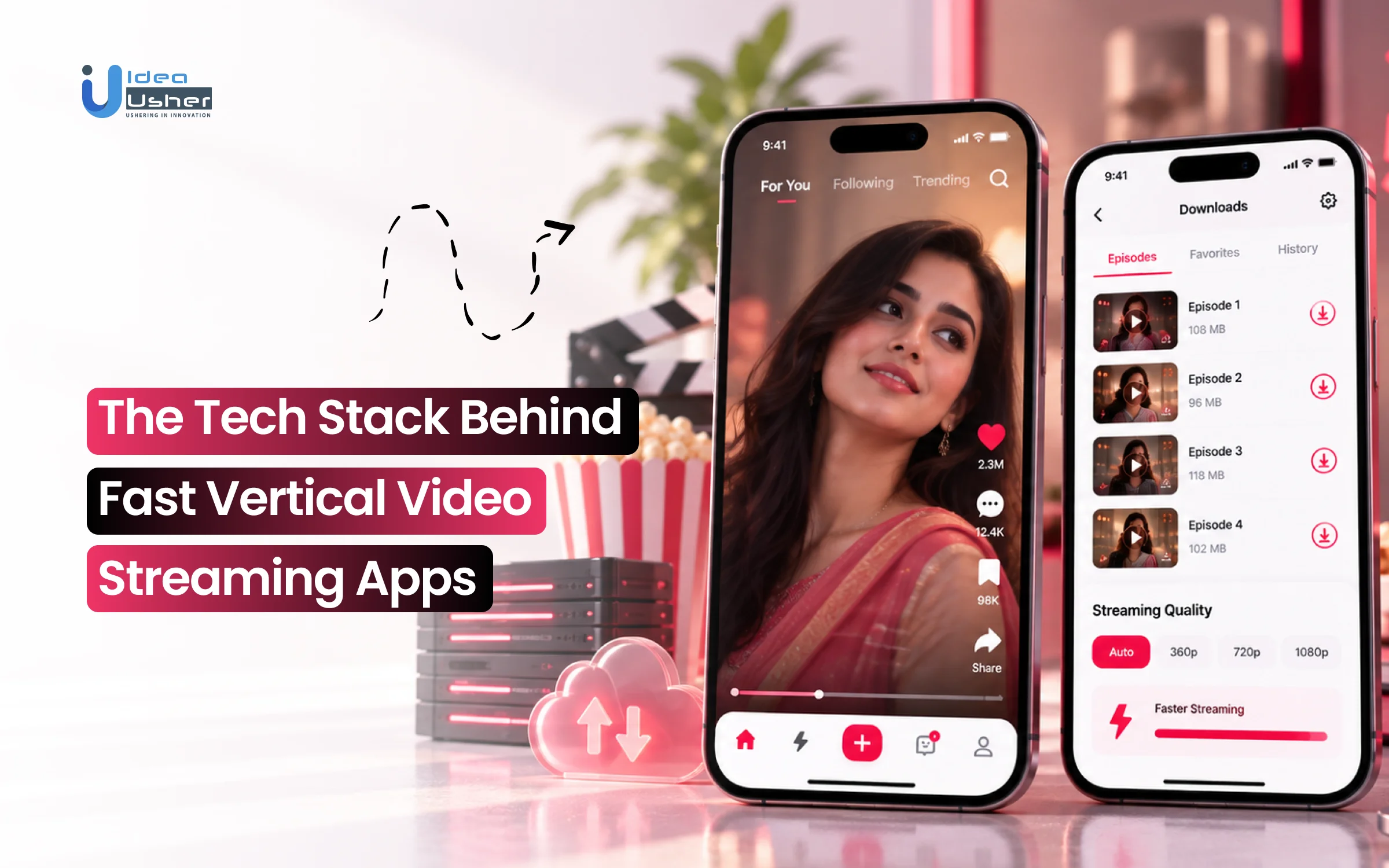
Vertical short-form drama apps are not competing on video quality alone. The main goal is to help viewers move from one short drama episode to the next without any pause, keeping the story flow, cliffhangers and viewing momentum alive. For founders, the vertical video streaming app technology stack is important because buffering, startup speed, video quality and content discovery can affect how long viewers stay and how much revenue the app generates.
Traditional streaming systems were built for longer viewing sessions, bigger screens and more predictable user behavior. Swipe-driven platforms need a different approach, with 9:16 video delivery, preloading, adaptive bitrate streaming, CDN optimization, scalable storage and real-time recommendation systems working together to keep viewing frictionless.
In this blog, we will talk about the vertical video drama streaming app tech stack, covering frontend and backend technologies, video processing, CDN architecture, storage, APIs, recommendations, scalability and the infrastructure decisions that enable fast continuous playback.
Global Microdrama Market Growth and App Opportunity
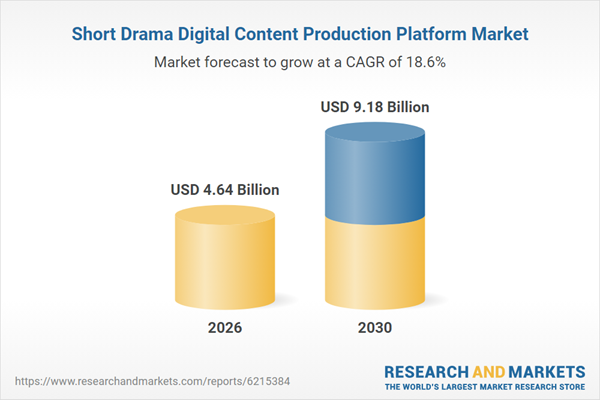
The short-drama digital content production platform market is projected to grow from $3.91 billion in 2025 to $4.64 billion in 2026 and will reach $9.18 billion by 2030, at a CAGR of 18.9%. This growth highlights the rising demand for mobile-first, short-form entertainment and creates strong opportunities for platforms that can scale content efficiently.
The global microdrama market reached an estimated $11 billion in total platform value in 2025 and is forecast to reach $14 billion by the end of 2026, according to Omdia.
Outside China, the market generated $1.4 billion in 2024 and is forecast to reach $9.5 billion by 2030 at a 28.4 percent CAGR, per Media Partners Asia, while global downloads topped 850 million in Q1 2026 alone, up 140 percent year over year according to Sensor Tower.
A strong example is ReelShort, whose US users averaged 35.7 minutes of daily mobile usage, compared with 24.8 minutes for Netflix, 26.9 for Amazon Prime Video and 23 for Disney+. This level of engagement is driving greater media investment in short-drama platforms for audience growth, monetization and retention.
A. What Is Driving Global Microdrama App Growth?
Growth at this scale is a business opportunity, but only for platforms built on the right technology. Mobile-first viewing habits, episodic formats, and international expansion are pushing founders toward specialized streaming, monetization, and personalization systems rather than a basic app shell.
- Short episodic formats reward platforms built for constant content drops: Average daily time spent across short drama apps reached 25 minutes globally by April 2026, up 85 percent from January 2025, according to Sensor Tower, a curve that depends on a CMS built for frequent, scheduled episode releases.
- International expansion is outpacing mature markets: Users in Southeast Asia already spend nearly 40 minutes a day inside short drama apps, per Digital Yield Group, which requires localized CDN routing, dubbing pipelines, and regional payment rails most template apps do not ship with.
- In-app monetization needs more than one paywall model: Even in China’s mature market, roughly 40 percent of viewers never pay, per adjoe, pushing platforms toward hybrid coin, subscription, and rewarded-ad systems engineered to work together.
- Personalized feeds separate winners from the rest of the field: The top five short drama apps capture 68.8 percent of category revenue while driving only 28.8 percent of downloads, according to adjoe, a gap that comes down to retention and recommendation technology, not just acquisition spend.
B. Why Market Growth Matters For Drama App Founders
Category growth at this pace changes the calculus for new entrants. HOLYWATER’s $22 million raise in January 2026, the largest microdrama round outside Asia, shows exactly where investor capital is heading.
- Market size supports multiple winners, not just one: Even at $14 billion, the top three platforms capture only about 60 percent of non-China revenue, leaving room for regional and niche players.
- Early movers are securing brand and distribution deals: Partnerships like ReelShort’s Crocs collaboration show the category maturing past pure app-store growth.
- Investor scrutiny is rising alongside the capital: 2026 due diligence increasingly demands real unit economics rather than download charts, which favors founders who plan cost structure from day one.
- Regional gaps remain wide open: Japan’s microdrama revenue alone is forecast to exceed $1.2 billion by 2030, still an underdeveloped market relative to China and Southeast Asia.
- Consolidation is coming, and timing matters: Streaming Lens projects the field will narrow to an estimated 5 to 8 surviving platforms as user acquisition costs rise, making the next 12 to 24 months decisive for new entrants.
Why Vertical Video Apps Need a Different Tech Stack
The vertical micro-drama platform deployment on conventional Over-The-Top (OTT) architecture leads to severe latency bottlenecks, memory crashes, and user churn. Standard streaming platforms are engineered for long-form, lean-back viewing sessions where a user buffers a single 45-minute file and stays put.
In contrast, short-drama apps operate under high-frequency, transactional mobile binging: users switch video streams every 60 to 120 seconds, demanding a specialized tech stack focused on instant frame initialization, client-side pre-fetching, and high-concurrency microtransactions.
A. How Microdrama Streaming Differs From Traditional OTT
The fundamental differences in user consumption patterns dictate radically different engineering constraints:
| Technical Metric | Traditional OTT (Netflix / Prime Video) | Vertical Microdrama (ReelShort / DramaBox) |
| Media Orientation | Landscape 16:9 widescreen | Portrait 9:16 full-screen native |
| Asset Segment Length | 6- to 10-second HLS/DASH chunk segments | 1- to 2-second ultra-short chunk segments |
| Session Cadence | 1–2 video stream requests per hour | 30–60 discrete media assets fetched per 45-minute session |
| Playback Handshake | 2–4 seconds of initial buffering tolerated | Strictly sub-300ms Time-to-First-Frame (TTFF) requirement |
| Monetization Gates | Checked once per session (subscription gate) | Checked per episode (virtual coin ledger / dynamic paywall) |
B. The Technology Behind Swipe-First Episode Discovery
A swipe-first experience depends on careful resource handling and responsive client behavior. The app must manage playback resources efficiently so rapid viewer actions feel instant and stable across devices and network conditions.
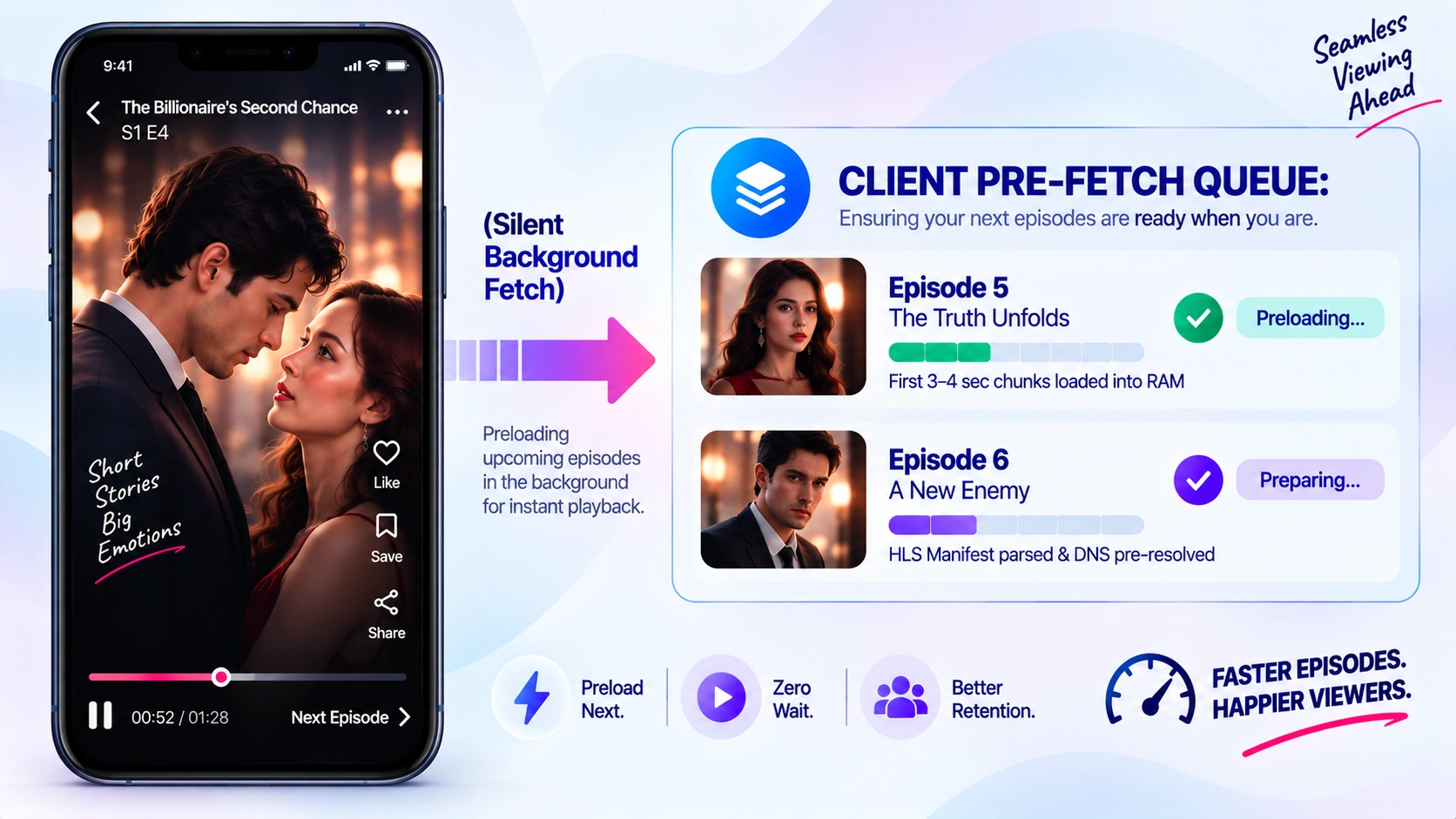
Delivering a ReelShort-like, zero-delay swipe gesture while playing serialized, DRM-protected mini-series requires a dual-track client architecture with proper vertical video streaming app tech stack:
- Client-Side Pre-Fetching Queues: The mobile player should not wait for the vertical swipe gesture to request media. While Episode 4 plays, background workers parse the manifests for Episodes 5 and 6 and pre-buffer the first 3 seconds of video segments into local memory.
- Texture Surface Recycling: Recreating video player instances on every swipe causes flickering and OOM crashes. High-performance apps avoid this by recycling native surfaces such as SurfaceView on Android and AVPlayerLayer on iOS while dynamically swapping the underlying media pipeline.
- Smart Eviction Logic: To keep device memory within safe limits, the caching layer removes previously watched episode segments from RAM while retaining the current series progress state.
C. Why Playback Speed Impacts Viewer Retention
Fast, consistent playback keeps viewers engaged and supports smoother purchasing decisions, especially when episodes depend on quick transitions and uninterrupted viewing.
- The 400ms Churn Cliff: If a user swipes up at a major cliffhanger and faces a loading spinner beyond 400 milliseconds, narrative momentum breaks. Playback delays can increase drop-off rates by 20%–30%.
- Paywall Impulse Window: Unlocking the next episode with 25 virtual coins or an Apple/Google in-app purchase happens on impulse. Several seconds of re-buffering after payment validation increases friction and can lower ARPPU.
- Network Adaptation Under Degraded Cellular Data: Short-drama bingeing often happens during mobile transit, requiring aggressive adaptive bitrate (ABR) switching. The player should shift seamlessly from 1080p to 720p or 480p without dropped frames or audio stalls.
D. What a Scalable Vertical Video Architecture Must Handle
To support hundreds of thousands of simultaneous viewers across dynamic regional catalog releases, the backend infrastructure must coordinate five key components:
- Short-Segment Adaptive Transcoding: Automated cloud encoding using AWS Elemental MediaConvert or FFmpeg container swarms, optimized for 9:16 video, converts raw masters into low-latency HLS/DASH renditions with 2-second segments.
- Edge CDN Optimization & Origin Shielding: CDNs such as CloudFront, Fastly, and Cloudflare use aggressive caching for initial free episodes (Episodes 1–5), preventing traffic spikes from overwhelming origin storage.
- High-Throughput Entitlement Gateways: Low-latency API gateways handle tens of thousands of concurrent lookups per minute to verify whether an active user_id can access a specific episode_id.
- Hardware-Level DRM Enforcement: Google Widevine and Apple FairPlay encrypt streams, while OS-level protections such as FLAG_SECURE on Android and iOS prevention layers limit screen recording and content ripping.
- Second-by-Second Video Telemetry: Real-time event streams track playback health, including rebuffering ratio, TTFF, and frame drops, alongside viewer retention curves across each 60-second narrative installment.
Vertical Video Streaming App Architecture Explained
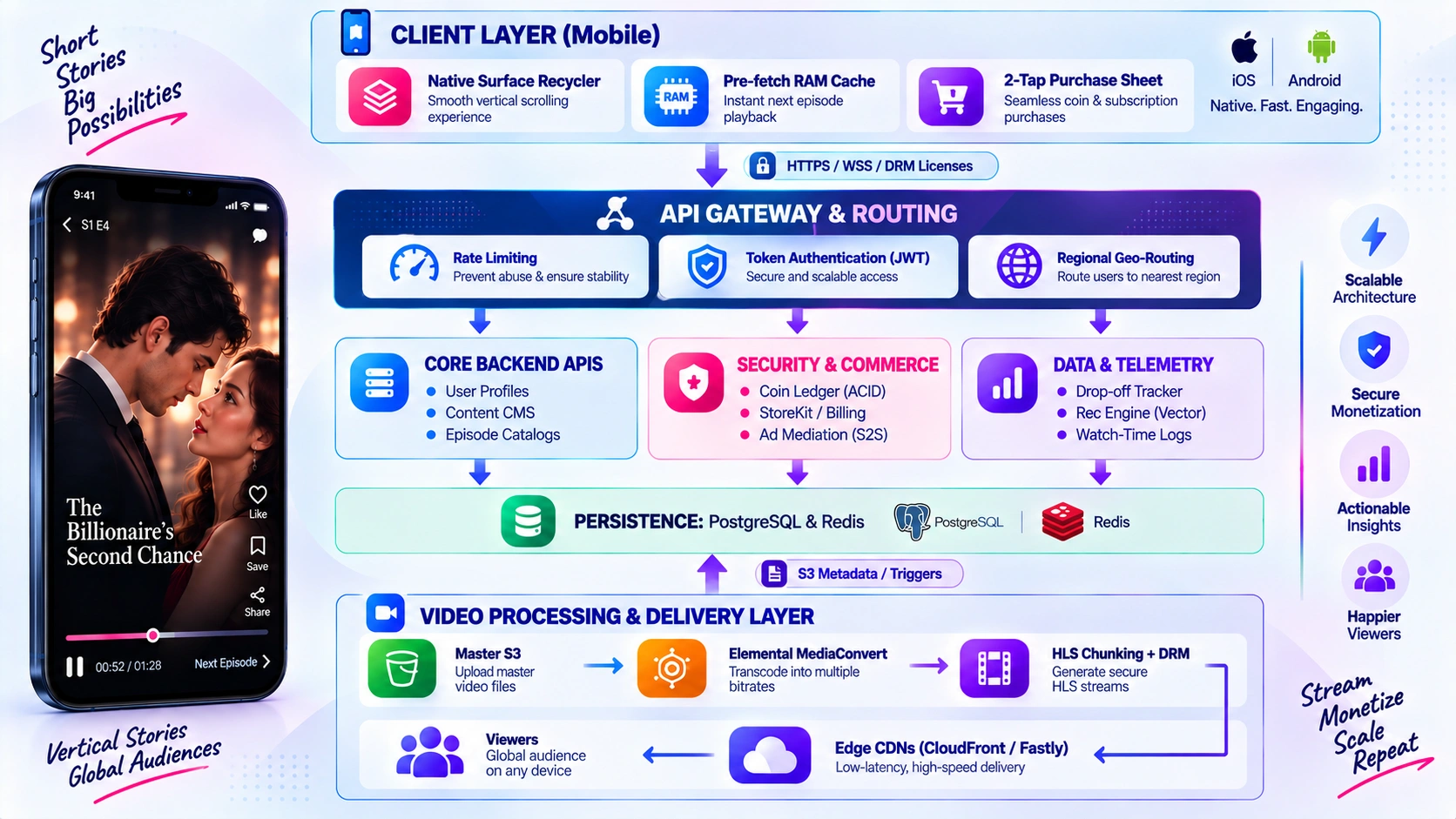
Building a custom vertical micro-drama platform requires orchestrating high-concurrency video delivery with transactional mobile gaming mechanics. A monolithic architecture quickly fails when a viral series drives tens of thousands of concurrent binge sessions.
Separating your platform into decoupled, modular service layers ensures that high-volume video bandwidth does not interfere with coin transactions, recommendation models, or content publishing workflows.
A. Client Layer for Mobile Video Consumption
The mobile client is an active cache and playback manager designed for 9:16 portrait viewing:
- Dual-Platform Implementation: Built with native codebases (Swift for iOS, Kotlin for Android) or cross-platform frameworks (Flutter/React Native) using native player bridges.
- Texture Surface Recycling: Reuses native video surfaces (AVPlayerLayer on iOS, SurfaceView on Android) within a custom vertical pager to prevent UI flicker and memory leaks during rapid swiping.
- Proactive Pre-Fetching Engine: A background worker parses upcoming HLS manifests while the current 60-second episode plays, pre-buffering the first 2–4 seconds of the next two episodes into device RAM.
B. API and Backend Service Layer
Stateless microservices in vertical video streaming app tech stack (built with Go or Node.js running on AWS ECS/EKS) handle high-frequency requests independently from video chunk delivery:
- API Gateway & Edge Authentication: Manages SSL termination, rate-limiting, and JSON Web Token (JWT) verification.
- Content Operations CMS: Back-office dashboard for bulk-uploading 80+ episodes, syncing .srt/.vtt subtitles, scheduling drops, and setting dynamic paywall flags.
- Episode Entitlement Services: High-speed endpoints validating whether an authenticated user has unlocked a target episode before issuing stream manifests or DRM licenses.
C. Video Processing and Delivery Layer
This tier handles the ingestion, encoding, and global distribution of media assets:
- Automated Transcoding Pipelines: Master uploads to Amazon S3 trigger event-driven transcoding via AWS Elemental MediaConvert or containerized FFmpeg. Raw files become multi-bitrate HLS renditions at 1080p, 720p, 480p and 360p with 1–2 second chunks.
- Global Multi-Edge CDN Delivery: AWS CloudFront and Fastly cache video segments near users, while origin-shield caching protects storage buckets from traffic surges during new series premieres.
D. Data, Analytics, and Recommendation Layer
Micro-drama monetization requires second-by-second visibility into viewer drop-off:
- Real-Time Telemetry Pipeline: Ingests granular playback events (heartbeat_5s, cliffhanger_reached, paywall_impression, churn_exit) via Kafka or Kinesis into analytical data lakes (e.g., ClickHouse or Snowflake).
- Recommendation Microservice: Evaluates binge velocity, tag affinity, and completion rates to dynamically order the discovery feed, pairing collaborative filtering models with low-latency Redis caches.
E. Security and Monetization Layer
The financial backbone isolates transaction processing to prevent client-side tampering:
- Double-Entry Coin Ledger: ACID-compliant PostgreSQL tables record coin purchases, promotional credits, expirations and episode deductions with cryptographic integrity.
- Server-Side IAP Webhooks: Validates Apple StoreKit 2 and Google Play Billing receipts on the server before updating wallet balances.
- Ad Mediation Callbacks: Secure S2S verification endpoints confirm rewarded video completions from AdMob and ironSource before crediting bonus coins.
- Hardware DRM & Stream Protection: Uses short-lived signed URLs, Apple FairPlay and Google Widevine DRM, with OS-level screen-recording protection via FLAG_SECURE.
Core Video Streaming Tech Stack for Microdramas
Delivering serialized, 9:16 vertical video at scale requires engineering for high-frequency video asset switching rather than sustained, long-form caching. When users swipe through dozens of 60- to 120-second episodes in a single binge session, the underlying video pipeline must guarantee sub-300ms startup latency across volatile mobile networks.
1. Cloud Storage for Vertical Video Assets
Managing a microdrama catalog spanning thousands of discrete video files requires separating write-heavy ingestion from read-heavy streaming:
- Tiered Hot-to-Warm Storage: Store master mezzanine files (.mov, ProRes/DNxHR) in Amazon S3 Standard or Google Cloud Storage Standard. After processing, automatically move them to S3 Glacier Flexible Retrieval or GCS Coldline to reduce long-term storage costs.
- Segmented Manifest Storage: Store transcoded manifests (.m3u8, .mpd) and segments (.ts, .m4s) in high-throughput object storage such as S3 Standard or Bunny Storage, configured as CDN origins.
- Origin Shielding: Use CloudFront Origin Shield to protect storage buckets from traffic spikes during viral episode drops, potentially reducing origin egress costs by 60%–80%.
2. FFmpeg vs Managed Video Transcoding Services
Choosing between custom containerized FFmpeg workers and managed cloud transcoders depends on your balance of internal DevOps overhead versus per-minute operational costs:
| Evaluation Factor | Self-Hosted FFmpeg (AWS ECS / Spot EC2) | Managed Services (AWS Elemental MediaConvert / Bitmovin) |
| Direct Cost | Lowest ($0.003–$0.007/min): Pay mainly for compute without per-minute software fees. | Higher ($0.015–$0.035/min): Predictable per-minute encoding, packaging and audio fees. |
| Pipeline Setup | Requires custom orchestration with SQS queues, auto-scalers and quality checks. | Minimal setup: REST APIs, ABR templates and native S3 event triggers. |
| Operational Scale | Requires infrastructure monitoring and can face queue backlogs during 100-episode batch drops. | Elastic concurrency: Can parallel-transcode 100+ episodes with minimal maintenance. |
| Best Fit For | High-volume studios processing 10,000+ minutes/month with dedicated DevOps teams. | MVPs and scaling startups prioritizing faster launch and lower maintenance. |
3. HLS vs MPEG-DASH for Adaptive Streaming
While both protocols segment video into discrete chunks for dynamic quality switching, client platform ecosystem support determines your production protocol choices:
- HTTP Live Streaming (HLS): Mandatory for Apple platforms. iOS, iPadOS and tvOS use AVPlayer with HLS (.m3u8 playlists and fMP4 or TS segments). Cross-platform microdrama apps should package HLS for reliable iOS playback and hardware acceleration.
- Dynamic Adaptive Streaming over HTTP (MPEG-DASH): Works efficiently with Android ExoPlayer/Media3 and desktop browsers. However, maintaining separate HLS and DASH packages can increase storage use and CDN cache fragmentation.
- The Unified Standard (CMAF): Common Media Application Format (CMAF) uses standardized fMP4 segments that can serve both HLS and DASH manifests, providing cross-platform delivery without duplicating video chunks.
4. CDN Selection for Low-Latency Video Delivery
Microdrama streaming requires short-segment caching and lightning-fast edge TLS termination rather than bulk peer-to-peer downloading:
- Top Enterprise CDNs: AWS CloudFront and Cloudflare Stream/CDN offer broad edge coverage and tokenized signed-URL security. Fastly supports edge compute and dynamic geo-routing, while Bunny.net offers high-throughput delivery at lower egress costs.
- Short-Segment Cache Policies: Cache video segments at the edge with long TTLs (Cache-Control: max-age=31536000, immutable), while .m3u8 manifests use short TTLs or edge invalidation to support rapid paywall changes.
- Range-Request Support: CDNs should support HTTP Byte-Range requests (Range: bytes=…) so mobile players can fetch partial chunks without downloading entire files during rapid swipes.
5. Why Video Preloading Matters in Swipe Feeds
In a vertical feed, Time-to-First-Frame (TTFF) governs user engagement. If a user swipes into Episode 6 and sees a black screen or spinning loader for more than 400 milliseconds, narrative tension breaks and churn spikes.
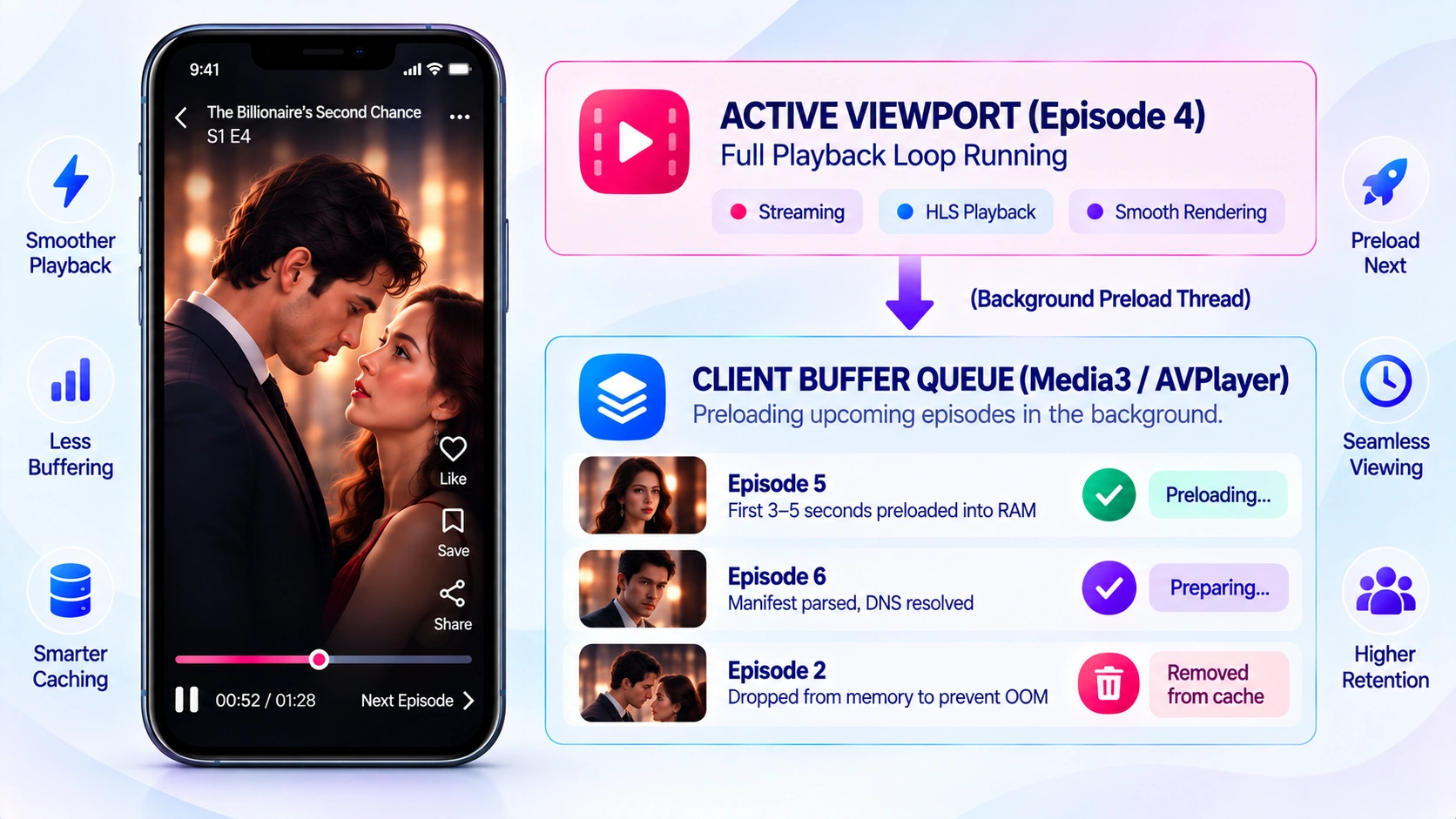
This seamless experience depends on preloading upcoming episodes, fast playback handoffs and efficient memory management to keep every swipe responsive and uninterrupted.
- Sliding-Window Pre-Fetching: The mobile player uses Media3 PreloadManager or custom AVPlayerItem queues to prefetch the first 3–5 seconds of the next two episodes while the current video plays.
- Instant Playback Handshake: When a swipe is detected, the player immediately decodes and displays the preloaded buffer while requesting the remaining segments in parallel.
- RAM Eviction & Texture Recycling: Previously watched episodes are cleared using an LRU cache to limit memory usage and prevent OOM crashes on low-end devices.
6. Multi-Bitrate Streaming for Different Networks
Viewers consume microdramas while commuting through degraded 4G/5G mobile cells, subways, and crowded public Wi-Fi. A rigid single-bitrate stream causes continuous mid-episode rebuffering:
| Rendition | Resolution | Aspect Ratio | Target Bitrate | Typical Segment Length |
| High (1080p) | 1080 × 1920 | 9:16 Vertical | 3,200 – 4,500 kbps | 2 seconds |
| Mid (720p) | 720 × 1280 | 9:16 Vertical | 1,800 – 2,400 kbps | 2 seconds |
| Standard (480p) | 480 × 854 | 9:16 Vertical | 800 – 1,100 kbps | 2 seconds |
| Low / Fallback (360p) | 360 × 640 | 9:16 Vertical | 400 – 600 kbps | 2 seconds |
These bitrate profiles work together to maintain smooth playback across changing network conditions. Two additional encoding choices, segment duration and keyframe alignment, determine how quickly the player can adapt.
- Ultra-Short 2-Second Segments: While traditional Netflix chunks run 6–10 seconds, vertical microdramas use 2-second segments for faster adaptive bitrate switching and lower pre-fetch overhead.
- Aligned Keyframe Intervals (GOP): All renditions should use matching 2-second GOP intervals (30 fps = 60 frames). This lets the player switch smoothly between 1080p and 480p at segment boundaries without audio pops or visual stuttering.
Choosing the Right Mobile Stack for Vertical Video Apps
Selecting a vertical video streaming app tech stack for mobile version directly impacts playback latency, memory efficiency, and operational costs. Unlike basic apps, vertical drama players continuously process hardware-decoded 9:16 video textures, rapid gestures, and instant in-app purchases.
Selecting the right framework depends directly on your stage of growth, engineering capacity, and long-term scale.
A. Flutter vs React Native for Microdrama Apps
For startups and media publishers launching a cross-platform MVP, cross-platform frameworks cut initial development time and engineering costs by nearly half compared to maintaining separate native codebases. However, each handles heavy video rendering differently:
| Metric / Dimension | Flutter | React Native (New Architecture) |
| Rendering Engine | Impeller GPU rendering via Metal on iOS and Vulkan on Android. | Native UI views via Fabric renderer and JSI, with direct C++ invocation. |
| Video Surface Handling | Uses Platform Views with Texture Layer Hybrid Composition for native video decoders. | Native view encapsulation through expo-video or react-native-video, bridging AVPlayer or Media3. |
| Animation & Gesture Parity | Superior out-of-the-box: Dart compiles to native ARM code, supporting complex UI overlays with minimal frame drops. | Excellent with react-native-reanimated worklets, though unoptimized bridge state changes can cause frame drops. |
| Ecosystem & IAP Libraries | Consistent packages such as better_player and in_app_purchase, but fewer microdrama feed wrappers. | Large npm ecosystem with mature video and monetization tools, including expo-video and RevenueCat. |
| Best Production Stage | UI-intensive MVPs requiring custom gestures and consistent cross-platform visuals. | JavaScript/TypeScript teams seeking rapid multi-platform prototyping with Expo. |
The Cross-Platform Trade-Off: While both frameworks handle standard UI screens effortlessly, they rely on platform channels or native bridges to communicate with underlying OS video decoders. When a user rapidly swipes through 15 episodes in 60 seconds, bridging overhead can cause micro-stutters unless your team writes custom native caching wrappers.
B. When Native Swift and Kotlin Make More Sense
For well-funded platforms scaling beyond 50,000 daily active users, native engineering (Swift for iOS and Kotlin for Android) becomes the industry gold standard.
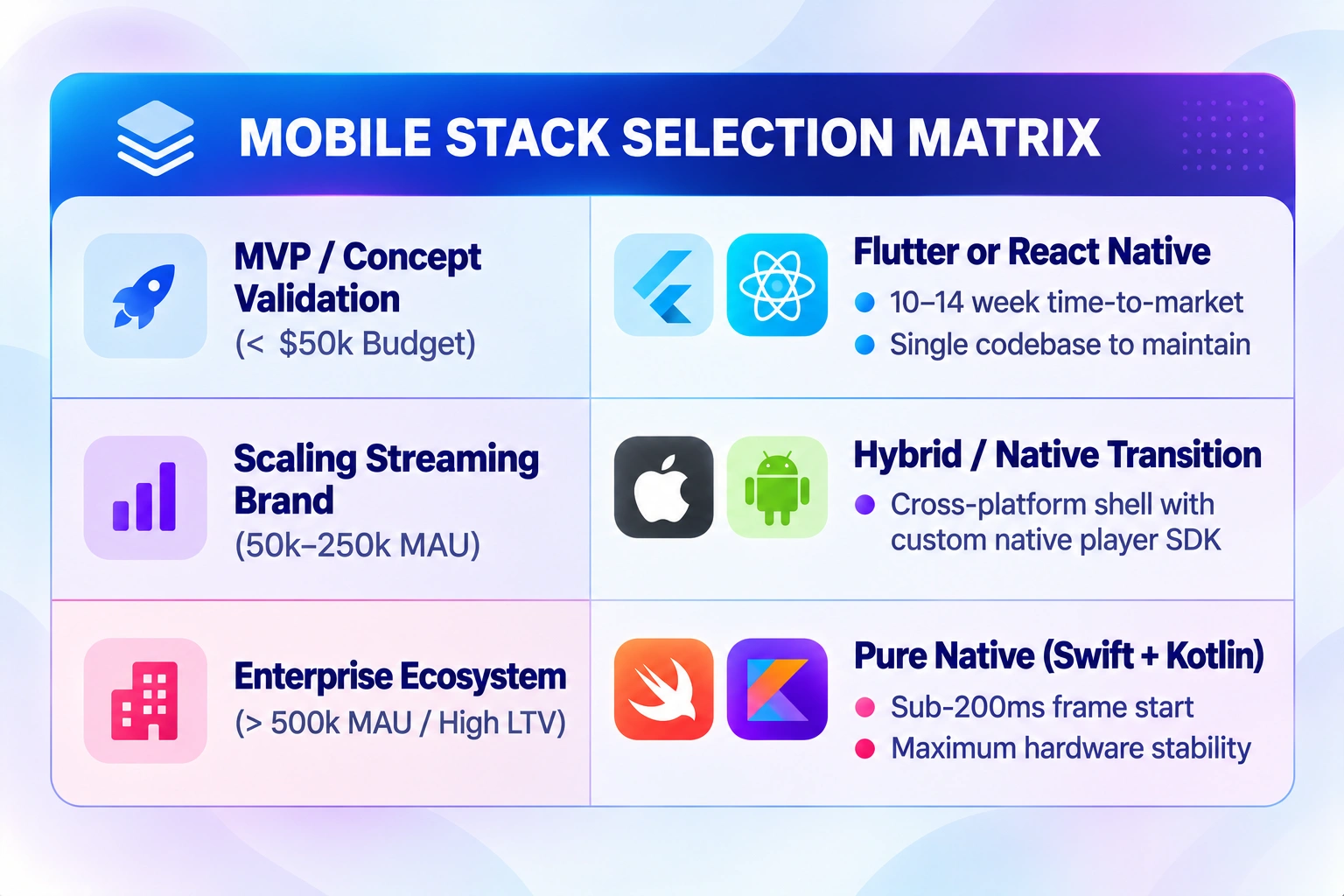
Building natively eliminates bridging overhead and unlocks direct access to operating system media pipelines:
- Direct Hardware Decoders: Native code communicates directly with Apple’s AVFoundation and Android’s Media3 / ExoPlayer, eliminating serialization overhead.
- Advanced Low-Level Caching: Low-level caching APIs, including Android’s DefaultPreloadManager and iOS’s AVAssetDownloadURLSession, enable byte-range background preloading directly into device RAM.
- DRM & Hardware Screen Protection: Apple FairPlay and Google Widevine require native cryptographic license exchanges and strict FLAG_SECURE window flags to block third-party screen recording.
- Lower Memory Footprint: Native surface recycling reduces out-of-memory (OOM) crashes on budget Android chipsets, especially when decoding multiple high-bitrate streams simultaneously.
C. Building a Smooth 9:16 Swipe Video Player
In a microdrama app, the primary viewport is not an isolated video screen, it is an infinite, gesture-driven vertical feed. Delivering fluid 60fps vertical swipe navigation requires strict architectural practices:
- Surface Texture Recycling: Avoid destroying and recreating players on every swipe. Use an object pool with 3 player instances: previous, current and next. On each swipe, recycle the off-screen player and assign the upcoming stream manifest.
- Decoupling Audio from UI Threads: Run video decoding, audio sessions and manifest parsing on dedicated background threads. Even if the UI stutters during a coin animation, video playback should remain uninterrupted.
- Gesture Physics Matching: The vertical pager should intercept touch events cleanly and use spring physics similar to TikTok or Instagram Reels, avoiding heavy layout rebuilds while the user tracks the screen.
D. Optimizing Startup Time and Episode Transitions
The key commercial metric in vertical streaming is Time-to-First-Frame (TTFF). If a viewer hits a major plot cliffhanger and encounters a 1-second loading spinner, emotional momentum evaporates and churn spikes.
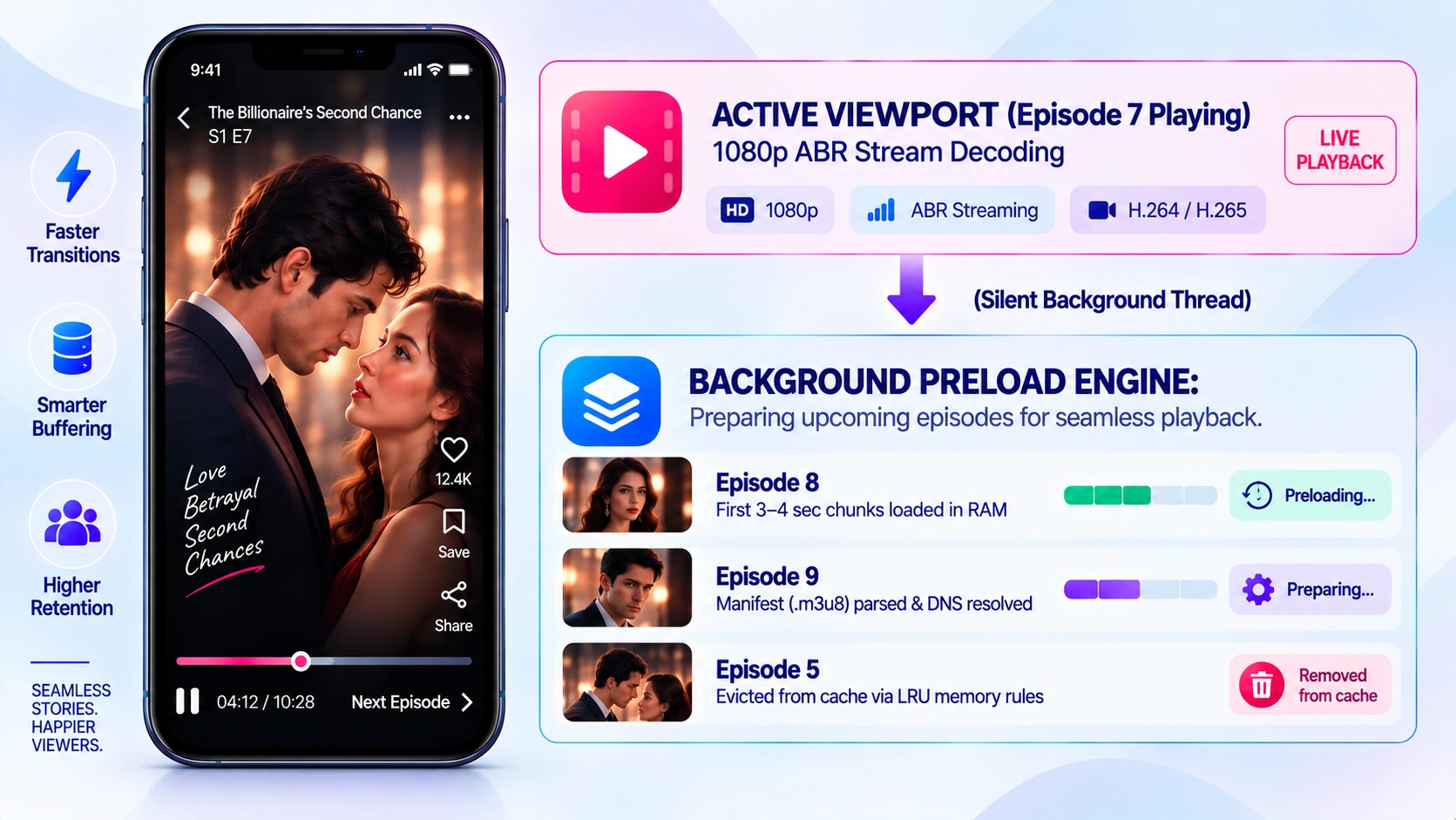
These vertical video streaming app tech stack work together to reduce startup delays and keep episode transitions smooth. Preloading buffers content, pre-warming reduces overhead and LRU eviction protects memory.
- Sliding-Window Preloading: During Episode 7 playback, the client pre-fetches the initial 2–4 seconds of Episode 8 at a low bitrate (e.g., 480p) to RAM. Swiping launches playback immediately, upgrading to 1080p once bandwidth allows.
- Manifest & DNS Pre-Warming: The player pre-resolves CDN DNS addresses and downloads the master .m3u8 playlist for the next two episodes before the current clip ends.
- Least Recently Used (LRU) Memory Eviction: Mobile devices enforce strict memory limits. When an episode leaves the viewport, its buffered segments are cleared from local heap memory to preserve space for upcoming decodes and prevent crashes on older hardware.
Recommendation Tech Stack for Personalized Drama Feeds
In vertical short-drama apps, recommendation engines directly drive bingeing, coin sales, and retention. Microdrama viewers decide to stay or swipe in 3 to 5 seconds, making real-time, personalized AI recommendations essential.
Delivering a hyper-personalized vertical feed requires an AI recommendation architecture that processes streaming event telemetry in real time and re-ranks candidate episodes before the viewer reaches the next swipe gesture.
A. What User Signals Should a Recommendation Engine Track?
A strong recommendation system in vertical video streaming app tech stack learns from viewer actions across each session, helping platforms understand attention patterns, spending behavior and story preferences to improve content matching over time.
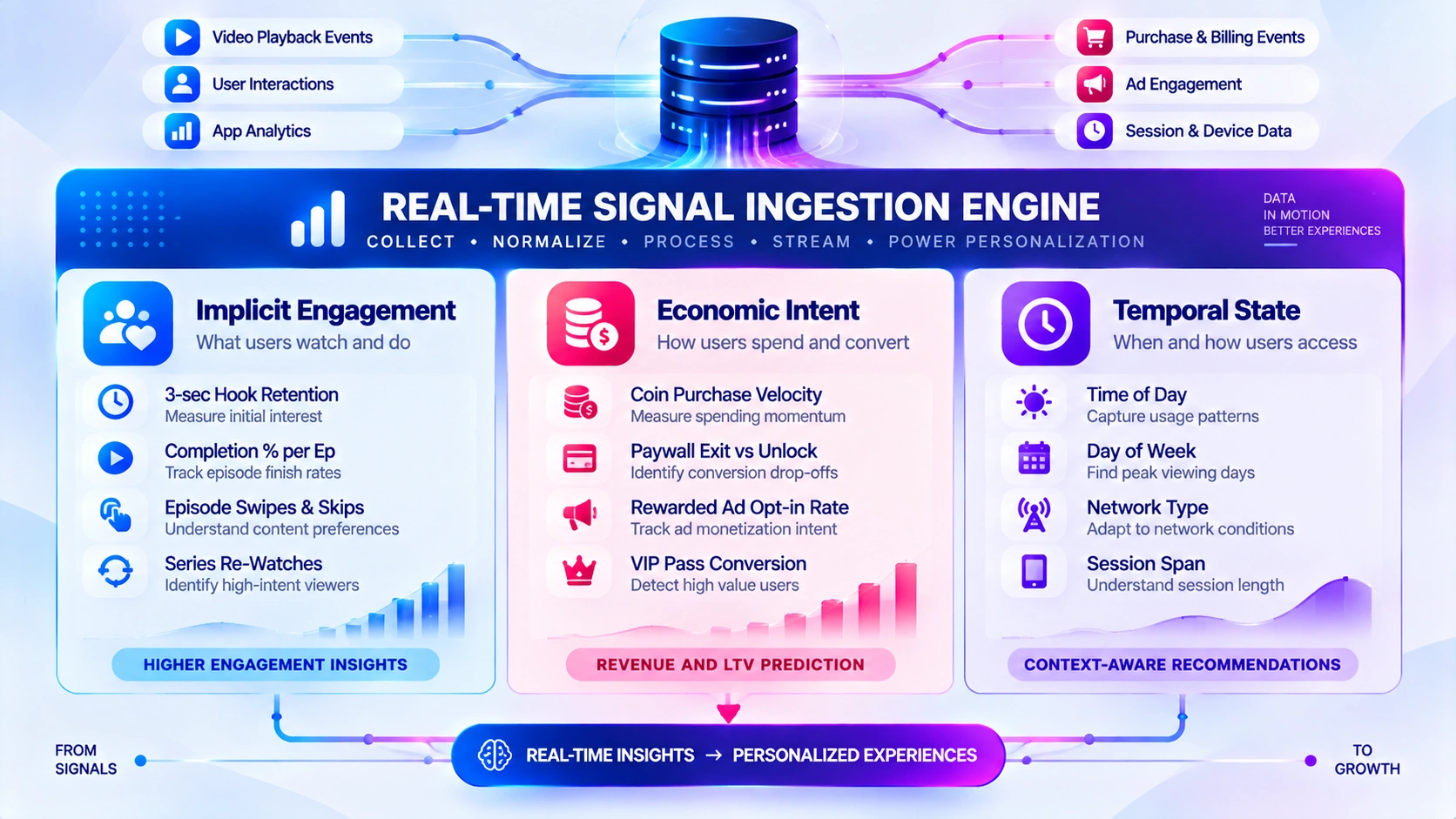
A production-grade recommendation pipeline captures continuous implicit telemetry rather than relying on explicit user reviews:
- Micro-Engagement Metrics: Second-by-second heartbeat events that measure whether the user engaged with the initial dramatic conflict or swiped immediately.
- Economic Conversion Signals: How a viewer behaves at paywall boundaries (Episodes 6–10) whether they immediately purchase coins, opt for a rewarded ad, or drop off, classifies their price sensitivity and content commitment.
- Narrative Archetype Affinity: Granular tracking across micro-genre tags, character tropes (e.g., Alpha Werewolf, Secret Billionaire, Revenge Heiress), and tonal tags (e.g., Melodrama, Suspense, Comedy).
B. Watch Time, Completion, Skips, and Rewatches
The algorithm weights different behavioral signals to determine whether an episode was genuinely enjoyed or abandoned:
| Viewer Interaction | Signal Type | Algorithmic Weight | Impact on Feed Ranking |
| Instant Skip (< 3s) | Strong Negative | -2.5 | Immediately suppresses that sub-genre and lead actor in the active session. |
| Partial Watch (10–45s) | Weak Negative | -0.8 | Down-ranks similar narrative pacing; signals that the narrative hook failed to hold. |
| Full Completion (55–60s) | Strong Positive | +3.0 | Signals narrative grip; queues the next sequential episode in the cache pipeline. |
| Immediate Unlock / Pay | Maximum Positive | +5.0 | Categorizes the series as high-converting; boosts cross-recommendations of similar trope clusters. |
| Rewatch / Rewind | Strong Positive | +4.0 | Indicates high engagement with specific plot reveals or climactic character moments. |
C. AI Models for Personalized Episode Recommendations
Modern microdrama platforms deploy a two-stage recommendation architecture: Candidate Generation (Retrieval) and Candidate Ranking (Scoring).
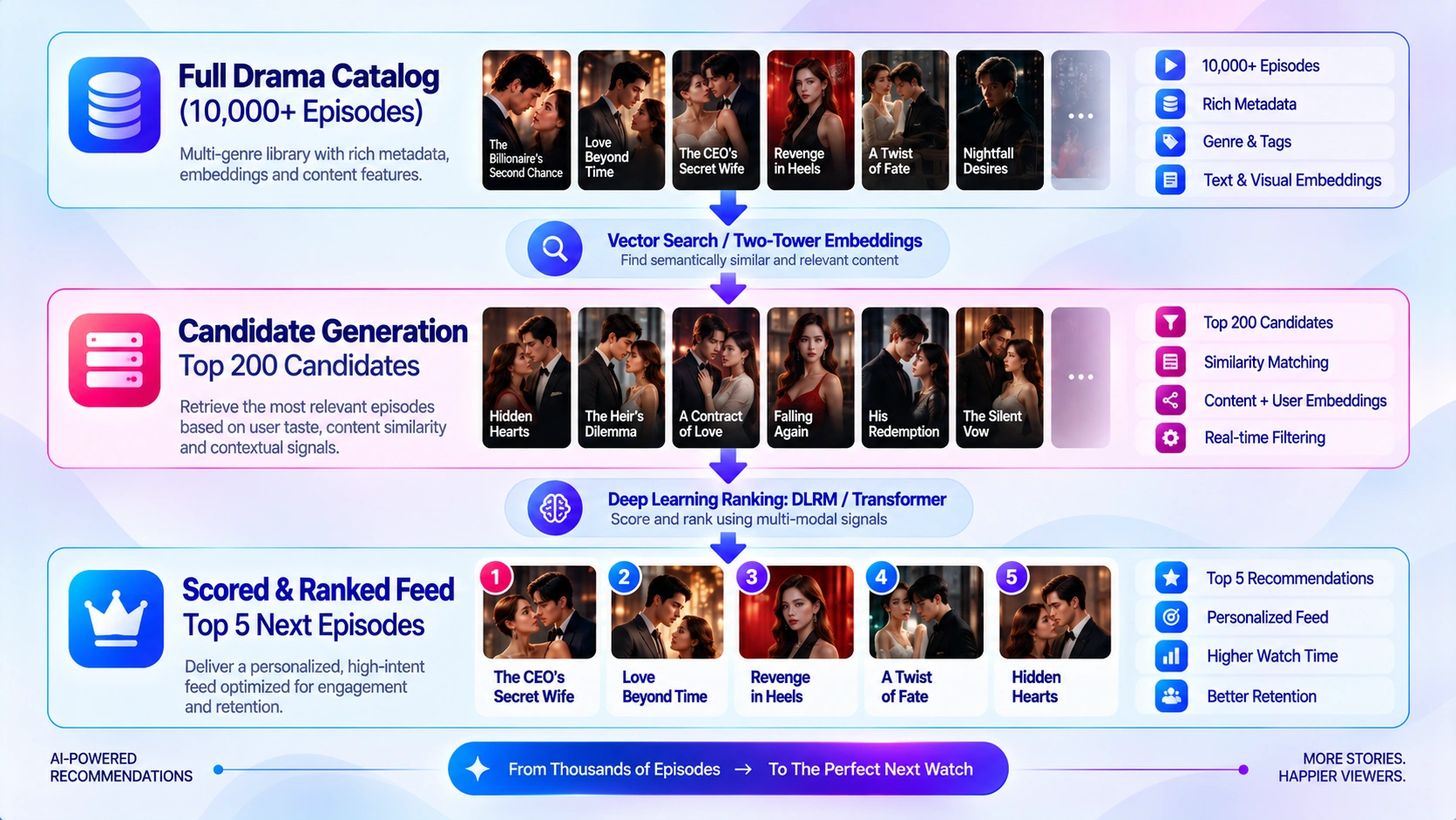
Two-Tower Neural Networks (Candidate Retrieval): Separate user and item networks generate dense vector embeddings. The User Tower encodes watch history and demographics, while the Item Tower captures series tropes, audio cues, and pacing. ANN search through Milvus, Pinecone, or pgvector retrieves the top 100–200 candidates in under 15ms.
Sequential Session Models (SASRec / BERT4Rec): Microdrama viewing is inherently sequential. Transformer models treat watched episodes like words in a sentence, predicting the next narrative archetype a user is likely to binge from recent session transitions.
Deep Learning Recommendation Models (DLRM): The final ranker scores retrieved series against multiple objectives, predicting both Probability of Completion (Pcomp) and Probability of Paywall Unlock (Ppay).
D. TensorFlow vs PyTorch for Recommendation Systems
Both frameworks in vertical video streaming app tech stack support deep learning recommenders, but their production advantages diverge across training flexibility and real-time inference latency:
| Framework | Suited Architecture | Core Strengths | Operational Trade-Offs |
| TensorFlow (TF Recommenders / TFX) | Large-Scale Enterprise Production | → Integrated production ecosystem with TF Serving → Native Google Cloud and TPU deployment → C++ serving optimized for high-throughput, sub-10ms inference. | Steeper learning curve and more rigid computation-graph debugging than Python-native frameworks. |
| PyTorch (TorchRec / PyTorch 2.x) | Rapid Experimentation & Research Teams | → Dynamic computation graphs simplify custom model iteration. → TorchRec enables optimized distributed GPU embeddings → Native Python debugging accelerates prototyping. | Requires serving layers like Triton Inference Server or TorchServe for low-latency enterprise deployment. |
The Production Consensus: Early-stage startups and MVPs benefit from PyTorch’s rapid experimentation cycle. High-throughput platforms scaling past 200,000 DAU frequently deploy TensorFlow Serving or NVIDIA Triton on Kubernetes to deliver low-latency ranking under massive concurrency spikes.
E. Building a Recommendation Engine That Improves Over Time
A static recommendation model degrades rapidly as viewer tastes evolve and content catalogs turn over. A self-improving ML pipeline requires four operational feedback loops:
- Real-Time Streaming Feature Store: Raw clickstream telemetry flows through Apache Kafka or AWS Kinesis into a feature store such as Feast or Redis. User embedding vectors update within the current session instead of waiting for overnight batch jobs.
- Exploration vs. Exploitation (Multi-Armed Bandits): Recommending only proven hits creates a cold-start problem for new releases. Contextual multi-armed bandits can allocate 10%–15% of the swipe feed to exploratory clips, using early hook retention to uncover breakout titles.
- Automated Daily Re-Training: Kubeflow or Airflow pipelines ingest the previous 24 hours of watch and payment data, continuously updating ranking weights and limiting catastrophic model drift.
- Negative Feedback Filtering: Automatically suppresses series a user has skipped for three consecutive episodes, reducing irrelevant recommendations and helping prevent app abandonment.
How to Build a Vertical Video Streaming Architecture
Building a production-ready streaming pipeline for 9:16 vertical microdramas requires an event-driven architecture optimized for ultra-low startup latency, rapid asset switching, and continuous telemetry capture.
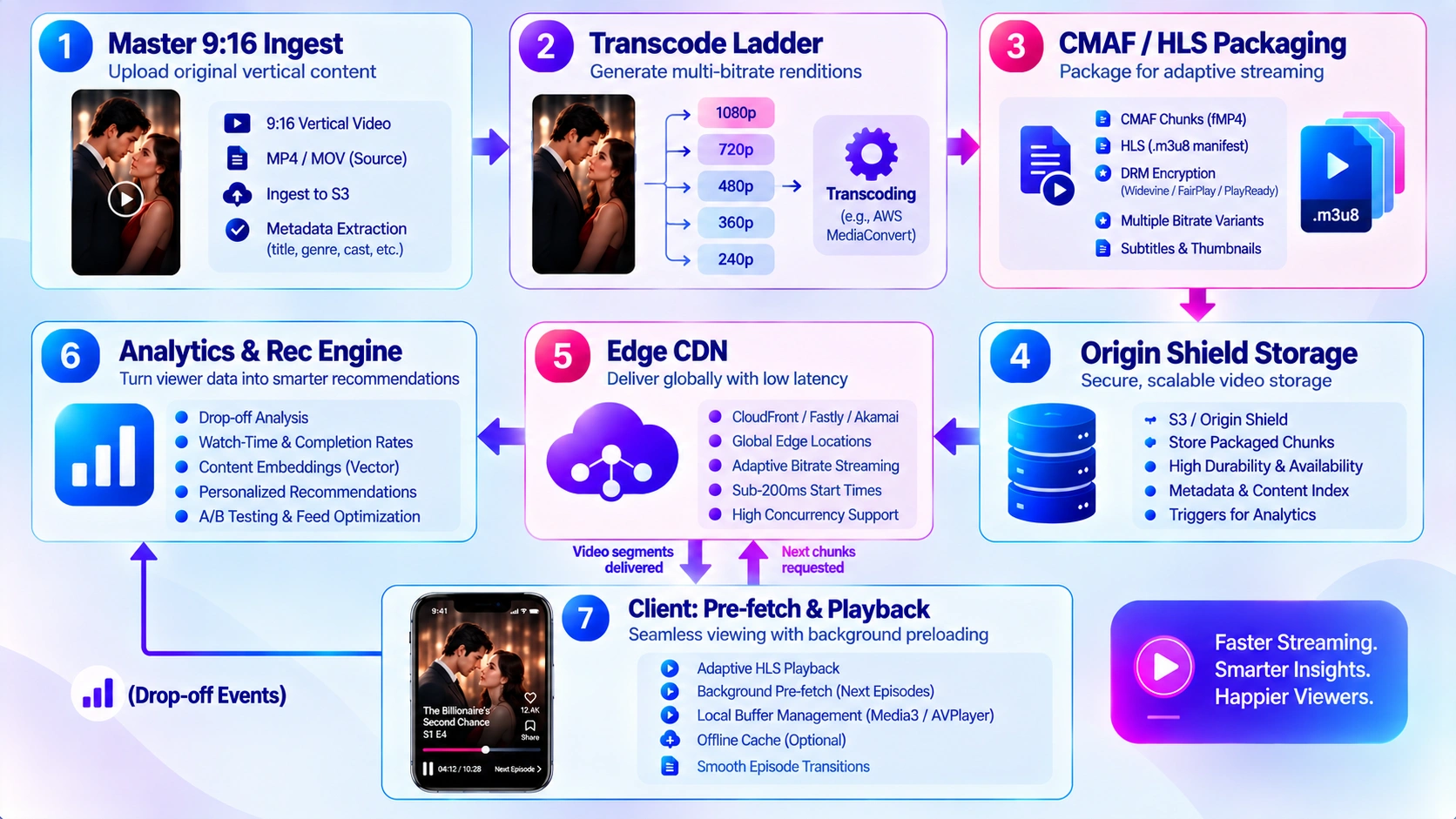
The end-to-end data and media flow spans seven coordinated engineering steps:
1. Upload and Ingest Master Video Files
The ingestion tier must handle hundreds of multi-gigabyte mezzanine files uploaded in bulk by editorial teams without blocking server resources:
- Direct-to-S3 Multi-Part Uploads: Client CMS dashboards request short-lived, pre-signed S3/GCS URLs from the backend, then upload 1080p/4K master files directly to raw storage buckets over HTTPS.
- Metadata Validation & Extraction: An S3 ObjectCreated event triggers a serverless worker (AWS Lambda/Cloud Functions) using ffprobe to verify 9:16 aspect ratios, 24/30/60 fps frame rates, audio channels, and container integrity.
- Task Queuing: Validated assets enter an Amazon SQS or RabbitMQ queue, which orchestrates downstream encoding jobs with retry policies and Dead Letter Queues (DLQs).
2. Transcode Videos Into Multiple Bitrates
Raw master files must be converted into a multi-bitrate ladder to prevent buffering across varying cellular networks:
| Profile | Resolution | Target Bitrate | Frame Rate | Keyframe Interval (GOP) |
| High | 1080 × 1920 | 3,500 – 4,200 kbps | 30 fps | 2.0s (Fixed 60 frames) |
| Mid | 720 × 1280 | 1,800 – 2,200 kbps | 30 fps | 2.0s (Fixed 60 frames) |
| Standard | 480 × 854 | 900 – 1,100 kbps | 30 fps | 2.0s (Fixed 60 frames) |
| Low / Fallback | 360 × 640 | 450 – 600 kbps | 30 fps | 2.0s (Fixed 60 frames) |
- Strict GOP Alignment: Enforce a closed-GOP structure of exactly 2.0 seconds across all renditions. This keeps segment boundaries frame-aligned, enabling instant bitrate switching without visual stutter or audio popping.
- Codec Selection: Standardize on H.264 (AVC) High Profile for broad playback across budget devices, while encoding parallel H.265 (HEVC) or AV1 tracks to reduce mobile bandwidth costs by 30%–45% on modern flagship smartphones.
3. Package Episodes for Adaptive Streaming
Transcoded video files are packaged into streaming manifests and short segment chunks:
- Fragmented MP4 (fMP4) via CMAF: Use CMAF to package video into 2-second .m4s fragments. A single segment set can serve both HLS and MPEG-DASH, reducing duplicate storage.
- HLS Manifest Hierarchies: Generate a master.m3u8 playlist pointing to variant playlists (1080p.m3u8, 720p.m3u8, etc.) that reference the 2-second segments.
- DRM Tokenization: For studio DRM, integrate Apple FairPlay and Google Widevine using the Common Encryption (CENC) standard during packaging.
4. Deliver Video Through a Global CDN
Distributing short, high-concurrency video files demands aggressive edge caching rather than long-distance origin round-trips:
- Origin Shield Architecture: Configure an Origin Shield layer between CDN edge points of presence (PoPs) and your storage bucket. The shield consolidates identical segment requests, reducing origin egress costs and protecting S3 from viral traffic spikes.
- Edge Cache TTL Strategies:
- Media Segments (.m4s, .ts): Set long, immutable cache headers (Cache-Control: public, max-age=31536000, immutable).
- Master Playlists (.m3u8): Set short TTLs (60–300 seconds) or employ automated cache invalidations when dynamic paywall tags change.
- HTTP/3 & Byte-Range Delivery: Enable HTTP/3 (QUIC) at the CDN edge to reduce handshake latency over unstable cellular connections, supporting HTTP Byte-Range requests for partial segment fetching.
5. Preload the Next Episode
To maintain a frictionless, ReelShort-like vertical swipe feed, the client application must mask network latency through proactive background pre-fetching:
- Manifest Pre-Warming: While the user is midway through Episode 3, the client pre-resolves CDN DNS and parses the manifest for Episode 4.
- Initial Segment Buffering: The app requests and buffers the first 2- to 3-second media chunk of Episode 4 (using a mid-tier resolution like 480p/720p to conserve data) directly into device RAM.
- Instant Surface Swap: Swiping vertically starts playback instantly from the local memory buffer without loading spinners. Once connection speed is verified, the player’s ABR algorithm automatically upgrades quality to 1080p.
6. Capture Viewer Behavior and Playback Data
Continuous, event-driven telemetry captures every interaction to drive script optimization and paywall performance:
- Client Event Heartbeats: The mobile player emits JSON event beacons every 5 seconds over WebSockets or lightweight HTTPS POST endpoints:
- playback_started (logs Time-to-First-Frame)
- heartbeat_5s (tracks continuous watch time)
- cliffhanger_reached (fired at second 55)
- paywall_impression and paywall_unlock_success
- episode_swiped (captures exact skip timestamp)
- High-Throughput Streaming Ingest: Events stream through AWS Kinesis or Apache Kafka into an analytical data lakehouse (ClickHouse, Snowflake, or BigQuery) for sub-minute aggregation.
7. Personalize the Next Episode or Drama
Data captured in Step 6 feeds back into the recommendation loop to determine what plays next:
- Dynamic In-Session Re-Ranking: If the telemetry engine records two consecutive sub-3-second skips, the active feed dynamically demotes that trope cluster and shifts the queue toward high-converting alternatives.
- Binge Hook Automation: When an entire 80-episode series concludes, the system analyzes the user’s completion velocity and character trope affinity, instantly serving the pilot episode of a complementary series into the vertical playback queue without returning to a static menu.
Common Tech Stack Mistakes in Vertical Video Apps
Vertical video platforms face engineering challenges that rarely appear in conventional apps. From unpredictable playback performance to infrastructure bottlenecks and fragmented mobile behavior, seemingly small vertical video streaming app tech stack decisions can quickly affect retention, scalability, and development costs.
1. Video Buffering During Rapid Episode Swipes
Challenge: Rapid swipes can trigger multiple video requests simultaneously, causing buffering, delayed playback, memory pressure, and excessive bandwidth consumption on mobile devices.
Solution: Our developers implement intelligent preloading, adaptive bitrate streaming, request cancellation, caching, and optimized player lifecycle management to prepare upcoming episodes without unnecessarily downloading multiple videos simultaneously.
2. Backend Bottlenecks During Viral Content Spikes
Challenge: A suddenly viral drama can generate massive concurrent requests, overwhelming APIs, databases, recommendation services, and authentication systems built for average traffic.
Solution: Our developers use horizontally scalable services, Redis caching, database optimization, asynchronous processing, load balancing, and cloud autoscaling to absorb traffic spikes without degrading core viewing experiences.
3. Inconsistent Playback Across Mobile Devices
Challenge: Different devices, operating systems, codecs, network conditions, and hardware capabilities can produce inconsistent playback, crashes, audio issues, or poor video quality.
Solution: Our developers test across device configurations, optimize codec and bitrate profiles, use adaptive streaming, monitor playback telemetry, and continuously tune player implementations for reliable cross-platform performance.
Build Your Vertical Video Streaming Drama App With IdeaUsher
IdeaUsher is an enterprise product engineering partner with 11+ years of experience across 50+ countries. Powered by 250+ engineers, 1,000+ completed builds and a 4.9/5 Clutch rating, we build resilient, high-concurrency streaming ecosystems.
Instead of using fragile third-party plugins, we build cloud-native platforms designed for sub-second playback initiation, multi-CDN redundancy, AI recommendations, and dynamic monetization pipelines to ensure your long-term digital entertainment dominance.
A. Product Architecture Designed Around Viewing Behavior
We engineer front-end clients and supporting backends to match modern consumption habits, prioritizing instant gratification and effortless user navigation:
- Micro-Interaction UI/UX Design: Native iOS, Android, and web players optimized for vertical swipe feeds, PiP, and one-handed controls.
- Smart Pre-Buffering Engines: Predictive client-side caching anticipates the next video, reducing launch latency and load spinners.
- Resilient Offline Playback: Encrypted local caching enables authenticated users to download episodes for secure offline viewing while preventing digital rights infringement.
B. Video Infrastructure Built for Continuous Playback
Our media systems architects build fault-tolerant video processing and distribution networks capable of delivering pristine video quality across varying network conditions:
- Adaptive Bitrate Streaming (ABR): HLS/MPEG-DASH services dynamically adjust video resolution based on user bandwidth.
- Automated Cloud Transcoding Pipelines: Event-driven pipelines compress, encode, and generate multiple renditions, thumbnails, and preview sprites.
- Multi-CDN Load Balancing: Intelligent routing distributes video segments across Cloudflare, Fastly, and AWS CloudFront to prevent origin bottlenecks and enable sub-second global delivery.
C. Personalized Feeds and Engagement Analytics
We integrate advanced data microservices to transform passive viewers into highly engaged, recurring subscribers:
- AI-Driven Recommendation Engines: Collaborative filtering and vector ML models analyze viewer history, completion rates, and skip tendencies to personalize “For You” feeds.
- Granular Telemetry Pipelines: Event-driven analytics capture viewer interactions, drop-off timecodes, rebuffering, and cohort retention.
- Automated Engagement Triggers: Dynamic push notifications and in-app alerts notify users about cliffhanger releases, seasonal drops, and limited-time coin promotions.
D. Architecture Designed for Future Platform Scaling
We deploy modular, decoupled backends that expand smoothly alongside catalog growth and traffic spikes:
- Containerized Microservices: Isolated Docker/Kubernetes clusters across AWS and GCP with automated horizontal pod autoscaling for viral traffic surges.
- Hardware-Grade Digital Rights Management (DRM): Apple FairPlay, Google Widevine, and Microsoft PlayReady integrations protect licensed assets against piracy and screen recording.
- Zero Vendor Lock-In Asset Delivery: Clean, documented, tested source code ensures 100% IP ownership, data sovereignty, and infrastructure control.
Ready to build an enterprise-grade video streaming platform engineered for global concurrency? Partner with Idea Usher’s principal infrastructure and cloud software architects to design your custom product build today.
Conclusion
The right technology choices determine whether a vertical video streaming app feels instant, reliable, and scalable under real-world demand. From adaptive streaming and CDN infrastructure to backend scalability and personalization, every layer needs careful planning. IdeaUsher helps businesses select and implement the right vertical video streaming app tech stack around their product goals, audience, content volume, and growth plans, enabling a stronger foundation for engaging vertical drama experiences and sustainable platform expansion.
FAQs
A.1. A suitable vertical video streaming app tech stack typically combines Flutter or native mobile technologies, Node.js or Go, scalable databases, Redis, cloud storage, CDN, adaptive streaming, analytics, and recommendation technologies.
A.2. Premium episodes can be protected through signed URLs, encryption, DRM, authentication, access controls, and secure APIs that restrict unauthorized video requests and help protect paid content.
A.3. Scalable cloud infrastructure, load balancing, caching, asynchronous processing, database optimization, and independently scalable services in vertical video streaming app tech stack help microdrama platforms handle sudden traffic spikes without affecting playback or availability.
A.4. Recommendation systems use behavioral signals such as watch time, completion rate, skips, rewatches, genres, and episode interactions to generate personalized content feeds and improve viewer engagement.