


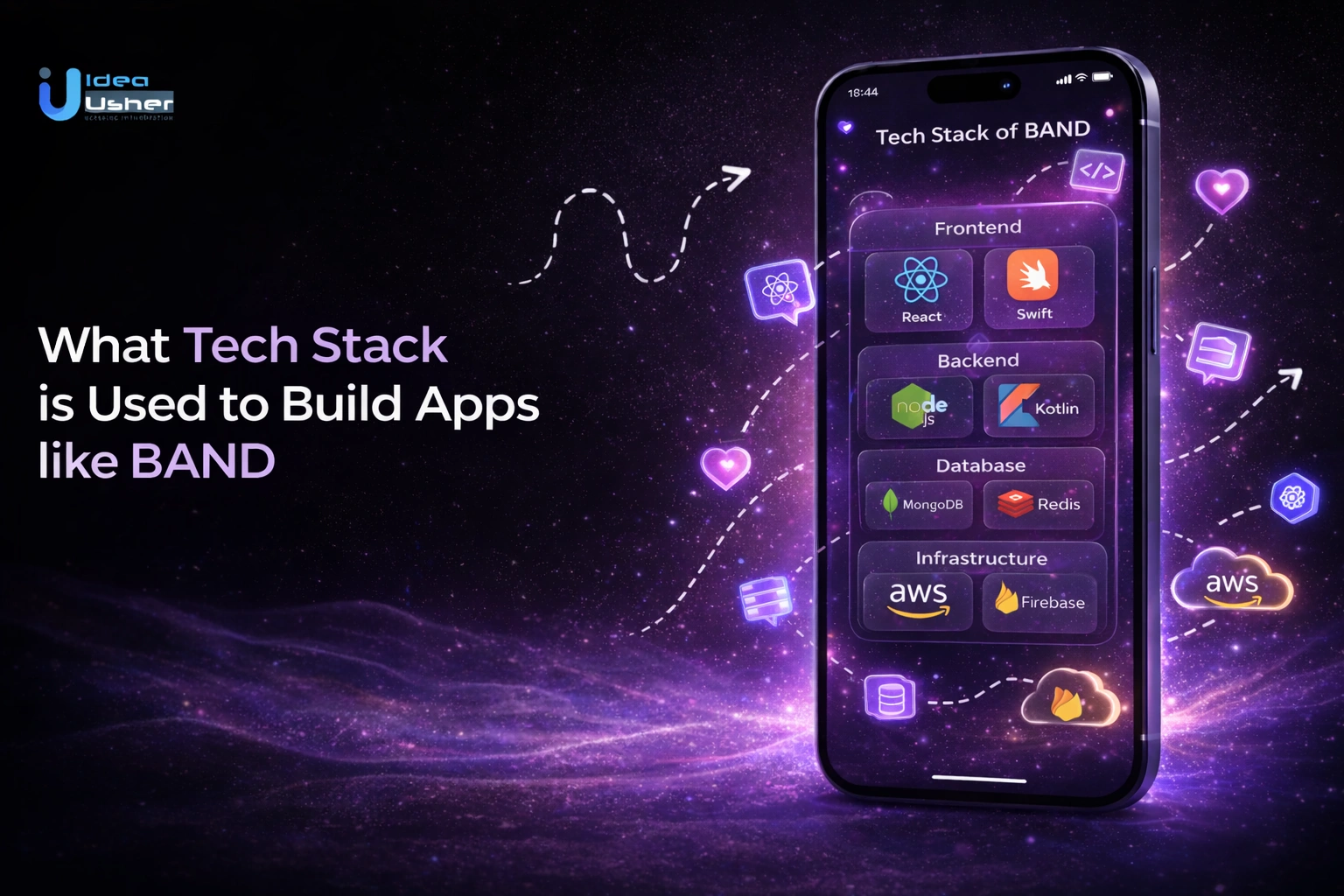
Group communication platforms bring together messaging, event coordination, content sharing, and community management in one environment, creating distinct technical demands.The tech stacks of apps like BAND is defined by the need for reliable real-time interaction, scalable group activity, media handling, and notification delivery, as these infrastructure choices directly shape the platform’s performance, reliability, and user experience.
The seamless integration of messaging services, backend APIs, databases, media storage, push notifications, and frontend frameworks is essential to maintaining system responsiveness and supporting both real-time interaction and structured group activities. The effectiveness of the platform depends on how well these components handle concurrency, data consistency, and scaling without degrading performance.
In this blog, we explore what tech stack is used to build apps like BAND by examining core technologies, system architecture, and the practical considerations involved in developing a scalable and reliable group communication platform.
Why Tech Stack Choice Defines App Scalability?
The global team collaboration market is projected to surge from $31.62 billion in 2026 to over $68 billion by 2034 at a CAGR of 10.1%, with more than 7.1 billion active messaging accounts globally this year, the demand for high-performance, secure coordination tools has never been higher.

The technical foundation of a private community platform dictates its scalability and evolution. With top community apps now seeing a 35% year-over-year increase in active user sessions, choosing tech stacks of apps like BAND ensures responsiveness. Strategic component selection effectively balances development speed with the high-concurrency requirements of millions of global users.
A. How Poor Tech Decisions Limit User Growth
Inadequate technology choices create a glass ceiling for any digital product. When the architecture cannot handle simultaneous data requests, the user experience suffers, leading to abandonment.
- Performance Latency: Frameworks lacking asynchronous processing delay message delivery and notifications; even minimal lag disrupts the real-time flow essential for effective group coordination.
- High Operational Costs: Inefficient code inflates server resource demands, causing maintenance costs to outpace revenue during scaling and threatening the sustainability of the business model.
- Development Stagnation: Outdated or niche languages create a “talent bottleneck,” making it difficult to find skilled engineers and extending bug fix or feature rollout timelines from weeks to months.
- Rigid Architecture: Monolithic structures prevent independent scaling; without decoupling, a heavy load on one module (like photo-sharing) can degrade the performance of the entire chat system.
B. Scaling Challenges In Community Apps Like BAND
Building for massive group communication involves handling exponential data loads. Unlike a one-to-one messaging app, a single action in a large community triggers a massive chain reaction across the network.
| Challenge Area | Impact on the Tech Stack |
| Broadcast Storms | A single post in a group of 10,000 members requires the system to push 10,000 unique notifications instantly. |
| Data Consistency | Shared calendars and polls must reflect the same state for every member simultaneously to avoid coordination errors. |
| Concurrent Writes | During live events, thousands of users may comment or react at the exact same millisecond, requiring high-performance database indexing. |
| Global Access | Serving users in different countries requires a distributed network to ensure low latency regardless of the user’s physical location. |
C. What Founders Often Overlook Before Development
Successful platforms require more than visible features; the underlying tech stacks of apps like BAND must prioritize robust infrastructure for long-term security, operational efficiency, and seamless scalability.
- Observability and Monitoring: Real-time tracking of server health and user behavior is essential to ensure technical teams remain proactive rather than reactive to performance issues.
- Integrated Security Protocols: Features like Role-Based Access Control (RBAC) are functional requirements for managing sensitive school or workplace data, not optional luxuries.
- Data Migration Strategy: A stack must support seamless database schema updates to prevent significant downtime or data loss as the platform evolves and scales.
- Third-Party API Compatibility: Services for live streaming or file storage require careful evaluation for long-term compatibility to avoid expensive vendor lock-in.
Understanding The BAND App Architecture Model
The architecture of a community-focused platform must balance high-speed interactions with massive data storage needs. Unlike simple messaging apps, the tech stacks of apps like BAND are built on a multi-layered model that separates user interface logic from heavy-duty background processing.
This separation ensures that even if one service experiences a surge in traffic, the rest of the application remains stable and responsive.

A. Core Layers Powering BAND-Like Platforms
Building a robust coordination tool requires a modular approach where each layer handles a specific business function. This structure allows developers to scale individual components based on actual usage patterns.
| Layer | Functional Role | Technical Value |
| Presentation Layer | The primary interface for iOS, Android, and Web users. | Manages smooth UI transitions, local caching for offline access, and real-time push notifications. |
| API Gateway Layer | Acts as the central traffic controller for the platform. | Handles authentication, rate limiting, and request routing to protect internal services from exposure. |
| Microservices Layer | The “brain” divided into specialized, independent services. | Prevents system-wide crashes by isolating features like polls, calendars, and permissions into modular units. |
| Data Persistence Layer | A hybrid combination of relational and NoSQL databases. | Stores structured profiles in relational systems while utilizing NoSQL for high-velocity chat streams. |
B. Real-Time Communication Architecture Breakdown
The hallmark of successful coordination apps is the “instant” feel of their communication. Achieving this requires a specialized communication architecture that moves away from traditional request-response cycles.
- WebSockets: This technology maintains a persistent, open connection between the server and the app, enabling instant message delivery and real-time “typing” indicators without requiring a manual refresh.
- Pub/Sub Messaging: Utilizing a “Publisher/Subscriber” model like Redis, this architecture broadcasts messages to specific channels, ensuring that every active group member receives critical announcements simultaneously.
- Message Broker: Queuing systems like RabbitMQ or Kafka manage data flow during peak traffic, preventing server crashes by processing thousands of user interactions in a structured, orderly queue.
- Media Servers: These specialized servers handle live streams, voice calls, and high-resolution images, providing high-quality video coordination without slowing down the primary text-based chat database performance.
C. How Multi-Group Coordination Systems Work?
The complexity of BAND lies in its ability to manage “subgroups” and “boards” within a larger organization. Managing complex hierarchies requires sophisticated tech stacks of apps like BAND, utilizing graph databases and event-driven architectures to seamlessly coordinate permissions and real-time notifications across overlapping communities.
- Relational and Graph Data Mapping: The backend employs optimized schemas or graph databases to map intricate relationships between users, subgroups, and content for rapid permission verification.
- Rapid Permission Logic: Upon login, the system performs instantaneous checks to determine specific user access for viewing subgroups, editing calendars, or downloading shared files.
- Event-Driven Architecture: Coordination is managed through internal signal buses; for example, creating a calendar event triggers an “Event Created” signal that initiates multiple background tasks.
- Decoupled Task Processing: By separating heavy processing like push notifications and data syncing from the user interface, the platform ensures immediate feedback and high performance.

Key Features That Drive Tech Stack Decisions
The specific functionality of a coordination platform dictates the performance requirements of the underlying infrastructure. When evaluating the tech stacks of apps like BAND, developers select tools that handle diverse data types while ensuring the system remains reliable under heavy concurrent usage.

1. Real-time Messaging and Notifications
Reliable communication is the heartbeat of community apps. The technology must support bidirectional data flow and ensure that no critical update is missed by the user, regardless of their device state.
- Bidirectional Protocols: WebSockets are the industry standard here, creating a persistent bridge between the client and server. This allows for instant message delivery and “typing…” indicators without manual refreshing.
- Notification Engines: Integration with Firebase Cloud Messaging (FCM) for Android and Apple Push Notification service (APNs) for iOS is essential for reaching users when the application is in the background.
- Presence Tracking: To show “Online” or “Away” status, the stack often uses an in-memory data store like Redis. This allows for sub-millisecond updates across millions of profiles without straining the main database.
2. Event Scheduling and Calendar Syncing
Coordination relies on a single source of truth for time-sensitive data. The tech stack must manage complex time zone logic and synchronize data across various third-party digital calendar ecosystems.
- iCal and WebCal Support: This allows users to sync their group events with external applications like Google Calendar or Outlook, ensuring participation remains high outside of the app environment.
- Conflict Resolution Logic: Heavy backend services are required to prevent double-booking or overlapping events within a specific group, maintaining the integrity of the shared schedule.
- Time Zone Normalization: Storing all timestamps in UTC at the database level and converting to local time at the UI level ensures that global teams stay perfectly aligned.
- Background Sync Workers: Utilizing periodic background tasks to update event statuses and send automated RSVP reminders ensures that the coordination process requires minimal manual oversight from admins.
3. File Sharing and Media Storage
Managing assets for thousands of groups requires a storage solution that is both cost-effective and highly available. The architecture must handle everything from simple documents to high-resolution photo albums.
- Cloud Object Storage: Using solutions like Amazon S3 or Google Cloud Storage keeps the main application server lightweight by offloading heavy file data to specialized, scalable infrastructure.
- Content Delivery Networks (CDNs): CDNs like Cloudflare cache files at edge locations closer to the user. This ensures fast global access and reduces latency for media-heavy community boards.
- Automated Processing Pipelines: The backend includes services that automatically create thumbnails and compressed versions of uploaded files to save user data and improve loading speeds on mobile devices.
- Secure Access Links: Implementing time-limited or token-authorized URLs ensures that private group files are only accessible to verified members, maintaining a high standard of data privacy.
4. Group Hierarchy and Admin Controls
Large organizations need granular control over who can post, edit, or delete content. This requires a sophisticated authorization logic that goes beyond simple user and administrator roles for effective management.
- Role-Based Access Control (RBAC): A system where permissions are assigned to specific roles (e.g., Coach, Parent, Student), making it easier to manage permissions for large, diverse communities.
- Hierarchical Database Structure: The schema must support “Parent-Child” group relationships, allowing subgroups to inherit certain global settings while maintaining their own private, independent chat and file spaces.
- Administrative Audit Logs: A dedicated service tracks all leadership actions, such as banning a member or changing group privacy settings, ensuring accountability and transparency within the organization.
- Invite and Onboarding Logic: Secure, link-based or code-based entry systems allow admins to control growth and verify identities before granting access to sensitive community data.
5. Live Streaming and Engagement Tools
Interactive features like live video and real-time polls increase user retention but place the highest demand on server bandwidth. The stack must be optimized for high-throughput data processing and low latency.
- Low-Latency Streaming Protocols: Incorporating WebRTC for real-time interactions or HLS (HTTP Live Streaming) for broadcasting to thousands of viewers simultaneously ensures a professional-grade video experience.
- High-Speed Write Operations: Tools like live polls require the database to handle thousands of entries per second. Using a “Buffered Write” approach prevents these small updates from slowing down core functions.
- Interactive Overlays: Utilizing a lightweight front-end framework allows for real-time reaction emojis and chat overlays on top of video feeds without causing frame rate drops on mobile devices.
- Engagement Analytics: Backend collectors aggregate interaction data in real-time, providing group leaders with insights into participation levels and community sentiment during live sessions.
Frontend Technologies Used In BAND-like Apps
The frontend of a coordination platform is the primary touchpoint for users, requiring a fluid and responsive interface. Selecting the right tech stacks of apps like BAND involves balancing development speed with the high-performance demands of real-time messaging and media-heavy community boards.

A. Best Frameworks For Cross-Platform Development
To maintain a consistent experience across iOS, Android, and Web without doubling development costs, modern frameworks are essential. These tools allow a single codebase to serve multiple platforms while maintaining high performance.
- React Native: Widely used for its ability to deliver near-native performance by mapping JavaScript components to native UI elements, making it ideal for feature-rich apps.
- Flutter: Created by Google, this framework uses the Dart language and its own rendering engine to ensure 60 FPS (frames per second) animations, which is critical for smooth scrolling in long chat histories.
- Kotlin Multiplatform (KMP): An emerging choice that allows developers to share business logic across platforms while keeping the UI layer strictly native for maximum platform integration.
- React.js (for Web): For the desktop version, React provides a component-based architecture that simplifies the management of complex states like live notifications and subgroup navigation.
B. Native Vs Hybrid Apps: What Works Best
Choosing between native and hybrid development is a strategic decision based on the complexity of the desired features. While hybrid apps offer faster market entry, native apps provide deeper access to device hardware.
| Development Type | Technical Characteristics | Business Case |
| Native (Swift/Kotlin) | Direct access to APIs, superior memory management, and the best possible battery efficiency. | Best for apps requiring heavy background processing or advanced camera/media features. |
| Hybrid (Ionic/Capacitor) | Web-based code wrapped in a native container, allowing for the fastest deployment across all platforms. | Suitable for early-stage MVPs where the priority is testing the core community concept. |
| Cross-Platform (React Native) | Compiles to native code, offering a “middle ground” with high performance and shared logic. | The most balanced choice for scaling a platform like BAND globally with a single team. |
C. UI Performance Considerations For Chat Apps
A chat-centric interface can quickly become sluggish as more data is loaded into the view. Optimizing the frontend ensures that even power users with hundreds of groups experience zero lag.
- Windowing and Virtualized Lists: Only rendering the messages currently visible on the screen prevents the device from crashing when a user scrolls through years of chat history.
- Optimistic UI Updates: Immediately showing a sent message on the sender’s screen before the server confirms receipt creates a perception of lightning-fast speed.
- Local Data Persistence: Using SQLite or Realm on the device allows the app to load instantly and remain functional even when the user has a poor internet connection.
- Image Lazy Loading: Postponing the high-resolution rendering of images and videos until they enter the viewport saves significant memory and improves initial load times for media-heavy boards.
Backend Technologies For Real-Time Performance
The backend acts as the engine of a community platform, processing thousands of requests per second while ensuring data remains synchronized across all users. Selecting the right tech stacks of apps like BAND involves choosing a server-side environment that excels in handling long-lived connections and rapid data throughput.
A. Choosing Between Node.js, Django, Or Go
Selecting the right backend environment is a balance between ecosystem maturity and raw execution speed. Each of these technologies serves a specific strategic purpose depending on whether the priority is rapid feature rollout or handling massive concurrent messaging.
| Backend Technology | Core Strength | Best Use Case for BAND-like Apps |
| Node.js | Non-blocking I/O and asynchronous event handling. | Powering real-time chat, instant notifications, and live presence tracking. |
| Go (Golang) | High-concurrency performance with minimal memory usage. | Managing massive data throughput and scaling to millions of simultaneous users. |
| Django (Python) | Rapid development with robust, built-in security and admin tools. | Building complex group hierarchies, permissions, and administrative dashboards. |
| Elixir (Phoenix) | Extreme fault tolerance and “hot” code swapping. | Ensuring 100% uptime for mission-critical coordination in large organizations. |
- Node.js Ecosystem: Leverages a massive library of pre-built modules for WebSockets (like Socket.io), significantly reducing the time required to build a functional real-time messaging core.
- Go’s Efficiency: Uses “Goroutines” which are much lighter than traditional threads, allowing a single server to handle tens of thousands of connections that would crash other frameworks.
- Django’s Security: Provides built-in protection against common vulnerabilities like SQL injection and Cross-Site Scripting (XSS), which is vital when handling sensitive community data.
- Scalability Potential: While Node.js is excellent for starting fast, many high-growth platforms migrate their most intensive microservices to Go as their user base reaches global proportions.
B. Handling Concurrent Users And Live Updates
A coordination app must remain stable when thousands of users interact within the same subgroup simultaneously. This requires a transition from traditional linear processing to a distributed, event-based system architecture.
- In-Memory Caching: Using Redis to store active session data and “Presence” information allows the system to verify user status without querying the primary database every millisecond.
- Load Balancing: Distributing incoming traffic across multiple server instances ensures that no single point of failure can take down the entire community network.
- Horizontal Auto-Scaling: Cloud-native configurations that automatically spin up new server containers during peak hours, such as during a global sporting event or school registration period.
- Database Sharding: Breaking a massive database into smaller, faster “shards” based on group ID or geographic region to prevent a single group’s activity from slowing down the entire platform.
C. Designing Scalable APIs For Communication Apps
The API serves as the bridge between the user’s device and the server’s data. For a platform like BAND, the API design must prioritize efficiency to reduce mobile data consumption and battery drain.
- GraphQL Implementation: Unlike traditional REST APIs, GraphQL allows the mobile app to request exactly the data it needs (e.g., only the names of group members) rather than downloading entire user profiles.
- gRPC for Microservices: For internal communication between different backend services, gRPC provides a high-performance, binary-based protocol that is much faster than standard JSON over HTTP.
- Throttling and Rate Limiting: Implementing strict limits on how many requests a single user can make prevents bot attacks and ensures that the system resources are distributed fairly among all members.
- Versioned API Endpoints: Maintaining multiple versions of an API ensures that users who have not updated their app recently can still communicate seamlessly with those on the latest version.
Real-Time Messaging Tech Stack Explained
A group coordination platform’s success is defined by how instantly it delivers data. The tech stacks of apps like BAND prioritize low-latency communication protocols that ensure every community member stays synchronized in real-time, whether they are chatting, voting, or checking a shared schedule.

A. WebSockets Vs Firebase Vs MQTT
Choosing the right protocol depends on the scale of the group and the frequency of the updates. Each technology serves a specific niche in the real-time ecosystem, from high-speed chat to battery-efficient background updates.
| Protocol | Technical Mechanism | Strategic Use Case |
| WebSockets | Persistent bidirectional connection. | Best for active group chats and “typing…” indicators where speed is the priority. |
| Firebase (FCM) | Cloud-based push notification service. | Essential for delivering alerts when the app is closed or running in the background. |
| MQTT | Lightweight publish/subscribe messaging. | Ideal for low-bandwidth environments or IoT-integrated community features. |
| HTTP Long Polling | Repeatedly requesting data from the server. | Used only as a fallback for older browsers that do not support modern protocols. |
- WebSocket Efficiency: Unlike standard API calls, WebSockets keep the “door open,” allowing the server to push messages to the user without waiting for the app to ask for them.
- Firebase Reliability: While WebSockets are great for active users, Firebase ensures that a “Coach’s Announcement” reaches a parent’s lock screen even if their phone has been idle for hours.
- Scalability Trade-offs: Managing 100,000 open WebSocket connections requires significant server memory, whereas Firebase offloads much of that infrastructure burden to Google’s cloud.
- Protocol Hybridization: Most successful apps use a combination: WebSockets for the “live” experience and Firebase for the “passive” notification layer.
B. Message Delivery, Sync, And Offline Handling
In a mobile-first world, users expect their apps to work regardless of their internet stability. The architecture must handle the transition between being online and offline without losing data or creating duplicate messages.
- Local Database Mirroring: Using on-device storage like SQLite or Realm allows the app to save a “sent” message locally first, giving the user immediate visual feedback while the sync happens in the background.
- Sequence Sequencing: Every message is assigned a unique ID and a timestamp. When a device reconnects, it asks the server for all IDs higher than the last one it received, preventing gaps in the conversation.
- Conflict Resolution: If two users edit a group event while offline, the backend uses “Last Write Wins” or “Operational Transformation” logic to merge the changes once both devices are back online.
- Exponential Backoff: When a connection fails, the app shouldn’t spam the server. It uses a smart retry logic waiting 1 second, then 2, then 4 to save the user’s battery life.
C. Read Receipts And Message State Management
Tracking who has seen a message in a group of 5,000 people is a massive data challenge. Effective state management ensures that “Seen by 10” or “Read” labels are accurate without slowing down the app’s performance.
- Write Buffering: Instead of updating the database every time a single person scrolls past a message, the system collects “read” events in a cache and updates the total count in batches.
- Optimistic Updates: The UI assumes an action will succeed. When a user clicks “Like,” the heart turns red instantly on their screen, and the API call to the server happens silently in the background.
- State Trees: Frameworks like Redux or Pinia manage the “Global State” of the app. If a user marks a message as read in a subgroup, that state change is reflected across the entire app instantly.
- Granular Acknowledgments: For critical coordination, the backend tracks individual delivery status like “Sent” (on server), “Delivered” (on device), and “Read” (opened by user) to ensure leadership accountability.
Database Choices For Community Apps Like BAND
The database layer is the foundation of any private community-driven platform, responsible for storing millions of messages, user profiles, and group configurations. When architecting the tech stacks of apps like BAND, a hybrid database approach is typically the most effective strategy to balance data integrity with high-speed performance.
A. SQL Vs NoSQL For Messaging Platforms
Choosing between relational and non-relational databases depends on whether the data is structured, like a user profile, or high-velocity, like a chat stream. Most modern coordination apps use both to leverage their unique strengths.
| Database Type | Example Technologies | Best Strategic Use Case |
| Relational (SQL) | PostgreSQL, MySQL | Managing user accounts, group hierarchies, and complex permission sets. |
| NoSQL (Document) | MongoDB, CouchDB | Storing flexible chat message data and rich media metadata. |
| NoSQL (Key-Value) | Redis, Memcached | Handling real-time session data, “Online” status, and temporary caches. |
| NoSQL (Wide-Column) | Cassandra, ScyllaDB | Managing massive archives of historical chat data across global regions. |
- ACID Compliance in SQL: Relational databases ensure that complex transactions such as adding a member to a private subgroup, either succeed completely or fail, preventing data corruption.
- NoSQL Scalability: Document databases allow the schema to evolve without downtime. If you decide to add “Emoji Reactions” to messages later, NoSQL handles this change more gracefully than a rigid SQL table.
- The Hybrid Approach: Developers often use PostgreSQL for “Core” data (who owns which group) and MongoDB or Cassandra for the “Activity” data (the actual messages and posts).
- In-Memory Performance: Redis acts as a high-speed layer above the main databases, storing the last 50 messages of every chat to ensure they load instantly when a user opens the app.
B. Structuring Chat Data And User Activity Logs
Organizing data efficiently is the key to maintaining a fast interface as the community grows. A well-structured database minimizes the “Search Time” required to retrieve historical conversations or group announcements.
- Message Sharding by Group ID: Instead of putting every message from every user into one giant table, data is often partitioned by Group ID. This ensures that a busy group of 10,000 members doesn’t slow down a small family group.
- Time-Series Optimization: Chat logs are essentially time-series data. Indexing messages by their “Created At” timestamp allows the app to fetch the latest 20 messages with sub-millisecond latency.
- Activity Feed Architecture: Logs for “User Joined,” “Event Created,” or “Poll Finished” are stored in a separate stream. This prevents the main chat database from being cluttered with administrative notifications.
- Data Denormalization: Sometimes, developers intentionally repeat data (like a user’s name next to every message they send) to avoid expensive “JOIN” operations that can lag a mobile app’s performance.
C. Handling Large-Scale Data Efficiently
As a platform reaches millions of users, the sheer volume of data can become a bottleneck. Strategic scaling techniques ensure that the application remains responsive regardless of how much history is stored.
- Hot vs. Cold Data Storage: Recent messages (Hot Data) are kept on fast, expensive SSD storage, while messages from three years ago (Cold Data) are moved to cheaper, slower “Archive” storage to save costs.
- Read-Replicas: By creating “copy” databases that only handle “Read” requests, the system can distribute the load. This ensures that 1,000 people reading a post don’t slow down the one person trying to write a new comment.
- Database Indexing Strategies: Creating specialized indexes for frequently searched terms or specific member lists ensures that “Find a Member” or “Search History” features return results instantly.
- Automated Data Pruning: For non-essential data like “User Started Typing” logs or temporary session tokens, the system uses “Time-To-Live” (TTL) settings to automatically delete old records and keep the database lean.
Cloud Infrastructure & DevOps Stack
The infrastructure layer acts as the physical backbone of a community platform, determining its global reach and operational reliability. For the tech stacks of apps like BAND, a cloud-native approach is non-negotiable to handle the erratic traffic spikes typical of large-scale social coordination and real-time events.
A. AWS Vs Google Cloud Vs Azure For Scalability
Choosing a cloud provider involves evaluating their global data center footprint and the specialized services they offer for real-time data streaming and managed databases.
| Provider | Core Advantage | Best Strategic Fit |
| AWS (Amazon) | Widest range of specialized services and global availability zones. | Best for complex, multi-region apps requiring deep customization and high security. |
| Google Cloud (GCP) | Industry-leading data analytics and Kubernetes integration. | Ideal for platforms prioritizing real-time data processing and AI-driven engagement. |
| Microsoft Azure | Seamless integration with enterprise tools and Windows ecosystems. | A strong choice for apps targeting corporate or educational organizational structures. |
- Global Content Delivery: AWS CloudFront or Google Cloud CDN ensures that media files are cached at edge locations, providing the same high-speed experience for a user in London as one in Seoul.
- Managed Database Services: Utilizing services like Amazon RDS or Google Cloud Spanner reduces the administrative burden on your team by automating backups, patches, and scaling.
- Serverless Computing: Tools like AWS Lambda allow for “Event-Driven” functions such as resizing a group profile photo without the need to manage a dedicated server, significantly reducing costs.
- Data Sovereignty Compliance: Major providers offer localized data residency options, which is critical for complying with international laws like GDPR when storing sensitive community information.
B. Load Balancing And Auto-Scaling Setup
To maintain 100% uptime, the infrastructure must be elastic, capable of expanding during peak activity and shrinking during quiet hours to optimize costs.
- Application Load Balancers (ALB): These act as a digital traffic cop, distributing incoming user requests across multiple server instances to prevent any single server from becoming overwhelmed.
- Horizontal Auto-Scaling: The system monitors CPU and memory usage in real-time. If a group’s live stream goes viral, the infrastructure automatically spins up dozens of new server containers to meet the demand.
- Health Checks: The load balancer continuously pings every server. If a “zombie” server stops responding, it is automatically removed from the rotation and replaced with a fresh instance.
- Multi-Availability Zone Deployment: By spreading servers across different physical data centers, the platform remains online even if an entire region experiences a power outage or natural disaster.
C. CI/CD Pipelines For Faster Deployments
In a competitive market, the ability to release new features and security patches without disrupting the user experience is a major operational advantage.
- Automated Testing Suites: Before any code reaches the live app, it passes through a series of automated “Unit Tests” and “Integration Tests” to ensure new updates don’t break existing group features.
- Blue-Green Deployment: A strategy where the new version of the app (Green) is launched alongside the old version (Blue). Once the update is verified, traffic is switched over instantly with zero downtime.
- Infrastructure as Code (IaC): Using tools like Terraform or CloudFormation allows developers to “script” their entire server setup. This ensures that the staging environment is an exact mirror of the production environment.
- Continuous Monitoring: Pipelines integrated with tools like Datadog or New Relic provide instant alerts if a new deployment causes a spike in error rates, allowing for an immediate “One-Click Rollback” to the previous stable version.
Security Stack For Group Communication Apps
Protecting sensitive community data and private organizational conversations is a non-negotiable requirement for a modern coordination platform. The tech stacks of apps like BAND integrate security at every layer, from the physical server hardware to the final encryption on a user’s mobile device, ensuring that trust remains the core of the digital community.
A. End-to-end Encryption Basics
Security in a communication app is built on the principle of ensuring that only the sender and the intended recipients can read the content. This requires a robust cryptographic framework that protects data both in transit and at rest.
- Transport Layer Security (TLS): The standard protocol for encrypting data as it moves between the app and the server, preventing “Man-in-the-Middle” attacks on public Wi-Fi networks.
- Asymmetric Encryption: A system using public and private keys where a message is locked with a recipient’s public key and can only be unlocked by their unique private key stored on their device.
- Signal Protocol Integration: Many top-tier messaging apps utilize the Signal Protocol for its “Perfect Forward Secrecy,” which ensures that even if one encryption key is compromised, past and future messages remain secure.
- Encryption at Rest: For data stored on the server such as group files or archived posts AES-256 encryption is used to ensure that the data is unreadable even if the physical storage media is accessed.
B. Authentication And Role-based Access Control
Controlling who enters a community and what they can do once inside is the primary defense against digital harassment and data leaks. A professional security stack utilizes multi-factor identity verification and granular permission logic.
| Security Component | Technical Implementation | Practical Community Benefit |
| OAuth 2.0 / OIDC | Standardized protocols for secure login via Google, Apple, or Email. | Simplifies the onboarding process while maintaining high-security standards. |
| Multi-Factor (MFA) | Requiring a second code via SMS, Email, or an Authenticator app. | Prevents unauthorized access even if a user’s primary password is stolen. |
| JWT (JSON Web Tokens) | Compact, URL-safe tokens used to verify user sessions for every API request. | Eliminates the need for the server to constantly check the database for login status. |
| RBAC Logic | Database tables that map specific “Permissions” to “Roles” (e.g., Owner, Moderator). | Allows a coach to delete posts while ensuring a student can only view them. |
C. Data Privacy And Compliance Considerations
Operating a global platform requires strict adherence to international laws regarding how personal data is collected, stored, and deleted. Failure to implement these “Privacy by Design” principles can lead to significant legal and financial risks.
- GDPR and CCPA Compliance: Features like “The Right to be Forgotten” must be hardcoded into the stack, allowing users to request the permanent deletion of all their data from the server.
- Data Residency Isolation: For enterprise or government clients, the infrastructure may need to store data on physical servers located within a specific country to meet local legal requirements.
- PII Redaction: Automated scripts that identify and “Mask” Personally Identifiable Information (like phone numbers or credit card details) in server logs to prevent accidental exposure during debugging.
- Regular Security Audits: Integrating automated vulnerability scanners (like Snyk or OWASP ZAP) into the deployment pipeline to identify and patch security holes before they can be exploited.
Cost Impact Of Tech Stack Selection
The financial trajectory of a platform is often determined in the initial architectural phase. For the tech stacks of apps like BAND, every chosen component from the programming language to the cloud provider carries both an immediate development cost and a long-term operational price tag that scales with the user base.
1. How Stack Choice Affects Development Cost
The initial investment is heavily influenced by the maturity of the chosen technology and the availability of specialized engineering talent. A stack that requires rare expertise or extensive custom coding will naturally command a higher budget.
- Talent Acquisition Costs: Popular frameworks like React Native or Node.js benefit from a massive developer pool, which keeps hiring costs competitive. In contrast, using niche languages like Erlang or Elixir may require paying a premium for specialized engineers.
- Ready-Made Modules vs. Custom Build: Modern stacks offer extensive libraries for chat, notifications, and file handling. Choosing a stack with a rich ecosystem allows teams to “plug and play” features, potentially saving hundreds of hours of manual coding.
- Licensing and Third-Party Fees: While many open-source tools are free, some “Enterprise” versions of databases or real-time engines charge based on the number of concurrent users. These costs can start small but become a significant line item as the community grows.
- Prototyping Speed: High-level languages like Python (Django) allow for rapid MVP development, reducing the “Time-to-Market” and the initial burn rate, though they may require more expensive hardware to scale later.
2. Trade-offs Between Speed, Cost, And Scalability
Every technology choice involves a compromise. Finding the “Sweet Spot” requires aligning the tech stack with the specific growth stage and budget constraints of the project.
| Priority Focus | Technical Decision | Business Impact |
| Speed to Market | Hybrid Frameworks / Serverless | Lower upfront cost and faster launch, but higher long-term cloud fees. |
| High Scalability | Microservices / Go / Rust | Higher initial build cost, but significantly lower server costs at scale. |
| Cost Optimization | Monolithic / Open Source | Simplest to manage with a small team, but harder to update as features grow. |
| Performance First | Native Mobile Development | Best user experience and battery life, but requires separate iOS and Android teams. |
3. Long-term Maintenance And Upgrade Costs
The real cost of a software product is rarely in the initial build; it lies in the years of maintenance, security patches, and version updates required to keep the app functional on new devices.
- Technical Debt Interest: Choosing “Quick and Dirty” solutions to save money today often leads to “Technical Debt.” Eventually, the system becomes so complex that adding a simple feature requires a complete and expensive refactoring of the old code.
- Dependency Maintenance: Every third-party library or API in your stack must be kept up to date. Stacks with high “Churn” (frequent breaking changes) require more developer hours just to keep the app running on the latest versions of iOS and Android.
- Cloud Cost Creep: Without active DevOps management, cloud bills for storage and data transfer can grow exponentially. Using a stack that supports “Auto-Scaling” and “Data Pruning” is essential for keeping these recurring costs under control.
- Security and Compliance Patches: Community apps must stay ahead of evolving security threats. Choosing a stack with a strong, active security community ensures that patches for new vulnerabilities are released quickly, reducing the risk of a costly data breach.
Common Tech Stack Mistakes Founders Make
Selecting the foundation for a community platform is a high-stakes decision where technical missteps can derail business growth. Professional developers identify and avoid common architectural traps that lead to excessive technical debt, ensuring the platform remains agile, secure, and cost-efficient.

1. Overengineering Vs Underengineering
Challenge: Building for millions on day one wastes capital, while building too cheaply creates a fragile system that crashes during initial growth spikes.
Solution: Our developers implement a “Scalable Monolith” strategy. We build a clean, modular core that allows for rapid feature launches while ensuring specific components can be easily migrated to microservices later.
2. Choosing Trends Over Business Needs
Challenge: Selecting the latest “hyped” frameworks often leads to a lack of long-term support, limited talent pools, and expensive integration difficulties.
Solution: We prioritize battle-tested, industry-standard technologies like Node.js or React Native. Our team focuses on proven ecosystems that offer extensive documentation, high security, and a sustainable roadmap for your product.
3. Ignoring Scalability From Day One
Challenge: Failing to account for concurrent user surges and data growth results in sluggish performance and a complete backend rewrite after launch.
Solution: We integrate horizontal auto-scaling and database sharding into the initial architecture. By utilizing cloud-native tools, our developers ensure the infrastructure expands automatically to meet user demand without manual intervention.
Ideal Tech Stack Recommended By IdeaUsher
For a high-concurrency group coordination platform, our experts recommend a hybrid architecture that prioritizes real-time responsiveness and modular scalability. This specific combination of technologies is designed to handle the “exponential notification” challenge unique to apps like BAND, ensuring the system remains stable as group sizes grow indefinitely.
A. Suggested Tech Stacks For App like BAND
Our engineers advocate for a “Unified JavaScript/TypeScript” approach to streamline development cycles and ensure seamless data synchronization between the server and the client.
| Layer | Recommended Technology | Key Benefit for Your App |
| Mobile Frontend | React Native (TypeScript) | Fast cross-platform development with native performance. |
| Web Frontend | Next.js / React.js | Optimized for SEO and complex admin dashboards. |
| Backend Framework | Node.js (NestJS) | Efficiently handles thousands of concurrent real-time events. |
| Primary Database | PostgreSQL | Ensures strict data integrity for roles and group settings. |
| Chat/Log Database | MongoDB | Scales horizontally to store millions of messages effortlessly. |
| Caching/Real-time | Redis & WebSockets | Powers “Instant” feel for messaging and status updates. |
| Cloud Hosting | AWS (Amazon Web Services) | Offers the most robust global infrastructure and auto-scaling. |
B. Scalable Architecture For Long-Term Growth
To prevent the “monolithic bottleneck,” our team architects the platform using a Microservices Model hosted on cloud-native infrastructure. This ensures that a surge in one feature doesn’t impact the rest of the app.
- Database Strategy: We utilize PostgreSQL for relational data (user profiles, group hierarchies) and MongoDB for unstructured chat history and activity logs, providing the perfect balance of integrity and flexibility.
- State Management: Redis is deployed as an in-memory cache to handle high-frequency data like user “Online/Offline” status and temporary session tokens, reducing the load on primary databases.
- Containerization: Using Docker and Kubernetes, we package every service into independent containers. This allows the system to “Auto-Scale” specific features like the calendar or file-sharing service based on real-time demand.
- Asynchronous Processing: RabbitMQ acts as the message broker, queuing heavy tasks like video transcoding or bulk push notifications so they don’t slow down the main user experience.
C. Why This Stack Works For BAND-Like Apps
The primary reason this stack succeeds is its ability to handle “Broadcast Storms” without lag. In a community setting, one leader’s announcement can trigger thousands of simultaneous events, requiring a backend built for concurrency.
- Unified Engineering Language: By choosing React Native and Node.js, developers ensure the entire team speaks the same technical language, which reduces “siloing” and accelerates the debugging process.
- Future-Proof Scalability: This stack benefits from massive community support and regular security updates from global tech giants, ensuring long-term viability.
- Data Integrity: The integration of PostgreSQL establishes a “Single Source of Truth,” keeping permissions and admin controls bulletproof, a critical factor for maintaining order in large organizations.
Real-World Use Case: Building A BAND-Like Platform
The development of HuBear serves as a definitive blueprintfor how a community coordination platform should be engineered. By creating a centralized digital hub for athletes and enthusiasts, the project demonstrates how the right technology can solve the problem of finding reliable partners and organizing group activities in real-time.
A. Client Problem And Business Requirements
The primary challenge was the difficulty sports enthusiasts faced in finding people with similar interests and skill levels. Once individuals reach a certain age or move to a new location, traditional networking often fails to provide regular sporting opportunities, leading to fragmented coordination and missed games.
- Difficulty in Discovery: The client needed a platform that could connect people based on specific sporting interests and geographical proximity to ensure no one misses out on playing.
- Coordination Friction: There was a critical need for a system that could manage event creation, join requests, and team communication without switching between different apps.
- Real-time Updates: A key requirement was an instant notification system to alert users about new events, teammate joins, or schedule changes.
- Social Connectivity: The platform required a way to build lasting sporting bonds through friend connections and personal or group messaging.
B. Tech Stack Selected And Why
The selection was driven by the need for a “Mobile-First” experience that could perform reliably across diverse geographic locations with fluctuating internet speeds.
| Component | Technology | Business Justification |
| Mobile Frontend | React Native | Delivers a high-fidelity, native experience on both iOS and Android with a single codebase, accelerating time-to-market. |
| Backend Engine | Node.js | Its non-blocking I/O model is essential for managing thousands of concurrent events, chats, and join requests simultaneously. |
| Primary Database | MongoDB | A flexible, document-based structure that handles diverse data types from skill levels to event tags without performance lag. |
| Real-time Comms | WebSockets & FCM | Powers the “Live” feel of the app, ensuring that coordination alerts and messages reach users with sub-second latency. |
C. Results Achieved After Launch
The strategic implementation of the tech stacks for the Hubear platform resulted in a powerful, all-inclusive sporting social app. The platform successfully moved the client’s vision from a concept to a high-performing digital product with significant market impact.
- Immense Market Popularity: Hubear stood out in the competitive sports tech market by offering a unique combination of event discovery and social linkups, rapidly gaining a large and active user base.
- Seamless Coordination: The integration of smart search and custom filters led to a measurable increase in event participation, as users could find and join activities that perfectly matched their skill levels and interests.
- High User Retention: Features like the “Add Friends” and “In-app Messaging” systems successfully transitioned one-time teammates into long-term sporting partners, driving consistent daily active usage.
- Significant ROI Generation: By delivering a robust and scalable solution from day one, the platform achieved high investment returns, proving the business viability of a well-engineered community coordination model.
How To Choose The Right Tech Stack For Your App?
The foundation for your platform is a strategic business decision that should align with your long-term vision. The tech stacks of apps like BAND are not chosen in isolation; they are the result of balancing current budget constraints with future performance requirements to ensure the product remains viable as it scales.
A. Based On Your Business Model And Users
The behavior of your target audience and your primary revenue streams should dictate your technical architecture. A platform designed for corporate coordination has different security and integration needs than a social app built for casual sports enthusiasts.
- High-Frequency Interaction: If your model relies on constant user engagement (chat, live updates, polls), your stack must prioritize low-latency tools like Node.js and WebSockets.
- Data-Heavy Usage: For platforms focused on resource sharing or media archives, a stack with robust cloud storage (Amazon S3) and Content Delivery Networks (CDNs) is essential to manage costs.
- Geographic Distribution: If your users are spread across 179+ countries, your infrastructure must support multi-region database replication to ensure a fast experience for everyone.
- Security Requirements: Apps handling sensitive school or workplace data must prioritize stacks with built-in encryption and advanced Role-Based Access Control (RBAC).
B. MVP Vs Full-Scale Product Decisions
Successful entrepreneurs often distinguish between what is needed to prove a concept and what is required to dominate a market. The goal is to build a “Scalable MVP”—a product that is fast to launch but doesn’t require a total rewrite when users start flooding in.
| Development Stage | Strategic Tech Goal | Recommended Approach |
| Minimum Viable Product | Fast market entry and user feedback. | Use cross-platform frameworks (React Native) and managed cloud services to reduce dev time. |
| Growth Stage | Stability and performance optimization. | Implement caching layers (Redis) and begin decoupling heavy features into independent microservices. |
| Full-Scale Product | Global dominance and cost efficiency. | Migrate high-load services to performance-heavy languages (Go) and utilize automated Kubernetes scaling. |
C. When To Consult A Development Partner
Building a complex coordination app requires more than just coding; it requires architectural foresight and experience in handling high-concurrency environments. Partnering with experts early can prevent the “Technical Debt” that kills many promising startups.
- Strategic Navigation: Expert consultation is vital for navigating trade-offs between different tech stacks of apps like BAND, offering an “outside-in” perspective to identify hidden costs and vulnerabilities early.
- Operational Readiness: Partners provide pre-established DevOps pipelines and automated testing, ensuring a smooth launch and consistently stable updates.
- Risk Mitigation: Professional guidance is a necessary investment for projects with complex integrations or high-stakes data privacy to protect capital and ensure ROI.
- Scalability Assurance: Expert oversight prevents technical bottlenecks during rapid global scaling, keeping the platform performant and reliable.
Development Process We Follow At IdeaUsher
We transform complex concepts into market-ready platforms through a structured, transparent engineering lifecycle. By prioritizing architectural integrity and user-centric design, our team ensures the tech stacks of apps like BAND are implemented with precision, scalability, and long-term business viability.

1. Discovery And Requirement Analysis
Our process begins with a deep dive into your business goals, target audience, and feature priorities. We conduct comprehensive consultation to define the functional requirements, ensuring every technical decision aligns with your vision for community engagement and organizational coordination.
2. Tech Architecture Planning
We design a robust blueprint that acts as the foundation for your application’s growth. This phase involves selecting the specific database schemas, API protocols, and cloud infrastructure models that will handle high-concurrency messaging and real-time data synchronization without performance bottlenecks.
3. Agile Development And Testing Approach
Utilizing the Agile methodology, we break the development into iterative sprints, allowing for continuous feedback and refinement. Every line of code undergoes rigorous automated and manual testing suites to ensure the final product is secure, bug-free, and ready for global deployment.
4. UI/UX Design And Prototyping
We craft intuitive, high-fidelity interfaces that prioritize user retention and ease of navigation. Our design team focuses on creating seamless user journeys for complex features like multi-group management and live streaming, ensuring the platform is accessible and engaging for all demographics.
5. Deployment And Continuous Optimization
Once the platform passes all quality benchmarks, we execute a controlled launch using CI/CD pipelines to ensure zero downtime. Post-launch, our DevOps team monitors server performance and user analytics in real-time, implementing proactive updates to optimize speed and resource efficiency.
Timeline To Build A BAND-like App
Establishing a realistic roadmap is critical for managing resources and market expectations. The development of the tech stacks of apps like BAND follows a phased approach, allowing you to launch a functional core quickly while progressively adding the complex coordination features that define the platform’s long-term value.
A. Development Timeframe and Cost Comparison
The following table outlines the estimated duration and investment for different stages of development, from a lean functional prototype to a comprehensive, market-ready community ecosystem.
| Phase | Estimated Duration | Estimated Cost | Core Deliverables |
| MVP Development | 3 – 5 Months | $30,000 – $60,000 | User authentication, basic group chat, simple event creation, and core push notifications. |
| Full-Featured App | 8 – 12+ Months | $80,000 – $150,000+ | Subgroup hierarchies, live streaming, advanced calendar sync, payment gateways, and global auto-scaling. |
B. Factors That Can Delay Development
While an agile process prioritizes speed, certain technical and strategic complexities can extend the project timeline and impact the final budget. Identifying these variables early allows for better risk management and more accurate launch scheduling.
- Complex Third-Party Integrations: Syncing with multiple external calendar APIs or specialized payment gateways requires extensive custom mapping and security testing to ensure data consistency.
- Granular Permission Logic: Designing a multi-level group hierarchy where admins and members have distinct, overlapping access rights requires a highly detailed and tested database schema.
- Real-Time Scalability Testing: Stress-testing the tech stacks of apps like BAND to handle thousands of concurrent WebSocket connections ensures stability but adds time to the quality assurance phase.
- App Store Approval Cycles: Navigating the strict privacy and functional guidelines of the Apple App Store and Google Play Store can lead to unexpected back-and-forth during the final submission.
- Scope Creep: Adding additional features during the active development phase can disrupt the sprint cycle and delay the deployment of the core platform.
Build Your BAND-like App With The Right Tech Stack
Partner with IdeaUsher to transform your vision into a scalable, real-time community platform. Our elite team, featuring ex-FAANG/MAANG talent, leverages over 500,000+ hours of development experience to build high-concurrency architectures.
We combine deep technical expertise with strategic business insight, ensuring the tech stacks of apps like BAND are optimized for global growth and massive user engagement.
- Get a personalized tech consultation: Receive a tailored roadmap and architectural breakdown specifically designed to meet your unique platform requirements and business goals.
- Discuss your idea with our experts: Connect with our senior consultants to refine your feature set, optimize project costs, and identify the most efficient path to market.
- Start your development journey today: Move from concept to code with a dedicated engineering team that prioritizes security, speed, and long-term scalability.
Reach out to our expert consultants today and turn your conceptual vision into a high-performance, market-ready reality.
Explore our portfolio of success stories to see how we deliver technical excellence across diverse industries.
Conclusion
Building a successful private community platform requires a strategic alignment between user experience and technical infrastructure. The tech stacks of apps like BAND must prioritize scalability, security, and real-time responsiveness to thrive in the 2026 market. Selecting a future-proof architecture, such as the combination of React Native, Node.js, and PostgreSQL, helps eliminate administrative drag and foster deeper member engagement. Ultimately, the right technology doesn’t just support a digital space; it creates a living ecosystem where large-scale coordination feels seamless, secure, and human-centric.


FAQs
A.1. A combination of Node.js for the backend and React Native for the frontend is ideal. This pair ensures seamless bidirectional data flow and high performance across both Android and iOS devices.
A.2. A hybrid approach works best. Use SQL for structured data like user profiles and permissions, while NoSQL databases like MongoDB handle the high-velocity, unstructured nature of real-time chat messages efficiently.
A.3. React Native is often preferred for its massive ecosystem and seamless JavaScript integration. This choice allows developers to share code efficiently between mobile and web platforms, accelerating your total time-to-market.
A.4. Use local database mirroring with SQLite or Realm to store messages on the device first. The system then synchronizes with the server once the connection is restored, ensuring a seamless user experience.


