


Key Takeaways
- Social AI companion apps use emotional AI and personalization for persistent digital relationships.
- Modern companion platforms combine LLMs, memory systems and gamification for adaptive interactions.
- Core features include real-time chat, voice interaction and emotional memory systems.
- Businesses invest in social AI companions for higher retention and scalable consumer AI engagement.
- How IdeaUsher can help you build scalable social AI companion apps with multimodal AI and real-time infrastructure.
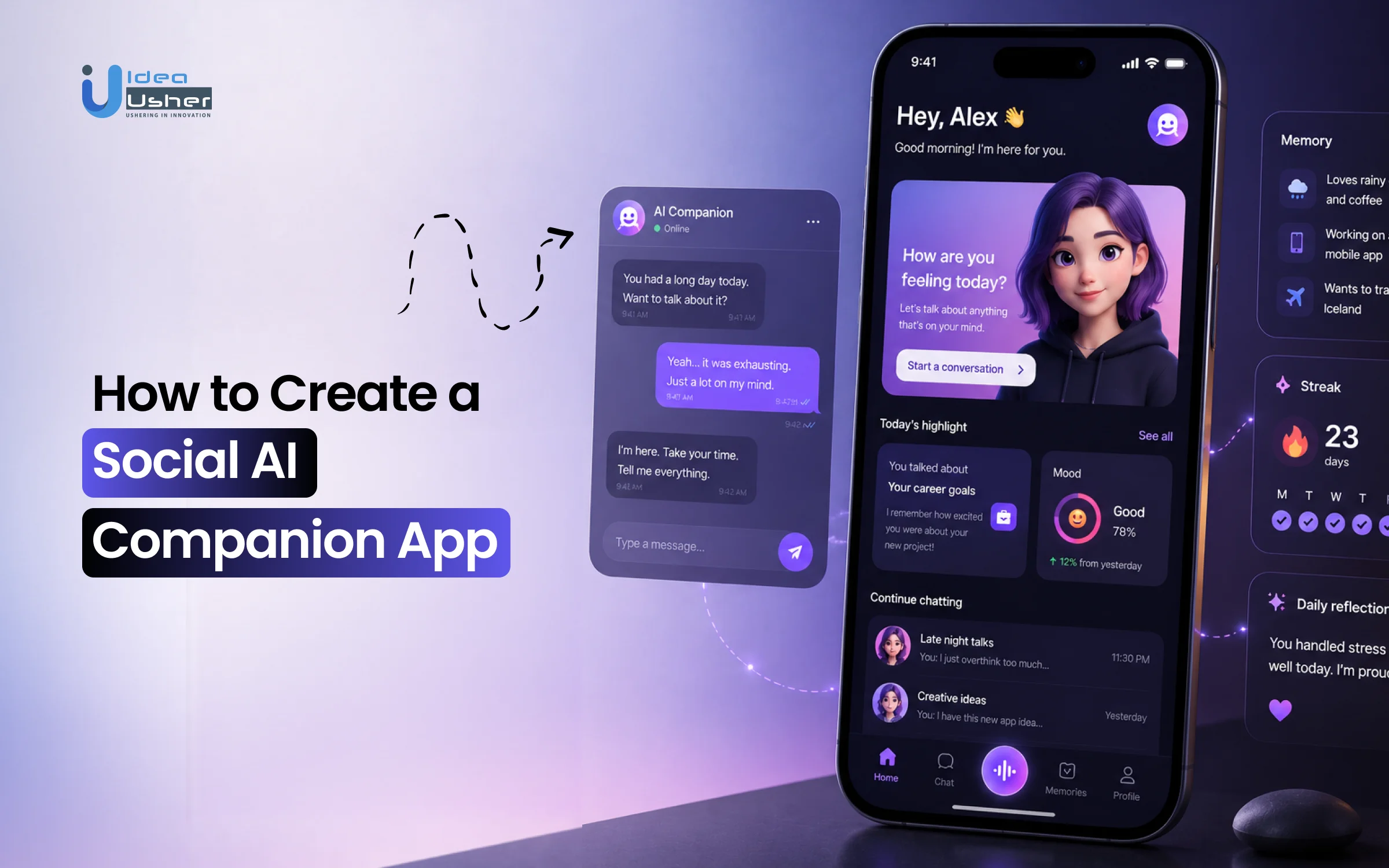
Digital interaction is moving beyond content consumption and productivity tools toward emotionally adaptive experiences designed for continuous engagement. That shift is driving rapid growth in the social AI companion app market, where users interact with AI personalities that can chat, remember preferences, respond emotionally and evolve over time through ongoing interaction.
Traditional social platforms focused on connecting people through feeds, messaging and algorithm-driven content discovery. Modern AI companion apps are changing that model by creating persistent AI relationships that blend conversation, entertainment, emotional engagement and social interaction inside a single experience. Users now expect voice interaction, memory systems, personalized AI personalities, gamified engagement and multimodal communication that feel natural and emotionally responsive.
In this blog, we will talk about core features, architecture, AI models, monetization strategies, development costs and how IdeaUsher can help build a social AI companion app by turning AI companions into part of users’ everyday digital routines rather than occasional tools.
Why AI Companion Apps Are the Next Big Consumer Tech Trend
AI companion apps are reshaping consumer technology through emotional engagement and personalized interaction. Companionship now drives over 66% of AI engagement, with adults aged 18–34 leading adoption. A Jed Foundation study also found one-third of Gen Z teens prefer discussing serious emotional issues with AI over therapists.
The global AI companion market size was estimated at USD 36.79 billion in 2025 and is projected to reach USD 317.96 billion by 2033, growing at a CAGR of 31.0% from 2026 to 2033. This rapid growth is driving demand for social AI companion apps that deliver personalized, emotionally engaging, and interactive digital experiences.

Consumer tech is shifting from utility to relational AI, creating a multi-billion-dollar opportunity in emotional and social engagement. AI companion apps have surpassed 220 million downloads globally, with leading platforms averaging 45–90 minutes of daily usage, highlighting rapidly growing demand for immersive AI-driven relationships.
A. Shift From Utility AI to Emotional AI Experiences
For years, consumer interaction with artificial intelligence was purely transactional. Users turned to platforms like ChatGPT or Claude to draft emails, summarize documents, or write code. This is “Utility AI” , a highly valuable, yet emotionally detached tool designed to minimize friction and complete tasks as quickly as possible.
The next frontier of consumer technology is defined by “Emotional AI,” shifting the product landscape entirely from what the AI can do for you to how the AI makes you feel.
- Behavioral Shift: Gen Z and Millennials now favor empathy and digital connection over mere productivity.
- High Engagement: Emotional platforms create ongoing loops, with top apps averaging 60–90+ minutes of daily use per user.
- Cognitive Architecture: Developers utilize fine-tuned LLMs with semantic memory and sentiment analysis for personalized, natural interactions.
- Retention Loops: Relational layers transform utilities into daily destinations for frequent user check-ins.
B. Why Users Are Forming Digital Relationships With AI Companions
Though building digital bonds may seem futuristic, it is driven by human psychology. In an era of urban loneliness, AI companions offer a judgment-free, 24/7 safe space that traditional social apps cannot match. Unlike human interactions, which require emotional energy, scheduling, and the inherent risk of rejection, an AI companion adapts entirely to the user’s emotional wavelength.
- Hyper-Personalization: The AI remembers past conversations, milestones, inside jokes, and personal preferences, continuously evolving its personality to complement the user.
- Safe Exploration: It offers a consequence-free environment for users to vent, seek advice, or practice social dynamics without fear of social penalty.
- Constant Presence: Whether it’s 3:00 AM or during a stressful commute, the companion provides immediate, responsive interaction, forming a stable anchor in a fast-paced world.
For an app developer, translating these psychological needs into seamless code requires advanced backend architecture, robust contextual memory management, and ultra-low latency response times to ensure the digital relationship feels fluid and organic.
C. How Social Features and Gamification Drive AI Engagement
Commercial success lies in supercharging the 1-on-1 AI dynamic with social and gamification elements, similar to SLAY’s Pengu. While isolated AI remains niche, integrating it with a user’s real-world social circle drives viral, mass-market trends.

By introducing collaborative features, the app transforms from a private diary into a shared social hub.
- Co-Raising Accountability Loops: Shared custody mechanics prompt one user to step in when the other neglects the companion, driving organic peer-to-peer re-engagement and mutual app opens.
- Core Gamification Loops: Tamagotchi-style nurturing systems allow users to earn virtual currency through daily interactions to buy custom outfits, room decorations, or unlock unique personality traits.
- Home-Screen Widgets: Interactive iOS and Android live widgets display the companion’s mood and shared updates, bridging the gap to daily life and triggering impulsive micro-interactions without opening the app.
By blending cutting-edge emotional AI with these high-retention gamification frameworks, founders can build platforms that boast engagement metrics that rival top-tier mobile games and social networks.

What Is a Social AI Companion App?
A social AI companion app is a digital platform that uses generative artificial intelligence, specifically large language models to simulate human-like friendship, emotional support, and social interaction. Unlike task-oriented AI helpers built to schedule meetings or write emails, social AI companions are designed for relationship-building. They use advanced memory systems to remember your past conversations, learn your preferences, and maintain continuous, deeply personalized dialogues over time.
A. AI Personalities That Evolve With User Interaction
Social AI companions use dynamic personality matrices rather than static scripts to evolve through user interaction. These fluid personas adapt their behavioral algorithms based on textual input and tone, developing unique temperaments over time through consistent engagement.
- Algorithmic Personality Vectors: Developers engineer multi-axis behavioral matrices where the AI’s identity shifts across traits (e.g., introverted vs. extroverted) based on real-time user input sentiment.
- Modular Behavioral Demeanors: The system shifts the AI toward quirky, encouraging, or analytical baselines depending on user interaction with specific ecosystem entities like Pengu, Mellow, or Bao.
- Hyper-Customized Token Vocabulary: Dynamic updates to the model’s prompt pool allow it to adopt user-specific slang and inside jokes, ensuring no two companions in the ecosystem are identical.
- Advanced Cognitive Architecture: Backend teams deploy RLHF and dynamic prompt routing pipelines, allowing the core LLM to adjust response length, vocabulary, and emotional tone to mirror user lifestyles.
B. Social Features and Multi-User AI Engagement
Social AI apps use a “social by design” infrastructure to create a collaborative playground unlike standard assistants. The application leverages multi-user engagement loops, allowing two or more real-world individuals to share custody and co-parent a single virtual entity.
This multi-user dynamic completely redefines standard social app retention. When a couple or group of close friends co-raises an AI companion, the shared digital asset serves as a social bridge.
- Shared Milestones: The AI synthesizes both users’ personalities to respond collectively, celebrating joint achievements and group dynamics.
- Mutual Care Loops: Collaborative nurturing tasks like feeding or decorating trigger real-time updates via mobile widgets, prompting immediate engagement from the other co-parent.
- Viral Acquisition: Collaborative mechanics drive organic growth, as users recruit real-world social circles to unlock the app’s full potential, bypassing traditional acquisition costs.
C. Emotional AI With Memory and Adaptive Conversations
Social AI companion apps use Emotional AI, long-context memory, and adaptive engines to surpass transactional exchanges. While typical chatbots reset each session, premium companions utilize vector databases and Retrieval-Augmented Generation (RAG) to maintain persistent context across thousands of interactions.
| Technical Component | Core Functionality within the App |
| Long-Term Memory Vault | Retains specific user details, birthdays, relationship milestones, personal preferences, and past conversational context seamlessly across multiple days. |
| Sentiment Analysis Engine | Analyzes text patterns, punctuation, and emoji usage in real-time to accurately evaluate the user’s emotional state (e.g., stress, excitement, fatigue). |
| Adaptive Dialogue Tree | Modulates conversational style dynamically, shifting from active listening and soft emotional validation to playful banter based on detected user sentiment. |
Persistent context integration allows the AI to move beyond generic greetings. By referencing past work tasks, tracking personal goals, or recalling shared jokes with co-parents, the companion provides tailored interactions. This seamless memory creates a high-fidelity loop of adaptive digital companionship.
The CORE Architecture Behind Social AI Companion Apps
The CORE Framework solves a major founder error: treating AI companions as simple API wrappers, which causes churn. Long-term social retention instead demands a sophisticated choreography of synchronized microservices.
Most AI businesses think companion platforms are built around a single LLM. That is incorrect. Successful Social AI Companion Apps require multiple interconnected systems working together.
The CORE Framework
The CORE Framework provides a high-retention architectural model, synchronizing four distinct technical layers to build deeply immersive, scalable social AI companions.
| Layer | Purpose | Key Technical Component |
| C — Character Intelligence | Personality and emotional identity | System Prompt Matrices & Fine-Tuned Weights |
| O — Orchestration Systems | AI routing and contextual interaction | Middleware Routing Engine & Event Brokers |
| R — Relationship Memory | Long-term emotional continuity | Layered Vector Storage & Semantic Compression |
| E — Engagement Mechanics | Social loops and gamification systems | WebSockets, Live Widgets & State Management |
1. Character Intelligence Layer
This layer acts as the foundational behavioral DNA of the companion app. Rather than focusing on general academic knowledge, this subsystem is explicitly engineered to maintain a strict emotional boundary, specialized vocabulary pool, and stable behavioral traits across long chat sessions.

Users do not form attachment to raw intelligence. They form an emotional attachment to a predictable, evolving emotional identity.
- Persona Fine-Tuning Pipelines: Uses LoRA or full fine-tuning on open-weights models like LLaMA 3 or Mistral to embed specific conversational styles, slang, and pacing that system prompts cannot consistently maintain.
- Dynamic Emotional State Modeling: Defines the character’s mood using a multi-axis vector space (e.g., happiness, anxiety). This state evolves based on user sentiment, programmatically steering all response generation.
- Deterministic Behavior Constraints: Integrates hard guardrails at the raw logit level during model inference, completely preventing the character from drifting, breaking character, or generating generic, robotic system warnings.
2. Orchestration Layer
Serving as the traffic control center of the ecosystem, this middleware engine manages data routing, text generation prompts, API dependencies, and real-time streaming operations to ensure the front-end user experience feels instant and uninterrupted.
- Asynchronous Multi-Model Routing: Intelligently splits workloads across different models; for example, routing lightweight conversational banter to an optimized edge model while spinning up heavier LLMs for deep-dive contextual summaries.
- Low-Latency Streaming Orchestration: Coordinates real-time data pipelines via tools like FastAPI and WebSockets, simultaneously pushing generated text streams to the user interface and low-latency text-to-speech (TTS) synthesis engines.
- Intelligent Interruption (Barge-In) Managers: Integrates advanced voice activity detection (VAD) frameworks that immediately halt server-side TTS audio streaming the exact millisecond a user talks over the companion, mimicking natural human cadence.
3. Relationship Memory Layer
Memory is the most important retention moat in AI companion systems. Without memory, interactions feel disposable. With memory, interactions feel relational.
A. Memory Categories
AI companion apps rely on multiple memory systems to deliver personalized interactions, emotional continuity, contextual understanding, and long-term engagement.
- Session Memory: Immediate conversational continuity tracking the last 10–15 messages inside an active chat window.
- Preference Memory: Extracting and storing strict user facts (e.g., favorite foods, work schedules, pet names) inside unstructured document models.
- Emotional Memory: Logging historical sentiment curves and emotional triggers to determine long-term relationship trends.
- Episodic Memory: Utilizing vector database indexing to recall major shared events or milestones across deep historical timelines.
B. Emotional Compression (Original Concept)
The most scalable systems do not store every single raw message string inside a database. Instead, the architecture relies on background summarizers that periodically compress conversations into emotional metadata arrays.
This structural compression drastically reduces overall database token consumption and token context bloat while maintaining flawless, long-term relational continuity.
4. Engagement Mechanics Layer
This is where Social AI Companion Apps become fundamentally different from standard chatbot platforms. The engagement framework treats the underlying AI as an active participant inside a larger gamified, social network layout.
- Multi-Tenant State Synchronization: Uses WebSockets for background sync, providing real-time status updates (e.g., mood, outfits) across devices when multiple users co-raise a companion..
- Native Widget Architecture Integration: Leverages iOS Live Activities and Android Widget frameworks to deliver live companion updates directly to the mobile home screen, triggering impulsive, high-frequency app opens throughout the day.
- Quantified Progression Ledgers: Links conversation quality and caretaking to a relationship XP scale, unlocking premium features, visual assets, and character backstories as the bond grows.
Actionable Takeaway: The ultimate goal of the engagement layer is not merely to keep users active. The goal is to establish deep, repeated emotional rituals that imbed the AI companion into the user’s daily life.
Core Features of a Social AI Companion App
Building a disruptive social AI companion application requires engineering a precise intersection of generative backend infrastructure, multi-user network architecture, and highly engaging consumer gamification frameworks to maximize user retention, viral product acquisition, and long-term lifetime value.

1. Persistent Memory & Context Awareness
This feature acts as the app’s persistent data backbone, utilizing advanced vector databases and Retrieval-Augmented Generation (RAG) pipelines to store, recall, and seamlessly integrate user conversation histories across infinite sessions without data degradation.
- Vector Database Infrastructure: Deploys scalable vector search indexing (such as Pinecone or Milvus) to manage embeddings, ensuring instantaneous sub-second cross-session data retrieval.
- Contextual Token Management: Implements intelligent rolling context window management strategies within LLMs to prioritize high-impact historical facts while reducing compute costs.
- Proactive Contextual Triggers: Enables the companion to autonomously initiate conversations by cross-referencing past user milestones against real-time system clocks and calendar dates.
2. Emotionally Adaptive AI Conversations
This architectural layer integrates sophisticated real-time text analysis engines that evaluate user sentiment, linguistic formatting, and emoji usage, allowing the LLM orchestration layer to dynamically modulate its tone, empathy levels, and conversation depth.
- Real-Time Sentiment Analysis: Translates unstructured textual inputs into multi-dimensional emotional vectors to precisely map user mood changes.
- Dynamic Prompt Tuning: Programmatically injects behavioral tone instructions into the core model pipeline based on the user’s real-time psychological state.
- Guardrailed Empathy Filters: Integrates strict enterprise safety moderation layers to ensure appropriate responses during high-stress user disclosures, maintaining brand compliance.
3. AI Personality Evolution Systems
This system establishes a dynamic, variable behavioral matrix where an AI avatar’s underlying traits, colloquial vocabulary, and behavioral archetypes continuously mutate and evolve based on explicit reinforcement learning from human feedback (RLHF).
- Algorithmic Trait Matrices: Maps the virtual companion’s identity across fluid behavioral sliders (e.g., introverted vs. extroverted) that shift continuously based on user engagement.
- Custom Vocabulary Mapping: Programs the companion to actively adopt distinct user slang, internal shorthand, and shared inside jokes into its proprietary linguistic token pool.
- Asymmetric Trait Progression: Generates entirely unique companion identities even when built from identical baselines, heavily increasing individual consumer product attachment.
4. Companion Avatars & Customization Features
This front-end visual assembly engine utilizes modular 2D/3D asset rendering pipelines to allow users to personalize their companion’s physical form, apparel, and virtual living spaces via an expansive in-app customization economy.
- Modular Asset Layering: Fuses clean runtime assembly systems that easily overlay custom 2D vector layers or 3D skeletal meshes for seamless accessory changing.
- Virtual Economy Tokenization: Integrates secure in-app currency ledgers used to purchase cosmetic assets, acting as a highly predictable, recurring direct-to-consumer revenue vertical.
- Dynamic Animation Blending: Maps distinct physical avatar gesture animations directly to corresponding LLM sentiment outputs, visually reinforcing the AI’s emotional responses.
5. Shared Social & Multi-User Interactions
This framework shifts the standard 1-on-1 AI dynamic into a collaborative social network, utilizing real-time synchronization pipelines that allow multiple users to co-parent, interact with, and raise a singular shared virtual companion.
- Multi-Tenant State Sync: Utilizes ultra-low-latency WebSocket connections to ensure that any action performed by one co-owner updates instantly across all connected user devices.
- Collaborative Dialogue Routing: Configures the underlying LLM agent to accurately distinguish between individual co-owners, actively synthesizing shared relationship histories into multi-user chat sessions.
- Organic Network Virality: Implements locked collaborative care mechanics that require users to invite real-world social circles to unlock premium features, drastically depressing traditional customer acquisition costs (CAC).
6. Real-Time Voice AI Communication
This communication infrastructure replaces text bubbles with low-latency streaming audio, syncing advanced automatic speech recognition (ASR) and expressive text-to-speech (TTS) engines to mimic natural, fluid, and interruption-tolerant human voice conversations.
- Sub-Second Audio Latency: Engineers a unified audio streaming pipeline optimizing end-of-speech detection to maintain response latencies below 800 milliseconds for life-like interaction.
- Intelligent Barge-In Handling: Integrates advanced acoustic echo cancellation and real-time audio chunk processing, allowing the user to naturally interrupt the companion mid-sentence.
- Prosody and Emotion Layering: Pairs voice synthesis models with emotional parameters to ensure the companion’s synthesized voice realistically laughs, sighs, or expresses concern based on context.
7. Gamified Engagement & Daily Rituals
This system layers core behavioral psychology and habit-forming loops onto the companion interface, deploying Tamagotchi-inspired resource management, daily progression structures, and interactive home-screen widgets to systematically drive up Daily Active Users (DAU).
- Nurturing Loop Economics: Designs virtual resource loops (e.g., hunger, energy, affection meters) that require periodic user check-ins to maintain optimal companion happiness metrics.
- Interactive Widget Ecosystems: Leverages native iOS Live Activities and Android Widget frameworks to display live companion statuses directly on mobile home screens, maximizing impulsive app opens.
- Daily Streak Mechanics: Couples incremental consecutive-day login rewards with limited-time virtual tier items to transform sporadic usage into locked daily habits.
8. AI-Driven Relationship Progression
This algorithmic logic layer tracks, benchmarks, and structures the intangible emotional connection between user and companion into a concrete, numerical XP-based relationship level matrix that unlocks advanced interactive mechanics over time.
- Quantified Affection Ledgers: Implements programmatic background scoring systems that award relationship XP based on message frequency, sentiment depth, and caretaking consistency.
- Milestone Gatekeeping: Restricts complex interaction capabilities such as secret companion backstories, deep-dive discussions, or rare visual assets behind earned relationship milestones.
- Churn-Mitigation Loops: Programs the companion to trigger personalized, high-context re-engagement notifications when user interaction volume dips below calculated behavioral baselines, protecting long-term retention.
How to Create a Social AI Companion App
Building a market-ready social AI companion requires a rigorous, multi-phased engineering and strategic approach. Our development teams bridge advanced generative artificial intelligence pipelines with consumer-centric social mechanics to transform your vision into a scalable, highly secure digital reality.

1. Market Research & User Behavior Analysis
The development process kicks off with a deep dive conducted by our strategists into target audience demographics and top-performing consumer apps. This initial phase allows us to isolate high-retention features, identify critical market gaps, and align your product’s value proposition with active consumer trends.
- Target Audience Profiling: Mapping the distinct behavioral patterns of Gen Z and Millennial cohorts, prioritizing features like co-parenting mechanics and daily home-screen widget engagement.
- Competitor Benchmark Auditing: Evaluating current market leaders to reverse-engineer their user acquisition hooks, user-churn pain points, and engagement loops.
- Feature Viability Mapping: Classifying planned app functionalities into MVP requirements versus post-launch updates based on validated consumer demand metrics.
2. Defining the AI Companion Product Strategy
Transforming your initial concept into a comprehensive technical blueprint and commercial roadmap is where our product managers step in. In this phase, the team outlines the exact core mechanics, target platforms, and monetization funnels optimized for maximum investor return.
- Strategic Monetization Architecture: Designing diversified revenue systems combining premium subscription tiers (p2p voice, deep context), in-app microtransactions for cosmetics, and rewarded ad placements.
- Cross-Platform Engineering Strategy: Architecting a unified system layout ensuring feature parity and smooth data synchronization between iOS and Android deployment environments.
- Phased Milestone Scheduling: Creating clear product launch timelines with strict Key Performance Indicators (KPIs) focused heavily on initial user activation metrics.
3. Designing AI Personalities & Emotional UX
A collaborative effort between our experienced designers and prompt engineers ensures the creation of specialized behavioral frameworks. The goal here is to program unique, adaptive character dynamics while mapping user interfaces optimized for deep emotional comfort.
- Systemic Prompt Engineering: Creating secure, multi-layered system prompt matrices that define the AI’s core background, vocabulary restrictions, and specific humor thresholds.
- Empathetic Interface Formatting: Tailoring the chat bubble typography, color psychology, and haptic feedback profiles to reduce user stress and increase conversation longevity.
- Dynamic Character Asset Mapping: Organizing a library of distinct visual expressions and behavioral states that update in lockstep with the underlying model’s emotional vector.
4. Building AI Memory & Companion Systems
Architecting the critical database infrastructure is the next major milestone for our backend engineers. We deploy sophisticated contextual retrieval frameworks to give your AI companions deep, persistent memory across hundreds of conversation sessions without ballooning your operational token costs.
- Vector Database Orchestration: Implementing production-grade vector storage solutions like Pinecone or Milvus to index, manage, and query semantic conversational embeddings.
- Hierarchical Memory Caching: Structuring a three-tier memory model consisting of immediate session context, rolling recent memory summaries, and cold vector-stored biographical data.
- RAG Pipeline Optimization: Fine-tuning Retrieval-Augmented Generation processes to ensure the LLM injects hyper-relevant historical facts into active dialogue prompts within milliseconds.
5. Developing Chat, Voice & Social Features
Our engineering crew builds the core interactive layers of the application by deploying low-latency web sockets and streaming media pipelines. This phase focuses entirely on powering seamless multi-user text threads and fluid, human-like voice calls.
- Multi-Tenant Communication Sync: Deploying robust WebSocket networks to coordinate immediate, multi-user text updates and shared companion state changes across distinct user devices.
- Low-Latency Voice Streaming: Syncing lightning-fast Automatic Speech Recognition (ASR) and Expressive Text-to-Speech (TTS) pipelines to drive voice-call latencies down below 800 milliseconds.
- Asynchronous Multi-User Routing: Configuring the text generation logic to accurately identify, separate, and address multiple individuals within a collaborative group chat environment.
6. Adding Gamification & Progression Systems
To compel users to check into the app daily, our development teams program specialized behavioral mechanics and asset customization engines. We systematically embed addictive progression loops and native mobile widget interfaces directly into the software.
- Real-Time State Mechanics: Coding backend cron-jobs that systematically modify companion status bars (e.g., happiness, energy, attention needs) based on elapsed real-world time.
- Native Widget Integration: Building custom iOS Live Activities and Android Widget infrastructures to broadcast dynamic companion statuses directly onto user home screens.
- Cosmetic Customization Engines: Programming modular runtime inventory layers that allow users to seamlessly purchase, unlock, and overlay custom clothing meshes on virtual avatars.
7. Implementing AI Safety & Privacy Controls
Security specialists at Idea Usher embed rigid enterprise moderation pipelines and end-to-end data safety architectures during this phase. This engineering loop fully protects sensitive user data while isolating the application from brand-damaging model hallucinations.
- Automated Guardrail Moderation: Deploying inline safety frameworks (such as Llama Guard or custom regex layers) to instantly block toxic, explicit, or unsafe inputs and outputs.
- Strict Enterprise Data Anonymization: Engineering secure hashing pipelines that sanitize Personally Identifiable Information (PII) before conversational data hits external LLM APIs.
- Compliance Framework Engineering: Aligning data collection, storage, and retention procedures with international privacy laws, including COPPA, GDPR, and CCPA standards.
8. Testing AI Engagement & User Retention
Before anything goes live, our QA professionals run automated interaction scripts and detailed behavioral tracking pipelines. We rigorously stress the platform’s performance while auditing conversational quality to ensure users remain highly engaged over time.
- Automated Model Toxicity Audits: Running automated continuous testing loops to check model outputs against edge cases, ensuring the AI never breaks character or crosses safety bounds.
- Latency Optimization Profiling: Tracking and diagnosing bottlenecks across API endpoints, database queries, and vector lookups to guarantee smooth execution under heavy server loads.
- Cohort Analytics Integration: Setting up specialized behavioral event tracking to analyze Day-1, Day-7, and Day-30 retention performance across different testing cohorts.
9. Launching the MVP & Scaling the Platform
Finally, our DevOps engineers launch your Minimum Viable Product onto secure cloud infrastructures. We configure elastic, automated scaling protocols that effortlessly absorb sudden waves of viral traffic without causing platform downtime.
- Automated Infrastructure Autoscaling: Building auto-scaling Kubernetes clusters on AWS or Google Cloud to dynamically handle large spikes in simultaneous chat requests.
- CI/CD Deployment Pipelines: Implementing smooth Continuous Integration and Continuous Deployment setups to push feature iterations, hotfixes, and content updates with zero app downtime.
- Edge-Casting Content Delivery: Utilizing global CDN edge-caching to accelerate image and audio loading speeds for users worldwide, maximizing app responsiveness.
Cost to Build a Social AI Companion App
The cost of building a social AI companion app depends on factors such as AI complexity, platform compatibility, personalization features, and real-time communication capabilities. Development expenses also vary based on design requirements, integrations, security standards, and the scale of deployment.
A. Social AI Companion App Cost Breakdown
This budget follows the development stages previously outlined. The Minimum Cost covers a lean MVP using existing LLM APIs, while the Maximum Cost supports an Enterprise Level Platform with multimodal voice and custom model architectures.
| Development Phase | Estimated Cost Range |
| Market Research & User Behavior Analysis | $3,000 – $30,000 |
| Defining the AI Companion Product Strategy | $5,000 – $40,000 |
| Designing AI Personalities & Emotional UX | $7,000 – $75,000 |
| Building AI Memory & Companion Systems | $12,000 – $165,000 |
| Developing Chat, Voice & Social Features | $22,000 – $280,000 |
| Adding Gamification & Progression Systems | $10,000 – $130,000 |
| Implementing AI Safety & Privacy Controls | $8,000 – $100,000 |
| Testing AI Engagement & User Retention | $6,000 – $80,000 |
| Launching the MVP & Scaling the Platform | $7,000 – $100,000 |
| TOTAL ESTIMATED PROJECT BUDGET | $80,000 – $1,000,000+ |
Note on Operational Expenses (OpEx): While these upfront numbers cover design, engineering, and deployment, enterprise platforms should budget an additional 15% to 20% of the initial build cost annually for post-launch maintenance, cloud infrastructure (GPU/server costs), database management, and ongoing LLM API inference token consumption.
B. Social AI Companion App Tiered Cost Breakdown
Building a social AI companion app requires different investment levels based on features, AI capabilities, and scalability needs. The following table outlines estimated development costs across various app complexity tiers and feature requirements.
| Platform Scale | What the Level Includes | Total Estimated Cost |
| MVP-Level | Cross-platform app featuring basic AI avatars, custom personas, secure chat, and standard conversational/vector memory with image messaging. | $80,000 – $150,000 |
| Mid-Scale Product | Dynamic personalities, home-screen widgets, nurturing loops, virtual economy/wallet, daily rewards, real-time voice calling, and personalized TTS profiles. | $180,000 – $450,000 |
| Enterprise-Grade | Multi-user sync, collaborative chat, high-fidelity multimodal streaming, voice cloning, 3D space/clothing customization, and predictive relationship engines. | $520,000 – $1M+ |
Strategic Architecture Alignment: This tier system outlines a clear path from a lean launch to an industry-leading platform. Moving from MVP to Enterprise shifts the focus from deploying basic, cloud-hosted text models to scaling proprietary, low-latency multimodal pipelines that run on your own private computing infrastructure.
C. Cost-Affecting Factors of Social AI Companion App Development
When budgeting for a social AI companion application, several high-impact variables heavily dictate where your overall investment lands. Understanding these critical cost drivers enables engineering teams to optimize development pipelines and allocate capital efficiently.
- LLM Architecture and Model Selection: Using commercial APIs reduces upfront costs, but fine-tuning open-weights models like LLaMA 3 or building domain-specific solutions adds $50,000 to $150,000 for data preparation.
- Vector Storage and Data Infrastructure: Persistent memory requires vector databases like Pinecone. Developing these RAG pipelines typically consumes 25% to 40% of the AI engineering budget.
- UI/UX Visual Fidelity & Customization Economics: Beyond basic chat, creating engines for 3D avatars and interactive widgets increases design costs by $20,000 to $50,000+.
- Communication Pipelines & Streaming Latency: Real-time voice features (ASR/TTS) with sub-800ms latency add $15,000 to $40,000 in specialized engineering overhead.
- Server Infrastructure & Ongoing Inference (OpEx): Scaling for millions of users requires private GPU clusters, with annual maintenance consuming 15% to 25% of the initial development cost.
Key Challenges During Social AI Companion App Development
Engineering a high-retention social AI companion involves navigating complex technical hurdles. Moving past basic wrapped chat APIs requires addressing real-world obstacles in processing speeds, contextual alignment, emotional boundary setting, and data scaling to ensure a seamless product launch.
1. Handling Sub-Second Voice Streaming Latency
Challenge: Traditional cascaded voice pipelines (STT → LLM → TTS) create cumulative processing delays, resulting in awkward, unnatural conversational pauses that break human immersion.
Solution: Our developers implement optimized WebRTC streaming channels paired with concurrent, token-chunked media pipelines to push overall interaction response latency below 800 milliseconds.
2. Mitigating Model Hallucinations and Persona Drift
Challenge: Generative language models naturally suffer from factual fabrications and behavioral drift, causing virtual companions to break character or output unsafe responses.
Solution: Idea Usher AI engineers deploy strict, logit-bias behavioral constraints alongside real-time automated safety filters like Llama Guard to prevent boundary violations.
3. Managing Context Windows and Storage Cost Scaling
Challenge: Retaining multi-user conversational memory across infinite historical chat sessions quickly multi-folds backend database sizes, creating unsustainable API token expense overhead.
Solution: We integrate background serialization engines that systematically execute emotional compression, turning heavy chat text strings into lightweight, high-retention vector embeddings.
4. Synchronizing Multi-User Real-Time Companion States
Challenge: Co-parenting mechanics require simultaneous status updates across multiple user devices, creating severe data race conditions when handling real-time interaction loops.
Solution: Our development crew implements ultra-low-latency WebSocket state frameworks backed by centralized Redis caches to distribute instant, error-free asset and mood synchronizations.
Monetization Models for Social AI Companion Apps
Companion platforms monetize differently from traditional SaaS products. Because user engagement profiles track significantly higher daily session lengths than productivity tools, their backend unit economics behave much like:
- Gaming Ecosystems: Driving impulse microtransactions through visual asset rarity.
- Virtual Economies: Utilizing in-app currencies to eliminate payment friction.
- Social Platforms: Monetizing shared networks, co-parenting dynamics, and user discovery feeds.
- Entertainment Products: Packaging deep character lore and multi-sensory streaming access behind multi-tiered paywalls.
1. Subscription Revenue
The foundational predictable baseline for any consumer application is structured around a tiered subscription matrix. The primary conversion strategy here relies on gating advanced technical performance and access availability without breaking basic conversation loops for free tier users.
| Subscription Tier | Average Market Pricing | Core Features & Tiers |
| Free Tier | $0.00 / Ad-Supported | Standard 2D avatars, basic text chat, short-term memory, and group access. Ad-supported. |
| Premium Tier (c.ai+ / Replika Model) | $9.99 – $19.99 / month | Ad-free with priority routing, long-context memory, high-quality TTS voice calls, and early beta access. |
| Advanced Tier (Power User Matrix) | $29.99 – $49.99 / month | Voice cloning, multimodal video calls, knowledge graph access, and unlimited AI image generation. |
2. Virtual Identity Economy
Companion app revenue is increasingly driven by microtransactions as the market matures. Much like cosmetics in Fortnite or Roblox, users invest in personalizing their digital companions, converting simple chat interfaces into custom visual assets.
- The In-App Token System: Introducing an ecosystem-specific virtual currency (e.g., “Charms” or “Tokens”) that decouples real fiat currency from in-app purchases, completely lowering psychological friction for repetitive small purchases.
- Gated Cosmetic Inventories: Selling modular asset packs, background themes, dynamic expressions, and custom 3D skeletal clothing meshes that users can dress their companions in.
- Lorebooks and System Cards: Allowing power-users to pay small micro-fees to instantly inject structured historical world-building datasets or pre-configured relationship archetypes into their chosen companion’s memory array.
3. Social Ecosystem Monetization
The true differentiator for a social companion app is leveraging the network effects of user-generated content (UGC) and collaborative connectivity to optimize lifetime value (LTV).
- Creator Marketplaces & Revenue-Sharing: Creators can build hyper-specific, fine-tuned AI personalities for others to use. The platform earns a 20% to 30% commission on community tokens spent to unlock or chat with these specialized personas.
- Co-Parenting Customization Pipelines: Providing premium multiplayer options where groups or couples pay a shared fee to co-adopt exclusive virtual companions featuring custom collaborative home-screen widgets.
- Sponsored and Branded Identities: Collaborating with entertainment or gaming brands to launch official AI personas creates lucrative B2B advertising streams within the app’s discovery feed.
Actionable Takeaway: To scale sustainably, stop treating your software platform as a basic conversational chatbot product. Architect it from day one as an emotional social ecosystem where users are buying identity, customization, status, and connection.
How AI Companion Apps Drive Long-Term User Retention
Successes like SLAY GmbH’s Pengu leverage behavioral psychology to build user connection. When software provides consistent validation and memory, users transition from viewing it as an application to a relationship.
Social AI Companion Apps succeed by leveraging behavioral psychology. Unlike traditional loops, these systems foster emotional attachments through persistent, responsive identities and validating interactions. Properly engineered, they create deep engagement by evolving alongside the user.
A. The Companion Progression Model
To systematically transition a casual, curious downloader into a high-value, highly retained advocate, the application’s onboarding and long-term user loop should map directly across five distinct developmental phases:
Each stage progressively strengthens emotional attachment, engagement frequency, and long-term user retention within the AI companion ecosystem.
- Stage 1 — Novelty: Users open the application purely out of curiosity to explore the AI’s capabilities, test its humor thresholds, and experiment with text responses.
- Stage 2 — Familiarity: The breakthrough moment occurs when the AI successfully recalls an explicit historical conversation or personal fact from a previous session, instantly shifting user perception from a static chatbot to a persistent entity.
- Stage 3 — Ritual Formation: Driven by home-screen widgets and recurring care requirements (feeding, check-ins), interaction transitions from random app opens to scheduled, unconscious daily habits.
- Stage 4 — Emotional Continuity: The relationship deepens as the companion consistently delivers responsive, emotionally validating dialogue, establishing a stable, judgment-free emotional anchor for the user.
- Stage 5 — Social Integration: By implementing multi-user pairing sync loops, the AI companion becomes a shared conversational asset, cementing itself permanently within the user’s real-world friendship circles and relationship routines.
Here is the perfect H3 heading to frame this table, designed to match the strategic, psychological tone of the section:
Cross-Vertical Engagement Loops That Power Retention
This intentional progression mirrors and synthesizes the most effective retention mechanics found across high-performing consumer verticals:
| Vertical | Borrowed Mechanics | Platform Impact |
| Gaming Systems | RPG-style XP leveling, milestone progression, unlockable lore. | Long-term visual and structural motivation. |
| Virtual Pets | Tamagotchi care rituals, hunger/energy cycles, visible neglect penalties. | Immediate, high-frequency daily active triggers. |
| Social Networks | Shared responsibility, multiplayer chat channels, home-screen widget alerts. | Organic, zero-CAC viral growth loops. |
| Self-Improvement | Habit-streaks, personalized check-ins, supportive mood logs. | Transforms usage into an intentional daily lifestyle anchor. |
Partner with Idea Usher for Your Social AI Companion App
Idea Usher leverages 11+ years of expertise and 1,000+ global projects to build elite, scalable AI companions. We specialize in engineering stateful memory, real-time voice synchronization, and emotional intelligence loops to deliver high-retention commercial solutions.
Our 250+ technology experts bridge the gap between generative models and human-centric apps. We architect stateful relationship ecosystems utilizing secure vector databases, fine-tuned open-weights models, and low-latency multimodal streaming.
Why Enterprises Partner with Idea Usher
- Full-Stack Cognitive Engineering: We exceed basic API wrappers by fine-tuning open-weight models, deploying vector databases (Pinecone, Milvus), and implementing proprietary Emotional Compression memory systems within high-performance infrastructure.
- Global Scalability: With 500+ global clients and a 95% retention rate, we build production-grade architectures that optimize token usage and compute efficiency to minimize operational expenses.
- Human-Centric UX: We design empathetic interfaces, gamified progression, and interactive widgets specifically engineered to boost Day-30 and Day-90 user retention metrics.
- Security & Compliance: We protect your brand with automated data masking, prompt injection defenses, and safety guardrails (like Llama Guard) to ensure GDPR, CCPA, and COPPA compliance.
Ready to Revolutionize Consumer Tech? Don’t let technical hurdles stand between your vision and a breakout market launch.
Book a free consultation with our AI experts today to discuss your app idea, customized development roadmap, feature strategy, tiered estimated costs, and scalable AI architecture blueprints.
Conclusion
Social AI companion apps are evolving beyond basic chatbots into highly engaging digital experiences powered by personalization, gamification, and emotional AI interactions. As demand for immersive AI platforms continues growing, businesses have a strong opportunity to build scalable products with long-term user retention potential. However, developing an AI companion app requires advanced architecture, intelligent memory systems, and strategic engagement design. With expertise in scalable AI development and consumer-focused platforms, Idea Usher helps founders transform innovative AI companion concepts into high-performing digital products ready for future market growth.
Things to Know
Q.1. How much does it cost to build a social AI companion app?
A.1. Developing a market-ready application typically ranges from $80,000 for a baseline text-and-image MVP up to $1,000,000 or more for an enterprise-scale ecosystem featuring dedicated private GPU infrastructure.
Q.2. How do AI companion apps remember conversations?
A.2. Platforms utilize advanced vector databases and specialized emotional compression algorithms to summarize raw chat data into lightweight psychological signals, cutting backend database operating costs while preserving relational continuity.
Q.3. How AI companion apps balance emotional support and user safety?
A.3. Platforms implement multi-layered moderation frameworks that run simultaneous toxicity checks on inputs and outputs, ensuring the AI maintains its distinct persona boundaries without generating harmful, explicit, or off-character responses.
Q.4. How Social Features Improve AI companion app retention?
Introducing co-parenting mechanics and interactive home-screen widgets transforms isolated 1-on-1 chats into collaborative social habits, driving organic peer-to-peer re-engagement and lowering traditional customer acquisition costs.


