

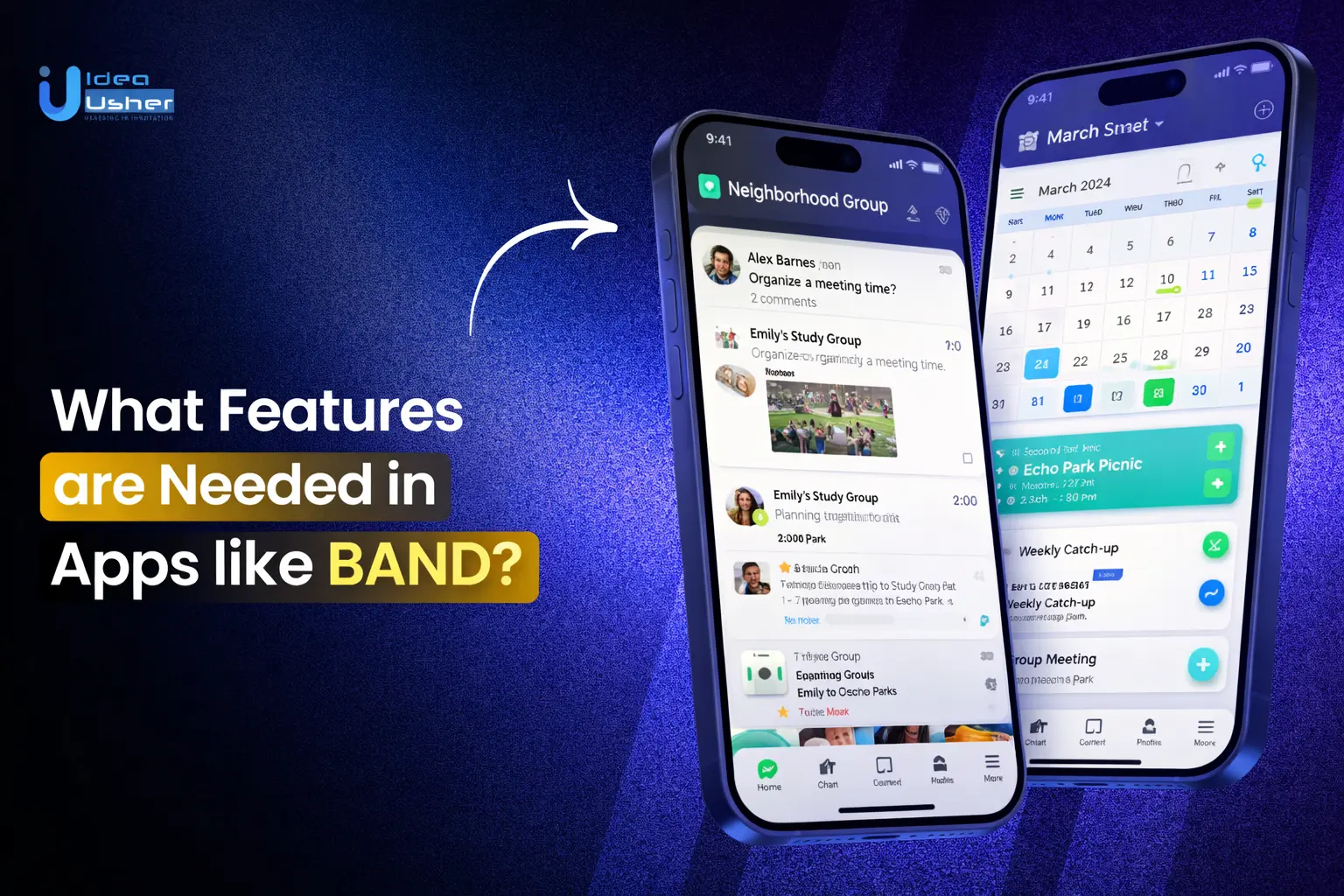
Communities today are shaped more by shared intent than by location. People join groups with a clear purpose, but the tools they use often fail to support that structure. Conversations can overlap, and key updates may get lost in unorganized threads. This creates issues for leaders who must maintain clarity and coordination.
Many people have started using private community apps because they need better control over access, and they want communication that stays focused and relevant. These apps can address this by introducing structured layers such as announcement tracking and role-based access. As usage grows, these systems will likely become essential for reliable and organized communication.
Over the years, we have developed group coordination platforms that use technologies like event-driven architecture and end-to-end encryption frameworks. Given our expertise, we are sharing this blog to discuss the steps to develop apps like BAND.
Why Band-Style Apps Replace Fragmented Tools?
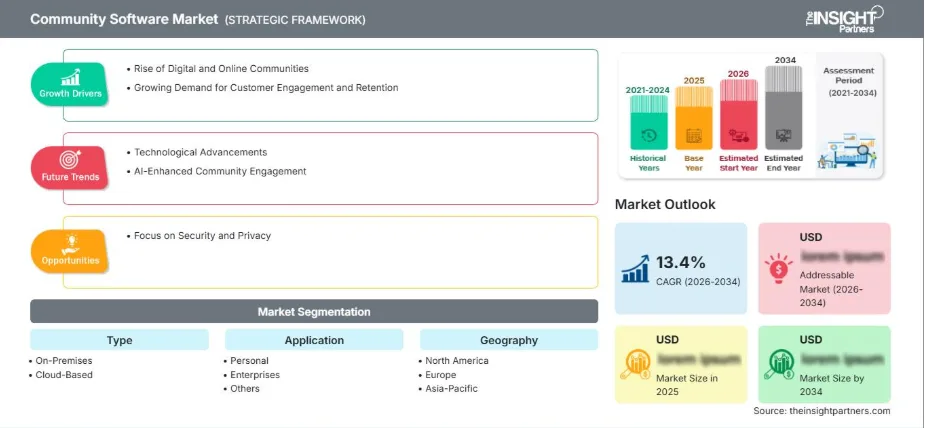
Source: The Insight Partners
The era of generic chat apps is ending. It is being replaced by a demand for specialized coordination environments. The modern professional landscape suffers from digital exhaustion. Entrepreneurs recognize that while the initial digital era was about connectivity, the current era is about consolidation.
High-utility platforms solve the friction of managing too many applications. When an organization relies on a patchwork of Slack, Trello, and email, information leaks.
Decisions are lost in the scroll of real-time chat. Accountability becomes impossible to track. Apps like BAND and Circle replace this fragmentation by providing a unified operating system.
For an investor, the value proposition is building an efficiency engine that recaptures lost hours and focus.
- Centralized Sovereignty: A unified platform keeps all proprietary data within a single, secure silo.
- Reduced Context Switching: Toggling between apps can cost 40% of productive time. Housing tools in one place eliminates this tax.
- Scalability: There is a massive market gap for professional-grade simplicity that these platforms exploit.
The Cost Of WhatsApp And Email
Using WhatsApp for updates and email for records creates operational debt. The hidden cost is found in the erosion of the “Source of Truth.”
When a team operates across two media, critical details bifurcate. A client might approve a change in a chat thread while the manager proceeds with an old email version.
This resulting rework is a direct hit to the bottom line. Beyond logistics, there is the issue of data volatility. In 2026, regulatory scrutiny over GDPR has intensified.
Using personal accounts for professional coordination creates a legal liability. Contact information is exposed to all members, and data sits on personal devices unencrypted.
Structured Communities Vs Open Groups
Open groups are essentially digital rooms where everyone is shouting. They lack information architecture. In an open group, the most recent message is the most important, regardless of value.
This linear chaos is the enemy of productivity. Structured communities, like those built on Mighty Networks, utilize categorized boards and pinned announcements. This ensures information is persistent and discoverable.
Strategic advantages include:
- Role-Based Hierarchy: Administrators define who can post and moderate. This prevents a few loud voices from drowning out the group’s purpose.
- Searchability: New members can access a knowledge base immediately. They are not forced to ask repetitive questions.
- Engagement Analytics: Structured platforms provide granular data. Investors can see which topics gain traction, allowing for better monetization.
Shift To Coordination Platforms
We are witnessing a paradigm shift from communication to coordination. A communication app is designed to move words from one point to another. A coordination platform is designed to move projects from start to finish. This distinction is where the real investment opportunity lies.
Coordination platforms integrate actionable features directly into the interface. Instead of just talking about a meeting, the platform includes a native RSVP tool.
Instead of discussing a task, the platform has a built-in to-do list with tracking. This moves the user from a passive state of talking to an active state of completing work.
What is the BAND App?
BAND is a mobile community application that facilitates group communication by providing separate, dedicated spaces for different teams and organizations. While generic messengers focus on the “now,” coordination-first platforms focus on the “what, where, and who.” This creates a structured environment where information has a shelf-life and tasks have owners.
Chat, Feed, and Coordination
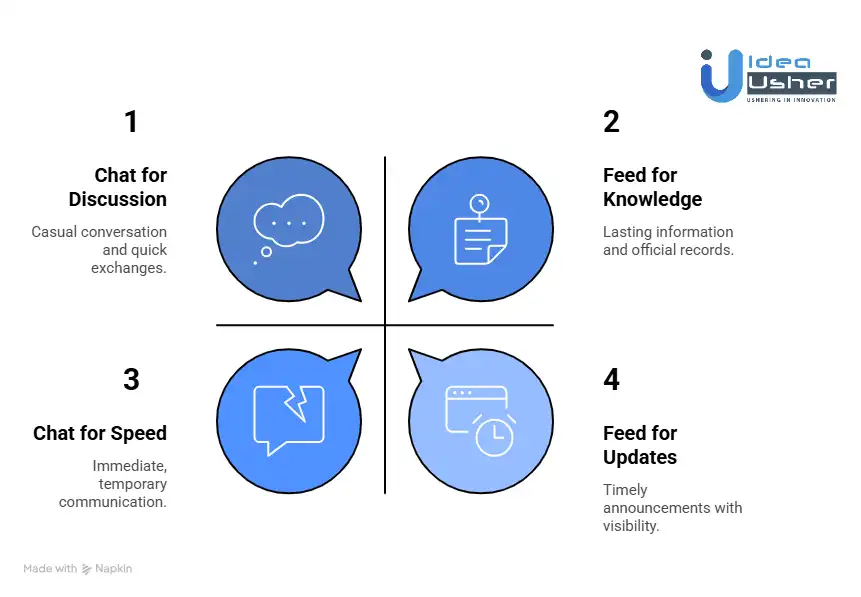
Most digital tools force a trade-off between speed and organization. BAND layers three distinct communication tiers into one interface to ensure visibility.
- The Chat Layer: Reserved for urgent, ephemeral, and social interactions.
- The Feed Layer: Functions as the “Board of Directors,” hosting pinned announcements and vital updates.
- The Utility Layer: A suite of native tools including calendars, polls, and sign-up sheets.
This integration eliminates “app-hopping.” A user can discuss a project, verify a deadline, and sign up for a shift without ever closing the application.
Daily Group Workflows
Efficiency is driven by automated, repeatable workflows. Instead of manual oversight, the software handles the heavy lifting of organizational maintenance.
- Morning Sync: An automated “Today’s Agenda” post is pushed to the feed from the shared calendar.
- Active Coordination: Members use “Read Receipts” on announcements to confirm they’ve seen instructions, eliminating follow-up texts.
- Closing the Loop: Post-activity, photos are uploaded to shared albums and attendance is automatically logged.
This approach ensures the platform is not just a place to talk, but a place where work actually moves forward.
Why BAND Beats Generic Apps
Generic apps like WhatsApp are built for social convenience, not organizational excellence. When groups reach a certain level of complexity, they hit a “complexity ceiling” where lack of structure leads to operational breakdown.
| Feature | Generic Chat Apps | Apps Like BAND |
| Info Lifespan | Minutes (buried) | Permanent (pinned) |
| Management | Flat (everyone equal) | Hierarchical (Admins/Roles) |
| Scheduling | Third-party links | Native RSVP & Reminders |
| Data Privacy | Numbers exposed | Profile-based privacy |
Communities migrate to gain Digital Sovereignty. They want a space they can control and search. By choosing a structured platform, they reduce cognitive load and keep the group’s purpose as the primary focus.
Who Is Actually Building Apps Like BAND Today?
The market for apps like BAND is currently being reshaped by a move toward digital autonomy. Businesses are no longer targeting the general public with broad social networks; instead, they are funding specialized platforms for high-value cohorts that prioritize privacy and structured utility.
Builders recognize that one-size-fits-all platforms have failed professional organizations. Dedicated spaces capture users willing to pay for specialized tools. The following sectors represent the most aggressive growth areas for these coordination platforms.
1. Sports And Fitness Communities
Sports organizations are moving away from messy chat threads. They require centralized hubs for schedules, registrations, and medical waivers. This shift is led by platforms like TeamSnap and Connecteam, which consolidate logistics into a single interface.
Builders are integrating location tracking and payment gateways for league fees. This turns a simple communication tool into a critical financial engine. For fitness professionals, apps like Skool host exclusive training and progress tracking, creating high-retention environments more valuable than social media followers.
2. Schools, Institutes, And PTAs
The education sector is a primary driver for coordination tech. Schools need secure ways to reach parents without exposing private phone numbers. Developers are building apps for homework distribution and digital permission slips to ensure updates aren’t lost in personal message streams.
PTAs use tools like Hevy or custom portals for fundraising and volunteer management. Built-in sign-up sheets provide a level of coordination that email chains cannot match. These platforms emphasize “compliance-by-design,” ensuring student data remains protected and encrypted.
3. SMBs And Distributed Teams
Small businesses are a massive untapped market. They often find enterprise tools like Microsoft Teams too bloated for their needs. Instead, they are building custom “Digital HQs” to manage field workers and remote creative teams.
These apps prioritize task completion and file sharing over social chatter. By providing a professional space for deskless workers, platforms like Circle solve a significant productivity gap. This sector offers the highest ROI for B2B SaaS investors looking for low-churn, high-utility products.
4. Niche High-Engagement Communities
Investment clubs and professional associations are moving to private apps to escape digital noise. These groups value curated exclusivity. Developers are catering to them with sophisticated moderation and tiered access levels.
An investment club might use a private app to share sensitive market data and conduct member polls on asset allocation. These communities are highly monetizable through membership fees or sponsorships. This represents a stable, high-margin business model built on community equity
Core Features That Define Apps Like BAND
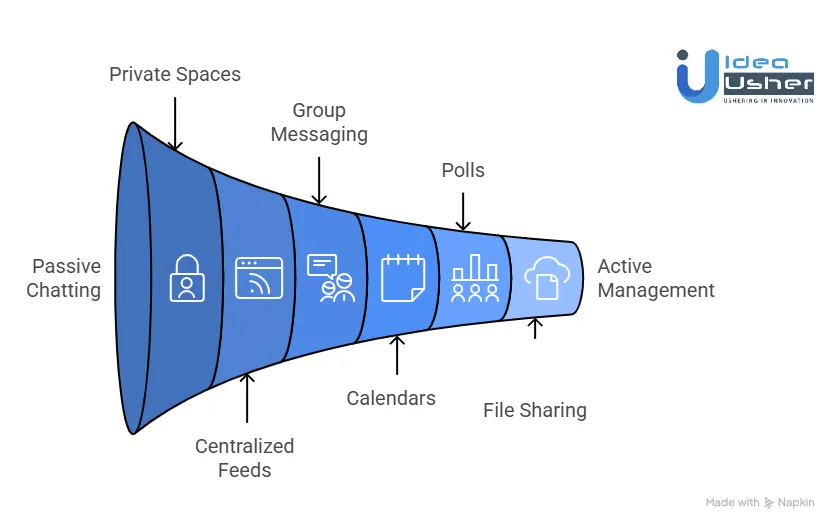
The architectural value of apps like BAND lies in the transition from passive chatting to active management. By consolidating tools into one interface, these platforms provide a professional environment that eliminates the friction of typical social messaging.
1. Private Spaces And Role Access
Granular membership control is a foundational requirement. High-utility apps allow administrators to define permissions for different user tiers, ensuring sensitive information stays restricted. Discord excels in this area, using a sophisticated role-based system to gate specific channels and moderate large-scale communities effectively.
2. Centralized Activity Feeds
Unlike linear chat streams where updates are quickly buried, a dedicated feed ensures high-priority information remains visible. This feature serves as the persistent source of truth for the group. Slack has refined this with its Activity view, which centralizes mentions and announcements to prevent users from losing critical updates in the noise.
3. Group And 1:1 Messaging
A robust messaging infrastructure supports both collaborative discussions and private consultations. By keeping these conversations within the platform, organizations preserve an audit trail while providing an instant feedback loop. Telegram is often used for this purpose, offering high-speed delivery and encrypted messaging that balances speed with privacy.
4. Calendars And RSVP Tracking
Scheduling is the backbone of group activity. An integrated calendar with native RSVP tracking allows managers to see real-time attendance projections and send automated reminders. TeamSnap is a prime example, providing sports leagues with a dedicated scheduling engine that automates the process of tracking who is attending a game or practice.
5. Polls And Participation Tools
Data-driven decision-making is facilitated through built-in feedback mechanisms. Whether using a quick sentiment poll or a detailed registration form, these tools collect structured data. GroupMe integrates this effectively with a native polling feature that allows groups to make democratic decisions quickly without leaving the chat interface.
6. Secure File And Media Sharing
A centralized repository for documents and media ensures all members have access to the latest assets. Secure, cloud-based storage within the app eliminates the need for external links, reducing data leak risks. Microsoft Teams sets the standard here, integrating directly with cloud storage to provide enterprise-grade file management within a secure environment.
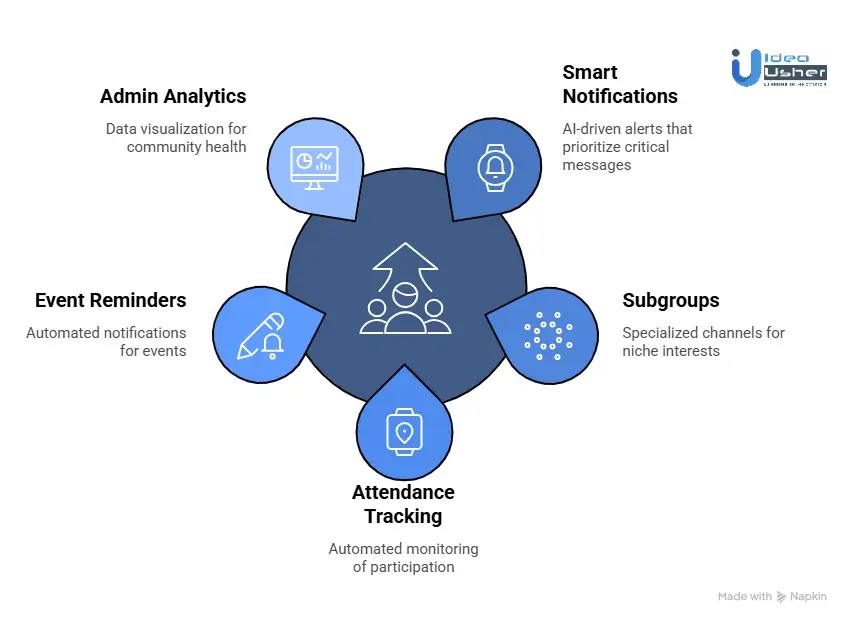
Advanced Features That Drive Daily Engagement
The most successful apps like BAND in 2026 go beyond basic chat by offering “habit-forming” features. These advanced tools reduce digital fatigue while increasing the platform’s daily utility, turning it into a necessary operating system for the community.
1. Smart Notifications
Digital exhaustion is solved through intelligent filtering. High-end platforms now use AI-driven “urgency detection” to prioritize critical alerts over social chatter. Microsoft Forms and similar tools have pioneered smart notifications that analyze participant behavior, sending reminders only when gaps in engagement are detected. This ensures users are never overwhelmed by irrelevant pings.
2. Subgroups For Micro-Communities
Large organizations thrive when they can splinter into smaller, focused clusters. Discord sets the standard here, allowing a primary server to house numerous specialized channels and “threads” for niche interests. This micro-community architecture keeps conversations relevant and manageable, preventing the “linear chaos” of a single massive group chat where information is easily lost.
3. Attendance Tracking And Insights
Monitoring participation is now automated and data-rich. Modern apps like Connecteam utilize GPS-tagging and “selfie-based” check-ins to provide verified attendance logs. Beyond a simple headcount, these tools offer analytical insights into absenteeism patterns, helping managers identify declining engagement before it leads to member churn.
4. Event Reminders And Automation
Manual follow-ups are being replaced by sophisticated automation. Platforms like Whova allow organizers to build “engagement loops” that trigger automated reminders, QR-code tickets, and post-event surveys. These flows ensure that from the moment an RSVP is tracked, the user is guided through a seamless journey without any manual intervention from the admin.
5. Admin Analytics And Dashboards
Decision-making is now backed by real-time data visualization. Advanced dashboards, often built on frameworks like PostHog or Grafana, provide administrators with a bird’s-eye view of community health. These dashboards track “stickiness” ratios (DAU/MAU) and feature adoption rates, allowing leaders to see exactly which topics or tools are driving the most value for their members.
The “Walled Garden” Model That Users Prefer in Apps like BAND
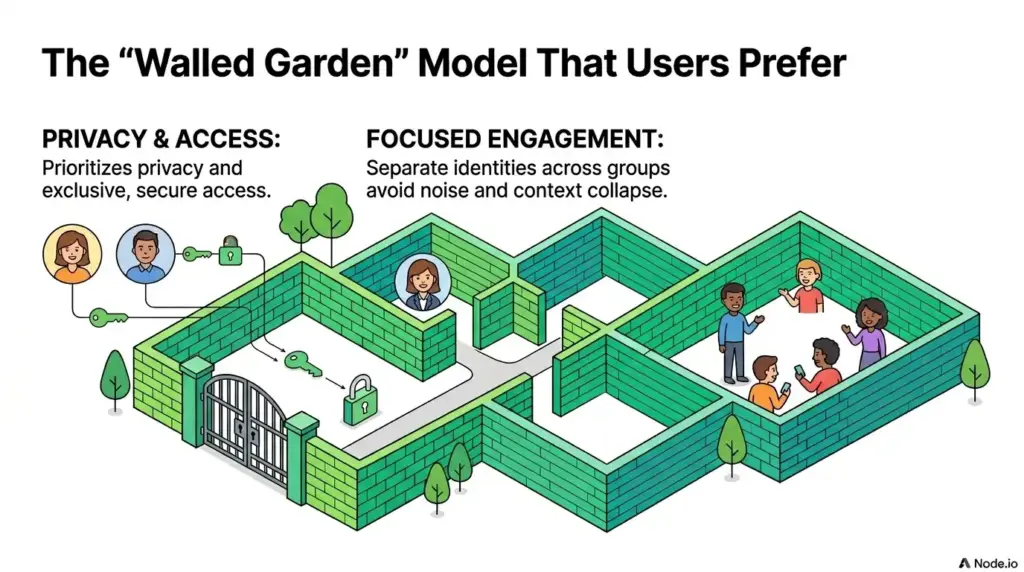
The appeal of apps like BAND lies in the “Walled Garden,” a controlled, invite-only ecosystem that prioritizes the group’s collective focus over individual social reach. Unlike public platforms designed for discovery, these closed systems are built for sanctuary and specific execution.
1. Privacy-First Onboarding
Traditional messengers demand a phone number, instantly tethering your digital identity to your physical one. Secure community platforms allow for a “Zero-Knowledge” onboarding process where users can join via email, unique invite codes, or usernames.
- No Number Required: Eliminates the risk of private contact info being scraped or seen by strangers in a large league.
- Instant Verification: Admins use tools like Skool to set membership questions, ensuring only verified individuals enter the “garden.”
- Data Shielding: Personal metadata is kept at the platform level, not shared with every member of the group.
2. Multi-Group Identity Management
One of the greatest frictions in digital life is “Context Collapse,” the awkward merging of your professional, social, and family personas. Dedicated community apps solve this through independent profiles for every space.
| Platform Type | Identity Model | User Experience |
| Social Apps | Single Global Profile | Your boss sees your weekend photos. |
| Apps like BAND | Group-Specific Profiles | Professional in the office; casual in the gym. |
This separation allows users to manage twenty different “Bands” or “Spaces” without their identities overlapping. You can be “Coach Miller” in one group and “Dave” in another, maintaining perfect social boundaries.
3. Why Closed Ecosystems Drive Retention
Retention in a closed ecosystem is driven by “High-Signal Utility.” When a user opens a generic app, they are met with a barrage of distractions. When they open a dedicated community app, they are there for a specific purpose.
The Retention Loop:
- Purpose: I need to check the practice schedule.
- Execution: I open the app and see the pinned calendar.
- Validation: I RSVP and see my teammates have done the same.
- Exit: Task complete in 30 seconds.
This lack of “doom-scrolling” creates a positive psychological association. Users don’t feel “used” by the app; they feel “served” by it, leading to years of consistent, low-fatigue usage.
4. Reducing Spam And Irrelevant Noise
Public groups are magnets for bots and “drive-by” spammers. In a walled garden, the barrier to entry acts as a natural filter. Advanced platforms like Discord or Circle utilize “Gatekeeper Workflows” to keep interactions relevant:
- Shadow Moderation: AI-driven filters catch high-risk keywords or suspicious links before they hit the feed.
- Level-Gated Posting: New members might be required to read the “Rules” or wait 24 hours before they can post, effectively killing bot scripts.
- Direct Admin Intervention: One-click “Ban and Wipe” tools ensure that if a bad actor does slip through, their entire history is erased instantly, maintaining the group’s integrity.
Designing for Accountability & Not Just Engagement
In apps like BAND, success is measured by clarity, not scrolling time. These platforms move beyond casual chatting by embedding accountability into the interface. By prioritizing oversight, they ensure every member understands their role, and every leader has the data to manage them.
1. Read Receipts as a Leadership Tool
In professional coordination, read receipts are a critical diagnostic tool rather than a privacy intrusion.
Leaders use them to verify that essential safety protocols or schedule changes have been seen by the entire team. Platforms like Connecteam even allow managers to see a detailed log of exactly who has viewed an update, ensuring no one misses a critical shift change or safety brief.
- No More Excuses: Admins see exactly who viewed a post and who is lagging.
- Targeted Follow-ups: Leaders only message members who haven’t acknowledged the update.
- Audit Trails: For youth sports or medical shifts, knowing info was received provides operational protection.
2. Visibility Controls for Announcements
The feed in a structured app acts as a permanent notice board. To prevent notification fatigue, admins use visibility controls to ensure the right people see the right things at the right time.
| Control Type | Function | Benefit |
| Pinned Posts | Locks a post to the top. | Vital info never gets buried. |
| Post Siloing | Limits posts to subgroups. | Parents don’t see coach-only drills. |
| Restricted Comments | Disables replies on posts. | Keeps the feed free of clutter. |
3. Frictionless Participation Tracking
Engagement is tracked through one-tap actions that fit a user’s natural flow. Apps like Heja use integrated modules to collect data without requiring long-form responses, making it simple for parents and players to confirm their status in seconds.
The Seamless Check-in:
- RSVP: A member taps “Yes” on a calendar invite.
- Attendance: On-site, an admin taps a name to mark them present.
- Auto-Log: The system generates a report showing monthly attendance percentages.
This data collection allows leaders to spot declining engagement trends instantly, enabling proactive intervention before a member drops out.
4. Admin Control Over Activity
A community is only as strong as its moderation. High-utility apps provide super-admin tools that go far beyond standard group chat permissions. Leaders can toggle the group’s ability to post, effectively locking the room during focused periods.
If a conflict arises, admins have the power to delete threads globally or remove members instantly. This level of control ensures the digital space remains a safe, focused environment where the group’s objectives are never hijacked by a single loud voice.
Why Feed-Based Architecture Beats Chat Threads in Apps like BAND?
In apps like BAND, the feed serves as the organizational anchor that prevents critical data from being lost in the flow of conversation. While chat is designed for high-speed, ephemeral talking, a feed-based architecture is built for asynchronous coordination and long-term knowledge retention.
Structuring Announcements for Access
A feed allows administrators to categorize and store information so it remains searchable and relevant. By treating a post as a record rather than a message, platforms like Mighty Networks ensure that new members can find the group’s foundational rules without scrolling through weeks of history.
- Categorization: Posts are organized by topics like “Rules” or “Resources” for easy navigation.
- Institutional Knowledge: Important files and guidelines remain accessible to new members indefinitely.
- Reduced Redundancy: Newcomers can self-serve information instead of asking the same questions in chat.
Preventing Updates from Getting Buried
The primary failure of generic group chats is message saturation, where a critical update is pushed out of sight by a dozen social replies. Feed-based apps solve this by decoupling announcements from the chat stream.
- Priority Pinning: Important posts are locked to the top of the screen for immediate visibility.
- Persistent Visibility: Updates stay in a dedicated tab, independent of how much chatter occurs elsewhere.
- Searchable Archives: Posts can be tagged by categories like “Schedules” or “Financials” for instant retrieval.
Combining Feed and Chat Workflows
The most effective communities use a hybrid model that assigns specific tasks to each interface. This creates a clear digital boundary: use the feed for “What we need to know” and the chat for “What we need to say.”
- Official Notices: An admin posts the final tournament bracket to the feed for permanent reference.
- Social Discussion: The team debates where to go for lunch in the chat thread.
- Action Items: A sign-up sheet for weekend volunteer shifts is hosted on the feed to ensure it remains accessible to everyone.
When to Prioritize Feed over Messaging
Messaging should be deprioritized when the information is intended for the entire group and requires future reference. If a leader needs to communicate a change in policy or a mandatory deadline, placing it in a chat thread is an operational risk.
- Formal Communication: Use the feed to ensure information is official and acknowledged via read receipts.
- Audit Trails: Keep a history of decisions that can be cited later without scrolling through thousands of messages.
- Clarity: Prioritizing the feed ensures the primary source of truth is never confused with casual conversation.
What Founders Get Wrong When Copying BAND?
Building apps like BAND requires more than just cloning a feature set. Many founders fall into the trap of technical replication while missing the underlying social engineering that makes these platforms functional. Success depends on solving specific coordination friction, not just providing more buttons to click.
1. Feature Replicas vs. Real Use Cases
Founders often build features because they exist on a competitor’s list, not because they solve a user pain point. A calendar feature is useless if it does not solve the specific chaos of a soccer mom managing 15 schedules.
- The Vanity Trap: Adding a live stream feature because it is trendy, even if the target audience only needs a PDF viewer.
- The Integration Gap: Building a poll tool that does not sync with the calendar, forcing users to manually move data between features.
- The Wrong Friction: Making onboarding too social when the user just wants to see the practice time and leave.
2. Chat vs. Structure Imbalance
The magic of BAND is the delicate tension between the fast chat and the slow feed. If you lean too far in either direction, the product breaks.
The Imbalance Symptom:
- Too Much Chat: The app becomes a noisier version of WhatsApp where critical info is lost.
- Too Much Structure: The app feels like a cold project management tool and users stop visiting for social connection.
Founders must design the interstitial spaces, specifically how a chat message can be promoted to a formal announcement or how a feed post can trigger a private chat.
3. Overengineering Early-Stage Products
Many startups try to build a Swiss Army Knife on day one. They spend months developing complex permission hierarchies before they even have a stable messaging protocol.
- Complexity Debt: Launching with 50 notification settings that confuse the average non-tech user.
- Infrastructure Bloat: Using enterprise-grade microservices for a product that could have been validated with a monolithic MVP.
- Feature Fatigue: Users abandoning the app because the interface requires a manual to understand how to post a photo.
4. Missing Admin-First Design
Most social apps are designed for the consumer. Apps like BAND must be designed for the organizers. If the admin finds the tool difficult to use, they will not bring their 50 members along with them.
| Design Focus | Consumer-First | Admin-First (The Winner) |
| Priority | Entertainment and Reach | Utility and Control |
| Notification | “Someone liked your photo” | “3 people haven’t read the update” |
| Success Metric | Time spent in app | Task completion rate |
Founders who fail to provide powerful moderation and bulk-management tools quickly realize that cool features do not retain community leaders; efficiency does.
Why Choose IdeaUsher for Apps Like BAND?
When developing apps like BAND, the difference between a chaotic chat room and a successful coordination tool lies in the underlying architecture. Partnering with IdeaUsher ensures your platform is built as a sophisticated ecosystem that balances social engagement with the administrative control required for high-performance communities.
Community App Expertise
Our team specializes in creating digital environments that prioritize clarity over clutter. We have a deep understanding of how to architect feed-based systems that keep critical information accessible while maintaining the real-time speed of modern messaging.
500,000+ Hours Of Coding
With over 500,000 hours of coding experience, our team of ex-MAANG/FAANG developers brings elite technical standards to every project. We have a proven track record of building robust, scalable architectures that can support millions of concurrent users without compromising on speed or security.
Strategy-Led Retention
We don’t just write code; we engineer user behavior to ensure long-term platform health. Our development process is led by retention strategies that focus on high-utility features, ensuring your app becomes an indispensable daily tool for community leaders and members alike.
Conclusion
To build successful apps like BAND, the feature set must transition from mere communication to total coordination. This requires a “Swiss Army Knife” approach where high-speed group chat is balanced by a structured announcement feed, synchronized calendars, and native polling tools. By integrating these utilities into a single, cohesive interface, you provide community leaders with the accountability they need while offering members a frictionless experience that keeps them engaged and informed.
FAQs
A1: The core of apps like BAND lies in the integration of real-time chat, a structured announcement feed, and collaborative tools like shared calendars and polls. Beyond communication, high-performing apps must include robust admin controls, member directories, and privacy-focused onboarding to ensure the group remains organized and secure.
A2: Building a successful platform starts with identifying a specific coordination gap, followed by designing a “walled garden” architecture that separates social chatter from official updates. Our team of ex-MAANG/FAANG developers follows a strategy-led roadmap: defining the user hierarchy, developing a scalable backend, and implementing high-utility features that drive daily retention.
A3: The 5 C’s represent the pillars of a thriving digital ecosystem: Content that provides value, Connection between members, Conversation that flows naturally, Context so users understand the group’s purpose, and Control for administrators to maintain order. Balancing these elements ensures that a community remains active, respectful, and focused on its shared goals.
A4: The investment for a community platform typically ranges from $30,000 to $100,000+ depending on technical complexity and feature depth. Factors such as real-time messaging protocols, cross-platform compatibility (iOS and Android), and advanced admin dashboards influence the final budget; however, starting with a focused MVP allows founders to validate their concept before scaling.