

Key Takeaways
- Generative AI is transforming enterprises by replacing rigid software with intelligent platforms capable of automation and adaptive decision-making.
- The blog explains how custom LLMs, RAG architectures, and AI agents help businesses improve efficiency and scale securely.
- It also highlights the importance of hybrid AI architectures, compliance frameworks, and infrastructure optimization for sustainable AI ecosystems.
- Additionally, the article explores how industries like finance, healthcare, logistics, and legal tech leverage generative AI to streamline workflows and process unstructured data.
- How Idea Usher can help businesses build generative AI through its developers specializing in AI infrastructure and custom model integration.
Having engineered over 500 digital products, including a specialized portfolio from our dedicated generative AI practice, our engineering teams at Idea Usher have seen firsthand exactly where enterprise AI initiatives fail in production. It is rarely a failure of the foundational model itself; it is an infrastructure failure.
When organizations treat generative AI as a standalone black box rather than an integrated component of a larger data fabric, they inherit massive system latency, unpredictable token costs, and severe data compliance liabilities. Moving a model from a successful proof of concept to an institutional-grade tool requires sophisticated multi-agent orchestration, dynamic context caching, and fine-tuning frameworks that protect proprietary data.
Over the years, we’ve built several generative AI solutions powered by advanced LLMs, intelligent automation, and enterprise-grade integrations. In this guide, we’ll explore the top generative AI development services in 2026, along with their development process, pricing factors, and real-world business use cases.
Why Enterprises Are Rebuilding With Generative AI?
According to Grand View Research, the global generative AI market size was estimated at USD 22.21 billion in 2025 and is projected to reach USD 324.68 billion by 2033, growing at a CAGR of 40.8% from 2026 to 2033. This growth trajectory represents a fundamental shift toward next-generation enterprise software, where legacy infrastructures are being rebuilt from the ground up. By embedding generative models directly into their core architecture, organizations are transitioning from static data storage to dynamic, active execution environments capable of autonomous reasoning and real-time decision-making.
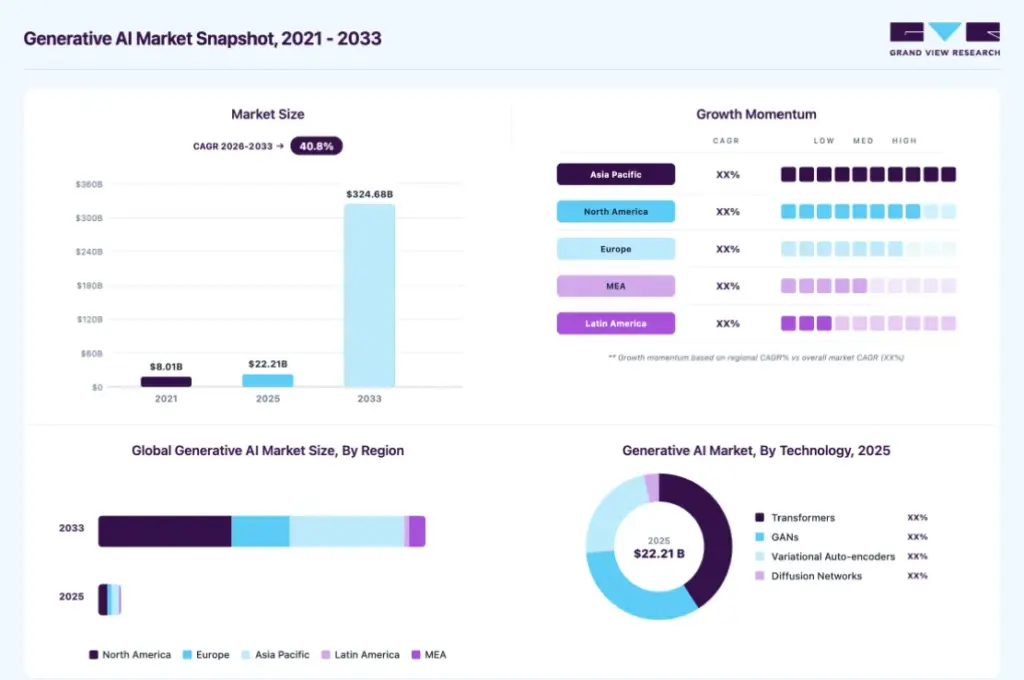
Source: Grand View Research
For capital allocators and entrepreneurs, the investment thesis is clear: legacy frameworks face escalating operational costs and diminishing returns. Rebuilding with GenAI compresses operational cycles, reduces human dependency on repetitive tasks, and unlocks entirely new revenue streams through automated customer experiences. Capital is shifting rapidly toward platforms that treat AI as a foundational infrastructure requirement rather than a superficial add-on.
From AI Assistants to AI Systems
The first wave of enterprise AI adoption focused mainly on standalone chatbots and productivity assistants. While useful for simple tasks, these tools struggled to deliver long-term ROI because they operated separately from core business systems and lacked workflow automation capabilities. In 2026, enterprises are shifting toward agentic AI systems that can monitor events, automate multi-step operations, access enterprise data securely, and execute tasks autonomously across platforms.
This evolution is already visible across major enterprises. Volkswagen integrated generative AI into its myVW platform to help drivers analyze dashboard indicators and access contextual vehicle guidance in real time. Similarly, Morgan Stanley deployed generative AI across its wealth management division to help advisors generate faster, compliance-ready investment insights. As businesses move from simple AI chat interfaces to deeply integrated autonomous systems, generative AI platform development is becoming a major growth opportunity for enterprises and investors alike.
Why Legacy Apps Lose Efficiency
Traditional application architectures are limited by rigid, deterministic logic. They rely on hardcoded paths, explicit user inputs, and brittle API integrations that break whenever underlying data structures change. As workflows become fluid and data volumes grow, these deterministic applications create severe operational bottlenecks that require manual human intervention. The inefficiency of traditional apps stems from several structural liabilities:
- High Cognitive Load: Employees spend significant time navigating complex interfaces, manually extracting data from dashboards, and translating business requirements into specific software commands.
- Brittle Integrations: Legacy systems rely on strict, pre-defined schemas. When a third-party vendor updates an API, the integration pipeline frequently collapses and requires expensive engineering fixes.
- Unstructured Data Blindness: Over 80% of enterprise data exists in unstructured formats like PDFs, emails, and call recordings. Traditional applications cannot process this information without manual transcription.
- Maintenance Overhead: As business logic evolves, traditional codebases require continuous manual updates, regression testing, and redeployments, which drag down engineering velocity.
By replacing these rigid frameworks with probabilistic, AI-driven architectures, platforms dynamically adapt to changing inputs without requiring constant code rewrites. This drives down the total cost of ownership for the enterprise while accelerating time-to-market.
Key Sectors Investing in GenAI
Industries with high data complexity and strict compliance requirements are becoming major adopters of generative AI platforms. Financial institutions are using AI-powered systems to analyze regulations, detect anomalies, and automate compliance workflows faster than traditional software.
In healthcare and life sciences, companies are leveraging generative AI to accelerate drug discovery, automate clinical documentation, and process large volumes of research data more efficiently.
At the same time, sectors like logistics, manufacturing, and legal tech are investing heavily in enterprise AI automation. Modern legal AI platforms now go beyond document search by enabling contract analysis, risk assessment, and workflow automation at scale. As enterprises prioritize efficiency and operational intelligence, these industries are creating strong demand for custom generative AI development services.
What Generative AI Development Services Actually Include?
One of the biggest misconceptions in the market is that generative AI development is simply about integrating ChatGPT APIs. In reality, enterprise-grade implementation requires a layered technology stack. For investors and entrepreneurs looking to back high-yield software ventures, understanding this breakdown is critical to separating surface-level software wrappers from deep, defensible tech platforms.
1. AI Strategy & Consulting
Before a single line of code is written, platforms require robust architectural blueprinting. This foundational stage moves companies past isolated experimentation efforts into structured execution. It also helps enterprises identify technical limitations, operational dependencies, and scalability requirements early in the development lifecycle.
- AI Readiness Assessments: Evaluating current data pipelines, cloud maturity, and technical debt.
- Opportunity Mapping: Identifying high-impact use cases where probabilistic AI models outperform traditional deterministic software.
- ROI Analysis & Workflow Prioritization: Calculating total cost of ownership against projected efficiency gains to ensure capital efficiency.
- Governance Planning & Compliance Alignment: Defining data boundaries, security protocols, and operational guardrails early.
2. Custom LLM Development
While third-party foundational models are useful for prototyping, sophisticated enterprises increasingly demand proprietary control over their core intelligence layer. This involves fine-tuning open-source models, optimization for domain-specific tasks, and private deployment to safeguard sensitive intellectual property.
Additionally, engineering teams focus on techniques like knowledge distillation and edge optimization to significantly reduce inference costs and latency.
3. Retrieval-Augmented Generation
RAG has become an essential enterprise AI architecture by connecting models directly to secure corporate knowledge sources in real time. Instead of relying solely on a model’s static training memory, a RAG system queries internal vector databases to ground every response in factual, up-to-date business data.
| Strategic Advantage | Business Impact |
| Drastic Hallucination Reduction | Minimizes compliance, legal, and operational risks. |
| Real-Time Data Access | Eliminates the need for constant, expensive model retraining. |
| Granular Access Control | Ensures users only view data aligned with their corporate permissions. |
4. AI Agent Development
The market is rapidly shifting from passive text generators to autonomous AI agents. These systems do not wait for basic prompts; they monitor internal events, reason through multi-step workflows, and execute complex business operations. Their ability to operate across multiple enterprise systems makes them highly valuable for large-scale operational automation.
[Trigger Event] ──> [Agent Reasoning Layer] ──> [API Tool Call] ──> [System State Update]
Enterprise deployment is accelerating across multiple core business functions. In Procurement, agents handle vendor matching, invoice reconciliation, and spot-buy negotiations. Within Financial Operations, they manage automated cash reconciliation, continuous fraud monitoring, and compliance reporting.
For HR Operations and Customer Service, agents scale operational capacity by autonomously resolving complex, multi-system service tickets without manual human intervention.
5. AI Infrastructure Engineering
Building a scalable platform requires deep engineering backend expertise to support sustained enterprise traffic. Development services in this category focus heavily on implementing vector databases like Pinecone, Milvus, or Qdrant for fast semantic searching. Teams design high-performance models serving infrastructure, implement automated GPU orchestration pipelines to maximize hardware utilization, and build custom API gateways equipped with advanced rate-limiting and cost-tracking observability metrics.
6. AI Governance & Compliance
As global AI regulations expand, robust corporate governance is no longer optional; it is a critical requirement for enterprise software adoption. Technical implementation must include deep visibility into data lineage and comprehensive model monitoring tools to audit decisions.
Engineering teams build strict bias mitigation protocols, implement automated fallback mechanisms, and design sophisticated human-in-the-loop validation flows to ensure absolute platform predictability and safety.
Are Enterprises Becoming Too Dependent on OpenAI and Anthropic?
The short answer is yes, but we are actively guiding our clients through a massive market correction. Initially, a heavy percentage of early corporate AI pilots were built exclusively on top of proprietary API endpoints, creating an immediate, risky reliance on OpenAI and Anthropic. Enterprises prioritized raw model capabilities and lightning-fast time-to-market over structural independence, essentially renting their intelligence layer from a centralized duopoly.
At IdeaUsher, we see this reliance as a severe vulnerability. Treating closed frontier providers as a permanent utility introduces compounding business risks that top-tier companies can no longer afford to ignore.
Risks of Closed Vendor Dependence
When we audit enterprise architectures, we frequently identify four major operational vulnerabilities tied to exclusive proprietary dependence:
- The Black Box Dilemma: Enterprises have zero visibility into the underlying weight distribution or training datasets of closed models. A sudden update from a third-party provider can trigger severe regressions in downstream applications without warning.
- Pricing Inelasticity: High-volume token usage becomes financially prohibitive as internal applications scale from limited test groups to global production environments.
- Data Sovereignty Redlines: Regulated fields like finance, healthcare, and defense cannot legally route deeply sensitive, core intellectual property across public API endpoints.
- Total Ecosystem Fragility: If a single provider suffers a prolonged infrastructure outage or a sudden corporate governance crisis, any business dependent on that single API faces immediate operational paralysis.
Decentralizing the Tech Stack
To break free from this dependency, our teams aggressively design decentralized, open-source counterweights into our clients’ systems. The enterprise landscape is moving from a “frontier model only” paradigm to a highly resilient, diversified framework that we host natively within your own Virtual Private Clouds.
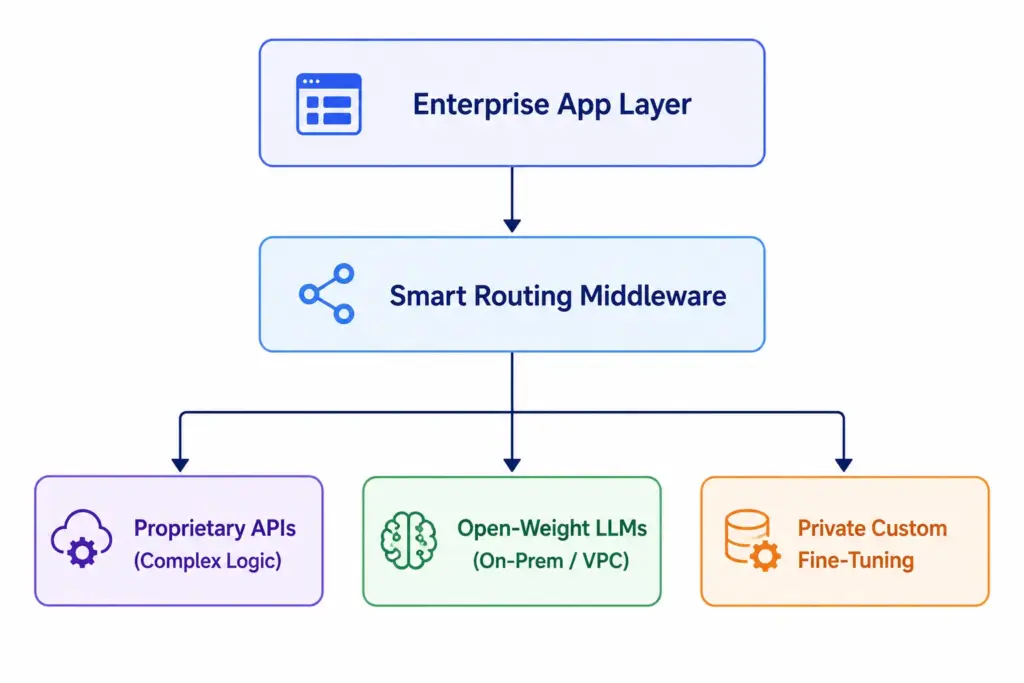
The monopoly has cracked. Powerful open-weight alternatives allow us to deploy advanced models locally. At high query volumes, this approach drops the cost-per-token to a fraction of a cent, eliminating recurring subscription fees and returning absolute data isolation to your enterprise.
Multi-Model Routing Strategy
Rather than choosing one extreme, our developers engineer smart routing middleware to optimize performance, protect your margins, and eliminate systemic risk across your workflows. This approach allows enterprises to dynamically allocate workloads based on latency, cost efficiency, and compliance sensitivity. It also creates a far more resilient AI ecosystem capable of adapting as foundational model providers evolve over time.
| Workflow Type | Selected Infrastructure | Primary Operational Driver |
| Complex Reasoning | Advanced Frontier Models (Claude/GPT) | Maximizes logical depth and complex software engineering tool use. |
| High-Volume Extraction | Self-Hosted Open-Weight Models | Secures absolute data isolation and eliminates recurring API call costs. |
| Repetitive Sorting | Fine-Tuned Compact Local Models | Delivers near-instantaneous execution speeds with minimal server overhead. |
Our Architectural Principle: True technical value no longer stems from a specific underlying base model. It is generated by the proprietary data pipelines, agentic orchestration layers, and custom vector search infrastructure we engineer around those models.
Reclaiming Infrastructure Autonomy
Ecosystem agility is your ultimate defense against vendor lock-in. Building an enterprise platform entirely on a single external API creates fragile software subject to the architectural changes and pricing whims of external vendors. At IdeaUsher, we do things differently.
We specialize in designing and implementing decoupled, multi-model hybrid architectures that return complete stack control to your enterprise. Our network of pre-vetted development teams bypasses superficial API wraps to build enterprise-grade systems from scratch. By hiring your dedicated development team through us, you gain the precise technical mastery needed to construct heavily guarded, cost-optimized, and permanently independent generative AI platforms.
How IdeaUsher Builds Generative AI Solutions?
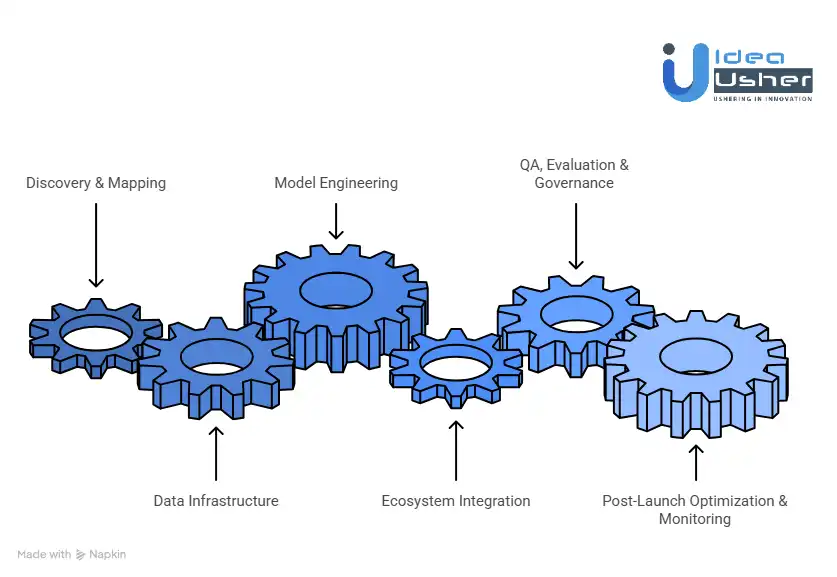
Successful AI implementation depends on structured delivery frameworks. Many enterprises fail because they jump directly into model deployment without validating workflows, data readiness, or operational requirements. To eliminate this risk, we at IdeaUsher follow a meticulous six-stage implementation methodology.
Through our network of pre-vetted developers, we help businesses build scalable, high-yield generative AI systems without the typical friction of hiring and onboarding engineering talent.
1. Discovery & Mapping
Our process begins by identifying high-impact automation opportunities and existing workflow inefficiencies. Our specialized developers assess data availability, risk constraints, and ROI priorities. The primary goal is to avoid building complex AI systems that create technical debt without delivering measurable business value to investors.
2. Data Infrastructure
Data quality directly impacts AI performance. During this phase, our infrastructure architects map out data pipeline analysis and design robust knowledge architectures. We establish high-performance vector databases, conduct comprehensive security assessments, and configure granular access management protocols to protect your corporate intellectual property.
3. Model Engineering
Rather than defaulting to a single provider, we match your platform’s foundation to specific operational requirements. Our engineers base their selection on balancing critical enterprise metrics. This allows businesses to optimize both performance and infrastructure costs without compromising scalability. It also ensures the AI architecture remains flexible enough to adapt as operational demands evolve over time.
- Performance Variables: Latency requirements, context window needs, and inference costs.
- Compliance Boundaries: Regulatory constraints and secure data handling capabilities.
- Architectural Options: Deploying specialized models from OpenAI, Anthropic Claude, Gemini, or open-source frameworks like Llama, often blending them into highly cost-efficient hybrid architectures.
4. Ecosystem Integration
AI systems must not operate in isolation; they must integrate cleanly into existing enterprise ecosystems. Our pre-vetted development teams handle end-to-end API orchestration, connecting the intelligence layer directly into legacy ERP systems, CRMs, authentication platforms, and internal corporate knowledge bases to automate fluid, multi-application business workflows.
5. QA, Evaluation & Governance
Before any platform goes live, our teams subject it to rigorous verification to guarantee enterprise predictability. This step combines advanced hallucination testing, adversarial red-team evaluation, and strict security audits. We perform thorough load testing, validate regulatory compliance, and deploy structured human-in-the-loop review guardrails.
6. Post-Launch Optimization & Monitoring
AI systems require continuous optimization post-deployment. We implement real-time usage monitoring and cost-optimization protocols to manage API spending. Through continuous prompt tuning, structured user feedback loops, systematic model upgrades, and detailed analytics reporting, we ensure your platform grows more efficient over time.
Case Study: Enterprise Document Automation
A major logistics enterprise faced significant operational bottlenecks when managing internal document processing across its global procurement workflows. The growing volume of procurement data across disconnected systems was slowing operational efficiency and increasing manual workload across departments.
The Challenge: The company’s staff spent thousands of hours manually reviewing disparate vendor contracts, invoices, and compliance documents spread across disconnected legacy systems.
We deployed a dedicated team of our specialized developers to engineer and launch a custom, RAG-powered intelligence platform integrated directly into the client’s existing core ERP infrastructure. The system completely automated document extraction, vendor classification, and complex procurement query handling.
| Performance Metric | Operational Impact |
| Manual Review Time | 61% Reduction |
| Procurement Processing Speed | 43% Faster |
| Operational Support Requests | 38% Decrease |
How Enterprises Should Evaluate Generative AI Vendors?
One major gap in the current market is the absence of standardized evaluation frameworks for assessing generative AI vendors. Because the technology is evolving so rapidly, buyers frequently struggle to differentiate between companies that merely build superficial software interfaces and partners capable of engineering robust enterprise platforms.
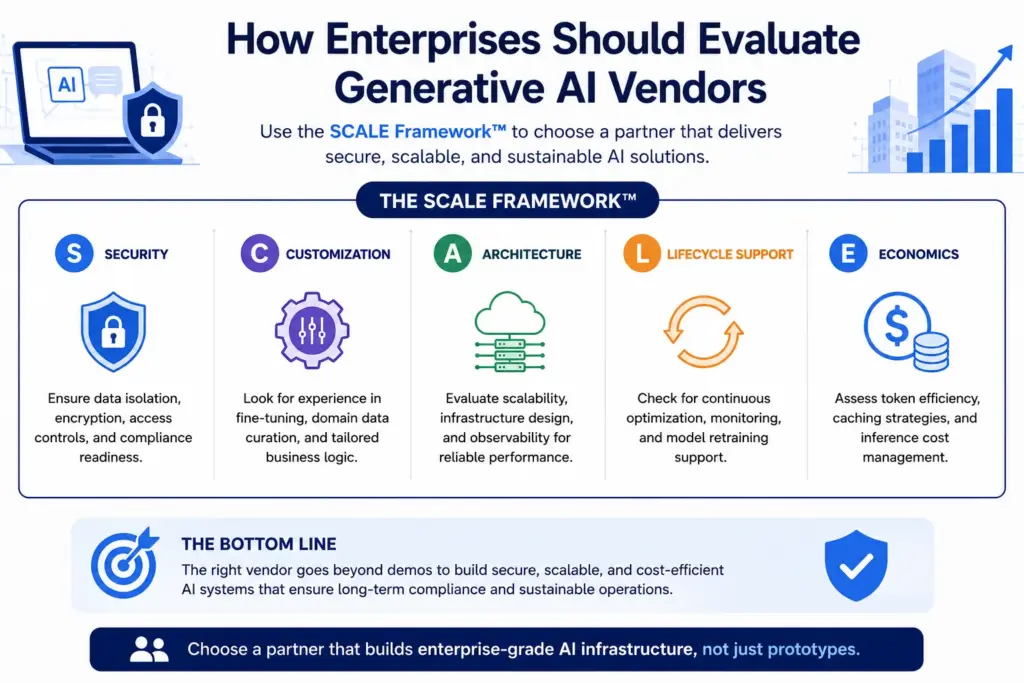
To solve this problem, we developed a systematic approach to assessing technical maturity and operational viability: the SCALE Framework™.
The SCALE Framework
When choosing a development partner, you can use this matrix to grade a vendor’s actual execution capabilities against long-term business needs. It helps businesses separate vendors offering superficial AI integrations from teams capable of building scalable enterprise infrastructure. This evaluation approach also reduces long-term operational risks by focusing on sustainability, security, and platform scalability from the beginning.
| Category | What Buyers Should Evaluate | Core Enterprise Metric |
| Security | Data isolation architectures, end-to-end encryption, role-based access controls, and strict compliance readiness. | Zero-Trust Validation |
| Customization | Experience with proprietary fine-tuning, domain-specific dataset curation, and tailored business logic adaptation. | Proprietary IP Value |
| Architecture | System scalability thresholds, infrastructure decoupling, and real-time observability pipelines. | Enterprise Reliability |
| Lifecycle Support | Post-launch model optimization, proactive hallucination tracking, and continuous data retraining loops. | Long-Term TCO |
| Economics | Token utilization strategies, semantic caching mechanisms, and strategic inference cost management. | Hardware Efficiency |
Why This Matters
Many AI vendors can build quick prototypes. Far fewer can support enterprise-scale deployment. Building a sleek user interface that connects to a generic API is a fundamentally different engineering challenge than deploying a reliable, secure system inside a heavily regulated corporate environment.
According to data from IBM’s Global AI Adoption Index, cost management, data privacy, and governance remain among the top barriers to successfully scaling enterprise AI initiatives. Organizations frequently stall in the experimentation phase because their chosen implementation partner lacks the technical depth needed to bridge the gap between a proof-of-concept and a fully compliant, cost-efficient production environment.
Questions Every Buyer Should Ask
Before signing a contract or allocating capital to an external development squad, your executive leadership should present these targeted technical, governance, and financial questions to potential vendors. Asking the right questions early helps businesses avoid costly architectural mistakes and long-term scalability issues later in the deployment cycle.
Technical Questions
- Which specific foundational and open-source models do your developers support?
- Do you support multi-model orchestration, or does your architecture lock our business into a single provider?
- What specific vector databases do you recommend for our scale of unstructured data?
- How do your engineers structurally mitigate hallucinations and handle fallback logic when a model fails?
- What specific logging and observability tools are baked directly into the platform backend?
Governance Questions
- How exactly is our proprietary enterprise data isolated from the base model public training sets?
- What regulatory compliance standards are natively supported by your data processing layers?
- How are system prompts logged, monitored, and shielded against malicious prompt-injection attacks?
- How is human-in-the-loop oversight implemented for high-stakes autonomous actions?
Financial Questions
- What are the projected monthly inference costs based on our estimated concurrent user volume?
- What are the exact infrastructure scaling thresholds where API or compute costs will spike?
- What specific optimization strategies do your teams use to actively reduce token consumption and GPU overhead?
Operationalizing AI Sustainably
The best AI vendor is not necessarily the company with the flashiest demos. It is the partner capable of operationalizing AI securely and sustainably. Demos are easy to assemble, but engineering enterprise-grade platforms that process sensitive corporate data smoothly requires deep architectural expertise.
When you partner with us at IdeaUsher, we bypass the fluff. Our pre-vetted developer network builds scalable, heavily guarded generative AI systems designed around the SCALE principles. We ensure your software investments yield maximum operational ROI while protecting your business from the unpredictable costs and compliance risks of unoptimized tech stacks.
Generative AI Development Costs in 2026
AI project costs vary dramatically depending on architecture complexity, deployment scale, compliance requirements, and infrastructure strategy. For capital allocators, evaluating these initiatives requires looking past initial development quotes and analyzing the multi-year capital commitment required to sustain high-performance intelligence systems built around generative AI.
Estimated Cost Benchmarks
The financial scope of building an AI platform depends heavily on the level of autonomy and system integration required. Below is a realistic breakdown of market cost ranges for distinct platform architectures. Factors such as infrastructure scale, data complexity, compliance requirements, and workflow automation depth can significantly influence the final investment.
| Project Type | Estimated Cost Range (USD) | Primary Architectural Drivers |
| AI Chatbot MVP | $20,000–$60,000 | Single model integration, standard user interface, basic prompt engineering. |
| Enterprise RAG Platform | $80,000–$300,000 | Vector database configuration, secure internal data ingestion pipelines, role-based access permissions. |
| AI Workflow Automation System | $100,000–$500,000 | Multi-application API orchestration, deterministic fallback logic, bidirectional data synchronization. |
| Autonomous AI Agent Platform | $150,000–$800,000 | Multi-agent reasoning loops, long-term memory allocation, autonomous tool-use and state updates. |
| Custom Fine-Tuned LLM Deployment | $250,000–$1M+ | Base model training, proprietary weight adjustments, deep dataset curation, and intensive GPU infrastructure. |
What Actually Drives Costs
Understanding where development capital is allocated prevents budget overruns and ensures proper asset engineering. It also helps businesses prioritize high-impact infrastructure investments instead of overspending on unnecessary AI complexity. A well-planned cost structure ultimately improves scalability, operational stability, and long-term ROI.
1. Infrastructure
GPU compute remains one of the largest expenses in the operational life of an AI system. While initial training or fine-tuning requires upfront capital, continuous model inference scales directly with concurrent user volume. Because of this, inference optimization has become a critical competitive advantage for software vendors. Platforms that leverage smart model caching, semantic routing, and quantization run significantly more efficiently than unoptimized software wraps.
2. Data Engineering
Most enterprise AI timelines are delayed because internal data systems are fragmented. Building a high-performing system requires clean, accessible data. Spending money here involves structuring data ingestion, setting up extract-transform-load (ETL) data pipelines, and designing unified knowledge graphs so the underlying models can access clean contextual parameters.
3. Compliance & Security
Deployments in healthcare, finance, and government sectors require additional governance layers. Safeguarding data means investing heavily in dedicated security frameworks, data isolation tools, regular vulnerability assessments, and prompt injection protection protocols to maintain absolute system integrity.
4. Integration Complexity
The more legacy software systems involved, the higher the implementation complexity. Connecting an intelligent model to an old mainframe, a non-standard ERP, or a fragmented internal CRM requires custom API engineering, extensive regression testing, and robust error handling to keep workflows stable.
The Hidden Cost Multiplier
Analysis of enterprise AI implementation patterns across major research reports from Gartner, IBM, and Deloitte reveals that the most prominent budget blind spot is post-launch operational tuning. Many organizations budget heavily for the initial build phase while vastly underestimating the long-term operational expenses needed to maintain model accuracy.
Operational Reality: In mature enterprise deployments, ongoing platform optimization routinely becomes a larger long-term expense than the initial code construction.
Post-launch engineering capital is silently drained by five core factors:
- Inference and API Scaling: Monthly infrastructure expenses scale sharply as adoption grows across different business departments.
- Model Drift and Retraining: Open-source or proprietary models require regular tuning as underlying corporate data patterns and market landscapes shift.
- Continuous Prompt Optimization: Adjusting context windows and prompt styles to lower latency and maintain accuracy metrics under varying conditions.
- Observability Pipelines: Running continuous monitoring platforms to detect hallucinations, flag security anomalies, and track token usage metrics.
- Human Review Workflows: Managing the necessary human-in-the-loop interfaces required to validate high-stakes model outputs before final execution.
Total Cost Management
Evaluate the total cost of ownership over a 24–36 month horizon rather than focusing solely on initial deployment pricing. When we architect solutions at IdeaUsher, we build with long-term cost containment as a primary design parameter. By leveraging our pre-vetted developer network, we help you right-size your models, select cost-effective hybrid infrastructures, and optimize inference paths from day one.
This proactive engineering approach ensures your platform remains highly performant and financially sustainable as your enterprise scales.
The Rise of Hybrid AI Architectures for Generative AI Development
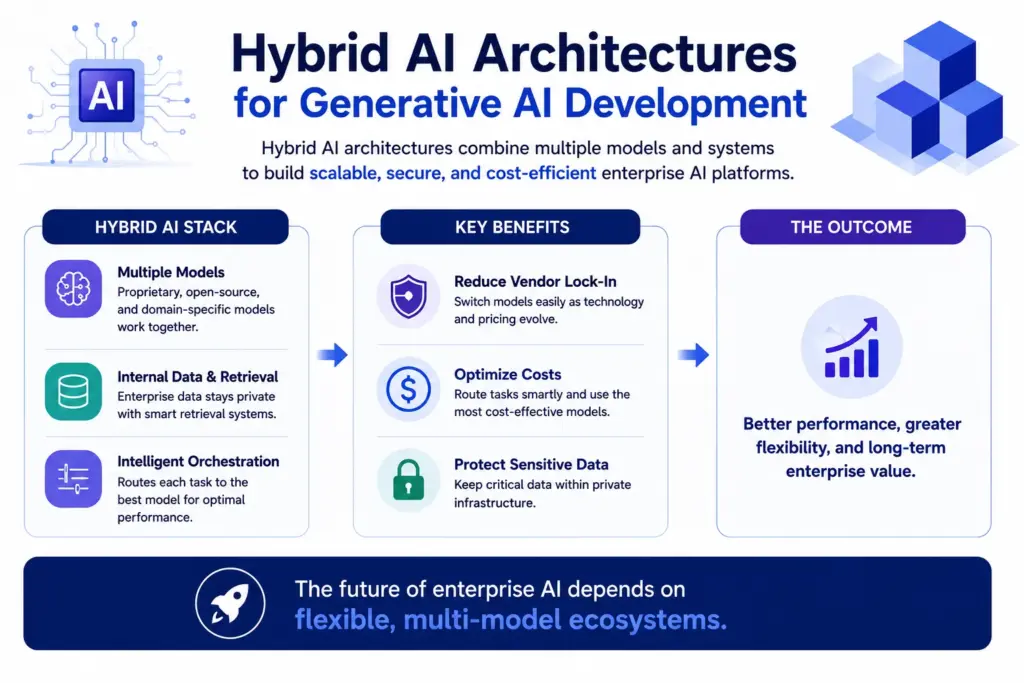
A major structural shift is taking place across the enterprise software landscape: the rise of hybrid AI stacks. Forward-thinking entrepreneurs and capital allocators are moving away from monolithic dependencies on a single model provider. Instead, they are engineering platform architectures that combine proprietary models, open-source LLMs, domain-specific networks, internal retrieval systems, and intelligent orchestration layers into a unified, high-performing software ecosystem built around generative AI.
Why Hybrid Architectures Matter
Building an enterprise platform with a hybrid AI stack provides direct, measurable advantages that directly influence a company’s financial valuation and operational agility. It allows businesses to balance performance, scalability, and infrastructure costs more efficiently across different operational workloads.
Hybrid architectures also reduce dependency on a single AI provider, giving enterprises greater flexibility, resilience, and long-term control over their technology ecosystem..
- Reduced Vendor Lock-In: Model capabilities and pricing structures fluctuate rapidly. A hybrid framework allows companies to switch underlying models seamlessly as market competition accelerates, protecting the software from becoming tethered to an obsolete or overpriced provider.
- Better Cost Optimization: Running every corporate query through a massive foundational model is financially unsustainable. Hybrid setups route simple, repetitive workflows to lightweight open-source models, reserving expensive frontier models exclusively for complex reasoning tasks.
- Improved Data Privacy: Massive public models introduce compliance liabilities. Hybrid environments allow enterprises to keep sensitive corporate data, proprietary financial calculations, and protected healthcare information entirely within private cloud boundaries.
- Multi-Model Routing: No single model excels at every operational task. Hybrid infrastructures leverage specialized networks optimized for distinct performance profiles, resulting in higher execution accuracy and lower latency across the entire platform.
Task to Model Mapping
To maintain strict cost controls and operational efficiency, hybrid platforms employ smart routing tables. The following matrix illustrates how distinct corporate tasks are dynamically mapped to the most efficient, purpose-built model infrastructure. This intelligent workload distribution helps enterprises optimize both inference performance and infrastructure utilization simultaneously.
| Task Complexity | Preferred Model Strategy | Operational Advantage |
| Creative Content Generation | Large proprietary models | Maximizes contextual nuance, linguistic fluidity, and creative reasoning power. |
| Internal Enterprise Search | Smaller optimized RAG models | Lowers latency and guarantees real-time grounding in local corporate knowledge bases. |
| Classification Workflows | Fine-tuned lightweight models | Drastically reduces token costs for repetitive tagging, categorization, and sorting tasks. |
| Sensitive Enterprise Workflows | Private hosted LLMs | Ensures absolute data isolation and compliance with strict data residency laws. |
Optimization Over Hype
This systemic shift toward hybrid environments aligns with major consensus shifts among top technology leaders. NVIDIA CEO Jensen Huang has repeatedly emphasized that enterprise AI requires full-stack optimization rather than just access to larger foundational models. True enterprise productivity gains occur when accelerated hardware, optimized data pipelines, sandboxed execution tools, and specialized models work together as a cohesive factory stack.
- Similarly, noted computer scientist Andrew Ng has argued that workflow engineering and agentic design patterns are often far more valuable for an enterprise than investing capital into massive model training from scratch.
- Wrapping even lighter, open-source models in structured, iterative workflows where the system can plan, use external tools, and check its own work consistently yields superior business outcomes compared to relying on a single, unoptimized public prompt.
Expert Perspective: The core value of an enterprise AI platform does not come from the underlying foundational model; it comes from the custom operational architecture built around it.
Future-Proofing Your Platform
Enterprises must prioritize flexible AI ecosystems over single-provider dependence. When you build a platform around a rigid, single-API setup, you inherit massive technical limitations and operational vulnerabilities. Sophisticated business buyers choose software platforms that can adapt dynamically to changing market standards.
At IdeaUsher, we specialize in designing and deploying custom hybrid AI architectures. Our network of pre-vetted development teams helps you build decoupled, multi-model platforms equipped with advanced orchestration layers and optimized vector storage pipelines. By hiring your engineering fleet through us, you gain the precise technical expertise required to turn raw model capabilities into a secure, cost-controlled, and highly scalable corporate asset.
Will SaaS AI Platforms Replace Custom Development?
Some analysts argue that enterprises no longer need custom AI development because out-of-the-box SaaS AI platforms already provide copilots, assistants, and built-in workflow automation. This perspective is partially correct, but it misses the deeper architectural requirements of modern enterprises. For lightweight, generic workflows, off-the-shelf software tools can provide strong, immediate ROI with zero development overhead.
However, relying entirely on public SaaS solutions presents severe limitations for enterprises looking to scale. For organizations aiming to capture true market differentiation and secure high-value intellectual property, a completely packaged approach creates rigid operational dependencies and exposes sensitive data to external models.
The Enterprise Defensibility Gap
Generic SaaS tools rarely address the deep operational complexities required by mature enterprises. True competitive advantage is not built by using the same generic software wrappers as your direct market competitors. Enterprises increasingly require customized AI infrastructure tailored to their unique workflows, data environments, and operational goals.
Strategic Viewpoint: The question is no longer whether an organization should adopt AI. The real question is how much structural competitive advantage companies want to own internally versus renting from a third-party vendor.
Enterprise-grade deployments systematically require five foundational pillars that off-the-shelf SaaS platforms struggle to deliver:
- Proprietary Data Integration: Connecting complex, multi-format legacy databases to an AI engine without exposing confidential corporate intelligence to public training pools.
- Complex Workflow Orchestration: Building bidirectional, multi-system automation that aligns perfectly with a company’s unique, non-standard business logic.
- Granular Compliance Controls: Meeting strict regulatory standards (such as HIPAA, GDPR, or SOC 2) through isolated data environments and fully auditable access logs.
- Internal Infrastructure Alignment: Deploying software natively within specialized private clouds to avoid API latency bottlenecks and scale user counts predictably.
- Custom Governance Models: Implementing tailored business rule sets, custom fallback logic, and human-in-the-loop validation checkpoints unique to the company’s risk profile.
The Emerging Coexistence Matrix
Rather than a total displacement, the market is organizing into a coordinated, hybrid software ecosystem. Organizations achieve the highest capital efficiency by balancing rented utility with owned innovation. This approach allows enterprises to maintain flexibility while retaining strategic control over their core AI capabilities.
| Architectural Layer | Software Strategy | Primary Business Objective |
| Commoditized Tasks | SaaS Copilots | Maximizes immediate, baseline productivity for standard employee workflows like writing and basic scheduling. |
| Proprietary Knowledge | Internal AI Systems | Secures corporate IP by keeping custom RAG architectures grounded exclusively in secure internal data warehouses. |
| Multi-Application Routing | Custom Orchestration | Prevents vendor lock-in by dynamically switching between models based on real-time cost, latency, and performance metrics. |
| Core Value Drivers | Domain-Specific Automation | Drives deep operational efficiency by automating highly specialized, industry-specific logistics, finance, or clinical pipelines. |
Retain Your Competitive Edge
Entrusting your core enterprise intelligence to a generic SaaS platform forces your company to operate at the exact same efficiency baseline as the rest of the market. Building a highly differentiated, securely sandboxed architecture is the only way to transform generative AI into a defensible corporate asset.
At IdeaUsher, we help you bridge the gap between commoditized software tools and custom-engineered infrastructure. Through our network of pre-vetted, ex-MAANG/FAANG development teams, we build and deploy proprietary hybrid stacks tailored explicitly to your operational workflows. By hiring your dedicated development fleet from us, you gain the precise technical depth needed to own your AI infrastructure completely, manage long-term inference costs, and secure a permanent digital advantage.
Contact Idea Usher for Generative AI Development
Navigating the intricacies of generative AI requires a partner who understands how to bridge the gap between initial concepts and robust, production-ready infrastructure. We at IdeaUsher provide deep technical authority to help enterprises construct defensible, multi-model platforms tailored to complex operations. With over 500,000 hours of coding experience, our team of ex-MAANG/FAANG developers specializes in engineering high-performance systems equipped with secure vector storage, smart token routing, and granular data governance.
Launch Scalable AI Products
Launching a successful software asset means building with scale and cost containment from day one. Instead of dealing with the administrative friction and long timelines of traditional hiring, you can tap into our elite roster of pre-vetted engineers to accelerate your development cycles.
Our developers embed smoothly into your existing Git and Jira environments within 24 hours, deploying custom Retrieval-Augmented Generation (RAG) architectures and fine-tuned open-source LLMs that keep your platform highly performant under massive traffic loads.
The Onboarding Advantage: Seamless integration with zero downtime. Our pre-vetted technical talent acts as a natural extension of your internal unit, allowing you to scale up or down based on sprint priorities.
Transform Workflows Natively
Moving past static databases into active, real-time execution environments is the key to unlocking true operational velocity. We help businesses automate complex, repetitive tasks across procurement, finance, logistics, and customer experience workflows using autonomous AI agents.
By choosing to hire your dedicated engineering fleet from us, you ensure your organization transitions smoothly into an automated execution hub, significantly reducing operational cycle times while securing maximum ROI on your technology investments.
Conclusion
Navigating the generative AI development market requires looking past superficial software interfaces and evaluating platforms on structural depth, lifecycle security, and multi-year operating economics. Capital allocators and entrepreneurs who treat AI as foundational infrastructure are uniquely positioned to secure permanent market advantages. By partnering with IdeaUsher, you gain immediate access to pre-vetted development teams ready to engineer secure, cost-optimized, and resilient hybrid AI ecosystems. Let our technical expertise handle deployment so you can focus on scaling a highly defensible, high-yielding corporate asset.
Author Bio
I’m Debangshu Chanda, a tech writer with 5+ years of experience covering generative AI, AI development services, and intelligent automation. I enjoy simplifying complex topics like AI agents, LLMs, and enterprise AI systems into practical insights for businesses and founders. Through my writing, I help readers understand how generative AI is reshaping products, workflows, and modern digital innovation.
FAQs
Q1: What are generative AI development services?
A1: Generative AI development services encompass the end-to-end process of building, deploying, and optimizing software powered by advanced machine learning models. This شامل end-to-end framework that covers initial architectural strategy, custom model fine-tuning, Retrieval-Augmented Generation system engineering, multi-agent workflow automation, and the implementation of strict compliance and data governance guardrails.
Q2: How much does generative AI development cost?
A2: The financial investment for a generative AI solution scales dynamically with system complexity, typically ranging from $20,000 for a lightweight proof-of-concept to over $1,000,000 for bespoke enterprise architectures. Key cost drivers include data pipeline preparation, specialized integration requirements, compliance scaffolding, and long-term infrastructure expenses like GPU compute and token inference.
Q3: What industries are investing most heavily in generative AI?
A3: Enterprise adoption is accelerating rapidly across high-stakes, data-heavy sectors including finance, healthcare, logistics, legal technology, procurement, and customer experience operations. These industries prioritize generative AI to compress long operational cycles, eliminate manual document processing bottlenecks, reduce human error in repetitive workflows, and open automated, real-time customer service channels.
Q4: What is the difference between AI consulting and AI development?
A4: AI consulting is a strategic planning phase focused on business readiness assessments, opportunity mapping, ROI calculations, and compliance blueprinting before engineering begins. Conversely, AI development is the technical execution phase where pre-vetted engineers actively write code, configure vector databases, train or fine-tune models, orchestrate APIs, and build runtime observability pipelines.