

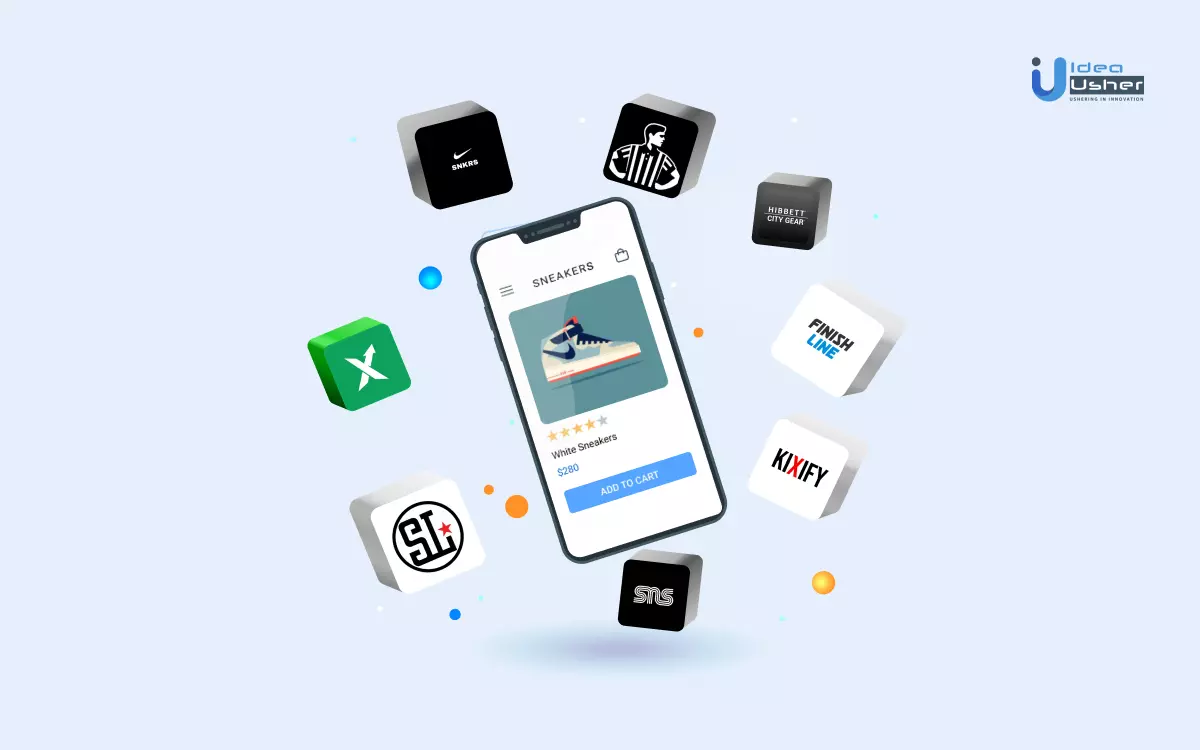
A kid in line outside a Nike store at 4 AM, refreshing the SNKRS app on a phone with 12% battery, hoping to land a pair of Travis Scott Jordan 1 Lows before bots eat the entire stock. That scene plays out every single weekend in cities across the world, and it is exactly why sneaker app development has picked up so much steam lately. People do not want to stand in line anymore. They really, truly do not.
What they want is an app where they can check upcoming drops, place a bid on a pair of used Off-Whites, get those shoes authenticated before money changes hands, and track the package all the way to their door. Sounds straightforward enough. But actually building something that handles all of that without buckling under traffic on release day? Way harder than most founders expect going in. The checkout flow alone trips up a surprising number of teams because sneaker drops create traffic spikes that look more like a DDoS attack than normal shopping behavior.
Go browse the App Store or Google Play right now and you will find dozens of sneaker apps already live. Most are mediocre. Some straight up crash the moment a hyped release goes live. A handful, though, have figured out what collectors actually care about and built around that. Idea Usher works with brands building mobile shopping apps in spaces like this, where the product has to be fast enough and robust enough to survive the kind of demand sneaker culture throws at it. That matters more than people realize until their server melts on launch day.
So yes, building a sneaker app is messy. Lots of moving pieces, lots of ways to get it wrong. But the teams that map out those pain points before writing a single line of code tend to ship something that actually sticks on people’s phones instead of getting deleted after one bad experience.
What Are Sneaker Shopping Apps?
Sneaker shopping applications give users a way to buy, sell, and resell trending, rare, and limited edition sneakers straight from their phones. They connect online retailers, independent sellers, and buyers from around the world. Everyone gets a place to list prices, throw in bids, and reserve pairs without standing in line outside a store at 5 AM on a Saturday.
The real draw here is access. Someone in Mumbai can grab a pair of Travis Scott Jordan 1s from a seller sitting in Chicago. A few taps and the deal is done. The platforms handle the messy parts: verifying authenticity, processing payments, coordinating shipping across borders. Resellers get a storefront that reaches millions of eyeballs without renting retail space. Buyers get a legitimate shot at limited drops that would otherwise mean camping outside a Foot Locker or losing to bots on release day.
Of course, not every reservation ends in a win. Raffles are random. Drops sell out in literal seconds. Prices on the secondary market swing around like penny stocks on a volatile day. But even with all of that, app-based purchasing still beats driving across the city hoping some store has your size left on the shelf. Most users just figure out which app fits their buying habits, whether that is placing bids on StockX, testing their luck in Nike SNKRS raffles, or digging through deals on GOAT.
| Market Size (2025) | USD 104.5 billion |
| Resale Market (2026) | USD 11.97 billion |
| CAGR (Primary Market) | 5.26% (2026-2034) |
| CAGR (Resale) | 11.9% (2026-2035) |
| Top Players | GOAT, StockX, Nike SNKRS, Grailed, SNKRDUNK |
| App Downloads (Top 3 Combined) | 30 M+ (Google Play) |
| Source | Grand View Research, Hype Proxies |
Features of Sneaker Shopping Apps
Generic ecommerce features will not cut it for a sneaker app. Sneakerheads are particular. They expect tools designed specifically around drops, authentication verification, and real-time pricing fluctuations. The features listed below are what separate an app people actually use from one they download once and forget about.
1. User Profiles
Buyers need a place to save their shoe size, favorite brands, and payment info so they can check out in seconds the moment a drop goes live. Nobody wants to fumble through entering their card number while a limited pair is disappearing from inventory. Profiles also hold purchase history, wishlist items, and notification preferences. If a returning user has to re-enter their shipping address, something has already gone wrong.
2. Advanced Search Filters
When there are thousands of listings on a platform, finding one specific pair without solid filters is painful. Users should be able to search by brand, model, size, color, condition (new vs. used), price range, and release year at minimum. If they cannot narrow things down fast, they bounce. Simple as that.
3. Sneaker Release Calendar
A release calendar displays upcoming drops along with dates, times, and retail prices. Users can set reminders and actually plan ahead instead of scrambling at the last minute. Without this feature, people end up relying on Twitter accounts, sneaker blogs, and random Discord servers for drop info. That means they leave your app. You do not want that.
4. Virtual Try-On (AR)
AR try-on is one of those features that sounded gimmicky three years ago but actually works now. Users point their phone camera at their feet and get a decent preview of how a pair will look. For shoes north of USD 200, this matters a lot because a wrong purchase stings hard. Return rates drop, buyer confidence goes up. The tech behind AR app development has matured considerably, and the implementation cost is a fraction of what it used to be.
5. Sneaker Authentication
Fakes are everywhere in sneaker resale. It is a billion-dollar headache. The platforms that have earned trust are the ones running actual authentication services, where trained specialists inspect pairs before anything ships to a buyer. GOAT, StockX, and eBay all operate dedicated verification centers for exactly this reason. Launch an app without some form of legitimacy check and you will spend your first year fighting credibility problems instead of growing your user base.
6. Wishlists
Sometimes users spot a pair they love but cannot pull the trigger right away. Maybe the price is too steep, maybe they are waiting for a restock, or maybe the paycheck has not landed yet. Wishlists solve this. They also plug directly into the notification engine. The moment a saved shoe drops in price or gets restocked, the app fires off an alert. That alert pulls the user right back into the purchase funnel.
7. User Reviews and Ratings
Buyers want to know if a pair runs small, if the materials feel cheap, or if the colorway looks different in person. User reviews with photos give that information. Ratings also help surface trusted sellers on marketplace-style apps, reducing the friction of buying from a stranger.
8. Push Notifications
This one can make or break your app. Real-time alerts about restocks, price drops, upcoming releases, and raffle results keep sneakerheads glued to the platform. But the timing has to be razor-sharp. A notification that lands five minutes after a drop has sold out? That is worse than sending nothing. It actively frustrates people. Developers would do well to look at how top ecommerce app features approach notification cadence and personalization because getting this wrong costs you users.
9. In-App Purchasing
Every part of the transaction needs to happen inside the app. The second you redirect someone to a mobile browser to finish paying, you have lost them. Conversion tanks. Secure in-app checkout, saved payment methods, one-tap purchasing, instant order confirmation. All of it is table stakes for any serious sneaker application in 2026.
10. Order and Shipment Tracking
Once someone drops USD 400 on a pair of sneakers, they want to know exactly where that package is. Every single day until it arrives. Real-time tracking tied to actual carrier data, estimated delivery windows, and delivery confirmation photos provide that reassurance. Think about it this way: a package with USD 500 sneakers inside obviously needs more shipment visibility than a USD 15 phone case from Amazon.
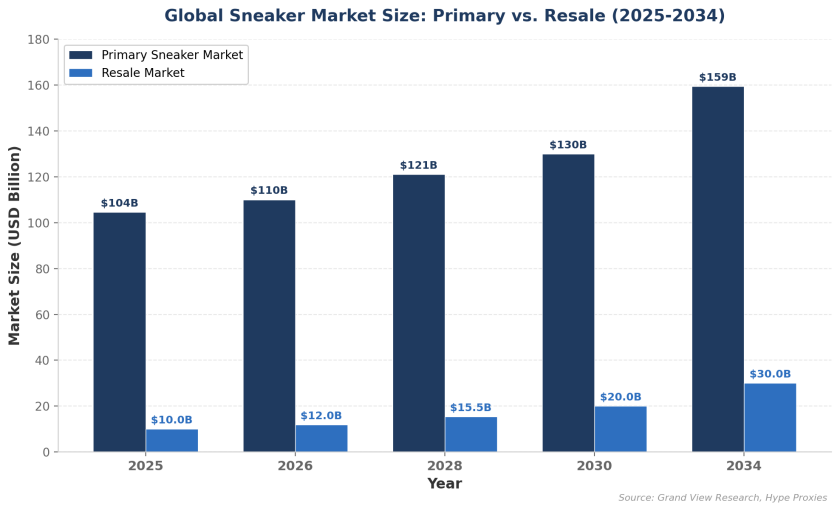
Sneaker Market Growth Chart
Top 10 Sneaker Apps to Shop the Latest Trends in 2026
There are plenty of sneaker apps out there now. Most of them are mediocre. Some crash every single time a hyped release goes live. Others run “authentication” processes that feel more like security theater than actual quality control. The ten apps listed below have genuinely earned their reputation, whether through product selection, rock-solid reliability, great user experience, or some blend of all three.
1. GOAT
If you care about getting real sneakers and not fakes, GOAT is probably where you start. The platform stocks over 125,000 pairs at any given time. That inventory stretches from brand-new Nike drops all the way to vintage Air Jordans from the early 1990s. The company acquired Flight Club in 2018 and then Grailed in 2022, stitching together an ecosystem that now covers new releases, used pairs, streetwear, and luxury fashion under a single umbrella.
How buying works: users can either pay the listed price or place a bid and wait. Every single pair ships through GOAT’s verification center first. Specialists inspect for authenticity and condition before forwarding anything to the buyer. Yes, delivery takes longer because of this. But it practically eliminates the counterfeit risk that plagues direct peer-to-peer transactions on other platforms.
There is also an AR try-on tool baked into the app, which lets users preview how sneakers look on their feet before spending money. With a USD 3.7 billion valuation and over 30 million members scattered across 170 countries, GOAT operates at a scale most competitors simply cannot touch.
| Pros | Cons |
| Authentication on every order | Seller fees are high and do not decrease over time |
| Both new and used pairs available | Approval process for new seller accounts is slow |
| AR try-on feature | Limited historical pricing data |
| International shipping to 170+ countries |
| Founder | Eddy Lu |
| USP | Authenticated marketplace covering new, used, and vintage sneakers |
| Price | Free |
| Platform Fees | Commission on sales |
| Downloads | 10 M+ (Google Play) |
| Ratings | 3.7 (Android) / 4.8 (iOS) |
2. StockX
StockX works like a stock exchange, except the ticker symbols are sneaker models. Sellers post asking prices. Buyers throw in bids. When the numbers align, the transaction fires automatically. This whole structure produces transparent, real-time pricing data that the rest of the sneaker industry treats as gospel. Average sale prices, historical graphs, trade volume per listing. No other sneaker platform comes close on the data front.
The platform goes well beyond just sneakers too. Streetwear, accessories, handbags, electronics, collectibles. In 2025, StockX rolled out a Verified Sellers program that added another credibility layer for high-volume transactions. Sixty million lifetime trades. Twenty million buyers. The model works.
Every item passes through a team of authentication specialists before reaching the buyer. And here is something that matters for sellers: fees actually decrease as your sales volume grows, which rewards consistent sellers and keeps the marketplace pricing competitive.
| Pros | Cons |
| Real-time pricing data with historical graphs | Authentication concerns have surfaced in user reviews |
| Seller fees decrease with volume | Sellers have limited time to ship after a sale |
| Best platform for price research and market trends | International shipping can be expensive |
| Covers sneakers, streetwear, electronics, and collectibles |
| Founders | Dan Gilbert, Greg Schwartz, Chris Kaufman, Josh Luber |
| USP | Stock-market-style bidding with transparent pricing data |
| Price | Free |
| Platform Fees | Commission on sales (decreases with volume) |
| Downloads | 10 M+ (Google Play) |
| Ratings | 4.4 (Android) / 4.6 (iOS) |
3. Nike SNKRS
SNKRS is Nike’s direct pipeline for limited edition and hyped releases. If you want exclusive Nike or Jordan drops at retail price without paying some reseller a 200% markup, this is your only option. The app runs raffles called “Draws” for the most sought-after pairs. Winners are picked randomly. Everybody, winners and losers alike, gets a notification about the outcome.
Nike added a notable feature in August 2025: SNKRS Reserve. This preorder tool lets members lock in certain releases before the general public even gets access. On top of that, SNKRS Pass uses bot-filtration tech to filter out automated entries and give actual humans a more level playing field during high-demand drops.
The interface itself is exceptionally polished. Clean feed of upcoming and past releases with product backstories, editorial content, detailed specs. But understand this: SNKRS is not a marketplace. You cannot resell on it. You cannot bid. It is purely a purchasing channel for new Nike products, nothing more.
| Pros | Cons |
| Access to exclusive Nike and Jordan releases at retail | Only sells Nike products |
| Clean, editorial-quality interface | Raffle system means no guaranteed purchase |
| SNKRS Reserve preorder feature (2025) | In-app prices sometimes higher than retail stores |
| Bot-filtration through SNKRS Pass |
| Founder | Nike, Inc. |
| USP | Exclusive Nike releases at retail price with raffle-based drops |
| Price | Free |
| Platform Fees | None |
| Downloads | 10 M+ (Google Play) |
| Ratings | 4.0 (Android) / 4.8 (iOS) |
4. Hibbett
Hibbett is an interesting one. Formerly called Hibbett City Gear, this is a sporting goods retailer with hundreds of physical stores scattered across the US. The app connects in-store and online shopping in a way that most purely digital sneaker platforms do not bother with. Reserve a pair online, walk into the closest location, try them on, pick them up. Done.
The interface is clean. Genuinely one of the better-designed sneaker apps out there. Limited edition pairs go through a raffle process, and the Hibbett Rewards loyalty program hands out coupons that function as straight-up cash on future purchases. Members also get bumped to the front of the line for select releases.
The physical retail angle is the real differentiator here. Pure-play digital marketplaces cannot offer the “try before you buy” experience. Hibbett can.
| Pros | Cons |
| Excellent user interface | Fewer hyped releases compared to GOAT or StockX |
| Free sneaker raffles | Bot protection during major releases has been inconsistent |
| Loyalty rewards that work as cash | Limited to US market |
| In-store pickup option |
| Founder | Michael E. Longo |
| USP | Hybrid online-offline sneaker retail with loyalty rewards |
| Price | Free |
| Platform Fees | None |
| Downloads | 1 M+ (Google Play) |
| Ratings | 4.8 (Android) / 4.8 (iOS) |
5. Stadium Goods
Stadium Goods has built its reputation on inventory depth. The platform lists over 200,000 sneaker offers at any given time, covering everything from the newest releases to rare vintage finds. Every pair comes with an authenticity certificate, so buyers know they are getting the real thing.
The app’s filtering system is extensive. Users can narrow by brand, model, size, price, and release year, which is essential when sifting through a catalog this large. Stadium Goods also carries streetwear and accessories, making it a broader fashion destination beyond just sneakers.
The company was acquired by Farfetch in 2019, giving it access to the luxury fashion platform’s global distribution network. This partnership expanded shipping options and improved delivery times for international buyers.
| Pros | Cons |
| 200,000+ listings with authenticity certificates | Pricing tends to be higher than competitor platforms |
| Extensive filtering options | Seller onboarding is less open than GOAT or StockX |
| Backed by Farfetch’s global distribution | App UI can feel cluttered on smaller screens |
| Rare and vintage pairs available |
| Founder | John McPheters, Jed Stiller |
| USP | Massive authenticated inventory backed by Farfetch |
| Price | Free |
| Platform Fees | Commission on sales |
| Downloads | 500 K+ (Google Play) |
| Ratings | 4.5 (Android) / 4.7 (iOS) |
6. Grailed
Grailed started as a menswear marketplace but has grown into one of the largest platforms for buying and selling pre-owned luxury streetwear and sneakers. After being acquired by GOAT Group in 2022, Grailed maintained its independent identity while gaining access to GOAT’s authentication infrastructure.
The app has a social layer that other sneaker marketplaces lack. Users can follow sellers, like listings, use hashtags, and browse curated storefronts. This creates a community feel that keeps users scrolling even when they are not actively buying. The reputation system tracks seller reliability through transaction history and buyer feedback.
Grailed’s strength is its breadth. It covers over 10,000 designer brands alongside sneaker releases, making it the platform of choice for users who shop across fashion categories rather than just footwear.
| Pros | Cons |
| Community-driven with social features | International shipping costs are high |
| Covers 10,000+ designer brands | Sellers must provide authenticity proof |
| Negotiation feature lets buyers and sellers agree on price | Desktop experience is stronger than mobile |
| Curated seller storefronts |
| Founder | Arun Gupta |
| USP | Social marketplace for luxury streetwear and sneakers |
| Price | Free |
| Platform Fees | Commission on sales |
| Downloads | 1 M+ (Google Play) |
| Ratings | 4.3 (Android) / 4.7 (iOS) |
7. SNKRDUNK
SNKRDUNK started in Japan and has expanded into a global sneaker marketplace. The platform supports auction-style bidding alongside fixed-price listings, giving buyers flexibility in how they purchase. Every item goes through authentication before shipping.
The app’s strength is its access to Japanese-exclusive releases and colorways that are hard to find on Western platforms. For collectors hunting region-specific pairs, SNKRDUNK fills a gap that GOAT and StockX do not fully cover. The platform has also expanded into trading card collectibles, broadening its appeal beyond sneakers.
Worldwide shipping is available, though international delivery costs can be steep. The filtering system is basic compared to StockX or Stadium Goods, limiting search to brand and model without granular condition or price filters.
| Pros | Cons |
| Access to Japanese-exclusive releases | International shipping is expensive |
| All items verified before shipping | Limited filtering options |
| Auction and fixed-price options | Smaller user base outside Asia |
| Expanding into collectibles (TCG) |
| Founder | Yusuke Uchida |
| USP | Japanese sneaker marketplace with global reach and authentication |
| Price | Free |
| Platform Fees | Commission on sales |
| Downloads | 100 K+ (Google Play) |
| Ratings | 4.6 (Android) / 4.5 (iOS) |
8. Kixify
Kixify positions itself as an open marketplace where independent sellers worldwide can list and sell sneakers. The platform follows a commission-based model, and its in-house team conducts due diligence on listings through a process called “Select” to verify authenticity.
The inventory ranges from current releases to hard-to-find older models, and prices tend to be more competitive than on GOAT or StockX for certain pairs. Setting up a seller account is straightforward, which means inventory turnover can be high.
The downside is reliability. The app crashes frequently, tracking is inconsistent, and customer support has been a persistent complaint in user reviews. For bargain hunters willing to navigate those rough edges, Kixify can surface deals that the bigger platforms do not have.
| Pros | Cons |
| Competitive pricing on many pairs | App crashes frequently |
| Easy seller onboarding | Tracking is unreliable |
| Good variety across current and older releases | Customer support is weak |
| Money-back guarantee on platform-verified items | Higher scam risk than top-tier platforms |
| Founder | Furqan Khan |
| USP | Open marketplace with competitive pricing and global sellers |
| Price | Free |
| Platform Fees | Commission on sales |
| Downloads | 100 K+ (Google Play) |
| Ratings | 3.8 (Android) / 4.7 (iOS) |
9. NTWRK
NTWRK blends live-stream entertainment with sneaker retail. The app releases “episodes,” which are live shopping shows where hosts unbox and showcase exclusive products, and users can purchase them in real time. Limited edition drops happen during these shows, creating an event-driven shopping experience that no other sneaker app replicates.
The platform has brought in celebrity collaborations with names like Billie Eilish, DJ Khaled, and Alexander Wang. NTWRK Drawings lets users enter raffles for the most coveted items, combining the excitement of a drop with the randomness of a lottery.
The live-stream model works well for engagement but creates friction at checkout. Users have reported issues completing purchases during high-traffic moments, and the app has crashed during major releases.
| Pros | Cons |
| Unique live-stream shopping experience | Checkout issues during peak traffic |
| Celebrity collaborations and exclusive drops | App crashes during big releases |
| Raffle system for limited items | Premium pricing on most items |
| Community chat during live shows |
| Founder | Aaron Levant |
| USP | Live-stream video shopping for sneakers and streetwear |
| Price | Free |
| Platform Fees | None for buyers |
| Downloads | 500 K+ (Google Play) |
| Ratings | 4.3 (Android) / 4.7 (iOS) |
10. Sole Links
Sole Links is not a marketplace. It is an alert and link aggregation tool. The app sends push notifications when a new shoe gets released or restocked, and each notification includes a direct link to the retailer selling the pair. It saves users the effort of monitoring dozens of retailer websites individually.
The app covers both US and international retailers, making it useful for buyers outside the United States who often miss out on region-specific drops. Sole Links also publishes release calendars and editorial content about upcoming launches.
The trade-off is stability. The app has a history of freezing during high-demand releases, which is exactly when users need it most. Notifications sometimes do not come through at all, which defeats the app’s core purpose.
| Pros | Cons |
| Direct links to retailers for purchases | App freezes during major releases |
| Covers US and international retailers | Notifications are unreliable |
| Release calendar and editorial content | Low Android ratings due to stability issues |
| Free to use with no platform fees |
| Founder | Jay Estacio |
| USP | Release alerts with direct purchase links across multiple retailers |
| Price | Free |
| Platform Fees | None |
| Downloads | 50 K+ (Google Play) |
| Ratings | 2.9 (Android) / 4.6 (iOS) |
Tips for Developing a Sneaker E-commerce App in 2026
Here is the reality: copying the feature list of GOAT or StockX and expecting your app to survive past six months is a losing strategy. The footwear app market is brutally competitive. Users will ditch a platform the moment something feels off, and they will not look back. The tips below come from watching what the top-performing sneaker apps get right and, equally important, studying where the weaker ones fall apart.
1. Product Display Makes or Breaks Trust
People decide whether they trust a sneaker app within seconds of looking at a product page. In a physical store, shoppers pick up the shoe, feel the leather, bend the sole, check the stitching. An app does not have any of those sensory advantages. All it has are images and text, so both need to be excellent.
Product photos should be high-resolution and shot from multiple angles. Close-ups on materials, soles, and branding details are not optional. Descriptions need specificity. “Premium leather upper” gives the buyer useful information. “High quality shoe” gives them nothing and quietly erodes trust.
Here is the part many developers miss: consistency. Every single listing needs to follow the same image format, the same description structure, the same hierarchy of information. When one listing has six professional photos and a detailed spec sheet while the next one shows a single blurry image with no description, users start questioning whether the platform is legitimate. Developers building ecommerce apps should look closely at how GOAT and StockX standardize their product pages across millions of listings.
2. Navigation Must Handle Traffic Spikes
Most ecommerce applications do not deal with traffic that multiplies by 50x in a matter of seconds. Sneaker apps do. When a hyped pair drops, thousands of people slam the app at once. If it crashes? Those users miss the drop. And they blame you for it. They will tweet about it. They will leave one-star reviews. They will not come back.
Load testing at volumes that feel absurd under normal circumstances is the only way to prepare. Auto-scaling cloud infrastructure, CDNs for static assets, and queue-based checkout flows keep things standing when traffic spikes. The checkout flow, specifically, should be the most resilient piece of the entire architecture because that is where actual revenue happens.
But it is not just about surviving spikes. Day-to-day navigation has to feel fast too. Page loads dragging past two seconds push users toward whatever competitor loads quicker. Dead ends, broken links, and navigation loops that go nowhere will quietly destroy retention numbers over time.
3. Checkout, Payment, and Delivery Cannot Have Friction
Complicated checkouts kill sales. Full stop. People entering their card details on a sneaker app need to feel safe, and the fewer screens between “Add to Cart” and “Order Confirmed” the better. One-tap checkout for returning users is standard now. Not a premium feature. Standard.
Payment variety is another place where apps quietly lose customers. Credit cards, debit cards, Apple Pay, Google Pay, PayPal, and whatever regional method is popular in your target market. Leave one out and you lose the people who swear by it. It sounds minor until you look at the abandoned cart data.
Delivery needs real-time tracking plugged into actual carrier APIs. Estimated arrival dates that are accurate, not optimistic guesses. Delivery confirmation photos for expensive pairs. For orders above a certain value, signature-required shipping and insurance options are worth offering. And here is something that should be obvious but apparently is not to everyone: show shipping charges clearly before checkout. Surprise fees at the last screen will tank your conversion rate.
Security cannot be an afterthought. PCI-DSS compliance, SSL encryption, two-factor authentication. A single data breach would gut a sneaker app’s credibility overnight, and rebuilding that trust takes years.
4. Define and Build Around Your USP
Look at every sneaker app that has succeeded and you will find one common thread: each one has a clear, specific reason to exist. StockX owns pricing data. GOAT owns authentication. Nike SNKRS owns direct-to-consumer drops. NTWRK owns live-stream commerce. None of them tried to be everything at once. Developers need to nail down their unique selling proposition before writing a single line of code.
And the USP does not have to revolve around the products themselves. It could be a pricing model, a community angle, an authentication workflow, a design philosophy, or even a geographic specialty. Sole Links does not sell a single sneaker. The entire app just sends links to retailers. That incredibly narrow focus is the whole value proposition, and it works.
Without a defined USP, any new sneaker app is just another entry in a crowded market. Users already have ten options installed. Why would they bother with yours? The USP needs to shape feature decisions, design choices, and marketing messaging from day one. Not as an afterthought bolted on before launch.
5. Build for Retention, Not Just Downloads
A million downloads means absolutely nothing if nobody opens the app a second time. The metric that actually matters is retention. How many users come back on day 7? Day 30? Day 90? Sneaker apps with healthy retention numbers tend to share a handful of traits: notifications that feel personal rather than spammy, loyalty programs with tangible rewards, wishlists that trigger timely alerts, and inventory that refreshes often enough to give people a reason to browse daily.
Track daily active users, session length, gap between sessions, wishlist-to-purchase conversion, notification open rate, and lifetime revenue per user. Each number tells you something different. Short sessions mean the content is not holding attention. Long gaps between sessions mean people are forgetting the app exists. Low notification open rates? Your alerts are either too frequent, too irrelevant, or both.
Loyalty programs create switching costs, which is the whole point. Hibbett Rewards lets purchases earn points that work as cash on future orders. Once a user has built up a meaningful points balance, moving to a competitor means walking away from free money. Very few people do that willingly.
6. Customer Support and Feedback Loops
A user drops USD 300 on a pair and something goes wrong. Wrong size arrives. Package marked delivered but never showed up. Authentication takes two weeks instead of two days. They want help. Right now. Not 72 hours later via some automated email that does not address their specific issue.
Live chat is baseline. In-app support tickets with transparent status tracking are baseline. A clear, readable refund policy is baseline. Any sneaker app that makes support hard to find or slow to respond will get absolutely demolished in app store reviews, and those reviews are permanent.
On the proactive side, developers should actually collect feedback instead of waiting for complaints to roll in. Post-purchase surveys, review prompts timed appropriately (not immediately after payment, wait until delivery), and a visible “report an issue” button all surface problems before they fester. Negative reviews on the App Store and Google Play are not attacks. They are free product feedback. The sneaker apps pulling the highest ratings are the ones that visibly respond to criticism, ship fixes, and tell users about the updates.
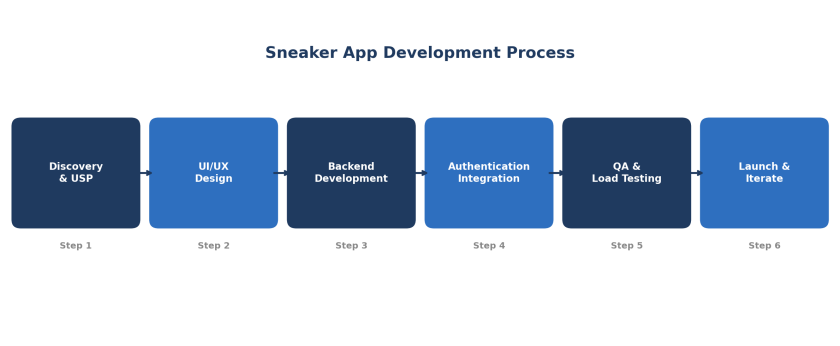
Sneaker App Development Process
Why Partner With Idea Usher to Build Your Sneaker App
Sneaker apps are not simple ecommerce builds. Real-time drops, multi-layered authentication workflows, payment processing under heavy concurrent load. Getting all of that right requires a development team that has actually shipped marketplace products before, not just read about them. Idea Usher has been building ecommerce and marketplace applications for over a decade, and their track record under pressure is the reason they keep getting hired for projects like these.
Deep Ecommerce and Marketplace Expertise
Over 1,000 projects delivered across ecommerce, fintech, and on-demand services. The team at Idea Usher knows the architecture behind marketplace apps where buyers, sellers, and authentication layers all need to operate in sync without breaking. They have built smart resale platforms powered by AI and virtual try-on features for clothing stores. Both of those are in their active portfolio, not theoretical capabilities listed on a slide deck.
A Team Built for Scale
The team is 250+ people strong. Engineers, designers, product managers. They handle full-cycle development from the earliest wireframes through post-launch iteration and support. Critically for sneaker apps, there are dedicated specialists in mobile development for both iOS and Android, backend infrastructure design, payment gateway integration, and QA testing. Those are not adjacent skills. Those are the exact skill sets a sneaker app project demands.
Speed Without Cutting Corners
A typical MVP build at Idea Usher runs 12 to 16 weeks, which includes architecture planning, development sprints, QA, and launch preparation. The phased approach lets founders validate their concept with real users before committing to the full feature set. Faster iterations mean quicker feedback loops and less wasted budget.
Proven Track Record
Idea Usher holds a 4.9 out of 5 average rating on Clutch, based on verified client reviews. The company has served clients across 50+ countries, building applications that handle high-traffic events, secure transactions, and complex marketplace logic. For a sneaker app that needs to survive drop-day traffic and maintain user trust, that track record matters.
Idea Usher by the Numbers
If you are planning to build a sneaker shopping app, talk to Idea Usher’s mobile app development team about scoping your project and getting a realistic timeline.
Final Words
Sneaker shopping apps address a genuine problem for millions of people who want access to limited releases, fair pricing, and authentication guarantees without physically standing in lines. The primary market is growing steadily. The resale segment is growing faster. And the technology required to build these apps has never been more accessible or affordable than it is right now.
What separates the apps people love from the ones they delete after a week comes down to execution, not ideas. Product display that builds trust. Navigation that survives traffic spikes. Checkout flows that do not leak customers. A USP that gives people an actual reason to choose your app over the competition. Retention mechanics that bring users back. Customer support that responds like it cares. Developers who nail these fundamentals before getting distracted by flashy features are the ones who end up building something sneakerheads actually keep on their phones.
For more perspective on building ecommerce apps, check out Idea Usher’s writing on AI-powered fashion app development and social shopping app strategies.
FAQ
What features are essential in a sneaker shopping app?
At minimum: user profiles that store sizes and payment info, search filters covering brand, model, size, price, and condition, a release calendar with reminder alerts, authentication services, wishlists, push notifications for restocks and price changes, in-app checkout, and live order tracking. Those are the essentials. AR-based virtual try-on and user review systems are not strictly necessary to launch, but they meaningfully improve conversion rates and cut down on returns once you add them.
How does sneaker authentication work in these apps?
It varies by platform, but the general flow works like this. A seller ships the sneakers, but they do not go directly to the buyer. They go to a verification facility first. At GOAT, StockX, and eBay’s authentication centers, trained specialists physically inspect the pair for counterfeiting indicators: materials, stitching quality, tag placement, packaging consistency, and brand-specific markers that fakes typically get wrong. Only after the pair clears inspection does it ship out to the buyer. eBay alone has pushed over 4 million pairs through its authentication program. The extra step adds a few days to delivery, but the fraud reduction is significant.
How long does it take to develop a sneaker e-commerce app?
A minimum viable product (MVP) with core features like listings, search, authentication workflows, and payment processing typically takes 12 to 16 weeks with an experienced development team. A full-featured platform with AR try-on, real-time bidding, loyalty programs, and multi-language support can take 6 to 9 months. Timeline depends on customization requirements, third-party integrations, and the number of platforms (iOS, Android, web) being built simultaneously.
Is building a sneaker app worth the investment?
The primary sneaker market is on track to reach USD 159.4 billion by 2034. The resale piece alone should hit USD 26.3 billion by 2035, growing at an 11.9% CAGR. Here is a stat that really puts the demand intensity in perspective: bot traffic accounts for 40 to 95 percent of all traffic during sneaker drops. People are building automated software just to have a chance at buying shoes. If your app solves real problems around authentication, access, and pricing transparency, it is entering a market where billions are already flowing through mobile platforms every year.
What makes StockX different from GOAT?
The fundamental difference is the buying model. StockX uses a bid-ask system modeled after stock exchanges, which is why it produces the best real-time pricing data in the industry. Historical price graphs, trade volume, average sale prices. If you want to know what a specific Jordan colorway is actually selling for, StockX is where you look. GOAT works more like a traditional marketplace. Sellers set prices, buyers can bid. Where GOAT wins is inventory breadth: they carry used pairs, vintage finds, and offer an AR try-on feature that StockX does not have. Both platforms authenticate everything before shipping, but their fee structures and seller economics are quite different.
How do sneaker apps handle high traffic during drops?
Top sneaker apps use queue-based systems, auto-scaling cloud infrastructure, and content delivery networks (CDNs) to manage sudden traffic surges. Nike SNKRS uses a raffle (Draw) system that removes the need for real-time checkout races entirely. StockX spreads demand through its bidding model. Apps that rely on first-come-first-served purchasing need significantly more infrastructure investment to prevent crashes during peak demand, and many still struggle with this challenge.
What is the cost of developing a sneaker app like GOAT or StockX?
There is no single number because it depends heavily on what you are building and where your development team is located. A basic MVP with core functionality (listings, search, authentication workflow, payments) typically lands between USD 50,000 and USD 100,000 when built through a partner like Idea Usher. A full-scale platform with AR try-on, real-time pricing engines, multi-currency support, and analytics dashboards? That can run from USD 150,000 up to USD 400,000 depending on complexity. And do not forget ongoing costs: servers, authentication operations if you run your own center, customer support staffing, and regular app updates to keep up with OS changes and user expectations.