


Key Takeaways
- A micro drama app MVP gives viewers a simple app to discover and watch short dramas.
- It also gives you basic tools like a CMS, payments, and basic analytics to manage the platform.
- The MVP should focus on features that help you bring in viewers and test your idea.
- You can add bigger features later after you learn what your audience really likes.
A micro drama app MVP package gives you the main tools like video streaming, user accounts, and basic recommendations needed to launch and test your idea. Viewers can discover dramas and watch episodes while you manage everything from the backend. You can also test paid content to see if people are ready to spend money on your app. The exact features can change based on your idea and budget. The goal is to build enough to learn what works before spending more on the full platform.
A micro drama app MVP can help you test your idea without spending too much on features you may not need at the start. Idea Usher has built white-label vertical drama solutions using adaptive video streaming and AI-powered content recommendations, so we know what it takes to create a smooth short-form viewing experience. In this blog, we’ll break down what you can expect in a micro drama app MVP package.
Why Are Micro Drama Apps Becoming a Serious Business Opportunity?
Micro drama apps are becoming a serious business opportunity because they fit easily into the way people watch entertainment on their phones. Short episodes make it easier to keep viewers engaged and bring them back for the next part of a story. This also gives businesses more ways to earn from the same audience. According to Mordor Intelligence, the global microdrama market generated about $11 billion in revenue, while the wider media streaming market was valued at $140.80 billion.

Source: Mordor Intelligence
Why Micro Dramas Are Growing
Micro dramas make stories easier to watch when people only have a few minutes. Short episodes can end with a cliffhanger that encourages viewers to continue with the next one. This creates more frequent viewing sessions than a traditional long episode. For businesses, that can mean more chances to build engagement and generate revenue.
| Traditional Streaming | Micro Drama Apps |
| Longer episodes | Short episodes |
| Longer viewing sessions | Frequent sessions |
| Mostly subscription-based | Coins, subscriptions, and ads |
| Slower story progression | Frequent cliffhangers |
ReelShort shows how powerful this model can become. Media Partners Asia estimates that its revenue grew from $400 million to $785 million, with the platform projected to pass $1 billion in revenue. It also recently partnered with WWE to create an original live-action micro drama featuring WWE Superstars, showing how the format is attracting major entertainment brands.
Short Episodes Change Viewing
Micro dramas are made for phones, so viewers can watch them while travelling, taking a break, or scrolling through their feeds. This helps the format reach people who may not have time for traditional long-form shows. Omdia found that ReelShort users in the US watched about 35.7 minutes per day, compared with 24.8 minutes for Netflix on mobile.
ShortMax also shows how micro drama platforms can reach audiences across different markets. Its app supports multiple languages and offers both subscriptions and one-time purchases, giving viewers different ways to access content. Sensor Tower estimated about $6 million in worldwide revenue for the app in the most recent month reported.
Micro Dramas Enable Monetization
Micro drama apps can earn from viewers in several ways without making the whole platform subscription-only. Some episodes can be free while later episodes use coins or one-time payments. Subscriptions and ads can then provide additional revenue from different types of viewers. This gives new platforms room to test which model works best for their audience.
The opportunity is already visible in the wider market. Omdia estimates that more than 60% of global microdrama revenue comes from subscriptions or transactional payments. It also reports that microdrama ARPU can reach around $20 per week, showing why even a relatively small paying audience can become valuable.

What Does a Micro Drama App MVP Package Cover?
A micro drama app MVP package includes the main tools needed to launch your platform and test how viewers respond. It usually covers the viewer app, content management, video streaming, payments, analytics, and the backend. You don’t need every advanced feature at the start.
1. Viewer-Facing Mobile App
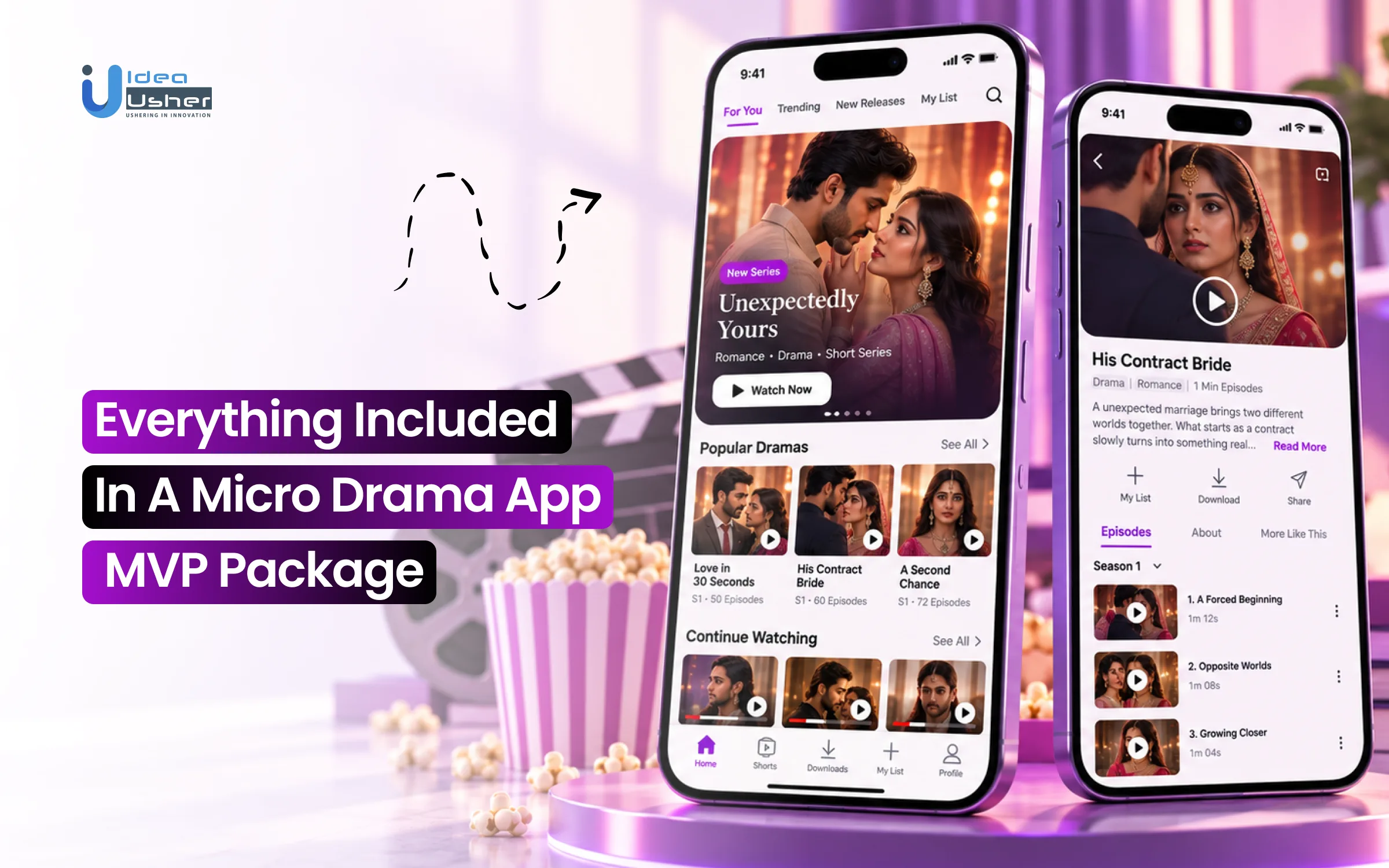
The viewer app is where users discover dramas and watch episodes. The MVP should make this journey simple, from finding a story to moving through its episodes. Features such as vertical playback, watch history, watchlists, and episode unlocking can create a smooth viewing flow. We can also customize the experience around your content and monetization model.
| Viewer Need | MVP Solution |
| Discover stories | Home feed |
| Watch episodes | Vertical player |
| Continue later | Watch history |
| Save dramas | Watchlist |
| Unlock content | Coins or subscription |
2. Micro Drama Content System
Your team needs an easy way to manage the drama library. The content system can help upload episodes, arrange them, add details, and control when they go live. It can also separate free and paid episodes. This gives your team more control without depending on developers for everyday content updates.
- Series and episode management
- Genre and tag controls
- Episode scheduling
- Thumbnail and metadata uploads
- Free and paid episode settings
- Subtitle management
3. Admin and Business Dashboard
The admin dashboard gives your team control over the platform. It can bring users, content, payments, promotions, and basic settings into one place. For an MVP, you only need the controls your team will use regularly. More advanced business tools can be added after the platform gains traction.
Content → Users → Payments → Promotions → Analytics
4. Backend APIs and Database
The backend connects everything happening inside the app. When a viewer creates an account, watches an episode, saves a drama, buys coins, or unlocks content, the backend handles that activity and stores the required information securely. A well-planned backend also makes it easier to add new features later without rebuilding the entire platform.
For example, a typical setup may use Node.js or FastAPI for backend services, PostgreSQL or MongoDB for data, and Redis for caching. The exact choice depends on your expected traffic, feature requirements, and development strategy rather than following one fixed stack.
5. Video Processing and Delivery
Video is one of the most important parts of a micro drama platform because viewers will quickly leave if episodes keep buffering. The MVP therefore needs more than a video player. It needs a system that can process uploaded videos and deliver them efficiently across different network conditions.
Typical video flow:
Upload → Transcode → Store → CDN → Stream → Track Viewing
Adaptive streaming can automatically adjust video quality based on the viewer’s connection. Pre-caching the next episode can also make transitions feel faster. Idea Usher’s vertical drama architecture includes HLS streaming, CDN delivery, transcoding, and next-episode pre-caching as part of its broader feature set.
6. Monetization Infrastructure
Your MVP should give you a way to test whether viewers will pay for content. You can start with coins, subscriptions, paid episodes, or a simple combination of these models. Micro drama platforms have already shown strong revenue potential. DramaBox generated $217 million in app-store revenue.
The right model depends on your audience and content strategy. Starting with one clear payment flow can make the MVP easier to launch. You can then add other revenue models after seeing what users prefer.
7. Analytics and Reporting
Analytics help you understand what viewers actually do inside the app. Instead of only tracking downloads, you can see which dramas attract attention and where viewers stop watching. You can also measure episode unlocks and returning users. These insights can guide the features you build after the MVP.
| Metric | What It Shows |
| Watch time | Viewer engagement |
| Completion rate | Content performance |
| Drop-off | Weak viewing points |
| Unlock rate | Payment interest |
| Retention | Repeat usage |
8. Testing and Launch Support
Before launch, the MVP needs to be tested across different devices and network conditions. This includes video playback, payments, account creation, notifications, and admin functions. Testing can help identify problems before real viewers encounter them. Launch support can then help move the product from development into the hands of users.
Where Idea Usher Fits In
We at Idea Usher can help take a Micro Drama App MVP from the initial scope to a working product. Our current vertical drama development offering covers viewer apps, CMS tools, coin wallets, AI recommendations, AI dubbing, monetization systems, analytics, and video infrastructure, allowing the MVP to be kept lean while leaving a path for future expansion.
We can also build beyond a basic MVP when the business needs it. For example, our work around AI drama products such as My Muse-style experiences explores AI-generated scripts, characters, scenes, and voice acting, while our short-drama solutions cover features such as coin economies, AI localization, and vertical streaming.
The key is to decide what your first version needs to prove before adding everything a mature micro drama platform can offer.
What Does the Viewer Actually Get in the MVP?
A micro drama app MVP should make it easy for viewers to find, watch, save, and unlock dramas. The experience should feel quick and simple from the first tap to the next episode. Instead of adding too many features, the MVP should focus on the main viewing journey. This creates a strong base for improving the app later.

1. Personalized Feed for Fast Drama Discovery
The home feed should help viewers find interesting dramas without much searching. It can show popular titles, new releases, genres, and basic recommendations based on viewing activity. As users watch more content, the feed can become more relevant to their interests. This makes discovery an important part of the MVP.
| Feed Element | Purpose |
| Recommended | Personal discovery |
| Trending | Popular dramas |
| New Releases | Fresh content |
| Continue Watching | Quick access |
| Genres | Easy browsing |
2. Vertical Playback Built for Episode Viewing
The video player should be designed around mobile viewing. Full-screen vertical playback, autoplay, subtitles, and quick loading can make episodes easier to watch. The next episode should also be easy to reach without sending viewers back to the home screen. This keeps the viewing experience focused on the story.
3. One-Tap Episode Progression
Viewers should be able to move from one episode to the next with very little effort. When an episode ends, the next one can start automatically or appear with a clear action. This works well for stories built around short episodes and frequent cliffhangers. The aim is to keep viewers inside the story.
Episode Ends → Next Episode → Continue Watching → Unlock if Needed
4. Continue Watching Across Sessions
Viewers may not finish a drama in one sitting, so the app should remember their progress. A Continue Watching section can take them back to the right episode or viewing position. The MVP can track recently watched dramas and completed episodes. This also gives you useful data about viewer behavior.
5. Free Episodes and Locked Chapters
Free episodes can give viewers a chance to experience a story before asking them to pay. Later episodes can then be locked behind coins, subscriptions, or another payment option. This creates a simple path from free viewing to paid content. You can also test which point works best for your audience.
| Episode | Access |
| Episode 1–3 | Free |
| Episode 4 | Locked |
| Episode 5+ | Premium |
6. Coins, Purchases, and Subscription Access
A coin system can let viewers purchase credits and use them to unlock premium episodes. Subscriptions can offer another option for users who watch dramas regularly. The payment flow should remain simple and connected to the viewing experience.
7. Watchlist and Saved Dramas
A watchlist lets viewers save dramas they want to watch later. This becomes more useful as your content library grows and users discover several stories at once. For the MVP, a simple save and remove option is enough. Later, you can add followed series and personalized collections.
8. Episode Release Notifications
Notifications can remind viewers when a new episode of a drama they follow is available. They can also highlight new stories or content based on their interests. The MVP should focus on useful alerts rather than sending too many promotional messages. This can help bring viewers back to unfinished stories.
What Does the Content Team Get With the MVP?
The content team gets the tools needed to upload, organize, publish, and control every drama on the platform. Instead of relying on developers for routine content changes, the team can manage episodes, categories, subtitles, pricing, and featured titles from one place. This makes it easier to keep the library fresh as new dramas are added. A focused CMS is therefore an important part of a practical Micro Drama App MVP.
1. Upload and Organize Every Episode
The team should be able to upload episodes and keep them organized under the right drama. Each episode can have its own title, thumbnail, description, and release status. This makes a growing content library easier to manage. It also reduces the chance of viewers seeing missing or incorrectly ordered episodes.
2. Build Series, Seasons, and Episodes
A drama may contain dozens of short episodes, so the CMS should keep the story structure clear. The team can create a series, add its episodes, and arrange them in the right sequence. This becomes even more useful when several dramas are being managed at the same time.
Series → Season → Episode 1 → Episode 2 → Episode 3
This simple structure gives viewers a clear path through the story while making content management easier behind the scenes.
3. Schedule Episodes for Release
The content team can decide when an episode should become available instead of publishing everything at once. Scheduled releases can help build anticipation and give viewers a reason to return to the app. The team can prepare several episodes in advance and let the system publish them automatically.
For example:
| Content | Release |
| Episode 1 | Immediately |
| Episode 2 | After 1 day |
| Episode 3 | After 2 days |
| Episode 4 | Scheduled |
4. Add Genres and Story Details
Genres, tags, descriptions, and other metadata help users discover the right dramas. The content team can tag stories by themes such as romance, revenge, fantasy, family, or mystery. These details can also give the recommendation system more information when suggesting content.
This becomes more important as the library grows. DramaWave, for example, currently promotes more than 30,000 dramas across 18 languages, along with personalized recommendations and regular new releases.
5. Decide Free or Paid Episodes
The CMS should let the team choose which episodes viewers can watch for free and which require payment. This can support different monetization strategies without changing the app every time. You can also change the access settings as you learn what works with your audience.
Free Episode → Viewer Hook → Locked Episode → Coin or Subscription
This gives the business more control over how each drama is introduced and monetized.
6. Manage Subtitles and Regional Content
Subtitles can help a drama reach viewers outside its original language market. The content team should be able to add subtitle files and connect them to the right episodes. Regional controls can also help decide which content is available in specific markets. DramaWave currently supports subtitles in languages including English, Spanish, French, German, Japanese, and Korean, showing how localization can expand a short-drama library beyond one audience.
7. Feature or Remove Home Dramas
The team should also control what viewers see first when they open the app. They can feature new releases, promote popular dramas, remove outdated titles, or create special sections for selected content. This gives the business control over the first impression and discovery experience.
This is especially useful because micro-drama discovery is heavily feed-driven. A Meta-Ormax report found that 89% of Indian micro-drama viewers discover these shows through social feeds, while viewers spend a median of 3.5 hours per week watching micro-dramas across short, repeat sessions.
DramaWave shows how content operations can expand as the platform grows. Its current product lists 30,000+ dramas across 18 languages, with weekly content updates, personalized recommendations, offline viewing, and on-screen comments. Recent releases have continued adding short dramas while improving performance and fixing playback issues.
What Should NOT Be Included in Your First Micro Drama MVP?
Your first micro drama MVP should leave out features that add major cost and complexity without helping you test the core viewing or monetization model. Advanced AI, live streaming, large social systems, and multi-platform expansion can all be valuable later. Starting with too much can slow the launch and make it harder to understand which parts of the product are actually driving results.

1. Advanced AI Recommendation Engines
A basic recommendation system can be enough for the first release. You can start with genres, popular dramas, recently watched content, and simple viewing signals. A more advanced AI engine needs more user data and a stronger recommendation infrastructure. It makes more sense once you have enough viewing behavior to train and improve the system.
2. Creator Social Networks
Profiles, followers, comments, creator feeds, and messaging can make a platform more engaging. However, they also introduce moderation, reporting, privacy, and community-management requirements. Unless creators are central to your business model, these features can wait until the core drama experience is working well.
Start with: Viewer → Drama → Episode → Engagement
Add later: Creator → Followers → Comments → Community
3. Live Streaming
Live streaming is very different from on-demand micro drama. It requires additional infrastructure for low-latency delivery, real-time interactions, moderation, and stream management. If your initial product is built around pre-recorded episodes, adding live streaming will increase the technical scope without helping you validate the basic concept.
A better approach is to first prove that users will discover, watch, return, and pay for recorded dramas. Live content can then become a later engagement feature once you know your audience.
4. Complex Gamification
Coins and simple rewards may support your monetization model, but you don’t need a complete gaming system. Leaderboards, badges, achievement levels, streak systems, missions, and complicated reward structures can quickly make the MVP feel overloaded.
| MVP | Later Stage |
| Coins | Leaderboards |
| Basic rewards | Daily missions |
| Episode unlocks | Achievement badges |
| Simple bonuses | Streak rewards |
The first goal is to understand whether viewers enjoy the stories, not whether they will spend time completing challenges inside the app.
5. Full Smart TV Ecosystems
A micro drama MVP can start with smartphones because the format is naturally suited to vertical viewing. Building dedicated experiences for Android TV, Apple TV, Roku, Fire TV, and other connected devices means creating and testing additional interfaces and playback flows.
This does not mean TV expansion is a bad idea. It simply makes more sense after the mobile product has gained traction. Once viewing data shows strong demand, the same content library can be extended to larger screens.
6. Multi-Region Content Operations
Launching in several countries sounds attractive, but it creates more work than simply translating the interface. You may need regional content rights, currencies, payment methods, subtitles, dubbing, tax handling, privacy requirements, and different content strategies.
A focused MVP can start with one primary market and a manageable content library. Localization can then be expanded based on where you see real audience demand.
7. Advanced Ad-Tech
Basic advertising can be added when monetization requires it, but a complete ad-tech stack is unnecessary for the first release. Real-time bidding, complex audience segmentation, multiple ad exchanges, dynamic ad insertion, and advanced optimization can make the backend much harder to manage.
This is especially relevant as advertising becomes more important in micro dramas. Redseer expects India’s micro-drama advertising market to grow from roughly $29 million to $630–$660 million, but that does not mean a new MVP needs enterprise-level ad infrastructure from day one.
8. Sophisticated AI Content Generation
AI-generated scripts, characters, voices, scenes, and complete episodes are becoming part of the micro-drama ecosystem. However, they should be treated as an expansion option unless AI production is the main reason for building your platform. For example, WINCHI is already positioning itself around AI-generated one-minute vertical episodes and an AI-powered production pipeline designed to create stories across multiple languages.
Its latest product updates have focused on the user interface and overall experience. That is a good example of where AI can become a core product strategy, but it does not mean every micro drama MVP needs the same architecture.
Why Keep These Features for Later?
The purpose of an MVP is to answer a few important business questions:
- Will people watch?
- Will they return?
- Will they unlock episodes?
- Which stories keep them engaged?
Features that do not help answer those questions can usually wait.
How Much Does a Micro Drama App MVP Package Cost?
The cost of a Micro Drama App MVP usually falls between $20,000 and $70,000, depending on how much of the viewing, streaming, monetization, and backend infrastructure you want to include. A lean MVP can validate the concept with a smaller feature set, while a more scalable version needs stronger video infrastructure and backend architecture. Published development estimates also show a wide range because streaming and content-management requirements can significantly change the scope.
Basic Micro Drama MVP Package
A basic package is suitable when the main goal is to launch quickly and test viewer demand. It can include the viewer app, vertical video player, basic CMS, user accounts, watch history, simple content discovery, and an admin panel. You can expect this level of MVP to cost around $20,000–$30,000.
| Included | Basic MVP |
| Viewer app | Browse and watch dramas |
| Vertical streaming | Watch episodes in full-screen mode |
| CMS | Upload and manage drama content |
| Admin panel | Control users and platform content |
| User accounts | Sign up and manage profiles |
| Watch history | Resume previously watched episodes |
| Basic analytics | Track views and user activity |
This approach keeps the first release focused without removing the core viewing experience.
Monetized Micro Drama MVP Package
A monetized MVP adds the features needed to test whether viewers will pay for content. This can include coin purchases, episode unlocking, subscriptions, payment integration, notifications, and stronger analytics. A package at this level can typically cost around $30,000–$45,000, depending on the payment and monetization setup.
The extra investment can be worthwhile when revenue validation is part of the launch goal. Short-drama apps have already shown how important monetization is, with global in-app revenue reaching about $700 million in a single quarter in Sensor Tower’s earlier market analysis.
Scalable Micro Drama MVP Package
A scalable package is designed for businesses that expect to grow beyond the initial launch. It can include stronger cloud infrastructure, CDN delivery, adaptive streaming, personalized recommendations, advanced analytics, better security, and a backend prepared for higher traffic. This version can cost around $45,000–$70,000+.
It is a better fit when you don’t want to rebuild the product after gaining traction. For example, newer platforms such as NetShort have grown quickly through frequent original drama releases, while continuing to expand their international content and user experience. Sensor Tower reported that NetShort’s in-app revenue grew 171% quarter over quarter in the period it analyzed, showing how quickly newer players can gain traction.
What Changes the Price of a Micro Drama MVP?
The biggest cost difference usually comes from how much you want the MVP to do. A simple streaming app with a small CMS will cost much less than a platform with subscriptions, coins, AI recommendations, multiple languages, advanced analytics, and complex video infrastructure.
| Cost Factor | Approximate Impact |
| Basic UI/UX | $3,000–$7,000 |
| Mobile app | $7,000–$15,000 |
| Backend + APIs | $6,000–$12,000 |
| CMS + Admin | $4,000–$8,000 |
| Monetization | $3,000–$8,000 |
| Streaming setup | $4,000–$10,000 |
| Advanced AI | $5,000–$15,000+ |
These are planning ranges rather than fixed quotes because the final scope depends on the product requirements.
Does Video Streaming Increase MVP Costs?
Yes. Video usually makes a micro drama MVP more expensive than a standard content app because you need storage, transcoding, CDN delivery, adaptive streaming, and bandwidth management. The amount of content and expected viewing traffic can also affect your ongoing infrastructure bill.
For a smaller MVP, you might initially budget around $3,000–$8,000 for the streaming setup and related development. As the library and audience grow, infrastructure costs can increase with storage and viewing volume, so the architecture should leave room for scaling.
How Much Do Monetization Features Add?
Basic monetization can add roughly $3,000–$8,000 to an MVP, depending on whether you use coins, subscriptions, in-app purchases, or multiple payment methods. More complex wallet systems, promotional pricing, regional payments, and advertising can push the cost higher.
The good news is that you don’t need every revenue model in the first release. A simple flow can be enough to test whether your audience is willing to pay.
What Are the Recurring Costs After Launch?
Development is only the first part of the budget. Once the app is live, you’ll need to account for cloud hosting, video storage, CDN usage, monitoring, maintenance, payment fees, and ongoing content operations. These costs depend heavily on how many viewers you attract and how much video they consume.
For a small platform, a starting operational budget of around $1,000–$4,000 per month can be reasonable for platform and infrastructure services, although high viewing volumes can push this much higher. Published micro-drama platform estimates place ongoing platform costs within a similar range.
A look at GoodShort App
GoodShort is a useful example of how a short-drama platform can expand beyond basic episode playback. Its product focuses heavily on personalized content discovery and short-form serialized storytelling, while its international strategy has included localized content and multiple language experiences.
Sensor Tower reported $65 million in in-app revenue for GoodShort in the quarter it analyzed, placing it among the leading short-drama apps. For an MVP, the lesson is not to copy its entire feature set, but to build an architecture that can support better personalization and localization later.
What Are You Actually Paying For?
The cost of a Micro Drama App MVP is not just the price of building a mobile application. You are paying for the viewer experience, content operations, streaming infrastructure, monetization system, backend, analytics, testing, and launch support that make the product usable as a business.
How Much AI Does a Micro Drama MVP Actually Need?
A micro drama MVP does not need an expensive AI system from the beginning. The first version can use simple rules to help viewers discover relevant dramas and improve the feed as more viewing data becomes available. AI becomes more useful once the platform has enough user behavior to learn from. This keeps the MVP focused while leaving room for smarter features later.
1. Rule-Based Recommendations
A simple recommendation system can start with genres, popular dramas, watch history, and recently viewed episodes. This is enough to make the home feed feel more relevant without building a complex machine-learning system. It can also cost less because the development team does not need to train and maintain advanced models. For a first release, the goal is to prove that better discovery leads to more viewing.
| Recommendation Signal | Example |
| Genre | Romance, revenge |
| Popularity | Trending dramas |
| Watch history | Similar titles |
| Recent activity | Continue watching |
2. Personalized Feeds From Viewing Behavior
Once users start watching more content, their behavior can make the feed more personal. The system can look at episodes watched, genres selected, dramas skipped, and content completed to improve recommendations. This does not always require generative AI or a complicated ML model. Even basic behavioral rules can make the experience feel more tailored.
For example, if someone repeatedly watches revenge dramas, the app can move similar titles higher in their feed. This creates a useful feedback loop without making the MVP unnecessarily expensive.
3. AI Recommendations After Data Accumulates
Advanced AI recommendations make more sense after the platform has collected enough viewing data. At that stage, machine-learning models can identify patterns across users and suggest dramas based on deeper behavior rather than simple categories. The system can also consider episode completion, viewing time, skips, and repeat sessions.
This can become valuable as the content library grows. The global short-drama market already shows how quickly platforms are scaling; Sensor Tower reported that short-drama apps generated about $700 million in global in-app revenue in Q1 2025, nearly four times the previous year’s level.
4. AI Dubbing and Localization as Expansion
AI can also help a micro drama platform reach viewers in new markets without manually producing every language version. AI dubbing, translation, voice generation, and subtitle creation can reduce the effort involved in localizing large content libraries. However, these tools can remain outside the first MVP unless international expansion is part of the launch plan.
MeloShort provides a useful example. Insightrackr reported that the app used AI translation and AI dubbing to localize Chinese voice-over content for international audiences, with nearly half of its revenue coming from the U.S. in the period analyzed.
Why Choose IdeaUsher for a Micro Drama App MVP?
A Micro Drama App MVP needs more than a basic video player. It needs smooth streaming, easy content management, and a clear way to make money. At Idea Usher, we bring 500,000+ hours of coding experience to product development. Our team also includes ex-MAANG and ex-FAANG developers who can handle complex technical requirements.
Revenue-Focused MVP Scope
Your MVP should support the way you plan to earn from it. We can build around coins, subscriptions, ads, or a hybrid model based on your audience and content. This keeps the first version focused and avoids unnecessary features. You can then add more monetization options as the platform grows.
| Revenue Model | MVP Approach |
| Coins | Unlock paid episodes |
| Subscription | Access premium content |
| Ads | Earn from free viewing |
| Hybrid | Combine selected models |
Vertical Streaming Architecture
Smooth video playback is one of the most important parts of a micro drama app. We can use HLS, CDN delivery, adaptive streaming, and video transcoding to support faster and smoother playback. The architecture can also be planned for higher traffic from the beginning. This makes it easier to scale when your audience grows.
Upload → Transcode → Store → Stream
Custom CMS and Episode Management
Your team needs an easy way to manage the drama library without relying on developers. We can build a custom CMS for uploading episodes, organizing series, scheduling releases, managing subtitles, and setting content access. This gives your team better control over daily operations. It also makes adding new dramas much easier as the library grows.
Scalable Video Infrastructure
We can build the video infrastructure with future growth in mind. The setup can support cloud storage, CDN delivery, analytics, secure video access, and scalable streaming as your viewer base increases. This helps reduce the need for major technical changes after launch. You can start with an MVP and expand the infrastructure as usage grows.
Conclusion
A micro drama app MVP should give you enough to launch your idea and learn what viewers really want. You don’t need to build a huge platform from the start. A focused MVP can help you test the viewing experience, content strategy, and monetization before making a bigger investment. Once you see what works, you can use those insights to build the next version with more confidence.
FAQs
A1: A micro drama app MVP can cost around $20,000 to $70,000, depending on the features and level of customization. A basic MVP with core viewing and content tools will cost less than one with advanced streaming, payments, AI, or analytics. Your content library and video infrastructure can also affect the final budget. The best approach is to decide the must-have features first and then estimate the development cost.
A2: A micro drama MVP can usually take around 3 to 5 months to build, depending on its scope. A simple version with basic streaming and content management can be completed faster. Adding monetization, recommendations, advanced analytics, or complex video infrastructure can increase the timeline. A clear MVP scope from the start can help avoid unnecessary delays.
A3: Yes, you can monetize a micro drama MVP from launch. You can use paid episode unlocks, coins, subscriptions, or ads based on your business model. Starting with one simple monetization method can make it easier to test whether viewers are willing to pay. You can then add more options after seeing how users respond.
A4: Yes, a micro drama MVP can include a CMS for managing dramas and episodes. Your team can use it to upload content, organize episodes, add descriptions, schedule releases, and control free or paid access. This means you won’t need developers for every small content update. The CMS can also be expanded as your drama library grows.


