

Key Takeaways:
- A Kalshi clone app could cost anywhere from $7,000 to $300,000 in 2026, depending on what you build.
- A big part of your money will go towards making the trading engine, payments, and market settlements work properly.
- You do not have to build everything from the start. Using existing APIs can save you a lot of money.
- There are things to pay for besides development. Compliance, liquidity, and maintenance can make costs go up fast.
- It is better to start with what your platform needs rather than paying for features you might never use.
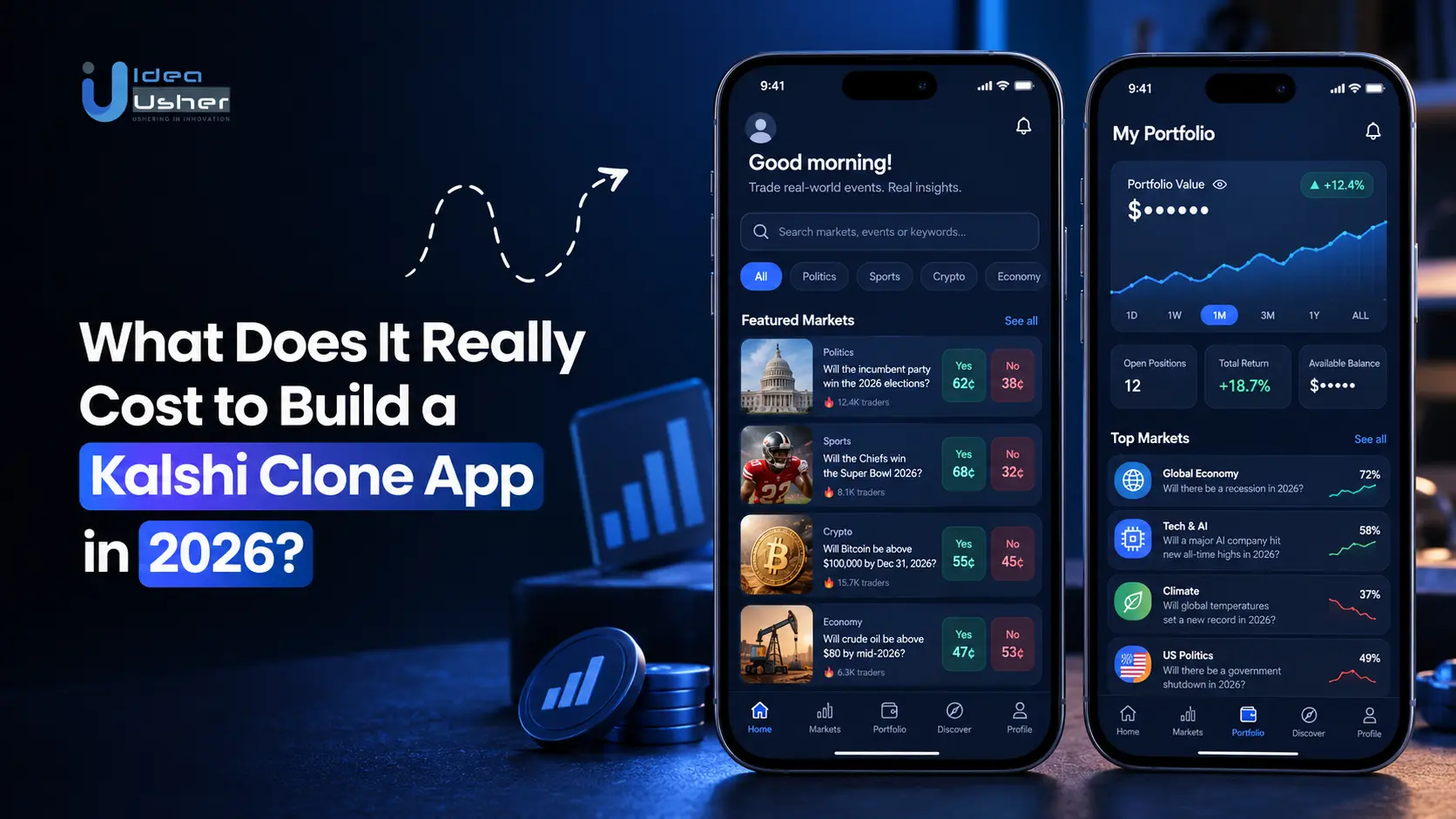
The price of the Kalshi clone app in 2026 will depend on what you decide to build. For instance, a simple MVP involving just one kind of market will be around $70,000. Conversely, a complete trading platform with apps for both iOS and Android as well as safety features will cost approximately $300,000.
This figure only includes the software. The founders have to pay three types of bills: the one for development, the one for the legal setup, and the amount needed to keep the markets active. It is usually the second and third of these bills that determine whether or not the app ever launches.
The legal arrangement is the means by which you obtain permission to carry out event trading in the United States. For example, you could base your operation on Kalshi’s system, form a partnership with a licensed exchange, or apply directly to the CFTC. Consequently, the way you choose among these options has a greater impact on your costs and launch date than any other feature.
This blog looks at all three bills and illustrates the shortcomings of cheap clone scripts, based on how Idea Usher plans prediction market builds for US founders.
How Much Does a Kalshi Clone App Cost in 2026?
A scoped Kalshi clone app costs $70,000 to $300,000 in 2026, depending on features and launch approach. For example, apps built on top of existing exchange infrastructure usually cost less than a full custom build.
On the other hand, an independent regulated exchange needs a much larger, separate budget for its own trading and legal setup.
1. Kalshi Clone Development Costs by Platform Type
First, it helps to know that a “Kalshi clone” can mean four very different products. Each one has its own scope, risk, and budget.
Therefore, compare them as separate options, not as cheaper or pricier versions of one app.
| Platform type | Budget treatment | Development scope |
| API-integrated app | Lower-cost alternative | Branded app using permitted existing exchange infrastructure |
| Scoped custom MVP | Within $70K to $300K | Selected trading features, wallet integrations, and basic operations |
| Expanded custom platform | Within or above $70K to $300K | Complex trading, monitoring, admin tools, and extra integrations |
| Independent regulated exchange | Separate, much larger budget | Own exchange infrastructure plus regulatory readiness |
For instance, Kalshi runs a Builders Program with $2 million in grants for apps that bring trading volume to its markets.
Meanwhile, a new exchange applicant must show funds covering at least 12 months of operating costs. In other words, the gap between the top and bottom rows is mostly legal and financial, not technical.
2. What the $70,000 to $300,000 Estimate Includes
Next, look at what the quote actually pays for. In most cases, the estimate covers the work that turns a plan into a tested, working app. Specifically, it usually includes the following:
- Product design: user flows, screens, and UI for web, iOS, and Android
- Core engineering: order book, matching engine, wallets, and the admin panel
- Selected integrations: KYC, a payment gateway, and one market data feed
- Testing: functional, load, and security testing before launch
- Deployment: cloud setup, App Store and Google Play release, and launch support
In other words, you get a launch-ready product, but not a launch-ready business.
3. What the Initial Estimate Usually Excludes
However, several high costs sit outside the build quote. These are not hidden fees, yet founders often forget them. As a result, plan a separate budget for each of these:
- Licensing and legal: CFTC filings, legal counsel, and state-level reviews
- External subscriptions: KYC checks, sports and market data, and cloud hosting
- Market-maker capital: money that keeps buy and sell orders on every market
- Marketing: paid ads, promotions, and sign-up bonuses
- Ongoing operations: support staff, compliance monitoring, and maintenance
Because of this, the software quote is rarely the full year-one budget.
The most useful cost estimate names the architecture, the deliverables, and the exclusions. Without all three, two quotes from different vendors cannot be compared fairly. So, once the software budget is clear, the next question is which legal route fits that budget.
What Can You Build With $70K, $150K, or $300K?
Each budget level buys a defined technical scope and not a full copy of Kalshi. For example, $70,000 suits a focused test product, $150,000 adds custom trading tools, and $300,000 funds an advanced platform.
However, even the top budget covers software only, not the license and capital a real exchange business needs.
1. Around $70,000: A Focused, Integration-First MVP
First, $70,000 fits a founder who wants to test demand before spending more. At this level, the app usually connects to existing trading infrastructure instead of running its own. It typically includes:
- A branded web application
- A small set of market categories
- Selected trading or exchange API integrations
- User accounts and basic portfolio views
- Essential admin functions
- A tightly limited first feature scope
2. Around $150,000: A More Customized Trading Platform
Next, $150,000 suits founders who already see early demand. Here, the budget shifts from connecting to existing tools toward building your own trading features. This tier usually adds:
- An expanded trading interface
- Fuller order management, such as limit orders and cancels
- Tools to create and resolve markets
- Wallet and payment gateway integration
- Reporting and a stronger admin panel
- Deeper testing and security controls
3. Around $300,000: A More Advanced Custom Platform
Then, $300,000 funds the heavier engineering a growing platform needs. In particular, this tier focuses on speed, safety, and accuracy at higher trading volumes. It typically covers:
- More extensive trading infrastructure
- Higher concurrency and performance targets
- Advanced risk controls
- Complex settlement and reconciliation
- Web, iOS, and Android interfaces
- Extra integrations and live operational monitoring
4. Why $300,000 May Still Be Insufficient for an Exchange
However, building exchange components is not the same as running a regulated exchange. A licensed exchange also needs federal approval, which has historically taken two to four years for some applicants.
Beyond the code, the business requires:
- CFTC filings and ongoing legal counsel
- Clearing arrangements and capital reserves
- Market surveillance and compliance staff
- Market makers to supply day-one liquidity
To compare, here is how the three tiers line up:
| Budget | Included features | Major exclusions | Ideal buyer | Upgrade considerations |
| $70K | Branded web app, API integrations, basic admin | Own matching engine, mobile apps | Founder testing demand | Move up once users and volume grow |
| $150K | Custom trading UI, market tools, wallets | High-concurrency infrastructure, advanced risk controls | Founder with early traction | Upgrade before volume spikes strain systems |
| $300K | Advanced infrastructure, risk, settlement, multi-platform | Licensing, clearing, liquidity capital | Funded team scaling a product | Next step is a legal route, not more code |
Therefore, each budget tier should map to a written scope, not a promise to match Kalshi. Even at $300,000, you get strong software, but not an exchange license.
Where Does the Kalshi Clone Development Budget Go?
Most of a Kalshi clone development budget goes into trading features, account systems, integrations, testing, and launch work. Specifically, the trading backend takes the largest share, because it handles orders, prices, and payouts. Overall, the seven phases below add up exactly to the $70,000 to $300,000 estimate for a scoped build.
Below is the phase-wise view. Larger builds can go higher, and one white-label vendor quotes $150,000 to $500,000 or more for a from-scratch build.
| Development phase | Estimated cost range |
| Product discovery and planning | $5,000 to $15,000 |
| UI/UX design | $8,000 to $25,000 |
| Web and mobile app development | $12,000 to $50,000 |
| Trading backend and market infrastructure | $20,000 to $90,000 |
| Wallet, payment, and KYC integrations | $10,000 to $45,000 |
| Testing and security | $10,000 to $40,000 |
| Deployment and launch engineering | $5,000 to $35,000 |
| Total | $70,000 to $300,000 |
1. Product Research and Technical Planning
First, planning decides what gets built and what stays out. In this phase, the team defines:
- Business model and trading mechanism
- Target jurisdiction and regulatory dependencies
- Third-party integrations
- Final MVP scope
2. UI/UX and Trading Interface Design
Next, trading screens cost more than basic app screens because users act on live prices with real money. Key screens include:
- Contract discovery and search
- Order entry and price charts
- Portfolio dashboards and transaction history
3. Trading Backend and Market Infrastructure
Then comes the backend, which takes the biggest share because errors here cost users money.
a. Order Processing and Matching Logic
This layer receives, matches, cancels, and tracks every order. It must also keep the order book accurate during traffic spikes.
b. Market Resolution and Settlement Logic
After an event ends, this layer records the outcome from a trusted data source. Then, it pays winning positions and updates every balance.
4. Wallets, Payments, and Identity Integration
Meanwhile, money movement and user checks add cost, because every transaction must be traceable. This work covers:
- Payment service connections
- Deposit and withdrawal flows
- A ledger that always balances
- KYC identity checks
5. Testing, Security, and Deployment
Finally, pre-launch work proves the platform is safe to open. It includes:
- Transaction accuracy and performance testing
- Security controls and monitoring
- Recovery testing for outages
In short, the backend and integrations take the largest shares of the budget, while planning and design stay smaller.
Which Kalshi Clone Features Cost the Most?
The matching engine, settlement logic, financial ledger, and real-time data feed cost the most in a Kalshi clone app. These features need specialized engineering because small errors can cost users real money. In contrast, standard screens like sign-up or settings cost far less, since teams build them with well-known, proven patterns.
The table below shows how much of the budget each feature takes. Note that these ranges are part of the $70,000 to $300,000 build estimate, not extra costs on top of it.
| Feature | What it does | Why it affects cost | MVP priority | Estimated cost |
| Order book and matching engine | Matches buy and sell orders | Must stay accurate under heavy load | Must-have | $8,000 to $35,000 |
| Event contract creation and resolution | Lists markets and settles outcomes | Needs clear rules and trusted data | Must-have | $5,000 to $20,000 |
| Real-time market data | Streams live prices and orders | Needs constant two-way connections | Must-have | $4,000 to $20,000 |
| Wallet, ledger, and payouts | Tracks every dollar in and out | Balances must always reconcile | Must-have | $10,000 to $45,000 |
| Risk and surveillance tools | Flags limit breaches and abuse | Requires audit-ready records | Basic at MVP, expand later | $3,000 to $15,000 |
| Web and mobile apps | Gives users trading access | Each platform adds build and testing | Web first, mobile later | $9,000 to $40,000 |
| Admin panel and reporting | Lets operators run markets | Many roles, controls, and reports | Must-have, basic version | $3,000 to $10,000 |
Therefore, judge each feature by whether it helps users trade safely, not by how long the feature list is. A smaller app with a reliable engine and ledger beats a crowded app that breaks under load.
Can APIs or Clone Scripts Reduce Development Costs?
Yes, APIs and clone scripts can lower the Kalshi clone app cost, but only for the parts they actually supply.
For example, a permitted exchange API can replace your own matching engine and contract listings. However, founders still pay to customize, integrate, test, and secure everything the provider leaves out.
1. Ready-Made Kalshi Clone Scripts
First, a clone script is prebuilt code with standard trading screens. Its low price looks attractive, but the real cost appears after purchase. Before buying, check these points:
- Interfaces often need heavy rework to match your brand
- Basic trading functions may fail under real volume
- Integrations are limited to what the script supports
- Support may end after launch
- Code ownership may stay with the seller
2. API-Connected Prediction Market Applications
Next, an API-connected app routes orders to an existing exchange instead of running its own matching engine. For instance, Apex launched an API that lets fintechs offer Kalshi contracts without building their own FCM. Even so, this route involves:
- Only the contracts the partner already lists
- External order routing you do not control
- Partner approval for your app and users
3. Custom Order Books Versus Automated Market Makers
Then, the trading mechanism shapes both build cost and liquidity cost.
a. Central Limit Order Book
A CLOB matches real buyers with real sellers, just like Kalshi. It suits regulated, Kalshi-style products, but it needs market makers to keep orders on the book.
b. Automated Market Maker
In contrast, an AMM uses a formula to quote prices when few traders are active. As a result, it helps new markets, but whoever funds the pool can lose money when prices move against it.
4. Long-Term Costs of Third-Party Dependence
Finally, cheaper upfront often means higher costs later. When a provider controls the exchange connection, it also controls key terms. Watch for:
- Revenue-sharing agreements that cut your margin
- Vendor lock-in that limits new features
- API rate limits during busy events
- High migration costs if you switch later
In short, APIs and scripts save money only when you know exactly what they include. Over time, fees and lock-in often decide whether it is cheaper to build or buy a prediction market platform.
What Compliance Costs Must Founders Budget For?
Building the Kalshi clone software does not give a business the right to run a real-money event-contract exchange in the US. Instead, founders must budget separately for the legal model they choose.
Depending on that choice, compliance can cost more than the app itself, both upfront and every year after launch.
1. CFTC Requirements for Independent Exchanges
First, running your own exchange means becoming a Designated Contract Market (DCM) regulated by the CFTC. Approval has taken anywhere from 204 days to four years, and applicants must hold funds for at least 12 months of operating costs.
Beyond approval, a DCM must fund:
- System safeguards and uptime controls
- Market surveillance tools and staff
- Ongoing compliance operations
2. Clearing and Settlement Requirements
Next, app settlement logic and regulated clearing are different things. Your code pays out winners, while a regulated clearing setup guarantees trades and protects customer funds. Founders usually choose between:
- Registering their own Derivatives Clearing Organization (DCO)
- Contracting with an existing clearing provider
3. Operating Through an Existing Regulated Partner
Alternatively, some founders launch through a licensed partner. For example, Underdog offered sports contracts in 16 states as a technology provider to Crypto.com’s exchange. Still, this route requires:
- Signed technology and revenue agreements
- Shared branding and shared customer ownership
- Your own legal duties, which the partner does not remove
4. KYC, AML, and Geographic Restrictions
Also, every real-money platform must know who its users are and where they trade. These checks carry both build and monthly vendor costs, including:
- Identity verification vendors
- Transaction monitoring and sanctions screening
- Geofencing for restricted states
- Secure record keeping
5. Legal Review and Continuing Compliance Expenses
Finally, legal and compliance work continues long after launch. Most of it sits outside the software quote, such as:
- Specialist derivatives counsel
- Regulatory filing preparation
- External audits and reviews
- Full-time compliance staff
Here is how the two budgets compare:
| Cost area | Software development | Regulatory and compliance |
| Paid to | Development team | Lawyers, vendors, regulators, staff |
| Timing | Mostly one-time | Upfront plus every year |
| Covers | App, backend, integrations | Licensing, clearing, KYC, surveillance |
| Included in the $70K to $300K quote | Yes | No |
In short, treat compliance as its own budget line, not part of the build. The exact amount depends on whether you seek CFTC DCM approval yourself or use a partner route.
What Expenses Continue After the App Launches?
After launch, a Kalshi clone app keeps costing money every month. Specifically, founders pay for hosting, data feeds, payment and KYC vendors, support staff, and ongoing security work.
As a rough planning guide, plan for yearly maintenance of 15% to 25% of the original build, on top of vendor fees.
1. Cloud Hosting and Real-Time Infrastructure
First, live trading needs servers that never go down. Traffic can also jump fast, as when Kalshi added 3 million new users during the 2026 World Cup. Budget for:
- Hosting, databases, and monitoring
- Auto-scaling for traffic spikes
- Backups and disaster recovery
2. Third-Party Data and Oracle Services
Next, every market needs a trusted source to confirm the final outcome. These feeds are rented, not owned, so costs include:
- Sports and economic data licenses
- API usage fees
- Backup providers if a feed fails
3. Payment Processing and KYC Subscriptions
Also, most vendors charge per user or per transaction. As a result, these fees grow as the platform grows:
- Per-check identity verification
- Payment processing fees
- Ongoing account monitoring
4. Maintenance, Security Audits, and Software Updates
Meanwhile, the code needs regular updates, fixes, and security audits. For illustration only, a $150,000 build at 20% per year needs about $30,000 annually. This reserve covers:
- Bug fixes and OS updates
- Annual security audits
- Small feature improvements
5. Customer Support and Settlement Disputes
Finally, more users bring more questions and problems. Therefore, staffing costs rise for:
- Customer support
- Failed deposits and withdrawals
- Disputed market outcomes
- Incident response
Here is a first-year view:
| Cost item | Type | First-year estimate |
| Software build | One-time | $70,000 to $300,000 |
| Maintenance and audits | Recurring | 15% to 25% of build cost |
| Hosting and infrastructure | Recurring | Scales with traffic |
| Data and oracle feeds | Recurring | Varies by provider |
| Payment and KYC vendors | Recurring | Per user or transaction |
| Support staff | Recurring | Scales with users |
In short, plan recurring costs before launch, not after the first invoice arrives. Next, it helps to see how long each launch path takes.
Can a Kalshi Clone App Generate ROI?
Yes, a Kalshi clone app can generate ROI, but only when real trading volume covers both operating costs and the original software build. In practice, returns depend on executed volume, the fee you actually keep, liquidity spending, and monthly expenses.
In other words, sign-ups alone do not pay back development costs.
1. How Kalshi-Style Trading Platforms Earn Revenue
First, most revenue comes from fees on matched trades. For example, Kalshi charges a transaction fee based on contract price, which peaks at 1.75¢ per contract at 50¢.
Makers who add liquidity usually pay less, and partner revenue shares depend on your agreements.
2. Trading Volume and Effective Platform Revenue
Next, revenue comes from executed volume, not registered users. Moreover, rebates, promotions, and low-fee trades push your effective fee rate below the headline rate.
3. Calculating the Break-Even Point
Then, compare monthly contribution against the build cost. The figures below are an illustrative business scenario, not a forecast:
| Item | Illustrative value |
| Initial software build | $150,000 |
| Monthly trading volume | $5,000,000 |
| Effective revenue rate | 1.0% |
| Monthly revenue | $50,000 |
| Liquidity incentives and variable costs | ($15,000) |
| Monthly operating expenses | ($25,000) |
| Net monthly contribution | $10,000 |
| Cost recovery period | About 15 months |
4. When the Platform May Fail to Recover Its Costs
However, the same budget becomes risky when:
- Trading volume stays thin
- Users stop trading after promotions end
- Operating costs grow faster than revenue
- Rules change in key states
- Liquidity incentives cost more than fees earned
In short, test the break-even math before approving any build budget, using every way prediction market apps make money, not only trading fees.
How Can Founders Reduce Kalshi Clone Development Costs?
Founders can cut the Kalshi clone app cost by shrinking the first release and reusing proven infrastructure. For example, fewer markets, a web-first launch, and existing KYC and payment providers all lower the first build bill.
However, transaction accuracy and core risk controls should never be cut to save money.
1. Launch With a Smaller Set of Markets
First, start with one category your users already care about. For instance, about 65% of Kalshi’s volume came from sports contracts. A narrow launch means:
- Fewer contract types to build and test
- A curated list of markets
- Fewer data feeds and integrations
2. Prioritize Web Before Separate Native Apps
Next, a responsive web app reaches users on any device for one build cost. Native iOS and Android apps feel smoother, but they add separate design, testing, and store approvals. So, many founders:
- Launch on the web first
- Add native apps once usage proves demand
3. Reuse Suitable Third-Party Infrastructure
Also, some parts are cheaper to integrate than to build. Good candidates include:
- Supported payment services
- Identity verification and KYC providers
- Licensed market data feeds
- Eligible exchange APIs, where permitted
4. Delay Nonessential Features, Not Essential Controls
However, not every cut is safe. Delay what users want later, but keep what protects their money now:
- Delay: custom visuals, social features, and advanced analytics
- Keep: security, ledger accuracy, settlement checks, and required compliance controls
5. Plan a Phased Development Budget
Then, split spending into clear stages. As a result, each release is funded only after the last one proves demand:
- MVP: core trading on web for one market category
- Expanded product: more markets, wallets, and mobile apps
- Later releases: advanced risk tools, analytics, and new integrations
6. Initial Versus Reduced Feature Costs
Finally, the table compares a full-scope build with a phased MVP. All figures are illustrative estimates:
| Feature | Launch priority | Initial cost (full scope) | Reduced cost (phased MVP) | How the cost drops |
| Order book and matching engine | Must-have now | $35,000 | $20,000 to $35,000 | Market and limit orders only, same accuracy |
| Contract creation and resolution | Must-have now | $20,000 | $8,000 to $12,000 | One market category |
| Real-time market data | Must-have now | $20,000 | $8,000 to $12,000 | Fewer data feeds |
| Wallet, ledger, and payouts | Must-have now | $45,000 | $20,000 to $30,000 | Reuse payment and KYC providers |
| Risk and surveillance tools | Basic now, expand later | $15,000 | $6,000 to $10,000 | Core limits and alerts first |
| Web and mobile apps | Web now, mobile later | $40,000 | $12,000 to $18,000 | Responsive web first |
| Admin panel and reporting | Basic now | $10,000 | $4,000 to $6,000 | Core controls first |
| Total | $185,000 | $78,000 to $128,000 |
In short, a phased MVP can cut the first build by roughly $57,000 to $107,000 without touching user safety. Next, choosing the right development partner decides whether those savings hold.
Why Partner With Idea Usher for Kalshi Clone Development?
Idea Usher builds custom and white-label prediction markets, including Kalshi-style event exchanges with order books, KYC, and trade surveillance. Its published capabilities cover trading engines, oracle-based resolution, wallets, and admin tools.
In addition, its process starts with fee and liquidity planning, which helps founders control the Kalshi clone app cost from day one.
1. Custom Prediction Market Architecture
First, the team maps your market types, trading model, custody setup, and license path into one architecture. This stage takes one to two weeks, and it delivers:
- An architecture blueprint
- A fee and liquidity model
- Defined feature scope
- Swappable modules as volume and jurisdictions grow
2. Trading Engines and Market Resolution Systems
Next, the team builds the trading core that matches orders and settles outcomes. This includes:
- Order book matching with price-time priority
- An LMSR automated market maker with a capped subsidy
- Outcome checks against a primary and a backup data source
- Challenge windows and a review panel for disputes
- Pre-trade risk checks and position limits
3. Wallet, Payment, and Compliance Tool Integration
Also, the team connects money movement and compliance tools inside one app. Published integrations include:
- Cards, ACH, Apple Pay, and USDC funding
- A double-entry ledger with daily reconciliation
- User accounts with KYC verification tiers
- Compliance providers such as Persona, Sumsub, and GeoComply
However, Idea Usher states that it is a software partner, not a law firm. So, founders should still pair the build with qualified regulatory counsel.
4. Phased Development and Post-Launch Engineering
Finally, work runs in two-week sprints with a demo at the end of each one. As a result, a focused MVP typically goes live in 12 to 16 weeks. The engagement covers:
- Discovery and architecture planning
- Prioritized builds with sprint demos
- Audits, load tests, and penetration tests
- Staged deployment with monitoring
- Post-launch support, liquidity tuning, and new market types
In short, Idea Usher scopes each phase against your budget instead of quoting a one-size clone.
Get Your Kalshi Clone Cost Mapped to Your Launch Route
Every number in this guide shifts with your market category, legal route, and budget. So, instead of guessing, talk to Idea Usher’s prediction market team on a free 30-minute call. Within 48 hours, you get a recommended architecture, a delivery timeline, and an itemized quote.
Book your free strategy call or explore Idea Usher’s prediction marketplace development services. An NDA is available on request.’
Conclusion
Overall, the Kalshi clone app cost in 2026 runs $70,000 to $300,000 for the software, depending on scope and launch approach. Beyond the build, however, founders also pay for compliance, liquidity, and yearly operations.
Therefore, the strongest plans start small, with one market category, a web-first MVP, and reused KYC and payment tools. They also test break-even math before committing to larger phases.
FAQs
Q1. Can I Build a Kalshi Clone App for Under $50,000?
A1. In most cases, no, not for a launch-ready Kalshi clone app. Some scripts sell for far less, but they rarely cover a reliable matching engine, ledger, KYC, and security testing. However, a limited API-connected web app can sometimes start near that budget, while a scoped custom MVP usually begins around $70,000.
Q2. Does a Kalshi Clone Script Include a Trading Engine?
A2. Sometimes, but quality varies widely between sellers. Many Kalshi clone scripts include basic order matching, yet they may fail under real trading volume or lack price-time priority. Therefore, ask the vendor for written load-test results, supported order types, source code ownership, and how settlement and order-state integrity are handled.
Q3. Do I Need a CFTC License to Launch a Kalshi-Like App?
A3. Generally, yes, if you run the Kalshi-like exchange yourself. In that case, you need CFTC approval as a Designated Contract Market, which has taken 204 days to four years. Alternatively, you can launch through a licensed partner, although your role may still require registration and legal review.
Q4. Is a Blockchain-Based Kalshi Clone More Expensive?
A4. Usually, yes, a blockchain-based Kalshi clone costs more. It adds smart contracts, crypto wallets, oracle integrations, and independent contract audits on top of the usual app and backend work. However, it can lower some costs, since on-chain settlement replaces part of a traditional ledger and payout system.
Q5. How Much Does Maintaining a Kalshi Clone App Cost?
A5. As a rule of thumb, plan for 15% to 25% of the original build each year for maintenance and security audits. For example, a $150,000 build needs about $30,000 a year at 20%. In addition, budget separately for hosting, data feeds, KYC and payment vendors, and support staff.
Q6. Can I Launch Without My Own Matching Engine?
A6. Yes, in some cases. For instance, an API-connected app can route orders to an existing regulated exchange, such as through Kalshi’s Builders Program or a broker API like Apex. However, you then depend on the partner’s listed markets, fees, rate limits, and approval of your app.
Q7. How Do I Get an Accurate Kalshi Clone Development Quote?
A7. First, share your target market categories, US states or jurisdictions, and legal route. Next, list must-have features, platforms, expected trading volume, and needed integrations such as KYC, payments, and data feeds. With that scope, a development team can give an itemized quote by phase instead of a vague range.