


Key Takeaways
- Prediction market apps generate revenue through trading fees, spreads, subscriptions, token models and data monetization.
- Revenue grows with user activity, liquidity and event frequency, not just platform size or features.
- Core models include transaction fees, spread earnings, market creation fees, premium tools and API data sales.
- Liquidity and user trust directly impact profitability, retention and long-term revenue stability.
- Compliance, UX and market diversity play a key role in sustaining revenue and avoiding regulatory risks.
- How IdeaUsher helps you build a prediction market platform with monetization-ready architecture, scalable backend, UX optimization and launch support.
Prediction markets are not just trading platforms. They are becoming real-time information systems where users price outcomes based on collective belief. That shift is reshaping the prediction market revenue model, as monetization no longer depends only on transaction volume but instead on how consistently users engage with events, liquidity and overall market activity.
Traditional finance monetization relies on commissions or subscriptions tied to static products but prediction markets grow through user participation, event frequency and market depth. Platforms generate revenue via trading fees, liquidity incentives, premium analytics and data access, with success driven by systems that keep users returning consistently beyond major events.
In this blog, we will talk about key revenue models, monetization strategies, platform mechanics and how IdeaUsher can help you design, build and launch a scalable prediction market platform with strong monetization from day one.
What Is a Prediction Market App?
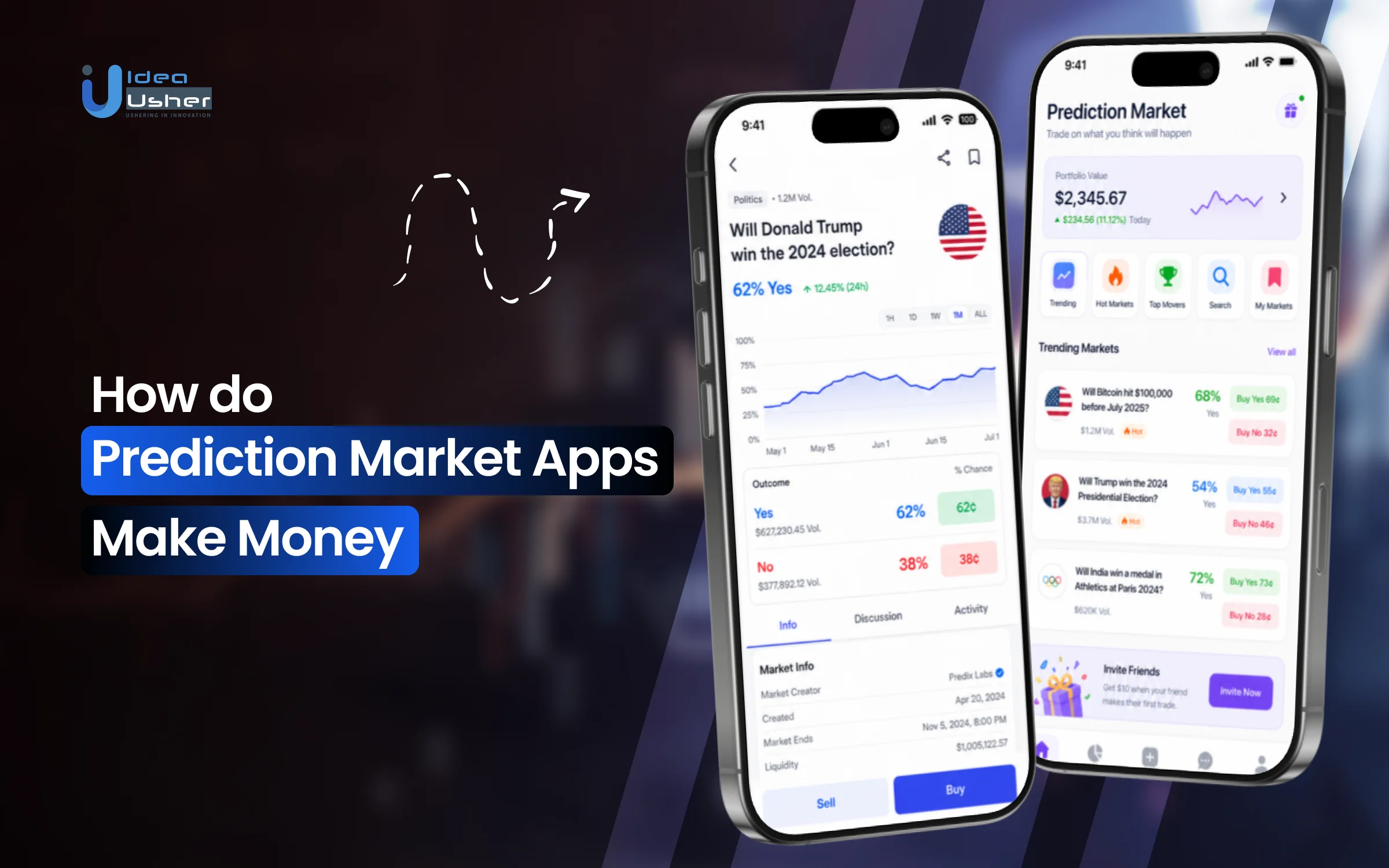
A prediction market app is a platform where people trade on the outcomes of future events. Think of it as a stock market but instead of trading shares of Apple or Tesla, you are trading shares of a specific reality such as Will a certain candidate win the election? or Will a specific movie cross the billion-dollar mark? or Will it rain in London on Christmas Day?
Unlike traditional sports betting, which is often a house vs. player dynamic, prediction markets function as an exchange. They leverage the “wisdom of the crowd,” aggregating individual opinions, data and even gut feelings into a single, fluctuating market price.
A. Core Concept Behind Prediction Markets
The mechanics of these apps are surprisingly elegant, turning abstract uncertainty into tradable assets.
- Users Trade on Outcomes of Real-World Events: Every market is centered on a specific question with a clear, verifiable resolution. Users buy shares in a “Yes” or “No” outcome. If your chosen outcome occurs, your shares typically settle at a value of $1.00. If it doesn’t, they go to zero.
- Market Prices Reflect Probability: This is the “secret sauce” of prediction markets. The price of a share at any given moment is a direct proxy for the crowd’s perceived probability of that event happening.
- If a “Yes” share for a specific event is trading at $0.65, the market is essentially signaling a 65% chance of that event occurring.
- This creates a continuous feedback loop: as new information emerges, traders buy or sell and the price, thus the predicted probability adjusts in real-time.
B. Why These Apps Are Growing Rapidly
Prediction markets have moved from niche academic experiments to mainstream financial tools. The global prediction industry decentralized finance market size was valued at US$ 2,030.8 million in 2025 and is estimated to grow at a compound annual growth rate (CAGR) of 66.7% from 2025 to 2033. This rapid growth highlights strong market demand and early opportunities for new platforms entering the space.

With monthly volumes now routinely clearing $20 billion, the “Poll-to-Prediction” pipeline is the dominant story of the year. Their rapid expansion is driven by three main factors:
- Real-Time Insights: Unlike biased polling, profit-driven prediction markets provide faster, more accurate forecasting data.
- DeFi Expansion: Blockchain enables global, low-fee and censorship-resistant trading via transparent smart contracts.
- Crowdsourced Intelligence: Apps empower communities to provide granular forecasting that traditional firms cannot match.
- Institutional Legitimacy: By 2026, regulatory clarity and adoption by Goldman Sachs and CME Group have established markets as professional hedging tools.
- AI Integration: AI improves precision and simplifies complex data, making prediction markets more accessible to retail participants.
Why Monetization Strategy Matters for Prediction Market Apps
Venturing into prediction markets with the hope that user growth will simply happen post-launch is a gamble in itself. While great design and accuracy help, they don’t guarantee sustainability. Without an early, robust monetization framework, the venture remains a fragile project rather than a viable business.

A. Unclear Revenue Models
Statistics are brutal: a significant percentage of startups fail because they run out of cash before finding a sustainable way to generate it. In a prediction market, revenue isn’t as simple as selling a subscription.
- The Transactional Trap: If you rely solely on trading fees, you need massive volume to survive.
- The Value Gap: Without a clear model, you risk “leaking” the valuable data your crowd produces to third parties who profit from it while you struggle to break even.
B. Regulatory and Liquidity Minefield
Monetizing prediction markets is challenging due to strict regulations, legal ambiguity, and the constant need to maintain active liquidity.
- Regulatory Hurdles: Depending on the jurisdiction, “monetizing” an outcome can look a lot like gambling. If your revenue model involves taking a “rake” (a percentage of the pot), you may trigger strict licensing requirements that can stall a launch for years.
- Liquidity Constraints: A prediction market only works if there are enough buyers and sellers to keep prices accurate. If your monetization strategy (like high entry fees) discourages participation, the market becomes “illiquid.” This leads to wide spreads, inaccurate data and a frustrated user base.
C. How Early Planning Shapes the Prediction Market Platform
Deciding how you make money on Day One ripples through every stage of development:
1. UX Design
A platform monetized through high-frequency trading fees needs a professional-grade, data-heavy dashboard. Conversely, a platform monetized through “premium insights” or ad-supported content might prioritize a cleaner, more editorial layout. Design follows the dollar.
2. Tokenomics
If you’re building on a blockchain, your monetization is baked into the code.
- Utility vs. Governance: Will users need your native token to pay fees?
- Deflationary Pressure: Will a portion of every transaction fee be “burned” to increase the token’s value? If these aren’t decided early, changing the protocol later is like trying to swap out an airplane engine mid-flight.
3. User Acquisition (UA) Strategy
Your monetization determines your LTV (Lifetime Value). If you know exactly how much a user is worth, you know exactly how much you can spend to acquire them (CAC).
The Golden Rule: Your CAC must be significantly lower than your LTV. If you haven’t defined your monetization, you’re essentially bidding on ads in the dark.

How Do Prediction Market Apps Make Money
The revenue model of a prediction market requires shifting your perspective from betting against the house to facilitating an exchange. These platforms operate as intermediaries, monetizing the flow of information and capital rather than the accuracy of their own forecasts.
A. The Core Revenue Mechanism Explained
Success in this space depends on building a robust environment where the “wisdom of the crowd” can be traded like a commodity. Revenue is generated through the sheer volume of activity rather than the specific outcomes of individual events.
- Neutral Marketplace Facilitation: Unlike traditional sportsbooks that take a position against the player, prediction apps act as a neutral marketplace. They profit by providing the infrastructure that allows users to trade with one another.
- Activity-Driven Revenue: The financial health of the platform is a direct reflection of how many users are active and how frequently they trade. High engagement translates into a steady stream of micro-fees that compound over time.
- Liquidity Correlation: Deep markets with plenty of buyers and sellers attract larger trades and more frequent activity.
B. Where the Money Really Comes From
The actual revenue streams are diverse while the mechanics are simple. Leading platforms in 2026 utilize a mix of transactional, structural, and premium monetization layers to ensure a stable bottom line across all market cycles.
- Trading Activity (Primary Driver): As the platform’s core engine, every buy and sell order generates small commissions, serving as a consistent and scalable revenue source.
- Platform Fees and Spreads: Beyond commissions, apps monetize the bid-ask gap. IdeaUsher designs tiered fees to reward high-volume traders while maintaining profitability.
- Premium Features & Ecosystem Revenue: Platforms monetize via “Pro” tools like real-time analytics and API access. Web3 models may also utilize native tokens and staking fees.
C. Why Revenue Scales with User Growth
Prediction markets leverage network effects to drive efficiency. As platforms scale, they become increasingly profitable per user, fueling a cycle of sustained growth and revenue.
- Network Effects Increase Trading Volume: Every new user adds a potential counterparty for everyone else, making the market more attractive and increasing the overall velocity of capital within the platform.
- More Markets → More Engagement → More Revenue: Expanding into diverse categories like entertainment, tech, and weather captures different user segments, ensuring the platform generates revenue 24/7 regardless of the global news cycle.
- Liquidity Improves User Retention and Profitability: A liquid market is a “sticky” market. Users are more likely to return to a platform where they can enter and exit positions easily.
Top Revenue Models Used by Prediction Market Apps
Selecting the right revenue model is a balancing act between platform sustainability and market liquidity. Here are the most effective strategies used by leading apps in 2026.

1. Transaction Fees (Trading Fees)
This is the bread and butter of most exchange-based platforms. Every time a user buys or sells a share in a market, the platform takes a small percentage of the trade volume.
IdeaUsher helps design fee structures that balance profitability and user retention, ensuring that fees are competitive enough to keep users active while securing the platform’s bottom line.
- Consistency: Because it generates revenue regardless of whether the market goes up or down, it provides the most stable cash flow.
- Example Structure: Typically ranges from 1–3% per trade, though some platforms offer tiered discounts for high-volume traders.
- Scalability: As the user base grows, transaction revenue scales exponentially without significantly increasing operational overhead.
Real-World Example: Kalshi utilizes a formulaic transaction fee model for its CFTC-regulated exchange. By applying small fees based on contract size and probability, they earned over $263M in 2025 revenue while maintaining neutrality across billions in trading volume.
2. Spread-Based Earnings
The platform acts as a market maker or facilitates liquidity through a bid-ask spread in this model. The spread is the difference between the highest price a buyer is willing to pay and the lowest price a seller is willing to accept.
Optimizing matching engines is a core competency at IdeaUsher. By building high-performance, low-latency engines, we help platforms maintain narrow spreads that attract professional traders while maximizing internal revenue.
- Liquidity Requirements: This model thrives in high-liquidity environments where frequent trading keeps the spreads tight but profitable for the house.
- Architecture Matters: The efficiency of the backend architecture directly impacts the spread. Low-latency systems prevent slippage, ensuring traders get the prices they see.
- Arbitrage Opportunities: Efficient spreads attract institutional arbitrageurs who provide additional depth to the market, further stabilizing the ecosystem.
Real-World Example: Polymarket uses an Automated Market Maker (AMM) to generate “implicit revenue” through buy-sell spreads. This allows the platform to provide zero-fee trading while capturing value from high-frequency global liquidity.
3. Market Creation Fees
High-interest events are listed to prevent market spam and ensure only high-quality platforms can charge a fee to users who want to propose or create a new prediction market.
- Quality Control: This creates a natural filter, ensuring the platform remains focused on events with genuine public interest and verifiable outcomes.
- Governance & Moderation: These fees are often funneled back into the platform’s governance, paying oracles or community moderators to verify final outcomes.
- Revenue Recirculation: A portion of these fees can be used to subsidize initial liquidity for the new market, helping it gain traction faster.
Real-World Example: Augur pioneered this model using a “validity bond” in Reputation (REP) tokens. This fee mandates clear event definitions; it is refunded for successful markets but forfeited to the community for poorly defined or “spam” listings.
4. Subscription Models
For power users and institutional investors, prediction markets are more than a game, they are a data source. Platforms can offer freemium models where the base app is free but advanced features are locked.
We specialize in building AI-powered insights dashboards that transform raw market data into actionable intelligence, providing a clear value proposition for your subscription tiers.
- Premium Tools: This includes access to real-time signals, sentiment analysis and advanced predictive modeling.
- B2B Data Licensing: Selling anonymized, high-fidelity sentiment data to hedge funds, marketing firms or research institutions.
- Ad-Free Experience: Providing a streamlined, professional environment for serious traders who require a distraction-free interface.
Real-World Example: Insight Prediction and Polymarket (Institutional) now license their accurate truth data. By offering real-time APIs and sentiment dashboards, they provide hedge funds and political analysts with a high-premium data advantage over traditional polling.
5. Token-Based Monetization (Web3 Models)
The platform’s value is often tied to a native utility token in the decentralized space.
Our experts design robust token economy architectures that ensure long-term sustainability, balancing utility, governance and value accrual for the entire ecosystem.
- Ecosystem Value: Revenue is generated through token appreciation, transaction fees paid in the native token or buy-back and burn mechanics.
- Governance Rights: Allowing token holders to vote on key platform upgrades, fee structures or dispute resolutions.
- Staking Tier Access: Unlocking specific high-stakes or niche markets only for users who hold or stake a minimum balance of the native token.
Real-World Example: Opinion and Predict.fun use token ecosystems requiring native assets for governance and participation. By sustaining high Total Value Locked (TVL), these platforms expand their treasury value as user adoption grows.
6. Liquidity Incentives & Staking Fees
Platforms encourage users to stake their capital into liquidity pools to ensure there is always a counterparty for every trade.
- Yield Sharing: The platform earns a percentage of the rewards generated by these pools or charges a small fee for managing the staking infrastructure.
- Smart Contract Security: This requires meticulous smart contract design to ensure funds are handled securely and that “impermanent loss” is minimized for users.
- Dynamic Rebalancing: Earning management fees by automatically moving liquidity to the most active or high-demand markets using automated algorithms.
Real-World Example: Kalshi Klear incentivizes liquidity by offering a 3.25% APY on idle holdings. While providing users interest, the platform utilizes this massive collateral pool to ensure instant trade matching and maintain its professional-grade liquidity.
7. Advertising & Sponsored Markets
Prediction markets are high-engagement environments, making them a goldmine for B2B advertising.
- Native Advertising: A brand might sponsor a specific market, for example, a film studio sponsoring a market on “Will this movie break $1B in its first week?”
- Revenue Potential: This offers a non-intrusive way to generate high-margin revenue from corporate partners who want to tap into the platform’s data-driven audience.
- Lead Generation: Using sponsored polls and markets to connect brands with highly engaged segments, providing valuable market research in the process.
Real-World Example: DraftKings Predictions and FanDuel Predicts use sponsored markets through partnerships with brands like UFC and MLS. These leagues purchase “engagement real estate” to maintain fan interaction between live matches.
Business Pillars That Define Prediction Market App Revenue Model
Choosing a single monetization path is rarely the best move. The most resilient prediction market apps in 2026 use a hybrid approach to balance the books while keeping users happy. Here is how the primary models stack up across four critical business pillars:

1. Scalability
Measuring how easily a revenue model grows alongside your user base is vital for long-term expansion. Scalable models ensure that as trading volume surges, your profit margins increase without a linear rise in overhead.
- Transaction Fees: High scalability. Revenue grows automatically as your user base and trading volume increase without requiring additional staff.
- Subscription Models: Medium scalability. While highly profitable, it requires constant content creation (insights, reports) and feature updates to prevent subscriber churn.
- Market Creation Fees: Low scalability. This is a quality control tool rather than a primary growth engine.
2. Regulatory Risk
Navigating the legal landscape is the biggest hurdle for prediction markets today. Understanding which models trigger gambling licenses versus those seen as information services is essential to avoid costly legal shutdowns.
- Advertising & Sponsorships: Lowest Risk. Since you aren’t taking a cut of the wager, this model avoids many gambling-related legal hurdles.
- Transaction Fees and Bid-Ask Spreads: Taking a percentage of trade volume can classify platforms as brokerages or gambling operators in many regions, requiring strict licenses.
- Token-Based Models: Variable Risk. This depends entirely on whether the native token is classified as a utility or a security by regional regulators.
3. Revenue Predictability
Financial stability relies on your ability to forecast monthly income accurately. While some models fluctuate with market volatility, others provide a steady baseline that helps you manage operational costs and investor expectations.
- Subscription Models: Highest Predictability. Monthly recurring revenue (MRR) allows for better long-term financial planning and higher company valuation.
- Transaction Fees: Low Predictability. Revenue is tied to market volatility. If there are no major global events (like elections or sports finals), trading volume and revenue can drop significantly.
- Liquidity Staking Fees: Medium Predictability. Revenue remains steady as long as the total value locked (TVL) in the platform remains stable.
4. User Experience (UX)
The way you monetize can either enhance or degrade the overall feel of your platform. Choosing methods and features that integrate seamlessly into the trading flow ensures high retention and keeps the community engaged.
- Spread-Based Earnings: Best UX. When done correctly, the “fee” is invisible to the user. They simply see a price and trade it, avoiding the “fee fatigue” of seeing a surcharge on every transaction.
- Subscription Models: Moderate UX. Paywalls can be frustrating for casual users but they provide a premium, ad-free environment for professionals.
- Advertising: Lowest UX. If not handled as “sponsored markets,” traditional banner ads can clutter the interface and degrade the perceived authority of the platform.
The Strategy for 2026: The Hybrid Model
We normally recommend other enterprises combining these models to create multiple safety nets for long-term sustainability. Relying on just one makes your platform vulnerable to market dips or sudden regulatory changes.
| Revenue Model | Scalability | Regulatory Risk | Revenue Predictability | UX Impact |
| Transaction Fees | High | High | Low | Moderate |
| Spread-Based | High | High | Moderate | Minimal (Best) |
| Market Creation | Low | Moderate | Low | Moderate |
| Subscription | Moderate | Low (Best) | High (Best) | Moderate |
| Token-Based | Very High | High | Low | Moderate |
| Advertising | Moderate | Low (Best) | Moderate | High |
A Winning Combination Example:
- Core Revenue: Low Transaction Fees to keep the platform accessible and liquid.
- Stability Layer: A Subscription Tier for professional traders to ensure consistent monthly cash flow.
- Growth Layer: Token-Based Incentives to reward early adopters and build a loyal, decentralized community.
By diversifying your income streams from Day One, you build a platform that can survive quiet market periods and adapt to the evolving legal landscape of prediction markets.
Key Factors That Impact Revenue in Prediction Market Apps
Revenue in prediction markets is not just a byproduct of trading; it is a calculated result of how well the platform handles ecosystem health, legal boundaries and the user journey.
1. Liquidity & User Base
A prediction market is only as strong as its order book depth. Without enough participants to take the other side of a trade, prices become stagnant and the platform’s revenue from transactional volume quickly dries up.
- Network Effect Revenue: More users lead to more frequent trades, creating a compounding revenue loop that stabilizes cash flow even during lower-volatility periods.
- Institutional Attraction: High liquidity attracts high-volume institutional traders who require deep markets to move significant capital, exponentially increasing fee collection.
- Slippage Prevention: Robust user bases reduce price slippage, which encourages larger trade sizes and higher overall platform throughput for better monetization.
2. Market Diversity
Offering a wide array of categories ensures that the platform remains relevant regardless of the global news cycle. Diversification prevents revenue blackouts that occur when a single major event, like an election, concludes.
- Evergreen Categories: Balancing high-stakes events like politics with consistent “evergreen” markets like sports and entertainment ensures a baseline of daily active trading revenue.
- Long-Tail Markets: Niche markets such as hyper-local weather or specific tech milestones capture specialized user groups that traditional betting platforms often ignore.
- Seasonal Hedging: Strategic market diversity allows the platform to pivot revenue focus seasonally, switching from summer sports to winter financial macro-events seamlessly.
3. Regulatory Compliance
The period of unregulated event trading has concluded; consequently, monetization strategies are now strictly governed by geographic and legal mandates. Regulatory compliance has transitioned from a mere legal requirement into a primary competitive advantage.
- Monetization Permissibility: Different legal frameworks dictate whether you can charge a rake, a flat fee or if you must move toward a subscription-based data model.
- Global Expansion Barriers: Proactive compliance allows for faster entry into lucrative markets like the EU or North America, where clear licensing increases long-term LTV.
- User Protection Trust: Implementing strict AML and KYC protocols might add friction but it prevents bad actor drain and protects the platform’s ability to process high-value transactions.
4. Platform UX & Trust
Trust is the ultimate currency in a market built on future uncertainty. If users don’t trust the verifiability of an outcome or the fairness of the interface, they will not commit significant capital.
- Retention through Reliability: A seamless, high-performance UX reduces “bounce rates” during peak trading times, ensuring that the platform captures maximum revenue during high-volatility events.
- Transparent Resolution: Using decentralized oracles for event resolution builds the trust necessary for users to place high-stakes trades without fearing “house bias.”
- Gamified Engagement: Features like leaderboards and streaks increase session frequency, leading to higher lifetime revenue per user through repeated small-scale trading.
How IdeaUsher Helps You Launch a Scalable Prediction Market App
Moving from a conceptual what-if to a high-traffic trading platform requires a partner who understands the intersection of finance, psychology and code. Here is how IdeaUsher turns your vision into a market-leading reality.

1. Product Strategy Aligned with Business Goals
We bridge the gap between abstract concepts and market-ready products by aligning every technical feature with your long-term commercial objectives and user acquisition targets for maximum impact.
- Vision-to-Roadmap Translation: We take your core idea and break it down into a structured, phase-by-phase roadmap that prioritizes high-value features for a competitive market entry.
- Monetization Readiness: Our strategy ensures the platform is technically equipped to support multiple revenue streams from fees to subscriptions, ensuring profitability is never an afterthought.
- Future-Proof Flexibility: We design features with an eye on the future, allowing you to implement or pivot your revenue models without needing to rebuild the core platform.
2. Flexible Architecture for Multiple Monetization Models
Our modular approach ensures your platform can pivot between transaction fees, subscriptions or Web3-native models without requiring a total system overhaul as your business evolves and grows.
- Multi-Model System Support: We build robust systems that can simultaneously handle transaction fees, monthly subscriptions and token-based governance models without performance degradation.
- Modular Backend Design: Our architecture is built in discrete modules, making it easy to integrate new monetization tools or third-party payment gateways as your strategy matures.
- Adaptive Infrastructure: We deploy scalable infrastructure that shifts alongside your revenue strategy, ensuring that high-volume trading and premium data services remain lightning-fast.
3. Scalable & Secure Backend Development
We build high-concurrency trading engines capable of handling thousands of simultaneous transactions, ensuring low latency and absolute security for every trade executed on your prediction platform.
- High-Performance Trading Engines: Our proprietary engines are optimized for real-time execution, ensuring that users can trade on live events without worrying about lag or order failure.
- Secure Web3 Smart Contracts: For decentralized platforms, we develop and audit secure smart contracts that automate payouts and protect user funds from external vulnerabilities.
- Activity-Resilient Infrastructure: Our backend is designed to handle extreme spikes in user activity and liquidity, particularly during major global events like elections or sports finals.
4. Regulatory-Ready Development Approach
We help you navigate complex global legal frameworks by integrating compliance into the core architecture, ensuring your platform is ready for deployment in highly regulated financial and gaming markets.
- Compliance-Friendly Architecture: We integrate KYC/AML modules and age-verification systems directly into the user flow, making it easier to meet the requirements of various jurisdictions.
- Region-Specific Deployment: Our systems support localized deployment rules, allowing you to toggle specific features or monetization models based on the user’s geographic location and local laws.
- Transparent System Design: We minimize legal and operational risks by building transparent systems where every trade and resolution is verifiable, fostering trust with both users and regulators.
5. Launch Support & Post-Launch Scaling
Beyond the initial build, we provide end-to-end deployment assistance and continuous performance monitoring to ensure your platform scales smoothly as your user base and market liquidity expand rapidly.
- End-to-End Launch Assistance: From server setup to app store submissions, we manage the technical heavy lifting of your launch so you can focus on marketing and growth.
- System Optimization: After launch, we continuously monitor performance metrics to identify and eliminate bottlenecks, ensuring the platform stays lean and fast as traffic grows.
- Continuous Technical Evolution: We provide ongoing support to integrate new features, scale your user capacity and connect with emerging third-party data oracles and liquidity providers.
6. Data & Analytics Integration
We integrate sophisticated tracking tools that provide founders with real-time insights into user behavior, allowing for data-driven refinements to monetization strategies and platform engagement features over time.
- Built-in Behavioral Analytics: Our platforms come equipped with deep analytics that track how users interact with different markets, helping you identify your most profitable niches.
- Monetization Refinement Tools: We provide the data insights necessary for founders to tweak fee structures or subscription tiers based on actual user willingness to pay and trading habits.
- Data-Driven Decision Making: Our integrated tools transform raw platform data into actionable intelligence, supporting your long-term growth strategy and helping you outpace the competition.
Cost vs Revenue: What Founders Should Expect
Prediction market development is a strategic asset, not merely an expense. While high-performance platforms demand substantial upfront capital, the combination of trading fees and data insights typically creates a highly profitable, compounding business model. IdeaUsher helps optimize both cost efficiency and revenue potential to ensure your project remains financially viable from launch to scale.
1. Initial Investment vs. Long-Term Monetization
Building a secure trading engine requires a front-loaded investment in security, licenses and high-performance architecture. While the initial burn is high, the low marginal cost of digital transactions allows for high-margin profitability as the platform matures.
- High Initial Capital: Startup funds are largely consumed by regulatory compliance and auditing smart contracts to ensure security.
- Revenue Growth Curve: Profitability typically follows a hockey stick trajectory, accelerating once the platform achieves a critical mass of traders.
- Data-Driven Monetization: Early investment in data infrastructure enables high-margin revenue through anonymized sentiment analysis as the platform matures.
2. Break-Even Considerations
Reaching the break-even point depends heavily on your Customer Acquisition Cost (CAC) and the “stickiness” of your trading environment. Monitoring the delta between user lifetime value and marketing spend is the key to achieving early financial independence.
- LTV vs. CAC Ratio: For a sustainable model, the Lifetime Value (LTV) of a trader should ideally be 3x to 5x their acquisition cost to cover operational overhead.
- Liquidity Advantage: Rapidly achieving organic liquidity reduces market-making expenses, quickening the break-even timeline.
- Retention Strategy: Strong UX and social features minimize churn, amortizing acquisition costs over prolonged trading lifespans.
3. Scaling Revenue with User Growth
Prediction markets are built on powerful network effects where each new user adds depth to the market and increases the overall value for everyone. As the user base expands, your revenue scales exponentially while operational costs tend to plateau.
- Diminishing Marginal Costs: Once the core engine is built, adding the millionth user costs significantly less than adding the first, leading to rapidly expanding profit margins over time.
- Volume-Linked Profit: Expanding user bases deepen order books, attracting institutional capital and generating the high trading volumes necessary for primary fee revenue.
- Institutional API Monetization: Increased traffic allows platforms to charge institutions for high-speed API access, facilitating efficient large-scale trading and arbitrage.
4. Cost Optimization Through Scalable Architecture
Smart architectural choices ensure that your operational expenses don’t grow at the same rate as your user base. By building with modularity and automation from the start, you can maximize your long-term margins and resource efficiency.
- Auto-Scaling & Ephemeral Environments: Demand-based scaling manages event spikes and shuts down idle environments, cutting infrastructure costs by 70–80%.
- FinOps & Resource Tagging: The 2026 FinOps model provides granular cloud spend visibility, ensuring funds target high-volume markets.
- AI-Augmented Maintenance: Building with AI DevOps tools minimizes human capital for 24/7 monitoring, stabilizing maintenance budgets as platforms grow.
Future Trends in Prediction Market Monetization
As we look toward the latter half of 2026, the prediction market landscape is shifting from speculative gaming to sophisticated financial infrastructure. The convergence of AI, blockchain, and traditional finance is opening new, high-margin revenue streams that go far beyond simple trading fees.
1. AI-Driven Prediction Insights
Artificial intelligence is transforming how markets function by providing deep-layer analytics that identify hidden patterns and sentiment shifts. These AI-powered tools provide users with a data edge, creating a premium tier of monetization for platform owners.
- Personalized Probability Views: AI-driven customized probability scores based on trading behavior can be restricted to premium subscribers.
- Dynamic Pricing Engines: Platforms utilize AI to adjust real-time odds and spreads, optimizing house revenue during high volatility.
- Explainable AI (XAI) Insights: Subscriptions provide transparent, AI-generated reports explaining the data points behind specific market shifts.
2. Decentralized Governance
The move toward Decentralized Autonomous Organizations (DAOs) allows users to have a literal stake in the platform’s success. This model monetizes community participation, turning users into stakeholders who are financially incentivized to maintain market integrity.
- Governance Token Ecosystems: Native tokens generate value through appreciation and utility, required for voting on listings or disputes.
- Community-Set Fee Structures: Decentralized models use community-governed “rakes,” redirecting fees to a treasury for platform development.
- Staking-as-a-Service: Platforms earn management fees by facilitating decentralized liquidity pools through user staking.
3. Real-Time Data Monetization
Prediction markets are essentially massive real-time truth engines and the data they generate is often more accurate than traditional polling. This creates a lucrative B2B revenue stream where the platform acts as a data provider for external industries.
- Sentiment APIs: Hedge funds and research institutions pay for low-latency access to live probability data and historical trends.
- Data-as-a-Product (DaaP): Marketing firms and political strategists purchase anonymized, real-time datasets to track public opinion shifts.
- Corporate Forecasting Shields: Enterprises use private prediction markets to forecast supply chain issues or product launches without exposing data publicly.
4. Integration with Financial Markets
The March 2026 CFTC ruling classifying prediction markets as financial derivatives has triggered a massive wave of institutional adoption. This integration allows platforms to tap into the trillion-dollar derivatives market, moving prediction apps into the mainstream financial stack.
- Institutional Arbitrage Tools: High-speed execution for institutions hedging against economic or political risks.
- White-Label Brokerage Solutions: Monetizing technology by licensing trading engines to major banks and brokerages.
- Hybrid Derivative Contracts: Products linking stock movements with event outcomes such as a “Tech-Earnings + Interest Rate” for complex payout structures.
Build and Launch Your Prediction Market App with Idea Usher
Turning a prediction market idea into a scalable product requires more than just development. It demands the right technical expertise, a performance-driven architecture, and a partner who understands how these platforms grow in real-world markets.
At IdeaUsher, we bring a strong combination of domain understanding, scalable development practices, and business-focused execution to help you launch with confidence. Our team of 250+ developers specializes in building high-performance platforms with real-time trading engines, secure system architecture, and flexible backend frameworks that are ready to support your chosen monetization model.
What sets us apart is our ability to deliver beyond just code. We focus on:
- End-to-end product development, from idea validation to deployment
- Scalable architecture design, ensuring your platform grows without technical limitations
- Web3 and smart contract expertise, for decentralized prediction market use cases
- Security-first development approach, critical for financial and trading platforms
- Post-launch support and optimization, helping you scale users, features, and performance
With IdeaUsher, you are not just building an app. You are launching a platform that is engineered for reliability, scalability, and long-term growth.
If you are ready to build a prediction market app that performs in real market conditions, IdeaUsher is here to help you design, develop, and scale it the right way.
Conclusion
Prediction market apps are far more than simple tech products; they are sophisticated financial ecosystems that thrive on liquidity and trust. For long-term viability, monetization must be baked into the foundational architecture, not tacked on later. Aligning your revenue strategy with your technical roadmap from day one ensures both scalability and resilience in a competitive landscape.
FAQs
A.1. Revenue primarily stems from transactional volume through dynamic taker fees and bid-ask spreads. This exchange-based model ensures steady cash flow as the platform facilitates trades without taking direct directional risks.
A.2. The prediction market app requires navigating complex global legal frameworks and obtaining necessary financial or gaming licenses. Strategic compliance minimizes operational risks and allows for broader market entry across various jurisdictions.
A.3. Liquidity drives profitability by narrowing spreads and attracting high-volume institutional traders. A deep market ensures immediate trade execution, which increases overall transaction frequency and maximizes the capture of recurring platform fees.
A.4. These platforms generate highly accurate sentiment data which is sold to hedge funds and researchers. Real-time probability insights provide a high-margin revenue stream that exists independently of traditional trading commissions.


