

Key Takeaways
- Mobile MLM software enables real-time tracking, automation and scalable network growth for modern direct-selling businesses.
- Core features include genealogy tracking, commission engines, digital wallets, analytics dashboards and onboarding systems.
- Mobile MLM software development cost ranges from $45K–$70K for MVPs and can exceed $150K+ for enterprise platforms.
- AI improves lead generation, conversion rates, churn prediction and operational efficiency in MLM platforms.
- Monetization models of MLM software include subscriptions, transaction fees, premium tools and white-label licensing.
- How IdeaUsher helps you build a mobile MLM platform with end-to-end development, scalable architecture, secure payout systems and faster launch support.
Growth in direct selling no longer depends on offline networks or manual tracking. It now depends on how efficiently distributors can operate, engage, and scale through mobile MLM software, as the shift is clear and teams require real-time visibility, automated workflows, and mobile-first access to manage expanding networks.
Traditional MLM systems relied on spreadsheets, delayed reporting and fragmented communication, which slowed decisions and limited performance. Mobile-first MLM platforms address this by enabling instant commission tracking, seamless onboarding, performance dashboards and integrated tools, allowing distributors to manage sales, track earnings and scale networks efficiently while reducing friction and supporting faster expansion.
In this blog, we will talk about core features, architecture, costs and the development process to build mobile MLM software and how IdeaUsher can help you develop and launch a scalable MLM platform aligned with your business goals.
What is Mobile MLM Software?
Mobile MLM software is a dedicated application designed to help network marketing companies manage their distributors, track sales, calculate commissions, and monitor team structures directly from mobile devices. It streamlines everyday operations by making essential tools accessible from anywhere, ensuring distributors can work, track progress, and communicate on the go.
Beyond basic management, modern mobile MLM software boosts scalability and engagement through features like automation, real-time data, and seamless collaboration. This enables capabilities such as:
- Streamlining distributor and team management by organizing profiles, tracking downlines, and maintaining clear genealogy structures.
- Automating commission and payout processes to ensure accuracy, reduce manual workload, and maintain full transparency across the network.
- Centralizing business operations so distributors can access tools, resources, and updates in one unified mobile platform.
- Supporting consistent communication between uplines, downlines, and company administrators for faster decision-making.
- Enhancing sales tracking and performance monitoring through real-time data visibility and progress insights.
- Improving distributor onboarding and retention by offering easy access to training materials, company updates, and product information.
- Enabling on-the-go business activities so distributors can work, engage, and grow their network anytime, anywhere.
How Mobile MLM Software Works?
Mobile MLM software lets distributors and admins manage teams, track sales, and calculate commissions from a mobile device, simplifying growth and daily operations.
1. User Onboarding & Network Placement
The process begins when a distributor registers through the app, and the system automatically positions them in the correct genealogy structure to set up their starting point. This ensures accurate placement and prevents errors in network tracking.
2. Sales Activity & Team Growth Tracking
As users place orders and build their teams, the software updates sales data and rank progress in real time, giving everyone instant visibility into their performance. It also highlights high-performing distributors to guide team strategy.
3. Automated Commission Processing
The system applies the chosen compensation plan to calculate commissions and bonuses automatically, updating all earnings directly in the distributor’s e-wallet. It reduces manual errors and ensures transparent, timely payments.
4. Financial Transactions & E-Wallet Management
Distributors can then review their balance, transfer funds, or request withdrawals through secure, integrated payment gateways within the app. The system also records all transactions for easy tracking and auditing.
5. Admin Oversight & Reporting Completion
The workflow ends with admins reviewing analytics, sales reports, and payout summaries to validate performance and guide future decisions. It also enables monitoring of growth trends and team efficiency.
Who Needs Mobile MLM Software?
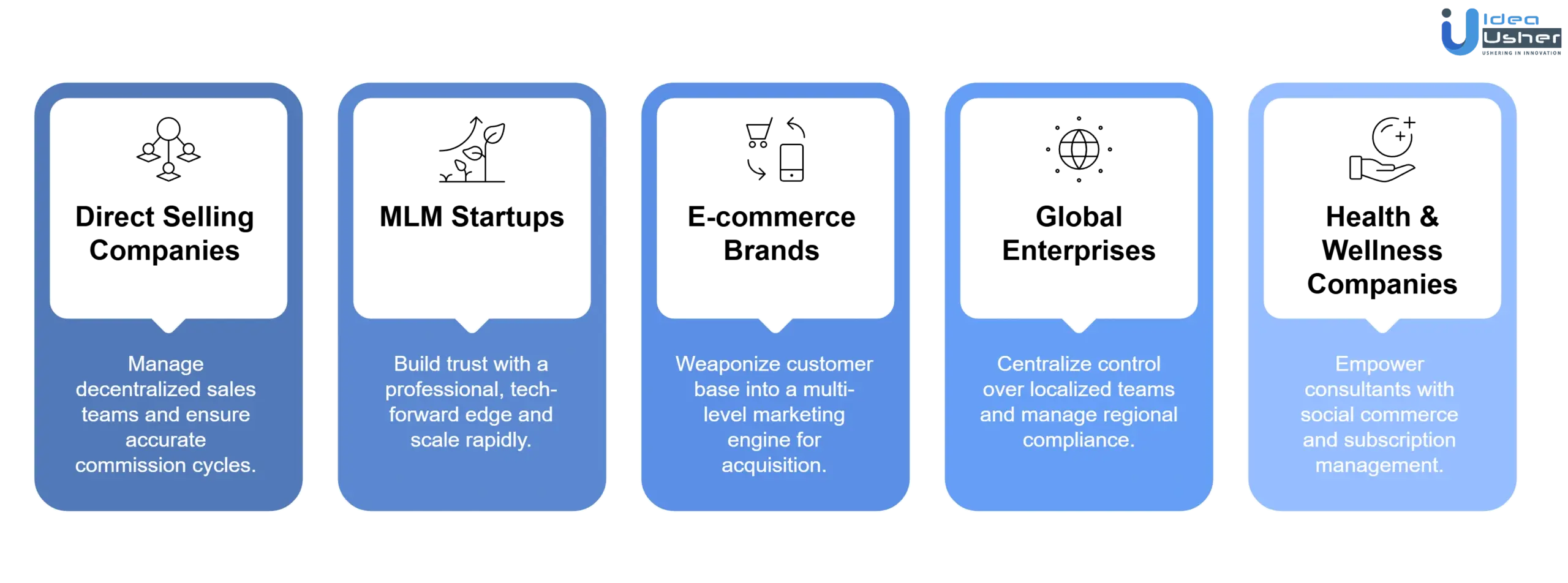
Dedicated mobile technology is no longer optional for network-driven businesses. These platforms act as the operational backbone for any organization that relies on a decentralized, high-velocity sales force to drive growth.
1. Direct Selling & Network Marketing Companies
These organizations thrive on managing high-performing, decentralized field-based sales teams.
- Genealogy Tracking: Monitor complex downlines and network growth in real-time.
- Instant Payouts: Ensure accurate, automated commission cycles that drive distributor retention.
2. MLM Startups & New Entrepreneurs
New entrants require a professional, tech-forward edge to build immediate trust with their first wave of distributors.
- Zero-Error Automation: Eliminate manual tracking risks from day one.
- Rapid Scalability: Transition from 10 to 10,000 members without increasing administrative overhead.
3. E-commerce Brands Using Referral Models
Brands looking to weaponize their customer base into a multi-level marketing engine for aggressive acquisition.
- Tiered Incentives: Boost Lifetime Value (LTV) through sophisticated multi-level rewards.
- Storefront Integration: Seamlessly sync referral data with existing checkout and inventory systems.
4. Enterprises Managing Global Distributor Networks
Large-scale operations spanning multiple regions that require centralized control over localized teams.
- Localization Tools: Automated multi-currency and multi-language support for borderless growth.
- Global Compliance: Manage regional tax rules and legal requirements from a single dashboard.
5. Health, Wellness & Lifestyle Brands
High-trust industries that rely heavily on personal testimonials, community-driven selling, and recurring revenue.
- Social Commerce: Empower consultants with one-click product sharing tools.
- Subscription Management: Drive repeat purchases through automated re-order and subscription tracking.
Top MLM Compensation Models You Can Consider
As more companies adopt mobile MLM software development to streamline team management, choosing the right compensation model becomes even more important. A clear understanding of each plan helps you build a structure that supports growth and distributor success.
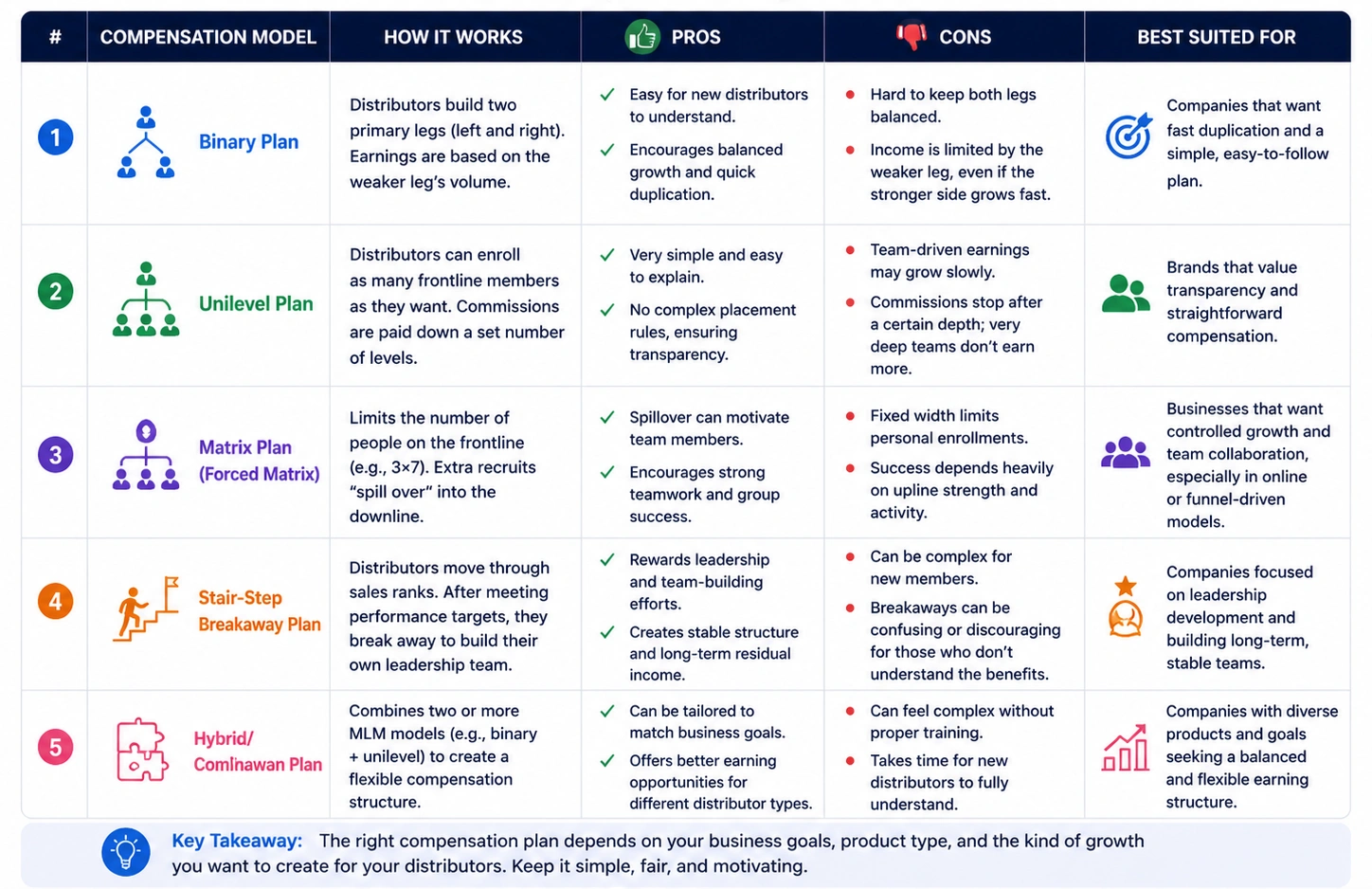
1. Binary Plan
In a binary plan, distributors build two primary legs, left and right, with earnings based on the weaker leg’s volume. This structure promotes quick duplication and offers a simple model that’s easy for teams to understand.
Pros
- The system is easy for new distributors to understand, which makes duplication and team-building much faster.
- It naturally encourages balanced growth because earnings depend on maintaining both legs.
Cons
- Many distributors struggle to keep both legs balanced, which can slow down earnings.
- Income is always limited by the performance of the weaker leg, even if the stronger side grows rapidly.
2. Unilevel Plan
This model lets every distributor enroll as many frontline members as they want, with commissions typically paid down a set number of levels. It’s ideal for brands that value transparency and want a straightforward plan that feels fair and honest to newcomers.
Pros
- The structure is extremely straightforward, making it simple to explain and easy for newcomers to follow.
- Because it lacks complicated placement rules, it reduces the chance of manipulation within the system.
Cons
- Team-driven earnings can grow slowly, especially if distributors don’t build wide frontlines.
- Commissions stop after a certain depth, which means very deep teams may not generate additional income.
3. Matrix Plan (Forced Matrix)
A matrix plan limits how many people each distributor can have on their frontline (e.g., a 3×7 structure). Extra recruits beyond the cap “spill over” into the downline. Companies use this for controlled growth and to encourage teamwork, especially in online or funnel-driven settings.
Pros
- The spillover effect can motivate team members, as they may benefit from efforts made by their uplines.
- This structure encourages strong teamwork since everyone’s placement affects the group’s success.
Cons
- The fixed width limits how many people a distributor can personally enroll on their frontline.
- Success often depends heavily on the strength and activity of the upline, which can be discouraging for self-driven individuals.
4. Stair-Step Breakaway Plan
Distributors advance through sales ranks, and upon reaching a performance threshold, they form their own leadership team. This model suits businesses focused on leadership development and building stable, long-term teams.
Pros
- It rewards distributors who develop leadership skills and invest in building strong teams.
- Over time, it creates a stable organizational structure that can generate long-term residual income.
Cons
- The system can be complicated for new members to grasp, especially the breakaway rules.
- When team members break away, it can feel confusing or even discouraging to those who don’t yet understand the benefits.
5. Hybrid/Combination Plan
A hybrid plan combines two or more MLM models, such as binary and unilevel, to create a flexible compensation structure. Companies adopt it for diverse products and a more balanced earning approach.
Pros
- Companies can design the structure to match their exact business goals, creating a compensation plan that feels more balanced.
- A blend of models often results in better earning opportunities across different types of distributors.
Cons
- The final plan can feel complex without proper training because multiple systems are combined.
- New distributors may need more time to fully understand how the compensation works.
Why MLM Software Demand Is Rapidly Growing
The MLM Software Market was valued at USD 600 million in 2024 and is projected to reach USD 1,259.12 million by 2031, growing at a CAGR of 9.97%. This growth is driven by increased digital transformation and the adoption of automation, mobile apps, and AI systems in direct-selling companies.
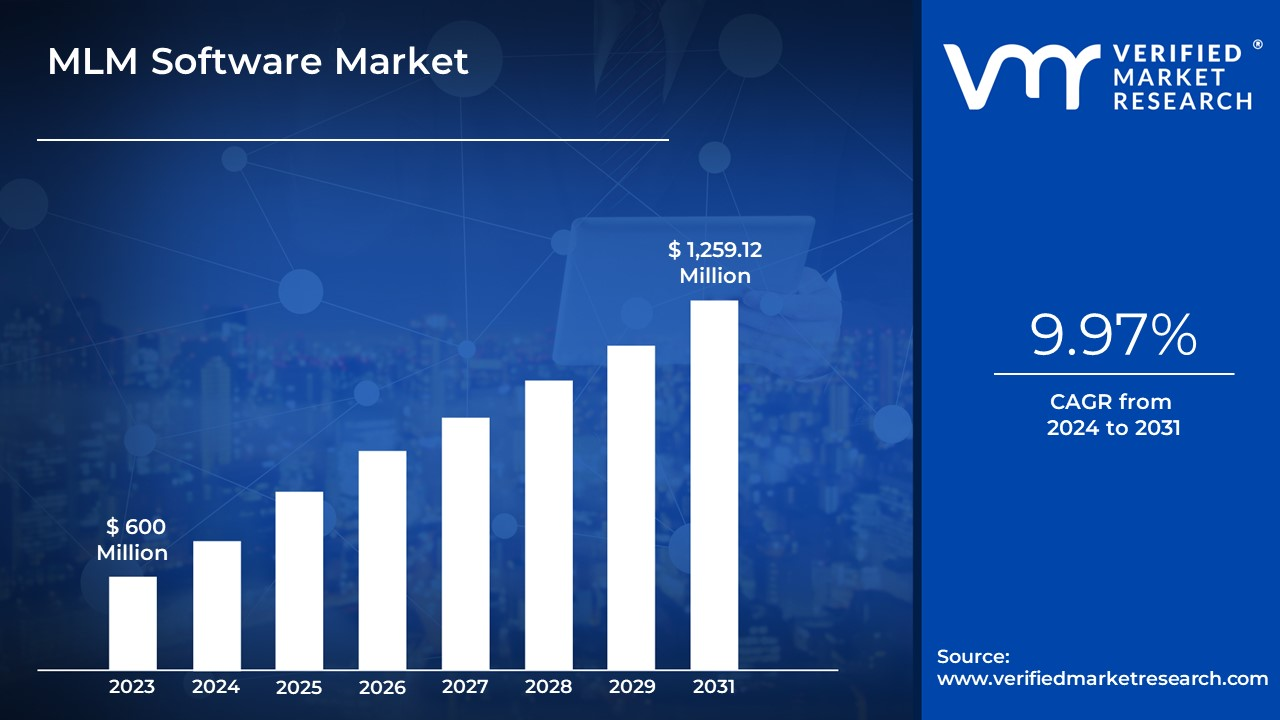
60% of U.S. distributors now use MLM software to manage commissions, track downlines, communicate with teams, and streamline operations, reflecting a demand for smarter tools that give companies a competitive edge.
The MLM software market still has gaps, with outdated, inflexible and non-mobile solutions leaving room for innovation. AI enhances platforms with analytics, personalization, and smarter sales and distributor insights.
The integration of Artificial Intelligence into these platforms is fundamentally reshaping performance benchmarks, as evidenced by these 2026 industry insights:
- AI adoption is accelerating fast as over 60% of direct selling organizations now deploy AI, with budget allocation rising sharply from 8% to 25% in just two years.
- Smarter lead generation with AI is driving up to 50% more sales-ready leads while reducing customer acquisition costs by up to 60%.
- Improved conversion efficiency through AI-based lead scoring boosts qualification accuracy by 40%, helping top MLM firms reach conversion rates close to 6%.
- Significant operational time savings as AI reduces manual workload from 52% to 20%, allowing distributors to focus more on high-value selling activities.
- AI-powered churn prediction enables proactive retention strategies, leading to up to 2.9x higher revenue compared to reactive approaches.
- Localized content at scale is growing rapidly, with 156% increase in regional content generation, improving voice search visibility and market expansion.
- Stronger fraud detection systems reduce false alerts by 50%, ensuring secure payouts without disrupting legitimate distributors.
Key Features to Integrate in a Mobile MLM Software
A top-tier mobile MLM app acts as a portable office, enabling global network management, recruitment, and sales. Integrating the right features ensures that your platform remains scalable, secure, and user-centric in the competitive 2026 landscape.
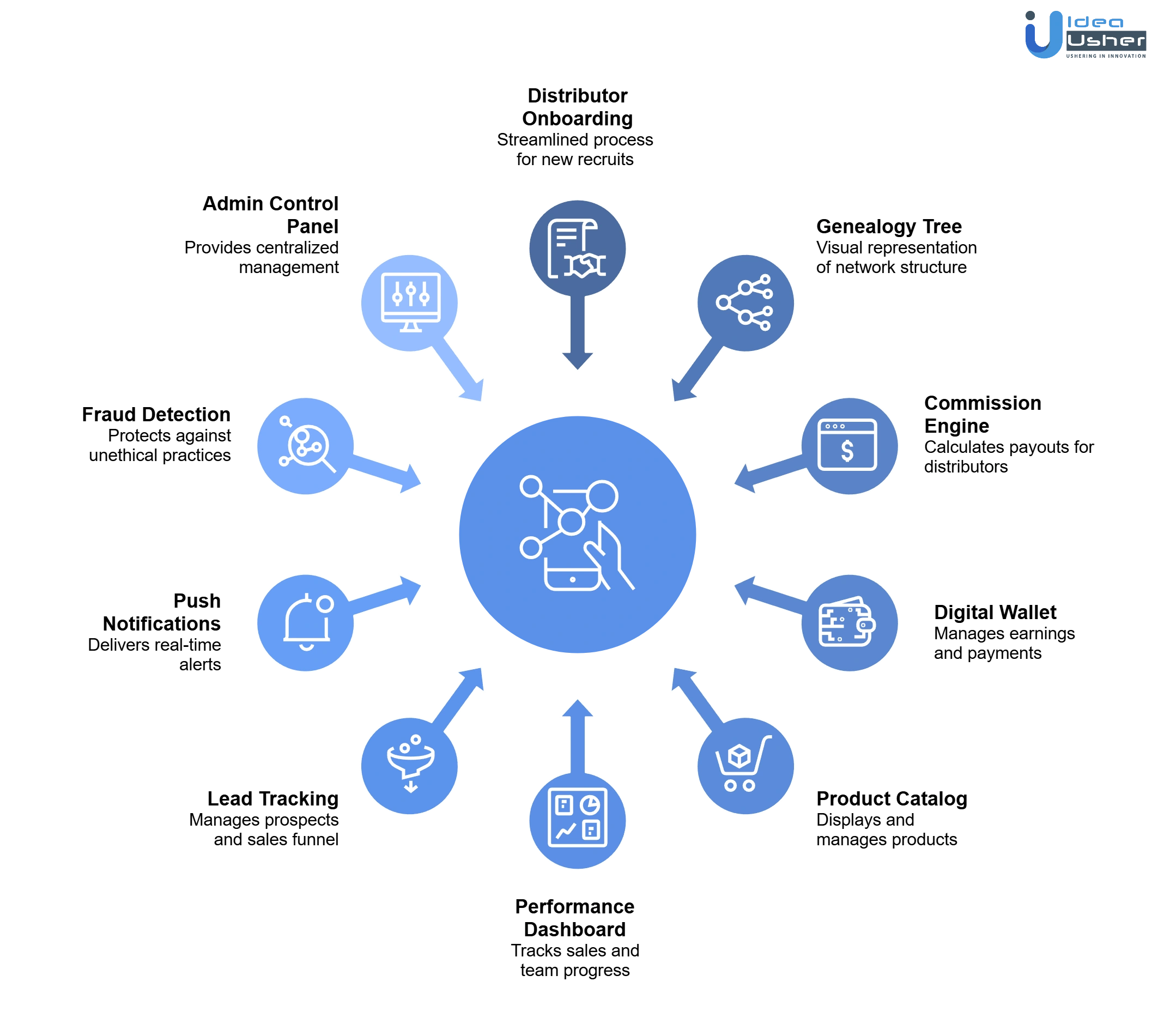
1. Seamless Distributor Onboarding & KYC
The first 48 hours are critical for distributor retention. Automated onboarding ensures new recruits can start selling immediately without administrative friction.
- AI-Powered Document Verification: Simple signup process with social logins and integrated OCR (Optical Character Recognition) scans IDs and tax documents in seconds, reducing manual approval times by 90%.
- Biometric KYC Verification: Utilize smartphone camera capabilities for instant ID verification and “Proof of Liveness,” ensuring every distributor is a verified human actor.
- Automated Welcome Workflows: Triggers a personalized “First Steps” training sequence as soon as the KYC is approved.
2. Genealogy Tree & Network Visualization
Visualizing the network structure is essential for distributors to understand their rank progress and team health.
- Interactive Tree Views: Allow users to explore their downlines through visual “Zoom-in/Zoom-out” maps that highlight active vs. inactive members.
- Rank-Based Color Coding: Instantly identifies high-performers, at-risk members, and new recruits through a color-coded legend.
- Advanced Downline Filtering: Enable distributors to sort their network by performance metrics, joining dates, or geographic locations to identify where coaching is needed most.
- Placement Strategy Tools: Visual indicators for “spillover” and automated placement logic to help leaders optimize their binary or matrix structures for maximum bonuses.
3. Flexible Commission & Bonus Engine
The heart of any MLM app is the payout engine. It must be robust enough to handle complex calculations without lag.
- Multi-Plan Compatibility: Supports Unilevel, Binary, Matrix, and Hybrid plans simultaneously within a single architecture.
- Real-Time Payout Calculations: Commissions are updated in “near real-time,” providing instant gratification as sales are closed.
- Global Tax & Compliance Logic: Automatically calculates VAT, GST, or local sales taxes based on the user’s and customer’s geographic locations.
- Dynamic “What-If” Simulator: A calculator tool that allows reps to see how much they would earn if they hit specific sales targets or rank milestones.
4. Integrated Digital Wallet & Payment Tracking
Modern distributors expect instant access to their earnings through a variety of payment methods.
- Hybrid Fiat-Crypto Support: Allows users to withdraw earnings via bank transfer, credit card or stablecoin (USDT/USDC) for global flexibility.
- Transaction Transparency: Provides a detailed ledger of every cent earned, pending, and withdrawn, categorized by bonus type.
- Internal Peer-to-Peer (P2P) Transfers: Enables users to send wallet funds to downline members for internal credit or onboarding fees.
- Automated Split-Payments: Instantly splits a customer’s payment into company profit and distributor commission at the moment of the transaction.
5. Product Catalog & Order Management
The app should function as a high-conversion e-commerce storefront for both distributors and their customers.
- Dynamic Inventory Syncing: Real-time integration with warehouse management systems to prevent “out-of-stock” sales.
- Smart Discount Engines: Automatically applies distributor pricing, bulk discounts, or limited-time promotional codes during checkout.
- End-to-End Tracking: Provides real-time shipping updates and push notifications from the warehouse to the customer’s doorstep.
- AI “Smart Reorder” Alerts: Analyzes customer consumption patterns to nudge distributors to follow up for refills exactly when the customer is likely running low.
6. Real-Time Performance Dashboard & Analytics
Data-driven decisions are what separate top-tier earners from the rest. The dashboard should be a “command center” for the business.
- Personal vs. Group Volume (PV/GV): Visual progress bars showing exactly how close the team is to hitting the next monthly goal.
- Churn Risk Indicators: Flags team members who haven’t logged in or placed an order in 14+ days, prompting upline intervention.
- Earning Trend Charts: Displays month-over-month growth patterns to help users visualize their business trajectory.
- Top 1% Benchmarking: Compares a user’s current activity (calls made, leads closed) against the platform’s top earners to identify gaps in their daily routine.
7. Lead, Prospect & Sales Funnel Tracking
Integrated CRM features prevent leads from falling through the cracks, which is the #1 reason for MLM failure.
- Automated Lead Scoring: Ranks prospects based on their engagement with shared links or marketing videos.
- Follow-Up Reminders: Sends automated nudges to the distributor to call a prospect after a specific period of inactivity.
- Pre-Built Marketing Assets: A library of videos, social posts, and scripts that can be shared with prospects in one tap.
- AI Social-Profile Synthesis: Scans a prospect’s public social data to suggest the most effective “opening script” based on their interests or career history.
8. Push Notifications & Real-Time Alerts
Information must be delivered instantly to maintain momentum in the MLM software.
- New Sign-Up Alerts: Triggers a celebration notification whenever a new member joins the user’s downline.
- Commission Milestones: Notifies users the second a significant bonus is credited to their wallet.
- Company-Wide News Broadcasts: Instant updates for product launches, webinar links, or policy changes directly from the admin.
- Gamified Behavior Nudges: Sends motivational alerts like, “You’re only $50 away from the Platinum Rank! Close one more sale to unlock a 5% bonus.”
9. Fraud Detection & Risk Management Tools
Protecting the integrity of the payout system is vital for the long-term sustainability of the company.
- Duplicate Account Detection: Uses device ID and IP tracking to prevent “stacking” (where one person creates multiple fake accounts to game the bonus system).
- Suspicious Activity Flagging: AI identifies unusual patterns, such as a sudden influx of $0 orders or 100% refund rates from a single leg.
- Geofencing & IP Monitoring: Ensures sales and sign-ups are coming from authorized regions to maintain international compliance.
- AI “Stacking” Analysis: Detects unethical placement tactics where uplines move high-performers into artificial positions to exploit specific binary bonuses.
10. Centralized Admin Control Panel
The business owners must have total visibility and control over the entire ecosystem from a single interface.
- Member & Role Management: Allows admins to view, edit, or suspend any user account and manage permissions for regional managers.
- Plan Configuration Tools: A “no-code” interface to adjust commission percentages, rank requirements, or promo periods instantly.
- Comprehensive Audit Logs: Records every administrative action and financial transaction for total transparency and regulatory compliance.
- Network “Health Score”: An AI-generated metric that summarizes the overall vitality of the company, factoring in sign-up rates, retention, and average order value.
Advanced Features That Can Give You a Competitive Edge
To stay ahead in mobile MLM software development, your platform needs smart, modern features that improve accuracy, engagement, and overall distributor performance.
- AI-Powered Lead Scoring & Insights: AI analyzes behavior and engagement patterns to highlight high-quality leads and suggest the best times and methods for follow-ups.
- Automated Commission & Payout System: The platform handles complex MLM structures and calculates commissions instantly, ensuring accurate, transparent, and timely payouts.
- Real-Time Sales and Team Analytics: Live dashboards let distributors track sales, rank progress, and team activity, helping them identify opportunities and gaps quickly.
- Built-In E-Wallet With Fast Withdrawals: Users can store commissions securely and access instant withdrawal options through integrated payment gateways.
- Automated Recruitment Funnels: Customizable landing pages and automated follow-up sequences help distributors manage prospects more efficiently.
- Targeted Push Notifications: Personalized updates, reminders, and promotions keep distributors engaged and informed in real time.
- Multi-Language & Multi-Currency Support: The platform adapts seamlessly to global markets, making international expansion easier for growing MLM companies.
- API and Third-Party Integrations: Smooth integration with CRM systems, ecommerce tools, and payment gateways enhances overall efficiency and flexibility.
How to Develop a Mobile MLM Software?
Developing a mobile MLM application is a precision-engineering task that requires balancing front-end simplicity with back-end complexity. At IdeaUsher, we follow a rigorous, field-tested methodology to move your concept from a whiteboard to the global market in record time, leveraging our history of 1,000+ successful digital transformations.
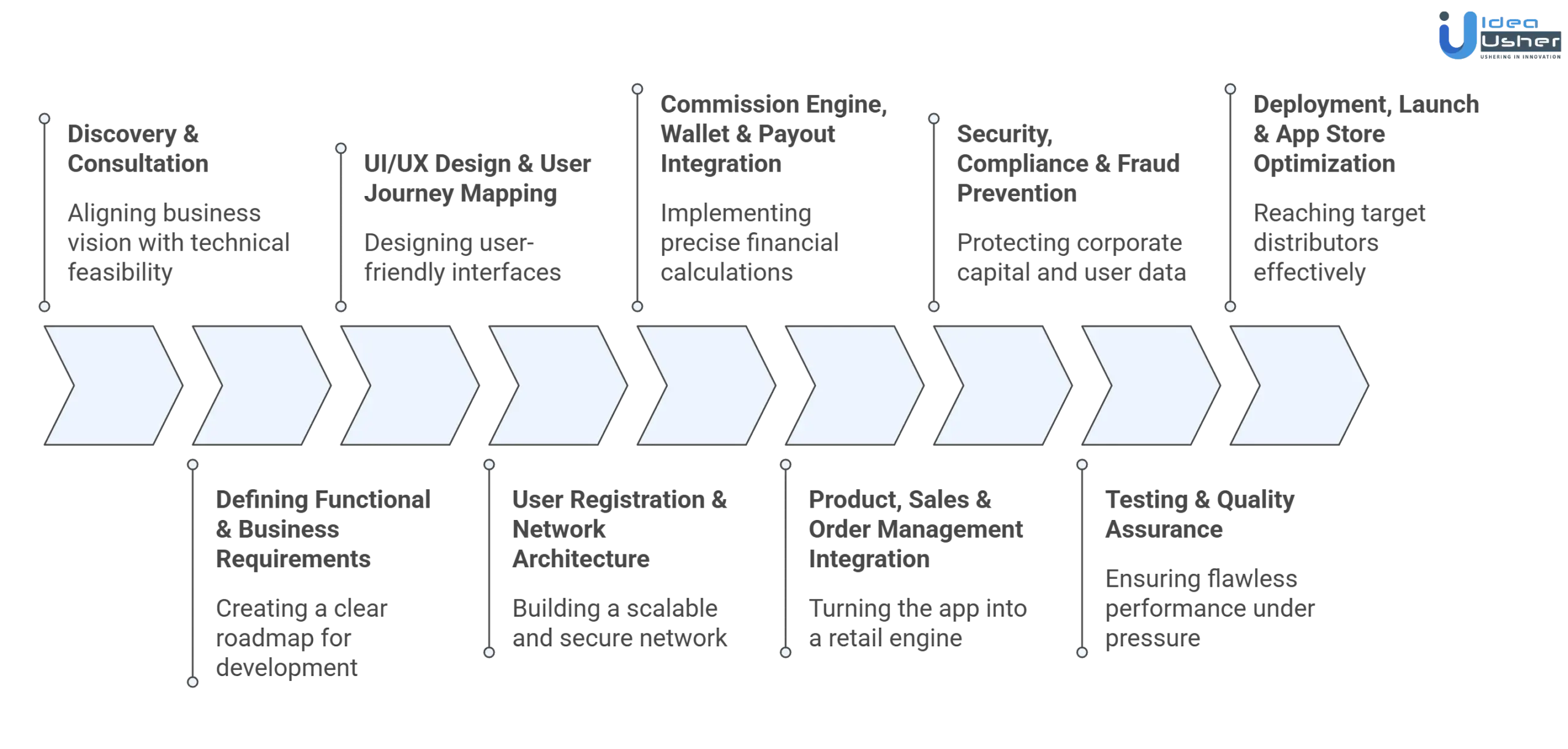
1. Discovery & Consultation
We begin by aligning your business vision with technical feasibility to ensure a solid foundation for growth.
- Stakeholder Vision Alignment: We conduct deep-dive sessions to map your specific compensation plan (Binary, Unilevel, etc.) and target demographic.
- Strategic Market Gap Analysis: Drawing on our experience across 30+ industries, we identify unique features that will give your platform a distinct competitive edge.
- Technical Feasibility Audit: Our architects evaluate your existing infrastructure or data to plan for seamless, zero-latency third-party integrations.
2. Defining Functional & Business Requirements
A clear roadmap prevents scope creep and ensures every line of code serves a specific business objective.
- Feature Prioritization (MVP vs. Scale): We categorize functionalities to maximize your initial budget, focusing on high-impact trading or recruiting loops first.
- Regional Compliance Mapping: Our legal-tech experts define the necessary gates for regional tax laws, GDPR data privacy, and MLM-specific legalities.
- Technical SRS Documentation: We produce a detailed Software Requirement Specification that acts as the immutable blueprint for our development team.
3. UI/UX Design & User Journey Mapping
The success of an MLM app depends on how easily a non-technical distributor can manage their multi-level business on the go.
- Persona-Driven Interfaces: We create custom designs tailored for different user roles, ensuring top-tier leaders and new recruits see exactly what they need.
- Frictionless Flow Optimization: We map the user journey to ensure that placing an order or checking a commission requires fewer than three intuitive taps.
- High-Fidelity Interactive Prototypes: You receive clickable mockups to “test-drive” the experience, allowing for UX refinements before a single line of code is written.
4. User Registration & Network Architecture
The genealogy is the heart of the system; IdeaUsher builds it to be immutable and infinitely scalable.
- Automated Placement Logic: We hard-code the rules for your specific network structure to ensure 100% accuracy in “spillover” and leg balancing.
- Scalable Node Architecture: Our back-end is engineered to handle millions of distributors without any degradation in tree-rendering or calculation speeds.
- AI-Powered KYC Integration: We implement biometric ID verification to prevent fraudulent accounts and maintain the absolute integrity of your network.
5. Commission Engine, Wallet & Payout Integration
This is the most critical technical component, requiring mathematical precision and high-level security for financial data.
- Real-Time Calculation Engine: We build a proprietary math core that calculates complex multi-tier bonuses and rank advancements instantly.
- Multi-Gateway E-Wallet Systems: We integrate global payment solutions, including fiat on-ramps and stablecoin payouts, to support borderless operations.
- Immutable Audit Ledgering: Every transaction is recorded with a unique hash, ensuring a transparent, tamper-proof financial history for every distributor.
6. Product, Sales & Order Management Integration
We turn your app into a high-conversion retail engine that syncs perfectly with your global supply chain.
- Live Inventory Synchronization: We connect your app directly to ERP/WMS systems to ensure product availability is always reflected accurately in real-time.
- Dynamic Tax & Logistics Logic: Our system calculates regional duties and shipping costs on the fly based on the user’s detected geographic location.
- Recurring Revenue Modules: We implement sophisticated subscription billing engines to drive predictable monthly sales and simplify re-ordering for customers.
7. Security, Compliance & Fraud Prevention
IdeaUsher applies a “Defense-in-Depth” strategy to protect your corporate capital and your users’ sensitive personal information.
- Enterprise-Grade Encryption: We secure all data transfers and storage using SSL/TLS and AES-256 standards, meeting the highest 2026 security benchmarks.
- Proactive Fraud Monitoring: Our systems use anomaly detection to flag “Stacking” or “Bonus Hunting” before they can impact your company’s bottom line.
- Global Data Sovereignty: We ensure your platform remains fully compliant with the GDPR, CCPA, and regional data protection acts relevant to your markets.
8. Testing & Quality Assurance
We subject the platform to rigorous stress tests to ensure it performs flawlessly under the pressure of a global recruiting surge.
- Automated Regression Testing: We run thousands of automated scripts to ensure that new feature updates never break your core commission logic.
- Load & Stress Simulation: We simulate massive traffic spikes to guarantee the app stays responsive during major company events or product launches.
- User Acceptance Testing (UAT): We facilitate a managed beta-testing phase with a select group of distributors to gather and implement real-world feedback.
9. Deployment, Launch & App Store Optimization
Our partnership extends to the final mile, ensuring your app reaches your target distributors effectively across all platforms.
- Multi-Platform Store Launch: We handle the complex technical requirements for deploying on both the iOS App Store and Google Play Store simultaneously.
- Data-Driven ASO Strategy: Our marketing experts optimize your store listings with high-conversion keywords and visual assets to drive organic downloads.
- 24/7 Post-Launch Support: IdeaUsher provides dedicated technical maintenance to ensure your network stays “always-on” and operational in every time zone.
Cost Breakdown for Developing a Mobile MLM Software
Creating an AI-integrated MLM platform in 2026 requires a precise Financial Commission Engine and top-tier security. To minimize costs and launch within 3–4 months, an MVP should focus strictly on User Onboarding and the core engine. Below is a detailed cost breakdown based on current 2026 market rates for a high-quality, scalable solution.
| Development Phase | Cost Range | Key MVP Deliverables | Estimated Timeline |
| Discovery & Strategy | $3,000 – $5,000 | Lean SRS, 1 Core Plan logic (e.g., Binary), MVP Feature Roadmap. | 1–2 Weeks |
| UI/UX Design | $5,000 – $8,000 | Essential screens only (Dashboard, Wallet, Tree, Profile), basic branding. | 2–3 Weeks |
| Backend & Engine Dev | $15,000 – $22,000 | Core 1-Plan logic, basic Database, Referral link generator, Admin API. | 6–8 Weeks |
| Frontend & Mobile Dev | $10,000 – $15,000 | Responsive Web App or Basic Hybrid App (1 platform), simple Admin panel. | 4–6 Weeks |
| Essential Security | $5,000 – $8,000 | Basic KYC (ID upload), SSL, Secure Auth, 1 Payment Gateway integration. | 2 Weeks |
| Basic QA & Testing | $4,000 – $6,000 | Core logic testing, basic bug fixes, mobile responsiveness check. | 2 Weeks |
| MVP Deployment | $2,000 – $4,000 | Cloud setup (AWS/DigitalOcean), basic CI/CD, production launch. | 1 Week |
| Total MVP Estimated Cost | $47,000 – $70,000 | ~3-4 Months |
Note: The estimated cost can vary based on plan complexity, custom AI features, and user concurrency. Final pricing depends on your specific business requirements and technical goals.
Tier-Wise Mobile MLM Software Development Cost
Choosing the investment tier for mobile MLM software defines scalability, compliance, and long term ROI. This breakdown highlights features, costs, and strategic advantages across MVP, mid scale, and enterprise levels.
| Tier | Investment Range | Strategic Value |
| MVP Build | $45k – $70k | Robust 1-plan commission engine, secure member portal, manual KYC, single-currency support, and encrypted storage. |
| Mid-Scale | $75k – $130k | Native iOS/Android apps, hybrid compensation, AI lead scoring, automated KYC, multi-currency support, and P2P E-wallets. |
| Enterprise | $150k – $350k+ | Agentic AI, biometric security, real-time compliance, NPU-optimized genealogy, and high-concurrency architecture for 100k+ distributors. |
Factors That Influence MLM Software Development Cost
Calculating the 2026 investment for an MLM platform involves balancing math and high-end tech. Costs for these financial engines vary based on risk, automation, and the scale needed for glitch-free operations.
- Compensation Plan Complexity: The primary cost driver is plan logic. Hybrid plans with advanced bonuses can increase development time by 35%–50% due to necessary stress-testing.
- AI Integration Depth: Adding Agentic AI for autonomous tasks typically adds 20%–30% to the initial budget, but often results in a 60% reduction in long-term admin costs.
- User Concurrency & Scalability: Architecture for 100,000+ concurrent users prevents crashes during peak periods and accounts for about 15% of the backend budget.
- Device Compatibility: Native development provides superior performance for AI but can increase frontend costs 2x compared to cross-platform (Flutter/React Native) builds.
- Security & Compliance: Implementing 256-bit encryption and real-time tax compliance for 10+ countries adds roughly $7,000–$15,000 to the security layer.
- Third-Party Ecosystem: Integrating external APIs for KYC, payments, and SMS requires 20–40 engineering hours per integration to ensure synchronization.
Tech Stack Required to Build a Mobile MLM Software
Selecting the right tech stack for an MLM platform in 2026 isn’t just about what’s popular; it’s about what can survive the “Month-End Rush” that high-concurrency window where thousands of distributors are checking their rank status simultaneously.
| Category | Recommended Stack | Why It Is Essential for MLM |
| Mobile Frameworks | Flutter, React Native | Allows for a single codebase across iOS and Android, cutting development time by 40% while maintaining 60 FPS native performance. |
| Backend & Logic | Node.js, Django, Go | Handles asynchronous tasks (like massive commission calculations) with high efficiency. Go is particularly favored in 2026 for its superior concurrency handling. |
| Database Systems | PostgreSQL (Relational), MongoDB | Relational databases are a must for financial integrity (Genealogy/Commissions), while NoSQL (MongoDB) handles flexible user profiles and activity logs. |
| Cloud & Infrastructure | AWS (Lambda/EC2), Google Cloud | Provides “Auto-Scaling” capabilities, ensuring the app doesn’t crash when traffic spikes by 500% during a major product launch or rank-reset day. |
| API Layer | RESTful APIs, GraphQL | GraphQL is increasingly used for MLM dashboards to allow the frontend to request only the specific “Tree” data it needs, reducing mobile data usage. |
| Payment & Payouts | Stripe, Razorpay, BitPay | Essential for automated split-payments and global “Mass Payouts” to distributors across different geographic regions and currencies. |
| Auth & Security | OAuth 2.0, JWT, Biometric API | Secures the “Digital Wallet” layer using JSON Web Tokens (JWT) for session management and biometric hardware integration for transaction approvals. |
| Analytics & BI | Firebase, Power BI, Mixpanel | Provides real-time “Retention Signals” and downline growth metrics, allowing admins to see where the network is expanding or stalling. |
Challenges in Building a Mobile MLM Software
Developing mobile MLM software in 2026 demands navigating intricate financial algorithms and high-concurrency architecture. Engineers must ensure absolute mathematical precision while protecting systems against sophisticated fraud. These hurdles define the difference between a scalable enterprise and a failed platform launch.
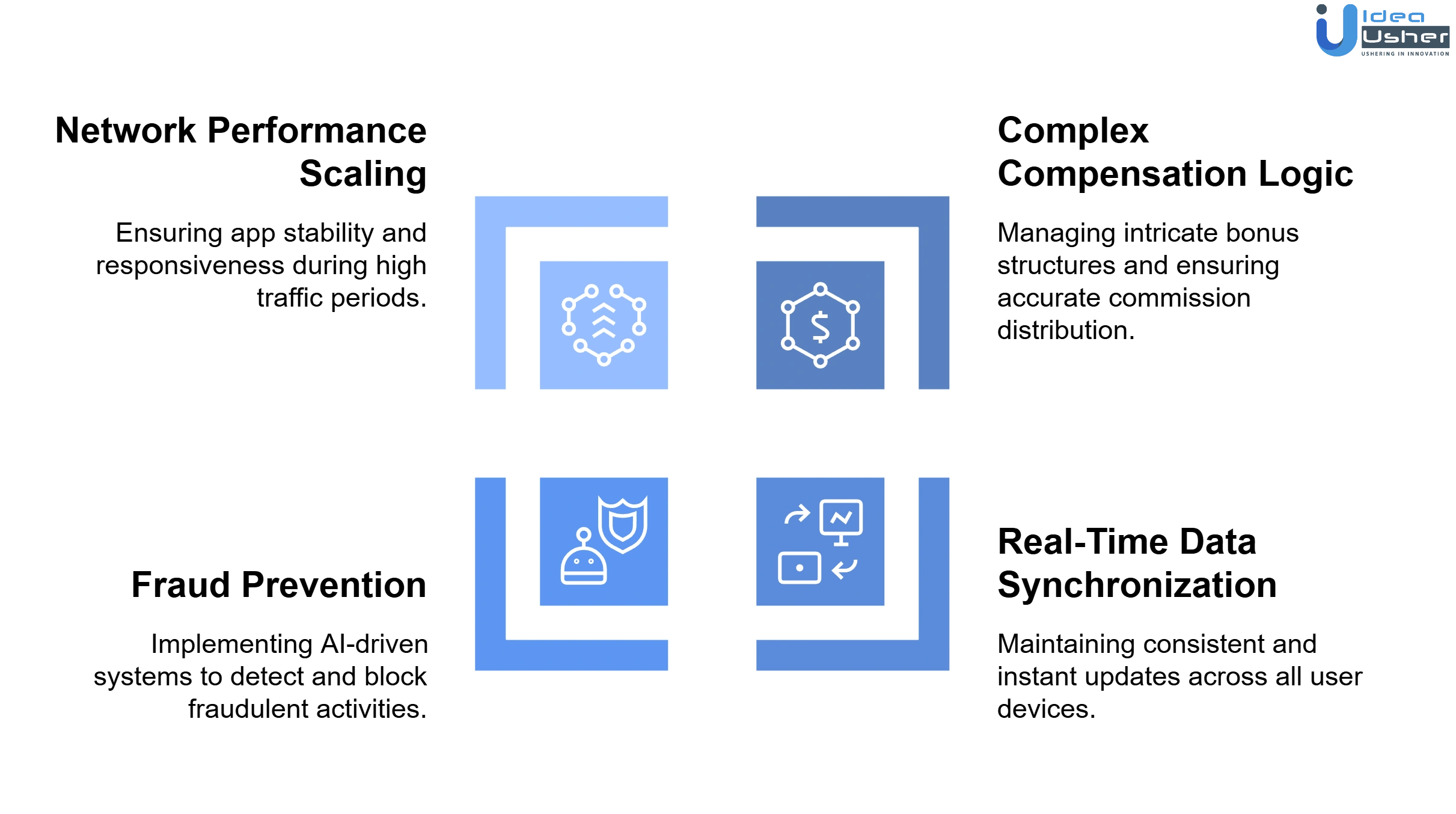
1. Managing Complex Compensation Logic
Challenge: Hybrid structures and multi-level bonuses create deep mathematical dependencies, making it difficult to calculate thousands of global commissions without errors.
Solution: We utilize isolated microservices and rigorous regression testing, allowing our developers to simulate millions of transaction scenarios, ensuring every cent is distributed correctly across even the most complex reward structures.
2. Ensuring Real-Time Data Synchronization
Challenge: Maintaining consistency across genealogy trees, e-wallets, and global sales updates in real-time is difficult when thousands of users interact simultaneously.
Solution: Our developers implement event-driven architectures and WebSocket protocols, ensuring that tree placements and wallet balances reflect instantly across all devices, eliminating discrepancies and building trust within your global distributor network.
3. Preventing Fraud & System Abuse
Challenge: Sophisticated “stacking” tactics and duplicate accounts can exploit binary bonuses, leading to massive financial losses and destabilizing the company’s economy.
Solution: We integrate AI-driven behavioral biometrics and IP-based tracking systems, allowing our developers to detect and block irregular patterns automatically, securing your commission engine from unethical manipulation and protecting your profits.
4. Scaling Network Performance
Challenge: Sudden traffic spikes during month-end rank achievements can overwhelm traditional servers, causing app crashes and preventing critical sales from processing.
Solution: Our developers deploy auto-scaling cloud clusters and load balancers, ensuring the infrastructure dynamically expands to handle high-concurrency periods smoothly, maintaining peak performance even as your network grows into global millions.
Monetization Models for Mobile MLM Apps
Mobile MLM apps can generate revenue through multiple models, combining subscription plans, transaction fees, premium features, and in-app purchases. Choosing the right approach ensures sustainability while providing value to distributors and the company.
1. Subscription Plans
Charge distributors a recurring monthly or yearly fee to access the app’s core features, dashboards, and tools. This ensures a predictable revenue stream while providing ongoing value to users. Subscription tiers can also encourage users to upgrade for more advanced features.
2. Transaction or Commission Fees
Take a small percentage from every product sale, order, or payout processed through the app. This aligns the app’s revenue with business activity and scales naturally with growth. It also incentivizes the platform to support higher sales volumes.
3. Premium Features or Add-Ons
Offer advanced features like enhanced analytics, CRM tools, or custom reporting, under a premium tier. Distributors or teams can pay extra for tools that boost efficiency and performance. These upgrades enhance user retention by providing tangible business advantages.
4. White-Label Licensing for Other Companies
License the mobile MLM software to other businesses under their brand name. This one-time or recurring licensing model expands revenue without requiring direct sales to end-users. It also allows the platform to tap into multiple MLM niches simultaneously.
Top Examples of Mobile MLM Software Platforms in 2025
Modern mobile MLM software is a mobile-first growth engine utilizing AI and real-time data. These platforms empower distributors to scale efficiently through intelligent network management and automated commission tracking. Here are the top platforms setting the benchmark for performance, scalability, and user experience in 2026.
1. Infinite MLM Software
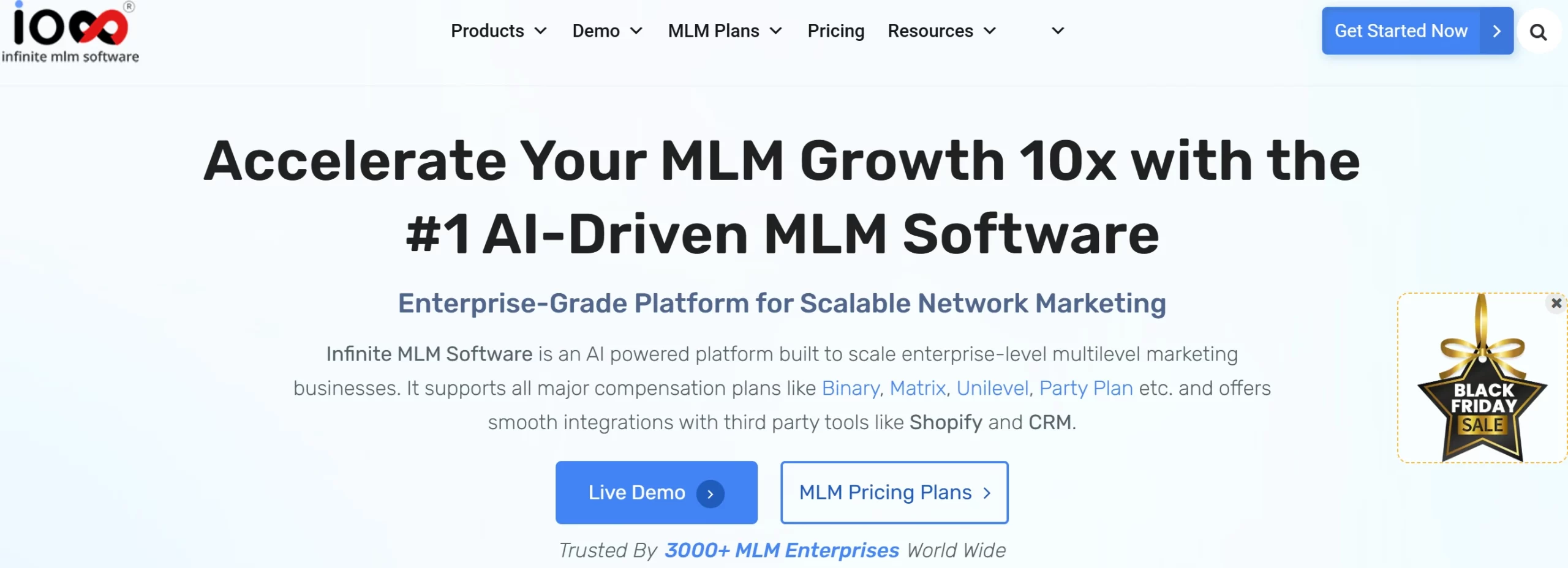
Infinite MLM Software’s AI Edition is a mobile-friendly tool that automates commissions, optimizes leads, and delivers predictive analytics. Its AI identifies top distributors, forecasts sales, and streamlines operations. The platform supports various compensation plans, e-commerce integrations, and real-time performance dashboards.
2. Epixel MLM Software
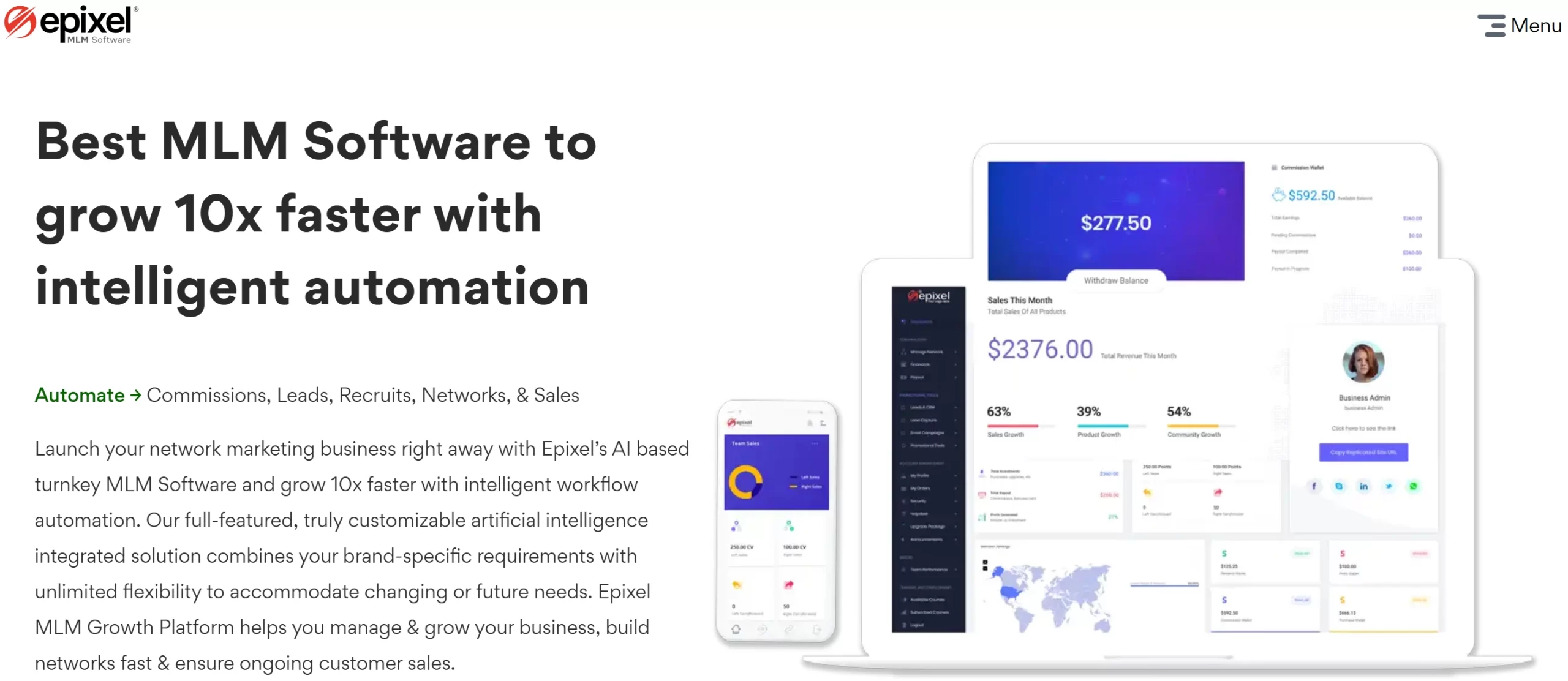
Epixel’s platform comes with AI‑driven automation, including smart onboarding, lead management, compensation planning, and marketing workflows. Their AI capabilities also help predict sales trends, suggest optimal incentive structures, and improve recruiter performance, all via a mobile‑friendly interface.
3. ProMLM Software

ProMLM leverages AI features to simplify complex MLM operations. Its mobile app offers real-time performance monitoring, lead management, and automated commission calculations. The platform supports multiple compensation plans, including binary, unilevel, and matrix, making it suitable for a wide range of network marketing businesses.
4. MarketPowerPRO
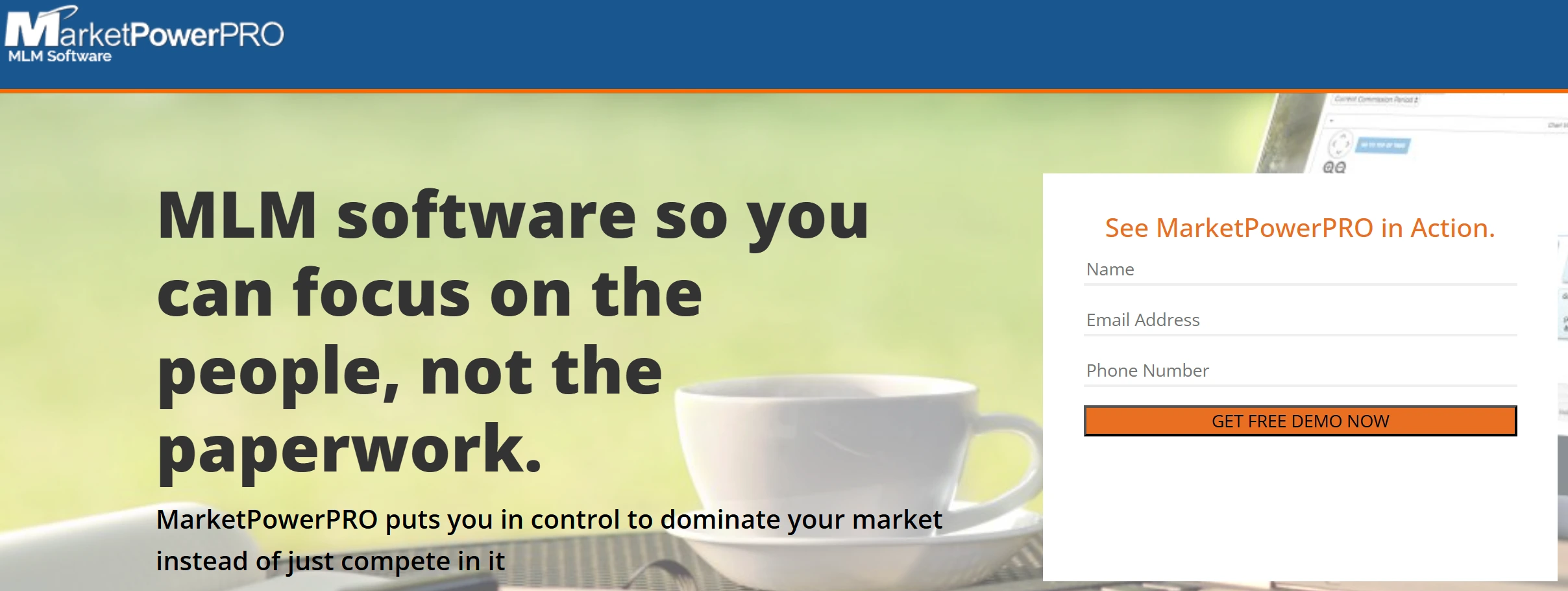
MarketPowerPRO is a mobile MLM software with replicated distributor sites, e-commerce integration, and real-time commission tracking. Its mobile interface lets distributors manage orders and sales anywhere. With support for 85+ payment gateways and multiple compensation plans, it suits established businesses needing a robust back office.
5. Flight Commerce
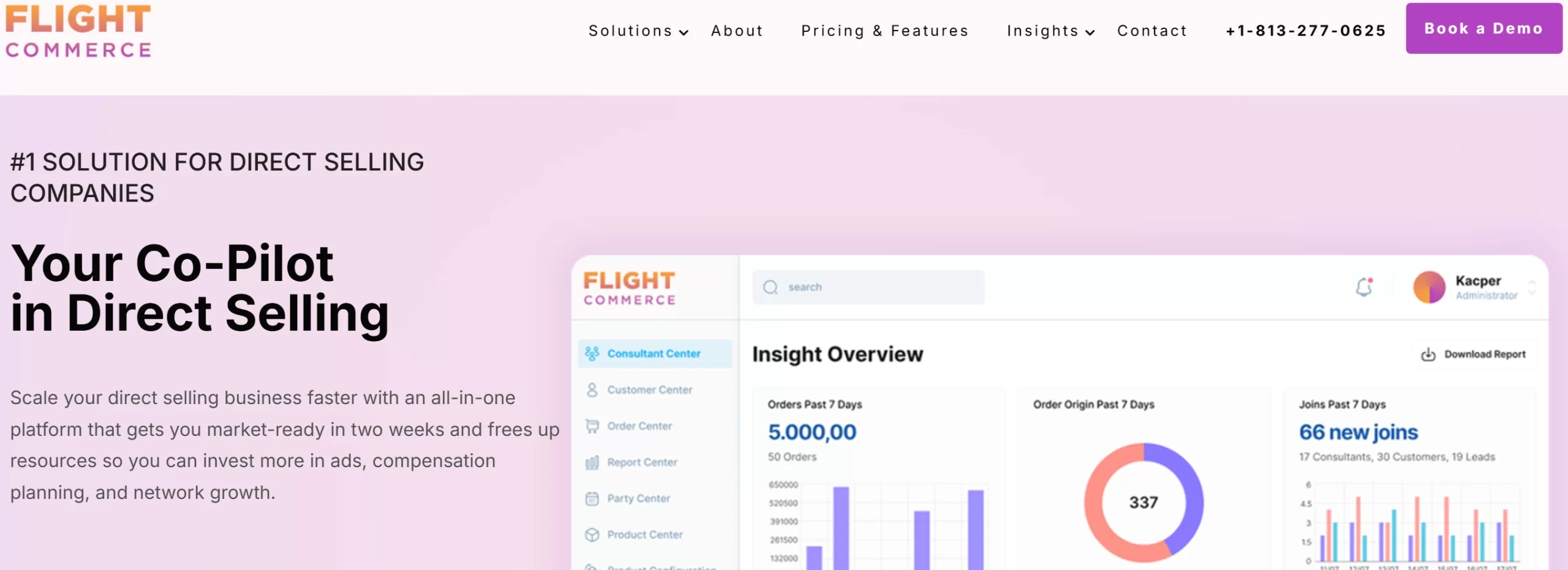
Flight Commerce integrates MLM operations with e-commerce on a mobile platform. Distributors can manage sales, track downlines, and access marketing tools easily. Its API-driven setup allows for simple configuration, and it supports multiple currencies and languages, making it ideal for international networks.
Why Choose IdeaUsher for Mobile MLM Software Development
Software serves as the fundamental operational engine of an enterprise in the competitive landscape of 2026 network marketing. Selecting an appropriate development partner is critical to ensuring system stability during peak activity and achieving seamless scalability.
With a powerhouse team of 250+ in-house tech experts and a proven track record of delivering 1,000+ successful projects globally, IdeaUsher brings the technical depth and industrial experience needed to build world-class MLM ecosystems.
A. End-to-End MLM Software Development Process
We design entire business ecosystems tailored to your specific goals. Using our experience across dozens of sectors, we ensure your platform remains flexible for any future business model changes.
- Tailored Compensation Engines: We develop bespoke logic for Binary, Unilevel, Matrix, or Hybrid-Stair-Step plans to precisely match your financial objectives.
- Brand-Differentiating Features: We build custom tools, such as training portals and loyalty economies, to set your brand apart in the 2026 market.
- Microservices Architecture: Our scalable approach allows independent growth for your frontend and databases as your network expands to millions.
B. Proven Expertise in Building Scalable Platforms
Security isn’t an afterthought at IdeaUsher; it’s the foundation. Having worked with both Fortune 500 companies and high-growth startups, we understand the mission-critical nature of data integrity and secure payouts.
- Secure Payouts: We use global gateways, blockchain, and AES-256 encryption to guarantee accurate, timely distributor payments.
- Fraud Prevention: AI tools proactively detect stacking, suspicious activity, and duplicate accounts to protect your revenue.
- High-Concurrency: Our infrastructure handles 500%+ traffic spikes, ensuring fluid genealogy and checkout processes during peak periods.
C. Faster Time-to-Market with Agile Development Approach
The first-mover advantage is everything as we worked with the USA, India, UK, and Canada clients, our global footprint allows us to work around the clock to get your product to market faster.
- Rapid MVP Strategy: Launch a Minimum Viable Product (MVP) in 3 to 4 months, prioritizing the core commission engine and onboarding for immediate ROI.
- Agile Methodology: Bi-weekly sprints provide transparency, allowing for constant feedback and iterative progress.
- Future-Proof Engineering: “Clean Code” and automated testing build a scalable foundation, preventing the need for future rewrites.
Conclusion
Building an effective platform requires careful planning, secure architecture, and intuitive design. Mobile MLM software development focuses on enabling seamless network management, real-time tracking, and automated commission calculations. By integrating features like user-friendly dashboards, reporting tools, and secure payment gateways, businesses can empower their distributors while ensuring transparency and efficiency. Prioritizing scalability, performance, and compliance ensures the software can support growing networks without disruption. A strategic approach to mobile MLM software development transforms complex network operations into a streamlined, reliable, and user-centric experience for both administrators and participants.
FAQs
Mobile MLM software development involves creating applications that help manage multi-level marketing networks. These apps enable real-time tracking of sales, commissions, network growth, and communication between distributors, streamlining operations and improving efficiency.
Essential features include distributor dashboards, commission tracking, network visualization, secure payment gateways, reporting tools, and push notifications. These functionalities empower users to manage teams effectively while maintaining transparency and accountability.
MLM apps use cloud databases, secure APIs, mobile frameworks like React Native or Flutter, payment integrations, and analytics tools. These technologies ensure real-time updates, scalability, and secure management of financial and network data.
Scalability and security are achieved through robust cloud infrastructure, encrypted data storage, secure authentication, regular updates, and compliance with financial regulations. This ensures the app can support growing networks without risking data breaches or downtime.