

Key Takeaways
- Generative AI development costs usually vary between $20,000 and $1M+, depending on product complexity, data preparation, security needs and infrastructure.
- The GenAI architecture may include APIs, RAG, fine-tuning, or custom models, chosen based on business goals, data needs and the desired level of control.
- Major GenAI development cost drivers include model integration, data preparation, RAG pipelines, third-party integrations, compliance, infrastructure and ongoing maintenance.
- Enterprise-grade GenAI systems need workflows, access controls, guardrails, human oversight, evaluation and monitoring to keep performance secure and consistent.
- Choosing a GenAI development partner with expertise in AI architecture, data engineering, integration, security and testing can help prevent overspending and technical failures.
A generative AI product may seem budget-friendly during the minimum viable stage, but costs can grow as businesses expect accurate, safe and consistent results. The real challenge is not simply linking a model to a user interface. It is creating an AI system that understands business data, follows workflows and works well as usage grows. That is why generative AI development cost depend on choosing the right model, preparing data, designing the architecture, meeting security needs and managing product complexity.
Generative AI costs increase when companies use it for more than simple assistants. Businesses now want GenAI tailored to specific industries with domain-specific AI, retrieval-augmented generation, fine-tuning, workflow automation, human oversight and ongoing evaluation to turn promising prototypes into reliable products. For builders, this creates an opportunity to design AI systems focused on business outcomes rather than novelty.
In this blog, we will talk about generative AI development cost in 2026, major pricing factors, development stages, technology choices, infrastructure expenses, maintenance costs, ROI considerations and how to plan a scalable generative AI product that delivers reliable performance as user demand and business requirements grow.
What Is Generative AI?
Generative AI creates new content including text, images, audio, video, code, summaries and synthetic data from patterns in large datasets. Rather than training models from scratch, modern business applications typically build on LLMs and multimodal foundation models via APIs, RAG, fine-tuning, or custom setups.
At the enterprise level, Generative AI has evolved from a consumer novelty into a cognitive compute layer. It acts as an organizational intelligence engine that ingests unstructured enterprise knowledge, including PDFs, operational transcripts, technical documentation and customer correspondence and converts it into actionable, automated workflows.
A. How Generative AI Works in Business Applications
Deploying generative AI in production requires far more than pinging a foundation model API with a raw prompt. Enterprise applications function across a multi-layered software stack designed to ground probabilistic models in deterministic corporate facts.
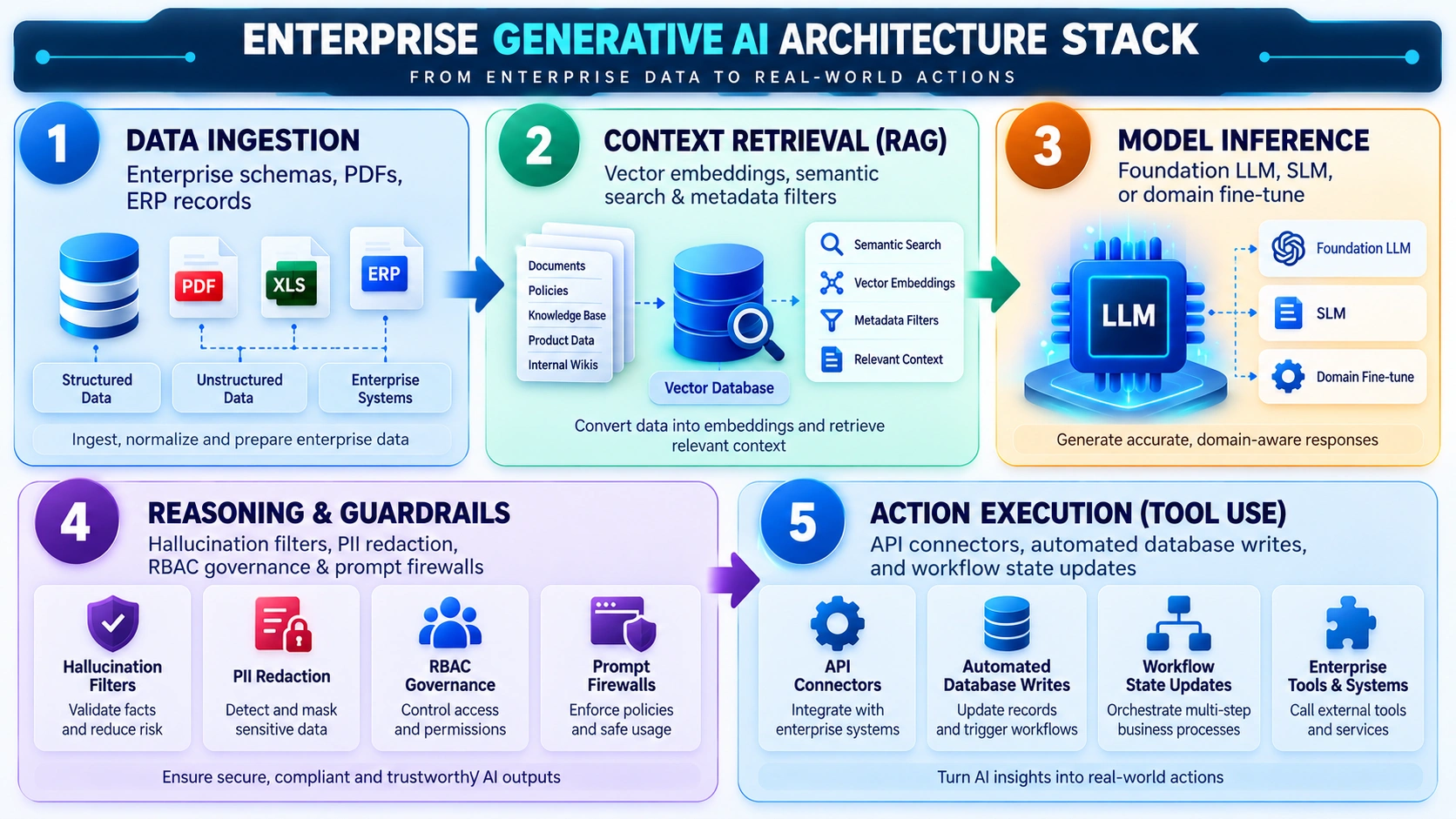
1. Contextual Grounding via Retrieval-Augmented Generation (RAG)
Instead of relying on static foundation-model weights, enterprise applications ingest live internal documentation, including SOPs, contract repositories and customer histories. These records become vector embeddings stored in databases such as Pinecone, Milvus and pgvector, enabling precise context retrieval at runtime.
2. Prompt Orchestration & In-Context Learning
User requests and retrieved business data pass through frameworks such as LangChain, LlamaIndex, or custom semantic routers that define operational parameters, task roles and output schemas, including structured JSON responses.
3. Inference Across Foundational & Small Language Models (SLMs)
The assembled context is processed through large foundation models or task-specific SLMs optimized for latency, domain accuracy and token economics. Model selection depends on the task, response time requirements, and overall operating cost.
4. Deterministic Guardrails & PII Filtering
Outbound tokens pass through defensive layers such as NeMo Guardrails and Llama Guard that screen for unsafe or hallucinated outputs, enforce RBAC and redact PHI or PII. These controls help maintain data privacy and reduce risks before responses reach users.
5. Autonomous Tool Calling & Action Execution
Advanced GenAI agents use function calling to interact with enterprise systems, triggering SQL queries, updating CRM records, sending webhooks or generating clean code commits. This allows AI agents to move beyond generating responses and perform controlled business actions.
B. What Can Generative AI Applications Do?
Modern generative AI applications address operational bottlenecks across knowledge management, software engineering, customer operations and domain-specific decision support:
| Functional Domain | Enterprise Application | Operational Impact |
| Knowledge Synthesis & Enterprise Search | Multimodal RAG platforms ingest technical manuals, internal policies and compliance briefs. | Cuts research time by 60%–80% and reduces information silos across global teams. |
| Autonomous Process & Agentic Workflows | Multi-agent systems research, draft, cross-reference regulations and stage transactions across back-office systems. | Replaces manual data entry and accelerates complex administrative work from days to minutes. |
| Software Modernization & Code Generation | AI generates unit tests, translates legacy code such as COBOL to Java and scaffolds microservices. | Increases sprint velocity by 25%–40% while improving documentation and test coverage. |
| Hyper-Personalized Customer Operations | Context-aware agents resolve Tier-1 and Tier-2 inquiries using conversational nuance and real-time account access. | Lowers cost per contact by 30%–50% while maintaining 85%+ first-contact resolution. |
| Synthetic Data & Risk Simulation | Generates de-identified, statistically representative datasets for financial stress testing and vision-model training. | Reduces privacy barriers and accelerates model training without exposing live consumer records. |
C. Why Is the Generative AI Market Growing So Fast?
The global generative AI market is on an unprecedented expansion trajectory, valued at $22.2 billion in 2025 and is projected to grow from $29.6 billion in 2026 to $324.7 billion by 2033, at a CAGR of 40.8% from 2026 to 2033. This rapid growth reflects rising enterprise adoption as businesses increasingly use generative AI for automation, content creation, analytics, and decision support.
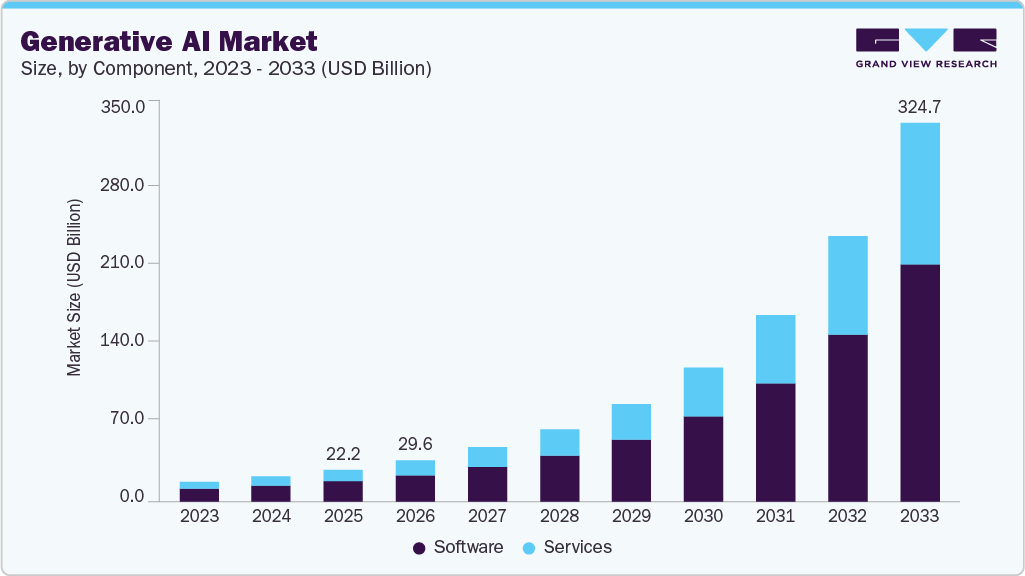
This exponential acceleration is driven by fundamental shifts in enterprise readiness. Businesses are moving beyond experimentation and investing in AI systems that support real workflows, customer needs, and measurable business outcomes.
- From Pilots to Business Impact: Generative AI is moving beyond experimentation. McKinsey’s 2025 survey found 88% of organizations regularly use AI, but nearly two-thirds have not scaled it enterprise-wide. Only 39% reported enterprise-level EBIT impact.
- Rise of Autonomous AI Agents: AI is evolving into agents that plan, reason, use tools and complete multi-step workflows. PwC found 79% reported AI-agent adoption, while 88% planned to increase AI budgets over the next 12 months.
- Lower Costs, Smaller Models: GPT-3.5-level performance costs fell from $20 to $0.075 per million tokens between December 2022 and August 2024, a 266.7-fold reduction. Efficient SLMs now support faster, domain-specific inference.
- Demand for Specialized AI: Enterprises need AI aligned with their data, terminology, workflows and regulations. An AWS-commissioned IDC study found 90.9% expect demand for vertical, industry-specific agents, while nearly two-thirds prefer customizable pre-built agents.
- Focus on Measurable Value: Organizations increasingly evaluate AI through productivity, cost reduction, revenue growth and decision quality. McKinsey found 80% identified efficiency as an AI objective, while high-performing organizations also prioritized growth and innovation.
D. Why Generative AI Development Is Not One-Size-Fits-All
A generic, off-the-shelf AI wrapper rarely survives the scrutiny of enterprise production. Organizations attempting to deploy standardized commercial chatbots across specialized business workflows encounter critical structural barriers:
- Security & Compliance Gaps: Public AI interfaces rarely meet regulated-industry requirements, such as HIPAA, SOC 2, PCI-DSS, or ITAR. Enterprises may need dedicated VPCs, zero-data-retention agreements and local or on-premise model execution.
- Domain-Specific Reasoning Needs: Standard foundation models can hallucinate around proprietary SKUs, ERP schemas and industry taxonomies, including CARC/RARC codes and CPT crosswalks. Custom RAG, fine-tuned adapters, or domain-trained SLMs improve accuracy.
- Model Cost and Latency Balance: Using frontier models for basic classification or data normalization increases costs and latency. Engineering teams should route simple tasks to sub-8B models while reserving advanced reasoning models for complex logic.
- Data Ownership & IP Control: Dependence on closed AI platforms creates exposure to pricing increases, API changes and model drift. Custom development enables ownership of data pipelines, fine-tuned weights and agentic frameworks.
The Enterprise Takeaway: Generative AI is not an end-user product; it is a foundational computing architecture. Realizing its commercial value requires moving beyond generic prompt wrappers and building tailored systems that combine contextual retrieval (RAG), strict enterprise security guardrails, domain-specific fine-tuning and deterministic API execution.
How Much Does Generative AI Development Cost in 2026?
Generative AI development cost in 2026 vary widely based on the model, features, data requirements, integrations, infrastructure, security, and maintenance. Understanding these factors helps businesses estimate budgets, choose the right development approach, and plan scalable AI solutions.
| Investment Tier | Typical Budget | Timeline | Typical Scope | Primary Use Cases |
| Focused AI Solution | $20,000 – $60,000 | 6 – 10 weeks | Hosted model API, basic UI, limited integrations, optional retrieval | Internal copilots, FAQ assistants, document summarizers |
| Production AI Application | $60,000 – $250,000+ | 3 – 6 months | RAG, multiple integrations, custom UI/UX, agentic workflows, monitoring | Customer-facing assistants, intelligent operations, proprietary search |
| Enterprise AI Platform | $400,000 – $1M+ | 6 – 12+ months | Advanced security, governance, complex integrations, custom AI capabilities | Regulated operations, mission-critical AI products, multi-system automation |
These generative AI development cost estimates provide a starting point, but the actual investment depends on what the application needs to accomplish. The following tiers explain what each budget can realistically deliver.
A. What Can Be Built With a $20,000–$60,000 AI Budget?
A $20,000–$60,000 budget builds an MVP or departmental copilot to test operational hypotheses. Teams avoid building custom AI infrastructure, relying instead on managed foundation model APIs (e.g., OpenAI, Anthropic, Google Gemini).
- Architecture Scope: A lightweight front-end (React or Next.js), an API orchestration layer (FastAPI or Node.js) and hosted model endpoints using prompt engineering and context stuffing.
- Data & Retrieval: Basic semantic search or a simple vector database instance (e.g., Pinecone Serverless or managed pgvector) connected to a static knowledge repository (like product documentation or company handbooks).
- System Integrations: 1 to 2 standard touchpoints such as an internal Slack/Teams bot, basic Google Workspace connectors, or a single CRM hook.
- Security & Auth: Standard OAuth2 authentication, basic role permissions and managed API key vaulting.
Why it matters: This tier allows organizations to prove real-world business value and user adoption before committing six-figure capital. It is suitable for internal team productivity tools, automated first-draft content generators, or simple self-service customer bots.
B. When Does an AI Application Cost $60,000–$250,000+?
Moving from an internal tool to a production-grade AI application typically requires a budget of $60,000–$250,000+. At this level, the software must be reliable, auditable, scalable under concurrent usage and deeply integrated into daily business operations.
- Advanced RAG Pipelines: Dynamic ingestion extracts and embeds data from live databases, SharePoint and ERPs. Hybrid search and re-ranking models minimize hallucinations and increase retrieval accuracy.
- Deep Multi-System Integrations: Two-way integration with 2 to 5 enterprise apps (e.g., Salesforce, HubSpot, SAP, custom APIs) enables automated tool-calling to execute tasks automatically.
- Tailored UI/UX & Roles: Purpose-built, responsive interfaces include granular Role-Based Access Controls (RBAC), multi-tenant data isolation and audit-logged admin consoles to support secure, role-specific access.
- Agentic Workflows & Guardrails: Multi-step autonomous execution combines programmatic policy guardrails, such as NeMo Guardrails and Llama Guard, with Human-in-the-Loop (HITL) approval gates for high-risk actions.
- Observability & MLOps: Production-grade tracing, token and cost monitoring, latency tracking and evaluation suites, such as LangSmith and Datadog, help detect model drift, evaluate performance and control API spending.
Why it matters: This is a critical commercial build band for startups launching AI-native products and mid-market companies automating revenue or customer service operations. It delivers software capable of handling public exposure while generating measurable labor-hour savings.
C. What Makes Enterprise AI Development Cost $400,000–$1M+?
Enterprise-grade AI engagements exceed $400,000 because of the extensive software engineering, compliance, data transformation and scalability requirements of global organizations, not simply the cost of calling proprietary LLMs.
- Complex Data Governance & Pipeline Engineering: Cleaning, deduplicating and normalizing petabytes of fragmented legacy data while enforcing access-level mirroring ensures that AI queries retrieve only information each employee is authorized to access.
- Model Customization & Private Deployments: Fine-tuning open-weight models, such as Llama and Mistral, on millions of proprietary records; developing domain-specific Small Language Models (SLMs) for edge inference; or provisioning private cloud/VPC infrastructure.
- Multi-Agent Orchestration: Complex autonomous agent systems allow specialized models to collaborate, cross-check outputs, verify compliance and execute multi-stage transactions across legacy enterprise architectures.
- Stringent Security & Regulatory Controls: Zero-data-retention compliance, automated PII/PHI redaction, air-gapped or on-premise execution and audit-ready architectures support requirements such as SOC 2 Type II, HIPAA, GDPR and ISO 42001.
- Global High-Throughput Infrastructure: Fault-tolerant, auto-scaling architectures support thousands of concurrent transactions through multi-region failover, caching layers and zero-downtime infrastructure.
Why it matters: For Fortune 1000 enterprises, health systems and financial institutions, data leaks, compliance failures and system outages can create existential financial risks. This investment supports data privacy, infrastructure resilience and defensible intellectual property at enterprise scale.
What Kind of Generative AI Product Are You Building?
“Generative AI application” covers vastly different architectures. A lightweight writing assistant and an autonomous multi-agent underwriting platform may both use large language models but their engineering needs, infrastructure and development costs differ significantly.
Choosing technologies such as fine-tuning, vector databases, or agentic frameworks before defining the product tier can cause misallocated capital and technical debt. Generative AI products generally fall into four operational categories.
1. API-Powered AI Features
This category involves integrating managed foundation model APIs (e.g., OpenAI, Anthropic, Google Gemini) into an existing software application to automate discrete text or content tasks.
- Core Capabilities: Automated text generation, executive summarization, semantic tagging, content drafting, product recommendations and language translation.
- Architecture: Stateless API calls, structured prompt engineering and lightweight response-parsing middleware.
- Development Scope:
- Frontend prompt-input fields and display components.
- Backend API proxy to manage authentication and rate limits.
- Basic caching layers (e.g., Redis) to reduce redundant API token consumption.
- Engineering Reality: Fast to deploy with minimal custom infrastructure. The primary engineering challenges are managing token latency, establishing basic input/output guardrails and handling third-party API availability.
2. AI Assistants and Knowledge Platforms
Knowledge platforms ground generative models in proprietary business data, allowing users to query internal documentation, manuals, or database records conversationally without model hallucination.
- Core Capabilities: Enterprise search, internal HR/IT support bots, customer-facing technical support assistants and legal/financial contract analysis.
- Architecture: Retrieval-Augmented Generation (RAG), semantic vector databases (e.g., Pinecone, Milvus, pgvector) and embedding models.
- Development Scope:
- Automated data-ingestion pipelines that extract, clean, chunk and embed documents (PDFs, Markdown, DOCX, SQL records).
- Hybrid retrieval mechanisms combining dense vector search with sparse keyword search (BM25) and re-ranking algorithms.
- Document access-control mapping (ensuring users can only query documents matching their specific enterprise permissions).
- Engineering Reality: Success depends on data quality and retrieval accuracy, not model choice. If the RAG pipeline retrieves noisy or irrelevant text chunks, even frontier models will provide flawed answers.
3. AI Agents and Workflow Automation
Agentic products shift from passive question-answering to active execution. These systems use foundation models as cognitive reasoning engines that make decisions, invoke external tools and complete multi-step tasks across enterprise software.
- Core Capabilities: Autonomous customer onboarding, automated claim processing, competitive intelligence scraping, financial report compilation and multi-system data reconciliation.
- Architecture: Multi-agent orchestration frameworks (e.g., LangGraph, AutoGen, CrewAI), function calling/tool calling and persistent state management.
- Development Scope:
- Complex planning engines that break macro user objectives into sequential sub-tasks.
- Bi-directional API connectors linking the agent to CRMs, ERPs, databases and third-party web services.
- Deterministic guardrails and Human-in-the-Loop (HITL) approval interfaces for high-consequence actions (such as initiating payments or updating live records).
- Engineering Reality: Requires extensive state-machine engineering, loop-prevention safeguards and rigorous edge-case testing to prevent agents from compounding errors across multi-step flows.
4. Multimodal and Custom AI Products
These applications operate beyond standard text inputs, processing complex combinations of vision, speech, video, or deeply specialized domain logic.
- Core Capabilities: Computer vision document parsing (extracting tables and diagrams from complex schematics), real-time conversational voice agents, automated video/creative asset generation and specialized code synthesis.
- Architecture: Vision-language models (VLMs), speech-to-speech architectures (e.g., WebRTC streaming audio pipelines), diffusion models, or domain-adapted Small Language Models (SLMs) running on private cloud infrastructure.
- Development Scope:
- Low-latency streaming pipelines for bidirectional audio/video exchange.
- Multimodal chunking and indexing engines to process images, charts and video timestamps alongside text.
- Custom model fine-tuning (LoRA/QLoRA) or private model deployment on dedicated GPU clusters (AWS Bedrock, Azure AI Foundry, or private VPCs) for proprietary workflows.
- Engineering Reality: Requires specialized MLOps infrastructure, heavy compute optimization and complex latency engineering to handle high-bandwidth media streams efficiently.
Generative AI Development Cost by Product Complexity
Engineering budgets for generative AI correlate directly with technical complexity, architectural autonomy and integration depth. While lightweight prompt interfaces require minimal infrastructure, autonomous multi-agent systems and enterprise RAG engines demand sophisticated orchestration, pipeline engineering and governance layers.
| Product Type | Typical Cost Range | Main Cost Drivers |
| AI Content Generation Feature | $20,000 – $50,000 | Model API integration, input/output UI, prompt engineering, output formatting and basic unit testing. |
| AI Chatbot or Assistant | $30,000 – $80,000 | Conversation state management, multi-turn memory, messaging UI/UX and 1–2 system integrations, such as CRM or ticketing platforms. |
| RAG Knowledge Assistant | $50,000 – $150,000+ | Dynamic data ingestion, chunking and embedding, vector database configuration, hybrid search and document-level access permissions. |
| AI Agent Platform | $80,000 – $250,000+ | Multi-agent orchestration using LangGraph or AutoGen, deterministic tool-calling, execution guardrails, state persistence and automated evaluation suites. |
| Multimodal AI Application | $100,000 – $300,000+ | Vision, speech and text model synchronization, WebRTC/streaming pipelines, media transformation and low-latency compute optimization. |
| Enterprise AI Platform | $400,000 – $1M+ | Fine-tuning and private model hosting, zero-trust security, enterprise RBAC/governance, air-gapped VPCs and SOC 2, HIPAA, or ISO 42001 compliance audits. |
These generative AI development cost pricing tiers frequently overlap because functional features alone do not dictate development cost. Data complexity, regulatory constraints and infrastructure requirements heavily skew baseline budgets.
The Development Approach Must Follow the Product Category
A common failure mode in generative AI procurement is selecting a development methodology before determining the product category:
Define Core Product Class → Identify Data Boundaries → Select Model & Architecture → Scope Development
- Attempting to build an API-powered text generator with complex multi-agent frameworks adds unnecessary latency and engineering overhead.
- Attempting to build an autonomous agent using standard prompt-chaining without tool-calling or state management results in brittle, unworkable workflows.
- Attempting to build an enterprise knowledge platform by fine-tuning model weights rather than implementing a robust RAG architecture leads to stale data and hallucinations.
Defining your product category first ensures that your data readiness, technical architecture and development budget are aligned before writing a single line of code.
Why Cost Ranges Overlap
A product’s surface-level category does not dictate its generative AI development cost on its own. Data complexity, integration depth and compliance constraints outweigh feature count.
- Data & Architecture: A simple internal document assistant using structured Markdown files may cost $50,000. The same assistant can exceed $130,000 when processing scanned PDFs, Excel workbooks and permission-restricted databases with real-time synchronization and access-control parity.
- Task Complexity: A consumer content generator using hosted APIs requires less engineering than a financial agent performing ledger updates with zero-hallucination verification loops.
- Infrastructure: Public foundation model endpoints keep costs lower. A HIPAA- or SOC 2-compliant private cloud with self-hosted open-weight models adds DevOps, security hardening and compute provisioning costs.
For instance, a compact RAG tool querying heavily regulated, messy electronic health records across custom role permissions will cost significantly more than an expansive consumer multi-agent bot running on public web data and standard hosted APIs. Development spend is ultimately driven by data engineering, security boundaries and exception handling rather than interface surface area.
What Drives Generative AI Development Costs?
Building a generative AI product requires balancing user experience with deep data engineering, model orchestration and runtime compute. While baseline API token prices continue to compress, software architecture, data readiness and enterprise compliance represent 70% to 85% of total project expenditure.
Evaluating the five primary technical generative AI development cost drivers helps engineering leaders scope accurate budgets, avoid mid-project redesigns and align spend with operational outcomes.
1. AI Model Selection and Integration
Your model strategy dictates both upfront engineering effort and ongoing inference spend. Choosing the right model can balance performance, scalability, and long-term operating costs.
- Hosted Models: Managed APIs from OpenAI, Anthropic and Google Gemini require $5,000–$25,000 in initial integration costs. Ongoing expenses scale with monthly token volume, prompt context size and rate-limit tiers.
- Self-Hosted Models: Deploying Llama or Mistral in a private cloud, such as AWS Bedrock, Azure AI Foundry, or raw GPU clusters, removes per-token SaaS fees and reduces data-leakage risks. However, containerization, AWQ/FP8 quantization and vLLM or TensorRT-LLM serving require specialized MLOps engineering, adding $30,000–$80,000 upfront.
- Fine-Tuning: Fine-tuning open models through LoRA or QLoRA adds $20,000–$70,000 for dataset curation, hyperparameter optimization and regression testing.
- Multimodal AI: Applications handling vision, document layouts and real-time audio through speech-to-speech WebRTC pipelines require asynchronous streaming, multi-model fallbacks and latency optimization.
2. Data Preparation and RAG Implementation
Data readiness is consistently the most underestimated line item, routinely consuming 20% to 40% of total development budgets.
- Data Preparation: Messy enterprise records, including PDFs, legacy databases, Excel sheets and scanned documents, require custom extractors, OCR and deduplication pipelines.
- Chunking & Embeddings: Millions of records require carefully engineered semantic, hierarchical, or sliding-window chunking and high-dimensional embedding generation.
- Vector Search: Production vector stores such as Pinecone, Qdrant, Weaviate and pgvector require indexing, hybrid search using dense vectors and sparse BM25 matching and cross-encoder re-ranking.
- Permission Mapping: Enterprise RAG systems must prevent users from retrieving unauthorized documents. Mirroring Active Directory, SCIM and internal RBAC permissions into the retrieval layer requires metadata filtering and security validation.
3. Application Complexity and Third-Party Integrations
An LLM is merely a reasoning engine; turning it into a commercial software product requires comprehensive full-stack and systems engineering:
- UI/UX & Conversation State: Responsive web, desktop, or mobile interfaces with streaming responses, multi-turn memory, editable outputs and citation badges.
- Authentication & Tenant Isolation: OAuth2, SAML/SSO, multi-tenant workspace partitioning and granular user-role management.
- Tool Calling & API Connectors: Integrations with Salesforce, SAP, HubSpot, Jira and custom SQL databases through automated function calling. Retry logic, idempotency keys and schema validators help AI execute tasks without disrupting target systems.
- Admin Consoles: Telemetry dashboards allow non-technical administrators to inspect system prompts, audit token usage, manage vector document collections and block toxic inputs.
4. Security, Compliance and Production Readiness
Deploying AI into commercial production especially in regulated verticals like healthcare, legal and financial services carries a 20% to 40% budget premium for governance and compliance controls:
- Guardrails & Redaction: Programmatic safety layers, such as NeMo Guardrails and Llama Guard, intercept prompt injections, block competitive mentions and redact PII/PHI before model inference.
- Privacy & Zero Retention: Enterprise BAA (HIPAA) or SOC 2 Type II agreements ensure vendors do not use proprietary customer data for foundation model training.
- Audit Logging: Tamper-evident records capture every prompt, retrieved context chunk, agentic tool call and generated response for compliance audits.
- Evaluation & Drift Monitoring: Automated evaluation suites using LLM-as-a-Judge and golden ground-truth sets measure hallucination rates, accuracy drift and latency degradation across continuous deployment cycles.
5. Infrastructure and Ongoing AI Operating Costs
The initial generative AI development cost only covers getting the product to production. Sustainable operational planning requires budgeting for ongoing compute, storage and maintenance:
| Cost Category | Monthly / Recurring Estimate | Key Cost Drivers |
| Model Inference (API or Cloud) | $500 to $30,000+/mo | Total prompt/completion token consumption, context-window sizes and concurrency. Caching and prompt optimization can cut this by 50%–80%. |
| Dedicated GPU Hosting (Self-Hosted) | $1,500 to $9,000+/mo per instance | Dedicated cloud compute instances (NVIDIA A10G, L40S, or H100 SXM) for hosting private open-weight models. |
| Vector DB & Knowledge Storage | $200 to $3,000/mo | Vector index size, query throughput, read/write IOPS and hot/cold storage tiering. |
| Data Egress & Cloud Networking | $300 to $2,500/mo | Inter-region bandwidth, large file chunk transfers and streaming WebSocket connections. |
| Maintenance & Model Governance | 15% to 25% of build cost/yr | Prompt recalibration, vector index re-embedding, code maintenance, model migrations and scheduled retraining. |
Note: Budgeting for both initial software engineering and long-term inference economics prevents runaway cloud bills and ensures your generative AI system produces a positive return on investment.
API vs RAG vs Fine-Tuning vs Custom Models Comparison
Choosing the right architecture is a critical engineering and financial choice in generative AI. Under-engineering risks hallucinations and leaks, while over-engineering wastes substantial compute and research resources.
Each of the four primary architectural pathways represents a distinct balance between speed-to-market, total generative AI development cost and control over model behavior:
| Architecture Layer | Enterprise Use Cases | Development Cost Range | Upfront Engineering Setup | Knowledge Control |
| API-Based AI | Content generation, summarization, categorization, light copilots | $20,000 – $50,000 | Low: Stateless integration, prompt design, proxy API | Minimal: Public foundation model and prompt context |
| RAG-Powered AI | Enterprise search, document analysis, Q&A assistants, compliance bots | $50,000 – $180,000+ | Moderate–High: Data parsing, vector databases, hybrid retrieval | High: Dynamic retrieval from private enterprise data |
| Fine-Tuned Models | Fixed-schema outputs, consistent tone, specialized medical/legal reasoning | $70,000 – $250,000+ | High: Dataset curation, LoRA/QLoRA, evaluation, private hosting | Moderate: Embeds behavior and style, not real-time facts |
| Custom Models | Sovereign AI, proprietary hardware, foundation research, strict data isolation | $500,000 – $2M+ | Extreme: GPU clusters, petabyte-scale curation, pre-training, MLOps | Complete: Owned weights, architecture and training data |
A. API-Based AI Development
API-based development involves building applications that interface directly with hosted foundation models (e.g., OpenAI, Anthropic, Google Gemini) via standardized REST or streaming endpoints.
When It Fits: Content creation, summarization, recommendations, translation and classification tasks where public training data is sufficient.
Cost Advantage: The fastest, least expensive path to production. Without vector databases or dedicated GPUs, engineering focuses on UI/UX, prompt templates and middleware proxy layers.
Core Limitation: Limited control over specialized domain logic and private, dynamic knowledge. Manually adding enterprise data to prompt contexts quickly exhausts rate limits and increases token costs.
B. RAG-Powered AI Applications
Retrieval-Augmented Generation (RAG) grounds foundation models in private corporate knowledge by extracting relevant context from internal repositories and injecting it into the model’s prompt in real time.
When It Fits: Ideal for enterprise search, multi-document analysis, internal knowledge assistants and customer support copilots using proprietary documentation, wikis, or databases.
Cost Advantage: Provides grounded answers on proprietary data without the expense of training or updating the foundation model. Knowledge updates require only refreshing the vector index, not running GPU training cycles.
Additional Engineering Cost Drivers: These engineering requirements add development time and cost by increasing the complexity of data processing, search, security and AI evaluation needed to deliver reliable enterprise RAG systems.
- Document ingestion pipelines (parsing messy PDFs, spreadsheets and database rows).
- Chunking strategies, embedding generation and vector database management (e.g., Pinecone, Qdrant, pgvector).
- Hybrid search engines (combining dense vector search with sparse BM25 keyword matching) and cross-encoder re-ranking.
- Enterprise role-based access control (RBAC) filtering and automated hallucination evaluation suites.
C. Fine-Tuned AI Models
Fine-tuning involves taking a pre-trained open-weight or base model (e.g., Llama, Mistral, GPT-4o-mini) and continuing its training on a curated dataset to modify its behavioral patterns, tone, or operational syntax.
When It Fits: Best for applications requiring deterministic outputs, such as valid complex JSON schemas, a consistent brand voice, or repetitive domain-specific tasks without lengthy prompts.
Strategic Reality: Fine-tuning teaches a model how to behave; RAG teaches a model what to know. Fine-tuning is ineffective for factual, changing knowledge because model weights remain static after training.
Additional Engineering Cost Drivers: Fine-tuning adds costs beyond model training, particularly for dataset preparation, specialized compute, regression testing and dedicated inference infrastructure required to deploy and maintain customized model weights.
- Curating, cleaning and labeling thousands of high-quality prompt-completion pairs.
- Compute infrastructure for parameter-efficient fine-tuning (PEFT/LoRA/QLoRA).
- Rigorous regression testing to ensure the fine-tuned model has not suffered from catastrophic forgetting on general reasoning tasks.
- Provisioning dedicated cloud inference endpoints (e.g., vLLM on AWS or Azure) to serve the customized model weights.
D. Custom Model Development
Custom model development involves training a proprietary model from scratch on private hardware clusters, establishing custom tokenizers, model architectures and pre-training data distributions.
When It Fits: Sovereign AI initiatives, funded research labs, or enterprises with massive proprietary datasets where commercial foundation models cannot legally or technically operate, such as defense, classified intelligence, or scientific discovery.
Cost Impact: Requires multi-million-dollar capital investment in GPU clusters, including NVIDIA H100s or B200s, petabyte-scale data pipelines, distributed training engineers and continuous infrastructure maintenance.
How to Choose a Generative AI Development Company
Building a commercial generative AI application requires far more than stitching together a third-party model API and a frontend chat interface. In software development, anyone can create an impressive prototype in a weekend; the actual engineering challenge lies in transforming a non-deterministic foundation model into a production-grade product that is auditable, secure, low-latency and cost-controlled.
Evaluating prospective development partners across five core capabilities ensures your software delivers measurable operational ROI without exposing your organization to data leaks, runaway inference bills, or critical hallucinations.
1. Look for Experience With the Right AI Architecture
A generalist agency will often default to whatever tool they know best, whether that means force-feeding an LLM prompt with massive context windows or pitching an unnecessary, multi-million-dollar custom model pre-training run.
The GenAI development partner must have architectural fluency across the entire generative AI continuum, understanding precisely when each pattern is technically and commercially justified:
A competent partner should articulate the trade-offs between these approaches immediately. If they propose fine-tuning an LLM simply to teach it static corporate facts like a task suited for Retrieval-Augmented Generation (RAG), they lack fundamental architectural discipline.
2. Evaluate Data and Integration Capabilities
Generative AI does not operate in a vacuum. A model’s real-world business utility depends on how effectively it reads and writes data across your existing operational stack. Assess prospective teams on their systems-level engineering capabilities:
- Data Pipelines: How they extract, sanitize and structure messy data from PDFs, database dumps, spreadsheets and scanned documents without corrupting formatting or losing tabular context.
- Vector Search: Proven implementation of dense semantic search using Pinecone, Qdrant, or pgvector, combined with BM25 keyword matching and cross-encoder re-ranking for higher contextual precision.
- Tool Calling: Experience building deterministic API connectors, retry logic and schema validators that let AI interact with Salesforce, HubSpot, SAP, or internal SQL databases without corrupting live records.
- State & Caching: Engineering persistent multi-turn memory, Redis semantic caching to reduce redundant inference costs and resilient agent state machines.
3. Check Security and Production Readiness
Deploying generative AI introduces attack vectors that traditional web applications never face including prompt injections, training data extraction and model poisoning. If your application operates in regulated environments like healthcare (HIPAA) or financial services (SOC 2, PCI-DSS), security cannot be an afterthought.
- RAG Access Control: Enterprise knowledge assistants must enforce RBAC during retrieval. Vector search should automatically exclude documents the user cannot access through Active Directory or Okta.
- Data Retention & Privacy: Commercial BAAs and enterprise API contracts with cloud providers should ensure prompts and outputs are not stored or used for base-model training.
- Guardrails: Validation layers such as NeMo Guardrails and Llama Guard can block prompt injections, prevent toxic or competitive outputs and redact sensitive PII/PHI before inference.
- Secrets & Encryption: Client bundles should contain no plaintext API keys. Credential vaults, such as AWS Secrets Manager and HashiCorp Vault, plus encryption for stored vectors and data in transit, protect sensitive information.
4. Ask How AI Quality Will Be Measured
Anyone can run a cherry-picked sales demo that answers five pre-scripted questions flawlessly. A production-grade AI product requires continuous, automated evaluation infrastructure to prove accuracy, track latency and detect regressions before users do.
| Evaluation Dimension | Measurement Method / Framework | What It Validates |
| Faithfulness & Groundedness | Ragas, TruLens, DeepEval | Validates whether generated answers are supported by the retrieved context and identifies potential hallucinations. |
| Context Retrieval Precision | Context Precision & Recall Metrics | Confirms the vector search surfaces the exact source information needed to answer the inquiry without irrelevant context. |
| Automated LLM-as-a-Judge | Multi-judge consensus scoring | Uses independent evaluator models to grade response relevance, format consistency and brand tone across synthetic test datasets. |
| Regression Testing in CI/CD | Golden test suites (100–300 curated prompts) | Evaluates every prompt or model update against an established baseline to catch performance degradation before deployment. |
If an agency cannot explain their automated evaluation framework or tells you that “our QA team reviews the chat logs manually,” they are not equipped to deliver enterprise-grade software.
5. Review the Development Process and Communication
AI initiatives derail when software scopes remain vague. Because probabilistic models can produce infinite variations, a development partner must establish rigid boundaries between deterministic application logic and non-deterministic model inference. Look for a transparent, phased product lifecycle:
- Discovery & Feasibility Audit: Assessing proprietary data readiness, mapping user journeys and verifying whether AI is truly required or if standard deterministic logic solves the problem more cheaply.
- Architecture Blueprinting: Defining data schemas, selecting hosted vs. open-source models, designing RAG ingestion pipelines and structuring RBAC boundaries.
- Evaluation-First Prototyping: Establishing golden test datasets and benchmark metrics before finalizing frontend interfaces.
- Integration & Pilot Deployment: Building application middleware, integrating core APIs, implementing guardrails and running phased user pilots.
- Production MLOps & Cost Monitoring: Setting up token-consumption telemetry, drift monitoring and proactive error logging to manage cloud infrastructure expenses.
Demand clear, milestone-driven proposals that separate fixed engineering deliverables from dynamic infrastructure costs.
The right generative AI development partner does not push flashy demos or promote a single proprietary tech stack. They act as a pragmatic technical partner, aligning the right model architecture with the business problem, existing data ecosystem and production needs. An experienced team such as IdeaUsher can help ensure the final product delivers reliability, security and sustainable economics.
Why Businesses Choose IdeaUsher for GenAI Development
IdeaUsher operates as an enterprise product engineering partner, backed by 11+ years of software expertise, 250+ technical specialists and a 4.9/5 Clutch rating. We help organizations move beyond experimental prototypes to engineer reliable, production-grade AI platforms designed around clear business outcomes.
A. From AI Use Case to Production-Ready Product
Translating a conceptual use case into an operational software platform requires structured engineering. We guide organizations from initial feasibility analysis and workflow mapping through to technical architecture, deployment and post-launch scaling, turning theoretical AI value into reliable day-to-day utility.
B. AI Architecture Based on Business Requirements
We match technical design directly to your operational constraints, latency needs and data maturity:
- Foundation Models & APIs: Fast integration of commercial LLMs for standard generative and cognitive tasks.
- Retrieval-Augmented Generation (RAG): Context-aware pipelines integrating enterprise knowledge bases and vector stores without full model retraining.
- Fine-Tuning & Custom Models: Dedicated domain adaptation, quantization and specialized machine learning architectures where off-the-shelf options fail.
C. Application Development and System Integration
Building a complete AI product requires deep full-stack engineering alongside machine learning models:
- High-Throughput Backends: Resilient microservices, queuing architectures and low-latency API layers.
- Data Pipelines & Storage: Scalable relational, document and vector database management.
- Intuitive UI/UX: Responsive mobile and web interfaces that make complex AI outputs transparent and actionable for end users.
D. Security, Testing and Ongoing Optimization
We implement automated evaluation frameworks, data privacy guardrails and role-based access controls to safeguard proprietary intelligence. Continuous monitoring pipelines track drift, inference costs and model accuracy over time to ensure consistent enterprise performance and sustainable ROI.
Planning your next intelligent platform? Contact Idea Usher’s software architects today to discuss your AI product idea, core feature requirements and project budget for a structured development proposal.
Conclusion
Generative AI development cost depends on the product’s purpose, technical complexity, data requirements, architecture, security standards and long-term infrastructure needs. A realistic budget begins with clear business goals and a carefully selected implementation approach, whether that involves APIs, RAG, fine-tuning, or custom models. The right development partner can help balance innovation, performance and cost while preparing the application for future growth. For businesses evaluating their next AI initiative, a well-planned strategy remains the foundation for sustainable value and measurable returns.
FAQs
A.1. Generative AI development costs typically range from $20,000 to $1M or more, depending on application complexity, model strategy, data preparation, integrations, security, infrastructure and production requirements.
A.2. API-based solutions suit focused applications, while RAG supports proprietary knowledge, fine-tuning improves specialized behavior and custom models fit organizations requiring maximum control over data, performance and deployment.
A.3. RAG is generally suitable for applications requiring access to frequently updated private information, while fine-tuning is better for specialized behavior, tone, formatting, or domain-specific response patterns.
A.4. Generative AI applications require secure data handling, access controls, monitoring, evaluation, human oversight, reliable infrastructure and compliance measures to maintain accuracy, privacy, availability and dependable business performance.