

Key Takeaways
- Choosing between custom AI and ready-made AI software impacts scalability, flexibility, and operational control.
- Generic AI tools struggle with enterprise workflows because of customization limits and vendor dependency.
- Enterprise AI systems require investment in infrastructure, integrations, governance, and continuous optimization to scale.
- Custom and hybrid AI architectures help businesses improve efficiency and strengthen competitive advantage.
- How IdeaUsher can help businesses build scalable custom AI solutions using pre-vetted developers and enterprise-focused engineering expertise.
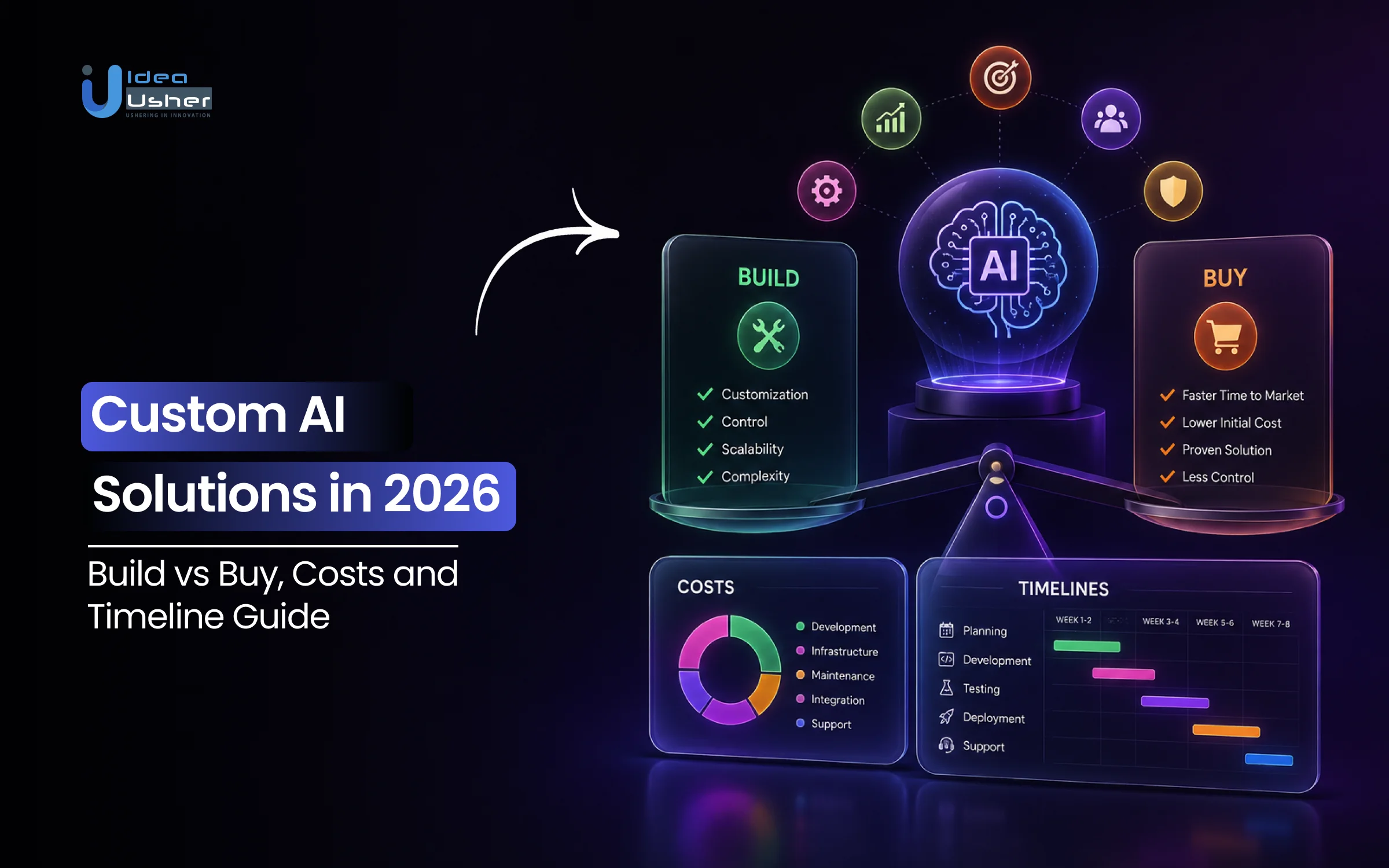
Choosing between building a custom AI system or buying a ready-made solution is no longer just about features or speed. In 2026, it’s a strategic decision that affects scalability, flexibility, and long-term technical control. Buying an AI solution can help teams launch an MVP in less than 30 days, making it attractive for fast-moving startups and businesses testing new ideas. However, these platforms often create dependency on external vendors, where pricing changes, roadmap shifts, or API deprecations can directly impact the product experience.
On the other hand, building a custom AI system requires a larger upfront investment and a longer development timeline. Still, it gives companies full ownership over their architecture, data workflows, and AI capabilities. More importantly, it allows businesses to create a modular AI stack where models and infrastructure can evolve over-time as new open-source and commercial AI technologies emerge.
Over the years, we’ve helped businesses build powerful custom AI solutions powered by AI agents and scalable cloud infrastructure. In this guide, we’ll explore the key differences between building vs buying AI in 2026, including development costs, timelines, and the long-term tradeoffs businesses should consider before investing in AI.
The Reality of AI: Off-the-Shelf AI Solutions Aren’t Enough
According to Fortune Business Insights, the global artificial intelligence market is projected to surge from USD 375.93 billion in 2026 to over USD 2.4 trillion by 2034, signaling a massive influx of capital. However, the initial boom captured by infrastructure providers and generalized foundational models is shifting. For entrepreneurs and investors seeking a high-moat business model, off-the-shelf AI tools and basic API wrappers are rapidly commoditizing, offering zero long-term competitive advantage.

Source: Fortune Business Insights
Sustainable enterprise value now lies in deep domain verticalization. High-net-worth investors must look beyond generic consumer applications and fund platforms engineered with custom logic and secure data pipelines. To capture a meaningful share of this multi-trillion-dollar growth, future-proof platforms must solve hyper-specific business complexities that off-the-shelf tools simply cannot address.
AI Adoption Outpaced Enterprise
The breakneck speed of global AI adoption has outpaced the baseline readiness of mature corporate ecosystems. In the rush to achieve digital transformation and signal innovation to stakeholders, many organizations integrated preliminary AI layers on top of deeply fragmented, legacy technology stacks. This superficial approach has created a significant systemic gap between what commercial foundation models promise and what an actual enterprise infrastructure can execute.
Enterprise readiness requires a multi-faceted alignment of data governance, security protocols, and operational workflows. When generic AI is introduced into an unoptimized corporate environment, the vulnerabilities become apparent immediately.
- Data Fragmentation and Silos: Modern enterprises generate massive pools of unstructured data across disconnected legacy systems, CRM platforms, and internal databases. Off-the-shelf AI cannot natively bridge these silos without substantial middleware customization, resulting in incomplete context windows and flawed outputs.
- Regulatory and Compliance Violations: Broad, consumer-facing AI models are frequently trained on public data pools and lack the strict compliance frameworks required in heavily regulated sectors. Deploying these tools without localized data residency and isolation protocols violates GDPR, CCPA, and industry-specific regulations like HIPAA or FINRA.
- The Technical Debt Mirage: Relying on basic API wrappers around external models creates an unsustainable reliance on third-party pricing structures, rate limits, and model drift. This architecture introduces massive technical debt, as the core asset lacks underlying intellectual property ownership.
Generic Tools Fail Enterprise Workflows
Mature enterprise workflows rely on deep institutional knowledge and localized decision trees that generalized models fail to grasp. Off-the-shelf AI offers broad approximations where corporate operations demand total precision, leading to low adoption and weak returns. Non-tech giants recognize this constraint and bypass generic software to protect their core business lines.
For example, Walmart developed its own proprietary route optimization engine to manage its massive fleet against real-time delivery and weather data. Similarly, JPMorgan Chase deployed its custom OmniAI platform to ingest real-time transactional networks and curb fraud. True business leverage requires owning this proprietary logic layer, ensuring the technology adapts to complex corporate workflows rather than forcing the business to compromise.
The Hidden Shift In Capital Reallocation
A major shift is happening in the B2B software market as enterprises move away from seat-based, generic AI assistants. Corporate buyers are tired of paying premium subscription fees for basic prompt-and-response interfaces. Instead, they are redirecting their budgets toward specialized, single-tenant, and domain-specific vertical platforms that deliver measurable ROI.

This reallocation highlights a crucial market reality: value is shifting away from the rapidly deflating foundation model layer. Sustainable value now sits within proprietary orchestration layers, secure data pipelines, and tailored user experiences. Modern enterprises want deterministic systems that pair flexible AI with rigid rule engines to guarantee precise, reliable operational automation
This hidden shift represents an extraordinary window of opportunity for operators and investors. By building platforms that own the end-to-end data value chain and solve a highly defined, friction-filled vertical problem, developers can establish high-margin, sticky software ecosystems. These ecosystems remain completely insulated from the commoditization of foundational AI models.
Strategic Guidance For Investors
For entrepreneurs and investors targeting this multi-billion-dollar landscape, the path to a high-ROI asset is clear. Do not build a horizontal AI wrapper. Avoid the temptation to build generic tools that claim to solve broad problems across multiple unlinked industries. Instead, focus capital allocation on developing deeply verticalized, domain-specific AI platforms designed to serve a singular, high-value industry sector.
To execute this strategy successfully, focus on three core architectural principles:
- Secure, Proprietary Ingestion Engines: Build advanced Retrieval-Augmented Generation pipelines and graph databases that can securely ingest, clean, and map highly unstructured enterprise data without exposing it to public training pools.
- Hybrid Orchestration Frameworks: Engineer a system that pairs flexible model capabilities with hard-coded, deterministic business logic. This ensures the platform can execute autonomous actions safely, predictably, and with zero hallucination risk.
- Deep System Integration: Position your platform not as an isolated destination, but as an intelligent connective tissue that integrates seamlessly into industry-standard legacy systems, such as SAP, Salesforce, or Oracle, via private API networks.

The Build vs Buy Debate Isn’t About Technology
Enterprise AI decisions are no longer purely technical. They now influence operational control, scalability, long-term costs, and competitive positioning across the business. As AI becomes deeply embedded into enterprise operations, organizations are increasingly evaluating which capabilities should remain vendor-dependent and which should evolve into proprietary assets.

We help businesses navigate this transition by identifying where custom AI can drive measurable ROI, reduce operational friction, and create long-term strategic advantage.
A Build vs Buy Framework
Choosing between building and buying AI is not simply a technical decision. It requires balancing speed, cost, scalability, operational flexibility, and long-term business value. The right approach often depends on how critical AI is to your competitive advantage and internal workflows. The framework below helps enterprise teams evaluate which approach aligns best with their strategic goals and operational requirements.
| Factor | Buy AI Software | Build a Custom AI Solution with IdeaUsher |
| Initial Cost | Lower | Optimized through expert engineering |
| Deployment Speed | Faster | Accelerated via pre-vetted teams |
| Customization | Limited | High and fully tailored |
| Ownership | Vendor-controlled | Full client ownership |
| Long-Term Cost | Recurring licensing | Predictable maintenance |
| Scalability | Platform dependent | Flexible and cloud-agnostic |
| Workflow Fit | Generic | Flawless operational alignment |
| Competitive Advantage | Low | Exceptionally high |
| Vendor Dependency | High | Zero lock-in |
| Data Governance | Shared limitations | Fully configurable security |
When Buying Makes Sense
Buying AI is often the smarter option when speed and simplicity matter more than operational differentiation. For many businesses, pre-built AI tools reduce implementation complexity and accelerate deployment timelines without requiring heavy internal AI investment. They also help teams validate AI adoption quickly before committing to larger infrastructure decisions.
- The use case is standardized across industries.
- Internal AI expertise is limited or unavailable.
- Budgets are constrained for experimental development.
- Deployment speed is critical to meet an immediate operational gap.
- AI is not central to competitive advantage or proprietary value.
Common Examples
Standardized Workflows: AI meeting assistants, generic customer support bots, productivity copilots, basic CRM automation, and standard analytics platforms.
For many organizations, buying AI helps reduce implementation complexity and accelerates short-term efficiency gains. It allows teams to leverage mature, external product roadmaps without absorbing the initial research and development risks. When clients approach us with these basic needs, we often advise them to stick to standard software to preserve capital for where it truly matters.
When Building Creates Value
Custom AI development becomes strategically important when AI directly shapes business operations, decision-making, or customer experience. Unlike generic platforms, custom systems can align closely with internal workflows, proprietary data, and enterprise-specific requirements. They also provide greater flexibility for long-term scalability, governance, and operational control. Building makes more sense when:
- Workflows are unique and heavily reliant on proprietary data.
- Regulatory requirements demand strict, localized compliance and isolation.
- Existing off-the-shelf tools create operational friction for employees.
- AI directly impacts revenue generation or core operational efficiency.
- Deep integrations are required across disconnected legacy internal systems.
Common Examples
Proprietary Moats: Healthcare diagnostics workflows, financial risk engines, procurement intelligence systems, multi-agent operational automation, custom recommendation engines, and enterprise knowledge copilots.
In these high-stakes environments, generic AI platforms often fail to adapt to the operational depth enterprises actually require, leaving substantial value unrealized on the table. This is where we step in. We eliminate the traditional talent acquisition friction by deploying elite, pre-vetted AI developers who hit the ground running, instantly translating your operational bottlenecks into secure, proprietary algorithms.
The Hidden Cost of Buying
Buying AI usually appears cheaper at the beginning because SaaS pricing hides infrastructure complexity. However, over time, many organizations encounter a frustrating compounding effect: escalating usage fees, API dependency risks, vendor lock-in, customization bottlenecks, and severe data portability limitations.
| Phase | What Happens | Financial Reality |
| Year 1: SaaS “Buy” Looks Cheap | Low setup fees and predictable seat-based pricing make adoption feel affordable | Initial costs appear manageable and low-risk |
| Year 2: Scaled Adoption | Increased usage leads to exponential API calls and premium tier upgrades | Costs begin rising faster than expected |
| Year 3: The Bottleneck | Organizations face missing custom features and expensive data extraction limitations | Vendor lock-in and operational friction increase long-term costs |
This dynamic is why we are shifting many of our enterprise clients toward custom AI infrastructure and hybrid AI architectures. We believe that the long-term cost of operational dependency can eventually outweigh the convenience of rapid deployment, which is why we build architectures where you own the underlying code and data conduits outright.
Choosing the Right Partner
Many enterprise AI initiatives fail not because of the technology, but because of a poor implementation strategy. The goal is not simply to build AI; it is to build AI systems that create lasting operational advantage. When you collaborate with IdeaUsher, we solve the engineering puzzle for you. You gain direct access to an elite pool of technical talent, allowing you to hire from our pre-vetted specialists who understand enterprise ecosystems inside out.
Our structured engineering framework helps your organization:
- Identify High-ROI Use Cases: We pinpoint exactly where custom AI creates defensible value versus where standard software suffices.
- Minimize Infrastructure Over-Engineering: We avoid unnecessary compute and storage complexity by sizing models and pipelines correctly.
- Ensure Enterprise Security: We build scalable, highly secure architectures that respect corporate compliance and data governance boundaries.
- Drive Native System Integration: We embed AI models seamlessly into your existing legacy systems without breaking current operational workflows.
- Mitigate Vendor Risk: We reduce long-term vendor dependency by ensuring your business owns the core intellectual property and data rights.
Start With IdeaUsher’s AI Discovery Workshop
Before writing a single line of production code, a successful artificial intelligence strategy requires deep validation. Market speed is meaningless if an engineering team spends months building a tool that fails to scale or misaligns with core business workflows. Our structured AI Discovery Workshop acts as a physical circuit breaker for your investment capital.
We work directly with your operational leadership to isolate high-risk variables, pressure-test technical assumptions, and map a definitive deployment architecture before you commit to large-scale development pipelines.
1. Validate Your Idea Early
A great conceptual vision doesn’t always translate into a stable algorithmic engine. Most deployment failures happen because teams jump into coding before auditing their existing database dependencies or compliance limits. We treat the initial discovery phase as a scientific stress test.
Our architectural team dives into your current software stack to verify that your data pipelines can genuinely support complex retrieval-augmented generation (RAG) or autonomous multi-agent loops without collapsing under production loads.
2. Map ROI, Risks, and Feasibility
To strip emotion and market hype out of your technology budget, our senior engineers score your targeted use cases across three distinct validation filters. This structured evaluation helps businesses separate high-value AI opportunities from expensive experimental ideas that may not scale effectively in production environments.

By filtering every feature request through this multi-layered assessment, we ensure your development budget is allocated exclusively to high-impact, low-liability features that generate undeniable enterprise value.
3. Build an Expert Roadmap
Navigating the transition from raw APIs to fully owned digital assets requires deep engineering maturity. When you collaborate with us, you don’t receive broad, theoretical slide decks. Instead, you gain direct access to our core team of ex-MAANG/FAANG developers who have collectively logged over 500,000 hours of complex software engineering experience.
We provide your leadership team with a completely transparent, milestone-driven technical blueprint that outlines exactly how your data will be captured, processed, routed, and secured.
4. Reduce Upfront Costs
Every hour invested in proactive architecture mapping saves dozens of hours in emergency code remediation down the line. Early planning also helps eliminate hidden infrastructure inefficiencies before they become expensive operational problems. By identifying technical gaps upfront, businesses can reduce deployment risks, avoid unnecessary rebuilds, and maintain smoother scaling as AI adoption grows.
- Prevent Computational Inflation: We design strategic caching, model-routing policies, and data-trimming frameworks directly into your roadmap to eliminate unexpected, runaway API or GPU cloud server utility bills.
- Avoid Vendor Lock-In: Our teams map out single-tenant, modular infrastructure models from day one, giving you the complete flexibility to swap out underlying foundational models later without breaking your interface.
- Accelerate Launch Velocity: By standardizing data labeling schemas, API endpoints, and authentication guardrails before building, our pre-vetted development teams hit the ground running with zero operational drag.
5. Align Features with Goals
Technology should never exist for its own sake; it must serve as an aggressive multiplier for your existing market dominance. Whether your priority is optimizing factory floor logistics like BMW, executing predictive vehicle maintenance like Volvo, or automating intensive back-office transaction pipelines, we ensure your custom AI framework maps directly to your core performance indicators.
By hiring dedicated developers from our specialized global talent pool, you secure the exact data engineers, cloud architects, and machine learning specialists needed to turn your business vision into an enduring, high-margin software moat. Let’s map your path to production stability together.

How IdeaUsher Approaches Custom AI Projects?
Most AI projects fail because companies jump into development before validating operational feasibility. Without a clear alignment between algorithmic capability and corporate reality, even the most advanced machine learning initiatives collapse under the weight of technical debt and low user adoption.

At IdeaUsher, we approach AI implementation through a staged, discovery-first methodology explicitly designed to reduce deployment risk. We protect your capital by treating AI development as an exact engineering discipline rather than a speculative experiment, ensuring that every line of code translated by our developers maps directly to a high-ROI business outcome.
1. AI Discovery Workshop
Before any development begins, our elite teams evaluate your existing business landscape to confirm that your project is technically and financially viable. During this initial diagnostic phase, we audit your operations across five distinct vectors, ensuring every AI investment is aligned with measurable business objectives and long-term operational scalability.
- Use-Case Feasibility: Assessing whether a machine learning model can realistically solve the targeted operational friction with high statistical accuracy.
- Data Maturity: Reviewing the cleanliness, structuring, and availability of your internal data pipelines to ensure the model has an adequate training foundation.
- Infrastructure Readiness: Evaluating your current cloud environment or legacy hardware to plan for seamless backend compatibility.
- Compliance Requirements: Framing strict data isolation boundaries to align with GDPR, HIPAA, or other industry-specific regulations.
- ROI Potential: Modeling the projected cost reductions or revenue gains to verify that the capital expenditure delivers a massive operational advantage.
By answering these fundamental structural questions upfront, we eliminate unnecessary development spending and prevent clients from funding features that offer zero long-term enterprise value.
2. Architecture & Workflow Mapping
Instead of starting with model selection, our engineering focus shifts entirely toward the practical environment where the software must live. We map out the intricate digital highways of your enterprise to design a blueprint that supports your team instead of disrupting them.
[Legacy Data Ingestion] ──► [IdeaUsher Orchestration Layer] ──► [Human Oversight Gate] ──► [ERP Execution]
Our architects design comprehensive schematics that define how data moves through operational workflows, identify critical integration dependencies with your existing software stack, establish rigid governance controls, and embed human oversight systems. This ensures that the AI functions as a reliable, deterministic asset that operates safely within your prescribed corporate boundaries.
3. Rapid Prototype Validation
Once the architectural blueprint is finalized, we build a functional prototype to test our hypotheses in a sandboxed corporate environment. The objective is not just proving the mathematical model works; it is validating its practical utility under real-world pressure, ensuring the solution can integrate seamlessly into existing workflows without disrupting operational efficiency.
The Validation Metric: A model that achieves high accuracy in a laboratory setting is useless if it introduces latency to your daily operations. Our prototypes must prove absolute scalability, frictionless workflow compatibility, and long-term operational sustainability before we allocate resources toward full-scale production.
4. Enterprise Deployment & Optimization
After successful prototype validation, the system evolves into a resilient, enterprise-grade architecture. We scale the platform from a localized test environment into a fully realized production infrastructure, deploying real-time monitoring pipelines to capture and prevent model drift.
Furthermore, we implement strict data governance frameworks and establish long-term optimization loops. This continuous refinement cycle allows the platform to learn from human feedback over time, ensuring your proprietary asset becomes increasingly efficient and valuable the longer it runs.
A Client Case Study
A mid-sized logistics company struggled with fragmented procurement workflows and manual document processing across multiple global vendors, resulting in costly human errors and severe operational delays. The lack of centralized automation also made it difficult for internal teams to maintain visibility, consistency, and compliance across procurement operations.
The Custom Solution
We deployed a dedicated team of pre-vetted developers to engineer a custom AI operations assistant tailored to their unique supply chain architecture. The platform was built to execute four critical autonomous tasks, helping the company reduce manual dependency while improving operational speed and decision accuracy across procurement workflows:
- Automated Invoice Extraction: Utilizing advanced OCR and context engines to ingest unstructured cross-border documents instantly.
- Vendor Classification: Automatically segmenting suppliers based on historical performance data and contractual compliance.
- Procurement Risk Detection: Scanning purchase orders in real time to flags price anomalies or delivery timeline conflicts.
- Workflow Routing: Dynamically sending approved files directly into their proprietary legacy ERP system without manual data entry.
Measurable Outcomes
Within months of deployment, the company experienced significant operational improvements across procurement efficiency, workflow automation, and processing accuracy. The AI-powered system streamlined repetitive tasks, reduced manual intervention, and created a faster, more scalable procurement environment. This transformation also allowed internal teams to focus more on strategic vendor management and high-value operational decisions instead of routine administrative work.
| Key Performance Indicator | Operational Improvement |
| Manual Processing Time | 62% Reduction |
| Procurement Approvals | 38% Faster Execution |
| Operational Bottlenecks | 41% Lower within 6 Months |
The company initially considered buying multiple SaaS AI tools but shifted toward a custom workflow platform after severe integration limitations and scaling costs became apparent. By choosing to build a proprietary asset with us, they eliminated recurring seat licenses and established an incredibly sticky, high-value intellectual property foundation.
Why Custom AI Solutions Cost More Than Vendors Admit?
AI development costs have risen significantly as infrastructure complexity continues to grow. Many companies underestimate budgets by focusing only on AI models while ignoring the broader systems required for deployment, scalability, governance, and integrations. At IdeaUsher, we help businesses build custom AI solutions designed for long-term operational value, scalability, and sustainable ROI.
Typical Custom AI Cost Ranges
The cost of building a custom AI solution depends heavily on the complexity of the architecture, integration depth, scalability requirements, compliance standards, and long-term operational goals. While lightweight AI tools may appear affordable initially, enterprise-grade platforms require significantly larger investments to ensure reliability, security, and sustainable performance at scale.
| Solution Type | Estimated Cost Range | Primary Architectural Drivers |
| AI Chatbot with Integrations | $25,000–$80,000 | Basic RAG pipelines, standard CRM hooks, transactional APIs |
| Enterprise AI Copilot | $80,000–$250,000 | Multi-source unstructured data ingestion, role-based access control |
| AI Workflow Automation Platform | $120,000–$400,000 | Deterministic logic gates, cross-platform state machines, legacy ERP syncing |
| Multi-Agent AI System | $200,000–$800,000+ | Inter-agent communication protocols, long-term memory systems, autonomous loop execution |
| Industry-Specific AI Platform | $300,000–$1M+ | Proprietary model fine-tuning, military-grade compliance, custom hardware orchestration |
Where AI Budgets Actually Go?
To build a defensible AI platform, capital must be allocated strategically across the entire software stack. True enterprise-grade AI expenditure breaks down into four critical pillars, proving that the model itself is often the least expensive component. The majority of long-term investment typically goes toward infrastructure resilience, workflow integration, governance systems, and maintaining operational reliability at scale.
1. Data Engineering (20–30%)
Cleaning, structuring, labeling, and governing fragmented corporate data consumes a major portion of project budgets. If your raw data is disorganized, your platform will produce inaccurate, high-risk outputs. We mitigate this risk from day one by matching your project with our pre-vetted data engineers who construct clean, automated extraction pipelines that turn chaotic repository files into optimized vector embeddings.
2. Infrastructure & Cloud Costs (15–25%)
Running advanced AI models at scale demands immense computational power. Continuous inference costs, dynamic GPU scaling, enterprise vector database subscriptions, and model orchestration layers significantly impact long-term operational spending. When you hire from our pool of specialized engineers, we build with computational efficiency in mind, preventing unexpected user queries from causing your cloud bills to spiral out of control.
3. Integration Complexity (20–35%)
An AI solution cannot exist in a vacuum. Connecting intelligent models with your existing ERPs, CRMs, private internal APIs, compliance frameworks, and deeply entrenched legacy infrastructure is incredibly difficult. Our senior back-end developers specialize in embedding new machine learning nodes into established workflows, maintaining complete operational continuity without breaking current systems.
4. Governance & Security (10–20%)
Deploying AI within a mature enterprise requires robust, institutional safeguards. A significant portion of your budget must be dedicated to establishing strict audit trails, granular user access controls, real-time hallucination filters, compliance monitoring systems, and human-in-the-loop approval gates. We hardcode these boundaries into your platform to ensure your business remains protected from legal and financial liabilities.
The Cheap AI Myth
Many vendors market AI as inexpensive because they are showing you a fragile, proof-of-concept prototype built in an afternoon. Production-grade AI is a completely different species. What works during a controlled demo often breaks when exposed to real enterprise workloads, unpredictable user behavior, and large-scale operational data.

True enterprise applications require real-time observability pipelines, continuous fine-tuning loops based on actual user feedback, and resilient, auto-scaling infrastructure. They also demand rigid prompt governance and dynamic model orchestration to switch tasks seamlessly between high-compute and low-compute environments. This operational layer is why we focus on building robust production engines rather than superficial wrappers.
How Long Does It Take to Build a Custom AI Solution?
Most AI projects take significantly longer than expected because enterprises consistently underestimate operational complexity. Moving an algorithmic model from a controlled sandbox environment into a living, breathing corporate ecosystem requires a rigorous engineering lifecycle.

When planning your capital allocation, treating AI development timelines as an absolute variable can derail your operational milestones. Understanding the real development roadmap is essential to align launch expectations with concrete technical benchmarks.
Typical AI Project Timelines
The timeline for building a custom AI solution depends on several factors, including infrastructure complexity, integration depth, compliance requirements, and the scale of automation involved. While smaller AI tools can be developed relatively quickly, enterprise-grade systems often require extensive engineering and deployment planning to ensure long-term reliability and scalability.
| Project Type | Estimated Timeline | Engineering Focus Area |
| AI Chatbot MVP | 4–8 weeks | Intent mapping, localized knowledge ingestion, basic UI |
| AI Workflow Assistant | 2–4 months | Multi-source API connections, deterministic logic gates |
| Enterprise AI Copilot | 4–8 months | Dynamic context windows, multi-tenant security architecture |
| Multi-Agent Automation System | 6–12 months | Autonomous negotiation loops, persistent memory registers |
| Industry-Scale AI Platform | 9–18 months | Custom model alignment, sovereign cloud networks, military-grade compliance |
Phase 1. Discovery & Feasibility
During this foundational diagnostic window, our structural teams dive into your business to identify your core commercial goals, analyze data availability, map out technical constraints, and calculate real ROI potential. We also frame your exact governance requirements. This deliberate step is where we deploy our specialized domain experts to eliminate the expensive architectural mistakes that cause generic projects to stall later.
- Timeline: 2–4 weeks
- Core Objective: Evaluating the technical, legal, and operational foundation before a single line of code is written.
Phase 2. Architecture Design
This phase requires heavy strategic thinking. Our back-end architects establish your critical infrastructure frameworks, making definitive decisions regarding proprietary build versus API usage, model selection, cloud network setups, retrieval-augmented generation architectures, and localized security frameworks.
- Timeline: 2–6 weeks
- Core Objective: Designing the complete digital blueprint of your platform.
Phase 3. Prototype Development
Most transactional software vendors stop right here. They deliver a flashy prototype that works flawlessly during a controlled demonstration but fails under true production pressure. At IdeaUsher, we treat the prototype merely as a scientific validator. We use it to stress-test data retrieval speeds and evaluate contextual recall in an isolated environment, ensuring the underlying code is built to scale.
- Timeline: 1–3 months
- Core Objective: Assembling a functional MVP to validate core algorithmic accuracy.
Phase 4. Enterprise Integration
This stands as the longest and most complex phase of the entire lifecycle. Your AI platform cannot exist as an isolated island; it must securely bind to your existing day-to-day corporate machinery. When you hire from our elite pool of pre-vetted developers, we focus on natively integrating your custom solution with current employee workflows, authentication systems, internal relational databases, human approval pipelines, and industry compliance structures without disrupting your live business operations.
- Timeline: 2–6 months
- Core Objective: Merging your custom AI engine seamlessly into your core business operations.
Phase 5. Optimization & Scaling
Once your platform is deployed into production, it requires continuous care to maintain its competitive edge. This phase demands persistent monitoring, model fine-tuning, prompt optimization, human feedback integration, and cloud cost optimization to ensure your proprietary software asset grows more efficient and valuable every single day.
- Timeline: Ongoing
- Core Objective: Protecting your digital asset from model drift and computational inflation.
Why Plug-and-Play AI Creates Operational Friction?
Many enterprises discover severe software limitations only after full operational deployment. Buying ready-made AI tools creates convenience initially, but long-term dependency risks are increasing rapidly. When we design a custom AI framework at IdeaUsher, we ensure your organization bypasses these rigid product limitations. By avoiding generic software pipelines, we help you construct an adaptable system that handles business logic exactly as your operations demand.
For platforms built entirely on third-party software, the lack of underlying architectural control turns surface-level automation into a permanent operational bottleneck. To scale effectively without creating systemic friction, enterprises must look past immediate convenience and evaluate the deep structural liabilities of plug-and-play platforms.
Major Enterprise Concerns
While plug-and-play AI platforms may accelerate initial deployment, enterprises often encounter deeper operational and strategic challenges as usage scales over time. Issues related to vendor dependency, workflow limitations, governance, and infrastructure costs can gradually reduce flexibility, increase risk exposure, and create long-term scalability problems for growing organizations.
- Vendor Lock-In: Foundations change quickly, but switching AI vendors later becomes operationally expensive. If a provider changes their core algorithms or deprecates an essential API feature, your entire integrated platform can break instantly, forcing costly emergency re-engineering.
- Data Portability Risks: Some software platforms intentionally make migration difficult. Your proprietary enterprise context becomes trapped inside siloed databases, meaning that extracting your historical user insights or fine-tuning datasets can incur massive financial penalties.
- Limited Workflow Control: Generic tools often force organizations to adapt processes around software limitations. Instead of your technology serving your team, your employees waste valuable hours building manual workarounds to fix what the broad consumer AI fails to understand.
- Rising API Costs: Usage-based AI pricing becomes highly unpredictable at scale. When you scale engineering teams through our specialized talent pool, we focus on code optimization to ensure a sudden spike in enterprise user adoption doesn’t cause your monthly cloud bills to balloon unexpectedly.
- Compliance Exposure: Regulated industries increasingly require explainability and strict governance controls. Broad, off-the-shelf software rarely offers clear visibility into how its algorithms derive specific outputs, leaving your organization vulnerable to heavy regulatory audit fines.
Why Hybrid AI Dominates
As enterprises scale their AI operations, maintaining flexibility, governance, and infrastructure control becomes increasingly important. Many organizations are now shifting toward hybrid AI architectures because they combine the speed and power of external AI models with the security, customization, and operational control of internally managed systems.

Instead of fully building or fully buying, modern enterprise systems use foundational models via secure APIs solely for raw linguistic processing. Meanwhile, they retain complete internal ownership over custom orchestration layers, internal knowledge systems, proprietary workflow logic, and private governance infrastructure.
This structural split guarantees that while you use external compute power, the intellectual property that drives your unique business value remains 100% yours.
The CONTROL Matrix for AI Decision-Making
Enterprise AI investments often fail when decisions are driven more by market hype than operational reality. The CONTROL Matrix helps organizations evaluate whether an AI capability should be bought, custom-built, or deployed through a hybrid approach. By assessing workflows across seven strategic factors, businesses can align AI investments with long-term operational goals and scalability needs.
C — Competitive Advantage
Does this specific workflow directly impact your market differentiation? If the AI system manages a commoditized task like summarizing team meetings, buying an off-the-shelf tool is perfectly logical. However, if the algorithm refines your core pricing engine, automates proprietary supply chain logistics, or touches unique customer interactions, it must be treated as a core asset.
O — Operational Complexity
How deeply must the AI integrate with internal systems? High complexity demands custom development. A system that requires real-time read/write access across isolated legacy databases, private internal APIs, and deeply entrenched ERP systems cannot simply be handled by a generic web widget or standard API wrapper.
N — Need for Customization
Can generic tools realistically support the intricate nuances of your workflow? Mature enterprises run on highly localized jargon, complex decision trees, and specialized institutional knowledge. When an operational process demands absolute precision over broad approximations, custom logic layers become mandatory.
T — Time Sensitivity
How quickly does the solution need to be deployed? If your business faces an immediate competitive gap that must be filled in a matter of weeks, buying a tool offers a rapid patch. If you are building a foundational platform designed to scale sustainably over the next decade, sacrificing speed for architectural durability is the smarter engineering choice.
R — Regulatory Exposure
Does compliance require total governance ownership? Operating within highly regulated fields like healthcare, defense, or institutional finance leaves no room for algorithmic black boxes. If your compliance framework mandates strict audit trails, explainable data outputs, and complete isolation from public training pools, building a private infrastructure is the only way to mitigate liability.
O — Ownership Requirements
Will long-term vendor dependency become an existential risk to your business model? Relying entirely on a third-party AI provider means you are vulnerable to sudden API price inflation, feature deprecation, and vendor lock-in. When the software driving your daily revenue is owned by someone else, you surrender your long-term operational agility.
L — Long-Term Economics
Which option is genuinely sustainable across a three-to-five-year operational horizon? While buying software appears highly cost-effective at first glance due to low initial setup fees, seat-based licenses, and escalating API usage charges can quickly surpass the cost of building and maintaining a dedicated, custom-tailored system.
Scoring & Decision Mapping
To apply the matrix, evaluate your specific use case against the seven pillars. This structured framework helps identify where operational risks, scalability concerns, and long-term ownership challenges may emerge before development begins. Use the interpretation below to guide your architectural roadmap and make more informed AI investment decisions.
| Evaluation Profile | Strategic Recommendation | Engineering Implementation |
| Mostly low complexity across all pillars | Buy | Rapidly deploy mature, off-the-shelf SaaS applications to address non-essential productivity gaps. |
| Mixed operational dependency and varied scores | Hybrid | Leverage public foundation models via secure APIs wrapped inside a proprietary orchestration layer. |
| High workflow uniqueness, strict compliance, or high core value | Build | Engineer a fully custom, single-tenant AI platform to establish an unassailable competitive moat. |
Why Some Experts Believe Buying AI Is Smarter?
Not every company should build AI. This is a critical distinction that often gets lost in market hype. In the rush to capitalize on automation, some organizations dramatically overestimate the value of proprietary infrastructure, accidentally burning capital on custom engineering when a simple subscription service would suffice.
Building software from scratch introduces significant research and development risks, long-term maintenance overhead, and talent acquisition friction. For businesses operating outside of high-moat industries, forcing an internal engineering initiative can easily drain resources that are better spent on core commercial operations.
When Buying Beats Building
In many situations, purchasing an existing AI solution is more practical than developing custom infrastructure from scratch. Businesses that prioritize speed, cost efficiency, and operational simplicity often benefit more from mature SaaS platforms, especially when the AI capability is not central to their long-term competitive advantage.
- Zero Strategic Leverage: The targeted use case is a back-office utility rather than a market differentiator.
- Low Technical Maturity: The internal team lacks senior data engineers, machine learning specialists, or infrastructure architects.
- Extreme Deployment Urgency: The business faces an immediate operational bottleneck that must be resolved in days, not months.
- Severe Budget Constraints: Capital is constrained, making the predictable, low initial setup fees of software-as-a-service highly attractive.
- Standardized Workflows: The process mirrors standard industry practices, meaning that a commoditized, off-the-shelf product fits perfectly out of the box.
The Operational Reality: For a mid-sized enterprise, paying a fixed monthly subscription for a mature meeting assistant or standard customer support bot is significantly smarter than spending six figures to build the same tool from scratch.
The No-Moat Catch
While buying software delivers immediate velocity, the strategic counterpoint is equally unyielding: ready-made AI rarely becomes a long-term differentiator. Since the underlying infrastructure is shared across multiple businesses, the opportunity to create unique operational advantages becomes increasingly limited over time.

If your closest competitors are utilizing the same off-the-shelf software stack, your operational advantage drops to zero. You are essentially renting the same intelligence as the rest of the market, tying your competitive position to a vendor product roadmap that everyone else can access. This commodity trap is precisely why traditional, non-tech enterprises are taking complete control over their tech stacks to build true operational advantages.
For instance, BMW Group engineered a custom AI solution called SORDI.ai to create complex digital twins that run thousands of automated supply chain simulations, optimizing factory distribution lines far beyond what a generic logistics tool could handle.
Similarly, automotive giant Volvo developed a custom Early Warning System that analyzes over one million mechanical events every week, allowing their operations to predict vehicle part failures and schedule maintenance before a breakdown ever occurs.
Balanced Architecture: The most resilient organizations are never ideological about their technology stack. Instead of declaring a rigid “build-only” or “buy-only” corporate mandate, they evaluate architecture on a sliding scale of strategic value.
The Valuation & Exit Perspective of AI Solutions
When private equity firms or corporate buyers evaluate your technology stack today, “AI as a feature” licensed from a third-party vendor is no longer viewed as a competitive moat. In fact, it is increasingly treated as operational overhead. The market has grown weary of surface-level software wrappers.

If your core business value relies on an AI layer that you are merely renting via generic APIs or pre-built software licenses, you are exposed to three silent valuation killers that actively devalue your enterprise. Mergers and acquisitions (M&A) due diligence teams are now trained to aggressively discount companies that rent their primary algorithmic intelligence.
Zero Intellectual Property Realization
A licensed solution cannot be capitalized on your balance sheet as a proprietary technical asset. You are effectively using your own corporate capital to fund data entry, while simultaneously building equity and refining machine learning models for your vendor’s product roadmap.
The “Black Box” Compliance Tax
Under modern global regulatory frameworks like ISO 42001, buying off-the-shelf AI makes you entirely dependent on the vendor’s willingness to provide exhaustive model explainability data. If they change an underlying weight, modify a neural network layer, or alter a data-masking rule without warning, your operational compliance audit trail breaks instantly, introducing severe legal liabilities during acquisition due diligence.
The Margin Ceiling
Off-the-shelf platforms charge predictable subscription fees early on, but as your corporate transaction volume scales, their seat-based or volume-based pricing structure caps your profitability. Because your costs scale linearly with your usage, this structure completely prevents tech-enabled margin expansion, killing your ability to achieve true EBITDA decoupling.
The Architecture Calculus
To maintain a premium valuation ahead of an exit or funding round, your engineering architecture must align directly with data sensitivity and workflow value. The division is straightforward: if the AI processes standard administrative data like routine payroll, basic customer ticketing, or general text summarization, buy it.
The low risk justifies the lack of asset ownership. But if the algorithm touches your proprietary data loops, predictive operations, or core product workflow, you must build it to preserve your corporate valuation. Traditional, non-tech enterprises understand this value preservation strategy perfectly and build tailored frameworks to permanently control their market edge.
- For instance, agricultural legacy John Deere avoided generic industrial platforms to engineer their own custom computer vision and deep neural network layers. This proprietary system processes millions of on-field crop data points in real time, moving their corporate identity from a hardware manufacturer to a high-margin precision technology powerhouse.
- Similarly, retail giant Walmart rejected monolithic, off-the-shelf logistics software in favor of a custom, proprietary “agentic AI” orchestration stack. Their internally owned network of task-specific nano-agents autonomously rebalances warehouse inventory, predicts localized consumer demand trends, and dynamically alters shipping routes to achieve massive margin expansion that can be fully capitalized on their balance sheet.
Contact Idea Usher for Custom AI Development
Transforming a complex business workflow into a resilient, production-grade AI asset requires deep architectural expertise, elite engineering talent, and a commitment to absolute data sovereignty. We do not build superficial API wrappers that leave your business exposed to vendor lock-in and unpredictable cloud bills. Instead, we architect highly optimized, secure, and fully owned custom engines designed to scale.
Share Your Product Vision
Every high-margin digital moat begins with a clear operational diagnostic, not a rigid product demo. Whether you are aiming to deploy autonomous multi-agent negotiation loops, engineer an enterprise-grade RAG pipeline, or optimize factory logistics through complex digital twins, our technical architects are ready to map out your execution blueprint.
With over 500,000 hours of coding experience, our team of ex-MAANG/FAANG developers specializes in translating abstract operational friction into high-performance, deterministic machine learning infrastructure.
Get Your Custom Strategy
We completely eliminate the guesswork and expensive structural mistakes that cause standard AI initiatives to fail under production pressures. By partnering with us, you bypass the friction of generic software and secure a direct line to elite technical specialists. Our structured consultation process targets your highest-leverage workflows.

- Complete Infrastructure Audits: Analyzing your existing databases, legacy ERPs, and compliance frameworks for seamless machine learning readiness.
- Granular Cost Modeling: Establishing predictable 3-to-5-year operational budgets that minimize inference compute inflation and eliminate hidden seat-based licensing fees.
- Defensible Asset Blueprinting: Designing a custom orchestration framework that ensures your core intellectual property remains 100% owned by your company.
Build Scalable Enterprise AI
The fastest way to deploy a resilient, high-moat digital asset is to build with a team that has already spent half a million hours mastering the intricacies of enterprise software development. Do not compromise your long-term operational agility by settling for a fragile plug-and-play setup.
When you scale your engineering division through our elite talent pool, we seamlessly embed specialized data engineers, back-end architects, and machine learning specialists directly into your timeline. We build for production stability from day one, transforming your day-to-day corporate machinery into an enduring, high-margin competitive advantage. Let’s build your custom AI engine together.
Conclusion
Navigating custom AI requires balancing immediate speed with long-term asset ownership. While buying off-the-shelf software works for standard tasks, building custom or hybrid systems provides the architectural control needed for a true competitive moat. Enterprise production goes beyond model selection, requiring strategic investment in data engineering, legacy integration, and resilient infrastructure. By aligning your business goals with realistic costs and timelines, you can successfully eliminate vendor lock-in and transform your core workflows into highly valuable, proprietary software assets.
Author Bio
I’m Debangshu Chanda, a tech writer with 5+ years of experience exploring AI, enterprise technology, and digital innovation. I enjoy breaking down complex topics like custom AI solutions, automation, and scalable software systems into clear, practical insights that businesses and readers can easily understand. My focus is on creating informative, engaging content that connects emerging technology trends with real-world business applications.
FAQs
Q1: What is the average cost of custom AI development?
A1: Most enterprise-grade AI systems range between $80,000 and $500,000+, depending heavily on infrastructure requirements, security frameworks, and legacy integrations. While basic chatbots with simple API connections sit on the lower end, complex multi-agent automation systems and highly regulated, industry-scale platforms often require much higher investments.
Q2: Is it cheaper to build or buy AI software?
A2: Buying is almost always cheaper initially because it bypasses research and development costs, offering predictable subscription fees for standard back-office utilities. However, building custom or hybrid systems becomes significantly more cost-efficient over a long-term horizon if your workflows are proprietary, require heavy customization, or risk high usage-based API cost inflation at scale.
Q3: How long does it take to develop a custom AI solution?
A3: Simple applications or basic proof-of-concept prototypes can be assembled in 1 to 3 months to validate a core concept. Moving beyond a sandbox environment to engineer a resilient, production-ready system that integrates seamlessly with your enterprise authentication databases, compliance structures, and active workflows typically requires 6 to 12 months.
Q4: What industries benefit most from custom AI solutions?
A4: Healthcare, finance, logistics, manufacturing, and legal services secure the highest return on investment from tailored platforms. These fields run on incredibly complex, proprietary operational data and strict governance guidelines where off-the-shelf software fails to deliver the necessary precision, privacy, or workflow control.