

Key Takeaways
- Microsoft AutoGen powers multi-agent AI systems that automate enterprise workflows, operations, and decision-making at scale.
- Businesses are adopting AutoGen for AI orchestration, workflow automation, enterprise copilots, and scalable multi-LLM infrastructure.
- The blog covers top AutoGenAI development companies with expertise in multi-agent architecture, AI integration, and secure enterprise deployment.
- Companies should evaluate AutoGen partners based on scalability, AI orchestration, security, and enterprise infrastructure capabilities.
- How IdeaUsher can help you build custom AutoGen AI platforms with scalable workflows, enterprise integrations, and secure deployment support.
The demand for AI agents is growing rapidly as businesses move beyond single-task automation toward autonomous workflows capable of handling research, decision-making, operations and enterprise coordination. This shift is accelerating adoption of Microsoft AutoGen for building multi-agent systems, AI copilots, workflow automation and enterprise AI orchestration across industries.
As AI infrastructure grows more complex, businesses are seeking AutoGen development companies that can build custom AI agents, integrate multiple LLMs, create scalable AutoGen workflows and deploy enterprise-grade AI systems securely across operations. The focus is shifting from standalone AI features toward flexible AI ecosystems that coordinate tasks, automate workflows and scale reliably across production environments.
In this guide, we explore the top 12 AutoGen development companies helping businesses build scalable AI agent ecosystems in 2026 shaped by how effectively businesses orchestrate intelligent agents across workflows, teams and systems.
What Is Microsoft AutoGenAI?
Microsoft AutoGen is a pro-code, open-source programming framework engineered for building advanced agentic AI systems and distributed multi-agent AI applications. Instead of treating Large Language Model (LLM) interactions as isolated, linear chat prompts, AutoGen models artificial intelligence as a network of distinct, specialized digital entities that can seamlessly communicate, share context, and execute code together.
The primary architectural shift in the modern version of AutoGen is its asynchronous, event-driven foundation. Unlike linear execution models, this framework enables independent agents to operate concurrently across information boundaries, responding to dynamic event streams in real time.
The framework is extensively used by software engineering teams to construct:
- AI Assistants: Context-aware, long-running personal agents that operate in the background to handle specific processes like inbox triage or real-time documentation updates.
- Workflow Automation: Complex business process automations where multiple independent agents mimic human organizational hierarchies to pass tasks along a structured pipeline.
- Agentic AI Systems: Deeply integrated software architectures that can autonomously plan multi-step operations, observe changing environments, and self-correct when encountering errors.
- Enterprise Copilots: Collaborative digital workforces that interface directly with internal systems, corporate data structures, and developer pipelines to assist human staff.
A. Key Features of AutoGen
AutoGen simplifies the design of highly technical multi-agent architectures through several core built-in primitives:
- Multi-Agent Communication: Supports flexible interaction topologies including GroupChat managers, state machines, and dynamic broadcast structures where conversational paths adapt automatically based on the input scenario.
- Autonomous Task Execution: Features native code execution tools, such as sandboxed Docker command-line environments, that allow agents to write, test, and safely run their own code to solve complex analytical problems.
- Human-in-the-Loop Workflows: Provides configurable intervention modes that let developers easily insert human verification gates, allowing managers to approve, reject, or redirect an agent’s planned action before execution.
- Multi-LLM Support: Offers a model-agnostic backend client infrastructure that lets different agents within the same team run on completely different foundational models, balancing performance and token costs.
- Tool Integrations: Built-in compatibility with enterprise connectivity standards, including the Model Context Protocol (MCP), which enables agents to seamlessly read from external APIs, local databases, and file systems.
- AI Orchestration: Leverages a unified abstraction layer that manages complex asynchronous message passing, tracks state across long-running tasks, and logs workflow data via OpenTelemetry.
B. Why Businesses Are Adopting AutoGen
The global AI agents market size accounted for USD 7.92 billion in 2025 and is predicted to increase from USD 11.55 billion in 2026 to approximately USD 294.66 billion by 2035, expanding at a CAGR of 43.57% from 2026 to 2035. With frameworks like Microsoft AutoGen gaining traction, enterprises are rapidly adopting multi-agent AI systems to automate complex workflows, collaboration, and decision-making processes.
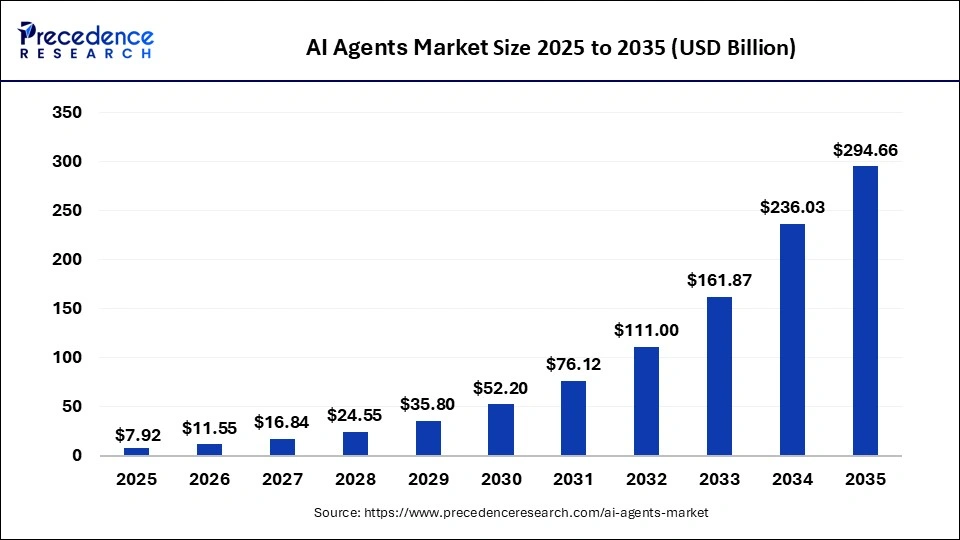
As enterprises realize the limitations of single-prompt AI platforms, technical leaders are turning to AutoGen to scale their custom artificial intelligence footprints for several strategic reasons:
- Faster Enterprise Automation: By breaking down massive, multi-step business objectives into isolated sub-tasks handled by specialized agents, companies can automate operations that typically stall generic chatbots.
- AI Research Workflows: The framework’s modular architecture enables academic and corporate data science teams to rapidly prototype, benchmark, and study collaborative logic models across complex mathematical and scientific domains.
- Autonomous AI Teams: Organizations can build specialized digital departments such as an automated content squad pairing a dedicated researcher agent, a writer agent, and a separate fact-checking agent to maintain continuous output quality.
- Scalable AI Infrastructure: The framework’s event-driven, distributed programming model allows agents to interact seamlessly across separate servers, programming environments, and organizational boundaries without bottlenecking system performance.
- Lower Operational Overhead: Implementing self-correcting agent teams reduces the human intervention time required to audit raw AI drafts, significantly lowering the long-term cost of maintaining scaled corporate AI pipelines.
AutoGen vs. Traditional AI Development Frameworks
Selecting the correct framework determines how your AI engineering team handles state persistence, model routing, and communication latency. While traditional AI tools treat Large Language Models as single-prompt inputs, agentic frameworks treat them as active processors within a larger system architecture.
The table below compares Microsoft AutoGen against other leading enterprise frameworks to highlight their fundamental design choices.
| Feature | AutoGen | LangChain (with LangGraph) | Microsoft Agent Framework (Formerly Semantic Kernel) |
| Multi-Agent Support | Advanced (Native asynchronous, event-driven loops) | Advanced (Manually mapped stateful graph nodes) | Advanced (GA multi-agent orchestration and A2A interoperability) |
| Autonomous Workflows | Highest (Built-in sandboxed code execution and self-correction) | High (Controllable via explicit cyclical graph loops) | High (Combines AutoGen abstractions with built-in CodeAct execution) |
| Enterprise Scalability | Excellent (Distributed architecture backed by Microsoft cloud) | Highest (GPU-accelerated compilation pools via NVIDIA) | Highest (Built with session state, type safety, and Azure hosting) |
| Human-in-the-Loop | Native (Built-in configurable message intervention gates) | Advanced (Stateful persistence allows checkpointing / time-travel) | Native (Durable execution state with pause/resume API support) |
How to Choose the Right AutoGen Development Company
Selecting an engineering partner for production-grade Microsoft AutoGen systems requires looking beyond generic AI metrics. Your chosen agency must possess deep expertise in event-driven software architectures, asynchronous message passing, and complex state management.
When evaluating potential AutoGen development companies, prioritize partners who demonstrate verified capabilities across these five core technological pillars:
1. AI Agent Development Expertise
Choose a partner skilled in designing specialized agent personas with clear boundaries. They must have proven experience setting up group chats or state machines while actively preventing common engineering pitfalls like infinite communication loops and context window exhaustion to minimize token waste.
2. Multi-LLM Integration Experience
Your agency should know how to implement model-agnostic client infrastructure. Production systems must route heavy reasoning to premium models like GPT-4o or Claude 3.5 Sonnet, while offloading simpler tasks to low-cost open-source models like Llama 3 or Mistral to keep costs sustainable.
3. Enterprise AI Infrastructure Capabilities
Look for engineering teams experienced in advanced RAG pipelines, vector databases, and real-time data caching. They must use modern standards like the Model Context Protocol (MCP) to let autonomous agents securely access and read from internal enterprise data lakes and file repositories.
4. Workflow Automation & Orchestration
The agency must have pro-code expertise in setting up secure, sandboxed code execution environments (like Docker) where agents safely run scripts to solve analytical problems. They should also build “Human-in-the-Loop” orchestration gates so managers can review actions before production deployment.
5. Security, Scalability & Deployment Flexibility
Ensure the company has strong cloud capabilities across Azure, AWS, or on-premises servers to protect data sovereignty. They must implement standard OpenTelemetry tracking to log agent conversations, monitor performance bottlenecks, and fully secure your proprietary corporate intellectual property.
Top 12 AutoGen Development Companies in 2026
Modern enterprise AI has evolved past basic prompts toward multi-agent models like Microsoft’s AutoGen. Scaling these agentic systems in production requires expert engineering to manage event-driven messaging, code sandboxing, and complex state management.
The following Microsoft AutoGen development companies specialize in building scalable multi-agent infrastructures, enterprise AI copilots, and autonomous workflow systems.
1. IdeaUsher
IdeaUsher is an AI engineering and software development firm that builds custom, production-ready multi-agent ecosystems and AI infrastructure utilizing the Microsoft AutoGen framework.
Core Services: The company provides comprehensive AI lifecycle development to help businesses transform abstract processes into autonomous digital workflows:
- Custom Multi-Agent Engineering: Building interconnected networks of specialized AutoGen agents capable of independent planning, cross-agent verification, and self-correcting logic loops.
- Enterprise RAG and Knowledge Architecture: Designing robust Retrieval-Augmented Generation (RAG) pipelines that connect autonomous agent teams to secure internal enterprise data lakes.
- Pro-Code Workflow Orchestration: Developing secure, sandboxed code-execution environments where AutoGen agents can safely write and run scripts to solve non-linear analytical problems.
- Private and Air-Gapped Deployment: Provisioning secure, self-hosted AI models and infrastructure on-premises or via isolated cloud environments to protect core corporate data.
AutoGen Expertise
IdeaUsher constructs dynamic, event-driven interaction topologies like automated group chats and custom state machines for cross-departmental data processing. They excel at building strict “Human-in-the-Loop” orchestration gates, giving teams granular control to review, edit, or redirect an agent’s plan before production deployment.
Best For: Enterprises needing fully secure AI infrastructure and proprietary multi-agent digital workforces that require deep integration with complex corporate data systems.
Notable Strengths: The company stands out through the following operational and engineering strengths.
- Delivers complete end-to-end AI product lifecycles, matching front-end enterprise software seamlessly with complex back-end multi-agent orchestration layers.
- Mitigates token inflation and latency bottlenecks by designing highly efficient model-agnostic client structures that mix premium and open-source LLMs.
- Ensures absolute data privacy and compliance by operating under strict development boundaries and protective data frameworks.
2. Intellivon
Intellivon is an enterprise AI consulting and development provider specializing in building highly compliant, data-secure intelligent agent systems and workflow optimization frameworks. They focus heavily on aligning cutting-edge generative language models with enterprise compliance requirements and strict data security standards.
Core Services: Their services are centered around compliance-focused AI infrastructure and secure workflow automation.
- Enterprise AI Workflow Automation: Architecting multi-layered business process automations that embed intelligent agents directly into existing corporate operations.
- Private LLM and MLOps Infrastructure: Setting up isolated machine learning operations pipelines and private models trained on proprietary corporate datasets.
AutoGen Expertise
Intellivon employs Microsoft AutoGen to create predictable, audit-ready multi-agent teams. They focus on strict data governance and access logging during cross-boundary agent collaboration. Their expertise lies in integrating AutoGen with corporate backends to reduce communication latency in distributed networks.
Best For: Mid-to-large scale financial, healthcare, and corporate institutions requiring highly structured, compliance-focused agentic process optimization.
Strengths: The following strengths make the company particularly effective for enterprise AutoGen deployments.
- Maintains a strong track record in data privacy engineering, making them highly dependable for industries with strict regulatory constraints.
- Brings deep technical expertise in building complex backend API connectors that seamlessly link legacy databases with active agent environments.
3. Markovate
Markovate is a digital product agency specializing in end-to-end generative AI applications that integrate multi-agent logic with high-quality mobile and web interfaces. They are an ideal partner for mid-market companies and product teams looking to deploy sophisticated, consumer-facing AI agents with advanced autonomous behaviors.
Core Services: Their development approach combines autonomous AI functionality with polished digital product experiences.
- Turnkey Generative AI Products: Creating complete web and mobile software packages powered by advanced artificial intelligence backends.
- Autonomous AI Assistants: Building task-focused digital assistants that execute data extraction, analysis, and continuous monitoring tasks.
AutoGen Expertise
Markovate is one of AutoGen development companies to manage multi-step user requests within customer-facing apps. They specialize in building hierarchical agent teams led by a supervisor agent that coordinates sub-agents to execute specific tasks, ensuring the final output aligns perfectly with required UI/UX design constraints.
Notable Strengths: Their technical capabilities make them well-suited for complex multi-agent AI implementations.
- Excels at connecting complex, multi-agent backend logic with modern, highly intuitive front-end mobile and web designs.
- Offers flexible, project-based delivery models well-suited for building rapid, high-fidelity MVPs and feature upgrades.
4. Alltegrio
Alltegrio is an AI consulting and software engineering firm that helps companies integrate large language models and deploy contextual AI copilots into existing business software suites.
Core Services: Their solutions primarily focus on integrating contextual AI capabilities into existing business environments.
- AI Strategy and Consulting: Guiding executive teams through framework selection, model feasibility studies, and direct ROI assessments.
- Custom Copilot Integration: Embedding contextual AI assistants directly into everyday business tools like CRMs and project management dashboards.
AutoGen Expertise
Alltegrio leverages the AutoGen framework primarily to transition businesses from basic single-prompt chatbots to collaborative multi-agent environments. They focus on building clean semantic search layers so that teams can accurately retrieve and reference company records during execution.
Best For: B2B organizations looking for tactical AutoGen development companies and targeted assistance when adding multi-agent features to their existing software platforms.
Strengths: These capabilities help the company support scalable AutoGen-based enterprise workflows.
- Provides clear, consultative roadmaps that prevent businesses from over-engineering simple AI automation tasks.
- Maintains deep technical expertise in connecting disparate cloud storage repositories to generative writing panes.
5. Deviniti
Deviniti is an enterprise software development provider that builds scalable AI systems, process automation frameworks, and custom software integrations. They specialize in helping large organizations integrate multi-agent autonomous troubleshooting into heavy-duty IT and enterprise software setups.
Core Services: Their enterprise offerings emphasize scalable automation and operational AI infrastructure.
- Enterprise AI Systems: Designing high-availability software architectures that run complex machine learning models at scale.
- IT Process Automation: Streamlining internal technical support tickets, infrastructure deployment, and data synchronization workflows.
AutoGen Expertise
Deviniti applies AutoGen within large organizational environments to resolve bottlenecked communication chains. They construct specialized technical agents that can monitor IT infrastructure, flag system performance anomalies, and collaborate to execute basic system patches autonomously.
Notable Strengths: The company’s infrastructure expertise enables reliable deployment across large-scale enterprise environments.
- Brings extensive experience managing massive software architectures, ensuring AI integrations do not disrupt legacy systems.
- Provides highly reliable managed delivery teams capable of executing large-scale, multi-stage software updates.
6. ThirdEye Data
ThirdEye Data is an AI and big data agency that transforms large-scale enterprise data into autonomous workflows. They specialize in building multi-agent systems for data-heavy organizations to parse, clean, and respond to complex analytical datasets.
Core Services: Their service stack focuses heavily on autonomous analytics, data intelligence, and large-scale processing systems.
- Data Intelligence Engineering: Designing high-throughput data pipelines, data lakes, and continuous processing architectures.
- Autonomous Operational Workflows: Building self-correcting software systems that analyze live data and make real-time operational choices.
AutoGen Expertise
ThirdEye Data integrates AutoGen with advanced data processing frameworks. They focus on building multi-agent systems where individual agents analyze specific data streams, collaborate to identify hidden patterns, and autonomously update corporate dashboards without manual human intervention.
Strengths: Their engineering strengths are particularly valuable for data-intensive autonomous AI operations.
- Maintains a deep background in big data engineering, allowing them to scale AI systems across complex cloud databases easily.
- Excels at building highly technical analytics agents that translate raw databases into clear corporate reports.
7. LeewayHertz
LeewayHertz is one of AutoGen development companies that engineers enterprise-grade AI agents, advanced custom LLM applications, and secure workflow automation systems.
Core Services: Their AI engineering services are designed to support enterprise-grade automation and intelligent digital workflows.
- AI Agent Product Development: Designing task-focused digital agents optimized for research, technical analysis, and workflow support.
- Generative AI Integration: Customizing and connecting large language models to fit specific business channels and user entry points.
AutoGen Expertise
LeewayHertz builds robust multi-agent systems for finance and HR using AutoGen Studio. They excel in creating low-latency API connections that link AutoGen workforces with external software, web tools, and code compilers.
Best For: Organizations looking to deploy specialized, task-driven digital teams across corporate business units like marketing, finance, and logistics.
Notable Strengths: The following strengths support the development of scalable and production-ready AI agent systems.
- Offers deep experience across multiple agent frameworks, helping clients choose the most efficient tools for their specific workloads.
- Provides reliable microservices architectures that allow AI agents to scale smoothly without reducing host application speeds.
8. SoluLab
SoluLab provides digital transformation and AI solutions, specializing in custom AI assistants, automated workflows, and distributed data systems. Their multi-agent automation is ideal for mid-market firms looking to modernize customer service and data entry pipelines.
Core Services: Their offerings focus on practical AI adoption through intelligent assistants and automated business systems.
- Custom AI Software Solutions: Developing tailor-made software applications infused with predictive and generative machine learning features.
- Intelligent AI Assistants: Creating conversational and task-oriented digital workers to optimize customer engagement.
AutoGen Expertise
SoluLab usually build multi-agent customer support networks. They construct systems where customer queries are triaged by an initial analyzer agent and then routed to specialized agents trained on specific product manuals, ensuring highly accurate responses.
Strengths: Their operational capabilities make them a practical choice for mid-market AI automation projects.
- Maintains a highly cost-effective global development model that delivers software solutions within predictable budgets.
- Provides rapid prototyping capabilities that allow businesses to test basic agent workflows quickly before full deployment.
9. Talentica Software
Talentica Software is an engineering-heavy product development company that constructs scalable AI infrastructure and complex SaaS applications. They focus primarily on growth-stage technology companies that require deep, code-level engineering to optimize the performance and cost of their AI applications.
Core Services: Their engineering capabilities are geared toward high-performance AI infrastructure and SaaS scalability.
- AI Engineering and Research: Conducting deep technical prototyping and optimization for highly complex machine learning concepts.
- Scalable Infrastructure Design: Building high-performance, cost-effective cloud backend platforms designed for continuous uptime.
AutoGen Expertise
Talentica focuses on the technical optimization of the AI frameworks. Their engineers specialize in reducing token consumption and preventing context window exhaustion by implementing advanced memory management systems within multi-agent chat topologies.
Notable Strengths: The company differentiates itself through deep technical optimization and AI infrastructure engineering.
- Brings a highly technical team composed primarily of product developers who understand the nuances of software optimization.
- Excels at solving complex mathematical and logical engineering bottlenecks within custom multi-agent environments.
10. NetSet Software
NetSet Software is another enterprise AutoGen development companies that develops intelligent automation platforms, corporate data frameworks, and custom business software systems.
Core Services: Their services revolve around intelligent enterprise automation and structured operational workflows.
- AI Automation Platforms: Engineering unified digital workspaces that combine rules-based automation with generative models.
- Intelligent Enterprise Systems: Designing software architectures that automate administrative, human resource, and operational workflows.
AutoGen Expertise
NetSet Software utilizes AI to automate internal corporate operations. They specialize in setting up sequential hand-off agent teams, where a task passes down a chain of digital workers such as moving an invoice from extraction to validation, and finally to automated log entry.
Best For: Mid-market corporate teams wanting to eliminate manual spreadsheet and documentation steps through structured multi-agent pipelines.
Strengths: These strengths help streamline structured enterprise automation and multi-agent coordination.
- Provides highly structured project management that ensures software developments stay closely aligned with client timelines.
- Delivers clean, straightforward enterprise applications that require minimal technical management from internal teams.
11. Quytech
Quytech is an AI and mobile application development company that builds AI-powered business applications and customer interaction platforms.
Core Services: Their AI solutions focus heavily on conversational systems and interactive mobile experiences.
- Conversational AI Development: Creating human-like virtual assistants, automated chat systems, and interactive customer portals.
- AI-Powered Mobile Apps: Integrating lightweight generative machine learning features directly into mobile operating systems.
AutoGen Expertise
Quytech utilizes AutoGen to develop multi-agent conversational platforms. They specialize in collaborative systems where specialized agents such as mapping, pricing, and weather tools, coordinate to fulfill complex requests like personalized travel itineraries.
Best For: Retail, e-commerce, and hospitality brands looking to upgrade their mobile applications with advanced, multi-agent conversational features.
Notable Strengths: Their expertise supports the delivery of responsive, consumer-focused multi-agent AI experiences.
- Maintains deep experience in mobile platform optimization, ensuring AI backend systems work smoothly with mobile interfaces.
- Delivers highly engaging user interfaces that simplify how everyday consumers interact with advanced AI logic.
12. A3Logics
A3Logics is a global IT consulting and one of AutoGen development companies providing intelligent automation and custom workflows. They are a specialized partner for legacy enterprises looking to replace manual document processes with multi-agent systems.
Core Services: Their enterprise offerings emphasize workflow modernization and intelligent operational automation.
- AI Transformation Consulting: Helping legacy companies modernize their operations by strategically introducing machine learning features.
- Workflow Automation Architecture: Designing multi-user corporate platforms that eliminate repetitive administrative tasks.
AutoGen Expertise
A3Logics uses AI agents to manage complex departmental data. They develop agent networks that automate compliance document parsing and legal database cross-referencing to assist human review.
Strengths: The company brings strong enterprise modernization capabilities for organizations adopting autonomous AI workflows.
- Brings decades of global IT service experience, making them highly skilled at managing large-scale corporate software upgrades.
- Provides robust post-deployment support models that ensure automated agent pipelines run smoothly over long-term operations.
Future of AutoGen & Multi-Agent AI Systems
The architectural paradigm of enterprise software has permanently broken away from static user interfaces. Moving forward, corporate technical maturity will be measured by the ability to seamlessly coordinate multi-agent AI networks across five defining trends:
1. AI Employee Ecosystems
Organizations are deploying permanent “digital assembly lines” populated by highly specialized AI agent networks. These digital workforces operate like cross-functional corporate teams, passing structured context via asynchronous message streams to execute end-to-end business operations with near-zero human intervention.
Real-World Example: Research teams at Novo Nordisk use AutoGen stacks to form automated data departments. A cluster of six distinct agents shares reasoning paths to extract database intelligence and compile production-ready scientific reports without manual SQL coding.
2. Autonomous Enterprise Workflows
Enterprise velocity is shifting from manual execution to human-guided supervision. Utilizing open standards like the Model Context Protocol (MCP), multi-agent systems independently execute non-linear, cross-application workflows such as detecting supply chain delays, sourcing alternative vendors, and queuing procurement requests autonomously.
Real-World Example: Industrial manufacturing plants deploy multi-modal AutoGen networks for physical site safety. By running computer vision agents on live cameras, the system autonomously flags safety compliance violations, updates risk registers, and alerts supervisors instantly.
3. AI Orchestration Platforms
As thousands of autonomous agents enter production, the focus is shifting from raw model power to strict governance. The industry is adopting advanced control planes like Microsoft’s Agent 365 framework to monitor agent-to-agent communications, enforce guardrails, and track data access via OpenTelemetry protocols.
Real-World Example: Enterprises use Microsoft Foundry Agent Service to move prototypes into production. These cloud platforms provide centralized dashboards to track token consumption across multi-agent clusters and map access controls via Azure identity management.
4. Collaborative AI Agents
Multi-agent execution relies on event-driven interaction topologies that mirror human collaboration. Upcoming AutoGen iterations utilize Swarm frameworks and selector group chats, allowing independent agents to evaluate a problem, select the right digital specialist, and dynamically hand off execution tasks in the background.
Real-World Example: HR platforms integrate multi-agent handoff patterns into ASP.NET architectures via the Microsoft Agent Framework. An applicant’s profile triggers a triage agent that automatically parses data before handing the workflow to specialized technical evaluators.
5. Enterprise AI Copilots
The next generation of corporate copilots will move away from reactive chat boxes to function as proactive teammates. Powered by tools like the Work IQ API, these systems stream background data across internal networks, lifecycles, and schedules to map workflows and prepare operational insights in real time.
Real-World Example: Enterprise sales teams leverage proactive copilots built on Work IQ and Microsoft Fabric. Background agents continuously extract context from emails, CRM pipelines, and calendar invites to synthesize deep client dossiers automatically before a sales call.
Ready to Build Your Multi-Agent AI Workforce with Idea Usher
The architecture you choose today dictates your development velocity, communication latency, and infrastructure costs for years to come. Whether you need an event-driven AutoGen network, a deterministic graph state machine via LangGraph, or an enterprise-grade setup using the Microsoft Agent Framework, you don’t have to map it out alone.
At IdeaUsher, we eliminate the operational gap between abstract data science and production-ready software. Our AutoGen AI development services help enterprises deploy scalable multi-agent ecosystems tailored to operational workflows.
What to Expect on Our Call:
- Architecture Blueprinting: We’ll analyze your explicit workflows to determine if AutoGen, LangGraph, or a unified enterprise framework matches your computational logic demands.
- Cost & Token Optimization: A practical breakdown of how to structure agent-to-agent communication loops to prevent runaway infrastructure expenses.
- Production Roadmap: A clear timeline to take your multi-agent concept from an initial sandboxed prototype into a secure, globally scalable environment.
Let’s build your custom AI workforce—schedule your free architecture consultation today.
Conclusion
Microsoft AutoGen is accelerating the adoption of enterprise-grade AI agent ecosystems by enabling autonomous, multi-agent workflows across complex business operations. As organizations move beyond basic AI assistants, the demand for development partners capable of building scalable, secure, and production-ready AutoGen infrastructures continues to grow. The right AutoGenAI development company ultimately depends on your workflow complexity, infrastructure requirements, deployment goals, and long-term scalability needs. Businesses evaluating AutoGen development companies should prioritize technical expertise, orchestration capabilities, and enterprise deployment experience before making a long-term investment decision.
Things to Know About AutoGenAI
Q.1. How does Microsoft AutoGen improve enterprise workflow automation?
A.1. AutoGen automates complex operations by dividing massive goals into isolated sub-tasks handled by specialized, collaborative agents. This multi-agent coordination allows businesses to execute non-linear, cross-application workflows with minimal human intervention.
Q.2. What makes AutoGen more scalable than traditional development frameworks?
A.2. The framework features an event-driven, distributed programming model. This architecture allows autonomous agents to communicate seamlessly across separate servers and cloud environments, preventing infrastructure performance bottlenecks during high-volume traffic surges.
Q.3. How AutoGenAI reduce operational software cost?
A.3. By deploying self-correcting agent loops that write, run, and debug their own code in sandboxed environments, the system automatically catches execution errors. This minimizes the manual developer auditing required over time.
Q.4. Can AutoGen integrate with existing corporate backend systems?
A.4. Yes. AutoGen connects securely with complex enterprise databases, corporate ERP ecosystems, and cloud architectures, enabling frontier language models to execute multi-step backend administrative tasks while maintaining strict data governance standards.