


Key Takeaways
- Elastic engineering teams help enterprises scale AI initiatives faster by providing specialized expertise exactly when needed.
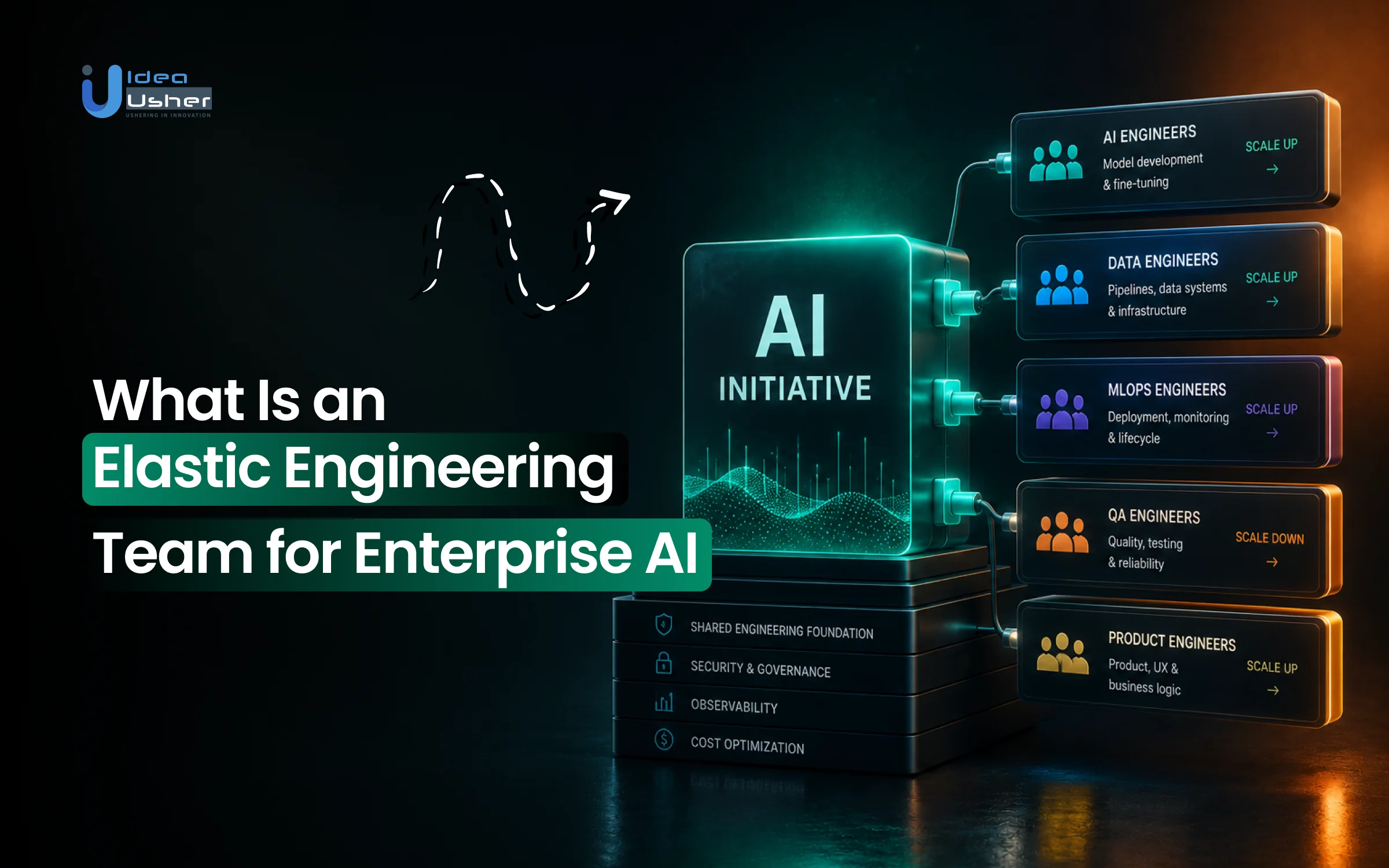
- Core roles include AI engineers, data engineers, MLOps specialists, cloud architects and software developers.
- This model improves development speed, resource flexibility and cost efficiency compared to traditional hiring approaches.
- Elastic teams are ideal for AI products, enterprise automation, MLOps and large-scale data infrastructure projects.
- How IdeaUsher can help you build enterprise AI and provide elastic engineering teams according to your AI project needs evolve.
The biggest bottleneck in enterprise AI is often not the technology but It is the inability of traditional engineering structures to adapt to rapidly changing business priorities, data requirements and deployment demands. This shift is driving interest in the elastic engineering team model, where specialized talent can expand, contract and reconfigure based on the evolving needs of AI initiatives.
Traditional software teams were designed around predictable roadmaps and fixed development cycles. Enterprise AI projects require a different approach that combines data engineering, MLOps, AI infrastructure, model development, software engineering, governance and deployment expertise at different stages of the lifecycle. The value is no longer just having a larger team. It is having the right expertise available at the right time without creating operational bottlenecks or unnecessary overhead.
In this blog, we will talk about what an elastic engineering team is, how it supports enterprise AI initiatives, its benefits, team structures, implementation strategies and how IdeaUsher helps organizations build and scale with flexible AI expert devs for production-ready deployments.
The Growing Challenge of Building Enterprise AI Solutions
As organizations rush to capitalize on the generative AI boom, they face a stark reality: building production-ready, enterprise-grade AI is far more complex than launching a pilot.
This growing complexity is driving demand for specialized engineering talent, reflected in the engineering services market’s growth from USD 1.77 trillion in 2025 to USD 1.88 trillion in 2026, with projections reaching USD 2.84 trillion by 2032.

The challenge is no longer access to AI technology, but access to the right expertise. In fact, 72% of employers globally report difficulty filling critical roles, while demand for AI skills continues to outpace available talent.
At the same time, more than 90% of AI pilots never reach production, largely due to talent shortages and deployment challenges. As AI initiatives scale, access to specialized engineering expertise becomes a critical factor in achieving successful outcomes.
A. Why Traditional Hiring Models Struggle with Enterprise AI Projects
Traditional talent acquisition is built for steady-state engineering, but AI development demands a highly specialized, multi-disciplinary assembly line where skills must shift dynamically across project phases.
- The Talent Assembly Problem: Enterprise AI requires a coordinated team of AI architects, ML/data engineers, MLOps specialists, and product managers. Because these roles are highly interdependent, even a single skills gap can delay the entire project.
- The Recruiting Bottleneck & Talent Shortage: The gap between the demand for AI expertise and the available talent pool has created an aggressive hiring bottleneck.
- According to Forbes, 85% of failed AI projects cite data quality or availability as a core issue.
- The specialized nature of these roles means recruitment cycles are grueling. While a standard IT role might take 30 to 45 days to fill, highly specialized AI and MLOps roles average 90 to 120 days to successfully recruit and onboard.
- The Cost of Inaction and Delays: The financial toll of these prolonged hiring cycles is severe.
- Base salaries for senior AI architects and MLOps specialists frequently exceed $200,000 to $300,000 annually, excluding equity and signing bonuses.
- In-house recruitment for these teams yields high opportunity costs from inflated salaries and 4 month hiring delays. These lags often lead to missed deadlines, resulting in lost market share to agile competitors.
Gartner research reveals a sobering reality for enterprise ambitions: only about 54% of AI projects ever make it from pilot to production. The primary culprit is not a lack of vision, but a lack of specialized in-house engineering capabilities to handle data pipelines and model deployment.
B. The Need for Flexible Engineering Capacity in AI Development
Because AI development is iterative and experimental, workloads do not remain constant. Relying solely on a fixed, full-time headcount creates severe operational inefficiencies.
- Fluctuating Lifecycle Requirements: The resource curve of an AI project is a roller coaster.
- Phase 1 (Discovery & Data Engineering): Requires heavy data engineering to clean, label, and pipeline petabytes of data.
- Phase 2 (Model Training & Tuning): Shifts the burden to AI Architects and Data Scientists to select, fine-tune, and validate models.
- Phase 3 (Deployment & MLOps): Demands MLOps specialists to build continuous integration/continuous deployment (CI/CD) pipelines, monitor for data drift, and optimize inference costs.
- The Scaling Dilemma: Hiring a large full-time team for peak workloads in Phases 1 and 2 results in costly, underutilized surplus during later maintenance stages. Conversely, under-hiring causes critical project bottlenecks.
- Elastic Capacity as a Strategic Imperative: Enterprises now utilize flexible, elastic engineering capacity to handle market shifts. This strategy enables scaling by 50% for data-intensive stages and reducing size during maintenance, which minimizes overhead and prevents hiring or layoff delays.

What Is an Elastic Engineering Team?
An elastic engineering team for enterprise AI is an on-demand, agile group of specialized technology experts designed to rapidly scale up or down based on a project’s needs. It provides enterprises with flexible access to critical AI, data, and cloud skills without the overhead of permanent, full-time hires.

These teams differ drastically from traditional IT structures, operating with a focus on specific business outcomes rather than rigid, fixed scopes of work. The table below explains Elastic Engineering Team model with other models:
| Feature / Model | Traditional Outsourcing | Staff Augmentation | Dedicated Teams | Elastic Engineering Teams |
| Core Structure | Fixed scope; rigid project-based delivery. | Flexible specialists embedded directly into internal teams as needed. | A fixed, long-term external team. | A variable, cross-functional squad that scales dynamically. |
| Speed to Scale | Slow (requires new contracts/RFPs). | Fast (pre-vetted experts can join projects quickly). | Slow (requires building a permanent unit). | Rapid (on-demand scaling of specific skills within days). |
| Skill Adaptability | Static throughout the project lifecycle. | High (specialists can be added or replaced based on evolving project needs). | Fixed skill sets unless roles are swapped. | Fluid (swapping an MLOps engineer for a Data Engineer seamlessly). |
| Management Overhead | Low (managed by the vendor). | Medium (maintains internal control while extending team capacity). | Medium (shared governance). | Low to Medium (autonomous but deeply integrated with internal tech leads). |
Through this model, enterprises gain on-demand access to highly specialized AI talent such as LLM fine-tuning experts, computer vision specialists, and vector database architects without the massive overhead of permanent recruiting, continuous training, or severance liabilities when a project phase concludes.
A. How Elastic Engineering Teams Work in Enterprise AI Projects
Enterprise AI solutions do not move in a straight line; they advance through milestones that require vastly different cognitive skill sets. An elastic team aligns directly with these shifting technical demands.
- Milestone-Based Resource Scaling: Teams scale based on milestones, enabling shifts from Principal AI Architects in design to Data Engineers during implementation.
- Dynamic Resource Allocation: Instead of keeping expensive specialists on a permanent retainer, the enterprise dynamically pulls from a diverse talent pool:
- Data Engineers during initial pipeline construction.
- ML Engineers & Data Scientists during model training.
- DevOps/MLOps Professionals to build Kubernetes clusters and automated CI/CD deployment loops.
- Product Experts to build user-facing APIs and interfaces.
- Embedded Collaboration Model: Elastic teams integrate directly into enterprise workflows through daily stand-ups, Slack/Teams communication, GitHub/GitLab repositories, and alignment with CTOs and engineering leadership, ensuring transparency, knowledge sharing, and architectural control.
B. Key Characteristics of an Effective Elastic Engineering Team
For an elastic engineering model to succeed at an enterprise level, it must possess five core pillars:
- Scalability & Flexibility: Enables organizations to scale engineering capacity up or down by 50%+ within a sprint cycle, aligning team size with project velocity and business needs.
- Cross-Functional Expertise: Combines front-end, back-end, data science, and infrastructure capabilities within a unified delivery and project-management framework.
- Rapid Onboarding: Leverages standardized engineering playbooks, enabling teams to integrate quickly into existing codebases, security protocols, and development workflows.
- Time-to-Value: Speeds up the time it takes to move AI prototypes into secure, production-ready environments.
- Cost Efficiency: Alleviates the difficulty of retaining expensive, hard-to-find AI talent full-time by bringing them in specifically when a complex capability is needed.
- Agility: Allows enterprises to easily swap out technologies (like swapping one LLM for another or adopting a new vector database) as the rapidly changing AI landscape evolves
Why Enterprise AI Projects Benefit from Elastic Engineering Teams
Building enterprise-grade artificial intelligence requires speed, specialized precision, and financial agility. Elastic engineering teams eliminate the structural bottlenecks of traditional workforce models, allowing enterprises to execute complex AI roadmaps with lower risk and higher efficiency.

A. Accelerating AI Product Development Timelines
In the fast-moving AI landscape, time-to-market is a critical competitive advantage. Delays in deployment do not just stall a roadmap, they allow competitors to capture market share.
- Immediate Execution vs. Recruitment Friction: Instead of waiting 90 to 120 days to source and onboard specialized engineers, an elastic engineering team provides an immediate injection of production-ready talent. This cuts time-to-onboard down to days.
- Eliminating the Onboarding Slump: Traditional hires require weeks of cultural and technical orientation. Elastic engineers are pre-vetted, highly senior professionals accustomed to dropping straight into active codebases, ensuring immediate productivity.
- Sustaining Velocity: The elastic model prevents AI project stalls caused by talent departures or niche technical blocks by providing instant backfills and specialized expertise to sustain development momentum.
B. Accessing Specialized AI and Engineering Expertise
Enterprise AI solutions require a deeply specialized, multidisciplinary talent matrix. An elastic engineering model provides a direct pipeline to elite professionals across every tier of the AI stack:
| Specialist Role | Core Technical Focus | Strategic Value to Enterprise AI Projects |
| AI/ML Engineers | Algorithmic development, model architecture selection, and optimization. | Builds, trains, and customizes high-performance models tailored to specific business logic and compute constraints. |
| Generative AI Specialists | LLM fine-tuning, Retrieval-Augmented Generation (RAG) architectures, and vector databases. | Integrates commercial or open-source foundational models with proprietary company data securely and accurately. |
| Data Scientists | Exploratory data analysis, statistical modeling, and predictive pattern identification. | Extracts actionable business insights from complex, unstructured datasets before the modeling phase begins. |
| MLOps Engineers | Continuous Integration/Continuous Deployment (CI/CD) for ML, automated pipelines, and model monitoring. | Automates model deployment, monitors for real-world data drift, and dynamically optimizes GPU/inference cloud costs. |
| Cloud Architects | High-Performance Computing (HPC) setup, multi-cloud infrastructure, and cluster management. | Designs and scales the secure, highly parallelized cloud environments (AWS, Azure, GCP) needed to compute massive AI workloads. |
| Enterprise Software Developers | Full-stack engineering, microservices orchestration, and secure API development. | Builds the robust backend pipelines and intuitive user interfaces that embed raw AI capabilities into existing workflows. |
| Security & Compliance Experts | Data encryption, vulnerability patching, and regulatory alignment (GDPR, HIPAA, SOC 2). | Ensures the entire AI pipeline adheres to strict corporate governance, data privacy boundaries, and global compliance frameworks. |
C. Managing Costs Without Sacrificing Innovation
The specialized talent required for AI development commands premium market rates. A rigid, permanent hiring model can quickly drain an enterprise’s innovation budget.
The Cost Realities: Maintaining a permanent, cross-functional team of 8 to 10 senior AI specialists can easily cost an organization $2.5M to $3.5M annually in base salaries alone excluding recruitment fees, benefits, equity, and continuous upskilling costs.
- Shifting from Fixed to Variable Costs: Elastic engineering converts fixed labor overhead into a fluid, variable operating expense (OpEx). Enterprises only pay for the exact expertise they consume, when they consume it.
- Precision Spending: Financial waste is eliminated. You cease paying for full-time data engineers once pipelines are complete and avoid retaining expensive MLOps specialists during early conceptual phases.
- Maximizing ROI: Optimizing project sprint allocations boosts budget efficiency. Redirecting funds from recruitment and idle staff to R&D and infrastructure accelerates core innovation.
D. Scaling Teams Based on Project Demands
The workload of an enterprise AI initiative is inherently non-linear, requiring a fluid resource strategy that scales alongside project milestones.
| Project Stage | Engineering Resource Curve | Elastic Team Response |
| Data Ingestion & Cleaning | Peak Demand (Data Engineering heavy) | Deploy a heavy squad of Data Engineers and Cloud Architects to build the foundation. |
| Model Training & Tuning | Moderate Demand (Data Science heavy) | Scale down data engineers; bring in GenAI Specialists and ML Engineers to fine-tune models. |
| Production Deployment | Peak Demand (Infrastructure heavy) | Introduce MLOps and Security experts to build CI/CD pipelines and ensure compliance. |
| Maintenance & Monitoring | Low Demand (Support heavy) | Downsize to a lean core team for ongoing optimization, drift monitoring, and minor updates. |
By dynamically matching headcount to this fluctuating lifecycle, enterprises maintain peak operational efficiency ensuring they are never under-resourced during critical development spikes, and never over-paying during periods of stabilization.
Common Enterprise AI Initiatives That Require Elastic Engineering Teams
Deploying AI across an enterprise involves navigating a web of data pipelines, infrastructure management, and application development. Elastic engineering provides the diverse technical talent needed to take these complex initiatives from design to production.
1. Generative AI Platforms and Enterprise Copilots
Enterprise copilots go far beyond simple chatbot interfaces. They act as secure, intelligent layers sitting on top of vast, fragmented internal corporate data networks.
- AI Assistants for Employees: Context-aware internal agents that understand role-specific functions, such as legal contract analysis and financial auditing, generating accurate corporate materials and recommendations.
- Knowledge Management & Enterprise Search: Moving beyond traditional keyword search, these systems leverage Retrieval-Augmented Generation (RAG) and vector databases such as Pinecone, Milvus, and Qdrant to surface precise answers from millions of internal documents, PDFs, and legacy wikis.
- Workflow Automation Copilots: Context-sensitive agents embedded within Slack, Salesforce, and Jira that don’t just answer questions but execute tasks such as CRM updates, project-template generation, and technical-support ticket routing based on conversational context.
Example: The Legal & Compliance RAG Copilot
The Scenario: A global financial institution wants an internal AI copilot that allows its compliance team to query 20 years of shifting regulatory PDFs, internal memos, and cross-border legal contracts.
Why it needs Elastic Engineering: Building this requires a huge up-front burst of Data Engineers and Generative AI Specialists to clean legacy PDFs, set up vector databases, and build secure semantic search pipelines. Once the system is built, the team can scale down to a lean core of Full-Stack Developers to handle the user interface and minor updates.
2. AI-Powered SaaS Products
For software companies and modern enterprises, adding AI to core product offerings is essential for maintaining market relevance.
- Predictive Analytics Solutions: Embedding machine learning models directly into SaaS dashboards to forecast supply chain demands, identify customer churn patterns before they happen, or predict machine failures in industrial setups.
- Customer Intelligence Platforms: Advanced sentiment analysis engines that process customer calls, emails, and chat histories in real time, giving sales and support teams deep, actionable insights into buyer behavior.
- AI Recommendation Engines: Sophisticated deep learning systems that deliver hyper-personalized content, product, or service suggestions to millions of users simultaneously, driving higher engagement and average order value.
- Automated Decision-Support Systems: Highly reliable systems designed for high-stakes industries like healthcare and fintech, providing real-time risk scoring, medical imaging pre-screenings, or automated credit risk evaluations.
Example: Predictive Healthcare Logistics SaaS
The Scenario: A healthcare software provider wants to add an AI module to their hospital management SaaS that predicts patient admission surges and automatically forecasts medical supply shortages two weeks in advance.
Why it needs Elastic Engineering: This requires top-tier Data Scientists and ML Engineers to build and validate highly sensitive predictive algorithms. Because patient data requires strict security, Security & Compliance Experts must be injected into the team immediately to ensure HIPAA compliance, and then rotated out once the architecture passes audit.
3. Enterprise Automation and Intelligent Operations
Intelligent operations bridge the gap between old legacy workflows and modern, automated corporate efficiency.
- Process Automation: Upgrading legacy Robotic Process Automation (RPA) by introducing AI that can interpret unstructured inputs, such as handwritten invoices, complex customer emails, or variable shipping manifests.
- Document Intelligence: Using advanced Optical Character Recognition (OCR) combined with layout-aware LLMs to instantly parse, classify, and extract data fields from thousands of incoming financial, legal, or medical records every day.
- AI-Driven Workflow Orchestration: Intelligent routing systems that monitor enterprise operational queues and dynamically assign tasks, allocate computing resources, and flag anomalies without human intervention.
Example: Autonomous Supply Chain Invoice Processing
The Scenario: A global manufacturing enterprise wants an AI system that intercepts millions of multinational supply chain invoices arriving via email in various languages, automatically reads them, converts currencies, maps them to the correct ledger, and flags fraud anomalies.
Why it needs Elastic Engineering: This relies heavily on Computer Vision (OCR) and NLP Specialists to train the document intelligence models. It also requires heavy integration with legacy ERP systems, demanding a spike in Enterprise Software Developers who can build stable microservices to connect the AI output directly to legacy corporate databases.
4. Large-Scale Data and Machine Learning Infrastructure Projects
An AI model is only as good as the infrastructure supporting it. This category focuses heavily on the underlying plumbing required to make enterprise AI reliable, safe, and cost-effective.
- Enterprise Data Pipelines: Building secure, automated, and highly scalable ETL (Extract, Transform, Load) pipelines capable of feeding clean, structured data into AI models from diverse databases in real time.
- MLOps Implementation: Establishing the continuous deployment foundation such as automated model retraining loops, containerized testing environments using Kubernetes, and precise GPU cluster allocation tracking.
- Model Deployment and Optimization: Minimizing ongoing cloud spending through advanced optimization techniques like quantization (reducing model size with minimal loss in accuracy) and caching strategies that keep system performance fast and responsive.
- AI Governance Frameworks: Implementing systemic guardrails to monitor data bias, track model lineage, log audit trails for every automated decision, and run real-time checks to prevent model hallucinations or corporate data leaks.
Example: Multi-Model MLOps & Cost Optimization
The Scenario: An enterprise has 15 different AI models running across different departments (HR, marketing, fraud, customer service) and is watching their cloud compute and GPU bills skyrocket out of control. They need an overhaul to centralize, monitor, and optimize these environments.
Why it needs Elastic Engineering: This is a pure infrastructure project. It requires zero front-end or product developers. Instead, it requires a heavy, elite squad of Cloud Architects and MLOps Engineers to build automated Kubernetes clusters, implement model quantization to reduce model sizes, and set up continuous monitoring to track real-time data drift and cloud spend.
When Should a Business Consider an Elastic Engineering Team?
Not every company needs an elastic model from day one. However, as an AI initiative scales from a simple internal test to a core operational layer, standard staffing models inevitably hit a wall. Recognizing the early indicators of capacity strain allows organizations to pivot before it impacts their bottom line.
A. Signs Your Current Team Is Limiting AI Growth
When in-house engineering resources are stretched beyond their core competencies, clear operational friction points emerge. If your business is experiencing any of the following symptoms, it is a trailing indicator that your staffing model is limiting growth:
- Severe Development Bottlenecks: Your core software developers are buried under routine platform maintenance, causing critical data pipeline construction or algorithmic fine-tuning tasks to sit frozen in the backlog.
- Specialized Skill Gaps: Your team possesses excellent full-stack capabilities but completely lacks the deep, niche mathematical expertise required for low-latency vector database indexing, model quantization, or localized Retrieval-Augmented Generation (RAG) architecture setup.
- Missed Delivery Timelines: Sprint velocities are plummeting. Project milestones that were scoped for 30 days are stretching into 90 days because internal teams are forced to learn highly complex machine learning concepts on the fly.
- Paralyzing Project Complexity: As data sets scale from gigabytes to petabytes, your current engineering staff struggles to manage GPU compute clusters, handle real-world model degradation, or protect systems against prompt injection vulnerabilities.
B. Scenarios Where Elastic Engineering Delivers Maximum Value
Rather than a permanent structural overhaul, certain strategic milestones yield an exceptionally high return on investment when executed via an elastic squad:
| Strategic Business Objective | The In-House Friction | The Elastic Team Intervention |
| Launching a New AI Product | Requires an immediate, multi-disciplinary team of 6-8 distinct specialists you cannot afford to wait 4 months to hire. | Drops a fully formed, pre-vetted AI product squad into your workflow within days to begin immediate execution. |
| Modernizing Enterprise Systems | High risk of disrupting legacy ERP/CRM systems due to lack of specialized API integration experience. | Injects senior Enterprise Software Developers and Cloud Architects to securely bridge legacy systems with modern AI layers. |
| Scaling Existing AI Platforms | Skyrocketing GPU cloud bills and unmonitored model drift causing system instability. | Deploys MLOps and Optimization Experts to quantize models, manage token caching, and automate monitoring. |
| Building MVPs & PoCs Fast | Traditional hiring overhead drains your budget before you can even prove product-market fit. | Assembles a ultra-lean, fast-moving team to construct a production-ready prototype in a fraction of the time and cost. |
C. Evaluating Internal Resources vs. External Engineering Support
Deciding whether to build an internal division or leverage an external elastic partnership comes down to an objective balance of capability, speed, and capital efficiency.

A clear assessment of skills, resource requirements, and long-term costs helps organizations choose the most effective approach for scaling AI development.
- Assessing Existing Capabilities: Evaluate whether your team has expertise in deep learning, AI infrastructure, and ML systems or is primarily focused on traditional software development. Misaligned responsibilities can impact product stability and delivery.
- Identifying Resource Gaps: Determine whether needs are long-term operational roles or short-term requirements such as MLOps, Kubernetes orchestration, or AI platform deployment, guiding the build-vs-buy hiring decision.
- Determining the Growth Strategy: Assess the full TCO of permanent hiring including recruitment, training, compensation, and retention versus elastic engineering teams that provide specialized expertise on demand.
Roles Included in an Elastic Engineering Team for Enterprise AI
An elastic engineering team is not an unstructured pool of generalist programmers; it is a highly calibrated, modular collective of specialized disciplines. Depending on your current development sprint, specific roles are dynamically activated to own distinct layers of the enterprise AI stack.
Core Roles & Ownership Breakdown
To see how these distinct disciplines collaborate seamlessly within a unified development loop, review the ownership breakdown below:
| Technical Discipline | Primary Operational Domain | Core KPI for the Project |
| Strategy & Architecture | Conceptual Design & Roadmap | Architectural scalability & business ROI alignment. |
| AI & ML Specialists | Algorithmic Core & Core Logic | Model precision, recall, and output accuracy. |
| Data & MLOps | Pipeline Automation & Deployment | Data processing velocity & pipeline uptime. |
| Software & Platform | Interface, Backend, & Integrations | API response times & end-user system adoption. |
| QA, Security & Compliance | System Guardrails & Optimization | Regulatory compliance passing & cloud spend reduction. |
While the table outlines the primary disciplines within an elastic engineering team, successful enterprise AI delivery depends on how these specialists collaborate across strategy, development, deployment, security, and optimization throughout the project lifecycle.
1. AI Strategy and Solution Architecture Experts
Before a single line of code is written, strategy and architecture professionals establish the technical blueprint, ensuring the AI project aligns with corporate governance and delivers concrete business value.
- Enterprise AI Consultants: Highly strategic advisors who assess business viability, evaluate existing legacy infrastructure, and define the return-on-investment (ROI) thresholds for the initiative.
- AI Solution Architects: High-level technical designers who select the foundational models (open-source vs. commercial APIs), establish vector database strategies, and map out how data will flow securely across systems.
- Technical Product Strategists: Specialized product managers who bridge the gap between business objectives and engineering sprints, mapping out the product roadmap, managing user stories, and defining clear milestones.
2. AI and Machine Learning Specialists
These core specialists focus on the brain of the application. They choose, build, tune, and test the core algorithmic structures that drive intelligent predictions and generation.
- Machine Learning Engineers: Software professionals who specialize in designing, training, and optimizing deep learning models to ensure performant algorithmic execution.
- Generative AI Developers: Experts specializing in Large Language Model (LLM) fine-tuning, Retrieval-Augmented Generation (RAG) architectures, and advanced prompt engineering to adapt models to proprietary data.
- NLP (Natural Language Processing) Engineers: Specialists who train models to understand, interpret, and generate human language, handling sentiment analysis, multi-lingual parsing, and entity recognition.
- Computer Vision Specialists: Engineers who design systems capable of extracting meaningful information from digital images, video streams, or spatial layout documents (OCR).
3. Data Engineering and MLOps Professionals
An AI model is static without fresh data, and highly vulnerable without automated delivery pipelines. These professionals construct the underlying operational framework.
- Data Engineers: System builders who construct the foundational ETL (Extract, Transform, Load) pipelines to ingest, clean, and structure massive volumes of raw information from fragmented enterprise databases.
- Data Architects: Data management specialists who design the overall data models, blueprint the metadata strategy, and set up scalable enterprise vector storage solutions (e.g., Pinecone, Milvus).
- MLOps Engineers: DevOps specialists specifically trained for machine learning workflows. They establish automated continuous integration/continuous deployment (CI/CD) pipelines for models and track live system metrics.
- Infrastructure Automation Specialists: Engineers who use Infrastructure-as-Code (IaC) tools like Terraform to automate the deployment of parallelized high-performance computing clusters.
4. Software Development and Platform Engineering Teams
Models must be accessible to users and integrated into software. This group builds the robust production systems that wrap around the core AI engine.
- Backend Developers: Engineers who build high-throughput microservices, orchestrate internal server logic, and manage core application databases.
- Frontend Developers: UI/UX developers who build user-facing enterprise web applications, data dashboards, or desktop copilot sidebars, ensuring intuitive interaction with AI outputs.
- Cloud Engineers: Systems specialists who deploy and maintain the cloud-native infrastructure (AWS, Azure, GCP), managing resource orchestration and compute load balancing.
- API Integration Specialists: Developers dedicated entirely to building secure, lightning-fast endpoints that smoothly connect the new AI engine directly to legacy internal tools like Salesforce, SAP, or localized ERP systems.
5. Quality Assurance, Security, and Compliance Experts
Enterprise AI introduces unique risks, from algorithmic hallucinations to compliance liabilities. This cross-functional unit provides the necessary defensive safeguards.
- AI Testing Professionals: Specialized QA engineers who test models for accuracy, edge-case resilience, system latency, and model behavioral drift over time.
- Security Engineers: Cybersecurity experts who implement end-to-end data encryption, establish strict role-based access controls (RBAC), and run penetration tests to defend against prompt injection attacks.
- Compliance Specialists: Regulatory analysts who audit the AI architecture to ensure total alignment with global data privacy boundaries and frameworks like GDPR, HIPAA, or SOC 2.
- Performance Optimization Experts: Engineers who optimize compute workloads using advanced techniques like quantization and layer caching to compress model sizes, maximize token delivery speed, and slash ongoing GPU cloud bills.
How Idea Usher Builds and Manages Elastic Engineering Teams for Enterprise AI
Navigating the complexities of enterprise AI requires more than just access to developers, it demands a highly predictable, enterprise-grade delivery framework. At Idea Usher, we build, manage, and scale elastic engineering squads that function as a friction-free extension of your in-house division, translating complex AI visions into high-performing commercial realities.
1. Understanding Business Objectives Before Team Formation
We believe that elite engineering is useless without absolute strategic alignment. Before a single developer is assigned to your account, Idea Usher executes a thorough, rigorous preparatory alignment phase:
- Discovery Workshops: Our product strategists consult with you to map out internal operational pain points, clarify product goals, and establish core business benchmarks.
- Technical Feasibility Assessment: We analyze your legacy IT systems, current database architectures, and data readiness to ensure your technical foundation can reliably support advanced machine learning workloads.
- Business Requirement Analysis: We define explicit constraints around security, latency, compute budgets, and user adoption metrics to eliminate technical scope creep early.
- AI Opportunity Identification: We pinpoint high-ROI insertion points where AI can deliver maximum impact whether that means automating a document pipeline or building an intelligent predictive SaaS module.
2. Creating a Custom AI Engineering Team Structure
Idea Usher moves completely away from rigid, cookie-cutter staffing. We build tailored, modular engineering squads customized explicitly around your unique technical milestones:
- Precision Talent Selection: We pull directly from our 250+ elite, pre-vetted bench of specialized AI architects, Generative AI engineers, MLOps specialists, and security experts to assemble the precise talent mix your current sprint requires.
- Defining Clear Governance: We establish explicit reporting lines, matrix structures, and code ownership boundaries so everyone understands exactly what they own.
- Strategic Resource Alignment: We ensure that expensive specialized talent is never underutilized, structuring your resource allocation curve so you only pay for highly specialized cognitive skills when they are actively moving the project forward.
3. Rapid Team Deployment and Seamless Integration
Speed is empty if it breaks your existing workflows. Our onboarding methodology is engineered to get your custom elastic squad writing production-grade code in days, not months:
- Accelerated Onboarding: Using standardized engineering playbooks, our teams plug straight into your existing code repositories, architectural guidelines, and cloud infrastructure with zero operational friction.
- Deep Internal Collaboration: Our engineers do not work in an isolated black box. They integrate directly into your daily stand-ups, leverage your internal communication lines (Slack, Teams), and collaborate transparently with your internal tech leads.
- Structured Project Governance: We deploy rigorous Agile frameworks, weekly sprint reviews, and transparent Jira/linear dashboards to give your leadership team absolute visibility into project velocity and development milestones.
4. Continuous Resource Optimization Throughout the Project
An effective elastic model must be dynamic. Idea Usher constantly monitors, optimizes, and adjusts team footprints to maintain peak capital efficiency:
- On-Demand Scalability: As your milestones shift from heavy data ingestion to core model tuning or frontend integration, we seamlessly scale up specific disciplines and scale down others without interrupting your timeline.
- Velocity Tracking: We closely track productivity data including code commit frequencies, pull request cycles, and feature delivery speeds to keep project execution fast and optimized.
- Eliminating Waste: By continuously rightsizing your development squad, we ensure you maintain maximum budget efficiency, avoiding the heavy financial drain of idle engineering benches.
5. End-to-End Delivery Ownership
When you partner with Idea Usher, you aren’t just renting an individual headcount, you are securing a comprehensive lifecycle delivery engine. We take absolute accountability for every stage of your AI initiative:

Our team manages the entire delivery lifecycle, ensuring every phase is executed seamlessly from initial planning and development to deployment and ongoing optimization.
- Product Planning & Architecture Design: Designing clean, highly scalable system blueprints, selecting appropriate models, and formatting secure data ingestion structures.
- Development & Model Integration: Writing clean, enterprise-grade code, setting up vector databases, executing RAG pipelines, and engineering robust API middleware layers.
- Rigorous QA & Testing: Auditing models for precision, evaluating system latency under simulated loads, checking for data drift, and patching vulnerabilities.
- Deployment & Post-Launch Optimization: Launching your solution on secure, autoscaling Kubernetes clusters, optimizing GPU compute spend, and providing continuous support to keep your models accurate, secure, and performant.
The Strategic Delivery Blueprint
Idea Usher follows a structured delivery framework that aligns specialized engineering talent with each stage of the AI lifecycle, ensuring faster execution, efficient resource allocation, and predictable outcomes.
| Project Lifecycle Phase | Active Idea Usher Squad Matrix | Primary Phase Output |
| 1. Assessment & Strategy | AI Consultants, Solution Architects, Data Architects | Technical PRD, Model Selection Matrix, Data Blueprint |
| 2. Pipeline & Model Prep | Data Engineers, GenAI Specialists, ML Engineers | Clean Data Ingestion Pipelines, Fine-tuned Base Models |
| 3. Full Application Build | Backend Devs, Frontend Devs, API Specialists | Production UI/UX, Secure Internal ERP Integrations |
| 4. Hardening & Scaling | MLOps Engineers, Cloud Architects, Security Experts | Automated CI/CD, Quantized Models, Cloud Cost Guardrails |
Ready to accelerate your enterprise AI roadmap without the friction of traditional hiring?
Connect with the technical strategists at Idea Usher today. Let’s design a high-performance, elastic engineering team tailored precisely to your timeline, technical stack, and business priorities.
Conclusion
For enterprises pursuing AI initiatives, success often depends on having the right expertise available at the right time. Elastic engineering teams provide the flexibility to scale resources, access specialized AI talent, and accelerate development without the constraints of traditional hiring. Whether building AI-powered products, enterprise automation systems, or advanced data platforms, this model helps organizations move faster and reduce operational risk. At Idea Usher, we help businesses achieve these outcomes through scalable engineering teams, AI expertise, and end-to-end development support tailored to evolving project needs.
Things to Know
Q.1. What Is an elastic engineering team for enterprise AI?
A.1. An elastic engineering team is a flexible group of AI specialists, data engineers, architects, and developers that can scale according to project requirements. This model helps enterprises accelerate AI initiatives without maintaining large permanent teams.
Q.2. When should enterprises go for an elastic engineering team?
A.2. Organizations typically adopt elastic engineering teams when launching AI products, building enterprise platforms, implementing machine learning solutions, or scaling existing initiatives that require specialized expertise and rapid execution.
Q.3. Which type of engineers are there in the enterprise AI elastic team?
Q.3. A typical elastic engineering team may include AI engineers, machine learning specialists, data engineers, MLOps experts, solution architects, cloud engineers, and software developers working together to deliver enterprise AI solutions.
Q.4. Why elastic engineering teams are better for enterprise AI development?
A.4. Enterprise AI projects often require niche skills that are difficult to hire and retain internally. Elastic engineering teams provide immediate access to specialized talent, reducing delivery timelines and implementation risks.


