


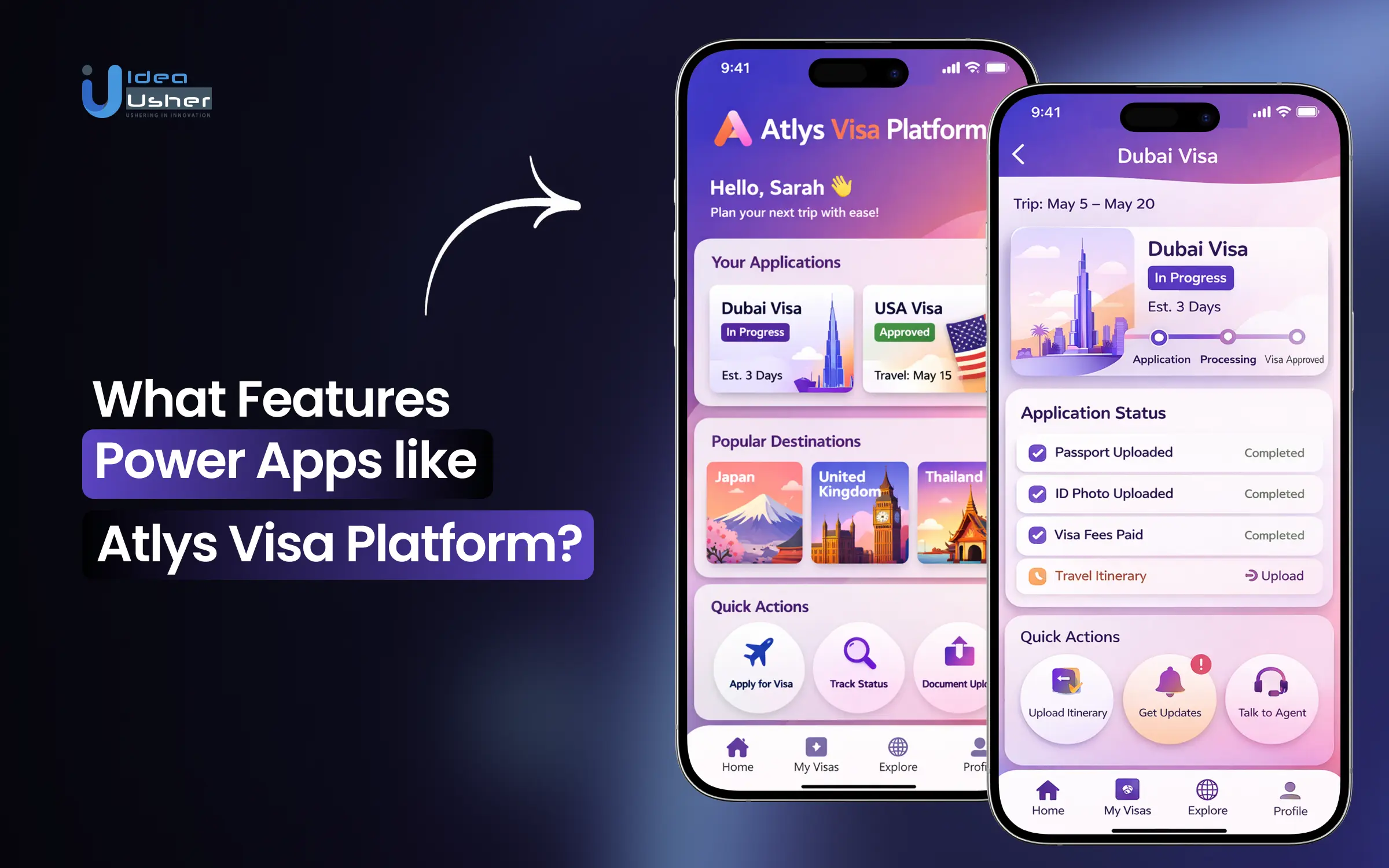
Applying for a visa can feel unclear, as rules may vary by destination and instructions often remain vague. The absence of real-time feedback can leave applicants unsure about what happens next. Many travelers have started using visa platforms because they bring consistency to this fragmented process. These systems can standardize requirements and guide each step in a structured flow.
They may also allow document scanning and photo capture in the app, with automatic error checking. Some platforms can provide live status tracking and may even support appointment scheduling from the same interface. As digital adoption grew, users began to expect faster updates and smoother interactions.
Over the years, we’ve built several visa platforms that use technologies such as AI-driven document intelligence and workflow orchestration. Given our expertise, we’re sharing this blog to discuss the features that power Visa apps like Atlys.
Why Visa Apps Are Replacing Travel Agents?

Source: Research And Markets
Traditional travel agencies are facing an existential crisis. While agencies rely on inconsistent manual labor, digital platforms like Atlys offer a scalable, software-driven approach that eliminates human error. For investors, the shift is about unit economics: a digital platform processes thousands of applications with near-zero marginal cost, whereas an agency is limited by headcount and geography.
Modern platforms act as fintech-travel hybrids, integrating real-time regulatory logic and sophisticated payment gateways. This transition moves the industry to a product-based model, capturing high-intent traveler data at the very start of the conversion funnel.
- Accuracy at Scale: Algorithms outperform human agents in compliance.
- Regulatory Agility: Platforms update visa rules across 150+ countries instantly.
- Fintech Integration: Automating government fees and offering premium financing.
Mobile-First Shifts
The “Uberization” of visas has moved applications from physical consulates to the user’s pocket. Leveraging smartphone cameras and NFC chips, apps like iVisa turn any location into a biometric enrollment station.
This decentralization removes the need for physical dossiers, appealing directly to high-value digital nomads. For the entrepreneur, this creates a sticky ecosystem where the app becomes the primary gateway for international movement.
Instant Processing Demand
In a high-velocity economy, the traditional 15-day waiting period is a significant friction point. There is an increasing willingness among professionals to pay for predictive processing.
By analyzing embassy backlogs and approval trends, platforms offer “On-Time Guarantees.” This is a risk-management play: using data to ensure travel timelines, justifying higher service fees, and building deep brand loyalty.
Traditional Service Gaps
Traditional services operate as black boxes with zero transparency. They lack the technical stack for real-time tracking, leading to user anxiety.
Furthermore, they struggle with data security: while agencies handle physical copies of sensitive IDs, digital platforms use SOC 2-compliant encryption. This security gap and lack of real-time updates make traditional agents a liability for modern, privacy-conscious travelers.

Core Features Behind Atlys-Like Visa Apps
The growth of visa apps stems from engineering that eliminates administrative friction through a zero-error architecture. By creating a cohesive ecosystem, these platforms ensure data flows seamlessly from a user’s camera to government databases, removing the human-led manual entry that typically causes rejections.

1. Smart Eligibility Engine
At the top of the funnel, the platform acts as a strategic advisor. This engine cross-references nationality and passport validity against real-time immigration policies. Sherpa° uses a similar logic to embed personalized requirements directly into airline booking flows.
From a business perspective, this reduces “bad leads” and lowers refund requests. Integrating live data feeds identifies destinations with the highest approval probability given the user profile, ensuring the user applies only for what they can actually obtain.
2. AI Document Validation
The critical technical moat for a visa platform is its validation layer. This feature uses computer vision to inspect documents like passports, ensuring they meet embassy standards. iVisa utilizes comparable technology to perform “quality checks” that catch errors before they reach government eyes.
Strategically, this serves as a pre-submission gate. By catching glare or expired dates at the source, the platform lowers operational costs and maintains its “on-time” guarantee.
3. OCR Auto-Fill
Optical Character Recognition is the engine of efficiency. Instead of manual data entry, the platform extracts information directly from the passport’s Machine Readable Zone. MakeMyTrip has integrated similar OCR tech to pre-fill application fields for millions of Indian travelers.
This ensures data integrity and eliminates human error. This precision allows the platform to process thousands of applications simultaneously without increasing headcount, providing a massive advantage over manual agencies.
4. Status Tracking
Transparency is a premium commodity. A centralized dashboard provides granular updates by scraping government portals. The Indian Visa Su-Swagatam app, for instance, provides direct status updates for foreign visitors to India, underscoring the demand for real-time clarity.
This acts as a retention tool, reducing support tickets by up to 60%. Historical data also allows for predictive modeling, informing users exactly when to expect their documents based on current embassy workloads.
5. AI Photo Capture
Non-compliant photos are a major cause of rejection. This integrated tool uses biometric algorithms to ensure photos meet requirements for tilt and lighting. Apps like Atlys and iVisa have popularized this by allowing users to skip the professional studio entirely.
By automating background removal and auto-cropping, the platform ensures the output meets international ICAO standards every time. This creates a “complete-at-home” experience that travelers find indispensable.
6. Multi-Visa Management
For corporate clients, managing multiple visas is a logistical challenge. A robust platform allows for parallel processing of different visa types. VFS Global offers premium “mobile” solutions that handle large-group or multi-visa batches for high-value clients.
This database tracks various expiry dates and document sets under one profile. This shifts the app from a one-time utility to a high-LTV travel management hub, capturing the high-frequency traveler segment.
7. Appointment Booking
Many high-value visas still require in-person interviews. An automated feature monitors consulate calendars 24/7 to secure slots. Atlys is particularly known for its ability to find and book early US or Schengen appointment slots in high-demand markets.
This is a high-demand feature in markets with long wait times. An appointment bot creates a massive competitive advantage and captures the segment requiring physical processing that simpler “e-visa only” apps miss.
8. Secure Document Vault
Security is the cornerstone of GovTech. A secure vault uses high-level encryption to store sensitive information for future use. TLScontact focuses on similar digital-first document handling to streamline the “biometric” journey for millions of applicants.
This creates a flywheel effect. The more a user utilizes the platform, the lower the friction for their next trip. This positions the platform as a leader in the digital identity space, making the business more than just a travel app.
Advanced Features That Drive Conversions in Visa Apps
Visa apps grow by using zero-error engineering to eliminate administrative friction. By syncing user data directly with government databases, these platforms remove the manual errors that cause rejections. To maximize ROI, they integrate risk-mitigation layers that convert high-intent traffic into loyal, paid users.
1. On-Time Guarantee Logic
The “on-time guarantee” is a powerful conversion tool. It is a financial model that calculates processing delays against historical embassy performance. Atlys uses this to offer full refunds if a visa is delayed, effectively de-risking the product for the traveler.
For an investor, this is a sophisticated data play. By leveraging real-time processing speeds, the system dynamically adjusts the “guaranteed” date. This creates a high-trust environment where users pay a premium for the certainty that their plans remain intact.
2. Rejection Risk Scoring
Before payment, the platform can provide a “Risk Score” based on the user’s profile. This model analyzes passport strength, travel history, and consulate trends. Boundless uses similar predictive logic for US immigration to identify potential red flags before submission.
This feature acts as a high-value advisory tool. By quantifying approval odds, the platform positions itself as an expert partner. High-risk users are prompted for more documentation, which reduces rejection rates and protects the platform’s success metrics.
3. Personalised Suggestions
Conversion increases when the platform anticipates the next move. A smart engine analyzes citizenship and location to offer “Visa-on-Arrival” or “e-Visa” ideas. Skyscanner has experimented with similar travel-intent data to suggest destinations based on visa ease.
This turns a transactional app into a travel discovery hub. By showing users they are “one click away” from 50 countries based on their existing document vault, you increase usage frequency and the customer’s overall Lifetime Value.
4. Hybrid Chat Support
High-stakes travel requires a safety net. An AI-first chatbot handles 90% of routine queries, while a seamless handoff to human experts manages complex edge cases. Revolut uses this hybrid model effectively to maintain high CSAT scores while keeping operational costs low.
For an entrepreneur, this scalability is key. AI handles the volume, while the “human touch” is reserved for high-value conversions. This ensures a user never feels abandoned, directly impacting positive reviews and organic growth.
5. Dynamic Pricing Models
Pricing in the visa space is elastic with respect to the traveler’s timeline. A dynamic engine can offer “Standard,” “Express,” and “Ultra-Fast” tiers, similar to how FedEx offers logistics tiers. When a user has a flight in 48 hours, their willingness to pay a premium is at its peak.
This model maximizes revenue per user. By integrating urgency-based fees and “peace-of-mind” add-ons, the platform can significantly increase its average order value. For the investor, this creates a diversified revenue stream beyond simple service fees.
What Founders Can Learn from Atlys’ Platform Design?
Visa apps grow by using zero-error engineering to eliminate administrative friction. By syncing user data directly with government databases, these platforms remove the manual errors that cause rejections. To maximize ROI, they integrate risk-mitigation layers that convert high-intent traffic into loyal, paid users.

1. Designing For Speed
In the GovTech space, speed is the ultimate product moat. Founders should view latency not just as a technical hurdle, but as a conversion killer. Atlys addresses this by promising users they can apply for a visa in ~4 minutes, transforming a multi-day chore into a high-speed digital interaction.
- Instant Gratification: Move the success moment as close to the start of the user journey as possible.
- Performance Engineering: Shaving milliseconds off an AI-Enhanced Passport Scan directly correlates to lower drop-off rates and higher trust.
2. Simplifying Complex Workflows
Atlys excels at abstracting the chaos of international bureaucracy. For a founder, the lesson is to handle the heavy lifting on the backend. Through their Pre-Qualification feature, users upload documents once to instantly check eligibility for 100+ visas, removing the need for redundant manual entries.
Instead of presenting a 10-page government form, the system uses OCR Technology to pre-fill 90% of the application. This cognitive offloading ensures the user never feels overwhelmed by the legal complexities of their destination.
3. Building Trust via Transparency
When dealing with sensitive identity documents, trust is the primary currency. Founders must design for anxiety reduction. Atlys utilizes a Real-Time Systems Tracker to display the live status of government portals, showing users exactly where the bottleneck lies if a delay occurs.
Strategic Insight: Trust is solidified by how the platform communicates during the wait. Proactive alerts are more valuable than a generic pending status.
- On-Time Guarantee: Offering a 100% refund for delays fosters high trust.
- Forex Fairness: Automatically refunding exchange rate differences shows a commitment to transparency that builds long-term loyalty.
4. Using AI to Reduce Friction
Automation should be invisible. Founders should use AI to eliminate redundant steps like studio visits. The Atlys Photo Model tool allows users to take a visa-compliant photo at home, adjusting dimensions and backgrounds in real-time to meet ICAO standards.
By deploying the Pre-Check Out Bot, the platform acts as a digital gatekeeper. It provides AI-verified guidance based on official sources, preventing the “garbage in, garbage out” cycle that leads to high rejection rates in manual agencies.
5. Prioritizing Mobile-First UX
The modern traveler is increasingly desktop-light. High-conversion platforms leverage native mobile features such as the camera and biometrics to finalize applications on the go.
| Feature | Mobile Advantage | Business Impact |
| BOLO AI Assistant | 24/7 empathetic support via chat | 3.4-minute average resolution time |
| Document Vault | Secure, encrypted storage on-device | One-click re-application for future trips |
| Push Notifications | Real-time Visa Status Tracking | 60% reduction in support inquiries |
How to Reduce Visa Rejections with Smart UX in Visa Apps?
Visa apps grow by using zero-error engineering to eliminate administrative friction. By syncing user data directly with government databases, these platforms remove the manual errors that cause rejections. To maximize ROI, they integrate risk-mitigation layers that convert high-intent traffic into loyal, paid users.

1. Pre-Validation Before Submission
The most effective way to handle errors is to prevent them from reaching the government’s eyes.
Atlys uses a Pre-Check System acting as an automated gatekeeper. This logic scans all uploaded documents against a destination-specific checklist before the Submit button even becomes active.
This system confirms passport validity and document integrity. AI models verify that a bank statement is recent or that a passport scan is not blurry. This prevents the “submit and pray” anxiety that leads to high rejection rates in traditional models.
2. Real-Time Error Detection
Static forms are a relic of the past. Modern visa platforms utilize Live Validation to catch mistakes as they happen. If a user enters a date of birth that conflicts with their passport OCR data, the UI immediately flags it with a Smart Warning.
By highlighting errors in real time, you reduce the need for manual backend reviews. This allows the platform to scale its volume without a proportional increase in human support costs. It ensures every application is submission-ready from the first click.
3. Guiding Users With Contextual Prompts
Bureaucratic language is often confusing for the average traveler.
A smart UX replaces “Place of Issue” with “Where was your passport printed?” and provides Visual Tooltips showing exactly where to find specific numbers on a document.
Reducing the cognitive load on the user is a direct path to higher conversion. By providing contextual, plain-language prompts, you help ensure the user provides correct information on the first attempt. This leads to a frictionless approval process and higher brand trust.
Data Points Every Visa App Must Track
Successful visa apps are built on a foundation of granular data. For an investor, these data points are not just numbers; they are the indicators of a platform’s operational efficiency and market dominance. By tracking how a user moves through the application funnel, a founder can identify where friction exists and deploy automated solutions to smooth the path to conversion.
Application Completion Rate Metrics
Completion rate is the primary health indicator for your product. If users start an application but do not finish, your “Unit Economics” suffer. High-performing platforms aim for a seamless flow that keeps the user engaged from the first document upload to the final payment.
- Average Time-to-Complete: Tracking how many minutes it takes to finish a form.
- Device-Specific Performance: Ensuring the mobile camera interface isn’t causing lag.
- Payment Success Rates: Monitoring if local payment gateways are failing in specific regions.
Drop-off Points In Visa Workflows
Understanding where a user leaves the app is critical for iterative design. Most drop-offs occur at high-friction moments, such as when a user is asked for a document they do not have on hand, like a specific bank letter or an older passport.
Technical Audit: If 40% of users drop off at the “Upload Photo” stage, your AI photo tool may be too rigid or the instructions too complex. Identifying these “leakage points” allows you to implement Smart Reminders or contextual help to bring the user back.
Approval vs Rejection Analytics
This is the ultimate metric for a visa platform’s credibility. By analyzing the reasons behind every rejection, a platform can update its Pre-Validation Logic to catch those specific errors in the future.
| Metric | Business Value | Strategic Action |
| Rejection Reason Category | Identifies recurring embassy pain points | Update AI scanning rules |
| Consulate Processing Time | Predicts the “On-Time Guarantee” risk | Adjust user expectations dynamically |
| Approval Rate by Nationality | Determines market expansion viability | Focus marketing on high-success corridors |
Why Timing Is Everything in Visa Apps like Atlys?
Visa apps capitalize on the fact that travel is a time-bound commodity. In the global mobility market, the value of a visa is inversely proportional to the time remaining before a flight. For an investor, the ability to monetize urgency while maintaining operational reliability is the ultimate driver of high-margin revenue.
By aligning technical processing speed with the user’s emotional state, the platform moves from being a simple tool to an essential travel partner. Managing the clock is not just a feature; it is the core business model that separates market leaders from generic service providers.
1. Handling Last-Minute Scenarios
Last-minute travel is the industry’s highest-margin segment. Atlys utilizes a Priority Processing Pipeline to fast-track applications for users with imminent departure dates. This requires deep integration with embassy workflows to provide accurate, minute-by-minute updates.
For the platform, this involves “Queue Management” logic that prioritizes high-urgency files without compromising the quality of standard applications.
By successfully navigating these “emergency” windows, the platform earns intense user loyalty and word-of-mouth marketing that a standard agency cannot match.
2. Building Urgency Into Design
Product design must reflect the time-sensitive nature of travel. Atlys uses a Departure Countdown and real-time “Processing Windows” to nudge users toward completion. These visual cues serve as a constant reminder of the shrinking window for approval.
This psychological design increases the completion rate of applications. When a user sees a “Submit within 2 hours for guaranteed Monday arrival” prompt, the conversion happens immediately.
This turns passive browsing into active purchasing through well-placed, data-driven urgency.
3. Pricing Based On Speed
Tiered pricing is the primary engine for increasing Average Order Value. By offering “Standard,” “Express,” and “Instant” processing tiers, the platform allows users to pay for the level of certainty they require.
This model captures the maximum “Willingness to Pay” from every customer.
A business traveler with a flight tomorrow is happy to pay a 3x premium for expedited service. For the entrepreneur, this creates a diversified revenue stream in which the platform is paid not just for the visa but also for the speed and peace of mind delivered.
How AI Is Transforming Atlys-Like Visa Apps?
Visa apps grow by using zero-error engineering to eliminate administrative friction. By syncing user data directly with government databases, these platforms remove the manual errors that cause rejections. To maximize ROI, they integrate risk-mitigation layers that convert high-intent traffic into loyal, paid users.

1. OCR And NLP In Document Processing
Optical Character Recognition and Natural Language Processing are the dual engines of modern document handling. Instead of a human clerk reading a bank statement, an NLP model parses the text to ensure the balance meets the specific threshold required by a consulate.
For example, iVisa uses similar automated parsing to handle high-volume digital applications for hundreds of destinations.
- Semantic Understanding: NLP goes beyond simple text. It can determine whether a “Letter of Invitation” includes the mandatory legal phrasing required by the destination country.
- Structured Data: OCR converts unstructured photos of documents into clean, searchable data. This allows the platform to run automated checks against embassy rules in milliseconds.
2. Fraud Detection Using ML Models
Trust with sovereign governments is a platform’s most valuable asset. Machine Learning models act as a first line of defense against fraudulent applications.
Sherpa, for instance, integrates comparable verification logic within airline partner systems to ensure travelers possess valid documentation before they even reach the airport.
Risk Mitigation: If a user’s passport photo doesn’t match the biometrics of their uploaded “Selfie,” the system triggers a manual review. This protects the platform’s “whitelisted” status with immigration departments, ensuring faster processing times for honest users.
3. AI Chatbots For Instant Query Resolution
High-fidelity support is no longer a task limited to humans. Intelligent chatbots are trained on thousands of previous visa cases to answer destination-specific questions instantly.
Platforms like VFS Global have deployed digital assistants to manage the massive volume of appointment and tracking queries they receive globally.
- 24/7 Availability: Travelers often apply for visas outside of standard business hours.
- Contextual Logic: The bot doesn’t just give a generic FAQ; it identifies the user’s nationality and destination to provide a tailored answer.
- Cost Efficiency: Automating 90% of inquiries allows founders to keep support teams lean while maintaining a 4.9-star user experience.
4. Smart Data Extraction From Passports
The entry point of every application is the passport. Smart extraction technology uses computer vision to simultaneously extract data from the Machine Readable Zone and the Visual Inspection Zone.
| Extraction Point | Benefit | Impact |
| MRZ Parsing | 100% accuracy on passport numbers | Zero rejections due to typos |
| Expiry Monitoring | Automated validity checks | Prevents “Invalid Document” errors |
| Biometric Alignment | Ensures name matches across all forms | Streamlines government verification |
Why Founders Choose IdeaUsher for Visa Apps?
IdeaUsher can help you to develop a high-performance visa platform by leveraging over 500,000 hours of coding experience and a team of ex-MAANG/FAANG developers. Our engineering philosophy mirrors the zero-error architecture of industry leaders like Atlys. We ensure your application handles complex government integrations with a technical foundation built for massive scale.
500K+ Hours Of Coding Expertise
With over 500,000 hours of coding experience, our team has mastered the nuances of high-stakes software. We understand that in the visa sector, one bug can lead to a rejection. Our deep knowledge allows us to bypass common pitfalls, accelerating your time-to-market with gold-standard code quality.
Ex-FAANG Level Engineering Talent
Our team consists of elite developers from ex-MAANG/FAANG backgrounds who bring world-class standards to your project. This ensures your platform uses the same scalability and security protocols as global tech giants. We implement advanced AI and OCR logic that mimics the efficiency of leaders like Sherpa° and iVisa.
Proven Success In Complex Platforms
We specialize in turning intricate, multi-layered workflows into seamless user experiences. Having delivered numerous complex platforms, we know how to navigate API limits and secure document storage. Our portfolio proves we can handle the “heavy lifting” problems that usually stall less experienced teams.
Long-Term Scaling And Support
We don’t just launch apps; we build businesses meant to scale. Our partnership extends beyond the initial release to provide ongoing technical support and infrastructure optimization. As your user base grows, our architecture evolves with you to ensure your platform remains fast and reliable through peak travel seasons.
Conclusion
Apps like Atlys are powered by a tightly integrated stack of AI-driven document intelligence, real-time validation engines, and adaptive workflow systems that work together to remove uncertainty from the visa process. Each feature is designed to reduce errors before submission, guide users with contextual precision, and automate complex compliance checks in the background. The result is not just a faster application flow, but a system that consistently improves approval outcomes while delivering a seamless, predictable experience for travelers.
FAQs
A1: Digital platforms eliminate the stress of manual bureaucracy by automating document verification and form-filling. For travelers, this means a significantly lower risk of rejection and a much faster application process. Businesses benefit from centralized tracking and higher success rates compared to traditional methods.
A2: A visa acts as official conditional authorization granted by a territory to a foreigner, allowing them to enter, remain within, or leave that territory. Modern e-visas are digitally linked to your passport number, allowing border officials to verify your status instantly upon scanning your travel documents at the airport.
A3: Building a platform like Atlys requires integrating advanced OCR Technology for data extraction and secure APIs for government portal synchronization. You must prioritize a “zero-error” architecture that includes AI-driven document validation and biometric photo tools to ensure every submission meets strict consular standards.
A4: Core features include Smart Eligibility Engines, real-time status tracking, and secure document vaults for encrypted data storage. Advanced platforms also offer on-time guarantees, automated appointment booking, and AI-powered chatbots to provide 24/7 support for complex international travel requirements.


