


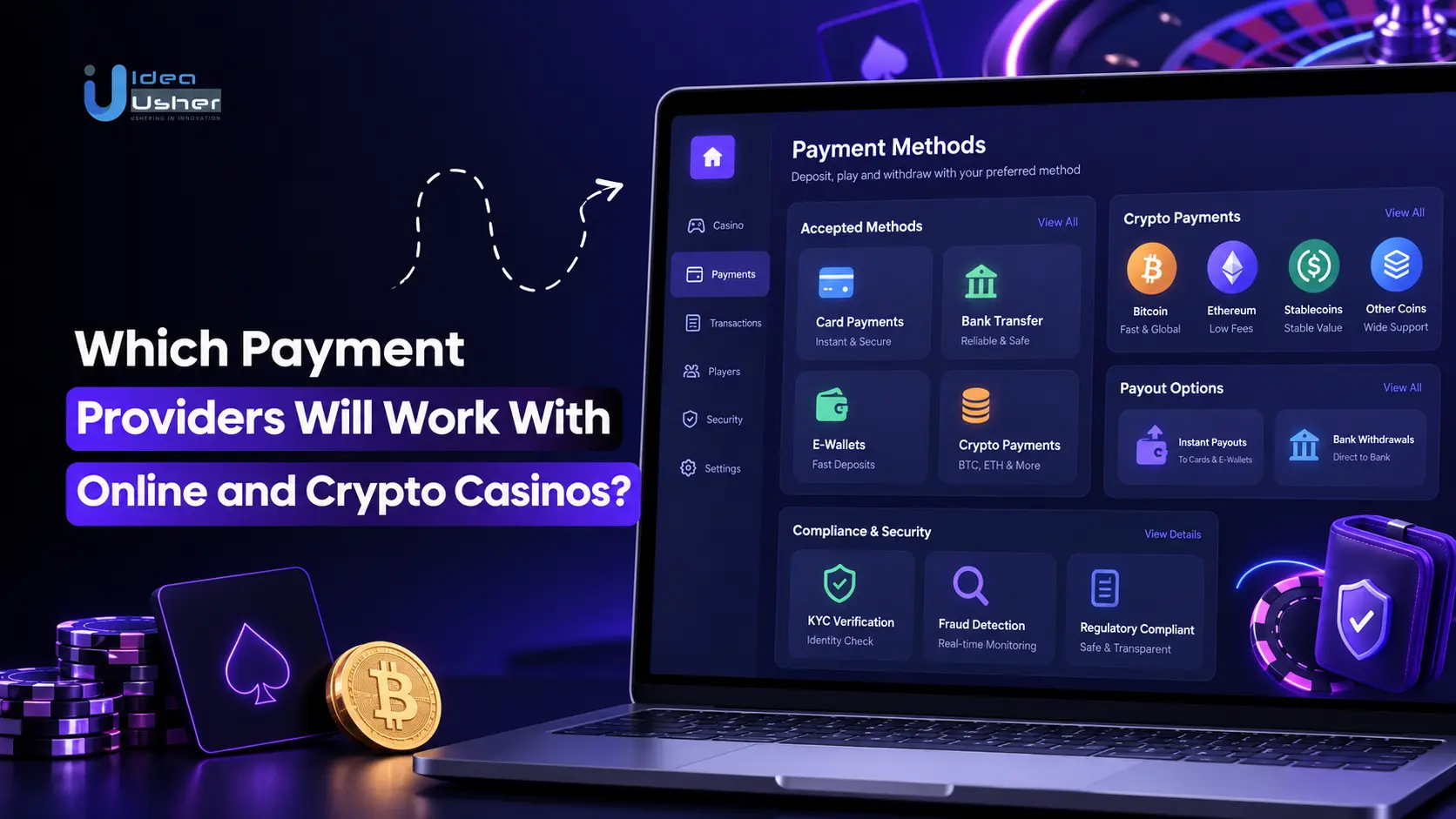
Key Takeaways:
- Stripe and Square do not process casino payments because gambling is on their list of things they do not allow.
- You must find a payment provider that deals with high-risk businesses and accepts either fiat money or cryptocurrency, or both, using ways to move money in and out that’re already available.
- Check how each business deals with money coming in, money going out, and changing between different types of money.
- Issues can happen later, such as money taking too long to get paid, extra charges that are not obvious, and money that is held back.
- Idea Usher can help you with the setup at every step of the process, like connecting the approved providers and creating your casino wallet and payment systems.
Since online and crypto casinos fall within a high-risk merchant category, the major processors such as Stripe and Square have banned gambling in their published terms. In order to deal with this, casinos use specialized high-risk payment providers who work with fiat currencies, crypto assets, or use a combination of both. The hybrid providers connect the two systems by offering built-in on-ramps and off-ramps.
In reality, the payment providers used by casinos include gambling-approved acquirers such as Nuvei, e-wallets including Skrill and Neteller, and pay-by-bank services such as Trustly. On the other hand, crypto processors like CryptoProcessing by CoinsPaid are also in charge of processing Bitcoin and stablecoin payments.
It depends on your license, the markets in which you operate, and whether you accept fiat or crypto, which casino payment providers will accept you. Furthermore, even after having been approved, providers are able to increase their reserves or freeze your account with little notice. Consequently, the way in which your cashier system is designed will determine whether losing a provider amounts to a simple switch or requires a full rebuild.
That is the reason why Idea Usher develops the cashier and payment integrations for custom iGaming platforms. In this blog, we explain which types of providers correspond to which casino models, the challenges that US founders will encounter in 2026, and the cost of the payment layer.

Why Casino Payments Need Specialized Providers
Casino payments need specialized providers because card networks, banks, and processors treat real-money betting as a separate, higher-risk category. As a result, a gateway that readily serves an online clothing store can still refuse a casino outright.
Therefore, operators should confirm a provider’s gambling policy before comparing fees, payout speed, or integration options.
1. How Casino Payments Differ From Regular Transactions
A regular purchase moves money one way, from a customer to a merchant. However, a casino moves money in both directions, because players deposit funds and later withdraw winnings.
In addition, card networks code gambling transactions separately, so issuing banks can apply their own rules.
- Repeat deposits: players often fund accounts several times, which raises fraud and dispute exposure.
- Player winnings: the operator owes money back, so payout capacity matters as much as deposits.
- Fraud exposure: stolen cards and bonus abuse target casinos because funds move quickly.
- Payout rails: withdrawals need their own route, such as a bank transfer or crypto send.
2. Why Banks Classify Online Casinos as High-Risk
Banks and acquirers price risk, and online gambling carries more of it than ordinary retail. For instance, a player who loses money may dispute the card charge afterward.
Consequently, many providers refuse gambling entirely, and Stripe’s restricted businesses list names internet gambling and casino games as prohibited.
- Merchant category code 7995: the betting code lets issuing banks identify and decline gambling charges.
- Chargebacks: high dispute rates can push card networks to raise fees or end the account.
- Financial exposure: the acquirer absorbs losses an operator cannot cover.
- Rolling reserves: acquirers commonly hold 5% to 10% of settlements for 90 to 180 days.
3. How Licensing Changes Payment Provider Eligibility
A gambling license gives you legal permission to offer games, but it does not oblige any processor to serve you. Instead, each provider runs its own underwriting and decides which licenses and markets it accepts.
Even so, a license remains the entry ticket, since few reputable providers onboard unlicensed operators.
- License tier: an MGA or UKGC license opens more doors than a Curaçao license.
- Target markets: providers check whether gambling is legal where your players live.
- Written confirmation: get each provider’s eligibility answer in writing before you build your cashier.
In short, casino payments run on different rules than ordinary ecommerce. Together, card coding, chargeback risk, and licensing decide which providers will say yes. With that foundation in place, the next section names the providers that openly serve this sector.
Casino Payment Providers Worth Comparing in 2026
Casino payment providers worth comparing in 2026 include Nuvei, Paysafe, emerchantpay, Trustly, and CryptoProcessing by CoinsPaid. Each one publicly markets dedicated services to gambling operators, so each deserves a place on an early shortlist.
Demand for casino payment providers keeps rising as online gambling grows. Meanwhile, Grand View Research valued the global online gambling market at $88.0 billion in 2025 and expects an 11.0% CAGR through 2033.

Consequently, more operators will compete for the same limited pool of gambling-approved acquirers, wallets, and crypto processors.
However, public iGaming positioning is not approval, because every provider still underwrites each casino separately before going live.
1. Nuvei for Multi-Market Casino Payment Processing
Nuvei suits regulated-market operators that need card acquiring, currency conversion, and local payment methods under one contract. Its online gaming page lists 700 local and alternative payment methods through a single integration with unified reporting.
In addition, Nuvei offers a hosted Cashier page built for gaming, which shortens integration work.
- Acquiring and FX: global card acquiring with foreign exchange support.
- Deposits and payouts: both run on one platform, and Nuvei promotes faster payouts.
- Crypto: Nuvei advertises crypto acceptance through the same solution.
- US presence: a 2021 release reported approvals to serve iGaming operators in multiple states.
2. Paysafe for Casino Wallets, Cards, and eCash
Paysafe is the parent provider, while Skrill, Neteller, and Paysafecard are the brands players see at the cashier. In other words, an operator signs one Paysafe relationship and then switches on individual methods.
According to Paysafe’s own announcement, its gateway combines card processing with these wallets, eCash, and 30 or more third-party local methods.
- Cards: debit and credit processing through the Paysafe Gateway.
- E-wallets: Skrill and Neteller for players who prefer not to use cards.
- eCash: Paysafecard and Paysafecash for cash-funded deposits.
- Regions cited: the UK, continental Europe, North America, and Latin America.
3. emerchantpay for Gambling Payment Processing
emerchantpay runs a dedicated gaming page that promotes global acquiring alongside risk and reporting tools. For that reason, it suits operators that want an acquirer with in-house fraud and performance controls. However, the public page gives few specifics on regional methods or payout rails, so operators should request both in writing.
- Cards: global acquiring for card deposits.
- Risk management: risk and reporting solutions aimed at gaming merchants.
- Regional methods: confirm the current list for each target market.
- Payouts: ask which withdrawal rails and settlement times apply to your account.
4. Trustly for Eligible Pay-by-Bank Casino Payments
Trustly fits casinos that want bank-funded deposits and fast bank payouts alongside an existing card processor. Its US gaming page claims reach to more than 99% of US bank accounts through direct APIs.
Even so, Trustly’s published gaming clients are licensed operators, so availability for your product and jurisdiction needs direct confirmation.
- Deposits: players pay from their bank account without entering card details.
- Payouts: Caesars Digital uses Trustly for real-time payouts over the RTP network.
- Guaranteed ACH: Hard Rock Digital gets guaranteed ACH payments across its operating states.
- Regions: Trustly cites coverage across the EU, UK, US, and Canada.
5. CryptoProcessing by CoinsPaid for Crypto Payments
CryptoProcessing by CoinsPaid suits casinos that accept crypto deposits and want automatic conversion into fiat. The Estonia-based provider reportedly counts more than 500 online casinos among its merchant clients.
Still, crypto casino payment processors run their own screening and onboarding, so operators should verify eligibility and features before integrating.
- Currencies: payments in more than 20 cryptocurrencies.
- Conversion: instant crypto-to-fiat conversion into 40 fiat currencies.
- Payouts: bulk crypto payouts to players and partners.
- Screening: AML and KYC support for operator compliance programs.
- Licensing: the provider holds an Estonian crypto-asset services license.
6. Casino Payment Provider Suitability Comparison
Use this matrix to compare providers on verified facts rather than marketing claims. Importantly, every eligibility entry reads “conditional,” because a public iGaming offering never proves a provider will accept your casino.
| Field | Nuvei | Paysafe | emerchantpay | Trustly | CryptoProcessing |
| Product | Nuvei Online Gaming | Paysafe Gateway (Skrill, Neteller, Paysafecard) | emerchantpay Gaming | Trustly Pay by Bank | Crypto Processing by CoinsPaid |
| Category | PSP and acquirer | PSP, acquirer, wallets | Acquirer and PSP | Bank payment | Crypto processor |
| Casino support | Dedicated gaming page | Published iGaming partnerships | Dedicated gaming page | Dedicated gaming page | iGaming-focused client base |
| Verified jurisdictions | US states (2021 release); others unverified | UK, Europe, North America, LatAm | Unverified | EU, UK, US, Canada | Estonia-licensed; player markets unverified |
| Methods | Cards, 700 local and alternative methods, crypto | Cards, wallets, eCash, 30+ third-party methods | Cards; others unverified | Bank transfer, guaranteed ACH | 20+ cryptocurrencies |
| Deposits | Confirmed | Confirmed | Confirmed | Confirmed | Confirmed |
| Payouts | Confirmed | Verify per method | Unverified | Confirmed, including RTP | Confirmed (bulk payouts) |
| Licensing requirement | Approval-dependent | Approval-dependent | Approval-dependent | Approval-dependent; published clients are licensed | Approval-dependent |
| Pricing | Custom quote | Custom quote | Custom quote | Custom quote | Custom quote |
| Integration | Single API, hosted Cashier | Single gateway API | Unverified | Direct APIs | REST API |
| Operator eligibility | Conditional | Conditional | Conditional | Conditional | Conditional |
Need a cashier that connects to several of these providers and swaps them without a rebuild? Idea Usher’s iGaming development team integrates payment providers into custom casino platforms.
In short, five providers publicly serve gambling operators across cards, wallets, bank payments, and crypto.
However, none of them guarantees approval or publishes casino pricing. Before shortlisting any of them, operators need to know which casino models each provider type actually serves.
Matching Payment Providers to Your Casino Model
The right casino payment providers depend on your business model, not on a universal top-ten ranking. A newly licensed casino, an established operator, a crypto-first brand, and a sportsbook adding casino each face different underwriting questions.
Therefore, operators should match provider categories to their own licensing, history, and payment mix before requesting quotes.
1. Payment Options for a Newly Licensed Online Casino
A new casino has no processing history, so underwriters lean on the license, ownership, and business plan. As a result, approval usually comes with stricter terms.
For example, PXP’s rolling reserve guide shows $1M a month at a 10% reserve leaves about $300,000 locked.
- Coverage first: secure one card route and one alternative method for deposits and payouts.
- Cash planning: budget for reserves before launch day.
2. Payment Options for an Established Casino Operator
An established operator can use its chargeback and volume history to negotiate better terms. Meanwhile, the bigger risk shifts to continuity, because one frozen account can stop every deposit. Consequently, mature casinos usually run more than one acquirer.
- Continuity: route traffic across several acquirers.
- Reconciliation: match every provider’s settlement reports to the player ledger.
3. Payment Options for a Crypto-First Casino
A crypto-only cashier needs just a specialist processor, but it limits players to people who already hold crypto. By contrast, a combined cashier adds card, bank, or on-ramp routes for fiat players. However, those fiat routes bring back full underwriting and reserves.
- Crypto-only: faster launch with a smaller audience.
- Combined cashier: wider reach with more compliance work.
4. Payment Options for Sportsbook and Casino Operators
An existing sportsbook payment system can often support a new casino, but approval may not carry across verticals. In practice, providers can approve sports betting and still review casino separately.
Likewise, operators who add a casino without rebuilding their sportsbook still need a wallet that separates product rules.
- Product permissions: confirm each provider covers casino, not only betting.
- Wallet architecture: keep one balance with product-level controls.
| Operator scenario | Typical payment needs | Provider categories to consider | Verify before contracting |
| Newly licensed casino | First merchant approval, card and alternative deposits, basic payouts | High-risk acquirers, gaming PSPs, e-wallets | Reserve percentage, hold period, licenses accepted |
| Established operator | Continuity across markets, local methods, reconciliation | Multiple acquirers, orchestration platforms, local methods | Termination notice, reserve release terms, volume caps |
| Crypto-first casino | Coin deposits and payouts, optional fiat on-ramp | Crypto processors, on-ramps, a fiat PSP for cards | Licenses accepted, screening rules, conversion fees |
| Sportsbook adding casino | One wallet, casino permissions on current providers | Existing PSPs, casino-specific methods | Casino coverage in each contract, market restrictions |
In short, each casino model faces a different payment problem. New operators fight for approval, while established ones protect continuity.
Why Casino Payment Providers Reject Applications
Casino payment providers reject applications when the license, ownership records, or compliance controls fail underwriting, even after the website and software are ready. A license proves legal permission, but providers still judge risk, documents, and target markets.
Consequently, many rejections trace back to gaps an operator could have closed before applying.
1. Gambling Licenses and Merchant Approval
Providers check which entity holds the license, where it allows play, and whether they serve that market. In other words, a license opens the conversation but never guarantees approval.
a. US State-Licensed Casinos
The US has no national online casino license, so operators secure approval state by state. Accordingly, providers approve specific states, and a New Jersey license covers New Jersey only.
b. UK and European Casino Operators
UK and European providers check that the licensed entity matches the contracting company. They also confirm eligibility in each market the operator serves.
c. Curaçao and Other International Licenses
A Curaçao license is lawful, yet it does not oblige any provider to accept you. Therefore, expect fewer options and stricter terms than regulated-market operators receive.
2. Business Documents and Merchant Underwriting
Underwriters review the company behind the casino, not just the product. For that reason, missing or inconsistent documents cause many delays. Prepare these items before applying:
- Company records: registration documents and beneficial ownership details.
- Funding: source of funds for owners and initial capital.
- Markets and volume: target countries and projected monthly volumes.
- Website policies: terms, privacy, and responsible gambling pages.
3. Stripe and PayPal Restrictions for Gambling
Stripe prohibits internet gambling and casino games outright on its restricted businesses list. By contrast, PayPal’s Acceptable Use Policy places gambling under a pre-approval requirement.
Even then, PayPal requires the operator and its customers to sit only in jurisdictions where gambling is legal.
4. Regulatory Controls Required for Payment Approval
Providers want proof that your controls work before they process a single deposit. Accordingly, the cashier must connect these checks to every transaction:
- KYC and AML: identity checks and transaction monitoring.
- Sanctions screening: players and payouts checked against sanctions lists.
- Responsible gambling: deposit limits and self-exclusion.
- Card data security: PCI DSS compliance for card processing.
A license starts the approval process but does not finish it. Documents and live controls decide the outcome. Once approved, though, operators still need to understand what each provider will cost them.
Fiat Payment Methods for Online Casino Operators
The fiat payment methods for online casinos that matter most are cards, e-wallets, pay-by-bank, and local or prepaid methods. However, each one fits a different player need and market.
Therefore, founders should choose methods by where their players live and how they withdraw, rather than by the longest method list.
1. Card Processing Through Gambling-Approved Acquirers
Cards remain the default deposit method, but only gambling-approved acquirers will process them. Meanwhile, issuing banks can still decline gambling charges, which lowers acceptance rates.
Rules also vary by market:
- UK: the Gambling Commission banned gambling on credit cards from April 2020.
- Disputes: card deposits carry chargeback risk that wallets and bank payments reduce.
2. Skrill and Neteller for Casino Transactions
Skrill and Neteller let players fund casinos from a wallet instead of a card. Importantly, the operator signs a merchant agreement with Paysafe, while each player holds a separate wallet account.
As a result, players keep card details away from the casino.
- Two relationships: the operator contracts with Paysafe, and players sign up with Skrill or Neteller directly.
- One contract: the same Paysafe gateway can also add cards and Paysafecard.
3. Pay-by-Bank and Open Banking for Casinos
Pay-by-bank moves money straight from the player’s bank account, so it suits casinos that want fast payouts. For example, Trustly supports real-time US payouts for Caesars Digital.
Still, eligibility depends on your license and market.
- US reach: Trustly cites access to more than 99% of US bank accounts.
- Settlement: guaranteed ACH options reduce the risk of returned bank payments.
4. Prepaid Methods and Local Casino Payments
Prepaid and local methods matter where players avoid cards or banks. In addition, regional favorites like Pix in Brazil and BLIK in Poland often outperform global options.
Before adding any of them, check two points:
- Coverage: your provider must support the method in that country.
- Payouts: many vouchers, including Paysafecard, handle deposits but not withdrawals.
5. Payment Coverage Across Different Markets
Local availability matters more than the total number of methods a provider advertises. For instance, 700 methods mean little if your licensed markets support only a handful.
| Market | Common fiat methods | Key restriction | Verify before launch |
| US | Debit cards, pay-by-bank, ACH | Licensing and provider approval run state by state | Provider approval for each state you serve |
| UK | Debit cards, e-wallets, pay-by-bank | Credit card gambling banned since April 2020 | Licensed entity matches the contracting company |
| EU | Cards, e-wallets, iDEAL, BLIK, pay-by-bank | Licensing varies by country | Local method coverage in each country |
| International | Local methods such as Pix, e-wallets, vouchers | Offshore licenses narrow provider options | Method eligibility for your specific license |
In short, the right fiat mix follows your players and licenses, not a provider’s catalog. Each market needs at least one deposit route and one payout route.
Crypto Payment Solutions for Casino Operators
Casino operators accept crypto through a specialist payment gateway or their own wallet infrastructure, then credit player balances after on-chain confirmation. However, blockchain rails change custody, settlement, and payout mechanics, not legal duties.
Licensing, AML checks, and sanctions screening still apply, so crypto adds a payment route rather than removing compliance.
1. Bitcoin and Ethereum Casino Deposits
A casino needs a deposit address per player, a confirmation policy, and a rule for crediting balances. Meanwhile, network fees and confirmation times differ between Bitcoin and Ethereum.
Consequently, the cashier should show expected wait times before players send funds.
- Networks: list exactly which chains you accept.
- Custody: decide who holds incoming coins.
2. USDT and USDC for Casino Payments
Stablecoins suit casinos that want crypto speed without price swings between deposit and payout. However, USDT and USDC run on several networks, so players can lose tokens sent on an unsupported chain.
In addition, FATF lists stablecoin misuse as an emerging risk.
- Settlement: choose stablecoin or fiat settlement.
- Compatibility: match token and network at the cashier.
3. Crypto Payment Gateways Versus Direct Wallet Support
A gateway handles wallets, conversion, and monitoring for you. By contrast, direct wallet support gives you full control and full responsibility.
a. Custodial Crypto Payment Processing
The provider controls the private keys and holds funds until settlement. As a result, you depend on its security and onboarding decisions.
b. Non-Custodial Wallet Integration
Your team controls the keys, which adds key management, node operations, and security audits. For example, a Stake-style crypto casino needs this engineering from day one.
4. Fiat-to-Crypto Conversion and Casino Payouts
Players may deposit crypto while the operator reports revenue in dollars. Therefore, the cashier must lock exchange rates and record both currencies for reconciliation.
- Rate exposure: convert immediately or hold the asset risk.
- Withdrawals: run KYC and screening before releasing payouts.
5. AML and Travel Rule Requirements for Crypto Casinos
Crypto deposits remain subject to monitoring wherever the operator is licensed. The FATF’s July 2026 targeted update reports Travel Rule progress across jurisdictions. Still, actual obligations depend on your jurisdiction and whether you act as a virtual asset service provider.
In short, crypto changes how money moves, not whether rules apply. Gateways reduce engineering, while direct wallets increase control and risk. Next, operators need to know what these payment layers cost to build.
The Casino Infrastructure Behind Payment Integration
An approved payment processor only moves money, so a casino needs a cashier, wallet, ledger, back office, and compliance controls around it. Without that layer, deposits can fail silently, and player balances can drift out of sync.
Therefore, operators should budget for this casino infrastructure as seriously as the provider contract.
1. A Casino Cashier for Deposits and Withdrawals
Connecting a PSP gives you a payment route, but the cashier is what players actually use. For example, Nuvei offers a hosted Cashier page built for gaming, which speeds launch but limits design control. By contrast, embedded APIs allow a branded flow across several providers.
- Method display: show only methods each player can use.
- Transaction states: track pending, approved, failed, and reversed payments.
- Mobile support: match the experience on web and app.
2. Player Account Management and Payment Permissions
The player account decides which payment services each person can see and use. In practice, KYC status, deposit limits, and player location all change the options at the cashier. As a result, an unverified player in one state may see fewer methods than a verified player elsewhere.
- KYC gates: lock withdrawals until verification completes.
- Jurisdiction rules: hide methods a player’s location does not permit.
3. A Unified Casino Wallet and Transaction Ledger
The wallet holds player balances, while the ledger records every movement behind them. Together, they keep cash, bonus funds, and product balances accurate.
a. Wallet Balances and Transaction Consistency
Each payment needs a unique reference, so a repeated provider callback never credits a player twice. Likewise, incomplete transactions must resolve to a final state before balances update.
b. Fiat and Crypto Balance Management
Each balance needs a clear asset denomination, such as USD or USDT. Furthermore, every conversion needs a stored rate, so settlements reconcile against the ledger.
4. Casino Back-Office and Payment Reporting
Operators need one view of deposits, withdrawals, reserves, and disputes across all providers. Meanwhile, finance teams match provider settlement reports to the ledger every day.
- Withdrawal review: approve or hold payouts with an audit trail.
- Provider reporting: compare approval rates and fees by provider.
5. KYC, AML, Fraud and Responsible Gambling Controls
These controls must run inside the payment flow, not beside it. For instance, a withdrawal should pause automatically when KYC is incomplete or a sanctions check flags a match.
- Fraud rules: velocity limits and device checks on deposits.
- Responsible gambling: deposit limits and self-exclusion enforced at the cashier.
6. Payment APIs and Platform Compatibility
Before commissioning work, check whether your platform can connect to several providers without custom rewrites.
For a deeper walkthrough, see our guide on how to integrate secure payment gateways in casino apps.
- Provider abstraction: one internal interface for all PSPs.
- Webhooks: reliable handling of provider status updates.
Ultimately, the processor is one component in a larger casino payment system. The cashier, wallet, ledger, and controls decide whether payments stay reliable. Consequently, the next question is what building this layer costs.
When a Casino Needs Multiple Payment Providers
A casino needs multiple payment providers when one approved provider cannot cover every market, currency, method, or payout route it serves. Even a strong provider can freeze an account or exit a market without much notice.
Therefore, growing operators add a second provider before they need one, rather than after a shutdown.
1. Limitations of a Single Casino Payment Gateway
A single gateway creates one point of failure for every deposit and withdrawal. For example, a frozen account or new reserve can stop revenue overnight. In addition, one provider rarely supports every local method across all your markets.
- Concentration risk: one decision can halt all payments.
- Coverage gaps: missing methods lose players in specific countries.
2. How Payment Orchestration Connects Multiple Providers
An orchestration layer sits between your cashier and several PSPs, so the casino integrates once.
For instance, Paysafe’s gateway connects its own methods plus 30 or more third-party local methods through one integration.
a. Payment Routing by Market and Method
Routing rules send each transaction to an eligible provider for that player’s country and chosen method. As a result, a UK debit card and a Brazilian Pix deposit can follow different paths.
b. Failover and Transaction Recovery
When one provider fails, the layer retries through a backup route. However, each retry needs the original transaction reference, so the casino never charges a player twice.
3. When Custom Payment Orchestration Is Worth Building
Custom orchestration pays off when provider fees and failures cost more than the engineering. Below that point, a provider with built-in routing usually costs less. Use these criteria to decide:
| Criterion | Buy or use a platform | Build custom |
| Transaction volume | Early or moderate | High and growing |
| Geographic reach | One or two markets | Many markets |
| Provider independence | Low priority | Strategic priority |
| Operational complexity | Standard flows | Custom routing and payout rules |
4. When a Single Provider Is Still Enough
A smaller licensed casino in one market may run well on one gambling-approved provider. In that case, custom orchestration adds cost before it adds value. Still, design the cashier so a second provider can plug in later.
- Good fit: one market, one currency, and steady volume.
- Upgrade signal: a new market or repeated payment outages.
Multiple providers protect revenue, but only at the right scale. A modular cashier keeps both options open.
How Much Casino Payment Integration Costs
Casino payment integration typically costs $70,000 to $300,000 for a fully scoped engineering engagement in 2026. That covers a custom cashier, player wallet, fiat and crypto integrations, reconciliation, and security work.
However, the range describes a full payment layer, so connecting one provider to an existing platform may cost substantially less.
1. Casino Payment Development Costs by Phase
Each phase adds a distinct part of the payment infrastructure. Consequently, the spread between $70,000 and $300,000 comes from scope, provider count, and crypto support.
The figures below are illustrative planning allocations, and not verified market quotes or a published rate card.
- Lower end: one market, two fiat providers, and a hosted cashier.
- Upper end: several markets, crypto wallets, and custom routing.
| Development phase | Illustrative estimate |
| Discovery and payment requirements | $8,000 to $20,000 |
| Payment architecture and cashier design | $12,000 to $45,000 |
| Fiat and crypto provider integrations | $18,000 to $75,000 |
| Wallet, payouts, and reconciliation | $20,000 to $85,000 |
| Security controls, testing, and validation | $8,000 to $45,000 |
| Deployment and stabilization | $4,000 to $30,000 |
| Total | $70,000 to $300,000 |
Free Payment Architecture Assessment: Get an assessment of your casino’s payment architecture, provider integration requirements, and estimated engineering scope. Book your assessment with Idea Usher.
2. Costs Excluded From Casino Payment Development
Engineering budgets cover software, not the cost of operating a licensed casino. Therefore, plan these items separately:
| Excluded cost | Why it sits outside the build |
| Gambling licenses | Regulators set these fees in each jurisdiction |
| Legal advice | Covers licensing questions and provider contracts |
| Processing fees | Each provider charges per transaction |
| Rolling reserves | Acquirers hold a share of your settlements |
| KYC and AML tools | Third-party vendors charge license fees |
| Compliance and payments staff | Ongoing operating headcount |
Reserves deserve special attention. For example, PXP’s rolling reserve guide shows $1M a month at 10% for 90 days locks about $300,000.
3. Casino Payment Integration Timelines
Development milestones and provider onboarding run on separate clocks. In practice, engineering can finish while underwriting is still open, so operators should apply to providers during discovery.
The estimates below are planning assumptions:
| Milestone | Planning assumption |
| Discovery and architecture | 3 to 6 weeks |
| Cashier, wallet, and integrations | 10 to 24 weeks |
| Testing and launch | 3 to 8 weeks |
| Provider onboarding | Runs in parallel; each provider’s underwriting decides the pace |
4. Annual Maintenance and Payment Infrastructure Costs
After launch, the payment layer needs updates, provider changes, monitoring, and security patches.
As a planning assumption, budget 15% to 20% of the initial engineering cost each year. In this range, that means roughly $10,500 to $60,000 annually.
- Separate from PSP fees: maintenance covers software, while providers bill per transaction.
- Scope drivers: new markets and new providers raise yearly costs.
Casino payment costs split into engineering, operating, and provider expenses. Consequently, the build range only covers the first.
Choosing Between Managed and Custom Casino Payments
Managed casino payments suit early operators that need a fast, low-cost launch. By contrast, custom infrastructure suits growing casinos that need control over the cashier, wallet, and providers, while hybrid models combine both.
Therefore, the right choice depends on your size, markets, growth plans, and how much control you need.
1. Managed Payments for Early-Stage Casino Operators
A managed setup lets one provider supply the cashier, methods, and risk tools. For example, Nuvei’s online gaming solution offers a single integration and contract for all its payment methods.
As a result, a licensed operator can launch quickly with a small engineering team.
- Best for: one or two markets and modest volume.
- Trade-off: the provider controls the cashier experience and payment rules.
- Watch for: limits on adding a second provider later.
2. Custom Payment Infrastructure for Growing Casinos
Custom infrastructure means your team owns the cashier, wallet, ledger, and provider connections. Consequently, you can add or replace providers without changing the player experience.
However, ownership brings engineering cost and ongoing maintenance.
- Best for: high volume, several markets, or crypto and fiat together.
- Trade-off: larger upfront budget and a longer build.
- Watch for: owning the cashier can widen your PCI DSS scope.
3. Hybrid Payments for Multi-Market Casino Platforms
A hybrid model keeps the cashier and ledger in-house while third-party providers handle processing. In practice, this gives multi-market operators control over balances without building acquiring or crypto custody themselves.
Meanwhile, each new market only needs a new provider connection.
- Best for: operators expanding into new markets in stages.
- Trade-off: you manage several provider contracts.
- Watch for: reconciliation across several settlement reports.
| Model | Speed to launch | Control | Upfront cost | Best fit |
| Managed | Fastest | Low | Lowest | Early-stage, one market |
| Hybrid | Moderate | Medium to high | Moderate | Multi-market growth |
| Custom | Slowest | Highest | Highest | High volume, many providers |
4. Payment Infrastructure Ownership and Vendor Lock-In
Lock-in happens when a vendor controls data or accounts you cannot move. For example, a platform that holds your merchant account can block a provider switch. Before signing, confirm these five points in writing:
- API access: full access to payment and player transaction data.
- Transaction export: complete history in a standard format.
- Merchant account ownership: accounts in your company’s name.
- Contract termination: clear notice periods and reserve release terms.
- Migration rights: vendor support when you move providers or platforms.
For the platform side of this decision, compare a turnkey, white-label, or custom casino before choosing your payment model. That guide covers license control and exit options at the platform level.
In short, managed payments buy speed, custom payments buy control, and hybrid payments balance both. Ownership terms matter in every model.
H2 14. How Idea Usher Builds Casino Payment Infrastructure
At Idea Usher, we build the software layer around your approved casino payment providers: the cashier, wallet, ledger, provider integrations, and compliance connections. We are an engineering partner, not a bank, payment processor, or licensing authority. Therefore, you secure licenses and provider agreements, while we build the infrastructure that makes those providers work together.
1. Reviewing the Casino’s Payment Requirements
We start by mapping your operating model, licensed markets, target payment methods, and current platform limits. Next, we check which providers you have approved or plan to apply to. As a result, the scope reflects your real business, not a generic feature list.
- Inputs: licenses, markets, provider shortlist, and expected volume.
- Output: a written requirements document.
2. Planning the Casino Payment Architecture
We then design how the cashier, providers, wallet, and compliance systems connect. In practice, this decides whether you need managed, hybrid, or custom infrastructure. Consequently, you see the cost and timeline before development begins.
- Architecture decisions: provider routing, custody model, and ledger design.
- Scope check: what to build now and what to defer.
3. Building the Casino Cashier and Wallet
We build the player-facing cashier for web and mobile, plus the wallet and ledger behind it. Each transaction gets a unique reference and a final state, so balances stay accurate. For crypto, we support custodial or non-custodial designs based on your risk appetite.
4. Integrating Approved Fiat and Crypto Providers
We connect your cashier to the card acquirers, e-wallets, bank payment services, and crypto processors you select. However, you must obtain each provider agreement and approval yourself. We have no special access to Nuvei, Paysafe, CoinsPaid, or any other provider, and no engineering partner can guarantee approval.
5. Connecting Risk, KYC, and Reporting Systems
We link payment flows to your KYC, AML, sanctions screening, and responsible gambling tools. For example, withdrawals pause automatically when verification is incomplete. In addition, we build back-office reports for reconciliation, disputes, and provider performance.
6. Testing Payments and Wallet Accuracy
Before launch, we test the failures that cost operators money. These include duplicate credits, stuck pending payments, failed payouts, and ledger mismatches against provider settlement reports. Therefore, finance and compliance teams start with numbers they can trust.
7. Supporting Deployment and Payment Operations
After launch, we monitor payment flows, maintain provider integrations, and add new methods or markets. Meanwhile, provider API changes and new regulations require regular updates. As a planning assumption, maintenance typically runs at 15% to 20% of the initial build each year.
What an Idea Usher Payment Engineering Project Delivers
Every engagement defines its deliverables in writing before development starts. The table below shows what a typical scope includes.
| Deliverable | What you receive |
| Payment architecture and integration scope | Documented design, provider map, and phased plan |
| Casino cashier and approved PSP connections | Web and mobile cashier linked to your providers |
| Wallet and ledger components | Player balances with a full transaction history |
| Payout and reconciliation workflows | Withdrawal processing matched to provider settlements |
| Compliance-system integrations | KYC, AML, sanctions, and responsible gambling connections |
| Testing and monitoring deliverables | Test results, alerts, and payment dashboards |
| Documentation and agreed support scope | Technical documentation and a defined support plan |
Our track record backs this approach. Clients rate us 4.9 out of 5 across 44 verified Clutch reviews. For example, we built a crypto prediction market on Polygon with automated payouts that reached over 15,000 users in its first month.
Build a Casino Cashier That Survives Provider Changes
Casino payment providers can approve your online casino today, then raise reserves, freeze accounts, or exit gambling with very little notice tomorrow. Therefore, the safest setup keeps your cashier, wallet, and ledger under your own control, while approved providers plug in and out as markets change.
Idea Usher builds that layer for licensed casino operators, so your platform keeps taking deposits and paying winnings whichever payment provider sits behind it.
- Provider-neutral engineering: we sell no payment processing, so our designs fit your providers, not ours.
- Verified client results: clients rate us 4.9 out of 5 across 44 verified Clutch reviews.
- Crypto payout experience: our Polygon prediction market reached over 15,000 users in its first month.
- Regulated fintech delivery: we have shipped platforms built to PCI DSS, FINRA, and SEC requirements.
- Proven scale: over 11 years, 1,000+ projects, and 250+ specialists.
- Time zone coverage: teams in India, the USA, the UK, and Canada support your operations.
Tell us your markets, licenses, and shortlisted payment providers. We will map the cashier, wallet, and integrations you need, with a phased cost estimate and timeline. Book your free casino payment architecture review.
Conclusion
Casino payment providers that work with online and crypto casinos include gambling-approved acquirers, e-wallets, pay-by-bank services, and crypto processors. However, approval depends on your license, markets, and controls, not on a provider’s marketing.
Moreover, providers can change terms at any time, so your cashier, wallet, and ledger should outlast any single relationship. Ultimately, the operators who own that payment layer can switch providers quickly and keep players depositing. Therefore, choose providers carefully, but never depend on just one.
FAQs
Q1. Can I Use Stripe for an Online Casino?
A1. No. Stripe’s restricted businesses list explicitly prohibits internet gambling, casino games, sweepstakes, and contests with monetary prizes.
Therefore, even a fully licensed online casino cannot process player deposits through Stripe. Instead, operators need gambling-approved acquirers, e-wallets, pay-by-bank services, or crypto processors that publicly support iGaming merchants and accept their license.
Q2. Does PayPal Accept Licensed Casino Payments?
A2. Only with specific prior approval. PayPal’s Acceptable Use Policy places gambling under a pre-approval requirement, so a standard business account cannot accept casino payments.
Moreover, PayPal requires both the operator and its customers to sit only in jurisdictions where gambling is legal. Consequently, licensing alone does not guarantee PayPal access.
Q3. Can a Curaçao-Licensed Casino Get a Merchant Account?
A3. Yes, but acceptance depends on each provider. A Curaçao license is lawful, yet it does not oblige any acquirer to approve you.
In practice, providers review your entity, ownership, target markets, and controls. As a result, Curaçao-licensed casinos usually face fewer provider options and stricter reserve terms than regulated-market operators.
Q4. Which Payment Providers Support Crypto Casinos?
A4. CryptoProcessing by CoinsPaid publicly targets iGaming merchants, and Nuvei advertises crypto acceptance within its gaming solution. However, public support is not approval.
Each provider still reviews your license, markets, and AML controls before onboarding. Therefore, confirm eligibility in writing for your specific entity before building your cashier around any crypto processor.
Q5. Can a Casino Accept Fiat and Crypto Payments Together?
A5. Yes. A combined cashier routes card, wallet, and bank payments to fiat providers and coin deposits to a crypto processor.
However, the wallet must track each asset’s denomination and conversion rate. Otherwise, balances and settlements stop reconciling. In addition, fiat routes still bring full underwriting, reserves, and card compliance requirements.
Q6. How Long Does Casino Payment Provider Approval Take?
A6. No provider guarantees a timeline because underwriting depends on your documents and risk profile. Typically, providers review company records, beneficial ownership, source of funds, licenses, target markets, and projected volumes.
Therefore, operators should apply to providers during platform discovery. That way, engineering and underwriting run in parallel instead of delaying launch.
Q7. Does a Casino Need More Than One Payment Processor?
A7. Not always at launch. A small casino in one market can run on one gambling-approved provider. However, a frozen account or new reserve can then halt every deposit.
Consequently, operators expanding into new markets, adding crypto, or growing volume should add a second provider and a cashier that supports switching.


