


Key Takeaways:
- You do have the possibility of adding casino games to your sportsbook without having to rebuild the entire system.
- Your current accounts, wallet, and betting system might be kept, provided that they support the integration.
- The difficult aspect lies in getting the payments, the casino games, and the player data to work together correctly.
- A custom integration might cost between $70,000 and $300,000, and licensing and game provider fees have to be added on.
- Idea Usher can assist you in deciding which parts need to be changed and which you can keep unchanged, and help you build the online casino platform from scratch.
Yes, in the majority of cases, you can include a casino in your sportsbook without having to rebuild it, since your odds feed and bet engine remain the same. The casino makes a connection to two other sections of your platform: the player account system and the wallet.
Start by finding out who owns your player accounts; if the platform keeps each player’s records, then you are in a strong position. Then look at your wallet; if it is capable of processing casino bets in real time, adding a casino would involve nothing more than an integration project.
In that case, if either of the two is owned by your sportsbook vendor, you will rebuild that particular layer. The rest of the sportsbook will remain as it is. There are two further things to take into consideration. The online casino will have to obtain its own state license. Moreover, online casino gambling is allowed in considerably fewer US states than sports betting.
This blog includes a simple five-question test that you can use to examine your own platform. As we go along, we explain how Idea Usher plans casino add-ons for sportsbook operators.

How Online Casino Fits Into an Existing Sportsbook
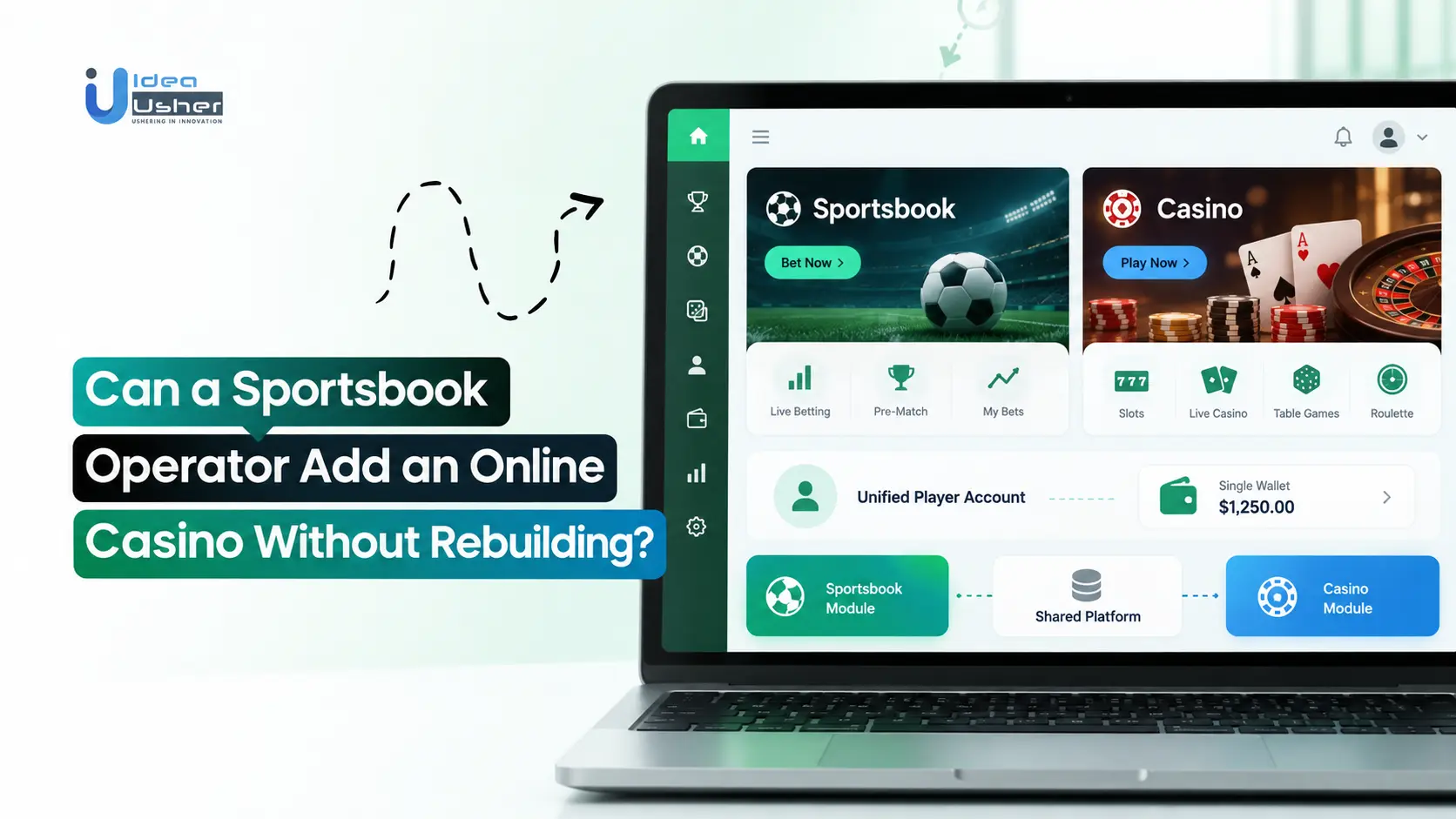
An online casino joins an existing sportsbook as an extra product, not a separate business. When you integrate casino into a sportsbook platform, players keep one account and one balance.
Meanwhile, the casino adds its own games, sessions, and compliance rules. So the work is connecting those parts to your current services.
1. What an Existing Sportsbook Already Has
A live sportsbook runs most of what a casino needs. As a result, the casino can reuse these shared services:
- Login and registration: one account opens both products.
- Wallet and payments: approved deposit and withdrawal rails.
- KYC and verification: one account keeps identity checks and limits consistent.
- CRM and promotions: player history and offers.
- Sports betting engine: odds, trading, and settlement stay unchanged.
These services form the core of a sportsbook and casino unified platform, which Idea Usher’s iGaming team audits before any casino build.
2. What an Online Casino Adds to the Platform
However, casino games run as short, repeated rounds. Therefore, the platform needs new parts:
- Casino games: slots, table games, and live dealer.
- Aggregator or studio deals: one connection adds thousands of games.
- Session management: each game ties to an account and location.
- Round settlement and reporting: every spin debits and credits the wallet.
- Casino compliance: casino needs its own state license, and many regulators build GLI-19 standards into their rules.
3. How Sportsbook and Casino Work Together
Example: One Player, One Visit
- Login: First, Jake signs in once in New Jersey.
- Balance: Next, he sees the $100 he uses for sports bets.
- Location check: Then the app confirms the casino is legal there.
- Game session: He opens blackjack.
- Settlement: He bets $10, wins, and gets $20 back.
- Reporting: Finally, the round logs as casino revenue.
In short, a casino extends your sportsbook instead of replacing it. It reuses your login, wallet, KYC, and CRM. It then adds games, sessions, round settlement, and its own state license.
Why Sportsbook Operators Are Adding Online Casino in 2026
Sportsbook operators are adding online casino because it is the fastest-growing part of US commercial gaming. In 2025, online casino revenue grew faster than sports betting revenue.
Casinos can also earn from players you already have. However, it is legal in far fewer states, so the opportunity depends on where you operate.
1. Growth of Sports Betting and Online Casino Markets
Both products set records in 2025, according to the American Gaming Association’s State of the States 2026. Online casino grew fastest, even though only seven states allowed it. Here are the headline figures:

- Online casino revenue: $10.73 billion, up 27.6% from 2024.
- Sports betting revenue: $16.89 billion, up 22.6%.
- All commercial gaming: a record $78.62 billion, up 9.1%.
- Market reach: online casino was live in seven states, far fewer than sports betting.
Looking ahead, reports project the US online gambling market to grow at a 9.8% CAGR from 2025 to 2030. Forecasts define this market differently, so treat the CAGR as a growth signal, not a revenue target.
2. Existing Sportsbook Brands Offering Casino Games
Adding casino is a proven model, not an experiment. In fact, the largest US sportsbooks, including DraftKings, FanDuel, BetMGM, and Fanatics, also run online casinos.
Each offers casino only in states that license it.
- Same account: players typically use one login and balance for both products.
- Same or linked app: casino sits inside the sportsbook app or in a companion app.
- State by state: casino appears only where iGaming is legal, such as New Jersey, Pennsylvania, and Michigan.
3. How Casino Can Create Another Revenue Stream
Casino adds a second revenue line on top of sports betting. However, not every bettor will play casino.
So plan returns on a share of your players, not all of them.
- New casino GGR: casino revenue on top of your sportsbook margin.
- Lower acquisition cost: you market casino to players you have paid to acquire.
- More choice: eligible players get slots, tables, and live dealer between games.
- Less seasonality: casino runs year-round, while sports betting follows the calendar.
- New costs: supplier revenue share, game fees, licensing, and state casino taxes.
4. Why Existing Players Matter to Casino Expansion
Your player base is the main advantage over a standalone casino launch. Those players hold verified accounts, funded wallets, and trust in your brand.
Even so, you can only market casino to eligible players who agreed to hear from you.
- Eligibility: players must meet the state’s age rule and be located in an iGaming state.
- Consent: casino offers go only to players who opted in to marketing.
- Responsible gambling: deposit limits and self-exclusions must apply across both products.
| Factor | Standalone casino launch | Casino added to a live sportsbook |
| Players | Acquired from zero | Existing verified players |
| KYC and payments | Built new | Reused |
| Brand trust | Built from scratch | In place |
| State casino license | Required | Required |
| Platform work | Full platform | Casino layer and integration |
In short, online casino grew faster than sports betting in 2025, but in far fewer states. Sportsbook operators can add it as a second revenue line using their current players and systems.
Eligibility, consent, and new costs decide how much of that value you capture.
Which Sportsbook Systems Can Stay After Casino Is Added?
In most cases, your sportsbook can keep its core systems when you add casino. The betting engine and player accounts stay, while the wallet, CRM, login, and reporting need extensions.
Casino games, sessions, and a lobby are the only new parts, and full replacement happens only after a failed compatibility check.
1. The Sportsbook Engine Can Often Remain Unchanged
Your betting engine handles odds, bet placement, and bet settlement. Casino games never use these functions. As a result, the engine keeps running exactly as it does today.
- Separate job: casino games settle their own rounds, not sports bets.
- No disruption: your trading team and risk tools keep working as before.
- Same odds feeds: your data providers and pricing setup do not change.
- Lower risk: a working engine stays live while you build the casino around it.
- Key check: if the engine also controls the wallet, casino work will reach it.
2. Existing Player Accounts Can Often Be Retained
Your players have profiles, verified identities, and login details. The casino can usually read the same records. That way, players never sign up twice.
- Profiles and identity: verified KYC data carries over to the casino.
- Credentials: one username and password open both products.
- Account history: past deposits and transactions stay attached to each player.
- Ownership: you must control the player database, not your sportsbook vendor.
- Responsible gambling settings: self-exclusions and deposit limits apply to casino from day one.
- Key check: if the vendor owns accounts, you need its approval or a migration plan.
3. The Wallet and Payment Systems May Need Extensions
Keeping your wallet does not mean it is ready for casino. Every spin or hand settles as its own small bet. Therefore, the wallet must answer fast debit and credit calls from game providers.
- Real-time calls: each round debits the stake and credits any win instantly.
- Separate tags: casino and sportsbook transactions stay apart for tax and reporting.
- Error handling: the wallet must reverse a debit when a game round fails.
- Reconciliation: daily totals match between your wallet and each game provider.
- Payments: deposit and withdrawal methods do not change.
4. CRM and Bonus Systems May Need Additional Rules
Your CRM knows how players bet on sports. However, it holds no record of casino play yet. So it needs new events, segments, and bonus rules.
- New activity data: spins, game types, and session length.
- Product-specific bonuses: free spins follow different rules from free bets.
- Cost reporting: you track bonus spend for each product separately.
- Cross-product offers: a sports bet can unlock a casino reward, and the reverse.
- State rules: casino promotions must meet each state’s requirements.
- Responsible marketing: offers skip players who opted out or self-excluded.
5. Casino Games and Session Services Must Be Added
A sportsbook has no casino content, so this part is always new. Games come from licensed suppliers, often through one aggregator connection. In addition, each game needs a session service that links it to the player’s account.
- Game content: slots, table games, and live dealer games from approved suppliers.
- Game launch: opens the right game for the right player and state.
- Session management: tracks each session from launch to close.
- Certification: many regulators build GLI-19 standards into casino approval.
- Back office: your team can switch games on or off by state.
6. The Frontend May Need a New Casino Section
Players need a clear path to casino. Typically, that means a new tab and not a new app. Meanwhile, the account and balance should match on both sides.
- Navigation: a casino tab next to the sportsbook.
- Game lobby: search, categories, and featured games.
- Mobile app: an app update, plus app store review for casino content.
- Account continuity: one login and one balance across both sections.
- Location gating: the casino tab shows only in states that allow it.
- Performance: the lobby must load quickly on mobile networks.
7. The Sportsbook Compatibility Table
This table sums up each component in one view. It uses four labels: Retain, Extend, Add, and Replace. Use it to see which parts of your platform need work.
| Component | Likely treatment | Key condition |
| Sportsbook betting engine | Retain | Existing system remains compatible |
| Player account management | Retain or Extend | Shared player identity supported |
| Wallet and ledger | Extend or connect | Casino wager settlement supported |
| Authentication | Extend | Shared login supported |
| Casino game services | Add | Approved game suppliers available |
| CRM and bonuses | Extend | Cross-product rules supported |
| Compliance controls | Extend and validate | Casino-specific rules satisfied |
| Reporting and back office | Extend | Both products reconciled correctly |
| Full sportsbook platform | Replace only when necessary | Critical compatibility failure |
Not sure which label fits your platform? Idea Usher’s iGaming team can review your current sportsbook and map every component to Retain, Extend, Add, or Replace. You get a clear scope before you commit any budget.
To sum up, your betting engine and player accounts can stay when you add casino. Beyond that, the wallet, CRM, login, and frontend require upgrades. Casino games and session services are the only parts that are always new.
The Three Layers of a Sportsbook, and the One a Casino Touches
Every sportsbook runs on three layers: betting, player, and front end. Adding casino leaves the betting layer alone and plugs into the player layer, where accounts and the wallet live.
So your scope depends on how ready that player layer is, plus the new casino pieces you add on top.
1. What Your Sportsbook Keeps
The betting layer prices events, manages risk, and settles sports bets. Casino games never call on it. As a result, this layer stays untouched.
- Odds feed: unchanged data providers and markets.
- Trading: existing risk rules and limits.
- Bet engine: current placement and settlement logic.
2. What a Casino Plugs Into
The player layer holds each account, balance, and verification record. This is the one layer a casino depends on. Therefore, its readiness decides whether you integrate or rebuild.
- Player account management (PAM): one identity, KYC status, and limit set for both products.
- Wallet: real-time debits and credits for every casino round.
- Ownership: you, not a vendor, must control both.
3. What You Add
The casino brings new pieces to the front end. None of them replace your sportsbook. Instead, they sit beside it in the same app.
- Game lobby: a casino tab with search and categories.
- Game launch: opens certified games, often tested against GLI-19 standards.
- Casino back office: game settings, casino reports, and state controls.
In short, the casino depends on just one of your three layers. The betting layer stays, the player layer connects, and the casino adds new front-end pieces.
The Four Ways to Add Online Casino to an Existing Sportsbook
You can add online casino to a sportsbook in four ways. The options are an aggregator API, a modular platform, a turnkey module, or a custom integration layer.
Each keeps your sportsbook running, but they differ in control, cost, and provider dependence, so your current systems decide the right fit.
1. Connect Casino Games Through an Aggregator API
An aggregator supplies games from many studios through one connection. Your backend talks to it rather than to each studio. Still, your wallet and sessions must match its API.
- Backend link: one platform integration.
- Game catalog: titles approved in your states.
- Wallet fit: real-time debit and credit.
- Fees: revenue share and minimums.
2. Add a Modular Casino Platform
A modular platform adds casino management as separate services. It connects to your sportsbook instead of replacing it. As a result, you skip a migration.
- Back office: games, bonuses, and limits.
- Game and session management.
- PAM integration with existing accounts.
- Wallet and reporting links.
3. Use a Turnkey or White-Label Casino Module
A turnkey module arrives ready to run. It shortens procurement, but the provider hosts key parts. So you trade control for speed.
- Preconfigured games and admin tools.
- Provider-hosted components.
- Shared or separate accounts.
- Branding and revenue-share terms.
4. Build a Custom Casino Integration Layer
A custom layer connects the casino to your current systems. It suits established sportsbooks. That way, nothing working gets replaced.
- Keeps current infrastructure.
- Connects only the suppliers you choose.
- Supports one identity and one wallet.
- Avoids duplicate systems.
5. API vs iFrame Casino Integration
Both display casino games but split control differently.
a. API Integration for Existing Sportsbook Systems
An API places casino inside your own interface. You control accounts, data, and design, but own more testing.
b. iFrame Integration for Hosted Casino Content
An iFrame shows the provider’s hosted game screen on your site. It launches faster with limited branding, and still needs a wallet connection.
6. Comparing the Four Casino Integration Models
Casino Integration Models Compared
| Model | Best suited operator | Systems retained | Customization | Provider dependence | Main risk | Cost complexity |
| Aggregator API | Needs content fast | Full stack | Medium | Medium | Wallet API mismatch | Low-medium |
| Modular platform | Avoids migration | Sportsbook, PAM, wallet | Medium-high | Medium | Scope creep | Medium |
| Turnkey or white label | Needs fastest launch | Sportsbook only | Low | High | Vendor lock-in | Low, then rising |
| Custom layer | Established systems | All working systems | High | Low | Longer first build | Medium-high |
Our guide to choosing a turnkey, white-label, or custom casino covers each model in depth.
In short, every model keeps your sportsbook running. Control, dependence, and cost are what differ.
How Players Use One Account Across Both Products
Players use one account across both products through player account management (PAM), the system that stores each player’s identity, balance, verification, and limits. When the casino reads the same PAM, players log in once and switch freely.
However, a shared account does not carry over every consent, permission, or state approval.
1. One Player Account for Sportsbook and Casino
A unified account means one profile serves sportsbook and casino. Players never register twice. As a result, each person has one record.
- No duplicate sign-ups.
- One balance and transaction history.
- Clearer reporting per player.
2. Single Sign-On Across Both Gaming Products
Single sign-on lets one login open each product. The credentials and session carry across. Therefore, players switch without signing in again.
- Same username and password.
- Same two-factor setup.
- One active session.
3. Existing KYC Records and Player Verification
Verified sportsbook players can often reuse KYC records for casino. However, some states may require extra checks. So confirm each state’s rules first.
- Reuse: identity, age, and address checks.
- Recheck: expired documents or a new state.
- Standards: regulators apply GLI-19 to interactive gaming systems.
4. Shared Account Restrictions and Player Limits
Restrictions must follow the player into each product. A block on one side cannot leave the other open. Otherwise, you risk a regulatory breach.
- Suspended accounts: blocked everywhere.
- Self-exclusion: honored on both sides.
- Deposit limits: shared or per product, as the state requires.
- Location: casino hidden outside iGaming states.
5. Player Experience Across Website and Mobile Apps
Eligible players should reach the casino in one tap. Their balance, profile, and settings stay consistent. Meanwhile, ineligible players see no casino tab.
- One navigation bar on web and app.
- Location checks before each casino session.
Note: A shared login is not a shared permission. Marketing consent and casino terms may need separate acceptance.
PAM lets one account, login, and KYC record serve sportsbook and casino. Restrictions follow the player everywhere, while consent needs separate checks.
How a Shared Wallet Handles Sports and Casino Bets
A shared wallet shows your player one balance for sports and casino. Behind that number, though, every bet, win, and refund is a separate record in a ledger.
The balance is only as accurate as those records, so the real work is keeping every casino transaction in step with the sportsbook.
1. One Balance Across Sportsbook and Casino
For the player, a shared wallet is simple. They deposit once and use the same money for a parlay or a slot. As a result, switching between products takes one tap, not a transfer.
- One deposit funds both products.
- Winnings from either side are ready to use right away.
- The player sees one history of every bet.
2. Casino Wagers Must Connect to the Existing Ledger
The balance a player sees comes from a ledger. A ledger is simply a list of every debit and credit on the account. Casino adds a new type of entry, so your ledger must record it as carefully as a sports bet.
Casino Bet Debits and Winning Credits
Every casino game, as our casino game development guide explains, plays out in rounds. When a round starts, the game sends a debit for the stake. When it ends, the game sends a credit for any win.
- Each entry links to one game round.
- So you can trace every dollar back to its source.
a. Failed Transactions and Repeated Callbacks
Networks sometimes drop in the middle of a round. When that happens, the game may send the same request twice. To prevent a double charge, each request carries a unique transaction ID, and the wallet accepts each ID only once.
- Unique IDs: every debit and credit has its own reference.
- Duplicate checks: a repeated ID gets the first answer again, not a second charge. Engineers call this idempotency.
- Status checks: the game can ask whether a request went through.
b. Canceled Games, Refunds, and Rollbacks
Sometimes a round never finishes. In that case, the wallet needs a clear rule for the stake. Typically, a rollback cancels the original debit and returns the money.
- The rollback records why the round failed.
- The player sees the refund in their history.
3. Deposits and Withdrawals Across Both Products
Your current payment gateways can often stay in place. However, each processor must allow casino payments, and some may need a new approval. Withdrawal rules also cover casino funds.
- Processor check: confirm casino payments are allowed.
- Withdrawal rules: Michigan, for example, requires operators to pay withdrawals within 10 business days. Until then, the requested funds stay out of play.
4. Cash Balances, Bonus Balances, and Restrictions
A shared wallet holds more than one kind of money. Cash can be withdrawn, while bonus credits come with conditions. So the wallet keeps them apart, and players never withdraw money they have not earned yet.
- Cash: deposits and real winnings, free to withdraw.
- Bonus credits: playable, but locked until the player meets the conditions.
- Player limits: deposit and time limits apply to both products. Pennsylvania, for instance, regulates responsible gaming self-limits.
5. Real-Time Wallet Reporting and Reconciliation
Each day, your wallet totals must match the records of every game provider and payment processor. Finance teams call this daily check reconciliation. Regulators watch player funds closely, and Pennsylvania even sets rules for segregated bank accounts and reserves.
- Match wallet, game, and payment records daily.
- Report casino and sportsbook revenue separately for tax.
- Send alerts the moment totals do not match.
Common Shared Wallet Failure Scenarios
| Scenario | Operator impact | Control needed |
| Duplicate debit request | Player charged twice | Unique transaction IDs |
| Lost win credit | Missing winnings and complaints | Status checks and retries |
| Round canceled mid-play | Stake stuck in limbo | Clear rollback rule |
| Bonus withdrawn as cash | Direct financial loss | Separate cash and bonus balances |
| Totals do not match | Reporting breach | Daily reconciliation |
In short, a shared wallet shows one balance but runs on a detailed ledger. Unique IDs, clear rollback rules, and daily reconciliation keep that balance correct. With those controls in place, players move between sports and casino without balance errors.
How Casino Games Connect to an Existing Sportsbook
Casino games reach your sportsbook through three separate parts that work together. Studios make the games, remote gaming servers run them, and aggregators bundle many studios into one feed.
An engineering partner connects these parts to your existing accounts and wallet, so your team manages one integration instead of dozens.
1. Casino Aggregators Connect Multiple Game Studios
An aggregator offers games from many studios through one connection. Without it, every studio needs its own contract and integration. Our guide to choosing a casino game aggregator covers selection.
- You manage fewer contracts.
- You maintain one technical link.
2. Remote Gaming Servers Deliver Casino Game Sessions
A remote gaming server, or RGS, runs the game and decides each outcome. Studios and aggregators usually host their own. So you only build an RGS for original games.
- Supplier RGS: the usual setup.
- Own RGS: in-house games only.
3. Slots, Table Games, and Live Casino Integration
Each content type connects differently. Slots and table games run on an RGS, round by round. Live casino, by contrast, streams real dealers, adding video and scheduling needs.
- Slots and tables: fast rounds, quick settlement.
- Live casino: video streams and dealer schedules.
4. Casino Game Launch and Session Management
When a player opens a game, your platform creates a secure token. That token tells the game who the player is. The session then sends each wager to your wallet until the player leaves.
- Token: confirms the player.
- Session end: closes cleanly and settles any open round.
5. Casino Back Office and Operator Reporting
Casino also adds admin work. Staff needs tools to manage games, limits, and results. In addition, finance needs casino reports besides sportsbook numbers.
- Game controls: on or off by state.
- Supplier reports: revenue share per studio.
6. Game Supplier Approvals and Platform Compatibility
Before launch, each supplier must approve your platform and test the connection. Regulators also check every game. In New Jersey, for example, the Technical Services Bureau tests and approves internet games before use.
- Supplier side: contracts, test environments, and documentation.
- Regulator side: technical certification for each game.
In short, studios make games, servers run them, and aggregators bundle them. Your partner links all three to your accounts and wallet, so your sportsbook stays intact.
How to Launch Casino Without Interrupting Sports Betting
At Idea Usher, we launch casino beside your live sportsbook, not on top of it. We test every connection away from real player balances, then release casino in small stages.
No launch is ever risk-free, so we also plan how to switch casino off quickly while sports betting keeps running.
1. Testing Casino Integrations Alongside the Live Sportsbook
We start in a separate test environment that mirrors your live platform. There, casino games run against test accounts and test money only. As a result, your real players and balances stay untouched while we find problems.
- A staging copy of your wallet, PAM, and sportsbook.
- Test accounts that never touch real funds.
- Supplier test servers for every game provider.
2. Wallet and Login Validation Before Launch
Next, we check the two things players notice first: their login and their balance. We run large batches of test rounds and match every result against the ledger. We also force failures on purpose to see how the wallet recovers.
- Account access across sportsbook and casino.
- Reconciliation of every test debit and credit.
- Failed sessions, timeouts, and duplicate requests.
- Location checks, since Michigan, for example, requires geofencing field tests before launch.
3. Load Testing for Sportsbook and Casino Traffic
Your biggest sports nights will now share servers with casino play. So we simulate a busy game day and heavy casino traffic at the same time. That shows us where the platform slows down before your players notice.
- Peak sports events and casino sessions together.
- Wallet response times under heavy load.
- Clear thresholds for scaling up.
4. Launching Casino Games in Controlled Stages
We avoid switching casino on for everyone at once. Instead, we start small and widen access as results hold steady. Each stage gives us real data without putting your whole player base at risk.
- One permitted state first.
- A small group of games.
- A limited group of eligible players.
5. Monitoring Failures and Maintaining Rollback Options
After launch, we watch wallet, session, and payment errors in real time. If something breaks, we can switch the casino off without stopping sports betting. Then we reconcile every open round and fix the cause before the casino returns.
- Alerts for failed transactions.
- A kill switch for casino features.
- Clear reconciliation and recovery steps.
6. What Determines the Casino Launch Timeline?
Code is not the slowest part of a casino launch. Instead, the timeline depends on how ready your systems are and how fast others approve them. These six factors set the pace:
- API readiness of your current platform.
- Supplier onboarding and contracts.
- Wallet and PAM complexity.
- Compliance and certification.
- Testing scope.
- External approvals from regulators.
In short, we protect your sportsbook by testing away from live balances and releasing casino in stages. Nobody can rule out disruption entirely, but monitoring and a kill switch keep it small.
How Much Does It Cost to Add Casino to a Sportsbook?
Adding online casino to a sportsbook typically costs $70,000 to $300,000 in custom engineering. That planning range covers integration work only, not supplier fees, licensing, or ongoing support.
Where you land depends on your existing wallet, PAM, and API readiness, so Idea Usher confirms the figure after auditing your platform.
1. Custom Sportsbook-to-Casino Integration Cost by Phase
Wallet and PAM work carries the widest range, since it depends most on your setup.
Table 1: Engineering Cost by Phase
| Engineering phase | Planning range |
| Existing platform audit | $7,000 to $20,000 |
| Architecture and API planning | $12,000 to $45,000 |
| Wallet, PAM and SSO integration | $20,000 to $80,000 |
| Casino content, UX and back office | $14,000 to $65,000 |
| QA, security and compliance readiness | $12,000 to $55,000 |
| Deployment and stabilization | $5,000 to $35,000 |
| Total | $70,000 to $300,000 |
2. Casino Aggregator and Game Provider Charges
Suppliers charge on top of the build, through setup fees, minimums, or revenue share. Because these recur, they shape long-term cost.
3. Licensing, Certification, and Payment Costs
Casino also needs its own license, game certification, and payment approvals, all outside the engineering budget.
4. Annual Maintenance and Integration Support
After launch, plan for hosting, monitoring, security updates, and supplier API changes. Support runs [X]% of the build yearly.
5. Cost Differences Between Integration Models
Each model trades build cost against ongoing fees.
Table 2: Three-Year Cost by Integration Model
| Model | Year 1 build | Years 2 and 3 | Main ongoing cost |
| Turnkey module | Low | Rising | Platform fees, revenue share |
| Aggregator API | Medium | Medium | Revenue share |
| Custom layer | Highest | Lowest | Maintenance |
6. Estimating the Total Cost of Ownership
Total cost adds engineering, supplier fees, operations, and compliance over several years. So compare three-year totals, not first quotes.
7. Measuring the Financial Return From Casino Expansion
a. Incremental Casino Revenue
Count only new revenue. Spend that simply moves from sports to casino adds nothing.
b. Supplier Fees and Operating Expenses
Subtract supplier shares, taxes and bonuses from gross revenue.
c. Payback and Break-Even Assumptions
Divide the build cost by monthly net incremental revenue. For example, a hypothetical $150,000 build earning $15,000 net each month pays back in 10 months.
Need your exact number? Our US team scopes your platform and sends a tailored estimate.
In short, the build costs $70,000 to $300,000, but supplier fees and support decide the three-year total. Measure return on incremental revenue only.
How Idea Usher Adds Casino to Existing Sportsbooks
Idea Usher has already added online casino to a live, working sportsbook. An established sports betting client wanted its users to stay longer after placing their bets.
So we built ten sports-themed slot games and connected them to the existing platform through a shared wallet, single sign-on, and CRM sync.
1. The Existing Sportsbook and Its Expansion Goal
The client ran a well-established sports betting platform. However, users often placed a bet and logged off, so sessions stayed short and acquisition costs stayed high.
The goal was to turn a quick transaction into a place players wanted to stay.
- Problem: short sessions and missed revenue.
- Goal: higher engagement and lifetime value.
2. The Casino Content Added to the Platform
We built ten branded slot games, each themed around a popular sports league. The games used team visuals and sports sound effects, so they felt familiar to bettors.
This was custom content, not a game library added through an aggregator.
- Ten sports-themed slots.
- Exclusive content for one brand.
3. How Idea Usher Connected the Existing Systems
We integrated the casino into the client’s existing backend, so it felt like part of the sportsbook. Three components made that possible.
a. Unified Sportsbook and Casino Wallet
Players moved funds between their sportsbook and casino balances instantly. One secure wallet held both, so nobody had to deposit twice.
b. Single Sign-On for Existing Users
Players opened the slots with their existing login. As a result, no one needed a second account.
c. CRM and Player Activity Synchronization
Casino activity flowed into the client’s CRM. That made personalized offers possible, such as free spins after a sports bet.
4. The Reported Results After Integration
According to the project summary in our casino game development guide, the client saw clear gains.
The published case does not state the measurement period, so treat these as results for this project only.
- 28% increase in user session time.
- 15% increase in average revenue per user (ARPU).
- A marketing edge, as the exclusive slots attracted new users.
5. What Other Sportsbooks Can Learn From This Project
Some lessons carry over to any operator. Others depend on your platform, budget, and goals.
- Transferable: a shared wallet, single sign-on, and CRM sync.
- Platform-dependent: whether your PAM and wallet allow the same integration.
- Optional: custom games. Many operators start with aggregator content instead.
- Variable: results depend on your audience, content, and market.
In short, this project paired custom sports-themed slots with a shared wallet, single sign-on, and CRM sync. Your scope, cost, and results will depend on your own platform and content choices.
Add Casino to Your Sportsbook Without Starting Over
You do not need a new platform to add casino. Instead, you need a team that checks what your sportsbook can support today, then builds only what is missing.
That is how Idea Usher works with sportsbook operators: platform first, casino second, and no rebuild unless your systems truly require one.
- Platform audit first: we map every component to Retain, Extend, Add or Replace before we quote.
- Shared wallet engineering: one balance, unique transaction IDs and daily reconciliation.
- Single sign-on and PAM work: one account and one KYC record across both products.
- Supplier-neutral integration: we connect the aggregator or studios that fit your markets.
- Custom casino content: we have built sports-themed slots for an existing sportsbook client.
- Published results: that project reported 28% longer sessions and 15% higher ARPU.
- Staged, monitored launches: controlled rollouts with a casino kill switch, so betting keeps running.
- Ready for prediction markets: our team has also built a prediction platform, so your stack can grow into a third product.
Tell us what your sportsbook runs on today. Our iGaming team will show you which layer casino changes and send a phased estimate.
Conclusion
So, can you add casino to a sportsbook without rebuilding? In most cases, yes. Your betting engine usually stays, while your player accounts and wallet decide how much work casino needs. Beyond the build itself, you still need state approval, supplier contracts, and a staged launch plan.
Therefore, start with a platform audit before you buy any casino package or platform. That single step tells you what to keep, what to extend, and what the expansion will really cost you.
FAQs
Q1. Can I Add Casino Games to a Third-Party Sportsbook?
A1. Yes, if your sportsbook vendor allows it. First, check your contract, since some vendors restrict outside integrations or require approval. Next, confirm the platform exposes APIs for accounts and the wallet. If access is blocked, an external casino module can still connect through a separate layer. Either way, you need your own casino license.
Q2. Can Sportsbook Players Use Their Existing Casino Login?
A2. Yes, players can use one login for both products when they share a player account. With single sign-on, the same credentials and session open sportsbook and casino. However, some states require extra checks, such as casino terms acceptance. Restrictions like self-exclusion and deposit limits must also follow the player across both.
Q3. Do I Need a Separate Wallet for Casino Games?
A3. No, not if your wallet can handle casino transactions. Casinos settle every round, so the wallet needs fast debits, credits, and rollbacks. It also needs unique transaction IDs to stop double charges. When those controls and daily reconciliation are in place, players can safely use one shared balance across both products.
Q4. Can I Add Casino to My Existing Sportsbook App?
A4. Yes, you can usually add casino as a new tab in your current sportsbook app. However, the app still needs a game lobby, provider integration, and location checks for each state. You will also need an app update, and app stores review real-money casino content before approving it for release.
Q5. Does My Sportsbook License Cover Online Casino Games?
A5. No, a sportsbook license does not cover online casino in the US. States regulate sports betting and iGaming separately, and many allow only sports betting. So you need separate casino authorization in each state you plan to enter. Your game suppliers and platform may also need their own state approvals.
Q6. Do I Need to Build My Own Remote Gaming Server?
A6. No, not unless you plan to create original games. Game studios and aggregators usually host their own remote gaming servers, which run each game and decide outcomes. Instead, your platform simply connects to them through an API. Building an RGS only makes sense when you want exclusive, in-house casino content.
Q7. How Long Does It Take to Add Casino to a Sportsbook?
A7. The timeline depends on more than code. In practice, your API readiness, wallet, and PAM complexity set the build time. Beyond that, supplier onboarding, testing, and state approvals add weeks or months. Therefore, the fastest way to get a real timeline is a platform audit before you sign any supplier.


