

Key Takeaways:
- Just because a casino game has been completed doesn’t mean that it can get onto an aggregator. One must first pass technical, legal, and compliance checks.
- It is also necessary for your Remote Game Server (RGS) to connect to the aggregator’s API, and you are not obliged to have your own RGS for that.
- Aggregators would also like to see that your games function correctly, have the appropriate certifications, and comply with their requirements.
- That doesn’t mean that casinos will actually include your games even after having been listed.
- Idea Usher can assist you in creating the games, arrange the RGS, and look after the integrations required for distribution.
In order to be listed on the distribution aggregators, casino game studios have to connect their Remote Game Server (RGS) to the aggregator’s unified API. Before this integration becomes live, the studio must possess its own supplier license and have its RNG and game math tested by accredited labs. It then has to satisfy the aggregator’s due diligence checks and enter into a revenue-share agreement.
While most explanations end with the API, it is actually at the license stage that many new studios come to a halt. The license obtained by an aggregator applies only to the aggregator and not to the studio that provides the games. There are three ways for studios to get to launch: they can build their own RGS, connect with a ‘powered-by’ partner’s RGS, or avoid using aggregators and instead enter direct agreements with operators.
This blog covers what casino game distribution aggregators check before signing a studio and what each route demands. It also shows how certification shapes your real launch date and what the full build costs. At the same time, it draws on how Idea Usher engineers aggregator-ready casino game stacks for founders entering regulated markets.
How Casino Game Aggregators Connect Games to Operators
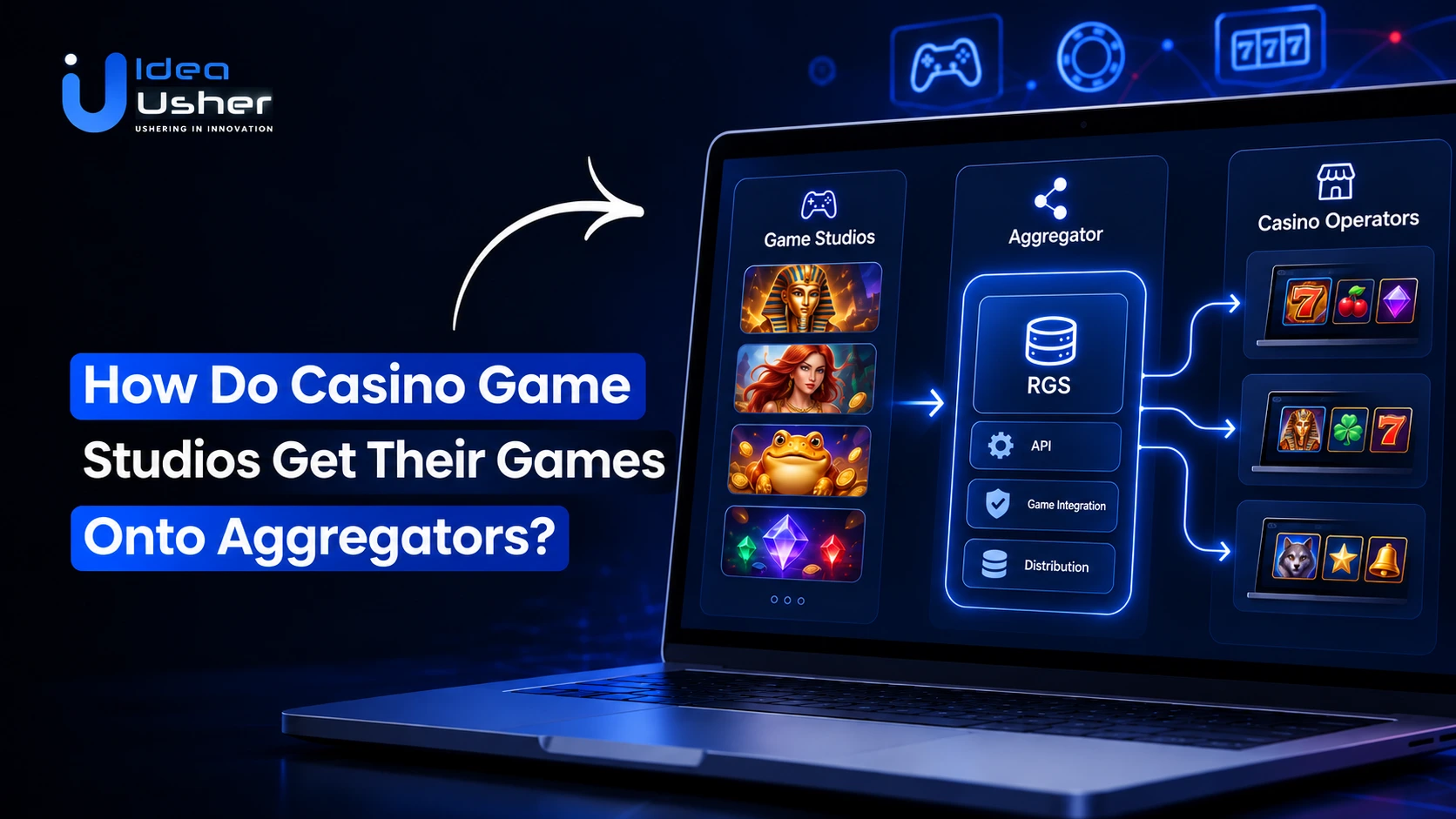
Casino game distribution aggregators connect game studios with online casino operators through one shared technical and commercial layer. Instead of building a separate API connection and contract for every casino, a studio integrates once with an aggregator.
The aggregator then offers those games to its connected operators, subject to market approval and operator selection.
1. The Studio, RGS, Aggregator, and Operator Chain
Five parties sit between a new slot idea and a player’s spin. Each one owns a different part of the job, so a studio founder needs to know which part is theirs.
Above all, the studio is the only party that creates the game and holds its rights.
- Casino game studio: Designs the game, owns its math and art, and controls the contractual rights to license it.
- Remote game server (RGS): Runs the game logic, draws random outcomes, and then calls the operator’s wallet for each bet and win.
- Casino game aggregator: Connects many studios’ servers to many operator platforms through one integration.
- Casino operator: Chooses which titles to switch on for its players in each market.
- Player: Finally, opens the game inside the casino’s website or app.
However, the RGS does not have to belong to the studio. It can also belong to a technology partner.
For example, Hacksaw opened its RGS to third-party studios in 2023 so they could build and distribute on its platform.
3. Why Aggregator Deals Do Not Guarantee Operator Reach
An aggregator deal makes your games available to operators. However, it does not make operators switch them on.
Kevin Dale’s research for iGB found studios with more aggregator partners appear on more operator sites, yet availability and adoption remain two different numbers.
- Network overlap: Two aggregators often serve many of the same operators, so a second deal adds fewer new casinos than it seems.
- Operator activation: Even after integration, each operator picks titles one by one from the catalog.
- Market restrictions: Likewise, a game without certification for a market stays switched off there.
- Commercial permissions: In addition, some operators need separate approval before adding a new studio.
- Lobby visibility: Studios on iGB’s roundtable said crowded platforms make it hard to get noticed.
- Traffic: As a result, a game listed across hundreds of casinos can still earn little if players never find it.
4. What the US iGaming Market Means for Game Distribution
US commercial iGaming revenue reached $10.73 billion in 2025, up 27.6%, according to the American Gaming Association.
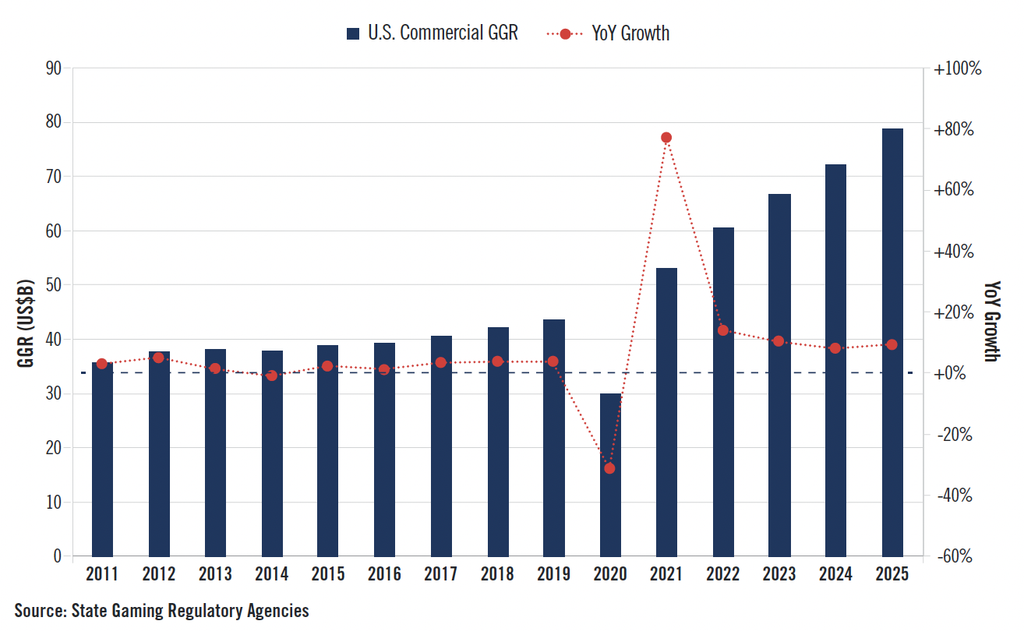
However, that revenue came from only seven states with legal online casinos. Moreover, each state licenses its own suppliers.
- State-by-state eligibility: For instance, New Jersey requires game developers to hold a license or registration before working with casinos.
- No national route: Consequently, an aggregator live in New Jersey cannot carry your game into Michigan until you qualify there.
- Partial reach: Similarly, a studio approved in two of the seven states earns from only part of that $10.73 billion.
- Planning impact: Therefore, budget for licensing per state, not one US entry.
In short, aggregators simplify access to casino operators, but they do not deliver players on their own. Real distribution depends on technical compatibility, signed contracts, certified markets, and each operator’s decision to activate your games. This raises the next question every founder faces: which route to an aggregator fits your studio’s budget and stage?
Major Casino Game Aggregators Operating in 2026
Seven aggregators show the range of distribution models a studio can choose from. In particular, they differ in catalog size, pricing model, and the regulated markets they already serve.
Because these numbers change often, each figure below carries the date of its public announcement.
| Aggregator | Distribution model | Network size (dated) | Regulated-market coverage | Public provider onboarding documented | Studio type it may suit |
| SOFTSWISS Game Aggregator | Aggregator inside a broader casino platform business | 40,000+ active games from 300+ providers (2025 overview) | Content portfolio across 24 regulated jurisdictions; Brazil and Peru added in 2025 | Not found in sources reviewed | Studios that want maximum catalog reach and can compete for lobby visibility |
| Hub88 | Single-API content aggregator | 24,000+ games from 205+ studios (Feb 2026) | Not specified in the release | Not found in sources reviewed | New studios seeking a first global deal, as with ScatterKings in 2026 |
| Slotegrator APIgrator | Aggregator alongside turnkey casino platforms | 40,000+ games (Dec 2025) | Anjouan license obtained in 2025 | Not found in sources reviewed | Studios targeting operators that launch on Slotegrator’s platforms |
| Pariplay Fusion | Aggregation platform with operator back-office tools | 14,000+ games from 120+ suppliers (undated release) | West Virginia Lottery, Ontario AGCO, Alberta AGLC, Atlantic Lottery | Not found in sources reviewed | Studios targeting North American regulated and lottery-run markets |
| EveryMatrix SlotMatrix | Standalone aggregator and module of the EveryMatrix suite | 300+ studio partners, about 33,000 games (Feb 2025) | Live in New Jersey; Pennsylvania and Michigan planned for Q1 2025 | Not found in sources reviewed | Studios aiming at tier-one operators and US state markets |
| Alea | Casino aggregation and game platform | No consolidated count published (iGB report, Mar 2026) | Brazil and Romania case studies | Not found in sources reviewed | Studios testing Latin American and European markets |
| Aggregator.gg | Pay-per-spin pricing to operators, from $0.0015 per spin | 6 studios listed, 218 live titles (provider page) | Not stated on site | Yes: assisted five-stage integration | Early-stage studios wanting a small, documented integration path |
That said, SOFTSWISS’s 2025 numbers show catalog scale, not market access. In other words, a game in a 40,000-title library may still be blocked wherever it lacks certification.
On the other side of the deal, casino operators evaluate these companies differently from game suppliers.
Idea Usher’s casino game aggregator comparison explains how operators choose a content network based on market coverage, platform compatibility, and commercial requirements.
The Three Ways Developers Can Distribute Casino Games
Casino game providers have three distribution routes: run their own RGS with aggregators, build on a partner’s RGS and network, or sign operators directly. Each route trades control against cost and speed in a different way.
Therefore, the right choice depends on game ownership, technical capability, target markets, and the budget available.
1. Own an RGS and Integrate With Aggregators
Owning the RGS gives a studio full control of its backend. However, that control comes with every running cost and compliance duty.
- Control: You manage game releases, RTP settings, and custom integrations.
- Reach: You can sign several aggregators without anyone’s permission.
- Costs: In return, you fund hosting, maintenance, certification, and security yourself.
This route therefore suits established providers with a growing catalog and in-house engineers.
2. Use a Powered-By or Partner RGS
Yes, a developer can distribute games without owning an RGS. For example, Hacksaw’s OpenRGS gives partner studios its technology and distribution network. Similarly, Yggdrasil’s YGG Masters and Powered By Relax offer partners a path to market.
- What you get: Hosted infrastructure, integration support, and existing operator relationships.
- What you give: A revenue share, plus dependency on the partner’s platform.
- What to verify: IP ownership terms and license scope. Gaming Corps extends its licenses to partners, but no partner license automatically covers every studio activity.
3. Integrate Directly With Casino Operators
Direct deals make sense when a studio already has operator relationships or exclusive content to sell. Nevertheless, each operator needs its own contract, technical connection, and ongoing support.
As a result, direct distribution suits established developers but is not automatically more profitable.
4. Comparing the Three Casino Game Distribution Routes
| Factor | Own RGS + Aggregators | Partner RGS | Direct Operator Deals |
| Initial engineering investment | Highest | Lowest | High, repeated per operator |
| Technical ownership | Full | Partner owns the platform | Full |
| Partner dependency | Moderate, spread across aggregators | High | Low |
| Revenue-sharing implications | Aggregator layer on each deal | Partner share on all revenue | No intermediary share |
| Licensing responsibilities | Fully yours | Shared; verify the contract | Fully yours |
| Integration workload | One build, several aggregators | Mostly handled by partner | One build per operator |
| Distribution potential | Broad | Limited to partner’s network | Limited to signed operators |
| Best-fit business | Growing catalog, in-house team | New studios with few games | Established supplier with relationships |
5. Which Route Fits a New Casino Game Provider?
- Concept, no software: Start on a partner RGS to reach market faster.
- One or two finished games: Likewise, a partner RGS usually costs less than building infrastructure.
- Growing catalog: At this stage, owning an RGS starts to pay off.
- Established supplier: Finally, combine your own RGS, several aggregators, and selected direct deals.
Before investing in game-server infrastructure, founders should understand what a casino RGS does and when ownership makes sense. The decision changes when a business creates original games instead of merely operating an online casino.
Idea Usher can assess whether you need a new RGS, integration with an existing platform, or custom components around partner technology.
What Aggregators Check Before Accepting Game Providers
Before signing a new game provider, an aggregator checks far more than how the games look. In particular, it reviews company legitimacy, intellectual property rights, licensing status, technical compatibility, game quality, and the commercial value the content adds.
As a result, a studio is evaluated as a business, not just a portfolio.
1. Business Ownership and Distribution Rights
First, aggregators confirm who owns the company and who owns the games. Without clear rights, no title can be distributed, however strong the game is.
- Corporate identity: Legal entity, beneficial owners, and due diligence checks.
- IP and permission: Proof the studio owns each game and may distribute it.
- Licensing and finances: The supplier license position, plus financial details on request.
2. Original Game Mechanics and Production Quality
Next, aggregators ask whether a game stands out in a crowded catalog. For example, Slotegrator signed AvatarUX after citing its award-winning mechanics, including the PopWins mechanic. Clear rules, predictable math, and stable performance matter just as much.
Game quality goes beyond animations and visual design. Idea Usher’s casino game development guide explores the mathematics, gameplay systems, and backend engineering involved in building an original title.
3. Game Portfolio Size and Release Frequency
No universal minimum game count exists. However, a single-title supplier and a full studio are judged differently. Quality usually outweighs catalog size, while a credible release roadmap strengthens the pitch.
- Roadmap: Share planned titles and dates, since aggregators favor studios that keep releasing.
- Benchmark, not a rule: 1spin4win reported a target of four releases a month in 2026.
4. HTML5 Compatibility and Localization
Similarly, games must run wherever operators sell them. That means HTML5 builds, smooth mobile browser performance, and support for approved devices.
In addition, localized languages, currencies, and bet denominations widen the markets a game can enter.
5. RTP, Volatility, and Game Configuration
Aggregators also expect documented math, including RTP, volatility, hit frequency, and certified configuration variants. Multiple RTP versions can serve different markets or commercial deals, but they are not always required.
Likewise, some markets restrict certain features or settings, so each variant must match its market.
6. Free Spins, Tournaments, and Jackpot Compatibility
Finally, promotional compatibility can raise an aggregator’s interest. The game supplier builds the hooks, such as free-round support, while the aggregator or operator runs the campaigns.
Aggregator Acceptance Criteria
| Area | What aggregators check | Owned by |
| Business | Ownership, due diligence, license position | Studio |
| Rights | Game IP and distribution permission | Studio |
| Quality | Original mechanic, stable performance | Studio |
| Portfolio | Current titles and release roadmap | Studio |
| Technical | HTML5, mobile, localization, currencies | Studio |
| Math | RTP, volatility, certified variants | Studio and test lab |
| Promotions | Free rounds, tournaments, jackpots | Studio hooks, operator campaigns |
In short, aggregators evaluate whether a business can deliver usable, lawful content, not just attractive games.
What Makes Casino Games Technically Ready for Aggregators
Aggregators need documented game behavior, reliable server protocols, correct transaction handling, and testing access.
Therefore, most studios must add backend services and technical interfaces before integration, which is exactly where a development partner adds value.
1. Game Client and Player Interface
The game client is the part that runs on the player’s device. It renders the interface, animations, and controls in HTML5, often with a rendering library such as PixiJS.
In addition, it must perform well across mobile and desktop browsers.
2. Game Mathematics and Technical Documentation
Next, every title needs documented math: rules, paytables, RTP, volatility, RNG behavior, simulations, and PAR sheets for test labs.
Without validated math, finished artwork is still not ready for real-money play. After all, labs test a game against its math, not its visuals.
3. The Remote Game Server and Its Core Functions
The remote game server (RGS) actually runs each round. Specifically, it manages sessions, processes RNG outcomes, stores round history, and tracks transaction state. It also logs operations and communicates with operator or aggregator systems.
4. APIs Required for Aggregator Connectivity
The RGS must expose standard interfaces that external platforms can call.
a. Game Launch and Session Authentication
First, the operator sends a launch request with a game identifier and a token. The RGS then validates the session before play begins.
b. Wallet Transactions and Game Settlement
Next, the RGS debits bets, credits wins, and reverses failed transactions. Seamless wallets update the operator’s balance per round, while transfer wallets move funds in advance. Support for each model differs by platform.
c. Round History and Transaction Reconciliation
Finally, unique round IDs prevent duplicate payments and support clean rollbacks. As a result, game-side records match operator reports.
5. Responsible Gambling and Market-Specific Controls
Rules change between markets. For example, the UK Gambling Commission requires 2.5 seconds between slot cycles and bans spin-speeding features.
Suppliers build these controls into games, while operators handle player-level limits.
6. Back-Office Systems for Games and Markets
Similarly, a back office manages the catalog, approved RTP variants, market availability, and game versions. As a result, each operator receives only approved settings. It also provides transaction reports and operational dashboards.
In practice, aggregators publish their own requirements. For instance, Aggregator.gg’s provider page lists documentation exchange, a connector build, and joint certification before traffic opens.
When existing games lack these layers, API development, server architecture, and integration testing become real engineering projects.
Which Licenses Do Casino Game Providers Need?
Joining an aggregator does not remove a game supplier’s own legal obligations. Instead, licensing depends on the business activity, the jurisdiction, the commercial structure, and the legal entity that delivers the game software.
Therefore, a studio must check each target market separately, even when an aggregator or partner already holds licenses there.
1. Software Supplier Licensing in the UK and Malta
In Great Britain, any business that manufactures, supplies, installs, or adapts gambling software needs a Gambling Commission operating license. Hosting a games platform may also require a separate remote operating license.
Meanwhile, Malta requires a B2B critical gaming supply license for supplying core game components from Malta.
- Key difference: Operator licenses authorize offering gambling, while supplier licenses authorize providing the software.
2. Casino Game Supplier Requirements in Ontario and US States
North American rules vary by province and state. For example, the AGCO requires suppliers that develop, provide, or run games to register before working with Ontario operators.
- New Jersey: The DGE uses separate licensing and registration categories for internet gaming suppliers.
- Pennsylvania: Suppliers to interactive gaming operators must apply for a supplier license.
- Michigan: The Gaming Control Board licenses online gaming suppliers.
Idea Usher’s guide to US states allowing real-money online casinos in 2026 explains where operator markets are live.
Game suppliers must then check their own authorization requirements in each applicable state.
3. Curaçao B2B Licensing and Distribution Limitations
Under the LOK framework, Curaçao now regulates critical B2B suppliers, including RNG game makers. Local suppliers need a license, while foreign suppliers must register by 24 December 2026.
However, Curaçao authorization does not grant access to the UK, Ontario, or US states.
4. Licensing Under Powered-By RGS Arrangements
A licensed platform partner can reduce, but not always replace, a studio’s own authorizations. In particular, the answer depends on which entity legally supplies the game and who holds each approval.
- Contract terms: Distribution duties and market restrictions should be written down.
- Extra licensing: A studio may still need its own approval in some markets.
- Due diligence: Ask the partner which licenses cover your titles, and in which markets.
Supplier Licensing by Market
| Market | Regulator | Supplier authorization |
| Great Britain | Gambling Commission | Gambling software operating license |
| Malta | MGA | B2B critical gaming supply license |
| Ontario | AGCO | Gaming-related supplier registration |
| New Jersey | DGE | Supplier license or vendor registration |
| Pennsylvania | PGCB | Interactive gaming supplier license |
| Michigan | MGCB | Internet gaming supplier license |
| Curaçao | CGA | Local license or foreign supplier registration |
Because every arrangement differs, founders should get qualified legal advice for their specific structure. Consequently, licensing becomes a planning input, not a launch-day surprise.
How Game Certification Affects Aggregator Approval
Three separate checks stand between a finished game and a regulated lobby: aggregator acceptance testing, independent lab certification, and regulatory authorization. The aggregator tests the integration, while an accredited lab certifies fairness and math.
Finally, each regulator approves the supplier and its software, so these checks overlap but never substitute for one another.
1. RNG Certification Versus Game Mathematics Testing
RNG testing proves outcomes are random. Game math testing, by contrast, proves those outcomes pay what the rules promise.
- RNG: Statistical tests confirm results are unpredictable and unbiased.
- Math: Labs check probabilities, declared RTP, and rule-to-outcome accuracy.
- Evidence: Both rely on simulations and documentation the studio supplies.
2. Independent Testing Laboratories for Casino Games
Four labs appear most often in casino game certification: Gaming Laboratories International, BMM Testlabs, iTech Labs, and eCOGRA. However, test scope and recognition vary by jurisdiction.
Therefore, studios should confirm which labs each target regulator accepts before submitting.
3. GLI-19 and Other Relevant Technical Standards
GLI-19 covers interactive gaming systems, while local rules add game-specific requirements. As a result, no single standard is universally sufficient.
- Outputs: Certification reports tie approval to specific software versions.
- Reuse: Earlier test evidence may support new markets, depending on each regulator.
- Changes ahead: GLI published a GLI-19 v4.0 draft in July 2026 for public comment.
4. Security and ISO 27001 Requirements
Distributors and operators also assess how safely a supplier runs its servers, since one outage or breach affects every connected casino.
In particular, they review security controls, game-server availability, access monitoring, and data protection. ISO/IEC 27001 certification applies where a contract or regulator requires it.
5. Testing Requirements for Provably Fair Crypto Games
Provably fair technology lets players verify each result cryptographically. Nevertheless, it does not remove independent testing obligations in regulated markets.
Notably, the GLI-19 v4.0 draft adds a formal framework for provably fair RNGs.
- Documentation: Fairness and RNG design must still be documented.
- Smart contracts: On-chain logic needs separate testing where used.
- Jurisdiction: Crypto games face different treatment across markets.
For crypto-native titles, provably fair casino game technology introduces additional verification mechanics. However, player-verifiable results do not automatically replace regulatory testing.
In short, certification is where launch dates are won or lost. Consequently, studios that prepare complete documentation early move through labs and aggregators faster.
How Aggregator Revenue Sharing Works for Game Providers
A game provider earns money when players wager on its games at operator casinos. The distribution contract then decides who receives a share, how each fee is calculated, and when payment arrives.
Because every contract is structured differently, no single revenue-share percentage applies across the industry, so the calculation basis matters as much as the rate.
1. GGR, NGR, and Supplier Revenue Share
Reported commission figures differ mainly because contracts use different bases. Therefore, always check which number your percentage applies to.
- GGR (gross gaming revenue): Total player bets minus player wins.
- NGR (net gaming revenue): GGR minus items such as bonuses and taxes.
- Operator payment: The operator pays a content fee, usually a share of GGR or NGR.
- Aggregator deduction: The aggregator keeps part of that fee.
- Supplier share: The studio receives the remainder.
Some aggregators charge operators differently. For example, Aggregator.gg prices content per spin rather than as a revenue share.
2. A $100,000 GGR Revenue-Sharing Example
Disclaimer: The figures below are assumptions for illustration only, not market rates. Notice that the aggregator’s share comes out of the operator’s fee before the studio is paid.
Casino Game Revenue Distribution Waterfall
| Step | Assumption | Amount |
| 1. Game generates GGR | Player bets minus wins | $100,000 |
| 2. Operator pays content fee | 14% of GGR (assumed) | $14,000 |
| 3. Aggregator keeps its share | 4% of GGR (assumed) | $4,000 |
| 4. Studio receives | 10% of GGR (result) | $10,000 |
In this example, the operator keeps $86,000 before its own costs. Meanwhile, the studio’s $10,000 must still cover hosting, certification, and support.
3. Contract Terms That Affect Studio Earnings
Beyond the headline rate, several clauses shape long-term profit.
- Exclusivity and territories: These limit where else you can sell.
- IP rights: Your games should remain yours.
- Payment and settlement periods: These decide when cash actually arrives.
- Reporting transparency: Clear reports let you verify every payout.
- SLAs: Service levels set uptime and support duties.
- Termination and migration rights: These protect you if you leave.
4. Game Promotion and Operator Visibility
Aggregators may also help games get noticed. However, most promotion is negotiated or optional, not guaranteed.
- Often available: Tournaments, free-spin campaigns, and launch promotions.
- Usually negotiated: Lobby recommendations and featured placement.
- Operator-controlled: Final marketing decisions stay with each casino.
Judge a contract by your actual net earnings, operating costs, and distribution reach. Consequently, a lower rate with wider reach can outperform a higher rate with few active operators.
When to Expand Beyond Your First Game Aggregator
One aggregator can give a new studio its first route to operators, while additional partnerships can open new markets and operator networks. However, each new agreement adds technical, regulatory, and operational work.
Therefore, expansion should follow clear gaps in reach, not simply the goal of signing even more distribution deals.
1. The Limits of Depending on One Aggregator
A single partner concentrates risk in one place, which matters most when it drives most of your revenue.
- Coverage: You reach only that aggregator’s operator network.
- Markets: You inherit its regulatory footprint.
- Commercial dependence: It sets much of your pricing power.
- Availability: Its downtime becomes your downtime.
- Termination: Losing the contract can cut most of your revenue.
2. How Multiple Aggregators Can Expand Distribution
A second aggregator is worthwhile when it adds markets or operators you cannot already reach. By contrast, overlapping networks add cost without much new reach.
- Check first: Complementary markets, distinct operators, and API compatibility.
- Budget for: Market-specific certification, another integration, and ongoing support.
- Avoid: Signing an aggregator whose operators you already reach through another partner.
3. When Direct Operator Agreements Make Sense
Direct supply suits established providers with proven demand, existing operator relationships, or exclusive titles. Even then, the team must maintain several integrations and support each operator directly.
As Relax Gaming’s product chief noted, studios that reach scale need options to grow independently.
4. Why Aggregator Listing Does Not Guarantee Game Revenue
Approval is only the first step toward income. Afterward, a game must pass through five commercial stages.
Game Distribution and Commercial Activation Funnel
- Accepted: The aggregator approves the game.
- Cataloged: The title joins the distribution catalog.
- Activated: Each operator chooses to switch it on.
- Placed: The casino gives it lobby visibility.
- Played: Players discover and return to it.
In short, measure distribution reach and actual adoption separately. Consequently, a studio listed with three aggregators but activated by few operators should fix placement before signing a fourth.
How Much Does Aggregator-Ready Development Cost?
An illustrative custom RGS and integration project can range from $70,000 to $300,000, depending on the agreed technical scope. However, this figure is not an aggregator admission fee, a certification charge, or a universal price for listing a game.
Instead, it covers the engineering that makes existing games ready for distribution.
1. The Cost of Custom RGS and Integration Development
The range below is an illustrative planning model, subject to Idea Usher’s project-specific validation. In addition, original game production, such as art, animation, and new game math, sits outside this RGS project scope.
Included deliverables are the RGS, game services, launch and wallet APIs, test documentation, and production deployment.
| Development phase | Estimated range |
| Discovery and system architecture | $5,000 to $20,000 |
| Core RGS and game services | $30,000 to $125,000 |
| API and wallet connectivity | $15,000 to $60,000 |
| QA and certification preparation | $10,000 to $45,000 |
| Deployment and launch support | $10,000 to $50,000 |
| Illustrative project range | $70,000 to $300,000 |
Each phase range is a planning allowance. Therefore, projects rarely sit at every minimum or every maximum at once.
Get an Aggregator-Ready Game Development Estimate. Ask Idea Usher to evaluate your existing games, RGS options, and integration scope before quoting custom development.
2. Building an RGS Versus Renting Existing Infrastructure
A hosted or partner RGS can lower initial engineering costs. Nevertheless, it shifts spending into recurring charges and dependency.
- Build: Higher custom development expense, but full ownership.
- Rent: Setup and platform charges, hosting, and recurring license fees.
- Partner model: Possible revenue sharing instead of fixed fees.
- Either way: Additional API work may still be needed.
- Exit terms: Check migration rights before you commit.
For a studio with one or two games, renting often makes sense first, because it preserves cash for game production. Later, a growing catalog can justify owning the infrastructure.
3. Certification, Licensing, and Aggregator Fees
Several external costs fall outside the engineering estimate. Consequently, founders should budget for them separately. Their size depends on target markets, lab scope, and legal structure, so request quotes from each provider.
- Lab testing: RNG and game certification fees.
- Licensing: Supplier license applications and renewals.
- Legal review: Contracts and regulatory structure.
- Security audits: External penetration tests or ISO 27001 work.
- Distributor charges: Any onboarding or commercial fees.
- Market approvals: Regulator-specific approval processes.
4. Ongoing Game and RGS Maintenance Costs
Spending continues after distribution begins. In particular, providers fund infrastructure, security updates, new releases, browser compatibility, and new market configurations.
Moreover, each additional aggregator connection or compliance change can trigger retesting.
Rather than relying on a generic percentage, ask Idea Usher for a scope-specific annual maintenance estimate.
First-Year Development and Distribution Cost Matrix
| Cost category | Included in engineering range? | Who sets the price | When it occurs |
| RGS and integration build | Yes | Development partner | During the build |
| Original game production | No | Studio or game developer | Before or alongside build |
| Lab certification | No | Testing laboratory | Before each market launch |
| Supplier licensing | No | Regulator | Before market entry, then renewals |
| Legal and security audits | No | External advisors | Before launch |
| Aggregator charges | No | Aggregator contract | At onboarding or per deal |
| Hosting and maintenance | No | Partner or cloud provider | Monthly, from launch |
In short, the engineering range is only one line in a first-year budget. Therefore, ask for a scoped estimate that separates build costs from every external fee.
What Your Business Needs Before Seeking Distribution
Businesses seeking casino game distribution start from very different points. Some founders still need a complete game, others need server infrastructure behind finished titles, and established suppliers may need only integration and testing support.
Therefore, the right first project depends on which assets you already own and which capabilities are still missing.
1. Founders With a Casino Game Idea but No Working Product
An idea alone cannot reach an aggregator. First, the concept must become a specified, testable product.
- Concept and specifications: Rules, features, and target markets in writing.
- Game mathematics: Paytables, RTP, and volatility, validated by simulation.
- UI and animations: A polished HTML5 front end.
- Core software: Game logic that runs reliably.
- Hosting and RGS options: Own, rent, or partner.
- Testing requirements: Lab and market needs, planned from day one.
Idea Usher can scope these steps together, so the math, software, and testing plans stay aligned.
2. Developers With Finished Games but No RGS
A finished game can still be unsuitable for distribution. In particular, it often lacks server-side execution, transaction interfaces, reporting, production infrastructure, or complete documentation.
- Partner RGS: Faster and cheaper to start, but with shared revenue and less control.
- Custom infrastructure: Higher upfront cost, but full ownership as the catalog grows.
Consequently, this choice usually depends on how many titles you plan to release and how quickly.
3. Providers With an RGS but No Aggregator Integration
Existing infrastructure shortens the path, but it rarely removes all work. Instead, the focus shifts to compatibility.
- API assessment: Review what your RGS already exposes.
- Protocol fit: Match each aggregator’s launch and wallet specifications.
- Documentation: Prepare clear technical guides for partners.
- Test environment: Set up a sandbox for integration testing.
- Missing functions: Add transaction or reporting features where needed.
- Troubleshooting support: Resolve issues quickly during go-live.
4. Established Suppliers Expanding Into New Markets
New jurisdictions bring new requirements, even for live providers. As a result, existing games often need changes before launch.
- Market settings: Adjust RTP, features, and limits per market.
- Approved versions: Track which build each regulator certified.
- Local compliance: Apply rules specific to each jurisdiction.
- Extra connections: Integrate additional distributors.
- Performance: Tune hosting for new regions and traffic.
- Support capacity: Scale the team behind more operators.
Casino Game Distribution Readiness Matrix
| Business stage | Existing assets | Likely missing capabilities | Potential Idea Usher scope |
| Game concept | IP and design | Product, backend, testing | Custom game development |
| Finished game | Playable client | RGS and distribution connectivity | RGS assessment and integration |
| RGS-equipped provider | Working game infrastructure | Aggregator compatibility | API integration and QA |
| Established supplier | Live titles and partners | Additional markets or networks | Extensions, testing, and maintenance |
Find your row first, then scope only what is missing. Idea Usher can start with an assessment of your current assets, so you avoid paying for work you have already done. In short, distribution readiness is a gap analysis, not a fixed checklist.
How We Prepare Casino Games for Distribution
Preparing casino games for aggregator distribution usually follows eight engineering stages, from assessment to maintenance. However, few projects need all eight, because most studios already own some of the pieces.
Therefore, our work starts by identifying what exists, then covers only the missing stages, including handoffs to labs, regulators, and aggregators.
Our iGaming software development services include custom applications, full-stack development, API integration, QA and testing, DevOps, and maintenance. Here is how that work maps to each stage.
1. Assess the Games and Distribution Model
First, we review the existing games, IP arrangements, and target markets. Then we compare aggregator, partner RGS, and direct integration routes against that starting point.
Deliverable: A readiness assessment and a recommended distribution route.
2. Plan the Game and RGS Architecture
Next, we decide which components to build and which to integrate. This includes reviewing the current backend, defining server responsibilities, and comparing hosted with custom RGS options.
Deliverable: An architecture plan and engineering scope.
3. Develop or Improve Original Casino Games
Where games are missing or incomplete, we build the mechanics, math model, interface, and server-side gameplay. In addition, we document the math, so it is ready for lab review.
Deliverable: Tested HTML5 game software within the agreed scope.
4. Build or Integrate Remote Game Server Technology
Depending on the route, we either build custom RGS components or connect to an existing RGS. Either way, the result must handle sessions, server-side execution, transactions, and reporting.
Deliverable: A working game-serving environment.
5. Develop Aggregator-Facing APIs
Aggregators expect standard interfaces for game launch, authentication, wallet transactions, and round reporting. Accordingly, we build these to each partner’s specification and write the integration documentation.
Deliverable: Technical interfaces and integration documentation.
6. Prepare Games for Technical Testing
Many certification delays come from avoidable engineering gaps. So before submission, we run functional, outcome, performance, and disconnection tests, and prepare the evidence labs request. Certification itself, however, remains the lab’s decision.
Deliverable: Tested builds and supporting technical evidence.
7. Support Integration Testing and Go-Live
During onboarding, we work in the aggregator’s sandbox to debug issues, test transactions, and prepare releases. Final approval, though, rests with the aggregator.
Deliverable: Integration-ready software and go-live support.
8. Maintain and Extend the Game Infrastructure
After launch, games and integrations need regular updates. Likewise, new markets and new aggregators add configuration, connection, and security work over time.
Deliverable: Ongoing maintenance and expansion support.
If you are unsure which stages your games still need, we can review your current setup and outline the remaining scope.
Why Founders Choose Idea Usher to Build the Aggregator-Ready Stack
Founders choose Idea Usher because we start from their distribution goal, not from a fixed product or template. First, we identify which route fits their games: their own RGS, a partner RGS, or direct operator deals.
Then we build only the missing pieces, so studios avoid paying for infrastructure they do not need yet, and can reach operators much sooner.
- Route-neutral advice: We recommend a partner RGS when it fits better than a custom build.
- Gap-based scoping: Every project starts with an assessment of what you already own.
- One team, full stack: Game engineering, backend, integrations, QA, and DevOps stay under one roof.
- Aggregator-ready APIs: We build launch, wallet, and reporting interfaces to each partner’s specification.
- Certification-ready builds: Math documentation and test evidence are prepared before lab submission.
- Phased delivery: You see working software and clear deliverables at every stage.
- US-focused support: Our US and UK offices keep communication within your working hours.
- Long-term maintenance: We stay on for updates, new markets, and new aggregator connections.
Not sure which route fits your games? Book a call with Idea Usher for a distribution-readiness assessment. We will map your current assets, recommend a route, and scope only the work that remains.
Conclusion
Casino game distribution aggregators can put your games in front of hundreds of licensed operators. However, reaching them takes more than finished titles. First, you need certified math, an RGS, aggregator-ready APIs, the right licenses, and a route that fits your catalog.
Ultimately, the studios that launch fastest are usually the ones that close these gaps early. Therefore, if your path is unclear, an iGaming software development team can assess your current stack and scope only the work that remains.
FAQs
Q1. Can I Get One Casino Game Listed on an Aggregator?
A1. Yes, in some cases, because no universal minimum game count exists and aggregators judge quality and originality first. However, a single title is a harder commercial pitch than a studio with a release roadmap. Therefore, pair one strong, certified game with clear plans for future releases to improve your chances of approval.
Q2. Do I Need My Own RGS to Distribute Casino Games?
A2. No, not always, since powered-by programs such as Hacksaw’s OpenRGS and Yggdrasil’s YGG Masters let studios build on a partner’s server and network. In return, the partner takes a revenue share and controls the platform. Consequently, a partner RGS often suits new studios, while owning one suits growing catalogs with in-house engineers.
Q3. Can Aggregators Accept Game Providers Without a Separate License?
A3. Sometimes, but an aggregator’s license never covers your studio automatically. For example, Great Britain requires gambling software suppliers to hold a Gambling Commission license, while Ontario, New Jersey, and Pennsylvania require supplier registration or licensing. Therefore, check each target market separately and get qualified legal advice for your specific distribution arrangement.
Q4. How Long Does Casino Game Aggregator Onboarding Take?
A4. It depends mostly on readiness, since industry panelists report games can go live in about two weeks once a studio is integrated. However, contracts, API work, and testing come first, and each new regulated market may need fresh certification. As a result, complete documentation is the biggest timing factor you control.
Q5. How Much Do Aggregators Charge Casino Game Providers?
A5. There is no single rate, and some aggregators even use per-spin pricing instead. Typically, though, the operator pays a content fee based on GGR or NGR, the aggregator keeps its agreed share, and the studio receives the rest. Therefore, compare contracts by your actual net earnings, not one advertised percentage.
6. Can I Distribute the Same Game Through Multiple Aggregators?
Yes, unless an exclusivity clause prevents it, provided you keep your IP rights and certify the game for each new market. However, overlapping operator networks can add cost without adding much real reach. Consequently, choose aggregators that open new markets or operators, and track which software build each regulator approved.