

Key Takeaways
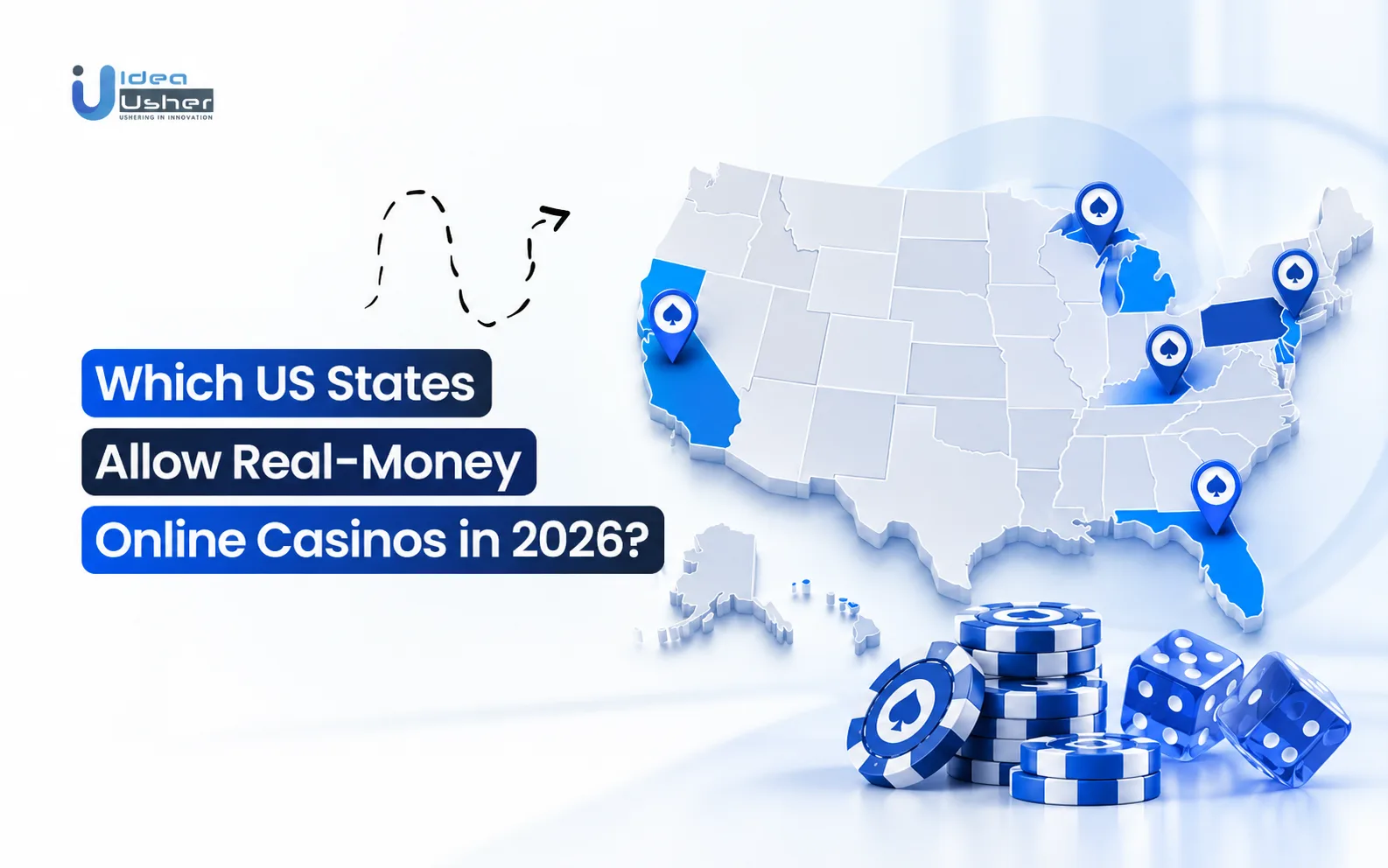
- As of 2026, eight US states have legalized real-money online casinos: Connecticut, Delaware, Michigan, New Jersey, Pennsylvania, Rhode Island, West Virginia, and Maine.
- However, only seven states currently have operational online casino markets. Maine has legalized online casino gaming under a tribal-led framework but is still awaiting launch.
- Nevada permits real-money online poker but does not allow full online casino games like slots and blackjack.
- Online casino laws, licensing requirements, and launch timelines vary by state, so operators should verify current regulations before entering a market.
- See how IdeaUsher helps businesses launch online casinos in the USA with custom development, secure payments, and state-specific regulatory requirements in mind.
As of 2026, eight U.S. states have legalized regulated real-money online casino gaming, but only seven currently have operational markets: Connecticut, Delaware, Michigan, New Jersey, Pennsylvania, Rhode Island, and West Virginia. Maine is the eighth state, having authorized online casino gaming under a tribal-led framework, although its consumer-facing platforms are still awaiting launch. Nevada follows a different model, permitting real-money online poker but not full-scale online casino games such as digital slots and blackjack. Because licensing and launch timelines can change, operators should verify each state’s latest regulatory status before planning market entry.
For businesses looking to enter the iGaming industry, these differences matter just as much as the games themselves. Each state has its own rules, licensing requirements, and market-entry challenges, making it important to understand the legal landscape before investing in an online casino platform. In this blog, we’ll discuss which US states allow real-money online casinos in 2026, how their regulations differ, and what operators need to consider when planning to launch an online casino.
Why Real-Money Online Casinos Are Booming in the USA?
Real-money online casinos are growing in the USA because people can now play on their phones, more states are legalizing online gambling, and live dealer games make online play feel more like a real casino. According to Grand View Research, the US online gambling market was valued at USD 12.68 billion in 2024 and is expected to grow at a CAGR of 9.8% from 2025 to 2030.
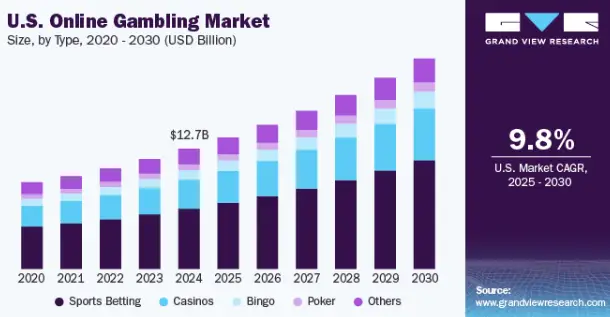
Source: Grand View Research
Mobile Gaming Drives Growth
Mobile phones have made online gambling easier to access. Players can open an app, deposit money and start playing without visiting a casino. Track360 found that around 95% of US sports betting handle was placed online. Legal Sports Report also reported a nationwide online share of about 94%.
| Market | Mobile / Online Share |
| US sports betting | About 95% of handle placed online |
| New York | Mobile accounts for over 95% of total handle |
| Nevada | 73.4% of handle came through mobile apps in one August month |
| Europe | 58% of online gambling was mobile |
Nevada shows how much the signup process matters. Its in-person registration rules can make it harder for players to get started. Casino apps can also use saved payment details and biometric login to make playing more convenient. These features help operators create a smoother mobile experience.
State Laws Expand Market Access
Online casino laws vary by state. Sports betting is legal in nearly 40 states, but real-money online casino games are available in far fewer. This creates opportunities for operators when new markets open. Maine is one recent example. The state passed LD 1164 to authorize online gambling under a tribal-led framework. Caesars also secured agreements with three of the four Wabanaki tribes.
The planned offering would connect casino play with the existing Caesars sportsbook through a shared login and wallet. However, authorization does not guarantee an immediate launch, and the framework has faced a legal challenge.
Key developments in 2026:
- Eight states are commonly counted as having legalized online casino gaming: Connecticut, Delaware, Michigan, New Jersey, Pennsylvania, Rhode Island, West Virginia and Maine. Maine has not yet launched.
- Maine’s online casino tax rate was set at 18%, up from an initial 16% proposal.
- New York, Maryland, Illinois, Indiana and Virginia considered online casino bills in 2026, but none passed.
- Legal sports betting does not automatically make online casino games legal in the same state.
These differences matter to operators because every new market can bring its own licensing rules, tax requirements and technical needs.
Live Dealer Games Improve Play
Live dealer games bring real dealers onto players’ screens. Players can watch blackjack or roulette in real time and interact with the game. This makes online casinos feel more like a visit to a physical casino. FanDuel Casino has invested in this experience by launching branded live dealer studios in Michigan and Pennsylvania with Evolution. These studios offer games such as blackjack and roulette while giving FanDuel more control over the look and feel of its casino tables.
Live Gaming Investments Grow
Online casino providers are investing in new studios and live dealer games to give players a better experience. For example, Evolution has expanded its US presence, while Playtech has partnered with bet365 to offer dedicated live tables in Pennsylvania and New Jersey. These investments bring more game choices to players and help operators create a more engaging online casino experience.
| Development | What Changed |
| Evolution, Grand Rapids | Its seventh US studio and second in Michigan opened on May 14. |
| Ezugi titles | EZ Baccarat and Triple Zero Roulette joined the studio’s offerings. Monopoly Live also reached Michigan. |
| Playtech with bet365 | Ten dedicated live tables were introduced across studios in Pennsylvania and New Jersey. |
| Evolution in West Virginia | Games include Lightning Roulette, Infinite Blackjack, Three Card Poker and Ultimate Texas Hold’em. |
More live studios mean players can enjoy more games and different experiences. For operators, this also creates a need for reliable streaming, smooth game integration and a platform that can handle more players.

The 2026 US Online Casino Legal Map
As of 2026, seven US states have live real-money online casino markets: New Jersey, Pennsylvania, Michigan, West Virginia, Connecticut, Delaware and Rhode Island. Maine has legalized online casinos but is still waiting to launch. Nevada allows online poker and sports betting but not online slots or table games. Each state has its own licensing rules and taxes. So, a state that allows mobile sports betting may still prohibit online casino games.
| State | Online Casino Status | Key Fact |
| New Jersey | Live | A 2011 federal Wire Act opinion helped clarify the legal path for online gambling. |
| Pennsylvania | Live | Live dealer games for West Virginia players also stream from Pennsylvania studios. |
| Michigan | Live | Online casinos launched in January 2021. |
| West Virginia | Live | Operates under state licensing rules. |
| Connecticut | Live | Operates under a regulated casino partnership model. |
| Delaware | Live | The Delaware Lottery works with three racino properties. |
| Rhode Island | Live | Became the seventh live market when it launched in 2024. |
| Maine | Legal, not live | Rules are still being finalized, and no consumer launch has occurred. |
| Nevada | Poker only | Online poker and sports betting are allowed, but not online slots or table games. |
The 7 Live Casino States
These seven states each passed their own laws to allow online casino gaming. There is no single federal online casino license. Each state sets its own rules for licensing, taxes and advertising. The Wire Act is a federal law from 1961 that targets certain interstate betting activities. Its interpretation has helped shape how states regulate online gambling within their borders. Geolocation tools also help ensure players are inside an approved state before they can play.
DraftKings shows how operators work across different markets. It offers online casino gaming in five states under the DraftKings brand and in four states under Golden Nugget Online Gaming. Its unified app combines casino games and sports betting. In June 2026, DraftKings also added its own prediction markets exchange, DKeX. However, prediction markets are different from state-licensed online casino gaming because they operate under a separate federal framework.
What these markets have in common:
- Each state has its own licensing rules, tax rates and advertising requirements.
- Sports betting is available in nearly 40 states, but real-money online casino gaming is legal in far fewer.
- Delaware operates through the Delaware Lottery and three racinos: Delaware Park, Dover Downs and Harrington Raceway.
- New York, Maryland, Illinois, Indiana and Virginia considered online casino bills in 2026, but none passed.
Maine’s Legal Status and Launch
Maine has legalized online casino gaming, but its market is not live yet. The state chose a tribal-led model that gives its four federally recognized Wabanaki tribes exclusive online casino rights. Each tribe can partner with a commercial operator.
| Date | Milestone |
| January | Governor Janet Mills signed LD 1164 into law. |
| April | The Wabanaki tribes joined the lawsuit over the law. |
| June | An operator secured partnerships with three of the four tribes. |
| July | The Gambling Control Unit filed its first draft rules. |
| September 30 | A third version of the rules was published, with comments accepted through October 30. |
| Next | The regulator indicated that launch was more likely in Q1 2027 than before the end of 2026. |
The draft rules set an 18% tax on adjusted gross iGaming receipts, a $50,000 operator license fee and a $500,000 bond. They also restrict marketing to people under 21 and require a real-time self-exclusion list.
However, a legal challenge from Churchill Downs could affect the launch timeline. Until an approved platform goes live, Maine should be described as legalized but not operational.
Why Nevada Only Allows Online Poker
Nevada is famous for its casinos, but it does not allow real-money online slots or table games. Players can access online poker and sports betting instead. The state’s first gaming law passed in 1931, while its later interactive gaming framework focused on poker. Nevada’s 2013 Assembly Bill 114 also included a “bad actor” clause. It restricts licensing for certain companies that offered US online wagers after December 31, 2006. This helped keep PokerStars out of the market.
WSOP Online, formerly WSOP.com, became a major option for Nevada poker players. It later combined player pools across Nevada, Michigan and New Jersey. Its features include mobile multi-table play, Omaha games, multi-flight re-entry tournaments, in-app gift drops and Mystery Bounty formats.
More recently, its fall online series brought together players from Nevada, New Jersey, Pennsylvania and Michigan. The series featured 33 bracelet events and more than $10 million in guarantees. Shared player pools help online poker platforms attract more players, even in smaller markets.
What Makes an Online Casino Legal?
An online casino is legal in the US when state law allows real-money casino gaming and the operator holds the required license. It must also verify players’ identities, check their age and confirm they are physically located within the state where the casino is authorized to operate. Since each state has its own licensing rules, taxes and compliance requirements, operators must meet local regulations before launching their platforms.
Federal vs. State Casino Laws
Federal laws set the boundaries for online gambling, while states decide whether to allow online casinos. One key law is the Wire Act of 1961, which targets certain interstate betting activities. Its application to online casino games has been debated for years. A 2011 Department of Justice opinion limited its scope to sports betting. A later opinion reversed that position, but federal courts rejected the broader interpretation.
| Law or Ruling | What It Means |
| Wire Act (1961) | Targets interstate transmission of sports bets. |
| 2011 DOJ opinion | Concluded the Wire Act applied only to sports betting. |
| 2018 DOJ opinion | Tried to extend the law to other forms of internet betting. |
| PASPA repeal (2018) | Ended the federal ban on state-authorized sports betting. |
| State laws | Allow and regulate online casino gaming within individual states. |
State laws determine who can operate an online casino and what rules they must follow. This is why an app may offer slots in one state but only sports betting in another.
Why Casino Licenses Vary by State
Online casino operators generally need separate authorization for each state they enter. They must meet local requirements and may need to partner with an approved land-based casino or tribal gaming entity. Licensing costs also vary.
| State | Upfront Cost | Ongoing Terms | Key Requirement |
| New Jersey | $400,000 initial internet gaming permit | $250,000 renewal | Partnership with an Atlantic City casino licensee |
| Pennsylvania | $10 million discounted fee at launch | 54% tax on online slots and 16% on table games | Only eligible existing land-based casinos can apply |
| Michigan | $50,000 application plus $100,000 initial license | $50,000 annual renewal | Partnership with a Detroit casino or federally recognized tribe |
BetMGM Casino shows how these partnerships work. In Michigan, its app launched with benefits linked to MGM Grand Detroit. The operator also uses technology from Entain and runs brands such as BetMGM, Borgata Casino and Party Casino. It has introduced exclusive slot games in selected licensed markets, including Michigan, New Jersey, Pennsylvania and West Virginia.
How Geolocation Protects State Borders
A casino license only covers approved jurisdictions, so operators must check where players are located before accepting bets. GeoComply uses signals from GPS, Wi-Fi, cell towers and IP addresses to help verify a player’s location. These checks also help identify attempts to use VPNs or fake location data.
How player verification works:
- Age and sign-up checks: Players provide identity details and must meet the state’s minimum age requirements.
- Identity verification: The operator confirms the player’s identity.
- Location checks: The app checks GPS, Wi-Fi, cell and IP signals against state borders.
- Ongoing monitoring: Location may be checked again during play. If a player leaves the permitted area, the session can be blocked.
BetRivers Casino shows why this matters for operators working across multiple markets. Its parent company, Rush Street Interactive, offers online gaming and/or sports wagering in Colorado, Delaware, Illinois, Indiana, Iowa, Michigan, New Jersey, New York, Pennsylvania, Virginia and West Virginia. Each market requires the correct location controls.
The company also introduced iRush Rewards, with Gold, Platinum and Black tiers. Players earn points based on their activity, and Pennsylvania poker players can connect their rewards with other eligible digital and retail offerings. Features like these help operators build loyalty while keeping play within the rules of each licensed market.
What Are the Rules in Each Legal Online Casino State?
Each US state with legal online casinos has its own rules for licensing, taxes, player verification and market access. New Jersey and Pennsylvania allow multiple operators, while Connecticut and Rhode Island follow more restricted models. Michigan and West Virginia license eligible casino partners, and Delaware operates through its state lottery. Maine has legalized online casino gaming but is still awaiting launch. Operators must understand each state’s requirements before launching a platform or offering real-money games.
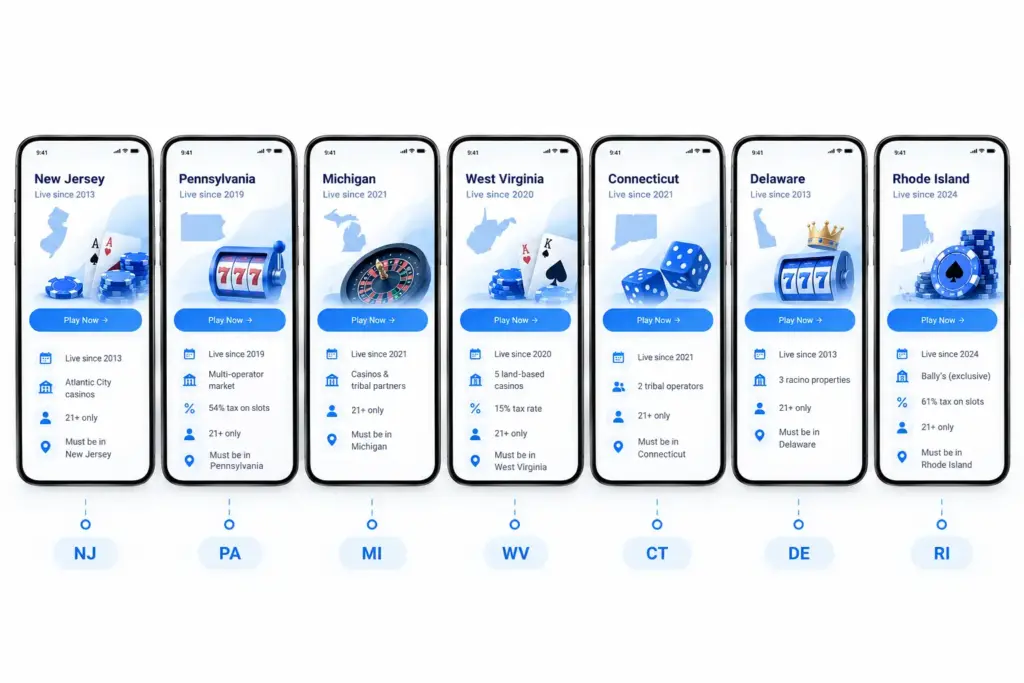
1. New Jersey: A Mature Casino Market
| Field | New Jersey |
| Regulator | Division of Gaming Enforcement |
| Launch status | Live since November 2013 |
| Operator access | Atlantic City casinos and licensed online partners |
| Licensing model | $400,000 initial permit and $250,000 renewal |
| Restrictions | Players must be 21+ and inside New Jersey |
Gaming systems must meet state requirements, and operators must verify player locations before accepting wagers.
2. Pennsylvania: A High-Tax Casino Market
| Field | Pennsylvania |
| Regulator | Pennsylvania Gaming Control Board |
| Launch status | Live since July 2019 |
| Operator access | Up to 39 certificates, with 13 per game category |
| Licensing model | $10 million for all three game categories or $4 million per category; platform operators pay a $1 million license fee |
| Restrictions | Players must be 21+, verified and physically in Pennsylvania |
The tax rate is 54% on online slots and 16% on table games and poker. Operators must connect their platforms to an eligible land-based casino.
3. Michigan: A Competitive Casino Market
| Field | Michigan |
| Regulator | Michigan Gaming Control Board |
| Launch status | Live since January 22, 2021 |
| Operator access | Detroit casinos and eligible federally recognized tribes |
| Licensing model | $50,000 application, $100,000 initial license and $50,000 annual renewal |
| Restrictions | Players must be 21+; identity checks are required before the first deposit |
Operators must work with one platform provider. Michigan allows multistate agreements for online poker, but slots and table games remain within state borders. The regulator has also taken action against 13 websites that unlawfully targeted Michigan residents.
4. West Virginia: A Lower-Tax Market
| Field | West Virginia |
| Regulator | West Virginia Lottery Commission |
| Launch status | Live since July 2020 |
| Operator access | Five land-based casinos, each with up to three management service providers |
| Licensing model | $250,000 for five years; $100,000 renewal every five years |
| Restrictions | Players must be 21+ and inside West Virginia |
The market operates under the Lottery Interactive Wagering Act. Its 15% tax rate is the lowest among the live markets. Supplier fees include $100,000 for platform and service management licenses and $10,000 for supplier licenses.
5. Connecticut: A Tribal Partnership Market
| Field | Connecticut |
| Regulator | Department of Consumer Protection |
| Launch status | Mohegan Digital launched on October 19, 2021 |
| Operator access | Two tribal casino operators |
| Licensing model | Public Act 21-23 and tribal compacts |
| Restrictions | Players must be 21+ |
Foxwoods partnered with DraftKings, while Mohegan Sun partnered with FanDuel. Mohegan Sun Online Casino also connects digital play with its physical resort through Momentum Dollars, which players can redeem for dining, shopping and hotel stays.
Its exclusive slot Love Island Unlocked is another way the brand stands out in a market with only two main operators.
6. Delaware: A State-Controlled Market
| Field | Delaware |
| Regulator | Delaware Lottery |
| Launch status | Live since November 2013 |
| Operator access | Delaware Park, Bally’s Dover and Harrington |
| Licensing model | Delaware Gambling Competitiveness Act of 2012 |
| Restrictions | Players must be 21+ and physically in Delaware |
All three brands use the same 888 platform. They share a game library and player pool, making Delaware a more centralized market than states with many competing platforms.
7. Rhode Island: A Lottery-Controlled Market
| Field | Rhode Island |
| Regulator | Rhode Island Division of Lottery |
| Launch status | Live since March 2024 |
| Operator access | Bally’s through Twin River and Tiverton |
| Licensing model | Senate Bill 948 |
| Restrictions | Players must be 21+ and inside Rhode Island; all table games require live dealers |
The state taxes online slots at 61% and table games at 15.5%. Bally’s partnered with Stakelogic for live blackjack, roulette and baccarat. It spent $5 million on an in-casino studio covering 4,000 square feet. At launch, the platform offered around 170 slot and table games.
Is Maine the 8th State? Legal vs. Live Explained
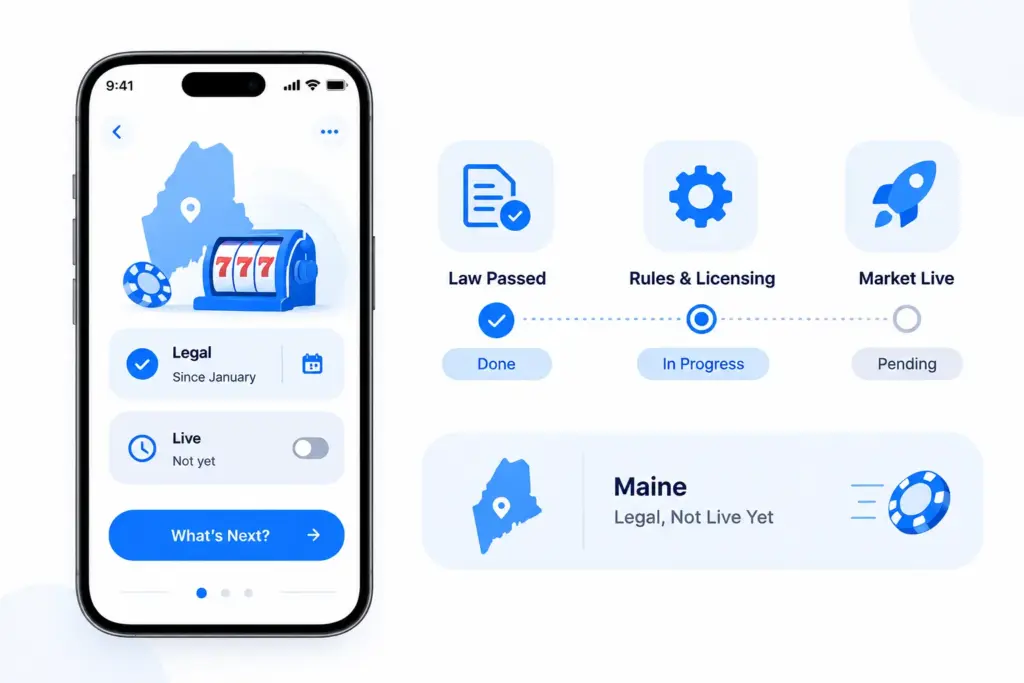
Maine is the eighth state to legalize online casinos, but it is not yet the eighth state with a live market. Legal means a law has passed. Live means licensed sites can accept real-money bets. Maine has reached the first stage but not the second. That is why some websites count eight states while others count seven.
| Term | What It Means | Maine’s Status |
| Legal | A law allows online casinos | Yes. It became law in January. |
| In effect | The law has taken force | Yes. It became effective in July. |
| Live | Licensed sites accept real-money bets | No. The market is not open yet. |
Has Maine Legalized Online Casinos?
Yes. Maine’s law is LD 1164, also called the Act to Create Economic Opportunity for the Wabanaki Nations Through Internet Gaming. It passed the legislature in June and became law in January after Gov. Janet Mills took no action. The law gives Maine’s four federally recognized Wabanaki Nations exclusive rights to offer online casino gaming through commercial partners.
Traditional commercial casinos cannot enter the market directly. The law covers online slots, live dealer games and poker. It follows a similar tribal-exclusive model used for sports betting in Maine. Some websites confuse the law’s approval with the market launch. The accurate description is that Maine has legalized online casinos but has not launched them yet.
Why Is Maine Not Live Yet?
Passing the law was only the first step. Maine still needs to finish its rules and licensing process. A court case could also affect the timeline. Fanatics Casino is an example of how state rules shape access. Its online casino operates in New Jersey, Pennsylvania, Michigan and West Virginia. Its app adjusts to the player’s location, so casino games only appear where they are authorized. Maine players will not have access to its casino games until the state approves licensed operators.
Four main issues are holding up Maine’s launch:
- Final Rules Are Pending: The Gambling Control Unit released its third draft of the rules on September 30. Public comments are open until October 30.
- The Regulator Needs More Resources: The state still needs to complete its legal review, hire six staff members and launch a licensing portal.
- Operators Must Meet the Requirements: The draft rules include an 18% tax on adjusted gross receipts, a $50,000 operator license fee and a $500,000 bond.
A Lawsuit Remains Unresolved
Churchill Downs’ Oxford Casino sued in federal court. It argues that the tribal-exclusive law violates the Equal Protection and Commerce Clauses. The tribes have joined the case as defendants. However, the court has not issued an injunction blocking the law.
When Will Maine Online Casinos Launch?
Maine has not announced an official launch date. However, Gambling Control Unit executive director Milton Champion said a launch is more likely in Q1 2027 than before the end of 2026.
| Step Before Launch | Status |
| Final rules adopted | Pending; comments close October 30 |
| Legal review, staffing and licensing portal | Still needed |
| Operator licenses and platform testing | Required before launch |
| Lawsuit resolved | Unresolved; may affect timing |
Operators are already preparing for the market. Caesars has announced plans for three brands in Maine: Caesars Palace Online Casino, Caesars Sportsbook & Casino and Horseshoe Online Casino, subject to regulatory approval.
Horseshoe offers an example of what a tribal partnership could look like. It launched in Michigan through a partnership with the Sault Ste. Marie Tribe of Chippewa Indians. Its app features themed game lobbies, live dealer tables and linked progressive jackpots. It also offers branded games and connects with the Caesars Rewards program.
If approved in Maine, this type of tribal partnership could help Caesars bring its online casino brands to the state. For now, though, Maine is legally approved but not yet open for real-money online casino play.
Which Operators Are Coming to Maine?
Caesars Entertainment and DraftKings are the two operators expected to enter Maine’s online casino market. Both will work with Wabanaki tribal partners instead of entering on their own. Caesars has agreements with three tribes, while DraftKings has a deal with the fourth. Neither can accept players until regulators approve the rules and licenses.
Which Caesars Brands May Launch?
Caesars has partnerships with the Penobscot Nation, Mi’kmaq Nation and Houlton Band of Maliseet Indians. These deals already support online sports betting. However, Caesars has not confirmed which casino brand it will launch in Maine. Industry reports suggest Caesars Palace Online Casino could be the leading option. Maine allows each tribe to work with only one management services provider, which limits the number of brands.
| Caesars Brand | Current Status in Maine |
| Caesars Palace Online Casino | Considered likely, but not confirmed |
| Horseshoe Online Casino | Possible, but not announced |
| Tropicana Online Casino | Not announced |
| Harrah’s Online Casino | Not announced |
| WSOP.com | Not announced |
How Will Tribal Partnerships Work?
Maine’s law gives its four federally recognized Wabanaki Nations exclusive rights to hold online casino licenses. These are the Penobscot Nation, Passamaquoddy Tribe, Mi’kmaq Nation and Houlton Band of Maliseet Indians.
The system works like this:
- One license per tribe: Each tribe can hold one online casino license.
- One operator per license: Each tribe can work with only one management services provider.
- 18% tax: Online casino revenue faces an 18% tax, compared with 10% for sports betting.
- Tribal branding: Proposed rules require the tribe’s name to receive equal billing in promotions.
- State oversight: The Maine Gambling Control Unit manages the rules and licensing process.
DraftKings will partner with the Passamaquoddy Tribe. The company already works with the tribe on sports betting. It has also developed more than 30 casino games in-house, including DraftKings Rocket, a real-time game where players wager before a virtual rocket launches. Other titles include Spanish 21 and DKCraps.
Maine’s commercial casinos, Oxford Casino and Hollywood Casino, oppose the tribal-exclusive model. Oxford Casino’s owner has also filed a lawsuit against the state.
What Can Horseshoe Tell Us?
Horseshoe Online Casino launched in Michigan through a partnership with the Sault Ste. Marie Tribe of Chippewa Indians. It offers a useful example of how Caesars can combine a casino brand with a tribal partner. The brand builds on Horseshoe’s casino history, which dates back to 1951. Its app uses a casino-floor layout with sections for high-limit slots, private live dealer tables and linked progressive jackpots.
Players can also earn Caesars Rewards credits to use at Caesars destinations across North America. This mix of online games and real-world rewards could be attractive in Maine if the brand receives approval.
Key takeaway: Caesars has already tested the tribal partnership model in Michigan. Maine could follow a similar approach, but its final brands are not yet confirmed.
Which Games and Rewards Could Launch?
Maine has not released a final game list. However, existing casino products offer an idea of what players may see.
| Category | What Players Could Expect | Example |
| Slots | Branded and exclusive games | Horseshoe Rising Rewards by Games Global, 2x3x Horseshoe by AGS and Horseshoe 3 Coin Cowboy by Bragg |
| Live dealer | Live games with regulated systems and audits | Evolution’s Lightning Roulette |
| Loyalty | Rewards linked to casino visits | Caesars Rewards credits |
| Player protection | Age restrictions and self-exclusion tools | Maine’s proposed rules restrict marketing to under-21s and require real-time self-exclusion |
BetMGM shows how operators use exclusive content to stand out. In Ontario, it opened a private live dealer studio with Evolution featuring six blackjack tables. It also secured early exclusive rights to Evolution’s Lightning Storm game show.
MGM has also announced a live studio at the MGM Grand in Las Vegas with Playtech. BetMGM gained exclusive casino rights to The Price Is Right and Family Feud through a partnership with Fremantle. Maine operators could use similar deals to attract players.
When Can Maine Casinos Launch?
Maine has not confirmed an official launch date. Operators must wait for the final rules and receive approval before accepting real-money bets.
| Milestone | Status |
| Law enacted | LD 1164 became law in January |
| Effective date | Three months after the legislature adjourned |
| Rule changes | The third round of updates covers live dealer systems and advertising |
| Legal challenge | Oxford Casino filed a lawsuit in January |
| Licenses and launch | No confirmed launch date |
Even after the rules are final, operators must receive their licenses before opening. Sites may launch in stages rather than all at once. A pre-registration alert list can help readers follow the launch news. It is not a casino account or a way to place bets. It simply provides updates on approved sites, welcome offers and the tribal partners behind each brand.
Online Casino vs. Online Sports Betting: Which States Allow Which?
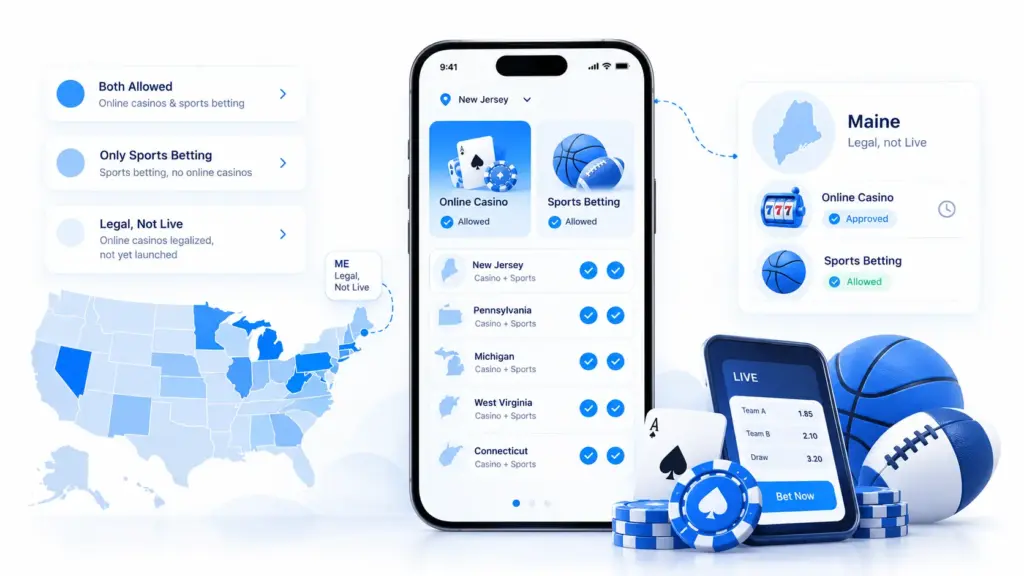
Most states that allow online sports betting do not allow online casino games. The two are regulated separately. Seven states have both live online casinos and sportsbooks: New Jersey, Pennsylvania, Michigan, West Virginia, Connecticut, Delaware and Rhode Island. Maine has legalized online casinos but has not launched them yet. Nevada allows online poker and sports betting but not online slots or table games.
1. How Do Casino and Sports Betting Laws Differ?
The 2018 Murphy v. NCAA decision removed the federal ban on sports betting and let states decide whether to legalize it. Online casinos followed a different path. A 2011 Department of Justice opinion said the Wire Act applied to sports betting, allowing states to authorize online casino games under their own laws.
Sports betting has spread faster because online slots and table games can compete with physical casinos. Still, more states are looking at the tax revenue online casinos could bring.
| Factor | Online Sports Betting | Online Casino |
| Legal basis | 2018 Murphy v. NCAA decision | Each state passes its own law |
| Federal rules | Wire Act applies to sports betting | States can regulate within their borders |
| Legal reach | 39 states plus D.C. and Puerto Rico have some form of sports betting | Eight states have legalized it, including Maine |
| Live markets | 32 states, with Wisconsin authorized but not yet live | Seven live markets |
| Example tax rate | Varies by state | Maine taxes casino revenue at 18% vs. 10% for sports betting |
2. Which States Allow Both Betting Types?
Seven states currently offer both live online sportsbooks and online casinos. Maine has approved online casino gaming but is still waiting for launch.
| State | Online Sports Betting | Online Casino |
| New Jersey | Yes | Yes |
| Pennsylvania | Yes | Yes |
| Michigan | Yes | Yes |
| West Virginia | Yes | Yes |
| Connecticut | Yes | Yes |
| Delaware | Yes | Yes |
| Rhode Island | Yes | Yes |
| Maine | Yes | Approved, not live |
FanDuel shows how a sportsbook brand can also operate a casino. FanDuel Casino is available in New Jersey, Pennsylvania, Michigan and West Virginia. Its products include the NBA Super Slam slot, a daily free-to-play game called Reward Machine and branded live dealer studios with Evolution in Michigan and Pennsylvania.
3. Which States Allow Only Sports Betting?
Many states allow online sports betting but not regulated online casino games. These include New York, Ohio, Illinois, Indiana, Kansas, New Hampshire, Arizona, Colorado, Maryland, Massachusetts, North Carolina and Virginia. Lawmakers in states such as New York, Maryland, Virginia and Massachusetts have considered online casino bills, but these efforts have fallen short.
The main market types include:
- Fully online sportsbooks: New York, Ohio, Illinois, Indiana, Kansas and New Hampshire.
- Limited online access: Mississippi allows app-based betting only on casino grounds. Montana restricts app use to authorized locations.
- In-person or tribal betting: Nebraska and New Mexico.
- Authorized but not live: Wisconsin, where tribal apps are expected after compact negotiations.
4. Why Does Nevada Allow Online Poker?
Nevada legalized online poker through Assembly Bill 114 in 2013. Although the law allows a wider range of interactive gaming, state regulations limit online casino play to poker. One reason is that poker is seen as less likely to draw players away from physical casino floors. Nevada’s market has a few key features:
- One licensed operator: WSOP.com is the only licensed online poker room in the state.
- Shared player pools: Nevada shares players with New Jersey, Michigan and Pennsylvania through a multistate agreement.
- Bad-actor clause: Rules restricting companies tied to US online wagering after the end of 2006 helped keep PokerStars out.
- Liquidity challenges: Online poker needs enough players to keep games active, which can be difficult in smaller markets.
Online poker is legal in seven states: Connecticut, Delaware, Michigan, Nevada, New Jersey, Pennsylvania and West Virginia.
5. Can Sportsbooks Offer Online Casino Games?
Yes, but only in states that allow online casinos. A sportsbook license does not automatically permit casino games. Operators must secure the required approvals for each type of gambling. Companies use three main app models:
| Model | What It Means | Example |
| Embedded casino | Casino games inside a sportsbook app | Fanatics’ earlier approach |
| Standalone casino app | A separate app for casino players | Fanatics Casino |
| All-in-one app | Sportsbook, casino and prediction markets in one app | Fanatics Sports & Casino |
Fanatics has used all three approaches. Its standalone casino app launched in Michigan, New Jersey, Pennsylvania and West Virginia. Its launch promotion included a $2 million FanCash prize pool, with a $25,000 top prize each week. The company also developed games such as Fanatics Fire Roulette and Fanatics Multi-hand Blackjack. Its newer all-in-one app brings sportsbook and casino products together with prediction markets and Fanatics ONE rewards.
What Should Operators Know Before Launching?
Operators must treat sports betting and online casino gaming as separate licensing processes. Before entering a state, they should:
- Check state laws: A sportsbook license does not grant casino rights.
- Compare taxes: Maine taxes online casino revenue at 18% and sports betting at 10%.
- Understand license rules: Only Maine’s four Wabanaki tribes can hold online casino licenses. Each can work with one operator.
- Follow advertising rules: Maine’s proposed rules restrict marketing to people under 21 and require equal visibility for tribal partners.
- Plan live dealer systems: Maine’s draft rules require the main server to be in-state, while backend systems may operate elsewhere with regular audits.
- Add player protection: Real-time self-exclusion tools are part of Maine’s updated rules.
- Track legal challenges: Oxford Casino has sued over Maine’s tribal-exclusive model.
Understanding these differences helps operators choose the right market, licensing model and platform features before investing in development.
Are Online Casinos Legal Under Federal Law? (Wire Act and PASPA)
Federal law does not ban all online casinos in the US. Instead, states decide whether to allow and license them. The Wire Act mainly covers sports betting, while PASPA was struck down in 2018. Federal laws still regulate payments, money laundering and illegal gambling. Offshore sites without proper authorization do not get the same protection. Here is how the main laws work.
1. What Does the Federal Wire Act Say?
The Wire Act was passed in 1961 to help fight organized crime. It restricts certain betting communications sent through wire services. For years, people argued that it banned online gambling. Courts later adopted a narrower reading that limits it to sports betting. This helped states develop regulated online casino markets.
| Wire Act at a Glance | Details |
| Enacted | 1961 |
| Original purpose | Disrupt organized crime |
| What it covers | Certain betting communications |
| Current court reading | Limited to sports wagering |
2. How Did PASPA Change Sports Betting?
Congress passed PASPA in 1992 to restrict state-authorized sports betting. It did not cover casino games such as online slots or blackjack. On May 14, 2018, the Supreme Court struck down PASPA in Murphy v. NCAA. This allowed each state to decide whether to legalize sports betting. The ruling did not automatically make sports betting legal nationwide.
- 1992: Congress passes PASPA.
- Legal challenge: New Jersey challenges the federal restrictions.
- May 14, 2018: The Supreme Court strikes down PASPA.
- Afterward: States begin setting their own sports betting rules.
3. What Did the 2011 DOJ Opinion Clarify?
In 2011, the Department of Justice said the Wire Act did not apply to interstate communications unrelated to sports betting. This helped states authorize online lotteries and casino games. In late 2018, the DOJ changed its position and argued that the law covered all interstate betting. New Hampshire challenged that interpretation. On January 20, 2021, the First Circuit ruled that the Wire Act was limited to sports betting.
| Date | Event |
| 2002 | DOJ advises Nevada that the Wire Act applies to online casino gambling |
| December 2011 | DOJ limits its interpretation to sports betting |
| Late 2018 | DOJ reverses its position |
| February 2019 | New Hampshire Lottery Commission sues |
| January 20, 2021 | First Circuit rules the Wire Act covers sports betting |
| September 15, 2022 | Rhode Island court grants IGT a declaratory judgment |
The 2022 ruling was specific to IGT, although the judge discussed its wider relevance. The legal position has remained favorable to state-regulated online gaming, but operators still need to follow applicable federal and state laws.
4. Can States Legalize Online Casinos Independently?
Yes. There is no single federal online casino license. Each state creates its own rules and decides which operators can enter the market.
- Commercial casino partnerships: Hard Rock Bet operates online casino games in states such as New Jersey under state authorization.
- Tribal-exclusive model: Maine’s LD 1164 gives its four Wabanaki Nations exclusive online casino licensing rights. The proposed tax rate is 18%.
- Poker-only model: Nevada permits online poker, but its regulations do not allow online slots or table games.
Hard Rock Bet shows how operators adapt to different state rules. Its online casino and sportsbook work together in eligible markets. The brand also introduced Legendary Reward Drops, which offers monthly levels and weekly rewards through Unity by Hard Rock. Bragg Gaming is developing exclusive casino games for Hard Rock Bet Casino, starting in New Jersey.
5. How Do Federal and State Laws Work Together?
Think of it as two layers. Federal law sets financial and legal safeguards, while states control licensing and market access. The Unlawful Internet Gambling Enforcement Act or UIGEA of 2006 is often mistaken for a complete ban on online gambling. It mainly targets payments connected to unlawful internet gambling.
| Layer | Law or Body | What It Covers |
| Federal | Wire Act | Certain interstate sports betting communications |
| Federal | UIGEA | Payments linked to unlawful internet gambling |
| Federal | Bank Secrecy Act and FinCEN | Anti-money laundering and financial reporting |
| Federal | DOJ and FTC | Illegal gambling enforcement and deceptive marketing |
| State | Gaming commission | Licensing, taxes, age checks and geolocation |
What Laws Must Online Casino Operators Follow?
Operators need a license in every state where they offer casino games. They must also follow payment rules, verify player identities and locations, and provide responsible gambling tools. Federal financial rules may require reports for qualifying or suspicious transactions. Enforcement also matters. One Michigan action targeted 45 offshore operators that were illegally offering online casino games and sports wagering to residents.
bet365 shows how these rules affect platform design. Players must be physically located in New Jersey or Pennsylvania to use its online casino there. The company launched online casino gaming and sports betting in Michigan on April 17, making it its third US state at the time. Both products use one account and wallet.
The company has also worked with Playtech on 10 live dealer tables across studios in Pennsylvania and New Jersey. Its promotional offers, including a 100% deposit match up to $1,000, must follow each state’s rules.
Which States Could Legalize Online Casinos Next?
Virginia, New York and Illinois are possible candidates for legalizing online casinos. Maryland and Indiana face bigger hurdles. None of the five states has passed an online casino law yet. Virginia needs another vote, New York needs stronger support from its governor, and Illinois faces opposition from casinos and unions. Maryland needs voter approval, while Indiana must rebuild support.
1. Which States May Legalize Online Casinos?
Five states had online casino proposals in the latest legislative round, but none became law. Massachusetts also considered a bill, but lawmakers sent it to study.
| State | Bill or Effort | Current Status | Main Obstacle |
| New York | S2614 | Effort stalled | No governor support |
| Maryland | SB 761 and SB 885 | Referendum bill withdrawn | Voter approval needed |
| Illinois | HB 4797 | Reintroduced, not passed | Casino and union opposition |
| Indiana | HB 1078 | Removed from agenda | Lack of support |
| Virginia | SB 118 and HB 161 | No final agreement | Chambers disagree on details |
2. Will New York Legalize Online Casinos?
The proposal would have allowed commercial casinos, racinos, tribal operators and mobile sportsbook providers to apply. It also included a $10 million platform fee for independent platform contractors and required live dealer studios to operate in New York.
Addabbo plans to keep pushing for legalization. For now, players can find regulated online casinos in neighboring New Jersey and Pennsylvania.
3. Is Maryland Moving Toward Legalization?
Maryland faces a major hurdle because it needs a statewide referendum to expand gambling. Senator Ron Watson withdrew SB 761 on March 13 after a committee hearing was canceled. Its companion bill, SB 885, could not move forward without it. A poll by Lake Research Partners for the National Association Against iGaming found that 71% of Maryland voters opposed legalization.
The group opposes online casino gaming, so that context matters. Some casinos and unions have also raised concerns, although MGM Resorts and Caesars Entertainment have supported a referendum.
Maryland needs three steps:
- The legislature must approve a constitutional amendment.
- Voters must approve it in a general election.
- Lawmakers must pass the rules for licensing and regulation.
The earliest path is likely to be in a future legislative session, followed by a public vote.
4. Could Illinois Legalize Online Casino Gaming?
Illinois has considered online casino bills in every session since 2023. None has passed. Governor JB Pritzker has called legalization “worthy of consideration,” but retail casinos and unions remain important opponents. Representative Edgar Gonzalez Jr. reintroduced the proposal as HB 4797. Its main terms include:
| Proposal Detail | HB 4797 |
| Eligible licensees | Existing casinos and racetracks |
| Skins per licensee | Up to three |
| License fee | $250,000; $100,000 renewals |
| Tax | 25% of adjusted gross gaming revenue |
| Regulator | Illinois Gaming Board |
| Server rule | In-state servers required after one year |
Penn Entertainment’s Hollywood Casino app shows what a casino-first platform can offer. It features virtual casino games, live dealer tables and exclusive PENN Game Studios titles such as Legendary Larry, Wuji Mines and Devils Blackjack. Players can also earn PENN Cash through PENN Play.
However, Penn has opposed online casino legalization in Illinois. That divide among operators is one reason the bill has struggled.
5. Will Indiana Approve Online Casinos?
Indiana is currently one of the weaker candidates. Representative Ethan Manning pulled HB 1078 from the agenda after it failed to gain enough support. The proposal combined online lottery gaming with online casinos. Manning said legalizing sports betting early may have made it harder to win support for other forms of online gambling.
Under the earlier proposal, only existing casinos and horse tracks could apply for licenses. The idea could return in a future session, but it needs stronger support from lawmakers first.
6. What Is Virginia’s Casino Outlook?
Virginia has made the most progress among these five states. SB 118 and HB 161 passed their original chambers, but lawmakers could not agree on a final version. Both bills require another vote in 2027. If approved, a launch would not be expected until 2028.
| Issue | Senate Bill | House Bill |
| Bill | SB 118 | HB 161 |
| Tax rate | 20% | 15% |
| Timing | July 1, 2027, proposed effective date | Another vote required in 2027 |
| Casino protection | Extra 6% tax for land-based casinos | Extra 6% tax plus 25% of promotional value redeemable at partner casinos |
BetRivers is an example of an operator that could benefit if Virginia legalizes online casinos. It already runs a sportsbook in the state through Rivers Casino Portsmouth, a $300 million project approved by voters in November 2020.
Its iRush Rewards program has Gold, Platinum and Black tiers. BetRivers also offers online poker through a product developed with poker professional Phil Galfond. Virginia’s proposed rules would favor existing casino operators, though lawmakers still need to settle who will regulate online casino gaming.
7. Which State Could Legalize First?
Based on the current bill positions, Virginia has made the most legislative progress, but a launch before 2028 appears unlikely. New York could move if the governor supports a new bill. Illinois needs to address opposition from casinos and unions. Maryland needs a referendum, while Indiana must rebuild legislative support.
| Rank | State | Main Reason | Possible Next Step |
| 1 | Virginia | Bills passed their original chambers | Another vote in 2027; possible 2028 launch |
| 2 | New York | Strong legislative sponsor | New bill with governor support |
| 3 | Illinois | Governor is open to the idea | Build support among casinos and unions |
| 4 | Maryland | Needs constitutional change and voter approval | Referendum in a future election |
| 5 | Indiana | Bill stalled due to weak support | Introduce a new bill |
These are estimates based on the legislative positions described above, not confirmed launch dates. The next legislative sessions will show whether any of these states moves closer to legal online casinos.
Can You Play in States Without Legal Online Casinos? (Sweepstakes Explained)
In states without legal online casinos, players may still find sweepstakes casinos or free social games. However, sweepstakes casinos are not legal everywhere. They use promotional coins instead of standard real-money wagers, and more states are restricting them. Always check your state’s rules before signing up.
1. Can You Play Without Legal Casinos?
Yes, but your options depend on state law. You cannot use a licensed online casino unless it is authorized in your state. Geolocation checks also stop players from accessing regulated casino games across state lines.
Your main options are:
- Social casinos: Free games using Gold Coins with no cash value.
- Sweepstakes casinos: Promotional coins that may be redeemable for prizes where allowed.
- Other legal products: Sports betting, lotteries and poker, depending on your state.
- Wait for legalization: Some states are still considering online casino bills.
Offshore casinos are riskier because they operate outside state oversight. You may have limited ways to recover your money if something goes wrong.
2. What Are Sweepstakes Casinos?
Sweepstakes casinos look like regular online casinos, with slots, table games and sometimes live dealers. However, they use a promotional model rather than a standard gambling license. Players may buy Gold Coins for entertainment and receive Sweeps Coins as a promotional bonus.
These coins may qualify for prize redemption. Operators rely on the “no purchase necessary” rule, which means users must have a free way to enter, often called an Alternative Method of Entry or AMOE. However, regulators in several states have challenged this model.
3. How Do Sweepstakes Coins Work?
Gold Coins and Sweeps Coins serve different purposes.
| Feature | Gold Coins (GC) | Sweeps Coins (SC) |
| Cash value | None | May be redeemed for prizes |
| How to get them | Free bonuses or purchase | Bonuses, daily rewards or mail-in entry |
| Typical redemption rate | Not redeemable | Often 1 SC = $1 at major operators |
| Purpose | Entertainment | Prize-eligible play |
New York’s attorney general showed how coin bundles can work. A $5 purchase provided 5.05 Sweeps Coins and 1,000,000 Gold Coins. A $50 purchase provided 51.50 Sweeps Coins and 15,000,000 Gold Coins.
The usual redemption process is simple:
- Collect Sweeps Coins through eligible bonuses or mail-in requests.
- Play using those coins.
- Reach the minimum redemption amount.
- Verify your identity and request cash or a gift card.
Prize winnings may be taxable. Some operators report them on a 1099-MISC form.
4. Are Sweepstakes Casinos Legal Everywhere?
No. Each state has its own rules, and restrictions are increasing. A platform may operate in one state but block players in another. Chumba Casino illustrates these changes. Its parent company, VGW, also operates LuckyLand Slots and Global Poker. It has stopped offering redeemable Sweeps Coins in states including New York, New Jersey, Mississippi and Louisiana.
In New York, VGW reached an $8 million settlement and was permanently barred from offering residents cash-redeemable coins or sweepstakes casino games. The company did not admit wrongdoing. As of late September, Chumba, LuckyLand and Global Poker were also unavailable altogether in Connecticut, Delaware, Michigan, Montana, Nevada and Washington.
5. Which States Restrict Sweepstakes Casinos?
The source lists nine states with statutory bans. Oklahoma is set to join them on November 1. Four more states restrict the model under existing gambling laws or regulator enforcement.
| Category | States | Legal Basis |
| Banned by statute | California, Connecticut, Indiana, Louisiana, Maine, Montana, New Jersey, New York, Tennessee | Laws including AB 831, SB 555, A5447 and S5935-A |
| Blocked under existing law | Idaho, Michigan, Nevada, Washington | Gambling laws and regulator enforcement |
| Joining soon | Oklahoma | Restrictions take effect November 1 |
California’s AB 831 passed the Senate 36–0 and the Assembly 63–0. It makes operating certain online sweepstakes games a misdemeanor. Penalties include fines of $1,000 to $25,000, up to one year in county jail, or both. Businesses that knowingly support the games may also face liability.
Most bans target operators, but Montana can also penalize players with a misdemeanor and fines of up to $500. State lists can change, so check the latest rules before playing.
6. How Do Sweepstakes and Real Casinos Differ?
A licensed online casino operates under state gaming laws. Players deposit money and withdraw winnings directly. Sweepstakes casinos use promotional coins, and prizes require redemption and verification. Stake.us shows how similar these sites can look to regular casinos. It offers slots, live dealer games, poker and original games such as Plinko and Crash. Its Stake Cash works like Sweeps Coins and can be redeemed through options that include cryptocurrencies such as Bitcoin and Tether.
However, Stake.us is restricted in several states, including some with legal real-money casinos. This shows that sweepstakes availability does not automatically follow online casino laws.
| Factor | Real-Money Online Casino | Sweepstakes Casino |
| Regulator | State gaming agency | Depends on applicable laws |
| Payment | Cash deposits | Gold Coin purchases with promotional Sweeps Coins |
| Winnings | Direct withdrawals | Prize redemption after verification |
| Legal basis | State online casino law | Promotional sweepstakes law |
| Availability | Eight states have legalized online casinos, with Maine not yet live | Available in many states, but restrictions are growing |
7. What Should Players Check First?
Before joining a platform, check these six things:
- State rules: Confirm the platform is allowed where you live.
- Free entry: Look for a clear “no purchase necessary” method.
- Redemption terms: Check minimum amounts and identity requirements.
- Company details: Review the operator, terms and responsible play tools.
- Taxes: Keep records because prizes may be taxable.
- Spending limits: Coin bundles cost real money, even when promotional coins are included.
The main takeaway is that sweepstakes casinos are not a legal substitute for licensed online casinos in every state. Check local rules before signing up or spending money.
Why Choose IdeaUsher for Online Casino Development?
IdeaUsher helps businesses build custom online casino platforms with secure backends, smooth game integrations and scalable architecture. With 500,000+ hours of coding experience and a team that includes ex-MAANG and FAANG developers, we help founders turn their iGaming ideas into reliable platforms. Our team focuses on the technical needs of casino operators, from initial development to future market expansion. We tailor each solution to your business goals and target audience.
Custom iGaming Platform Architecture
We design online casino platforms around your business model, target markets and expected player traffic. Our team builds flexible systems that can support new games, features and markets as your business grows. This helps your platform adapt as player demand changes.
Casino API and Aggregator Integration
We integrate casino game APIs and aggregators to help operators offer slots, table games and live dealer experiences. Our focus is on smooth integration, reliable performance and a consistent player experience. We help simplify game management as your content library expands.
Secure Wallets and Backend Engineering
We develop secure wallet systems and backend services to manage player balances, transactions, bonuses and gaming activity. We also consider access controls, data protection and system reliability throughout development. Our goal is to build a dependable foundation for daily operations.
Support for Future Market Expansion
As your business grows, your platform may need new integrations, features and market-specific updates. IdeaUsher provides technical support to help you improve your platform architecture and prepare for expansion while meeting the requirements of each target market. This gives your team a clearer path to adding features and entering new markets.
Conclusion
As of 2026, seven US states have live real-money online casino markets: Connecticut, Delaware, Michigan, New Jersey, Pennsylvania, Rhode Island and West Virginia. Maine is the eighth state to legalize online casinos, but its market is not live yet. Since each state has its own licensing rules, taxes and player requirements, operators must understand local regulations before launching. For businesses planning to enter the iGaming market, choosing the right state and building a compliant, scalable platform are key first steps.
FAQs
A1: In 2026, seven US states have live real-money online casinos: Connecticut, Delaware, Michigan, New Jersey, Pennsylvania, Rhode Island, and West Virginia. Maine has legalized online casinos but has not launched its market yet. Each state sets its own rules for licensing, taxes, and player eligibility. Operators must meet these requirements before offering real-money games.
A2: Players generally cannot cross state lines to access online casinos where they are not legally authorized. Geolocation systems verify a player’s physical location before allowing real-money play. Some states have agreements that allow licensed operators to share poker player pools. However, these agreements do not automatically permit online casino games across state borders.
A3: No. California and Texas do not currently permit licensed real-money online casino gaming. Players should check local laws before using any online gambling platform. Both states have different gambling regulations, so operators cannot assume that approval in another state applies there. Any future legalization would depend on state-specific legislation and regulatory approval.
A4: Nevada permits online poker but does not offer full-scale online casino gaming with real-money slots and table games. Its online gambling market is more limited than those in the seven live casino states. Licensed poker platforms must follow Nevada’s regulatory requirements. Sports betting is also available through separately regulated services.
A5: Yes, but operators must meet each state’s licensing, compliance, and technical requirements. A platform may need separate approvals, geolocation controls, and state-specific integrations before expanding into new markets. It must also adapt responsible gambling tools, payment processes, and reporting systems where required. A scalable platform can simplify expansion, but it does not replace the need for individual state authorization.