


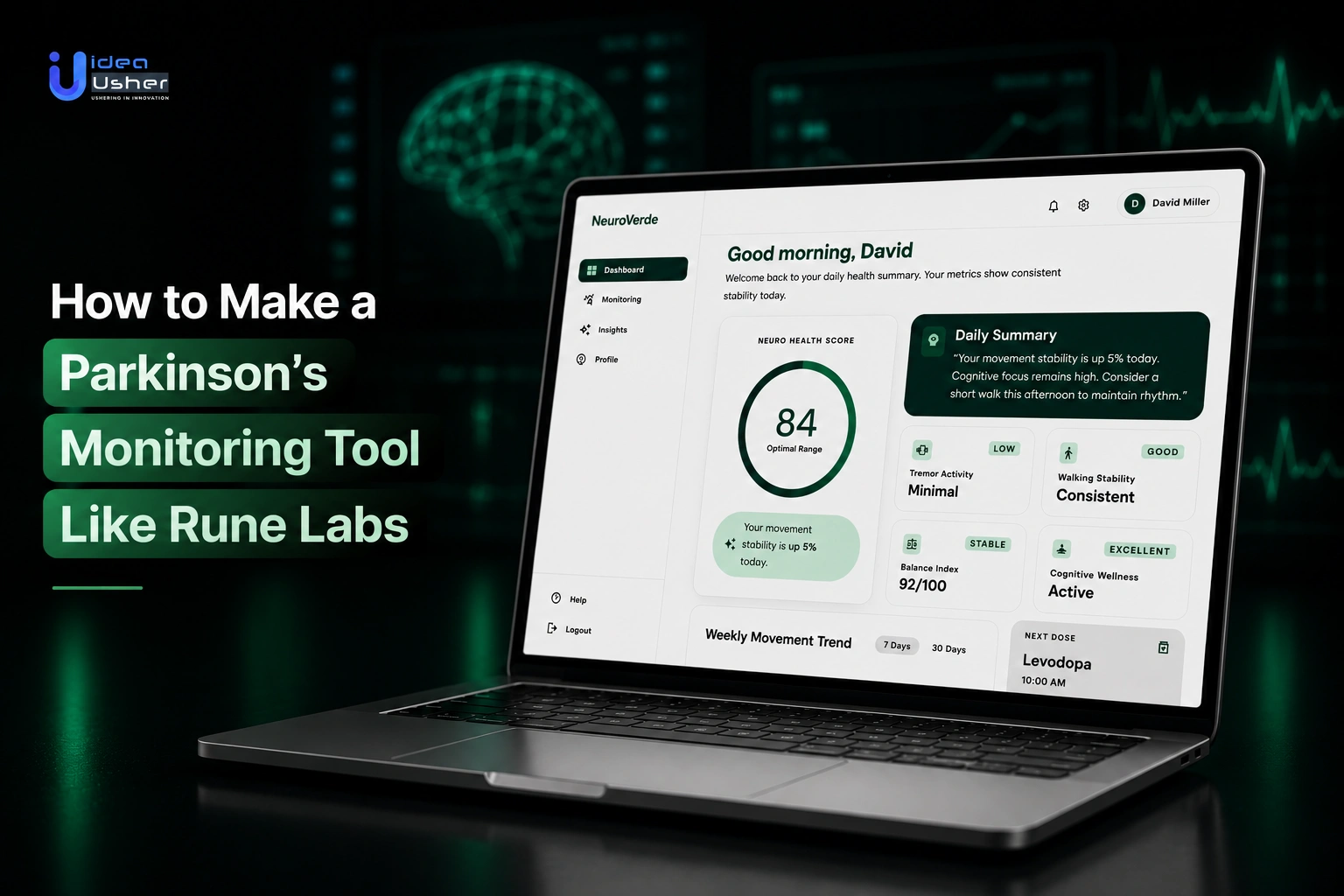
Key Takeaways
- AI-powered Parkinson’s monitoring platforms replace episodic clinic visits with continuous wearable-based tracking for real-time symptom and treatment monitoring.
- Core capabilities include wearable integration, digital biomarkers, medication correlation, AI symptom analysis, clinician dashboards and EHR connectivity.
- Continuous movement tracking and AI insights help neurologists optimize treatment, monitor disease progression and improve long-term patient outcomes.
- Healthcare-grade AI, wearable interoperability and regulatory compliance are essential for building scalable precision neurology platforms.
- How Idea Usher can help you build Parkinson’s monitoring platform like Rune Labs with AI-powered digital biomarkers, wearable integrations and neurology solutions.
The biggest blind spot in Parkinson’s care isn’t diagnosis and neurological diseases don’t progress only during clinical visits. This is driving demand for Parkinson’s monitoring tools like Rune Labs, as healthcare organizations replace episodic assessments with continuous monitoring that tracks symptoms, treatment response, and disease progression through real-world patient data.
Traditional Parkinson’s care relied on periodic consultations and patient recall, offering limited visibility into symptoms that fluctuate throughout the day. Modern neurology platforms increasingly combine AI-powered Parkinson’s monitoring, FDA-cleared wearables, Apple Watch integration, digital biomarkers, precision neurology, remote patient monitoring, AI clinical decision support, neuromodulation data, and personalized care to enable continuous, data-driven neurological management.
In this blog, we’ll explain how to build a Parkinson’s monitoring tool like Rune Labs, covering its core features, AI architecture, technology stack, development process, and how IdeaUsher can help build enterprise-grade precision neurology platforms powered by multimodal patient data for smarter treatment and clinical decision-making.
Why AI Parkinson’s Monitoring Is Gaining Adoption
The management of Parkinson’s disease (PD) is undergoing a structural transition from reactive clinical evaluations to continuous, data-driven remote care. Driven by the global rise in neurodegenerative conditions, the digital Parkinson’s disease monitoring market expanded from $237.47 million in 2025 to $262.92 million in 2026 and is projected to surge to $440.91 million by 2032 at a 9.24% CAGR.

Concurrently, the broader AI in neurology market is expanding from $937.2 million to $4.45 billion by 2033 (24.9% CAGR), with disease progression monitoring representing the fastest-growing application segment. This rapid adoption addresses long-standing vulnerabilities in traditional neurological care models.
A. Why Episodic Neurological Care Falls Short
For decades, clinical tracking of Parkinson’s disease has relied almost exclusively on periodic in-person evaluations such as the Movement Disorder Society-Unified Parkinson’s Disease Rating Scale (MDS-UPDRS) conducted once or twice a year. This traditional framework introduces severe operational gaps:
- Inadequate Clinical Exposure: The average Parkinson’s patient spends less than 3 hours per year with a neurologist, leaving 8,757 hours of daily life where motor fluctuations often go unmonitored.
- Recall Bias & Subjective Diaries: Paper symptom diaries are often unreliable, with studies showing up to 40% of entries are completed retrospectively or missed due to memory lapses and motor impairment.
- The Hawthorne Effect in Clinics: During brief clinic visits, up to 30% of patients show temporary improvements in movement, masking severe dyskinesias, involuntary movements, and medication “OFF” periods experienced at home.
- Delayed Medication Adjustments: As levodopa response cycles change over time, relying on retrospective reports can delay dosage adjustments by 6–12 months, increasing the risk of falls and emergency room visits.
B. Rise of Wearable-First Parkinson’s Management
To close the monitoring gap, health systems are deploying FDA-cleared, wearable-first motion analysis platforms (such as the Personal KinetiGraph/PKG and STAT-ON). These devices pair tri-axial accelerometers and gyroscopes with specialized machine learning models to capture continuous biometric streams.

The adoption of wearable-first platforms is powered by high patient readiness and advanced multi-sensor integration:
- High Patient Acceptance: Demolishing ageist technology assumptions, clinical surveys reveal that 91% of Parkinson’s patients express strong interest in using wearable monitoring technologies, with 67% already possessing experience with consumer wearables.
- Passive Biometric Ingestion: Wrist-worn or waist-mounted sensors ingest over 3,000 motion data points per minute, recording continuous movement profiles during ordinary daily tasks (e.g., walking, typing, eating) without requiring active patient input.
- High Diagnostic Sensitivity: Machine learning algorithms evaluate movement parameters to distinguish true resting tremor from daily functional hand movements, achieving an Area Under the ROC Curve (AUROC) of 0.77 to 0.79 for upper extremity symptom detection.
- Quantifiable Symptom Metrics: Wearable AI platforms generate objective scores including Bradykinesia Scores (BKS), Dyskinesia Scores (DKS), and Percent Time Immobilized (PTI), converting subtle physical movements into explicit clinical data trends.
C. How AI Is Changing Long-Term Neurological Care
Artificial intelligence transforms unstructured sensor data into actionable clinical intelligence. Machine learning algorithms process millions of kinetic data points per second, establishing a continuous digital biomarker profile for every patient.
| Long-Term Care Vector | Traditional Neurological Workflow | AI-Enabled Remote Management | Measurable Clinical & Economic Return |
| Symptom Quantitation | Subjective, manual MDS-UPDRS scoring during visits. | Automated, continuous motor scoring via deep learning models. | Eliminates intra-rater variability, delivering objective longitudinal disease progression. |
| Freezing of Gait (FoG) | Patient-reported fall history after events occur. | Real-time FoG detection using ankle/IMU sensor arrays. | Enables earlier intervention, reducing fall risk and emergency admissions. |
| Therapeutic Optimization | Trial-and-error drug adjustments spaced months apart. | Closed-loop medication response mapping (ON/OFF states). | Optimizes Levodopa dosing, with healthcare savings of up to €137.8M in single-country deployments. |
| Clinical Trial Endpoints | High variance in human observer evaluations. | Objective digital endpoints measuring real-world functional decline. | Lowers trial variability, reducing sample sizes and accelerating drug development. |

What Is a Parkinson’s Monitoring Tool Like Rune Labs?
Rune Labs is an AI-powered precision neurology platform that enables clinicians, researchers, and people with Parkinson’s disease to continuously monitor symptoms, personalize treatment, and improve long-term care. Instead of relying on periodic clinic visits, it analyzes real-world data from wearables, mobile devices, and neuromodulation systems to deliver objective insights into disease progression.
Powered by its StrivePD® platform, it combines FDA-cleared Apple Watch monitoring with AI to continuously track tremor, dyskinesia, medication adherence, symptom logs, and lifestyle data. It also provides AI-generated patient summaries, longitudinal dashboards, personalized care workflows, and clinical trial matching to support data-driven neurological care.
A. Core Workflow of the StrivePD Ecosystem
The StrivePD platform connects patients, consumer hardware, deep brain stimulation (DBS) devices, and clinical care teams into a unified data environment:

The platform follows a continuous, AI-driven workflow that captures, integrates, and analyzes multiple health data streams to support personalized Parkinson’s care.
- Passive Telemetry Collection: Utilizing Apple’s FDA-cleared Movement Disorder API on the Apple Watch, the system continuously measures involuntary muscle movements specifically tracking resting tremors and dyskinesia without requiring manual input from the user.
- Contextual Log Intake: Through the StrivePD mobile app, patients log medication doses, physical exercise, and subjective non-motor symptoms (such as sleep quality, anxiety, or fatigue).
- Multimodal Data Aggregation: The cloud platform synthesizes wearable sensor data with patient logs and, when applicable, electrophysiological brain-sensing metrics from Medtronic Percept™ Deep Brain Stimulation (DBS) implants.
- Clinician Portal Delivery: Neurologists access curated visual dashboards that highlight medication response curves, “OFF” episodes, and disease progression trends.
B. AI-Powered Symptom Monitoring Explained
At the heart of the platform is Rune Labs’ specialized AI engine, including conversational intelligence like StrivePD Guardian. Unlike general-purpose AI, these machine learning models are trained on large-scale, continuous wearable datasets specifically tuned to Parkinson’s physiology:
At the core of the platform is an advanced data engine capable of separating functional daily movements from pathological neurological symptoms.
- FDA-Cleared Symptom Tracking: By tapping into wearable accelerometer and gyroscope streams, the platform’s algorithms continuously detect and measure two hallmark motor complications of Parkinson’s:
- Resting Tremor: Involuntary rhythmic shaking that occurs when muscles are relaxed.
- Dyskinesia: Uncontrolled, fidget-like involuntary movements typically resulting from long-term levodopa therapy.
- Identifying “OFF” Times: The software compares passive motion metrics directly against medication schedules. When the system detects a surge in resting tremor or immobility prior to a scheduled dose, it flags an “OFF” episode indicating that the medication is wearing off early.
- Conversational AI Intelligence (StrivePD Guardian): The ecosystem features an AI assistant trained on continuous wearable datasets. Users can query their data using natural language (e.g., “How has my tremor changed after my morning dose this week?”) to receive personalized insights based on their actual logged telemetry.
C. Continuous Care Through Connected Health Data
The primary value of platforms like Rune Labs lies in replacing brief, 20-minute clinic visits with longitudinal, data-driven neurological care:
| Care Vector | Traditional Periodic Neurology | StrivePD Connected Ecosystem |
| Observation Window | Snapshot evaluation 2 to 4 times a year. | 24/7 continuous passive tracking in home settings. |
| Symptom Mapping | Retrospective patient memory logs. | Objective, timestamped tremor & dyskinesia trends. |
| Therapeutic Adjustments | Slow, trial-and-error drug titration. | Data-backed medication tuning and DBS programming guidance. |
| Research Utility | Limited to episodic clinical trial site visits. | Real-world data pipelines for pharmaceutical trial design. |
By continuously syncing these data streams, tools like StrivePD remove the guesswork from neurological consultations. Instead of spending appointments reviewing vague memories, clinicians can view clear symptom trends over weeks or months.
This data clarity allows specialists to make precise adjustments to levodopa schedules, fine-tune DBS neurostimulator parameters, and match qualified patients with targeted clinical trials, shifting Parkinson’s care from a reactive process into a proactive, data-driven system.
Key Features Your Parkinson’s Monitoring Tool Must Have
A Parkinson’s monitoring platform should go beyond basic symptom tracking to deliver continuous neurological insights, AI-assisted clinical intelligence, and real-world patient monitoring. The following features form the foundation of a scalable precision neurology platform inspired by Rune Labs’ approach.

1. FDA-Cleared Apple Watch Tremor Monitoring
Continuous tremor and dyskinesia monitoring through Apple Watch enables passive, real-time symptom detection outside clinic visits. This feature captures objective movement data, supports remote neurological assessment, improves longitudinal monitoring, and gives clinicians reliable wearable insights for better Parkinson’s disease management.
2. Medication, Symptom, and Activity Correlation
Correlating medication schedules with symptoms, physical activity, sleep patterns, and patient-reported outcomes helps clinicians understand treatment effectiveness. This feature uncovers symptom patterns, identifies medication response, supports personalized therapy optimization, and provides a complete view of daily disease progression.
3. AI-Generated Parkinson’s Health Reports
AI-powered reporting converts complex wearable and patient-generated data into concise clinical summaries, symptom trends, and visit-ready reports. It reduces manual analysis, improves physician efficiency, highlights meaningful neurological changes, and supports faster, more informed clinical decision-making.
4. Longitudinal Disease Trend Dashboards
Longitudinal dashboards visualize symptom progression, treatment response, medication adherence, and movement trends across weeks or months. They help clinicians compare historical data, identify disease progression patterns, evaluate therapy outcomes, and make evidence-based care decisions using continuous patient monitoring.
5. Clinician Dashboards and Care Workflows
A centralized clinician dashboard consolidates wearable data, symptom history, medication records, and patient insights into one interface. It streamlines remote monitoring, prioritizes patients needing intervention, simplifies follow-ups, and supports efficient, data-driven neurological care workflows.
6. Digital Biomarker and Mobility Analytics
Digital biomarker analytics use AI to evaluate gait, tremor, mobility, and movement signals collected from wearable devices. These objective neurological measurements improve disease assessment, track functional changes over time, and provide quantifiable insights beyond traditional clinical evaluations.
7. Clinical Trial Recruitment and Matching
Clinical trial matching analyzes real-world patient data, disease characteristics, and eligibility criteria to identify suitable research participants. This feature accelerates recruitment, supports decentralized clinical studies, expands patient access to innovative therapies, and strengthens neurological research programs.
8. Real-World Data Integration Platform
A unified data integration platform connects Apple Watch, wearable sensors, electronic health records, neuromodulation systems, and patient-reported outcomes. Combining multimodal neurological data creates a comprehensive precision neurology ecosystem that powers AI analytics, clinical decision support, and research initiatives.
How to Make a Parkinson’s Monitoring Tool Like Rune Labs
Building a Parkinson’s monitoring platform requires more than software development. It involves combining healthcare expertise, AI engineering, wearable integrations, regulatory compliance, and scalable cloud infrastructure through a structured development process that ensures clinical accuracy, security, and long-term platform reliability.

1. Define Clinical Goals and Product Requirements
Our team begins by understanding your business vision, target users, clinical workflows, regulatory requirements, and product objectives. We define essential features, user journeys, data sources, and platform architecture to establish a clear roadmap before development starts.
- Stakeholder Alignment Strategy: Aligns business stakeholders, clinicians, and technical teams to define shared goals and measurable outcomes.
- User Persona Identification: Defines patient, caregiver, and clinician personas to guide feature prioritization and personalized platform experiences.
- Clinical Workflow Mapping: Documents real-world clinical processes to ensure platform design supports accurate and efficient healthcare delivery.
- Regulatory Requirement Assessment: Evaluates compliance needs including HIPAA and GDPR to ensure legal readiness from early development stages.
2. Design Patient and Clinician Experiences
We create intuitive interfaces for patients, neurologists, caregivers, and researchers by designing seamless dashboards, wearable interactions, medication tracking, symptom logging, and reporting workflows that simplify daily use while improving clinical efficiency and user engagement.
- User Experience Optimization: Designs intuitive interfaces that simplify navigation and improve engagement for patients and healthcare professionals.
- Multi-Role Interface Design: Creates tailored dashboards for patients, clinicians, and caregivers to support role-specific workflows and insights.
- Accessibility and Usability Focus: Ensures platform usability for older patients through simple layouts, readable fonts, and guided interactions.
- Data Visualization Strategy: Presents complex neurological data through clear charts and dashboards for faster clinical interpretation.
3. Choose the Right Technology Stack
Our developers select secure, scalable technologies for mobile apps, backend systems, AI infrastructure, cloud deployment, healthcare interoperability, and analytics. Every technology decision focuses on performance, HIPAA compliance, future scalability, and seamless integration with healthcare ecosystems.
The following table outlines essential technologies and tools required to build a scalable, secure, and intelligent Parkinson’s monitoring platform effectively.
| Platform Layer | Recommended Technologies | Purpose |
| Patient Mobile App | Swift (iOS), Kotlin (Android), Flutter, React Native | Build responsive, user-friendly mobile apps for patients to track symptoms and interact with the platform |
| Clinician Web Portal | React.js, Angular, Vue.js | Develop interactive dashboards for clinicians to monitor patient data and insights |
| Backend Framework | Node.js, Django, Spring Boot | Handle business logic, APIs, and data processing securely and efficiently |
| AI & Machine Learning | TensorFlow, PyTorch, Scikit-learn | Develop predictive models, digital biomarkers, and clinical intelligence |
| Cloud Infrastructure | AWS, Microsoft Azure, Google Cloud | Provide scalable, secure, and compliant cloud hosting and services |
| Wearable Integration | Apple HealthKit, Google Fit, Fitbit SDK | Collect real-time patient data from wearable devices |
| EHR & FHIR APIs | HL7 FHIR, Epic APIs, Cerner APIs | Enable interoperability with electronic health record systems |
Note: This technology stack ensures seamless integration, scalability, and security while supporting real-time data processing, AI-driven insights, and compliance with healthcare standards, enabling efficient Parkinson’s monitoring and improved patient outcomes.
4. Develop the Core Platform and Mobile Apps
We build secure patient applications, clinician portals, backend services, APIs, databases, and cloud infrastructure using modular architecture. This creates a scalable platform capable of supporting continuous monitoring, AI processing, and enterprise healthcare operations.
- Modular Architecture Implementation: Builds flexible system components that allow independent updates, scalability, and faster feature enhancements.
- API Development Strategy: Creates secure and efficient APIs to enable seamless communication between mobile apps, backend systems, and services.
- Cross-Platform Development Approach: Ensures consistent performance across iOS and Android platforms using unified development frameworks.
- Backend Scalability Planning: Designs backend systems to handle increasing data volumes and user growth without performance degradation.
5. Integrate Wearables, EHRs, and Medical Devices
Our engineers integrate Apple Watch, wearable sensors, HealthKit, electronic health records, FHIR APIs, and neuromodulation devices to create a unified patient data ecosystem that delivers comprehensive neurological insights from multiple clinical data sources.
- Wearable Data Integration Strategy: Connects wearable devices to capture continuous patient data including movement, tremors, and activity levels.
- EHR Interoperability Implementation: Enables seamless data exchange with healthcare systems using standardized protocols like HL7 FHIR APIs.
- Multi-Device Synchronization: Ensures consistent data flow across multiple devices and platforms for accurate and unified patient monitoring.
- Real-Time Data Processing: Processes incoming data streams instantly to provide timely insights and alerts for clinicians and patients.
6. Build AI Models and Clinical Intelligence
We develop AI models that process multimodal patient data to identify digital biomarkers, predict disease progression, generate clinical insights, detect symptom trends, and support neurologists with evidence-based decision-making throughout the patient’s care journey.
The following table highlights key AI capabilities that transform neurological data into actionable insights, enabling personalized care, improved clinical decisions, and advanced Parkinson’s research outcomes.
| AI Capability | Purpose in the Platform | Business Value |
| Digital Biomarker Identification | Detect tremor, gait, dyskinesia, and other neurological indicators from wearable sensor data. | Enables objective disease measurement beyond subjective patient reporting. |
| Predictive Disease Progression Models | Analyze longitudinal patient data to forecast symptom progression and treatment response. | Helps clinicians intervene earlier and personalize long-term care plans. |
| Multimodal Neurological Data Fusion | Combine wearable, EHR, medication, neuromodulation, and patient-reported data into one AI pipeline. | Provides a comprehensive neurological profile for more accurate clinical insights. |
| AI-Assisted Clinical Decision Support | Generate patient summaries, symptom trends, risk alerts, and treatment insights for neurologists. | Reduces manual analysis while improving clinical efficiency and evidence-based decisions. |
| Population-Level Parkinson’s Analytics | Analyze anonymized datasets across patient populations to identify disease patterns and support research. | Accelerates clinical research, therapy development, and real-world evidence generation. |
Note: Together, these AI capabilities transform raw neurological data into actionable clinical intelligence, enabling personalized Parkinson’s care, faster clinical decisions, improved patient outcomes, and continuous innovation through precision neurology and real-world evidence.
7. Ensure Security, Compliance, and Validation
Security and compliance are incorporated throughout development by implementing HIPAA safeguards, GDPR controls, encryption, audit logging, role-based access, clinical validation, and documentation that supports regulatory readiness for digital health platforms.
- Data Encryption and Protection: Secures sensitive patient data using encryption protocols during storage and transmission processes.
- Access Control Management: Implements role-based access systems to restrict data visibility based on user roles and responsibilities.
- Regulatory Compliance Monitoring: Ensures ongoing adherence to healthcare regulations including HIPAA and GDPR throughout platform lifecycle.
- Audit Logging and Tracking: Maintains detailed logs of system activities to support transparency, accountability, and compliance audits.
8. Test, Deploy, and Optimize the Platform
Before launch, we perform functional, usability, security, AI, and performance testing to ensure platform reliability. After deployment, we continuously monitor performance, release improvements, optimize AI models, and support future feature expansion.
- Comprehensive Testing Strategy: Conducts multiple testing phases to ensure functionality, security, performance, and user experience quality.
- Deployment Automation Setup: Uses automated pipelines to streamline deployment processes and reduce manual errors during releases.
- Performance Monitoring Systems: Tracks system performance metrics to identify issues and maintain optimal platform efficiency.
- Continuous Improvement Framework: Implements feedback loops to refine features and enhance platform capabilities over time.
Cost to Build a Parkinson’s Monitoring Tool Like Rune Labs
The cost of developing a Parkinson’s monitoring platform depends on feature complexity, AI capabilities, wearable integrations, compliance requirements, and deployment scale. A phased approach helps estimate investment, prioritize features, and build a scalable precision neurology solution efficiently.
The following breakdown estimates development costs based on each major development phase involved in building a secure, AI-powered Parkinson’s monitoring platform.
| Development Phase | Estimated Cost (MVP → Enterprise) | What the Phase Covers |
| Clinical Discovery & Product Planning | $5,000 – $12,000 | Define product scope, clinical workflows, user personas, compliance strategy, technical architecture, and business requirements. |
| UX/UI Design | $8,000 – $20,000 | Design patient applications, clinician dashboards, user journeys, accessibility, reporting interfaces, and responsive user experiences. |
| Technology Architecture & Setup | $10,000 – $25,000 | Configure backend architecture, cloud infrastructure, databases, DevOps pipeline, authentication, and scalable deployment environment. |
| Core Platform Development | $30,000 – $80,000 | Develop mobile apps, clinician portal, backend APIs, user management, dashboards, notifications, and healthcare workflows. |
| Wearable & Healthcare Integrations | $12,000 – $35,000 | Integrate Apple Watch, HealthKit, wearable devices, FHIR APIs, EHR systems, and medical device connectivity. |
| AI Model Development | $25,000 – $70,000 | Build digital biomarker models, disease prediction algorithms, AI insights, clinical intelligence, and analytics pipelines. |
| Security & Regulatory Compliance | $8,000 – $25,000 | Implement HIPAA, GDPR, encryption, audit logs, access control, security testing, and compliance documentation. |
| Testing, Deployment & Optimization | $10,000 – $30,000 | Perform QA testing, AI validation, cloud deployment, performance optimization, monitoring, and post-launch improvements. |
| Total Estimated Cost | $75,000 – $700,000+ | Overall aggregated expenses covering all development stages from planning through deployment phases |
Note: Estimated costs represent MVP and enterprise ranges. Final pricing depends on AI complexity, wearable integrations, regulatory compliance, interoperability requirements, and the level of customization needed for your platform.
Development Cost According to Platform Level
The overall budget largely depends on the platform’s feature set, AI maturity, integration requirements, and compliance needs. Businesses typically choose between an MVP, mid-level product, or enterprise-grade precision neurology platform.
| Platform Level | Estimated Cost | Features Included |
| MVP | $75,000 – $160,000 | Patient app, clinician dashboard, symptom tracking, medication logging, basic wearable integration, limited analytics, secure authentication, and cloud deployment. |
| Mid-Level | $160,000 – $300,000 | AI-assisted symptom analysis, deeper wearable integrations (HealthKit, APIs), longitudinal dashboards, EHR connectivity, reporting, remote monitoring, and enhanced security. |
| Enterprise | $300,000 – $700,000+ | Full precision neurology ecosystem with validated digital biomarkers, predictive AI models, multimodal data fusion, clinical trial modules, enterprise integrations, and scalable infrastructure. |
Important clarification: The parkinson’s monitoring tool like Rune Labs development costs are directional estimates varying by geography, expertise, validation, and AI complexity. MVPs enable faster validation and lower investment, with advanced features added progressively as the platform scales.
- Costs Are Highly Customizable: Development costs vary based on clinical objectives, target users (patients, neurologists, researchers), and the platform’s feature set.
- AI Complexity Drives Costs: Advanced digital biomarkers, predictive analytics, and real-time symptom detection require significantly greater investment than basic symptom-tracking solutions.
- Wearable Ecosystem Impacts Pricing: Integrating Apple Watch, proprietary sensors, and multi-device synchronization increases development complexity and overall costs.
- Compliance Level Affects Budget: Platforms designed for clinical care, research trials, or FDA pathways require additional compliance, validation, and security, increasing both development time and investment.
Factors That Influence Development Budget
Every Parkinson’s monitoring platform has unique technical and clinical requirements. The following factors have the greatest impact on overall parkinson’s monitoring tool like Rune Labs development cost, timeline, engineering effort, and long-term platform scalability.
- Clinical Data & Labeling: Parkinson’s datasets from hospitals, clinical trials, or research partners, along with neurologist-led labeling, typically cost $50,000–$250,000+, depending on dataset size and clinical involvement.
- Device Licensing & SDKs: Integration of Apple Watch, wearable sensors, and proprietary medical devices requires licensing, SDK access, and certifications, costing $10,000–$75,000 annually.
- Cloud Infrastructure & Storage: Continuous wearable data, video streams, and longitudinal patient records require scalable cloud infrastructure, costing $2,000–$15,000 per month based on usage.
- Regulatory & Legal Compliance: HIPAA compliance, FDA clearance (if applicable), and regional regulatory approvals add $30,000–$150,000 for legal, audit, and certification activities.
- Clinical Validation & Pilots: Hospital pilot programs, clinical trials, and accuracy validation cost $40,000–$200,000, depending on study scope.
- Hospital System Integration: Integration with EHRs, insurance platforms, and clinical workflows adds $20,000–$100,000, based on complexity.
Challenges in Building a Parkinson’s Monitoring Tool
Developing a Parkinson’s monitoring tool like Rune Labs goes beyond high-level AI and integrations. Developers face practical engineering challenges that impact performance, usability, and reliability, often stemming from imperfect data, unstable device connections, and strict healthcare constraints.
1. Handling Inconsistent and Noisy Sensor Data
Challenge: Wearable sensors generate inconsistent, incomplete, or noisy data due to placement errors, battery issues, and unpredictable user behavior patterns.
Solution: Our developers implement advanced data cleaning pipelines, filtering algorithms, and anomaly detection systems, ensuring reliable signal extraction while handling missing data through intelligent fallback mechanisms.
2. Managing Device Connectivity and Sync Failures
Challenge: Bluetooth disconnections, delayed syncing, and intermittent connectivity often cause data loss or duplication across wearable devices and mobile applications.
Solution: Our developers build resilient sync architectures with retry logic, offline storage, background synchronization, and conflict resolution strategies to ensure seamless, accurate data transfer without loss.
3. Ensuring Real-Time Performance on Mobile Devices
Challenge: Continuous neurological data processing strains mobile CPU, memory, and battery, especially during real-time monitoring and AI inference operations.
Solution: Our developers optimize edge computing algorithms, deploy lightweight AI models, and strategically offload heavy processing to cloud systems while maintaining responsiveness and battery efficiency.
Build Your Parkinson’s Monitoring Platform With IdeaUsher
IdeaUsher is an elite digital product engineering partner and healthcare technology catalyst with 11+ years of industry expertise across 50+ countries. Backed by 250+ niche experts, 1,000+ deployed solutions, and a 4.9/5 Clutch rating, we build high-capacity medical applications from the ground up.
We skip generic templates to build premium, HIPAA-compliant care platforms optimized with real-time wearable signal processing, automated symptom logging, and secure neuro-EHR integration to help you lead the digital health market.
Why Enterprises Partner With Us
Healthcare networks, neuro-tech pioneers, and life science leaders choose us to deploy continuous neuro-monitoring software because we transform complex biosensor streams into objective, clinical-grade neurological insights.
- Wearable Monitoring Integration: Our developers integrate Apple Watch, wearable sensors, HealthKit, and connected medical devices to continuously capture neurological signals for real-time Parkinson’s symptom monitoring.
- AI Digital Biomarker Development: We build machine learning models that identify digital biomarkers from gait, tremor, dyskinesia, and mobility data, enabling objective disease progression tracking and personalized care.
- Healthcare Interoperability Platform: Our team develops secure HL7 FHIR integrations connecting wearable devices, EHRs, patient-reported outcomes, and neuromodulation data into a unified neurology ecosystem.
- HIPAA-Compliant Infrastructure: We architect secure cloud platforms with encryption, role-based access control, audit logging, and regulatory safeguards to comply with HIPAA, HITECH, and GDPR.
- Scalable AI Neurology Solutions: Our developers deliver enterprise-grade Parkinson’s platforms with modular architecture, explainable AI, clinician dashboards, longitudinal analytics, and complete source code ownership without vendor lock-in.
Ready to transform neuro-therapeutics with a continuous, AI-powered Parkinson’s monitoring engine? Partner with Idea Usher’s principal healthcare tech and wearable software architects to map out your custom product build today.
Conclusion
Parkinson’s care is steadily shifting from episodic clinic assessments to continuous, data-driven monitoring powered by AI, wearables, and digital biomarkers. The parkinson’s monitoring tool like Rune Labs demonstrate how connected health technologies can improve clinical decision-making, personalize treatment, and generate valuable real-world evidence. If you’re planning to enter this space, partnering with an experienced healthcare technology team can help you build a secure, compliant, and scalable precision neurology platform that meets both clinical expectations and long-term business goals.
FAQs
A.1. A Parkinson’s monitoring tool continuously collects data from wearables, mobile apps, and clinical systems to track symptoms, medication response, and disease progression, helping clinicians make more informed treatment decisions.
A.2. The core features of parkinson’s monitoring tool like Rune Labs include wearable integration, symptom and medication tracking, AI-powered health reports, clinician dashboards, digital biomarker analytics, longitudinal disease monitoring, EHR integration, and secure healthcare compliance capabilities.
A.3. The parkinson’s monitoring tool like Rune Labs development costs generally range from $75,000 to $700,000+, depending on AI sophistication, wearable integrations, regulatory compliance, interoperability requirements, platform complexity, and enterprise-level scalability objectives.
A.4. AI analyzes continuous neurological data to detect symptom patterns, generate digital biomarkers, predict disease progression, and produce objective clinical insights that support personalized treatment planning and improved patient outcomes.


