

Key Takeaways
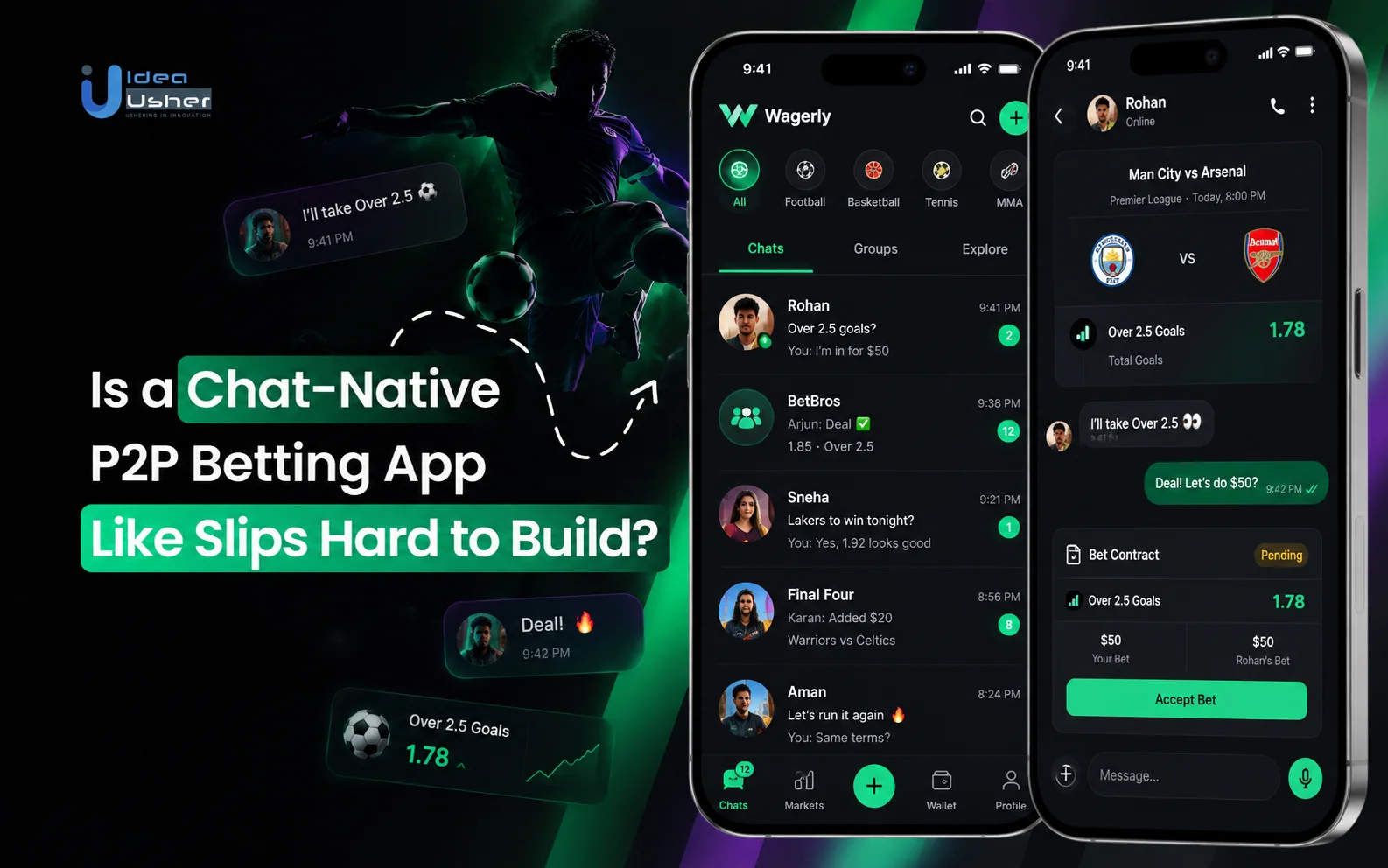
- A chat-native P2P betting app like Slips brings betting into private chat threads and group chats, so users can create, share and accept wagers without leaving the conversation.
- The main challenge of a chat-native P2P betting app is keeping chat, P2P matching and real-money transactions in sync. This gets harder when multiple users accept bets or lock funds at the same time.
- The MVP chat-native P2P betting app should focus on chat-to-bet creation, shareable bet cards, P2P matching, wallets, fund locking, live tracking and automated settlement before adding advanced features.
- Building it needs real-time chat, a matching engine, double-entry financial ledger, sports data, settlement systems and compliance controls working together, not as separate pieces.
- Development can cost around $100,000 to $2M+, depending on the delivery model, state coverage, chat and escrow systems, social features, AI and compliance requirements.
- AI can help with bet discovery, recommendations and conversational market creation, but fund movement and final settlement should stay with deterministic systems and verified sports data.
Yes, a chat-native P2P betting app like Slips is difficult to build because it must bring together live chat, direct wager matching, fund locking, sports data, transaction processing and automated settlement within one platform. Every component must stay synchronized, secure and reliable so conversations remain uninterrupted even when financial transactions occur. The app must also handle real-money live betting, fraud prevention, security and compliance at scale.
Traditional betting platforms keep chatting and betting apart, forcing people to jump from markets to bet slips to payment pages. A chat-native model brings these actions together, allowing users to discuss games, create wagers, challenge friends and manage bets within one conversation. This creates a more social experience while introducing tighter dependencies between messaging, betting, wallet and settlement infrastructure.
In this blog, we will cover the technical complexity, core features, architecture, integrations, security and development considerations for a chat-native P2P betting app like Slips, and how IdeaUsher can address these challenges through the right product architecture, development strategy and launch planning.
What Is a Chat-Native P2P Betting App Like Slips?
Slips is a messaging-first peer-to-peer (P2P) wagering application that embeds sports betting directly inside conversational interfaces. Instead of making users navigate standalone sportsbook menus and bet builders, Slips connects the chat thread directly with the wager.
By combining social messaging with financial settlement infrastructure, the platform turns sports conversations in direct messages or group chats into peer-matched contracts. The platform acts as a neutral technology layer, holding stakes in escrow and automating settlement without taking the opposing side.
A. How Does This App Work?
The platform shifts the point of transaction from an isolated sportsbook bet-slip to the communication channel where sports discussion already takes place.
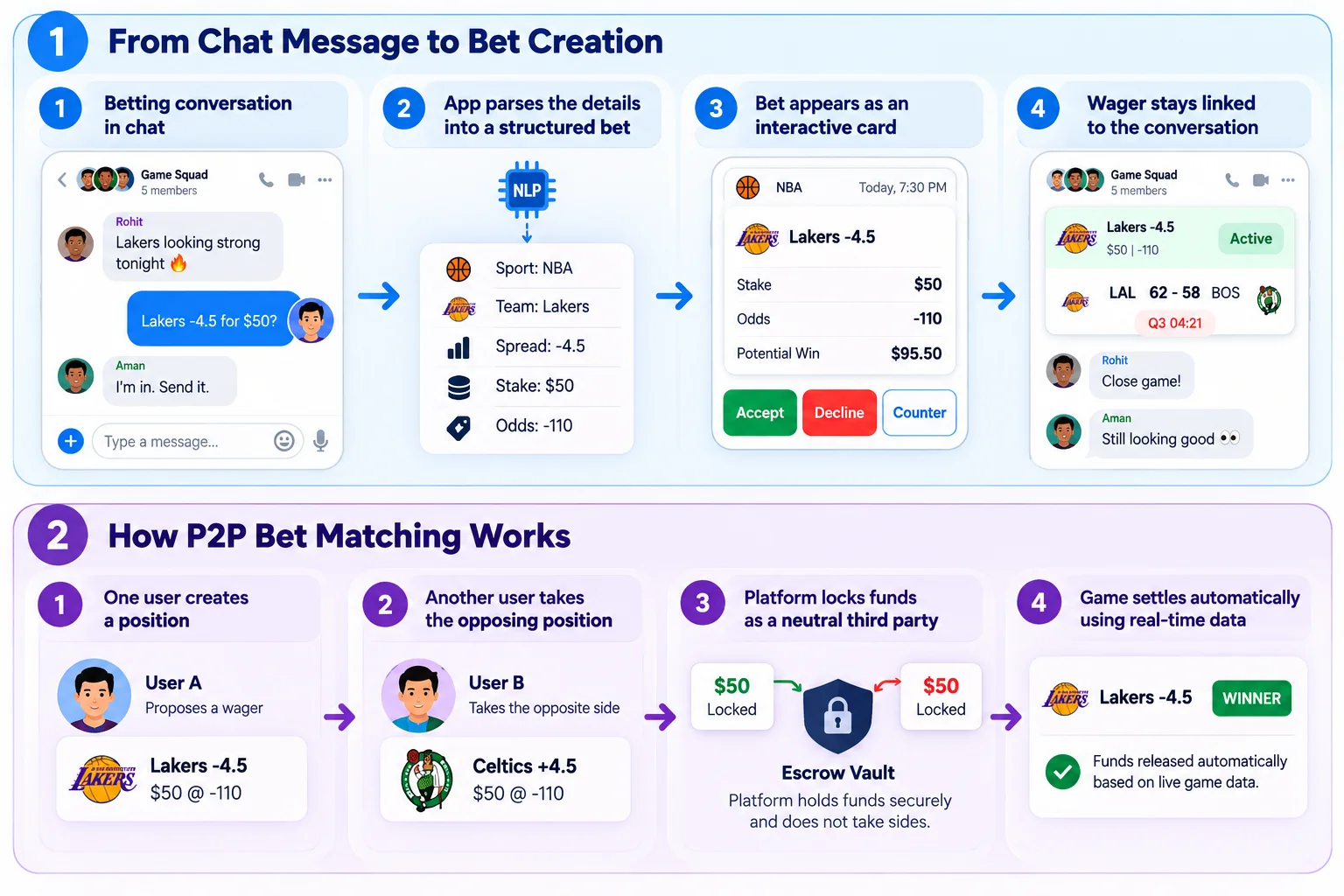
1. From Chat Message to Bet Creation
The app turns casual sports conversations into structured wagers by capturing betting intent, converting terms into a digital bet slip and keeping the wager connected to the ongoing conversation.
- User Starts or Receives a Betting Conversation: A wager can originate in a direct message or group chat such as a user proposing a custom bet around an upcoming game.
- Bet Parameters Are Created from Interaction: NLP or structured in-chat widgets can parse teams, spreads, player props, stakes and odds into a formalized bet contract.
- Users Can Send, Accept, or Decline a Wager: The wager appears as an interactive card within the chat, allowing recipients to accept, decline or counter the proposed terms.
- The Conversation Remains Connected to the Wager State: The active bet stays linked to the conversation and updates as the sporting event progresses.
2. How P2P Bet Matching Works
Once a wager is created, the platform connects opposing positions, verifies available funds, locks the required amounts and manages settlement without taking the other side.
- One User Creates a Position: A user proposes a position such as “Lakers -4.5 for $50.”
- Another User Takes the Opposing Position: A peer accepts the contract by taking the opposite position such as “Celtics +4.5 for $50.”
- Platform Facilitates the Transaction: Slips acts as a neutral third-party platform rather than a bookmaker, holding funds securely and using real-time sports data to support automated settlement.
- Matching & Liquidity as Core Infrastructure: Social connections and peer participation can provide liquidity, reducing reliance on traditional sportsbook-style market making.
B. What Happens After a Bet Is Accepted?
Once counterparties agree to the terms, the platform converts the wager into a structured transaction that moves through funding, escrow, live tracking, settlement and payout.
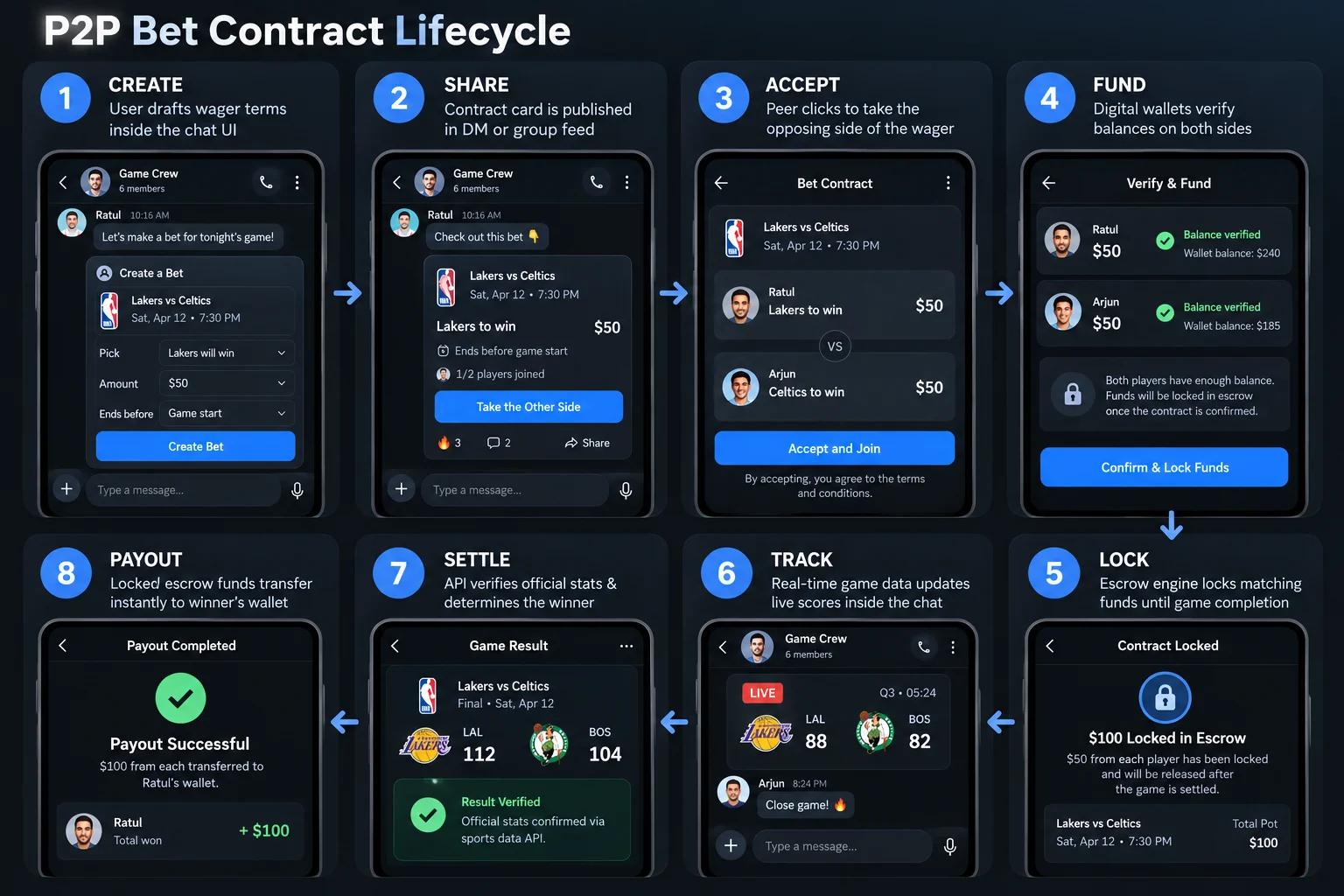
The wager moves through an automated eight-stage lifecycle that eliminates settlement disputes and defaults:
| Stage | Name | Description |
| 1 | Create | The user defines the event, market, line, odds, stake and settlement terms through in-chat prompts, validating the inputs and generating a structured bet proposal. |
| 2 | Share | The dynamic bet slip appears directly in the chat as an interactive card. showing proposed terms, potential payout, expiry and available actions. |
| 3 | Accept | Another participant reviews the proposed wager and accepts the exact terms or submits a counter-proposal with a different line, odds or stake. |
| 4 | Fund | The platform checks both participants’ wallet balances, account eligibility and applicable betting limits before allowing the wager to proceed. |
| 5 | Lock | The escrow engine reserves the required funds from both wallets and holds them until the event is resolved, reducing the risk of payment default. |
| 6 | Track | An embedded chat widget displays live scores, event updates, market movement and win probabilities, allowing participants to follow the wager within the conversation. |
| 7 | Settle | An approved sports data provider such as Sportradar or Opta, supplies the official event results. The platform applies predefined settlement rules to determine the winning position. |
| 8 | Payout | Once settlement is confirmed, the platform releases the locked funds to the winning participant’s wallet. Eligible users can then withdraw through supported methods such as ACH or debit card transfers. |
What Makes a Chat-Native P2P Betting App Hard to Build?
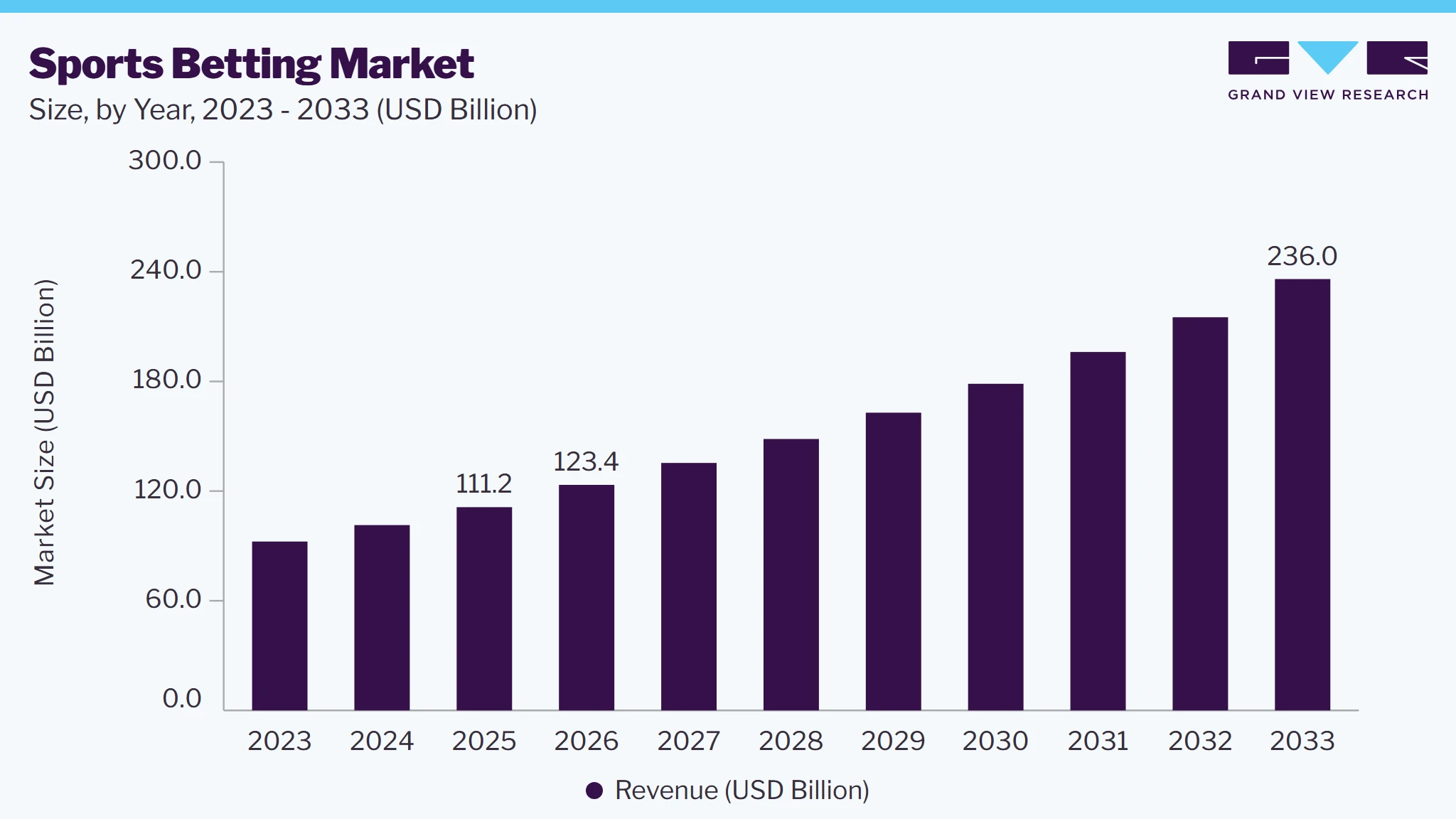
The global sports betting market, valued at $111.2 billion in 2025 and is projected to grow from $123.4 billion in 2026 to $236.0 billion by 2033, at a CAGR of 9.7% from 2026 to 2033, according to Grand View Research, with P2P betting marketplace emerging as one of its fastest-growing segments.
Building a chat-native peer-to-peer (P2P) betting application requires merging three historically isolated systems into a single interface: an event-driven messaging app, an exchange matching engine, and an ACID-compliant financial ledger.
In the U.S. sports betting ecosystem, where according to the American Gaming Association (AGA), the legally wagered over $121 billion in commercial sportsbooks in 2023, chat-native P2P platforms turn conversations into financial venues, creating architectural challenges around concurrency, liquidity, data synchronization and transactional integrity.
A. Chat and Betting Logic Must Stay Synchronized
The primary architectural challenge is reconciling an asynchronous chat stream with an immutable wager state machine.
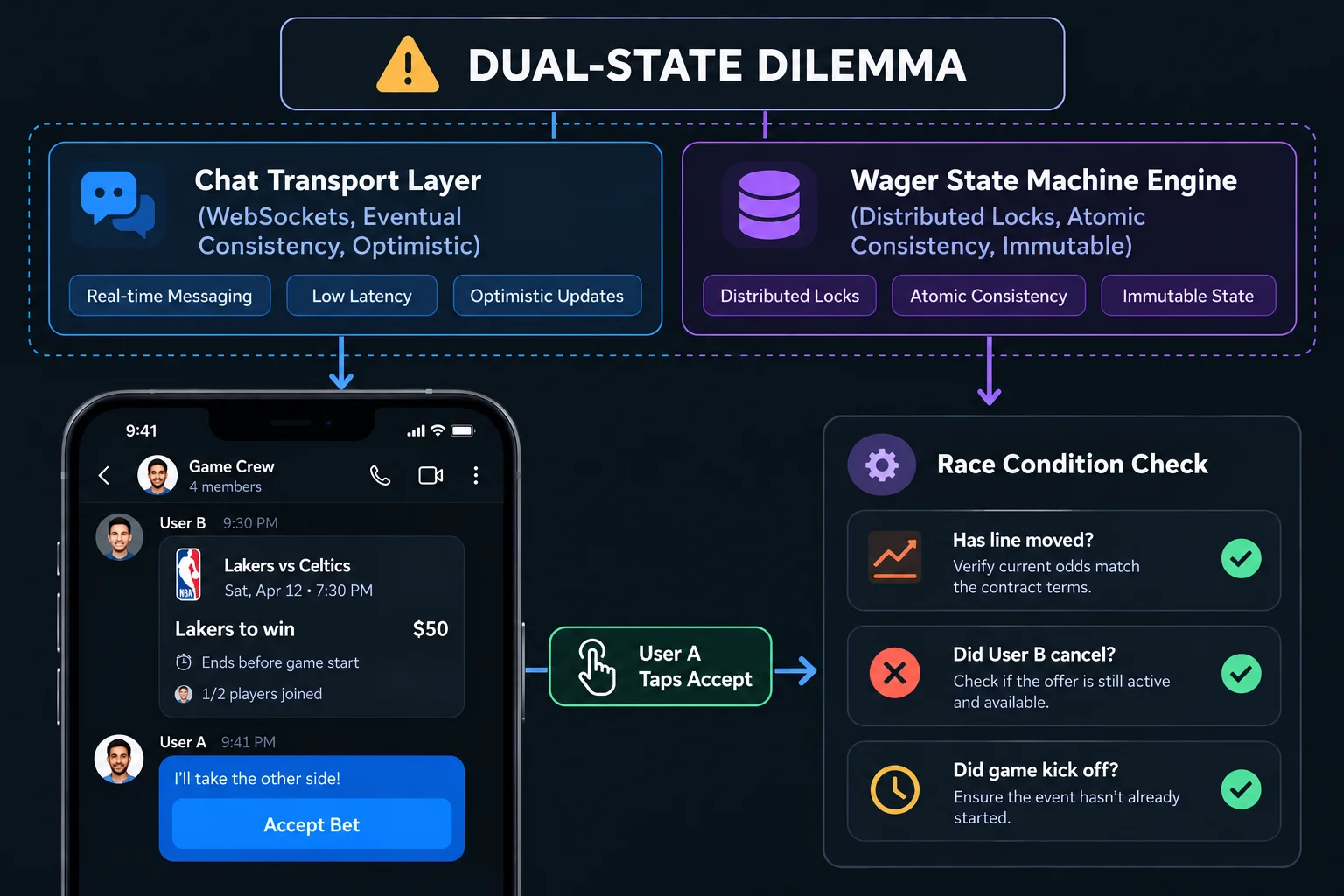
Messaging frameworks optimize for eventual consistency and low latency, whereas financial wagering demands immediate serializability and atomic state transitions:
- Message-Wager State Sync: Financial states such as Draft, Proposed, Matched, Escrowed and Settled require controlled transitions to prevent disputed payouts.
- Concurrent Offer Handling: Multiple users attempting to accept the same wager require concurrency controls and immediate updates to remaining bet cards.
- Live Offer Expiration: Open wagers need strict expiration rules tied to event timing and changing game conditions.
- Real-Time State Sync: WebSocket broadcasts should update active participants when offers are modified, accepted or cancelled.
B. P2P Matching Is More Complex Than Sportsbook Odds
Traditional sportsbooks publish fixed lines, while P2P marketplaces must find a suitable human counterparty for each position. This introduces additional matching and liquidity requirements.
- Custom Bet Risk: Bespoke spreads or moneylines require the matching engine to calculate compatible opposing positions and validate market eligibility.
- Partial Group Fills: Larger wagers may need to be divided across multiple participants while maintaining separate accounting under one wager.
- Liquidity Gap Routing: Unmatched positions can require broader marketplace mechanisms such as a Central Limit Order Book (CLOB) to improve liquidity without breaking the conversational wager flow.
C. Real-Money Transactions Raise the Technical Stakes
Operating a real-money application under U.S. federal and state regulatory scrutiny such as FinCEN Bank Secrecy Act (BSA) rules, Anti-Money Laundering (AML) mandates, and state gaming commissions leaves zero room for ledger errors. System bugs that would cause a missed text in standard chat apps cause regulatory fines or balance discrepancies here:
| Ledger Operation | Operational Risk | Architectural Requirement |
| Pre-Trade Balance Check | User places a wager without sufficient funds. | Sub-millisecond balance checks against in-memory stores before order entry. |
| Atomic Fund Locking | Concurrent bets cause double-spending. | Distributed transactions using Two-Phase Commit or Saga to lock funds in isolated escrow. |
| Immutable Double-Entry Ledger | Wallet and contract balances diverge during audits. | Strict double-entry accounting where every credit and debit nets to zero. |
| Stat Settlement & Payouts | Stat corrections, overturned plays or abandoned games cause incorrect payouts. | Official sports feeds, delayed settlement windows and automated clawback/re-grade state machines. |
| Transaction Rollbacks | A network failure deducts funds without successfully locking the wager. | Idempotent transaction queues with automated rollbacks to restore the original wallet state. |
The core engineering challenge is that the chat card becomes a live financial terminal, requiring the speed of real-time messaging to coexist with the transactional guarantees expected from financial infrastructure.
Which Systems Power a Chat-Native P2P Betting App?
A chat-native P2P betting app like Slips requires multiple interconnected systems working in real time. The chat interface is only the user-facing layer. Behind it, the platform needs betting, matching, financial, sports-data, social and AI infrastructure to move a wager from conversation to settlement.
| Core System | What It Handles | Key Components |
| Real-Time Chat System | Connects conversations directly with betting actions | One-to-one chats, group chats, bet cards, real-time messages, notifications |
| P2P Betting Engine | Creates and manages player-versus-player wagers | Bet creation, open positions, wager acceptance, wager states, liquidity |
| Matching Engine | Connects users taking opposing positions | Bet discovery, matching logic, availability checks, match confirmation |
| Wallet & Ledger System | Controls balances and records every financial movement | Balance verification, fund locking, transaction records, payouts, reconciliation |
| Sports Data & Settlement Engine | Tracks events and determines when bets can be settled | Live event feeds, market data, result verification, settlement rules, disputes |
| Social Betting Layer | Adds community interaction around betting activity | Feeds, friends, groups, leaderboards, pools, competitions |
| AI Prediction Layer | Supports prediction discovery and personalized engagement | AI-generated predictions, bet discovery, recommendations, conversational assistance |
| Compliance & Risk Layer | Controls who can participate and how transactions are monitored | KYC, age verification, geolocation, responsible-play controls, fraud monitoring |
The complexity comes from connecting these systems rather than building them in isolation. A single bet acceptance can require eligibility verification, balance checks, fund locking, wager-state updates, notifications and transaction recording within one coordinated workflow.
What Features To Include in Chat-Native P2P Betting App Like Slips?
A chat-native P2P betting app should not attempt to replicate every capability of established platforms at launch. A stronger approach is to build an MVP around features that make the chat-to-bet experience distinctive, establish trust in P2P transactions and create a foundation for future expansion.
The roadmap can be divided into MVP capabilities that validate the core product and advanced features that expand the platform as participation and liquidity grow.
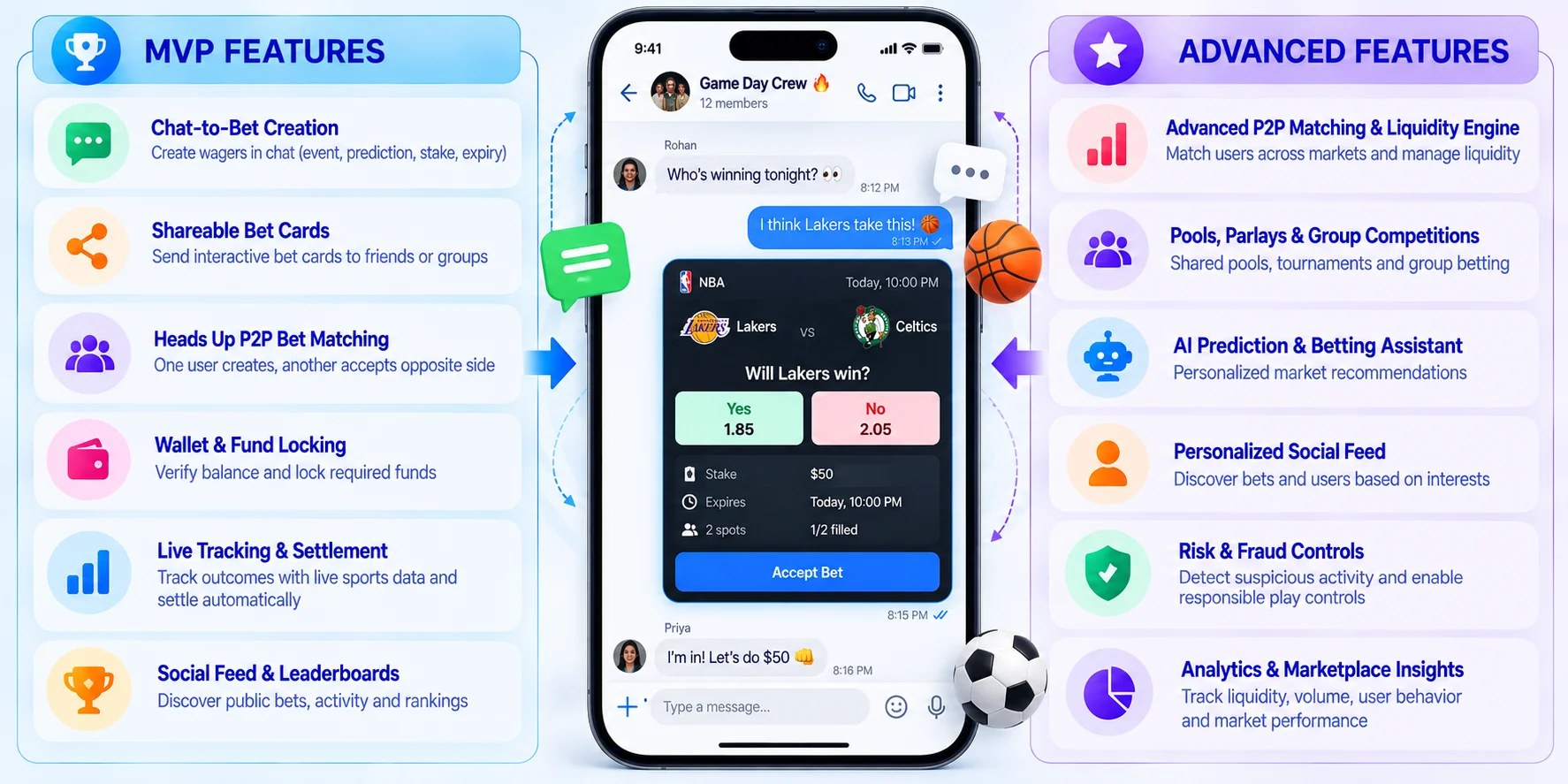
A. MVP Features for a Chat-Native P2P Betting App
The MVP chat-native P2P betting app should focus on features that support the core betting lifecycle, from creating a wager in chat to matching, fund locking, live tracking and settlement, while keeping the initial product manageable and scalable.
| Feature | What It Does | Why It Matters |
| Chat-to-Bet Creation | Lets users create wagers inside conversations by defining the event, prediction, stake, terms and expiry. | Connects social interaction with betting and removes conventional sportsbook navigation. |
| Shareable Bet Cards | Converts wagers into interactive cards that users can send to friends, groups or public feeds. | Makes peer challenges easier and creates a built-in distribution loop. |
| Heads Up P2P Bet Matching | Lets one user create a position while another accepts the opposing side and required stake. | Establishes the platform’s core peer-to-peer betting mechanic. |
| Wallet & Fund Locking | Verifies available balances and locks required funds when a wager is accepted. | Creates the financial foundation for reliable transactions and higher betting volumes. |
| Live Tracking & Settlement | Connects wagers to sports data, tracks outcomes and settles completed bets using predefined rules. | Reduces manual settlement and supports expansion across sports and markets. |
| Social Feed & Leaderboards | Helps users discover public bets, activity and performance while competing through rankings. | Adds social discovery and repeat engagement beyond private wagers. |
The MVP should focus on proving the complete conversation → wager → acceptance → fund locking → event outcome → settlement lifecycle rather than matching every feature of established platforms.
These capabilities can later expand into richer conversational betting, deeper P2P liquidity, larger communities and personalized discovery.
B. Advanced Features for a Scalable P2P Betting Platform
Once the core betting loop has demonstrated user demand and the platform has sufficient participation, advanced capabilities can expand liquidity, personalization, monetization and operational control.
| Feature | What It Does | Why It Matters |
| Advanced P2P Matching & Liquidity Engine | Matches opposing positions across public markets while managing liquidity and wager states. | Supports higher volumes and improves fill rates and market efficiency. |
| Pools, Parlays & Group Competitions | Enables shared pools, tournaments and group betting beyond individual wagers. | Expands participation and increases community engagement. |
| AI Prediction & Betting Assistant | Recommends markets and organizes prediction opportunities through conversational interactions. | Improves personalization and market discovery. |
| Personalized Social Feed | Uses relationships, betting behavior and engagement to personalize feeds, groups and recommendations. | Makes markets and users easier to discover. |
| Risk & Fraud Controls | Monitors transactions, detects suspicious activity and applies betting and responsible-play controls. | Strengthens protection as users, volume and regulatory exposure grow. |
| Analytics & Marketplace Insights | Tracks liquidity, wager volume, retention, user behavior and market performance. | Helps operators optimize liquidity, performance and marketplace decisions. |
Enterprise development should extend the MVP architecture rather than replace it. The initial wallet, wager and event-processing systems should therefore be designed around secure fund locking, clear wager states and event-driven workflows.
This approach allows the platform to scale its capabilities as its user base, betting volume and market complexity grow, rather than spending heavily on enterprise infrastructure before there is sufficient demand to justify it.
How Do You Build a Chat-Native P2P Betting App like Slips?
Building a chat-native P2P betting app requires more than connecting a messaging interface to a betting engine. The platform needs to make conversation, wager creation, matching, funding, sports-data processing, and settlement work as one connected workflow.
The development process should begin by defining the chat-to-bet journey, then build the real-time communication layer, P2P wager engine, financial infrastructure, sports-data integrations, and social capabilities around that core workflow.
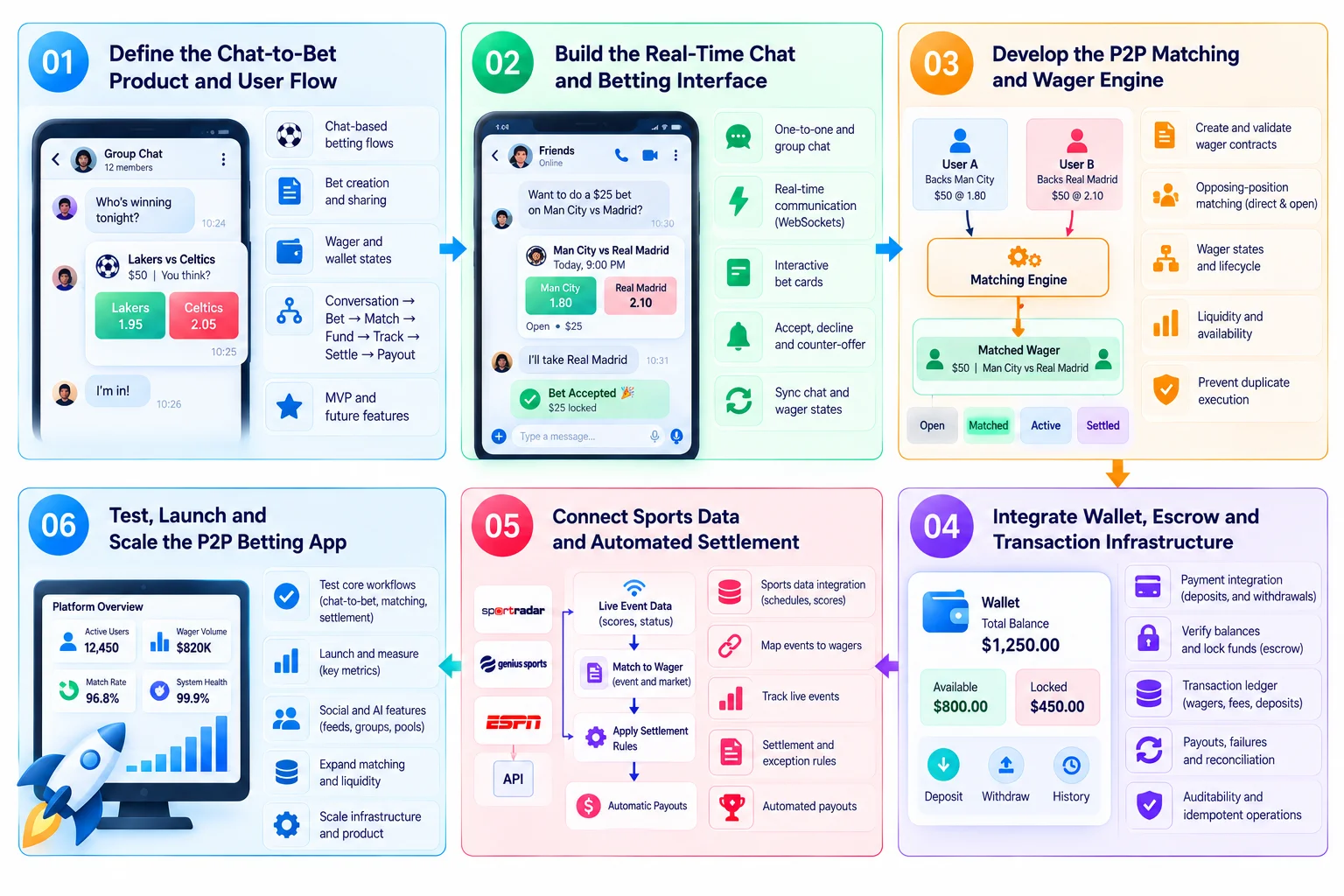
1. Define the Chat-to-Bet Product and User Flow
Start by translating the product concept into a complete user journey. Unlike a conventional sportsbook, a chat-native product needs to define how a wager originates inside a conversation and moves through matching and settlement.
- Map Chat-Based Betting Flows: Define how users create, discuss, share and manage wagers across one-to-one and group conversations.
- Design Bet Creation & Sharing: Determine how users select events, configure terms, set stakes and publish Heads Up and open P2P wagers.
- Define Wager & Wallet States: Establish states such as draft, published, accepted, funded, active, cancelled, expired, won, lost and settled while mapping balances, locked funds, payouts and withdrawals.
- Map the Complete Bet Lifecycle: Structure the core flow as Conversation → Bet → Match → Fund → Track → Settle → Payout.
- Separate MVP & Future Features: Prioritize the capabilities needed to validate the core experience before expanding into advanced social, marketplace and liquidity features.
The wager lifecycle should remain consistent across the chat interface, backend services, wallet system and matching engine so a wager cannot appear accepted in the conversation while remaining unmatched or unfunded underneath.
2. Build the Real-Time Chat and Betting Interface
The conversational layer should allow users to create and manage wagers without leaving the primary chat experience. This requires messaging functionality and betting interactions to operate as coordinated real-time systems.
- Build Chat Infrastructure: Support one-to-one and group conversations, participant management, message history and conversation controls.
- Implement Real-Time Communication: Use WebSockets to deliver messages, wager updates, acceptance events and other time-sensitive changes.
- Create Interactive Bet Cards: Display event details, wager terms, stake, opposing position, status and available actions directly within conversations.
- Enable Wager Actions & Notifications: Support accept, decline and counter-offer actions while notifying users about offer changes and relevant event updates.
- Synchronize Chat & Wager States: Keep messaging and betting systems consistent across accepted, matched, funded, cancelled and settled states.
Wager cards should function as transactional objects rather than ordinary messages, with each action validated by the backend before the updated state is reflected to other participants.
3. Develop the P2P Matching and Wager Engine
The P2P wager engine turns conversations into enforceable betting transactions by creating contracts, validating terms, identifying opposing positions and managing wager lifecycles.
- Create & Validate Wager Contracts: Store events, outcomes, stakes, odds, participants, expiry and settlement conditions while validating terms before execution.
- Build Opposing-Position Matching: Support direct challenges, open wagers and marketplace orders according to defined platform rules.
- Manage Wager States & Lifecycle: Track open, matched, cancelled and expired wagers while enforcing valid state transitions.
- Manage Liquidity & Availability: Track open positions, available liquidity and opposing interest so users can identify eligible opportunities.
- Prevent Duplicate Execution: Use atomic operations, concurrency controls and idempotent processing to prevent multiple users from accepting the same wager.
The matching engine should maintain a consistent relationship between wager state, user position, available liquidity and financial commitment, treating each successful match as a transactional event rather than only a UI interaction.
4. Integrate Wallet, Escrow and Transaction Infrastructure
The financial layer must remain synchronized with wager states. When a user accepts or creates a real-money wager, the platform needs to verify funds, reserve the appropriate amount and record every financial movement.
- Integrate Deposits & Withdrawals: Connect supported payment infrastructure for account funding and withdrawals.
- Verify Balances & Lock Funds: Check balances before acceptance and use escrow or fund locking to reserve committed amounts.
- Build the Transaction Ledger: Implement a double-entry ledger covering wagers, fees, deposits, withdrawals, settlements and account adjustments.
- Handle Payouts, Failures & Reconciliation: Process winnings, recover from payment failures and retries, and reconcile internal records with external payment or custody systems.
- Maintain Financial Auditability: Record transaction events, actors and state changes while keeping critical wallet operations atomic and idempotent.
This becomes especially important when a single chat action triggers multiple backend operations, such as accepting a wager, locking funds and updating its state.
5. Connect Sports Data and Automated Settlement
The sports-data layer provides the external event information required to monitor wagers and determine outcomes. Settlement should rely on predefined rules and authoritative event data rather than subjective interpretation.
- Integrate Sports Data APIs: Connect reliable providers for schedules, teams, competitions, scores and event status.
- Map Events to Wagers: Link each wager to its specific sporting event, market and outcome identifier.
- Track Live Events: Process scores, status changes, postponements, suspensions and other relevant updates.
- Apply Settlement & Exception Rules: Determine winning, losing or void outcomes while handling cancelled events and corrected results.
- Trigger Automated Payouts: Initiate settlement and payout workflows once the outcome meets the platform’s resolution criteria.
The platform should maintain an explicit relationship between wager → event → settlement rule → authoritative result, providing traceability when wagers are resolved or disputed.
6. Test, Launch & Scale the P2P Betting App
Once the core chat, P2P and financial infrastructure is stable, test the essential workflows, launch the focused MVP and use real user activity to guide future social, AI and marketplace development.
- Test Core MVP Workflows: Validate chat-to-bet, wager creation, matching, fund locking, settlement, payouts, notifications and wallet operations through functional, security, performance and end-to-end testing.
- Launch & Measure the MVP: Release the core experience and track user activity, wager volume, match rates, liquidity, retention and feature usage.
- Build Social & AI Features: Add feeds, profiles, groups, pools, competitions, leaderboards and AI-assisted discovery based on user behavior while keeping execution and settlement deterministic.
- Expand Matching & Liquidity: Progress from direct P2P challenges toward broader marketplace functionality and deeper liquidity as participation increases.
- Scale Infrastructure & Product: Expand database, real-time communication, event-processing and backend capacity alongside personalized discovery, social experiences, AI capabilities and advanced marketplace features.
The goal is to launch a focused MVP, learn from real usage and scale deliberately, allowing the product to evolve with its P2P community and transaction volume.
How Much Chat-Native P2P Betting App Like Slips Development Cost?
A chat-native P2P betting app like Slips development can cost approximately $100,000 to $2M+ to develop, depending on its delivery model, state coverage, chat infrastructure, matching and escrow systems, social features, AI capabilities, payment integrations and regulatory requirements. Development timelines can range from 1 to 24 months based on platform complexity.
A. Chat-Native P2P Betting App by Delivery Model
The chat-native P2P betting app development cost varies by delivery model, with white-label platforms offering faster deployment while custom builds require greater investment. The following comparison shows how cost, timeline and ownership can differ.
| Delivery Model | Estimated Cost | Timeline | What You Get |
| White-label / turnkey P2P wagering platform | $100,000 – $500,000 entry cost, plus a revenue share | 1 to 4 months | Peer matching, payments, and a compliance framework supplied by the provider under your brand |
| Custom-built MVP (chat-native, single state or small group of states) | $200,000 – $500,000 | 6 to 12 months | Your own peer matching and escrow engine, chat-native bet creation, and core social features |
| Full custom, multi-state platform with AI-generated markets | $600,000 – $2M+ | 12 to 24 months | Broad state coverage, AI-driven market generation, full social layer, and complete platform ownership |
Note: These are estimated development ranges, not fixed vendor quotes. Actual costs vary based on licensing requirements, state coverage, third-party integrations, data providers, payment infrastructure, security controls, feature complexity and the amount of technology built from scratch.
B. What Slips-like Specific Features Actually Cost to Build
Individual Slips-like features can add significantly to development costs depending on their technical and regulatory complexity. Chat-native betting, peer matching, social functionality, AI markets and lottery integrations each require different infrastructure and compliance considerations
| Feature | What It Does | Estimated Cost |
| Chat-native bet creation | Lets users create and send a bet conversationally from within a chat thread, rather than through a separate betting form | $30,000 – $90,000 |
| Peer matching and escrow engine | Matches counterparties for head-to-head bets and pools, and holds funds until an outcome settles | $50,000 – $150,000 |
| Social feed, leaderboards, and gamification | Tracks and displays stats, wins, and activity across a user’s network to drive engagement | $20,000 – $60,000 |
| Geolocation and IRL group features | Supports location-based groups for bars, stadiums, and in-person events, tied to state-by-state legal eligibility | $25,000 – $70,000 |
| AI-generated prediction markets | Automatically creates, prices, and resolves user-vs-user markets across trending topics | $60,000 – $180,000 |
| Digital lottery ticket integration | Purchases official lottery tickets through licensed retailers and manages secure digital custody of the physical ticket | $40,000 – $120,000, plus a direct retailer/custody partnership most platforms won’t need at all |
Note: The lottery ticket feature is the clearest example of how one product decision can add real regulatory scope. Digital custody of a physical lottery ticket is a meaningfully different compliance problem than peer-to-peer sports wagering, and it’s the reason Slips currently limits that specific feature to four states (California, Delaware, Florida, and Pennsylvania) while sports betting runs much more broadly.
C. Why the Regulatory Model Changes the Cost Structure
The regulatory model directly affects development cost because real-money P2P wagering requires jurisdiction-specific compliance, payments, geolocation and operational controls. Broader state coverage increases licensing work, integration requirements and the infrastructure needed to support compliant market expansion.
- Because this is state gambling law, not federal CFTC oversight, licensing has to be pursued state by state, which is why Slips itself is unavailable in eight states (Hawaii, Idaho, Kansas, Maryland, Montana, Nevada, South Dakota, and Washington) despite operating nationally otherwise.
- State-by-state licensing is typically slower and more fragmented than the single CFTC registration path a ProphetX-style exchange follows, which affects both cost and how quickly a new market can be added.
- A real-money peer-to-peer wagering app at this scale (Slips reports 150,000+ users and $6M+ in reported winnings as of 2026) needs production-grade payment infrastructure from day one, not a feature added later.
What Technology Stack Powers P2P Betting App Like Slips?
A Slips-like platform needs a technology stack capable of handling real-time conversations, concurrent P2P wagers, financial transactions, sports-event updates and scalable event processing. The exact stack can vary based on the product scope, but the following technologies cover the most critical layers.
| Core Technology Layer | Recommended Technologies | What It Powers |
| Application & Data Layer | React Native / Flutter + Node.js / NestJS + PostgreSQL | Connects the mobile experience with betting logic, user data, wagers, wallet records and settlement data. |
| Real-Time Communication | WebSockets / Socket.IO | Keeps conversations, bet cards, wager states, notifications and live updates synchronized across users and devices. |
| P2P Matching & State Management | Redis + custom matching services | Supports low-latency wager discovery, availability checks, concurrent acceptance, temporary state and distributed locking. |
| Event-Driven Infrastructure | Kafka / RabbitMQ | Processes wager events, fund-locking workflows, settlement events, notifications and other asynchronous operations without tightly coupling services. |
| Financial Infrastructure | Double-entry ledger + payment/wallet APIs | Manages fund locking, wallet balances, payouts, transaction records and financial reconciliation. |
| Sports Data & Settlement | Real-time sports data APIs + settlement services | Supplies event status, scores and verified results that trigger deterministic wager settlement. |
| AI & Prediction Layer | LLM APIs + prediction services | Supports AI-assisted prediction discovery, personalized recommendations and conversational betting experiences. |
Why These Technologies Matter
The technology stack should support the platform’s critical workloads, not follow technology trends. PostgreSQL handles structured wager and financial data, Redis supports low-latency operations, WebSockets synchronize chat and betting states, while Kafka or RabbitMQ manages high-volume asynchronous events.
For example, accepting a wager can trigger backend validation, fast state or fund-locking operations through Redis, transaction recording in PostgreSQL and event distribution for settlement or notifications.
This architecture supports the MVP while providing room to scale across users, markets and advanced P2P functionality.
How Can AI Improve a Chat-Native P2P Betting App?
AI can improve a chat-native P2P betting app by helping users discover relevant markets, summarize live events, interpret betting conversations and personalize recommendations. It can also automate routine support and detect unusual activity. However, wager execution, fund movement and settlement should remain controlled by deterministic rules and validated transaction systems.
A. AI-Generated Betting Predictions
AI can help users discover betting opportunities by analyzing real-time sports data, conversational context and historical trends. Instead of promising guaranteed returns, predictive models should provide relevant context and simplify the process of creating actionable propositions.
- Real-Time Stats to Tradable Props: AI models analyze live game feeds and advanced metrics to generate contextual betting suggestions, such as identifying red-zone trends that could support an Under prop.
- Conversational Market Creation: Intent-detection models can interpret betting discussions in chat and convert colloquial phrases into structured market parameters, allowing users to create valid propositions with minimal input.
- In-Game Angle Discovery: Algorithms can analyze head-to-head data, player rest, recent performance and weather changes to surface relevant micro-markets when specific trends emerge during live events.
B. AI-Assisted Bet Discovery
A central bottleneck in P2P wagering is the two-sided cold-start problem: open limit orders sit unmatched if counterparties never see them. Machine learning optimizes discovery by treating resting orders as personalized feed content:
- Matching Orders With Likely Counterparties: Recommendation engines analyze betting patterns, preferred leagues and risk preferences to surface open wagers to users who may be interested in taking the opposing position.
- Personalized Feeds Around Live Liquidity: Collaborative filtering can prioritize liquid peer bets, active discussions and trending team propositions, helping users discover relevant markets instead of browsing static or unrelated betting lines.
- Activating Relevant Social Circles: Graph-based models can identify shared teams, leagues and betting interests across friend networks, then surface relevant head-to-head challenges when engagement around an event increases.
- Finding Cross-Market Opportunities: AI can compare private chat proposals with public order books to identify pricing or liquidity gaps, helping active traders discover potential hedging and market-making opportunities.
C. Keep AI Separate From Final Settlement
AI can support discovery, matchmaking and user interaction, but it should not control final wager settlement.
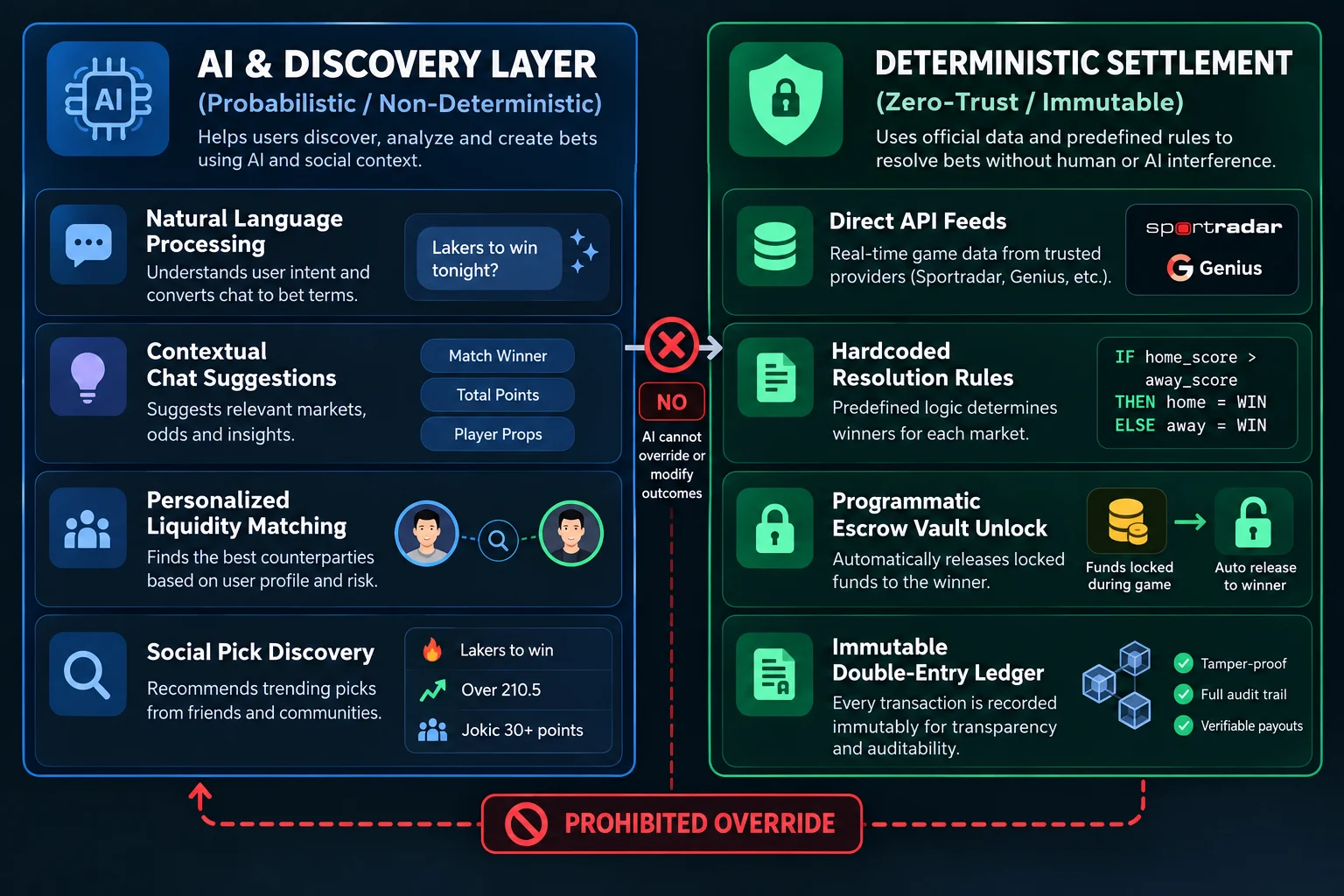
The settlement layer should remain deterministic, rule-based and isolated from generative models to ensure payouts follow verified event results and predefined financial rules.
- Eliminate AI Settlement Risk: LLMs and predictive models can produce variable outputs, making them unsuitable for interpreting final scores or determining payouts. Settlement should rely on fixed rules and validated event data.
- Use Authoritative Sports Feeds: Final settlement should use verified sports data from providers such as Sportradar or Genius Sports, with event results passed into a deterministic settlement engine.
- Maintain Double-Entry Accounting: Once an official result is confirmed, automated state machines can release escrowed funds to winning wallets while recording each transaction in the financial ledger.
- Keep AI in Pre-Trade Workflows: AI can support bet discovery, matchmaking and market recommendations, while deterministic financial systems handle fund locking, settlement and payouts.
How Can IdeaUsher Help Build a Slips-Like App?
IdeaUsher operates as an enterprise product engineering partner, backed by 11+ years of software expertise, 250+ specialized technologists and a 4.9/5 Clutch rating across 1,000+ delivered builds. We engineer custom, social peer-to-peer (P2P) betting platforms, combining real-time conversational UX with high-performance wagering engines.
A. Build the Chat and P2P Betting Architecture
We build the core chat and P2P architecture around real-time communication, deterministic wager lifecycles, secure fund management and scalable matching systems that support reliable peer-to-peer betting experiences.
- Real-Time Messaging Fabric: Deploy low-latency WebSocket and XMPP pipelines supporting thread-level chat, inline bet challenges, and live banter.
- Deterministic Bet Lifecycles: Engineer automated state machines governing wager creation, counter-offers, escrow locks, outcome resolution, and instant payouts.
- P2P Matching Engine: Implement in-memory matching logic for heads-up duels, custom odds, and syndicated betting pools.
- Secure Ledger & Multi-Wallet Integration: Architect double-entry ledgers supporting multi-currency fiat accounts, digital wallets, and automated dispute holds.
B. Integrate Sports, Payment and AI Services
Our developers integrate sports data, payment, compliance and AI services into the platform, creating connected infrastructure for real-time event updates, secure transactions, identity verification and personalized betting experiences.
- Live Sports Feeds: Integrate Sportradar, Opta, or Genius Sports APIs for real-time odds, live score updates, and automated match settlement.
- Payment Infrastructure: Connect PCI-DSS-compliant gateways (Stripe, Plaid, ACH, Apple Pay) for frictionless cash-in and instant withdrawals.
- Compliance Service Integrations: Embed GeoComply for automated geolocation fencing and Sumsub/Jumio for multi-tier KYC/AML identity verification.
- AI Copilots & Market Generators: Integrate LLM APIs to generate dynamic pop-culture prediction prompts, automated wager summaries, and personalized betting insights.
C. Develop the Social Betting Layer
We develop social betting features that connect conversations, communities and wagering activity through real-time feeds, private groups, competitive profiles, leaderboards and shared pools for stronger engagement.
- Community Activity Feeds: Stream friend wagers, bet slips, public challenges, and win celebrations in real time.
- Private Squads & Public Groups: Allow users to build closed betting circles with shared bankrolls, custom rules, and private leaderboards.
- Competitive Leaderboards & Profiles: Track ROI, win streaks, and public betting stats across customizable user profiles.
- Syndicated Pools & Tourlays: Build tournament-style parlay pools where multiple users contribute stakes toward collective payouts.
D. Scale From MVP to Full Betting Marketplace
We prioritize high-engagement social features and P2P wagering for your initial MVP, transitioning into an elastic, microservices-based Kubernetes architecture designed to absorb high-concurrency traffic during major sporting events. You receive 100% clean, documented source code with zero vendor lock-in.
Planning to build a social P2P betting app? Connect with Idea Usher’s software architects to define your platform architecture, matching logic, and technical MVP roadmap.
Conclusion
A chat-native P2P betting app like Slips requires more than a conversational interface and betting features. Real-time messaging, P2P matching, financial infrastructure, sports data, compliance and scalable architecture must work together reliably. A focused MVP can validate the core chat-to-bet experience before advanced social, AI and marketplace capabilities are introduced. With the right technical architecture and development strategy, the platform can evolve from an initial P2P betting product into a broader, scalable social betting marketplace.
FAQs
A.1. Chat-driven P2P betting matching connects users taking opposing positions through conversational betting flows, while the platform manages wager terms, liquidity, fund locking, and settlement.
A.2. Core features of chat-native P2P betting app like Slips include chat-to-bet creation, shareable bet cards, P2P matching, wallet and fund locking, live tracking, settlement, social feeds, and leaderboards for engagement.
A.3. A chat-native P2P betting app like Slips can cost from $100,000 to $2 million or more, depending on features, integrations, compliance requirements, scalability, and development scope.
A.4. A scalable P2P betting app typically requires real-time communication, matching services, event-driven infrastructure, financial ledgers, sports data APIs, settlement systems, databases, and AI services.