


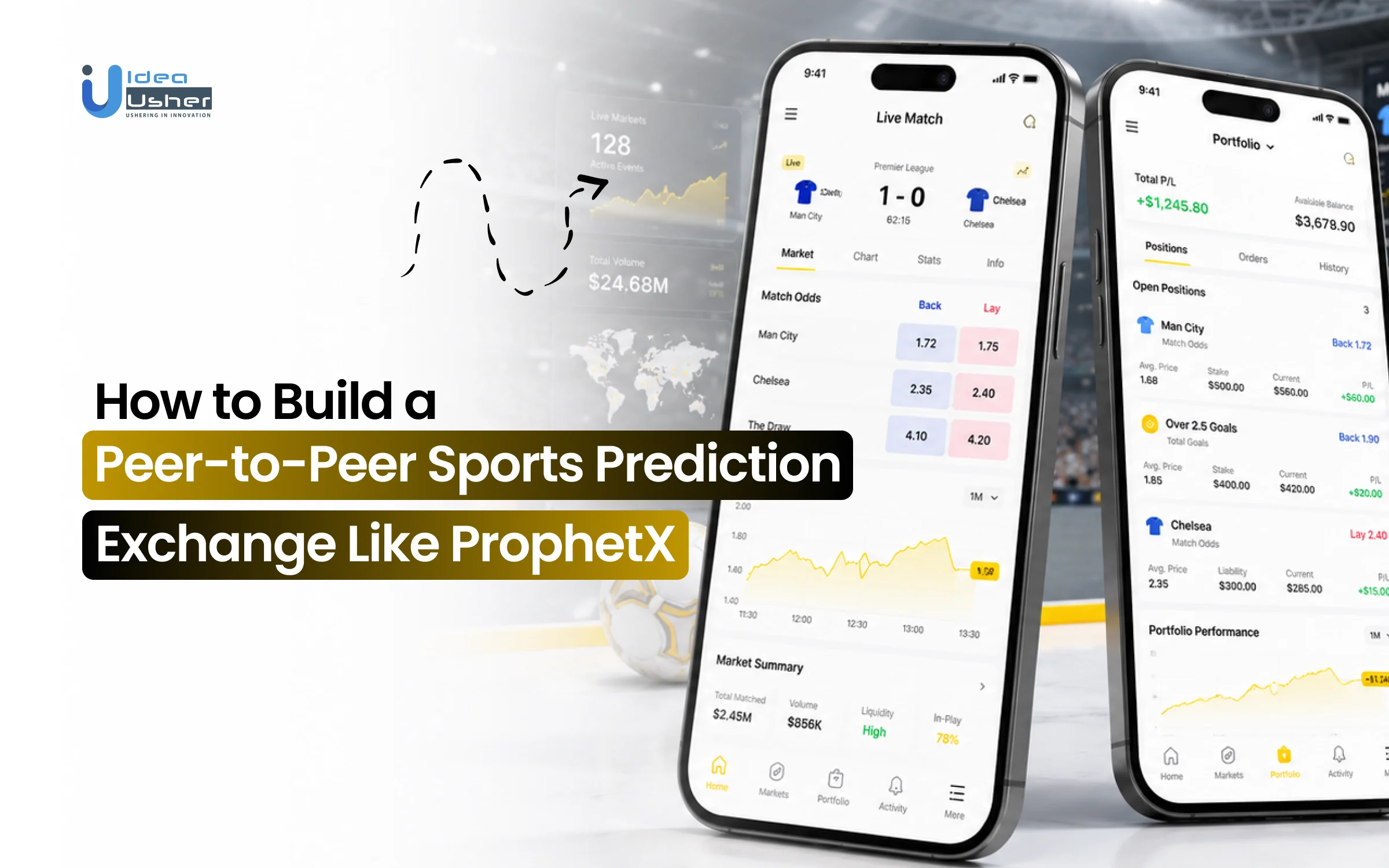
Key Takeaways
- A P2P sports prediction exchange lets users trade against each other instead of betting against a bookmaker.
- Users place buy or sell orders, get matched through an order book, lock funds in escrow and receive payouts after results are verified.
- To build one, define the market rules first, then develop the matching engine, trading interface, wallets, sports data feeds and settlement system.
- Core features include market discovery, live prices, order matching, portfolio tracking, transaction history, risk controls and admin tools.
- The main challenges are keeping trades fast during big games, handling live-data delays, preventing balance errors and meeting legal requirements.
- A custom MVP may cost $150,000–$500,000, while enterprise builds can exceed $1 million; revenue may come from trading commissions and other models that fit the platform’s legal structure.
A peer-to-peer sports prediction exchange app operates as a marketplace where users take opposing positions on sports outcomes, match with other participants and trade through transparent pricing and reliable settlement. ProphetX-like sports prediction exchange development brings these components together in a platform built around liquidity, real-time market activity and user trust. The enterprises who want to build P2P sports exchanges should focus on how to turn this model into a scalable, reliable product.
Traditional sportsbooks relied on operator-controlled pricing, built-in margins, and one-sided risk management. This makes market design, order book matching, peer-to-peer sports trading, risk controls and regulatory requirements that help user to actively manage positions within a transparent, market-driven ecosystem.
In this blog, we’ll explore how to build a peer-to-peer sports prediction exchange like ProphetX, covering its core features, exchange architecture, development cost and how IdeaUsher can help build P2P sports prediction exchange app where liquidity and efficient price discovery drive competitive advantage.
What Is Peer-to-Peer Sports Prediction Exchange?
A peer-to-peer (P2P) sports prediction exchange is a bilateral trading platform where users wager directly against each other by buying and selling contracts on sports outcomes, completely eliminating the traditional bookmaker.
Unlike fixed-odds sportsbooks that extract a vig (margin), exchanges utilize a Central Limit Order Book (CLOB) to match bids and asks, monetizing solely through a small transaction commission (typically 1–3%) or a sweepstakes virtual currency model.
How Does a Peer-to-Peer Sports Prediction Exchange Work?
A peer-to-peer (P2P) sports prediction exchange connects participants who hold opposing views on a sports outcome, eliminating the traditional bookmaker. Instead of taking on house risk, the platform operates a central matching engine that pairs compatible buy and sell orders, holds funds in escrow, and settles contracts automatically using verified sports results.
A. The 5-Stage Exchange Lifecycle
The exchange lifecycle moves a prediction contract from market selection to final settlement through five coordinated stages: order placement, matching, escrow, position management, and verified payout for each matched trade.
1. Select a Sports Market: A user selects an event and an outcome market such as full-time match winner, total points spread, or live in-game props.
2. Place or Accept an Order: Users can either accept existing odds from the public order book (market taker) or place a limit order proposing their own preferred price and stake (market maker).
3. Order Matching & Escrow: The platform’s matching engine pairs compatible buy and sell orders using Price-Time Priority (FIFO). Orders can be fully matched, partially filled, or left open in the Central Limit Order Book (CLOB) until a counterparty steps in. Once matched, the engine locks both participants’ stakes securely in escrow.
4. Active Position Management: Traders can hold contracts through final whistle or “cash out” early by selling their position back to the order book to lock in gains or mitigate losses as live odds shift.
5. Market Settlement: As soon as official league feeds verify the final result, the platform executes automated settlements, crediting net payouts to winning accounts while unfreezing any remaining unmatched orders.
The order book is central to this process, displaying available buy and sell orders at different prices, helping participants understand the market’s trading interest. The matching engine processes those orders according to the exchange’s execution rules.
B. Example: The Math of a Binary Contract Execution
Binary contracts simplify prediction trading by assigning each outcome a price that reflects its implied probability and determines potential payout.

Many prediction marketplaces structure trades as binary outcome contracts priced between $0.00 and $1.00:
- The Bid & Ask: A buyer bids $0.60 per contract on a “YES” outcome (reflecting a 60% implied probability). A seller accepts a limit price of $0.60 to take the opposing side.
- The Execution: The matching engine executes the order and reserves the total $1.00 contract value in escrow ($0.60 from the buyer and $0.40 collateral from the seller).
- The Resolution: Resolution determines final contract value by comparing the verified sports result with the traded outcome, triggering the corresponding payout automatically.
- If the outcome resolves YES, the winning contract pays out $1.00 gross (yielding the buyer a +$0.40 net gain).
- If the outcome does not resolve, the contract pays $0.00, and the full $1.00 escrow pool settles to the seller (yielding a +$0.60 net gain).
Why P2P Sports Prediction Exchange Is Gaining Traction
The sports gaming industry is shifting from traditional sportsbooks to peer-to-peer (P2P) prediction exchanges. While the global sports betting market has reached USD 134.2 billion, prediction markets now generate USD 11.6 trillion in annualized trading volume, with the prediction DeFi market projected to grow from $3.39 billion in 2026 at a 66.7% CAGR through 2033.

A 2026 survey by the Siena Research Institute found that 15% of Americans have bought sports event contracts through prediction platforms, including 42% of the most avid sports fans and 33% of men aged 18 to 49.
- Demographic skew: Prediction market usage for sports trades sits at 11% among men aged 18 to 34, more than double the general adult population rate.
- Investing vs. gambling perception: Most active users still see event contracts as risky, with 91% calling prediction markets financially risky rather than safe investing.
- Low market awareness: Only 21% of Americans say they are familiar with prediction markets, compared to 35% who say the same about online sportsbooks today.
This transition from bookmaker-driven betting to transparent P2P trading is fueling the rise of platforms like ProphetX, which raised a total of $31.1 million in funding across its investment rounds, where sports outcomes are traded as financial assets through liquid, exchange-grade infrastructure built for modern sports markets.

How Does ProphetX Apply the P2P Exchange Model?
ProphetX operates as a bilateral peer-to-peer (P2P) sports prediction exchange, federally regulated across 49 US states, replacing the traditional bookmaker with a financial-style Central Limit Order Book (CLOB).
Instead of betting against “the house (player-versus-house model),” users trade contracts directly against other participants by backing (buying) or laying (selling) event outcomes at market-driven odds using order-matching software infrastructure, with the platform earning a low 1%–2% commission strictly on net trader profits.

1. Betting Against Peers, Not the House
Peer-to-peer betting differs from traditional sportsbooks because users wager against other participants rather than the house, allowing the platform to facilitate transactions without taking a direct position.
- Traditional Model: In a standard sportsbook (e.g., DraftKings, FanDuel), the company sets the lines, takes the opposing side of your wager, and profits from an embedded margin (the “vig” or “juice”) while managing its own financial exposure.
- ProphetX P2P Model: ProphetX takes no house position. You wager directly against another user or liquidity provider holding the opposite side, while ProphetX simply facilitates and clears the transaction.
2. Market-Driven Pricing (“Price Maker” vs. “Price Taker”)
In standard sports betting, users are strictly price takers and they must accept whatever odds the bookmaker posts. ProphetX borrows the financial exchange concept:
- Taking Liquidity: You can accept existing odds already posted by other market participants (similar to a market order).
- Making Liquidity: You can act as a “market maker” by posting a limit order at a price you choose (e.g., offering to back a team at -110 instead of accepting -125 elsewhere). Your order rests on the public order book until another user agrees to match it.
The ProphetX Advantage: ProphetX’s shift to a CFTC-regulated Designated Contract Market creates a transparent, uncapped ecosystem for retail and institutional participants, turning sports knowledge into a tradable financial asset.
3. “Backing” and “Laying” (Playing the Role of the Bookmaker)
A cornerstone of sports exchange mechanics (pioneered globally by platforms like Betfair) is the ability to lay an outcome:
- Backing: Wagering for an event to occur (e.g., backing Team A to win).
- Laying: Wagering against an event to occur (e.g., betting that Team A will not win).
When you lay a bet on ProphetX, you effectively assume the role of the sportsbook by offering odds and liquidity to someone else who wants to back that team.
4. Central Limit Order Book (CLOB) and Matching Engine
Financial exchanges rely on order books, and ProphetX uses an anonymous Central Limit Order Book (CLOB) to maintain transparency:
- Transparency: Users can see market depth, meaning they can view exactly how much capital is available at each specific price point before executing.
- Price-Time Priority (FIFO): The platform matches opposing orders programmatically based on the best available price first, followed by whichever order arrived earliest.
5. Monetization via Commission (No Baked-In Vig)
Commission-based monetization lets P2P betting platforms earn from successful trades rather than user losses, using a transparent fee on net winnings instead of embedding a traditional sportsbook margin into betting odds.
- Because ProphetX does not take market risk or trade against users, it has no need to shade lines or add heavy house margins.
- Instead, it monetizes purely through a flat commission on net winnings (typically around 2%). If a user loses, ProphetX takes nothing. This aligns the platform’s revenue with transaction volume and trader success rather than user losses.
- In ProphetX’s P2P model, winning players are welcomed. Since revenue stems from trading volume and winning commissions, sharp traders build liquidity and tighten spreads without financial risk to the platform.
What Architecture Does a Sports Prediction Exchange Need?
A peer-to-peer (P2P) sports prediction exchange architecture requires a decoupled, event-driven microservices system capable of processing high-frequency order matching at sub-millisecond latencies.
Unlike traditional bookmakers that hold risk on balance sheets, an exchange functions like an electronic communications network (ECN) or stock exchange, orchestrating order routing, collateral escrow, and live event settlement across six modular tiers.
Six Core Modules of a Sports Prediction Exchange
The architecture relies on six interconnected modules that manage user access, fund protection, order matching, live market data, sports event processing and settlement while supporting high-speed trading and operational reliability.
| Module | Core Function | Business Impact | Risk Mitigated |
| API & Access Control | Authenticates users, checks KYC/geo-fencing and blocks bots. | Supports regional compliance and market-maker access. | Regulatory breaches, multi-accounting, DDoS. |
| Risk & Escrow | Verifies funds and locks stakes before orders. | Prevents negative balances and supports solvency. | Double-spending, user defaults. |
| CLOB Matching | Matches buy and sell orders at market-clearing prices. | Enables fast execution, competitive odds and commission growth. | Slippage, bottlenecks, latency churn. |
| Live Market Data | Streams prices, order depth and volumes in real time. | Supports responsive trading and in-play engagement. | Stale quotes, manual refreshes. |
| Sports Oracles & Suspensions | Ingests official feeds and pauses markets during critical plays or reviews. | Protects market makers and automates result processing. | Courtsiding: exploiting broadcast delays to front-run trades. |
| Ledger & Settlement | Records double-entry transactions, pays winnings and deducts fees. | Enables auditable records for banks, tax authorities and regulators. | Balance errors, payout delays, audit failures. |
These modules form the foundation of the exchange, but each handles a distinct stage of the trading lifecycle. The following tiers show how orders, risk checks, matching, data and settlement work together.
1. Client Applications & API Gateway Tier
This tier provides the user-facing trading interface and secure entry point, connecting web and mobile clients with backend services while managing authentication, authorization, traffic control and API security.
- Web and Mobile Clients: Native iOS/Android (Swift, Kotlin, or Flutter) and responsive web dashboards (React/Next.js) delivering active order book feeds, positions, and portfolio tracking.
- API Gateway & Identity Layer: Orchestrates mutual TLS/HTTPS traffic and persistent WebSocket multiplexing. It governs JWT/OAuth2 authentication, role-based authorization, rate-limiting (token bucket algorithms), and anti-DDoS perimeter defenses before routing payloads downstream.
2. Pre-Trade Execution: Order Management & Risk Engine
This tier validates incoming orders, checks balances, trading limits and jurisdictional requirements, then locks eligible funds in escrow before orders reach the matching engine for execution.
- Order Management System (OMS): Manages order validation, sequence formatting, cancellation requests, and order state tracking (open, partially filled, filled, expired).
- Risk Controls Engine: Validates balance checks and platform limits prior to matching. Funds are placed in escrow immediately using in-memory state stores (Redis/Dragonfly) to eliminate double-spend exploits during live play volatility.
- Pre-Trade Compliance Checks: Edge checks confirm jurisdictional boundaries (GeoComply) and compliance thresholds before forwarding validated orders to the matching core.
3. The Core Matching Engine (CLOB)
The matching engine is the exchange’s execution core, using a Central Limit Order Book (CLOB) and deterministic Price-Time Priority to process orders with low latency and consistent execution.
- Order Priority & Execution: Utilizes a Central Limit Order Book (CLOB) executing strict Price-Time Priority (FIFO) matching.
- Sub-Millisecond In-Memory Throughput: Built in memory-safe compiled languages (Rust, Go, or C++) executing in single-threaded event loops to achieve 25,000+ matches/sec without disk I/O bottlenecks.
- Atomic State Changes: Produces deterministic execution receipts, instantaneously broadcasting execution states to downstream ledgers and market feeds.
4. Post-Trade Settlement, Ledger & Ingestion Tiers
These tiers manage market data distribution, ledger updates, sports data ingestion and automated settlement, while suspending markets during critical events to maintain accurate execution and protect market integrity.
- Market Data Distribution: Pushes low-latency Level 2 and Level 3 order book depth updates, active bids/asks, and completed tape trades to frontends via WebSocket clusters and pub/sub brokers (Apache Kafka).
- Trade & Account Ledger: An immutable, double-entry ledger that records every matched bet, user liability balance, and 1%–2% platform commission deduction with strict ACID compliance (PostgreSQL / CockroachDB).
- Sports Data Ingestion: Connects multi-sourced real-time data feeds (Sportradar, Genius Sports) to stream official match scores, play-by-play events, and live game states.
- Resolution & Settlement Engine: Automatically reconciles official game results via multi-vendor consensus, calculating gross payouts, disbursing escrow balances to winning traders, and returning open unmatched orders.
- In-Play Market Suspension: When high-impact events occur (VAR reviews, penalty kicks, score changes), ingestion triggers an instant matching engine halt to neutralize courtsiding (broadcast latency arbitrage).
How to Build a Peer-to-Peer Sports Prediction Exchange Like ProphetX
The peer-to-peer sports prediction exchange development requires defining market rules, designing a scalable trading architecture, developing user and admin features, integrating real-time sports data, and implementing security, risk and compliance controls. The process concludes with rigorous testing, a controlled launch and ongoing platform optimization.
Below is the process our team follows to create a secure, scalable and high-performance platform tailored for modern prediction markets.
1. Define the Exchange Model, and Market Rules
The operating model requires choosing between state sweepstakes laws, CFTC event-contract licensing, or onshore gaming frameworks, followed by drafting deterministic market rules and order-matching mechanics.
- Regulatory Model Selection: Determine jurisdiction strategy, deploying either a dual-currency sweepstakes model (like ProphetX or Fliff for 40+ state coverage) or CFTC-regulated designated contract market (DCM) status (like Kalshi).
- Price-Setting Mechanism: Structure binary prediction contracts (priced $0.00 to $1.00) where prices mirror implied probability, allowing users to propose limit orders or accept prevailing market depth.
- Market Scope & Order Types: Define launch coverage (Moneylines, Spreads, Player Props) alongside order formats (limit orders, market orders, fill-or-kill).
- Exchange Fee Architecture: Replace the house vig with a transparent commission (typically 1%–3%) charged strictly on net winning payouts or via virtual sweepstakes token sales.
2. Architect the Trading Matching Engine
The core engineering sports prediction exchange development phase centers on building an in-memory Central Limit Order Book (CLOB) capable of deterministic execution, atomic balance locking, and sub-millisecond latency under peak sporting traffic.
- In-Memory CLOB: Queue and execute bids and asks in active memory via Price-Time Priority (FIFO) without blocking on disk reads.
- Atomic Pre-Trade Escrow: Verify user balances and instantly lock matched liabilities into escrow state stores (e.g., Redis Enterprise) to prevent double-spending during live gameplay.
- Event-Driven Microservices: Decouple order validation from post-trade settlement using high-throughput message brokers (Apache Kafka, RabbitMQ).
- Market-Maker API Layer: Provide low-latency FIX and WebSocket endpoints so programmatic liquidity providers can seed continuous two-sided order books.
3. Develop Trading UI, Wallets and Account Verification
This stage builds intuitive client interfaces across native mobile and web platforms, supported by rigorous KYC onboarding, payment rails, and administrative supervision suites.
- Trader Interfaces (Web & Mobile): Build responsive order slip ladders, interactive depth charts, and portfolio tracking dashboards (React, Flutter, React Native).
- Automated KYC & Geofencing: Integrate edge verification (Sumsub, GeoComply) to automate identity validation, age verification, and state boundary enforcement.
- Multi-Rail Wallet Management: Facilitate seamless fiat payments (ACH, credit cards, wire rails) or dual-currency sweepstakes tokens with instant debit/credit balance reconciliation.
- Back-Office Risk Console: Provide administrative tooling for real-time order-book monitoring, user liability exposure tracking, and anti-collusion fraud inspection.
4. Integrate Low-Latency Sports Data and Automated Settlement
Official sports data feeds power real-time in-game trading, automate market suspensions, and enable verified, multi-sourced payout reconciliation upon game completion.
- Fast Data Pipelines: Ingest sub-second feeds from licensed providers (Sportradar, Genius Sports) for live scoring, game clocks, and play-by-play states.
- In-Play Suspension Automation: Trigger instant, millisecond halts in the matching engine during high-impact plays (goals, touchdowns, referee/VAR reviews) to neutralize courtsiding exploits.
- Consensus-Driven Settlement: Automatically evaluate match outcomes across redundant data providers, settling winning contracts programmatically to user balances.
- Edge-Case Dispute Logic: Execute codified fallback protocols to handle voided wagers, weather delays, and rescheduled events without manual accounting bottlenecks.
5. Implement Double-Entry Accounting and Regulatory Controls
Institutional-grade security, auditable double-entry ledgering and systematic risk controls safeguard customer balances and support regulatory compliance across exchange operations.
- Immutable Double-Entry Ledger: Track all customer deposits, locked escrow stakes, settled payouts, and platform rake deductions within an ACID-compliant ledger (PostgreSQL).
- AML & Market Integrity Monitoring: Detect wash trading, synchronized bot collusion, and irregular market manipulation patterns across associated user accounts.
- Position & Exposure Limits: Enforce maximum trade size and platform aggregate liability limits to prevent single-market illiquidity.
- Platform Hardening: Enforce strict role-based access control (RBAC), end-to-end data encryption at rest and in transit, and continuous audit trail preservation.
6. Stress Testing and Phased Launch
Before public deployment, the platform must undergo end-to-end load simulations, synthetic market-making tests, and staged production rollouts to ensure infrastructure resilience.
- Staged Market Rollout & Monitoring: Launch with high-liquidity marquee sports (NFL, NBA, EPL) before expanding into niche props, continuously monitoring latencies via distributed observability tools.
- High-Concurrency Stress Testing: Simulate peak trading events (10,000+ orders/sec) to verify matching engine throughput, memory leak stability, and failover redundancy.
- Liquidity Seeding & AMM Calibration: Deploy automated market-making algorithms or institutional partner liquidity to guarantee tight spreads on Day 1.
- Historical Settlement Simulation: Backtest settlement engines against historical multi-sport game anomalies to prevent edge-case accounting errors.
What Features Should a ProphetX-Like P2P Sports Exchange Include?
A ProphetX-like P2P sports exchange needs three layers to function: account and market infrastructure, an order-matching and settlement engine, and compliance controls suited to trading real event contracts. MVP features cover the first two; advanced features add liquidity depth, surveillance, and jurisdiction-aware compliance for scale.
A. MVP Features for a Peer-to-Peer Sports Prediction Exchange
The MVP sports prediction exchange development layer establishes trust and functionality: verified accounts, discoverable markets, a working order-matching engine, and transparent settlement. Without these capabilities working reliably together, no amount of advanced tooling can fix a broken foundation.
| Feature | What It Does | Why It Matters |
| User Registration and Account Management | Handles sign-up, authentication, profile management, and account status tracking | Establishes verified identity and account integrity before any money or predictions are at stake |
| Sports Market Discovery | Lets users browse sports, events, and available prediction markets | Users can’t trade on a market they can’t find; discoverability directly drives trading volume |
| Order Placement and Matching | Allows users to submit, cancel, and match compatible orders based on defined rules | This is the exchange’s core function; a flawed matching engine undermines the platform’s entire credibility |
| Order Book and Market Prices | Displays available orders, current prices, and real-time market activity | Price transparency is what separates a genuine exchange from a black-box betting product |
| Portfolio and Position Tracking | Shows open positions, matched orders, and transaction history in one place | Users need to trust their exposure is accurately reflected before they’ll trade larger amounts |
| Sports Data Integration | Displays event information and receives reliable score or status updates | Settlement accuracy depends entirely on data feed reliability; a bad feed corrupts every downstream market |
| Market Settlement | Applies predefined rules to verified event outcomes to resolve markets | Settlement disputes are the fastest way to destroy user trust in a P2P exchange |
| Trade and Transaction History | Records matched orders, transaction details, fees, and settlement status | Complete records are required for compliance audits, user disputes, and tax reporting obligations |
What a founder should actually know here: Order Matching and Market Settlement carry the most engineering and legal risk. Sports Data Integration is a hard dependency: lock in a licensed feed provider before development starts. And Admin Dashboard can’t wait, since live-event disputes begin on launch day.
B. Advanced Features for a Sports Prediction Exchange
Advanced features exist to handle scale, not to launch with. Liquidity tools, surveillance, and compliance workflows become necessary once real trading volume, regulatory scrutiny, and multi-jurisdiction users arrive, not before the exchange has proven basic demand.
| Feature | What It Does | Why It Matters |
| Advanced Order Types | Supports additional order conditions and execution options beyond basic buy/sell | Serious traders expect this; its absence pushes real trading volume to competitors |
| Liquidity and Market-Making Tools | Monitors order-book depth and supports active liquidity management | Thin liquidity produces bad prices and slow fills, which drives away exactly the users who trade most |
| Advanced Trading Analytics | Surfaces market activity, trading volume, execution metrics, and user behavior insights | Operators need this data to price risk, plan liquidity incentives, and catch product issues early |
| Automated Risk Management | Applies configurable exposure limits, anomaly detection, and automated risk alerts | A single unmanaged large position can create platform-wide settlement risk if an outcome goes against it |
| Real-Time Market Surveillance | Detects suspicious trading patterns and flags unusual activity as it happens | Regulators increasingly expect exchanges to demonstrate active market abuse monitoring, not just after-the-fact review |
| Advanced Order Management | Adds conditional orders, execution preferences, and more sophisticated order controls | Retains high-volume traders who would otherwise outgrow the platform’s basic order tools |
| Market Monitoring and Reporting | Tracks trading volume, market activity, order-book depth, and operational reports over time | Ongoing visibility into platform health is what lets operators catch problems before users do |
| Advanced Compliance Workflows | Applies configurable identity checks, geolocation controls, and jurisdiction-specific restrictions | Legal status varies sharply by jurisdiction, determining if the platform can operate |
What a founder should actually know here: Surveillance and Compliance Workflows aren’t optional here; regulators may require both at launch depending on the platform’s legal structure. “Advanced” means engineering complexity, not deferrable. Decide the regulatory classification, state-regulated betting versus CFTC event contracts, with counsel before scoping the MVP P2P sports prediction exchange development.
How Much Does It Cost to Build a P2P Sports Prediction Exchange?
The cost of P2P sports prediction exchange development depends on the delivery model, trading complexity, integrations and regulatory requirements. A custom MVP may require $150,000–$500,000, while enterprise-scale platforms can exceed $1 million.
The following sports exchange app cost estimates break down development approaches, project phases and recurring expenses.
A. P2P Sports Exchange Cost by Delivery Model
The delivery model shapes upfront investment, timeline and product ownership. This comparison outlines typical costs and trade-offs between turnkey solutions, custom-built MVPs and enterprise-grade exchanges before selecting an implementation approach.
| Delivery Model | Estimated Cost (USD) | Timeline | What You Get |
| White-label / turnkey exchange | $100,000 – $500,000 entry cost, plus a revenue share (typically 10-25% of gross gaming revenue) | 1 to 4 months | Matching engine, liquidity pool, compliance framework, and payments supplied by the provider under your brand |
| Custom-built MVP exchange | $150,000 – $500,000 | 6 to 12 months | Own matching engine, order book, wallet, basic KYC, and admin dashboard for the MVP feature set covered earlier |
| Full custom exchange with enterprise features | $1M – $5M+ | 12 to 24 months | Full surveillance, automated risk management, enterprise administration & advanced compliance workflows built and owned |
Note: These delivery-model ranges describe broad project scopes, not directly comparable quotes. The phase-wise estimate breaks down custom development; its total can overlap MVP work and exclude enterprise-scale expansion and operations.
B. Phase-Wise Custom P2P Sports Exchange Development
A custom exchange budget can also be divided across six development phases. This sports prediction exchange development cost breakdown estimates where investment goes, from defining market rules and designing the trading engine to testing and launch.
| Phase | Estimated Cost | What Happens Here |
| Define the Exchange Model and Market Rules | $10,000 – $40,000 | Market structure design, order and matching rules, settlement logic definition |
| Design Trading Engine Architecture | $40,000 – $250,000 | The matching engine itself, the highest-risk, most engineering-intensive phase in the build |
| Build Core Trading UI/UX | $50,000 – $200,000 | Registration, market discovery, order book, portfolio tracking, and admin dashboard |
| Integrate Sports Data and Settlement Systems | $20,000 – $100,000 | Live data feed integration and automated settlement against verified outcomes |
| Implement Security and Compliance Controls | $30,000 – $150,000 | KYC/AML, risk and exposure limits, surveillance, and jurisdiction-specific compliance workflows |
| Test, Launch and Scale | $20,000 – $100,000 | Load testing, security review, phased launch, and early scaling support |
| Total Estimated Cost | $170,000 – $840,000 | Spans a functional custom MVP through a mid-to-large scale build |
Note: This range reflects a single build cycle for a working custom exchange. Enterprise-scale sports prediction exchange development pushing toward the $1M–$5M+ end of the delivery-model table typically involve extended iteration across these same six phases, particularly Phases 2 and 5, rather than additional phases.
C. Factors That Influence Development Budget
The cost of a P2P sports prediction exchange development depends on its technical complexity, market scope and operational requirements. These key factors influence the overall investment:
- Trading Engine Complexity: Custom matching engines with advanced order handling can push engineering costs beyond the $40,000–$250,000 allocated in the phase-wise estimate.
- Sports and Market Coverage: More sports and live markets increase data and integration costs. Sports data feeds may cost $2,000–$10,000 monthly.
- Regulatory Requirements: Licensing and jurisdiction-specific compliance can add substantial expenses. Security and compliance implementation is estimated at $30,000–$150,000, excluding potentially significant legal and licensing fees.
- Liquidity and Payment Model: Market-maker integrations, payment processing and operational support affect costs. A managed trading or risk desk may cost $25,000–$50,000 monthly.
D. Recurring Costs After Launch
The sports prediction exchange development is only part of the total investment. After launch, an exchange needs ongoing spending for sports data, operational support, infrastructure and compliance, with costs varying according to market coverage and platform activity.
| Cost Category | Estimated Monthly Cost | Notes |
| Sports data and odds feeds | $2,000 – $10,000/month | Scales with sport coverage depth; live, ball-by-ball data (cricket, for example) sits in premium pricing tiers |
| Managed trading/risk desk | $25,000 – $50,000/month | Cheaper than an in-house team until handle grows large enough to justify one |
| Compliance, infrastructure, and data feeds combined | $30,000 – $100,000+/month | Scales with user volume, jurisdictions served, and regulatory reporting obligations |
How P2P Sports Prediction Exchanges Make Money
Modern peer-to-peer sports prediction exchanges that have transitioned to a nationwide sweepstakes model position themselves as player-first, “no-vig” marketplaces, allowing users to trade sports outcomes directly with one another.
Because users trade sports event contracts directly with one another rather than against a bookmaker, the platform doesn’t embed profit in the odds. Instead, it generates revenue through micro-commissions on successful trades and the mechanics of the sweepstakes framework.
Revenue Mechanism Summary
The following table outlines the key revenue streams used by peer-to-peer sports prediction exchanges, highlighting how each monetization method contributes to overall platform profitability and sustainable growth across user activity levels.
| Revenue Stream | Monetization Method | Primary Metric / Fee | Underlying Driver |
| Net Winnings Commission | Small success fee charged only on profitable trades | 2% to 3% commission on net profits per market | High-volume trading activity and successful predictions |
| Virtual Token Packages | Sale of non-redeemable social currency packages | $1.99 to $99.99 per virtual bundle | Users purchasing play tokens to practice trading or receive promotional rewards |
| Sweepstakes Breakage | Revenue generated from unused promotional credits | 5% to 15% ecosystem breakage rate | Unredeemed balances, expired promotional credits and mandatory playthrough requirements |
| Interest on Float | Yield earned on temporarily held customer funds | 4.5% to 5.25% annualized yield | Capital held during contract settlement and multi-day sporting events |
The primary monetization layers that power platforms following this exchange model include the following:
1. Direct Exchange Commissions (The Core Fee)
Unlike traditional sportsbooks that embed a profit margin into every wager, peer-to-peer sports prediction exchanges operate on a transparent commission-based model.
- Winnings-Only Commission: A small 2% to 3% fee is charged only on a user’s net profit after a market settles. If a participant loses a trade, the platform generally does not collect a commission.
- Volume-Driven Revenue: Keeping commissions low encourages active traders, professional users and market makers to participate. Although the percentage is modest, significant trading volume allows the platform to generate sustainable revenue over time.
2. Dual-Token Sweepstakes Framework
Many modern prediction exchanges use a dual-currency sweepstakes model to operate across multiple jurisdictions while remaining compliant with applicable regulations.
- Virtual Token Purchases: Users purchase non-redeemable virtual tokens primarily for entertainment, practice trading or accessing platform features. These purchases create a direct revenue stream for the platform.
- Promotional Reward Credits: Alongside virtual tokens, users often receive complimentary promotional credits that can be used to participate in eligible prediction markets. Subject to platform rules and playthrough requirements, eligible winnings may later become redeemable.
3. Sweepstakes Breakage and Redemption Mechanics
A meaningful portion of revenue comes from user engagement patterns and promotional credit mechanics built into the sweepstakes ecosystem.
- Playthrough Requirements: Promotional credits typically must be used at least once before they become eligible for redemption. This naturally circulates promotional funds throughout the exchange while reducing immediate cash withdrawals.
- Minimum Redemption Thresholds: Many platforms require users to accumulate a minimum redeemable balance before requesting withdrawals. Small unused balances and inactive promotional credits contribute to ecosystem breakage over time.
4. Interest Income on Escrowed Funds
Since many sports contracts remain active until games or tournaments conclude, customer funds may remain securely held for varying periods before settlement.
Generating Yield on Held Capital: During this settlement window, platforms can place eligible funds in secure, low-risk financial instruments such as high-yield corporate accounts or short-term U.S. Treasury-backed products, generating an estimated 4.5% to 5.25% annualized return while maintaining liquidity for future payouts.
Challenges in Building a P2P Sports Prediction Exchange Platform
The sports prediction exchange development involves more than developing a trading interface. Developers must handle volatile sports data, maintain consistent order execution during peak demand and ensure accurate settlement. Addressing these challenges early helps create a reliable, scalable exchange experience.
1. Handling Live Sports Data Delays and Settlement Disputes
Challenge: Delayed, conflicting or corrected sports data can trigger incorrect market suspensions, stale prices or disputed settlements during live sporting events.
Solution: Our developers integrate reliable sports data providers, validate incoming feeds and define event-specific settlement rules. We implement timestamp checks, market suspension logic and auditable settlement workflows to manage discrepancies.
2. Maintaining Order Matching Performance During Peak Traffic
Challenge: Sudden traffic spikes during major matches can overwhelm order-matching systems, increase latency and leave users facing delayed or inconsistent trade execution.
Solution: Our developers design the matching engine around efficient order-book operations, controlled concurrency and scalable infrastructure. We load-test peak scenarios, monitor execution latency and use resilient queues to handle supporting workloads.
3. Preventing Balance and Order-State Inconsistencies
Challenge: Concurrent orders, cancellations, partial fills and interrupted requests can cause duplicate execution, incorrect available balances or mismatches between user accounts and trade records.
Solution: Our developers use atomic order-state transitions, idempotent request handling and ledger-based balance tracking. We add reconciliation checks, transaction audit trails and failure-recovery tests to detect and resolve inconsistencies.
Build Your P2P Sports Prediction Exchange Platform with IdeaUsher
IdeaUsher operates as an enterprise product engineering partner and Web3 fintech innovator, backed by 11+ years of software expertise, 250+ specialized developers and a 4.9/5 Clutch rating across 1,000+ delivered builds.
We engineer custom, high-frequency peer-to-peer (P2P) sports prediction exchanges designed to replace traditional bookmaker models with transparent, user-driven liquidity pools and end-to-end trading engines tailored for high concurrency and operational trust:
- High-Throughput Matching Engines: Central limit order books (CLOB) and automated market maker (AMM) architectures executing sub-millisecond bet matching, order cancellation, and position netting.
- Real-Time Sports Feeds & Oracle Integration: Resilient pipelines linking official sports data APIs (Sportradar, Opta) and decentralized oracles (Chainlink) for automated, tamper-proof match settlement.
- Escrow & Multi-Currency Settlement: Secure smart-contract and multi-currency fiat rails supporting automated stake locking, instant payouts, and PCI-DSS-compliant payment gateways.
- Compliance & Risk Guardrails: Multi-jurisdictional KYC/AML verification, automated geo-fencing, responsible gaming limits, and anti-collusion monitoring tools.
- Zero Vendor Lock-In Delivery: Complete intellectual property ownership with fully audited, clean source code and deployment infrastructure.
Planning to launch a P2P prediction exchange? Connect with Idea Usher’s principal fintech and gaming software architects to define your platform architecture, order-matching logic, liquidity model, and technical roadmap.
Conclusion
The future of sports prediction is shifting toward transparent, exchange-based platforms that give users greater control, fair market pricing and real-time trading opportunities. A successful sports prediction exchange development requires the right combination of exchange architecture, low-latency infrastructure, regulatory readiness and seamless user experience. At IdeaUsher, our team specializes in delivering scalable, secure and high-performance prediction exchange solutions tailored to unique business goals. Whether planning an MVP or an enterprise-grade platform, we help transform innovative ideas into market-ready products with confidence.
FAQs
A.1. A custom MVP sports prediction exchange development may cost $150,000 to $500,000+. Estimate costs by defining core features, selecting a delivery model and accounting for trading infrastructure, sports data, compliance and ongoing maintenance.
A.2. Core features of sports prediction exchange development include user accounts, sports markets, order placement, order matching, balances, trade history, market settlement, sports data integration, risk controls, administrative tools and payment functionality.
A.3. A P2P sports prediction exchange can generate revenue through trading commissions, transaction fees, premium features, market-related services and other monetization models supported by its operating structure.
A.4. sports prediction exchange development post-launch scalability requires performance monitoring, horizontally scalable infrastructure, optimized matching systems, database management, caching and load testing to support growing users, markets, transactions and peak-event traffic.


