


Key Takeaways
- Many sports fans are choosing P2P sports prediction exchanges for transparent, community-driven trading with lower platform risk.
- Leading platforms combine order books, live prediction markets, escrow wallets, and automated settlement for seamless trading.
- A successful exchange requires high-speed matching, liquidity management, sports data APIs, and secure wallet infrastructure.
- P2P exchanges generate revenue through low trading commissions, higher liquidity, real-time markets, and active user participation.
- How Idea Usher can help businesses build P2P sports prediction exchanges with real-time matching engines, sports API integrations, and scalable fintech infrastructure.
The way people engage with sports prediction platforms is changing. Instead of settling for fixed odds, many users now want the freedom to challenge other users directly and find better opportunities through community-driven markets. This shift is creating strong demand for P2P sports prediction exchanges that are fast, transparent, and engaging. But launching a successful platform takes much more than a polished app. It requires a reliable backend that can handle live events, process predictions in real time, and deliver a seamless experience even as thousands of users participate simultaneously.
Over the past decade, we’ve developed several P2P sports prediction exchanges that combine real-time odds and market matching engines with secure wallet infrastructure to deliver fast prediction experiences. As we’ve this expertise, we’re writing this blog to explain what it takes to develop a P2P sports prediction exchange that can handle high activity and scale smoothly.
Market Opportunities for P2P Sports Prediction Platforms
According to Technavio, the global sports betting market is projected to grow by USD 248.7 billion at a 12.8% CAGR between 2025 and 2030, driven by expanding legalization and wider adoption of digital platforms. As the market grows, many startups are moving toward P2P sports prediction exchanges, where the platform connects users instead of taking the opposite side of every prediction. This model offers better scalability, lower operational risk, and creates long-term value through user activity and transaction volum.
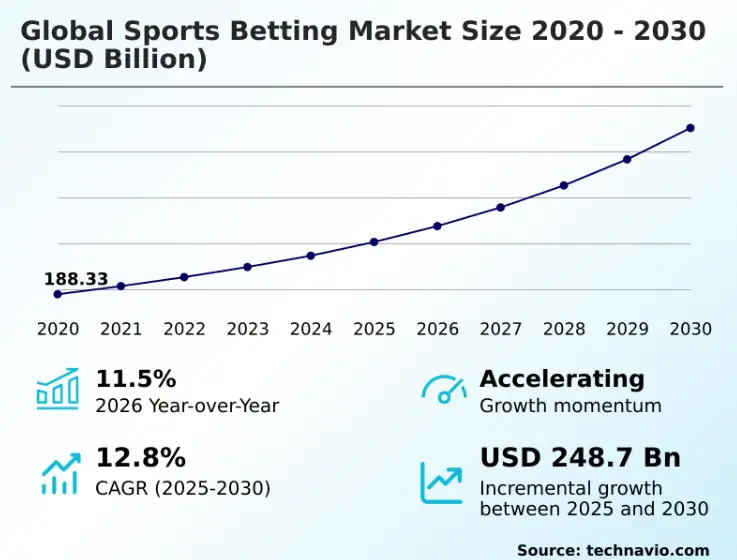
Source: Technavio
Rising Demand for Sports Trading
The traditional sportsbook model has an inherent conflict of interest because the house only wins when the user loses. Serious players and modern tech-savvy sports fans are growing tired of this dynamic. They are actively migrating toward peer-to-peer prediction markets and exchanges because the underlying mechanics are fundamentally fairer.
Consider the baseline established by Betfair, the pioneer of this model. Operating a pure exchange ecosystem, its parent division drives immense financial scale, with the platform’s estimated annual revenue sitting comfortably at over $171 million. This scale is achieved entirely by taking a minor friction fee from matching opposing user opinions, proving that platform builders do not need to take on house risk to generate massive cash flows.
In a P2P setup, users trade outcomes directly with each other. The platform does not set the odds; the market does. This creates several distinct advantages that attract high-value users:
- True Market Pricing: Odds reflect the actual supply and demand of opinions, removing the heavy profit margins that traditional bookies build into their lines.
- No Winning Limits: Traditional sportsbooks routinely ban or limit users who win too consistently. P2P platforms welcome them because the operator makes money on transaction fees, regardless of who wins.
- Position Trading: Users can buy a prediction early, watch the market shift, and sell their position before the event even starts to lock in a profit.
For an entrepreneur, this model eliminates the massive financial risk of bookmaking. Instead of balancing liability against a lucky streak of user wins, your platform generates predictable revenue through a small commission on winning trades or volume-based fees.
Global Events Fuel Market Growth
Big sporting events are where prediction exchanges see the highest activity. Competitions like the English Premier League, UEFA Champions League, and Indian Premier League attract millions of fans who actively trade predictions, making it easier to maintain strong liquidity. This model has already proven successful, with Smarkets generating more than £24.8 million ($32 million) in annual revenue through an efficient exchange platform.
For founders, these tournaments offer the fastest way to acquire users and build market momentum. Once people experience a smooth prediction exchange during a major event, many continue using the platform throughout domestic league seasons. This creates a steady stream of activity instead of relying only on short-term tournament traffic.
Gaps for New Platform Builders
The biggest opportunities in P2P sports prediction exchanges come from solving problems that traditional platforms still overlook. Live in-play prediction markets are seeing strong demand because users want to trade on moments within a match instead of waiting for the final result. The potential is clear from platforms like Polymarket, which recently surpassed $1 billion in annualized revenue, showing how quickly transparent, real-time prediction markets can scale.
Another area with huge potential is creator-led prediction communities. Sports influencers and fan groups are looking for platforms where they can host their own prediction markets and engage their audiences. Adding AI-powered insights, smarter market recommendations, and better liquidity management also makes the experience more interactive while helping users discover active markets across different sports.

How Does a P2P Sports Prediction Exchange Work?
A peer-to-peer sports prediction exchange operates as a technology marketplace rather than a bookmaker. Instead of users wagering against the platform, the infrastructure matches individuals holding opposing views on a sporting outcome. The platform takes zero risk on the game results. It simply provides the order book, the escrow system, and the settlement mechanism, monetizing the volume of transactions rather than the losses of its users.
1. Matching Prediction Orders
The core engine of a P2P exchange is the automated order book. When an entrepreneur builds this type of platform, they are essentially creating a stock exchange for sports events. Users browse markets and place orders based on their preferred odds and stake. The matching backend handles these orders through a specific lifecycle:
- Order Placement: A user enters the market by either accepting existing odds or posting their own desired price.
- The Matching Engine: The software scans the order book to pair opposing positions instantly. If a user wants to back a team at specific odds, the engine finds someone willing to take the opposite side of that position.
- Partial Fills: If a large institutional user wants to trade a high volume, the platform can split that order across multiple smaller participants automatically.
- Escrow Locking: Once a match happens, the system pulls the required stakes from both user accounts and holds them securely in a smart contract or centralized escrow pool.
This clear mechanism is what drove the early success of software-driven exchanges like Matchbook. By building a highly responsive matching engine, they showed that users prefer liquidity and tight pricing over the static, unfavorable lines offered by traditional houses.
2. Secure Event Settlement
Accurate and fast settlement is one of the biggest factors that determines whether users trust a P2P sports prediction exchange. After a match ends, the platform verifies the result using official sports data providers and automatically settles every winning prediction. This removes delays, reduces disputes, and gives users confidence that payouts are based on verified match data.
Platforms like SX Bet (formerly SportX) have shown how automated settlement can improve user trust. By combining secure escrow with blockchain-based smart contracts, they eliminated the need for manual payouts and reduced counterparty risk. For new exchanges, a reliable settlement system is just as important as attracting users because it directly impacts long-term retention and platform credibility.
3. Earning Commission Revenue
Most P2P sports prediction exchanges generate revenue by charging a small commission on successful trades instead of taking the opposite side of user predictions. Fees typically range from 1% to 5% of net winnings, while some platforms earn from overall trading volume. This approach creates a more stable business model because revenue depends on user activity rather than match outcomes, allowing operators to scale without carrying the financial risk faced by traditional sportsbooks.
| Revenue Attribute | Traditional Sportsbook | P2P Prediction Exchange |
| Financial Risk | High (Exposed to player wins) | Zero (Platform remains neutral) |
| Monetization Source | User Losses & Built-in Margins | Small Transaction Commissions |
| User Lifetime Value | Low (Winning users are banned) | High (Profitable traders generate more volume) |
Because the business model relies on volume rather than user losses, the platform’s incentives align perfectly with its community. The more successful and active your traders are, the more transaction fees your platform collects. This creates a sustainable, compounding revenue stream that scales naturally with market liquidity.
Key Features of P2P Sports Prediction Exchanges
A successful P2P sports prediction exchange needs more than an attractive interface. It should deliver fast order matching, reliable liquidity, real-time updates, and a simple trading experience that works for both experienced traders and new users. Focusing on these core capabilities from the start helps the platform scale while encouraging higher trading activity and long-term user retention.
1. Peer-to-Peer Order Book
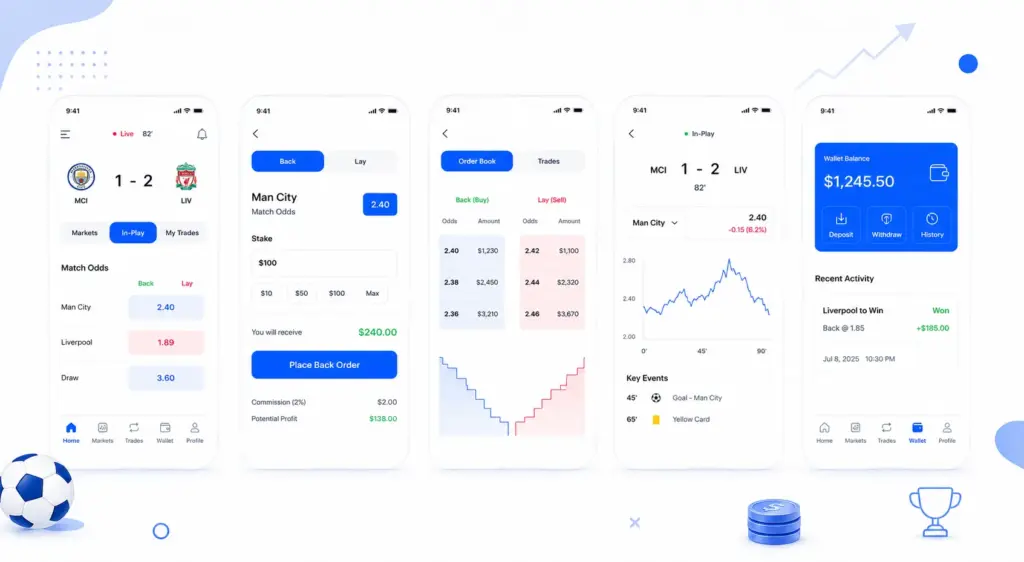
The pillar of a true exchange is a transparent order book. When deploying this feature, developers can look at Betfair, a pioneer that drives immense financial scale with an estimated annual revenue sitting comfortably at over $171 million. Instead of accepting fixed prices from a bookmaker, users browse an active board where they can buy an outcome (back) or sell it (lay).
Traders use this feature to capture better prices than any traditional site offers. They can see the depth of the market, viewing exactly how much money is waiting to be matched at various odds levels. This real-time visibility lets users adjust their entry points dynamically based on how other participants are putting capital to work.
2. Partial Order Matching
High-volume traders often face a major issue on newer platforms: finding a single user to match a massive order. A robust matching engine resolves this by breaking large positions into smaller pieces automatically. This feature is a core reason why SX Bet has processed over $670 million in volume over the past year, becoming a dominant force in blockchain-based execution.
- The Problem: A user wants to place a $10,000 prediction on a match, but no single opponent has that much liquidity on the other side.
- The Solution: The partial-matching algorithm splits the $10,000 order, matching $2,000 with one user, $5,000 with another, and leaving the remaining $3,000 open for future takers.
This backend functionality ensures that large market players do not walk away frustrated. It dramatically lowers execution times and keeps capital moving smoothly through the system.
3. Low-Commission Trading
Traditional bookmakers hide their massive profits inside poor odds. A P2P exchange wins over users by offering raw, unmanipulated market pricing coupled with a highly transparent, low commission rate on net winnings. Lean, agile operators like Smarkets have used this exact pricing model to generate over $32 million in annual revenue by focusing on superior tech infrastructure and lower margins.
Trader Math: Traditional Bookmaker Margin (~8%) vs. P2P Exchange Commission (2% on net profit). The choice for a professional trader is obvious.
Users flock to this model because it preserves their profit margins over time. For the operator, a clean and low-fee architecture builds incredible brand loyalty, turning casual users into high-frequency traders who generate consistent transaction volume for the platform.
4. Real-Time Prediction Markets
Modern sports fans want to trade continuously while watching a live match. This high-velocity trading behavior is precisely what has allowed platforms like ProphetX to secure market share in competitive regions by providing real-time liquidity on major US sports leagues. In-play markets recalculate prices every second based on real-time events on the field, such as a sudden touchdown or a yellow card.
| Game Event | Impact on Exchange Prices | Trader Action |
| Team A scores first | Odds for Team A plummet instantly | Traders sell early to lock in profits |
| Star player gets injured | Market sentiment shifts toward Team B | Traders hedge risk by backing the opponent |
5. Web3 Escrow and On-Chain Settlement
Eliminating human intervention from payouts is a massive trust accelerator for users handling large balances. By integrating smart contract architecture, a mechanism utilized heavily by SX Bet to secure its high-volume ecosystem, funds are locked safely the moment a trade matches.
Once an official sports data provider verifies the final score via an API, the code executes automatically. Winnings land in the user’s wallet without any manual approvals or withdrawal delays from the platform team. This decentralized custody model proves to serious investors and high-net-worth traders that their capital cannot be frozen or mismanaged by the operator.
6. Simple Yes/No Interface
Complex exchange terminology like backing, laying, and decimal odds can alienate mainstream sports fans. To scale your platform rapidly, you need a simplified layer that translates these mechanics into simple everyday choices, similar to the interface built into Betfair Predicts for its prediction markets.
Instead of navigating complicated order books, casual users encounter clear questions like: Will Team X score in the first half? They simply choose Yes or No. Behind the scenes, the matching engine still pairs them with opposing traders, keeping the exchange liquid while offering an accessible, friction-free interface to the masses.
7. Cross-Market Trading and Cash-Out Tools
Experienced traders rely on advanced execution tools to manage their portfolios efficiently across multiple matches. Features like cash-out options allow users to settle their positions instantly with a single click before an event ends, a core mechanic that Betfair perfected to maintain its massive global user base.
The platform uses cross-matching algorithms to optimize order execution, automatically pairing related positions across different markets to find the absolute best price for the user. These analytical tools help serious players track market trends, minimize potential downsides, and execute complex trading strategies seamlessly.
How to Develop a P2P Sports Prediction Exchange?
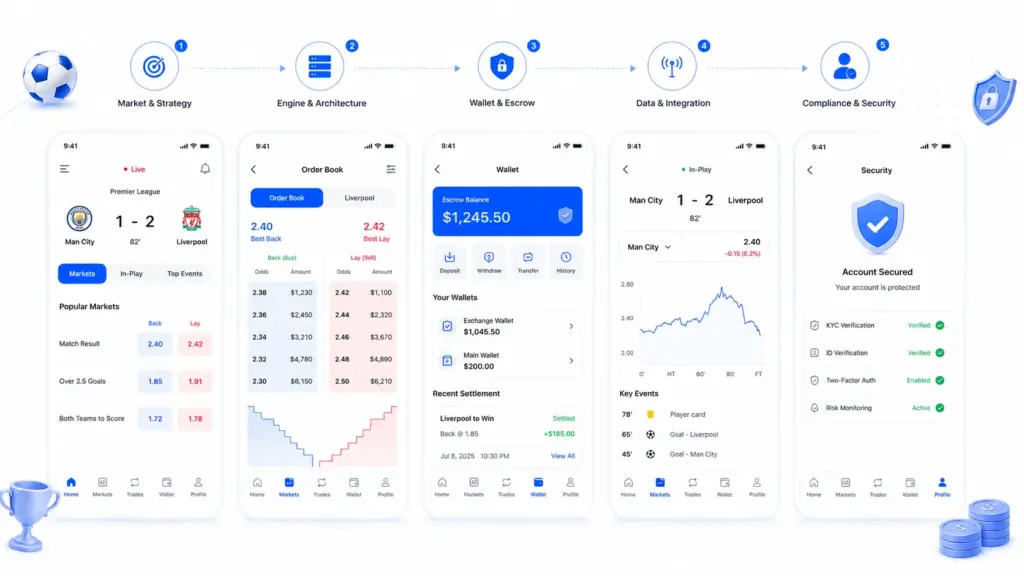
Building a P2P sports prediction exchange requires more than developing a standard betting platform. The system must support real-time order matching, handle thousands of transactions with minimal latency, and protect user funds at every stage. A structured development approach helps ensure the platform is scalable, secure, and ready to support growing trading volumes from day one.
1. Business Model and Market Strategy
Before writing a single line of code, we work with you to nail down the precise commercial architecture. Trying to build a universal exchange for every sport on day one dilutes your early liquidity. Instead, we help you identify high-margin niches, whether that means targeting micro-markets in European football or launching creator-led prediction pools for niche sports.
Our team maps out your regional compliance strategy from the start. Depending on your target jurisdictions, we design the platform to accommodate local licensing requirements. We then implement your chosen revenue model, ensuring the backend can seamlessly calculate and deduct varying commission structures based on net user winnings or raw trading volume.
2. Engine and Exchange Architecture
The matching engine is the heart of your platform, and its performance determines your user retention. If a trader experiences lagging prices during a live match, they will take their capital elsewhere. We engineer high-frequency trading infrastructure that processes thousands of orders per second using price-time priority logic.
- Price-Time Priority: Orders are filled based on the best available price first, and then by the exact timestamp they entered the book.
- Partial Fill Logic: We build algorithms that split massive institutional orders into smaller pieces, matching them instantly across retail participants to prevent market stalls.
- Real-Time Visibility: The front-end UI updates instantly, allowing users to see changing market depth as money moves in and out of positions.
3. Wallets and Escrow Security
Secure fund management is essential for any P2P sports prediction exchange. We build wallet infrastructure that supports both fiat and Web3 payments, while ensuring matched funds are securely held in escrow until an event is settled. Our automated payout system then releases winnings instantly based on verified results, helping create a transparent and trustworthy experience for every user.
4. Data Feeds and API Integration
An exchange cannot function in isolation; it requires an uninterrupted stream of real-time sports data. We integrate your platform directly with premium, low-latency sports data APIs like Sportradar or Genius Sports. These secure data pipelines allow the platform to create trading markets automatically and update live event statistics.
More importantly, we build automated triggers that suspend trading instantly during critical match moments, such as a penalty kick or a red card, protecting your market makers from toxic arbitrage.
5. Compliance, KYC, and Risk Control
To protect your investment and maintain a clean operating license, we deploy automated compliance and fraud detection layers. We integrate identity verification (KYC) and anti-money laundering screening tools directly into the user onboarding workflow.
| Security Layer | Operational Function | Business Value |
| Automated KYC/AML | Instant identity and sanctions screening | Rapid onboarding with total regulatory compliance |
| Multi-Factor Auth (MFA) | Biometric and token-based account locks | Eliminates account takeover risks for high-balance traders |
| Anomaly Detection | Real-time monitoring of betting patterns | Flags syndicates and prevents market manipulation |
6. Live Performance and Stress Testing
A P2P sports prediction exchange must remain fast and stable even during peak trading periods. Before launch, we perform extensive stress and load testing to simulate thousands of users placing and matching predictions at the same time. This helps identify performance bottlenecks, reduce latency, and ensure the platform delivers a smooth experience when traffic is at its highest.
7. Launch, Liquidity, and Scaling
Launching an MVP is only the first step for a P2P sports prediction exchange. After launch, the focus shifts to maintaining liquidity, improving platform performance, and adding new capabilities as the user base grows. We help businesses scale with regular feature updates, advanced trading tools, and infrastructure that supports expansion into new markets without rebuilding the platform from scratch.
Cost to Develop a P2P Sports Prediction Exchange
Investing in a peer-to-peer (P2P) sports prediction exchange requires a clear understanding of where your capital goes. Because this is a high-performance financial marketplace rather than a simple betting app, the budget shifts toward complex backend engineering, low-latency data streams, and bulletproof security.
Cost Breakdown by Phase
When we partner with an entrepreneur to build an exchange, we break the project into transparent development phases. This structured roadmap ensures that every dollar spent translates directly into a tangible, high-value asset for your platform.
| Development Stage | Estimated Cost Range (USD) | Core Deliverable |
| Discovery & Blueprint | $10,000 – $18,000 | Technical spec sheet and system architecture design |
| UI/UX Trading Interface | $12,000 – $22,000 | User-friendly trading screens and intuitive mobile wireframes |
| Core Matching Engine | $35,000 – $65,000 | High-speed order book logic and order execution backend |
| Escrow & Wallet Systems | $20,000 – $40,000 | Automated escrow storage and smart contract settlement systems |
| Live Sports Data Integration | $15,000 – $25,000 | Real-time connections to data pipelines like Sportradar |
| QA & Concurrent Load Testing | $15,000 – $30,000 | Stress-testing the system against high concurrent trading volume |
| Cloud Deployment & DevOps | $10,000 – $20,000 | Scalable AWS or Google Cloud infrastructure setup |
| Total MVP Investment | $127,000 – $220,000 | A fully functional, market-ready P2P sports exchange |
Cost Drivers and Variables
The final price tag of your platform depends on the level of technical sophistication you want to offer your users. A lean application built for localized sports will require a vastly different engineering investment than a global, multi-currency trading hub. Three major components heavily influence the overall capital allocation:
- Matching Engine Complexity: Simple pre-match order matching is straightforward. If your business model requires live, sub-second in-play trading where odds change continuously during a match, the development effort increases due to complex concurrency handling.
- Wallet and Custody Infrastructure: Integrating simple fiat card processors keeps costs on the lower end. Implementing multi-chain Web3 wallets or building an institutional-grade automated escrow vault requires specialized cryptography engineers.
- Data Feed Costs: While our team handles the integration, the tier of live data you choose impacts the build. Basic data feeds are affordable, but official, ultra-low-latency sports data streams require premium integrations to prevent traders from exploiting delayed prices.
Our Cost Optimization Strategy
At IdeaUsher, we focus on helping you launch a market-ready P2P sports prediction exchange without overspending on features you don’t need initially. Instead of building everything from scratch, we prioritize an MVP with the core capabilities required to attract users, validate your idea, and start generating traction quickly.
Our team uses a modular development approach that speeds up delivery while keeping the platform ready for future growth. This lets us spend more time building the features that make your exchange stand out, such as a high-performance matching engine, custom trading experience, and scalable infrastructure, so you’re prepared to grow as your user base expands.
Liquidity: The Biggest Factor Determining Business Success
A large user base alone does not guarantee the success of a P2P sports prediction exchange. What matters more is liquidity, because users expect their predictions to be matched quickly at competitive prices. Without enough active trading on both sides of the market, even a platform with thousands of registered users will struggle to retain users and generate consistent revenue.
Why Liquidity Trumps User Growth
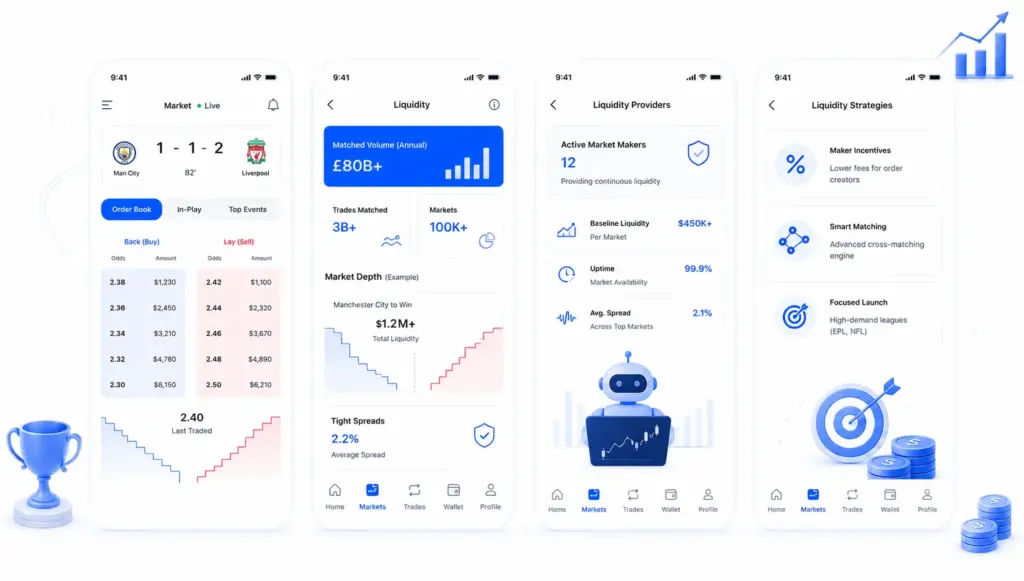
A P2P sports prediction exchange is only as strong as its liquidity. When users place predictions, they expect them to be matched instantly. If there are not enough participants on both sides of a market, trades remain unfilled, pricing becomes less competitive, and users are more likely to leave the platform. Maintaining an active order book is therefore one of the biggest priorities for any exchange.
Betfair demonstrates the impact of deep liquidity at scale. The platform matches more than 3 billion trades every year, with over £80 billion ($100+ billion) in annual matched volume. This level of activity allows users to execute even large trades quickly, creating a seamless experience that keeps both casual users and high-volume traders engaged.
Active Markets via Market Makers
To prevent empty trading screens at launch, a professional exchange relies on designated market makers and automated liquidity strategies. These entities do not participate to gamble; they act as algorithmic stabilizers. They continuously place both buy and sell orders across major markets, creating an immediate baseline of liquidity that organic retail users can trade against.
We see this methodology optimized perfectly by Polymarket, a decentralized event and sports trading network. Their long-term prediction contracts maintain an average of $450,000 in baseline liquidity per market. This stable floor is achieved through specialized automated market-making algorithms that incentivize liquidity providers to keep spreads tight around the clock.
The Liquidity Loop: Algorithmic Market Makers -> Constant Bid/Ask Orders -> Tight Spreads -> Retail User Confidence -> High Trading Volume
Building Liquidity From Day One
When we engineer a new P2P exchange infrastructure, we integrate specific programmatic tools designed to seed and scale trading activity rapidly. Building sustainable liquidity requires a structured mix of software automation and smart commercial positioning. Our development team prioritizes cross-matching engines that analyze the entire order book simultaneously.
| Liquidity Strategy | Technical Implementation | Core Business Objective |
| Maker-Taker Fee Splits | Low or zero fees for order creators, standard fees for order takers | Encourages institutional traders to post deep volume on the board |
| Cross-Selection Matching | Advanced algorithms that map multi-outcome combinations automatically | Maximizes internal matching efficiency using existing open orders |
| Hyper-Focused Launch | Limiting initial markets strictly to high-demand leagues like the EPL or NFL | Concentrates all organic platform traffic into a single, highly active pool |
If a user places an unmatched bet, the software searches related markets to combine opposing fractional positions, executing the trade behind the scenes. By layering these algorithmic tools into your core infrastructure, we help you launch a highly responsive marketplace that keeps capital moving and positions filling without delay.
Top 5 P2P Sports Prediction Exchanges in the USA
After researching the current market, we found several P2P sports prediction exchanges that stand out for different reasons. Some focus on regulated prediction markets, while others are built around exchange-style trading, lower fees, or stronger liquidity. Looking at these platforms can give you a clear idea of the features users expect today and the opportunities to build a more competitive product
1. Kalshi
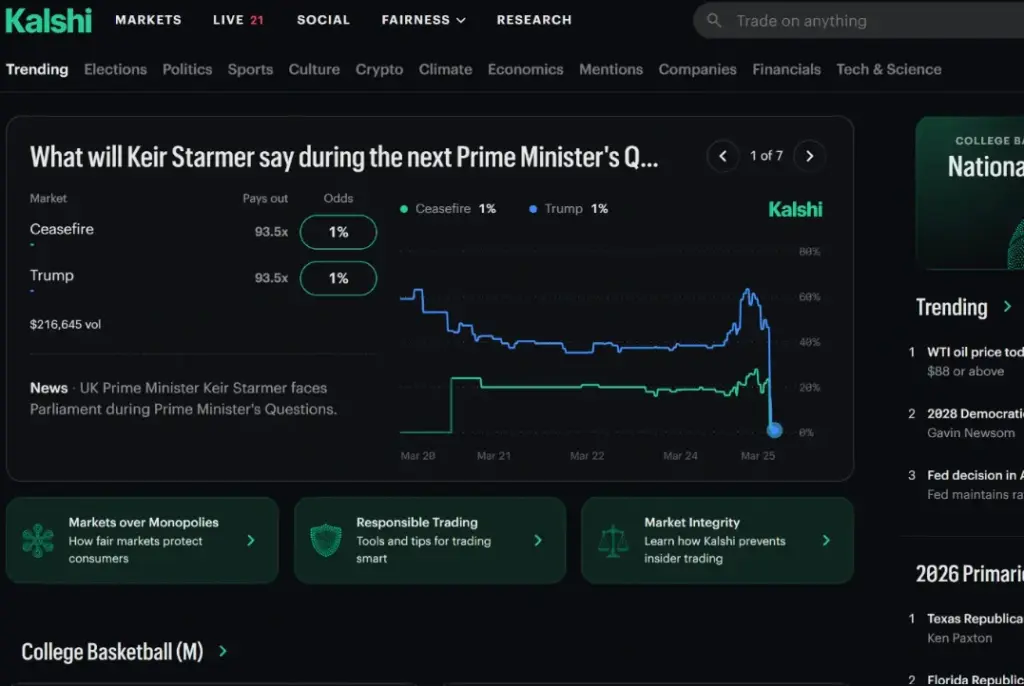
Kalshi is the largest regulated prediction market in the US and has become a major player in sports event trading. Users buy and sell event contracts instead of placing traditional bets, with sports accounting for nearly 80% of the platform’s trading volume since mid-2024. During November 2025, Kalshi recorded around $5.8 billion in monthly trading volume, highlighting how quickly regulated prediction markets are growing.
2. Polymarket
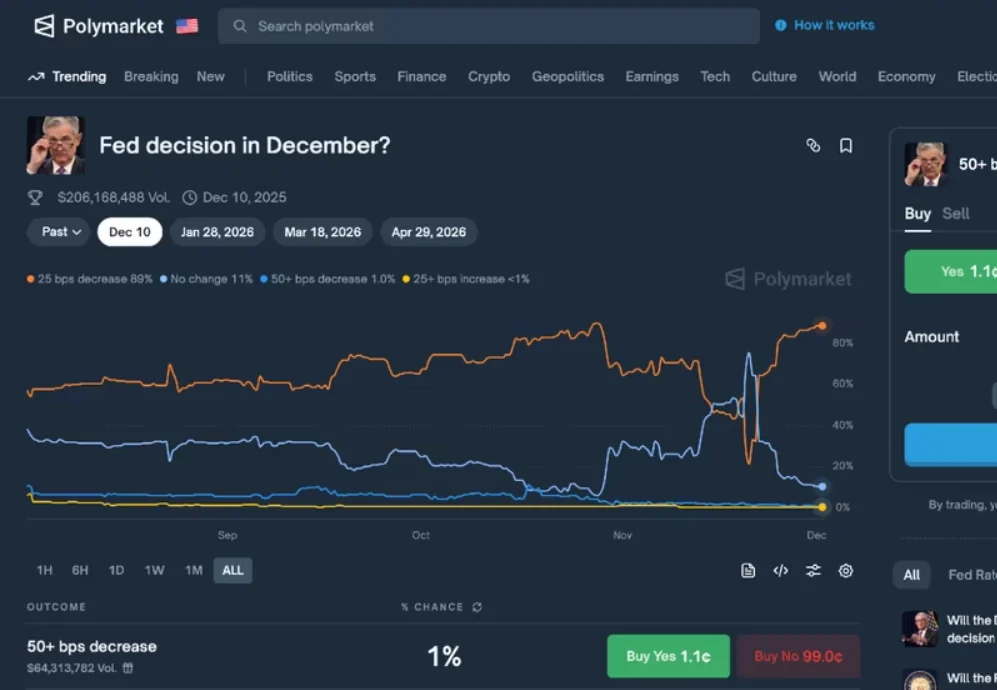
Polymarket is one of the world’s biggest blockchain-based prediction exchanges, offering markets across sports, politics, finance, and global events. The platform supports thousands of active markets, and its international platform generated around $9 billion in trading volume during April 2026. It is particularly known for its deep liquidity, making it easier for traders to enter and exit positions at competitive prices.
3. ProphetX

ProphetX is a true peer-to-peer sports exchange where users trade directly against one another instead of a sportsbook. The platform supports major leagues including the NFL, NBA, MLB, NHL, PGA, and international soccer, while focusing on lower transaction fees and exchange-style trading. Its order-book model appeals to experienced sports traders looking for better pricing than traditional sportsbooks.
4. Novig
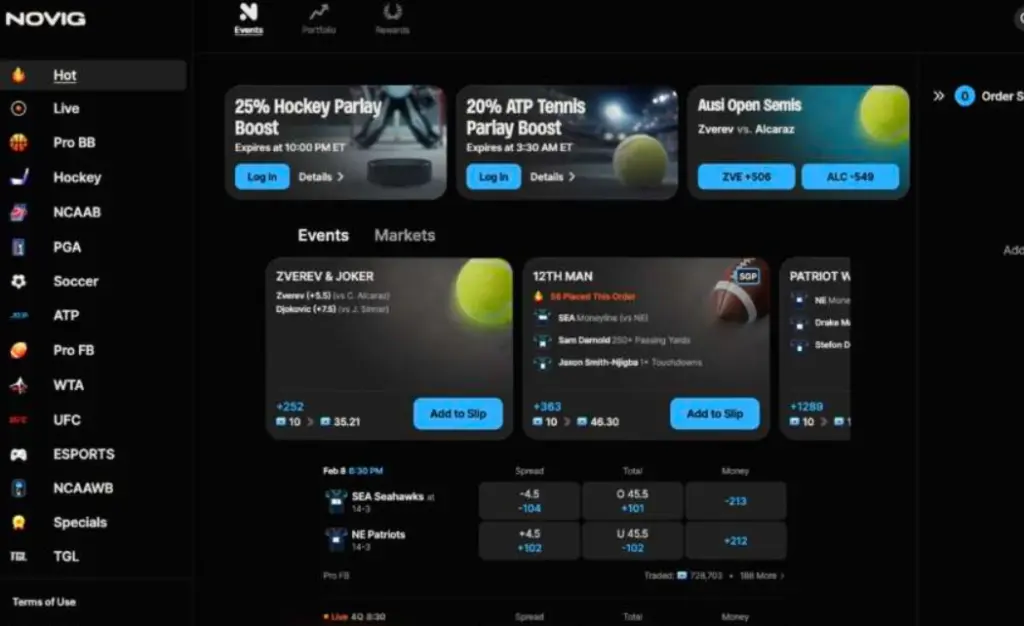
Novig is a commission-free sports prediction exchange that removes the traditional sportsbook margin, allowing users to trade directly with each other. The platform covers popular US sports such as the NFL, NBA, MLB, NHL, and college sports, with a growing user base attracted by transparent pricing and zero-house-edge trading. Its simple interface makes it especially appealing to first-time exchange users.
5. BettorEdge

BettorEdge combines peer-to-peer sports trading with social networking features. Instead of betting against the house, users negotiate and match predictions with other members of the community. The platform supports thousands of sporting events every year across major US leagues and also includes features such as private betting groups, leaderboards, and community challenges that help keep users engaged beyond individual trades.
Build a P2P Sports Prediction Exchange with Idea Usher
Building a P2P sports prediction exchange requires expertise beyond standard app development. Success depends on fast platform performance, secure fund management, accurate sports data integration, and infrastructure that can handle high trading volumes. Working with an experienced development partner helps ensure the platform is scalable, compliant, and ready for long-term growth.
Proven Fintech Expertise
With 500,000+ hours of coding experience and a team of ex-MAANG/FAANG developers, IdeaUsher builds P2P sports prediction exchanges designed for speed, scalability, and reliability. The focus is on creating low-latency matching engines, secure trading infrastructure, and real-time systems that can process thousands of user transactions while maintaining a smooth experience during both regular matches and peak live events.
Scalable MVP Launch Strategy
For an investor, managing capital efficiency and getting to market quickly is critical. We don’t believe in spending years over-engineering software in a vacuum. Instead, we work directly with you to craft a precise Minimum Viable Product (MVP) strategy designed to capture early market share.
- Core Order Book Engine: We deploy an optimized matching backend focused on high-demand sports to establish baseline operations rapidly.
- Premium API Data Feeds: We hook up direct connections to low-latency sports data streams to automate market creations and live suspensions.
- Cloud-Native Architecture: The platform is built from day one on modular, auto-scaling cloud servers like AWS to accommodate sudden traffic peaks.
This agile methodology protects your launch capital while giving you a polished, high-performance platform. It delivers a fast, highly secure environment that immediately appeals to high-volume market makers and early adopters.
Complete End-to-End Support
Launching a P2P sports prediction exchange is only the beginning. Long-term success depends on continuous platform optimization, regulatory compliance, performance monitoring, and the ability to scale during major sporting events. Ongoing technical support helps keep the platform secure, reliable, and ready to handle increasing user activity as the business grows.
Conclusion
Developing a successful P2P sports prediction exchange requires much more than building a feature-rich app. The platform needs reliable liquidity, fast order matching, secure fund management, real-time sports data, and infrastructure that can scale as trading activity grows. Getting these foundations right from the start helps create a platform that attracts users, earns their trust, and supports long-term business growth.
Things to Know About P2P Sports Prediction Exchanges
A1: A P2P sports prediction exchange works very differently from a traditional sportsbook. Instead of placing predictions against the platform, users trade directly with each other through an order book. This creates a more transparent marketplace where odds are driven by demand rather than set by a bookmaker. For users, that often means better pricing and more flexibility. For platform owners, it creates a business model that earns from facilitating trades instead of taking the opposite side of every prediction.
A2: Most startups can launch an MVP within a few months if they focus on the essential features first. A production-ready platform naturally takes longer because it needs extensive testing, stronger security, and the ability to handle thousands of users during live sporting events. Building in phases is often the fastest way to reach the market while continuing to improve the platform after launch.
A3: Unlike traditional sportsbooks, a P2P exchange doesn’t profit when users lose. Its main source of revenue is a small commission charged whenever two users successfully match a prediction. As the platform grows, additional revenue can come from premium memberships, featured markets, advertising partnerships, or API access for third-party developers.
A4: Liquidity is what makes a P2P exchange feel fast and reliable. Even if thousands of people sign up, users won’t stay if they can’t find someone to match their predictions. A healthy order book keeps trades moving quickly and offers better prices, which encourages more activity. That’s why successful exchanges spend as much effort building liquidity as they do building the technology itself.