


Key Takeaways
- 24/7 wellness apps provide continuous emotional support through AI coaching, habit building and personalized wellness guidance.
- Modern platforms combine behavioral science, long-term memory and multimodal AI to create adaptive wellness experiences.
- Core features include mood tracking, journaling, habit coaching and proactive wellness check-ins.
- Growing demand for always-on support is driving rapid adoption of AI-powered wellness companion platforms.
- How IdeaUsher can help you build 24/7 AI wellness apps with personalized coaching, compliance-ready architecture and scalable AI infrastructure.
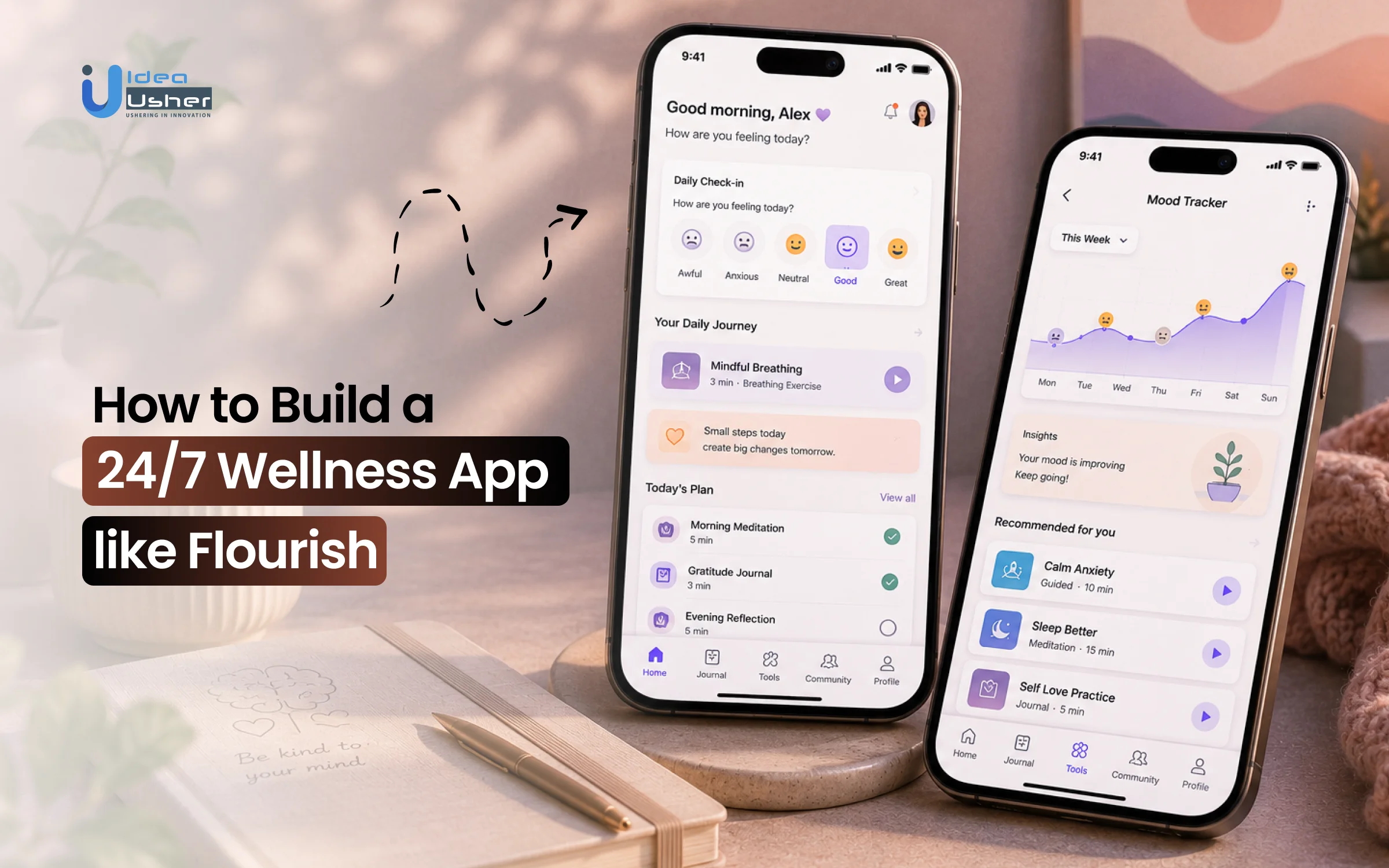
Mental wellness is increasingly shaped by what happens between therapy sessions, coaching calls and moments of crisis. The growing demand among businesses to build 24/7 wellness app like Flourish is now extending beyond physical wellness into AI-powered emotional wellbeing platforms that provide continuous support, accountability and behavior change throughout daily life.
Traditional wellness apps focused on meditation libraries, mood tracking and self-guided content that relied heavily on user motivation. Modern users increasingly expect 24/7 AI wellness companions, personalized wellbeing plans, habit-building support, proactive check-ins, emotional resilience coaching and conversational guidance that adapt to their needs in real time. The value is no longer in providing wellness resources. It is in creating persistent support systems that help users stay engaged, accountable and emotionally resilient over time.
In this blog, we will talk about core features, AI capabilities, architecture, compliance requirements, development costs and how IdeaUsher can help build a 24/7 wellness app like Flourish, shifting toward AI-native wellness ecosystems that combine behavioral science, personalized coaching and continuous engagement into a single experience.
What is Flourish 24/7 AI Wellness Buddy?
Flourish is an award-winning, science-based mental health and well-being app designed by psychologists to help users manage stress, overcome daily emotional challenges, and foster personal growth. Instead of acting as a clinical intervention tool, it operates as a proactive, daily companion that turns mental chaos into clear, actionable next steps.
Grounded in affective science, behavioral psychology, and motivation research, Flourish bridges the gap between academic clinical insights and everyday life. The app is widely used by students, busy professionals, and individuals seeking continuous emotional support between traditional therapy sessions.
A. The “STAR” Psychological Framework
The foundational vision of Flourish is to solve the “last-mile problem of science” translating decades of complex empirical psychological research into simple, accessible, and practical daily tools. Instead of just chatting aimlessly like a generic AI assistant, Sunnie (the AI companion) is trained on a specific framework designed by psychologists called STAR:
- Science-based: It skips pop-psychology trends and translates empirical research from neuroscience and affective science into practical, daily exercises.
- Timely: It is designed to quickly assess context (e.g., if you are panic-scrolling or in a stress loop) and deliver immediate, bite-sized grounding tools.
- Action-oriented: The app prioritizes taking physical or mental steps (like the “Three Good Things” gratitude list or a quick breathing exercise) rather than keeping you locked in endless conversation.
- Real-life-focused: The objective is to give you skills to use out in the real world and encourage social interaction, rather than creating an emotional dependency on the AI itself.
B. How Sunnie Functions as an AI Wellness Buddy
Sunnie, built using the STAR Framework, is designed around positive psychology (focusing on strengths and building resilience) rather than a deficit-based model (focusing solely on diagnosing or fixing problems).
Instead of mimicking a human therapist or acting like a passive sounding board, Sunnie operates more like a dynamic mental gym coach.

1. Active Multimodal Listening (Text, Voice, & Images)
Sunnie does not just process typed text. Users can interact in whatever way suits their current mental state:
- Voice Notes: If a user is too overwhelmed to type out a long explanation, they can vent out loud via audio. Sunnie analyzes the context of what is said to respond with appropriate empathy.
- Visual Check-ins: Users can share images of their day—whether it’s a photo of a messy room when they are feeling unmotivated, or a sunset they want to savor. Sunnie uses these visual cues to ground the conversation and anchor reflections.
2. Context-Aware Personalization & Long-Term Memory
One of the major limitations of standard AI models (like baseline ChatGPT) is that they treat every session as a completely blank slate. Sunnie is built with localized long-term memory.
- Pattern Recognition: If you tell Sunnie on a Tuesday that you are feeling anxious about an upcoming presentation, and you log back in on Friday feeling exhausted, Sunnie connects those dots: “Hey, I know you had that big presentation yesterday. How did it go? Is this fatigue part of the post-anxiety crash?”
- Personalized Habit Coaching: It tracks which micro-habits you are struggling to maintain and adjusts its accountability checks, offering gentle nudges rather than generic, repetitive reminders.
3. Transitioning Conversations to Physical Actions
A core philosophy behind Sunnie’s engineering is that too much screen time can actually worsen mental health. Sunnie is explicitly programmed to avoid “engagement loops”, it does not use guilt tactics or “love-bombing” to keep you inside the app.
Instead, it actively tries to steer the conversation toward a real-world resolution within a few minutes, deploying specific tools based on your input:
| If you tell Sunnie you are… | Sunnie will pivot the UI to: |
| Spiraling or Panicking | Interactive breathing modules, guided imagery, or somatic grounding exercises to physically calm your nervous system. |
| Procrastinating / Stuck | A “brain dump” tool or task-breakdown widget that chops a massive goal into a tiny, single step, backed by a Pomodoro timer. |
| Overthinking / Venting | The “Memory Jar” journaling framework, prompting you to separate the raw facts of a situation from the emotional narrative you are telling yourself. |
4. Guardrails & Immediate Triage Protocol
Because Sunnie is an AI buddy and not a licensed emergency responder, it uses a highly specialized crisis detection protocol.
If Sunnie detects signs of self-harm, severe clinical depression, or suicidal ideation, it activates a crisis safety net rather than providing counseling. Users receive immediate access to localized hotlines and, for campus partners, the specific location and hours of university counseling centers.
Equipped with long-term memory, Sunnie tracks a user’s emotional patterns over time, safely recalling past contexts to surface deep self-insights. Sunnie communicates naturally through text, voice, and images, acting as a non-judgmental sounding board.
C. Why Flourish Focuses on Daily Wellbeing
Mental wellness isn’t a weekly appointment; it happens in the tiny, cumulative moments of everyday life. Flourish focuses heavily on daily intervention because small, consistent practices prevent acute stress spirals and burnout. The app provides a robust suite of daily tools designed to fit into busy schedules within minutes:
- Guided Journaling & Reflection: Features like the iconic Memory Jar help users quickly move heavy thoughts out of their heads and onto the page to build emotional awareness.
- Stress & Anxiety Relief: Fast-acting, interactive activities including deep breathing, guided imagery, and physical grounding exercises.
- Focus & Productivity Support: Tools like structured brain dumps, task-breakdown assistants, and integrated Pomodoro timers designed to break through overthinking and procrastination.
- Habit Building: Gentle nudges and tracking tools that celebrate “baby steps” and small wins, helping users build sustainable routines around sleep, mindfulness, and social connection.
D. Lessons Founders Can Learn From Flourish
For founders navigating the crowded digital health and AI companion space, Flourish provides a powerful blueprint for sustainable, ethical product design:
- Validate Through Rigorous Research: Flourish sets itself apart by choosing clinical validation over pure marketing claims. Its efficacy has been proven through large-scale Randomized Controlled Trials (RCTs), the gold standard of research conducted alongside top universities, showing verified reductions in loneliness and anxiety.
- Design Against AI Dependency: A major risk of conversational AI is creating an unhealthy emotional loop where the user isolates themselves with the bot. Flourish intentionally limits turn-level interactions to drive the user back into real life, encouraging them to connect with friends, step into nature, or use real-world campus/corporate resources.
- Prioritize Safety Benchmarking Early: In independent safety audits (such as the Vera-MH benchmark), Flourish’s crisis detection protocols significantly outperformed generic frontier LLMs. Founders must bake rigorous crisis handling and ethical guardrails into their core architecture from day one rather than treating them as an afterthought.

Why 24/7 AI Wellness Companions Are Gaining Adoption
The global demand for mental health and preventative lifestyle support has outpaced traditional infrastructure. As individuals seek continuous, immediate, and accessible care, 24/7 AI wellness companions are seeing an unprecedented surge in adoption across consumer and corporate demographics.
A. The Shift From Therapy Sessions to Daily Support
Traditional mental health care is episodic, with weekly 50-minute sessions often failing to address unpredictable emotional distress. This has led to a systemic bottleneck, as the WHO reports post-pandemic global anxiety and depression rates remain 25% higher.
With roughly 50% of the U.S. population expected to face shortage of licensed providers and a mental illness diagnosis, traditional therapy leaves significant care gaps during the 167 hours each week spent outside clinical settings.
Clinical research underscores that treating mental wellness requires micro-interventions at the exact moment stress or anxiety spikes. AI companions bridge this gap, shifting care from reactive, episodic treatment to continuous, preventative daily support.
Market Opportunity for AI Wellness Platforms
The global mental health apps market is valued at USD 7.48 billion in 2024 and is forecast to hit USD 17.52 billion by 2030, with a 14.6% CAGR. Growth is fueled by rising mental health awareness and the role of these apps in enhancing lifestyle and treatment results.
The economic landscape for digital wellness and artificial intelligence has expanded exponentially, creating strong incentives to build 24/7 wellness app like Flourish.

| Market Segment | 2025 Value | 2026 Projected Value | Projected Long-Term Valuation | Annual Growth Rate (CAGR) |
| Global Mental Health Apps | $8.57 Billion | $9.82 Billion | $17.52 Billion (by 2030) | 14.6% |
| Dedicated AI Companions | — | $48.63 Billion | — | 31.0% |
| Digital Health Coaching | $13.26 Billion | $15.29 Billion | $26.7 Billion (by 2030) | 15.3% |
Key Market Insight: At a 31% annual growth rate, the specialized AI companion market is growing at more than double the speed of traditional, static mental health applications.
Enterprise adoption is rising as healthcare organizations expand AI infrastructure at a 36.8% CAGR. Presently, AI chatbots manage initial patient queries in 42% of major healthcare networks.
Why Users Want Always-On Wellness Coaching
The rapid adoption of conversational AI is one of the primary reasons businesses are looking to build 24/7 wellness app like Flourish, that is: extreme financial barriers and severe systemic friction.
- Prohibitive Costs: Traditional in-person therapy sessions routinely cost between $100 and $250 per hour out-of-pocket, pricing out a vast segment of the population.
- Long Wait Times: The average wait time to see a licensed psychiatrist or psychologist stretches from 6 to 12 weeks, meaning individuals in acute, non-crisis distress are left entirely without guidance when they need it most.
- The Demand for Immediacy: Consumers are actively seeking real-time, low-friction alternatives. App store data reveals that 64.8% of user reviews for legacy health apps are negative, largely due to rigid interfaces that lack real-time adaptability.
With over 4.3 billion global smartphone users, mobile tech has created accessible wellness hubs. Users now prefer AI coaches for immediate, personalized support via text and voice at a significantly lower cost than traditional teletherapy.
How AI Powers Personalized Wellness Journeys
Moving from static mental health applications to an intelligent wellness companion requires a sophisticated technical architecture. Modern platforms leverage specialized artificial intelligence models to transform raw user inputs into cohesive, highly individualized personal growth roadmaps.
1. Generative AI for Natural Conversations
Legacy wellness apps relied on rigid, pre-programmed decision trees that made interactions feel mechanical and repetitive. Generative AI models utilize Natural Language Processing (NLP) to understand complex, open-ended human dialogue in real time.
Rather than simply matching keywords, the generative layer analyzes sentence structure, contextual nuances, and emotional undertones. This allows the AI to respond with genuine conversational flexibility and adaptive empathy, helping users feel actively listened to and understood during a vulnerable moment.
2. Behavioral Profiling and User Context
A personalized journey relies heavily on deep user context rather than general demographic assumptions. The platform securely aggregates data into a multi-dimensional behavioral profile, tracking key vectors over time:
- Communication Preferences: Adapting vocabulary complexity and conversational pacing to match the user’s immediate cognitive load.
- Stress Triggers & Coping Strategies: Identifying whether a user responds better to cognitive reframing exercises or structured, action-oriented task breakdowns.
- Chronobiological Routines: Mapping interactions against the user’s unique daily rhythms such as recognizing when energy dips or mid-afternoon fatigue typically occurs.
3. Adaptive Coaching Recommendations
To avoid prescription fatigue, the AI utilizes a multi-agent orchestration architecture. Instead of deploying a single chat model, one backend agent acts as a strategist to select an evidence-based behavioral framework (like Motivational Interviewing or Cognitive Behavioral Therapy techniques) and a secondary agent then crafts the final, conversational response.
This dual-layer approach ensures that micro-actions such as breathing exercises, focus sprints, or stretching routines are continuously adapted in real time based on the user’s active emotional state, schedule changes, or physiological capacity.
4. Predictive Wellbeing Risk Detection
The platform shifts mental wellness from reactive crisis management to proactive psychological nurturing by running advanced machine learning algorithms on anonymized user interaction logs.

The system deep-mines data to catch subtle language modifications, sudden drops in routine adherence, or changing sleep logs before the user is even consciously aware of an oncoming burnout spiral. If the system detects severe anomalies, it safely triggers specialized, hard-coded safety protocols.
5. Proactive Engagement and Accountability
A persistent challenge in digital wellness is long-term retention. AI closes this loop by functioning as an automated, non-judgmental accountability partner.
The platform replaces generic notifications with intelligent, low-friction check-ins powered by contextual memory. By recalling past user mentions of high-stress events, the AI provides timely support such as morning rituals or wind-down spaces to reinforce positive habits through empathetic engagement.
Core Features of a Flourish-Like 24/7 Wellness Buddy App
Businesses aiming to build 24/7 wellness app like Flourish must move beyond generic chatbot APIs and create personalized wellness experiences. To drive measurable improvements in resilience, focus, and positive emotion, the platform must seamlessly blend behavioral science with an intuitive feature architecture.

1. AI Wellness Coach With Long-Term Memory
A true wellness buddy must evolve with the user. Integrating specialized long-term memory allows the AI agent to securely reference previous conversations, past stressors, and recurring behavioral triggers.
Instead of treating every interaction as a blank slate, the coach recognizes emotional trends over weeks or months. This deep context enables the AI to surface meaningful, lived-in self-insights, gently highlighting a user’s personal growth or noting when their anxiety correlates with specific weekly patterns.
2. Mood Tracking and Emotional Check-Ins
Rather than relying on tedious, manual logging that users quickly abandon, emotional tracking should be lightweight and conversational. Quick, interactive mood check-ins prompt users to identify their current emotional state in seconds.
The platform then synthesizes this raw data into visual metrics, such as a localized wellness score. This allows users to track their emotional trajectories without feeling overwhelmed by clinical charts or perfectionist streaks.
3. Personalized Habit Building Programs
Behavior change science shows that sustainable wellness relies on clear triggers and tiny, micro-actions. The platform transforms abstract wellness goals into realistic, bite-sized daily habits.
Users can customize, edit, and reorder their routine through intuitive drag-and-drop interfaces. The system celebrates “baby steps” like taking a two-minute stretch or stepping outside. By leveraging positive feedback loops, it helps users stick to their routines. This prevents them from experiencing shame or burnout if they break a streak.
4. Goal Setting and Progress Visualization
Users can initiate an interactive “brain dump” with the AI coach, which automatically organizes unstructured, chaotic thoughts into a clean, prioritized list. Transforming abstract emotional development into scannable data dashboards provides continuous motivation.
- Multi-Dimensional Analytical Charts: Tracks mindfulness consistency, stress-reduction metrics, and emotional resilience baselines alongside standard activity lines over months.
- Gamified Achievement Milestones: Celebrates consistency streaks and emotional breakthrough points with visual rewards. It avoids vanity metrics to emphasize true habit retention.
- Aesthetic Progress Summaries: Generates shareable, highly visual infographics detailing personal growth trends to drive organic, word-of-mouth user acquisition channels.
5. Daily Affirmations and Reflection Tools
The app features structured digital journaling spaces, most notably a digital Memory Jar. This tool acts as an emotional release valve, allowing users to move heavy thoughts out of their heads and onto the digital page.
The AI agent then delivers highly customized, non-judgmental feedback on these entries, prompting deeper self-compassion, positive cognitive reappraisal (reframing stressors), and intentional gratitude.
6. Voice, Text, and Image-Based Interactions
A modern wellness platform must adapt to the user’s changing environment through multimodal capabilities:
- Conversational Text: For private, quiet reflections during work or transit.
- Natural Voice Mode: Allowing hands-free, organic venting sessions where the user can talk out their feelings out loud.
- Image Processing: Enabling users to share a photo of their environment—like a peaceful view from a nature walk—which the AI coach can analyze and discuss to foster present-moment mindfulness.
7. Community and Social Wellness Features
AI should serve as a bridge to human connection, not a replacement for it. The platform features dedicated, secure community spaces where users can connect with peers, share wellness milestones, and participate in collective well-being challenges.
In institutional partnerships (such as university campuses or corporate environments), these networks are localized, allowing users to securely share activities, swap advice, and support one another through shared organizational experiences.
8. Therapist-Guided Between-Session Support
The platform is explicitly structured as a non-clinical, proactive tool that complements rather than replaces professional medical care. For users currently in therapy, it serves as an indispensable bridge for between-session care.
Users can log notes from their clinical appointments, track assigned homework, and process immediate, mid-week stressors with the AI coach. Licensed professionals can confidently recommend the app as a safe, evidence-backed resource that reinforces cognitive-behavioral tools in the exact moments their clients face real-world challenges.
How to Build a 24/7 Wellness App like Flourish
Building a 24/7 mental well-being application like Flourish requires moving beyond basic chatbot templates to construct a highly personalized, science-backed emotional support network. To dominate the high-growth digital health sector, businesses must weave evidence-based psychological modalities and adaptive contextual memory into a seamless mobile architecture.

1. Product Discovery and Wellness Strategy
Our strategy team defines your unique brand position, targets high-intent consumer demographics, and creates sustainable monetization frameworks. We analyze competitor features and build a product roadmap focused on premium corporate health opportunities.
- Target Demographic Profiling: Identifies high-value university student networks or busy corporate enterprise workforces to specialize the app’s market placement.
- Monetization Engine Engineering: Structuring B2B enterprise tier subscriptions alongside consumer-facing premium updates to capture multiple recurring business revenue pipelines.
- Strategic Roadmap Validation: Maps primary features directly against shifting global well-being demands to ensure instant market-product fit upon launch.
2. Behavioral Science Framework Design
Our development team designs and implements the educational architecture of your wellness app, converting expert-led, evidence-based frameworks into engaging digital experiences. We develop scalable features for mobile and web to effectively deliver structured wellness programs.
- Clinical Methodology Integration: Combines Cognitive Behavioral Therapy and Mindfulness-based stress reduction frameworks into daily, digestible user habit routines.
- Evidence-Based Content Structuring: Transforms psychological science concepts into actionable micro-journals, guided breathing prompts, and interactive emotional regulation exercises.
- Scientific Outcome Validation: Aligns core application pathways with clinical guidelines to satisfy corporate buyer requirements for measurable wellness returns.
3. AI Wellness Companion Development
Our AI engineers build your proprietary conversational companion utilizing the psychologist-backed STAR framework. We fine-tune large language models to communicate with human-like empathy, shifting dynamically from enthusiastic motivation to calm support.
- STAR Framework Enforcement: Instructs your AI buddy to deliver science-based, timely, action-oriented, and real-life-focused conversational text and voice responses.
- Vocal Sentiment Tuning: Programs natural language processing engines to detect user distress via phrasing, automatically adjusting conversational empathy levels.
- Proactive Engagement Modeling: Equips the virtual guide to autonomously initiate supportive check-ins during user slumps, driving higher daily retention.
4. Personalization and Long-Term Memory Setup
Our developers construct a sophisticated, vector-based memory architecture that eliminates generic chatbot experiences. By securely retaining past user inputs, life events, and personal triggers, your app builds true emotional intelligence over time.
- Vector Database Graphing: Implements secure memory storage networks that log historical entries to track contextual emotional patterns across months.
- Adaptive Recommendation Engines: Analyzes continuous usage metrics to deliver hyper-personalized daily affirmations and specific mindfulness recommendations right when needed.
- Zero-Retention Private Layering: Protects user identity profiles by dynamically stripping personal names from the background AI training data pipelines.
5. Wellness Tracking and Engagement Features
We engineer an interactive tracking ecosystem designed to dismantle tracking fatigue and eliminate user perfectionism. Our developers build visual tools that turn emotional logs into a rewarding, gamified daily routine.
- Interactive Mood Mapping: Deploys fluid, visual grid interfaces that allow members to quickly log moods along with external lifestyle triggers.
- Frictionless Daily Gamification: Builds custom engagement rewards and non-judgmental milestone trackers to keep users inspired without inducing digital stress.
- Contextual Habit Signalers: Syncs with native device hardware to send gentle notifications prompting micro-habits right during optimal user windows.
6. Compliance and Security Implementation
Our cybersecurity engineers install rigid medical-grade protective protocols across your entire application architecture. We secure your platform against data breaches, ensuring full compliance with international data privacy legislation.
- Regulatory Pipeline Standardization: Hardens backend servers to align fully with strict HIPAA, GDPR, and CCPA consumer privacy mandates automatically.
- End-to-End Cryptography Execution: Implements complete message encryption and biometric login keys to completely guard sensitive personal mental health journals.
- Role-Based Access Guardrails: Sets up technical permission walls that keep administrative workers completely separated from private user conversation data.
7. Quality Assurance and Safety Testing
We conduct thorough clinical simulation testing to verify conversational safety boundaries and technical performance. Our developers build reliable, real-time safety nets to protect users and shield your business from legal liabilities.
- Automated Crisis-Escalation Audits: Implements real-time text scanning to detect self-harm indicators, immediately locking AI chats to display crisis helpline data.
- Hallucination Redaction Sweeps: Stress-tests conversational models using automated adversarial attacks to completely eliminate non-scientific or harmful health guidance loops.
- Cross-Device Load Verification: Evaluates UI responsiveness and platform latency across multiple mobile operating systems to guarantee smooth global user performance.
8. Deployment, Monitoring, and Scaling
Our cloud engineers launch your app using robust server architecture prepared for high-volume organic expansion. We continuously monitor live interaction metrics to optimize processing costs while expanding your data infrastructure.
- Compliant App Store Publishing: Directs app launch protocols ensuring swift approval through specialized Apple and Google health app submission guidelines.
- Real-Time Outcome Analytics: Aggregates group-level well-being data dashboards to show corporate clients anonymous, actionable insights into team wellness trends.
- Dynamic Server Scaling: Minimizes operational overhead using cloud hosting infrastructure that scales processing capacity up or down with live volume.
Cost to Build a 24/7 Wellness App like Flourish
The cost of developing a wellness platform like Flourish depends on the complexity of AI capabilities, personalization engines, compliance requirements, engagement features, and infrastructure scalability. Projects can range from a focused MVP to a fully integrated enterprise wellness ecosystem.
A. Development Cost Breakdown by Phase
The following table provides an estimated cost breakdown based on individual development phases involved in building a Flourish-like AI wellness platform.
| Development Phase | Estimated Cost | What the Phase Covers |
| Product Discovery & Strategy | $5,000 – $15,000 | Market validation, user research, wellness goals, competitor analysis, feature prioritization, and roadmap planning. |
| Behavioral Science Framework Design | $12,000 – $35,000 | Designing CBT, DBT, ACT, mindfulness, and coaching methodologies for personalized wellness experiences. |
| UX/UI Design | $10,000 – $30,000 | User journeys, onboarding flows, engagement loops, dashboards, and emotionally supportive interface design. |
| AI Wellness Companion Development | $20,000 – $80,000 | Conversational AI, coaching logic, LLM integration, contextual understanding, and response generation systems. |
| Personalization & Memory Engine | $15,000 – $60,000 | User profiling, long-term memory architecture, recommendation systems, and adaptive wellness experiences. |
| Wellness Tracking Features | $10,000 – $55,000 | Mood tracking, habit management, progress visualization, journaling, and accountability mechanisms. |
| Compliance & Security Implementation | $8,000 – $40,000 | HIPAA readiness, GDPR controls, encryption, access management, consent workflows, and audit logging. |
| QA Safety Testing | $7,000 – $25,000 | Functional testing, AI validation, performance optimization, security audits, and safety assessments. |
| Deployment & Infrastructure Setup | $5,000 – $20,000 | Cloud deployment, monitoring systems, DevOps automation, analytics integration, and scaling preparation. |
| Total Estimated Cost | $88,000 – $410,000 | Combined estimated investment across all development phases. |
Note: These estimates represent typical development ranges and may vary based on customization requirements, AI sophistication, regulatory obligations, third-party integrations, and long-term scalability objectives.
B. Development Cost by Platform Level
The platform-level estimates below are aligned with the phase-wise development costs shown above.
| Platform Level | Features Included | Estimated Cost |
| MVP | AI chatbot, basic mood tracking, journaling, habit tracking, onboarding assessments, simple analytics dashboards, and core security features. | $88,000 – $130,000 |
| Mid-Level | Advanced personalization, long-term memory, wellness programs, accountability coaching, enhanced analytics, community features, and stronger compliance controls. | $150,000 – $220,000 |
| Enterprise | Multimodal AI, predictive wellness insights, therapist integrations, advanced compliance systems, enterprise-grade scalability, and extensive AI safety mechanisms. | $250,000 – $410,000+ |
Note: The platform-level estimates are derived from the cumulative phase-wise development costs. Actual costs may vary depending on feature scope, AI sophistication, integrations, compliance requirements, and post-launch enhancements.
C. Factors That Influence Development Budget
Several variables can significantly impact the final cost of building a Flourish-like wellness platform, particularly when advanced AI personalization and regulatory compliance are involved.
- AI Personalization Complexity: Advanced recommendation engines, contextual coaching, behavioral analysis, and adaptive learning systems drive up expenses. They can increase development costs by 20%–40%. This is due to the additional AI training, testing, and optimization required.
- Long-Term Memory Infrastructure: Developers must build persistent memory systems. These systems retain user goals, habits, preferences, and wellness history. This infrastructure can add $10,000–$50,000 to the overall budget. The final cost depends on data complexity and storage requirements.
- Behavioral Science Integration:Platforms often incorporate CBT, DBT, ACT, mindfulness, and evidence-based coaching frameworks. This integration may increase development costs by 15%–30%. The extra expense stems from specialized design, validation, and content creation efforts.
- Multimodal Interaction Support: Adding voice conversations, image analysis, speech processing, and cross-channel engagement features expands capabilities. However, these features can raise costs by $15,000–$75,000. This increase is driven by additional AI and infrastructure requirements.
- Compliance and Data Security Requirements: Apps must integrate HIPAA, GDPR, encryption standards, consent management, and audit systems. These security measures can account for 10%–25% of the total project budget. Total costs depend entirely on your specific regulatory obligations.
- AI Safety and Crisis Intervention Systems: Teams must implement risk detection, escalation protocols, human handoff mechanisms, and moderation frameworks. These safety features can add $10,000–$40,000 to your total development costs.
Privacy and Safety Requirements of 24/7 Wellness Buddy App
Organizations that build 24/7 wellness app like Flourish must prioritize user security, privacy, and ethical AI practices from the start because mental health and behavioral data are deeply intimate, platforms must be engineered with defense-in-depth architectures that treat privacy, compliance, and clinical safety as core product requirements rather than checklist items.

1. HIPAA-Ready Wellness Data Systems
Even when categorized as a non-clinical wellness application rather than a medical tool, an AI platform must be built to the standards of healthcare-grade infrastructure to remain institutional-ready:
- PHI Isolation & Secure Storage: Isolate chat histories, journal entries, and behavioral health data from general analytics pipelines, storing PHI only within HIPAA-compliant cloud environments with strict access controls.
- Immutable Audit Trails: Log every database read, write, update, and access attempt in append-only, tamper-resistant audit records, providing a complete audit trail for compliance and forensic investigations.
- BAA-Covered Infrastructure Stack: Ensure all third-party services handling patient data including AI inference providers, vector databases, cloud infrastructure, and storage systems operate under signed Business Associate Agreements (BAAs).
2. GDPR and Global Privacy Compliance
To scale internationally across university campuses and multinational corporate workforces, platforms must respect global data autonomy rights by adhering strictly to GDPR, CCPA, and evolving global privacy frameworks:
- Granular Consent Controls: Allow users to independently opt in or opt out of behavioral data processing, including AI coaching interactions, mood tracking, and product analytics.
- Data Portability & Export: Provide users with a machine-readable export of their data, including AI conversation histories, mood journals, behavioral logs, and other account-generated records.
- Automated Data Retention & Deletion: Enforce lifecycle policies that automatically delete user profiles, chat histories, and associated records after account closure or prolonged inactivity, including secure removal from backups where required.
3. End-to-End Data Protection
Securing user data against outside threats requires locking down every stage of the digital pipeline, from a user’s mobile device to the cloud inference layer:
- End-to-End Data Encryption: Protect sensitive data with AES-256 encryption at rest and TLS 1.3+ in transit, with enhanced encryption controls for highly confidential user-generated content such as journal entries and personal reflections.
- Secure API & Access Controls: Secure all APIs using JWT or OAuth 2.0 authentication, and protect production environments with web application firewalls (WAFs) to defend against unauthorized access, injection attacks, and automated abuse.
- Continuous Security Monitoring: Implement automated dependency scanning, centralized secret management through key-vault systems, and regular third-party penetration testing to identify and remediate security vulnerabilities.
4. Role-Based Access Governance
To prevent internal data misuse or accidental disclosure, systems must follow the principle of least privilege through Role-Based Access Control (RBAC):
- Platform Administrators: Retain full configuration, system maintenance, and infrastructure management permissions, but are completely blocked from viewing unencrypted user conversation text.
- Support & Troubleshooting Teams: Granted access exclusively to system health metadata, licensing details, and account subscription parameters to fix bugs, without any visibility into personal journal logs or chat histories.
- Clinicians & On-Campus Therapists: Authorized to see aggregated, anonymized behavioral trends for their specific assigned user groups, but can only view individual raw conversation histories if the user gives explicit digital consent.
5. AI Safety and Crisis Intervention Workflows
Because users experiencing severe emotional distress may treat an AI companion as an immediate lifeline, platforms must implement highly sensitive, multi-layered risk mitigation systems:
- Dual-Layer Intent Auditing: Every inbound message from a user must pass through an ultra-low-latency safety classifier before it reaches the core conversational AI model. This classifier screens for self-harm intent, explicit violence, or acute psychological crises.
- Immediate Safety Interventions: If a crisis indicator is identified, the system bypasses the open-ended AI conversation entirely. It drops a hard-coded, psychometrically verified message offering immediate human assistance.
- Human Support Handoffs: The platform displays localized crisis lifelines (like 988 in the US or global equivalents) alongside simple UI components that allow users to connect to a live human emergency operator with one tap.
6. Transparency and Ethical AI Practices
Building long-term user confidence means removing the “black box” around artificial intelligence and setting transparent expectations for everyday wellness coaching:
- Clear AI Disclosures: Users must be explicitly reminded across the onboarding experience and within active chat screens that they are interacting with an AI wellness companion, not a human doctor or licensed medical professional.
- Explainable Well-being Suggestions: When recommending micro-actions like focus techniques, the AI coach must provide clear explanations that link these suggestions to established psychological models, such as CBT or positive psychology.
- Continuous Bias Auditing: LLM fine-tuning datasets and system prompt structures must be routinely reviewed by diverse panels of psychologists and ethicists. This keeps the AI’s language neutral, inclusive, and free from harmful cultural or demographic biases.
Key Challenges to Build a 24/7 Wellness App like Flourish
Building an AI-powered 24/7 wellness buddy platform like Flourish requires navigating highly technical and deeply psychological boundaries. To build a robust commercial product, your development partner must proactively tackle severe data isolation mandates, complex behavioral modeling, and high-stakes safety integration challenges.

1. Preventing AI Wellness Coaching Hallucinations
Challenge: Large Language Models used for 24/7 wellness conversations can fabricate incorrect psychological advice, introducing severe medical liabilities and brand-damaging errors.
Solution: Our engineers enforce strict Retrieval-Augmented Generation pipelines anchored exclusively to verified psychological databases, completely blocking the AI coach from outputting unvetted or non-evidence-based guidance loops.
2. Long-Term User Memory and Personalization
Challenge: Standard chatbots forget past user interactions across separate login sessions, frustrating users with repetitive conversations and shattering app engagement levels.
Solution: We construct high-performance vector databases that securely compress and recall historical user life milestones, triggers, and progress trends without degrading real-time conversational system speeds.
3. AI Crisis Detection and Escalation Systems
Challenge: Wellness companion applications face catastrophic liabilities if their text algorithms fail to instantly identify implicit self-harm language or user crisis indicators.
Solution: Our team builds a multi-layered NLP parsing engine that scans inputs in real-time, instantly locking down AI chats to route local distress helpline resources when crisis language is detected.
4. Reducing User Burnout and Engagement Drop-Off
Challenge: Mental health platforms experience sharp retention declines within thirty days as manual mood logging and habit tracking feel like tedious chores.
Solution: We build automated, multimodal data logging engines utilizing voice note transcription and image recognition software, paired with predictive machine learning alerts to prompt micro-habits fluidly.
Future Trends Shaping AI Wellness Platforms
The landscape of digital health is evolving rapidly, creating new opportunities to build 24/7 wellness app like Flourish with advanced AI capabilities. Emerging technologies are transforming AI wellness companions from reactive chatbots into hyper-personalized, context-aware ecosystems that proactively support human well-being.
1. Emotion-Aware AI Coaching
Next-generation platforms are shifting from basic text analysis to multimodal sentiment processing. By evaluating real-time vocal biomakers, facial micro-expressions, and typing cadences, AI companions can dynamically detect subtle shifts in a user’s underlying psychological state.
Real-World Example: Platforms like Hume AI utilize sophisticated empathic large language models (eLLMs) to accurately measure vocal modulations and facial expressions, adjusting their conversational tone to match the user’s immediate emotional needs.
2. Digital Therapeutics Integration
The boundary between wellness apps and clinical medicine is blurring as software undergoes formal regulatory evaluation. Validated AI platforms are increasingly functioning as evidence-based treatments prescribed by doctors to manage chronic conditions alongside traditional medical care.
Real-World Example: Woebot Health develops clinically validated digital therapeutics that utilize structured cognitive behavioral therapy (CBT) protocols, earning FDA Breakthrough Device Designation for treating postpartum depression and adolescent anxiety.
3. Multi-Agent Wellness Ecosystems
Monolithic AI assistants are being replaced by collaborative networks of specialized, autonomous agents. A primary orchestrator coordinates distinct sub-agents such as a dedicated nutrition strategist, a habit coach, and a sleep expert to build a unified wellness plan.
Real-World Example: Modern open-source agent frameworks like AutoGen or CrewAI allow developers to deploy multi-agent networks where specialized AI personas safely debate, refine, and co-create highly personalized behavioral intervention strategies.
Why Partner With Idea Usher for AI Wellness App Development
Idea Usher combines 11+ years of industry experience and a dedicated team of 250+ niche professionals helping businesses build 24/7 wellness app like Flourish and other AI-powered healthcare platforms. Having successfully delivered over 1,000 projects across 50 countries, we blend human-centered UI/UX design with robust AI engineering to build highly scalable, premium wellness ecosystems.
Successfully merging behavioral science, generative AI, and healthcare compliance demands an execution partner with deep domain expertise. Global enterprises and startups partner with IdeaUsher to build secure, clinically aligned technology optimized for commercial growth.
- Expertise in AI and Healthcare Solutions: We engineer context-aware conversational LLMs, predictive behavioral nudge engines, and computer-vision-powered automated data logging tools.
- End-to-End Product Development Services: Our team manages your full lifecycle, seamlessly connecting custom frontends with external EHR systems, laboratories, and e-prescribing networks.
- Security-First Development Approach: Every platform we architect features a zero-trust infrastructure, complete end-to-end data encryption, and strict HIPAA and GDPR regulatory compliance.
- Building Scalable Wellness Ecosystems: We build high-performance cloud databases designed to effortlessly scale server processing capacity alongside your growing global subscriber base.
Ready to schedule your blueprint session? Partner with IdeaUsher to architect a HIPAA-compliant, AI-driven wellness platform that scales.
Conclusion
As demand for personalized mental wellness support continues to grow, platforms like Flourish demonstrate how AI can deliver meaningful, always-on guidance that extends beyond traditional care models. To build a 24/7 wellness app like Flourish, businesses must combine behavioral science, advanced AI, robust personalization, and strong compliance frameworks into a seamless user experience. With the right development strategy and technology foundation, organizations can create scalable wellness platforms that improve engagement, foster healthier habits, and deliver measurable wellbeing outcomes.
Things to Know
Q.1. What features are essential in a 24/7 wellness buddy app?
A.1. A successful wellness buddy app requires AI coaching, mood tracking, habit building tools, personalized wellness plans, progress monitoring, and proactive engagement features that help users maintain consistent wellbeing routines.
Q.2. How does AI personalize wellness experiences?
A.2. AI analyzes user behaviors, goals, wellness history, and preferences. It also tracks engagement patterns over time. The system uses this data to deliver tailored recommendations and adaptive coaching. This ensures users receive relevant wellness activities and more meaningful daily interactions.
Q.3. Why are privacy and compliance important for wellness apps?
A.3. Wellness platforms often manage sensitive personal data. Strong security measures, regulatory compliance, access controls, and encryption help protect user information while building trust and platform credibility.
Q.4. How much does it cost to develop a wellness app like Flourish?
A.4. Development costs typically range from $88,000 to over $330,000. The final price depends closely on your AI capabilities and personalization depth. Compliance requirements, platform coverage, integrations, and overall product complexity will also drive the budget.


