


Key Takeaways
- Ray combines conversational AI, computer vision, and wearables to deliver personalized fitness coaching that adapts to user goals and recovery data.
- Growing demand for fitness guidance is accelerating adoption of AI coaching platforms, creating opportunities for businesses to build scalable fitness products.
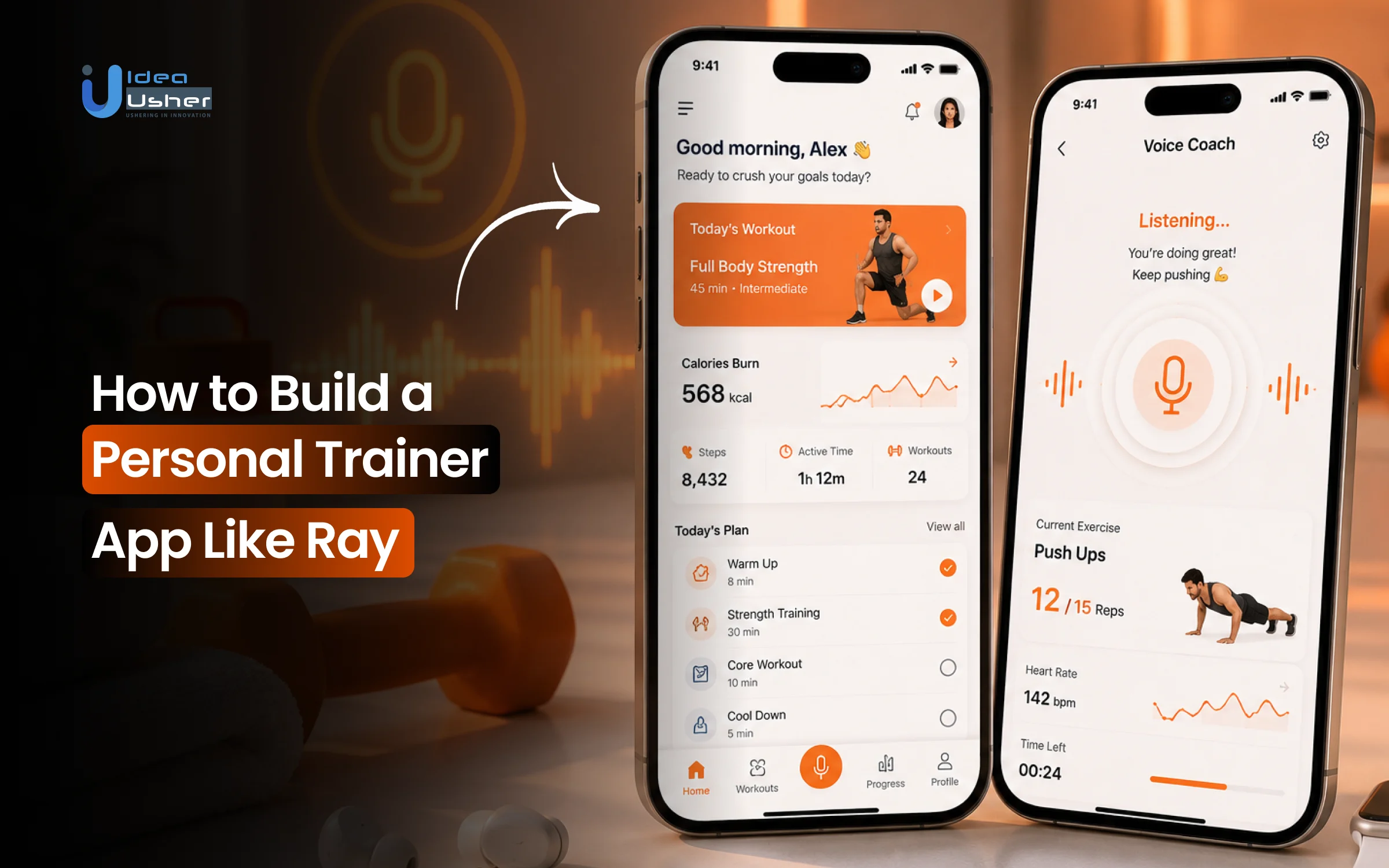
- Building a Ray-like app requires adaptive workout plans, voice-guided coaching, workout adjustments, computer vision rep counting, and wearable connectivity.
- Successful AI fitness businesses focus on user retention, recurring revenue, and personalization, while investors favor platforms combining AI coaching, health insights, and subscription models.
- How Idea Usher can help businesses build AI personal trainer apps like Ray through AI development, voice coaching, and scalable platform architecture.
Today’s fitness enthusiasts have more options than ever when it comes to personalized coaching. AI personal training apps are making fitness coaching more accessible by adapting workouts to each user’s needs. Rather than providing a fixed list of exercises, these apps understand how people move and adjust training plans based on progress, performance, and movement patterns. This helps users improve their form, stay consistent, and achieve better results. The ability to deliver smart, personalized guidance without a dedicated coach is one of the key reasons AI-driven personal trainer apps are becoming increasingly popular.
We’ve developed numerous AI personal training solutions that leverage computer vision and real-time motion tracking to create highly personalized workout experiences. Drawing on this expertise, we’ve created this guide to explore how to build a personal trainer app like Ray, including its key features and estimated costs.
What Is Driving Demand for AI Personal Trainer Apps?
According to Research and Markets, the AI personal trainer market is projected to grow from $15.72 billion in 2025 to $20.25 billion in 2026, reflecting strong demand for more personalized fitness experiences. As users move beyond generic workout plans and prerecorded content, AI-powered coaching platforms are becoming increasingly attractive. For businesses, this creates an opportunity to build scalable fitness solutions that deliver tailored guidance without the limitations of traditional one-on-one coaching.

Source: Research and Markets
Real-Time Adaptive Coaching
Traditional fitness apps often follow fixed workout plans that leave little room for real-life changes. If you miss a workout, feel unusually tired, or experience muscle soreness, the plan usually stays the same. Modern users expect a more flexible experience where their fitness coach can respond to how they actually feel. Platforms like Freeletics helped popularize this approach by adjusting future workouts based on user feedback after each session.
To deliver this level of personalization, AI fitness coaching apps need a system that continuously learns from workout performance and user input. If a workout feels too difficult or recovery is taking longer than expected, the app can automatically adjust upcoming sessions to keep training effective and sustainable. This adaptive experience helps users stay consistent while reducing the risk of burnout or injury.
Wearable Data Integration
The explosion of smartwatches and biometric rings has changed the fitness industry. Consumers now have constant access to their physiological data. They know their resting heart rate, sleep quality, and heart rate variability. The problem is that most people do not know what to do with this data. An abundance of raw health metrics leaves users confused.
AI fitness apps solve this by acting as the translation layer. They ingest data from devices like Apple Watch, Garmin, or Oura Ring and convert it into actionable training advice. A great example of this is Whoop. It analyzes recovery metrics to tell users exactly how much physical strain their bodies can handle each day.
If a user wakes up with a low recovery score, an advanced AI trainer will automatically scale back a heavy weightlifting session. It might replace it with a mobility routine instead. This integration makes the app a central part of the user’s daily health routine.
Democratizing Elite Fitness
Many people want personalized fitness guidance but cannot justify the ongoing cost of a dedicated personal trainer. At the same time, basic workout apps often provide the same experience to every user regardless of their goals or fitness level. AI fitness coaching apps help fill this gap by delivering personalized recommendations, workout adjustments, and ongoing support at a much more accessible price point.
- Scalability: One algorithm can coach millions of users simultaneously without extra overhead.
- Retention: Users stay longer because the platform evolves with their fitness journey.
- Data Moats: Every workout completed makes the underlying AI smarter, creating a barrier against competitors.
By investing in this technology, you are targeting a massive demographic of professionals. These users are willing to pay a premium for software that actually delivers results. They want the guidance of a trainer without the scheduling headaches and high costs. Providing a scalable alternative to human coaching allows a platform to capture massive market share quickly.

The Vision Behind Ray: Bringing Personal Training to Everyone
Ray is an AI-powered personal trainer that delivers personalized workout guidance through a more adaptive and interactive experience than traditional fitness apps. Rather than relying on fixed training plans, Ray adjusts recommendations based on a user’s goals, progress, and feedback, helping create a coaching experience that feels more personal while remaining accessible to a larger audience.

Solving the Accessibility Gap
High-quality personal training comes with a massive price tag. This financial barrier prevents the average fitness enthusiast from getting professional help. Ray solves this distribution problem by leveraging automation. This positioning creates a massive market opportunity by capturing the underserved middle market.
| Service Feature | Traditional Trainer | Ray AI Platform |
| Monthly Cost | 300 to 600 dollars | 15 to 30 dollars |
| Availability | Appointment only | Instant 24/7 access |
| Scalability | Cap at 15-20 clients | Unlimited users |
These are users who want professional guidance but refuse to pay hundreds of dollars a month for a human coach. By charging a scalable subscription fee of 15 to 30 dollars, the platform opens a recurring revenue stream from a much larger demographic.
On-Demand Expert Guidance
One of Ray’s biggest advantages is its ability to fit into a user’s schedule rather than forcing users to adapt to a fixed routine. Whether someone is traveling, working late, or exercising with limited equipment, Ray can adjust workout recommendations to match the situation. This flexibility makes it easier for users to stay consistent with their fitness goals and maintain their routine even when life becomes unpredictable.
A Coach That Evolves
Static fitness apps fail because they treat users like robots. They deliver the same repetitive routine week after week. Ray takes a completely different approach by focusing on continuous learning. The platform acts like a live coach that listens and remembers. It tracks workout history, notes when weights feel too heavy, and learns user preferences over time.
- Memory: The software remembers past injuries and avoids risky movements.
- Progression: It calculates when to increase weights based on biometric data.
- Engagement: The system changes training styles to prevent mental burnout.
This continuous optimization creates a powerful data moat. The longer a customer uses Ray, the better the platform understands them. This makes the software highly personalized and incredibly difficult for a user to abandon.
How Ray Uses Conversational AI to Mimic a Human Fitness Coach?
Static interfaces limit engagement. Traditional fitness platforms feel like data entry sheets where users tap buttons to log numbers. Ray breaks this mechanical pattern by introducing conversational artificial intelligence. It handles complex dialogue to recreate the natural rapport of an in-person training session. This shift turns a basic utility app into a dynamic fitness partner.
Conversations Replace Menus
Navigating drop-down menus mid-workout ruins exercise momentum. Ray replaces complex dashboard menus with open dialogue. Users speak to the software just like they would talk to a professional trainer on the gym floor. This responsive design solves the biggest issue with digital training.
- User: “My lower back feels tight today.”
- Ray AI: “Let us swap the heavy squats for belt squats or leg presses to take the load off your spine.”
It handles unexpected real-world variables instantly. If a user runs out of time or experiences sudden muscle strain the platform changes the session immediately through spoken commands.
Context-Aware Coaching
A human coach does not look at a workout in isolation. They evaluate everything from previous injuries to current stress levels. Ray uses a context-aware processing engine to achieve this depth of personalization. The system analyzes data across multiple layers simultaneously. It recognizes when a user is fatigued based on their historic performance metrics. Instead of pushing a user toward burnout, the algorithm adjusts the target weights to keep the workout productive and safe.
Immersive Voice Guidance
Accountability is the main reason people buy expensive personal training packages. It is hard to skip a repetition when someone is watching. Ray recreates this sense of presence through an advanced voice-first system.
- Active Pacing: The system monitors workout duration and tracks resting intervals.
- Verbal Reinforcement: It delivers verbal cues at critical moments during a heavy set.
- Proactive Engagement: The voice feedback changes tone based on performance data to keep the user focused.
This continuous audio connection simulates the psychological support of an actual human coach. The software keeps the user accountable throughout the entire workout session without requiring them to stare at a phone screen.
Key Features of a Personal Trainer App Like Ray
Building a competitive fitness product requires a robust feature architecture that stands out among standard personal trainer apps. Ray combines several advanced technologies to create a cohesive user experience. Users interact with Ray not as a passive logging tracker, but as an active fitness partner that manages every aspect of their training journey.
1. Conversational AI Coach
Users interact with Ray using natural speech during their workouts. Instead of tapping through menus with sweaty hands, a user simply tells Ray to modify the session. If a user says they are running short on time, Ray immediately drops the accessory movements and tightens the rest periods. This conversational interface keeps the user moving without digital friction.
2. Voice-Guided Coaching
Ray provides an entirely hands-free training environment through high-fidelity voice guidance. Users listen to Ray to receive precise instructions on exercise transitions, set structures, and optimal recovery times. The software paces the workout out loud. It keeps users focused on the physical movement rather than staring down at a mobile screen between sets.
3. Adaptive Workout Plans
Every time a user opens Ray, the platform evaluates their current situation to build the perfect session. Users supply raw contextual data, and Ray calculates the ideal training load. This ensures that unexpected real-world limitations never stall user progress. Ray crafts a viable path forward under any condition.
4. Computer Vision Rep Counting
Manual logging ruins training focus. Users position their phone camera toward their workout space, and Ray tracks the movement using computer vision algorithms.
- Hands-Free Tracking: Ray detects movement patterns and tallies completed reps automatically.
- Pacing Analysis: The system tracks execution speed to judge muscle fatigue accurately.
- Flawless Logs: Users finish their sets without ever touching the device to record data.
5. Intelligent Accountability System
Consistency determines fitness success. When a user skips a session, Ray does not just send a generic push notification. It initiates a smart recovery workflow. The software checks in to understand why the session was missed and reschedules the remaining weekly volume. This proactive retention loop keeps users on track without feeling guilty.
6. Continuous Behavioral Learning
Ray operates on a continuous feedback loop. Every single completed movement makes the underlying system smarter. The platform learns consumer preferences over time. This makes the software experience completely unique to the individual. As a result, workout recommendations become more personalized and effective with every session.
| User Interaction | Ray Response Mechanism |
| User struggles with a specific weight | Ray reduces target load for the next session |
| User consistently fast-forwards an exercise | Ray swaps the movement out of the rotation |
| User shows strength gains in a specific lift | Ray auto-calculates a new predictive max |
7. Ecosystem Data Integration
Users sync Ray directly with their Apple Watch and Apple Health profiles. This connection provides Ray with an absolute view of user biometrics outside the gym. Ray analyzes sleep scores and daily caloric expenditure to refine training intensity. If the wearable data shows poor recovery, Ray automatically scales back the difficulty of the next workout to prevent overtraining.
How to Build a Personal Trainer App Like Ray?
Creating a personal trainer app that stands out in today’s competitive market requires more than basic workout tracking and content delivery. We help businesses build intelligent, scalable platforms that combine personalization, automation, and a seamless user experience, enabling them to deliver long-term value and compete with leading fitness technology brands.
1. Define the Journey
A successful development cycle begins by defining how your application will deliver value beyond static workout plans. Ray captures user interest because it focuses on immediate engagement and conversational interactions. We map out a user journey that emphasizes immediate accessibility. The goal is to make the user feel like they have an elite personal trainer on call. By engineering a friction-free onboarding process, we ensure users experience the platform’s core AI value within their first session.
2. Build the Engine
The heart of the application is the intelligence layer. This system must generate customized workout plans based on individual user profiles, fitness histories, and current environments. We build these backend engines using advanced recommendation algorithms. Our team structures the database so the system processes complex inputs like active injuries or missing equipment instantly, yielding a safe workout plan.
3. Conversational Voice Coaching
Voice interaction is the feature that sets Ray apart from legacy applications. Developing this capability requires robust natural language processing paired with text-to-speech technologies. We integrate sophisticated voice-first frameworks into the core architecture. This allows your app to comprehend casual spoken phrases during high-intensity training. Users can easily request exercise alternatives out loud, keeping their hands free and their focus on the workout.
4. Real-Time Adaptation
A premium platform must modify training variables on the fly. If a user signals excessive fatigue, the software needs to recalibrate the remaining sets instantly. We deploy responsive feedback loops that alter intensity or duration mid-session. This architecture ensures the platform responds dynamically to human signals, protecting user health and driving retention.
| Technical Challenge | Our Engineering Solution |
| Processing mid-workout changes | We build real-time state management systems |
| Prevent dangerous weight recommendations | We code strict physiological safety bounds |
| Handling unexpected time drops | We engineer instant session-shortening logic |
5. Computer Vision Rep Counting
Eliminating manual logging elevates the user experience. By leveraging the smartphone camera, the application can track physical movement patterns automatically. We implement custom computer vision models using native device frameworks. Our developers train these models to recognize exercise form, count repetitions, and gauge movement velocity. This automation keeps data logs perfectly accurate without requiring user touch.
6. Connect Wearables
To build a complete health profile, the software must look beyond the workout session. It needs to ingest outside biometrics like sleep depth and daily energy expenditure.
- Ecosystem Sync: We connect the platform directly to Apple Health and Google Connect.
- Smart Apple Watch Apps: We build lightweight wearable extensions to monitor live heart rates.
- Recovery Translation: Our systems translate raw biometrics into an actionable readiness score.
This integration provides the engine with the data necessary to fine-tune daily training loads automatically.
7. Launch and Continuous Tuning
Deployment is simply the beginning of the platform’s lifecycle. Once the application hits the market, real-world usage data becomes your most valuable asset. We set up advanced analytics pipelines to track user retention and workout completion rates. Our engineers help you use this feedback loop to continuously refine the recommendation models. This post-launch optimization ensures your AI grows smarter and more competitive every single day.
Cost to Build a Personal Trainer App Like Ray
Planning the budget for a personal trainer app starts with understanding which features will deliver the most value to users. We work closely with our clients to prioritize functionality, define a practical development roadmap, and allocate resources efficiently, helping them build a competitive product while keeping development costs aligned with their business goals.
Minimum Viable Product Cost
A Minimum Viable Product focuses on core features to validate market demand with minimal financial risk. This baseline version includes onboarding flows, standard workout planning, basic progress metrics, and standard subscription processing. We build these initial frameworks to get your product to market quickly. This strategy allows you to gather real user feedback before investing heavily in custom machine learning models.
| Feature Scope | Estimated Cost Range | Roadmap Goal |
| Basic MVP Architecture | 30,000 to 50,000 dollars | Rapid market entry and user validation |
| Mid-Tier AI Platform | 60,000 to 90,000 dollars | Deeper integration and adaptive algorithms |
| Premium Ray-Like System | 100,000 to 150,000+ dollars | Full conversational AI and computer vision |
Advanced Features Cost
Integrating advanced capabilities like conversational voice coaching and real-time adjustment loops changes your budget structure. These proprietary tools are the primary value drivers for modern personal trainer apps. We engineer these sophisticated layers by training custom natural language models and building low-latency data pipelines.
| Advanced Feature | Cost Impact (USD) | Why It Increases Development Cost |
| Conversational AI Coach | $15,000 – $40,000 | Requires AI model integration, conversation flows, context management, and personalized responses. |
| Voice-Based Workout Guidance | $10,000 – $30,000 | Involves speech-to-text, text-to-speech, voice commands, and real-time audio interactions. |
| Real-Time Workout Adjustments | $20,000 – $50,000 | Needs performance monitoring, feedback processing, and dynamic workout generation engines. |
| Personalized Recommendation Engine | $15,000 – $35,000 | Uses machine learning to analyze user behavior and create tailored fitness plans. |
| Wearable Device Integration | $8,000 – $25,000 | Requires integration with Apple Health, Google Fit, smartwatches, and fitness trackers. |
| AI Progress & Recovery Analysis | $12,000 – $30,000 | Analyzes workout history, recovery metrics, and fitness trends to optimize training. |
Budget Influencing Factors
Several technical choices impact the total capital required to bring a fitness application to life. Understanding these variables prevents unexpected cost overruns during the engineering cycle.
- Operating Systems: Developing natively for both iOS and Android increases design and testing hours compared to single-platform or cross-platform deployment.
- Biometric Syncing: Building custom background sync engines for devices like Apple Watch requires specialized optimization to prevent battery drain.
- Infrastructure Overhead: Real-time AI processing demands scalable cloud hosting and secure data compliance frameworks to protect user health metrics.
Our engineering team guides you through these architectural decisions. We optimize the product layout to maximize software performance while keeping your ongoing maintenance expenses highly predictable.
Which Business Model Works Best for Personal Trainer Apps?
Selecting the right monetization architecture directly dictates user lifetime value and platform profitability within the crowded sector of personal trainer apps. The choice of how to charge users determines the ability to fund ongoing server processing and continuous algorithm upgrades. Implementing a strategic monetization engine secures predictable revenue while maximizing user conversion.
1. Freemium Strategies
Many successful fitness apps use a freemium model to attract users by offering essential features at no cost while reserving advanced tools for premium subscribers. This lowers the barrier to entry and allows users to experience the platform before committing to a paid plan. It is a popular strategy for growing a large user base while creating opportunities for long-term revenue.
The effectiveness of this model is evident in platforms like MyFitnessPal, which generates more than $171 million in annual revenue through premium offerings. We often help clients implement similar subscription structures that balance user acquisition with monetization, ensuring valuable AI-powered features remain a strong incentive for upgrades.
2. Subscription Frameworks
Recurring monthly or annual subscriptions represent the most reliable structure for personal trainer apps. Because real-time coaching requires constant cloud database queries, a recurring payment model aligns perfectly with ongoing operational costs. It also encourages long-term user engagement, creating a more predictable and sustainable revenue stream for the business.
| Metric | Industry Standard Performance | Impact on Platform |
| Revenue Predictability | High recurring monthly income | Steady capital for product upgrades |
| Customer Retention | Multi-month engagement cycles | Compounding customer lifetime value |
| Data Optimization | Continuous metric collection | Stronger barrier to entry against rivals |
Look at Strava, which relies heavily on subscription access for its advanced analytics and premium mapping tools. This model allowed the platform to scale its recurring revenue to over $275M annually.
3. One-Time Purchases
Charging a single upfront fee removes recurring billing friction for users who dislike monthly deductions. However, this strategy creates significant financial challenges for apps that depend on continuous cloud-hosted machine learning. A single transaction provides immediate cash flow but fails to support ongoing operational costs.
For example, platforms like Freeletics moved far away from static digital products toward subscription models to hit over $50M in annual revenue. This transition allowed them to fund ongoing AI adjustments and live coaching updates.
- Upfront Caps: One-time fees fail to monetize long-term users who consume server power over multiple years.
- Feature Stagnation: Without a predictable cash inflow, updating the system to support new mobile operating systems becomes an expensive burden.
- Scaling Bottlenecks: Growth depends entirely on acquiring new customers rather than retaining your existing user base.
Avoiding rigid one-time purchase models is generally advisable for advanced AI applications. Deploying modern recurring frameworks supports better scalability and long-term business value.
Retention Metrics That Define Successful AI Fitness Businesses
For a personal trainer app, attracting downloads is only the first step. Long-term growth depends on keeping users engaged through personalized coaching, meaningful progress tracking, and experiences that evolve with their fitness journey. Strong retention not only increases revenue opportunities but also signals that the product is delivering real value to its users.
1. Workout Completion and Consistency
A vital metric for a premium health platform is the workout completion rate. This number tracks how many users actually finish the routines generated by the application. High completion rates show that the software creates practical and engaging workouts. It also provides valuable insight into how effectively the platform is helping users stay consistent with their fitness goals.
A strong market example of this focus is Fitbod. By adjusting exercises based on log data, the app keeps users consistently training. This level of engagement has helped the company scale to an estimated $7.9M in annual revenue.
2. Critical Retention Milestones
The 30-day and 90-day retention curves show whether a platform delivers ongoing value. Many applications lose the majority of their users during the first month because the initial novelty fades. Strong retention rates indicate that users continue finding the platform useful long after their first few workouts.
| Time Marker | Target Benchmark | Business Value Impact |
| Day 30 | Above 40% retention | Confirms successful user onboarding loops |
| Day 90 | Above 25% retention | Establishes long-term user lifestyle habits |
Consider Caliber, an application that emphasizes structured training progressions and deep user accountability. This analytical approach to training retention helped the company build a business generating over $11M in revenue.
3. Renewals and Churn Metrics
For platforms using recurring payment loops, monthly subscription renewals dictate capital efficiency. Tracking subscriber churn reveals whether the customer continues to find the coaching valuable enough to pay for it.
- Gross Churn: This metric measures the total number of cancellation requests over a specific month.
- Net Revenue Retention: This tracks funding growth generated by the existing customer base over time.
- Customer Lifetime Value: This calculates the cumulative financial revenue a single user spends before leaving.
A great example of optimizing for these metrics is Centr. The platform leverages tailored exercise content to maintain low monthly churn, driving its commercial valuation past $200M. Using automated merchant billing backends flags payment issues and reduces involuntary user churn.
4. Feature Engagement Tracking
Monitoring how frequently subscribers interact with core artificial intelligence tools helps validate technical development priorities. If users ignore premium differentiators, a platform risks losing its market edge. Configuring advanced product telemetry systems tracks exactly how consumers use software.
By monitoring interaction metrics for components like voice coaching and adaptive scheduling, development teams uncover which features drive customer retention. This clear data allows businesses to allocate engineering capital toward the functions that maximize user lifetime value.
Investment Trends in AI Fitness Startups and Digital Wellness Platforms
Investor interest in digital health is increasingly centered on platforms that can deliver deeper personalization and actionable insights rather than simple activity tracking. For founders, this highlights a growing opportunity to build intelligent health and fitness solutions that solve real user problems, improve engagement, and create stronger long-term business value..
1. AI Personal Coaching Platforms
Startups attempting to replace or scale human personal training through machine learning dominate early and mid-stage funding conversations. Investors favor platforms that eliminate human labor overhead while keeping user accountability high.
- For instance, Tempo secured $220M in funding to scale its real-time 3D motion-tracking technology.
- Similarly, Tonal captured a $45 million series C funding round to expand its intelligent resistance-training platform. The core differentiator attracting capital to these models is their blended revenue architecture.
They combine advanced software subscriptions with automated, adaptive coaching logic, which produces reliable customer lifetime values without requiring human trainer payroll.
2. Wearable Health Platforms
The hardware landscape has transformed into a high-margin data play. Venture firms are assigning massive valuations to companies that treat physical hardware as a simple entry point to lock users into lifelong analytical subscriptions. This shift highlights the growing importance of recurring revenue models built around personalized insights and ongoing user engagement.
| Company | Total Recent Funding | Market Valuation | Core Analytical Focus |
| Oura | Over $900M | Approximately $11B | Advanced sleep data, stress tracking, and recovery metrics |
| WHOOP | $575M | Over $10B | Continuous strain analysis, metabolic outputs, and sleep staging |
What makes these businesses unique to investors is their pivot from fitness tracking into preventive wellness. They do not just report how many steps a user takes. They use artificial intelligence to predict impending illness, assess daily cardiac strain, and deliver highly personalized lifestyle advice. This analytical utility converts a consumer gadget into an essential, daily wellness utility.
3. Prioritizing Recurring Revenue
The era of funding companies built solely on one-time consumer hardware sales has ended. The largest financing rounds go to platforms that use artificial intelligence to establish high retention and predictable membership revenue.
- Membership Integration: Top platforms tie physical products directly to mandatory monthly digital memberships. The structural value sits entirely with high-margin data subscriptions rather than hardware sales.
- Engagement-Driven Value: Capital flows to companies demonstrating high week-over-week user interaction metrics rather than mere download volume.
- Data-Backed Moats: The software becomes structurally more defensive as users log more health data, which dramatically drops annual churn rates.
Recent landmark transactions show exactly how heavily the market rewards this predictability. WHOOP closed a massive $575M Series G round to push its valuation to $10.1B, fueled by a membership model that grew bookings by over 100% year-over-year.
Build a Personal Trainer App with Idea Usher
Bringing a breakthrough product into the competitive digital health market requires sharp engineering execution. At Idea Usher, we help founders turn ambitious concepts into scalable applications that capture market share. Our teams work side-by-side with your business to structure your roadmap, design elegant user experiences, and deploy stable software that scales.

With over 500,000 hours of coding experience, our elite engineering team features ex-FAANG developers who specialize in building resilient systems. We write clean code designed to handle heavy user traffic without performance drops.
Turn Ideas Into Market-Ready Products
Whether your goal is to build an AI fitness coach or a voice-powered training app, we translate your high-level vision into clear technical requirements. We prioritize features that maximize immediate market impact. Our development workflow focuses on rapid validation. We build a high-performance blueprint that allows you to present a functional software solution to investors and early adopters quickly.
End-to-End Advanced Technology Expertise
Engineering an application that mirrors real human coaching demands deep mastery of modern machine learning and hardware ecosystems. We assemble specialized project teams to manage every layer of your platform architecture.
- Smart Engines: We build recommendation systems that customize workout variables based on user performance logs.
- Hands-Free Control: Our team configures voice processing frameworks to allow smooth spoken communication during workouts.
- Device Syncing: We engineer secure background synchronization for popular smartwatches to track live heart rates accurately.
By combining these technical disciplines under one roof, we eliminate integration bottlenecks. This comprehensive approach ensures that your application provides a fluid experience across all user devices.
Build for Long-Term Revenue
A truly successful software product must be engineered from day one to drive user engagement and recurring business profitability. We focus heavily on the underlying analytics that help you scale. Great apps look past the download button. We build deep data pipelines that track exactly how users engage with your workouts, helping you optimize features to keep retention high.
We build flexible monetization layers that handle subscription tiers seamlessly. Our infrastructure provides a secure foundation for your business to grow its recurring revenue and dominate the digital wellness market.
Conclusion
Building a personal trainer app like Ray involves much more than creating workout plans and tracking progress. Success comes from combining AI-driven personalization, seamless user experiences, and adaptive coaching features that keep users engaged over time. By focusing on real user needs and scalable technology, businesses can create a fitness platform that delivers lasting value and stands out in a rapidly growing market.
Things to Know About Personal Trainer Apps
Q1: How do AI-powered personal trainer apps work?
A1: AI-powered personal trainer apps use data such as fitness goals, workout history, activity levels, recovery patterns, and user feedback to create customized fitness experiences. Over time, the system learns from user behavior and adjusts workout recommendations, helping deliver a more personalized and adaptive coaching experience.
Q2: Can a personal trainer app replace a human trainer?
A2: While personal trainer apps cannot fully replace the expertise and personal interaction of a professional coach, they can provide many of the same benefits at a lower cost. Features like personalized workout plans, progress tracking, real-time recommendations, and AI-driven coaching make them a practical option for many fitness enthusiasts.
Q3: What features should a modern personal trainer app include?
A3: A successful personal trainer app typically includes workout planning, goal tracking, progress analytics, nutrition support, wearable integrations, and personalized coaching. Many modern platforms also incorporate AI-powered recommendations, voice guidance, and adaptive workout adjustments to improve user engagement and long-term retention.
Q4: How do personal trainer apps generate revenue?
A4: Most personal trainer apps rely on subscription-based business models that offer premium features through monthly or annual plans. Additional revenue streams can include in-app purchases, personalized coaching services, nutrition programs, affiliate partnerships, and premium content designed to enhance the user experience.


