

Key Takeaways
- Restaurant discovery, ordering, payments, and delivery are becoming more convenient as food delivery apps evolve into smarter digital platforms.
- Leading platforms use AI recommendations, real-time tracking, group ordering, memberships, and multi-category delivery to improve engagement.
- Successful platforms connect customers, restaurants, and delivery partners through scalable systems for orders, payments, logistics, and communication.
- New opportunities are emerging through AI automation, faster delivery models, autonomous logistics, niche marketplaces, and diversified revenue streams.
Choosing dinner used to be as simple as browsing a menu and picking something that looked good. Today, people expect much more from the experience. Food delivery service apps can suggest meals based on past orders and make it easier to decide what to eat without spending too much time searching. The best online food delivery service apps stand out because they make the entire process feel smooth from discovery to delivery. Behind that simple experience are systems that help restaurants manage orders and help delivery partners reach customers faster. For founders, this shows that a successful food delivery platform is not just about listing restaurants. It is about using technology to make ordering faster and more convenient at every step.
Food delivery platforms have become more complex as customers expect faster ordering and more accurate delivery experiences. We’ve worked on food delivery service solutions that use route optimization and cloud-based order management to handle everything from order processing to delivery coordination. In this guide, we’ll explore what makes the best online food delivery service apps successful and what it takes to build a platform with similar capabilities.
Why the Food Delivery Market Is Still Attractive?
According to Grandview Research, the global online food delivery services market was valued at USD 380.4 billion in 2024 and is projected to reach USD 618.4 billion by 2030 at a 9.0% CAGR from 2025 to 2030. Asia Pacific led the market with a 41.6% revenue share in 2024. This growth shows that food delivery has become part of everyday life rather than a temporary trend. As customers rely more on digital platforms for meals and groceries, businesses have a strong opportunity to build services that offer faster delivery and a more convenient ordering experience.
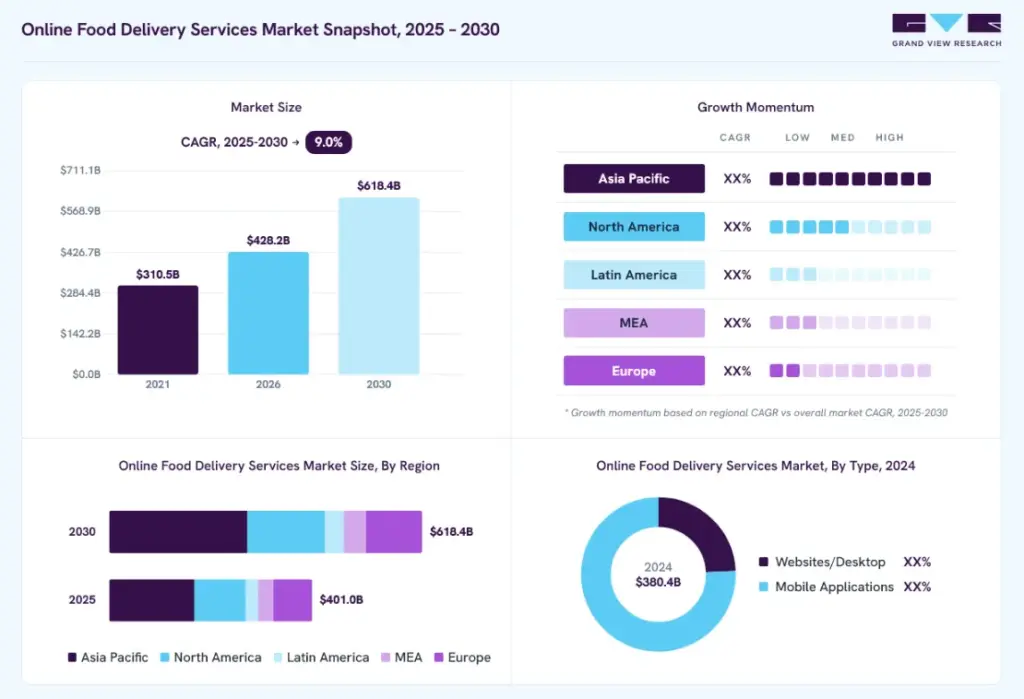
Source: Grandview Research
For investors, this shift means customer acquisition is no longer about convincing people to order online. The market infrastructure already exists. The real opportunity lies in capturing specific niches, serving underserved regions, or providing higher service quality than legacy players.
Diversified Revenue Models
A food delivery platform is a multi-sided marketplace with several ways to generate revenue. Relying solely on delivery charges limits profit margins, but built-in monetization tools create sustainable returns.
- Restaurant Commissions: Taking a percentage cut from each order processed through the platform.
- Subscription Models: Monthly or yearly memberships offering users free deliveries and exclusive perks, similar to the Swiggy One membership model.
- In-App Advertising: Charging restaurants premium fees to feature their listings at the top of search results or offer sponsored promotions.
- Convenience and Service Fees: Small fixed fees added to transactions to cover technology maintenance and operational costs.
- Merchant Services: Offering inventory tools, POS integrations, and financial services to restaurant partners for an added fee.
Diverse revenue streams provide strong financial stability. DoorDash demonstrated the power of this strategy by expanding its marketplace offerings, generating 13.7 billion dollars in revenue in a single year.
AI and Automation Advantages
New entrants can compete with established food delivery platforms without copying their entire model. AI can help smaller platforms operate with lower costs while making smarter decisions. Demand forecasting can help restaurants prepare for busy periods and route optimization can reduce delivery times. Automated support also takes care of routine customer questions so teams can focus on more important issues.
The bigger opportunity is in last-mile delivery. DoorDash is investing in autonomous delivery technology to improve unit economics and reduce operational costs. For new platforms, adopting AI and automation from the start can create a leaner operation and make it easier to reach profitability without carrying the infrastructure limitations of older delivery networks.
How Do Online Food Delivery Apps Work?
Online food delivery service apps connect customers, restaurants, and drivers through a unified digital system. The app coordinates complex logistics in real time to turn a digital order into a hot meal delivered to a doorstep. It also manages payments, order updates, and delivery coordination in the background to keep the entire process running smoothly.
Restaurant Discovery to Order Placement
The customer journey starts with location mapping. Once a user opens the app, GPS instantly filters nearby restaurants, active promotions, and estimated delivery times.
| Stage | What Happens |
| Browsing | Users search for cuisines, dishes, or highly rated restaurants. Dynamic filters help them quickly find relevant local options. |
| Cart & Checkout | Customers choose their meals, customize items, and add delivery instructions before placing the order. |
| Address & Payment | The app confirms the delivery location and supports payment methods such as cards, digital wallets, or cash on delivery. |
When payment clears, the order routes straight to the merchant’s portal, confirming the transaction instantly.
Order Fulfillment and Driver Matching
Restaurant partners receive the order on a dedicated kitchen display or tablet. Staff accept the items and set an estimated preparation time. At the same time, the backend algorithm starts driver matching.
- Proximity: The system locates nearby active couriers.
- Timing: Dispatch algorithms delay alerting drivers until the kitchen is nearly done, avoiding unpaid waiting time.
- Batching: Uber Eats uses smart routing to assign multiple orders along the same route to a single courier, maximizing efficiency.
The driver accepts the job, navigates to the venue, and collects the packaged order.
Payments, Live Tracking, and Settlement
Real-time synchronization keeps customers, restaurants, and delivery partners updated throughout the order. GPS tracking shows the driver’s location and gives customers a more accurate arrival estimate. Push notifications also keep them informed as the order moves from preparation to pickup and finally to delivery.
Once the order is completed, automated payment systems handle the money flow in the background. The platform collects its service fee and transfers the remaining amount to the restaurant while the delivery partner receives their earnings in their digital wallet. This automation helps reduce payment delays and simplifies reconciliation.
Core Features of Online Food Delivery Service Apps
Building a food delivery service app requires balancing user experience, real-time logistics, and scalable tech. By analyzing how top platforms handle ordering, tracking, and AI-driven checkout, investors can focus on the features that actually drive engagement, reduce operational friction, and keep users coming back.
1. Personalized Restaurant and Food Discovery
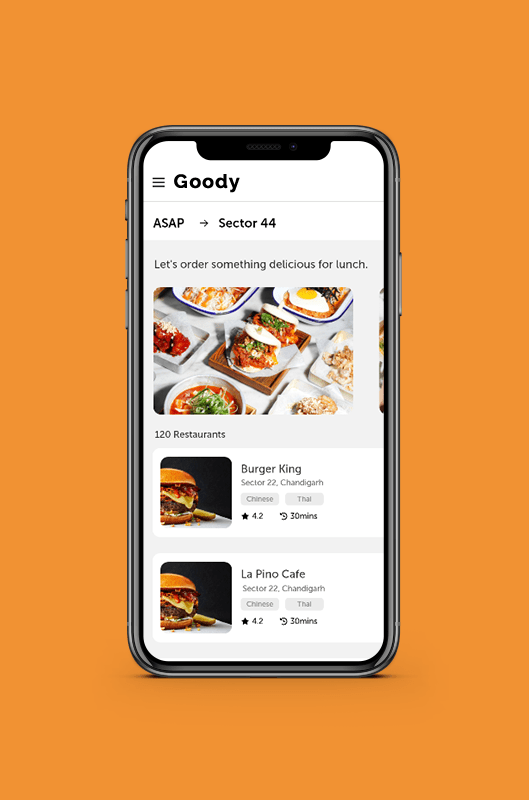
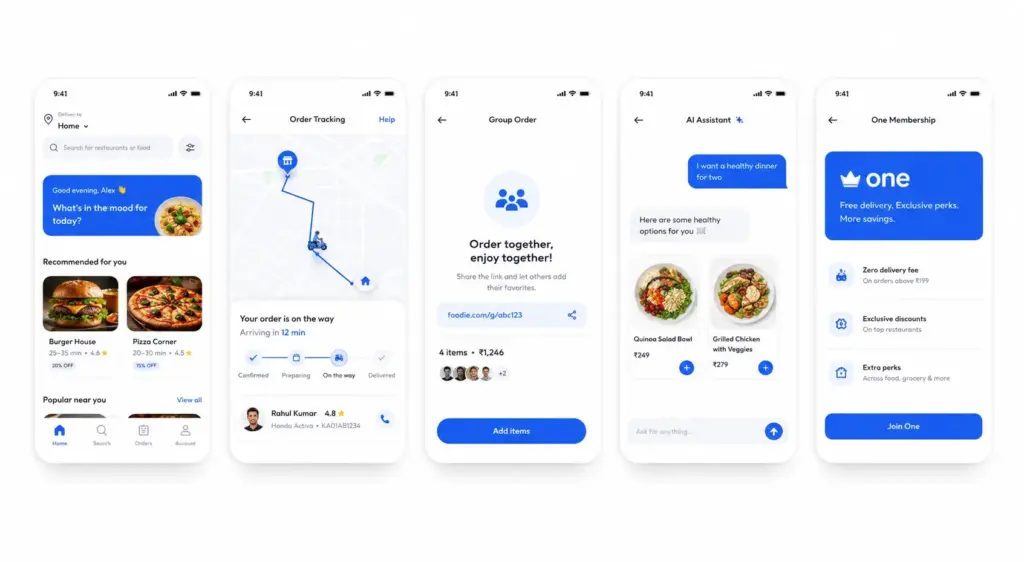
Modern apps keep users engaged by showing relevant options immediately upon opening the screen. Algorithmic discovery boosts conversion rates by reducing the time spent searching for a meal.
- Smart Carousels: Dynamic feeds rank dishes by order history and local preferences.
- Contextual Suggestions: Show specific choices based on time of day, weather, or location.
- Filter Options: Fast sorting by dietary needs, delivery times, and price ranges.
Grubhub uses personalized recommendation carousels driven by past orders, favorite cuisines, nearby merchants, and live delivery times to make restaurant discovery effortless.
2. Order Tracking and Delivery Updates
Visibility eliminates customer anxiety and builds trust. Live maps update order progress from the moment the kitchen accepts the ticket until the driver arrives. Uber Eats uses map-based real-time tracking combined with clear delivery notifications to keep customers updated throughout the entire order journey.
3. Group Ordering for Shared Meals
Group ordering solves the hassle of collecting individual orders manually. Multiple users can add items to a shared cart through a simple share link.
- Shared Carts: Everyone picks their own items on their own devices.
- Split Payments: The host can pay the bill or split costs at checkout.
- Workplace Orders: Easy catering setups for corporate teams and office lunches.
Deliveroo simplifies group dining by allowing friends or co-workers to contribute items to a single order in real time.
4. AI Food and Product Recommendations
Generative AI is turning food delivery and grocery platforms into more personalized shopping assistants. Instead of relying only on search filters, users can describe what they want and receive relevant meal ideas or product suggestions. Instacart’s Cart Assistant takes this further by helping users plan meals and create shopping lists before adding the right products directly to their carts.
5. Memberships That Drive Repeat Orders
Subscription tiers turn occasional buyers into loyal power users. Waiving small service fees encourages higher monthly order frequency.
- Zero Delivery Fees: Free drop-offs on orders meeting a minimum threshold.
- Member Discounts: Exclusive price cuts on top restaurant partners.
- Cross-Platform Perks: Special bonuses that span ride-sharing or partner services.
Swiggy One uses its membership program to lock in repeat usage by offering free deliveries and unique perks across food, grocery, and pick-and-drop services.
6. Multi-Category Ordering Beyond Restaurants
Expanding into neighboring verticals increases overall order volume and keeps delivery fleets busy between meal peaks. DoorDash expanded its core marketplace far beyond restaurants to cover local grocery stores, convenience shops, and retail merchants.
| Category | Key Items |
| Grocery | Fresh produce, pantry staples, dairy |
| Convenience | Snacks, beverages, quick essentials |
| Retail & Specialty | Pet supplies, flowers, over-the-counter medicine |
7. AI Cart Building and Faster Checkout
AI is making food ordering faster by letting users create complete carts with very little manual input. Customers can turn a meal idea or grocery list into an order through text or images while the system checks item availability before checkout. Just Eat has introduced AI features that can convert text prompts and photo-based lists into active carts while using past orders to make repeat purchases even faster.
Best Online Food Delivery Service Apps in the USA
We’ve researched the leading online food delivery service apps in the USA and found several platforms that stand out for their features, convenience, restaurant coverage, and overall user experience. From established names like DoorDash and Uber Eats to specialized services, these apps offer useful insights into what makes a food delivery platform competitive in today’s market.
1. DoorDash
DoorDash is one of the largest food and local-commerce delivery platforms in the U.S. In 2025, the company processed 3.17 billion orders, generated $102 billion in Marketplace GOV, and reported $13.7 billion in revenue, making it a strong benchmark for founders studying how a delivery marketplace can scale.
Standout features:
- AI-powered discovery: Features such as conversational search help customers find restaurants and products using natural-language requests rather than traditional keyword searches.
- DashPass: Its membership ecosystem had more than 35 million members across DashPass, Wolt+ and Deliveroo Plus at the end of 2025.
- Multi-category marketplace: The platform has expanded from restaurant delivery into groceries, convenience, retail and other local-commerce categories.
2. Uber Eats
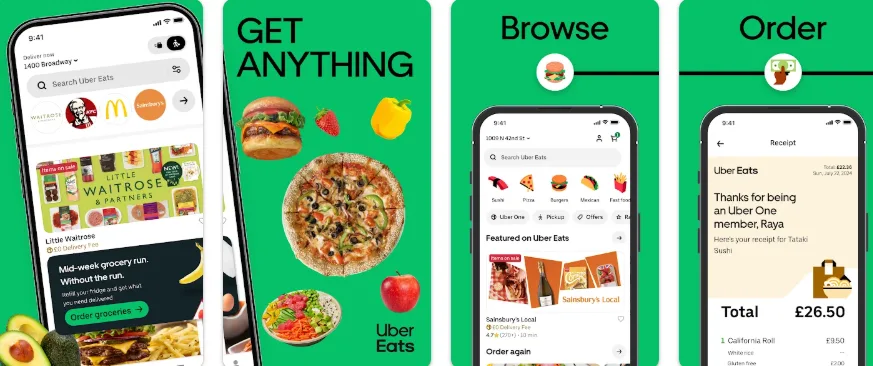
Uber Eats benefits from being part of the broader Uber ecosystem and has grown into a major delivery marketplace. Uber reported $193.5 billion in company-wide Gross Bookings and $52 billion in revenue in 2025, while its Delivery business continued to record double-digit growth in Gross Bookings.
Standout features:
- Real-time tracking: Customers can monitor their order and delivery progress through live location updates.
- Uber One: A subscription model connects food delivery benefits with other Uber services to encourage recurring usage.
- Autonomous delivery: Uber is expanding into delivery through autonomous vehicles, robots and planned drone services.
3. Grubhub
Grubhub remains an important U.S. food-ordering marketplace with a strong focus on restaurant discovery and ordering. While its parent company does not report Grubhub as a standalone U.S. revenue business in the same way public companies such as DoorDash do, its scale makes it useful to study for restaurant marketplace functionality.
Standout features:
- Restaurant discovery: Customers can browse restaurants by cuisine, location, ratings and delivery options.
- Group ordering: Multiple users can contribute to the same order, making the feature useful for offices, families and gatherings.
- Campus and business ordering: Grubhub has expanded beyond individual consumers into university and workplace food programs.
4. Instacart
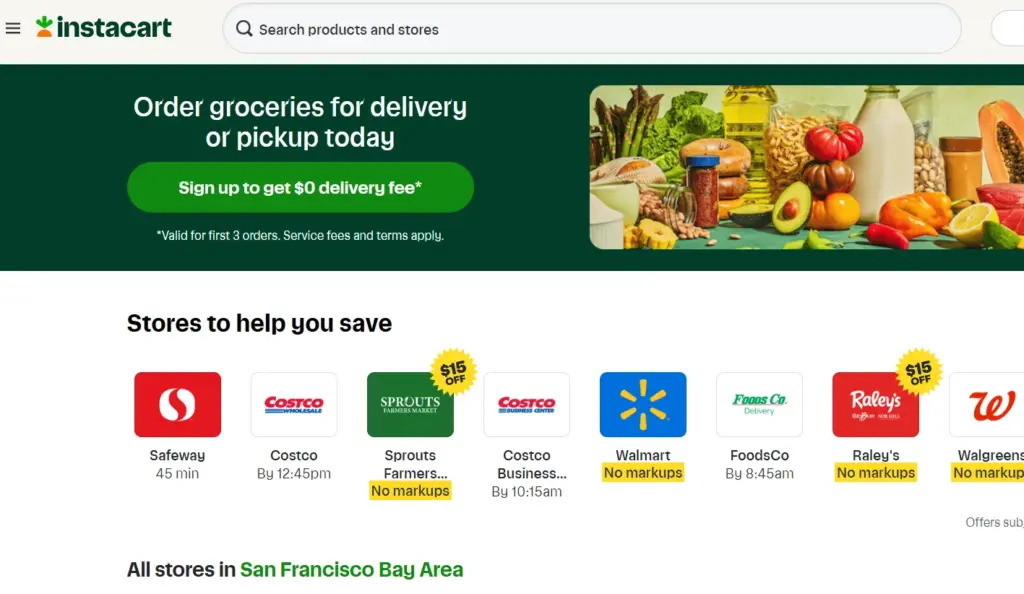
Instacart demonstrates how food delivery can expand from prepared meals into grocery commerce. In 2025, it generated $3.74 billion in revenue, processed 338.8 million orders, and reached $37.2 billion in GTV, with revenue growing 11% year over year. Its scale also shows how combining convenience with personalized shopping can create strong customer retention and recurring order volume.
Standout features:
- AI shopping assistant: Customers can use conversational prompts to discover products and build shopping lists.
- Recipe-to-cart: Meal ideas and recipes can be converted into grocery shopping lists and purchasable products.
- Real-time inventory: The platform connects recommendations with products available from nearby retailers.
5. Postmates
Postmates is an interesting example of how an on-demand delivery platform can move beyond traditional restaurant orders into local commerce. Following its integration with Uber, Postmates’ technology and delivery capabilities became part of Uber’s broader Delivery ecosystem, which generated $18.1 billion in Gross Bookings in Q2 2025, up 20% year over year.
Standout features:
- Local commerce: The model supports delivery from restaurants and other local businesses.
- Multi-category ordering: Customers can use delivery services for food, groceries and everyday products.
- On-demand logistics: Its technology demonstrates how one delivery infrastructure can support different merchant categories.
6. ChowNow
ChowNow takes a different approach by helping restaurants build direct digital ordering channels rather than depending entirely on large marketplaces. Its platform highlights restaurant-level results such as $2 million in annual commission savings for Ollie’s and $2.5 million in total sales for Sushi-Zen.
Standout features:
- Direct ordering: Restaurants can accept orders through branded websites and mobile apps while maintaining a direct customer relationship.
- POS integration: ChowNow supports 20+ POS integrations to automatically route orders and synchronize menus.
- Marketing and loyalty: Restaurants can use customer segmentation, campaigns, email, SMS, and loyalty tools to encourage repeat orders.
7. Caviar
Caviar differentiates itself by focusing on a more curated and premium restaurant marketplace. Its positioning is particularly useful for founders considering a specialized food delivery platform. Caviar reports that its diners spend 55% more per order than the average third-party delivery order, highlighting the potential of premium positioning.
Standout features:
- Curated restaurants: The platform focuses on selected restaurants rather than trying to maximize marketplace breadth.
- Premium positioning: Higher-value orders create a different economics model from mass-market delivery.
- Restaurant discovery: Partnerships with brands such as Michelin, Zagat and The Infatuation help strengthen its food-focused positioning.
8. Seamless
Seamless is closely connected to Grubhub and provides another example of how a delivery brand can build around local restaurant ordering. Rather than having reliable standalone financial figures, it is more useful to evaluate Seamless through its product model and role within the broader Grubhub ecosystem.
Standout features:
- Local restaurant discovery: Customers can search and order from restaurants available in their area.
- Scheduled ordering: Customers can place orders ahead of time instead of ordering only for immediate delivery.
- Group ordering: Shared carts simplify food ordering for offices, families and larger groups.
9. Slice
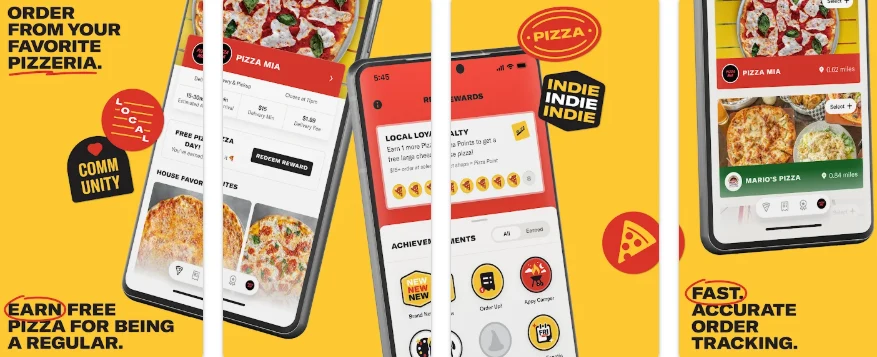
Slice uses vertical specialization as its competitive advantage by focusing heavily on independent pizzerias. Rather than competing as another general-purpose marketplace, it provides ordering, POS, marketing and operational tools specifically for pizza businesses. One Slice case study reports that Nino’s generated $4 million+ in online sales across 73,000+ orders through the platform.
Standout features:
- Pizza-focused marketplace: Specialization creates a more targeted discovery experience for pizza customers.
- Restaurant technology: Slice combines ordering, POS, marketing and operational tools for pizzerias.
- Direct ordering economics: The platform helps independent restaurants reduce dependence on high-commission third-party marketplaces.
10. Favor
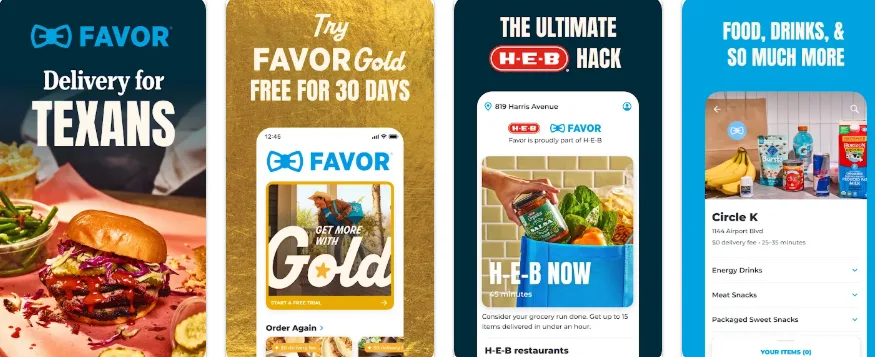
Favor provides a useful example of a regional delivery strategy, with its operations centered on Texas. Unlike publicly traded platforms, Favor does not regularly publish audited standalone revenue figures, so third-party revenue estimates should be treated cautiously. One business-data provider currently estimates annual revenue at approximately $619.5 million, but this is not company-reported financial data.
Standout features:
- Regional focus: Concentrating on a specific market can help a platform develop stronger local delivery density.
- Personalized delivery: Favor has historically positioned its service around a more personal delivery experience.
- Multi-category delivery: The platform extends beyond restaurant meals into other local delivery needs.
Food Delivery Service Apps That Recently Got Fundings
Capital continues to flow into new food delivery models. Investors are showing strong interest in startups that can deliver faster and use technology to improve logistics. This creates opportunities for new platforms to enter the market with more efficient business models. This funding is also helping startups experiment with automation and broader services that can improve long-term profitability.
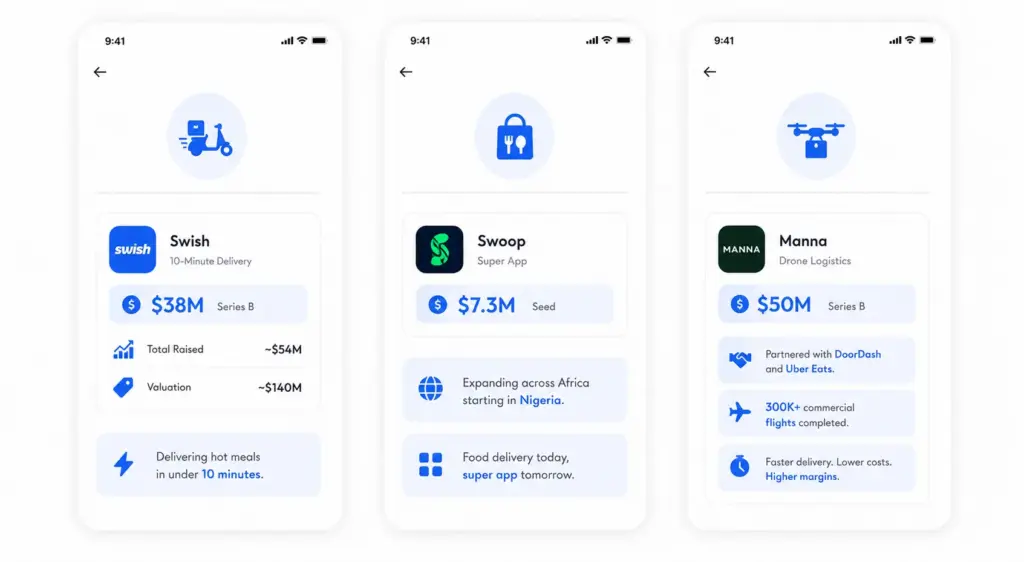
1. Swish Secures $38M for 10-Minute Delivery
Swish is building its food delivery model around speed and hyper-local operations. The Bengaluru startup raised $38 million in Series B funding, taking its total capital raised to around $54 million and its valuation to nearly $140 million. Its focus on dark kitchens, automated food preparation, and stronger supply chains supports its goal of delivering hot meals in under ten minutes. This approach shows why ultra-fast delivery is attracting investor interest in busy urban markets.
2. Swoop Raises $7.3M for African Super App
Eswatini-based Swoop secured $7.3 million in seed funding to launch operations in Nigeria. The company uses food delivery as an entry point to build a multi-service super app. Venture firms are backing platforms that start with high-frequency meal orders, then cross-sell other on-demand services to boost lifetime customer value.
3. Manna Lands $50M for Drone Logistics
Irish drone startup Manna raised $50 million in Series B capital to scale autonomous air delivery across major markets.
- Strategic Alliances: Partnered directly with industry giants DoorDash and Uber Eats for last-mile integration.
- Proven Scale: Already completed over 300,000 commercial flights before expanding into US markets like Tulsa.
- Investor Appeal: Drones significantly lower per-delivery labor costs while slashing fulfillment times.
Autonomous air logistics offers early-stage platforms a clear path toward sustainable, long-term profit margins.
Build a Food Delivery Service App with IdeaUsher
IdeaUsher turns ambitious concepts into high-performing digital products. With over 500,000 hours of coding experience, our team of ex-MAANG developers builds custom delivery ecosystems engineered for reliability, fast scaling, and real-world profitability. We combine product strategy, AI capabilities, and scalable engineering to help businesses launch with confidence and grow without technical limitations.
Turn Your Food Delivery Idea
Launching a successful food delivery platform is about getting the core experience right before adding more features. A lean MVP lets you validate your business model, understand how customers and restaurants use the platform, and invest in the areas that show the most potential. Starting with a focused product also helps you reach the market faster and improve the app using real user feedback instead of assumptions.
Integrate Smart AI Capabilities
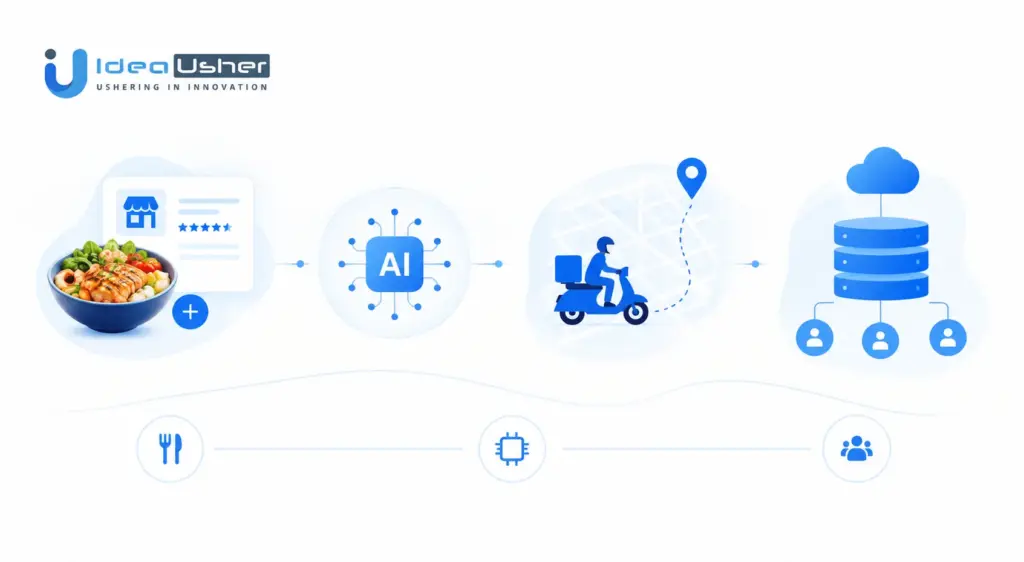
Integrating artificial intelligence transforms traditional apps into proactive service networks. IdeaUsher builds custom AI modules directly into your backend architecture.
- Tailored Recommendations: Machine learning suggests relevant dishes based on past preferences and local dining trends.
- Predictive Dispatch: Algorithms estimate kitchen preparation times and traffic delays to keep deliveries prompt.
- Smart Logistics: Dynamic route plotting cuts driver fuel consumption and shortens transit times.
- Automated Support: AI tools resolve common order tracking issues instantly to save overhead costs.
Data-driven operations give new platforms a distinct edge over slower legacy competitors.
Multi-Sided Architecture for Scaling
A food delivery business relies on four distinct portals working together in sync. IdeaUsher engineers a connected marketplace that scales seamlessly as order volume accelerates. Our scalable architecture ensures your platform handles heavy peak-hour traffic, multi-currency payouts, and regional expansions without performance lag.
| Portal | Core Functionality |
| Customer App | Smooth browsing, secure multi-method checkout, and real-time order tracking |
| Merchant Hub | Live order management, dynamic menu controls, and kitchen prep notifications |
| Driver App | Smart route navigation, earnings dashboards, and single-tap order acceptance |
| Admin Panel | Multi-zone management, commission payouts, and deep business analytics |
Conclusion
The best online food delivery service apps are raising the bar for convenience and speed. Their success shows that customers now expect a smooth experience beyond basic food ordering. For new platforms, the key is to focus on features that genuinely improve the customer journey and give users a reason to come back. A strong platform should also make ordering easier while helping restaurants and delivery partners operate more efficiently.
Things to Know About Food Delivery Service Apps
A1: Food delivery apps can follow different models depending on the target market and business goals. A multi-restaurant marketplace connects customers with many restaurants, while a single-restaurant app focuses on direct ordering for one brand. There are also niche platforms built around specific cuisines, dietary needs, locations, or delivery models.
A2: Most food delivery platforms combine several revenue sources instead of relying on a single fee. Restaurant commissions and customer delivery fees are common, while subscriptions, sponsored listings, advertising, and service fees can create additional revenue. The right mix depends on your marketplace size and operating costs.
A3: A strong platform typically needs restaurant discovery, menu browsing, cart and checkout, payments, order management, notifications, and delivery tracking. Behind the customer experience, you also need restaurant and delivery-partner interfaces plus an admin dashboard to manage the marketplace.
A4: The cost depends heavily on whether you are building a single-restaurant app or a multi-sided marketplace. A basic MVP requires far less than a platform with separate customer, restaurant, delivery-partner, and admin systems. Real-time tracking, payment integrations, AI features, and advanced logistics can increase the investment significantly.