

Key Takeaways
- A vertical drama app usually takes 8–12 weeks for an MVP, 4–6 months for a custom platform, and 6–12+ months for an enterprise solution, depending on the scope.
- The short-form vertical drama app development timeline depends on video streaming, episode unlocking, CMS, personalization and scalable infrastructure, making it more complex than a basic OTT app.
- Key factors include feature scope, platforms, custom vs. prebuilt architecture, monetization and the level of personalization required.
- A focused MVP should start with 9:16 playback, swipe navigation, content discovery, watch history, CMS, notifications and basic coin-based monetization.
- Streaming infrastructure can add 4–8 weeks because of transcoding, CDN setup, adaptive bitrate streaming, preloading and load testing.
A vertical drama app does not become market-ready when the interface is finished. The real timeline is shaped by everything required to make viewers discover, watch and unlock episodes without friction. For founders planning a vertical drama app development timeline, this means accounting for video infrastructure, content operations, monetization logic and the product systems that turn short viewing sessions into repeat behavior.
Traditional OTT development usually focuses on catalogs, subscriptions and long-form playback. Vertical drama apps demand a different architecture. It requires 9:16 streaming and swipe-based discovery, along with adaptive playback, episode unlocking, recommendations, analytics and scalable content delivery. All these elements must work together from the start.
In this blog, we will talk about the short-form vertical drama app development timeline, development phases, feature priorities, technology requirements, testing, launch considerations and the factors that can accelerate or extend the build.
What Is A Vertical Drama App And Why Is It Growing?
A vertical drama app delivers short, serialized episodes, typically 60 to 90 seconds each, shot in 9:16 format and built for mobile-first, swipe-based viewing. Each episode ends on a cliffhanger, prompting viewers to unlock the next installment with coins or a subscription rather than wait for a weekly broadcast slot.
That format, once a China-only mobile niche known as duanju, has become one of the fastest-growing categories in digital entertainment, pulling in serious commercial investment as it scales globally.
A. How Fast Is The Global Vertical Drama Market Growing?
The short-vertical drama content app market is projected to grow from $3.91 billion in 2025 to $4.64 billion in 2026 and will reach $9.18 billion by 2030, at a CAGR of 18.9%. This growth highlights the rising demand for mobile-first, short-form entertainment and creates strong opportunities for platforms that can scale content efficiently.
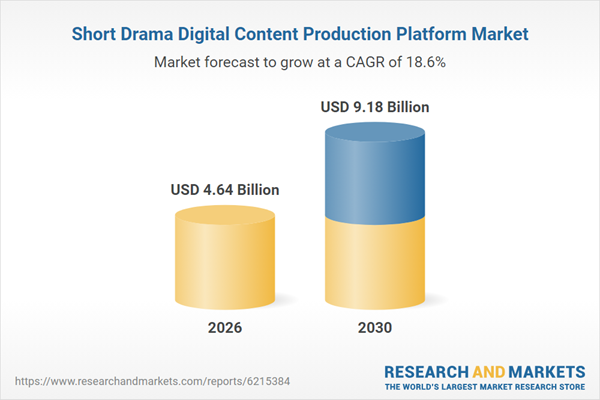
A broader view of the full content production pipeline, covering scriptwriting, studio production and distribution, puts the market at $4.64 billion in 2026, expanding to $9.18 billion by 2030 at nearly 19% annually, according to Digital Yield Group.
B. What Is Driving Demand For Vertical Drama Platforms?
Audience behavior is shifting in a direction that favors this specific format, not just video apps in general.
- Mobile-first entertainment consumption: ReelShort users spend more time in-app daily than mobile users of Netflix, Disney+, or Prime Video, according to Sensor Tower’s State of Mobile 2026 report.
- Shorter attention windows: Average daily time across short drama apps reached 25 minutes globally by April 2026, up 85% from January 2025, according to Sensor Tower.
- Serialized cliffhanger-based storytelling: More than 830 million viewers consume microdramas in China, with nearly 60% paying or transacting, according to Media Partners Asia.
- Increasing willingness to pay for individual episodes: Global in-app revenue nearly quadrupled year over year in Q1 2025, reaching roughly $700 million in one quarter, per Sensor Tower data.
- Growth of localized and dubbed content: AI dubbing and lip-sync pipelines can add a new language for roughly $50–$150 per episode, making regional localization commercially viable at scale, according to MinionArts.
- Social-media-style discovery experiences: Google TV added dedicated microdrama discovery tools in March 2026, treating the format as its own content category rather than a subset of streaming, per Plot Party.
C. Why Are Businesses Investing In Vertical Drama Apps?
Audience growth is only half the story. The economics behind vertical drama are pulling in production studios, platforms, and investors for reasons that go beyond download charts.
- New monetization opportunities: ReelShort grew from roughly $36 million in revenue in 2023 to about $1.2 billion in gross consumer spend in 2025.
- Lower episode production costs than traditional TV: A full 80-episode US vertical drama season can cost around $150,000, or roughly $1,875 per episode, versus $3 million to $8 million per episode for standard scripted network drama, according to Filmustage and C&I Studios.
- Global content distribution: More than 10,000 AI-generated microdrama titles reportedly release monthly in China alone, with Western platforms increasingly commissioning AI-native series for international audiences, per MinionArts.
- Subscription and coin-based revenue: DramaBox generated $323 million in revenue and $10 million in net profit in 2024, showing coin-and-subscription models can be profitable, not just scalable.
- Opportunities for creator-led content: Vigloo launched a 2026 creator dashboard giving independent producers visibility into coin and subscription revenue splits, payouts, and audience data.
- Personalized content discovery: With the top five platforms capturing 68.8% of category revenue from just 28.8% of downloads, recommendation systems that drive retention have become critical to converting audience reach into revenue.
How Long Does It Take To Build A Vertical Drama App?
Building a vertical micro-drama app takes anywhere from a few weeks for a re-skinned white-label deployment to 4–6 months for a custom production-ready platform, while advanced enterprise ecosystems with AI-driven feeds and studio portals require 6 to 12+ months.
The exact timeline depends on whether you are launching a lean proof-of-concept to validate script retention or building a custom media delivery engine with server-side coin ledgers and sub-300ms playback pre-fetching.
A. Vertical Drama App Development Timeline At A Glance
The vertical drama app development timeline depends on project scope, technical complexity and customization. The table below shows typical timelines for launching platforms from white-label deployments to enterprise-grade systems.
| Development Scope | Estimated Timeline | Core Technical Deliverables |
| White-Label Deployment | A few weeks | Turnkey script re-skinning, basic cloud CDN configuration, App Store and Google Play submissions. |
| Lean MVP | 8–12 weeks | Flutter/React Native, 9:16 vertical swipe player, core HLS streaming, static paywalls, basic coin wallet. |
| Mid-Scale Custom App | 4–6 months | Memory pre-fetching, server-side IAP receipt validation, rewarded ad mediation, weekly VIP passes, batch episode CMS. |
| Advanced Custom Platform | 6–9 months | Swift + Kotlin playback optimization, dynamic remote paywalls, studio royalty dashboards, subtitle sync, second-by-second analytics. |
| Enterprise-Grade Platform | 9–12+ months | Widevine & FairPlay DRM, real-time vector recommendations, multi-region CDN origin shields, automated transcoding pipelines. |
B. Why Vertical Drama Apps Take Longer Than Basic OTT Apps
Conventional Over-The-Top (OTT) platforms are essentially relational catalog browsers: a user navigates a grid, selects a title, buffers a single 45-minute file for 3 to 4 seconds, and watches passively.
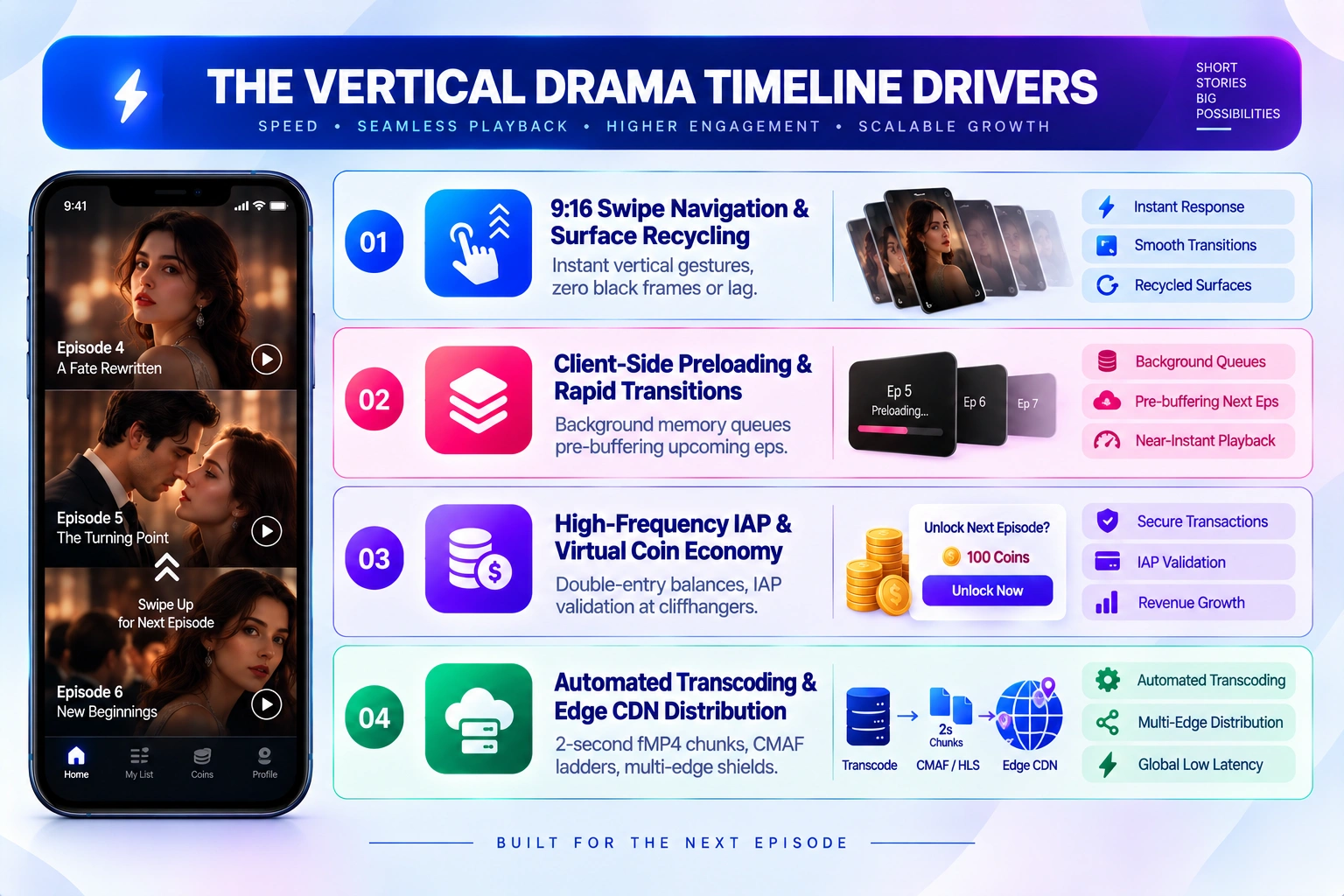
A vertical drama platform introduces engineering complexities across eleven interdependent systems that traditional streaming apps never have to address:
- 9:16 Video Playback & Swipe Navigation: Fluid full-screen swiping requires recycling native video surfaces, such as SurfaceView or AVPlayerLayer. Re-instantiating players causes memory leaks and frame drops, requiring custom gesture handling.
- Rapid Episode Transitions & Video Preloading: Eliminating loading spinners requires a custom pre-fetch engine that loads the first 2–4 seconds of upcoming episodes while the current episode plays, enabling instant stream switching.
- Adaptive Streaming & High-Volume CDN Delivery: Micro-dramas require 2-second HLS/CMAF chunks across a 4-tier bitrate ladder from 1080p to 360p. Edge CDNs need dedicated tuning to handle rapid requests without latency or origin overload.
- Coin-Based Unlocking & Paywalls: Short-drama apps require double-entry ledgers, Apple StoreKit 2 and Google Play Billing webhook validation, and dynamic unlock rules, such as 25 coins versus a 30-second rewarded ad.
- Batch Content CMS & Operational Workflows: A custom CMS enables parallel multi-part S3 uploads, automated .srt/.vtt subtitle synchronization, and scheduled release calendars for bulk episode publishing.
- Personalization & Second-by-Second Telemetry: Analytics must stream granular events such as heartbeat_5s, cliffhanger_reached, and paywall_exit to map narrative drop-offs and trigger real-time recommendation re-ranking.
Coordinating these high-performance media layers with financial microtransactions is what stretches custom vertical drama development beyond standard app timelines.
What Determines Your Vertical Drama App Timeline?
While external factors like Apple App Store review cycles or third-party API changes play a role, the launch date of a vertical drama platform is primarily shaped by decisions made during product scoping.
Understanding the trade-offs across these five variables allows founders to protect their go-to-market schedules without compromising playback performance or core monetization mechanics.
1. Feature Scope And Product Complexity
Every feature added to the scope does not just require initial coding hours, it expands integration complexity, edge-case handling and QA cycles and ultimately affecting in vertical drama app development timeline.
Core MVP Scope: A focused feature set such as vertical swipe playback, an in-app coin wallet, static episode paywalls, and a basic CMS, keeps codebases lean and limits automated testing matrices.
Secondary Complexity Multipliers: Adding social features, VIP tiers, streak bonuses, or branching storylines extends sprint cycles by creating complex state-management edge cases across the mobile player, database, and analytics pipeline.
Testing & QA Overhead: In streaming apps, QA is not just functional testing; it requires latency benchmarking, testing variable mobile cellular handoffs (5G to degraded 3G), and stress-testing background memory pre-fetching across lower-end hardware.
2. Number Of Platforms You Want To Launch
Targeting multiple operating systems expands engineering, device certification, release synchronization requirements and vertical drama app development timeline:
| Platform Strategy | Timeline Impact | Technical & Operational Reality |
| Single Platform (iOS Only) | Fastest Baseline | Simplest QA matrix; uniform Apple hardware decoders and standardized StoreKit 2 IAP integration. |
| Single Platform (Android Only) | +2 to 3 weeks vs iOS | Larger QA matrix due to device fragmentation, varying screen aspect ratios, and divergent GPU decoders. |
| Dual Mobile (iOS + Android) | +4 to 8 weeks (or cross-platform) | Managing dual app store guidelines, parallel Google Play Billing and Apple StoreKit webhooks, and device-specific testing. |
| Mobile + Responsive Web | +3 to 5 weeks | Web requires building a browser-based 9:16 player, managing CORS policies, desktop mouse-wheel/swipe emulation, and Stripe/web checkout flows. |
| Mobile + Web + Smart TVs | +8 to 14+ weeks | Unnecessary for micro-dramas. 9:16 vertical content looks awkward on 16:9 television screens; remote-control navigation breaks the rapid vertical swipe impulse loop. |
3. Custom Development Vs Prebuilt Architecture
The choice between starting with a custom build short-form drama app or leveraging pre-engineered streaming modules is the single largest timeline lever available to founders:
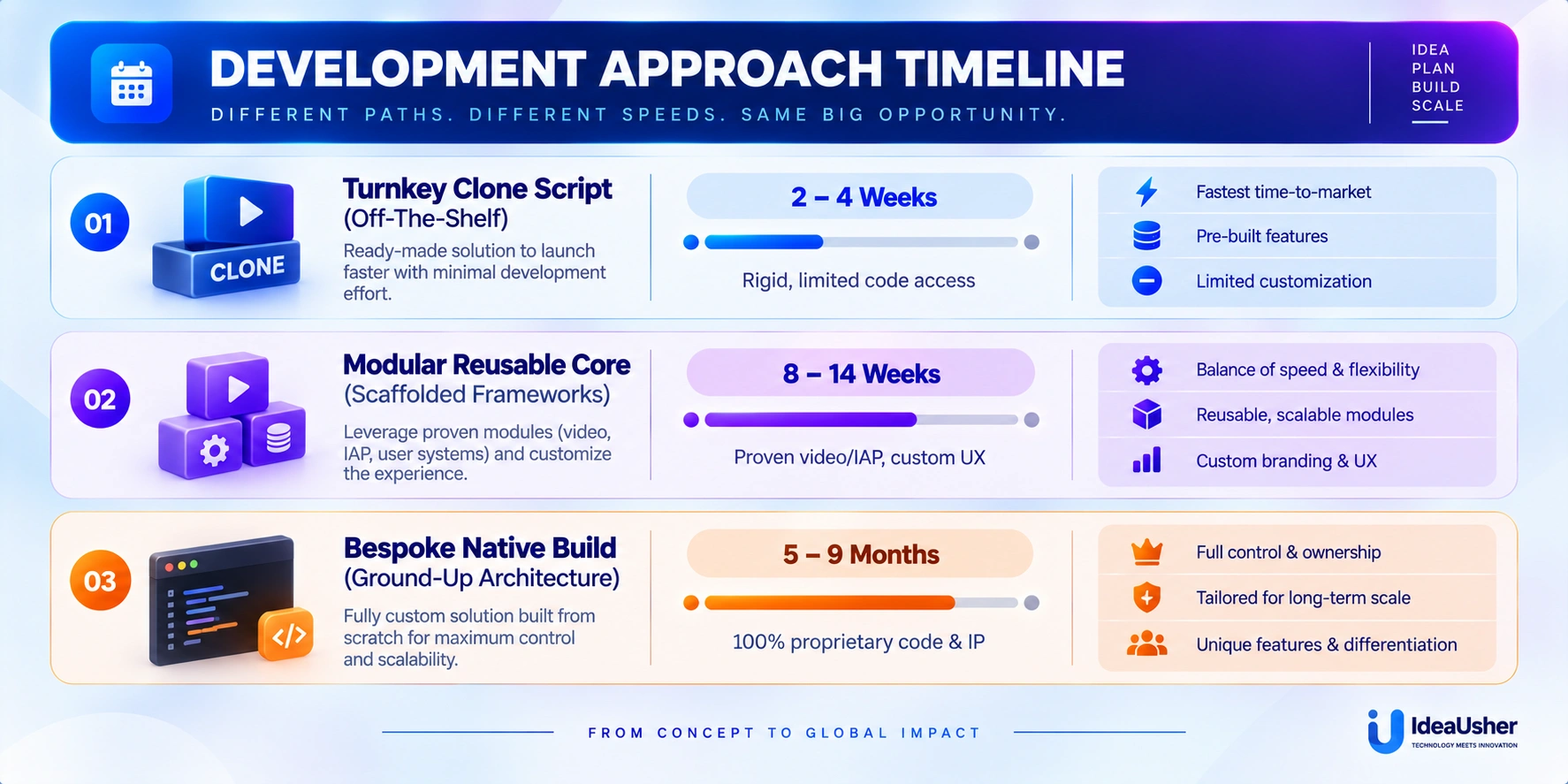
Ground-Up Custom Engineering: Building the media transcoding pipeline, client pre-fetch logic and ACID-compliant coin ledger from scratch delivers complete intellectual property control, but requires extensive sprint planning and integration testing.
Accelerated Modular Frameworks: Seasoned teams use proven architectural frameworks like backend templates, player modules and payment webhooks to gain the speed of reusable code while maintaining source code ownership and UI/UX customizability.
4. Your Monetization Model
The complexity of your revenue engine dictates the depth of backend database logic and payment gateway integration:
- Ad-Supported Only (AVOD) (Fastest to implement): Rewarded video SDKs such as Google AdMob and AppLovin, with basic server-to-server callbacks, avoid financial ledgers and bank compliance.
- Subscriptions Only (SVOD) (Moderate complexity): Requires StoreKit and Google Play subscription lifecycle management for renewals, cancellations, grace periods, and billing retries.
- Virtual Coin Economy & Pay-Per-Episode (TVOD) (High complexity): Requires an audit-grade double-entry ledger, cryptographic receipt validation, separate wallets for purchased and promotional coins, and real-time micro-deductions at episode boundaries.
- Hybrid Monetization (Highest complexity): Unified entitlement logic must verify VIP status, coin balance or ad-supported unlock eligibility, adding 3–5 weeks of development and regression testing.
5. How Much Personalization You Need
Algorithmic discovery can range from simple editorial curation to real-time machine learning pipelines:
- Curated Content Feeds (Day 1 Ready): Editors manually assign series to categories like “Trending Now,” “Billionaire Romance,” or “New Releases.” Zero algorithmic overhead; sets up in days.
- Rule-Based Recommendations (+1 to 2 weeks): Relies on deterministic database queries (e.g., “If viewer finished Series A, display Series B which shares the same 3 genre tags”). High ROI for catalogs under 30 titles.
- Behavioral Recommendations (+3 to 5 weeks): Incorporates user telemetry such as completion rate percentages, skip velocity, and time-of-day viewing to dynamically adjust feed rankings in Redis.
- AI-Powered Vector Personalization (+6 to 10+ weeks): Involves building two-tower neural network embeddings, real-time Kafka feature streaming, and vector database similarity search (e.g., Pinecone or Milvus). Recommended only for platforms with extensive content libraries and established data pipelines.
Vertical Drama App Development Timeline By Project Scope
A vertical drama app development timeline reflects technical scope, architecture, and risk management. Rushing an enterprise platform in two months causes instability, while taking nine months for a basic MVP wastes valuable runway.
Aligning your target release date with a defined milestone ensures you launch with a stable codebase that matches your current business stage.
A. 8 – 12 Weeks For A Focused Vertical Drama MVP
The objective of an MVP is to validate audience appetite, narrative retention, and basic customer acquisition costs (CAC) with minimal technical overhead.
1. Included Core Features
These core features create a functional MVP with essential playback, navigation, content management, user access, monetization and analytics capabilities.
- Vertical 9:16 Video Player: Seamless full-screen playback supporting gesture-driven vertical swiping between episodes.
- Swipe-Based Navigation: Fast scrolling transitions designed for one-handed mobile engagement.
- User Registration & Guest Access: Frictionless onboarding via Apple Sign-In, Google OAuth, and anonymous device guest IDs.
- Content Discovery & Trays: Standard home screen featuring manual editorial carousels (“Trending Now,” “New Releases,” “Romance”).
- Watch History & Favorites: Basic local bookmarking allowing users to resume where they left off and favorite active series.
- Basic Video CMS: Web dashboard for uploading MP4s, ordering episode sequences, and setting series descriptions.
- Push Notifications: Standard automated reminders for daily check-in bonuses and new series alerts.
- Basic Monetization: In-app purchase (IAP) integration for 3 to 4 coin pack bundles and hardcoded paywalls (e.g., Episodes 1–5 free; remainder locked).
2. What Founders Should Deliberately Leave Out
To protect the 8-to-12-week vertical drama app development timeline window, cut secondary features that do not validate the core story-consumption loop:
- Omit Custom AI Recommendation Models: Use simple chronological or tag-based queries. You do not need deep learning when your catalog contains fewer than 25 series.
- Omit Social Mechanics: Comments, chat rooms, user forums, and direct messaging distract from the single goal of getting viewers to swipe into the next episode.
- Omit Complex Multi-Tier VIP Passes: Launch exclusively with pay-per-episode coin packs. Subscriptions introduce complex billing-retry logic and churn handling that can delay delivery by several weeks.
- Omit Studio Partner Portals: Manage licensing agreements and revenue splits manually via spreadsheets during pilot stages.
B. 4 – 6 Months For A Mid-Scale Custom Platform
A mid-scale platform shifts focus from raw validation to optimizing playback performance, scaling catalog management, and improving user lifetime value (LTV).
| Platform Component | Technical Deliverable | Engineering Focus |
| Streaming Performance | Client-side RAM pre-fetching & multi-rendition HLS | Sub-300ms playback startup; elimination of loading spinners on mobile cellular networks. |
| Monetization Engine | Server-side double-entry coin wallet & dynamic paywalls | Cryptographic receipt validation (StoreKit 2 / Google Play Billing webhooks) to prevent piracy. |
| Subscription Tiers | Auto-renewing weekly and monthly VIP passes | Recurring billing lifecycle, grace period handlers, and cross-platform entitlement sync. |
| Ad Mediation | Rewarded video ads (AdMob / ironSource / AppLovin) | Server-to-server (S2S) callbacks allowing non-paying users to unlock episodes by viewing ads. |
| Advanced Video CMS | Bulk multi-part uploader with automated transcoding hooks | Batch-processing 80+ episodes simultaneously with automated HLS ladder generation. |
| Multi-Language Support | Subtitle synchronization engine (.srt / .vtt) | User-facing language selectors and regional metadata mapping for international viewers. |
| Recommendation Logic | Behavioral session-based heuristic ranking | Dynamic sorting based on completion rate percentage, drop-off velocity, and genre affinities. |
| Granular Analytics | Second-by-second drop-off tracking | Pinpoints the exact narrative moments and episode boundaries where users abandon the app. |
C. 6 – 12+ Months For An Enterprise Vertical Drama Platform
An enterprise-grade platform is built for global distribution, multi-tenant rights management, massive concurrency, and defense against digital video piracy.
- Two-Stage AI Recommendation Engine: Production deployment of deep learning recommenders, such as Two-Tower networks or Transformers, with real-time Kafka feature streams to dynamically re-rank feeds using in-session micro-signals.
- Multi-Tenant Studio & Creator Dashboards: Self-service portals enable production houses to upload series, analyze viewer retention, and track automated revenue-share payouts.
- Global Multi-Region Payment Infrastructure: Integration of regional alternative payment methods (APMs), including UPI in India, Pix in Brazil, and Southeast Asian e-wallets, alongside standard app store billing.
- Multi-Language Dubbing & Multi-Audio Switching: Cloud infrastructure supports multi-track audio, AI-assisted voice dubbing, and dynamic right-to-left (RTL) localized layouts.
- Studio-Grade Digital Rights Management (DRM): Integration with Apple FairPlay and Google Widevine license servers, combined with OS-level screen-recording blocks such as FLAG_SECURE, helps prevent content ripping.
- High-Throughput CDN Architecture: Multi-CDN origin-shield configurations using AWS CloudFront, Fastly, and Cloudflare, with edge routing and byte-range optimization, support millions of simultaneous video requests.
Vertical Drama App Development Timeline By Phase
Building a vertical short-drama platform requires a coordinated engineering sequence spanning seven development stages. While individual phases range from one week to three months, they are executed iteratively rather than sequentially.
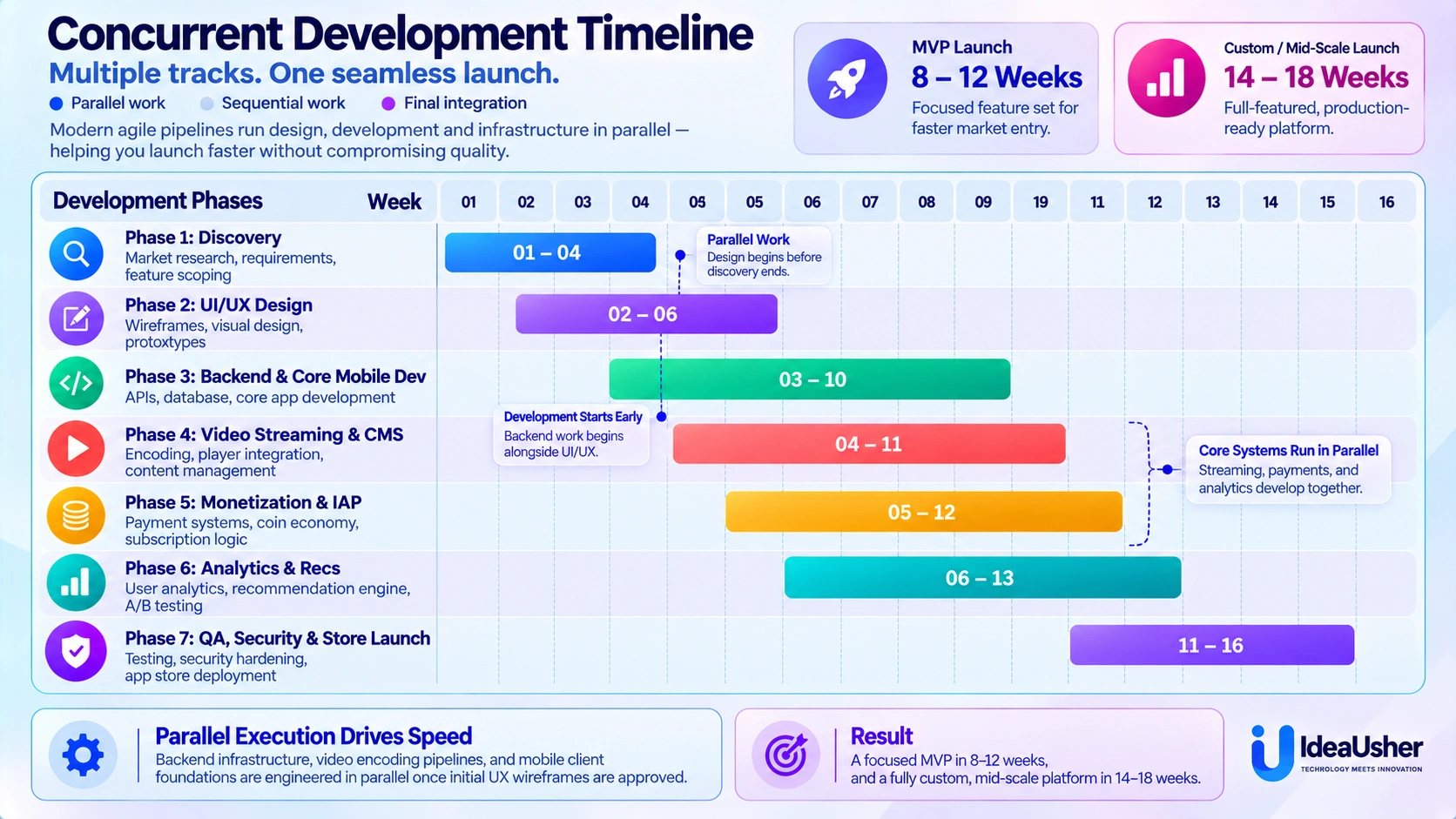
Backend infrastructure, video encoding pipelines, and mobile client foundations are engineered in parallel once initial UX wireframes are approved. This vertical drama app development timeline overlap allows a focused MVP to launch in 8 to 12 weeks, while a fully custom, mid-scale production platform typically goes live in 14 to 18 weeks.
1. Discovery And Product Planning — 1–2 Weeks
The discovery phase establishes the technical specifications, architectural boundaries, and financial model before design or coding begins:
- Business Model & Monetization Strategy: Locking down the primary revenue engine (pay-per-episode coin packs, weekly/monthly VIP passes, rewarded ads, or a hybrid structure).
- Target Audience & Content Strategy: Defining core genre tropes (e.g., billionaire romance, revenge, werewolf fantasy), target geographic territories, and release cadence.
- Platform Selection: Deciding between a unified cross-platform build (Flutter / React Native) for rapid time-to-market or dual-native builds (Swift + Kotlin) for low-level media hardware access.
- Feature Prioritization & Technical Requirements: Defining the line between Day-1 launch requirements and Phase 2 backlog items to protect timelines and engineering budgets.
2. UX/UI Design — 2–4 Weeks
Design for short-drama apps centers around high-engagement mobile mechanics rather than traditional browsing menus:
- Vertical Viewing & Swipe Physics: Prototyping edge-to-edge 9:16 video viewports with fluid vertical gesture mechanics that mirror TikTok-style interactions.
- Episode Progression & Cliffhanger Modals: Designing non-intrusive slide-up paywall sheets triggered at the 55-second mark of locked episodes.
- Coin Wallet & Instant Top-Up: Crafting two-tap native checkout sheets for purchasing coin bundles without forcing the user out of the active video playback screen.
- Content Discovery & Personalized Feeds: Structuring auto-playing teaser reels, curated genre carousels, and continuing-watch shelves.
3. Backend And Core App Development — 6–12 Weeks
This is the primary engineering track. Mobile client development and backend engineering proceed concurrently:
- Parallel Engineering Tracks: Backend engineers construct REST/GraphQL APIs, database schemas, and microservices while mobile engineers build the frontend UI shell, local state management, and gesture handlers using mocked API responses.
- Data Architecture: Deploying relational databases (PostgreSQL) for user data and financial ledgers, alongside Redis for sub-millisecond session caching and real-time view counts.
- Core App Modules: Building user authentication (Apple Sign-In, Google OAuth, SMS OTP, guest device IDs), watch history tracking, user profile management, and deep linking for performance ad attribution.
4. Video Streaming And CMS — 3–6 Weeks
Video infrastructure engineering focuses on low-latency delivery and back-office editorial controls:
- Ingest & Automated Transcoding: Cloud storage (AWS S3) and automated transcoding pipelines (AWS Elemental MediaConvert or FFmpeg) encode master files into multi-bitrate HLS ladders (1080p, 720p, 480p, 360p) with 2-second segments.
- CDN Configuration: Global edge CDNs (CloudFront, Fastly) use origin-shield architectures, aggressive caching for early free episodes, and byte-range request support.
- Administrative Video CMS: An editorial web console supports bulk uploads of 80+ episodes, subtitle synchronization (.srt/.vtt), and scheduled episode-drop calendars.
5. Monetization And Payment Integration — 2–5 Weeks
Monetization modules require audit-grade financial security to prevent client-side currency manipulation:
- In-App Purchases (IAP): Integrating Apple StoreKit 2 and Google Play Billing for coin bundles and auto-renewing weekly VIP passes.
- Server-Side Receipt Validation: Building backend webhook listeners to verify cryptographic purchase signatures directly with Apple and Google before crediting coins.
- Virtual Coin Wallet Ledger: Implementing a double-entry database ledger separating purchased coins from expiring reward tokens.
- Rewarded Ad Mediation: Integrating AdMob, ironSource, or AppLovin SDKs with Server-to-Server (S2S) callback verification to grant free episode unlocks.
6. Recommendations And Analytics — 2–6 Weeks
The vertical drama app development timeline for discovery mechanics varies based on algorithmic complexity:
| Capability Tier | Engineering Effort | Technical Implementation |
| Basic Analytics & Heuristics | 2–3 Weeks | Event tracking (playback_start, heartbeat_5s, paywall_exit) feeds ClickHouse/BigQuery. Feed sorting uses manual curation, trending tags and completion rates. |
| AI-Powered Recommendation Engine | 4–6+ Weeks | Real-time feature streaming (Kafka), Two-Tower embeddings and Pinecone/pgvector retrieval dynamically re-rank feeds using in-session skip and watch telemetry. |
7. QA, Security And App Store Launch — 2–4 Weeks
Before commercial launch, the platform undergoes comprehensive quality verification and app store compliance reviews:
- Streaming & Load Testing: Simulating network handoffs (switching from 5G to degraded 3G) and testing player pre-fetching queues under load to ensure sub-400ms startup times.
- Device Fragmentation QA: Validating video surface recycling across diverse Android GPU chipsets and iOS screen aspect ratios to catch memory leaks and frame drops.
- Security & DRM Auditing: Testing tokenized signed URLs, FairPlay/Widevine DRM licensing, and OS-level screen-recording blockers (FLAG_SECURE).
- App Store Submissions: Managing Apple App Store and Google Play reviews, verifying compliant IAP digital coin disclosures, and executing staged rollouts.
How Video Streaming Architecture Changes The Timeline
A micro-drama app is not an e-commerce catalog or a standard social feed where assets load on demand. It is a high-throughput, latency-sensitive media system where playback delays directly destroy user conversion.
Founders often underestimate schedules by viewing video playback as a simple SDK plug-in rather than a core system. In practice, building, tuning, and testing the media pipeline adds 4 to 8 weeks of engineering to the critical path.
A. Why A Vertical Player Needs More Than Video Playback
A standard web or OTT player simply renders an MP4 file from a remote URL, while vertical drama apps require smarter playback systems built for rapid episode transitions and continuous viewing.
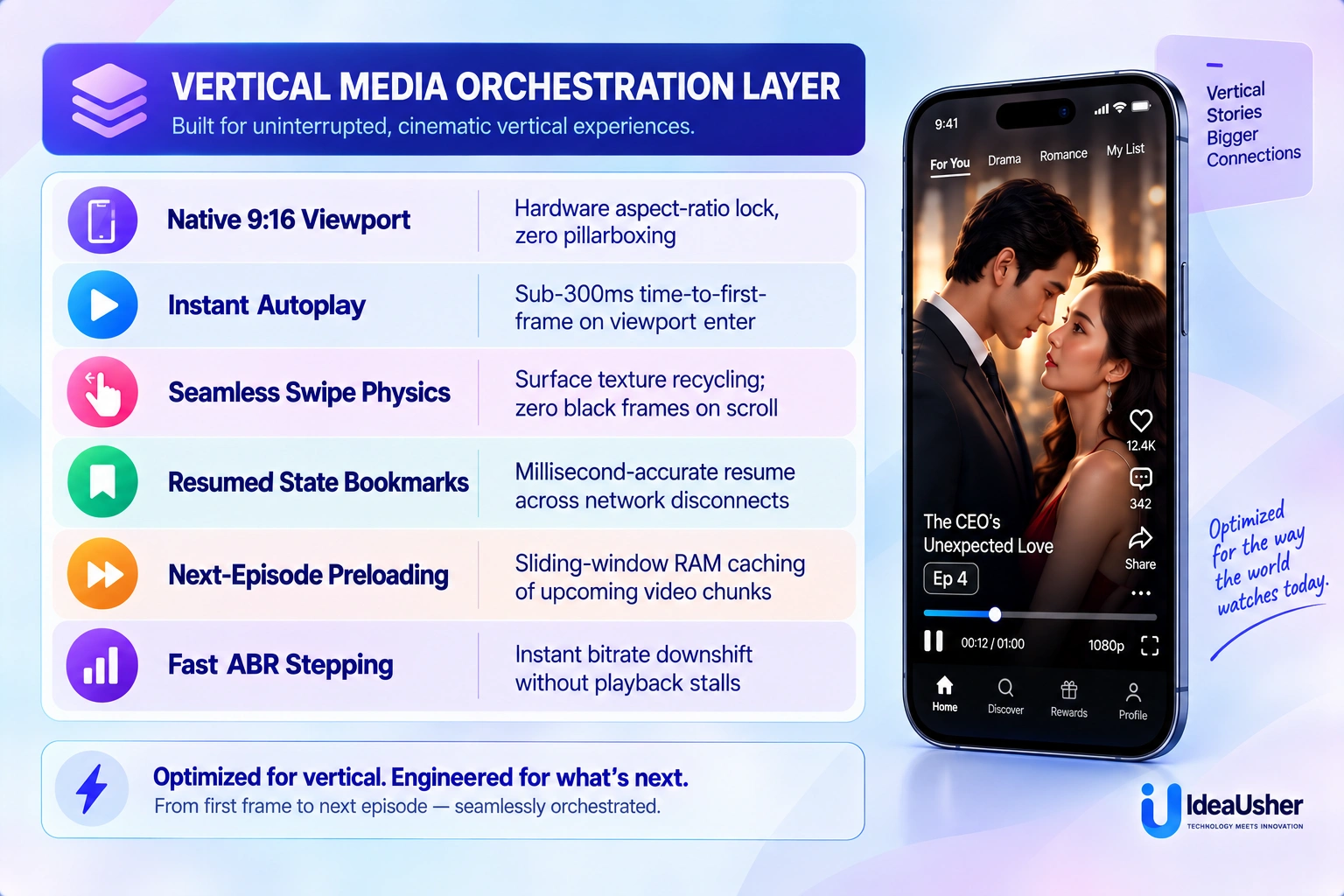
A vertical micro-drama player requires low-level orchestration across six interdependent playback operations:
- Surface Texture Recycling: Reuse 2–3 video player surfaces across previous, active and next slots to reduce GPU memory, prevent UI freezes, and avoid OOM crashes on Android devices.
- Millisecond-Accurate Bookmark Synchronization: Save exact playback timestamps locally and asynchronously sync them with backend databases without blocking the main UI thread.
- Aggressive ABR Stepping: Evaluate bandwidth and switch between 1080p, 720p, and 480p in under 2 seconds to prevent mid-scene buffering.
B. Transcoding, CDN And Adaptive Bitrate Streaming
Setting up cloud storage and an encoding pipeline introduces multiple infrastructure sprint dependencies before an app can safely pass QA:
| Pipeline Stage | Engineering Requirement | Impact on Launch Readiness |
| Automated Transcoding | Event-driven microservices using AWS MediaConvert or FFmpeg ingest 9:16 mezzanine files and output multi-bitrate CMAF/fMP4 ladders. | Adds 1–2 weeks for S3 triggers, retry queues, encoding presets, and synchronized audio. |
| GOP & Segment Alignment | Enforces strict 2-second GOP alignment across bitrates so segments align frame-by-frame. | Requires network-simulator testing to ensure 1080p-to-360p switching avoids audio clicks and visual artifacts. |
| CDN Edge Topology | Configures origin-shield caching, byte-range requests, and short-TTL manifests across CloudFront, Fastly, or Cloudflare. | Requires 1–2 weeks for edge routing and regional cache-hit ratio tuning before production. |
Note: Skipping proper ABR encoding and streaming raw MP4 files directly from basic cloud buckets leads to high buffering rates on mobile connections, inflating early churn and stalling product launches.
C. Preloading Episodes Without Wasting Bandwidth
The engineering challenge of a vertical swipe feed lies in balancing instant startup latency against crippling cloud bandwidth costs:
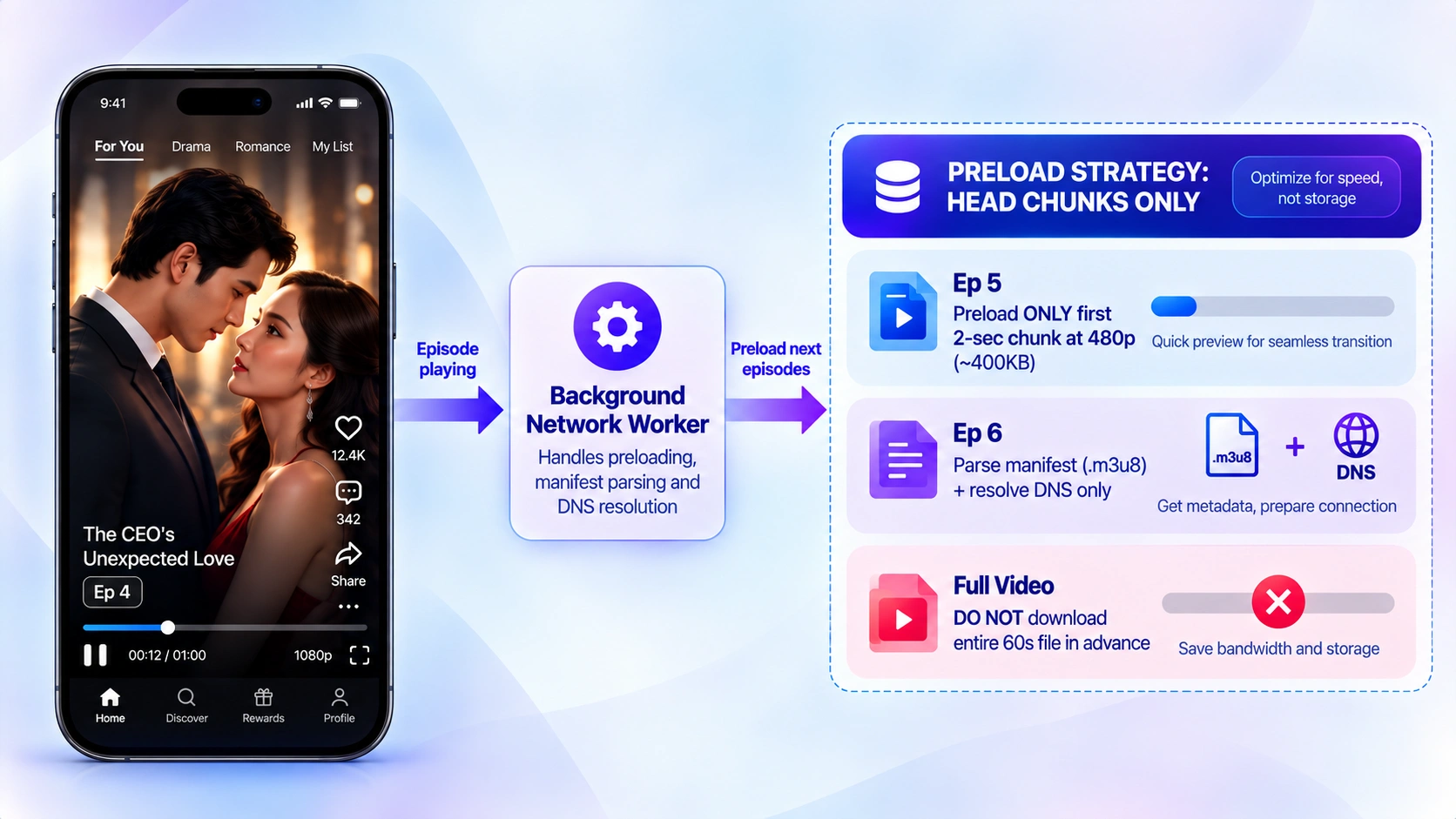
The Naive Approach (The Bandwidth Trap): Buffering full 60-second files for upcoming episodes wastes bandwidth if users swipe away after seconds. For 100,000 active users, this naive buffering can inflate monthly CDN egress costs by 400% to 600%.
The Chunk-Constrained Strategy: Production-ready architectures preload only the initial 2-second media segment of the next episode at a baseline mid-tier bitrate (e.g., 480p or 720p).
Seamless Upscaling: Swiping instantly triggers playback from a pre-buffered 2-second memory chunk. After confirming 3 seconds of viewing, the player fetches remaining segments at 1080p, protecting user experience and CDN budgets. Fine-tuning these heuristics requires 2 to 3 weeks of player-side optimization.
D. Scaling Streaming For Thousands Of Concurrent Viewers
Scaling an app to handle sudden spikes such as thousands of viewers arriving simultaneously from a viral TikTok ad requires load testing the entire media pipeline, not just testing REST APIs:
- Origin Shield Architecture: An Origin Shield layer between CDN edges and S3 consolidates duplicate requests, so 10,000 simultaneous viewers trigger only one origin fetch per rendition.
- Stateless Tokenized URLs: Edge CDNs validate short-lived HMAC tokens or cookies instead of querying the database for every 2-second segment, offloading entitlement checks to the edge.
- Stress & Load Testing Cycles: Locust or k6 simulates high-concurrency swiping, measures Time-to-First-Frame (TTFF) under throttled networks, and monitors CDN cache-hit ratios, targeting >95%.
- Real-Time QoE Telemetry: Client-side tools such as Mux Data or Datadog track rebuffering, frame drops, and playback failures in real time.
Accounting for these streaming engineering requirements up front ensures your project timeline reflects the true scope of delivering a high-retention, broadcast-grade video application.
Custom Build Vs White-Label: Which Launches Faster?
For vertical micro-drama founders, balancing launch speed against long-term enterprise value is the initial key strategic challenge. White-label solutions speed up market entry using pre-packaged codebases, whereas custom development builds proprietary, decoupled media ecosystems tailored to your exact business needs.
Deciding between them comes down to a fundamental trade-off: do you need to validate narrative demand in weeks, or do you need to own a defensible technology asset engineered for high-concurrency scale?
A. White-Label Vertical Drama App Timeline
Turnkey white-label solutions can launch significantly faster—typically within 2 to 8 weeks—because the underlying software architecture is already built, integrated, and verified:
- Pre-Integrated Video & CMS Stacks: The 9:16 vertical player, content ingestion dashboard, user database schemas, and Apple/Google IAP hooks come pre-wired.
- Scope of Customization: The couple of weeks to two-month timeline largely depends on superficial changes, including custom logos, color palettes, UI translations, and custom domain mapping.
- Direct App Store Submission: Previously deployed codebases have likely resolved common App Store rejection issues around navigation and standard IAP configurations, shortening the submission window.
B. Custom Vertical Drama App Timeline
A ground-up custom build typically requires 3 to 6+ months, with complex enterprise deployments extending to 9 months. This timeline reflects the time needed to design, engineer, and stress-test multiple decoupled services rather than simply rebranding an existing template:
- Bespoke Media Engineering: Writing low-level native video players (AVPlayer for iOS, ExoPlayer/Media3 for Android) equipped with specialized RAM pre-fetching managers and surface recycling to eliminate swipe lag.
- Custom Transcoding & CDN Topologies: Building automated, event-driven pipelines (e.g., AWS Elemental MediaConvert or containerized FFmpeg) to output 2-second CMAF/HLS segments across dynamic multi-bitrate ladders.
- Transactional Coin Ledgers: Architecting ACID-compliant, double-entry backend databases that separate purchased coins from expiring promotional tokens, backed by cryptographic server-to-server receipt validation.
- Custom CMS & Telemetry Pipelines: Developing multi-part batch uploaders for 80+ episodes, subtitle synchronizers, and high-throughput event streaming (Kafka/Kinesis) to track second-by-second viewer drop-off.
C. What You Gain By Choosing Custom Development
While custom engineering requires a longer initial runway, it delivers structural, commercial, and operational advantages that off-the-shelf software cannot provide:
| Dimension | White-Label Solution | Custom Proprietary Development |
| Source-Code Ownership | Rented license or obfuscated code; vendor lock-in. | 100% unencumbered IP ownership transferred directly to your business. |
| Playback & UX Control | Generic UI templates; rigid swipe physics and player layouts. | Fully bespoke player mechanics, custom thumb-zone navigation, and branded purchase flows. |
| Monetization Agility | Fixed unlock rules; often limited to basic coin bundles. | Dynamic paywalls, hybrid VIP subscriptions, server-verified rewarded ads, and custom web-checkout rails. |
| Scalable Infrastructure | Monolithic backends that choke under sudden traffic surges. | Decoupled microservices, origin-shield CDNs, and auto-scaling compute built for high concurrency. |
| Recommendation Engine | Basic chronological or tag-based sorting. | Proprietary vector search, collaborative filtering, and real-time in-session behavioral re-ranking. |
| Third-Party Integrations | Restricted to vendor-supported plugins and gateways. | Unlimited API connectivity to enterprise CRMs (Braze), data lakes (Snowflake), and external ad mediation. |
| Long-Term Enterprise Value | Low enterprise valuation; technology is not an asset. | High valuation multiple; proprietary tech stack, user data pipelines, and platform IP can be acquired or funded. |
D. When A White-Label Platform Makes More Sense
Despite the architectural limitations of turnkey scripts, there are specific market scenarios where a white-label platform is the more practical commercial choice:
- Proof-of-Concept Market Validation: When you have 3–5 pilot micro-drama series and need to measure real-world CAC and viewer retention on app stores without spending $50,000+ on development.
- Aggressive Launch Deadlines: When contractual obligations, seasonal trends or investor milestones require an operational app store presence within 30–45 days.
- Constrained Upfront Budgets: When working capital is under $20,000, allowing you to deploy a turnkey script while preserving cash for content production and performance marketing.
- Standard Feature Requirements: When your roadmap does not require proprietary recommendations, complex VIP monetization or specialized studio royalty portals.
- Testing an Unproven Geographic Niche: When evaluating whether a regional territory or localized catalog has enough binge-watching demand to justify later custom platform investment.
What Can Delay A Vertical Drama App Launch?
Even with a well-defined roadmap, vertical drama app development can face technical bottlenecks that affect launch timelines. Streaming performance, payment reliability, and complex backend workflows are three common challenges developers must resolve before production release.
1. Video Streaming Performance And Playback Issues
Challenge: High-resolution vertical videos can cause buffering, playback failures, slow episode loading, and inconsistent performance across devices and network conditions.
Solution: Our developers optimize transcoding, adaptive bitrate streaming, CDN delivery, caching and video preloading to maintain reliable playback across devices and varying network conditions.
2. Complex Coin, Payment And Episode Unlocking Logic
Challenge: Coin purchases, subscriptions, episode unlocks, refunds and transaction verification can create complex backend logic and payment inconsistencies.
Solution: Our developers implement secure wallet and entitlement systems, integrate payment services, validate transactions server-side, and thoroughly test purchase, unlocking, refund, and failure scenarios.
3. Scaling Backend And Recommendation Infrastructure
Challenge: Growing concurrent users can strain APIs, databases, content delivery, analytics and recommendation systems, causing slow feeds or unexpected service failures.
Solution: Our developers design scalable backend architecture with optimized databases, caching, API performance, monitoring, and cloud infrastructure that can handle increasing traffic without compromising user experience.
How IdeaUsher Will Help You Launch Your Vertical Drama App
IdeaUsher operates as an enterprise product engineering partner and streaming technology innovator, backed by 11+ years of software expertise, 250+ technical specialists and a 4.9/5 Clutch rating across 1,000+ delivered builds.
We build custom, high-concurrency vertical streaming apps from the ground up, pairing low-latency media delivery with targeted micro-monetization to drive user engagement and enterprise revenue.
A. From MVP Scope To Production-Ready Platform
Launching a micro-drama platform requires translating high-level business goals into an agile, cost-controlled execution plan:
- Requirements Deconstruction: We assess content volume, target geographies and acquisition channels to set realistic delivery milestones.
- Lean MVP Architecture: We prioritize core playback, coin unlocks and payment rails to accelerate time-to-market and validate retention before major investment.
- Production-Grade Delivery: Each phase includes automated QA, load testing and zero vendor lock-in, ensuring infrastructure can scale smoothly to global deployment.
B. Build The Core Vertical Drama Experience
We build the foundational front-end and back-end features essential for seamless daily consumption:
- 9:16 Video Player & Swipe Navigation: Native, lightweight portrait players for iOS/Android with low-latency vertical swiping, gesture controls and predictive next-episode caching.
- Episode Gating & Coin Wallet: Flexible microtransaction systems that let viewers buy coin bundles to unlock cliffhanger episodes on demand.
- Subscription Management: Recurring weekly, monthly and VIP billing integrated with Apple In-App Purchase and Google Play Billing.
- Publishing CMS & Notifications: Centralized dashboards to schedule episode releases, manage catalog metadata and send automated push alerts for new episodes.
- Core Viewer Analytics: Real-time dashboards tracking viewer drop-offs, completion rates and average revenue per user (ARPU).
C. Add Advanced Features As Your Platform Scales
As your viewer base and content catalog expand, we integrate enterprise-grade capabilities to drive global retention and safeguard assets:
- AI Recommendations & Smart Feeds: Machine learning algorithms analyze watch history and drop-off patterns to power dynamic, personalized “For You” feeds.
- AI Dubbing & Multi-Language Support: Automated AI voice dubbing and localized subtitles enable rapid international series launches.
- Creator Dashboards & Revenue Sharing: Self-service portals let production houses and indie creators track views, manage uploads and reconcile royalty splits.
- Multi-DRM Content Protection: Integrates Apple FairPlay and Google Widevine with anti-screen-recording guardrails to protect video IP.
- Scalable Multi-CDN Architecture: AWS CloudFront and Cloudflare with HLS/DASH adaptive streaming deliver reliable playback across fluctuating mobile networks.
Get A Custom Vertical Drama App Timeline with Idea Usher with project-specific development roadmap, cost and technology plan. Connect with our principal streaming software architects today to align on scope, evaluate your business model, and map out your path to launch.
Conclusion
A realistic timeline gives founders greater control over their vertical drama app launch and investment decisions. An MVP may reach the market within 8–12 weeks, while advanced platforms can require several months because streaming infrastructure, monetization, personalization, and scalability add substantial complexity. The right approach depends on your feature priorities, target audience, platforms, and long-term roadmap. A clear scope and experienced development team can reduce avoidable delays while keeping technical foundations ready for future growth.
FAQs
A.1. Vertical drama app development can take 8 weeks for a focused MVP and 6 to 12 months for advanced platforms with personalization, monetization, creator tools, and scalable streaming.
A.2. Essential features include vertical video playback, swipe navigation, user accounts, content discovery, watch history, favorites, notifications, CMS, monetization, analytics, and reliable video streaming infrastructure.
A.3. Streaming infrastructure, episode unlocking, payment processing, personalization, content management, analytics, and scalable backend architecture increase technical complexity and require additional engineering, integration, testing, and performance optimization.
A.4. Vertical drama app costs range from $4,500–$18,000 for a white-label license to $250,000–$835,000+ for a full-scale custom platform, with source-code, MVP, and mid-scale options falling between these ranges.