


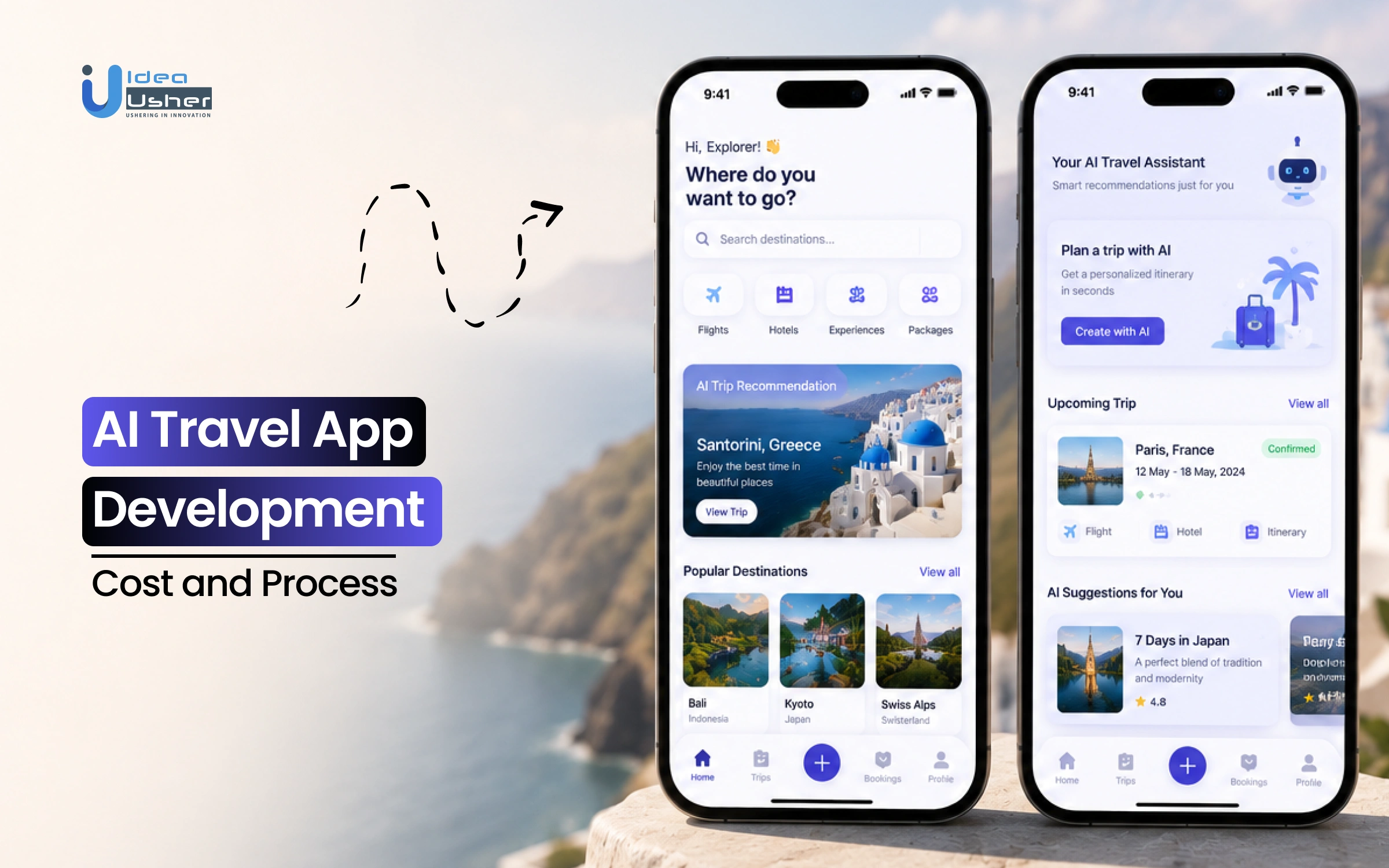
Key Takeaways
- AI travel apps use personalization and automation to simplify trip planning, discovery and booking experiences.
- Core features include AI recommendations, itinerary generation, route optimization and conversational trip assistance.
- Development costs typically range from $68K–$130K for MVPs, increasing with AI complexity and integrations.
- Travel businesses invest in AI apps to improve engagement, conversions and long-term customer retention.
- How IdeaUsher can help you build scalable AI travel apps with AI models, travel API integrations and cloud-native infrastructure.
Travel apps are no longer competing on the size of their inventory or the number of destinations they list. The competitive advantage is shifting toward intelligence, where platforms can understand traveler intent, personalize recommendations and automate planning decisions. This evolution is accelerating demand for AI travel app development as businesses look to create more adaptive and engaging travel experiences.
Traditional travel platforms focused on search filters, static recommendations, and manual planning. Today’s travelers expect AI-powered itinerary generation, personalized destination discovery, conversational trip planning, and real-time assistance. The opportunity has shifted from helping users find travel options to building intelligent systems that continuously learn from user behavior and deliver increasingly relevant travel experiences.
In this blog, we will talk about AI travel app development, including the development process, core features, cost factors, how IdeaUsher can help build and launch a scalable AI-powered travel platform and what it takes to create a travel product that delivers personalized experiences while driving long-term business growth.
What is an AI Travel App?
An AI travel app is a travel platform that uses artificial intelligence to help users discover destinations, plan trips, create personalized itineraries, book services, and receive real-time travel assistance. Unlike traditional travel apps that rely on manual searches and fixed recommendations, AI-powered travel apps analyze user preferences, behavior, budgets, travel history, and live data to deliver customized travel experiences.
These apps can recommend destinations, flights, and hotels while optimizing routes and generating itineraries. By integrating machine learning, NLP, and real-time data, AI travel apps serve as efficient virtual assistants that make planning faster and more personalized.
A. How AI Travel Apps Differ From Traditional Travel Platforms
Traditional travel platforms primarily function as booking tools, requiring users to manually search, compare, and organize travel plans. AI travel apps, on the other hand, act as intelligent travel assistants that personalize recommendations, automate planning, and adapt to changing travel conditions in real time.
| Feature | Traditional Travel Platforms | AI Travel Apps |
| Primary Role | Booking and reservation management | Intelligent travel planning and assistance |
| User Experience | Manual search and comparison of options | Personalized recommendations based on preferences |
| Trip Planning | Users create itineraries themselves | AI generates customized itineraries automatically |
| Recommendations | Generic results based on filters | Context-aware suggestions based on behavior, budget, interests, and travel history |
| Decision Making | Traveler evaluates and selects options manually | AI narrows choices and recommends the most relevant options |
| Adaptability | Limited ability to adjust after booking | Continuously updates plans using real-time data |
| Handling Disruptions | Users must manually manage delays or changes | AI suggests alternatives for flights, transportation, accommodations, or activities |
| Personalization | Basic filtering options | Advanced personalization powered by machine learning |
| Discovery of New Experiences | Relies on user research | Proactively recommends destinations, attractions, and experiences |
| Overall Travel Experience | Transaction-focused | End-to-end travel companion experience |
B. Types of AI Travel Applications Businesses Are Building
Travel companies are leveraging artificial intelligence to create innovative applications that address diverse traveler needs. From trip planning and personalized recommendations to corporate travel management, AI is transforming how travel experiences are delivered.
| AI Travel App Type | Description | Platform Examples |
| AI Trip Planner Apps | Create personalized itineraries using destination, budget, dates, preferences, accommodations, transport, dining, and activities. | Mindtrip, Wonderplan, GuideGeek |
| Travel Recommendation Engines | Recommend destinations, hotels, attractions, and packages using behavior, preferences, bookings, and trends. | Roamy, iPlan AI |
| AI Itinerary Generators | Generate optimized daily schedules using trip duration, weather, attraction availability, and traveler interests. | Roam Around, Trip Planner AI, Curiosio |
| AI Discovery Map Apps | Provide interactive maps highlighting attractions, restaurants, events, hidden gems, and nearby experiences. | Zest Maps, Sygic Travels |
| AI Travel Concierge Apps | Offer real-time travel assistance, recommendations, transportation guidance, events, and local experiences. | MindTrip, Kayak AI, TripGenie |
C. Why Travel Companies Are Investing in AI-Powered Experiences
The global AI in travel market size is experiencing exponential growth. It is valued at $3.373 billion and is projected to skyrocket to $13.869 billion by 2030, sustaining a staggering compound annual growth rate (CAGR) of 26.7%. This rapid expansion reflects the growing demand for intelligent travel experiences, personalized recommendations, and AI-driven trip planning solutions across the industry.

Investing in AI has shifted from an experimental strategy to a baseline commercial necessity for survival and growth. Global travel technology leaders are allocating heavy capital to AI infrastructure due to compelling financial, conversion, and operational metrics.
- Aggressive Capital Reallocation: Travel operators are rapidly shifting their budgets. According to industry data, 64% of travel operators plan to increase their direct investment in AI over the next 12 months, with 21% of those businesses planning to completely double their spending.
- Exponential Conversion Lift: According to McKinsey, AI-driven personalization increases travel booking conversion rates by up to 30%. Furthermore, real-world case studies show that consumers who actively engage with a conversational AI travel agent convert at 3x to 5x the rate of those navigating standard static filters.
- Drastic Operational Cost Reductions: Deploying generative AI assistants to draft email responses cuts agent handling times down from an average of 4 minutes per message to a brief 30-second human review. This automation allows travel firms to handle over 50% of customer inquiries instantly, driving massive operational savings (averaging roughly €18,000/month for mid-sized agencies).
- Rapid Time-to-Market: Large-scale AI platforms facilitate hyper-personalization at scale. Marriott, for example, uses AI to create millions of tailored content variations for guests, reducing content time-to-market by 70%.

Advanced AI Capabilities That Differentiate Modern Travel Apps
The gap between standard booking tools and elite digital platforms is defined by intelligence. Legacy apps use manual inputs and basic filters, whereas modern platforms utilize a multi-layered AI ecosystem for complex reasoning, visual processing, and autonomous task execution.
To stand out in today’s landscape, an application must move beyond basic transactional scripts and implement these seven differentiating AI capabilities.

1. Generative AI-Powered Travel Planning
This layer replaces traditional form-based search with an open-ended conversational engine capable of synthesising vast travel options into hyper-customized narratives.
- Semantic Intent Decoding: Understands highly abstract, nuanced user prompts like “a restorative wellness weekend without tourist crowds.”
- Narrative Itinerary Stitching: Combines real-time logistics with descriptive local insights to turn plain schedules into compelling stories.
- Dynamic Document Compilation: Generates fully interactive, media-rich travel dossiers that users can instantly share across social networks.
How it works in practice: When users provide natural language prompts, like “Design a 4-day culinary trip to Tokyo focused on hidden izakayas and ramen spots, leaving afternoons free for exploring thrift stores,” the system uses an LLM to generate a contextual itinerary in under 60 seconds. It manages geographical grouping and timing constraints to convert unstructured text into an interactive, bookable travel timeline.
2. Predictive Travel Recommendations
By applying machine learning to historical market data, this capability predicts upcoming price drops, flight disruptions, and capacity constraints.
- Market Yield Forecasting: Advises users on the mathematically optimal hour to purchase airline tickets or lock in stays.
- Disruption Risk Modeling: Analyzes historical weather pattern anomalies and airport congestion metrics to flag potential connecting flight delays.
- Dynamic Pricing Arbitrage: Empowers platforms to bundle flights and lodging proactively based on anticipated marketplace rate dips.
How it works in practice: When a user searches for NYC-London flights, the app issues a “Wait to Book” alert, predicting a 14% price drop in 11 days instead of just showing the current $850 price. It also identifies a 40% chance of delays at Heathrow due to July congestion, recommending a safer 2-hour layover.
3. AI-Based Travel Preference Learning
This subtle analytics layer continuously studies real-time user browsing interactions to build an evolving behavioral profile without invasive surveys.
- Implicit Affinity Scoring: Tracks scrolling speeds, image clicks, and interface dwell time to gauge true traveler interest profiles.
- Fluid Cohort Clustering: Automatically shifts users into real-time demographic micro-segments as their active travel priorities evolve.
- Retention Loop Compounding: Sharpens recommendation accuracy automatically with each user session, drastically driving up app lifetime value.
How it works in practice: The app identifies traveler styles by tracking engagement, such as dwell times on specific design photos. For instance, after noting a preference for minimalist aesthetics over high-rises, the system automatically prioritizes matching boutique stays for a future Paris trip.
4. Image Recognition for Travel Discovery
This computer vision framework allows users to upload screenshots or photos of travel destinations and immediately access matching booking pipelines.
- Visual Landmark Triangulation: Identifies specific geographical landmarks, boutique hotels, or scenery from un-tagged user-uploaded media files.
- Spatial Inventory Mapping: Scans the visual contents of a photo to instantly suggest nearby accommodations matching that aesthetic.
- Social-to-Booking Conversions: Transforms passive inspiration from social media screenshots into transactional, executable booking pathways within seconds.
How it works in practice: A user uploads a screenshot of an un-tagged social media video showing a cliffside infinity pool. The app’s image recognition identifies the specific Bali resort, verifies real-time availability, and provides an instant booking button along with three similar alternatives.
5. Conversational AI Trip Modification
This support capability gives travelers the power to rewrite active, multi-vendor itineraries mid-journey through a single chat interface.
- Simultaneous Multi-Vendor Adjustments: Cancels delayed flights and rebooks hotels concurrently via a single text request from the traveler.
- Automated Policy Auditing: Scans the fine print of cancellation clauses instantly to minimize unexpected traveler penalty fees.
- Downstream Schedule Re-Anchoring: Automatically reschedules subsequent tours, restaurant bookings, and car rentals when an anchor transit link breaks.
How it works in practice: While waiting at the airport, a traveler learns their Rome flight is delayed by five hours and several bookings are affected. They simply message, “My flight is delayed, please fix my evening.” The AI reschedules the tour, updates transportation, and sends a revised itinerary automatically.
7. Hyper-Personalized Recommendation Engines
This advanced logic matrix eliminates the standard catalog view, building an entirely unique product storefront for every individual user.
- Contextual Feature Matrixing: Computes local weather forecasts, user tier status, and meal restrictions to curate elite lodging choices.
- Predictive Ancillary Merchandising: Displays relevant add-ons such as specific airport lounge passes at high-intent points during checkout.
- Choice Paralysis Eradication: Trims away thousands of irrelevant global listings, presenting only high-converting inventory tailored to the user.
How it works in practice: Two travelers search for hotels in Miami simultaneously. A solo business traveler is shown hotels with 24-hour gyms and healthy dining options, while a parent traveling with a toddler and dog sees pet-friendly stays with children’s facilities, eliminating the need for manual filtering.
8. Autonomous Travel Agents and Agentic AI Workflows
This next-generation architecture shifts AI from an advisory tool to an independent agent authorized to execute complex workflows.
- End-to-End Execution Autonomy: Authorizes digital agents to independently research options, apply payment tokens, and finalize multi-vendor checkout.
- Proactive Delay Intervention: Detects flight cancellations mid-trip and reserves alternative seating before the stranded passenger notices the delay.
- B2B Agentic Discovery Optimization: Structurally prepares your application infrastructure to be easily discovered and booked by external AI concierge networks.
How it works in practice: A business traveler requests, “Book my usual trip to Chicago next Tuesday, keep the total budget under $600, and ensure I am back by Thursday night.” The AI agent automatically books flights and accommodations, completes the purchase, and sends a final confirmation receipt.
Core Features Every AI Travel App Should Include
To build a successful travel app today, you need features that actively solve customer frustrations and drive bookings, transforming your app from a basic directory into an indispensable, revenue-generating companion.
1. AI-Powered Travel Recommendation Engine
This feature replaces generic filters with a predictive engine that instantly matches users with their ideal destinations, hotels, and activities based on past behavior, budget constraints, and active preferences.
- Hyper-Personalized Matchmaking: Analyzes individual user tastes and spending habits to surface tailored options that drive immediate booking decisions.
- Predictive Upselling Tracks: Offers context-aware upgrades and add-ons at the exact moment users are most likely to buy.
- Budget-Optimized Curation: Automatically filters out irrelevant choices, presenting highly targeted selections that match the user’s wallet size.
2. Personalized Itinerary Generation
This core automation tool crafts custom, day-by-day travel plans in seconds, dynamically rearranging schedules around real-time events, weather shifts, and individual traveler pacing.
- Instant Multi-Day Mapping: Eliminates hours of manual trip planning by generating full schedules based on user interest profiles.
- Live Schedule Recalibration: Smoothly updates the user’s active itinerary when unexpected flight delays or local weather disruptions occur.
- Pacing and Flow Control: Smartly balances high-energy sightseeing with realistic travel transit times to prevent vacation burnout.
3. Smart Destination Discovery
This feature uses intelligent search to guide users toward trendy hidden gems and alternative spots that perfectly fit their desired vacation vibe and budget.
- Intent-Based Search Logic: Understands abstract mood descriptions like “cozy weekend getaway” instead of requiring specific city names.
- Alternative Destination Swaps: Suggests lesser-known, cost-effective locations that mirror the luxury appeal of overcrowded global hotspots.
- Niche Micro-Targeting: Connects specialized traveler niches directly to off-the-beaten-path experiences, boosting user platform loyalty.
4. Intelligent Route Optimization
This feature calculates the most efficient daily travel paths, seamlessly combining public transit, rideshares, and walking routes to save travelers time and money.
- Anti-Zigzag Efficiency: Uses intelligent mapping layouts to sequence daily stops chronologically, eliminating unnecessary travel back-and-forth.
- Predictive Traffic Routing: Automatically bypasses local transit bottlenecks using real-time congestion data feeds to keep trips moving.
- Cost-Effective Commute Planning: Displays the perfect balance between transit price and speed, protecting the user’s daily budget.
5. Interactive Maps and Location Intelligence
This feature turns static navigation into a live, location-aware guide that sends users contextual tips, nearby recommendations, and critical safety alerts on the move.
- Proximity-Triggered Alerts: Notifies travelers of top-rated cafes or historic landmarks exactly as they walk past them.
- Offline Access Architecture: Keeps vital navigation maps and local safety data working flawlessly even without cellular roaming data.
- Dynamic Neighborhood Insights: Displays live safety scores, local crime alerts, and neighborhood vibe ratings to protect travelers.
6. AI Chat Assistant for Trip Planning
A conversational interface that allows users to plan, modify, and book their entire vacation through natural, text-based dialogue just like texting a human travel agent.
- Natural Language Tweaks: Lets users change complex booking parameters instantly through simple, conversational chat text requests.
- Constant 24/7 Support Desk: Answers instant questions regarding baggage rules, hotel check-ins, and reservation changes around the clock.
- Frictionless Booking Closers: Guides hesitant users through complex travel decisions directly inside the chat window to close sales.
7. Hotel, Flight, and Activity Booking Integrations
This backend engine connects your app to global travel inventories, letting users search, compare prices, and securely buy complete trips without leaving your platform.
- All-In-One Cart Checkout: Allows users to purchase multi-vendor flights, hotels, and tours simultaneously in one single transaction.
- Live Price-Drop Alerts: Tracks price fluctuations across inventory databases to notify users the exact moment tickets get cheaper.
- Direct-to-App Ticketing: Keeps all booking passes, digital boarding vouchers, and hotel confirmations stored safely in one dashboard.
8. Collaborative Trip Planning and Sharing
This social tool lets group travelers co-create itineraries, share media, vote on activities, and coordinate group budgets together in real time.
- Group Sync Workspaces: Keeps multiple friends or family members aligned on the same live, updating itinerary schedule.
- Preference-Mesh Engine: Automatically finds restaurants and activities that satisfy the combined tastes and budgets of everyone traveling.
- In-App Voting Polls: Streamlines group decision-making with built-in polling features that prevent long text message debates.
How to Develop an AI Travel App
Transforming an innovative travel concept into a market-ready, scalable AI platform requires a structured, precision-engineered development framework. Our end-to-end process bridges advanced machine learning architecture with commercial product strategy to launch high-performance digital travel assets.
1. Market Research and Product Discovery
Our strategic consulting team analyzes current market blind spots, evaluates competitor feature gaps, and maps user behaviors to define your app’s unique value proposition and maximize your long-term return on investment.
- Competitor Gap Blueprinting: Identifies specific weaknesses in existing travel platforms to position your application for maximum market share.
- User Persona Mapping: Profiles target traveler demographics to align feature sets with real-world consumer demands and booking behaviors.
- Feasibility Risk Assessment: Evaluates technical scope and cost parameters early to ensure a highly predictable and profitable launch.
2. Defining AI Use Cases
We pinpoint the exact business workflows where machine learning adds the highest value, selecting high-impact features like predictive pricing or automated itinerary generation to drive rapid user retention.
- Value Matrix Prioritization: Targets high-ROI automated features first, ensuring your initial budget drives immediate user acquisition and retention.
- Workflow Automation Mapping: Replaces slow, manual travel search steps with instant, algorithm-driven solutions that delight busy users.
- Monetization Alignment Framework: Links specific AI interactions directly to booking triggers to maximize your app’s average order value.
3. UX/UI Design for Travel Experiences
Our design team engineers intuitive, conversion-focused mobile interfaces that turn complex, data-heavy travel choices into effortless conversational chat workflows, drastically reducing user booking drop-off rates.
- Conversational Workspace Blueprints: Visualizes clean, text-based interfaces that allow users to plan trips without complex filter forms.
- Frictionless Checkout Paths: Streamlines the multi-vendor booking process into a highly optimized, one-click payment screen experience.
- Contextual Visual Triggers: Minimizes on-screen clutter by displaying dynamic travel maps and data layers only when needed.
4. AI Model Selection and Training
Our data scientists choose and fine-tune specialized large language models and predictive algorithms, training them on verified travel datasets to ensure hyper-accurate recommendations and contextual intelligence.
- LLM Fine-Tuning Protocols: Tailors foundational language models with domain-specific travel data to eliminate incorrect answers and hallucinations.
- Predictive Model Engineering: Integrates advanced forecasting algorithms to anticipate shifting pricing trends and flight delay patterns accurately.
- Data Compliance Auditing: Implements strict data filtering layers to protect sensitive customer information and meet international privacy laws.
5. Backend and API Development
We build a highly secure, enterprise-grade cloud backend infrastructure designed to process heavy user traffic, manage real-time data flows, and support complex AI operations with zero system latency.
- Elastic Cloud Scaling: Builds auto-scaling server systems capable of handling massive seasonal traffic spikes without performance dips.
- Real-Time Data Pipelines: Streamlines complex data feeds to sync itinerary updates and flight statuses across devices instantly.
- Secure API Architecture: Implements bulletproof data protection protocols to secure user profiles and sensitive transactional information.
6. Third-Party Travel API Integration
Our developers establish secure pipelines connecting your app to major global distribution systems and aggregators, enabling seamless real-time inventory synchronization for flights, hotels, and local tours.
- GDS Inventory Synchronization: Hooks your application directly into global aviation and hospitality grids for live pricing updates.
- Unified Booking Pipeline: Merges fragmented provider APIs into a singular backend command, simplifying the entire checkout architecture.
- Webhook Event Triggers: Sets up instant alerts to update booking records immediately when operators change travel details.
7. Testing and Optimization
We conduct rigorous quality assurance cycles, stress-testing the application’s performance across diverse devices while refining the AI engine to eliminate hallucinated data and secure payment gateways.
- AI Intent Verification: Validates conversational accuracy across thousands of diverse travel phrasing scenarios to ensure flawless assistance.
- End-to-End Stress Testing: Simulates massive concurrent user booking volumes to guarantee total platform stability during peak seasons.
- Cross-Device Optimization Checks: Polishes interface responsiveness across diverse mobile systems to provide a premium user experience everywhere.
8. Deployment and Continuous Improvement
We launch your application successfully onto the global app stores, utilizing continuous post-launch user data monitoring and iterative AI training loops to systematically improve feature accuracy and performance.
- Phased App Store Launch: Deploys production builds smoothly to global marketplaces using strict version control optimization methods.
- Live Behavior Analytics: Monitors active user navigation patterns post-launch to continuously uncover new conversion optimization opportunities.
- Continuous Feedback Refinement: Feeds real interaction logs back into the AI engine to systematically enhance future recommendation accuracy.
AI Travel App Development Cost Breakdown
The cost of AI travel app development depends on factors such as app complexity, AI features, integrations, data infrastructure, and scalability needs. While basic travel planners require lower investment, advanced platforms with personalization, predictive analytics, and booking capabilities demand significantly higher development budgets and ongoing resources.
A. Cost by Development Stage
The overall budget is typically distributed across multiple development phases, each contributing unique technical requirements and business outcomes.
| Development Stage | Estimated Cost | What this Phase Covers |
| Market Research & Product Discovery | $5,000 – $8,000 | Market validation, competitor analysis, user research, feature planning, and product strategy. |
| UX/UI Design | $12,000 – $18,000 | User journey mapping, wireframing, prototyping, visual design, and usability optimization. |
| AI Model Development & Training | $20,000 – $40,000 | Building, training, testing, and optimizing AI models for personalized travel experiences. |
| Backend Development | $15,000 – $28,000 | Server architecture, databases, APIs, business logic, security, and scalability setup. |
| Frontend Development | $10,000 – $25,000 | Developing responsive interfaces, user interactions, dashboards, and cross-platform functionality. |
| Third-Party API Integrations | $8,000 – $150,000 | Connecting booking systems, maps, payments, weather services, and travel databases. |
| Testing & Quality Assurance | $10,000 – $13,000 | Functional testing, performance checks, bug fixing, security validation, and reliability. |
| Deployment & Launch | $5,000 – $8,000 | Production deployment, cloud configuration, monitoring setup, and launch support. |
| Total Estimated Development Cost | $68,000 – $130,000 | Complete AI travel app development from planning through deployment and launch. |
Note: Estimated costs may vary depending on project scope, AI complexity, and infrastructure requirements.
B. AI Travel App Development Cost by Platform Tier
The overall investment largely depends on the complexity of the platform being developed. While an MVP focuses on validating market demand with core AI functionality, advanced and enterprise-grade platforms require sophisticated recommendation systems, large-scale data infrastructure, and extensive third-party integrations
| Platform Tier | Estimated Cost | Typical Features Included |
| MVP Level | $70,000 – $150,000 | AI travel recommendation engine, personalized itinerary generation, smart destination discovery, interactive maps, AI chat assistant and basic booking integrations. |
| Mid-Tier Level | $170,000 – $260,000 | Advanced personalization, route optimization, collaborative trip planning, real-time travel intelligence and multi-provider booking integrations. |
| Enterprise Level | $300,000 – $450,000+ | Predictive pricing engines, agentic AI travel assistants, large-scale personalization systems, enterprise reporting, complex API ecosystems, multi-region deployment. |
C. Cost by Team Structure
The development team’s composition can substantially influence both project cost and delivery timelines.
| Team Structure | Estimated Hourly Rate | Best For |
| Freelance Developers | $20 – $75/hour | Small prototypes, proof-of-concepts, and early-stage MVP validation projects. |
| In-House Team | $80 – $200/hour | Companies requiring complete ownership, long-term product management, and internal technical resources. |
| Enterprise Development Agency | $30 – $60/hour | Full-scale AI travel platforms requiring AI expertise, dedicated teams, faster delivery, and end-to-end development support. |
Freelancers offer lower costs but often lack the multidisciplinary expertise needed for complex AI travel apps. In-house teams provide control but carry high recruitment and operational overhead. Enterprise agencies like Idea Usher provide dedicated AI specialists and cloud architects under one model, accelerating development while minimizing execution risks.
D. Key Factors Affecting Development Cost
Several technical and business considerations directly influence the total investment required to build an AI travel application.
- App Complexity: Basic itinerary planners may cost 30% less, while platforms with 10+ features require significantly higher development investments.
- AI Sophistication: Rule-based systems cost less initially, whereas generative AI, predictive analytics, and personalization models increase budgets by 40%.
- Data Integrations: Connecting 5–15 external APIs, including airlines, hotels, maps, and payments, directly impacts timelines and implementation costs.
- Custom Recommendation Systems: Proprietary recommendation engines analyzing traveler behavior, preferences, and booking patterns require substantial machine learning investments.
- Scalability Requirements: Supporting 100,000+ users demands cloud infrastructure, load balancing, caching, and database optimization, increasing overall development expenses.
- Security and Compliance: Implementing encryption, fraud prevention, secure payments, and regulatory compliance frameworks can increase project costs by 20%.
E. Ongoing Maintenance and AI Model Costs
Launching the application is only the beginning of the investment cycle. AI-powered travel platforms require continuous maintenance, optimization, and infrastructure management to remain competitive.
| Ongoing Expense Category | Estimated Monthly Cost |
| Cloud Infrastructure | $500 – $10,000+ |
| AI Model/API Usage | $500 – $15,000+ |
| Travel Data Providers | $300 – $5,000+ |
| Maintenance & Support | $2,000 – $15,000+ |
| Security & Monitoring | $500 – $3,000+ |
For most businesses, annual maintenance costs typically range between 15% and 25% of the original development investment, depending on platform complexity and growth rate.
AI travel app development costs vary significantly by scale: a feature-rich MVP typically ranges from $60,000–$100,000, whereas enterprise platforms with advanced personalization and real-time booking systems can exceed $250,000–$500,000+. The final investment depends on business goals, target audience, and long-term scalability.
AI Travel App Monetization Models
Building an intelligent travel platform requires a highly sustainable revenue architecture. Modern applications leverage AI data insights to diversify their income streams, shifting away from basic transaction fees toward high-margin, automated monetization models that maximize user lifetime value.
1. Booking Commissions
The application earns a direct percentage cut from travel suppliers every time a user finalizes a flight, hotel room, or car rental checkout directly within the conversational platform interface.
Real-World Example: Roam Around utilizes smart affiliate tracking links to capture backend booking commissions from major inventory partners like Viator and Booking.com whenever users reserve items from their AI itineraries.
2. Premium Subscription Plans
Users unlock advanced, exclusive app features such as automated autonomous booking agents, continuous price-drop protection, and elite 24/7 concierge support by paying a structured monthly or annual recurring membership fee.
Real-World Example: Layla AI features an optional premium tier ($49/year) that unlocks advanced planning utilities, live global inventory pricing feeds, and a specialized 24/7 automated flight price-tracking engine
3. Travel Marketplace Revenue
The platform acts as a digital storefront, charging third-party local tour operators, independent guides, and regional transit services a transaction fee to access their highly targeted, high-intent traveler audience.
Real-World Example: Mindtrip integrates local destination experiences directly into its conversational AI mapping interface, charging operators a marketplace platform fee whenever a user adds an independent local excursion to their custom timeline.
4. Sponsored Travel Recommendations
Hospitality brands and tourism boards pay premium advertising fees to have their properties or destinations featured prominently at the top of an AI assistant’s curated conversational recommendations list.
Real-World Example: Zest Maps utilizes its AI-powered dining and restaurant tracking interface to organically weave sponsored restaurant listings, culinary events, and local hotspots into a user’s highly personalized, automated food map.
Technology Stack Required for AI Travel App Development
Building a modern AI travel app requires a carefully selected technology stack capable of handling real-time travel data, AI-powered recommendations, itinerary generation, booking integrations, and scalable user experiences. The following technologies are commonly used to develop secure, high-performance AI travel platforms.
| Technology Layer | Technologies | Purpose |
| Frontend Technologies | React Native, Flutter, Swift, Kotlin, Next.js | Build responsive web and mobile applications with seamless cross-platform user experiences. |
| Backend Technologies | Node.js, Python, Django, FastAPI, Express.js | Handle business logic, user management, API orchestration, and real-time travel data processing. |
| AI & Machine Learning Frameworks | OpenAI, Anthropic, LangChain, TensorFlow, PyTorch, Hugging Face | Power conversational AI, recommendation engines, itinerary generation, and predictive travel intelligence. |
| Travel Data APIs | Amadeus, Skyscanner, Booking.com APIs, Expedia APIs, Google Maps Platform | Provide access to flights, hotels, activities, location services, routes, and travel inventory. |
| Database Technologies | PostgreSQL, MongoDB, Redis, Pinecone | Store user data, booking information, travel content, and vector embeddings for AI search. |
| Cloud Infrastructure | AWS, Microsoft Azure, Google Cloud Platform | Deliver scalable computing resources, AI workloads, storage, and high-availability deployment. |
| Authentication & Security | OAuth 2.0, Firebase Auth, Auth0, JWT | Secure user accounts, protect sensitive travel data, and manage platform access control. |
| Payment Gateway Integrations | Stripe, PayPal, Razorpay | Enable secure processing of travel bookings, subscriptions, and in-app transactions. |
| Analytics & Monitoring Tools | Google Analytics, Mixpanel, Datadog, New Relic | Track user behavior, monitor application performance, and optimize conversion funnels. |
| DevOps & CI/CD | Docker, Kubernetes, GitHub Actions, Jenkins | Automate deployments, improve scalability, and streamline development workflows. |
Common Challenges in AI Travel App Development
Building an intelligent travel platform presents unique architectural and operational obstacles. Navigating these complexities requires specialized development strategies to ensure your application remains reliable, high-performing, and commercially viable.
1. Preventing AI Hallucinations in Itineraries
Challenge: Generative models can confidently invent nonexistent hotel amenities, closed local attractions, or structurally impossible transit timelines during itinerary generation.
Solution: Our developers implement Retrieval-Augmented Generation (RAG) to anchor the AI, verifying every single generated recommendation against trusted, live booking databases.
2. Overcoming Heavy Technical Fragmentation
Challenge: Syncing fragmented data formats across legacy airlines, global distribution networks, and indie tour provider APIs causes severe performance lag.
Solution: We build a unified middleware aggregation layer that standardizes conflicting external data streams into a single, lightning-fast platform pipeline.
3. Eliminating Real-Time Data Latency
Challenge: Processing heavy AI algorithms alongside live flight tracking and dynamic price changes slows down mobile screen loading speeds significantly.
Solution: We deploy aggressive edge caching mechanisms and asynchronous background processing, keeping your user interface fast, responsive, and completely friction-free.
4. Mitigating Severe Data Privacy Risks
Challenge: Collecting, storing, and processing sensitive traveler information like passport numbers and live geolocation data exposes platforms to massive compliance liabilities.
Solution: Our engineers integrate strict, enterprise-grade data isolation layers and automated tokenization protocols to completely secure transactions and guarantee global regulatory compliance.
Top AI Travel App Examples in the Market
AI is reshaping how travelers discover destinations, build itineraries, and optimize journeys. The following platforms showcase different approaches to AI-powered travel planning, from social discovery and itinerary generation to conversational trip assistance and personalized recommendations.
1. Roamy

Roamy is a Gen Z-focused travel discovery platform that transforms TikTok videos, Instagram Reels, screenshots, and Google Maps links into structured travel plans. Its AI automatically extracts locations, organizes saved places, generates day-by-day itineraries, optimizes routes, and enables collaborative trip planning through interactive maps and shared travel collections.
2. Mindtrip

Mindtrip combines conversational AI, personalized recommendations, and collaborative travel planning into a single platform. Users can chat with AI to discover destinations, generate itineraries, explore attractions, and build trips with friends. Its key differentiator is its ability to merge AI guidance with rich travel data and interactive planning tools.
3. iPlan AI

iPlan AI is a personalized itinerary generation platform that creates travel plans based on user preferences, budget, interests, travel companions, and trip duration. The platform continuously adapts recommendations as travelers modify plans, helping users optimize schedules, attractions, and travel routes while reducing planning time.
4. Layla

Layla functions as an AI travel assistant and trip planner that helps users discover destinations, accommodations, flights, and experiences through natural language conversations. Its AI creates tailor-made itineraries, recommends budget-friendly options, and integrates inspiration, planning, and booking into a single travel experience.
5. Roam Around

Roam Around is one of the earliest AI itinerary generation platforms, having created millions of travel itineraries worldwide. The platform generates customized day-by-day travel plans based on destination, interests, travel style, and trip duration while providing recommendations for attractions, dining, and local experiences.
Partner with Idea Usher for Your AI Travel App Development
Transforming a high-potential AI travel concept into a market-dominant, revenue-generating platform requires far more than standard software development. It demands an experienced engineering partner capable of building sophisticated AI systems, integrating complex travel ecosystems, and delivering a seamless user experience at scale.
Idea Usher is an award-winning global digital product agency with over 11 years of experience, successfully delivering 1,000+ projects across 50 countries. Supported by a team of 250+ niche experts, we specialize in AI engineering, Large Language Model fine-tuning, and cross-platform development using cost-efficient frameworks such as Kotlin Multiplatform and Flutter. We possess the technical expertise to integrate multi-vendor travel inventories, minimize AI hallucinations, and scale AI travel platforms into robust marketplace ecosystems.
Why Enterprises Partner With Us
Navigating complex AI travel app development requires an established, battle-tested technology partner to guarantee market success. We combine deep structural engineering expertise with agile commercial execution strategies to launch highly resilient, feature-rich travel applications that capture direct market share.
- Battle-Tested AI Mastery: Deploys custom large language models, predictive revenue logic, and secure vector databases with zero operational lag.
- Frictionless API Aggregation: Links complex backend systems seamlessly into legacy aviation, hospitality, and localized activity global distribution networks.
- Conversion-Optimized UX Design: Creates stunning, fluid conversational interfaces engineered specifically to eliminate reservation abandonment and drive automated checkouts.
- Strict Security Architecture: Integrates enterprise-grade data encryption, tokenization layers, and absolute compliance infrastructure to safeguard global user profiles.
- Rapid Commercial Deployment: Accelerates your digital product launch pipeline by leveraging pre-configured middleware frameworks and highly optimized codebases.
Ready to Build the Future of Intelligent Travel?
Don’t let legacy platforms dictate the boundaries of the travel industry. Let’s collaborate to build an intelligent, predictive, and highly scalable digital asset that captures premium market share.
Want to understand the cost, technical requirements, or development process of an AI travel app? Connect with our development experts to discuss your project goals, feature roadmap, technology stack, and estimated development budget.
[Schedule Your Free Product Discovery Consultation Today]
Conclusion
AI travel apps are redefining how travelers discover destinations, plan journeys, and make booking decisions through personalized, data-driven experiences. From intelligent recommendation engines and itinerary generation to real-time travel insights, these platforms create significant opportunities for travel businesses to increase engagement and revenue. Success, however, depends on choosing the right features, technology stack, and development strategy. By partnering with an experienced AI travel app development company Idea Usher, businesses can build scalable, future-ready solutions that stand out in an increasingly competitive travel market.
Things to Know
Q.1. How Much Does AI Travel App Development Cost?
A.1. AI travel app development costs vary by features, AI functionality, integrations, and scalability. MVPs typically cost $68,000–$150,000, mid-tier platforms $150,000–$260,000, and enterprise-grade solutions with advanced capabilities $300,000–$430,000+.
Q.2. What are the core features of AI Travel Apps?
A.2. Successful AI travel apps commonly include recommendation engines, itinerary generation, destination discovery, route optimization, booking integrations, interactive maps, and AI-powered trip planning assistants for personalized experiences.
Q.3. Can AI travel apps integrate flight and hotel booking systems?
A.3. Yes, AI travel apps can integrate with airline, hotel, and activity booking APIs to provide real-time availability, pricing, reservations, and itinerary management within a unified platform.
Q.4. What Is an AI travel recommendation engine?
A.4. An AI travel recommendation engine analyzes traveler preferences, search behavior, budgets, and booking history to suggest relevant destinations, accommodations, attractions, and activities in real time.


