


Key Takeaways
- Kubernetes vulnerabilities remain unpatched because remediation workflows cannot keep pace with automated vulnerability detection at scale.
- Manual patching, fragmented ownership and fear of production downtime are the biggest reasons security backlogs continue growing in Kubernetes environments.
- Effective remediation requires continuous scanning, automated patch pipelines, policy enforcement and runtime threat monitoring integrated directly into DevSecOps workflows.
- Delayed remediation increases risks of container escape, ransomware attacks, compliance failures and large-scale production outages.
- How IdeaUsher helps enterprises fix Kubernetes vulnerabilities faster with pre-vetted security engineers, automated remediation pipelines and scalable DevSecOps implementation.
Why Kubernetes Vulnerabilities Remain Unpatched and How to Fix Them
The biggest Kubernetes security risk is often not unknown vulnerabilities, but known ones that remain unresolved for weeks or months. That is why kubernetes vulnerabilities unpatched have become a growing operational problem across production environments. Detection tools are improving rapidly, but remediation processes are still struggling to keep pace.
Traditional security workflows rely on manual prioritization, fragmented ownership and delayed patch cycles. In Kubernetes environments where workloads change continuously, this creates growing backlogs and longer exposure windows. Teams now need automated remediation workflows, policy-driven prioritization and tighter coordination between security and engineering to reduce risk effectively.
In this blog, we will talk about why Kubernetes vulnerabilities remain unpatched, the risks they create and how Idea Usher can pre-vetted kubernetes experts according to your need for the most effective ways to fix them at scale.
Why Kubernetes Vulnerabilities Stay Unpatched at Scale
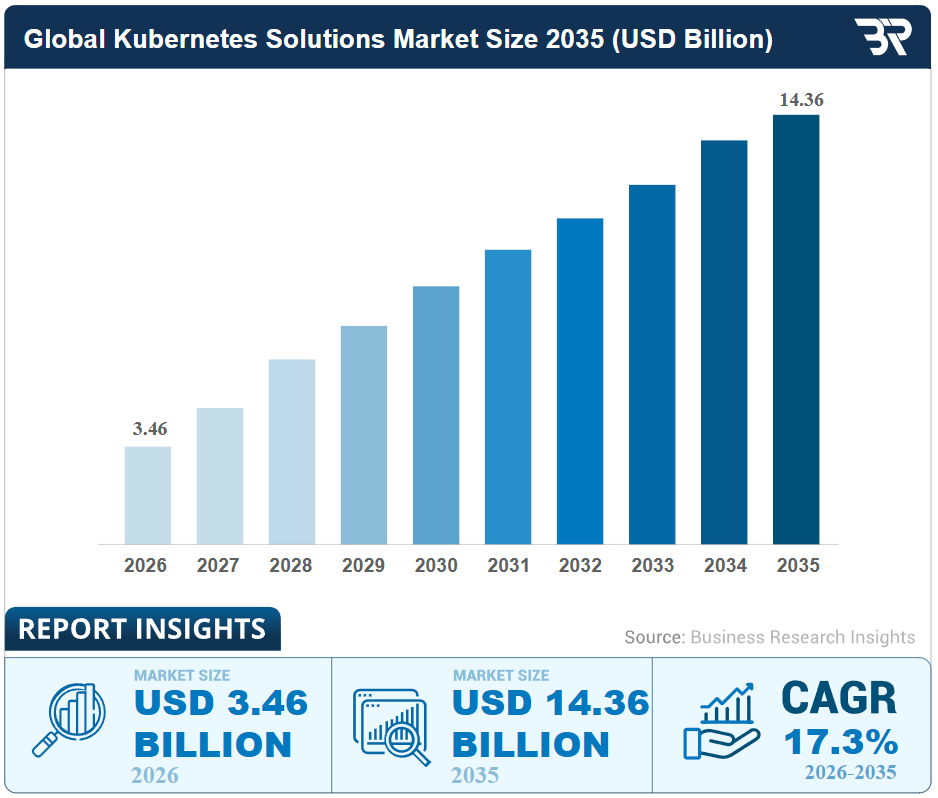
The global Kubernetes Solutions Market is estimated at USD 3.46 billion in 2026 and is projected to reach USD 14.36 billion by 2035, growing at a CAGR of 17.3% over the forecast period. This growth reflects the rising urgency for advanced Kubernetes security as organizations scale increasingly complex and dynamic containerized environments.
Kubernetes has revolutionized container orchestration, but its complexity often creates a patching debt where kubernetes vulnerabilities unpatched continue growing faster than security teams can manage. At scale, the sheer volume of ephemeral assets and interdependencies makes traditional vulnerability management nearly impossible.
A. Why Vulnerability Detection Outpaces Remediation Teams
The primary bottleneck in modern cloud-native security is not finding bugs, but fixing the growing number of kubernetes vulnerabilities unpatched across production environments. Scanning tools can identify thousands of Common Vulnerabilities and Exposures (CVEs) in seconds across hundreds of nodes. However, the remediation process which involves verifying the patch, testing it against the current environment and redeploying, is a manual or semi-automated process that takes significantly longer.
- Alert Fatigue: Excessive low-impact and false-positive alerts overwhelm security teams and bury critical vulnerabilities within constant notification noise.
- Skill Gaps: Remediation requires deep knowledge of both security and Kubernetes-specific configurations (like YAML manifests and Helm charts), a dual-competency that is rare in many organizations.
B. How Kubernetes Vulnerabilities Unpatched Increase Attack Risks
A Kubernetes cluster is a dense ecosystem of moving parts. When kubernetes vulnerabilities unpatched remain unresolved, they create a cumulative risk profile that attackers can exploit through lateral movement.
- Exploitable API Servers: If the Kubernetes API server remains unpatched against remote code execution (RCE) flaws, an attacker can gain total control over the cluster.
- Container Breakouts: Unpatched vulnerabilities in the container runtime (like containerd or CRI-O) allow attackers to escape a single container and access the underlying host machine.
- Service Mesh Weaknesses: Delayed updates to service mesh components (like Istio or Linkerd) can leave encrypted traffic vulnerable to interception.
C. Hidden Business Costs of Delayed Vulnerability Remediation
Organizations that leave kubernetes vulnerabilities unpatched expose their business to financial losses, operational instability, and long-term security risks.
- Downtime & Revenue Loss: Unpatched flaws invite ransomware and DoS attacks, often requiring total production shutdowns that damage revenue and trust.
- Compliance & Legal Risks: Regulated sectors like PCI-DSS, HIPAA, and SOC2 mandate strict patching. Failure leads to audit rejection, heavy fines, and loss of licenses.
- Supply Chain Vulnerability: Kubernetes relies on third-party images; unpatched deep dependencies turn all connected applications into systemic risks.
- DevOps Burnout: Constant, unprioritized alerts cause fatigue, leading engineers to overlook critical warnings and increasing breach likelihood.
Understanding Kubernetes Vulnerability Remediation Gaps
The gap between identifying a security flaw and deploying a fix is where kubernetes vulnerabilities unpatched continue creating the highest risks in cloud-native environments. While automated tools have made discovery instantaneous, the remediation process remains a complex hurdle.
A. Why Finding Vulnerabilities Is Easier Than Fixing Them
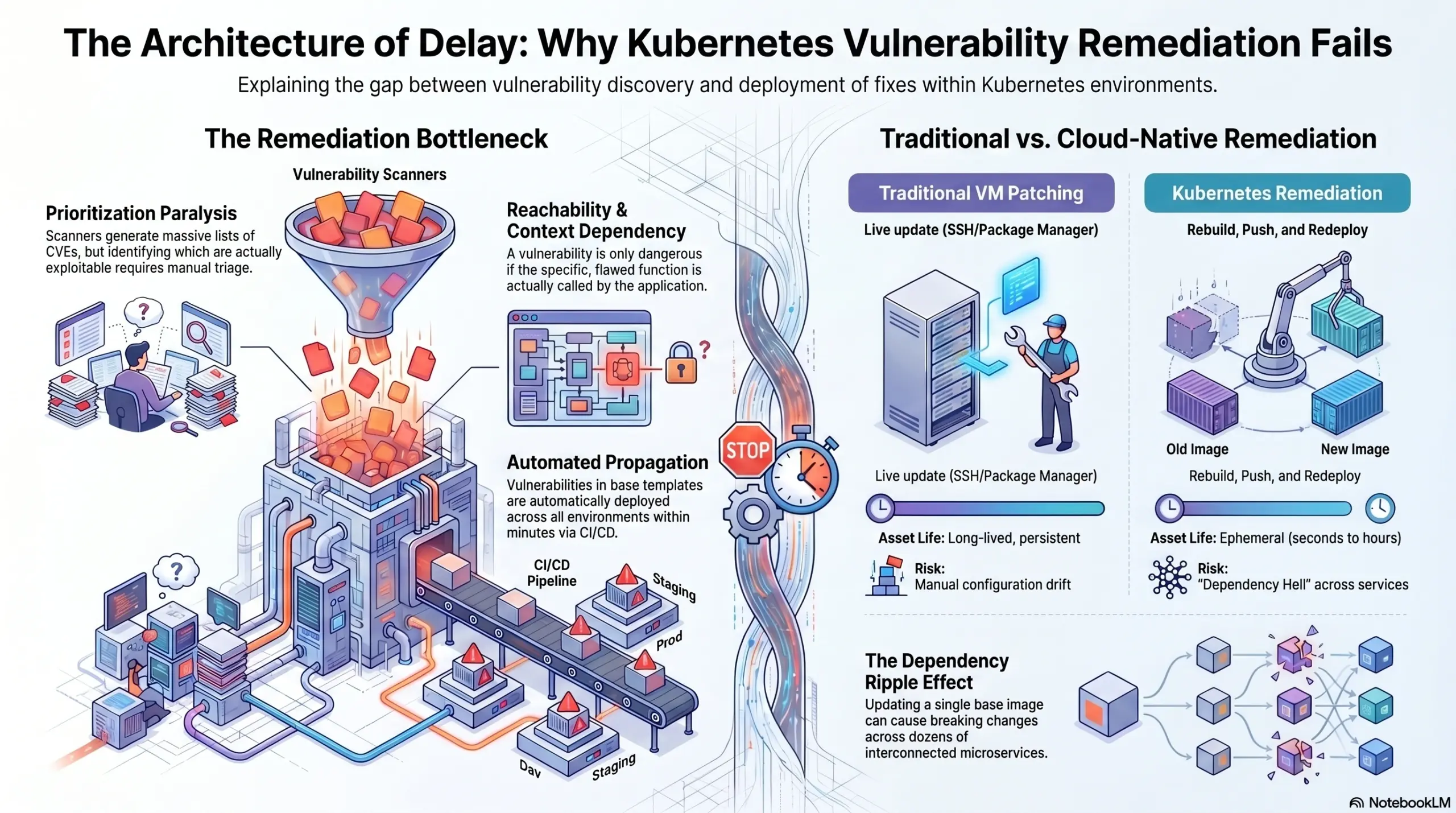
Modern security relies on Software Composition Analysis (SCA) and container scanners that can analyze thousands of images per hour. These tools generate massive lists of CVEs, but identifying a flaw is only the first and easiest step.
- Prioritization Paralysis: A scanner might flag 500 critical vulnerabilities, but not all are exploitable in your specific environment. Determining which ones actually pose a threat requires manual triage.
- Context Dependency: A library vulnerability only becomes dangerous when applications actively use the affected function. Security teams must analyze runtime reachability instead of simply flagging the library’s presence.
B. How Kubernetes Architecture Increases Security Complexity
Unlike monolithic applications, Kubernetes is a distributed system with multiple abstraction layers, each introducing its own set of potential weaknesses.
- The Layered Attack Surface: ecurity teams must secure the host OS, container runtime, Kubernetes API, and application code simultaneously. Updating one layer, such as a node kernel, can easily disrupt configurations in another layer like a CNI plugin.
- Ephemeral Nature: Containers live and die in seconds. Traditional security tools designed for long-lived servers struggle to track assets that disappear before a scan can even complete.
C. Why Traditional Patch Management Fails in Kubernetes
Traditional patching workflows built for virtual machines leave kubernetes vulnerabilities unpatched because Kubernetes requires immutable image rebuilding and automated pod redeployment instead of direct system patching.
- Immutability: Kubernetes environments rely on immutable containers, so teams must rebuild the image, push the updated version to a registry, and redeploy the pod instead of patching a running container.
- Dependency Hell: Updating a single base image can trigger a ripple effect. If a new version of a base image changes a configuration file or a shared library, it may cause breaking changes for dozens of microservices relying on that same parent image.
D. How Rapid CI/CD Pipelines Increase Security Debt
The move fast and break things mentality of modern DevOps often prioritizes feature velocity over security hygiene, leading to a mounting security debt.
- Automated Propagation of Flaws: A vulnerable base template or shared CI/CD pipeline can rapidly spread security flaws across staging and production environments within minutes.
- The Ignore Culture: To keep deployment green-lights, developers may bypass security gates or suppress alerts that seem non-critical, intending to fix them later. As the release cycle accelerates, that later rarely arrives, leaving a trail of unpatched workloads in the wake of rapid innovation.

Where Kubernetes Vulnerabilities Commonly Appear
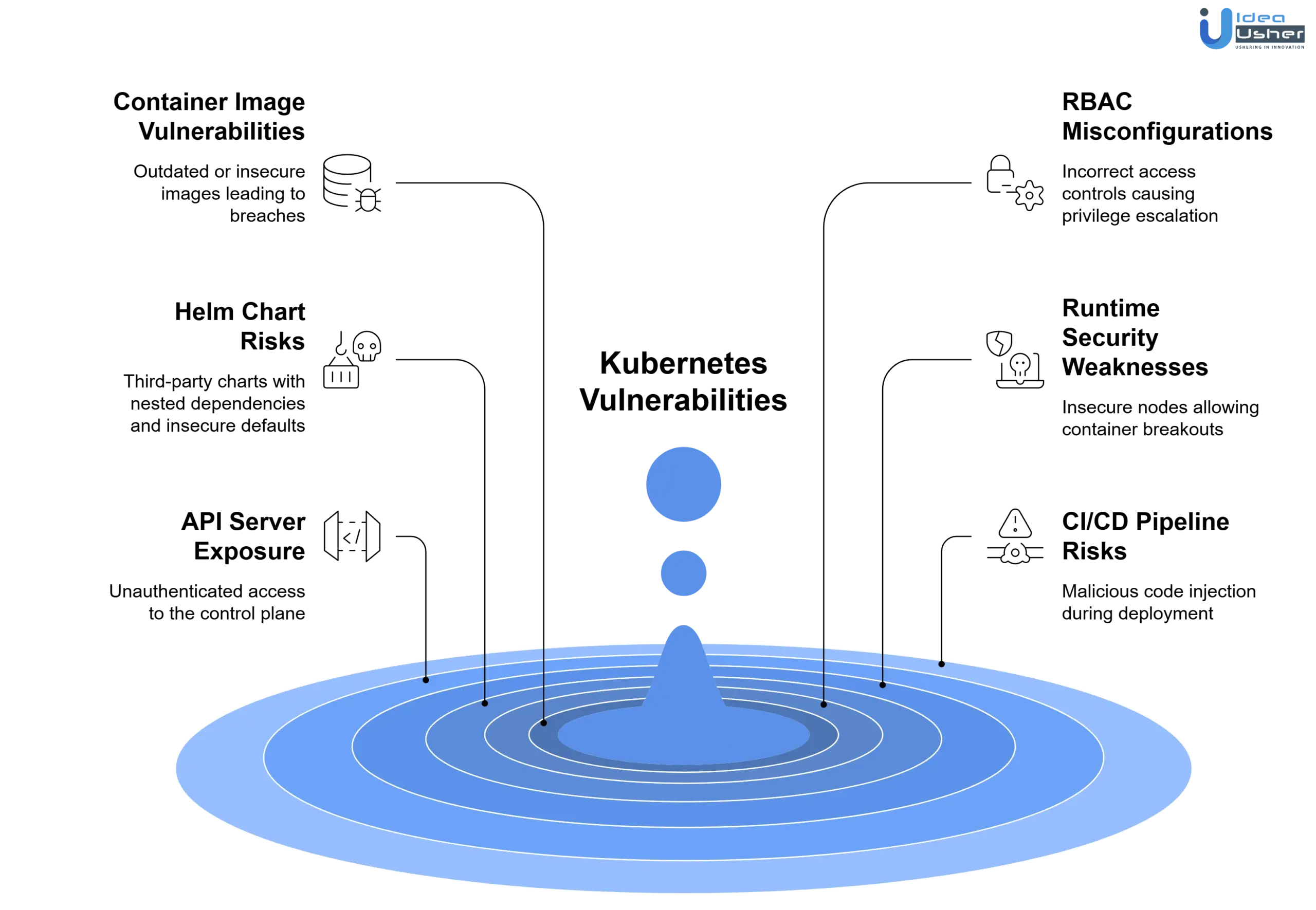
Securing a Kubernetes environment requires looking beyond the application code. Because Kubernetes is a multi-layered orchestration platform, vulnerabilities can hide in the container images, the cluster configuration, or the underlying infrastructure itself.
1. Container Image Vulnerabilities Across Production Clusters
The most frequent entry point for vulnerabilities is the container image. Production clusters often run hundreds of images, many of which contain outdated binaries or insecure libraries.
- Bloated Base Images: Using full-service operating system images (like Ubuntu or CentOS) instead of minimal distros (like Alpine or Distroless) increases the attack surface by including unnecessary tools like curl or ssh.
- Stale Images: Teams that avoid rebuilding container images for months often leave high-severity CVEs active long after researchers discover them.
2. Kubernetes RBAC and Misconfiguration Security Risks
Role-Based Access Control (RBAC) protects cluster access, but teams often misconfigure permissions and create serious privilege escalation risks.
- Over-privileged Service Accounts: Applications often run with cluster-admin rights when they only need to read a single namespace.
- Excessive Secret Access: Misconfigured RBAC can allow a compromised pod to read all Secrets in a cluster, exposing database passwords and API keys.
3. Helm Charts and Open-Source Dependency Vulnerabilities
Helm is the de facto package manager for Kubernetes, but third-party charts can be a black box of security risks.
- Nested Dependencies: Helm charts often import container images or sub-charts from untrusted third-party maintainers, increasing supply chain security risks.
- Insecure Defaults: Many open-source charts default to running containers as the root user or mounting sensitive host paths to simplify the initial setup.
4. Runtime and Node-Level Kubernetes Security Weaknesses
Even a perfectly configured pod is at risk if the node it sits on is insecure.
- Kernel Vulnerabilities: Since containers share the host’s Linux kernel, an unpatched kernel vulnerability can allow an attacker to perform a container breakout to access the node.
- Insecure Kubelet Settings: If the Kubelet (the agent on every node) allows anonymous authentication or has an exposed port, an attacker can execute commands across all pods on that node.
5. API Server and Control Plane Vulnerability Exposure
The Kubernetes Control Plane manages the entire cluster and exposing the API server to the public internet without strict authentication creates serious security risks.
- Unauthenticated Access: Vulnerabilities like CVE-2018-1002105 allowed unauthorized users to escalate privileges through the API server.
- Etcd Exposure: Attackers can access sensitive cluster data when teams leave the etcd database unencrypted or expose it directly to the network.
6. CI/CD Pipeline Risks That Impact Kubernetes Security
Security gaps often start long before a pod is deployed. The CI/CD pipeline is a high-value target for attackers looking to inject malicious code.
- Poisoned Build Tools: Unpatched GitHub Actions or GitLab CI runners allow attackers to intercept secrets and modify container images during the build process.
- Insecure Registry Storage: Lack of access control on container registries allows attackers to swap a legitimate production image with a compromised version containing a backdoor.
Why Enterprises Struggle to Patch Kubernetes Risks
Scaling Kubernetes across an enterprise introduces operational friction where kubernetes vulnerabilities unpatched accumulate faster than remediation cycles. As clusters multiply, the logistical and cultural hurdles to maintaining a secure environment often become more daunting than the technical vulnerabilities themselves.
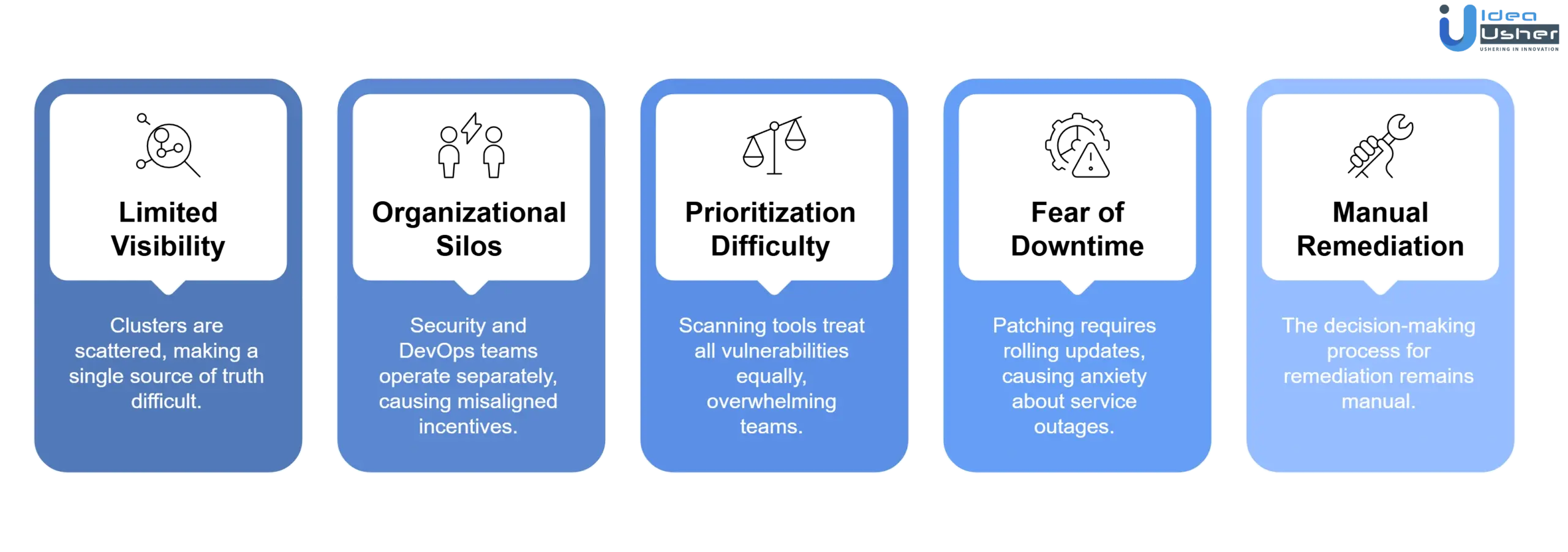
A. Limited Visibility Across Multi-Cluster Environments
Organizations often distribute Kubernetes clusters across multiple cloud providers, on-premises environments, and geographic regions, making centralized security visibility difficult to maintain.
- Shadow Kubernetes: Development teams may spin up rogue clusters for testing that bypass corporate security policies and remain unmonitored and unpatched.
- Version Disparity: Managing different versions of Kubernetes, CNI plugins, and ingress controllers across hundreds of clusters makes it nearly impossible to apply a uniform patching strategy.
B. Security and DevOps Teams Operate in Organizational Silos
A fundamental cultural gap often exists between those who secure the infrastructure and those who keep it running.
- Misaligned Incentives: Security teams focus on reducing risk and maintaining compliance, while DevOps teams prioritize uptime and deployment speed, creating conflicts that delay critical patching efforts.
- Context Gaps: Security analysts may identify a CVE but lack the operational context to know if a specific microservice is critical for production, leading to friction when they demand immediate remediation.
C. Difficulty Prioritizing Critical Kubernetes Vulnerabilities
Many vulnerability scanning tools treat all security issues equally, overwhelming enterprises with excessive alerts that lack business and environmental context.
- The Reachability Problem: Vulnerability scanners may flag OpenSSL issues across thousands of pods, even though attackers can only exploit a small number of them. Without advanced reachability analysis, teams waste valuable time patching low-risk exposures.
- Environmental Context: A Critical vulnerability on a developer’s sandbox cluster is far less urgent than a Medium vulnerability on a cluster handling customer payment data.
D. Fear of Downtime During Production Patch Deployment
The immutability of Kubernetes means that patching usually requires a rolling update, destroying old pods and spinning up new ones. In complex, stateful, or highly interconnected applications, this process is fraught with anxiety.
- Orchestration Risks: Teams fear that a new image version might have a subtle configuration change that causes a crash loop or breaks a database connection, leading to a service outage.
- Legacy Debt: Older containerized applications often lack cloud-native resilience, causing failures and instability during automated patch redeployment workflows.
E. Manual Remediation Workflows Slow Security Response
Despite the automated nature of Kubernetes, the decision-making process for remediation remains stubbornly manual in many enterprises.
- Human-in-the-Loop Bottlenecks: Every patch often requires manual approval from a Change Advisory Board (CAB), a security lead, and a product owner.
- Lack of Automated Testing: Teams without robust CI/CD testing suites must rely on slow manual smoke tests to verify security patches, significantly delaying remediation timelines.
Risks of Leaving Kubernetes Vulnerabilities Unpatched
The dynamic nature of Kubernetes often creates a false sense of security; however, recent exploits in 2025 and 2026 prove that unpatched clusters are primary targets for high-speed, automated attacks. When kubernetes vulnerabilities unpatched remain unresolved, the risk shifts from a simple bug to a systemic failure of the entire infrastructure.
1. Container Escape and Privilege Escalation Attack Risks
The boundary between a container and its host has become more porous for attackers.
- The Copy Fail Flaw (CVE-2026-31431): A critical 2026 Linux kernel flaw enables root access in seconds. Since containers share this kernel, a single compromised node lets attackers escape sandboxes, take over the host, and spread throughout the cluster.
- Hardware-Level Escapes: Hardware-level flaws like NVIDIAScape (CVE-2025-23266) threaten GPU-accelerated workloads, enabling attackers to bypass container isolation and exfiltrate AI models or customer data directly from host memory.
2. Ransomware Threats Targeting Kubernetes Infrastructure
Ransomware has evolved into multi-extortion models specifically designed for cloud-native environments.
- Data Theft Without Encryption: Attackers now prioritize silent data theft over encryption. Exploiting unpatched API servers or Ingress vulnerabilities such as the 2026 Ingress-Nginx injections allows them to exfiltrate secrets and service tokens, effectively seizing control of cloud operations.
- Targeting the Control Plane: By exploiting unpatched vulnerabilities in etcd or the Kubernetes API, ransomware groups can wipe cluster configurations, delete backups, and demand payment just to restore the orchestration layer.
3. Compliance Violations Caused by Unresolved Vulnerabilities
Regulatory bodies have tightened their stance on patching debt. Maintaining unpatched workloads is now a direct path to audit failure.
- PCI-DSS and SOC2 Failures: Current compliance standards require teams to remediate critical vulnerabilities within strict timelines, often within 30 days. Organizations that leave known CVEs in production risk major fines and loss of trusted provider status.
- Automated Audit Scans: Regulatory agencies now use the same scanning technology as attackers. If an automated compliance check detects outdated Ingress controllers or vulnerable base images, it can trigger immediate legal scrutiny.
4. How Attackers Exploit Known Kubernetes Security Flaws
The window between a vulnerability’s disclosure and its mass exploitation has collapsed from weeks to less than 48 hours.
- Automated Scanning Bots: Attackers deploy AI-driven bots that constantly crawl public IP ranges, looking for specific version headers of Kubernetes components or unpatched Load Balancers.
- Chained Exploits: Typical 2026 attacks chain Medium Ingress flaws with High local privilege escalation (LPE), enabling full cluster takeovers before alerts are triaged.
5. Financial Losses From Preventable Kubernetes Breaches
The cost of a breach in a containerized environment is often higher than in traditional IT due to the density of data.
- Revenue and Customer Loss: Reports from early 2026 indicate that 46% of organizations hit by a Kubernetes-related security incident suffered significant revenue loss or permanent customer churn.
- The Cost of Blast Radius: A single unpatched node can compromise dozens of microservices, creating a massive blast radius with exponential costs for forensics, legal fees, and total infrastructure recovery.
How to Fix the Kubernetes Remediation Workflow
Organizations must move away from manual patching toward automated workflows that reduce kubernetes vulnerabilities unpatched across clusters and workloads to bridge the gap between detection and defense. By integrating security directly into the DevOps loop, teams can neutralize threats before they reach production.
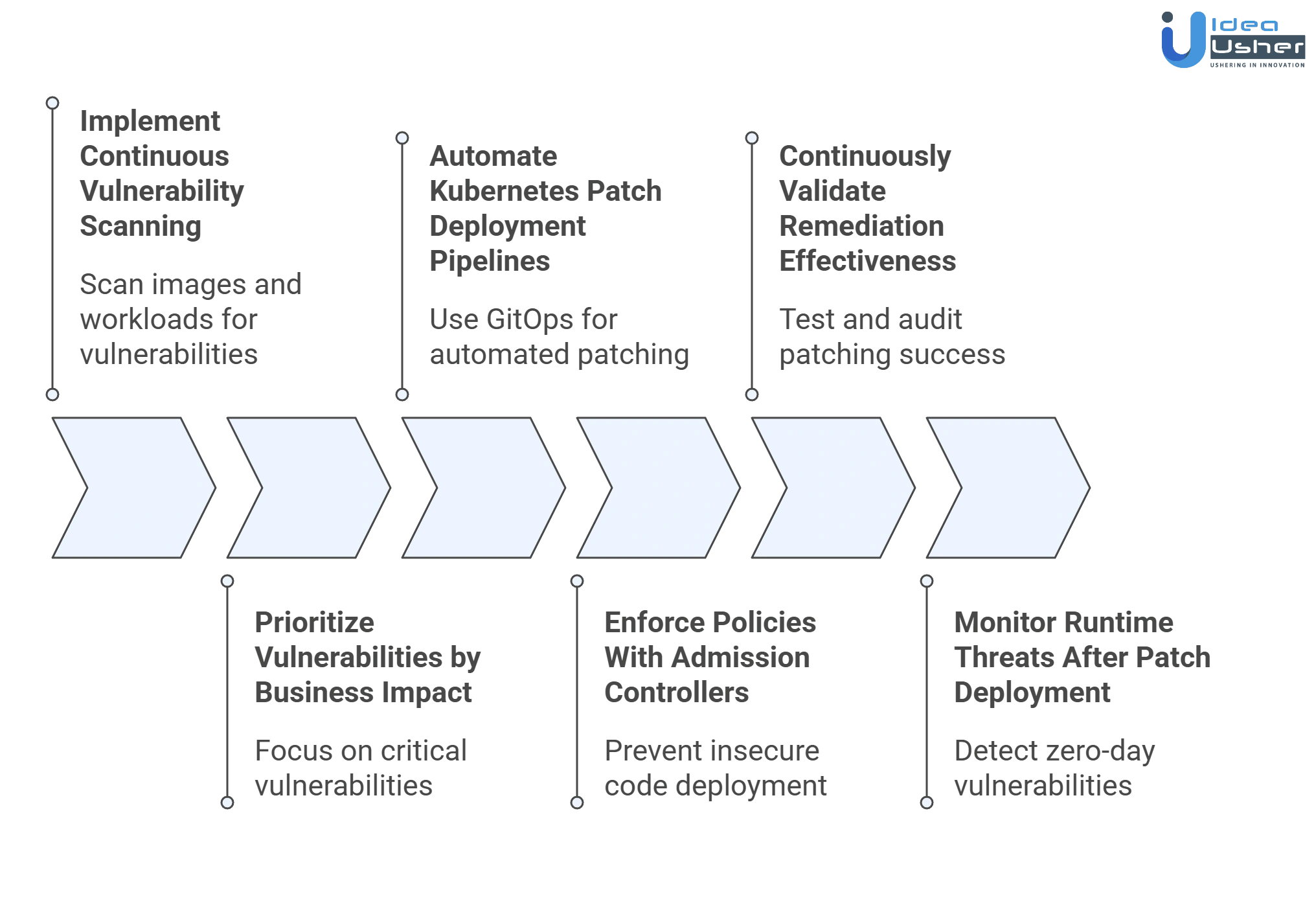
1. Implement Continuous Vulnerability Scanning
Security shouldn’t be a point-in-time event. Continuous scanning ensures that new vulnerabilities are caught the moment they are disclosed, not just when a developer happens to trigger a build.
- Registry Scanning: Automatically scan images as they are pushed to the container registry.
- In-Cluster Scanning: Use agents to monitor running workloads, identifying stale pods that have been running longer than the lifecycle of a newly discovered CVE.
- Shift-Left Integration: Embed security scanners directly into the developer’s local IDE and pre-commit hooks to catch vulnerabilities before code is even pushed to the repository.
2. Prioritize Vulnerabilities by Business Impact
Not all Critical alerts require an immediate midnight page. True prioritization requires looking at the context of the workload.
- Reachability Analysis: Determine if the vulnerable code is actually being executed or if the vulnerable port is exposed to the internet.
- Environmental Tagging: Prioritize remediation for clusters housing sensitive data (PII, financial records) over development or sandbox environments.
- Exploitability Scoring (EPSS): Utilize the Exploit Prediction Scoring System to identify which CVEs are being actively exploited in the wild, moving beyond static CVSS scores.
3. Automate Kubernetes Patch Deployment Pipelines
Manual patching is the enemy of scale. The goal is to move toward Automated Patching (GitOps).
- Automated Pull Requests: Use tools that automatically create a PR to update a base image version in your Dockerfile or Helm chart when a patch is released.
- Blue-Green/Canary Deployments: Use automated deployment strategies to roll out patches to a small subset of users first, ensuring the fix doesn’t cause performance regressions before a full rollout.
- Self-Healing Infrastructure: Leverage operators that can automatically trigger a rolling restart of deployments once a new, patched image is successfully verified in the container registry.
4. Enforce Policies With Admission Controllers
Prevention is more efficient than remediation. Admission controllers act as the cluster’s bouncers, preventing insecure code from ever being deployed.
- Policy as Code: Use tools like OPA (Open Policy Agent) or Kyverno to reject any pod deployment that contains critical vulnerabilities or lacks a security-scanned signature.
- Block Root Access: Enforce policies that prevent containers from running as root, significantly reducing the impact if an unpatched vulnerability is exploited.
- Image Provenance Verification: Mandate cryptographic signatures for all container images (using tools like Cosign) to ensure that only verified, untampered images are admitted to the cluster.
5. Continuously Validate Remediation Effectiveness
A patch is only successful if it actually closes the hole without breaking the system.
- Security Integration Testing: Incorporate security unit tests into the CI/CD pipeline to verify that a vulnerability is no longer exploitable after the fix is applied.
- Configuration Auditing: Regularly audit the cluster against benchmarks (like CIS Kubernetes Benchmark) to ensure that patching a component hasn’t accidentally drifted the configuration into an insecure state.
- Automated Rollback Triggers: Set up monitoring hooks that automatically roll back a patch if the new deployment triggers a spike in 5xx errors or increased latency during the validation phase.
6. Monitor Runtime Threats After Patch Deployment
Even with a perfect patching record, Zero-Day vulnerabilities exist. Runtime security provides a final safety net for the gaps you don’t know about yet.
- Behavioral Baselining: Use runtime security tools to monitor for unusual process execution, such as a web server suddenly launching a shell script (a classic sign of a breakout).
- Real-time Observability: Correlate runtime alerts with known unpatched vulnerabilities to identify which systems are under active attack, allowing for rapid isolation or killing of compromised pods.
- Drift Detection: Continuously monitor for exec events or file system changes within running containers that deviate from the immutable image profile established at deployment.
Best Practices for Kubernetes Vulnerability Reduction
Reducing the attack surface of a Kubernetes environment is a continuous process of hardening configurations and streamlining developer workflows. By implementing these best practices, organizations can move from a reactive patching mindset to a proactive security posture.
A. Shift Security Left Without Slowing Engineering Teams
Shifting left means integrating security checks early in the development cycle, but it must be done without creating friction for developers.
- Integrated IDE Feedback: Provide developers with real-time security feedback within their coding environment, highlighting vulnerable libraries as they are imported.
- Automated PR Comments: Configure CI/CD pipelines to automatically comment on pull requests with security scan results, allowing developers to fix issues before code review.
- Pre-Approved Templates: Offer Golden Path Helm charts and YAML manifests that are pre-configured with security best practices, reducing the need for manual security intervention.
B. Use Hardened Base Images
The base image is the foundation of every container. Using unverified or bloated images significantly increases the number of vulnerabilities that must be managed.
- Adopt Distroless Images: Use distroless base images that contain only the application and its runtime dependencies, removing shells, package managers, and other tools used by attackers.
- Centralized Image Registry: Establish a private, hardened container registry where all images are scanned, signed, and approved before they can be pulled by production clusters.
- Regular Image Rebuilds: Automate the periodic rebuilding of base images to ensure that even if the application code doesn’t change, the underlying OS packages stay current with the latest patches.
B. Apply Zero-Trust Security
Under a zero-trust model, no entity whether inside or outside the cluster is trusted by default. Every communication must be strictly authenticated and authorized.
- Implement Micro-Segmentation: Use Network Policies to restrict pod-to-pod communication, ensuring that a compromise in one microservice cannot easily spread to another.
- Mutual TLS (mTLS): Deploy a service mesh to automatically encrypt all internal traffic and provide strong identity-based authentication for every service.
- Identity-Based Access: Move away from static IP-based security and toward dynamic, identity-based policies that follow the workload regardless of where it is scheduled in the cluster.
C. Rotate Secrets and Reduce Privileged Access Exposure
Static secrets and over-privileged accounts are among the most exploited weaknesses in Kubernetes environments.
- Dynamic Secret Injection: Use external secret managers (like HashiCorp Vault or AWS Secrets Manager) to inject short-lived, dynamic credentials into pods at runtime rather than storing them in Kubernetes Secrets.
- Just-in-Time (JIT) Access: Implement tools that grant temporary, elevated permissions for troubleshooting that automatically expire, reducing the window of opportunity for an attacker.
- Least-Privilege RBAC: Regularly audit RBAC roles to identify and remove wildcard permissions, ensuring that service accounts only have the specific access required for their function.
D. Use Drift Detection to Prevent Security Regression
Security drift occurs when the live state of a cluster deviates from its intended, documented configuration, often due to emergency manual interventions.
- Continuous Configuration Auditing: Use tools to continuously compare the running cluster state against the version-controlled manifests in Git.
- Automated Reconciliation: Leverage GitOps operators (like ArgoCD or Flux) to automatically revert any manual changes made to the cluster, ensuring the environment always stays in a hardened state.
- Alerting on Runtime Changes: Set up alerts for any modifications to sensitive cluster resources, such as changes to ClusterRoles or NetworkPolicies, to catch unauthorized or accidental security regressions.
Common Kubernetes Remediation Mistakes to Avoid
Even with the best intentions, security strategies can fail if the execution is reactive or inconsistent. Avoiding these common pitfalls is essential for maintaining a resilient and high-performing Kubernetes environment.
1. Treating Every Vulnerability With Equal Priority
Attempting to fix every High or Critical vulnerability simultaneously leads to resource exhaustion and security paralysis.
- Lack of Contextual Triage: Failing to distinguish between a critical vulnerability in an internet-facing web server and one in an isolated, internal-only backend service.
- The CVSS Trap: Relying solely on the Common Vulnerability Scoring System (CVSS) without considering if the vulnerable component is actually being used or loaded into memory.
- Ignoring Reachability: Wasting engineering hours patching libraries that are present in a container image but are never actually called by the application’s executable code.
2. Deploying Patches Without Staging Environment Testing
Teams often bypass standard deployment protocols in the rush to close a security hole, which can lead to catastrophic production failures.
- Breaking Dependency Chains: Patching a shared library or base image without testing can cause cascading failures in microservices that rely on specific versions of those dependencies.
- Configuration Mismatches: Assuming a patch that worked on a developer’s laptop will behave the same way in a production cluster with different network policies and RBAC constraints.
- Incompatibility with Sidecars: Failing to verify that a patched application container still plays nicely with existing service mesh sidecars (like Istio) or logging agents.
3. Ignoring Runtime Threats After Vulnerability Resolution
Many organizations believe that once a patch is deployed, the risk is gone. This fire and forget mentality ignores the possibility of persistent threats.
- Overlooking Pre-Patch Compromise: If an attacker exploited a vulnerability before you patched it, they might have already established persistence. A patch does not remove an existing backdoor.
- Failure to Scan Active Memory: Static image scanning cannot detect malicious processes that were injected into a running container’s memory prior to the update.
- Neglecting Post-Remediation Logs: Not monitoring logs immediately after a patch to see if the vulnerability is still being targeted, which could indicate a zero-day or an incomplete fix.
4. Depending Only on Open-Source Security Tools
While open-source tools are powerful, relying on them exclusively in an enterprise setting can create blind spots and operational overhead.
- Slower Update Cycles: Some open-source scanners may have a longer delay in updating their vulnerability databases compared to premium feeds that receive early bird disclosure data.
- Integration Gaps: Community-driven tools often lack the native, out-of-the-box integrations with enterprise ticketing systems (like Jira or ServiceNow) and SIEM platforms.
- Manual Maintenance Burdens: The lack of professional support means internal teams must spend time maintaining the security infrastructure itself rather than focusing on actual remediation.
5. Delaying Remediation Until Compliance Audit Deadlines
Treating security as a once-a-quarter compliance checkbox creates a massive window of opportunity for attackers.
- The Audit Crunch: Rushing to patch hundreds of vulnerabilities a week before a SOC2 or HIPAA audit leads to sloppy testing and increased production risk.
- False Sense of Security: Passing a compliance audit does not mean a cluster is secure; it only means it met a specific set of requirements at a specific point in time.
- Accumulated Security Debt: By waiting for an audit, organizations allow vulnerabilities to age, making them easier for automated exploit kits to target while the patch debt becomes increasingly expensive to pay down.
Why Hiring Kubernetes Security Experts Is Difficult
As Kubernetes becomes the backbone of AI-driven infrastructure in 2026, the demand for specialized security talent has reached a breaking point. Organizations are no longer just looking for cloud engineers; they need experts who understand the intersection of container orchestration, network security, and automated remediation.
A. Shortage of Skilled Kubernetes Security Professionals
The rapid growth of Kubernetes with nearly half of organizations expected to grow their cluster counts by over 50% this year has far outpaced the production of qualified experts.
- The Double-Deep Skill Requirement: A true expert must possess deep knowledge of both Kubernetes internals (like etcd, CNI, and API controllers) and advanced security disciplines (like threat modeling and forensics).
- Specialized AI Demands: Security professionals are now required to secure GPU-accelerated workloads and stateful AI pipelines, adding a layer of complexity that few traditional cloud engineers possess.
- Outsourcing as a Necessity: Due to the scarcity of talent, many organizations are forced to rely on third-party managed service providers (MSPs) or platform engineering teams rather than building their own internal security units.
B. Why Most DevOps Teams Lack Advanced Security Expertise
While 85% of organizations practice DevOps, a significant gap remains in their ability to handle the Sec in DevSecOps.
- Cultural Focus on Speed: DevOps is traditionally incentivized by deployment frequency and velocity. Advanced security, which often requires slower, more meticulous verification, is frequently outside a typical DevOps engineer’s core training.
- The 37% Gap: Recent 2026 data indicates that 37% of IT leaders identify DevSecOps as their largest technical skills gap, even as 83% of developers now perform some operational activities.
- Complexity Overload: Kubernetes security tools frequently generate excessive noise; 72% of teams find most alerts irrelevant, necessitating triage expertise that typical DevOps teams lack.
C. Rising Costs of Hiring Kubernetes Security Engineers
The scarcity of talent has driven compensation to historic highs, making it difficult for mid-sized enterprises to compete with tech giants.
- Six-Figure Standard: the average salary for a Kubernetes-skilled professional in regions like the US is approximately $139,000, with top-tier leads and managers commanding upwards of $250,000 to $515,000.
- Global Competition: Remote work allows top Kubernetes security engineers to work for global firms at USD 6,000+ per month for senior roles, creating a bidding war that prices out many local or non-tech industries.
- The Niche Premium: Adding specific security certifications (like CKS – Certified Kubernetes Security Specialist) can increase an engineer’s market value by an additional 20–30% compared to a standard administrator.
D. Challenges Building Internal 24/7 Security Operations
Kubernetes doesn’t sleep, and neither do attackers. Building a round-the-clock Security Operations Center (SOC) for a cluster environment is a monumental task.
- High Attrition and Burnout: Managing ephemeral workloads across thousands of sites (edge AI) leads to alert fatigue. Finding enough staff to cover 24/7 shifts without burnout is nearly impossible for most internal teams.
- Sophisticated Tooling Requirements: A 24/7 operation requires specialized observability and automated response tools that are expensive to license and even more expensive to configure and maintain internally.
- Multi-Cluster Management: Coordinating security consistently across decentralized environments (on-prem, cloud, and edge) requires a level of centralized management that most internal teams are still struggling to build.
E. Why Internal Upskilling Slows Security Remediation
While 68% of IT teams have upskilling programs in place, training current staff on Kubernetes security takes time that attackers don’t give.
- The Steep Learning Curve: It can take 6–12 months for a traditional systems administrator to become proficient enough in Kubernetes security to manage production-grade remediation safely.
- Delayed Response Times: During the upskilling phase, teams are more likely to spend time figuring out the fix, leading to longer Mean Time to Repair (MTTR) for critical vulnerabilities.
- Risk of Misconfiguration: Learning on the job in a live Kubernetes environment is high-risk. 45% of respondents in 2026 report misconfiguration incidents as a top concern, often caused by well-intentioned staff who lack the deep expertise to navigate complex YAML configurations and network policies.
In-House Teams vs Kubernetes Staff Augmentation
Rising Kubernetes complexity has intensified the choice between in-house teams and staff augmentation. While internal teams provide continuity, IdeaUsher, a top 1% partner offers the technical agility to secure large-scale clusters without the high costs and stability tax of traditional hiring.
A. In-House vs. Staff Augmentation Cost & Value
Choosing between a permanent hire and staff augmentation isn’t just about the monthly paycheck; it’s about the Total Cost of Ownership (TCO) and the speed of risk mitigation. Below is a high-impact breakdown of how IdeaUsher’s model accelerates ROI.
| Strategic Value Factor | In-House Team | Staff Augmentation (IdeaUsher) | Business Impact |
| Speed to Deployment | 30–90 Days (Sourcing & Notice) | 1–2 Weeks (Ready-to-deploy) | Eliminates months of vulnerability exposure. |
| Direct Recruitment Cost | $30k–$40k (Fees, Ads, & HR Hours) | $0 (Pre-vetted talent pool) | Redirects capital toward infrastructure, not hiring. |
| Hidden Overhead | 30–40% (Equity, Health, Taxes, 401k) | Zero (All-inclusive hourly/monthly) | Simplifies budget forecasting and burn rate. |
| Technical Ramp-up | High (3–6 months to peak efficiency) | Instant (Top 1% niche expertise) | Immediate remediation of critical CVEs. |
| Long-term Flexibility | Rigid (Severance & Legal Risks) | Elastic (Scale up/down on demand) | Matches the ephemeral nature of K8s clusters. |
| Annual Savings | 0% Baseline | 30% – 60% Savings | Maximizes security budget efficiency. |
B. Faster Execution With Kubernetes Security Specialists
A threat landscape where exploits like Copy Fail can compromise a cluster in 48 hours, speed is the ultimate security feature. IdeaUsher’s augmented engineers are pre-vetted niche experts who integrate into your workflow in days, not months.
- Immediate Productivity: While an internal hire spends their first month in orientation, an augmented specialist from IdeaUsher is often productive by day three, having already mastered the tools (like Falco, Kyverno, or Istio) your stack requires.
- Reduced Management Burden: IdeaUsher provides engineers who are self-sufficient, allowing your internal leadership to focus on high-level strategy rather than technical hand-holding.
- Zero-Gap Transition: Our experts come from a culture of shifting left, ensuring that security is integrated into your existing CI/CD pipelines from the very first commit.
C. Scalability Benefits of Staff Augmentation Models
SaaS infrastructure rarely stays static and that is why staff augmentation provides the elasticity that mirrors the Kubernetes clusters themselves.
- Burst Capacity: Rapidly add security specialists during a major migration, a compliance audit (SOC2/HIPAA), or a post-incident remediation phase.
- Zero-Friction Downscaling: Unlike the legal and morale-damaging complexities of layoffs, staff augmentation allows you to scale down resources as project milestones are met, protecting your company’s long-term burn rate.
- Geographic Coverage: Access 24/7 Follow the Sun support by leveraging our global talent pool, ensuring your clusters are monitored while your core team sleeps.
D. Access to Specialized Kubernetes Security Experience
Finding a single engineer who understands AI-driven infrastructure, eBPF-based runtime security, and multi-cloud networking is a purple squirrel hunt.
The IdeaUsher Edge: As a top 1% development company, IdeaUsher maintains a pool of 250+ niche experts. When you augment your team through us, you aren’t just getting a coder, you are getting a specialist who has spent thousands of hours hardening production clusters for global brands and high-growth startups.
Best Hiring Model for Growing SaaS Infrastructure Teams
Staff Augmentation has emerged as the definitive winner for organizations in their high-growth phase. While maintaining a core vision is important, the sheer velocity of the current market makes the flexibility and cost-efficiency of augmented teams a primary driver of success.
- Maximized Budget Efficiency: Staff augmentation eliminates recruitment fees and heavy overhead, allowing growth-stage companies to reinvest savings directly into product development.
- Instant Expert Access: Skip months of training with immediate access to specialized talent for security remediation and 24/7 monitoring.
- Strategic De-risking: Partnering with IdeaUsher for execution-heavy tasks prevents core team burnout, keeping your top talent focused on innovation and ARR growth.
- Agile Scalability: Instantly adjust your engineering force to match project demands or funding cycles, ensuring you only pay for necessary resources.
How IdeaUsher Solves Kubernetes Security Challenges
Navigating the complexities of container orchestration requires more than just tools; it requires a specialized workforce that understands the nuances of cloud-native defense. IdeaUsher bridges this gap by providing high-tier engineering talent designed to fortify your infrastructure while maintaining peak deployment velocity.
1. Access Vetted Kubernetes Security and DevOps Engineers
The global shortage of Kubernetes talent makes finding the right engineer a months-long ordeal. IdeaUsher eliminates this hurdle by maintaining a pre-vetted pool of the top 1% of technical talent.
- Deep Domain Expertise: Our engineers are specialists in Kubernetes internals, from etcd encryption to CNI networking, ensuring your clusters are built on a secure foundation.
- Certified Professionals: We provide experts with industry-recognized certifications (such as CKS and CKAD), ensuring that the hands on your keyboard are well-versed in the latest security benchmarks and best practices.
2. Accelerate Remediation Workflows Across Clusters
Discovery is only half the battle; the real value lies in how quickly a threat is neutralized. IdeaUsher focuses on reducing the Mean Time to Remediate (MTTR) across your entire fleet.
- Contextual Prioritization: Instead of handing you a list of a thousand CVEs, our engineers triage vulnerabilities based on real-world reachability and business impact.
- Rapid Patch Deployment: We move beyond manual intervention, implementing GitOps-driven workflows that allow for safe, automated rolling updates that close security holes in hours rather than weeks.
3. Integrate Security Directly Into Existing CI/CD Pipelines
Security shouldn’t be an afterthought or a gate at the end of the development cycle. We help you shift left by weaving security into the very fabric of your software delivery.
- Automated Policy Enforcement: We integrate tools like Kyverno or OPA directly into your pipelines to reject non-compliant code before it ever touches a registry.
- SCA and Image Signing: Our specialists set up automated Software Composition Analysis (SCA) and cryptographic image signing (Cosign), ensuring that only verified, vulnerability-free images are permitted to run in production.
4. Improve Runtime Security and Policy Enforcement
A secure image is only safe until it starts running. IdeaUsher implements advanced runtime protection to defend against zero-day exploits and lateral movement.
- eBPF-Powered Monitoring: We deploy runtime security tools (like Falco or Tetragon) to monitor system calls and network activity in real-time, detecting anomalous behavior the moment it occurs.
- Micro-segmentation: Our DevOps teams implement strict Network Policies and service mesh configurations to enforce a zero-trust architecture, ensuring that a single compromised pod cannot lead to a full cluster breach.
5. Scale Security Operations With Flexible Hiring Models
For growing SaaS companies, fixed overhead is the enemy of agility. IdeaUsher’s staff augmentation model provides the most cost-effective path to a secure infrastructure.
- Budget-Friendly Growth: In the critical scaling stage, our model allows you to save significantly on hiring and retention costs, redirecting those funds toward core product innovation.
- Elastic Engineering: Whether you need a full team for a major security overhaul or a single specialist to assist with a compliance audit, our model scales up or down instantly to match your project’s lifecycle.
- 24/7 Operational Support: Access global talent that provides around-the-clock monitoring and response, ensuring your infrastructure is defended even when your core team is offline.
What IdeaUsher Developers Execute for Enterprises
Our developers don’t just provide support; they act as a high-velocity execution arm for your infrastructure. By combining deep architectural knowledge with automated workflows, IdeaUsher ensures your Kubernetes environment is not only patched but fundamentally resilient against the threats of 2026.
1. Audit Kubernetes Infrastructure for Security Gaps
The first step in any remediation journey is understanding the current state of your cluster. Our experts perform deep-dive assessments to identify structural weaknesses before they can be exploited.
- CIS Benchmark Alignment: We audit your control plane, worker nodes, and etcd configurations against the latest CIS (Center for Internet Security) benchmarks to ensure baseline hardening.
- RBAC Auditing: We review Role-Based Access Control policies to identify over-privileged accounts, wildcard permissions, and unused service accounts that could lead to privilege escalation.
- Network Policy Review: Our team analyzes your network traffic patterns to identify missing micro-segmentation, ensuring that East-West traffic is restricted by default.
2. Detect Critical Vulnerabilities Across Workloads
Continuous discovery is the backbone of our execution strategy. We move beyond manual scans to establish a constant state of vulnerability awareness.
- Multi-Layer Scanning: We deploy automated scanning across container images, OS binaries, and third-party libraries (SCA) to identify CVEs at every layer of the stack.
- IaC Scanning: We scan your Terraform, Helm, and YAML manifests during the development phase to catch misconfigurations—like running containers as root—before they reach production.
- Reachability Triage: Using advanced analysis, we determine which identified vulnerabilities are actually reachable in your running environment, allowing your team to ignore the noise and focus on high-risk threats.
3. Build Automated Kubernetes Remediation Pipelines
In 2026, manual patching is a liability. IdeaUsher developers build the auto-pilot for your security updates.
- GitOps-Driven Patching: We implement automated workflows using tools like ArgoCD or Flux that automatically trigger image updates in your Git repositories when a patched version is available and verified.
- Automated Canary Rollouts: To ensure stability, we configure pipelines that roll out security patches to a small subset of pods first, automatically rolling back the change if performance metrics deviate from the baseline.
- Virtual Patching: In cases where a vendor patch isn’t yet available, we implement Web Application Firewalls (WAF) or runtime filters to virtually patch the vulnerability at the network level.
4. Implement Runtime Security and Policy Enforcement
Since vulnerabilities like zero-day exploits can appear at any time, our developers build a proactive defense layer that monitors your clusters in real-time.
- Behavioral Monitoring: We deploy eBPF-based tools (like Falco) to detect suspicious activity, such as a container suddenly making an unauthorized outbound connection or modifying a sensitive system file.
- Admission Control Enforcement: We configure Kyverno or OPA Gatekeeper to act as a cluster bouncer, automatically rejecting any deployment that doesn’t meet your organization’s security signatures.
- Drift Prevention: Our systems monitor for manual changes made to the cluster (drift) and automatically reconcile the environment back to its hardened, version-controlled state.
5. Improve Incident Response and Compliance Monitoring
We turn security data into actionable intelligence, ensuring you are always ready for an audit or a threat.
- Centralized Security Dashboards: We consolidate alerts from various scanners and runtime tools into a single pane of glass, providing your stakeholders with real-time visibility into the cluster’s risk posture.
- Automated Compliance Reporting: Our developers automate the collection of evidence for SOC2, HIPAA, or PCI-DSS, turning a month-long manual audit process into a push-button report.
- Forensic Readiness: We implement specialized logging and snapshotting capabilities that allow your team to conduct deep forensic analysis if a security event occurs, capturing the state of ephemeral containers before they disappear.
6. Establish Long-Term Kubernetes Security Governance
Security is a marathon, not a sprint. We help you build the frameworks that keep your infrastructure secure as your company scales.
- Security-First Templates: We create Golden Path templates for your developers, ensuring that every new microservice is born with the correct security headers, resource limits, and network policies.
- Lifecycle Management: We manage the regular upgrade cycles of your Kubernetes clusters and their underlying nodes, ensuring you never fall behind on the critical security fixes provided by the upstream community.
- Knowledge Transfer: While our augmented engineers handle the heavy lifting, we document every process and policy, ensuring your internal team understands the why behind every security configuration.
Kubernetes Vulnerability Remediation Use Case Example
IdeaUsher scales security through Zeno, a proprietary EHR/EMR platform. In healthcare, where data is often fragmented, Kubernetes provides the essential infrastructure to integrate patient records, financial data, and telehealth services.
A. How a Healthcare EHR Platform Reduced Critical Cluster Risks
Before the intervention, the client managed patient data across four disconnected systems, leading to fragmented records and manual documentation burdens. Moving to a unified, Kubernetes-orchestrated architecture introduced significant security requirements to meet HIPAA compliance.
The IdeaUsher Execution:
Our specialized Kubernetes engineers implemented a HIPAA-Compliant Security Layer to protect ZenO’s longitudinal patient records:
- End-to-End Encryption: We applied AES-256 encryption for data handling and deployed cluster-wide mTLS (mutual TLS) to secure all microservice communications, including e-prescribing and lab integrations.
- Role-Based Access Control (RBAC): We built a granular RBAC framework that mapped directly to clinical workflows. This ensured that clinicians, admins, and IT leads had access only to the specific modules (like CPOE or RCM) necessary for their roles, minimizing the risk of internal data exposure.
- Automated Audit Trails: We configured the cluster to maintain full audit logs of every API call and data access event, ensuring the platform remained audit-ready for regulatory reviews.
B. Automating Patch Validation Without Production Downtime
For a platform like ZenO, which supports real-time clinical decisions and medication orders, downtime is not an option. IdeaUsher developed a remediation pipeline that prioritized uptime alongside security.
- Vulnerability Triage for Medical APIs: The team deployed automated scanning for Node.js and React.js stacks. By identifying third-party library vulnerabilities automatically, critical patches were validated and installed without impacting clinical operations.
- FHIR R4 & HL7 Integration Testing: Our CI/CD pipeline verified FHIR R4 and HL7 connectivity after every patch, maintaining the reliable flow of lab and imaging data to patient charts.
- Seamless Rollouts: We used Kubernetes rolling updates to patch six clinics at once. Automatic rollbacks prevented service disruptions to Telehealth (WebRTC) or Caching (Redis), maintaining zero downtime for clinical operations.
C. Results Achieved With Kubernetes Security Specialists
By leveraging IdeaUsher’s staff augmentation model to manage ZenO’s infrastructure, the client moved from a fragmented, high-risk environment to a secure, unified digital ecosystem.
| Key Outcome | Before IdeaUsher (Fragmented Systems) | After IdeaUsher |
| Documentation Errors | High (Manual Entry) | 60% Reduction |
| Data Retrieval Speed | Slow/Manual | 3x Faster via Unified K8s API |
| Security Compliance | Fragmented/Manual | 100% HIPAA Compliant |
| System Reliability | Disconnected | Zero-Downtime Patching Workflows |
The Bottom Line: Kubernetes security established clinical trust. Partnering with IdeaUsher allowed the client to bypass high enterprise fees and leverage an elite technical team. We built a secure, compliant infrastructure, enabling healthcare providers to prioritize patients while we managed their complex containerized environment.
When Enterprises Should Improve Kubernetes Security
Security is no longer a static milestone but a dynamic requirement. Identifying exactly when to shift from standard operations to an aggressive security overhaul is critical for protecting the bottom line and maintaining customer trust.
A. Warning Signs Your Remediation Workflow Is Failing
A failing remediation workflow doesn’t always break the cluster immediately; instead, it creates a silent backlog that erodes your security posture.
- Growing Mean Time to Remediate (MTTR): If the time between a vulnerability being flagged and its actual patching exceeds 72 hours for Critical CVEs, your manual processes are failing to keep pace with automated exploits.
- Repetitive Audit Findings: If internal or external audits continue to flag the same misconfigured RBAC roles or unencrypted secrets, it’s a sign that your remediation isn’t sticking and requires a more fundamental, automated approach.
- Deployment Throttling: When 67% of DevOps teams report slowing down feature releases due to security concerns, the workflow has become a bottleneck rather than an enabler.
- Alert Fatigue and Silencing: If your security dashboard shows thousands of unread High alerts or if engineers are regularly suppressing notifications to keep the board green, your triage system is broken.
B. Indicators of Growing Kubernetes Security Debt
Security debt is the cumulative cost of choosing the fast way over the secure way. Left unchecked, it becomes too expensive and risky to pay down.
- High Ratio of Outdated Components: Running Kubernetes versions, CNI plugins, or Ingress controllers that are more than two minor versions behind the upstream stable release.
- Dependency Bloat: Using container images with hundreds of unpatched, low-priority vulnerabilities. While each is minor, collectively they provide an attacker with a massive toolkit for lateral movement.
- Shadow Clusters: The presence of unmonitored clusters spun up by developers for testing that lack the same network policies and secret management as production environments.
- Lack of Policy as Code: Relying on manual configuration reviews rather than automated admission controllers (like Kyverno or OPA) to enforce security standards.
C. Why Delaying Security Fixes Increases Business Risk
The gap between a vulnerability’s disclosure and its mass exploitation has shrunk to less than 48 hours. Delaying a fix isn’t just a technical oversight; it’s a high-stakes business gamble.
- High Breach Costs: In 2026, 46% of firms reported revenue loss and churn after Kubernetes incidents. Proactive remediation is cheaper than the legal and forensic costs of a breach.
- Legal Risk: Frameworks like HIPAA and GDPR mandate active management. Delays risk audit failures, fines, or lost licenses in Fintech and Healthcare.
- Supply Chain Impact: Unpatched base images or libraries propagate through the software supply chain, potentially infecting partners and damaging brands.
- Operational Instability: Security flaws often double as stability bugs. Delaying runtime or kernel updates causes outages that are hard to debug without current telemetry.
Strengthen Kubernetes Security With IdeaUsher
Automated exploits rapidly compromise containerized workloads in today’s sophisticated threat landscape, making conventional security frameworks insufficient. IdeaUsher provides premier engineering talent, enabling enterprises to transition from reactive patching protocols to a proactive, secure-by-design architecture.
A. Hire Vetted Kubernetes Security Developers Faster
The standard recruitment cycle for a specialized Kubernetes security engineer can take 3 to 6 months but Idea Usher can vetted experienced Kubernetes developers in 48 to 72 hours according to your business need.
- Pre-Vetted Talent Pool: We can provide 250+ experienced Kubernetes ecosystem developers including those with CKS (Certified Kubernetes Security Specialist) credentials.
- Elimination of Sourcing Fatigue: We provide engineers who are not only technically proficient but also understand the specific security demands of industries like Fintech, AI, and Healthcare.
- Rapid Integration: Our developers are trained to integrate into existing Scrum and DevOps workflows within days, ensuring your security initiatives move forward without the friction of a long onboarding process.
B. Accelerate Remediation Without Expanding Internal Teams
Scaling your security posture doesn’t have to mean doubling your full-time headcount. IdeaUsher’s staff augmentation model allows you to inject high-tier expertise exactly where it’s needed.
- Audit Burst Capacity: Scale rapidly for SOC2, HIPAA, or PCI-DSS remediation, then downsize once compliant.
- Expert Triage: Our engineers manage complex vulnerability analysis, letting your team focus on product innovation.
- 24/7 Security: Use global talent for overnight patching and constant monitoring.
C. Secure Kubernetes Infrastructure Before Breaches Occur
Prevention is the only sustainable strategy in a landscape dominated by ransomware and container escapes. IdeaUsher developers focus on hardening the cluster from the inside out.
- Zero-Trust Implementation: We use mTLS, micro-segmentation, and identity-based access control to isolate pod compromises and secure the cluster.
- Automated Guardrails: Using Policy as Code (Kyverno or OPA), we block insecure configurations and vulnerable images from entering production.
- Continuous Runtime Protection: eBPF-powered tools like Falco detect and neutralize real-time anomalous behavior and zero-day threats missed by static scans.
Conclusion
Continuous remediation is no longer optional in the hyper-evolving landscape of 2026. It is the bedrock of a resilient Kubernetes infrastructure. Relying on periodic scans allows kubernetes vulnerabilities unpatched to persist longer, creating dangerous security gaps that automated exploits quickly target. By combining advanced automation with specialized human expertise, enterprises can move beyond mere detection to proactive defense. This synergy ensures that high-scale clusters remain secure and compliant without sacrificing deployment velocity, ultimately transforming security from a bottleneck into a competitive business advantage.
FAQs
A.1. Remediating vulnerabilities in large-scale Kubernetes environments is difficult due to the sheer volume of ephemeral assets and complex interdependencies. Detection tools often identify flaws faster than manual teams can verify and deploy fixes.
A.2. Delayed patching leads to significant operational risks, including production downtime and ransomware threats. Furthermore, unresolved flaws cause compliance failures and legal penalties in regulated industries, potentially resulting in the loss of operating licenses.
A.3. Staff augmentation provides immediate access to specialized expertise without the long recruitment cycles of internal hiring. This model offers the elasticity to scale security operations rapidly during critical audits or remediation phases.
A.4. Implementing automated GitOps pipelines and admission controllers ensures that security patches are validated and deployed consistently. This approach reduces human error, maintains deployment velocity, and prevents insecure configurations from entering production clusters.