


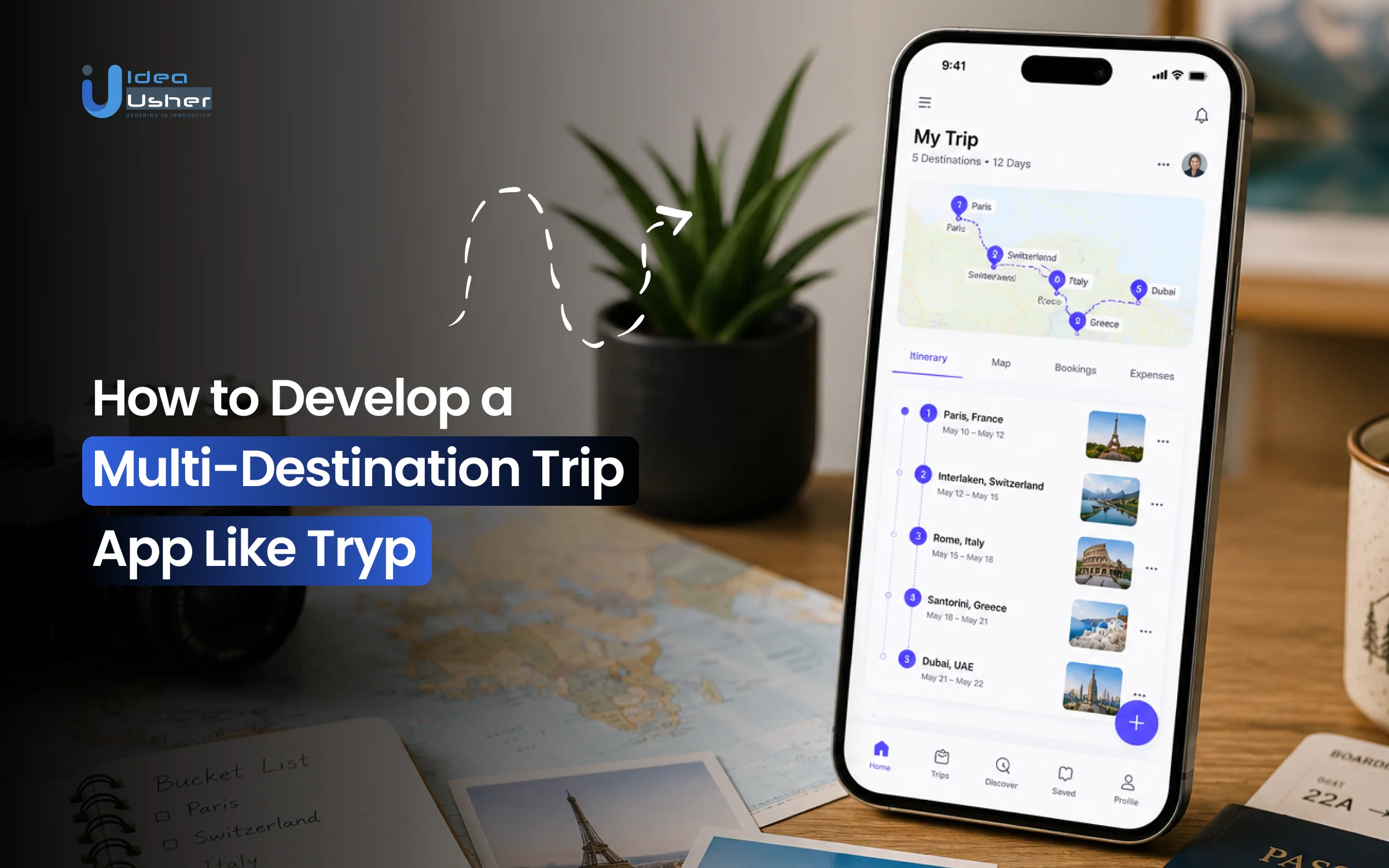
Key Takeaways
- Multi-destination trip planners simplify complex multi-city travel with AI-powered itinerary generation and route optimization.
- Modern platforms combine flights, trains, hotels and local experiences into one unified booking journey.
- Core features include destination discovery, smart routing, budget management and automated itinerary planning.
- Businesses monetize through travel bookings, accommodation commissions, premium features and affiliate partnerships.
- How IdeaUsher can help you build AI-powered multi-destination trip planner app with travel API integrations, route optimization and scalable cloud infrastructure.
Travel behavior is shifting away from single-destination vacations toward flexible journeys that combine multiple cities, countries and experiences within one trip, increasing demand for a modern multi-destination trip planner capable of helping travelers discover, organize and optimize complex itineraries without managing dozens of separate bookings and travel tools.
Traditional travel platforms were designed around point-to-point planning, where flights, accommodations and activities were booked independently for a single destination. Modern travelers increasingly expect multi-city itinerary generation, route optimization, destination discovery, budget planning and integrated booking experiences that simplify the complexity of extended travel. The challenge is no longer finding places to visit. It is creating seamless travel flows across multiple destinations while balancing time, cost and experience quality.
In this blog, we will talk about core features, architecture, development costs, monetization opportunities and how IdeaUsher can help build a multi-destination trip planner like Tryp by transforming fragmented travel planning into a connected multi-destination experience.
Why Multi-Destination Travel Apps Are Gaining Momentum
The travel landscape has fundamentally broken away from old booking patterns. Managing fragmented reservations across multiple apps is no longer cutting it for today’s travelers. The momentum behind multi-destination trip planner apps is driven by a massive demographic shift, an appetite for hyper-personalized experiences, and the rapid maturation of generative AI tools that make managing complex logistics seamless.
A. The Shift From Single-City To Experience-Led Travel
The global experiential travel market is valued at $3.2 trillion and is on track to hit $6.1 trillion by 2034 at a compounding 7.4% CAGR, driven by a massive generational shift (Gen Z and Millennials) prioritizing immersive, custom experiences over physical luxury goods.

Modern experiential travelers prefer exploring entire regions such as dining in Florence and traversing the Tuscan countryside over staying at single resorts (“one hotel, one city” vacation template). However, manually coordinating these complex, multi-modal itineraries across various platforms remains a significant logistical challenge.
A multi-destination trip planner app like Tryp solves this fragmentation. By automating the booking of flights, trains, hotels, and local tours into a single, unified package, your app acts as the ultimate digital gateway to this $3.2 trillion market.
This phenomenal growth is fueled by a generational shift in how people travel and their willingness to pay a premium for authentic experiences.
- The Experience Premium: Travelers are increasingly willing to pay more for immersive and personalized experiences. On average, experiential travelers spend $4,210 per international trip, about 22% more than traditional package tourists, and 47% more overall per trip than conventional travelers.
- Generational Drivers: Gen Z and Millennials now account for 50% of all travelers and are driving demand for experience-focused travel. Among them, 74% consider travel a non-negotiable expense, while 78% prioritize memorable and authentic local experiences when planning trips.
B. Why Travelers Want AI To Build Complex Itineraries
Building a single-destination itinerary is relatively simple; chaining together flights, trains, hotel transitions, and local experiences across three or four stops manually is a logistical nightmare. Travelers are actively offloading this friction to automated platforms.
- Surging AI Adoption: Roughly 40% of global travelers are actively using AI tools to plan their trips, a figure that climbs to 62% among Millennial and Gen Z demographics.
- Massive Shift from Traditional Search: Travelers are rapidly discarding static data sources. Search engine dominance for travel planning dropped from 51% to 36%, while the use of generative AI platforms for travel discovery and routing surged from 6% to 15%.
- Demand for Hyper-Personalization: Travelers are increasingly embracing AI for trip planning. Research shows that 71% expect to use AI when planning their next trip, while 54% want AI-generated personalized itineraries that combine destinations, interests, and travel schedules.
C. The Market Opportunity For Multi-Stop Travel Platforms
For developers, OTAs (Online Travel Agencies), and travel tech startups, the fragmentation of the current booking landscape represents a highly lucrative ecosystem gap.
| Metric | Market Metric & Projection Value |
| AI Trip Planner Market Size (Current) | $4.2 Billion |
| Projected Market Size (2033) | $18.7 Billion |
| Market CAGR (2026–2033) | 18.5% |
| Personal & Leisure Segment Share | 48.2% of the market |
| Cloud-Based Platform Deployment | 74.8% of software delivery |
The Commercial Edge: Online Travel Agencies holding a 41.3% booking share, multi-destination platforms using seamless multi-leg checkouts are positioned for significant growth, leveraging the sector’s 8.6% expansion rate.
With individual consumers driving 51.7% of this market, the mandate is clear. Consumers do not want a list of disjointed links; they want unified, intelligent multi-stop platforms that handle the journey seamlessly from initial spark to final booking.

What Is a Multi-Destination Travel App, Tryp?
Tryp.com is an AI-powered travel marketplace built to simplify planning and booking complex, multi-stop journeys. Unlike traditional online travel agencies (OTAs) where users manage separate bookings, it acts as an automated agent, enabling the booking of flights, trains, buses, and hotels in one transaction.
The platform focuses primarily on experience-led travel, steering away from rigid search queries. Instead of forcing users to input exact dates and locations, the platform caters to younger demographics (like Millennials and Gen Z) by letting them search via travel “themes”.
A. The Value Anchors Driving Tryp’s Industry Success
Tryp’s market success stems from three strategic innovations that transform travel discovery, route optimization, and itinerary planning experiences.
- Theme-Driven Discovery Sandbox: Replacing restrictive date-and-city fields with inspirational lifestyle themes (e.g., “Digital Nomad Breaks” or “Surfing Escapes”) to hook exploratory travelers early in their planning cycle.
- Algorithmic Virtual Interlining: Overcoming rigid airline alliances by programmatically pairing unconnected low-cost flights with regional rail or cross-border bus networks to uncover hidden, budget-friendly travel pathways.
- Combinatorial Calendar Simulation: Processing thousands of open-ended background simulations simultaneously (e.g., “any 10 days in July”) to automatically pinpoint the ultimate cost-and-time optimized travel window.
B. How The Multi-Destination Travel App Works
The platform completely re-engineers the traditional booking experience by replacing fragmented logistics with an automated, data-driven pipeline. By following a traveler’s natural journey from initial inspiration to post-booking support the platform integrates predictive AI, multi-modal routing, and fintech solutions into a unified, friction-free workflow.
1. AI-Powered Destination Discovery
The travel journey starts with discovery rather than constraints. Instead of fixed inputs, an AI discovery sandbox lets users choose experiential themes like Digital Nomad City Breaks or Beach Escapes.
- Employs machine learning to interpret semantic intent from user-selected travel themes.
- Cross-references selections with global travel corridors, localized seasonal trends, and specific budget parameters.
- Generates optimized clusters of cities instead of single destinations to align with qualitative travel goals.
- Engages high-intent users early in the decision-making process by surfacing matching travel options.
2. Predictive Smart Date Optimization
Once the destination cluster is chosen, the platform addresses the logistical headache of scheduling multi-stop legs. Travelers are not locked into static dates; they can input highly flexible, open-ended macro windows, such as “any 10 days between June and August.”
- The proprietary predictive AI engine instantly runs thousands of background simulations, analyzing every possible date permutation and destination sequence simultaneously.
- It computes a data-driven value curve to pinpoint the exact time block that minimizes transit layovers.
- It catches historic pricing sweet spots, optimizing the calendar for both convenience and cost.
3. Algorithmic Virtual Interlining
After finalizing dates and locations, the routing engine manages complex transit mapping. Unlike standard search engines, this system programmatically interlines disparate transport networks such as commercial flights, low-cost carriers, rail, buses, and ferries.
- Executes complex data-matching across unpartnered operators to build a continuous, door-to-door transit chain.
- Utilizes “hidden routing” capabilities to solve the last-mile delivery problem.
- Uncovers hyper-efficient travel combinations that save users 20% to 40% compared to traditional disjointed bookings.
4. Unified Checkout & Dynamic Bundling
The platform uses financial microservices to bundle multi-vendor bookings into a single package, eliminating friction. Its engine automatically aligns vetted hotel stays with the transit timeline, ensuring check-in dates match arrival windows perfectly.
- Travelers review a single, scannable day-by-day itinerary and make one payment for the entire journey.
- The backend transaction infrastructure processes this single payment through automated split-gateways.
- Funds are instantly distributed to multiple global airlines, hotels, and transit operators simultaneously to secure all tickets.
5. Post-Booking Automation & Smart Travel Management
The automation engine remains active long after the transaction is complete. The system removes the tedious, manual overhead of managing travel logistics by centralizing all boarding passes, booking confirmations, and vouchers into a single, live chronological timeline.
- The platform employs automated microservices to facilitate hands-free flight check-ins for travelers as windows open.
- An integrated itinerary manager utilizes real-time data feeds to monitor live flight delays and gate changes.
- The system delivers instantaneous push notifications and dynamically updates transit reminders to ensure a stress-free travel experience.
Key Features Of A Multi-Destination Trip App Like Tryp
Building a platform capable of handling multi-destination journeys requires moving past standard search fields and isolated booking flows. To match the capabilities of an AI travel agent like Tryp, a multi-destination app must integrate advanced automation, real-time data aggregation, and collaborative tools.
The core feature set below outlines how a modern, multi-stop travel platform optimizes the entire user journey from initial discovery to final checkout.

1. AI Multi-Modal Route & Transit Builder
The backbone of a multi-destination platform is its ability to automatically chain together completely different modes of transportation. Instead of limiting users to flight-to-flight connections, the proprietary routing engine automatically maps out interconnected combinations of flights, trains, buses, ferries, and local transit.
The algorithm analyzes millions of data points to solve the “Traveling Salesperson Problem,” optimizing destination sequences to minimize backtracking and layovers. By coordinating windows across various transport operators, it creates hyper-efficient routes that reduce transit time and lower costs by avoiding uncoordinated bookings.
2. Personalized Multi-City Destination Finder
Traditional travel apps assume the user already knows exactly where they want to go. A multi-destination app shifts this paradigm by utilizing a personalized destination finder that recommends curated combinations of cities based on travel goals.
Travelers provide high-level criteria like budgets, timelines, and interests (e.g., “historic architecture + coastal relaxation”). The AI evaluates these against global data and regional transit patterns to recommend logical destination clusters such as Lisbon, Seville, and Faro that align with the user’s specific profile and budget.
3. Smart Flight, Train & Bus Discovery Engine
To feed the multi-modal builder, the app requires a robust, real-time transportation aggregation engine. This discovery engine connects directly to Global Distribution Systems (GDS), low-cost carrier APIs, and regional rail/bus aggregators to pull live fare data, route availability, and scheduling.
The platform’s predictive alternative routing identifies more affordable or convenient transit options like trains or buses, when flights become overpriced or involve long layovers. Using a “Value Index,” it generates smart booking recommendations that balance travel speed and cost.
4. Automated Hotel & Accommodation Bundling
Managing accommodations across a four-city tour can easily lead to booking errors, such as missing a night during a transit day. The automated accommodation bundling engine completely eliminates this risk by sync-matching hotel stays to the exact transport itinerary.
Once the transit route is confirmed, AI bundles multi-destination accommodations by filtering properties based on user preferences, budgets, ratings, and location. This process provides a curated package perfectly synchronized with the itinerary’s check-in and check-out dates.
5. Real-Time Trip Cost & Budget Management
Multi-stop travel makes it notoriously difficult for travelers to track their actual total spend due to varying currencies, hidden fees, and multiple individual bookings. The real-time cost and budget management dashboard fixes this by providing total financial transparency.
The app provides a real-time, comprehensive cost breakdown including all travel expenses, taxes, and fees. To maintain budget limits, like a $2,500 cap, the system alerts users when thresholds are met and suggests cost-saving adjustments, such as changing dates or hotel tiers.
6. AI-Powered Dynamic Itinerary Generator
Once the logistics are locked in, the platform transitions into an on-the-ground guide. Utilizing generative AI, the platform builds a complete, day-by-day travel blueprint tailored to the rhythm of a multi-city trip.

The dynamic itinerary generator maps out hourly schedules that account for localized travel times, museum opening hours, and geographic proximity to prevent user burnout. It populates each day with:
- Curated sightseeing opportunities and hidden gems.
- Contextual dining recommendations based on dietary preferences.
- Real-time adjustments; if local weather indicates rain, the itinerary automatically swaps an outdoor walking tour for an indoor museum track.
7. Unified Booking, Checkout & Auto Check-In
The ultimate point of friction in multi-destination travel is executing the purchase. Buying five tickets across four different websites requires entering payment and passport details repeatedly, compounding the risk of a card getting flagged for fraud.
Tryp-style platforms offer a unified, single-click checkout that allows users to book multiple airlines, hotels, and transport providers simultaneously after entering details just once. To further streamline the experience, auto-check-in technology handles flight registrations automatically, consolidating all boarding passes and confirmations into one accessible dashboard.
8. Integrated Travel Calendar & Itinerary Manager
Once a trip is booked, the app serves as a centralized control center. The integrated itinerary manager synchronizes the entire multi-leg journey into a single, cohesive timeline, completely removing the need to dig through emails for scattered PDF confirmations.
Direct calendar integration populates native mobile apps with travel details like departure times and addresses. The engine delivers real-time push updates; if a delay occurs during one leg, the manager automatically adjusts subsequent reminders and alerts the user to potential impacts on later accommodations.
9. Collaborative Group Trip Planning Workspace
Multi-destination travel is rarely a solo endeavor, and planning it with multiple stakeholders can quickly devolve into messy group chats. The collaborative workspace centralizes group decision-making directly within the app.
| Collaborative Tool | Functionality & Impact |
| Shared Itinerary Editing | Allows multiple authorized users to add destinations or modify transport legs in real time. |
| In-App Voting Systems | Solves group stalemates by letting members vote on preferred hotel options, destinations, or daily activities. |
| Automated Expense Splitting | Tracks the total shared cost of bundled packages and automatically calculates per-person breakdowns based on selected legs. |
| Group Communication Hub | Centralizes media sharing, destination suggestions, and notes directly alongside the live itinerary view. |
The Collaborative Edge: By creating a unified sandbox environment, the workspace transforms a fragmented planning process into a streamlined, consensus-driven flow, significantly accelerating booking conversion rates for groups.
How to Develop a Multi-Destination Trip Planner App Like Tryp
Building a complex multi-destination travel platform requires a structured, strategic development approach. At IdeaUsher, we transform this intricate logistical challenge into a seamless, high-performing software solution through a meticulous, step-by-step engineering and product design lifecycle.

1. Product Discovery & Travel Workflow Mapping
Our product strategists and developers map your business vision against real-world user behavior, defining target personas, complex travel workflows, and system architecture before writing a single line of code.
- Traveler Profile Planning: Define target users, their travel preferences, budgets, and needs to ensure the platform delivers relevant experiences.
- User Journey Mapping: Outline the complete travel planning process, from destination discovery to booking, for a smooth and intuitive user experience.
- Technical Architecture Planning: Design the system structure, database setup, and integration requirements needed to support the platform efficiently.
- Feature Prioritization: Identify and prioritize essential MVP features to launch faster, reduce development costs, and maximize business value.
2. Designing The Multi-Destination Booking Experience
Our UI/UX designers build intuitive, scannable wireframes and interactive prototypes that transform confusing multi-leg logistics into a clean, visually engaging, and effortlessly navigable user interface.
- Simple & Intuitive Interface: Replace complex multi-tab booking processes with a clean, centralized dashboard for managing complete itineraries.
- Interactive Route Maps: Display destinations, routes, and transportation options on dynamic maps with real-time updates.
- Smart Information Display: Present important pricing, schedule, and travel details at the right time to simplify decision-making.
- Mobile-First Experience: Ensure a seamless booking and trip-planning experience across iOS, Android, and web devices.
3. Building The AI Destination Recommendation Engine
Our AI engineers and data scientists develop machine learning models that analyze qualitative traveler inputs, budget constraints, and historic travel patterns to deliver highly personalized destination combinations.
- AI-Powered Preference Understanding: Uses natural language processing to understand user interests and match them with relevant destinations and travel experiences.
- Personalized Recommendations: Continuously learns from user interactions to improve future trip suggestions and itinerary recommendations.
- Seasonal Travel Insights: Analyzes historical trends to recommend destinations based on favorable weather, demand patterns, and pricing.
- Traveler Behavior Analysis: Identifies similar travel preferences among users to suggest popular and highly rated multi-destination itineraries.
4. Developing The Route Optimization System
Our algorithmic developers build computational routing engines that solve complex transit sequences, instantly balancing total travel time, layovers, multiple transportation modes, and strict budget ceilings.
- Smart Route Planning: Automatically finds the most efficient combination of flights, trains, and buses to reduce travel time and avoid unnecessary backtracking.
- Cost & Time Optimization: Evaluates route options to balance travel costs with convenience and overall journey efficiency.
- Connection Protection: Adds appropriate buffer time between travel segments to reduce the risk of missed connections caused by delays.
- Flexible Date Search: Analyzes multiple travel dates to identify the most affordable departure and travel options across the entire itinerary.
5. Integrating Flight, Hotel & Travel APIs
Our backend engineers establish secure, high-speed connections with global travel inventory aggregators, flight GDS systems, rail operators, and accommodation providers for live data synchronization.
- Airline & Flight Integration: Connects with major airline systems to provide real-time flight availability and up-to-date pricing for multi-city trips.
- Unified Transportation Search: Combines train, bus, and ferry options into a single platform for easier travel planning.
- Hotel & Accommodation Integration: Syncs with hotel and vacation rental providers to display accurate availability across multiple destinations.
- Real-Time Travel Information: Integrates weather, maps, and currency conversion data to provide travelers with up-to-date trip insights.
6. Creating The Booking & Payment Infrastructure
Our fintech developers implement a secure payment architecture that splits a single user transaction among multiple independent airlines, hotels, and ground transportation vendors simultaneously.
- Unified Booking & Payments: Allow users to pay for flights, hotels, and transportation through a single secure checkout process.
- Automated Payment Distribution: Automatically route payments to the appropriate travel providers after a successful booking.
- Secure Payment Protection: Use industry-standard encryption and security measures to protect user and payment information.
- Instant Booking Confirmation: Automatically send reservation requests to all selected travel providers once payment is successfully processed.
7. Building The Travel Management Dashboard
Our development team construct a centralized control panel for travelers, featuring automated digital boarding pass organization, real-time delay notifications, and unified post-booking modifications.
- Centralized Trip Timeline: Organize flight details, hotel bookings, tickets, and travel confirmations in one easy-to-follow itinerary.
- Automatic Check-In Support: Simplify travel by automatically initiating flight check-ins when eligible.
- Real-Time Travel Alerts: Send instant notifications for flight delays, gate changes, hotel check-ins, and other important travel updates.
- Self-Service Trip Management: Allow users to easily modify, cancel, extend, or update bookings through a simple self-service portal.
8. Testing, Deployment & Platform Scaling
Our QA and DevOps teams perform rigorous load testing, route calculation validation, and cloud-native deployment to guarantee your platform remains fast, stable, and highly secure under peak traffic.
- Performance Testing: Stress-test route optimization systems to ensure fast and reliable itinerary generation, even during high traffic periods.
- API & Data Validation: Continuously verify the accuracy and reliability of data received from travel, transportation, and accommodation providers.
- Scalable Cloud Infrastructure: Use cloud platforms like AWS or Google Cloud to automatically handle increases in user activity and bookings.
- Security & Privacy Protection: Perform regular security audits and vulnerability testing to safeguard user accounts, payments, and personal data.
Cost to Build a Multi-Destination Trip App
Building a multi-destination trip planner app requires investment in itinerary planning engines, travel data integrations, route optimization, booking systems, and scalable infrastructure. The following table breaks down the estimated development costs based on development process, phase complexity, feature depth, and business requirements.
| Development Phase | What the Phase Covers | Estimated Cost |
| Product Discovery & Workflow Mapping | Defining target personas, mapping travel user journeys, and creating the initial feature scope matrix. | $5,000 – $7,000 |
| Multi-Destination Booking Experience | Wireframing user flows, mapping UI/UX, and building interactive high-fidelity multi-stop screen prototypes. | $6,500 – $9,000 |
| AI Destination Recommendation Engine | Developing core machine learning models for processing user themes and predicting personalized travel clusters. | $22,000 – $34,000 |
| Route Optimization System | Coding advanced transit algorithms to instantly balance complex multi-modal schedules, durations, and costs. | $20,000 – $28,500 |
| Flight, Hotel & Travel APIs | Embedding global distribution systems, rail networks, bus APIs, and accommodation inventory providers. | $10,500 – $15,000 |
| Booking & Payment Infrastructure | Constructing a unified single-transaction checkout system and automating split-payment gateways to vendors. | $10,000 – $13,000 |
| Travel Management Dashboard | Engineering live passenger panels, timeline management controls, calendar synchronization, and automated notification alerts. | $7,000 – $10,000 |
| Testing, Deployment & Scaling | Conducting rigorous load testing, route stress validation, security compliance audits, and cloud auto-scaling deployment. | $6,000 – $8,500 |
| TOTAL ESTIMATED MVP COST | Building a robust, launch-ready multi-destination travel platform with core AI routing features. | $70,000 – $137,000 |
Note on Cost Factors: This multi-destination trip planner app budget represents a lean, high-performance Minimum Viable Product (MVP) designed to securely launch your platform. Total costs vary based on the specific number of API providers chosen and platform deployment choices (iOS, Android, or Web).
A. Multi-Destination Trip App Development Cost by Platform Tier
The cost of developing a multi-destination trip planner app depends on itinerary complexity, travel integrations, personalization capabilities, and scalability requirements. The table below outlines estimated costs across different platform tiers, from MVPs to enterprise-grade solutions.
| Platform Tier | Features Included | Estimated Cost |
| MVP | Web or cross-platform app, basic flight and hotel integrations, AI-powered trip planning, secure checkout, itinerary builder, and user support features. | $70,000 – $140,000 |
| Mid-Tier Platform | Native iOS and Android apps, advanced AI recommendations, multi-modal transportation planning, budget tracking, hotel bundling, automatic check-ins, and group trip collaboration tools. | $160,000 – $245,000 |
| Enterprise Platform | Web, iOS, and Android platforms, predictive AI recommendations, large-scale travel API integrations, multi-currency payments, real-time travel alerts, group voting and expense sharing, plus dedicated enterprise support. | $260,000 – $450,000+ |
Pro Tip for Startups: Start with the MVP multi-destination trip planner app to validate your travel product with real users. As you grow, our team of 250+ developers helps you scale to Mid-Tier or Enterprise levels, reducing investment risk.
B. Cost-Affecting Factors of an Multi-Destination Trip App
Calculating the precise budget for an multi-destination trip planner app involves balancing several variable technological and operational levers. While a foundational MVP can launch between $70,000 and $140,000, scaling the application’s intelligence, coverage, and platform availability introduces clear cost-driving factors.
- AI Model Complexity: Using existing AI models through APIs is more cost-effective, while building custom or highly personalized AI systems can increase the AI budget by $20,000–$80,000.
- Data & AI Infrastructure: Collecting, cleaning, and organizing travel data, along with setting up AI search and storage systems, typically accounts for 20%–30% of the total project budget, with ongoing data storage costs of $1,000–$10,000 per month.
- Travel API Integrations: Connecting to services like flight, hotel, maps, and location providers requires additional development and can add $3,000–$7,500 per month in recurring API and infrastructure costs.
- Platform Choice: Building a single cross-platform app is generally more affordable, while developing separate native apps for iOS and Android can increase development costs by 40%–60%.
- Maintenance & AI Improvements: Ongoing hosting, security updates, performance monitoring, and AI model improvements typically require an annual budget of 15%–25% of the initial development cost.
Technology Stack For A Tryp-Like Travel Planner Platform
A travel planner platform like Tryp requires a robust technology stack to support itinerary generation, travel data aggregation, booking integrations, real-time recommendations, and scalable user experiences across web and mobile platforms.
The following table highlights the key technologies commonly used to build and operate a Tryp-like multi-destination trip planner app.
| Technology Layer | Recommended Technologies | Purpose |
| Frontend Development | React.js, Next.js, Flutter, React Native, TypeScript | Build responsive web and mobile interfaces for itinerary planning, destination discovery, booking workflows, and traveler dashboards. |
| Backend & Cloud Infrastructure | Node.js, Python, Express.js, FastAPI, AWS, Google Cloud, PostgreSQL, MongoDB, Redis | Manage business logic, user accounts, booking workflows, AI processing, real-time data synchronization, and scalable cloud deployment. |
| AI Recommendation Technologies | OpenAI GPT, Claude, Gemini, LangChain, Pinecone, Weaviate, TensorFlow, Scikit-learn | Power destination recommendations, itinerary generation, route optimization, traveler preference analysis, and personalized trip planning. |
| Travel Data & Booking Integrations | Amadeus API, Skyscanner API, Booking.com API, Expedia API, Google Maps API, OpenWeather API | Enable flight discovery, hotel booking, route planning, location intelligence, travel information, and real-time pricing updates. |
| Payment & Security & Systems | Stripe, PayPal, Razorpay, Firebase Analytics, Google Analytics 4, Auth0, OAuth 2.0, SSL Encryption | Support secure payments, booking transactions, authentication, user behavior tracking, fraud prevention, and platform performance monitoring. |
Challenges in Building a Tryp-Like Multi-Destination Trip App
Engineering a multi-destination travel platform requires overcoming deep algorithmic, architectural, and data synchronization bottlenecks. Behind a seamless, one-click booking interface lies a complex network of moving variables, volatile real-time pricing, and highly intensive data-processing challenges that demand advanced software solutions.

1. Maintaining Accurate Travel Data
Challenge: Disparate third-party travel APIs update inventory at completely different rates, causing systemic synchronization lag and inaccurate flight or room availability.
Solution: Our developers will build a high-speed data caching layer paired with real-time web sockets to force instant availability verification precisely at the moment a user views an itinerary leg.
2. Optimizing Complex Route Combinations
Challenge: Calculating millions of multi-modal route permutations across flights, trains, and buses simultaneously triggers severe computational latency and sluggish search results.
Solution: We will implement advanced heuristic search algorithms and parallel processing matrix models that rapidly filter out illogical transit paths, delivering optimized multi-city routes in under three seconds.
3. Managing Real-Time Pricing Volatility
Challenge: Flight fares and hotel rates fluctuate minute by minute, frequently causing price mismatches between initial search and final unified checkout.
Solution: Our team will deploy automated fare-lock microservices and dynamic pricing buffer algorithms that monitor price movements, instantly executing API bookings to secure the exact quoted rates for consumers.
4. Personalized AI Recommendations At Scale
Challenge: Processing heavy streams of unique user preferences and global geographic data concurrently creates massive server strain during high-traffic travel booking periods.
Solution: We will construct a scalable vector database infrastructure coupled with asynchronous machine learning pipelines to serve hyper-personalized, multi-stop vacation combinations to thousands of active users simultaneously without performance drops.
Revenue Models of Multi-Destination Trip Planner Apps
The revenue model for multi-destination trip planner apps is a unique case study for entrepreneurs. By managing complex itineraries through the integration of typically uncoordinated transport and lodging options, the platform prioritizes technology-driven margins over traditional advertising.
As a highly scalable, AI-driven platform that recently closed a multi-million euro funding round to expand across Europe, it generates its revenue through four core pillars:
1. “Virtual Interlining” Merchant Margins
The platform’s revenue primarily stems from Virtual Interlining. Its backend algorithm intelligently links unrelated transit providers, such as budget airlines and trains, rather than merely redirecting users to separate booking sites.
How it makes money: The platform secures wholesale or real-time API rates from these distinct vendors, packages them dynamically into a single itinerary, adds a technology service markup to the final package price, and acts as the direct merchant of record.
2. Multi-Vendor Accommodation Bundling
During multi-city tours, the app captures lodging revenue for every leg of the trip. By embedding hotel and property management APIs into its routing engine, the platform cross-sells accommodations tailored to travel dates. This enables the app owner to earn standard OTA commissions, typically 10% to 20% per room night.
3. Ancillary Add-ons and Dynamic Check-In Fees
Multi-destination travel comes with massive logistical friction. The platform builds high-margin revenue streams by offering convenience-focused add-ons at checkout:
- Automated Multi-Carrier Check-In: The app can charge a premium service fee to automatically check the traveler into all of their separate flights, trains, and buses across various companies.
- Proprietary Connection Guarantees: Because traditional airlines do not cover missed connections if a separate budget flight is delayed, the platform can sell custom travel protections and connection insurance policies directly through the app.
4. Affiliate Partnerships for In-Destination Experiences
Once the multi-city route is locked in, the app acts as an affiliate channel for local experiences. By integrating APIs from platforms like Viator or GetYourGuide, The multi-destination trip planner app suggests targeted tours, car rentals, or airport transfers tailored to the exact dates the traveler is in a specific city, earning a 5% to 15% commission on every booking.
Partner with IdeaUsher for Your Multi-Destination Trip Planner App
The future of travel lies in intelligent, unified experiences that combine AI, real-time travel data, and seamless user journeys. IdeaUsher helps bring these platforms to life, backed by 11+ years of software engineering excellence, 1,000+ successfully launched digital products, and a 95% client retention rate. From MVPs to enterprise ecosystems, we build scalable solutions designed for long-term growth.
Why Choose IdeaUsher as Your Tech Partner?
- Access to Elite Engineering Talent: Instantly scale your project requirements by tapping into our dedicated powerhouse pool of 250+ pre-vetted devs, custom AI solutions architects, and UI/UX designers.
- Advanced Geospatial Optimization: Our developers build complex graph-theory constraint solvers that instantly sequence multiple travel legs like calculating shortest-path matrices across flights, rail lines, and local transit to eliminate costly backtracking.
- Capital-Efficient System Integration: Our thin-client hybrid architecture connects enterprise models with high-speed regional vector databases via optimized APIs. This approach minimizes both initial development expenses and long-term server overhead.
- Automated Multi-Stream Monetization: We integrate your commercial infrastructure into the source code from the start, using flexible subscriptions, micro-transactions, and automated affiliate tracking to capture booking commissions efficiently.
Ready to Capitalize on the Multi-Trillion Dollar Travel Market?
Don’t let technical complexity hold your business vision back. Let’s collaborate to build an AI-driven, multi-stop vacation planner that redefines how the world explores.
Conclusion
The future of travel belongs to platforms that simplify complex journeys while delivering highly personalized experiences. A multi-destination travel app like Tryp combines AI-powered recommendations, route optimization, automated booking, and itinerary management into a single ecosystem, making travel planning faster and more efficient. As the experiential travel market continues to grow, businesses have a significant opportunity to build intelligent travel solutions that meet evolving traveler expectations. With the right technology strategy and development partner, launching a scalable and competitive travel platform is more achievable than ever.
Things to Know
Q.1. What is the difference between multi-destination and traditional trip apps?
A.1. Multi-destination trip apps use AI and route optimization to combine multiple destinations, transportation modes, accommodations, and schedules into one itinerary, reducing planning complexity and creating a seamless travel booking experience.
Q.2. What are the core features of a multi-destination trip planner app?
A.2. Core features include AI itinerary generation, destination recommendations, route optimization, multimodal transport discovery, accommodation bundling, unified booking, budget management, and real-time itinerary updates for travelers.
Q.3. Why is AI important in multi-destination travel planning app?
A.3. AI helps analyze traveler preferences, recommend destination combinations, optimize routes, generate itineraries, predict travel costs, and automate planning decisions that would otherwise require extensive manual research.
Q.4. How much does it cost to develop a multi-destination trip planner app?
A.4. Multi-destination app costs vary by complexity and AI integration. An MVP is priced at $70,000–$140,000, mid-tier platforms cost $160,000–$245,000, and enterprise solutions reach $260,000–$450,000+ based on infrastructure needs.


