


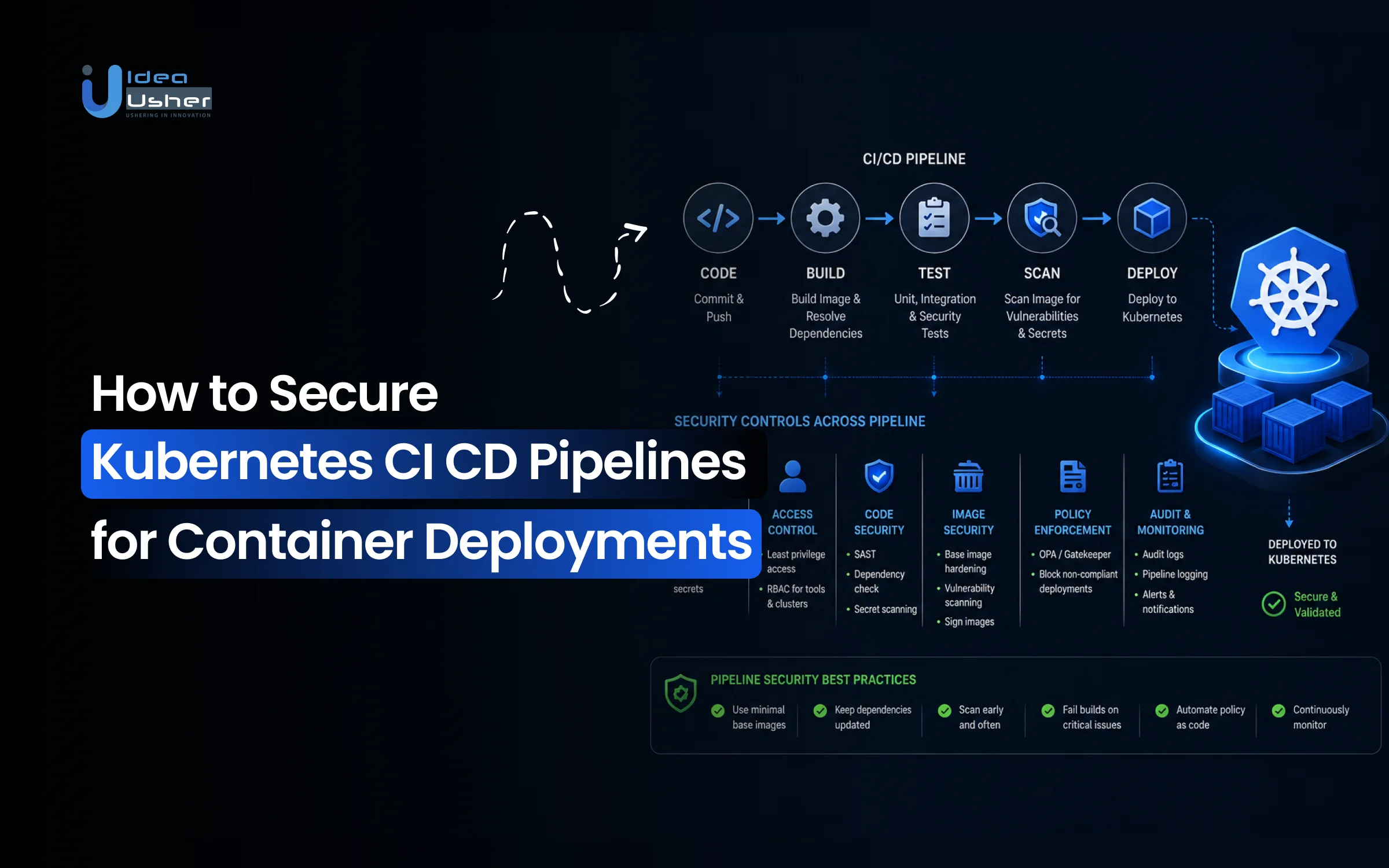
Key Takeaways
- Kubernetes CI/CD pipelines are major attack targets because compromised workflows can deploy malicious containers at scale.
- Secure deployments require image signing, RBAC hardening, secrets management, and automated vulnerability scanning.
- Risks like runtime drift, insecure Helm charts, and overprivileged access often lead to breaches and compliance failures.
- Enterprises are adopting Zero Trust CI/CD, GitOps security, and runtime threat detection to secure deployments faster.
- How IdeaUsher helps businesses secure Kubernetes CI/CD pipelines with pre-vetted DevSecOps experts and automated security workflows.
CI/CD pipelines are becoming one of the most targeted entry points in Kubernetes environments because they control how code reaches production. That shift is making Kubernetes CI CD security a critical priority for modern engineering teams as the risk is no longer limited to vulnerable containers. Compromised pipelines can expose secrets, inject malicious code and deploy insecure workloads at scale.
Traditional pipeline security relied on isolated scans and manual approval processes. That model struggles in fast-moving container ecosystems where deployments happen continuously. Teams now need automated policy enforcement, image verification, secrets management and runtime security controls integrated directly into the delivery workflow.
In this blog, we will talk about key risks, security best practices, tools and how IdeaUsher can help businesses with pre-vetted Kubernetes developers with proper implementation strategies to secure Kubernetes CI/CD pipelines for container deployments.
Why Most Enterprises Struggle to Secure Kubernetes CI CD Pipelines
Modern DevOps pipelines make Kubernetes CI CD security the key to the kingdom. The global Kubernetes Solutions Market is estimated at USD 3.46 billion in 2026 and is projected to reach USD 14.36 billion by 2035, growing at a CAGR of 17.3%.

By automating code flow from developers to production Kubernetes clusters, these systems hold extensive permissions. Attackers prioritize compromising the pipeline factory over hardened clusters, as it provides control over every deployed product.
A. How Pipeline Attacks Compromise Kubernetes Environments
Pipeline attacks often focus on Supply Chain Compromise. By injecting malicious code or backdoor containers early in the build process, attackers ensure their malware is cryptographically signed and deployed by the organization’s own trusted systems.
- Image Poisoning: Attackers swap base images in a private registry with versions containing vulnerabilities.
- Credential Theft: Pipelines often hold API keys, SSH keys and kubeconfig files. If an attacker gains access to the CI/CD runner, they can exfiltrate these credentials to gain full administrative control over the Kubernetes API server.
- Sidecar Injection: Malicious scripts can be injected into the deployment YAML, allowing attackers to run unauthorized processes alongside legitimate applications.
B. Why Misconfigured CI CD Pipelines Increase Security Risks
Automation is a double-edged sword. While it increases speed, it also scales human error across the entire infrastructure. Common misconfigurations include:
- Over-Privileged Service Accounts: Pipelines often run with cluster-admin rights. If a single build step is compromised, the attacker inherits total control over the cluster.
- Lack of Network Isolation: Build nodes that aren’t isolated can be used as a jumping-off point (lateral movement) to reach other sensitive internal databases or services.
- Unprotected Webhooks: Many CI/CD tools trigger builds via webhooks. Without proper authentication, an attacker could trigger arbitrary builds or manipulate the build parameters to execute malicious code.
C. The Cost of Weak Kubernetes CI CD Security Controls
The fallout from weak Kubernetes CI CD security extends far beyond a simple data breach. Because Kubernetes environments are often highly interconnected, the damage can be exponential:
| Impact Category | Consequences |
| Operational | Total cluster takeover, ransomware locking down microservices, or crypto-jacking using cluster resources. |
| Financial | Regulatory fines (GDPR/CCPA), loss of customer trust, and the massive cost of forensic cleanup. |
| Reputational | Brand damage resulting from poisoned software being distributed to end-users or clients. |
D. Why Enterprises Struggle to Secure Deployment Pipelines
Despite the risks, securing these pipelines is notoriously difficult for several reasons:
- Complexity of Tooling: A typical pipeline involves dozens of integrations (GitHub, Jenkins/ArgoCD, Docker Hub, Terraform, etc.). Securing the seams between these tools is a massive undertaking.
- The Speed vs. Security Friction: Security teams often introduce gates that slow down deployment, leading developers to bypass protocols to meet deadlines.
- Ephemeral Nature of Containers: Because Kubernetes pods and build runners are short-lived, traditional security monitoring tools often miss the blip of an attack before the evidence disappears.
- Shadow IT: Teams often set up their own localized CI/CD instances that fall outside the purview of central IT security policies, creating unmonitored blind spots.
Understanding Where Kubernetes CI CD Pipelines Break Down
The transition from traditional CI/CD to Kubernetes-native pipelines introduces a paradigm shift from pushing code to orchestrating state. Most breakdowns occur because teams try to force-fit legacy monolithic deployment habits into a declarative, containerized world, creating a fragile bridge between the CI tool and the cluster.

A. What a Kubernetes CI CD Pipeline Actually Includes
To secure the pipe, you have to understand the specific moving parts that are unique to the K8s ecosystem:
- Source Repositories: Not just for application code, but for GitOps manifests (YAML, Helm charts, Kustomize). A compromise here means an attacker can alter the desired state of the cluster infrastructure itself.
- Build Systems: K8s-native builders (like Tekton or Kaniko) often run inside the cluster as pods. This creates an inception risk where the build process could potentially escape its container to compromise the host node.
- Container Registries: These act as the source of truth for the cluster. If the registry lacks vulnerability gating, the cluster will pull and run insecure binaries by default.
- Kubernetes Deployment Stages: This involves the Controller (ArgoCD/Flux) or the API Server interaction. This is the final gate where RBAC (Role-Based Access Control) policies are enforced.
- Secrets and Runtime Configurations: K8s needs dynamic secret injection, unlike static VMs. Issues arise when secrets are hardcoded in ConfigMaps rather than using providers like HashiCorp Vault or AWS Secrets Manager.
B. How Containers Move Through Modern Kubernetes Pipelines
In a modern Pull-based (GitOps) model, the container doesn’t just get pushed to the cluster. Instead:
- The CI tool pushes a tagged image to the Registry.
- The CI tool updates a Git Manifest repo with the new image tag.
- The Kubernetes Operator (inside the cluster) detects the change in Git and pulls the new state.
The breakdown usually occurs in the latency between these steps, where a drift occurs between what is in Git and what is actually running in the namespace.
C. The Security Gaps Between CI Tools and Kubernetes Clusters
The most dangerous gap is the God-Mode CI Runner. To deploy, many CI tools are given a kubeconfig with cluster-admin privileges.
- The Risk: If an attacker compromises a single GitHub Action or Jenkins plugin, they don’t just get your code; they get the ability to delete your entire production cluster.
- The Fix: Moving toward OpenID Connect (OIDC) to provide short-lived, identity-based access instead of static, long-lived service tokens.
D. Why Multi-Cloud Kubernetes Deployments Increase Risk Exposure
Running EKS, GKE, and on-prem clusters simultaneously creates Inconsistent Admission Control.
- The Breakdown: You might have a Pod Security Policy enforced on AWS, but a developer forgets to port that logic to the Google Cloud environment.
- Shadow Infrastructure: Multi-cloud often leads to orphaned clusters that aren’t being patched, creating easy entry points for lateral movement across the entire corporate network.
- Identity Provider (IdP) Fragmentation: Fragmented identity providers across AWS EKS and GKE create permission management difficulties. This often causes teams to use broad, insecure permissions to prevent cross-cloud deployment failures.
- Egress Traffic Blind Spots: Multi-cloud traffic often uses public networks. Lacking a unified Service Mesh (e.g., Istio, Linkerd) prevents consistent mTLS or Zero Trust enforcement, leaving inter-cloud links exposed.
E. Common Weak Points Across Different Stages of CI CD Pipelines
Modern containerized CI/CD pipelines often share recurring security weaknesses across build, registry, and deployment stages. These gaps create opportunities for attackers to exploit trusted workflows, compromise workloads, and disrupt cluster availability.
| Pipeline Stage | The Breakdown Point | Technical Impact |
| Build | Non-Distroless Images | Large attack surfaces (shells/package managers) left inside the production container. |
| Registry | Mutable Tags | Using latest tags allows an attacker to overwrite a trusted image with a malicious one without changing the manifest. |
| Deployment | Missing Resource Quotas | A compromised pod can perform a Resource Exhaustion (DoS) attack on the entire node. |
F. Why Generic DevOps Teams Miss Critical Kubernetes Threats
Standard DevOps teams often focus on green builds, whereas Kubernetes requires focusing on runtime intent.
- Lack of Context: A generic DevOps engineer might see a successful deployment as a win, while missing that the pod is running as root or has hostPath mounts enabled.
- The YAML Wall: The sheer volume of Kubernetes configurations leads to Copy-Paste Engineering, where insecure boilerplate code from Stack Overflow or public repos is promoted into production without a security audit.
- The Observability vs. Security Trap: Teams often track performance metrics like CPU and latency while overlooking Audit Logs. A pod may appear healthy in Grafana despite making unauthorized API calls or scanning internal services.
- Post-Deployment Configuration Drift: DevOps focuses on deployment but Kubernetes remains vulnerable to Runtime Drift. This occurs when automated operators or manual kubectl commands alter pod security, creating discrepancies with the audited Git YAML.

Top Kubernetes CI CD Security Risks in Container Deployments
The shift to containerized orchestration hasn’t eliminated traditional security risks; it has repackaged them into the automated plumbing of the cluster. In a Kubernetes-native environment, security is only as strong as the weakest link in the automated delivery chain.

1. Compromised Container Images and Dependency Poisoning
The risk starts before a single line of code is deployed. Attackers target public registries or upstream dependencies (like npm packages or Python modules) to inject malicious binaries.
- The Squatting Risk: Attackers publish packages with names similar to popular ones (Typosquatting), hoping a developer or an automated build script pulls the wrong one.
- Layer Poisoning: If your Dockerfile uses a broad base image (e.g., node:latest), an attacker who compromises that upstream image automatically gains a foothold in your pipeline the next time the cache clears.
2. Exposed Secrets Inside CI CD Workflows
CI/CD runners require high-level access to push images and update clusters, but managing these credentials is the most common point of failure.
- Log Leakage: Secrets often leak into build logs if not properly masked, allowing anyone with read access to the CI platform to exfiltrate them.
- Static Kubeconfigs: Using long-lived, static kubeconfig files stored as Variables in your CI tool is a major risk. If the CI platform is breached, the attacker has a permanent backdoor into your production environment.
3. Misconfigured Kubernetes RBAC Permissions
Role-Based Access Control (RBAC) is often configured with convenience over security, leading to massive over-privilege.
- The Cluster-Admin Fallback: Many teams assign the cluster-admin role to their CI service account because it’s the easiest way to ensure deployments don’t fail due to Permission Denied errors.
- Insecure Bindings: Binding sensitive roles to the default service account in a namespace allows any pod in that namespace to potentially escalate privileges and intercept cluster communications.
4. Supply Chain Attacks Targeting Build Systems
If an attacker compromises the build server (Jenkins, GitLab, or a GitHub Runner), they can alter the application logic after it has been audited but before it is signed.
- Runner Persistence: In self-hosted runner environments, an attacker can install a persistent backdoor on the runner host itself, allowing them to intercept every subsequent build across the entire company.
5. Insecure Helm Charts and Kubernetes Manifests
Helm charts are the installers for Kubernetes, but they are often treated as black boxes.
- Hardcoded Defaults: Many community Helm charts come with insecure defaults, such as allowPrivilegeEscalation: true or running containers as the root user.
- Tillerless Vulnerabilities: While modern Helm (v3) is more secure, the logic within the templates can still bypass security gates if they aren’t explicitly audited for Pod Security Standards (PSS).
6. Runtime Drift Between Staging and Production Clusters
The works on my machine problem has evolved into works in staging, fails (securely) in production.
- The Breakdown: If the Staging cluster has lax security policies to move fast, but Production has an Admission Controller like Kyverno or OPA Gatekeeper, your CI/CD pipeline will break.
- Manual Intervention: When teams perform hotfixes by manually editing production resources (kubectl edit), the CI/CD pipeline is no longer the source of truth, leading to Shadow Configurations that are never security-tested.
7. Unverified Third-Party Actions and Plugins in CI Platforms
Modern pipelines rely heavily on marketplace plugins (e.g., GitHub Actions, Jenkins Plugins).
- The Hidden Dependency: By using a third-party K8s-Deploy action from an unverified creator, you are essentially giving that creator the ability to execute code within your build environment.
- Orphaned Plugins: Many popular plugins are abandoned by their creators, leaving unpatched security vulnerabilities sitting directly in your deployment path.
Business Risks of Insecure Kubernetes CI CD Pipelines
The fallout ripples beyond the engineering department when a Kubernetes pipeline is compromised. Because Kubernetes often orchestrates an organization’s most critical customer-facing applications, an insecure delivery path transforms a fast-moving innovation engine into a high-speed liability.

1. Production Downtime Caused by Pipeline Exploitation
In a Kubernetes environment, an attacker doesn’t need to delete your data to cause chaos; they only need to disrupt your orchestration.
- Orchestration Sabotage: By compromising the CI/CD pipeline, attackers can push poisoned manifests that trigger infinite crash loops (CrashLoopBackOff) across your entire cluster, leading to massive service outages.
- Resource Hijacking: Attackers frequently exploit compromised pipelines to deploy unauthorized workloads like crypto-miners. These rogue containers drain cluster resources, throttling or evicting legitimate applications and degrading performance for end-users.
2. Compliance Failures From Weak Kubernetes Security
Modern regulatory frameworks (SOC2, HIPAA, PCI-DSS) now scrutinize the integrity of the software supply chain.
- Audit Trail Gaps: Insufficient logging or shared credentials prevent verifying who authorized production changes. This missing provenance creates significant audit red flags.
- Automated Non-Compliance: Without automated security gates in the pipeline, non-compliant configurations (like pods running with root privileges) are deployed at scale, potentially resulting in heavy fines and the revocation of operating licenses.
3. Data Breaches Across Multi-Cluster Deployments
The flat network nature of many Kubernetes deployments means that once an attacker enters through a compromised pipeline, they can often move laterally.
- Cross-Cluster Contamination: In multi-tenant or multi-cluster environments, a breach in a Dev pipeline can be used to pivot into a Production cluster if network policies are inconsistent.
- Secret Exfiltration: Kubernetes Secrets (database passwords, encryption keys) are often managed within the CI/CD flow. A breach here gives attackers the keys to your most sensitive data stores, bypassing perimeter defenses entirely.
4. Financial Losses From Delayed Threat Remediation
In Kubernetes, the speed of deployment must be matched by the speed of response.
- The Remediation Lag: Lacking automated CI/CD security feedback often delays vulnerability discovery until weeks post-deployment. Rectifying integrated flaws in production is far costlier than resolving them during the build phase.
- Cloud Bill Spikes: Automated attacks that spin up hundreds of high-compute containers via a compromised pipeline can lead to overnight bill shocks from cloud providers that take months to dispute and resolve.
5. Brand Reputation Damage After Supply Chain Breaches
The most significant long-term consequence is often not the technical remediation itself, but the resulting loss of customer trust.
- The Poisoned Update Syndrome: If a company unknowingly pushes a malicious update to its customers via a compromised pipeline (a SolarWinds style event), the brand is perceived as a vector for infection rather than a trusted partner.
- Erosion of Trust: A single supply chain breach can lead to the termination of enterprise contracts, as clients realize your internal automation could potentially compromise their environments.
Core Components of Secure Kubernetes CI CD Pipelines
A hardened pipeline acts as a series of automated filters. By the time a container reaches your production cluster, it should have been scanned, signed, and validated against a strict set of organizational policies.
1. Securing Source Repositories and Branch Policies
The source repository is the first link in the chain. If an attacker can merge code without oversight, the rest of your security controls are effectively bypassed.
- Mandatory Pull Request (PR) Reviews: Enforce a two-man rule where no code can reach the main branch without at least one (or two) approvals from senior engineers.
- Branch Protection Rules: Disable Force Push and Delete Branch permissions to maintain an immutable audit trail.
- Signed Commits: Require developers to use GPG keys to sign their commits, ensuring that the code actually came from a verified identity and wasn’t spoofed.
2. Hardening Build Runners and CI Execution Environments
Build runners (the machines that execute your scripts) are high-value targets because they handle sensitive secrets and build artifacts.
- Ephemeral Runners: Use single-use runners that are destroyed immediately after a build finishes. This prevents attackers from establishing persistence or stealing cached data from previous builds.
- Network Isolation: Runners should reside in a locked-down VPC with no inbound access and strictly limited outbound access (only to required package managers and registries).
- Rootless Builds: Use tools like Kaniko or Buildah to build container images without requiring a privileged Docker daemon, significantly reducing the risk of container escape.
3. Protecting Container Registries and Image Storage
The registry is your Source of Truth. If an image is in the registry, the cluster assumes it is safe to run.
- Vulnerability Gating: Integrate automated scanners (like Trivy or Clair) that block the Push or Pull of any image containing High or Critical CVEs.
- Image Signing and Attestation: Use tools like Cosign (Sigstore) to sign images. The cluster can then use an admission controller to verify that only images signed by your CI pipeline are allowed to run.
- Immutable Tags: Avoid using the latest tag. Use unique SHA-256 digests or semantic versioning to ensure that the image you tested in staging is the exact same binary being deployed to production.
4. Enforcing Kubernetes Admission Controller Policies
Admission controllers (like OPA Gatekeeper or Kyverno) act as the cluster’s bouncer. They intercept requests to the Kubernetes API and validate them against security policies.
- Policy as Code: Define rules such as No containers can run as root or All pods must have resource limits.
- Validating vs. Mutating: Use validating controllers to reject insecure deployments and mutating controllers to automatically inject security sidecars or labels into incoming manifests.
5. Securing GitOps-Based Kubernetes Deployments
In a GitOps model (using ArgoCD or Flux), the cluster pulls its state from Git. This removes the need to give your CI tool direct access to the cluster.
- The Pull Advantage: By using an agent inside the cluster to pull changes, you eliminate the need to store a kubeconfig or high-level credentials inside your CI platform (like GitHub Actions or Jenkins).
- Repository Scoping: Ensure the GitOps operator only has permissions to manage specific namespaces, preventing a single compromised repo from affecting the entire cluster infrastructure.
6. Integrating Runtime Security Into CI CD Pipelines
Security doesn’t end once the pod is running. You must close the loop by feeding runtime insights back into the development cycle.
- Shift-Left Feedback: Use tools that detect runtime anomalies (like Falco) and automatically create tickets for developers if a running container starts performing suspicious actions (e.g., spawning a shell or opening an unexpected port).
- Drift Detection: Automatically alert or auto-remediate when the live state of the cluster deviates from the audited configuration stored in Git.
Comparison: Traditional vs. Secure Kubernetes CI/CD
| Feature | Traditional Pipeline | Secure K8s Pipeline |
| Credentials | Static, long-lived tokens | Short-lived OIDC identities |
| Image Security | Periodic scans | Build-time gating & Image Signing |
| Access Control | Broad cluster-admin | Granular RBAC + GitOps |
| Visibility | Build logs only | Full Audit Logs + Runtime Observability |
How to Secure Kubernetes CI CD Pipelines for Container Deployments
Securing a Kubernetes pipeline is a complex orchestration of moving parts. To transition from a vulnerable factory to a hardened, enterprise-grade delivery system, you need a methodical approach.
At IdeaUsher, our specialized DevOps engineers don’t just set up pipelines; we architect secure ecosystems. Here is the step-by-step framework our team implements to ensure your Kubernetes deployments are airtight.

1. Implement Zero Trust Access Across CI/CD Workflows
IdeaUsher’s engineers eliminate the risk of permanent credential leakage by removing static secrets from your environment. We move your infrastructure toward an identity-based model where trust is never assumed.
- OIDC Integration: Our developers configure OpenID Connect (OIDC) to allow your CI runners to authenticate directly with Kubernetes using short-lived, auto-expiring tokens.
- Identity-Based RBAC: We map CI/CD service identities to granular Kubernetes roles, ensuring the automation has the least privilege necessary to execute a specific deployment task.
2. Enforce Signed and Verified Container Images
We ensure your cluster only runs software that has been explicitly approved. IdeaUsher developers build a digital chain of custody that follows your code from the build to the pod.
- Cryptographic Signing: Our team integrates Sigstore/Cosign into your build pipeline to digitally sign every container image immediately after a successful security pass.
- Admission Controller Enforcement: We deploy a verification engine within your cluster that automatically blocks any container pull attempt that lacks a valid, trusted signature.
3. Add Automated Vulnerability Scanning in Every Build
IdeaUsher transforms security from a manual bottleneck into an automated gate. We ensure that every container is scrutinized for vulnerabilities long before it reaches your production registry.
- Shift-Left Scanning: Our developers embed tools like Trivy or Snyk into the CI workflow to perform deep-layer analysis of OS libraries and application dependencies.
- Automated Build Failure: We configure hard gates that automatically terminate any build containing critical CVEs, providing your team with immediate remediation reports.
4. Isolate Build Runners Using Ephemeral Environments
To prevent cross-build contamination and persistent threats, IdeaUsher engineers move your processes to isolated environments. We ensure your build infrastructure exists only for as long as it is needed.
- On-Demand Runner Provisioning: Our developers set up ephemeral runners that spin up in isolated namespaces for a single job and are instantly destroyed upon completion.
- Network Sandboxing: We implement strict egress policies on build nodes, preventing compromised code from communicating with external command-and-control servers during the build phase.
5. Encrypt and Rotate Secrets Across Deployment Stages
IdeaUsher’s security experts stop the practice of hardcoding sensitive data. We implement dynamic secret management that ensures passwords and API keys are never stored in plain text.
- External Vault Integration: Our team integrates HashiCorp Vault or AWS Secrets Manager, allowing Kubernetes to pull secrets directly into memory at the moment of execution.
- Automated Rotation: We script automated rotation cycles for database and third-party credentials, significantly narrowing the window of opportunity for an attacker to use a leaked key.
6. Apply Policy as Code Across Kubernetes Clusters
We replace manual Kubernetes CI CD security checklists with automated enforcement. IdeaUsher developers write the digital laws that govern your cluster, ensuring every deployment remains compliant with global security standards.
- Policy Engine Deployment: Our engineers implement Kyverno or OPA Gatekeeper to act as a real-time bouncer for all incoming Kubernetes API requests.
- Hardened Guardrails: We write custom policies that automatically reject pods requesting root privileges, missing resource limits, or using insecure host-path mounts.
7. Integrate Runtime Threat Detection Before Deployment
IdeaUsher goes beyond static analysis by observing how your applications behave in a live, sandboxed environment. We identify malicious intent that standard scanners might overlook during the build.
- Behavioral Monitoring: Our developers deploy Falco in staging to detect anomalous system calls, such as unexpected shell execution or unauthorized file system writes.
- Security Feedback Loops: We create an automated bridge between runtime alerts and your CI/CD platform, halting production releases if staging environment behavior triggers a security event.
8. Continuously Audit Kubernetes Deployment Activities
Our developers provide you with total visibility into your cluster’s history. We build a comprehensive audit trail that is essential for both threat forensic analysis and regulatory compliance.
- Centralized Audit Logging: We configure Kubernetes API auditing to stream directly to a secure, tamper-proof logging stack like Elasticsearch or CloudWatch.
- Real-Time Alerting: Our team builds custom dashboards and alerts that notify your security officers the moment a high-risk configuration change or unauthorized access attempt occurs.
Best Tools for Kubernetes CI CD Pipeline Security
To build a resilient defense-in-depth strategy, specialized tools must be integrated at every stage of the lifecycle. The following table categorizes the industry-leading solutions that IdeaUsher experts utilize to automate security gates and protect cloud-native environments.
| Category | Top Tools & Platforms | Primary Security Function |
| Container Image Scanning | Trivy, Snyk, Quay (Clair) | Detects vulnerabilities (CVEs) in OS packages and application dependencies before the image is pushed to the registry. |
| Policy Enforcement | Kyverno, OPA Gatekeeper | Acts as an Admission Controller to validate or mutate Kubernetes manifests against organizational security standards. |
| Secrets Management | HashiCorp Vault, AWS Secrets Manager, Bitnami Sealed Secrets | Replaces hardcoded credentials with dynamic, encrypted, and auto-rotating secrets injected at runtime. |
| Runtime Threat Detection | Falco, Aqua Security, Sysdig | Monitors system calls and network activity in live containers to detect unauthorized shell execution or suspicious file changes. |
| Supply Chain Security | Cosign (Sigstore), Syft, In-toto | Handles cryptographic image signing, attestation, and the generation of Software Bill of Materials (SBOMs) to ensure provenance. |
| GitOps & Drift Detection | ArgoCD, Flux, Magalix | Ensures the live cluster state matches the audited Git repository and automatically reverts unauthorized manual changes. |
Strategic Tooling Implementation with IdeaUsher
Selecting the right tool is only half the battle; the real value lies in the orchestration of these platforms. IdeaUsher’s developers ensure these tools don’t just alert but actually act within your pipeline.
- Custom Policy Engineering: Our team doesn’t just install OPA; we write the custom Rego policies tailored to your specific compliance needs (HIPAA, SOC2, etc.).
- Vulnerability Remediation: We go beyond scanning. IdeaUsher developers own the fix by automating the update of base images and patching vulnerable dependencies.
- Unified Observability: We integrate runtime alerts from tools like Falco directly into your Slack or PagerDuty, ensuring your team has real-time visibility into cluster anomalies.
Common Kubernetes CI CD Security Mistakes to Avoid
Even with advanced Kubernetes CI CD security automation, the “set it and forget it” mentality often leads to critical vulnerabilities. Kubernetes environments are dynamic; failing to account for the fluid nature of container orchestration during the deployment process creates easy entry points for sophisticated attacks.
1. Treating CI CD Security as a One Time Activity
Security is often viewed as a final gate rather than a continuous loop. Many teams perform an initial audit during cluster setup but fail to account for new CVEs, configuration drift, or updated Kubernetes API standards that emerge months later.
- The Risk: A pipeline that was secure at launch can become a liability within weeks as new exploits for base images or CI plugins are discovered.
- The Correction: Security must be integrated into the daily heartbeat of the DevOps cycle, utilizing automated tools that re-scan and re-validate existing deployments against the latest threat intelligence.
2. Using Overprivileged Service Accounts in Pipelines
To avoid Permission Denied errors during automated deployments, many teams default to giving CI/CD service accounts cluster-admin privileges. This violates the core security principle of Least Privilege.
- The Risk: If an attacker gains control of a single CI runner, they inherit total control over the entire cluster, allowing them to delete namespaces, exfiltrate secrets, or shut down production workloads.
- The Correction: Use granular Role-Based Access Control (RBAC). Limit the pipeline’s permissions to only the specific namespaces and resources it needs to manage.
3. Storing Secrets in Repositories and Build Logs
Hardcoding database passwords, API keys, or TLS certificates in Git repositories—or allowing them to be printed in plain text within CI build logs—remains a leading cause of data breaches.
- The Risk: Once a secret is committed to a repository’s history, it is incredibly difficult to fully erase. Furthermore, anyone with Read access to your Jenkins or GitHub Actions logs can harvest credentials for lateral movement.
- The Correction: Use dedicated secret management providers and ensure Secret Masking is enabled in your CI tool to redact sensitive strings from output logs automatically.
4. Ignoring Security Validation for Infrastructure Code
Teams often scan their application code but ignore the Infrastructure as Code (IaC) that defines the cluster. Misconfigured Helm charts or Terraform scripts can inadvertently open public ports or disable security features.
- The Risk: You can have perfectly secure application code running on a cluster that has its Insecure Port enabled or lacks network policies, making the application code’s security irrelevant.
- The Correction: Treat YAML manifests and IaC files as code. Run static analysis tools like Checkov or Kube-score to identify misconfigurations before they are applied to the cluster.
5. Deploying Unsigned Containers Into Production
Relying on image tags (like :latest or :v1.2) without cryptographic verification creates a trust gap. There is no way to guarantee that the image sitting in your registry is the same one that passed your CI tests.
- The Risk: An attacker who compromises your container registry can overwrite a trusted tag with a malicious image. The Kubernetes cluster will pull and run the poisoned version because it appears to have the correct name.
- The Correction: Implement Image Attestation. Use signing tools to ensure the cluster only executes binaries that have been digitally verified by your internal build system.
6. Relying Only on Static Vulnerability Scanning
Static Analysis (SAST) is excellent for finding known bugs in code, but it is blind to how that code behaves when it actually starts running and interacting with the Kubernetes API.
- The Risk: A container may have zero known vulnerabilities (CVEs) but could still be configured to perform a Zip Bomb attack or attempt to scan the internal network once it is live.
- The Correction: Complement static scanning with Dynamic Analysis (DAST) and runtime monitoring. Observability tools should be used to flag anomalous behavior in staging environments before the code is promoted to production.
Why In House Teams Fail to Secure Kubernetes CI CD Pipelines
Internal teams often struggle to harden pipelines due to a knowledge gap regarding Kubernetes’ ephemeral nature. While proficient in traditional infrastructure, they frequently underestimate cloud-native complexities. Securing these environments requires a fundamental shift in execution rather than just incremental skill updates.
1. Lack of Kubernetes-Native Security Expertise
Traditional security frameworks often fail when applied to containerized environments because they treat clusters like static infrastructure. Without a specialized understanding of the Kubernetes control plane, teams inadvertently create security gaps through overly permissive configurations.
- Orchestration Overload: In-house teams frequently treat Kubernetes as legacy Virtual Machines, failing to secure API and pod levels alongside the network perimeter.
- Specialized Knowledge Gaps: Security staff may lack expertise in K8s-native guardrails like Network Policies, RBAC, and Admission Controllers.
- Default Configuration Risks: Lacking native skills, teams often deploy pipelines with insecure defaults, such as privileged containers, increasing lateral movement risks during breaches.
3. Difficulty Hiring Experienced Kubernetes Engineers
The prevailing demand for purple team professionals engineers possessing dual expertise in offensive security methodologies and Kubernetes architectural frameworks significantly exceeds the current market availability.
- The Talent War: Small-to-medium enterprises often find themselves priced out of the market by tech giants, leaving them with teams that are learning on the job.
- Skill Fragmentation: Even a seasoned developer might not understand the security implications of a specific Helm chart or the intricacies of securing a service mesh like Istio.
4. High Costs of Building Dedicated DevSecOps Teams
Building an internal Security Operations Center (SOC) that understands Kubernetes is an immense capital expenditure.
- Tooling Costs: Beyond salaries, the licensing costs for enterprise-grade K8s security platforms (like Prisma Cloud or Aqua Security) can be staggering for a single organization.
- Training Overhead: Kubernetes evolves rapidly. Keeping an internal team updated on every new vulnerability (like the latest runc or kube-proxy bypasses) requires a continuous investment in training that many companies cannot sustain.
5. Internal Teams Struggle With Continuous Monitoring
In Kubernetes, an attack can happen and vanish in seconds because containers are ephemeral.
- The Vanishing Evidence Problem: Internal teams often rely on traditional logging that isn’t fast enough to capture a container escape before the pod is deleted.
- Alert Fatigue: Without a specialized team to tune security filters, in-house engineers are often overwhelmed by thousands of false positive alerts, leading them to ignore the one genuine notification that indicates a cluster breach.
6. Why Enterprise DevOps Teams Become Operationally Overloaded
When security is added to the plate of a standard DevOps team, Velocity almost always wins over Security.
- The Friction Point: DevOps teams are measured by how fast they ship code. When security checks slow down the pipeline, there is immense internal pressure to bypass those checks.
- Maintenance Debt: Kubernetes demands frequent node, control plane, and image patching. Overburdened internal teams often delay these maintenance tasks, leaving pipelines vulnerable to known exploits.
Why Staff Augmentation Is Becoming the Preferred Solution
Modern organizations are increasingly turning to Kubernetes CI CD security staff augmentation to bridge the gap between rapid deployment needs and complex security requirements. This model provides the agility to inject expert knowledge into existing workflows without the friction of long-term structural changes.
1. Faster Access to Kubernetes Security Developers
The demand for cloud-native talent makes traditional recruiting a bottleneck for urgent security initiatives. Staff augmentation bypasses the sourcing phase, delivering pre-vetted specialists who can immediately begin hardening pipelines and clusters.
- Immediate Deployment: Organizations can bypass the typical 3-to-6 month recruitment cycle, placing security-focused engineers into active projects within days.
- Rapid Skill Injection: Expert developers bring ready-made security frameworks and playbooks, eliminating the learning curve associated with internal onboarding.
2. Eliminating Long DevSecOps Hiring Cycles
Finding candidates who possess the rare intersection of software development, security, and Kubernetes operations is a significant challenge. Augmentation provides a shortcut to this specialized talent, ensuring critical security roles don’t remain vacant.
- Minimized HR Overhead: The burden of vetting technical competencies and conducting deep-dive security interviews is shifted to the service provider.
- Reduced Vacancy Risk: Projects stay on track because the security seat is filled by a professional who is already experienced in K8s-native delivery models.
3. Scaling Kubernetes Security Teams Based on Project Needs
Security demands often fluctuate based on product launches, audits, or migration phases. Staff augmentation allows leadership to scale their technical headcount up or down based on the actual workload of the sprint.
- Elastic Resourcing: Teams can expand their security oversight during high-risk production migrations and scale back once the infrastructure reaches a stable, compliant state.
- Optimized Budgeting: Organizations pay for specialized expertise only when it is required, avoiding the high fixed costs of a large, permanent DevSecOps department.
4. Accessing Specialized CI CD and Cloud Native Expertise
Generic DevOps knowledge is often insufficient for securing complex tools like ArgoCD, Flux, or Service Meshes. Staff augmentation connects enterprises with niche experts who have handled these specific architectures across diverse environments.
- Niche Competency: Augmentation grants access to engineers who specialize specifically in pipeline integrity, image signing, and admission control logic.
- Best-Practice Implementation: External specialists bring diverse experience from multiple industries, preventing the tunnel vision that can occur within isolated in-house teams.
5. Reducing Deployment Risks Without Expanding Internal Teams
Protecting a Kubernetes environment requires constant oversight that can easily overwhelm a standard IT department. Staff augmentation adds a layer of expert protection that mitigates risk without requiring a permanent increase in corporate headcount.
- Expert Oversight: Temporary specialists can audit manifests and terraform scripts, catching misconfigurations that overloaded internal developers might overlook.
- Risk Transfer: By bringing in verified experts to handle the security-critical components of the pipeline, the organization reduces the likelihood of catastrophic deployment errors.
In House Hiring vs Idea Usher Staff Augmentation Comparison
Choosing between permanent recruitment and IdeaUsher staff augmentation is a decision between fixed operational drag and on-demand technical excellence. While in-house teams provide stability, IdeaUsher provides 250+ top 1% security expertise required to survive the modern K8s threat landscape.
A. Hiring Cost and Resource Availability
The financial burden of an in-house hire extends far beyond salary, often involving hidden costs that drain enterprise budgets. IdeaUsher eliminates these phantom costs by providing a transparent, utility-based talent model.
| Cost Factor | In-House Hiring | IdeaUsher Augmentation |
| Recruitment | High (Agency fees, internal HR time) | Zero (Pre-vetted talent pool) |
| Onboarding | 30–90 days to full productivity | Immediate (Day 1 integration) |
| Fixed Costs | Benefits, hardware, taxes, office space | Included in a single transparent rate |
| Retention | High risk of poaching in K8s market | Guaranteed continuity of expertise |
The IdeaUsher Edge: We maintain an internal K8s Knowledge Vault, ensuring our developers have access to a collective library of security patches and configurations that a single in-house hire wouldn’t possess.
B. Speed of Security Implementation
In the world of Kubernetes, a vulnerability discovered today must be patched by tomorrow. Traditional hiring cycles are simply too slow to keep up with the rate of CVE (Common Vulnerabilities and Exposures) discovery.
- Bypassing the Knowledge Gap: Our developers arrive with Pre-Engineered Security Blueprints. We don’t spend time researching how to secure a pipeline; we spend time implementing it.
- Rapid-Fire Deployment: While an internal HR team is still screening resumes, IdeaUsher engineers are already configuring your OIDC identity providers and image signing policies.
C. Access to Specialized Kubernetes Security Knowledge
Generalist DevOps engineers are often jacks of all trades who lack the surgical precision required for Kubernetes hardening. IdeaUsher provides Deep-Vertical specialists who live and breathe container security.
Key Factor: IdeaUsher developers are part of a Continuous Learning Loop. We don’t just assign an engineer; we assign a professional who is backed by our internal Security Task Force, providing a level of collective intelligence that no individual hire can match.
- Advanced Tooling Mastery: Immediate expertise in OPA Gatekeeper, Kyverno, Falco, and Istio Service Mesh.
- Security-First Coding: Our developers don’t just write YAML; they write Hardened Manifests that are resistant to injection and privilege escalation by default.
D. Scalability Across Enterprise Deployment Needs
Enterprise needs are cyclical. You might need ten security engineers during a major migration to EKS, but only two for ongoing maintenance. In-house hiring makes this level of flexibility impossible.
- Dynamic Headcount: IdeaUsher allows you to burst your security capacity during high-risk project phases (like a production launch or a SOC2 audit) and scale back once the objective is met.
- Elastic Resourcing: We provide the ability to swap or add specific skill sets—such as moving from a CI/CD Specialist to a Runtime Security Expert—as your project moves through the SDLC.
E. Long-Term Maintenance and Operational Overhead
An in-house team is a long-term management commitment. IdeaUsher removes the administrative weight of career development, training, and technical upskilling from your internal leadership.
- Managed Excellence: Our developers are self-managed units. We handle the technical mentorship and upskilling, ensuring the expert working on your cluster is always trained on the latest K8s version and security patches.
- Zero Technical Debt: We prioritize Clean-Code Security. Every configuration we implement is documented and automated, ensuring that when our engagement ends, your internal team inherits a transparent, manageable system.
F. Risk Reduction and Compliance Readiness
Compliance isn’t just about being secure; it’s about proving it. IdeaUsher provides the rigorous audit trails and automated gating necessary to pass the most stringent enterprise audits.
- Audit-Ready Architecture: We implement Automated Compliance-as-Code, ensuring that your cluster is always in a compliant state for frameworks like HIPAA, PCI-DSS, or GDPR.
- The Fresh Eyes Advantage: As external specialists, IdeaUsher developers provide an objective security assessment, identifying shadow configurations and legacy vulnerabilities that internal teams often overlook due to operational familiarity.
How Idea Usher Helps Enterprises Secure Kubernetes CI CD Pipelines
IdeaUsher bridges the critical gap between high-speed development and Kubernetes CI CD security. Our specialized engineering teams integrate directly into your workflow to build resilient, automated delivery systems that protect your most sensitive production workloads.
1. Providing Vetted Kubernetes Developers
Finding elite talent capable of securing complex orchestrators is a major bottleneck for most enterprises. IdeaUsher eliminates this friction by providing immediate access to top 1% pre-vetted experts who specialize exclusively in Kubernetes security.
- Rapid Team Integration: Our developers sync with your existing tools and internal culture within days, ensuring no downtime in your development lifecycle.
- Specialized Skillsets: We provide engineers who are experts in K8s-native security constructs, from RBAC hardening to advanced Network Policy configuration.
2. Secure CI CD Architectures for Container Deployments
A secure pipeline starts with a blueprint that prioritizes isolation and integrity. IdeaUsher architects build delivery systems that treat every stage of the container journey as a potential point of verification.
- Secure Path-to-Production: Our developers design pipelines that utilize ephemeral environments, ensuring that no build process leaves a persistent footprint for attackers to exploit.
- Supply Chain Integrity: We implement end-to-end provenance tracking, ensuring that every piece of code is accounted for from the moment it is committed to the repository.
3. Hardening Kubernetes Clusters Against Deployment Threats
Securing the pipeline is irrelevant if the destination cluster is vulnerable. IdeaUsher focuses on hardening the target environment to ensure it can withstand the rigors of automated, high-frequency deployments.
- API Server Protection: Our developers implement strict admission controllers that act as a final gatekeeper, rejecting any deployment that doesn’t meet your security standards.
- Node-Level Security: We apply hardened OS images and CIS Benchmarks to your cluster nodes, significantly reducing the host-level attack surface.
4. Zero Trust Security Across CI CD Pipelines
IdeaUsher moves your organization away from perimeter-based security to a model where trust is never assumed. We ensure that every interaction between your CI tools and your clusters is authenticated and authorized.
- Secret-less Authentication: Our team replaces static, long-lived service account tokens with short-lived, identity-based credentials via OIDC.
- Least-Privilege RBAC: We audit and refine your existing permissions, ensuring that automated systems only have the must-have access required to execute a specific task.
5. Kubernetes Security Validation Workflows
Manual security audits cannot scale with modern Kubernetes deployments. IdeaUsher automates the Shift-Left philosophy, turning security requirements into code that runs with every build.
- Automated Policy Enforcement: Our developers implement Policy as Code using Kyverno or OPA Gatekeeper, ensuring that security rules are enforced consistently across every namespace.
- Vulnerability Gating: We integrate automated scanning into the build process, preventing any container with critical vulnerabilities from ever reaching your production registry.
6. Multi-Cloud and Hybrid Kubernetes Environments
Managing security across EKS, GKE, and on-prem clusters creates significant complexity. IdeaUsher provides a unified security posture that ensures your policies remain consistent regardless of the underlying cloud provider.
- Unified Policy Management: Our team builds cross-cluster security frameworks that prevent policy drift when moving workloads between different cloud environments.
- Inter-Cloud Connectivity: We implement secure, encrypted communication tunnels and Service Meshes to protect data-in-transit as it moves between fragmented hybrid environments.
Real World Example of Securing Kubernetes CI CD Pipelines
Consider a FinTech transformation where a company shifted from a legacy monolith to Kubernetes native architecture. They struggled to balance rapid daily updates with strict PCI-DSS and SOC2 compliance requirements.
In this scenario, the organization moved away from a trust-by-default internal network to a hardened, automated delivery system. Below is how they addressed the specific architectural breakdowns common in enterprise Kubernetes.
A. Securing Multi-Cluster Kubernetes Deployments
Managing security across a Dev cluster in AWS and a Production cluster on-prem often leads to configuration drift. In this real-world case, the team implemented a Unified Control Plane strategy.
- The Problem: Developers had cluster-admin access in Dev to move fast, but accidentally applied those same permissive manifests to Production.
- The Solution: They adopted GitOps (using ArgoCD). Instead of using kubectl to push changes, the clusters pulled their state from a central Git repository.
- The Result: Security policies became global. A change to a Network Policy in the Git repo was automatically and identically applied across every cluster, ensuring the Dev environment was a perfect, secure mirror of Production.
B. Eliminating Manual Security Checks Through Automation
Manual Security Review meetings were causing a 4-day delay for every deployment. The team replaced these meetings with a Security-as-Gate model within their CI/CD pipeline.
The Automated Workflow:
- Commit: Developer pushes code.
- SCA Scan: Automated tools check for vulnerable open-source libraries.
- Image Linting: Checks the Dockerfile for USER root or unnecessary packages.
- Binary Authorization: Once the scan passes, the image is cryptographically signed.
- Admission Control: The cluster checks for the signature. No signature = No deployment.
By shifting these checks Left (earlier in the process), the company reduced its average deployment time from days to minutes without bypassing a single security protocol.
C. Improving Compliance With Policy Enforcement
For FinTech, compliance isn’t a suggestion—it’s a legal requirement. The organization used Policy-as-Code to ensure every pod was audit-ready by default.
| Compliance Requirement | Technical Enforcement (Policy-as-Code) |
| Data Isolation | Deny all egress traffic except to verified database CIDRs. |
| Privilege Limitation | Reject any pod with allowPrivilegeEscalation: true. |
| Storage Security | Only allow volumes to be mounted if they use encrypted PVCs. |
| Audit Visibility | Automatically inject a sidecar container for log shipping to every pod. |
This moved the burden of compliance from the developer to the infrastructure. If a developer tried to deploy a non-compliant pod, the cluster simply rejected it with a clear error message explaining which PCI-DSS rule was violated.
D. Lessons Learned During Kubernetes Hardening
Hardening a pipeline is a cultural shift as much as a technical one. The FinTech team walked away with three critical insights:
- Security Fatigue is Real: If your automated gates are too aggressive and provide cryptic errors, developers will find ways to bypass them. Lesson: Provide actionable how-to-fix links in the CI/CD error logs.
- Secrets are the Weakest Link: Most breaches didn’t happen through code flaws; they happened because a Service Account token was leaked in a build log. Lesson: Always use short-lived, dynamic secrets (like HashiCorp Vault) rather than static Kubernetes Secrets.
- The Latest Tag is a Trap: Using :latest resulted in inconsistent versions between staging and production. Lesson: Always use SHA-256 immutable digests to ensure that what was tested is exactly what is running.
Signs Your Kubernetes CI CD Pipeline Needs Security Upgrades
Recognizing the warning signs of a failing pipeline is the first step toward preventing a catastrophic cluster breach. If your DevOps team is consistently fighting fires rather than shipping features, it is likely that the security architecture has become brittle under the weight of modern Kubernetes demands.
1. Frequent Deployment Failures and Rollbacks
When security is bolted on rather than integrated, it often manifests as unpredictable failures in production. If your team is frequently rolling back deployments due to permission errors or unexpected pod crashes, the pipeline’s logic is fundamentally misaligned with the cluster’s security constraints.
- Permissions Friction: Frequent 403 Forbidden errors from the Kubernetes API suggest that your RBAC (Role-Based Access Control) is either too restrictive for the task or too broad, causing identity collisions during automated updates.
- The Shadow Patch Cycle: If developers are manually bypassing the CI/CD pipeline to apply hotfixes because the automation is too slow or broken, you have lost your secure source of truth.
2. Lack of Visibility Into Container Vulnerabilities
A major red flag is the Black Box syndrome, where images are deployed without the team knowing which libraries or dependencies are running inside them.
- Zero Feedback Loops: If your CI tool reports a Green Build despite the container containing critical CVEs (Common Vulnerabilities and Exposures), your pipeline is a liability.
- Outdated Base Images: A pipeline that doesn’t automatically flag or block the use of ancient, unpatched base images (like node:12 or ubuntu:18.04) is effectively inviting legacy exploits into your environment.
3. Uncontrolled Secrets Across CI CD Environments
Secrets management is often the first thing to break as a Kubernetes footprint scales. If you can find API keys, database passwords, or certificates in plain text within your Git history or CI environment variables, your security is compromised.
- Secret Sprawl: When different teams use different methods to store secrets (e.g., some in Jenkins, some in K8s Secrets, some in .env files), you no longer have a centralized way to rotate credentials in the event of a leak.
- Plain-Text Logs: A tell-tale sign of a weak pipeline is the appearance of sensitive tokens in build logs. Without automated Secret Masking, anyone with read access to the CI tool becomes a potential threat actor.
4. Inconsistent Security Policies Across Clusters
If a container runs perfectly in your Staging cluster but gets rejected by the Production cluster, you are suffering from Policy Drift. This inconsistency indicates a lack of centralized Policy-as-Code.
- Manual Policy Management: If your security team has to manually update NetworkPolicies or PodSecurityStandards on every cluster individually, human error is guaranteed.
- The Dev-Prod Gap: When security gates only exist in production, developers spend days building features that will eventually be blocked by the production bouncer, leading to wasted resources and project delays.
5. Increasing Compliance and Audit Violations
For organizations under regulatory scrutiny (HIPAA, SOC2, PCI-DSS), an audit failure is a business-level disaster. If your internal audits are consistently flagging unauthorized changes or a lack of deployment provenance, your pipeline is failing its primary duty of governance.
- Missing Audit Trails: If you cannot pinpoint exactly who authorized a specific container deployment or what vulnerabilities were present at the time of the push, you are non-compliant.
- Lack of Image Attestation: Inability to prove that the image running in the cluster is the exact same binary that was scanned and approved in the build phase is a critical compliance gap that modern Kubernetes pipelines must solve.
Future Trends in Kubernetes CI/CD Pipeline Security
The next frontier of Kubernetes security focuses on proactive, intelligent automation that eliminates human error. As clusters scale, static defenses are being replaced by dynamic, identity-driven frameworks and AI-powered oversight.
1. AI-Driven Threat Detection in DevSecOps Pipelines
Future pipelines will leverage machine learning to analyze massive telemetry datasets, identifying subtle anomalies that manual audits miss. These systems predict potential breaches by Correlating build-time behavior with runtime patterns.
Real-world example: Platforms like SentinelOne or Aqua Security use AI to detect unauthorized living-off-the-board attacks where attackers use legitimate K8s tools for malicious data exfiltration.
2. Policy as Code Becoming Enterprise Standard
Policy as Code (PaC) is shifting from a luxury to a mandatory compliance requirement. It allows security teams to define guardrails that are version-controlled and automatically enforced across globally distributed clusters.
Real-world example: Financial giants use Open Policy Agent (OPA) to ensure that any container lacking a specific PCI-DSS-Compliant label is automatically rejected by the Kubernetes admission controller.
3. Rise of Software Supply Chain Security Frameworks
Standardization of the software supply chain ensures that every component is verified from source to shelf. Frameworks are focusing on generating and verifying comprehensive software bills of materials (SBOMs).
Real-world example: The SLSA (Supply-chain Levels for Software Artifacts) framework, adopted by Google, provides a roadmap for ensuring that a container hasn’t been tampered with between the build and deployment phases.
4. Fully Automated Secure Kubernetes Deployments
The No-Ops security model aims to remove human intervention from the deployment path entirely. This involves automated remediation where the system self-heals when a security drift is detected.
Real-world example: Using ArgoCD in combination with Kyverno, enterprises can auto-sync their clusters, meaning any manual, unauthorized change to a production pod is instantly overwritten and reverted to the secure, audited Git state.
Secure Kubernetes Deployments With Idea Usher Experts
IdeaUsher provides a high-velocity execution engine for Kubernetes security, moving beyond simple audits to active vulnerability remediation. Our experts embed within your team to harden your attack surface, ensuring fewer critical open issues and a significantly faster MTTR.
A. Work With Vetted Kubernetes Security Engineers
IdeaUsher offers a Top 1% pre-vetted talent pool of CIS Kubernetes security experts. Our engineers take full ownership of your attack surface, operating directly within your production environments to drive security issues to closure.
- 48-Hour Deployment: We can deploy highly specialized security engineers to your project in under 48 hours, bypassing traditional months-long hiring cycles.
- Vetting for Execution: Our candidates are evaluated on real-world scenarios including RBAC policy design and runtime threat remediation before they are assigned to your stack.
- Zero Upfront Payment: For companies with 50+ employees, we offer a no upfront payment model, allowing you to validate our expertise before making a long-term commitment.
B. Build Secure CI CD Pipelines and Reduce Risks
We treat the CI/CD pipeline as the highway to production, securing every handoff from code commit to cluster deployment. IdeaUsher developers integrate DevSecOps best practices to prevent supply chain poisoning.
- Supply Chain Hardening: We implement end-to-end provenance by integrating binary authorization and image signing into your automated build workflows.
- Remediation-as-a-Service: Unlike generic consultants who only report bugs, our team owns the execution of patches, dependency updates, and manifest hardening.
- Secret-less CI/CD: We replace static credentials with dynamic OIDC identities, ensuring your pipeline runners never store long-lived God-mode tokens.
C. Accelerate Kubernetes Adoption With Expert Support
IdeaUsher minimizes the Complexity Tax of Kubernetes, helping you scale without security becoming a bottleneck. We provide the structural workflows needed to maintain a resilient, compliant posture in multi-cloud environments.
- Hybrid & Multi-Cloud Mastery: Our experts bring hands-on experience across AWS, GCP, and Azure, ensuring consistent policy enforcement regardless of where your clusters live.
- Scalable Guardrails: We implement Policy-as-Code (PaC) that scales with your growth, automatically rejecting non-compliant workloads before they consume resources.
- Institutional Knowledge Retention: Through our staff augmentation model, your internal team learns battle-tested security strategies directly from our specialists, retaining high-value knowledge within your organization.
Conclusion
Kubernetes CI CD security is no longer a one time setup but a continuous Kubernetes engineering discipline that requires constant monitoring, policy enforcement, and runtime protection. Enterprises that build secure and automated container deployment pipelines gain faster release cycles, stronger compliance readiness, and reduced operational risks. However, the growing complexity of Kubernetes ecosystems makes internal execution increasingly difficult. This is why many organizations are partnering with specialized Kubernetes security experts like Idea Usher to accelerate secure deployments while maintaining scalability, performance, and long term infrastructure resilience.
FAQs
A.1. Enterprises minimize risks by implementing automated vulnerability scanning, enforcing image signing, and adopting GitOps workflows. These technical guardrails ensure that only verified, secure code reaches production environments while reducing human error.
A.2. Automating security ensures consistent policy enforcement across multiple clusters and significantly reduces manual oversight. It allows development teams to accelerate release cycles while maintaining strict compliance with industry regulatory standards.
A.3. Zero trust prevents unauthorized lateral movement by requiring continuous authentication for every pipeline interaction. Using short-lived tokens instead of static credentials ensures that a single compromised component cannot jeopardize the entire cluster.
A.4. Runtime drift occurs when the live state of a cluster deviates from its audited configuration. Detecting this drift is critical for identifying manual, unauthorized changes that bypass the secure CI CD pipeline.


