

Key Takeaways
- Building an online casino app MVP costs $50,000 to $150,000. A full custom platform costs $200,000 to over $500,000. The final price depends on the game library, the license, and the payment methods you add.
- Swift and Kotlin apps run fast on iPhones and Android phones. Slots and table games are often built in Unity or HTML5.
- The backend usually runs on .NET or Python. You also need a certified random number generator, a database like MongoDB, and hosting on AWS or Azure.
- Build fraud checks, KYC, and payment encryption into the first version. Adding them after launch costs more.
- Learn how Idea Usher builds online casino apps for businesses, and you can see how the team could handle your project.
An online casino app MVP usually costs between $50,000 and $150,000. A fully custom platform for a larger operator starts around $200,000 and can pass $500,000. Gaming licenses, third-party game and payment integrations, and the security and compliance work regulators require account for most of that gap.
For the tech stack, many teams build the mobile app in Flutter or React Native so a single codebase covers both iOS and Android. The server side commonly runs on Node.js, Go, or Java. Live dealer tables rely on WebSockets to keep the video stream and player bets in sync. For payments, PostgreSQL keeps wallet balances accurate because its transactions either complete fully or not at all, and Redis sits in front of it to serve frequently requested data, such as lobby listings and session state, with very little delay.
If you’re planning to launch a casino app, it helps to know where the money goes before you start talking to development companies. In this blog, we’ll discuss what drives the cost, how the budget splits across each development stage, which technologies are worth choosing, and how you can keep spending in check without cutting corners on security.
Why Is Market Demand for Online Casino Apps Increasing?
Demand is growing because casino apps now fit into daily life. People play on the phone they already carry. They can sit at a live dealer table from the couch. More countries also allow it by law now. The numbers show it too. According to Fortune Business Insights, the global online gambling software market size was USD 66.72 billion in 2020 and is projected to grow from USD 74.17 billion in 2021 to USD 158.20 billion in 2028 at a CAGR of 11.4%.
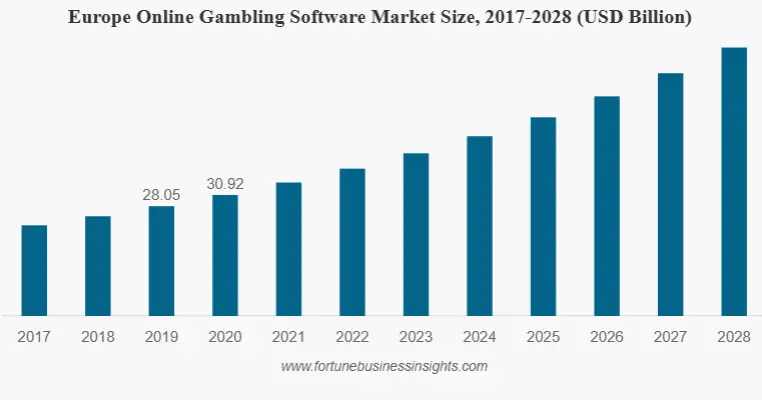
Source: Fortune Business Insights
Mobile Access and Player Convenience
Most people have a phone in their hand all day. That makes a casino app easy to open for a quick game on the bus or in a waiting room. There is no trip to a casino and no need to sit at a computer. Small bets are common too. Operators build their apps around this habit, so everything works fast with one thumb. The data from a few places shows how far this has gone.
Rising Demand for Live Games
Many players want more than a spinning reel. They want a real person on the screen. Live dealer games give them that. A dealer deals the cards in a studio and the player bets from the app. Evolution is the biggest name in this space. It ran over 700 tables in 2019 and about 2,000 by the end of 2025. Its presenters speak 24 languages and its game screen comes in 47.
A few things keep players coming back:
- Game shows like Crazy Time mix a live host with bonus rounds. Crazy Time launched in 2020 and became a big hit.
- Real-time chat with the dealer and other players makes it feel social.
- Dual Play tables let online players join the same game as people at the casino.
How BetMGM Uses Live Dealers
BetMGM Casino shows where this is going. In August, it launched live dealer games for players in Alberta that are streamed from Las Vegas through the MGM Resorts and Playtech partnership. The list includes MGM Grand Live American Roulette and Bellagio Live Baccarat. Dual Play games from Bellagio and MGM Grand also let online players sit in the same round as guests on the casino floor. A player at home gets a seat at a real Las Vegas table.
Expansion of Regulated Gambling Markets
People need to trust an app before they use it. That is why legal markets matter so much. When a government gives out licenses and sets clear rules, more people feel safe to sign up. In the US, real-money online casinos are live in seven states. Maine made it legal earlier this year, but its market has not launched yet. Other places are opening faster.
Alberta and DraftKings
Alberta opened its market in July. 22 operators went live on day one and 50 had been approved. DraftKings was one of them. Its casino app has been adding new features too. Flex Spins is a rewards feature that does not tie players to one particular game. The Lightning Link launch with slot creator Brian Christopher covers players in Connecticut, Michigan, New Jersey, Pennsylvania, West Virginia, and Ontario. DraftKings is also building a super app called DraftKings Sports & Casino that brings sportsbook, casino, lottery and predictions into one place.
Brazil Opens Its Doors
Brazil started its regulated market on 1 January 2025. 66 authorized companies began operating that day. Each full license costs R$30 million, which is about $5.2 million, and covers up to three brands on a .bet.br domain. That high fee keeps out weak operators. It also gives players a safer place to play, which brings in more of them.

Online Casino App Development Cost by Game Type
The cost mostly depends on the type of game you build. Slots are the cheapest because they have no live players or staff. Poker costs more since people sit at the same table and the server has to keep every hand in sync. Live casino costs the most because you need dealers, cameras, and a studio. Crypto sits in the middle and depends on the wallets and fairness checks you add. Each game type below has its own price guide so you can find your own.
Slot Game Development Cost
A slot is the easiest casino game to start with. The price moves with the art, the animation and how many bonus rounds you add. Testing is a cost people forget. Lab certification adds $8,000 to $35,000 for each place you launch in. Keep some money for upkeep too. Studios often set aside 15% to 20% of the build price every year.
Poker App Development Cost
Poker costs more than slots because players share a table in real time. The server has to deal every hand fairly and block cheating. Real money adds even more work like ID checks and secure payments. After launch, you still pay for fixes and server monitoring. One guide puts that at $2,000 to $8,000 or more a month.
How PokerStars Rebuilt Its App
PokerStars shows how big a poker rebuild can get. This April it moved players in New Jersey, Pennsylvania and Michigan to a new app called PokerStars Exclusively on FanDuel, which runs on new iPoker-powered software. The three states now share one player pool, so tables fill faster and prizes get bigger. The app also got a rewards program called Dynasty Builder. Ontario followed with its own version in June.
Live Casino Development Cost
Live casino is the most expensive type to build. Real dealers deal real cards and the video must reach the player with almost no delay. That is why most operators plug into an existing live casino provider instead of building a studio. If you do want your own studio the bills never stop. Running one costs roughly $400,000 to $2,000,000 a year for the two biggest expenses alone.
The price jumps for a few simple reasons:
- A real studio needs tables, cameras, and trained dealers.
- The stream must be very steady with almost no delay.
- Cameras need card-reading tech to turn each real card into data.
Crypto Casino App Cost
Crypto casinos look cheap at first. A single dice or crash game is not expensive. But wallets and fairness checks add up fast. Players can check every result themselves, which is what “provably fair” means. That does not replace lab testing in regulated places, though. It does not replace third-party RNG certification under regulator rules. Running costs matter too. Monthly operating costs generally run $5,000 to $15,000.
| Crypto build | What it includes | Cost |
| One provably fair game | Dice, plinko or crash | $15,000 – $40,000+ per game |
| MVP | A basic web interface, one or two provably fair games and one wallet chain | $30,000 – $60,000 |
| Full platform | Core platform, games, apps and wallets | Around $300,000+ |
How Stake Keeps Players Busy
Stake is the crypto casino most people know. It uses provably fair systems for its own house games. Those games sit under a line called Stake Originals, and the team keeps updating them. In October, it gave Keno a fresh look with new tiles, a gem animation and faster Auto and Instant play. In September, it opened its game platform, called Engine, to other casinos. One of them, Housebets, launched an Engine section with 28 titles from 19 studios.
Online Casino App Cost Breakdown by Development Stage
Most of the budget for an online casino app goes into a few big pieces and not the fancy screens. These ranges come from agency blogs and regulators, so treat them as a starting point and not a final quote.
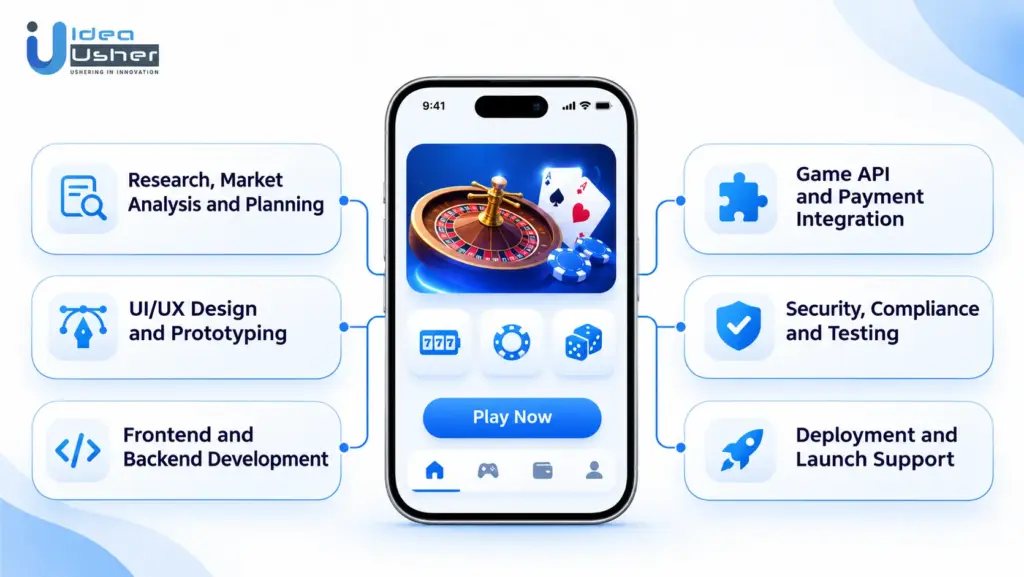
1. Research, Market Analysis and Planning
This is the cheapest stage, but it saves you the most money later. You look at other casino apps and pick your games and choose which countries you want to launch in. A simple casino app can get this done for $3,000 to $5,000. Bigger betting-style apps cost a lot more. One agency puts it at $10,000 to $20,000 for an app like 1xBet, and another says anywhere from $2,000 to $20,000. If you skip this stage, you often end up paying to rebuild things later.
What you should get out of it:
- A list of features for the first version
- The countries and licences you are aiming for
- A tech plan and a rough timeline
- A clear budget for each stage
2. UI/UX Design and Prototyping
Players decide fast if they like an app. Slow menus or confusing buttons make them leave and the design stage is where you stop that from happening. Designers draw the screens and build a clickable prototype so you can test it before any code is written. For casino apps the range is $2,000 to $15,000. Betting apps with more animation cost more as this table shows.
3. Frontend and Backend Development
This is where most of the money goes. The frontend is what players see and touch. The backend runs the wallet, the accounts, and the game logic. One agency says the backend and data parts take the largest share of the investment in a betting app. Game development alone can swing from $15,000 to $200,000 depending on how many games you want.
- Frontend: The frontend has to feel quick on both iPhone and Android. Using one shared codebase usually keeps the price lower.
- Backend: The backend needs to handle lots of players at the same time without crashing. It is also where the wallet lives, and that is why it costs $10,000 to $120,000.
A good example is DraftKings. Its new Super App puts the sportsbook and casino and predictions, and lottery in one app with a single account and wallet. The app shows different products depending on the state where the player lives. One newsletter warned that cramming so much into one app risks slowing it down. DraftKings also added Flex Spins, which lets players use free spins across over 100 gaming titles.
4. Game API and Payment Integration
Most casino apps do not build every game themselves. They plug in games from other studios through an API and that work costs about $5,000 to $30,000. Payments are the other half. One agency says payment gateway and security work costs $10,000 to $20,000 in the USA but only $5,000 to $12,000 in the Middle East. Cheaper does not always mean worse but you should still check the team’s past work.
Fanatics Casino shows how this works in real life. Its games come from Fanatics Game Studios and partners like Light & Wonder and IGT. It also signed content deals with Wazdan and White Hat Studios. More recently, it released WWE-themed games made with Boom Entertainment and Games Global, and players earn FanCash rewards while they play. Fanatics has since merged its sportsbook and casino and Fanatics Markets into one app with one account and FanCash balance.
5. Security, Compliance and Testing
You cannot skip this stage. A hack can cost far more than the whole app. IBM’s annual breach report found the global average cost of a data breach was $4.4 million and the US number was higher. Casino apps hold money and ID documents so they are a big target. Testing also means checking payments and game fairness and how the app behaves when many people log in at once.
| Item | Amount | Source |
| Malta licence application | €5,000 one time | Malta Gaming Authority |
| Malta annual fee for B2C | €25,000 | Malta Gaming Authority |
| Testing and deployment | $5,000 – $25,000 | Fulminous Software |
6. Deployment and Launch Support
Launch day is not the finish line. The team puts the app on the servers and on the app stores and watches for bugs. Agencies price testing and launch together at about $3,000 to $20,000. Many operators also launch in small steps. When Fanatics went live in Pennsylvania, it ran a two-day soft launch watched by the Pennsylvania Gaming Control Board. Planning some money for fixes and updates after launch is a smart move.
How Your Tech Stack Choice Affects Online Casino App Development Cost
Your tech stack sets how much you pay to build the casino app and how much you pay to run it every month. Cheap and simple tools get you to launch fast but they can get pricey when more players show up. Heavy custom tools cost more at the start but give you more control later. The smart move is to match each tool to what your casino app really needs on day one.
| Stack choice | What it does to cost | Source |
| Cross-platform instead of two native apps | 30 to 40 percent lower build cost | LowCode Agency |
| White-label vs custom platform | $50,000 – $200,000 vs $500,000 – $1,500,000+ | GeekyAnts |
| Backend and API work | $30,000 – $150,000+ | Quokka Labs |
| Moving hosting to the cloud | About $20,000 saved each month on ISP costs | AWS case study |
| A weak security setup | About $100 million lost by MGM Resorts after one attack | SEC filing |
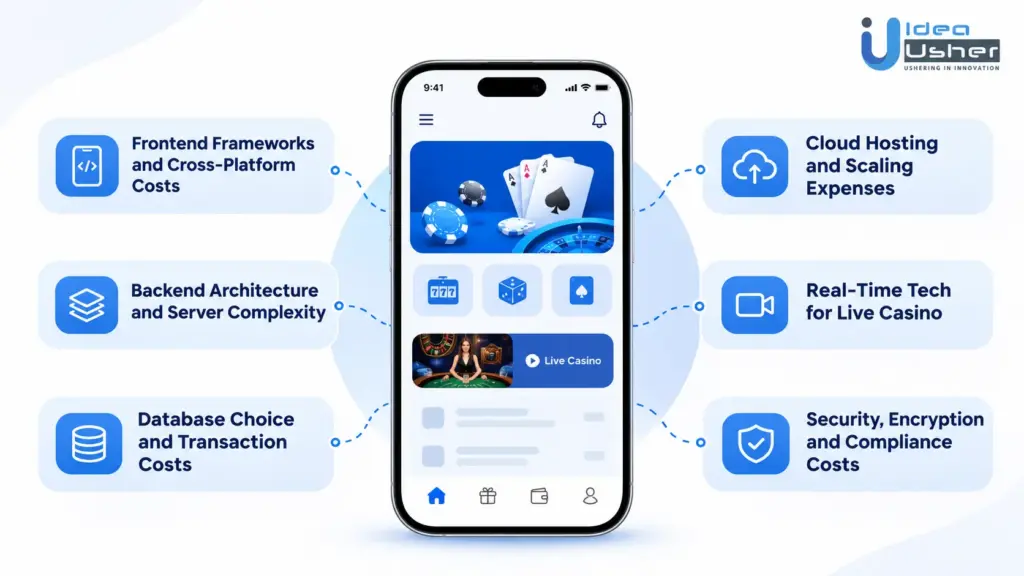
1. Frontend Frameworks and Cross-Platform Costs
The frontend is what players tap on. If you build one app for iPhone and another for Android, you pay twice. Tools like Flutter and React Native let one team build both from one codebase. One study of React Native found it saves about 30 percent through code reuse and faster work. The savings are biggest for simple apps and smaller for big ones.
- Simple app: 35 to 45 percent saved
- Medium app: 25 to 35 percent saved
- Enterprise app: costs end up within 10 to 15 percent of native
- Yearly upkeep: 15 to 22 percent of build cost for cross-platform and 20 to 30 percent for native
A casino app with lots of integrations and strict rules usually sits near the enterprise end. So do not count on huge savings there.
2. Backend Architecture and Server Complexity
The backend is the brain of your casino. It runs the wallet, the bonuses and the game rules, and the link to every game studio. Betting backends and API work can cost $30,000 to $150,000 or more. The way you design it matters a lot. Betfred tried a serverless setup on AWS and cut its codebase from 120,000 lines to 15,000 lines. Less code means less to fix and less to pay for,
Build or Buy
| Option | Cost | Time to launch |
| White-label | $50,000 – $200,000 + fees | 2 – 4 months |
| Custom build | $500,000 – $1,500,000+ | 12 – 24 months |
BetMGM chose to buy. It runs on Entain’s U.S.-licensed technology so it did not need to build a full backend alone. That helped it ship things like a single account and wallet that works across all its US mobile markets. Its rewards points also travel with the player across states.
3. Database Choice and Transaction Costs
Your database holds every bet and every balance. If it is slow, players get angry fast. Some casino providers expect wallet debits and credits to finish within a strict 1-second limit. That is why most teams use a safe relational database for money and a fast in-memory one for live game data. Picking the wrong one early means a painful and costly rebuild later.
4. Cloud Hosting and Scaling Expenses
Casino traffic jumps when big events happen. If you buy servers for the busiest day you waste money on every other day. Cloud hosting lets you grow and shrink as needed and the real case studies show it:
- Europebet: saves around $20,000 a month on ISP costs and cut website loading time by around 75 percent
- DreamCasino: reduced costs by 30 percent while scaling up
- Onlyplay: reached 99.99% uptime and 50% lower costs after moving to AW
These are vendor case studies so your results will differ. But the pattern is clear. Paying for what you use usually beats owning idle hardware.
5. Real-Time Tech for Live Casino
Live dealer games are the most demanding part of the stack. The video has to arrive almost instantly or players bet on things that already happened. Normal streaming is too slow since HLS often has delays of 10 to 30 seconds. Low latency versions get down to 3 to 7 seconds, but that is still not enough for fast tables. WebRTC can reach sub-1-second delivery compared to 4 to 8 seconds on older methods. It costs more to set up but it keeps the game fair and fun.
Hard Rock Bet
6. Security, Encryption and Compliance Costs
Security looks like a cost you can skip until something goes wrong. Then it becomes the highest cost of all. MGM Resorts said a cyberattack cost it about $100 million and it spent less than $10 million on consultants and lawyers on top of that. Casino apps hold money and ID details so they are a big target.
The good news is that good tools pay for themselves. IBM found that companies using security AI and automation had breach costs that were $1.76 million lower on average and found problems 108 days faster. Put money into encryption, fraud checks and logging from the start. It is far cheaper than fixing it after a hack.
Recommended Tech Stack for Online Casino App Development
A strong casino app stack uses React Native or Flutter for the screens and Node.js or Java for the server. PostgreSQL holds the money data, and Redis keeps game data fast. WebSockets and WebRTC handle live play, and AWS or Azure host everything. Add strong encryption and certified payment tools, and tests that run on their own. This mix is fast and safe and it can grow when more players join.
| Layer | Technology | Purpose |
| Frontend | React Native, Flutter, Swift, Kotlin | Build the iOS and Android screens players use |
| Backend | Node.js, Java, Go, Python | Run the wallet and bonuses and game rules |
| Database | PostgreSQL, Redis, MongoDB | Store bets and balances safely and fast |
| Real-time | WebSockets, WebRTC | Power live tables and instant updates |
| Cloud and DevOps | AWS, Azure, Docker, Kubernetes | Grow with traffic and ship updates quickly |
| Security | TLS, AES encryption, WAF, KYC tools | Protect money and ID data |
| Integrations | Game provider APIs, payment gateways | Bring in games and take deposits |
| Testing | Jest, Selenium, k6, lab tools | Find bugs and prove the games are fair |
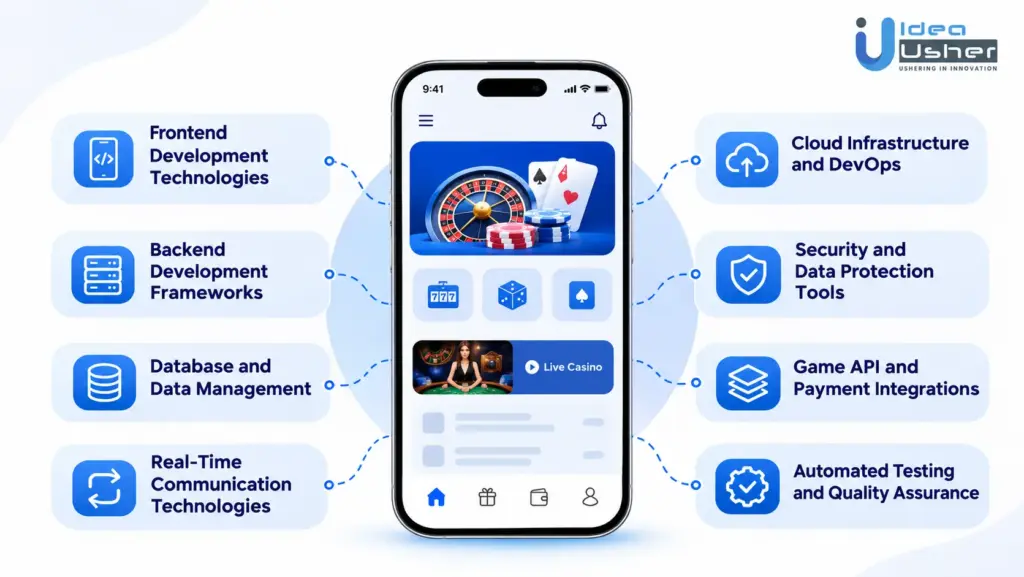
1. Frontend Development Technologies
The frontend is the part players see and tap. It needs to load fast and look the same on every phone. React is a safe base for this since it is used by 46.9 percent of developers in the Stack Overflow survey. That means it is easy to find people who know it. Flutter is the other popular pick when you want a very custom look.
Caesars Palace Online Casino shows why the frontend matters. It runs on a natively built proprietary gaming platform and it recently got an app upgrade with a multi-lobby navigation layout and near-instant loading. It also added the Caesars Rewards Shop so players can spend reward credits on bonus spins or bonus cash right inside the app.
2. Backend Development Frameworks
The backend is where the real casino logic lives. It checks every bet, updates every balance, and talks to every game studio. Node.js is a very common choice, and the same survey shows it is used by 49.1 percent of developers. It handles lots of small requests well which fits casino traffic.
How to choose:
- Node.js for fast real-time features and a quick start
- Java for big and strict systems with lots of rules
- Go for heavy traffic that needs to stay light and quick
- Python for fraud checks and player analytics
Many teams mix two or three of these as separate services.
3. Database and Data Management
Money data must never be wrong so most casinos pick a strong relational database for it. Game sessions need speed so they sit in memory. The table shows the usual pair.
| Tool | Best job | Fact |
| PostgreSQL | Wallets and transactions | Used by 58.2% of professional developers |
| Redis | Fast sessions and caching | Used by 30.7% of developers |
Redis has also been growing fast. One report shows it gained 8 percent in usage in a year.
4. Real-Time Communication Technologies
Casino apps need things to happen right now. Bets and balances and live dealer video must all stay in sync. WebSockets keep a steady line open between the app and the server. WebRTC does the same for live video. One guide says live casino needs delay under 300 milliseconds and that real-time ingest saves 200 to 400 milliseconds over older methods. Evolution treats anything below two seconds as ultra-low latency.
FanDuel
FanDuel shows real-time at a big scale. Its new poker platform, called PokerStars exclusively on FanDuel joined player pools in Michigan, New Jersey and Pennsylvania so everyone sits at the same tables. It runs through a dedicated poker app and desktop site and uses FanDuel’s account and wallet system. A new rewards program called Dynasty Builder came with it. Joining three states means the servers must keep seats and bets in sync across all of them.
5. Cloud Infrastructure and DevOps
Casino traffic comes in waves. Big sports nights and jackpots can fill your servers in minutes. Cloud hosting and containers let you add power only when you need it. DevOps tools then ship fixes without stopping the app.
- Sportsbet: said it had to scale its infrastructure tenfold for the Melbourne Cup so it moved to the cloud
- William Hill: now runs over 80 percent of its apps on AWS and handles spikes like the Grand National
- Yggdrasil Gaming: uses AWS Lambda for serverless functions and Amazon ECS and EKS for containers
Docker and Kubernetes fit well here because each service can grow on its own.
6. Security and Data Protection Tools
Players trust you with money and ID papers. Use TLS for every connection and strong encryption for stored data. Add a web firewall and two-step login and KYC checks. Card rules matter too. Industry sources report that PCI DSS non-compliance can bring penalties of $5,000 to $100,000 per month. The card brands set these through your bank so they add up fast.
Good habits to build in from day one:
- Never store raw card numbers
- Log every wallet change
- Limit who can touch player data
- Run regular security tests
7. Game API and Payment Integrations
Most casinos plug in games from other studios through APIs. This keeps your own work small and your lobby full. A clean and well-documented API layer makes it easier to add new studios later without breaking what already works.
Payments
Payments are harder than they look. Gambling is high-risk so these accounts cost 2 to 5 times more than standard ones, and setup can take 2 to 6 weeks. If your chargeback rate goes above 1 percent, the processor may add a reserve or extra fees or even close the account. Fraud is a growing worry as well. Juniper Research expects merchant losses from online payment fraud to pass $362 billion globally between 2023 and 2028. Pick gateways that bring fraud and chargeback tools with them.
8. Automated Testing and Quality Assurance
Automated tests run on every code change so bugs get caught early. Load tests copy a busy night. Then an outside lab checks that your games are random and fair. GLI-19 is the standard for interactive gaming systems like online casinos. Lab testing usually takes 4 to 12 weeks.
| Certification scope | Lab fees | Timeline |
| One game in one jurisdiction | $5K – $15K | 4 – 8 weeks |
| Multi-game series | $15K – $40K | 8 – 16 weeks |
| Full platform plus game suite | $40K – $120K+ | 16 – 36+ weeks |
These are planning ranges and not fixed quotes. Getting games ready for the lab can add more on top so plan for it early.
Gambling License Costs for Online Casino App by Jurisdiction
Your casino app licence cost depends on where you apply. Malta and the UK cost the most and give players the most trust. Curaçao costs less and Anjouan costs the least but they carry limits on where you can take players. Look at the licence fee and the tax and the setup work all together. The fee alone never tells the whole story.
Fees are shown in euros and pounds since that is how regulators publish them.
1. Malta Gaming Authority Licence Costs
Malta is the pick if you want a licence that players and banks trust. The first step is a one-time application fee of €5,000, and it is not refundable. After that a B2C operator pays a fixed yearly fee of €25,000 or just €10,000 if it only offers the simpler Type 4 games. The MGA also checks your company closely. Expect to wait 6 to 10 weeks while it reviews your papers.
Other Malta costs to plan for:
- Gaming tax: 5 percent on revenue from players located in Malta
- Share capital: €40,000 to €100,000 depending on licence type
- Compliance contribution: an extra yearly payment on top of the fixed fee
2. UK Gambling Commission Licence Costs
The UK licence costs more as your business grows. The fee depends on your gross gambling yield, which is the money players stake minus what they win back. The Gambling Commission also says that your first yearly fee is reduced by 25 percent.
| Annual yield band | Application fee | Yearly fee |
| Under £250,000 | £8,185 | £7,000 |
| £250,000 to £875,000 | £14,483 | £12,375 |
| £875,000 to £3 million | £25,628 | £19,569 |
| £3 million to £10.5 million | £40,475 | £27,337 |
The higher cost is tax. Remote Gaming Duty on online casino games went from 21 percent to 40 percent and that can matter more than the licence fee itself.
LeoVegas
LeoVegas shows how a casino can hold more than one licence. Its Apple App Store page says LeoVegas Gaming Ltd is licensed by the Malta Gaming Authority and also holds a UK licence from the Gambling Commission. The app has a safer play tool called LeoSafePlay. The group also owns Push Gaming and is a subsidiary of MGM Resorts International. Holding two licences means paying two sets of fees and following two sets of rules.
3. Curaçao Gaming Licence Costs
Curaçao changed its rules and now gives licences directly. A B2C licence has an application fee of €4,592 and the regulator can take up to 16 weeks to decide. Yearly costs have two parts.
| Cost | Amount |
| Treasury licence fee | €24,490 |
| Supervisory fee | €22,960 |
| Total each year | €47,450 |
| Extra domain | €250 each |
| Owner background checks | €150 each |
Stake
Stake is a good example. It is run by Medium Rare N.V. a company in Curaçao, and it started out on an older sublicence under the old system. When Curaçao moved to direct licences, the company got its own licence, which now covers both the casino and the sportsbook. Stake is known for Stake Originals, which are games you cannot find anywhere else. It also has a feature called Stake Vault that adds extra protection for stored funds.
4. Anjouan Gaming Licence Costs
Anjouan is the budget choice. The issuer charges €17,828 to issue a licence and the same amount for each yearly renewal for both B2C and B2B. An extra domain costs €500 per licence cycle. These are only the issuer fees, though. One guide says a realistic first-year budget is €25,000 to €45,000 once you add setup costs. For comparison, it puts Tobique and Nevis at about $25,000 a year.
Extra setup costs to expect:
- Company formation: €2,500 to €5,000
- Documents and policies: €2,000 to €5,000
- Each extra key person: about €2,000 a year
Be careful about where you plan to take players. If a market needs its own licence, then Anjouan does not replace it. Some guides also say it has a weaker enforcement reputation.
5. Additional Licensing and Compliance Expenses
The licence fee is only the start. Game testing, local setup, and taxes all add up. Labs usually charge $5K to $15K to certify a single game in one jurisdiction, and it takes about 4 to 8 weeks. A full platform with a game suite can cost $40K to $120K or more. Every new jurisdiction can add another review round. So it is smart to budget for these costs before you pick where to apply.
| Extra cost | Where it applies | Amount |
| Gaming tax | Malta | 5% on Malta player revenue |
| Remote Gaming Duty | UK | 40% |
| Key person fee | Anjouan | About €2,000 a year |
| Extra domain | Curaçao | €250 |
Want to know what your own license route would cost? Ask our team for a custom estimate.
Which License Should You Choose Based on Your Budget and Revenue Goals?
The right license depends on your cash and on where your players live. If money is tight you should start with Anjouan or Curaçao. When you want bigger markets and smoother payments, you should move up to Malta or the UKGC. Pick the license that fits the stage you are in right now and plan the next step early. Chasing a top license too soon can eat your whole budget before you earn anything.
Fees are shown in euros and pounds since that is how regulators publish them.
1. Best Licenses for Bootstrapped Startups
If you have a small budget, you have three real paths. Anjouan is the cheapest license and Curaçao is the next step up. A white-label deal lets you skip the license work and use a partner’s setup. Anjouan charges €17,828 to issue and renew a license and a guide says processing takes about 2 months. Remember the real first-year bill is higher. One guide puts it at €25,000 to €45,000 once setup is counted.
| Option | Cost | Speed |
| Anjouan | €17,828 a year | 4 to 8 weeks |
| Curaçao | €47,450 a year | Up to 16 weeks |
| White-label | $50,000 – $200,000 + fees | 2 – 4 months |
For comparison, the same guide lists Tobique and Nevis at about $25,000 a year.
2. When Curaçao Suits a Growing Casino
Curaçao works well once you have players and want more trust than the cheapest options give. The application costs €4,592, and the yearly total is €47,450. An extra domain costs €250. That is not tiny, but it is far below what Malta needs in total. One guide shows that Curaçao has no fixed minimum capital, while Malta asks for €40,000 to €100,000.
Things to plan for:
- Local setup: you will need to pay for local substance and key-function holders under the new rules
- Wait time: the regulator can take up to 16 weeks to decide
- Payments: banks and payment providers are good and getting better with Curaçao since the reform
3. When Malta or UKGC Makes Sense
These two are for operators that already have steady players and want a license that opens doors. Malta charges €5,000 to apply and then €25,000 a year for most B2C licenses. Once you pass the checks, the license lasts ten years. The UK costs more as you grow. A mid-size operator can pay £51,975 a year, and a bigger one can pay £112,556. The UK also taxes online casino games at 40 percent now, so run your numbers first.
bet365
bet365 shows what established operators do. It keeps adding new game studios to its casino. Octoplay recently went live in the UK, and it holds active licenses in 17 jurisdictions. bet365 also signed an aggregation deal with EveryMatrix, whose SlotMatrix platform supplies games from over 40 external suppliers. Years ago, it was the first operator to launch Playtech’s native mobile casino app, which was said to run three times faster than HTML5. Big operators win by adding content fast, and that only works with a strong license behind it.
4. Choosing a License for Crypto Casinos
Most crypto casinos start in Curaçao or Anjouan. One guide says Curaçao’s crypto friendliness and low cost make it the most practical option for serious crypto operators who do not need Malta. Another guide calls Anjouan the budget alternative and Malta’s crypto-friendly route the premium choice. It also warns that Costa Rica is not actually a gambling license. Always check that your license is real before you build around it.
BC.Game
BC.Game shows why the license matters. It first ran on a Curaçao sublicense and later announced a new license under the LOK framework. Then things got messy. In November 2024, a Curaçao court declared two of its Curaçao companies bankrupt, and the brand moved on. It now runs through Twocent Technology Limited, which holds an Anjouan license.
The platform has kept building products like BC Swap, a built-in crypto exchange, and it supports 150+ cryptocurrencies. The lesson is simple. Keep a backup plan in case your license or your operator company hits trouble.
5. Planning a License Upgrade Path
Think of licenses as steps. You do not need to pay for the top step on day one, but you should know what the next step costs. Testing helps too. Getting certified to GLI-19 early can speed up new markets since labs then run a reduced test instead of a full re-evaluation.
| Stage | Likely license | Yearly fee |
| Starting out | Anjouan | €17,828 |
| Growing | Curaçao | €47,450 |
| Established | Malta | €25,000 |
| Large UK business | UKGC | £51,975 – £112,556 |
Platform-level certification also helps because it reduces the extra cost for each new game you add later.
6. Target Markets and Payment Access
Your players decide your license more than your budget does. The UK is the clearest case. The Gambling Commission says you need its license if you serve customers in Great Britain, no matter where in the world you are based. Offshore licenses will not cover that market. Payments matter just as much. Gambling is a high-risk category so accounts can cost 2 to 5 times more than standard ones, and setup can take 2 to 6 weeks. If your chargeback rate goes above 1 percent, the processor can add fees or reserves.
Not sure which license fits your budget and your markets? Talk to our team for a custom estimate.
Revenue Models and ROI: How Fast Can a Casino App Pay Back Its Cost?
A casino app pays for itself when the money you keep from players becomes bigger than the money you spent to build it and bring players in. That does not happen on launch day. You pay for the app, the licence, and the ads first, and the players come later. So the honest answer depends on three things: how cheap it is to get a player, how long that player stays, and how much of their play you really keep after bonuses and taxes. You now know what the app costs to build, so this section shows what it can earn back.
Revenue Models: GGR, Rake, Purchases
Most real-money casino apps earn from the house edge. The house edge is the built-in advantage that lets the casino win a little from every game over time. The money left after the app pays out wins is called GGR. It is simply the total bets players make minus the total winnings they get back. This is the main money maker for slots, roulette and blackjack apps, and it grows when more players play more often.
Real-Money Apps
Poker works in a different way. The app is not playing against anyone, so it takes a small fee from the game instead. This fee is called rake, and it is usually a percentage of the pot. That means a poker app earns when the tables are busy, no matter who wins the hand. This is why poker apps care so much about getting lots of players into one place.
Social Casino Apps
Social casino apps are free to play and use virtual coins instead of real money. Their main income is in-app purchases, where players buy more virtual currency. One report says purchases bring about 64.8% of the money and ads bring about 26%. The catch is that only a small group of players ever buy anything, so these apps need a lot of installs to work.
How to Calculate GGR, NGR, Profit
GGR looks nice on a report, but it is not what you get to keep. NGR is what remains after you take off bonuses, taxes, chargebacks, and platform costs. One source warns that an operator can show $10 million in GGR and still lose money, because bonuses, taxes and fees do not go away. Net profit comes one step later, when you take off your normal running costs like your team, support and marketing. Here is a simple example from Blask:
| Item | Amount |
| Player stakes | $1,000,000 |
| Player winnings | −$920,000 |
| GGR | $80,000 |
| Bonuses | −$12,000 |
| Gaming taxes | −$10,000 |
| Payment fees | −$3,000 |
| Supplier fees | −$5,000 |
| NGR | $50,000 |
Net profit = NGR − running costs
Key ROI Metrics: CAC, LTV, Retention
CAC is the one that surprises people. One source says it can run from $280 to $1,400 for each first-time depositor. Another says online casinos usually land between $80 and $400. The gap is big because the market, the channel, and the welcome bonus all change the price. The same source says most operators sit near a 3:1 LTV to CAC ratio. Retention is the other worry. Casino and gambling apps keep only about 2.3% of iOS users and 3% of Android users after 30 days.
- CAC: what it costs to get one paying player
- LTV: what a player brings in during their whole time with you
- ARPU: the average money per player in a set time
- Retention: how many players come back on day 1, day 7, and day 30
That is why LTV matters so much, and DraftKings is a good example. Its new DraftKings Sports & Casino “Super App” puts the sportsbook, online casino, lottery and predictions in one experience. Everything runs through a single account and wallet. The company says this helps it cross-sell and keep players engaged. It also added Flex Spins, a reward that players can use without being tied to one particular game, with winnings paid out as bonus bets.
Break-Even and Payback Period Math
Break-even is the moment all the money you put in has come back. Add up what you spent on the build, the licence, the team, and the marketing. Then divide it by the net money the app makes each month after running costs. That gives you the number of months to break even. Payback period is the same idea for one group of players. It is the time until the money from that group equals what it cost to get them.
You can work it out with a simple example. If you spend $50,000 in a month and get 200 new depositing players, each player costs you $250. Remember that this cost is higher than ad spend alone. It also includes affiliate fees, bonus costs, KYC checks, and compliance work. Large welcome offers can lower early NGR and push payback later, even if they help retention in the long run.
Example ROI Scenarios by Budget
Match each row with the cost ranges from the cost section above. The player costs below come from Cointraffic.
What Speeds Up or Slows ROI
Casino numbers are very sensitive to bonus design and payment friction. The licence can also eat time. The UK Gambling Commission lists 16 weeks for a new operating licence application. You are paying your team during that wait and earning nothing.
- Faster: cheaper player acquisition, careful welcome bonuses, easy payments, and cross-selling games to the same player
- Slower: a long licence wait, heavy bonuses, high CAC, and weak retention
FanDuel Casino shows how sharing players can speed things up. On April 1, it launched PokerStars Exclusively on FanDuel in Michigan, New Jersey and Pennsylvania, with one player pool across all three states. It runs on FanDuel’s account and wallet system and came with a new rewards program called Dynasty Builder.
A Playtech partnership also brought the iPoker network to North America. More players at each table means more rake sooner, and about two months after launch, it had already passed the revenue it made with its previous partner.
Top 5 Online Casino Apps in the USA
The top online casino apps in the USA have a wide range of games, bonuses and great user experiences. Here are five of the most popular ones:
1. BetMGM Casino App

BetMGM stands out because of its huge variety of games and exciting promotions. With over 700 games like slots, blackjack and roulette, users can always find something to play. The app also has a fantastic loyalty program and regular bonuses that enhance the experience.
2. FanDuel Casino App

FanDuel stands out for its smooth user experience and its ability to let users easily switch between casino games and sports betting. This integration gives users a complete gaming experience. The app is also known for offering creative promotions with exclusive deals for new and returning users. It’s a fun app for those who enjoy both casino games and sports betting.
3. DraftKings Casino App

DraftKings is perfect for users who want a wide range of games and exciting promotions. It offers a great selection of slots and table games along with live dealer options that give users the feeling of being at a real casino. The app is also user-friendly and works great on mobile devices so users can enjoy gaming on the go.
4. Borgata Casino App

Borgata offers a wide variety of games, including slots, baccarat and blackjack. What makes it stand out is its reliable payouts and excellent customer service. Users can also try their luck with progressive jackpot games where they could win big. Borgata is a trusted app for users who want a smooth and rewarding gaming experience.
5. Caesars Palace Online Casino App

Caesars brings the classic casino experience right to users’ phones. It’s known for offering generous bonuses and a loyalty program that players really enjoy. Users can also play a variety of themed slots and table games, which make it feel like they’re visiting one of the iconic Las Vegas properties.
Build an Online Casino App with Idea Usher
Idea Usher builds it with you from the first idea to the live product. Our team has 500,000 hours of coding experience. It also includes ex-MAANG and FAANG developers who know how to build apps that stay fast when thousands of players join at once. You get a team that has built at scale before.
Custom Casino App Development
Every casino business is different. You may want slots, live dealer tables, poker or a mix of all three. We build the app around your model and your players. Nothing is copied from a template. Your app looks and feels like your brand. You choose the games and features that matter most.
Scalable Games, Wallets, and Payments
Players want games that load fast and money that moves safely. We connect top game providers to your app and set up secure wallets. We also add payment methods for the regions you serve. As your player base grows, the system grows with it. Deposits and withdrawals stay quick and smooth. Players trust the app, so they keep coming back.
End-to-End Development, Security, and Support
We handle design, development, testing, and launch. Security is built in from day one. This covers data protection, fraud checks, and fair play controls. After launch, our team stays with you for updates, fixes, and new features. You are never left alone after go-live. One team takes care of everything for you.
Conclusion
The cost of an online casino app depends mostly on your features, licence, games and team. The right tech stack keeps the app fast and safe as more players join. Start lean, grow as you learn, and keep player costs and bonuses under control so the app earns its money back. Want a clear estimate for your budget and tech stack? Talk to our casino app experts and get a free consultation.
FAQs
A1: The cost depends on how big the app is. A simple app with a few games costs much less than a full platform with live dealers, poker and a custom admin panel. The main things that change the price are the number of games, the platforms you build for (iOS, Android, web), the licence, payment and KYC setup, and the team you hire. The best way to get a real number is to share your feature list with a development team and ask for an estimate.
A2: There is no single best stack, but a common setup uses React Native or Flutter for the app and Node.js, Python or Java for the backend. Teams often add PostgreSQL or MongoDB for data, Redis for speed, and WebSockets for real-time play. Unity or HTML5 works well for games, and AWS or Azure for hosting. Pick tools that fit your budget, your games, and how many players you expect.
A3: A simple version can take a few months, and a full platform with many games and integrations can take much longer. Testing, game certification, and security checks add time, so plan for them from the start. The license can also take months, so most teams apply while the app is being built.
A4: Building the app is legal, but running it is not allowed everywhere. Each country or state has its own gambling laws, and you usually need a license before you take real-money bets. Check the rules of every market you plan to launch in, and speak to a gambling lawyer before you go live.
A5: Yes. Start with a minimum viable product that has only the key features, like registration, a wallet, and a few games. You can also use a white-label solution or games from third-party providers instead of building everything from scratch. Then add more features as players join and money comes in.
A6: Native apps give the smoothest speed and the best use of phone features, which helps with heavy games and live streaming. Cross-platform tools like Flutter or React Native cost less and let you launch on iOS and Android at the same time. For most new projects, cross-platform is a good start, and native makes sense when performance is the top priority.