

Key Takeaways
- Scaling issues often stem from lacking specialized expertise, not infrastructure, making Akka developers critical for building high-concurrency, fault-tolerant systems.
- Traditional architectures and hiring methods fail to support modern, real-time demands, creating bottlenecks, delays, and system instability.
- Akka’s actor-based, asynchronous model enables efficient resource use, resilience, and linear scalability for industries like fintech, IoT, and SaaS.
- Staff augmentation with pre-vetted Akka experts helps businesses reduce hiring risks, accelerate development, and maintain high-performance systems.
- How IdeaUsher provides pre-vetted Akka developers ensures quick access to experts for faster, scalable system development.
What if scalability is no longer about adding infrastructure, but about how systems behave under stress? The old model of scaling through servers, database tuning, and caching is breaking down. Modern products face unpredictable spikes, real-time interactions, and distributed complexity, where the real bottleneck is not hardware but how systems manage concurrency, failure, and state. Platforms like Uber exposed this shift early, but it is now becoming the default across industries.
As Akka reflects this change in thinking, it moves beyond being just a framework and becomes a model for building systems that stay responsive under pressure. The real hiring gap is no longer backend capacity, but expertise in resilience-first design. As event-driven architectures become standard, companies that invest early in Akka talent can build systems that do more than scale. They adapt, recover, and sustain performance when conditions are no longer predictable.
This blog explores top companies for hiring Akka developers, along with key evaluation factors and engagement models to help you choose the right partner for building scalable, distributed systems. It will help you identify teams that can design for high concurrency, system resilience, and long-term scalability without introducing unnecessary architectural risk.
Why Are Businesses Hiring Akka Developers for Scale?
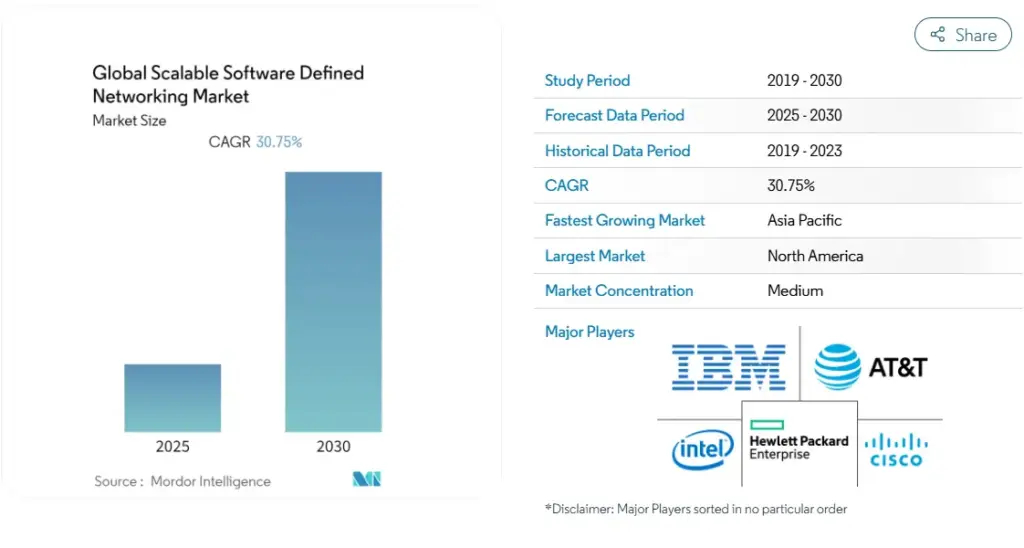
Source: Mordor Intelligence
As the digital economy moves toward real-time ecosystems, the underlying architecture must evolve. For investors, the challenge is no longer just building an app, but engineering resilience. Hiring Akka developers is a strategic move for businesses that have outgrown traditional thread-based processing. Akka provides the blueprint for self-healing and elastically scalable systems. When a platform handles millions of concurrent users, the cost of latency translates directly into lost capital. Akka-based stacks offer a competitive moat by allowing linear scaling without a massive increase in complexity.
Demand for High-Concurrency
The instant economy drives the demand for high concurrency. Whether it is a fintech platform or a massive multiplayer backend, the requirement is the same. The system must handle millions of simultaneous tasks without blocking. For an entrepreneur, concurrency is the engine of profitability. The more users your system supports with high performance, the lower your cost per acquisition.
Traditional systems struggle with concurrency because they rely on shared state and locking. As data grows, these locks become bottlenecks. Akka developers solve this by using the Actor Model. In this model, each Actor is an isolated unit of logic. These units communicate via asynchronous messages rather than sharing memory.
Strategic Concurrency Advantages
- Resource Efficiency: High concurrency frameworks allow better CPU utilization. Akka’s non-blocking nature ensures every cycle of your cloud infrastructure is working toward business goals.
- Predictable Performance: Systems designed for high concurrency maintain consistent response times during traffic spikes. This prevents the performance death spiral common in less sophisticated architectures.
- Real-Time Capabilities: Market leaders leverage streaming data. Akka enables the development of reactive streams, allowing businesses to provide instant feedback to users.
Why Traditional Architectures Fail
Investors often ask why a platform that worked for 10,000 users breaks at 100,000. The answer lies in the fragility of Request-Response architectures. Most legacy systems use a one thread per request model. When requests exceed available threads, the system queues and eventually crashes. This is a catastrophic failure mode for any business looking to dominate a market.
Traditional architectures are often tightly coupled. If one component slows down, it creates a ripple effect that paralyzes the entire ecosystem. This cascading failure is the nemesis of scalability. In monolithic or poorly designed microservices, managing state across multiple servers leads to data inconsistency and unpredictable behavior.
Legacy Scaling Failure Points
- Vertical Constraints: Traditional systems often require scaling up by buying bigger servers. This has a hard ceiling and exponential costs. Akka allows for scaling out across cheaper, distributed hardware.
- Shared State Bottlenecks: When multiple processes access the same data simultaneously, the management overhead creates a performance plateau. Extra hardware cannot fix inefficient software logic.
- Complexity Management: As a system grows, the mental model for thread safety becomes too difficult for average teams. This leads to hidden bugs that increase technical debt and slow down time to market.
Need for Fault-Tolerant Apps
In the modern landscape, downtime is an obsolete concept. If your platform is down, revenue stops, and customers migrate to a competitor. This has birthed the need for fault-tolerant software that handles errors gracefully. This is where Akka developers provide the highest ROI. They build systems based on a Let it Crash philosophy.
In an Akka system, if a component fails, its supervisor detects the failure and restarts it in a clean state. The rest of the system remains unaffected. This isolation ensures a minor bug does not bring down the entire platform. For an entrepreneur, this means higher uptime and lower maintenance costs as the system manages its own recovery.
Resilience Implementation Strategies
- Supervision Strategies: Akka allows developers to define clear hierarchies. If a database actor fails, the system can retry the connection or escalate the error without stopping the user-facing side.
- Location Transparency: Akka actors can reside on the same machine or across a global cluster. This allows a business to deploy across different regions to ensure the application remains online during outages.
- Self-Healing Logic: By delegating error handling to a supervisor, the business logic remains clean. This results in robust code that is easier to audit and cheaper to evolve over the long term.
What Makes Akka Developers Critical for Scalability?
Building for scale is a financial calculation as much as a technical one. The primary bottleneck in scaling modern platforms is not hardware availability. It is the management of the state and complexity. Akka developers are critical because they shift the architecture from a rigid model to a fluid, reactive one.
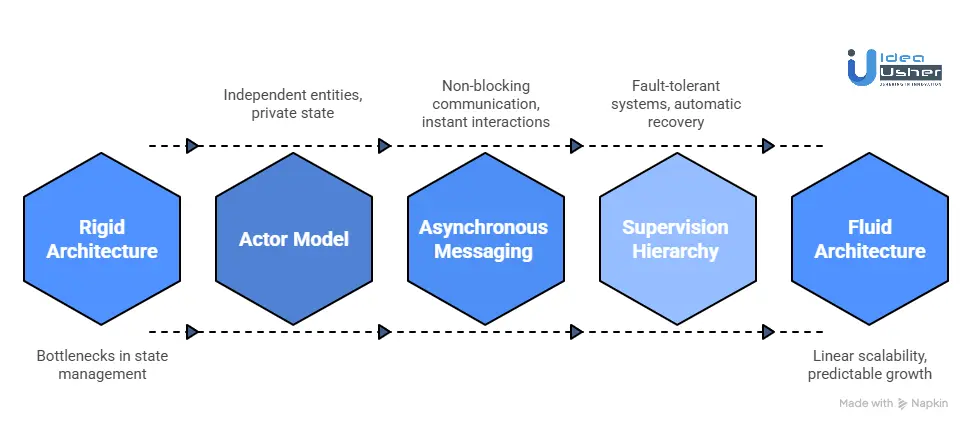
When an entrepreneur invests in Akka, they are investing in linear scalability. This means that as you double your user base, you simply add cloud instances without rewriting core logic. This predictability is essential for capital planning and long-term budgeting.
1. Actor Model In System Design
The Actor Model is the cornerstone of high-performance system design. Traditional programming has objects call each other directly, which creates tight coupling. The Actor Model treats Actors as independent entities.
Strategic Insight: Think of an Actor as a private business unit. It has its own state and logic. It never allows anyone else to touch its internal data. This total isolation allows thousands of Actors to run in parallel without the risk of data corruption.
For a decision-maker, the Actor Model translates to:
- Modular Growth: Add new features as new Actors without breaking existing ones.
- Distributed Power: Actors function the same on any server. This makes moving to a multi-cloud environment seamless.
- Reduced Overhead: By eliminating the need for complex database locks, the system stays fast under heavy loads.
2. Handling Concurrency Via Messaging
Concurrency is often the silent killer of growing platforms. Most systems fail because they use synchronous communication. One part of the system stops and waits for another part to finish. This creates a bottleneck effect where everything slows down to the speed of the slowest component. Akka developers use asynchronous messaging to bypass this entirely. Instead of waiting for a response, an Actor sends a message and immediately moves on to the next task.
| Feature | Traditional Sync Systems | Akka Async Systems |
| User Experience | Users see loading spinners during high traffic. | Users experience instant interactions. |
| System Health | High risk of thread exhaustion and crashes. | System stays responsive via non-blocking I/O. |
| Cost Efficiency | Requires massive servers for idle threads. | High CPU utilization with minimal hardware. |
By utilizing non-blocking communication, developers ensure your platform can handle massive traffic spikes without a degradation in service quality.
3. Building Fault-Tolerant Systems
In a distributed environment, failure is a mathematical certainty. Hardware fails, and networks drop. A standard developer builds a system that tries to avoid failure. An Akka developer builds a system that thrives despite it. This is achieved through a Supervision Hierarchy. In this structure, every Actor is watched by a supervisor. If an Actor fails, the supervisor can instantly decide to resume, restart, or stop the component.
When Should You Hire Akka Developers?
Knowing when to pivot toward Akka is a critical leadership decision. It usually happens when your current stack reaches a performance ceiling that more hardware cannot fix. If growth is hindered by technical debt or stability issues, bringing in Akka developers becomes the primary path to sustaining market momentum.
1. System Struggles Under High Traffic
Performance degradation during peak usage is a clear signal. If your servers consume maximum memory while throughput remains low, your architecture is likely suffering from thread contention. Akka allows you to process more with less by using lightweight actors instead of heavy system threads.
2. Need For Real-Time Systems
Business models centered on live data require a different approach. If you are building any of the following, Akka is your best bet:
- Fintech Platforms: For instantaneous transaction processing and ledger updates.
- IoT Ecosystems: To manage millions of sensor signals simultaneously.
- Betting Or Bidding Apps: Where a millisecond delay equals a lost user.
3. Lack Of Distributed Expertise
Distributed computing is notoriously difficult. Without specialized knowledge, teams often struggle with data consistency and network partitions. Hiring experts ensures your system handles these complexities out of the box, reducing the risk of a botched rollout.
IdeaUsher Fast Access To Experts
Finding elite talent is often the biggest hurdle to scaling. IdeaUsher streamlines this by providing immediate access to vetted professionals who understand the nuances of the Actor Model.
- Vetted Talent: Skip the long hiring cycle with experts ready for deployment.
- Proven Delivery: Benefit from a team experienced in building high-stakes, resilient platforms.
- Strategic Growth: Partner with developers who prioritize your business ROI over just writing code.
Challenges in Hiring Skilled Akka Developers
Securing top-tier Akka developers is a significant hurdle for most enterprises. Because Akka requires a deep understanding of functional programming and the Actor Model, the candidate pool is much smaller than that of standard Java or Python developers. For an investor, this scarcity creates a strategic risk that can stall product roadmaps. At IdeaUsher, we mitigate this risk by maintaining a curated bench of experts ready to deploy on your timeline.
1. Limited Availability Of Niche Talent
The expertise required for Akka goes beyond basic coding. It involves a shift in mindset toward asynchronous logic and distributed state. Most developers are trained in traditional imperative styles, making those who truly master reactive systems a rare find. We bridge this gap by providing you with specialists who have spent years mastering these specific environments.
2. High Hiring Costs And Delays
When demand outstrips supply, costs skyrocket. Internal HR teams often spend months trying to fill a single role. By hiring from us, you eliminate:
- Recruitment Fees: Forget high commissions for specialized headhunters.
- Opportunity Cost: We ensure you don’t lose months of scaling while waiting for a hire.
- Onboarding Lag: Our in-house developers are already trained in high-level architectural patterns.
3. Risk Of Poor Technical Fit
A bad hire in a distributed systems project is more than just a lost salary. If a developer lacks experience in Akka cluster management, they may introduce flaws that are expensive to fix later.
Investor Warning: Poorly implemented Akka code leads to race conditions that only appear during peak traffic. We prevent this by using a peer-review system within our team to ensure all code meets enterprise-grade standards before it reaches your production environment.
Why Staff Augmentation Works for Akka Projects?
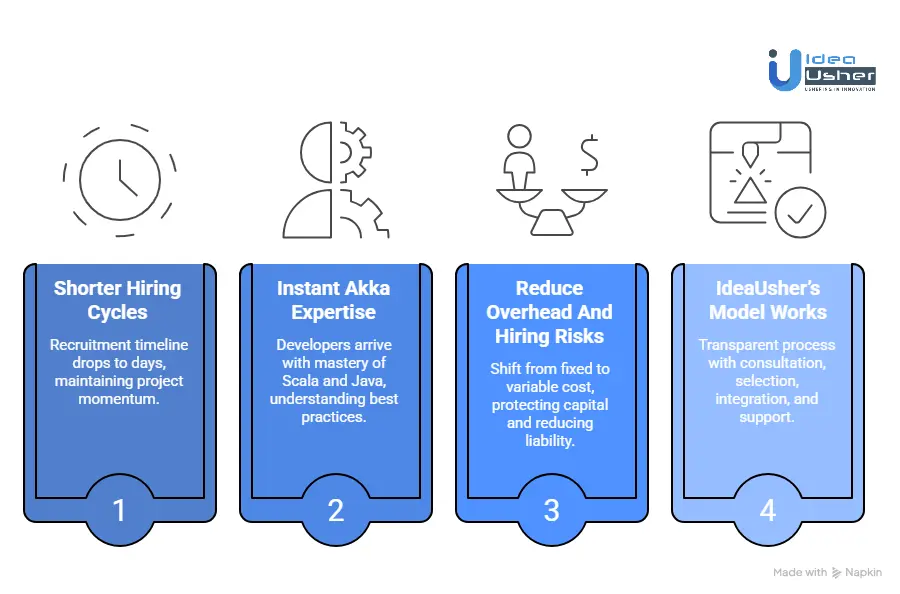
For an entrepreneur, speed of execution is often the only thing that separates a market leader from a footnote. Traditional hiring is too slow for the fast-paced demands of distributed system development. We provide a staff augmentation model that allows you to hire Akka developers as a dynamic resource, letting you bypass the friction of internal HR processes to focus entirely on your product roadmap.
1. Shorter Hiring Cycles
The typical recruitment cycle for a niche role can last months. When you work with us, that timeline drops to days. We maintain an active bench of talent, ensuring that your project never loses momentum due to a vacant seat. This agility is vital when you need to capitalize on a market opportunity or pivot your strategy quickly.
2. Instant Akka Expertise
Akka is not something a developer learns over a weekend. It requires a deep understanding of reactive principles and cluster sharding.
- Ready-to-Code: Our developers arrive with a mastery of the Scala and Java ecosystems.
- Best Practices: We integrate developers who already understand how to manage actor lifecycles and persistence.
- Immediate Impact: There is no learning on the job at your expense. We provide experts who have already solved the challenges you are currently facing.
3. Reduce Overhead And Hiring Risks
| Expense Category | Internal Hiring | IdeaUsher Augmentation |
| Benefits & Taxes | High additional costs | Included in the service |
| Equipment & Office | You provide everything | We manage the infrastructure |
| Long-term Liability | High liability | Zero (Scale down anytime) |
By shifting from a fixed cost model to a variable one, you protect your capital. If a specific phase of your project ends, you are not stuck with a high-salary specialist you no longer need. We take on the administrative burden so you can focus on the bottom line.
How IdeaUsher’s Model Works
We do not just send you a resume. We provide a partnership designed for high-stakes technical environments. Our process is transparent and built for serious decision-makers:
- Consultation: We analyze your current architecture and identify the exact skill gaps.
- Selection: You interview and hand-pick the developers from our elite in-house team.
- Integration: Our developers join your Slack, Jira, and stand-ups, functioning as an extension of your own office.
- Support: We provide ongoing management to ensure our talent remains aligned with your business goals.
Top Companies to Hire Akka Developers in 2026
Selecting the right partner to source Akka developers is a high-stakes decision for any investor or founder. The following organizations represent the current leaders in the market, each offering distinct advantages in terms of technical depth, speed of delivery, and cost-efficiency.
1. IdeaUsher – Best For Akka Staff Augmentation
We position ourselves as the premier choice for businesses that need to move fast without sacrificing architectural integrity. Our approach focuses on providing pre-vetted developers who possess real-world experience in the trenches of high-concurrency engineering.
- Access to Proven Talent: You gain immediate entry to a pool of developers who have already navigated the complexities of distributed systems. This drastically reduces the ramp-up time that usually plagues new hires.
- Fast Onboarding Logic: Our experts are trained to integrate seamlessly into your specific architecture. Whether you use Jira, GitHub, or proprietary workflows, our developers align with your tools from day one.
- Agile Scaling Models: We recognize that capital allocation needs to be fluid. We offer flexible hiring models, including hourly, monthly, or project-based options to match your current burn rate and scaling requirements.
- Core Technical Depth: Our in-house team specializes in the reactive landscape, including Akka, Scala, and microservices architecture.
2. Intellivon – Enterprise Akka Development Services
Intellivon is the premier choice for large-scale organizations requiring heavy-duty backend infrastructure. They specialize in the long game, prioritizing structural robustness and architectural integrity over rapid headcount expansion. This makes them especially suited for enterprises tackling complex, distributed systems where long-term stability, scalability, and maintainability are critical to success.
- Enterprise Authority: They excel at migrating traditional corporate backends into modern reactive systems.
- Deep Technical Knowledge: Their focus on long-term engagements ensures they build the institutional knowledge necessary for multi-year distributed projects.
- Built for Stability: Ideal for enterprises where mission-critical uptime and complex system integration are the top priorities.
3. Cortance – AI-Matched Akka Talent Platform
Cortance utilizes a data-driven approach to recruitment, using intelligent matching to pair businesses with relevant technical talent. This ensures faster hiring cycles, better alignment with project requirements, and access to pre-vetted developers who can contribute effectively from day one.
- Intelligent Matching: Their system filters through developer profiles to find the specific Akka experience your project demands.
- Speed of Delivery: They boast an impressive onboarding window of 24 to 48 hours, which is excellent for filling urgent vacancies.
- Pricing Transparency: Their model is built on clear, competitive hourly rates, making it a reliable choice for mid-to-senior backend infrastructure needs.
4. Toptal – Elite Freelance Akka Developers
For mission-critical systems where the margin for error is zero, Toptal offers access to a highly selective tier of global talent. Toptal famously accepts only the top 3% of applicants. For a founder, this means a guarantee of quality, though it comes with a premium price tag.
- Rigorous Vetting: Their multi-stage screening process ensures that any developer you hire has a mastery of performance-intensive systems.
- High-Stakes Reliability: They are often the preferred choice for high-stakes projects where failure is not an option, provided your budget can accommodate their top-tier rates.
5. Proxify – Flexible Remote Akka Developers
Proxify targets companies looking to build or extend remote engineering teams with minimal friction. They focus on the “remote-first” culture that has become standard for global startups.
- Remote Scalability: Their platform is designed specifically for companies that operate across different time zones and require distributed team members.
- Minimal Friction: With a simple engagement model and transparent contracts, Proxify makes it easy to add or remove developers as your roadmap evolves.
- Vetted Remote Pool: They provide a reliable stream of pre-screened candidates who are accustomed to the unique communication demands of remote development.
Skills to Look for in Akka Developers
Identifying elite talent in this niche requires looking beyond basic syntax. Because Akka handles the most sensitive parts of your infrastructure, hiring experienced Akka developers ensures your team possesses a specific mental model for distributed computing. At IdeaUsher, we focus on identifying candidates who prioritize system health and resource efficiency over just writing functional code.
1. Experience With System Failures
The most valuable Akka developers are those who have seen systems fail in production. In a distributed environment, the question is not if a component will fail, but when. You need experts who understand:
- Partition Tolerance: How the system behaves when network communication between nodes is lost.
- Split-Brain Scenarios: Managing clusters to prevent data corruption when nodes lose synchronization.
- Backoff Strategies: Implementing exponential backoff to prevent a failing service from being overwhelmed.
Knowledge of these edge cases separates a junior developer from a strategic asset who can protect your investment during a crisis.
2. Reactive Architecture Knowledge
Reactive architecture is the backbone of modern, responsive applications. A skilled developer must be deeply familiar with the four pillars of the Reactive Manifesto.
- Responsive: The system must provide rapid and consistent response times.
- Resilient: The system stays responsive even under failure.
- Elastic: The system stays responsive under varying workloads.
- Message Driven: Using asynchronous message passing to ensure loose coupling and isolation.
A developer who masters these principles ensures your platform feels snappy to the end user, regardless of background data processing.
3. Designing Scalable Systems
Scaling is more than just adding servers. It requires a fundamental understanding of how data flows through a cluster. You should look for developers who can demonstrate expertise in:
- Cluster Sharding: Distributing actors across multiple nodes to handle massive datasets.
- Akka Persistence: Ensuring the state of an actor can be recovered after a crash.
- Event Sourcing: Storing every change as a sequence of events for a perfect audit log.
Strategic Goal: You want a system where doubling capacity does not double your management headaches. A developer with design foresight makes this possible.
Why IdeaUsher Pre-Vets Skills
We understand that you do not have the time to conduct deep technical audits on every candidate. That is why our in-house experts handle the heavy lifting for you.
We put our developers through a rigorous internal screening process. We test their ability to handle live coding challenges involving cluster failures and high-concurrency bottlenecks. When you hire from us, you are getting more than a coder. You are getting a specialist proven to handle the technical demands of a growing enterprise. This process eliminates the risk of a technical misfit. It ensures that the person joining your team is ready to contribute to your roadmap from their first hour on the clock.
Industries Using Akka for Scalable Systems
High-performance industries gravitate toward Akka because it provides the reliability needed for mission-critical operations. When downtime or data inconsistency translates to massive financial loss, hiring specialized Akka developers is the standard move for technical leaders.
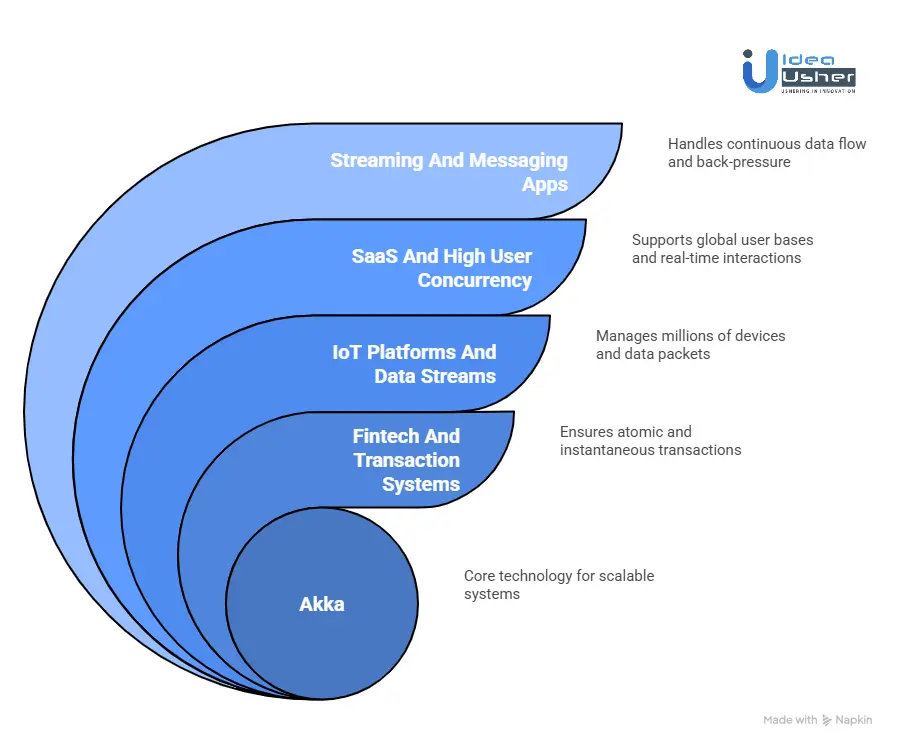
We help businesses in these sectors deploy systems that remain responsive under the most extreme pressure.
1. Fintech And Transaction Systems
In the world of finance, latency is the enemy. Whether it is high-frequency trading or mobile payment processing, transactions must be atomic and instantaneous. Akka is the preferred choice for fintech because it manages stateful entities like a user’s bank balance with extreme precision.
- Fraud Detection: Real-time analysis of transaction patterns to stop theft before it happens.
- Ledger Management: Maintaining a consistent state across thousands of simultaneous deposits and withdrawals.
- High Throughput: Handling millions of requests per second during market volatility.
2. IoT Platforms And Data Streams
IoT ecosystems are defined by millions of devices constantly talking to a central server. Traditional architectures often crumble under the weight of these constant small data packets. Akka excels here by assigning a lightweight Actor to every individual device.
Representing each sensor as an Actor allows the system to track the state of every device independently. This enables massive horizontal scaling without the database becoming a bottleneck.
3. SaaS And High User Concurrency
Modern SaaS platforms must support a global user base that fluctuates throughout the day. If your application provides collaborative tools, real-time dashboards, or social interactions, you face high concurrency challenges.
- Live Collaboration: Instant synchronization of state between multiple users.
- Push Notifications: Delivering millions of alerts without blocking system resources.
- Tenant Isolation: Ensuring one user’s usage does not slow down another.
We provide the expertise to build these multi-tenant environments so your software stays fast as your subscription numbers grow.
4. Streaming And Messaging Apps
Streaming services and messaging platforms require constant, non-blocking communication. Whether it is a live video feed or a global chat app, the system must process data in a continuous flow rather than in chunks.
Akka Streams allows developers to build data pipelines that handle back-pressure automatically. If the data consumer is slower than the producer, the system slows down the flow instead of crashing or losing data. This level of control is why the biggest names in media and communication rely on Akka to keep their services running smoothly for millions of viewers.
How IdeaUsher Helps You Hire Akka Developers?
Finding specialized talent for reactive systems is a complex endeavor. At IdeaUsher, we simplify this by connecting you with Akka developers who understand the nuances of the Actor Model and distributed state. We act as your strategic technical partner, ensuring that your infrastructure is built for long-term resilience and linear growth.
1. Access To Pre-Vetted Talent
We do not believe in sending a pile of unverified resumes. Every developer on our bench undergoes a rigorous internal evaluation.
- Technical Audits: We test for mastery in Scala, Java, and the Akka toolkit.
- Problem Solving: Candidates must solve real-world scenarios involving cluster failures and network partitions.
- Code Quality: We ensure our developers follow best practices for clean, maintainable, and non-blocking code.
2. Matching Talent To Needs
Every project has unique requirements. A fintech app needs different expertise than an IoT platform. We analyze your current tech stack and business goals to provide the perfect fit.
- Cluster Specialists: For managing massive stateful datasets across nodes.
- Streaming Experts: For real-time data pipelines and back-pressure management.
- Persistence Pros: For systems requiring high-speed recovery and event sourcing.
3. Flexible Engagement Models
We understand that startup and enterprise needs differ. Our models are designed to protect your capital while providing high-level expertise.
- Staff Augmentation: Add specific experts to your existing team to fill skill gaps.
- Dedicated Teams: A full squad of developers to own a feature from start to finish.
- Hourly Support: Scalable help that adapts to your current development cycle.
4. Seamless Team Integration
Our developers do not work in a vacuum. We ensure they become a natural extension of your internal department. Our experts adapt to your specific Jira workflows, Slack channels, and daily stand-up schedules. This eliminates the friction often associated with external contractors and keeps your project moving at full speed.
5. Support For Scaling Systems
Scaling a system is a continuous journey. Even after the initial deployment, we provide ongoing support to ensure your architecture stays healthy as user traffic grows. We monitor performance bottlenecks and help you refactor code to handle new levels of concurrency. By partnering with us, you gain more than just a hire. You gain a team committed to the technical success and stability of your platform.
Benefits of Hiring Akka Developers from IdeaUsher
Choosing to partner with us means moving beyond traditional recruitment hurdles. We provide a direct pipeline to elite Akka developers who are ready to tackle your most complex architectural challenges. By leveraging our pre-vetted talent pool, you can stop worrying about talent shortages and start focusing on your product roadmap.
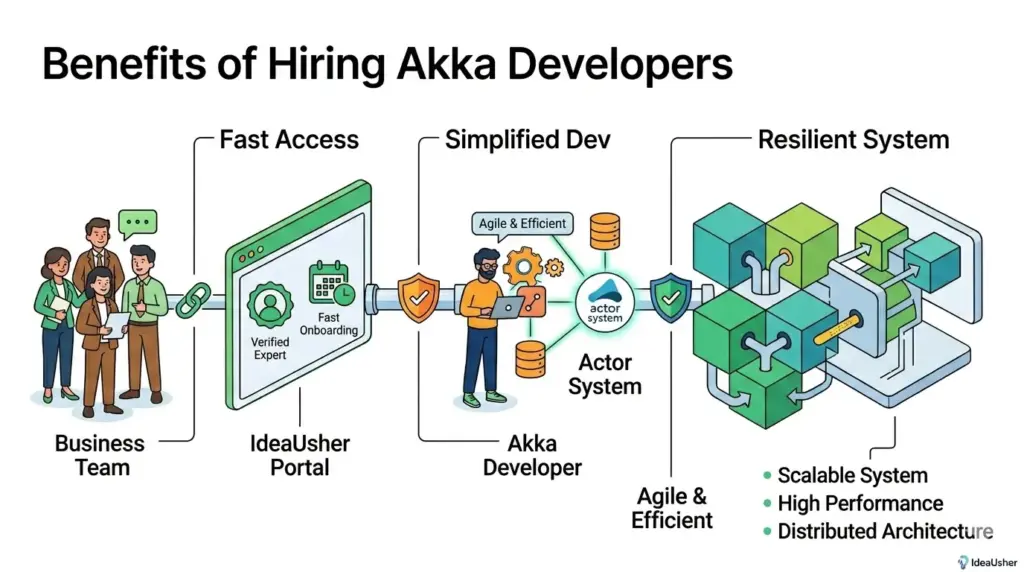
1. Faster Scaling and Deployment
Speed is the primary currency of modern software development. When you hire from us, you bypass the learning curve associated with reactive systems.
- Rapid Integration: Our developers arrive with deep knowledge of Akka HTTP, Alpakka, and Cluster management.
- Reduced Development Cycles: We use proven patterns to avoid common pitfalls in distributed state management.
- Operational Readiness: We ensure your system is deployment-ready by implementing robust CI/CD pipelines alongside the core logic.
2. Reduced Hiring Risks and Delays
The cost of a bad hire in a distributed systems project is astronomical. We eliminate that risk by providing professionals who have already been tested in high-pressure environments.
Risk Mitigation Note: Traditional hiring takes months and often leads to candidates who understand theory but fail in practical application. We provide experts who have successfully managed production clusters, ensuring your system remains stable during peak traffic.
3. Access To Niche Talent
Mastering the Actor Model is a rare skill set. We maintain an in-house team of specialists so you don’t have to compete in an overcrowded market for individual freelancers.
- Distributed State Expertise: We provide developers who understand how to maintain data consistency across multiple nodes.
- Concurrency Specialists: Our team excels at managing millions of simultaneous actors without thread contention.
- Fault Tolerance Specialists: We hire for the ability to design self-healing systems using Akka supervision strategies.
5. Flexible Augmentation Model
We offer a partnership that scales with your business needs. Whether you are a startup building a proof of concept or an enterprise refactoring a legacy monolith, our engagement models adapt to you.
| Feature | Our Flexible Model |
| Commitment | Scale up or down as your project phases shift. |
| Management | Our developers work under your direction or our project management. |
| Onboarding | Immediate access to talent without the HR administrative burden. |
By hiring from us, you gain a technical advantage that allows you to outpace competitors. We provide the specialized labor necessary to build resilient, elastic, and truly message-driven applications.
Steps to Hire Akka Developers from IdeaUsher
Bringing elite Akka developers into your workflow should not be a bureaucratic ordeal. We have refined our process to eliminate the typical friction of technical recruitment, allowing you to move from a talent gap to a fully staffed project in record time. Our goal is to handle the sourcing and vetting so you can stay focused on high-level architecture and business growth.
1. Share Your System Requirements
The journey begins with a deep dive into your technical landscape. We need to understand the specific challenges your distributed system is facing to provide the right caliber of talent.
- Concurrency Needs: Are you managing thousands or millions of actors?
- Tech Stack: Do you require Scala or Java expertise?
- Current Bottlenecks: Is the issue cluster stability, persistence, or streaming back-pressure?
By defining these parameters early, we ensure our search is surgical and effective.
2. Get Matched With Akka Experts
Once we understand your needs, we tap into our pre-vetted bench. We do not just look for available people. We look for the specific experience that matches your industry, whether that is fintech, IoT, or high-scale SaaS.
Our Matching Philosophy: We prioritize developers who have already solved problems similar to yours. If you are building a real-time bidding engine, we match you with specialists who have mastered low-latency message passing.
3. Interview And Onboard Quickly
We value your time. Instead of a dozen rounds of generic interviews, we provide you with a shortlist of candidates who have already passed our rigorous internal audits.
- Technical Review: You conduct a focused interview to ensure a cultural and specific technical fit.
- No-Hassle Paperwork: We manage the contracts, benefits, and administrative overhead.
- Rapid Setup: Our developers join your communication channels and development environment within days, not weeks.
4. Start Scaling Your System
With the right experts in place, the focus shifts to execution. Our developers integrate into your sprints and begin contributing to the roadmap immediately.
As your system grows, you have the flexibility to adjust the team size. Whether you need to add more specialists for a critical launch or scale back after a major refactor, our model adapts to your momentum. This ensures you always have the exact amount of specialized power required to keep your distributed system resilient and responsive.
Why Choose IdeaUsher Over Traditional Hiring?
Choosing the right talent for reactive systems is a pivotal decision for any technical founder. Traditional recruitment is often too slow and rigid for the high-velocity demands of modern infrastructure. We offer a sophisticated alternative that combines elite technical standards with the agility of a modern workforce. With over 500,000 hours of coding experience, our team at IdeaUsher includes ex-MAANG/FAANG developers who have built and scaled some of the world’s most recognizable distributed systems.
Faster Talent Access
In a traditional model, finding a specialist can take months. We eliminate this delay by providing immediate access to a bench of pre-qualified Akka developers.
- Elite Talent Pool: Our developers come from top-tier backgrounds, bringing high-level architectural insights to your project.
- Specialized Knowledge: We focus on the niche skills required for reactive programming, so you do not have to waste time teaching the basics of the Actor Model.
- Proven Track Record: Our 500,000 hours of collective experience mean we have already solved the bottlenecks you are currently facing.
Efficient Hiring Cycles
The hidden costs of traditional hiring, like recruitment fees and weeks of training can drain your budget before a single line of code is written.
- Zero Friction: We handle the sourcing, vetting, and administrative overhead.
- Immediate Productivity: Because our developers are already experts in the Akka ecosystem, they contribute to your codebase within days.
- Surgical Integration: We match developers to your specific culture and tech stack, ensuring they slide into your existing sprints without disrupting your team’s rhythm.
Flexible Scaling Models
System requirements evolve as you scale. A traditional full-time hire is a long-term commitment that may not match your future needs.
- Scale On Demand: Add more power during a heavy refactoring phase and scale back once the system stabilizes.
- No Long-Term Liability: Avoid the complications of severance or long-term benefits for specialized roles that may only be needed for specific project phases.
- Adaptable Expertise: As your project shifts from initial builds to optimization, we provide the right talent for that specific stage.
Built For Scalability
We do not just provide labor; we provide architectural integrity. Our ex-MAANG/FAANG developers bring an enterprise-grade mindset to every project. The difference between a functional system and a scalable one lies in the details of the implementation. We prioritize:
- Elasticity: Ensuring your system handles traffic spikes without manual intervention.
- Resilience: Building self-healing actors that recover automatically from failures.
- Performance: Optimizing message-passing to ensure your application remains responsive under any load.
Conclusion
Selecting the right partner to hire Akka developers is the difference between a resilient infrastructure and a system that buckles under pressure. Whether you choose the elite freelance standards of Toptal or the specialized staff augmentation at IdeaUsher, the goal remains the same: securing experts who master the Actor Model and distributed state. By prioritizing pre-vetted talent and flexible scaling, you ensure your platform stays responsive, elastic, and ready for any workload.
FAQs
A1: Standard backend engineers often focus on request-response cycles and traditional database interactions. Akka developers specialize in the Actor Model, which treats every component as an independent entity that communicates via asynchronous messages. This requires a deep understanding of non-blocking I/O, distributed state, and how to build systems that are self-healing rather than just functional.
A2: The market for reactive programming talent is highly competitive and niche. Traditional hiring can take months to find a candidate with the right expertise in Scala or Java-based Akka toolkits. Staff augmentation allows you to bypass the recruitment lag by accessing a pre-vetted bench of experts who can integrate into your project immediately and scale down once the architectural heavy lifting is complete.
A3: Any industry requiring high concurrency and low latency benefits from this technology. This includes Fintech for real-time transaction processing, IoT for managing millions of simultaneous device connections, and streaming services that require consistent data flows. These sectors rely on Akka to ensure that if one component fails, the entire system does not crash.
A4: Vetting should go beyond basic coding tests to focus on distributed system challenges. You should evaluate their ability to manage cluster sharding, implement Akka Persistence for state recovery, and handle back-pressure in data streams. At IdeaUsher, we simplify this by putting our developers through rigorous simulations of system failures to ensure they can maintain stability under pressure.