


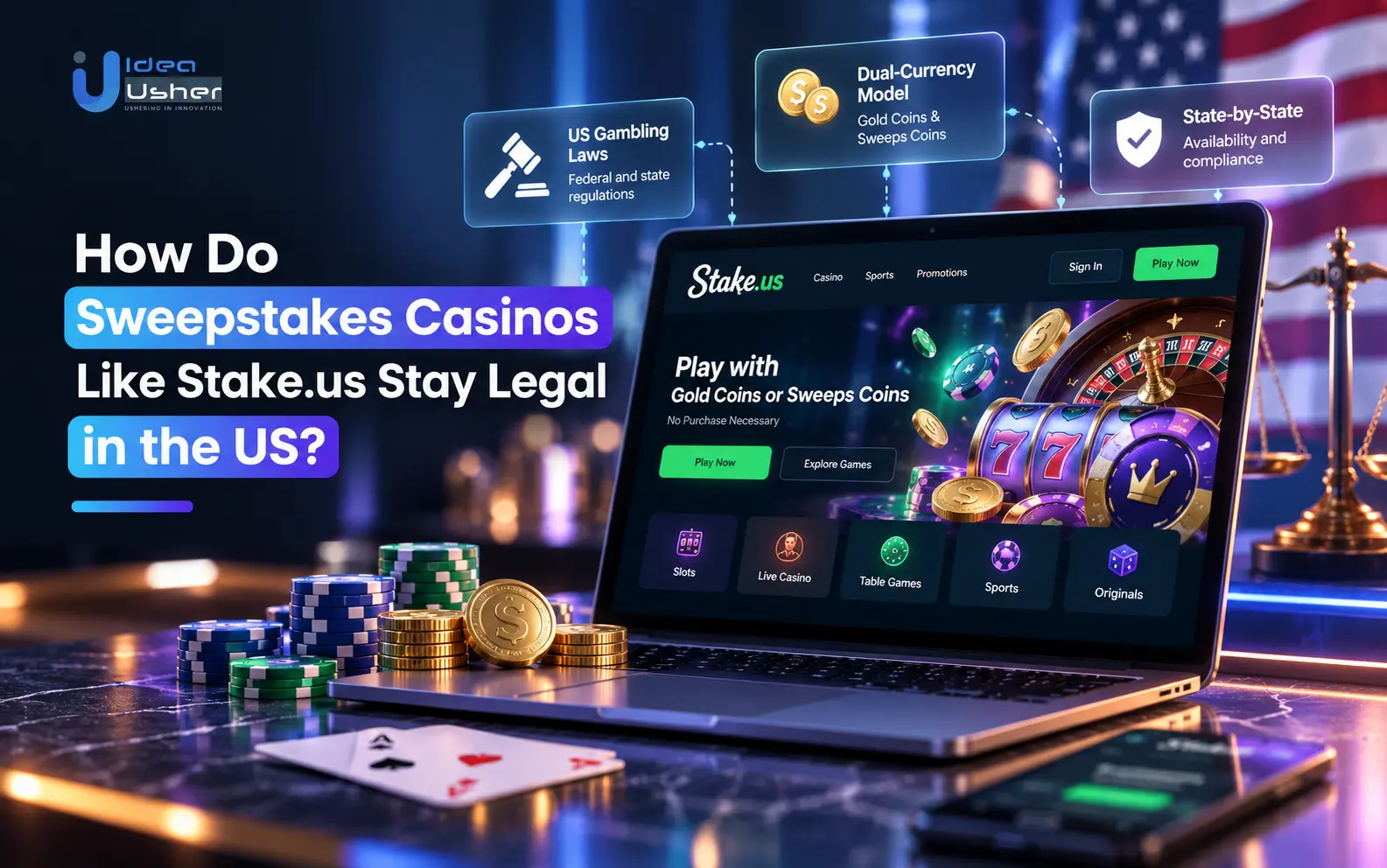
Key Takeaways:
- Unlike a typical online casino, Stake.us uses virtual currencies rather than accepting direct cash bets.
- It also provides players with a free means of entry, which is an essential element of the sweepstakes model.
- That setup helps it avoid looking like regular gambling, but it does not make the model legal in every state.
- Because state laws have become stricter, Stake.us has had to cease operating in certain areas of the United States.
- The model achieves this by combining the rules of sweepstakes with compliance on a state-by-state basis, rather than depending on a single nationwide loophole.
The legal status of sweepstakes casinos like Stake.us in the United States is varied: they are allowed in most states at the present time, have been banned in an increasing number of states, and no licenses are issued. Operators of the platform depend on the promotional sweepstakes legislation rather than on gambling licenses since players can take part without having to pay. As a result, the response to the question ‘is this legal?’ depends on both the state and the year.
The free-entry argument has led platforms such as Stake.us into most of the United States, but it has also attracted state bans, cease-and-desist letters, and lawsuits.
This blog explains how the casino model functions and why it has remained legal. After that, it goes on to describe the areas in which the model is prohibited and the cost involved in setting it up. If you plan to build one, our team at Idea Usher turns a counsel-approved model into a working platform, including the wallet, identity checks, geolocation, and admin systems. As a result, you can plan the build with the legal limits in view.

How Sweepstakes Casinos Like Stake.us Work
A sweepstakes casino is an online platform with casino-style games where players use virtual coins instead of wagering deposited cash on each game.
Stake.us is a clear example for beginners because it runs two separate coin types, one for entertainment and one for sweepstakes prizes.
As a result, the screen looks like a regular casino. However, the way players get coins, play games, and redeem prizes is quite different from a normal real-money site.
1. How a Sweepstakes Casino Works
First, a player signs up and gets virtual coins. Next, those coins fund games, and some winnings can later become prizes.
- Create an account.
- Receive or buy virtual coins.
- Play slots, table games, and live casino games.
- Redeem eligible promotional winnings for prizes.
2. Stake.us Uses Gold Coins and Stake Cash
Stake.us splits play into two currencies. Gold Coins are for fun, while Stake Cash is for sweepstakes play.
- Gold Coins can be bought or earned through promotions, and they cannot be redeemed for cash prizes.
- Stake Cash comes from eligible promotions and is used for sweepstakes play.
- Qualifying Stake Cash winnings may be redeemed for prizes.
3. Stake.us and Stake.com Work Differently
Although the names are similar, the two sites run on different legal and payment models.
Stake.us vs Stake.com: Side-by-Side Comparison
| Feature | Stake.com | Stake.us |
| Model | Real-money gambling | Promotional sweepstakes |
| Currency | Real money | Gold Coins and Stake Cash |
| How players play | Direct cash wagers | Virtual coins, with Stake Cash for sweepstakes play |
| Licensing | Gambling licenses in supported markets | Usually none, relies on sweepstakes law |
| Target market | Licensed markets | US sweepstakes market |
| Operator | Curaçao-based casino operator | Sweepstakes Ltd |
In short, Stake.com is a licensed real-money casino, while Stake.us is a sweepstakes product built on virtual currencies. The name is shared, but the money, the licensing, and the legal basis are not.
4. The Main Difference Is How Money and Prizes Work
On screen, the two products look alike. Behind the screen, the difference is how players get currency and redeem prizes.
- Currency: players use coins instead of a cash deposit.
- Play: promotional currency drives the sweepstakes play.
- Prizes: eligible winnings are redeemed under sweepstakes rules.
In short, a sweepstakes casino looks like a normal casino but runs on two virtual currencies. Stake.us shows the model clearly, with Gold Coins for play and Stake Cash for prizes. Stake.com, by contrast, is a separate real-money product.
Are Sweepstakes Casinos Like Stake.us Legal in the US?
Mostly yes, but not everywhere and not permanently, because each state decides how its own gambling and sweepstakes laws apply to these platforms.
Sweepstakes casinos operate in many states under promotional sweepstakes law, yet a growing list of states bans them outright, and none licenses them.
Therefore, founders should read the legal status of Stake.us as allowed today, with real risk of change soon for any business built on it.
1. Legal in Most States While Banned in a Growing List
Several states in the US still allow the model. However, a growing group has passed outright bans.
- WSN’s tracker lists bans in California, Connecticut, Indiana, Louisiana, Maine, Montana, New Jersey, New York, and Tennessee.
- Oklahoma joins on November 1, 2026.
- Other states restrict the model through older gambling laws, so trackers count differently.
2. “Legal” Does Not Mean “Licensed”
Regulated casinos hold state gaming licenses. In contrast, no US state licenses sweepstakes casinos the same way.
- They sit outside gaming-commission oversight.
- They rely on sweepstakes and consumer protection law.
- Therefore, the lack of a license is not a safety net.
3. What “Gray Area” Really Means for a Business Owner
Gray area means the activity is allowed until a state or court says otherwise. As a result, your legal position can change without any change to your product.
- Allowed today does not mean allowed next year.
- A new law or lawsuit can change access quickly.
- Plan for that risk before you build.
4. Lawsuits and Cease-and-Desist Letters Show the Risk
Enforcement is already active. For example, the Los Angeles City Attorney sued Stake.us on August 28, 2025, and the allegations are unproven.
- Gambling Insider counted at least nine lawsuits against the company behind Stake.us.
- It also counted more than 100 class actions against sweepstakes casinos overall.
- Stake.us has denied the claims, and a judge sent one Virginia case to arbitration.
In short, sweepstakes casinos are legal in most states today but licensed in none. Bans, lawsuits, and enforcement mean the status can change quickly. Therefore, treat legality as a question for each state and each date.
Why Sweepstakes Casinos Use Two Currencies
Sweepstakes casinos use two currencies to keep what players pay for separate from what can win real prizes.
- Gold Coins cover entertainment and have no cash value, so players cannot redeem them for anything.
- A second currency, called Stake Cash on Stake.us and Sweeps Coins elsewhere, carries the prize element, and that split keeps the two roles apart.
This split is the central design choice of the model, not a cosmetic one.

1. One Currency Is Used for Normal Gameplay
Gold Coins fund everyday play because they have no cash value.
- Players buy them or earn them through promotions.
- Players use them to play games.
- They cannot be redeemed for prizes.
2. The Other Currency Is Linked to Sweepstakes Play
Stake Cash and Sweeps Coins arrive as promotions. However, critics point out that one Stake Cash is valued at one US dollar.
- Players get them through eligible promotional methods.
- Qualifying winnings can be redeemed for prizes.
- That dollar value is the center of the critics’ argument.
3. Players Do Not Simply Deposit Cash and Bet It
In a regular casino, you deposit cash and wager the same cash. A sweepstakes flow has more steps.
- Traditional casino: deposit $100, then wager $100.
- Sweepstakes casino: buy or receive Gold Coins, receive promotional coins, then use those in sweepstakes play.
- For example, one listing shows $20 buying 200,000 Gold Coins plus 20.05 Stake Cash, though package sizes change.
In short, two currencies separate the purchase from the prize. Gold Coins buy entertainment, and promotional coins carry the sweepstakes.
Together, they keep the sweepstakes legally distinct from the purchase.
Why the “No Purchase Necessary” Clause Matters
No purchase necessary means a player can join the sweepstakes without paying, and this clause is the legal foundation of the whole model. Therefore, operators must offer a free route to the promotional currency, called an alternative method of entry, or AMOE.
Regulators and plaintiffs check whether that free route works in practice, not just on paper, so it has to be real. That is why the phrase appears on almost every sweepstakes casino site.
1. Players Need a Free Way to Participate
Free entry is the whole point. Without it, the sweepstakes argument weakens.
- If the only route to prize play is a purchase, it looks like paid gambling.
- The free route must be easy to find.
- It must work for every player.
2. AMOE Gives Players Another Way to Enter
AMOE stands for alternative method of entry. Therefore, platforms may offer several free routes.
- Mail-in requests
- Daily bonuses
- Promotional rewards
3. Paying Should Not Increase the Chance of Winning
Sweepstakes terms often say that buying coins does not improve the odds. In other words, paying and free players should be treated equally.
- Buying Gold Coins is optional.
- Free and paid entries get the same chance.
- Unequal treatment invites legal trouble.
4. Free Entry Does Not Make Every Platform Legal
However, a working free route is not a legal guarantee. States can still ban the model, as California and New York did.
- Product design and state law are separate questions.
- Each state decides for itself.
- A ban applies even to platforms with working free entry.
In short, free entry is the foundation of the sweepstakes model, not a legal guarantee. AMOE keeps the structure honest, but each state still decides whether the model is allowed.
The Legal Model Starts With Three Basic Ideas
Gambling law usually turns on three elements: prize, chance, and consideration, and a game is typically gambling when all three are present together. Sweepstakes casinos accept prizes and chance, but they try to remove the required payment, which is the consideration element, through free entry.
That is how sweepstakes casinos try to avoid gambling laws, and it is also where the legal fight begins. Understanding these three terms makes the rest of the model easy to follow.
1. Prize Means Something Valuable Can Be Won
A prize is anything valuable a player can win. Sweepstakes casinos clearly have this element.
- Money
- Gift cards
- Merchandise and other redeemable prizes
2. Chance Means the Result Is Not Fully Controlled
Chance means the outcome is not set by the player. Slots and live tables run on chance by design.
- Outcomes are random.
- Player skill does not decide the result.
- Therefore, this element is always present.
3. Consideration Usually Means Paying to Participate
Consideration is the price of entry. Therefore, if a player must pay to compete for a prize, the activity looks like gambling.
- It usually means paying to take part.
- Sweepstakes try to avoid requiring any payment.
- It is the most important of the three elements.
4. Sweepstakes Try to Remove Required Payment
Stake.us argues that anyone can enter without paying. However, critics call this a sweepstakes casino loophole.
- An Alabama class action argues that Stake Cash works as a real-money substitute.
- It compares the site to internet café gambling.
- Courts and states will decide which side is right.
In short, prize and chance are always present in casino games. The legal fight is about consideration, and free entry is how operators try to remove it.
Sweepstakes Casino vs Social Casino vs Real-Money Casino
Sweepstakes, social, and real-money casinos differ in whether players can win redeemable prizes and who regulates the operator. Social casinos offer entertainment coins with no cash prizes, so they sit outside most gambling rules.
Real-money casinos hold state gaming licenses and take cash wagers.
Sweepstakes casinos sit in between, with virtual currencies and prize redemption but usually no gaming license. Founders should know which lane a product sits in before building.
1. Side-by-Side Table: License, Prizes, Age Limits, Taxes, Regulator
This table compares the three models on the points founders ask about most. Therefore, it is worthy to note that social casinos stay broadly available because they offer no prizes.
| Feature | Social casino | Sweepstakes casino | Real-money casino |
| Redeemable prizes | No | Yes | Yes, cash |
| Gaming license | No | Usually no | Yes, per state |
| Regulator | Consumer law | Sweepstakes and consumer law | State gaming commission |
| Minimum age | Varies | 18+ or 21+ by operator | Typically 21+ |
| Taxes on winnings | None, no prizes | Generally taxable | Generally taxable |
Confirm tax treatment with a tax professional.
2. Why States With Legal Online Casinos Still Block Sweepstakes
Regulated states want players inside licensed, taxed products. Therefore, they often resist unlicensed rivals.
- Stake.us restricts New Jersey, Pennsylvania, Michigan, and Connecticut.
- All four regulate real-money online casinos.
- Licensed operators pay fees that sweepstakes platforms usually avoid.
In short, the three models are legally different products. Prize redemption and licensing are what separate them.
Where Can Stake.us Operate Today?
Stake.us does not operate in every US state, because it blocks states that ban the model and some that regulate real-money casinos. The list has changed several times, and one tracker counted 20 restricted and 30 open states.
In practice, every restricted state removes a group of potential players from your addressable market. Therefore, treat state availability as a moving input, and check sweepstakes casino laws by state before you plan.
1. Stake.us Blocks a Growing Number of States
States with statutory bans are off the table for legal sweepstakes casinos in the USA. Meanwhile, Illinois joined the restricted list in May 2026.
Per WSN, the statutory bans are:
| State | Law | Effective |
| California | AB 831 | Jan 1, 2026 |
| Connecticut | SB 1235 | Oct 1, 2025 |
| Indiana | HB 1052 | Jul 1, 2026 |
| Louisiana | HB 883 and HB 53 | Aug 1, 2026 |
| Maine | LD 2007 | Jul 14, 2026 |
| Montana | SB 555 | Oct 1, 2025 |
| New Jersey | A 5447 | Aug 15, 2025 |
| New York | S 5935-A | Dec 5, 2025 |
| Tennessee | SB 2136 and HB 1885 | May 22, 2026 |
| Oklahoma | SB 1589 | Nov 1, 2026 |
2. The Restricted List Has Changed Over Time
The business model can stay the same while the market shrinks. In addition, sources report different ban counts.
- Some count only statutes.
- Others add attorney general action.
- Others add operator self-exclusion.
3. State Availability Is Now a Business Decision
Losing a large state changes more than traffic. For example, it affects four parts of your plan.
- User acquisition plan
- Revenue projections
- Advertising strategy
- Payment setup
In short, Stake.us blocks a changing list of states, and ten statutory bans are on the books. Counts differ by source, so check the date and the method before you rely on any number.
How Big Is the Sweepstakes Casino Market?
Analyst estimates of the US sweepstakes casino market vary because they measure different things.
Eilers & Krejcik put 2025 Gold Coin sales near $14.3 billion and net revenue after prizes near $4 to $5 billion, per Track360’s compilation.
Therefore, treat any single figure as an analyst range, not an audited total, and read the chart below as a scenario range. Still, the numbers show a large market under growing legal pressure.
1. Player Demand Has Grown Quickly
Demand has risen fast. For instance, Track360 reports that Gold Coin sales roughly quadrupled between 2022 and 2025.
- Blask puts the segment at $7.2 billion in 2026.
- That figure holds even after six state bans.
- Blask data also shows growth in states that remain open.
2. Advertising Helped the Category Grow
Celebrity and streamer promotion brought these brands to mainstream audiences. For example, Drake often promotes Stake.us.
- Social media gave brands fast reach.
- Regulators criticize the lack of advertising and age rules that licensed operators face.
- As a result, advertising rules may tighten.
3. Regulation Is Changing the Growth Story
However, growth now depends on where operators can legally run. California alone was about 17.3 percent of sweepstakes sales in 2025.
- Eilers & Krejcik’s forecast expected a 10 percent net revenue decline to $3.6 billion in 2026.
- Blask data points the other way for open states.
- Therefore, plan for both outcomes.
In short, market size depends on the source and the date. Demand is strong, but bans cut the addressable market, and analysts disagree on the net effect.
Major Sweepstakes Casino Brands in the US
Stake.us competes with several established sweepstakes brands, and each applies its own list of restricted states. Chumba Casino belongs to VGW, which Track360 identifies as the largest operator group.
Pulsz and McLuck follow the same dual-currency model, so their legal risks are also similar. Each one also offers prize redemption, which is what makes it a sweepstakes casino.
The table below maps who uses which currencies, for market orientation rather than ranking.
| Platform | Main model | Virtual currencies | Prize redemption |
| Stake.us | Sweepstakes | Gold Coins + Stake Cash | Yes |
| Chumba Casino | Sweepstakes | Gold Coins + Sweeps Coins | Yes |
| Pulsz | Sweepstakes | Gold Coins + Sweeps Coins | Yes |
| McLuck | Sweepstakes | Gold Coins + Sweeps Coins | Yes |
In short, the leading brands share one structure: Gold Coins for play and a promotional currency for prizes. Stake.us is one of several operators using it.
What a Sweepstakes Casino Needs Behind the Scenes
A compliant sweepstakes casino needs far more than a game lobby. It needs a wallet, identity checks, geolocation, state rules, redemption, fraud monitoring, and responsible gaming tools.
Legal counsel decides what the business may offer. Engineering then makes those rules work, so compliance must be built into the product from the very first day.
Each piece below is a separate build item with its own cost. Skipping any piece can create legal or financial risk.
1. Dual-Currency Wallet and Prize Redemption
The wallet tracks every coin, and redemption turns eligible winnings into prizes. Therefore, both need strict controls.
- Gold Coins and promotional currency need separate ledgers.
- Redemption handles eligibility, verification, withdrawal requests, and transaction histories.
- Free entry needs a working system, not just terms and conditions.
2. KYC and Geolocation
KYC means “know your customer,” and geolocation checks where the player is. Together, they decide who may play.
- KYC confirms age, identity, address, and account ownership before any redemption.
- Operators set minimum ages of 18+ or 21+.
- If a state becomes unavailable, access must actually stop.
3. Fraud and Responsible Gaming
Platforms must stop abuse and protect players. Idea Usher’s AI consulting services cover risk scoring of this kind.
- Watch for multiple accounts, identity fraud, bonus abuse, and unusual redemptions.
- Offer account limits and cooling-off tools.
- Add self-exclusion for players who need it.
4. Compliance Rules Need to Change Without Rebuilding Everything
State rules will keep moving. Therefore, rules belong in configuration, not in hard-coded logic.
- A new state ban becomes a settings change.
- Blocked states stay blocked.
- The team responds in days, not months.
In short, a compliant platform is mostly engineering behind the lobby. Wallets, identity checks, location rules, and risk tools all have to work, and they have to change when the law does.
Payment Systems Add Another Layer of Risk
Payments add risk because players buy Gold Coins through processors, prizes leave through separate payout channels, and each provider applies its own gaming rules. A processor can restrict a business even where the law allows it.
Therefore, payment design affects feasibility, cost, and market access. Many first-time founders overlook this layer until a processor says no, so founders should check processor support early in the planning stage. Planning a backup provider reduces that risk.
1. Gold Coin Purchases Need Payment Processing
Card and wallet providers must accept your business type. Idea Usher’s VR casino guide treats payments, wallets, and compliance as a separate budget line.
- Processors must approve the business type.
- Each provider sets its own rules.
- Budget payments as their own line item.
2. Prize Redemption Needs Separate Controls
Payouts carry more risk than purchases. As a result, they need their own checks.
- Verify the player before every payout.
- Set payout limits.
- Keep a full audit trail.
3. Payment Providers Can Change Market Access
Providers may decline sweepstakes merchants regardless of state law. Likewise, a policy change can close a state in practice.
- Confirm processor support for each target state.
- Line up a backup provider.
- Review provider terms regularly.
In short, payments are a feasibility question rather than a technical detail. A processor decision can limit your market even when the law does not.
What Founders Should Know Before Building One
Before commissioning a sweepstakes casino build, founders should settle target states, legal review, revenue resilience, vendor support, and platform flexibility.
Idea Usher builds the software, qualified gaming counsel decides the legal framework, and Idea Usher does not give legal advice.
Therefore, a platform designed for one state mix may not work for another, so plan the market first. Each decision below is easier to make before development starts, and changing course later costs far more.
1. Target States and Legal Review Come First
Choose your states before your feature list. Then get counsel’s written position before engineering starts.
- Features follow from state rules.
- Rewrites after a legal change cost more than planning.
- Counsel, not engineers, sets the legal framework.
2. Revenue and Vendors Must Survive State Restrictions
Test the business without its biggest states. Then confirm that vendors cover the same markets.
- Does the business still work without California, New York, and New Jersey?
- Do payment processors, game providers, geolocation vendors, and KYC providers support your states?
- Is there a backup for each vendor?
3. The Platform Must Be Built for Regulatory Change
Build so you can add licensed play or prediction markets later. Our prediction marketplace development, sports prediction exchange, and peer-to-peer sports betting practices cover those paths.
- Keep compliance rules configurable.
- Keep wallets and identity systems reusable.
- See the no-vig betting platform guide for how one is built.
When Building One Is the Wrong Move
Sometimes the honest answer is not to build. Skip this model in these cases.
- Your main customers live in banned states.
- You cannot fund ongoing legal review.
- You need regulator-backed certainty.
In short, planning before building protects the budget. When states, legal position, and vendors line up, the model can work. Otherwise, a licensed casino or prediction exchange fits better.
How Much Does a Sweepstakes Casino Cost to Build?
A custom sweepstakes casino platform typically costs around $70,000 to $300,000 to develop, depending on the gaming stack, compliance systems, integrations, and scale.
The line items below total roughly $70,000 to $240,000, and custom games or multi-state scale push projects higher.
1. Cost by Development Component
This table shows where the money goes. As the chart shows, games, payments, and the wallet are where scope grows fastest.
| Component | Estimated cost | What it covers |
| Discovery and product planning | $8,000 to $20,000 | Scope, target states, architecture |
| UI and player experience | $8,000 to $25,000 | Lobby, wallet screens, onboarding |
| Dual-currency wallet | $15,000 to $45,000 | Separate ledgers, promotional currency logic |
| KYC, geolocation, and risk systems | $10,000 to $35,000 | Identity checks, location blocking, fraud tools |
| Games and payment integrations | $12,000 to $60,000 | Game providers, payment processors |
| Admin and reporting systems | $7,000 to $25,000 | Dashboards, reports, redemption review |
| Testing and launch | $10,000 to $30,000 | Restricted-state testing, release |
2. Ongoing and Separate Costs
Launch is not the only cost. Therefore, budget for these items as well.
- Maintenance runs around 15% to 20% of the initial development cost each year.
- Legal counsel, licensing where required, and game-provider contracts are usually separate.
- These estimates reflect October 2026.
Want a line-item estimate for your target states? Book a free consultation with Idea Usher and get a scoped quote.
In short, a compliant build runs about $70,000 to $240,000 in line items, with scale and custom games pushing toward $300,000. Maintenance and legal costs come on top, so budget for them early.
How Idea Usher Builds Sweepstakes Gaming Platforms
Idea Usher builds sweepstakes gaming platforms in phases that start with your legal framework and end with post-launch support. The team has delivered custom software for more than 11 years across healthcare, fintech, on-demand, and AI.
It now focuses on betting, casino, and prediction platforms, including sweepstakes builds for founders targeting the US market. Each phase has a clear output, so founders always know what they are paying for and what comes next.
1. Define the Product Around the Target Market
First, we start from your counsel’s framework and intended states. Then we shape features to fit them.
- Confirm target states.
- Map the controls each state needs.
- Set scope and budget.
2. Build the Core Platform
Next, we build the systems that make the model work. Each one follows the rules you set.
- Dual-currency system: separate balances, transaction rules, promotional currency logic, and redemption workflows.
- KYC and geolocation controls, added before redemption features.
- Games and payment systems that support your states, plus admin and risk dashboards.
3. Test Restricted-State Scenarios and Keep Rules Configurable
Before launch, we confirm that blocked states stay blocked. Then we keep compliance rules configurable.
- Test access from restricted states.
- Change rules without a rebuild.
- Respond quickly when state availability changes.
4. Support the Platform After Launch
Launch is the start of operations, not the end of the project. Therefore, support continues afterward.
- Updates, scaling, and security.
- New integrations and state configuration changes.
- See our iGaming software development services, the mobile-first casino app guide, and our Clutch profile.
In short, Idea Usher builds in phases, from legal framework to launch to support. Each phase is designed so the platform can adapt when state rules change. Book a free strategy call to see how we build your Sweepstakes Casino platform.
What Happens Next for Sweepstakes Casinos in the US?
Expect more state-specific rules rather than one national answer for sweepstakes casinos. Bans are spreading through legislation and enforcement, and operators are adjusting where they run.
Compliance is also becoming a core product feature. As a result, the market is not disappearing, but broad ambiguity is giving way to state-by-state rules.
Founders who plan for this shift now will face fewer surprises later. Flexibility is therefore the safest planning assumption today.
1. State Rules Will Keep Changing
Track360 counts six state bans in the first five months of 2026, matching all of 2025. As a result, more change is likely.
- New bans may follow.
- Enforcement actions may continue.
- Operators will keep adding and dropping states.
2. Compliance Will Become More Important to Product Design
Sweepstakes casino regulations will shape the product from day one. Therefore, compliance moves from legal paperwork into engineering.
- Wallets
- Identity checks
- Access controls
3. Flexible Platforms Will Have an Advantage
Configurable rules let operators respond quickly. In contrast, hard-coded rules need rebuilds.
- Respond to a ban in days.
- Add or drop states easily.
- Keep revenue steadier through change.
In short, the market is moving from broad ambiguity to state-by-state rules. Compliance and flexibility now decide which platforms stay in business.
Conclusion
Sweepstakes casinos like Stake.us differ from conventional online casinos through virtual currencies, promotional play, free entry, and prize redemption rules. However, that does not create one nationwide legal status, so sweepstakes casino legal questions are answered state by state.
For founders in 2026, the real question is whether enough target states stay open and whether the platform can adapt. Idea Usher can turn your counsel-approved model into a working platform, including the wallet, KYC, geolocation, game integrations, payments, admin systems, and compliance controls. Talk to our iGaming team about your target states and budget.
FAQs
Q1. Are sweepstakes casinos legal in the US?
A1. Yes, in many states, but not in all. Sweepstakes casinos operate under promotional sweepstakes law, and no state licenses them like casinos. However, WSN lists nine statutory bans, with Oklahoma effective November 1, 2026, so confirm current law with qualified counsel.
Q2. Is Stake.us legal in every US state?
A2. No, and the list keeps changing: one tracker counted 20 restricted and 30 open states. Stake.us blocks states with bans and some that regulate real-money casinos, such as New Jersey and Pennsylvania. Illinois joined the restricted list in May 2026, so verify the current list first.
Q3. Why does Stake.us use two currencies?
A3. Two currencies separate what players buy from what can win prizes. Gold Coins are for entertainment and cannot be redeemed, while Stake Cash is promotional and tied to sweepstakes play. As a result, the split supports the claim that no payment is required to compete for a prize.
Q4. What does “no purchase necessary” actually mean?
A4. It means players can join the sweepstakes without paying anything. Therefore, a platform must offer a free way to get promotional currency, such as a mail-in request or a daily bonus. Otherwise, buying Gold Coins starts to look like paying to play, and the structure looks like paid gambling.
Q5. What is an AMOE in a sweepstakes casino?
A5. AMOE stands for alternative method of entry, the free route to promotional coins. For example, it can be a mail-in request, a daily bonus, or a promotional reward. It must work in practice, and failing to process mail-in requests is a common weak point.
Q6. Do sweepstakes casinos need gambling licenses?
A6. Usually not, because operators claim to fall outside gambling law. In contrast, real-money casinos need a license in each state, and licensing fees alone can run $50,000 to $500,000+. However, states keep passing bans, so confirm your position with qualified gaming counsel.
Q7. How much does it cost to build a sweepstakes casino?
A7. A custom platform typically costs $70,000 to $300,000, with line items totaling about $70,000 to $240,000. Maintenance then runs 15% to 20% of the build cost each year. Legal counsel, licensing, and game-provider contracts are usually separate, so get a scoped estimate for your target states.


