


Key Takeaways
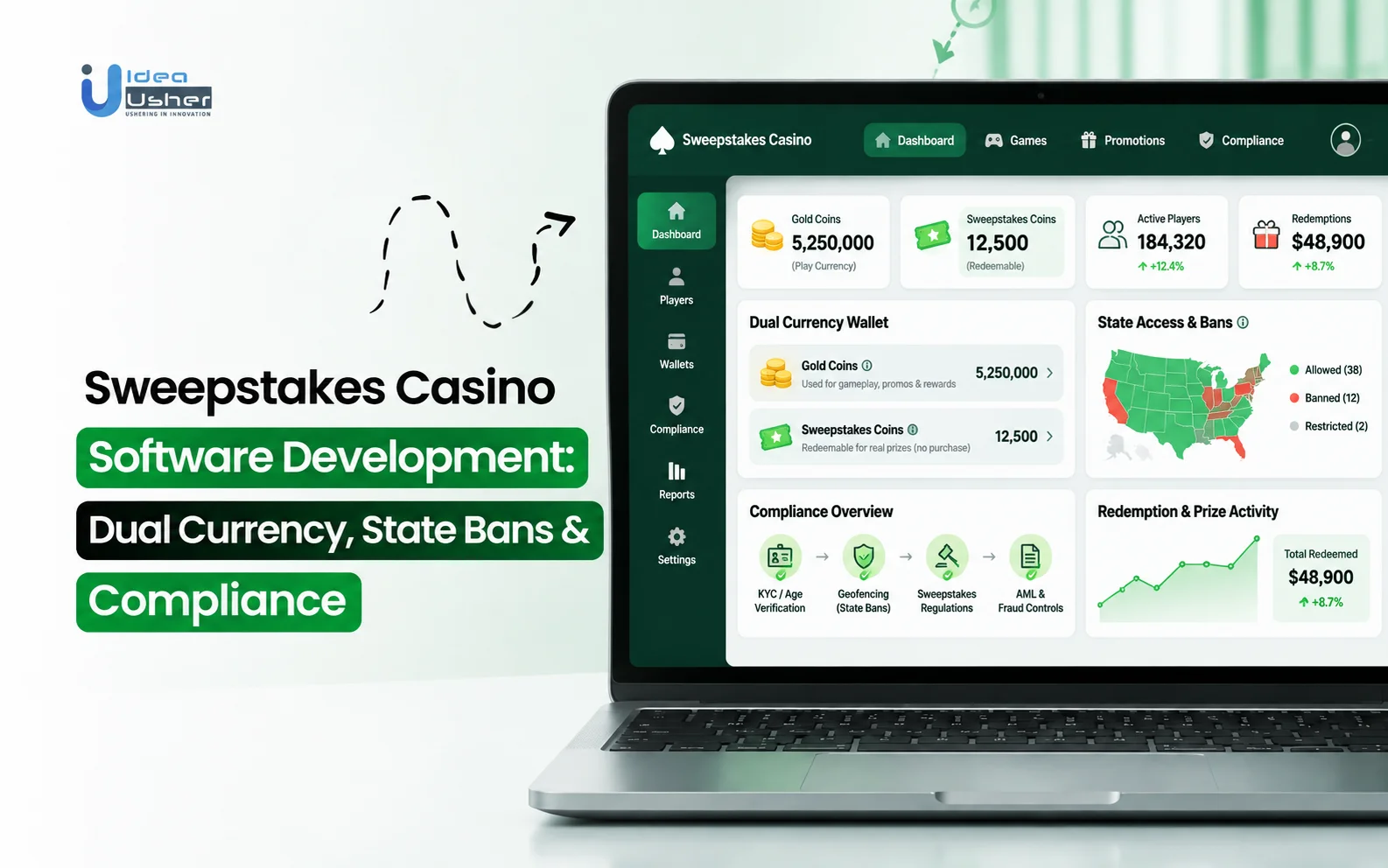
- Sweepstakes casinos use two currencies: Gold Coins (GC) for entertainment and Sweeps Coins (SC) for promotional games with prize redemption.
- US state regulations are tightening in 2026 for sweepstakes casinos. New York, New Jersey, California, Maine and Illinois are actively applying existing gambling laws.
- Configurable geofencing and compliance controls help block restricted states. The software adjusts access based on state-specific rules without rebuilding the platform.
- Basic MVP sweepstakes software can cost around $20,000, while a custom platform may cost up to $500,000 or more. Other cost factors include compliance, multi-state requirements, advanced functionality and integrations.
Sweepstakes casino software development involves building online gaming platforms that use dual currencies. These consist of Gold Coins (GC) for entertainment and Sweeps Coins (SC) for promotional gameplay with prize redemption. The cost to build this platform can range from $20,000 for an MVP to $500,000 or more for a custom system. It includes secure wallet architecture, casino games, AMOE workflows, prize redemption and KYC/AML verification. With increasing restrictions across several US states in 2026, configurable geofencing and compliance controls are also important for supporting reviewed operations across permitted jurisdictions.
The main challenge of a sweepstakes casino platform is not limited to implementing dual-currency wallets and casino games. Operators must ensure the software meets jurisdiction-specific requirements, with promotional mechanics, AMOE workflows, prize redemption and verification working together. Configurable geofencing, eligibility checks and state-specific policy updates are also important for controlling access according to regulations and enforcement actions.
In this blog, we will explain sweepstakes casino software development, covering dual-currency architecture, core features, AMOE workflows, state bans, geofencing, KYC/AML controls, compliance requirements and the technical decisions that influence sweepstakes casino platform development costs.
What Is Sweepstakes Casino Software?
Sweepstakes casino software powers an entertainment model designed to navigate gambling regulations in markets like North America. Rather than accepting direct real-money bets on casino games, a sweepstakes platform operates under promotional sweepstakes laws.
By removing direct financial consideration (the requirement to pay to enter a contest), sweepstakes software allows operators to offer real-prize redemptions while operating legally in regions where traditional online gambling is restricted.
A. How the Gold Coin and Sweeps Coin Model Works
The foundation of any sweepstakes casino platform is a Dual-Currency Sub-Ledger System. The engine maintains two independent virtual wallets that run in parallel but follow completely different legal and operational rules:
1. Gold Coins (GC) — Standard Virtual Currency:
- Purpose: Pure entertainment and casual social play.
- Monetary Value: Zero real-world cash value; cannot be cashed out, transferred, or redeemed for prizes.
- Acquisition: Granted for free upon registration, earned via daily login bonuses, or purchased in store bundles using credit cards, e-wallets, or crypto.
2. Sweeps Coins (SC) — Promotional Sweepstakes Entries:
- Purpose: Promotional contest entries that allow players to win redeemable rewards.
- Monetary Value: Redeemable for cash transfers or digital gift cards at a published conversion rate (e.g., 1.00 SC = $1.00 USD) after meeting minimum wagering play-through requirements.
- Acquisition: Cannot be purchased directly under any circumstances. SC are only distributed as a free promotional bonus attached to Gold Coin purchases, via social giveaways, or through no-cost alternative entry methods.
B. How Sweepstakes Casinos Differ From Real-Money Casinos
The global online gambling market is expanding as digital platforms make casino-style gaming more accessible across markets. According to Grand View Research, the market was valued at $88 billion in 2025 and is projected to reach $202.8 billion by 2033.

The sweepstakes casino segment is also attracting substantial commercial activity. Eilers & Krejcik Gaming estimated $12.5 billion in player sales during 2025 and $4 billion in net revenue after accounting for player prizes.
Additionally, Optimove research found that sweepstakes platforms acquired players at a 16% monthly growth rate, compared with 5% for traditional real-money casinos.
These figures highlight the commercial potential of the sweepstakes model, but its operating structure differs significantly from conventional online gambling.
To understand these differences, the software engine must enforce clear distinctions across financial, legal and operational dimensions:
| Operational Vector | Traditional Real-Money Casino | Free-to-Play Social Casino | Dual-Currency Sweepstakes Casino |
| Wagering Mechanism | Direct fiat/crypto deposits placed on bets. | Non-redeemable virtual chips/coins. | Dual currency: GC (fun) and SC (promotional). |
| Prize Payouts | Cash payouts directly from game winnings. | None (Virtual coins only). | Prize redemptions (cash/gift cards) for accumulated SC. |
| Direct Purchasing | Players deposit funds to wager. | Players buy virtual coin packs. | Players buy GC; SC are given free as bonuses. |
| No-Purchase Option | None (Must wager real capital). | Included (Free daily chips). | Mandatory (AMOE): Free SC via mail-in & daily drops. |
| Primary Regulatory Rail | State / Country iGaming Licensing. | Standard Mobile Consumer Rules. | U.S. State Promotional Sweepstakes Laws. |
C. How Players Purchase, Earn and Redeem Virtual Currencies
Players interact with virtual currencies through defined platform workflows, from store purchases and promotional participation to gameplay eligibility checks and prize redemption under applicable rules.

The backend architecture of sweepstakes software dictates the precise lifecycles for both currencies:
1. Purchasing Gold Coins (With Promotional SC Bonuses)
Players navigate to the platform’s store to select Gold Coin bundles. When a player completes a transaction (e.g., buying a $20 Gold Coin package), the store automatically credits Gold Coins to their GC wallet and attaches a free bonus of Sweeps Coins (e.g., 20 free SC) to their SC wallet.
2. Alternative Method of Entry (AMOE) & Free Accumulation
To break the legal definition of gambling (“consideration”), the software must provide free ways to acquire Sweeps Coins without spending money:
- Daily Wheel / Login Streak Drops: Free micro-allocations of GC and SC granted every 24 hours.
- Postal Mail-in Requests (AMOE): Players mail a physical handwritten request card containing a unique system-generated code to the operator’s registered address. Upon receipt, operational staff process the entry code, and the platform credits free SC directly to the user’s account.
3. Redemption Mechanics & Play-Through Rules
Before winning Sweeps Coins can be redeemed for cash or gift cards, the software enforces compliance rules:
- Play-Through Requirements: Promotional SC granted as bonuses cannot be redeemed immediately; they must be wagered at least once (1× play-through) in games before moving to the redeemable balance.
- Minimum Redemption Thresholds: Platforms set balance minimums before processing redemptions (e.g., 50 SC for digital gift cards, 100 SC for direct ACH bank transfers).
- Verification & KYC Enforcement: The system mandates identity verification (checking legal age, photo ID, residential address and SSN for U.S. tax Form 1099 reporting when applicable) prior to approving any prize cashout.

How Dual-Currency Architecture Works in Sweepstakes Casino Software?
A dual-currency system maintains two isolated accounting tracks within a single player account. The platform’s sub-ledger tracks non-redeemable virtual goods (Gold Coins / GC) alongside promotional contest entries (Sweeps Coins / SC).
Engineering Note: A dual-currency architecture is an engineering choice, not a legal guarantee. Awarding SC with GC purchases does not ensure sweepstakes compliance. The promotional engine must be genuine, non-mandatory and backed by an accessible Alternative Method of Entry (AMOE).

A. Separate Gold Coin and Sweeps Coin Wallets
The database schema isolates GC and SC assets into distinct balance tables or segregated account structures:
- GC Wallet Structure: Stores integer units allocated for entertainment play. Because GC holds no monetary value, rounding precision is straightforward.
- SC Wallet Structure: Stores floating-point or fixed-precision values (e.g., NUMERIC(12, 2)). The sub-ledger divides the SC balance into two sub-categories:
- Unplayed (Unredeemable) SC: SC obtained from promotional drops, bonuses, or AMOE mail-ins that have not yet cleared play-through requirements.
- Redeemable SC: SC won from game rounds played using unplayed SC. Only cleared, redeemable SC can trigger a cash prize request.
B. Currency Issuance, Transfers, and Transaction Ledgers
Every state change across GC and SC balances must execute as an atomic transaction backed by an append-only transaction ledger (double_entry_ledger).
When a user places a wager:
- The game engine confirms which wallet state is active (GC mode or SC mode).
- For SC wagers, the ledger draws from the Unplayed SC bucket first. If unplayed funds are exhausted, it draws from the Redeemable SC balance.
- Winnings from an SC wager credit directly to the Redeemable SC pool, clearing the 1× play-through requirement for those won funds.
C. Promotional Entry and AMOE Processing Logic
To ensure the promotional campaign engine operates independently of direct store purchases, the software coordinates three distinct issuance streams:
- Store Purchase Bundling Logic: When a player buys a GC bundle, the backend calls the promotional engine API. The system verifies if a bonus SC allocation is attached to that store SKU, issuing the bonus SC as an independent promotional grant.
- AMOE Postal Card Processing Pipeline:
- Token Generation: A registered player generates a unique, time-stamped 12-digit AMOE code within their account dashboard.
- Physical Matching: The user mails a physical index card with the handwritten code to the operator’s processing center.
- Verification & Audit Credit: Staff verify the code, submission date and user details in the admin portal. Once verified, the backend credits the exact promotional SC amount (e.g., 5.00 SC) to the user’s Unplayed SC balance and logs the submission ID for auditing.
D. Prize Eligibility and Redemption Workflows
The redemption engine controls the process of converting cleared Sweepstakes casino coins into real-world prize payouts (such as ACH bank transfers or digital gift cards).
The workflow follows four controlled stages, ensuring each redemption request meets eligibility requirements, passes verification, secures the requested balance and reaches the payout processor after approval.
- Threshold & Play-Through Check: The engine verifies that the request uses only Redeemable SC and meets the minimum threshold (e.g., 50 SC for gift cards or 100 SC for bank transfers).
- KYC/AML Validation: Confirms identity verification, including document checks, applicable SSN validation for Form 1099 reporting and sanctions screening.
- Atomic Balance Lock: Moves the requested SC into a pending escrow state (locked_sc), preventing further wagers during review.
- Payout Dispatch & Ledger Reconciliation: After approval, marks the locked SC as REDEEMED, removes it from active circulation and sends the payout instruction to the payment processor.
Which US State Laws Affect Sweepstakes Casinos in 2026?
In 2026, New York, New Jersey, California and Maine have enacted laws restricting online sweepstakes casino models, while Illinois has intensified enforcement against unlicensed operators.
These developments affect dual-currency systems, prize redemption and promotional gaming, making state-specific legal reviews and configurable geofencing essential before launching a sweepstakes casino platform.
How Do These State Restrictions Affect Sweepstakes Casino Software?
The regulatory developments across these five states create different implementation requirements for sweepstakes casino operators. The following table summarizes the major developments and their implications for platform architecture.
| State | Regulatory development | Key date | Status | Software implication |
| New York | S5935A, Chapter 605 | December 5, 2025 | Banned | Restrict prohibited dual-currency sweepstakes operations |
| New Jersey | Public Law 2025, Chapter 128 | August 15, 2025 | Restricted | Review paid-entry and prize-equivalent mechanics |
| California | AB 831, Chapter 623 | January 1, 2026 | Banned | Restrict prohibited online sweepstakes games |
| Illinois | IGB enforcement actions | February 5, 2026 | Enforcement Active | Support regional access restrictions and audit trails |
| Maine | LD 2007, Chapter 645 | July 29, 2026 | Banned | Disable prohibited online sweepstakes operations |
To remain operational, founders and software architects must track specific statutory changes across key states and design adaptable platform infrastructure.

A. New York’s Ban on Dual-Currency Sweepstakes Games
In December 2025, New York enacted landmark legislation (Senate Bill S5935A, Chapter 605), signed by Governor Kathy Hochul, establishing a statutory prohibition on online dual-currency sweepstakes casino games operating within the state.
Effective Date: Signed into law on December 5, 2025, as Chapter 605, with immediate effect.
Legislative Action: The law adds Section 912 to New York’s Racing, Pari-Mutuel Wagering and Breeding Law, defining dual-currency, casino-style sweepstakes offering cash prizes. It bans operating, promoting, or supporting these games through related services.
Affected Operations: Dual-currency social casinos, sweepstakes slot apps, promotional table game platforms and supporting businesses such as payment processors, geolocation providers, gaming content suppliers and platform providers.
Software & Operator Implications: Platforms must use jurisdiction-aware geofencing across registration, login, purchases, and redemptions to block prohibited New York operations. Backend systems must restrict transactions and log blocked actions for auditing.
B. New Jersey’s Restrictions on Sweepstakes Models
New Jersey, a mature and strictly regulated real-money iGaming market, enacted specific legislation in 2025 addressing unlawful gambling operations and sweepstakes models involving prize-equivalent mechanisms.
Effective Date: Approved on August 15, 2025, with immediate effect.
Legislative Action: New Jersey enacted Public Law 2025, Chapter 128 (Assembly Bill 5447), classifying dual-currency sweepstakes involving value exchanges for prizes as unlawful gambling, unless specific statutory exceptions apply.
The law permits compliant sweepstakes that offer free entry methods, follow paid entry restrictions and maintain required disclosures, rather than imposing a total ban or requiring a B2C iCasino license for all operators.
Affected Operations: Sweepstakes slot platforms, social casino operators, promotional gaming businesses and third-party providers supporting prize-equivalent token systems.
Software & Operator Implications: New Jersey-targeted platforms must align entry, payment, and redemption flows with statutory rules by enforcing eligibility, maintaining disclosures, prohibiting paid entries, and providing free entry options. Operators should consult legal counsel before launching prize-based gameplay.
C. California’s Sweepstakes Casino Restrictions
California enacted Assembly Bill 831 (AB 831), Chapter 623 of the Statutes of 2025, signed by Governor Gavin Newsom, introducing significant restrictions on online sweepstakes gaming.
Effective Date: Signed into law in October 2025, with the relevant provisions taking effect on January 1, 2026.
Legislative Action: AB 831 updates California gambling laws to regulate online sweepstakes and simulated gambling platforms awarding prizes, targeting entities that intentionally engage in or facilitate prohibited gaming.
However, technology vendors and service providers are not automatically liable solely for servicing these platforms, requiring evaluation under statutory language and exceptions.
Affected Operations: Online sweepstakes casino operators, platform providers, gaming software vendors, promotional gaming businesses and other entities knowingly engaging in or facilitating prohibited activities.
Software & Operator Implications: Platforms must use geolocation across registration, access, purchases, and redemptions to block restricted California gameplay and transactions. Operators should also consult legal counsel regarding existing California user balances, limits, and redemption obligations.
D. Illinois Enforcement Against Online Sweepstakes Operators
Rather than introducing a new sweepstakes-specific statutory prohibition, Illinois has relied on enforcement through existing gambling laws and cease-and-desist actions by the Illinois Gaming Board (IGB), working alongside the Illinois Attorney General.
Effective Date: The enforcement action was publicly announced on February 5, 2026, with enforcement continuing under existing Illinois gambling laws.
Enforcement Action: On February 5, 2026, the IGB announced sending over 60 cease-and-desist letters to illegal online casino and sweepstakes platforms in Illinois. The notices targeted unauthorized sites offering online games of chance that award money or items of value.
Affected Operations: Unlicensed online casinos, dual-currency sweepstakes platforms, social gaming operators and entities facilitating unauthorized online gambling activities.
Software & Operator Implications: Platforms require real-time jurisdiction controls for ops teams to restrict access, suspend purchase/redemption endpoints, and log transactions. Admin dashboards must support regional restrictions, state policy configs, and compliance reporting.
E. Maine’s Dual-Currency Sweepstakes Prohibition
Maine enacted dedicated legislation prohibiting online sweepstakes games that use dual-currency systems and simulate casino-style gaming.
Effective Date: Signed by Governor Janet Mills on April 6, 2026, with the prohibition taking effect on July 29, 2026.
Legislative Action: Maine enacted LD 2007 (SP 825), Public Law 2025, Chapter 645, “An Act Regarding the Prohibition of Online Sweepstakes Games,” banning the operation, promotion, and support of dual-currency, casino-style prize games.
Violations carry civil penalties of $10,000 to $100,000, potential licence revocation, and disqualification from future gaming licences.
Affected Operations: Dual-currency sweepstakes casinos, online promotional gaming platforms, casino-style sweepstakes apps and businesses supporting prohibited operations.
Software & Operator Implications: Operators must enforce Maine access blocks and disable prohibited gameplay, purchases, and redemptions. Existing balances must meet legal standards, and audit logs must be retained for compliance.
Why Platforms Need a Dynamic Jurisdiction Policy Engine
Hardcoding a static list of restricted states into client-side JavaScript or backend configuration files (IF state == ‘CA’ THEN BLOCK) introduces operational fragility and compliance risks.
Because US gaming laws evolve rapidly through legislative votes, administrative orders, and judicial rulings, sweepstakes software must utilize a Configurable Jurisdiction Policy Engine.
Key Technical Advantages of a Policy Engine
- Granular Feature-Level Toggling: Rather than binary IP blocking (allow vs. deny), a policy engine allows operators to dynamically adjust feature availability based on user location:
- Full Mode (Unrestricted): Both Gold Coins (GC) and Sweeps Coins (SC) features enabled.
- Social-Only Mode (Restricted): Disables SC purchasing, promotional giveaways, and redemptions while allowing non-monetary Gold Coin entertainment play.
- Hard Geofence (Prohibited): Completely blocks site access, account creation, and login attempts for blocklisted jurisdictions.
- Zero-Downtime Rule Updates: Compliance teams can modify jurisdiction rules in an administrative dashboard or via dynamic database updates without requiring code refactoring, full application recompilation, or app store re-submissions.
- Multi-Factor Geolocation Verification: Integrates IP routing analysis, Wi-Fi triangulation, cell-tower data, and proxy/VPN/Tor detection APIs (e.g., GeoComply or IPQS) to prevent spoofing attempts.
- Audit Trail & Legal Logging: Automatically logs jurisdiction policy evaluations per user session with timestamped proof of location, ensuring operators can provide verifiable compliance records during regulatory audits.
How to Develop Sweepstakes Casino Software?
Developing sweepstakes casino software requires a structured process covering legal validation, dual-currency mechanics, platform engineering and operational controls. The development lifecycle should establish the business model and applicable jurisdictional requirements before implementing promotional currencies, monetization or prize redemption workflows.
1. Validate the Business Model and Legal Structure
Start by validating the proposed sweepstakes model before defining product features or currency mechanics. Legal requirements across target jurisdictions will influence player eligibility, promotional structures and redemption workflows.
- Select Target Markets: Identify intended jurisdictions and assess applicable sweepstakes, promotional gaming and consumer protection requirements.
- Review Legal Structure: Consult qualified legal counsel to evaluate the operating entity, promotional model and prize redemption obligations.
- Define Business Operations: Establish player eligibility, promotional entry methods, monetization and redemption workflows.
A legally reviewed business model defining target jurisdictions, operating structure, player eligibility requirements and permitted promotional and prize redemption workflows.
2. Define Dual-Currency Rules and Promotional Mechanics
Once the business model is validated, establish how both currencies function across gameplay and promotional activities. Clearly separated rules help maintain accurate balances and transparent redemption conditions.
- Configure Currency Types: Define separate Gold Coin balances for entertainment and Sweeps Coin balances for eligible promotional participation.
- Establish Currency Allocation: Set issuance rules for purchases, free entry methods, daily bonuses, referrals and campaigns.
- Implement Currency Restrictions: Define transfer, usage, expiration, balance adjustment and conversion rules.
- Design Promotional Mechanics: Build campaigns, bonus distribution, free entry options and player eligibility rules.
- Define Redemption Workflows: Set Sweeps Coin redemption thresholds, prize eligibility, verification and fulfillment procedures, subject to legal review.
A documented dual-currency framework outlining currency allocation, usage restrictions, promotional entry methods, bonus distribution and applicable prize redemption conditions.
3. Design Platform Architecture and Develop Core Modules
With product requirements established, design the technical architecture and develop the platform’s core modules. These components must support player activity, currency management, administration and compliance operations.
- Plan System Architecture: Define frontend, backend, database, API and cloud infrastructure, including communication between player and admin services.
- Build Player Account Management: Develop registration, authentication, profiles, session tracking, preferences and activity history.
- Implement Dual-Currency Wallets: Maintain separate Gold Coin and Sweeps Coin balances with transaction ledgers and auditable updates.
- Develop Casino Game Management: Build game catalogs, categories, launches, provider configurations, player sessions and gameplay history.
- Create Admin and Compliance Dashboards: Enable player management, promotions, transaction monitoring, reporting and compliance oversight.
A functional platform foundation integrating player accounts, separate currency wallets, transaction ledgers, administrative dashboards and essential compliance management modules.
4. Integrate Casino Games and Payment Systems
After building the core platform, connect external game providers and permitted payment services. Integration workflows should synchronize player sessions, game activity, payment events and currency allocations.
- Integrate Casino Game Providers: Connect slot, table and other games through provider APIs, supporting launches, authentication and outcome callbacks.
- Implement Game Session Management: Synchronize player identities, session tokens, game states and balances with external providers.
- Configure Payment Gateways: Integrate permitted processors for eligible purchases, handling authorization, status updates and failures.
- Automate Currency Allocation: Link successful payments to Gold Coin purchases and separately record promotional Sweeps Coin distributions.
- Implement Transaction Reconciliation: Track payment references, provider callbacks, currency allocations, refunds and failures to detect discrepancies and prevent duplicate processing.
An integrated gaming and payment environment supporting provider connectivity, player sessions, eligible payment processing, currency allocation and transaction reconciliation workflows.
5. Implement Geofencing, KYC and Security Controls
Implement jurisdictional eligibility and player verification controls before preparing the platform for launch. These systems help enforce access restrictions, protect accounts and maintain traceable operational records.
- Implement IP-Based Geofencing: Use IP intelligence to restrict registration, login and gameplay in prohibited jurisdictions.
- Add Location Verification: Apply device-location signals and verification checks where legally permitted.
- Integrate KYC and Age Verification: Connect identity providers to verify player details, age eligibility and required checks.
- Build Fraud Detection Controls: Monitor suspicious accounts, multiple-account activity, unusual transactions, promotional abuse and redemption requests.
- Strengthen Platform Security: Apply encryption, role-based access, secure API authentication, rate limiting, audit logs and incident monitoring.
An implemented compliance and security framework covering jurisdictional access restrictions, player verification, account protection, fraud monitoring and auditable operational controls.
6. Test, Audit and Prepare for Deployment
The final milestone validates whether the complete platform operates reliably and meets its documented requirements. Test gameplay, promotional mechanics, financial workflows and security controls before production deployment.
- Test Core Workflows: Validate accounts, currencies, promotions, games and redemption operations.
- Conduct Security Audits: Review APIs, wallets, access permissions and transaction integrity.
- Validate Compliance: Obtain necessary legal and operational reviews before launch.
- Deploy and Monitor: Release the platform and track performance, errors and suspicious activity.
A tested and deployment-ready platform with validated gameplay, promotional workflows, transaction integrity, security controls and completed legal and operational reviews.
What Features Should Sweepstakes Casino Software Include?
Sweepstakes casino software development must include player accounts, dual-currency wallets, casino games, promotional campaigns, prize redemption and administrative controls. While an MVP needs these core features to attract initial users and validate engagement, an enterprise platform requires advanced automation, analytics, fraud prevention and scalable infrastructure.
A. MVP Features for a Sweepstakes Casino Platform
An MVP should prioritize features that allow players to register, explore casino games, manage virtual currencies and participate in promotional activities. These foundational modules help operators launch the platform, acquire early users, evaluate engagement and validate their business model.
| Feature | What It Does | Why It Matters |
| Player Registration and Account Management | Handles account creation, login, player profiles, age checks and basic identity verification. | Reduces onboarding friction while establishing player eligibility. |
| Dual-Currency Wallet | Maintains separate Gold Coin and Sweeps Coin balances, transaction histories and issuance records. | Prevents balance mixing and transaction inconsistencies. |
| Casino Game Lobby and Integration | Provides a central lobby for slots, blackjack, roulette and other supported games. | Gives players varied gaming experiences and encourages repeat visits. |
| Promotional Campaign and Bonus Engine | Manages welcome offers, daily bonuses, coin distributions, eligibility rules and campaign disclosures. | Supports acquisition and repeat engagement through consistent promotion management. |
| AMOE and Prize Redemption Management | Handles no-purchase entry methods, entry records, redemption requests and prize eligibility checks. | Supports transparent participation and structured prize processing under applicable rules. |
| Admin Dashboard and Basic Reporting | Lets operators manage accounts, monitor transactions, configure promotions and review platform activity. | Centralizes essential operations without direct database intervention. |
These features establish the functional foundation of a sweepstakes casino software development. Operators can use the MVP to test player acquisition, promotional engagement and game preferences while identifying operational gaps. However, currency mechanics, promotional rules and prize eligibility should undergo legal validation before launch.
B. Advanced Features for Scaling The Software
Once the platform establishes consistent user acquisition and engagement, enterprise development should focus on operational automation, infrastructure resilience and deeper player insights. These capabilities help operators manage larger user volumes, improve fraud prevention and support complex business operations.
| Feature | What It Does | Why It Matters |
| Fraud Detection & Risk Scoring | Uses behavioral analytics, device fingerprinting, velocity checks and anomaly detection to flag suspicious accounts. | Helps prevent bonus abuse, account manipulation and fraudulent redemptions. |
| Centralized Jurisdiction Policy Engine | Applies state-level rules to player eligibility, game access, purchases and redemptions using verified location data. | Enables centralized policy updates without rebuilding application modules. |
| Player Analytics and Segmentation | Tracks acquisition, retention, sessions, promotional engagement and lifetime value through analytics dashboards. | Helps identify user segments, understand churn and optimize marketing strategies. |
| AML and Transaction Monitoring | Monitors unusual transactions, redemptions, account relationships and suspicious financial activity. | Strengthens financial oversight as transaction volumes grow. |
| Cloud Infrastructure and Load Management | Uses distributed services, auto-scaling, caching and database optimization to manage traffic. | Maintains availability, faster game loading and reliable transactions during traffic spikes. |
| CRM and Responsible Gaming Management | Integrates player communications, campaigns, self-exclusion, session limits, cooling-off periods and risk alerts. | Supports player retention while strengthening responsible gaming controls. |
Enterprise capabilities help transform a functional gaming platform into a scalable operating ecosystem. As user volumes and transaction activity increase, operators can automate risk monitoring, centralize jurisdiction controls and make data-driven product decisions. These upgrades should follow measurable business growth rather than being introduced without a clear operational requirement.
How Much Does Sweepstakes Casino Software Development Cost?
The cost of sweepstakes casino software development typically ranges between $20,000 for a basic MVP and $500,000+ for a custom enterprise platform. The exact amount depends heavily on whether you utilize a pre-built foundation or build a custom platform from scratch, alongside your target game variety and operational requirements.
Because sweepstakes casinos operate using a legal dual-currency model (Gold Coins for free play and Sweeps Coins for prize redemption), they avoid expensive state-level real-money gaming licenses. However, the core engineering must still handle secure dual-wallet mechanics, geolocation, and strict compliance layers.
A. Total Cost Breakdown by Platform Deployment Tier
Sweepstakes casino software development costs vary by deployment model, customization level and operational requirements. The following tiers compare typical budgets, delivery timelines and capabilities across different platform configurations.
| Platform Tier | Estimated Budget | Timeline | Key Capabilities Included |
| White-Label / Template MVP | $20,000 – $60,000 | 4 to 8 weeks | Basic UI templates, pre-integrated standard games, core GC/SC wallet logic, basic IP geofencing, high monthly rev-share (15–30%). |
| Turnkey / Mid-Tier Platform | $60,000 – $150,000 | 2 to 4 months | Customized Web/Mobile UI, dual-currency sub-ledger, automated mail-in (AMOE) tracking, third-party game aggregator iFrames, automated KYC/AML pipeline. |
| Custom Enterprise System | $150,000 – $500,000+ | 5 to 12 months | Ground-up custom architecture, proprietary game math engines, dynamic state-by-state compliance policy engine, multi-brand back-office management, 100% IP ownership. |
Note: These figures are indicative software development estimates, not fixed market rates. Actual costs depend on game integrations, licensing support, compliance complexity, payment providers, infrastructure and customization. Ongoing expenses including hosting, provider fees, regulatory costs and revenue sharing, may require separate budgeting.
B. Key Technical Modules & Core Cost Drivers
A sweepstakes casino software development requires several interconnected modules, each contributing to its development budget. The following breakdown highlights the major engineering components and their estimated costs.
1. Core Platform Architecture & Player Account Management ($15,000 – $50,000)
This module establishes the platform’s technical foundation, defining how users access services and how operational teams oversee player accounts and routine activities.
- Frontend Web/App Interfaces: High-performance HTML5/WebGL responsive client supporting mobile web, iOS, and Android wrappers.
- Back-Office Admin Portal: Operational dashboards to manage player accounts, grant manual bonuses, view financial audit logs, and control daily campaign rules.
2. Dual-Currency Wallet & Promotional Engine ($10,000 – $35,000)
This component governs the platform’s currency accounting and promotional logic, ensuring each balance follows its assigned rules throughout gameplay and redemption.
- Isolated Wallets: Backend architecture maintaining strict separation between non-redeemable Gold Coins (GC) and promotional Sweeps Coins (SC).
- Play-Through Enforcement: Automated logic restricting prize redemptions until promotional SC satisfy mandatory 1× wagering requirements.
3. AMOE & Free Entry Workflows ($8,000 – $25,000)
Free-entry functionality requires dedicated workflows to process alternative participation methods, manage promotional eligibility and maintain records of qualifying entries.
- Postal Entry Processing: Unique token generation and admin portals to verify physical handwritten mail-in cards.
- Free Allocation Engine: Automated daily login streak wheel drops and social media promo code claims.
4. Compliance, KYC & Dynamic Geofencing ($15,000 – $40,000)
Compliance infrastructure adapts platform access and verification procedures to changing jurisdictional requirements, reducing the risk of serving ineligible players or processing restricted activity.
- Jurisdiction Policy Engine: Dynamic state-level geofencing API integrations (e.g., GeoComply) to block restricted states (such as CA, NY, NJ, ME, IL) and toggle mode states (GC-only vs. GC+SC) without app redeployment.
- KYC/AML Automation: Third-party identity verification API integrations (Sumsub, Persona, Jumio) for age verification, SSN tax validation, and sanctions/PEP screening prior to prize payouts.
5. Payments, Store Purchasing & Prize Redemptions ($10,000 – $30,000)
Financial integrations connect the platform’s commercial operations with its prize fulfillment process, covering purchase processing, payout coordination and transaction oversight.
- Store Payment Gateways: Merchant integration for Gold Coin package sales using credit cards, Instant ACH, e-wallets, or crypto payment processors.
- Redemption Engine: Payout review pipelines supporting gift cards, direct bank transfers (ACH), or Web3 wallet payouts.
C. Initial Pre-Launch Capital Expenditure (CapEx)
Beyond software development, launching a sweepstakes casino requires upfront investment in legal documentation, corporate formation, independent testing and third-party services before the platform can begin operations. These are the one-time corporate, legal and operational setup costs required before you take your first player.
| Expense Category | Estimated Cost | Purpose / Description |
| Legal Framework & T&Cs | $10,000 – $35,000 | Draft sweepstakes rules, platform Terms of Service, and privacy policies compliant with U.S. and Canadian sweepstakes laws. |
| Corporate Structuring | $3,000 – $7,000 | Establishing an offshore or onshore business entity, corporate bank accounts, and merchant account registrations. |
| Compliance Audits & RNG Certification | $5,000 – $15,000 | Third-party testing (e.g., iTech Labs or GLI) to certify that game Random Number Generators (RNG) are fair and legally sound. |
| Third-Party API Setup Fees | $5,000 – $20,000 | One-time integration and setup fees charged by KYC/AML providers, SMS verification gateways, and geolocation services. |
| Total Pre-Launch CapEx | $23,000 – $77,000 | Does not include sweepstakes software development costs. |
Note: These estimates represent one-time setup expenses and exclude software development, ongoing service subscriptions, licensing fees and operating reserves. Actual costs vary by jurisdiction, business structure, testing scope and provider agreements. Obtain legal advice to confirm applicable requirements before committing capital.
D. Ongoing Operational Costs (OpEx)
Beyond initial sweepstakes casino software development (CapEx), platform owners should budget for monthly operational expenses:
- Cloud Infrastructure & WebSockets: $1,500 – $6,000 / month for high-availability database hosting, load balancing, and DDoS protection.
- KYC & Geofencing API Fees: $0.50 – $2.00 per identity verification check and per-location evaluation.
- Game Aggregator Revenue Share: 8% to 15% of net gaming revenue (NGR) paid to third-party slot/table game software providers.
- Legal & Compliance Retainers: $5,000 – $15,000 / year for ongoing U.S. state law monitoring and promotional sweepstakes legal audits.
What Compliance Systems Must a Sweepstakes Casino Platform Have?
While state-level regulatory laws define where a dual-currency platform may legally accept players, backend compliance systems determine how the software enforces those rules in real-time.
Technical controls like AMOE processing or automated KYC cannot legalize an improperly structured model. If core mechanics violate laws like NY’s S5935A or CA’s AB 831, compliance features offer no legal immunity.
Instead, compliance engines serve as the operational infrastructure required to mitigate fraud, satisfy payment processor mandates, maintain verifiable records, and execute legal rules at scale.
A. Dynamic State-Level Geofencing and IP Detection
Sweepstakes casino software development requires dynamic, multi-layered geolocation systems to prevent access from restricted jurisdictions. Reliance on static IP lookup tables is insufficient due to VPN usage, proxy services, and mobile boundary changes.
- Multi-Signal Verification: The geofencing engine combines IP routing analysis, mobile network cell tower data, Wi-Fi tri-angulation, and HTML5 browser location prompts (via integrations like GeoComply or IPQS).
- Real-Time Proxy/VPN Detection: Incoming traffic is analyzed for virtual private network (VPN) signatures, Tor exit nodes, residential proxies, and data center IP ranges to block location spoofing attempts.
- Contextual Access Toggling: Geofencing checks trigger during account registration, daily login, store checkout (Gold Coin purchases), and prize redemption requests.
B. Age Verification and KYC Identity Checks
To prevent underage participation and fraudulent account creation, platforms implement a staged Know Your Customer (KYC) identity verification pipeline.
| Verification Tier | Trigger Point | Technical Requirements | Operational Purpose |
| Tier 1: Basic Registration | Account creation | Email verification, self-declared age (18+/21+), address check & initial IP validation. | Filters bot registrations & blocks accounts from restricted states. |
| Tier 2: Purchase & Velocity | Cumulative store spend | Automated checks against identity registries & credit header databases. | Verifies age & address before high-value purchases. |
| Tier 3: Prize Redemption | First cashout / Gift card request | 3D biometric liveness, government-issued photo ID verification (Sumsub, Persona or Jumio) & applicable SSN validation for U.S. tax reporting. | Confirms identity, detects multiple accounts, supports tax & anti-fraud compliance. |
C. AML Monitoring and Suspicious Transaction Detection
Even though sweepstakes casinos utilize promotional entry mechanics, payment gateways, banking partners, and merchant acquirers require platforms to maintain robust Anti-Money Laundering (AML) controls.
- 1× Play-Through Enforcement: The database sub-ledger ensures unplayed Sweeps Coins (obtained via bonuses or AMOE) cannot be redeemed immediately, enforcing game participation to stop instant cash-cycling.
- Sanctions & PEP Screening: Automated screening matches player details against global sanctions lists (OFAC, UN, EU) and Politically Exposed Persons (PEP) databases.
- Transaction Velocity & Structuring Alerts: The system flags micro-deposits, rapid card switching, uncharacteristic purchasing spikes, and chargeback-risk patterns for manual compliance review.
- Closed-Loop Payout Restrictions: Redemptions are constrained to payout accounts matching the verified name on the primary player profile, blocking third-party transfers.
D. AMOE Rules, Disclosures, and Promotional Records
To satisfy promotional sweepstakes principles, the backend must support clear disclosures and track free entry distribution.
- No-Purchase-Necessary Disclosures: Dynamic UI templates render clear sweepstakes rules, eligibility terms, odds of winning, and no-purchase entry instructions at every store checkout screen.
- AMOE Tokenization Engine: The system generates single-use, time-bound entry tokens for postal mail-in requests, tracking card issuance, physical receipt dates, and manual validation statuses in an administrative audit database.
- Equivalency Monitoring: The platform tracks the proportion of Sweeps Coins issued via free methods (daily drops, AMOE, social codes) relative to promotional purchase bonuses, preserving the non-mandatory nature of store purchases.
E. Responsible Gaming and Self-Exclusion Controls
Consumer protection standards mandate built-in Responsible Gaming (RG) modules to assist players in managing their time and virtual currency spending.
- Player-Set Store Purchase Limits: Daily, weekly, and monthly caps on Gold Coin package purchases.
- Session Reality Checks: In-game modal alerts displaying active play duration, total Gold Coins spent, and net Sweeps Coins won/lost.
- Cool-Off & Self-Exclusion: Automated controls allowing players to temporarily suspend accounts (7–30 days) or execute permanent self-exclusions. Self-exclusion immediately freezes store access, blocks promotional communications, and restricts login credentials across network platforms.
Challenges in Building Sweepstakes Casino Software
The sweepstakes casino software development involves more than integrating casino games and virtual wallets. Developers must address complex transaction logic, third-party integration dependencies and changing jurisdictional requirements while maintaining platform reliability, data consistency and a seamless player experience.
1. Maintaining Dual-Currency Wallet Accuracy
Challenge: Managing separate Gold Coin and Sweeps Coin balances becomes complex when promotional distributions, gameplay transactions and prize redemptions occur simultaneously across multiple services.
Solution: Our developers implement independent currency ledgers, atomic transaction processing, idempotent APIs and automated reconciliation mechanisms to prevent duplicate transactions, unauthorized balance changes and inconsistencies across wallet services.
2. Third-Party Casino Games and APIs Integration
Challenge: Different game providers use varying API protocols, authentication methods, session management workflows and wallet transaction formats, creating integration and synchronization difficulties.
Solution: Our developers build standardized integration adapters, secure API gateways and centralized session management layers to normalize provider communication, synchronize wallet transactions and handle failed callbacks across game integrations.
3. Dynamic Geofencing and Jurisdiction Controls
Challenge: Changing state restrictions, inaccurate location signals and VPN-based access attempts make it difficult to enforce jurisdiction-specific gameplay and prize eligibility rules consistently.
Solution: Our developers implement centralized jurisdiction policy engines combining IP intelligence, device location signals, risk-based verification and configurable state rules to restrict prohibited activities and maintain auditable access decisions.
Why Build Your Sweepstakes Casino Platform With IdeaUsher?
Building a sweepstakes casino model into a high-concurrency digital platform requires an enterprise architecture that can balance dual-token economies, high-volume coin packages, automated prize redemptions, and low-latency game streaming.
IdeaUsher operates as an enterprise product engineering partner, backed by 11+ years of software expertise with 4.9/5 Clutch rating with 250+ specialized technologists engineer custom, cloud-native sweepstakes software platforms designed around compliance-ready standards, deterministic ledger reconciliation, and zero vendor lock-in.
A. Custom Casino Platform Architecture and Development
Our developers architect modular sweepstakes casino software development with independent game logic, flexible player management and responsive interfaces. Each component supports reliable operations while maintaining clear separation between currencies and workflows.
- Decoupled Dual-Token State Machines: Separate Gold Coins and Sweeps Coins through isolated backend state machines, preventing balance crossover and unauthorized transitions.
- Alternative Method of Entry (AMOE) Workflows: Automate digital and mail-in AMOE processing with single-use codes, identity binding and verification queues.
- Responsive Platform Clients & Administrative PAM: Deploy mobile-first WebGL/HTML5 apps for iOS and Android with centralized PAM back offices for bonus, loyalty, and lifecycle management.
B. Scalable Wallets, Integrations and Backend Infrastructure
We engineer the financial and integration layers that connect game providers, payment systems and player accounts. Our architecture supports concurrent transactions, reliable wallet operations and scalable backend performance.
- Double-Entry Financial Ledgers: Maintain real-time transaction records with atomic holds for coin purchases, bonuses and prize redemptions.
- Third-Party Game Aggregator Bridges: Connect RGS and aggregator APIs, including Pragmatic Play, Relax Gaming and Hacksaw, with synchronized wallet reservations across game sessions.
- Omnichannel Payments & Elastic Infrastructure: Integrate PCI-DSS payment gateways, ACH rails, digital wallets, and automated payouts, backed by auto-scaling Kubernetes microservices to manage traffic surges.
C. Security-Focused Development and Ongoing Support
Our sweepstakes casino software development approach incorporates identity controls, fraud monitoring and audit-ready infrastructure. These safeguards help maintain platform integrity, support regulatory requirements and protect proprietary software assets.
- Identity Verification & Boundary Fencing: Integrate KYC/AML providers such as Jumio, Veriff and Sumsub with GeoComply for geolocation checks and multi-account detection.
- Fraud Detection & Audit-Ready Packaging: Track coin velocity, chargebacks, bot activity, and redemptions while structuring logs, database schemas, and RNG audit trails for standards like GLI-19.
- 100% IP Ownership & Clean Source Code: Retain full ownership of platform IP, microservices and database schemas without recurring software revenue-sharing or vendor lock-in.
Build a Sweepstakes Casino Platform With a Compliance-Ready Architecture! Connect with Idea Usher’s software architects to evaluate your dual-currency wallet logic, game aggregation feeds, cashier infrastructure and technical MVP roadmap.
Conclusion
The future of sweepstakes casinos depends on more than engaging games and attractive promotional offers. A reliable platform needs a well-structured dual-currency architecture, secure wallet management, transparent AMOE workflows and adaptable jurisdiction controls. Sweepstakes casino software development also requires careful attention to state-specific laws, player verification, fraud prevention and prize redemption. A clear technical roadmap, realistic budget and thorough legal review help operators make informed decisions. The right development partner can turn these requirements into a scalable platform built for evolving market demands.
FAQs
A.1. Sweepstakes casino software development typically costs $20,000 for a basic MVP and $500,000+ for a custom enterprise platform, depending on wallet complexity, game integrations, compliance infrastructure and customization requirements.
A.2. Gold Coins (GC) support entertainment-only gameplay, while Sweeps Coins (SC) are promotional currencies that may qualify for prize redemption under platform rules, eligibility conditions and applicable sweepstakes laws.
A.3. AMOE (Alternative Method of Entry) is required where applicable sweepstakes laws and promotional rules mandate a qualifying no-purchase entry method. Its implementation must follow specific eligibility, disclosure and entry requirements.
A.4. In 2026, New York, New Jersey, California and Maine have enacted restrictions targeting online sweepstakes casino models, while Illinois has pursued enforcement against unlicensed operators under existing gambling laws.
A.5. Yes, sweepstakes casino software can support multiple jurisdictions through configurable geofencing, state-specific eligibility rules and centralized policy management. However, each jurisdiction requires legal review before enabling gameplay, purchases or prize redemption.


