


Key Takeaways
- Creator metaverse platform development is growing rapidly as users now prefer platforms where they can create, own, earn and participate instead of only consuming content.
- Platforms like The Sandbox proved that combining virtual land, creator tools, NFT ownership, token economies and social worlds creates stronger retention and monetization.
- Core success features include LAND NFTs, no-code game builders, creator studios, NFT marketplaces, wallet login, avatars, live events and reward systems.
- Estimated creator metaverse platform development cost ranges from $63,500 to $118,500 for MVP builds, $150,000 to $450,000 for mid-scale platforms and $500,000 to $1M+ for enterprise ecosystems.
- Successful platforms require strong focus on multiplayer scalability, token economy balance, user retention, moderation systems and frictionless blockchain UX.
- How IdeaUsher helps build your full creator metaverse platform through strategy, UI/UX, multiplayer architecture, NFT integration, tokenomics setup, launch support and long-term scaling.
Attention alone no longer builds durable creator platforms. Communities stay where they can create, own and earn value inside the product itself. That shift is driving creator metaverse platform development. Users now expect more than content feeds. They want interactive worlds, digital ownership, creator tools and social participation that deepen engagement over time.
Traditional creator platforms relied on ads, algorithmic reach and rented audiences, limiting monetization control and loyalty. The Sandbox reflects a stronger model by combining user-generated experiences, virtual land, token economies and creator marketplaces, creating systems where engagement grows through participation and revenue expands through assets, memberships and transactions.
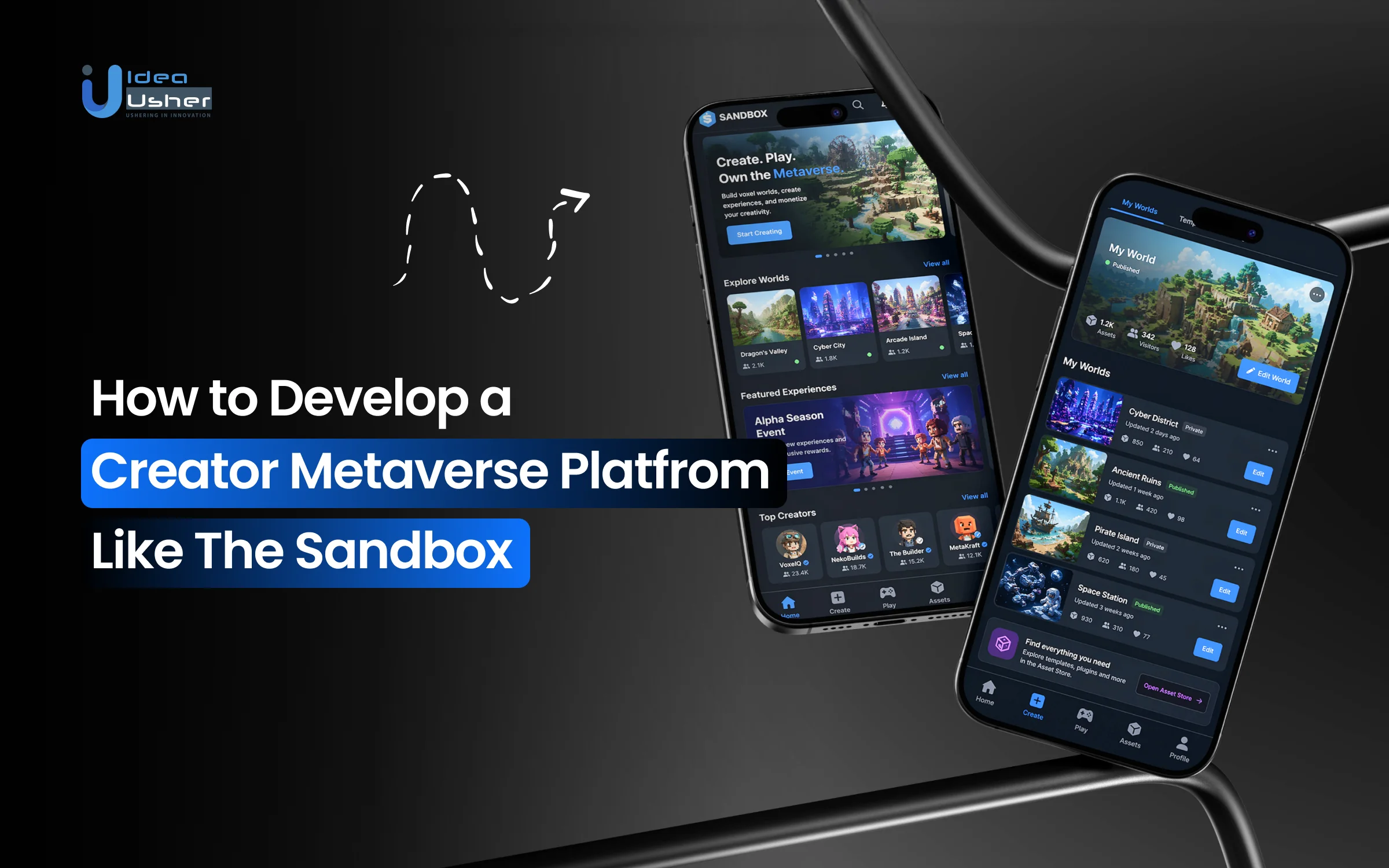
In this blog, we will explore the core features, architecture, costs and development process required to build a platform like The Sandbox where Idea Usher will also guide you with the key technologies, monetization opportunities involved in creating a scalable blockchain-powered virtual gaming ecosystem.
Why Creator Metaverse Platforms Are Winning in 2026
The metaverse landscape is shifting from closed entertainment systems to open economic engines, with the market expected to grow from USD 105.4 billion in 2024 to USD 936.57 billion by 2030 at a 46.4% CAGR. The Metaverse transitioned from a buzzword into a stable creator-centric economy in 2026 and the key trend is a move toward decentralized, creator-owned worlds.

The platforms dominating the landscape today like Roblox, The Sandbox and Wilder World share a common DNA and succeed by providing tools for user-driven content. The creator economy is set to top $313 billion by 2026 with much of this value coming from immersive 3D spaces.
- Low Barriers to Entry: AI-powered world-building tools now allow users to generate complex environments and assets using simple voice or text prompts, effectively making every player a potential developer.
- Interoperability: Unlike the walled gardens of the past, 2026’s winning platforms allow creators to move digital assets (like 3D avatars or wearables) across different virtual worlds via blockchain standards.
- Monetization First: Platforms are no longer just games; they are business engines. Top creators are now Creator-Entrepreneurs, running full-scale studios within these ecosystems.
A. Users Want Ownership, Not Just Gameplay
The primary differentiator for users in 2026 is sovereignty. Traditional gaming followed a rented model: you pay for a skin, but the studio owns it. Today’s users demand more:
- Verifiable Ownership: Through NFTs and blockchain ledgers, players have legal and technical proof of ownership over their digital assets. If a platform shuts down, the asset remains in their wallet.
- Governance Power: Many platforms now operate as DAOs (Decentralized Autonomous Organizations). In projects like Decentraland, token holders vote on platform updates, fee structures and even land zoning.
- Resale Markets: The ability to sell a rare digital item or a developed plot of land on secondary markets has turned play into a form of investment.
B. Why Brands Are Investing in Virtual Land Worlds
Virtual real estate has become a standard line item in marketing budgets in 2026. Brands like Adidas, Gucci and Nike are no longer just testing the waters; they are building permanent digital flagships.
| Brand Strategy | Objective | Example |
| Virtual Showrooms | Global retail without physical overhead. | Interactive 3D storefronts where users try on digital twins of real clothes. |
| Experience-Based Ads | Replacing static banners with immersive quests. | A car brand building a racing circuit on their virtual land to showcase handling. |
| Phygital Rewards | Linking virtual land events to physical products. | Attending a virtual concert on a brand’s land unlocks a discount code for local physical stores. |
C. How Creator Economies Drive Long-Term Growth
The reason these platforms are winning while traditional social media usage fluctuates is the flywheel effect of the creator economy.
- Retention through Contribution: When a user builds a house, a game, or a fashion line in a world, they are far less likely to leave it. Their digital sweat equity creates high switching costs.
- Constant Content Freshness: A platform with 10,000 active creators updates its content faster than any professional studio ever could. There is always something new to see.
- Economic Resilience: Even during market downturns, the internal economies of these worlds persist because they are driven by peer-to-peer trade, not just top-down advertising.
What Is The Sandbox and Why It Succeeded
The Sandbox is a decentralized virtual world where players build, own and monetize experiences on the Ethereum blockchain, achieving true digital sovereignty by ensuring every community-created item is an NFT owned by the creator.
Its growth as a thriving digital nation is fueled by its accessibility, with over 50% of its featured experiences now generated by the community rather than brands, effectively shifting the platform from a digital theme park into a creator-led ecosystem.

A Creator-Led Metaverse Built on Blockchain
The Sandbox succeeds because it solves the creator’s dilemma: how to get paid for the value you bring to a platform. By using the $SAND utility token, the platform facilitates a circular economy:
- Ownership: Every asset has a verifiable history and owner.
- Monetization: Creators earn 95% of the revenue from their sales.
- Governance: Landowners and $SAND holders vote on the future of the platform through the DAO.
B. The Three Pillar Architecture Behind Sandbox Growth
The Sandbox’s Three Pillars have effectively democratized game development, proving that when you give users the tools of production, they will build a world more diverse than any single studio could imagine.
1. Voxel Editor for 3D Asset Creation
VoxEdit is the starting point for the ecosystem. It is a simple yet powerful all-in-one 3D voxel modeling and NFT creation package.
- Modeling & Rigging: Users build objects (people, animals, foliage) out of voxels (3D pixels) and then give them a skeletal structure to allow for movement.
- AI Integration: In 2026, VoxEdit features AI-assisted rigging, which automatically creates realistic movement patterns for complex models, saving creators hours of manual work.
- Exportability: Once a model is finished, it is exported as an ASSET NFT, ready to be used or sold.
2. Marketplace for NFT Asset Trading
The Marketplace serves as the economic heart of the platform. It is a web-based portal where creators list their VoxEdit masterpieces.
- True Scarcity: Creators define the supply of their items (e.g., Legendary vs. Common), which dictates their value in the open market.
- Interoperability: Assets bought here are not just for one game; they can be used across any experience within The Sandbox ecosystem.
- Security: With the 2026 launch of SANDchain (a dedicated Layer-2 solution), transaction fees are nearly zero, making the trading of low-cost cosmetic items viable for everyone.
3. Game Maker for No-Code Experiences
The Game Maker is the final piece of the puzzle, allowing anyone to place their assets on a plot of LAND and turn them into an interactive game.
- No Coding Required: It uses a visual scripting system where users drag and drop behaviors (e.g., If player touches this, spawn an enemy) onto objects.
- Multiplayer Ready: By 2026, the Game Maker supports sophisticated multiplayer features including global leaderboards, social hubs and complex quest systems.
- Persistent Progress: Players can now save their progress across different community-created games, allowing for meta-narratives that span multiple creators’ worlds.

UGC Loop and Tokenomics Behind Sandbox like Creator Metaverse Platform
The User-Generated Content (UGC) Loop in The Sandbox is a self-sustaining cycle: Create → Tokenize → Monetize → Govern. Creators build assets and games tokenized as NFTs as they are sold for $SAND and it is used to buy more LAND or participate in the platform’s future via the DAO.

A. Easy Tools That Empower Non-Developers
The barrier between player and creator has vanished in 2026. The Sandbox provides a suite of no-code tools that allow anyone to build high-quality content:
- VoxEdit: A 3D modeling tool where voxels (3D pixels) are used like LEGOs. By 2026, it includes AI-assisted rigging, allowing users to animate complex movements by simply describing them.
- Game Maker: A visual scripting interface where users program games by dragging behaviors onto objects. No knowledge of any programming language is required to build a fully functional RPG or shooter.
B. True Ownership That Rewards Creators
The Sandbox operates on a 95/5 split unlike traditional platforms (e.g., Roblox) that take a significant cut of creator revenue
- Revenue Share: Creators keep 95% of all sales from their assets and experiences.
- Sovereignty: All assets are hosted on IPFS (a decentralized storage network). Even if The Sandbox servers went dark, the data for your digital assets would remain accessible via the blockchain.
C. Cross-Platform Assets With Real Utility
The launch of The Sandbox NEXT in early 2026 marked a shift toward true interoperability.
- Mobile & Console: Assets created in VoxEdit are no longer restricted to the desktop client. They are now optimized for mobile devices and integrated into third-party Unreal Engine 5 experiences.
- Avatar Interoperability: Your Sandbox NFT avatar can now be imported into other partner metaverses, maintaining its visual identity and stats across different worlds.
D. SAND Token for Payments and Governance
$SAND (ERC-20) is the lifeblood of the ecosystem, serving as the medium of exchange and a tool for platform direction.
- Transactional Utility: All LAND, ASSETS and Gems are priced in $SAND.
- Staking & Rewards: Users can stake $SAND to earn passive rewards and Gems/Catalysts, which are required to upgrade the rarity of their creations.
- The Sandbox DAO: $SAND holders vote on platform upgrades, foundation grants and which community games receive featured status on the map.
E. LAND NFTs for Virtual Real Estate
LAND (ERC-721) represents a physical piece of the digital world. With a hard cap of 166,464 plots, it is a scarce resource.
- Monetization: Landowners can charge $SAND for entry to their games, rent their land to brands, or host sponsored events.
- Estates: By combining multiple LAND plots, creators can build Estates to host larger-scale experiences like virtual festivals or corporate headquarters.
F. ERC-1155 ASSET Tokens for Digital Goods
While LAND uses the ERC-721 standard for unique properties, all in-game items (sword, tree, avatar skin) use the ERC-1155 standard.
- Efficiency: This standard allows creators to mint a single Smart Contract that covers both a unique 1-of-1 item and a batch of 1,000 common items, significantly reducing gas fees on the SANDchain Layer-2 network.
- Hybrid Utility: These tokens can behave as both fungible (currency-like) and non-fungible (unique) assets, making them perfect for complex in-game economies where items can be stacked or upgraded.
Core Features to Build a Platform Like Sandbox
The creator metaverse platform development demands a modular ecosystem blending blockchain, AI and creative tools into a seamless loop. Success requires the platform to act as a Foundational Layer, providing infrastructure for community content, thus moving from a product to a protocol.

1. NFT LAND Map With Buy-Sell Ownership Logic
The Map is the metaverse’s core visual base. It is an interactive grid fully synced with a blockchain ledger rather than a static image.
- The Grid System: Use a coordinate-based system (X, Y) where each Parcel is an ERC-721 NFT.
- Visual Interface: Implement a real-time rendering engine like Mapbox or React Three Fiber to allow users to zoom, pan and click on plots to see owner data, price history and live experience previews.
- Smart Contract Logic: The contract must handle Secondary Sales (automatic royalties for the platform) and Land Merging (combining adjacent plots into larger Estates).
2. Creator Studio Like VoxEdit for 3D Assets
A successful platform needs a dedicated Art Engine. While voxel art is popular for its accessibility, the key is the rigging and animation pipeline.
- Voxel/Poly Modeler: A lightweight tool that allows users to build with 3D pixels or low-poly meshes.
- AI-Assisted Rigging: Studio features should provide AI-driven utilities for automatic skeletal rigging of 3D models, allowing a user to upload a static mesh and immediately apply pre-set animations like run, dance or fight.
- IPFS Integration: When a creator saves an asset, it should automatically upload to decentralized storage (like IPFS or Arweave) and mint as an ERC-1155 token.
3. No-Code Game Builder Like Game Maker
This is the logic layer where users can design interactive and complex gameplay mechanics through intuitive no-code tools without writing a single line of code.
- Visual Scripting: A behavior system where users drag logic onto objects (e.g., If Player enters Trigger Zone → Play Sound & Spawn Enemy).
- Global Templates: Provide game presets (Racing, RPG, Social Hub) so creators aren’t starting from a blank canvas.
- Local Simulation: A play mode within the editor that allows for instant testing before publishing the experience to their LAND.
4. NFT Marketplace for Assets and Experiences
The NFT marketplace is your economy’s town square and needs to support high-frequency, low-fee trading.
- Dual-Asset Support: Support for both ASSETS (items used in-game) and EXPERIENCES (permission to access a specific game or event).
- Layer-2 Scalability: Transactions must occur on a fast network (like Polygon, Arbitrum, or a custom AppChain) to ensure gas fees don’t exceed the price of a $2 digital hat.
- Royalty Enforcement: On-chain logic ensures that every time a creator’s item is resold, they receive a 5–10% cut automatically.
5. Wallet Login and Token Payment Support
Seamless wallet login, token payments and fiat onboarding simplify access, improve adoption and create frictionless user experiences platform-wide.
- Account Abstraction: Allow users to log in via Email or Socials (using tools like Magic.link or Privy). Behind the scenes, a smart wallet is created for them.
- Native Token Utility: The ecosystem should have a primary utility token (like $SAND) for all internal transactions, staking and governance.
- Fiat On-Ramps: Integrated buy buttons that allow users to purchase your token directly with a credit card without leaving the platform.
6. Avatar Profiles, Social Hubs, Live Chat
Social avatars, live chat and shared hubs create immersive communities that keep users engaged beyond gameplay experiences daily.
- Universal Avatars: Support for Ready Player Me or similar standards so users can bring their identity from other worlds.
- Spatial Audio: Implement proximity-based voice chat where the volume of other players changes based on how close your avatar is to theirs.
- Global Social Hubs: Permanent, platform-owned areas where users can meet, show off skins and find portals to community-created games.
7. Events, Quests, Rewards and Missions
Events, quests and rewards boost retention by motivating users to return, participate and earn valuable incentives regularly.
- Mission Engine: A backend that tracks user actions (e.g., Talk to 3 NPCs, Find the Hidden Key) and triggers a reward once completed.
- On-Chain Rewards: Use a claim system where finishing a season or quest-line allows the user to mint a limited-edition badge or earn a small amount of your utility token.
- Live Events API: Tools for brands to host live-streamed concerts or product launches that sync with the 3D environment (e.g., the lights in the game change based on the music’s BPM).
Advanced Features to Outperform Sandbox
The 2026 landscape has moved beyond manual voxel placement. Successful creator metaverse platform development now depends on how quickly a user can move from imagination to instantiation. If a platform requires 40 hours of manual work to build a single quest, it will lose to platforms that use generative intelligence to do the heavy lifting.

1. AI World Builder for Faster UGC Creation
AI world builders accelerate content creation by generating environments, NPCs and assets through simple prompts instantly.
- Prompt-to-World: Integrated LLMs (Large Language Models) and 3D Diffusion models allow creators to type, “Build a neo-tokyo alleyway with neon signs and rainy puddles” and see the environment generated in real-time.
- AI NPC Generation: Instead of scripting every dialogue line, creators now give NPCs a Personality Profile (e.g., Grumpy Blacksmith with a secret) and the AI handles dynamic, unscripted voice and text interactions with players.
- Semantic Asset Search: Finding a specific 3D model in a library is replaced by an AI that understands context, suggesting assets that fit the vibe of the current build.
2. Mobile Metaverse App With Cross-Play Access
The desktop-only era of high-end metaverses is over. Users expect to manage their digital lives on the go and can access from different devices.
- Unified Engine: Using frameworks like Flutter or Unity’s 2026 Mobile Pipeline, platforms now offer a 1:1 visual experience between a gaming PC and a high-end smartphone.
- Social-First Onboarding: Users can enter a world via a Deep Link in a social media message, hopping into a 3D space instantly without a 5GB download, thanks to cloud-streaming technology.
- Passive Interaction: While on mobile, users can check in on their virtual land, collect rewards from their automated shops, or chat with community members via an integrated 2D social interface.
3. Creator Revenue Analytics Dashboard
Creators in 2026 are businesses and they demand the same level of data that an e-commerce giant would use.
- Heatmaps & Traffic Flow: See exactly where avatars are spending time on your LAND. If players are walking past your shop without entering, the data will show you the drop-off point.
- Conversion Tracking: Real-time data on which ASSETS are being clicked, tried on and purchased.
- Churn Prediction: AI-driven insights that warn creators when their community engagement is dipping, suggesting Events or Airdrops to re-engage users.
4. Brand Spaces for Ads and Virtual Commerce
Brand spaces combine advertising and commerce through interactive experiences, personalized promotions, virtual shopping and new revenue opportunities.
- V-Commerce (Virtual Commerce): Integrated checkout systems where buying a digital Nike shoe for your avatar can automatically trigger the shipment of a physical pair to your real-world home.
- Dynamic Ad Placement: Ad spaces on LAND that change based on the viewer’s profile (e.g., a car enthusiast sees a Porsche, while a gamer sees an Alienware ad), with revenue shared between the platform and the Landowner.
- Brand AI Assistants: Every brand space features a Virtual Concierge that can answer product questions, handle returns and offer personalized styling advice.
5. AR Land Preview for Real-World Promotion
AR land previews connect physical and virtual worlds through immersive promotions, location-based experiences and interactive real-world engagement.
- Geo-Spatial Overlay: Using a smartphone, a Landowner can stand on a real-world street corner and see their virtual building overlaid onto the physical world via AR.
- Digital Twins: Many platforms are creating Mirror Worlds. If you own a plot of LAND that corresponds to a real-world location (like a park in London), you can use AR to leave Digital Graffiti or Virtual Pop-up Shops that only users with the app can see.
- Phygital Portals: QR codes in the real world that, when scanned, open a window on your phone screen into the virtual version of that exact location, allowing for seamless cross-world marketing.
How to Develop a Creator Metaverse Platform Like The Sandbox
The creator metaverse platform development has evolved into a disciplined engineering lifecycle merging game dev, DeFi and generative AI to create virtual ecosystems. Current strategies prioritize Mixed Reality First and modular blockchain architectures, ensuring accessibility across all devices while providing near-zero transaction costs.

1. Discovery, Goals and Feature Planning
Establishing a clear platform vision and core user loop is essential to ensure that every technical feature serves a specific community need from day one.
- The Core Loop: Define how creators build, how players consume and how the token facilitates the exchange.
- Technical Benchmarking: Choosing between high-fidelity (Unreal Engine 5) or high-accessibility (WebGL/Unity). In 2026, most platforms opt for Hybrid Rendering to support both.
- ROI Modeling: Planning the platform’s revenue streams (e.g., a 5% marketplace fee) to ensure long-term sustainability without overcharging creators.
2. UI/UX Design for Worlds and Creator Tools
Metaverse UX must serve both Players and Architects, balancing seamless navigation with professional-grade creative precision.
- Immersive Player UX: Focusing on spatial UI menus that exist within the 3D world rather than flat overlays.
- Creator Tool Ergonomics: Ensuring that tools like the World Builder feel as intuitive as a social media app. This includes Natural Language UI, where creators can speak changes into existence.
3. 3D Asset Pipeline and World Prototyping
Establishing the art bible is critical to ensure a cohesive look across thousands of community-built assets.
- Standardized Specs: Setting limits on polygon counts and texture sizes to ensure the world runs smoothly on mobile devices.
- AI-Assisted Rigging: Setting up a pipeline where any uploaded 3D model is automatically bonded and animated by an AI agent, allowing non-animators to create living characters.
- The Greybox Phase: Prototyping the main social hubs in low-fidelity to test player flow and gravity points (where people naturally congregate).
4. 3D World, Marketplace and Backend Build
This phase involves the high-performance engineering of the virtual environment and its supporting server-side infrastructure.
- Spatial Partitioning: Building a backend that can handle Mega-Instances allowing thousands of players to see each other in the same space without crashing.
- Marketplace Architecture: Developing a web-based and in-game portal for trading. By 2026, these are usually Headless Marketplaces, meaning the same inventory can be accessed from a browser, a VR headset, or a mobile app.
5. Blockchain, NFT and Token Integration
The Trust Layer establishes value by securing digital scarcity, verifying authentic asset ownership and ensuring transparent, immutable transactions through decentralized blockchain protocols.
- Modular Blockchain Choice: Integrating with an L2 or L3 (like an Arbitrum Orbit chain) to ensure that minting a new digital hat costs a fraction of a cent.
- Account Abstraction: Implementing Gasless transactions so players don’t need to know what a private key is, they just log in with their email and the blockchain works in the background.
6. Economy Balancing and Reward System Setup
A metaverse lives or dies by its inflation, as the balance between token supply and actual utility determines whether the virtual economy remains a sustainable engine for growth or a collapsing speculative bubble.
- Sinks and Faucets: Designing Sinks (where tokens are spent/burned, like land taxes or cosmetic upgrades) and Faucets (where tokens are earned, like quest rewards).
- AI Economy Monitoring: Platforms use AI agents to simulate millions of transactions before launch to stress-test the economy against hyperinflation or market manipulation.
7. QA Testing and Performance Checks
The most scrutinized phase in the 2026 landscape because it ensures the technical integrity and economic security of the decentralized world before public access.
- Smart Contract Audits: Having third-party firms (like OpenZeppelin or CertiK) verify that the land and token contracts are unhackable.
- Anti-Cheat and Governance: Implementing decentralized moderation tools and AI-driven Griefing detection to keep the community safe.
- Cross-Device Stress Testing: Ensuring a user on a $200 smartphone has a comparable experience to a user on a $3,000 VR rig.
8. Launch, Scaling and Post-Launch Support
The metaverse is a living organism that evolves through continuous user contributions, seasonal updates and community-led governance to ensure long-term relevance and growth.
- The Genesis Drop: Often starting with a Land Sale or an Avatar Mint to seed the initial community.
- Live-Ops: A dedicated team managing seasons, global events and weekly quest updates to keep retention high.
- DAO Handover: Many 2026 platforms eventually transition control of the treasury and roadmap to the token holders, making the platform truly decentralized.
Creator Metaverse Platform Development Cost Breakdown
The creator metaverse platform development involves costs across design, development, blockchain integration, infrastructure and ongoing maintenance requirements. The table below outlines the estimated cost breakdown for each stage to help plan your development budget effectively.
| Development Phase | Estimated Cost | Key Deliverables |
| Discovery & Strategic Planning | $3,500 – $5,500 | Requirement Specification (SRS), Technology Stack Selection, Architecture Diagram |
| UI/UX Design | $7,000 – $10,000 | Mobile/Desktop Wireframes, 3D HUD (Heads-up Display) Design, Navigation Flow |
| 3D Asset Pipeline | $10,000 – $15,000 | Low-poly Character Base, 25-40 Standard Environmental Assets (Trees, Buildings, Props) |
| Core World Engine Build | $22,000 – $34,000 | Physics Engine, Avatar Movement, Multi-user Synchronization, Basic Terrain Rendering |
| Blockchain & NFT Integration | $17,000 – $28,000 | Web3 Wallet Connect (MetaMask/Social Login), ERC-721 Smart Contract for LAND, Minting Logic |
| Backend & Infrastructure | $6,000 – $9,000 | User Authentication, Real-time Database (Firebase/Supabase), WebSocket Server Setup |
| QA Testing & Deployment | $4,000 – $7,000 | Bug Tracking, Cross-device Compatibility Tests, Mainnet/Devnet Deployment |
| TOTAL ESTIMATED COST | $63,500 – $118,500 | Functional Proof-of-Concept ready for User Feedback |
Note: The above creator metaverse platform development costs are based on 2026 market standards for specialized development teams. Final pricing may vary based on specific feature complexity and the geographic location of the engineering team.
- MVP Proof-of-Concept ($60,000 – $120,000): Core functional build featuring a basic 3D land grid, single-wallet integration, simple NFT minting and essential avatar movement.
- Mid-Scale with Marketplace ($150,000 – $450,000): Community-focused tier including a custom NFT marketplace, social features, utility tokenomics and basic no-code editing tools.
- Enterprise Ecosystem ($500,000 – $1M+): High-end Sandbox competitor with advanced AI creation tools, cross-platform play, DAO governance and scalable Layer-2 architecture.
Factors That Increase Budget and Timeline
Several technical variables can influence the overall timeline and cost of creator metaverse platform development, particularly when integrating cross-chain functionality
- Generative AI Implementation (+$30,000 – $65,000): Integrating text-to-3D or AI-driven NPC dialogue adds significant backend complexity and requires specialized API subscriptions or custom model training, typically extending the timeline by 8 to 12 weeks.
- Multi-Chain Interoperability (+$12,000 – $25,000): Supporting more than one blockchain (e.g., Ethereum + Polygon) requires redundant smart contract deployment and bridge logic, adding roughly 4 to 6 weeks to the development cycle.
- High-Security Smart Contract Audits (+$15,000 – $35,000): Professional third-party security audits are mandatory for platforms handling financial transactions. These audits can take 3 to 5 weeks and often require subsequent code revisions.
- Full VR/AR Cross-Play (+$20,000 – $45,000): Optimizing the 3D environment for VR headsets while maintaining performance on mobile devices requires a dual-rendering pipeline, which can increase front-end development hours by 35% to 50%.
- Advanced Anti-Cheat & Moderation (+$8,000 – $18,000): Implementing real-time monitoring and automated reporting tools for user behavior in a 3D space adds another 3 to 4 weeks to the backend development.
Tech Stack for Creator Metaverse Development
Selecting the right technology stack is the most critical decision for scalable creator metaverse platform development. The infrastructure must handle real-time 3D rendering, decentralized asset ownership and high-concurrency social interactions simultaneously.
| Component | Recommended Technology | Strategic Value |
| Unity or Unreal | Unity (for mobile/cross-platform) or Unreal Engine 5 (for high-fidelity) | Acts as the main engine. Unity provides device versatility, while Unreal 5 delivers high-fidelity visuals. |
| Creator Platform Frontend | React.js with Next.js | Powers the web dashboard and marketplace, ensuring fast, responsive user interfaces. |
| NFT Ownership | Polygon (zkEVM or PoS) | Manages LAND/ASSET ledgers. Polygon offers superior speed and lower fees than Ethereum L1. |
| Backend Development | Node.js with Socket.io or NestJS | Handles the logic layer, multiplayer synchronization and efficient chat system integrations. |
| Data Storage | PostgreSQL (Relational) or MongoDB (NoSQL) | PostgreSQL manages structured accounts/logs; MongoDB stores flexible 3D asset metadata. |
| Performance and Scaling | AWS (S3, EC2, CloudFront) | AWS S3 hosts 3D files, with CloudFront CDN providing low-latency global delivery. |
| Secure Wallet and Payment Integrations | MetaMask, WalletConnect and Stripe | Forms the trust layer, enabling Web3 logins and multi-currency (crypto/fiat) asset purchases. |
Multiplayer Server Architecture of Creator Metaverse
A robust networking layer ensures real-time synchronization of player actions across devices. Replacing monolithic servers with distributed architecture enables dynamic scaling based on density, which is a critical requirement for high-performance creator metaverse platform development.
A. Spatial Partitioning for Optimized Data Flow
Standard servers fail under heavy user loads. Spatial partitioning addresses this by segmenting the world into interest zones, only updating users on their immediate surroundings. This minimizes data packets, avoids bandwidth bottlenecks and maintains responsiveness during high-traffic events like concerts.
B. Distributed Server Logic with Photon and SpatialOS
The choice between a session-based engine and a persistent world engine dictates the platform’s long-term scalability.
- Photon (Fusion/Quantum): This is ideal for fast-paced and high-performance interactions where low latency is the top priority. It uses a tick-based system that is perfect for competitive mini-games within the metaverse.
- SpatialOS: This allows for seamless worlds by stitching multiple server nodes together. It enables a persistent environment where changes made by one player are saved and visible to others across the entire map, regardless of the server load.
C. Latency Mitigation and Real-Time Synchronization
Immersion relies on minimizing delays. Developers use Client-Side Prediction and Server Reconciliation to ensure a lag-free experience. The device predicts inputs locally while the server validates them, correcting any discrepancies to maintain smooth gameplay even with imperfect connections.
D. Comparison of Multiplayer Networking Solutions
Choosing the right multiplayer networking solution depends on scale and performance. This comparison highlights the technical trade-offs essential for high-performance creator metaverse platform development to guide your architectural decisions.
| Feature | Photon Fusion | SpatialOS | Mirror (Open Source) |
| Best For | Fast-paced session games | Massive persistent worlds | Small-scale indie projects |
| Scaling | Vertical scaling per room | Horizontal scaling across nodes | Manual server management |
| Complexity | Moderate | High (Custom architecture) | Low to Moderate |
| Ownership | Proprietary Cloud | Proprietary Managed | Fully Self-Hosted |
Monetization Strategies for a Sustainable Creator Metaverse
Monetization has shifted toward high-utility revenue streams and blockchain cycles. This persistent virtual commerce rewards creators and developers, providing a sustainable foundation for creator metaverse platform development.
1. Virtual Land Sales
Parcels and estates auctions provide foundational revenue and land value depends on utility and hub proximity in 2026. Through Genesis Drops or phased auctions, scarce ERC-721 NFT plots establish the platform’s economy.
2. Marketplace Transaction Fees
The platform maintains steady revenue by taking a 2.5% to 5% commission on secondary market trades. These fees from creator sales of 3D assets, wearables, or virtual land are redirected to the platform treasury, directly linking developer benefits to the vitality of the creator economy.
3. Token Valuation and Governance Utility
Native cryptocurrency appreciation incentivizes early and long-term participants. Used for transactions, governance and staking, the token’s rising demand increases treasury valuation, providing essential capital for further ecosystem development.
4. Brand Partnerships and Advertising
Selling virtual land and branded experiences has become a multi-billion dollar industry. Companies invest in immersive Experience-based Ads, building interactive quests and stores rather than static banners. These Phygital integrations enable brands to sell both digital and physical goods.
5. Creator Subscriptions or Tool Licensing
While the basic creation tools are free, premium features for power creators offer a recurring revenue stream. Advanced creators pay for Pro versions of the Voxel Editor or Game Maker which include AI-powered asset generation, advanced analytics dashboards and higher limits for concurrent players in their custom experiences.
6. Play-to-Earn Mechanics and Event Fees
The platform earns commission from events and competitive play. When creators host tournaments or concerts, the platform manages prize distribution and collects fees from ticket sales or prize pools.
Key Challenges in Creator Metaverse Platform Development
The creator metaverse platform development in 2026 requires navigating a complex intersection of economic stability, community safety and technical accessibility. While the potential for growth is immense, developers must address several structural hurdles to ensure long-term sustainability and mass-market adoption.

1. Balancing Economy and Token Inflation
Challenge: Excess token supply from rewards often outpaces utility, leading to value dilution and a collapsing ecosystem that discourages long-term investment.
Solution: Our developers implement automated burn mechanisms and tiered staking sinks. We balance token emissions with mandatory fees for land upgrades and exclusive marketplace access to maintain healthy asset scarcity.
2. Moderating User Generated Content at Scale
Challenge: Decentralized platforms face significant risks from inappropriate or copyrighted content, which can damage brand reputation and lead to complex legal hurdles.
Solution: We integrate AI-driven vision models for real-time asset screening. Our developers also build community-led governance tools where trusted users earn rewards for flagging and validating content quality.
3. Retaining Users Beyond Initial Hype
Challenge: Many metaverses see a sharp decline in activity after the initial novelty wears off, failing to provide consistent and engaging experiences.
Solution: We design seasonal live-ops and dynamic quest systems. Our developers focus on social-first infrastructure, ensuring users have persistent reasons to return through evolving community events and brand partnerships.
4. Blockchain UX for Mainstream Users
Challenge: Complexities like seed phrases, gas fees and wallet signatures create high friction, often scaring off non-technical users from participating.
Solution: Our developers utilize account abstraction to allow simple email logins. We integrate gasless transactions on Layer-2 networks, making the blockchain layer invisible while maintaining all the benefits of true ownership.
Why Founders Choose IdeaUsher for Creator Metaverse Platform
With an 11-year track record of engineering intelligence at scale, IdeaUsher provides the technical maturity required to navigate the volatile Web3 landscape. Here is why industry leaders trust IdeaUsher to turn their metaverse concepts into high-performance digital economies.
A. Proven Experience in Web3 Product Delivery
IdeaUsher has delivered 1,000+ projects for 500+ global brands including Veelive, a 3D virtual city with an NFT marketplace and dual-token economy on Polygon. Their expertise spans decentralized markets and DeFi, shipping secure, audit-ready Web3 products capable of supporting thousands of users instantly.
B. Dedicated Teams for Design to Launch
Metaverse development is a multidisciplinary effort and IdeaUsher provides a “one-stop-shop” approach with a roster of 250+ niche experts from ex-FAANG/MAANG. Founders benefit from a dedicated team that manages the entire lifecycle:
- Discovery & Design: Creating immersive UI/UX wireframes and 3D world architectures.
- Core Engineering: Implementing high-concurrency multiplayer networking and spatial audio.
- Security & Deployment: Conducting rigorous smart contract audits to ensure zero vulnerabilities before going live on the mainnet.
C. Custom Builds Instead of Clone Templates
IdeaUsher avoids insecure “clone scripts” by prioritizing bespoke development. Through clean, custom-coded foundations, they bypass template restrictions to integrate unique features like AI-driven NPCs or v-commerce, ensuring your platform stands out in the metaverse market.
D. Post-Launch Growth and Scaling Support
Launching is just the beginning; the real challenge is scaling. IdeaUsher boasts a 95% client retention rate because they don’t walk away after the product goes live. They offer comprehensive post-launch support including:
- Infrastructure Scaling: Utilizing AWS and cloud-native solutions to handle traffic surges.
- Staff Augmentation: Providing on-demand access to specialized AI and blockchain engineers as your needs evolve.
- Continuous Optimization: Regularly updating the 3D environment and refining the tokenomics based on real-time user data.
Build Your Sandbox-Like Platform With IdeaUsher
The transition from a conceptual Metaverse to a high-revenue Creator Economy requires a strategic partnership rather than just code. IdeaUsher removes technical blockchain and 3D complexities, letting you focus on your virtual vision.
A. Launch Faster With Pre-Vetted Experts
The talent gap for specialized metaverse engineers is at an all-time high. IdeaUsher bridges this gap by providing immediate access to a dedicated team of 250+ specialists who have already solved the hard problems of Web3.
- Engineers: Experts in Unity and Unreal Engine 5 for cross-platform rendering.
- Blockchain Architects: Specialists in Layer-2 scaling (Polygon, Arbitrum) and ERC-1155 asset standards.
- AI Integration Leads: Developers who can implement text-to-3D tools and dynamic NPC behaviors.
- Economy Designers: Mathematicians who stress-test your tokenomics to ensure long-term stability.
B. Get a Custom Roadmap and Cost Estimate
Generic templates lead to generic results. We provide a tailored, phase-by-phase roadmap designed to maximize your budget and hit your milestones.
- Discovery Phase: We define your core loop and select the tech stack that fits your specific user count and fidelity goals.
- Technical Blueprint: You receive a detailed architecture map including your smart contract logic and multiplayer server structure (Photon/SpatialOS).
- Transparent Costing: No hidden fees. We provide a granular breakdown of your MVP vs. Enterprise costs, ensuring your investment is aligned with your scaling strategy.
C. Start Your Creator Metaverse Today
The 2026 metaverse landscape is moving toward Sovereign Ownership. The window to establish yourself as a foundational platform is now.
- Consultation: Speak directly with our lead architects to vet your idea.
- Prototype: Move from a pitch deck to a greybox prototype in weeks, not months.
- Market Entry: Leverage our 95% retention rate and post-launch support to scale from your first 1,000 users to your first 1,000,000.
Ready to architect your digital nation? Let’s set up a technical deep dive to see how we can turn your land-sale vision into a functional reality.
Conclusion
Building a platform like The Sandbox requires a balanced mix of immersive design, creator-friendly tools, secure blockchain systems, and scalable multiplayer infrastructure. Long-term success comes from empowering users to create, own, and monetize digital experiences while sustaining an active in-platform economy. As demand for virtual ownership and user-generated ecosystems grows, creator metaverse platform development is becoming a strong opportunity for businesses looking to build engaging digital communities and future-ready revenue models.
FAQs
A.1. A successful platform requires three core pillars: a user-friendly 3D asset editor, a decentralized marketplace for trading digital goods, and a no-code game engine that allows users to build interactive experiences.
A.2. Integrating blockchain ensures true digital ownership through NFTs, facilitates secure peer-to-peer transactions via native tokens, and establishes a transparent governance model where the community influences the future development of the virtual ecosystem.
A.3. The creator metaverse platform development cost varies between $60,000 – $500,000, based on feature complexity, multiplayer requirements, and blockchain integration. Primary budget drivers include UI/UX design, smart contract auditing, 3D modeling pipelines, and robust server architecture for real-time synchronization.
A.4. Sustainability is achieved through a mix of virtual land sales, marketplace transaction fees, brand partnerships for immersive advertising, and premium subscriptions for advanced creator tools or exclusive digital assets and events.


