

Key Takeaways
- Illuvium proves players now prefer gameplay-first Web3 worlds, not token-only ecosystems.
- It combines AAA graphics, open-world exploration, PvP battles, NFTs, staking, land economy, and DAO governance.
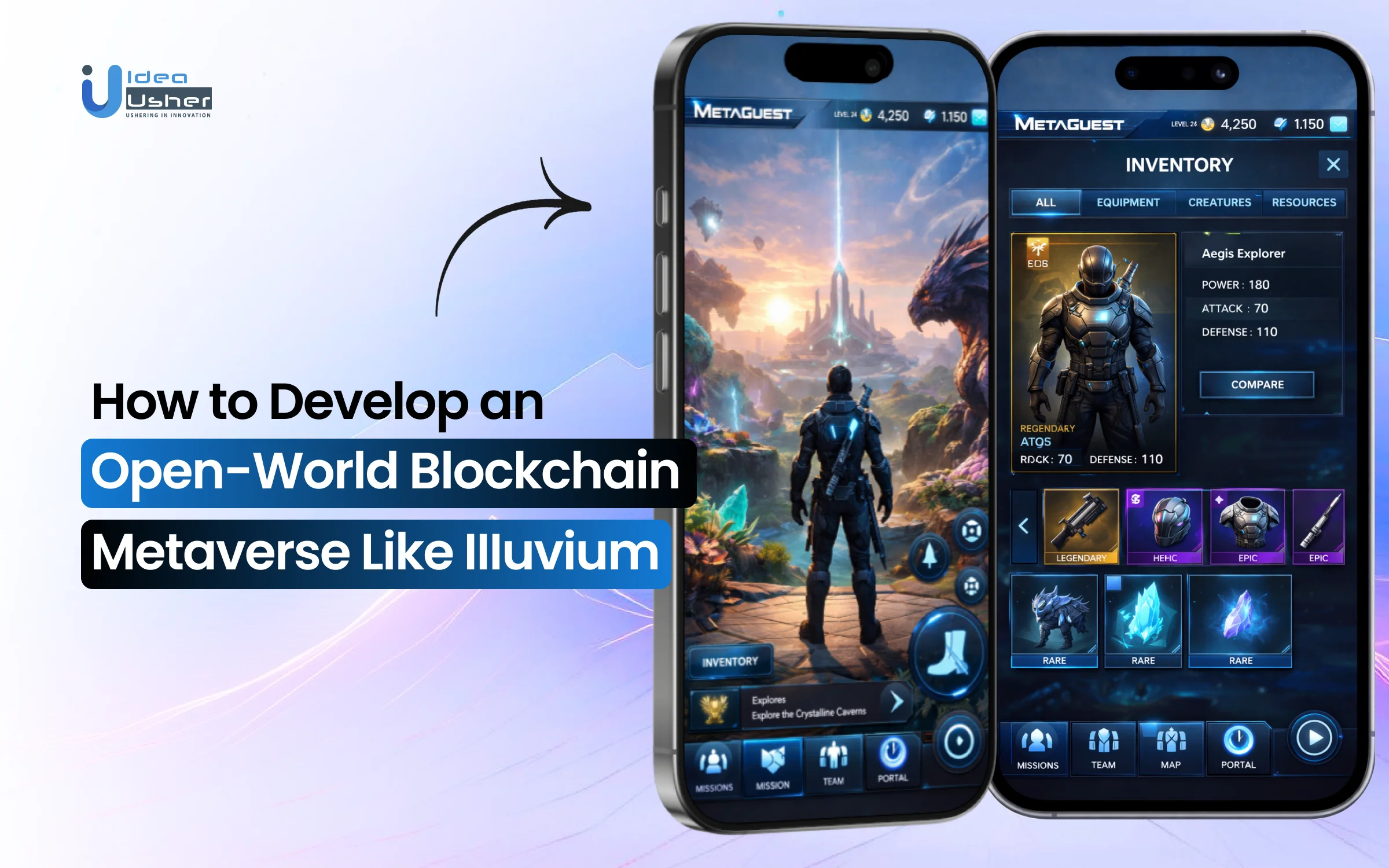
- Core ecosystem includes Overworld for exploration and creature capture, Arena for PvP auto-battler combat, Zero for land and resources, and Beyond for avatars and digital identity.
- Key success factors behind Illuvium include Unreal Engine 5 visuals, a play-to-own economy, shared assets across multiple games, zero gas fees via Immutable X, and strong community governance.
- Essential features include open-world maps, NFT creature capture, PvE quests, PvP arenas, trading marketplaces, land economies, wallet onboarding, staking dashboards, and DAO governance.
Most blockchain games were built around token mechanics when users were actually looking for better worlds. That shift is redefining blockchain metaverse game development where players no longer stay for rewards alone and expect exploration, ownership, progression and social experiences that make digital economies feel meaningful.
Early Web3 games prioritized emissions and short-term incentives, but users now seek open environments, strategic gameplay and assets with real in-game purpose. Illuvium reflects this shift by combining open-world exploration, collectible assets, competitive systems and blockchain ownership, creating platforms where engagement comes from gameplay depth and monetization expands through assets, marketplaces and premium experiences.
In this blog, we will talk about core features, architecture, costs and the development process to build a platform like Illuvium where economies support gameplay instead of replacing it.
Why Illuvium Is Redefining Web3 Gaming
Illuvium is shifting the perception of decentralized entertainment by proving that high-end production can coexist with transparent digital economies. It serves as a primary example of how to merge complex financial layers with an engaging user experience.
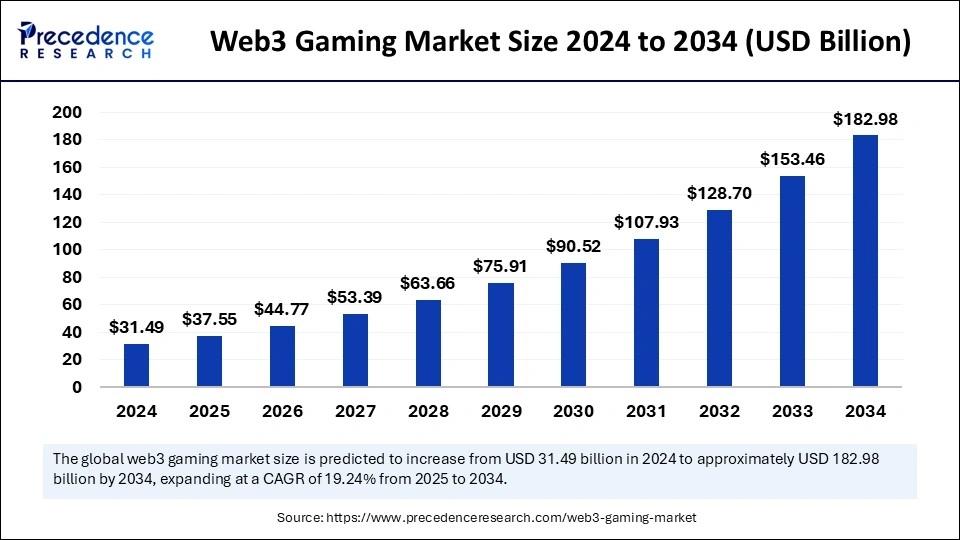
The global web3 gaming market size was calculated at USD 31.49 billion in 2024 and is predicted to increase from USD 37.55 billion in 2025 to approximately USD 182.98 billion by 2034, expanding at a CAGR of 19.24% from 2025 to 2034. This rapid valuation surge highlights the massive commercial potential currently driving blockchain metaverse game development.
A. AAA Graphics Meets Web3 Ownership
The visual quality of a digital world often determines its long-term value. Illuvium utilizes Unreal Engine to create a cinematic environment that stands apart from the pixelated or simplistic designs common in early blockchain projects. This focus on high-fidelity aesthetics creates a more believable world where digital assets feel substantial and worth holding.
- Visual Integrity: High-resolution textures and fluid animations make the world feel alive.
- True Digital Rights: Every character or item is a unique asset held in the user’s private wallet.
- Market Value: Superior design translates to higher demand in secondary trading markets.
B. Moving From Play-to-Earn to Play-to-Own Models
The industry has shifted from unstable Play-to-Earn loops to a Play-to-Own (P2O) philosophy. This 2026 model prioritizes asset value and gameplay over speculation, ensuring long-term sustainability by rewarding genuine player engagement and digital ownership.
- Sustainable Asset Value: Players are motivated to acquire assets because they have functional utility and rarity, not just for immediate cash-outs.
- Risk-to-Earn Mechanics: High-level rewards are tied to skill-based achievements and strategic staking, ensuring that value is distributed to active contributors.
- Long-term Retention: By focusing on ownership, the platform builds a community of collectors and competitors who are invested in the ecosystem’s longevity.
- Economic Stability: Shifting to ownership-first ensures the economy is driven by the game’s content and land development which is essential for building a platform that lasts in the modern market.
C. Multi-Game Ecosystem With Shared Assets
The strength of a metaverse lies in its ability to connect different experiences rather than keeping them in silos. Illuvium does not limit itself to a single genre and offers a suite of games that all utilize the same collection of characters and items, significantly increasing the utility of every digital asset.
- Cross-Title Utility: Items found in the open-world RPG are directly usable in the strategic auto-battler and the city-builder.
- Unified Progression: Player achievements and asset growth carry over across the entire ecosystem.
- Broad Market Appeal: Different game styles attract diverse player demographics while maintaining a single, unified economy.
D. Zero Gas Fees With Layer-2 Scaling
High costs and slow speeds are often the biggest hurdles for people trying to use blockchain applications. Illuvium addresses this by using Immutable X which acts as a specialized highway on top of the Ethereum network. This setup allows for thousands of transactions to happen instantly without the burden of expensive network fees.
- Instant Trades: Buying or selling items happens in real time without waiting for block confirmations.
- Accessibility: Users can perform small transactions without worrying about fees eating their profits.
- Scalability: The infrastructure can handle a massive influx of users without slowing down or becoming more expensive.
E. Strong Community Governance Model
Traditional platforms are typically controlled by a single central entity, but Illuvium operates through a decentralized structure. This allows the people who use the platform to have a direct say in how it evolves, building a high level of trust and long-term loyalty through transparent decision-making.
| Governance Pillar | Function and Benefit |
| Voting Rights | Token holders can vote on game balance, new features and treasury spending. |
| Proposal System | Community members can submit formal improvements to be reviewed by the council. |
| Stakeholder Alignment | The model turns users into active participants who are motivated to help the platform succeed. |
What Is Illuvium and How Its Ecosystem Works?
Illuvium is a decentralized gaming universe that functions as a collection of interconnected experiences rather than a single standalone title. It combines the high production value of traditional gaming with a transparent, player-owned economy built on the Ethereum network. By integrating multiple game genres into one cohesive world, the platform ensures that every digital asset has purpose and value across various styles of play.
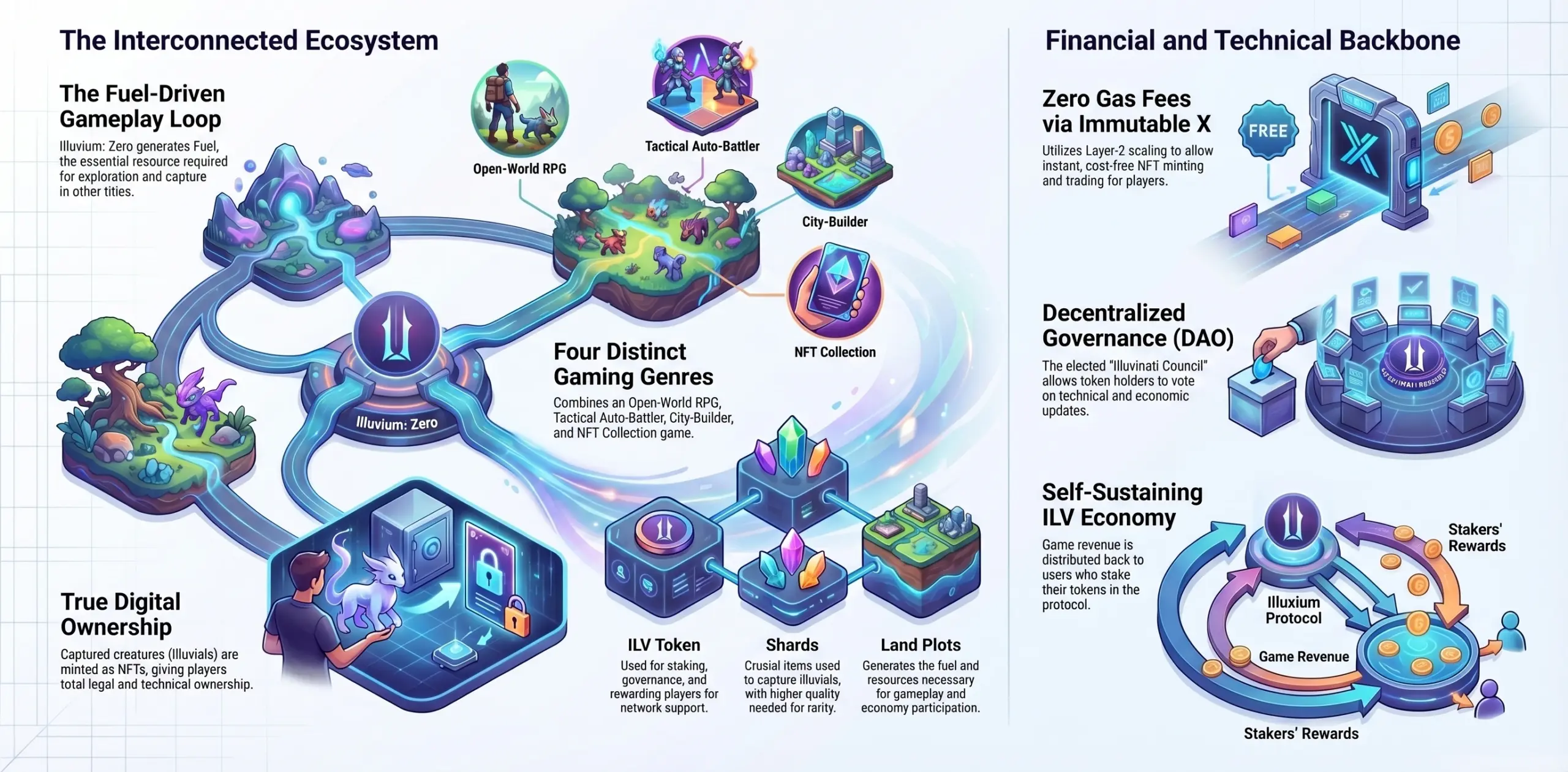
- Illuvium: Overworld: A 3D open-world RPG where players explore seven distinct alien regions to hunt and capture creatures (Illuvials).
- Illuvium: Arena: A tactical auto-battler where players use their captured Illuvials to fight in ranked or casual matches.
- Illuvium: Zero: A mobile-first industrial city-builder (land-based) that generates Fuel, the essential resource for the other two games.
- Illuvium: Beyond: A competitive NFT collection game (Illuvitars) that provides customizable avatars and leaderboard rewards.
A. Open-World Exploration With AAA Game Mechanics
The core experience of Illuvium centers on a vast, alien landscape where players explore diverse biomes to uncover the secrets of a shattered planet. Unlike many earlier blockchain projects that lacked depth, this platform utilizes advanced physics and exploration mechanics found in top-tier RPGs.
- Dynamic Environments: Players navigate complex terrain using jetpacks and advanced movement sets to find hidden resources.
- Resource Gathering: The world is filled with materials needed for crafting and upgrading, creating a constant loop of exploration and reward.
- Immersive Narrative: The game uses environmental storytelling and quests to keep users engaged with the lore, driving long-term retention.
B. NFT Illuvials, Battles and Player Ownership
The heart of the ecosystem resides in the Illuvials, deadly alien creatures that players track, defeat and capture. Once captured, these creatures are minted as NFTs, giving the player total legal and technical ownership of that specific asset.
| Asset / Feature | Utility in Ecosystem |
| In-game Currency | Used for native cryptocurrency transactions including wagering, battles, shard curing, revival, obelisk travel and enhancements. |
| Battle Arenas | A competitive environment where a matching engine ranks players by talent and difficulty to facilitate fair PvP combat. |
| Adventuring | The core gameplay loop for collecting in-game characters; integrates DAO and DeFi protocols for financial advantages and replay value. |
| Inbuilt DEX | A decentralized exchange hub for trading and obtaining all in-game characters with low gas expenses via DAO smart contracts. |
| Shards | Crucial items used to capture uncommon Illuvials; higher quality shards are required as game difficulty increases. |
| Illuvials | Used in strategic auto-battler combat and tradable on the open market. |
| Land Plots | Generates fuel and resources necessary for gameplay and economy participation. |
Combat is a strategic affair where players must understand elemental affinities and class synergies to win. This focus on strategy ensures that the value of an Illuvial is determined by its effectiveness in battle and its rarity, making the marketplace a competitive and active environment for collectors.
C. ILV Token Economy, Staking and DAO Control
The financial backbone of the platform is the ILV token which serves multiple roles from rewarding players to giving them a voice in the direction of the project. The economy is designed to be self-sustaining, with revenue generated by the game being distributed back to those who support the network.
- Staking Rewards: Users who lock their tokens in the protocol receive a share of the in-game revenue, aligning their success with the platform’s growth.
- Decentralized Governance: The Illuvinati Council, a group elected by token holders, makes decisions on technical updates and economic shifts.
- Liquidity Provision: High liquidity for the native token ensures that players can easily enter or exit their positions, maintaining a healthy financial environment.
D. Why Immutable X Powers Scalability and Zero Gas Fees
A metaverse must handle thousands of transactions without the high costs typically associated with Ethereum. Illuvium achieves this by utilizing Immutable X, a Layer-2 scaling solution that significantly improves the user experience.
This technology allows players to mint, trade and transfer NFTs instantly without paying any gas fees. By moving these transactions off the main Ethereum chain while still using its security for finality, the platform offers a seamless interface that feels like a traditional web application.
The Interoperable Game Universe (IGU) of Illuvium-like AAA Web3 Game
Constructing a high-end metaverse requires a shift from traditional isolated game design to a unified ecosystem where data and utility flow between different environments. The core of this blockchain metaverse game development architecture is the Interoperable Game Universe or IGU which ensures that a single digital asset remains functional and valuable across various gameplay modes.
A. Overworld vs. Arena: Structuring Multi-Game Assets
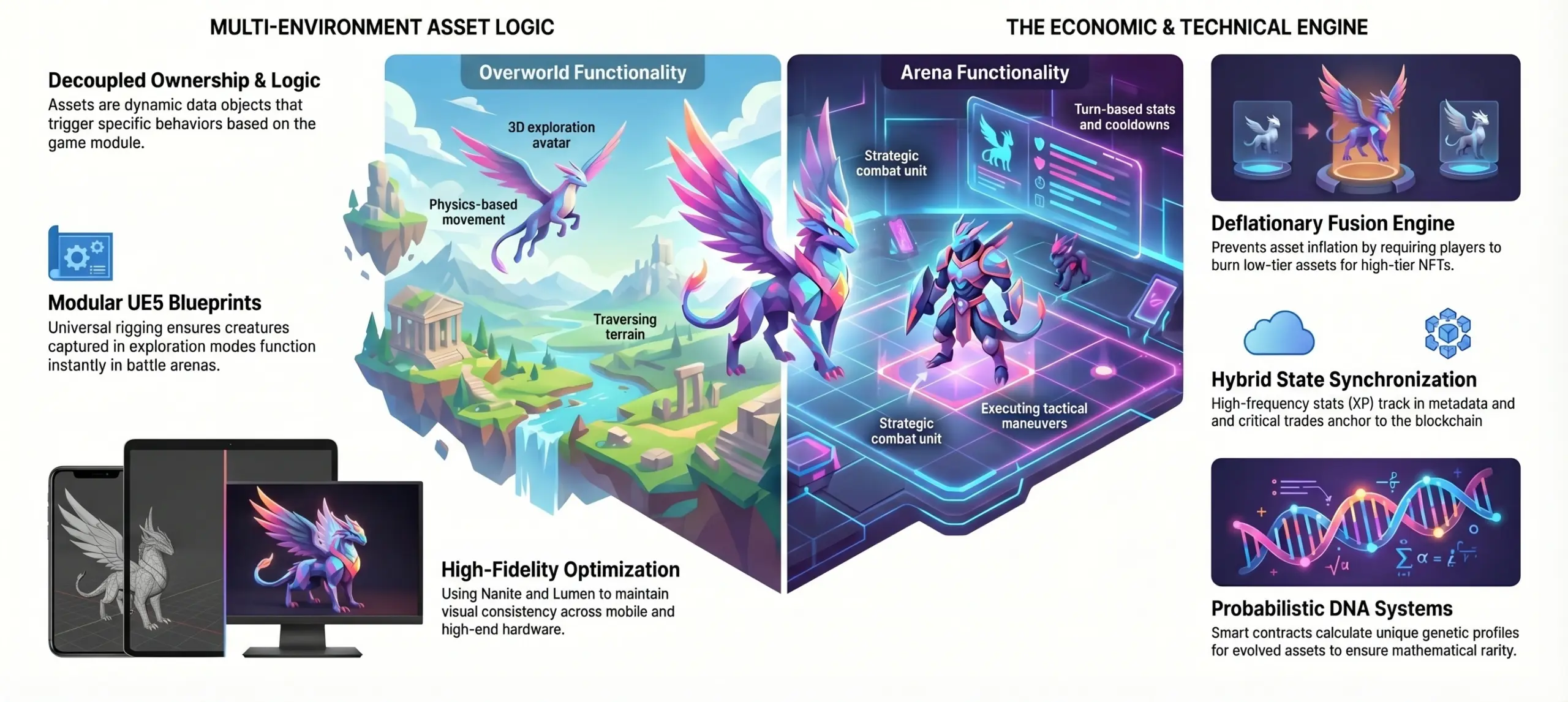
In an IGU architecture, a character is not a static file but a dynamic data object stored on the blockchain. The technical objective is to decouple the ownership layer from the logic layer so that one NFT can trigger different behaviors depending on the specific game module it enters.
| Feature | Overworld Functionality | Arena Functionality |
| Asset Role | 3D exploration avatar | Strategic combat unit |
| Core Logic | Physics-based movement and resource gathering | Turn-based statistics and ability cooldowns |
| Data Interaction | Environmental collision and world-state updates | Competitive matchmaking and leaderboard synchronization |
| Asset Utility | Traversing terrain and capturing new creatures | Executing tactical maneuvers and earning rewards |
B. The Fusion Engine: Managing NFT Scarcity & Evolution
A sustainable metaverse economy relies on a fusion engine to prevent asset inflation. This is achieved through specific smart contract triggers that govern how assets evolve.
- Deflationary Burn Mechanisms: The system requires players to permanently remove multiple low-tier assets from circulation to create a single high-tier NFT. This burn-and-mint logic ensures that as the player base grows, the total supply of common assets remains balanced.
- Probabilistic DNA Systems: When a fusion event occurs, the smart contract calculates a unique genetic profile for the new asset. It inherits randomized metadata attributes from the parent NFTs, ensuring that every evolved creature is mathematically distinct and rare.
- On-Chain Provenance: Every fusion event is recorded on the ledger, providing a transparent history of the asset’s evolution which increases its secondary market value for collectors and investors.
C. The Unified Metadata Layer: Syncing Stats Across Games
To maintain a cohesive experience, the architecture in blockchain metaverse game development must utilize a hybrid state synchronization model. This ensures that progress made in one part of the metaverse is instantly recognized in another without incurring high latency or excessive gas fees.
- High-Frequency State Tracking: While ownership is secured on an Ethereum Layer-2, active gameplay stats like experience points and levels are tracked in a high-speed metadata layer.
- Single Source of Truth: A centralized or decentralized database acts as the primary reference for the game engine. Every time a milestone is reached, the engine pushes a state update to this layer.
- Blockchain Anchoring: During critical economic events such as a trade, a sale or a fusion, the updated stats are anchored to the blockchain. This ensures the permanent ledger reflects the most recent version of the asset.
D. Solving the Interoperability Challenge in Unreal Engine 5
Building for AAA standards requires Unreal Engine 5 to handle high-density environments while maintaining cross-game compatibility. Engineering teams must focus on standardizing the technical skeleton of all digital assets.
- Modular Character Blueprints: By establishing a universal rigging system, developers ensure that a creature captured in a high-fidelity forest can be instantly re-targeted for the physics and animation sets required in a battle arena.
- Nanite and Lumen Optimization: The use of virtualized geometry and dynamic lighting allows the metaverse to maintain visual consistency across different gameplay modes without sacrificing performance on mobile or lower-end hardware.
- Asset LOD Standardization: Standardizing the Level of Detail settings across the entire ecosystem allows for seamless transitions as players move between open-world exploration and localized combat scenarios.
Dual or Multi-Token Models in AAA Blockchain Metaverse
A sustainable blockchain metaverse game development requires a sophisticated economic engine that balances player incentives with long term platform health. This is achieved through a multi-token architecture that separates speculative investment from in-game utility to ensure a stable and scalable digital nation.
A. ILV vs. sILV2: Balancing Governance & Utility
Managing a high fidelity digital economy necessitates a dual-token approach to mitigate volatility and protect the internal game market from external market fluctuations. This separation allows the platform to maintain a stable user experience while offering long term value capture for investors.
| Token Metric | Main Token (ILV) | Synthetic Token (sILV2) |
| Primary Function | Governance, staking and revenue sharing | In-game purchases, travel and forging |
| Liquidity Status | Tradable on external exchanges | Locked within the game ecosystem |
| Value Peg | Determined by market demand and supply | Equal to the value of the main token |
| Supply Logic | Capped total supply to ensure scarcity | Minted as staking rewards to fuel gameplay |
B. Revenue Distribution: The DAO Liquidity Flywheel
The DAO Liquidity Flywheel is a mechanism where platform revenue is redistributed to stakeholders to align the interests of developers, players and investors. This creates a self-sustaining loop that rewards long term participation and ecosystem growth.
- Revenue Source Aggregation: Every transaction within the metaverse including land sales, marketplace fees and travel costs is captured by the platform vault.
- Buyback and Distribute: The vault uses the accumulated revenue to purchase the native token from the open market, creating sustained buy pressure.
- Staking Vault Rewards: These purchased tokens are then distributed to ILV stakers, providing a yield that is directly tied to the actual usage and success of the platform.
- Compounding Incentives: As more players join and spend, the revenue increases which leads to higher rewards and further attracts long term capital to the project.
C. Preventing Inflation: Burn Mechanics & Sinks
Maintaining the value of digital assets requires aggressive deflationary mechanics. Without effective sinks the abundance of tokens and NFTs can lead to a collapse in asset value which is why scarcity engineering is a priority in the development phase.
- Asset Fusion and Deflationary Triggers: Players must destroy multiple low-tier assets to mint higher-tier NFTs, effectively reducing total circulating supply and maintaining secondary value.
- Resource Consumption and Currency Sinks: Mandatory resources like fuel are burned upon use for travel and capture, preventing the infinite accumulation of in-game wealth.
- Liquidity Locking and Time-Weighted Sinks: Staking protocols lock tokens for set durations to reduce market sell pressure and align circulating supply with platform growth.
Must-Have Modules for Illuvium-Like Success
The blockchain metaverse game development requires a modular approach where each technical layer supports a specific business objective. Beyond the visuals, the underlying infrastructure must handle high-frequency data exchanges and secure asset movements to maintain a stable and attractive environment for high-value participants.

1. Real-Time Multiplayer Server Architecture
A seamless world requires a robust backend capable of managing thousands of concurrent connections without performance degradation. For a blockchain metaverse game development project, the server must sync player actions with on-chain states in real time.
- Regional Edge Hosting: Deploying game servers across global nodes to minimize latency and provide a responsive experience for a worldwide audience.
- State Synchronization: Implementing high-frequency updates between the client and server to prevent rubber-banding and keep the world state consistent.
- Elastic Scaling: Using cloud infrastructure that automatically expands to accommodate sudden spikes in traffic during major events or asset drops.
2. Cross-Game Asset Interoperability Layer
The true value of a metaverse is the ability to use a single asset across multiple environments. This module acts as the translator that allows an NFT to maintain its stats and appearance in different game genres.
- Standardized Metadata: Creating a unified data structure for assets so that a character in an RPG can easily transition into a strategic card game.
- Universal Wallet Connection: Supporting a single sign-on experience where the user’s entire inventory is instantly recognized by any game within the ecosystem.
- Asset Mapping Logic: Defining how specific traits or equipment function in different gameplay contexts to maintain balance and utility across the board.
3. Anti-Cheat and Fraud Prevention Systems
When real-world value is at stake, the incentive for malicious activity increases. Protecting the integrity of the game is vital for maintaining the market value of the digital assets and the trust of the community.
- Behavioral Analytics: Using server-side monitoring to detect unusual patterns that indicate the use of bots or automated scripts for farming resources.
- On-Chain Verification: Cross-referencing in-game actions with blockchain transactions to prevent the use of duplicated or unauthorized assets.
- Secure API Gateways: Shielding the connection between the game client and the economy layer to block attempts at manipulating item drops or reward distributions.
4. Seasonal Rewards and Retention Engines
Long-term success depends on keeping the community engaged through a constant stream of new content and incentives. This module manages the lifecycle of seasonal events and ensures that active participants are consistently rewarded.
- Dynamic Battle Passes: Implementing tiered progression systems where users earn exclusive, time-limited NFTs and tokens based on their participation levels.
- Event-Based Economy: Launching limited-time challenges that require the use of specific assets, driving temporary demand and secondary market activity.
- Retention Milestone Tracking: Recognizing and rewarding users for their long-term loyalty which helps reduce churn and builds a dedicated core audience.
Core Features of an Open-World Metaverse Like Illuvium
The blockchain metaverse game development requires a sophisticated blend of spatial computing, decentralized finance and high-performance networking. To attract serious participants, the architecture must support a seamless transition between immersive exploration and a transparent digital economy that rewards long-term engagement.

1. Open-World Exploration Maps
The foundation of the experience is a series of high-fidelity environments that act as the primary interface for user interaction. These maps require optimized level streaming to maintain zero-latency movement across diverse and complex biomes.
- Dynamic Biome Scaling: Utilizing advanced engine capabilities to render massive landscapes without compromising frame rates or taxing end-user hardware.
- Spatial Asset Integration: Strategic placement of interactive elements and hidden resources throughout the map to encourage exploration and maximize session time.
- Persistent World State: Using decentralized storage to verify that environmental changes and player footprints remain consistent across the entire network.
2. NFT Creature Capture and Collection
The heart of the gameplay is a complex system for identifying, weakening and securing digital assets. This mechanic transforms a traditional gaming loop into a sophisticated minting process for rare and valuable NFTs.
- On-Chain Minting Logic: Smart contracts trigger the creation of a unique NFT asset immediately upon a successful capture event within the game world.
- Rarity and Trait Generation: Verifiable randomness determines creature attributes which establishes distinct market value and combat utility for every individual asset.
- Digital Custody: Providing users with full ownership through non-custodial wallet integration, allowing for the independent management of their growing collections.
3. PvE Quests and PvP Battle Arenas
Competitive and narrative-driven modes provide the necessary utility for captured assets. These systems must balance high-stakes strategy with fair match-making algorithms to maintain a healthy and active community of players.
- Auto-Battler Logic: Complex combat simulations where asset stats and positioning determine outcomes, removing the pay-to-win stigma through skill-based depth.
- Asynchronous Matchmaking: Robust backend services pair players in competitive arenas, verifying balanced encounters based on historical performance data and skill ratings.
- Reward Distribution Tiers: Clear paths for earning rare items and tokens through both narrative exploration and high-level competitive ladder rankings.
4. Marketplace for NFT Trading and Rentals
A liquid economy is vital for any blockchain metaverse game development project. A dedicated marketplace allows users to monetize their efforts and provides a low-barrier entry point for new participants.
- Smart Contract Escrow: All trades and rentals are secured through automated contracts that handle the exchange of assets and currency without third-party risk.
- Rental Mechanics: Asset owners can lease their NFTs to other players, creating a passive income stream while increasing accessibility for those with smaller budgets.
- Real-Time Analytics: Integration of price feeds and volume data helps users make informed decisions regarding their digital asset portfolios.
5. Land Ownership and Resource Economy
Digital real estate acts as the industrial engine of the metaverse. By owning land, users gain the ability to produce essential resources, creating a foundational layer of on-chain economic value.
- Resource Extraction Loops: Systems where land plots generate specific materials required for crafting, capturing and upgrading in-game assets.
- Tiered Plot Architecture: Varying levels of land rarity provide different production capacities, driving strategic investment and long-term development of the map.
- Interconnected Economies: Verification that resources produced on land are vital for players in exploration and combat modes, fostering a symbiotic community.
6. Staking Rewards and Yield Systems
To promote financial stability, the platform must offer incentives for users to lock their tokens into the protocol. This reduces market volatility and aligns the community’s interests with long-term platform growth.
- Revenue Sharing Protocols: Distribution of a portion of all in-game fees and marketplace commissions back to users who stake their native tokens.
- Flexible Locking Periods: Tiered reward structures based on the duration of the stake which promotes a long-term mindset among the user base.
- Yield Compounding: Automated systems allow users to reinvest their earnings, effectively growing their share of the ecosystem over a sustained period.
7. DAO Voting and Governance Modules
A decentralized platform shifts power from a central board to the collective of stakeholders. This module verifies the metaverse remains transparent, adaptable and driven by its most dedicated users.
- Proposal Lifecycle Management: A clear framework for users to submit, debate and vote on technical or economic changes to the platform.
- Weighted Voting Logic: Token balances determine voting power which puts decision-making in the hands of those with the most financial commitment to the project.
- Treasury Transparency: A public ledger of all community funds allows stakeholders to monitor how capital is allocated for future development and marketing.
How to Develop an Open-World Blockchain Metaverse Like Illuvium
A successful blockchain metaverse game development requires a phased approach that synchronizes high fidelity game engineering with complex on chain logic. This systematic roadmap ensures technical scalability, economic stability and a seamless transition from concept to market.
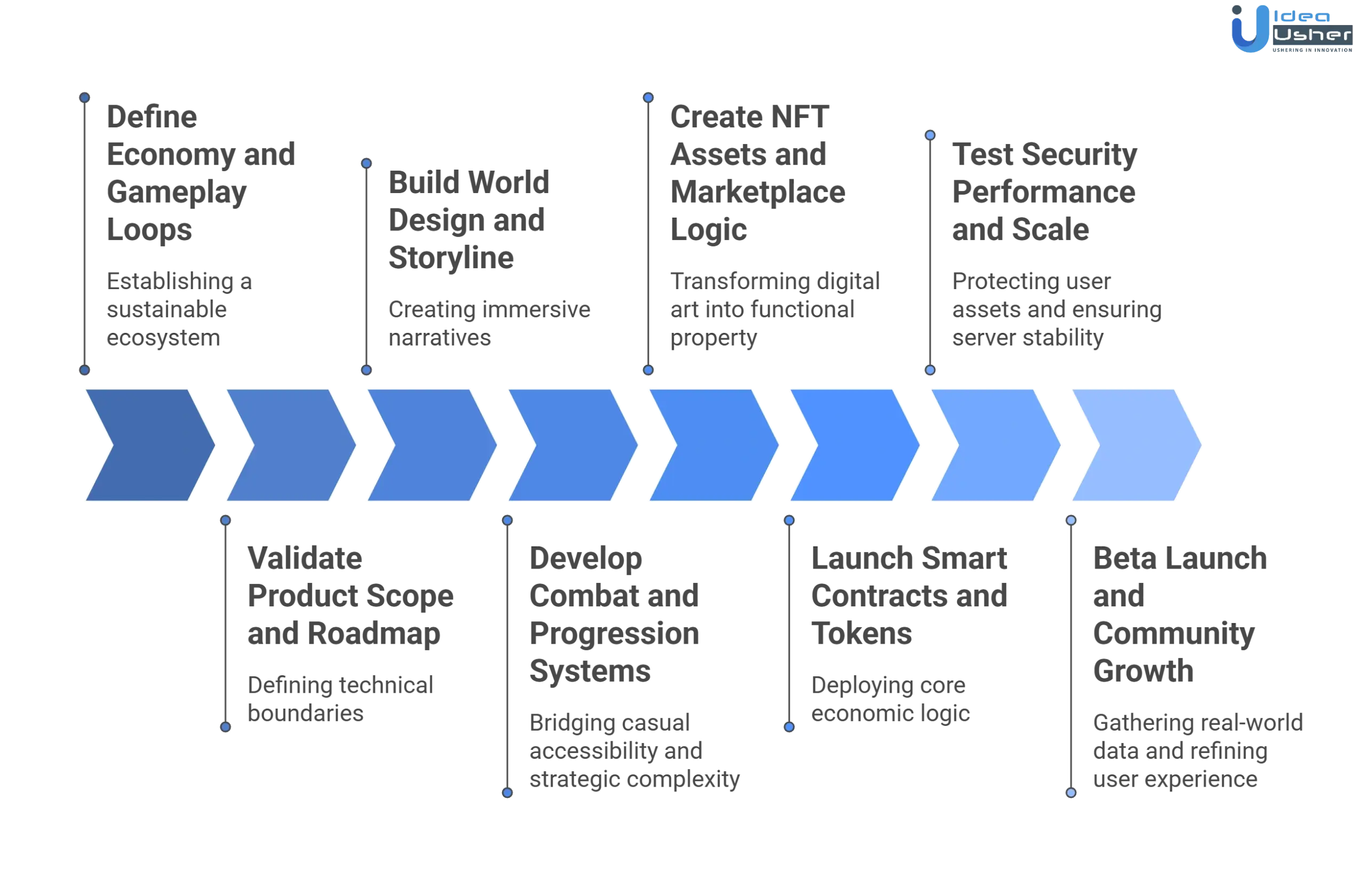
1. Define Economy and Gameplay Loops
Establishing a sustainable ecosystem begins with mapping the interactions between player actions and token utility. Developers must design circular loops where gameplay effort directly translates into value within the decentralized economy.
- Token Velocity Management: Architecting sinks and faucets to balance the flow of native assets and prevent hyperinflation within the game world.
- Incentive Alignment: Designing reward structures that encourage long term participation rather than short term speculative extraction by players.
- Circular Gameplay Loops: Integrating resource gathering with crafting and combat to ensure constant player engagement and asset utilization.
2. Validate Product Scope and Roadmap
Defining technical boundaries is critical to prevent scope creep in AAA projects. A structured roadmap aligns development milestones with market expectations, ensuring the project remains viable during long production cycles.
- Technical Feasibility Analysis: Assessing engine capabilities against blockchain throughput to identify potential performance bottlenecks before the coding phase begins.
- Milestone Structuring: Dividing production into manageable segments such as technical prototypes, vertical slices and the minimum viable product.
- Infrastructure Mapping: Identifying the necessary stack for smart contract development, 3D asset pipelines and high speed backend databases.
3. Build World Design and Storyline
Narratives in the metaverse provide the essential context for asset utility and world exploration. Effective world building involves creating expansive biomes and lore that justifies the existence and rarity of NFTs.
- Procedural Generation Frameworks: Utilizing advanced algorithms to create diverse landscapes while maintaining the high performance standards required for AAA games.
- Lore Integration: Crafting backstories that explain creature affinities and elemental systems to deepen player immersion and emotional connection.
- Environmental Storytelling: Designing assets and locations that visually communicate the history and rules of the digital universe to the player.
4. Develop Combat and Progression Systems
Combat mechanics must bridge the gap between casual accessibility and deep strategic complexity. Progression systems ensure that player growth is quantifiable and reflected accurately through both on chain and off chain data.
- Deterministic Battle Logic: Engineering server side combat calculations to prevent client side manipulation and ensure total outcome transparency.
- Dynamic Stat Management: Implementing systems where character growth directly impacts gameplay variables like damage, speed and elemental resistance levels.
- Competitive Meta Balancing: Utilizing player data to constantly adjust unit statistics and maintain a fair, engaging PvP environment for all skill levels.
5. Create NFT Assets and Marketplace Logic
Transforming digital art into functional property requires a standardized NFT framework. The marketplace logic must support secure, instant and cost effective trading of assets between players in a decentralized manner.
- Standardized Token Implementation: Selecting the appropriate ERC protocols for unique creatures versus stackable resources to optimize wallet interactions.
- Layer-2 Scaling Integration: Utilizing ZK-rollups or sidechains to facilitate gasless transactions and handle high frequency trading volumes without friction.
- Embedded Royalty Logic: Programming smart contracts to automatically distribute a percentage of secondary market sales back to the ecosystem treasury.
6. Launch Smart Contracts and Tokens
The deployment phase involves pushing the core economic logic to the mainnet. This includes initializing the native tokens and setting up the staking contracts that will power the ecosystem governance.
- Multi-Signature Security: Utilizing multiple authorization layers to protect the project treasury and critical administrative functions from single points of failure.
- Token Minting Schedules: Implementing sophisticated vesting periods and cliff durations to ensure market stability during the initial launch phase.
- Staking Protocol Deployment: Creating liquidity pools and reward distribution logic to incentivize token holders and long term ecosystem supporters.
7. Test Security Performance and Scale
Rigorous testing is mandatory to protect user assets and ensure server stability. High traffic metaverses must handle thousands of concurrent transactions without compromising the user experience or data integrity.
- Smart Contract Auditing: Engaging specialized security firms to identify and patch potential vulnerabilities in the code before the public release.
- High Density Load Balancing: Simulating peak player activity to optimize server response times and ensure the backend can scale horizontally.
- Stress Testing On-Chain Logic: Verifying that the blockchain integration layer can process high volumes of minting and trading during major events.
8. Beta Launch and Community Growth
Transitioning from development to live operations involves gathering real world data from a controlled group of players. This phase focuses on refining the user experience based on actual community feedback.
- Iterative Feedback Loops: Collecting qualitative data from beta testers to identify and remove friction points in the onboarding and gameplay experience.
- Early Adopter Incentives: Rewarding initial participants with exclusive badges, tokens or limited edition NFTs to foster community loyalty and word of mouth.
- Marketing Synchronization: Aligning game updates with PR outreach to build sustainable momentum for the full public release of the platform.
Cost Breakdown for Blockchain Metaverse Development
The blockchain metaverse game development involves a wide range of capital requirements depending on the scale of the world and the complexity of the economic layers. A Minimum Viable Product (MVP) focuses on core gameplay and basic NFT integration, while an Enterprise Level project delivers AAA visuals, multi-game interoperability and a fully decentralized governance structure.
| Development Phase | Estimated Cost | Key Deliverables |
| Strategy & Economy | $12,000 – $20,000 | Mathematical token models, DAO structure and legal framework. |
| World & Narrative | $25,000 – $45,000 | Environmental assets, level design and storyline documentation. |
| Blockchain & NFT | $20,000 – $35,000 | Smart contracts, minting logic and L2 marketplace integration. |
| Game Mechanics | $35,000 – $60,000 | Combat systems, character physics and progression logic. |
| Backend & Servers | $15,000 – $30,000 | Multiplayer sync, database security and global edge hosting. |
| QA & Security | $10,000 – $20,000 | Penetration testing, smart contract audits and stress tests. |
| Total Estimated Cost | $117,000 – $210,000 | Initial deployment focusing on core loops and economy. |
A. MVP vs Full Scale Metaverse Cost
The final investment required for the blockchain metaverse game development depends heavily on the depth of the world and the number of interconnected systems. While an MVP allows you to enter the market quickly, scaling up to a high-fidelity experience involves progressive technical layers.
- Basic MVP with limited features: $80,000 – $110,000
- Mid-level platform with multiplayer and economy: $150,000 – $350,000
- Advanced platform to grow: $500,000 – $1,200,000+
Illuvium Clone Scripts vs. Enterprise AAA Metaverse Game Development
Founders must distinguish between a visual shell and a fully functional ecosystem. A clone script provides a surface level imitation of a UI but usually fails to integrate the deep backend logic required to handle thousands of concurrent transactions or high fidelity assets.
Investing in blockchain metaverse game development requires a clear understanding of the technical gap between off the shelf scripts and custom engineering. While clones offer a fast entry point they often lack the mathematical security and rendering fidelity necessary for a long term project.
| Metric | White-Label Clone Script | Custom AAA Metaverse (Illuvium Style) |
| Initial Investment | $50,000 to $100,000 | $10,000,000 to $50,000,000+ |
| Time to Market | 2 to 4 months | 3 to 5 years |
| Core Architecture | Rigid templates with limited scaling | Bespoke modular systems |
| Visual Quality | Basic 3D assets or 2D sprites | AAA Unreal Engine 5 fidelity |
| Economic Security | Generic smart contracts | Audited custom tokenomics |
| Scalability | Fixed user caps and high latency | Horizontal cloud scaling |
A. The Engineering Reality of the AAA Timeline
The multi year development cycle for a project of this magnitude is not due to inefficiency but is a result of the technical granularity required to build a persistent world.
- Advanced Rigging and Animation: Creating a library of hundreds of unique creatures with fluid motion sets takes thousands of hours of specialized character engineering.
- Economic Stress Testing: Developing a sustainable treasury requires months of mathematical modeling to verify that the token sinks can withstand extreme market volatility.
- Backend Synchronization: Engineering a system where a player’s on chain inventory updates in real time across different game modes requires a custom metadata layer.
- Comprehensive Security Auditing: Protecting a platform that manages millions in user capital necessitates multiple rounds of external testing to patch every potential vulnerability.
B. Why the Clone Script Model Usually Fails
Founders who choose the cheap path often encounter technical debt that makes future updates impossible. A script bought for a low price is typically a closed system where adding new features like land ownership or cross game interoperability requires a total rewrite of the codebase.
These scripts often share identical code across hundreds of different projects making them a primary target for hackers. Without customized smart contract logic your platform is vulnerable to the same exploits that have collapsed dozens of low budget GameFi projects. Building with a dedicated partner ensures your architecture is unique and defensible against both market shifts and security threats.
Tech Stack to Build a Metaverse Like Illuvium
Selecting a robust tech stack is the most critical decision for maintaining high performance and security during blockchain metaverse game development. The following architecture mirrors the Illuvium blueprint, ensuring your platform handles high-fidelity rendering and on-chain transactions with institutional-grade reliability.

1. Unreal Engine for AAA Gameplay
AAA blockchain games like Illuvium uses Unreal Engine to achieve cinematic realism and this choice allows your platform to deliver industry-leading visuals and complex physics that attract high-value players.
- Nanite & Lumen Integration: Utilizing virtualized geometry and dynamic lighting to create photorealistic environments without the typical performance overhead of legacy engines.
- Blueprint & C++ Scalability: Combining rapid prototyping with low-level code optimization to manage complex game logic and high-speed character interactions.
- Spatial Audio Engines: Implementing immersive soundscapes that react to player movement, enhancing the sensory depth of the open-world exploration experience.
2. Blockchain Layer and Wallet Setup
By utilizing Ethereum with Layer-2 scaling, Illuvium provides security without high costs; your platform will benefit from trustless ownership and seamless transaction finality.
- Immutable X Integration: Deploying a ZK-rollup solution to facilitate carbon-neutral minting and instant trading with zero gas fees for the end user.
- Non-Custodial Connectors: Implementing Web3Auth or RainbowKit to allow users to manage their digital assets through a secure, familiar interface.
- Smart Contract Standards: Utilizing ERC-721 and ERC-1155 protocols to ensure all in-game items remain interoperable across global secondary marketplaces.
3. Backend for Real-Time Multiplayer
A specialized backend ensures the open-world blockchain metaverse handles thousands of concurrent players; for your project, it maintains a synchronized world state across a global user base.
- Custom Socket Logic: Using WebSockets or gRPC for low-latency communication between the client and the server to prevent synchronization lag.
- Distributed State Management: Leveraging Redis or similar in-memory data stores to track real-time player positions and active combat instances.
- Matchmaking Microservices: Developing proprietary algorithms that group players based on skill level and asset strength to maintain competitive balance.
4. NFT Minting and Asset Metadata
The AAA web3 game relies on structured metadata to define creature rarities; this technical layer allows your platform to verify asset scarcity and on-chain provenance.
- Decentralized Storage (IPFS): Hosting high-resolution asset data on Filecoin or IPFS to ensure that NFT visuals remain immutable and accessible forever.
- Dynamic Metadata Updates: Implementing evolving NFT traits where creature stats update on-chain as players achieve specific gameplay milestones.
- Batch Minting Protocols: Optimizing the creation of thousands of assets simultaneously to reduce network congestion during major seasonal drops.
5. Cloud Servers and LiveOps Tools
Global edge hosting allows Illuvium to minimize latency; integrating these tools into your stack ensures 99.9% uptime and rapid content delivery.
- AWS GameLift Integration: Utilizing elastic cloud computing to automatically scale server capacity based on real-time player traffic spikes.
- CI/CD Pipelines: Setting up automated deployment workflows to push seamless updates and security patches without taking the game offline.
- Telemetry & Analytics: Implementing deep-data tracking to monitor economic health and player retention metrics for informed business decision-making.
6. AI for NPCs and Player Behavior
Illuvium employs AI to make alien encounters unpredictable; adding this to your platform creates a living ecosystem where NPCs adapt to user strategies.
- Behavior Tree Architectures: Designing complex decision-making paths for NPCs so they react intelligently to player combat tactics.
- Neural Network Training: Using machine learning to refine bot behavior in arenas, ensuring the PvE experience remains challenging and dynamic.
- Procedural Content Generation: Leveraging AI to assist in creating unique landscape variations which reduces manual art costs while expanding the map.
Challenges in Building Illuvium-like AAA Metaverse Game Development
The enterprise-grade blockchain metaverse game development involves navigating technical and economic hurdles that can destabilize a project if left unaddressed. Proactive engineering and strategic modeling are essential to ensure long-term stability and platform growth.
1. Balancing Rewards vs Token Inflation
The challenge lies in distributing attractive player incentives without devaluing the native currency through uncapped supply or excessive minting rates.
- Implementation of Dynamic Emission Rates: Adjusting reward scales based on active user metrics to maintain a balanced circulating supply.
- Diversified Asset Sinks: Creating mandatory token expenditures for high-value actions like upgrading gear or entering exclusive regional tournaments.
If this imbalance persists, the token value will likely collapse, leading to player exodus and the total failure of the economy.
2. Retaining Players After Token Hype
The open world metaverse often struggles to maintain engagement once the initial speculative surge fades and players demand deep, rewarding AAA gameplay experiences.
- Core Gameplay Loop Optimization: Focusing on high-fidelity mechanics and lore that provide intrinsic entertainment value beyond the financial incentives.
- Seasonal Content Roadmaps: Deploying regular updates, new regions and limited-time events to keep the virtual world fresh and engaging.
Failure to transition from speculation to genuine entertainment leads to a ghost-town ecosystem with no sustainable long-term revenue streams.
3. Scaling Servers During Traffic Spikes
Large-scale metaverse events can trigger sudden influxes of thousands of concurrent users, potentially causing server crashes and high-latency gameplay experiences.
- Horizontal Auto-Scaling Infrastructure: Utilizing cloud-native clusters that automatically provision additional server instances as the real-time player count increases.
- Regional Sharding Strategies: Distributing the global player base across multiple localized shards to reduce individual server load and latency.
Neglecting scalability results in massive service outages during peak events, permanently damaging the brand reputation and the user experience.
4. Compliance for Web3 Gaming Markets
Navigating the fragmented global regulatory landscape for digital assets and in-game gambling mechanics presents a significant legal and operational risk.
- Geofencing and KYC Integration: Implementing automated systems to restrict specific features in jurisdictions where blockchain gaming regulations are strictly enforced.
- Transparent Asset Classification: Working with legal counsel to ensure utility tokens and NFTs are structured to meet international compliance standards.
Ignoring legal frameworks risks severe regulatory penalties, platform de-platforming or complete shutdown of the project in major global markets.
Monetization Model of Open World Metaverse Game
A sustainable blockchain metaverse game development project relies on a circular economy where value flows between the developers and the participants. Rather than relying solely on initial sales, the most successful platforms build multiple revenue streams that scale alongside the user base and market activity.
1. NFT Primary Sales (Initial Offerings)
The first injection of capital usually stems from the sale of Generation Zero assets which carry the highest rarity and prestige. These initial offerings establish the foundational supply for the digital economy and provide the necessary runway for long-term development.
- Founder Assets: Selling limited-edition tokens or badges that grant early access, special perks or exclusive airdrops.
- Virtual Real Estate: Offering Land NFTs that serve as the industrial base for resource production and in-game passive income.
- Early-Bird Creatures: Distributing the first wave of battle-ready characters to populate the world and kickstart the competitive meta.
2. Marketplace Transaction Fees
Long-term revenue is driven by the velocity of trade within the ecosystem. By facilitating a proprietary decentralized exchange (DEX), the platform captures a small percentage of every peer-to-peer transaction, turning high market activity into consistent revenue.
- Residual Royalties: Automating a 1% to 5% fee on all secondary market sales, ensuring the platform profits as asset values appreciate.
- Listing & Settlement Fees: Charging nominal amounts for hosting trade orders which helps maintain the infrastructure of the digital marketplace.
- Cross-Chain Trade Cuts: Monetizing the movement of assets between different networks or sidechains through integrated bridge fees.
3. Native Token ICO/IDO
Launching a native utility and governance token allows the project to secure early-stage funding while distributing ownership to the community. This token acts as the primary currency for all high-level interactions and platform decision-making.
- Liquidity Bootstrapping: Using Initial DEX Offerings (IDOs) to establish a market price and provide immediate liquidity for early investors.
- Governance Premiums: Creating demand for the token by making it a requirement for voting on the platform’s future roadmap and treasury allocation.
- Staking Pools: Encouraging users to buy and lock tokens to reduce circulating supply which supports price stability and long-term holding.
4. In-Game Purchases
To maintain a Play-to-Own balance, monetizing cosmetic and quality-of-life items is essential. These purchases allow players to personalize their experience without disrupting the competitive balance of the game.
- Seasonal Battle Passes: Offering tiered reward systems where players pay a flat crypto fee to unlock exclusive skins and emotes through gameplay.
- Cosmetic Customization: Selling rare visual upgrades for characters or land plots that do not affect combat stats but carry significant social status.
- Consumables & Boosters: Providing non-essential items like travel speed boosts or aesthetic environmental effects that enhance the user experience.
5. Staking Mechanisms
The platform treasury functions like a decentralized bank, holding a portion of tokens and fees to generate yield. This model ensures that the platform has a self-growing reserve to fund future updates and community rewards.
- Yield-Bearing Reserves: Utilizing treasury funds in low-risk DeFi protocols to earn interest that is funneled back into game development.
- Fee Redistribution: Sharing a portion of marketplace earnings with users who stake their tokens which increases the intrinsic value of holding the native currency.
- Lock-up Incentives: Rewarding long-term stakers with higher yield rates which minimizes market volatility and builds a committed investor base.
6. Tournament Fees and Sponsorships
As the platform matures into a competitive arena, it opens doors for esports-style monetization. High-stakes PvP environments attract both professional players and corporate sponsors looking for brand exposure.
- Entry Fee Pools: Hosting competitive brackets where a portion of the entry fees goes to the prize pool and the remainder is retained by the platform.
- In-Metaverse Advertising: Selling digital billboard space or naming rights for arenas to external brands looking to reach a tech-savvy audience.
- Broadcasting Rights: Monetizing the streaming and spectating of high-level matches through exclusive platform features or ad-supported viewing.
How NFT Creature Economies Drive Revenue in Illuvium-like AAA Game
The NFT creature economy is a closed-loop system where 100% of game revenue is redistributed to the community. By treating digital creatures (Illuvials) as rare, productive assets, the game drives revenue through continuous utility rather than one-off sales.
1. Minting Rare Assets and Breeding Mechanics
Revenue is heavily driven by the scarcity and evolution of creatures like Illuvials. This creates a deflationary pressure that encourages continuous spending.
- Fusion (Deflationary Breeding): Unlike typical breeding games where two assets create a third, Illuvium requires players to burn (destroy) three identical, leveled-up Illuvials to fuse them into a single, more powerful stage.
- Fuel Requirements: Every minting and fusion action requires Fuel (Crypton, Hyperion, Solon). This Fuel must be purchased from landowners or produced in the mobile game, creating a constant sink for capital.
- Shard Costs: To mint a wild creature into an NFT, players must use Shards. The cost of high-tier shards acts as a direct revenue stream for the ecosystem.
- Rarity Tiers: Illuvials come in different rarities (Tier 1–5) and holographic expressions, driving high-value shiny hunting mechanics similar to Pokémon but with real-world market value.
2. Secondary Marketplace Fee Generation
The IlluviDEX of Illuvium works as a central hub for all player-to-player commerce, designed to capture value from every transaction.
- Commission Fees: The DAO collects a percentage-based commission on every secondary sale. This fee is typically around 5% which is then used to buy back ILV tokens from the open market to reward stakers.
- Gasless Trading: By utilizing Immutable X (Layer 2), the marketplace eliminates gas wars, allowing for high-frequency trading of low-value items (like resources or shards) which collectively generate significant fee volume.
- Interoperability: Because the same NFTs are used across multiple games (Overworld, Arena, Zero), the utility of a single asset is higher, leading to more frequent trading as players switch between different gameplay styles.
3. Rental Models for Competitive Gameplay
Illuvium-like open world metaverse games enable a scholarship or rental economy that allows high-value assets to generate revenue even when their owners are offline.
- Access to High-Tier Content: Players who cannot afford to buy a Rare/Legendary Illuvial can rent them for a fraction of the cost to complete high-level missions or climb the leaderboard.
- Tournament Advantages: In the Illuvium: Arena (auto-battler), certain team compositions are dominant. Competitive players rent specific Illuvials to gain a strategic edge in tournaments with large prize pools.
- Passive Income for Owners: Owners can list their collections for lease, turning their NFTs into yield-bearing assets. This reduces the circulating supply of for sale NFTs, supporting the floor price while generating rental fees for the DAO.
Future Trends in Open-World GameFi Platforms
Open world GameFi platforms are evolving through AI driven economies and deeper social play experiences worldwide. Future trends include interoperable assets creator tools, dynamic quests, sustainable rewards and crosschain governance for players everywhere soon.
1. AI-Powered Dynamic Worlds
AI is no longer just for backend automation; it is becoming a core component of the open-world experience. Static characters are being replaced by AI-driven NPCs that learn from player behavior, engage in unscripted dialogue and even act as autonomous merchants or companions.
Real-World Example: Suck Up!: An AI-integrated game where players must use real-time voice chat to trick AI NPCs into letting them into their homes. The NPCs’ reactions are unscripted and generated on the fly.
2. Cross-Chain Interoperability
The next generation of platforms is moving toward a Chain-Agnostic future where the underlying blockchain is invisible to the user. Players will be able to take an NFT weapon earned in one game and use it as a functional item or even a different type of asset (e.g., a skin or vehicle) in another game.
Real-World Examples: Illuvium Assets: A single NFT (like an Illuvial) can be used as a combatant in Arena, a resource collector in Overworld and its data influences base-building in Zero.
3. Mainstream Accessibility and Tech Evolution
The industry is pivoting to Play-to-Own (P2O), where the primary focus is on long-term asset value and community governance rather than short-term token extraction. Over 70% of new GameFi experiences are expected to be mobile-friendly and actively removing the crypto friction to reach mass adoption.
Real-World Example: Off The Grid (Gunzilla Games): This AAA cyberpunk shooter uses Avalanche subnet technology but looks and feels like Call of Duty. Players can trade items without ever needing to know what a private key is.
How IdeaUsher Builds AAA Blockchain Games?
IdeaUsher helps founders launch scalable AAA Web3 gaming ecosystems by combining blockchain engineering, advanced game development, token economies and growth-focused execution for long-term platform success.
1. Blockchain gaming architects and dev teams
IdeaUsher builds secure, scalable blockchain gaming products with dedicated engineers experienced in Web3 ecosystems, multiplayer systems and player-owned economies.
- Smart contract architecture for tokens, NFTs, staking and rewards
- Wallet login systems with smooth onboarding for new users
- Scalable backend infrastructure for real-time multiplayer gameplay
- Cross-chain integrations for broader asset utility and access
- Security-first development with audits and fraud prevention layers
2. NFT marketplace and tokenomics experts
Our specialists design sustainable NFT economies and token systems that improve engagement, retention and long-term monetization across gaming ecosystems.
- NFT minting, listing, auctions and peer-to-peer trading systems
- Marketplace fee models that generate recurring platform revenue
- Utility and governance token frameworks for ecosystem growth
- Reward balancing with sinks to reduce inflation pressure
- Treasury, staking and yield systems for user retention
3. Unreal Engine and multiplayer specialists
We create immersive AAA game worlds like Veelive using Unreal Engine with real-time multiplayer systems optimized for performance, scale and competitive gameplay.
- Unreal Engine 5 environments with cinematic-quality visuals
- PvP, co-op and open-world multiplayer gameplay systems
- Matchmaking logic for casual, ranked and tournament play
- Low-latency networking architecture for global player bases
- Cross-platform support for PC, mobile and future devices
4. End-to-end launch and growth support
IdeaUsher supports every stage from strategy to launch, helping clients scale user acquisition, retention, monetization and ecosystem expansion.
- Product strategy, roadmap planning and launch milestones
- UI/UX flows that improve onboarding and player retention
- Analytics dashboards for revenue, gameplay and engagement metrics
- Live operations support for seasonal updates and events
- Post-launch scaling, optimization and growth experimentation
Conclusion
The 2026 gaming landscape requires a strategic blend of high-end production and sustainable economic design. Developing a platform like Illuvium is no longer just about technical execution; it is about creating a living digital world where players feel genuine ownership of their journey. By prioritizing AAA visuals and robust Layer-2 infrastructure, you position your project at the forefront of blockchain metaverse game development. This transition toward immersive, asset-driven ecosystems offers a unique opportunity for visionary investors to build resilient platforms that redefine the future of interactive entertainment.
FAQs
A.1. The most efficient method involves integrating a layer 2 Ethereum scaling solution like Immutable X. This architecture eliminates gas fees for players and ensures instant NFT minting, which is critical for maintaining high transaction volumes without compromising on-chain security or network speed.
A.2. Unreal Engine 5 is the industry standard for creating the AAA graphics required to compete in the current market. Its advanced rendering capabilities allow for immersive, high-fidelity environments that significantly increase the perceived value and collectibility of in-game NFT assets and characters.
A.3. A matching engine ensures competitive integrity by pairing players based on talent, historical win rates, and point totals. This systematic approach facilitates fair gameplay by grouping participants with similar skill levels, which is vital for maintaining a balanced and engaging PvP environment.
A.4. An inbuilt DEX provides a seamless hub for players to trade assets without leaving the game environment. Using DAO-governed smart contracts ensures transparent, low-cost peer-to-peer transactions, which boosts liquidity for your NFTs and encourages a thriving secondary market for rare digital collectibles.