

Key Takeaways
- RPA services help healthcare teams automate repeated work without changing the systems they already use.
- Common use cases include claims, patient registration, insurance checks, billing, scheduling, and document work.
- A good provider should understand healthcare workflows and offer strong integration, security, testing, and support.
- RPA can work with APIs, OCR, document processing, and AI to handle more difficult healthcare tasks.
A hospital may have a modern EHR and advanced billing software yet still depend on employees to move information between systems. These small manual steps can quietly slow down operations and consume hours that staff could spend on more important work. RPA services for healthcare can take over many of these repetitive tasks without requiring the organization to replace its existing systems. But simply automating a task does not guarantee a better process. The real question is whether the provider understands where automation will make a meaningful difference. A good RPA partner should help identify those opportunities and build workflows that make everyday healthcare operations faster and easier to manage.
Healthcare RPA is becoming a practical way to handle the repetitive work that often slows down day-to-day operations. We’ve worked on healthcare RPA solutions that use intelligent document processing and API-based integration to simplify these workflows while keeping existing systems in place. With this experience, we’re writing this blog to help you understand what to look for when choosing an RPA services provider for healthcare.
Why Are Healthcare Organizations Investing in RPA Services?
According to Coherent Market Insights, the robotic process automation in healthcare market is estimated to be valued at $2.41 billion and is expected to reach $7.14 billion, growing at a 16.8% CAGR over the forecast period. This growth reflects a broader shift in how healthcare organizations approach operational work. Many are no longer looking at automation as a small IT experiment. They are looking for a practical way to reduce manual workload while keeping their existing systems in place.
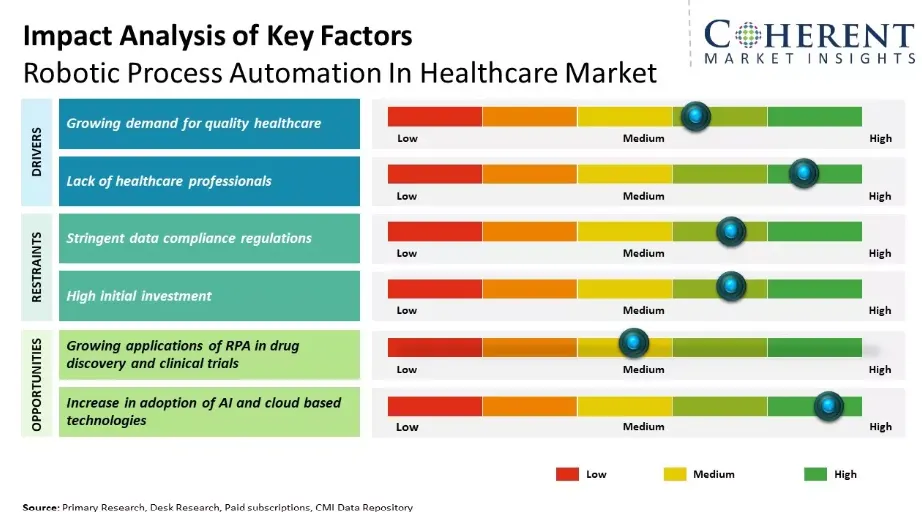
Source: Coherent Market Insights
This is where an external RPA provider can bring value by finding suitable workflows and turning them into reliable automations without putting the entire operation through a technology overhaul.
Rising Admin Workloads
Healthcare staff often spend a surprising amount of time on work that does not require clinical judgment. Insurance checks, claims updates, data entry, document handling, and status checks can take place hundreds or even thousands of times each day. As patient volumes grow, adding more people to handle these tasks is not always a sustainable answer. An experienced RPA provider can identify repetitive workflows that are slowing teams down and automate them so employees have more time for work that actually needs their attention.
A good example is Helse Vest, a Norwegian regional health authority. Its RPA program automated more than 50 processes and gave doctors and nurses an estimated 14,000 hours back each year. The organization also expected around $550,000 in annual postage savings from one automated appointment process.
Legacy Systems Create Friction
Replacing an old healthcare system is expensive and disruptive. Yet many organizations still have employees manually moving information between applications because those systems were never designed to work together. This is one area where RPA can be useful. Instead of rebuilding the underlying infrastructure, a provider can create an automation layer that works with the applications already in use.
University Hospitals Birmingham NHS Foundation Trust used Blue Prism automation across areas such as patient records, pharmacy stock control, and patient self-registration. At the time of the documented case, the Trust had annual turnover of more than $425 million and served over half a million patients. Its automation work helped integrate systems that lacked natural interfaces while reducing pressure on internal teams.
RPA Works With Existing Systems
One of the strongest reasons to work with an RPA provider is that automation does not always require replacing the software already running the business. Bots can interact with applications in much the same way employees do. This can be useful when a healthcare organization has older systems that are difficult or costly to modify.
The bigger opportunity is deciding where RPA should sit in the workflow. A provider can assess whether a process is better handled through RPA, an API, or a combination of both. That prevents organizations from using bots simply because they are available and helps them build automation around the systems they already depend on.
Automation Must Scale
A workflow that works for one department may become difficult to manage when dozens of departments need the same automation. This is why healthcare organizations need more than a developer who can build a working bot. They need a provider that can think about monitoring, reuse, maintenance, and expansion from the beginning.
The experience of Helse Vest shows why this matters. After establishing governance and testing practices, its team was able to reuse automation across multiple hospitals and processes rather than treating every bot as a separate project. That approach helped turn individual automation projects into a broader organizational capability.
Which Healthcare Workflows Can RPA Services Automate?
Healthcare RPA works best when teams spend too much time on repetitive work. A bot can handle these routine steps while staff take care of tasks that need human judgment. It can also reduce delays caused by moving data between different systems. Finding the right workflow is therefore an important first step before choosing an RPA provider.
1. Claims and Denials
Claims teams often work across payer portals, spreadsheets, billing systems, and patient records. A bot can collect claim information, check required fields, update status, and move the results into the right system. This reduces the amount of repetitive portal work while helping teams catch missing information earlier.
Typical flow: Claim received → Data checked → Payer portal updated → Status recorded → Exception sent to staff
At Max Healthcare, RPA was used for claims processing and reconciliation across government healthcare schemes. The automation reduced claims turnaround time by 50% and helped recover ₹1 crore in pending payments over 12 months.
2. Patient Registration
Patient registration becomes difficult when the same information has to be entered more than once. RPA can pull existing patient details and populate registration fields before an appointment. Staff can then focus on cases that actually need attention instead of repeating data-entry work.
| Manual Work | RPA Approach | Result |
| Re-enter patient details | Pull existing records | Faster registration |
| Check previous data | Match required fields | Fewer errors |
| Update registration systems | Populate fields automatically | Less manual work |
IU Health scaled its digital workers to more than 300,000 pre-registered appointments each month. The process fell from about 3.4 minutes manually to 2.5 minutes per patient. IU Health reported $6.08 billion in total revenue for its 2024 fiscal year, showing the scale of the organization in which these operational efficiencies were being applied.
3. Insurance Verification
Eligibility verification often means checking several payer systems before a patient receives care. An RPA workflow can retrieve coverage information and place the result where registration or billing teams can use it. This is particularly useful when payer portals do not provide convenient integrations.
A typical automation can:
- Open the required payer portal
- Search using patient details
- Capture eligibility information
- Update the registration or EHR system
- Flag coverage issues for staff
The important point is that the bot does not need to make a clinical decision. It handles the repetitive lookup and leaves the unusual cases for a person.
4. Prior Authorization
Prior authorization can become a bottleneck when staff repeatedly check requirements and move information between payer and provider systems. RPA can monitor defined steps and update records when the required information is available. This can shorten administrative turnaround without changing the clinical decision itself.
The workflow can look like this:
Request received → Patient details checked → Payer portal accessed → Status captured → EHR updated → Exception escalated
The provider’s role is to make sure the automation follows the organization’s authorization rules and has a clear path when a request falls outside them.
5. Billing and RCM
Revenue cycle teams deal with a large volume of repetitive financial tasks. RPA can help with invoice preparation, payment reconciliation, claim-status checks, and transferring information between billing applications. The biggest opportunity is often not one isolated task. It is the handoff between several tasks.
Automating these handoffs can reduce delays and give billing teams a cleaner view of outstanding work.
6. Scheduling and Follow-Ups
Appointment workflows contain many predictable actions that do not always need staff involvement. RPA can help update schedules, send routine communications, process cancellations, and trigger follow-up actions after an appointment. Princess Alexandra Hospital NHS Trust combined RPA with electronic forms to streamline its referral pathway.
Before automation, staff manually entered digital referrals into its EHR, processing around 2,323 documents each month. The project reduced rekeying and gave time back to clinical teams while improving data quality. The Trust’s total operating income was approximately $558 million based on its 2024/25 reported income of £430 million.
7. EHR Data Updates
Healthcare employees may need to enter the same information into several systems after a patient interaction. RPA can reduce this duplication by transferring structured information between applications and checking whether required fields have been updated. The provider should also design validation rules so that incorrect or incomplete information does not simply get copied from one system into another.
8. Compliance and Documents
Compliance teams deal with reports, forms, records, and evidence that must be collected consistently. RPA can gather information from defined sources and prepare reports or documentation without requiring employees to repeat the same steps. This becomes even more useful when combined with intelligent document processing.
RPA can move the information while document-processing technology extracts relevant fields from PDFs or scanned documents. The result is a workflow where software handles routine extraction and movement while employees review information that needs judgment.
9. Provider Onboarding
Healthcare organizations regularly need to collect and verify information for physicians, nurses, contractors, and other workers. RPA can move approved information between HR platforms, credentialing systems, compliance databases, and internal applications.
A simple workflow might be:
Application → Document check → Credential record → HR system → Access request
This can reduce the administrative workload around onboarding while giving teams a more consistent process. It also creates a useful starting point for organizations that want to expand automation beyond patient-facing workflows.
What Should You Expect From an RPA Services Provider?
When hiring an RPA provider, you are not just paying for a bot. You are paying for the work that happens before and after automation. A good provider should help you find the right process, build the workflow, connect it with your existing systems, and keep it running after launch.
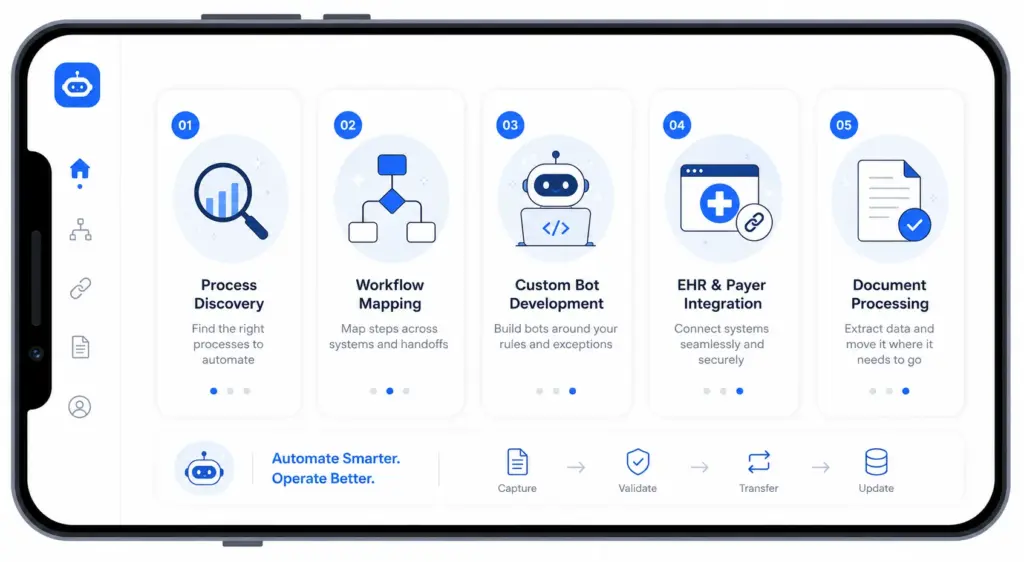
1. Process Discovery and Assessment
Before development starts, the provider should understand how your team handles the process today. This helps uncover where employees spend the most time and whether the workflow is actually suitable for automation. A proper assessment can also reveal steps that may need to be redesigned before a bot is introduced.
The assessment should answer:
| Question | Why It Matters |
| How often does the task occur? | Shows automation potential |
| How much staff time does it consume? | Helps estimate savings |
| Does it follow clear rules? | Determines RPA suitability |
| What systems are involved? | Defines integration needs |
2. Workflow Mapping and Analysis
Healthcare workflows rarely stay inside one application. A single process may move through an EHR, payer portal, billing platform, and internal database before it is complete. Your provider should map these steps clearly so the automation follows the real workflow rather than simply automating one isolated task.
The final process map should show where information starts, what happens to it, where it moves next, and when a person needs to step in.
3. Custom RPA Bot Development
Every healthcare organization has its own processes and system setup. That makes a one-size-fits-all bot less useful for complex operations. A capable provider should build the automation around your actual business rules and make it flexible enough to handle normal changes.
For example, a claims bot may check a claim, update its status, and move it forward automatically. If required information is missing, it should stop and send the case to the right employee instead of continuing blindly.
4. EHR and Payer Integration
Integration is often where healthcare RPA projects become technically challenging. Your provider may need to connect the automation with an EHR, payer portal, billing platform, or another internal application.
The goal should be simple:
Capture → Validate → Transfer → Update
Where APIs are available, they may provide a more stable integration route. RPA can then handle parts of the workflow where direct integration is difficult or impractical.
5. Document Processing and Extraction
Healthcare teams deal with large amounts of structured and unstructured information. Intelligent document processing can extract relevant data from forms, invoices, referrals, and other documents. RPA can then move that information into the appropriate system. This combination is useful when employees currently spend hours reading documents and manually entering the same details elsewhere. Instead of asking a bot to simply copy information, the workflow can first understand the document and then take the required action.
6. Bot Testing and Deployment
A healthcare bot should not go directly from development into daily operations. The provider should test it against normal cases as well as situations where information is missing or unexpected.
A practical testing cycle includes:
- Test the standard workflow.
- Test incorrect or incomplete data.
- Check system and integration failures.
- Validate security and access controls.
- Confirm the expected output.
- Deploy after successful validation.
This reduces the chance of a small automation error becoming a larger operational problem.
7. Monitoring and Exception Management
Launching a bot is not the end of the project. Healthcare systems change, payer portals get updated, and workflows can behave differently from one case to another. A provider should therefore give your team visibility into what the automation is doing. A useful monitoring setup can show successful transactions, failed runs, processing delays, and cases waiting for human review. This allows teams to address exceptions quickly instead of discovering problems after a large batch of work has already been affected.
8. Maintenance and Optimization
RPA workflows need attention after deployment. Changes to an application or business rule can cause an otherwise reliable bot to stop working. Ongoing support allows the provider to make updates before these changes disrupt the workflow. Over time, the provider can also identify new opportunities around the same process. One successful automation can become the foundation for a wider healthcare automation program rather than remaining a standalone bot.
10 Criteria for Choosing a Healthcare RPA Provider
Choosing a healthcare RPA provider is not just about finding a team that can build bots. You need a partner that understands how your workflows operate and where automation can actually make a difference. At IdeaUsher, we help healthcare businesses implement RPA within their existing systems so they can improve everyday processes without making unnecessary changes to their technology.
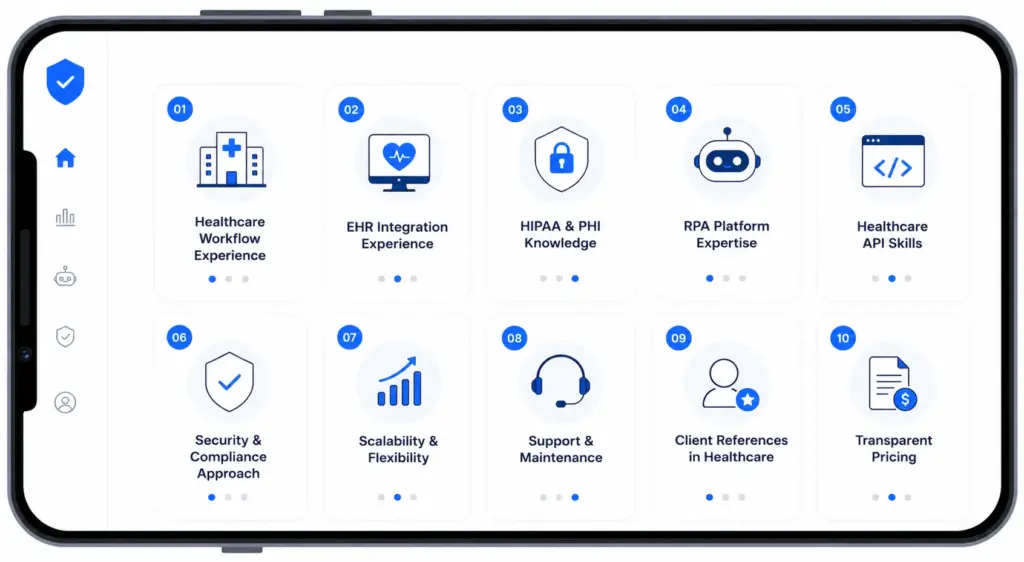
1. Healthcare Workflow Experience
Healthcare processes have rules and exceptions that generic automation projects may not account for. A provider with healthcare experience is more likely to understand how administrative teams work with EHRs, payer systems, billing platforms, and internal applications.
Look for a provider that can show real healthcare automation projects rather than only general RPA case studies. At IdeaUsher, we can help healthcare businesses identify workflows where RPA can create measurable value and then build the automation around those operational requirements.
2. EHR Integration Experience
An RPA bot may need to work across systems that were never designed to communicate with each other. Your provider should understand both modern integrations and older applications that may have limited API support. A useful evaluation can look like this:
| Integration Area | What to Check |
| EHR/EMR | Experience with healthcare platforms |
| Payer systems | Portal and claims automation |
| Billing | Data movement and reconciliation |
| Legacy apps | UI-based automation capabilities |
| APIs | Secure data exchange |
At IdeaUsher, we can help healthcare businesses connect RPA workflows with their existing systems instead of forcing them into a complete technology replacement.
3. HIPAA and PHI Knowledge
Healthcare automation can interact with sensitive patient information. That means security needs to be considered during architecture and development rather than added after the bot is finished. A provider should have a clear approach to access controls, credentials, encryption, audit trails, and PHI handling. Ask how bots are authenticated and what happens to patient data while a workflow is running. These answers can reveal whether the provider understands healthcare security beyond simply mentioning HIPAA.
4. RPA Platform Expertise
Different RPA platforms offer different capabilities. A provider should have experience with established platforms such as UiPath, Automation Anywhere, or Microsoft Power Automate and know how to select the right option for the workflow. The technology should support the project rather than dictate it.
IdeaUsher can help businesses evaluate the right RPA approach based on their workflows, integrations, and long-term automation plans instead of recommending a platform without first understanding the requirements.
5. Healthcare API Skills
RPA does not have to work alone. Modern healthcare automation may combine bots with APIs, databases, document processing, and other technologies. This is particularly useful when a workflow involves several systems. For example, an API could retrieve patient information while RPA handles a payer portal that has no suitable integration. Our team at IdeaUsher can help healthcare businesses design these combined automation workflows so different technologies work together as one process.
6. Exception Handling Skills
A workflow may look simple until it encounters an unusual case. A missing document, changed payer requirement, or unexpected system response can stop an automation if the provider has not planned for it. This is why exception handling should be part of the design from the beginning.
A reliable workflow should know when to:
- Continue automatically
- Retry the failed action
- Flag the case
- Send it to an employee
- Record what went wrong
Cleveland Clinic provides a useful example of this approach. Its automation team reviewed different scenarios and exceptions before putting bots into production. The organization later reported $700,000 in ROI over three years from its initial automation program, including use cases around claim edits and eligibility verification.
7. Scalability Across Workflows
A provider should think beyond the first bot. If the initial automation succeeds, your organization may want to extend it to other departments or processes. We can help healthcare businesses start with a focused RPA workflow and build toward a broader automation strategy as their requirements grow.
A scalable approach usually includes:
Pilot workflow → Shared automation framework → Multiple bots → Central governance → Enterprise automation
8. Monitoring and SLA Support
A bot that works perfectly during testing can still encounter problems after deployment. Healthcare systems change, and external portals can behave differently without warning. Your provider should therefore offer monitoring and a clear support arrangement. Ask about response times, incident handling, bot monitoring, maintenance windows, and escalation procedures.
A defined SLA becomes especially important when automation supports a workflow that affects billing, staffing, patient administration, or other time-sensitive operations.
9. Proven Automation Results
Do not evaluate an RPA provider only by the number of bots it has deployed. Look for evidence that its automation actually improved the process. For example, Lewisham and Greenwich NHS Trust automated pharmacy invoice consolidation. The process fell from one hour to two minutes and the Trust expected around $40,000 in annual savings, alongside a reported 233% ROI.
When evaluating providers such as IdeaUsher, ask for measurable outcomes rather than vague claims about “increased efficiency.” Useful measures include processing time, cost reduction, accuracy, and staff hours saved.
10. Clear Pricing and Engagement
RPA pricing can vary significantly depending on the number of workflows, integrations, development effort, infrastructure, and ongoing support. A provider should make it clear what is included in the quoted price.
| Pricing Area | Ask About |
| Discovery | Assessment and process mapping |
| Development | Bot design and development |
| Integration | EHR, API, and third-party systems |
| Deployment | Testing and production launch |
| Support | Monitoring and maintenance |
| Scaling | Cost of additional workflows |
IdeaUsher can help healthcare businesses plan an RPA engagement around their actual automation needs. This makes it easier to start with the workflows that offer the strongest potential value and expand the solution as the business sees results.
Why Healthcare RPA Integration Is More Important Than a Bot?
A healthcare bot is only useful when it can work smoothly with the systems around it. Most organizations already rely on several platforms to manage patients, billing, claims, and records. The provider needs to understand how these systems exchange information and where automation can fit without disrupting daily operations.
1. EHR and EMR Integration
EHR and EMR systems hold much of the information an RPA workflow may need. A bot might need to retrieve patient details and update a record after completing another task. If this connection is poorly designed, automation can create more work instead of reducing it. The provider should understand the system’s available integration methods and build the workflow around them.
2. Automating Payer Portals
Payer portals are often a practical RPA opportunity because employees may need to perform the same checks repeatedly. A bot can log in through approved credentials and retrieve information based on predefined rules. This can save staff from repeating the same portal-based work throughout the day.
For example:
Patient details → Eligibility check → Payer response → Record update
The workflow can then send unusual cases to an employee instead of trying to handle them automatically.
3. Billing System Integration
Billing automation often involves more than one application. Payment information may begin in a billing platform and then need to be matched against claims or updated in another system. A provider should be able to connect these steps without creating unnecessary duplication. This is where integration experience becomes just as important as the RPA bot itself.
| Workflow | Automation Opportunity |
| Claim status | Retrieve and update status |
| Payment posting | Match payment information |
| Reconciliation | Compare records |
| Billing updates | Transfer approved data |
5. API vs UI Automation
The right integration method depends on the systems involved. APIs can provide a direct way for applications to exchange information. UI-based RPA can be useful when a system does not offer a suitable API or when an existing application still requires manual interaction. The practical approach is not “API or RPA.” It can be both.
For example, an API could retrieve structured patient information while an RPA bot handles a payer portal that only works through its user interface. This combination can make the overall workflow more flexible.
6. Legacy System Integration
Older healthcare systems can be difficult to replace because they may support critical operations. Organizations therefore need automation that can work around these limitations without forcing a complete technology overhaul. RPA can interact with legacy applications through their existing interfaces when direct integration is not practical.
IdeaUsher can help healthcare businesses assess these systems and determine where RPA can provide a workable automation layer. The goal is to make the existing technology more useful while gradually reducing the manual work around it.
How Much Do RPA Services for Healthcare Cost?
The cost of healthcare RPA depends on what you want the automation to handle. A simple bot for one repetitive task will usually cost much less than a solution that connects several healthcare systems. The final budget also depends on the level of customization and support required. Instead of using one fixed price, it is better to estimate the cost based on the complexity of your project.
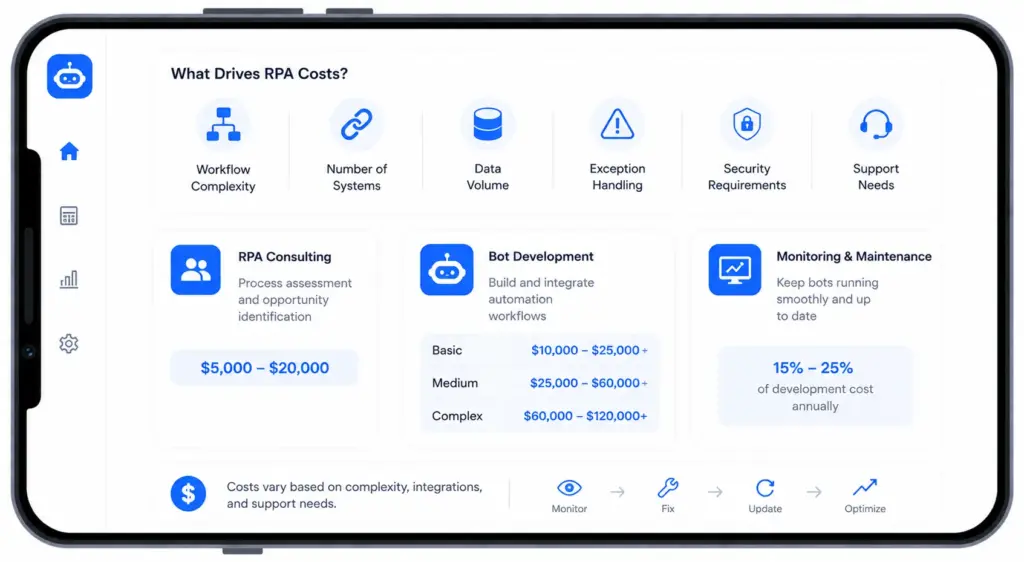
What Drives RPA Costs?
The biggest cost difference usually comes from what you want the automation to do. A workflow involving one system is relatively straightforward. A process that moves data between an EHR, payer portal, billing platform, and document system needs more development and testing.
| Cost Factor | Impact on Budget |
| Workflow complexity | More rules increase development time |
| Number of systems | More integrations require more work |
| Data volume | Higher volume may need stronger infrastructure |
| Exception handling | Complex cases require additional logic |
| Security requirements | Sensitive data needs stronger controls |
| Support needs | Long-term monitoring adds recurring costs |
RPA Consulting Costs
Before a bot is developed, an RPA consultant may assess the existing workflow and determine whether automation is actually worthwhile. This stage can reveal hidden dependencies and help estimate potential savings before development begins. For larger healthcare organizations, the assessment may cover several departments and workflows.
Typical consulting range: $5,000–$20,000
At IdeaUsher, we can help healthcare businesses identify suitable processes first so they can avoid spending money automating a workflow that offers little operational value.
Bot Development Costs
The development cost depends on how many actions the bot needs to perform and how many systems it must interact with. A basic data-entry bot can be relatively simple, while a claims workflow with multiple integrations and exception paths requires considerably more engineering.
Typical development range:
- Basic workflow: $10,000–$25,000
- Medium workflow: $25,000–$60,000
- Complex workflow: $60,000–$120,000+
Integration can increase the cost further when the workflow involves APIs, legacy applications, payer portals, or custom healthcare software.
Monitoring and Maintenance Costs
RPA continues to need attention after deployment. A payer portal may change its interface or an internal application may receive an update that affects the bot. Regular monitoring helps identify these issues before they interrupt an important workflow. Ongoing support also helps keep the automation aligned with changing business rules and healthcare processes.
Ongoing support can include:
Bot monitoring → Error resolution → Workflow updates → Performance checks → Optimization
A common planning approach is to budget around 15%–25% of the initial development cost annually for maintenance and support, although the actual amount depends on the number of bots and the service agreement.
RPA Cost by Complexity
These figures are planning estimates rather than fixed quotes. A healthcare RPA provider should first review the workflow, systems, data volume, security requirements, and expected outcomes before providing a project-specific estimate. For organizations working with IdeaUsher, this assessment can also help determine whether to begin with a single high-value automation or build a broader RPA program.
| Project Type | Estimated Cost | Typical Scope |
| Basic RPA | $10,000–$25,000 | One repetitive workflow |
| Mid-Level RPA | $25,000–$60,000 | Multiple steps and integrations |
| Advanced RPA | $60,000–$120,000+ | Complex rules and multiple systems |
| Enterprise RPA | $120,000–$300,000+ | Multiple workflows and departments |
What Questions Should You Ask an RPA Services Provider?
Before choosing an RPA partner, it helps to ask questions that reveal how they actually work. A provider may have strong technical skills yet lack experience with healthcare workflows. We believe these conversations should happen before development starts. The answers can help you understand whether a provider can handle your systems, security needs, changing processes, and long-term automation goals.
Which Workflows Have You Automated?
Start by asking for examples that are close to your own processes. A provider that has automated claims or patient registration will have a better understanding of the challenges involved than one with experience limited to general office automation. At IdeaUsher, we help healthcare businesses find workflows that are suitable for RPA and then plan the automation around their actual operational needs. When reviewing our capabilities or any other provider, look for specific examples rather than a simple list of industries served.
Which Systems Can You Integrate?
Your provider should be comfortable working with the systems your team already uses. This may include an EHR, billing platform, payer portal, or custom application. We at IdeaUsher can help healthcare businesses assess these systems before deciding how the automation should connect with them.
| Ask About | Why It Matters |
| EHR integration | Supports patient workflows |
| Payer portals | Helps automate insurance tasks |
| Billing systems | Reduces manual financial work |
| APIs | Enables direct data exchange |
| Legacy systems | Supports older applications |
This question can quickly show whether a provider can work within your current technology environment instead of expecting you to replace it.
How Do You Protect PHI?
Healthcare automation can involve protected health information. Ask the provider how that information is accessed and protected while the bot performs its work. Our team at IdeaUsher can help build healthcare RPA workflows with security requirements considered from the architecture stage.
You should understand how the provider handles:
Access → Authentication → Data Transfer → Processing → Audit Logs
Also ask how credentials are stored and how bot access is controlled. These details can tell you much more about a provider’s security approach than simply stating that the solution is “secure.”
How Are Bot Failures Handled?
No automation runs perfectly forever. A portal may become unavailable or a record may contain unexpected information. At IdeaUsher, we approach RPA with these situations in mind so the workflow has a clear response when something does not go as planned. A reliable setup should be able to:
- Detect the problem
- Stop the affected action
- Record the failure
- Retry when appropriate
- Send the case to the right employee
Ask potential providers to demonstrate how they handle these situations. It can reveal whether their solution is designed for real healthcare operations or only for ideal scenarios.
What If Workflows Change?
Healthcare processes do not remain static. Payer requirements can change and internal systems may receive updates. We can help businesses adapt their RPA workflows when these changes affect the automation. The answer will give you a better idea of the provider’s maintenance process and long-term engagement model.
A useful question to ask is: “If this workflow changes six months after launch, who updates the bot and how is that work charged?”
How Will ROI Be Measured?
The value of RPA should be visible in the numbers. When we work with healthcare businesses at IdeaUsher, we can help identify measurable targets before implementation so the organization has a clear way to judge the outcome. Ask providers which metrics they will track. Processing time, error reduction, staff hours saved, and increased workflow capacity can give you a clearer picture of the actual return.
For example:
| Metric | Before RPA | After RPA |
| Processing time | 10 minutes | 3 minutes |
| Manual touches | 5 | 1 |
| Daily capacity | 300 cases | 700 cases |
| Error rate | 4% | 1% |
What Support Comes After?
The relationship should not end when the bot goes live. IdeaUsher can support healthcare businesses beyond the initial RPA development by helping with monitoring, updates, troubleshooting, and further optimization.
A support agreement may cover:
- Bot monitoring
- Bug fixes
- System updates
- Performance reviews
- Workflow changes
- Technical assistance
Before choosing a provider, ask exactly what happens when an automation fails after deployment. You should also know the expected response time and whether ongoing support is included in the original agreement.
What Does Pricing Include?
The initial quote does not always represent the complete project cost. We at IdeaUsher can help healthcare businesses understand the different components of an RPA project before development begins. A clear pricing discussion makes it easier to compare providers fairly. It also helps you understand whether the quoted amount covers the full implementation or only the initial bot development.
| Cost | Ask |
| Discovery | Is process assessment included? |
| Development | What does the build cover? |
| Integration | Are system connections included? |
| Deployment | Is testing part of the quote? |
| Support | What happens after launch? |
| Scaling | How are new workflows priced? |
When Is Custom Healthcare RPA a Better Choice?
Not every healthcare workflow fits neatly into a standard automation template. Some processes involve several systems, unusual business rules, or strict access requirements. In these situations, custom RPA can provide more control than trying to force an existing bot into a workflow it was never designed to handle.
1. When Standard Bots Fall Short
Standard automation can work well for simple and predictable tasks. Problems arise when a workflow has several exceptions or depends on systems that behave differently from one case to another. A custom solution gives the provider more freedom to design the automation around those specific requirements.
Custom RPA can make sense when:
- The workflow has unique business rules
- Existing bots cannot support the required process
- Several manual steps need to work together
- The automation needs custom exception handling
We can help healthcare teams identify where standard automation ends and custom development becomes more practical.
2. When Systems Must Connect
A healthcare workflow may pass through an EHR, payer portal, billing platform, and internal database before it is complete. Standard bots may handle individual tasks but struggle to coordinate the entire process. Custom RPA can bring those steps together into one controlled workflow.
| Requirement | Custom Approach |
| EHR access | RPA or API integration |
| Payer portal | UI automation |
| Billing data | System integration |
| Documents | Intelligent extraction |
| Exceptions | Human escalation |
This approach can be especially useful for healthcare businesses with older systems.
3. When Rules Get Complex
Healthcare workflows often contain rules that go beyond simple “if this, then that” actions. A claim may require different treatment based on its status. A document may need to be routed differently depending on its contents. These situations call for automation that can follow more detailed logic.
A custom workflow can combine RPA with APIs, intelligent document processing, databases, and AI-based decision support when appropriate. The goal is not to automate every decision. It is to let software handle predictable work while sending cases that need judgment to the right employee.
4. When Security Needs Customization
Healthcare organizations may have their own access policies and security requirements. A standard bot may not provide enough flexibility for workflows that involve sensitive patient information or tightly controlled systems. Custom development can allow the automation to follow specific requirements for user access, credentials, audit trails, data movement, and human approval. At IdeaUsher, we can help healthcare businesses build these controls into the RPA architecture rather than treating security as an afterthought.
5. When You Plan to Scale
Custom RPA becomes even more valuable when automation is expected to grow beyond one workflow. A solution designed only for a single department may become difficult to manage when other teams want to adopt it. Singapore General Hospital offers an interesting example. Its RPA program has been used across different departments and has saved more than 84,000 man-hours since 2020. The hospital reported productivity gains of around $3 million from its automation efforts.
This shows why scalability should be considered from the beginning. We at IdeaUsher can help healthcare businesses start with a focused automation project and create an architecture that can support additional workflows as adoption grows.
Why Choose IdeaUsher for Healthcare RPA Services?
Choosing an RPA partner is ultimately about finding a team that can understand your processes and turn them into dependable automation. At IdeaUsher, we approach healthcare RPA as a business workflow problem first and a technology problem second. Our team can help organizations move from identifying the right process to developing and integrating the automation.
Healthcare Workflow Automation
Healthcare automation needs to fit the way teams actually work. A bot may look effective in a demonstration but still create problems if it does not account for existing processes, exceptions, or system dependencies. We at IdeaUsher can help healthcare businesses identify repetitive workflows that are suitable for RPA and design automation around them. This can include administrative processes such as claims handling, document processing, patient registration, billing, and other back-office operations.
Custom Intelligent Automation
Not every process can be handled by a simple rule-based bot. Some workflows involve documents, changing information, or decisions that require additional technologies. That is where combining RPA with intelligent automation can make the solution more capable. Our development team can work with technologies such as intelligent document processing, AI, APIs, and workflow automation to create solutions suited to more complex requirements. IdeaUsher brings 500,000+ hours of coding experience to projects where healthcare businesses need automation that can grow beyond a basic bot.
EHR and System Integration
Healthcare organizations rarely operate with a single application. RPA may need to work alongside EHRs, billing platforms, payer portals, databases, and custom enterprise software. Making these systems work together is often more important than the bot itself. At IdeaUsher, we can help healthcare businesses build integration-driven RPA solutions that work with their existing technology. Our experienced development team can evaluate available APIs and legacy interfaces to determine the most practical way to connect each part of the workflow.
Conclusion
Choosing the right RPA provider can make the difference between a bot that performs a task and an automation solution that improves the way your healthcare business operates. The best partner should understand your workflows and work comfortably with your existing systems. At IdeaUsher, we help healthcare businesses plan and implement RPA solutions that reduce repetitive work while leaving room to scale as their needs grow.
FAQs
A1: Look for a provider with experience in healthcare workflows and system integration. They should understand EHRs, security requirements, exception handling, and long-term bot maintenance. It is also useful to review their previous healthcare projects and ask how they measure the results of automation. A provider should also be able to explain how the solution can scale as your automation needs grow.
A2: The cost depends on the complexity of the workflow and the systems involved. A simple RPA project may start around $10,000, while larger implementations can reach $100,000 or more. Integration, customization, testing, and ongoing support can also affect the final cost. Getting a workflow assessment before development can help create a more realistic project estimate.
A3: RPA can be designed to work securely with sensitive healthcare information when the right controls are implemented. These can include role-based access, secure credential management, encryption, and audit logs. Healthcare organizations should also make sure their provider understands the security and compliance requirements that apply to their workflows. Security should be considered during the design stage rather than added after the automation is built.
A4: Implementation time depends on the number of workflows and the complexity of the systems involved. A straightforward automation may take a few weeks to develop and test. Larger projects with multiple integrations, complex business rules, and extensive testing can take several months. Starting with one well-defined workflow can help organizations launch automation faster and learn before expanding further.