

Key Takeaways
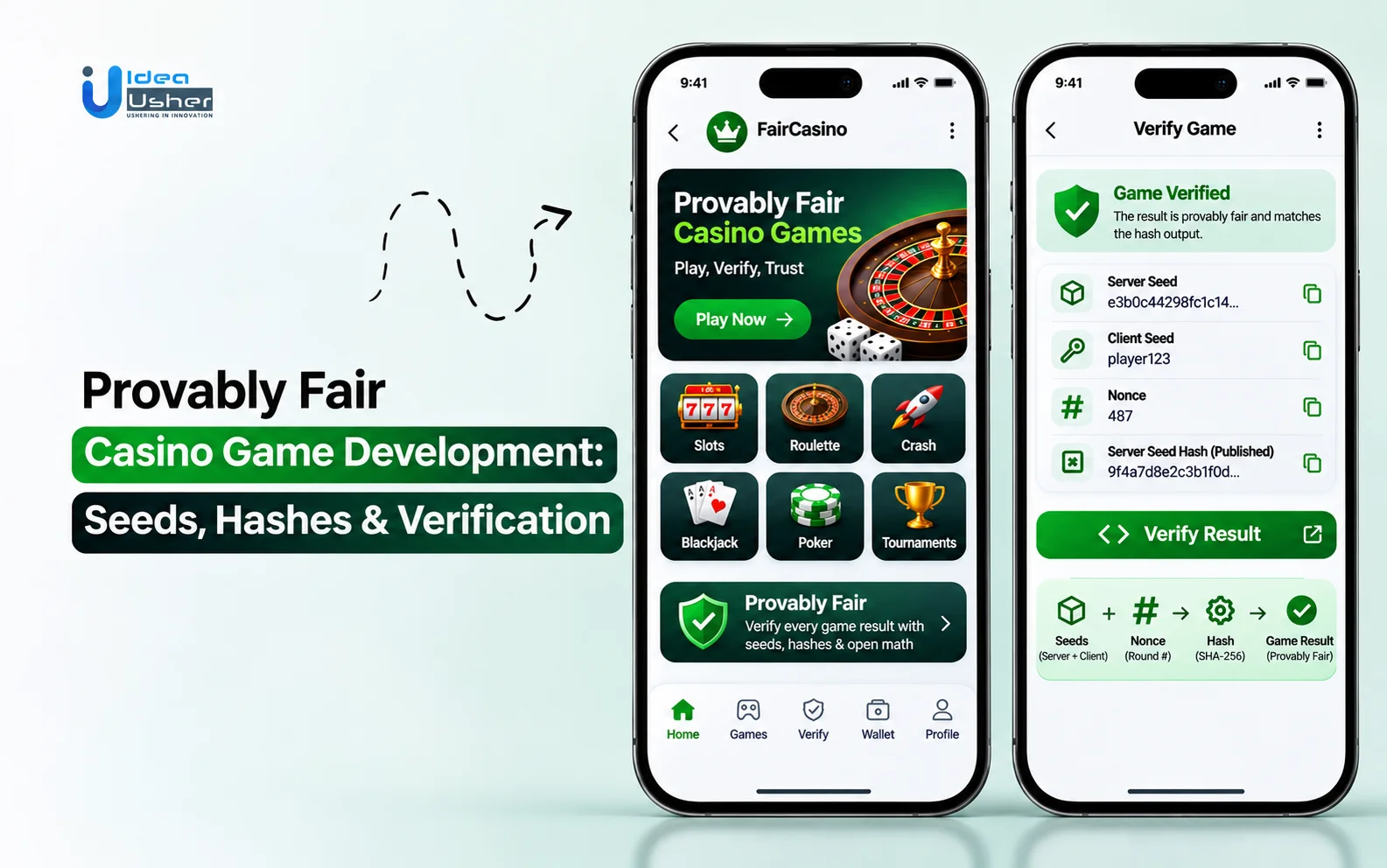
- Provably fair casino games let players check if the game result is fair or not. The technology uses server seeds, client seeds and nonces variables combined to match with the final result.
- SHA-256 and HMAC-SHA256 handle the verification process. Players verify past results using server seed using commit-and-reveal verification.
- The provably technology verification works with various casino games. Examples like dice, crash, Mines, Plinko, Keno and slots, with different maths used for each game.
- A single provably casino game can cost around $8,000 to $65,000. The full custom of different types of casino games can cost up to $300,000.
Provably fair casino game development involves building online games that use cryptographic algorithms to verify the outcomes. The systems combine server seeds, client seeds and nonces with SHA-256 and HMAC-SHA256 hashing to generate a result to verify with the outcome. Players can validate the completed games using a commit-and-reveal mechanism comparing the revealed seeds. The development process also requires secure seed management, accurate game mathematics for different games and independent verification tools for transparency and integrity.
Integrating provably fair technology is more than adding cryptographic hashing in the casino games. Developers have to make sure that seed generation, hash commitments, outcome calculation and verification logic are consistent for every game round. Secure seed storage, controlled seed rotation and transparent verification are also equally important. Together these prevent game outcome manipulation and help players to validate their result independently.
In this blog, we will explain provably fair casino game development, covering server seeds, client seeds, nonces, SHA-256 hashing, HMAC-SHA256, commit-and-reveal workflows, verification tools and the technical safeguards required to build a transparent provably fair casino gaming platform.
What Is a Provably Fair Casino Game?
A provably fair casino game is an online gambling game that uses cryptographic technology to allow players to independently verify that the outcome of each round was generated fairly and has not been tampered with.
Unlike traditional online casinos where game randomness is hidden inside a closed corporate server (a “black box”), provably fair games use open-source algorithms and cryptographic hashes to give players mathematical proof that the operator did not alter the results after wagers were placed.
A. How the Provably Fair System Works
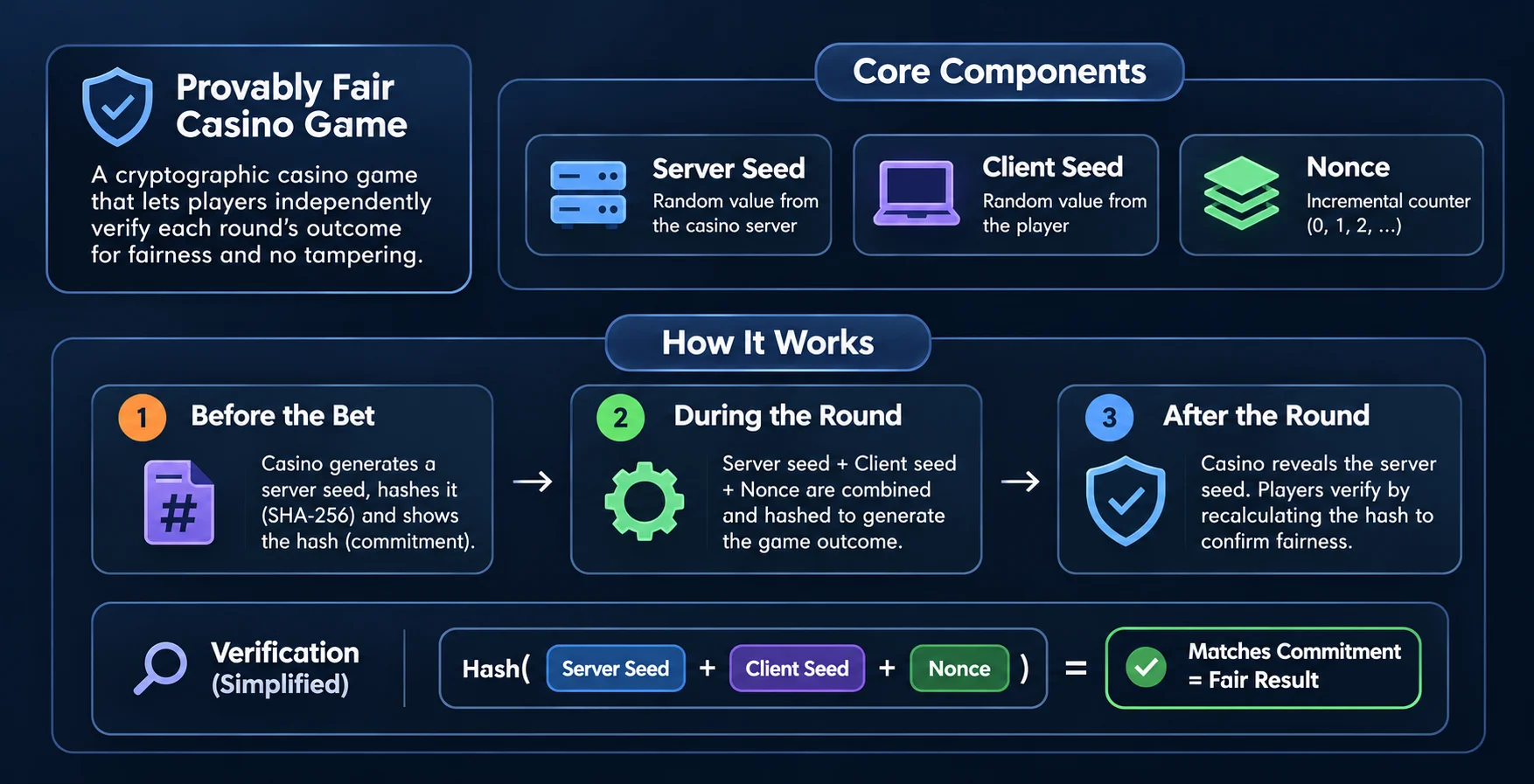
The mechanism relies on three core variables that combine to determine a game’s outcome (such as a roulette spin, a card sequence, or a dice roll):
- Server Seed: A random string of data generated by the casino’s server.
- Client Seed: A random string of data provided by the player’s browser (or customized by the player), ensuring the casino doesn’t control the entire input.
- Nonce: A simple counter that starts at zero and increases by one with every bet placed, ensuring a unique result for every single round.
The Gameplay Loop
When you hit “Spin” or “Roll,” the system combines the Server Seed + Client Seed + Nonce. It hashes this combined string and translates it into the game’s actual result like a specific card deck order, a roulette wheel slot, or a multiplier value.
B. The Verification Process
The system operates like a digital “sealed envelope” following a strict chronological order:
Before the Bet: The casino generates a server seed and hashes it (typically via SHA-256). Displaying this hashed server seed beforehand prevents cheating by keeping the seed secret while binding the casino to the pre-determined value.
During the Round: The player’s client seed and the incrementing nonce are combined with the casino’s server seed. This combined dataset is hashed and mapped directly to a numerical game outcome.
After the Round: The casino unveils the unhashed server seed. Inputting this, the client seed, and the nonce into a verifier lets players check if the recalculated hash matches the original commitment. Alignment confirms the outcome was predetermined without seed swapping or mid-round manipulation.
C. Provably Fair vs. Traditional RNG Certification
The global online gambling market continues to expand, creating opportunities for operators to introduce more transparent gaming experiences. According to Grand View Research, the market was valued at $88 billion in 2025 and is projected to reach $202.8 billion by 2033, growing at an 11% CAGR.
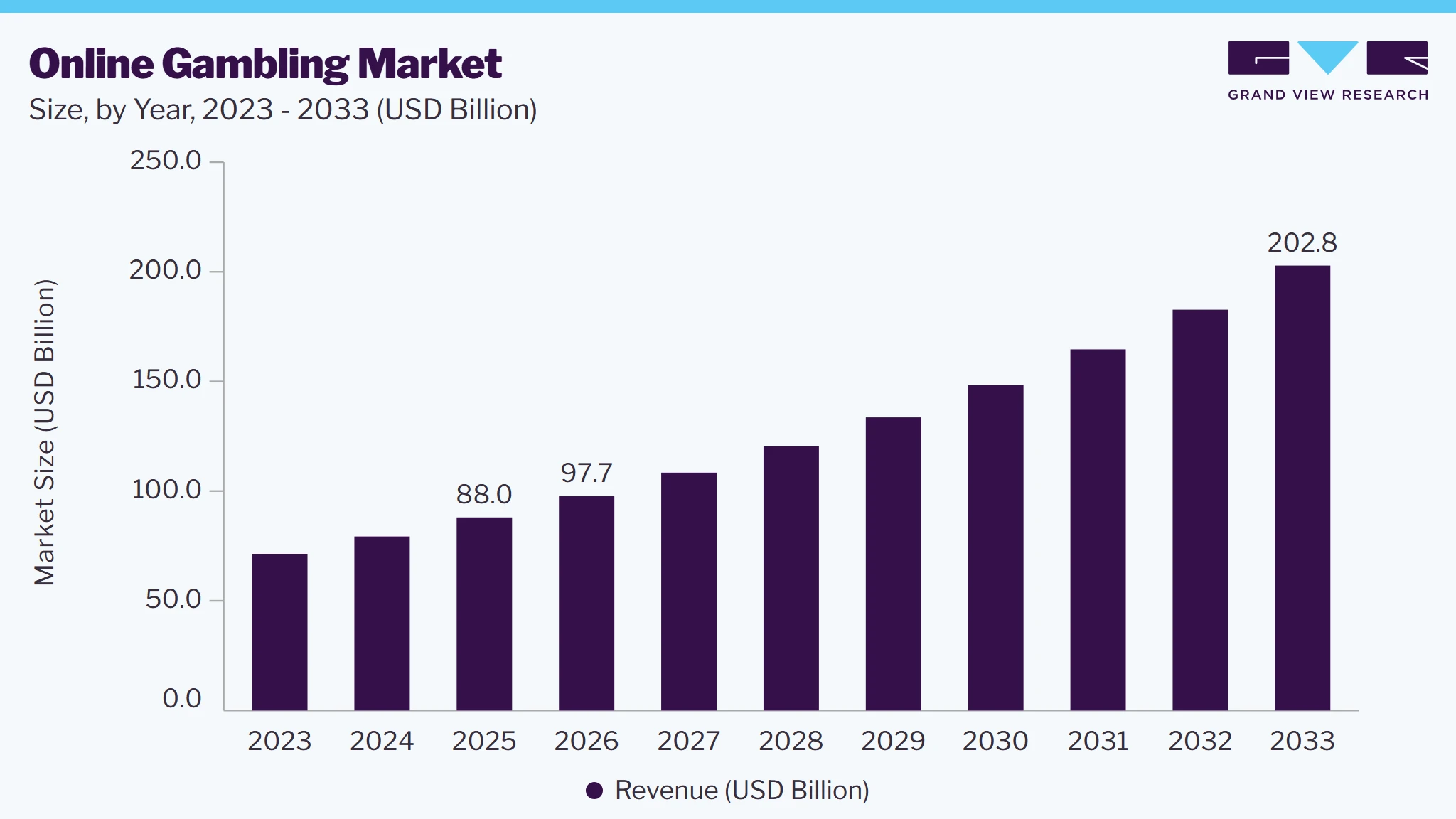
On-chain gambling reached $51 billion in transaction volume during 2025. TRM Labs also reported that quarterly on-chain gambling volume reached $15 billion in Q4 2025, highlighting the scale of blockchain-based gambling activity.
ProvablyFair.org published an audit covering reproduced 61,155 live bets across 11 casino games and simulated 266 million rounds for mathematical validation. All captured outcomes matched, with no fairness failures identified within the audited scope.
As online gambling expands, casino operators need mechanisms that establish game integrity and give players confidence in how outcomes are generated.
Traditional RNG certification and provably fair technology address this requirement through different approaches to testing, oversight and outcome verification. The following comparison highlights how these systems differ.
| Feature | Provably Fair Games | Traditional RNG Certification |
| Trust Model | Trustless/Self-Verifiable: The player verifies individual round outcomes mathematically. | Institutional: The player trusts independent third-party audit firms. |
| Verification Method | Cryptographic data matching (Server Seed + Client Seed + Nonce). | Large-scale statistical testing of software over millions of simulation samples. |
| Primary Auditors | The player themselves or open-source community code. | Independent test labs like eCOGRA, iTech Labs, or GLI. |
| Regulatory Status | Common in cryptocurrency-based casinos; often operates outside traditional licensing frameworks. | Mandatory for games hosted by strictly regulated jurisdictions (e.g., UKGC, MGA). |
Note: While a provably fair system mathematically proves a specific round wasn’t rigged, it does not guarantee that the operator holds a valid license, processes cashouts quickly, or offers robust responsible gambling controls.

How the Provably Fair Cryptographic Architecture Works
A Provably Fair system replaces blind trust with cryptographic verification. Unlike traditional online gaming, where RNG logic remains hidden on the server, it uses deterministic cryptography to make outcomes independently verifiable.
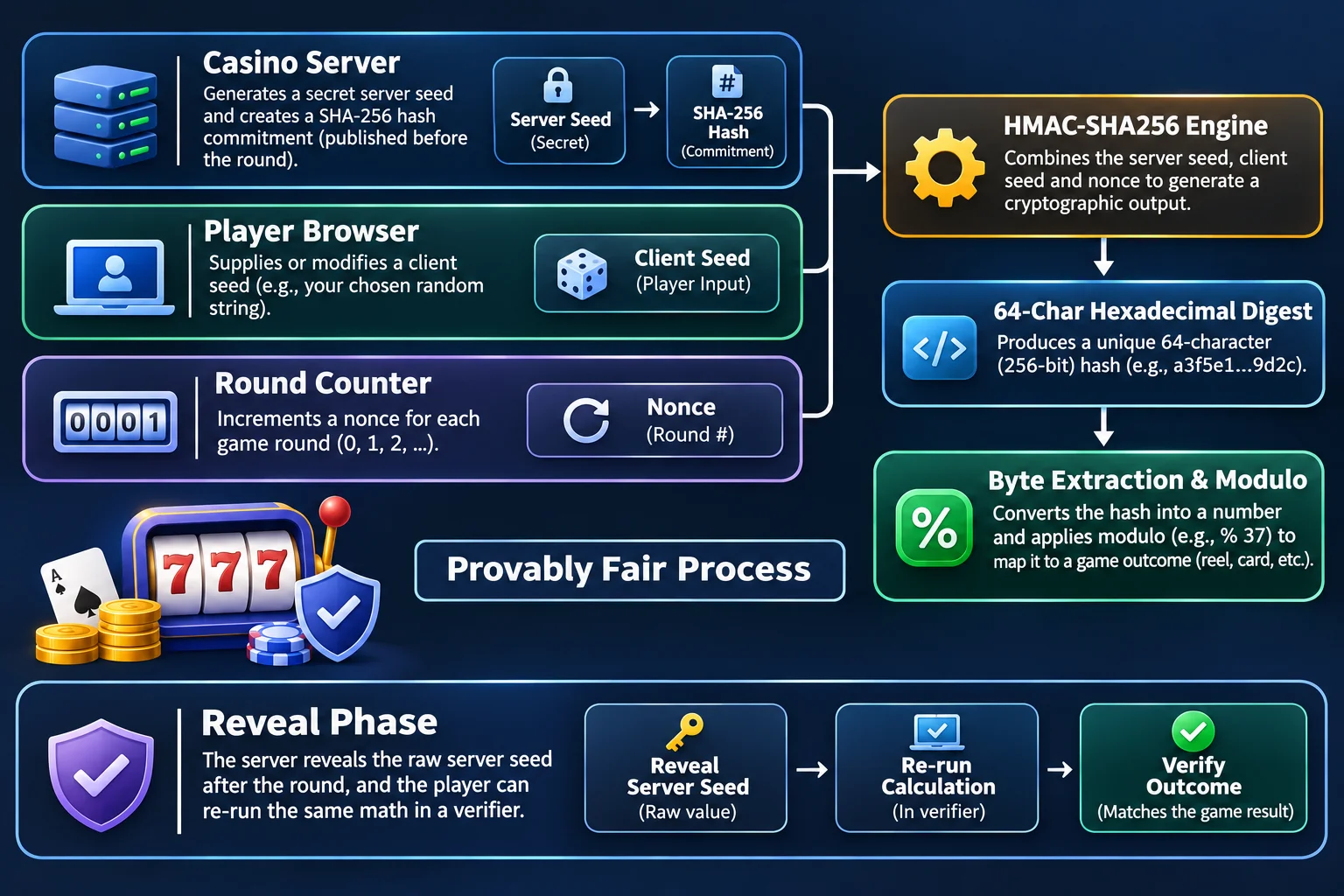
Before each round, the casino and player establish seed inputs. The operator publishes a server seed hash before the bet, preventing post-bet changes without invalidating the commitment. The player’s client seed also limits the operator’s ability to predetermine outcomes independently.
1. Server Seed: Creating the Casino’s Secret Input
The Server Seed is a cryptographically secure, pseudo-random string generated by the operator’s backend engine (using high-entropy sources like /dev/urandom or hardware-level CSPRNGs).
- Role: Acts as the operator’s private input contribution to the random state generation engine.
- Confidentiality: Must remain strictly confidential on the backend while active. Exposing the active server seed prematurely would allow players or automated bots to pre-calculate all future round outcomes for that seed pair.
- Entropy Standards: Typically generated as a high-entropy 32-byte or 64-byte hexadecimal string (e.g., d2a4f6e8c0b2…) to ensure protection against brute-force dictionary attacks.
2. Client Seed: Giving Players Control Over Randomness
The Client Seed is a string supplied or modified by the user’s web browser or mobile client.
- Role: Serves as the player’s input contribution to the outcome calculation.
- User Authority: Platforms generate a default client seed upon user connection, but allow players to manually overwrite it with any arbitrary text or custom value at any time.
- Cryptographic Value: Player-side entropy prevents operators from pre-determining outcomes. Modifying even one character of the client seed drastically alters the hash digest through cryptographic hashing’s avalanche effect, invalidating pre-selected winning server seeds.
3. Nonce Management: Separating Consecutive Game Rounds
The Nonce is an integer counter that tracks the number of individual bets or rounds executed using a specific Server Seed / Client Seed pair.
- Function: Starts at 0 or 1 when a seed pair is initialized and increments by 1 with every subsequent game action.
- State Preservation: Prevents duplicate outcomes across sequential bets without requiring the server to generate a new server seed and publish a new hash commitment for every single spin or card deal.
- Multi-Action Games: In complex games like Mines or Multi-Hand Blackjack, nonces may feature secondary sub-counters or “cursors” to sample multiple random numbers within a single round.
Alongside nonce management, two cryptographic processes make these inputs verifiable and usable for game outcome generation:
- SHA-256 Hashing: Before gameplay, the casino publishes a 64-character SHA-256 hash of its secret Server Seed as a public commitment, preventing post-bet seed modifications.
- HMAC-SHA256: Using HMAC-SHA256, the platform combines the Server Seed, Client Seed, and Nonce to generate a deterministic output, which the game engine converts into a specific result like a dice roll, card position, or slot combination.
Players can later reproduce these calculations using the revealed Server Seed, their Client Seed and the recorded Nonce to check whether the outcome matches the original inputs.
4. Seed Rotation: Revealing Previous Seeds Securely
Verification requires comparing past outputs against revealed secrets. The platform manages this transition via Seed Rotation:
- Rotation Trigger: A seed pair remains active across multiple nonces until the player manually changes their client seed, requests a seed rotation, or hits an automated rotation threshold.
- Unlocking Historical Verification: When rotated, the backend archives the active server seed, exposes its raw unhashed version via UI or API, and generates a new server seed while publishing its SHA-256 hash commitment for future bets.
- Third-Party Verifier Execution: Players or open-source verifiers re-run SHA-256 and HMAC calculations using the revealed server seed, client seed, and nonces. Matching results confirm predetermined outcomes and unmanipulated game logic.
How Commit-and-Reveal Verification Works in Provably Technology
A Commit-and-Reveal system provides an auditable cryptographic loop that guarantees the casino operator did not manipulate game outcomes after seeing a player’s bet.
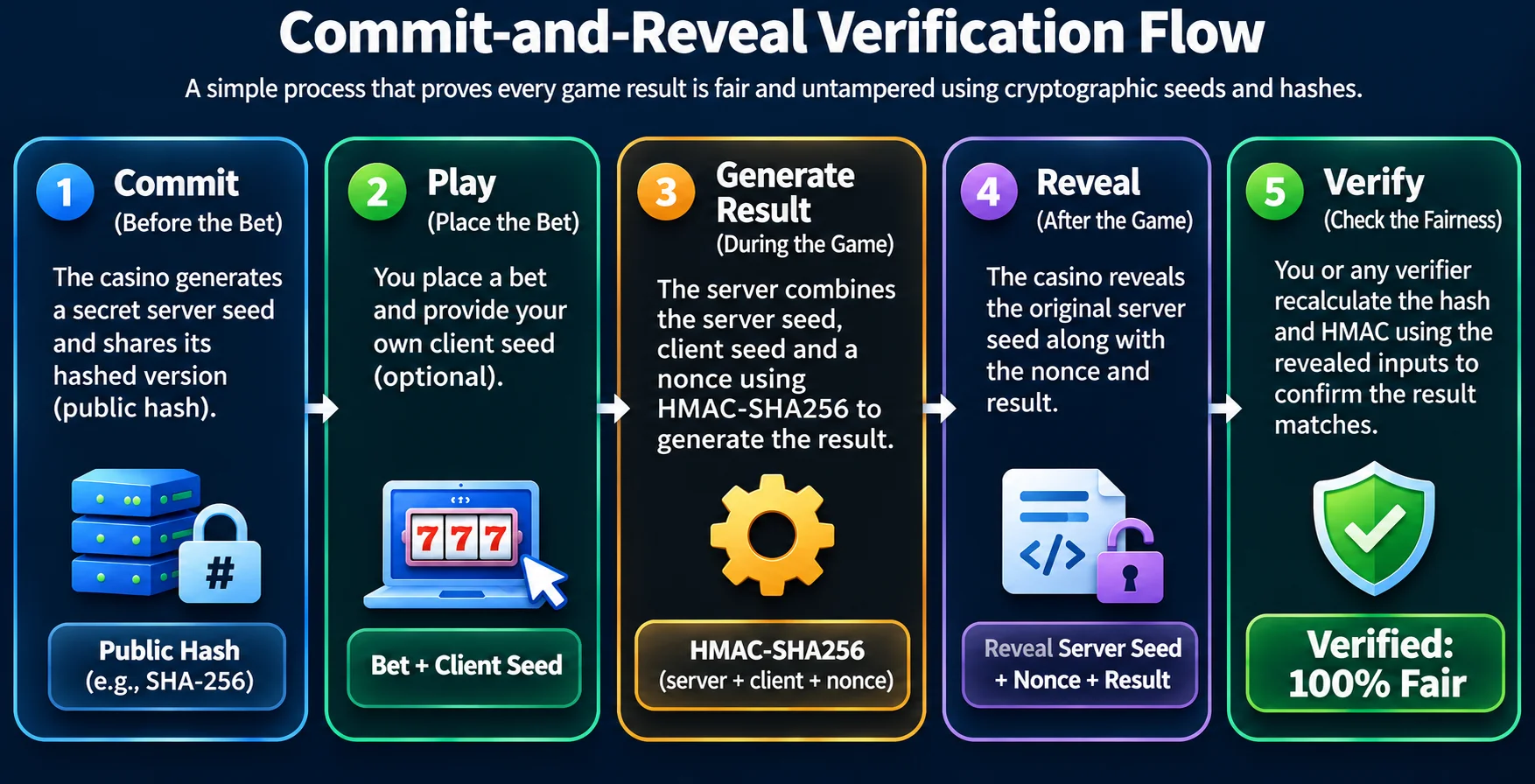
The process splits game round execution into two phases: Commitment (where the operator locks in the random seed beforehand) and Revelation (where the operator discloses the secret seed so the player can re-run the calculation).
Step 1: Generate and Hash the Server Seed
Before initializing a game session, the backend server creates a cryptographically secure random secret the Server Seed and immediately computes its SHA-256 hash digest.
- Server Action: Generates a 64-character hexadecimal string (Server_Seed_Secret).
- Hash Computation: Server_Seed_Hash = SHA256(Server_Seed_Secret)
Step 2: Publish the Hash Before Gameplay
The operator transmits the 64-character hexadecimal SHA-256 hash to the player’s client interface prior to wager placement. Because SHA-256 is a one-way function, the player cannot decode the hash to reveal the secret seed.
However, rendering this hash publicly locks the operator into that exact seed value. Changing even a single bit of the server seed on the backend would produce a completely different hash commitment.
Step 3: Combine Seeds With the Nonce
When the player initiates a wager, their local client sends the Client Seed (a string generated by the user or their browser) and the current Nonce (a round counter that increments with every bet, e.g., 0, 1, 2).
The backend combines these parameters into an input payload string: Message Payload = Client Seed + “:” + Nonce
Step 4: Generate and Record the Game Outcome
The engine computes a Hash-based Message Authentication Code (HMAC-SHA256), using the secret Server Seed as the key and Client Seed:Nonce as the message.
HMAC Digest = HMAC-SHA256 (Key = Server Seed, Message = Client Seed + “:” + Nonce)
The engine parses the resulting hexadecimal digest into a numerical value and maps it to a game outcome (e.g., a dice roll between 0.00 and 99.99 or a slot reel configuration). The platform then renders the visual outcome and records the bet state to the database ledger.
Step 5: Reveal the Seed and Verify the Result
Once a player rotates their seed pair (or closes a gaming session), the server reveals the raw, unhashed Server Seed. The player or a third-party verifier script re-executes two mathematical checks to confirm absolute game integrity:
- Hash Verification: Does SHA256 (Revealed Server Seed) match the hash published before the bet was placed?
- Outcome Verification: Does recomputing HMAC-SHA256 (Revealed Server Seed, Client Seed + “:” + Nonce) produce the exact same outcome on screen?
Which Casino Games Can Use Provably Fair Technology?
A key advantage of provably fair technology is its architectural versatility. A single cryptographic engine generating deterministic HMAC-SHA256 digests from combined server seeds, client seeds, and nonces can power distinct game categories.
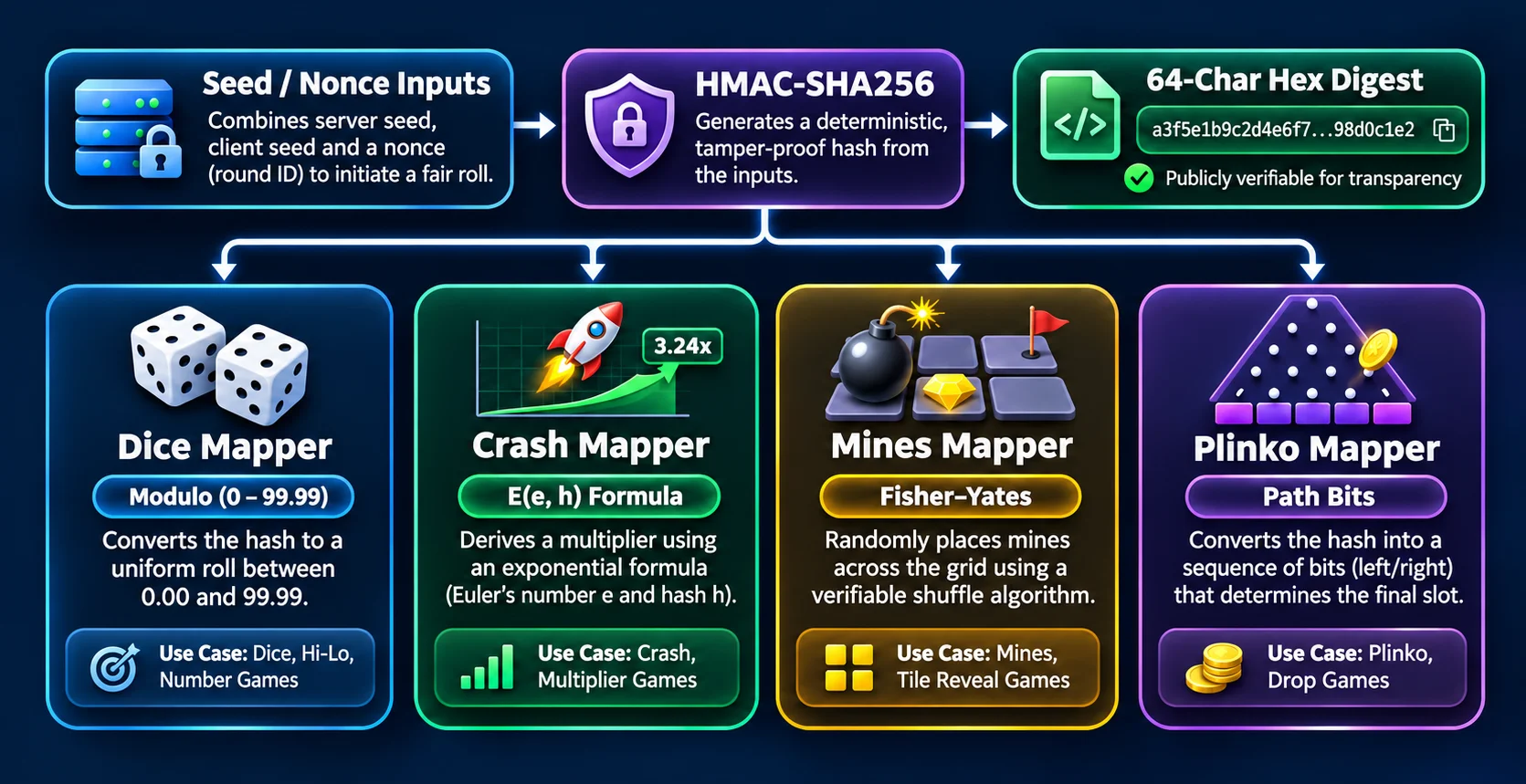
Using this shared random stream, each game applies a unique mathematical mapper to convert hex digests into visual events like dice rolls (0.00–99.99), crash multipliers, minefields, or Plinko paths.
Because mapping formulas vary, testing labs must independently validate probability distributions, range mappings, and paytables for each title.
A. Dice: Mapping Hash Outputs to Randomized Rolls
Provably Fair Dice is the simplest implementation of cryptographic random number mapping.
- Number Range Conversion: The game engine extracts the first 4 bytes (8 hexadecimal characters) of the HMAC-SHA256 digest and converts them into a 32-bit unsigned integer (0 to 4,294,967,295).
- Decimal Precision Formula: To map this large integer into a readable 0.00 to 99.99 roll output, the engine executes a modulo operation: Dice Roll = (Decimal Value mod 10000) / 100
- House Edge Validation: A target slider allows players to select their win condition (e.g., roll under 50.00). If the casino enforces a 1.0% House Edge, the multiplier is calculated dynamically as: Multiplier = (100 – House Edge) / Win Probability = 99.00 / 50.00 = 1.98x
B. Crash: Calculating Verifiable Crash Multipliers
Crash games (e.g., Aviator, JetX) rely on a rising multiplier curve that abruptly stops at an unpredictable “crash point.”
- Crash-Point Math: The engine takes the HMAC-SHA256 digest, extracts a subset of bits, and evaluates a mathematical inverse function designed to yield an exponential curve distribution: Multiplier = floor(((100 – e) × h) / (h – e)) / 100
Where h is a constant maximum value (2^52) and e is the integer derived from the digest’s first 52 bits.
- Instant Crash Mechanic: Apply a baseline house edge (typically 1%–3%) by triggering an immediate crash at 1.00x when the derived integer e is divisible by a fixed constant (e.g., e mod 33 = 0), resulting in the loss of initial wagers.
C. Mines: Randomizing Mine Positions Across the Grid
In grid-based Mines games (e.g., a 5 x 5 board with 25 tiles), the engine must randomly scatter a user-defined number of hidden mines (e.g., 3 mines) across available tile coordinates.
- Fisher-Yates Grid Shuffling: To prevent mine location bias, the provably fair engine uses the byte stream of the HMAC digest as the random swap seed inside a Fisher-Yates shuffle algorithm:
- Selection Validation: When a player selects a tile, the backend verifies its ID against the pre-generated mine array. Since this array is established from the seed pair before selection, the operator cannot retroactively insert a mine.
D. Plinko and Keno: Converting Random Outputs Into Game Events
Multichannel decision games derive sequential choice pathways directly from cryptographic hashes.
1. Plinko (Ball-Path Generation)
- In a 16-row Plinko pyramid, a dropping ball hits 16 sequential pins. At each pin, the ball must deflect Left (0) or Right (1).
- The engine reads the first 16 bits of the HMAC-SHA256 digest. A 0 bit pushes the ball left; a 1 bit pushes it right.
- The count of 1 bits sets the landing slot via a Binomial Distribution (n = 16, p = 0.5). Center slots carry higher probabilities with lower multipliers, whereas outer slots offer lower probabilities with higher payouts (e.g., 1000x).
2. Keno (Number Selection)
- In a 20-number draw out of 80 total Keno spots, the cryptographic engine uses byte chunks from the HMAC output to draw numbers sequentially without replacement.
- Payout calculations evaluate the mathematical overlap between the player’s chosen array of numbers and the algorithmically drawn 20-number set against a certified Keno paytable matrix.
How to Develop a Provably Fair Casino Game Platform
The provably fair casino game development requires establishing seed management, hashing logic, and outcome generation before building game interfaces, allowing players to verify outcomes independently.
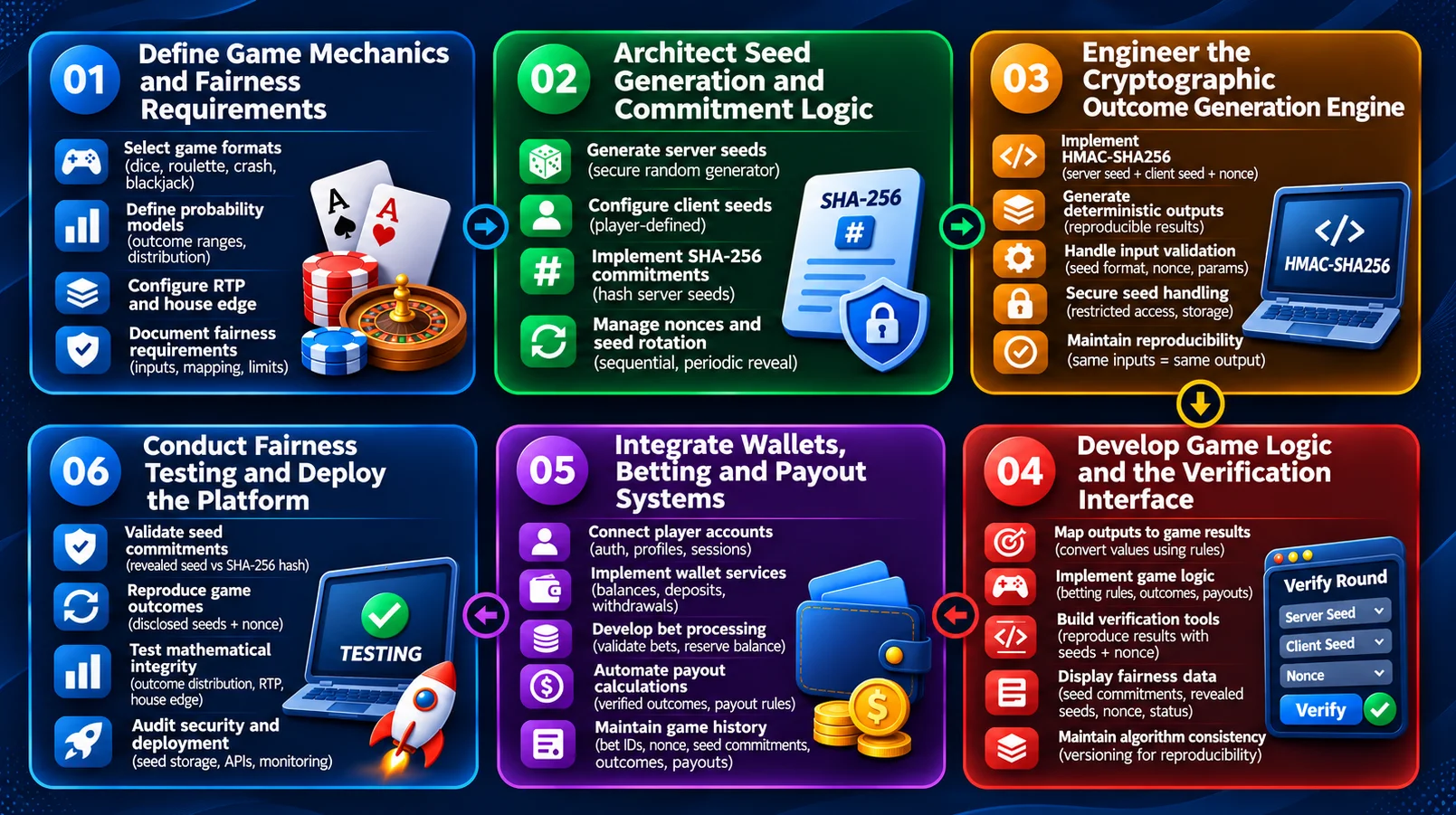
Integrating fairness mechanisms with game math, betting, wallets, and history ensures every round yields a traceable, reproducible outcome.
1. Define Game Mechanics and Fairness Requirements
Begin by defining the casino games and mathematical rules the platform will support. These requirements determine how cryptographic outputs translate into game outcomes and payout calculations.
- Select Game Formats: Identify supported games such as dice, roulette, crash and blackjack.
- Define Probability Models: Establish outcome ranges, probability distributions and game-specific mathematical rules.
- Configure RTP and House Edge: Calculate theoretical RTP, payout structures and house edge for each game.
- Document Fairness Requirements: Define configurable inputs, hidden values, outcome mapping, betting limits and verification rules.
Documented game specifications covering probability models, payout mathematics, RTP targets, house edge and cryptographic fairness requirements for each supported game.
2. Architect Seed Generation and Commitment Logic
Design the seed management architecture before implementing game interfaces. It must generate unpredictable server seeds, accept client seeds and create verifiable commitments before corresponding game rounds are executed.
- Generate Server Seeds: Create unpredictable server seeds using a cryptographically secure random number generator.
- Configure Client Seeds: Allow players to set or change client seeds under defined platform rules.
- Implement SHA-256 Commitments: Hash server seeds and publish commitments before gameplay to prevent retrospective changes.
- Manage Nonces and Seed Rotation: Assign sequential nonces to bets, rotate server seeds periodically and reveal previous seeds after completed rounds.
A seed management system supporting secure generation, player-configurable inputs, SHA-256 commitments, nonce tracking and verifiable seed rotation.
3. Engineer the Cryptographic Outcome Generation Engine
Once seed management is established, implement the cryptographic engine that produces deterministic results. Identical verification inputs must reproduce the same output without exposing unrevealed server seeds.
- Implement HMAC-SHA256: Use the server seed as the secret key and the defined client seed and nonce as message inputs.
- Generate Deterministic Outputs: Convert cryptographic digests into reproducible numerical values using a documented conversion algorithm.
- Handle Input Validation: Validate seed formats, nonce values and request parameters before processing game outcomes.
- Secure Cryptographic Operations: Protect unrevealed server seeds through restricted access, secure storage and controlled disclosure procedures.
- Maintain Reproducibility: Ensure the same seed combination and algorithm version consistently produce identical cryptographic outputs.
A deterministic cryptographic engine generating reproducible outcomes through HMAC-SHA256, validated inputs, secure seed handling and documented conversion logic.
4. Develop Game Logic and the Verification Interface
Connect cryptographic outputs to individual game mechanics through deterministic outcome-mapping functions. Build a verification interface that allows players to reproduce completed rounds using disclosed inputs and documented algorithms.
- Map Outputs to Game Results: Convert generated numerical values into game-specific outcomes using predefined probability and mapping rules.
- Implement Game Logic: Develop individual game engines that apply betting rules, outcome conditions and payout calculations.
- Build Verification Tools: Allow players to enter server seeds, client seeds and nonce values to reproduce historical outcomes.
- Display Fairness Data: Show seed commitments, revealed seeds, nonce values and verification status alongside completed game rounds.
- Maintain Algorithm Consistency: Version outcome-generation and mapping algorithms so historical results remain reproducible after platform updates.
Functional casino game engines and an independent verification interface that reproduces historical outcomes using disclosed cryptographic inputs.
5. Integrate Wallets, Betting and Payout Systems
After validating game execution, connect the fairness engine with player accounts and financial infrastructure. Every bet and payout should have traceable records linked to its corresponding game round.
- Connect Player Accounts: Integrate authentication, player profiles, session management and account-level betting permissions.
- Implement Wallet Services: Maintain player balances and transaction ledgers with accurate records of deposits, withdrawals and game-related transactions.
- Develop Bet Processing: Validate wager amounts, reserve balances and create unique bet records before executing game rounds.
- Automate Payout Calculations: Calculate winnings using verified game outcomes, predefined payout rules and applicable house edge parameters.
- Maintain Game History: Link bet IDs, nonce values, seed commitments, outcomes and payout records for future verification and reconciliation.
An integrated betting and wallet infrastructure with traceable transactions, automated payouts and game histories linked to cryptographic verification records.
6. Conduct Fairness Testing and Deploy the Platform
Before production deployment, test the complete fairness workflow across seed generation, outcome calculation, verification and payout processing. Independent security and mathematical reviews help identify implementation weaknesses.
- Validate Seed Commitments: Verify revealed server seeds against previously published SHA-256 hashes.
- Reproduce Game Outcomes: Confirm disclosed seeds, client inputs and nonces regenerate historical results.
- Test Mathematical Integrity: Simulate outcome distributions, RTP calculations and house edge implementation.
- Audit Security and Deployment: Review seed storage, cryptographic logic, API access, transaction integrity, monitoring, backups and release controls.
A tested and audited provably fair platform with reproducible historical outcomes, validated game mathematics, secure infrastructure and production deployment readiness.
Technology Stack for Provably Fair Casino Development
Building a provably fair casino platform requires a technology stack that supports secure cryptographic operations, deterministic game logic, real-time gameplay and reliable transaction processing. The selection should prioritize backend performance, cryptographic consistency and scalability.
| Development layer | Technology options | Technical purpose |
| Frontend Development | React.js, Next.js | Build interactive casino interfaces, player dashboards and verification tools. |
| Backend Development | Node.js, Python, Go | Handle game logic, seed management, bet processing and API communication. |
| Cryptographic Algorithms | SHA-256, HMAC-SHA256 | Generate server seed commitments and deterministic game outcomes. |
| Database | PostgreSQL, Redis | Store player records, seed history, bet results and manage real-time game states. |
| Real-Time Communication | WebSockets, Socket.IO | Deliver live game updates, betting events and crash multiplier changes. |
| Cloud Infrastructure | AWS, Google Cloud, Microsoft Azure | Host game engines, backend services and scalable platform infrastructure. |
| Blockchain Integration | Ethereum, Polygon, Web3.js | Support crypto wallet connectivity and blockchain-based transaction integration where required. |
Note: SHA-256 and HMAC-SHA256 are cryptographic algorithms rather than development frameworks or libraries. They should be implemented using established, well-maintained cryptographic libraries instead of custom cryptographic code.
How Much Does Provably Fair Casino Game Development Cost?
The development cost for a single provably fair casino game typically ranges from $8,000 to $65,000, while building a comprehensive, custom-tailored iGaming platform to host these games can push the total budget from $50,000 to over $300,000.
While provably fair games rely on relatively straightforward frontend mathematics (such as SHA-256 cryptographic hashing), the variance in pricing depends on whether you are buying a standalone game title, integrating a turnkey software package, or engineering a specialized crypto-casino architecture from scratch.
A. Cost Breakdown by Game Type
Provably fair game development costs vary by game mechanics, visual complexity and backend requirements. The following comparison outlines typical budgets, common examples and the main factors influencing development effort.
| Game Category | Estimated Cost Range | Common Examples | Key Cost Drivers |
| Provably Fair Mini-Games | $8,000 – $25,000 | Plinko, Dice, Mines, Limbo | Lightweight 2D graphics, simple database read/write logic, basic administrative controls. |
| Social Multiplier Games | $40,000 – $65,000 | Crash (Aviator style), Rocket | Real-time multiplayer synchronization, auto-cashout triggers, live lobby chat. |
| Traditional Table Games | $15,000 – $50,000 | Blackjack, Roulette, Baccarat | Complex game-rule state machines, custom 3D animations, seat/split logic. |
| Provably Fair Slots | $20,000 – $100,000 | Custom crypto slots | High graphic rendering needs, multiple payline calculations, custom audio. |
Note: These are indicative development estimates, not fixed market rates. Actual costs depend on game complexity, platform compatibility, graphics, multiplayer features, testing requirements and third-party integrations. Certification and ongoing maintenance may require separate budgets.
B. Total Cost by Project Complexity
The final budget heavily depends on whether you are launching a standalone game or a massive interactive platform:
- Simple / Instant Games ($15,000 – $40,000): Single-player games like Crash, Plinko or Limbo. These have simple 2D graphics, straightforward math models, and require 2 to 4 months of engineering time.
- Mid-Complexity Multiplayer & Slots ($40,000 – $100,000): Provably fair slots with advanced 3D animations, bonus structures, or multiplayer table games (like poker or blackjack) featuring shared cryptographic seed generation.
- Enterprise Custom Platforms ($200,000 – $500,000+): A complete online casino ecosystem with an integrated Turnkey/Custom crypto wallet solution, back-office administrator dashboard, player tier/loyalty mechanics, affiliate management tools, and multiple provably fair game options.
C. Key Cost Drivers in Development
Development costs depend on the platform’s technical scope, performance targets and operational complexity. Understanding these factors helps estimate the resources required for reliable gameplay, secure transactions and consistent performance as player activity increases.
1. Integration Scope & Architecture: The overall system design determines how much existing infrastructure can be reused and how many new components must be developed and maintained.
- Standalone Game API ($8,000 – $15,000): If you already own an online casino platform, developers will simply code a single game title using a modular architecture and supply an API to plug into your existing wallet system.
- Full Casino Platform Suite ($50,000 – $120,000+): If you are launching from scratch, you must budget for a Player Management System (PAM), full crypto-wallet payment processing APIs, affiliate tracking code, and security firewalls.
2. Real-Time Math & Server Infrastructure
Provably fair games require backend systems to process seeds, nonces and outcomes with minimal latency. High-concurrency titles like Crash may add $10,000–$30,000 for server scaling, load balancing, real-time synchronization and performance testing.
D. Hidden Costs to Anticipate
When launching an iGaming product, software code is only part of the investment. You must budget for these critical phases:
- Third-Party Math and Random Number Generator (RNG) Certification: Even if a game is provably fair using cryptography, formal deployment in specific jurisdictions requires testing from labs like iTech Labs or eCOGRA. This adds $10,000 to $25,000.
- Crypto & Fiat Payment Gateways: Integrating secure hot/cold wallets, automated gas fee management, and anti-fraud monitoring ranges from $15,000 to $50,000.
- Legal Fees & Licensing: Operating a legal platform requires licensing. For crypto-friendly options, a Curacao Gaming Control Board (GCB) license incurs roughly $53,000 to $55,000 in total regulatory fees for Year 1.
E. Post-Launch Annual Maintenance (Year 1)
A game is never truly “finished” at launch. To prevent security vulnerabilities and ensure players can always access the public ledger/verification tools, budget for 15% to 20% of your initial development cost annually for maintenance.
| Maintenance Task | Annual Cost Estimate | Frequency |
| Mathematical & House Edge Tuning | $3,000 – $6,000 | Periodic adjustment of the math models based on actual player volume data. |
| Cryptographic Rotation & Security Patches | $4,000 – $8,000 | Upgrading hashing libraries and rotating master server keys to prevent security leaks. |
| API & Crypto Wallet Version Upgrades | $5,000 – $12,000 | Updating smart contracts or wallet connections to keep up with network hard forks or library deprecations. |
| Server Logs & Verification Ledger Upkeep | $2,400 – $4,800 | Storing historical hash lists so players can check past bets from months ago. |
| Emergency Bug Fix Retainer | $6,000 – $10,000 | Technical support budget reserved for unexpected downtime or gameplay glitches. |
Note: These are estimated annual maintenance costs, not fixed charges. Actual expenses depend on platform scale, update frequency, security requirements, blockchain integrations and support coverage. Smart contract audits, major feature upgrades and infrastructure expansion may require separate budgets.
How to Validate Fairness Before Launching Your Casino?
Passing an isolated hash verification test or verifying a single seed rotation in development is not sufficient to establish complete platform fairness.
Even with flawless seed commitments, a casino game can fail to be fair if math models have rounding errors, reel mappings contain modulo bias, or production ledgers drop payouts under heavy load.
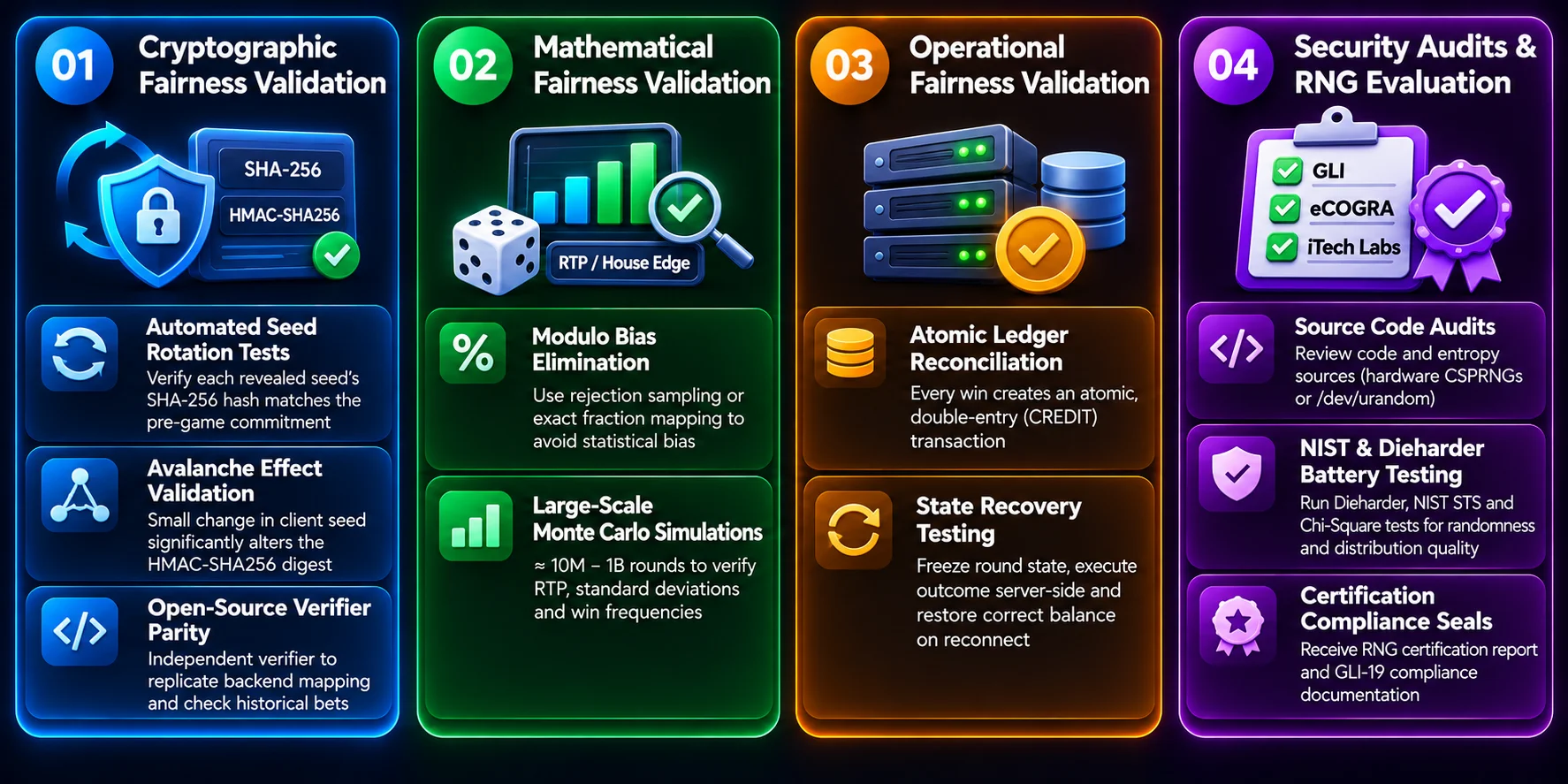
Establishing true platform integrity requires validating three independent layers: Cryptographic Commitment, Mathematical Probability, and Operational Execution.
A. Cryptographic Fairness: Are Seed Commitments Valid?
Cryptographic validation confirms that game outcomes are mathematically tied to pre-declared inputs and cannot be altered retroactively by the operator or player.
- Automated Seed Rotation Tests: Audit scripts should simulate thousands of seed rotations, verifying that each revealed server seed’s SHA-256 hash matches its pre-game published commitment.
- Avalanche Effect Validation: Quality assurance should confirm that changing a single client-seed character significantly alters the HMAC-SHA256 digest, preventing predictable patterns and pre-calculated streaks.
- Open-Source Verifier Parity: Operators should provide an independent, open-source verifier that replicates backend byte extraction and outcome mapping, allowing players to check historical bets without internal casino APIs.
B. Mathematical Fairness: Do RTP and House Edge Match?
A game can be cryptographically deterministic while remaining mathematically broken if its outcome mapping skew distributions away from documented paytables.
- Modulo Bias Elimination: Mapping raw 32-bit integers (0 to 4,294,967,295) to paytable ranges (e.g., 0–99 for dice or 0–36 for roulette) using simple modulo arithmetic can create statistical bias. Engines should use rejection sampling or exact fraction mapping to avoid it.
- Large-Scale Monte Carlo Simulations: Before deployment, mathematicians run approximately 10 million to 1 billion simulated rounds to verify that empirical RTP, standard deviations and maximum win frequencies fall within documented PAR sheet confidence intervals.
C. Operational Fairness: Do Payouts Match Game Results?
Operational fairness tests whether calculated winning outcomes translate into accurate, unmanipulated balance updates within the player’s wallet sub-ledger.
- Atomic Ledger Reconciliation: Integration tests verify that every game win creates an atomic, double-entry database transaction (CREDIT), preventing dropped balance credits during server timeouts or WebSocket reconnections.
- State Recovery Testing: If a player loses internet connection mid-spin or mid-hand, the backend must freeze the round state, execute the deterministic outcome server-side, and restore the correct balance upon client reconnect.
D. Security Audits and Independent RNG Evaluation
Prior to production launch in regulated or licensed markets, platforms must submit their source code, math specifications, and production environments to accredited testing laboratories (ATLs) such as GLI (Gaming Laboratories International), eCOGRA, or iTech Labs.
- Source Code Audits: ATLs review backend repository code to ensure entropy sources such as hardware CSPRNGs or /dev/urandom, cannot be manipulated by database administrators or external network attacks.
- NIST & Dieharder Battery Testing: Raw numerical output streams undergo statistical test suites, including Dieharder, NIST STS and Chi-Square tests, to assess randomness and distribution quality.
- Certification Compliance Seals: After successful testing, the lab issues an RNG certification report and applicable GLI-19 compliance documentation, providing evidence of platform integrity to players, payment processors and licensing bodies.
How Idea Usher Can Build Your Provably Fair Casino Platform?
Provably fair gaming replaces black-box trust with mathematical certainty. By combining cryptographic commitments, deterministic server-side game logic, and accessible client verification tools, operators can prove beyond doubt that game outcomes are unmanipulated and pre-committed before each round begins.
IdeaUsher is an enterprise product engineering partner with 11+ years of experience, 250+ technologists, a 4.9/5 Clutch rating and 1,000+ delivered builds. We develop custom, production-ready provably fair casino games and crypto platforms built for high-concurrency wagering, zero latency, and audit-grade code sovereignty.
A. Cryptographic Commitments & Deterministic Game Logic
Our cryptographic architecture combines secure seed management, deterministic outcome generation and backend execution to ensure every game round remains independently verifiable and resistant to manipulation.
- Dual-Seed & Nonce Generation: Implement HMAC-SHA256 and SHA-512 mechanisms combining server seeds, client seeds and incrementing nonces for deterministic outcomes.
- Pre-Round Hashing: Publish server seed hashes before bet placement to establish verifiable outcome commitments.
- Isolated Server-Side Engines: Execute game logic through hardened backend microservices to prevent client-side manipulation across crash, dice, plinko, roulette and custom slots.
B. Transparent On-Chain and In-Browser Verification
We integrate verification tools and auditable data systems that allow players and independent reviewers to validate historical outcomes, inspect seed records and examine game integrity.
- Interactive Verification Interfaces: Provide embedded widgets for entering seeds and nonces to independently recalculate historical outcomes.
- Public Seed Verification: Integrate blockchain block hashes and decentralized entropy sources such as Chainlink VRF for third-party validation where applicable.
- Auditable Architecture: Index transaction logs, seed histories and RNG state transitions for independent audits and compliance reporting.
C. Complete Crypto Casino Platform Engineering
Our development approach covers the core infrastructure of a crypto casino, connecting payment systems, player account management and scalable deployment within a unified platform.
- Multi-Currency Cashier & Cold Vault Management: Support Bitcoin, Ethereum, Solana and EVM Layer-2 payments with automated wallet rebalancing and MPC security.
- Modular Player Account Management (PAM): Unify wallet balances, player sessions and automated bonus workflows through a custom PAM core.
- Clean Code & Platform Ownership: Deliver an enterprise-grade codebase on auto-scaling Kubernetes infrastructure with full IP ownership and zero vendor lock-in.
Planning to build custom provably fair casino games or launch a high-performance crypto casino?
Connect with Idea Usher’s gaming and Web3 software architects to review your game mathematics, cryptographic verification workflows, platform architecture, and development scope.
Conclusion
Provably fair casino game development offers a practical way to bring greater transparency and accountability to online gaming. However, cryptographic verification alone cannot guarantee complete platform integrity. Reliable implementation requires secure seed management, deterministic outcome generation, accurate game mathematics and independent verification. A well-engineered platform connects these components with robust betting, wallet and security infrastructure. With the right technical architecture and development expertise, casino operators can launch scalable gaming platforms built around verifiable outcomes and player trust.
FAQs
A.1. Provably fair casino game development typically costs $8,000 to $65,000 for individual games, while complete casino platforms can exceed $300,000, depending on game complexity, integrations, infrastructure and security requirements.
A.2. Provably fair games prevent retrospective outcome manipulation through cryptographic commitments. However, flawed algorithms, biased outcome mapping or compromised seed management can still undermine game integrity.
A.3. Yes. Provably fair systems use SHA-256 hashing and HMAC-SHA256 for outcome generation and verification. Blockchain integration is optional and not required for cryptographic fairness.
A.4. Yes. Provably fair technology can be integrated into existing casino platforms through modular game engines, seed management services, cryptographic APIs and independent verification interfaces.
A.5. Yes. Players can use revealed server seeds, client seeds and nonce values with published algorithms to reproduce historical game outcomes through built-in or third-party verification tools.