

Key Takeaways
- Polymarket maker taker fees rules depend on the market. Other markets do not ask for any fee at all. Traders need to look at the rules before they make any orders.
- Maker orders help add liquidity by staying in the order book. Taker orders are used to fill existing orders. Might come with a fee.
- Part of the taker fees goes back to eligible market makers as rebates, usually paid in USDC based on their share of trading activity.
- These rebates can help keep spreads tighter and order books deeper, but they don’t guarantee profits because market makers still face price changes and trading risks.
- Building a polymarket maker taker fees engine means connecting trade matching, fee calculations, rebate records, USDC payouts and reconciliation so every transaction is tracked correctly.
- A basic fee module may cost $5,000–$15,000, while a custom or advanced engine can cost $10,000–$60,000 or more, depending on the features and integrations.
Polymarket does not charge any taker fees, meaning standard traders pay zero fees to execute orders. Instead, the platform utilizes a Liquidity Rewards program that acts like a maker rebate, automatically distributing daily USDC rewards to users who place limit orders close to the current market price. Ultimately, order execution is completely free in polymarket maker taker fees, while active market makers are incentivized purely through these daily prize pools based on liquidity depth and spread.
Trading fees and liquidity rewards serve different purposes in Polymarket’s incentive model. Polymarket maker taker fees vary by market, so traders should verify applicable fee rules before placing orders. Liquidity providers must also evaluate order placement, spread, market depth and reward eligibility to understand potential returns and avoid assuming every trade is free.
In this blog, we will explain how Polymarket’s maker incentives and taker fees work, including limit orders, liquidity rewards, USDC distributions, market-specific fee rules and the factors traders should understand before providing liquidity and the technology behind a prediction market platform.
What Are Polymarket Maker-Taker Fees?
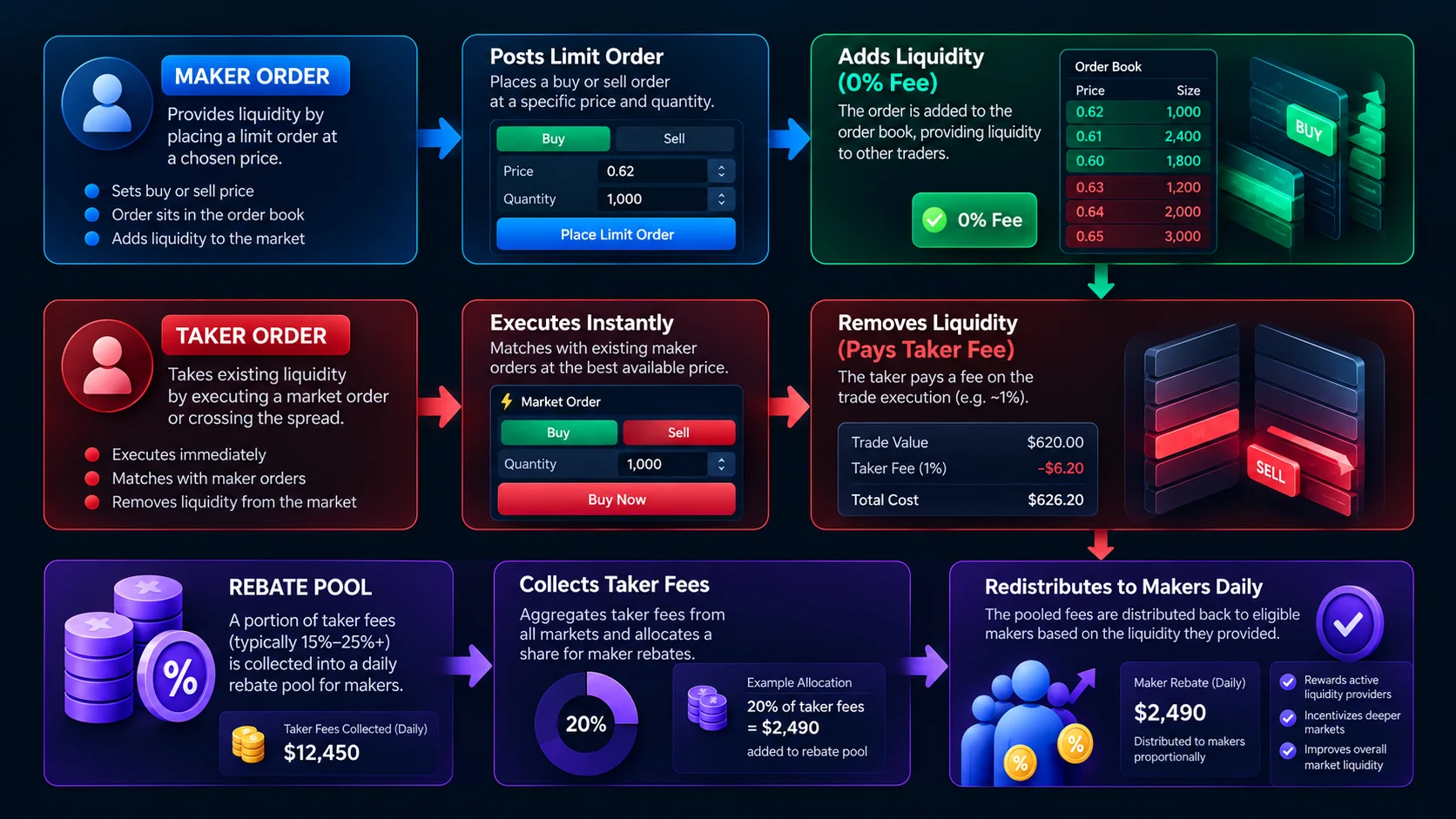
Polymarket utilizes a dynamic maker-taker fee model designed to optimize market microstructure, incentivize liquidity provision, and narrow bid-ask spreads. Rather than charging flat transaction fees or taking a cut of winning payouts (“winner’s tax”), the protocol evaluates whether an order adds or removes liquidity from its Central Limit Order Book (CLOB).
The platform’s underlying fee formula calculates transaction costs based on contract probability rather than a flat percentage: Fee = C X feeRate X p X (1 – p)
Where C represents the share count, p is the contract price (0.01 to 0.99), and feeRate is the category multiplier. Because p x (1 – p) reaches its maximum value at p = 0.50, fees peak when an event is at a 50/50 toss-up (maximum market uncertainty) and decline toward zero as outcomes approach certainty (0.00 or 1.00).
A. What Is a Maker Order in a Prediction Market?
A Maker Order is a passive limit order that adds liquidity to the order book because it cannot be immediately matched against an existing quote.
- Execution Behavior: The order rests on the public ledger at a specified price (e.g., bidding “Yes” at 0.42 when the lowest ask is 0.44) until a counterparty explicitly matches it.
- Fee Structure: 0% transaction fees. Makers never pay platform fees for posting, adjusting, or filling resting limit orders.
- Execution Risk: The primary trade-off for zero fees is execution uncertainty. If market prices move away from the maker’s limit price, the order goes unfilled.
B. What Is a Taker Order and When Is It Charged?
A Taker Order is an aggressive market order or marketable limit order that executes instantly against liquidity resting on the order book.
- Execution Behavior: Clicking “Buy” or “Sell” to instantly fill an order consumes book depth and removes market liquidity.
- Fee Execution: Taker fees are applied server-side at the precise moment of matching.
- Category Rate Variations: Taker rates vary dynamically depending on the market sector:
These category-specific rates determine the maximum taker fee at a 50% contract probability, where the fee formula reaches its peak. The table below compares the fee rates, peak fees per 100 shares and maker rebate allocations across different market categories.
| Market Category | Category Multiplier (feeRate) | Peak Fee per 100 Shares (at 0.50) | Maker Rebate Share |
| Crypto Markets | 0.07 | $1.75 | 20% |
| Sports (General) | 0.05 | $1.25 | 15% |
| Economics / Culture / Weather | 0.05 | $1.25 | 25% |
| Politics / Finance / Tech | 0.04 | $1.00 | 25% |
| Geopolitics & World Events | 0.00 (Fee-Free) | $0.00 | N/A |
C. Why Does Polymarket Redistribute Taker Fees to Makers?
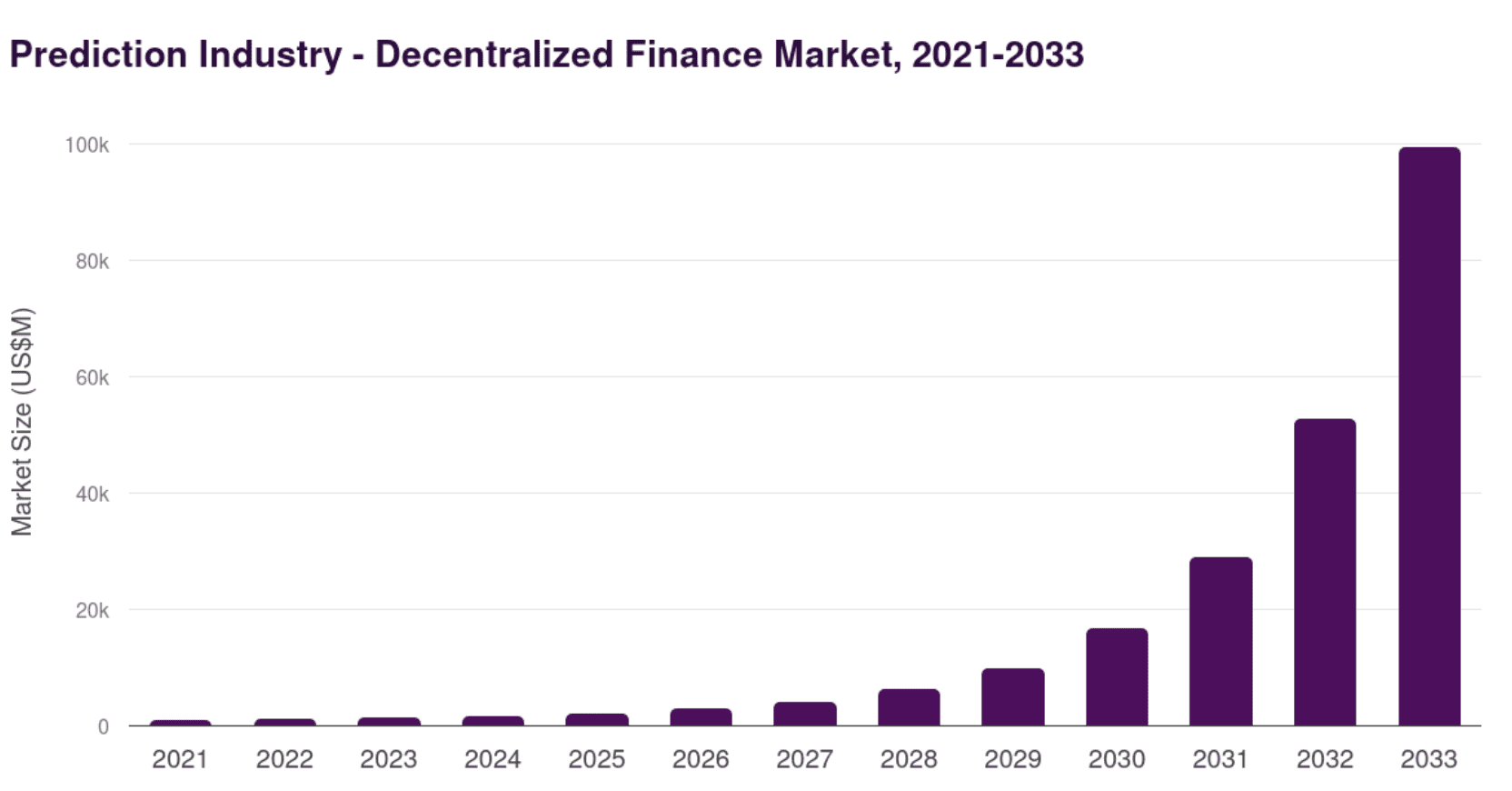
The global prediction industry decentralized finance market size was valued at $3.39 billion in 2026 and projected to reach $99.40 billion by 2033, growing at a 66.7% CAGR. As the prediction market industry grows rapidly, understanding Polymarket’s maker rebates, taker fees, and liquidity rewards is essential for traders navigating its evolving fee structure.
Polymarket’s growth reflects this expanding activity. The platform reached 477,850 monthly active traders in October 2026, a 93.7% increase from September’s 246,610.
It also recorded $425 million in single-day trading volume on February 28, 2026, surpassing the $371 million Election Day record from November 2024.
Polymarket has accumulated $33.70 billion in lifetime trading volume across categories, with total trades approaching one billion.
To support market liquidity, it recycles taker fees directly back to automated market makers (AMMs) and institutional liquidity providers through its daily Maker Rebates Program.
This redistribution engine serves several structural micro-market purposes:
- Compensating for Adverse Selection: Market makers face adverse selection when informed traders (takers) execute against limit orders on new info. Taker fee shares help cushion these price risks.
- Compressing Bid-Ask Spreads: Rewards for posting passive quotes encourage market makers to quote closer to the fair-value mid-price, reducing execution costs for retail traders.
- Deepening Order Book Liquidity: Greater liquidity reduces slippage during volatility spikes. Redistributing 15%–25%+ of collected taker fees in USDC can help maintain deeper order books across major event categories.

How Does the Polymarket Taker Fee Formula Work?
Polymarket does not charge taker fees across all its markets. Its dynamic taker fee model applies only to eligible markets, while certain geopolitical and world-event markets remain fee-free. In fee-enabled markets, fees depend on share quantity, category-specific fee rate and contract price.
Rather than charging a flat transaction fee or a percentage of total turnover, the platform uses a parabolic fee function: Fee = C X feeRate X p X (1 – p)
This structure ensures fees peak when outcome uncertainty is at its maximum (p = 0.50) and decline symmetrically as a market moves toward resolution (p → 0 or p → 1).
A. What Does Each Variable in the Fee Formula Mean?
The fee formula combines four variables to calculate transaction costs based on trade size, market category and contract probability. Each variable isolates a distinct parameter of the executed trade:
- Share Quantity (C): The total number of outcome contracts being bought or sold in the matched transaction.
- Category Fee Rate (feeRate): A protocol parameter assigned based on market domain:
- Politics, Finance, Tech, Mentions: feeRate = 0.04
- Sports, Economics, Culture, Weather, General: feeRate = 0.05
- Crypto Markets: feeRate = 0.07
- Geopolitics & World Events: feeRate = 0.00 (Fee-Free)
- Contract Price (p): The probability price of the share, ranging from $0.01 to $0.99 (1% to 99%).
- Complementary Term (1 – p): The inverse probability of the contract, creating a symmetrical parabola centered at p = 0.50.
B. Why Are Fees Highest Near a 50% Probability?
The quadratic term “p X ( 1 – p )” reaches its mathematical maximum at p = 0.50: 0.50 X (1 – 0.50) = 0.25
At a 50% share price, market uncertainty is highest. Liquidity providers (makers) face maximum adverse selection risk because incoming trades carry equal probability of swinging either way.
Peak taker fees collected at this midpoint are redistributed to makers via Polymarket’s Maker Rebates Program, compensating liquidity providers for maintaining deep order books during high-uncertainty periods.
C. How Do Fees Change Across Different Contract Prices?
To evaluate how fees scale across probabilities, consider buying 1,000 shares (C = 1,000) in a Politics market where feeRate = 0.04:
| Contract Price (p) | Implied Probability | Trade Notional Value (C X p) | Calculated Taker Fee Formula | Total Taker Fee | Fee as % of Spend |
| $0.10 | 10% | $100.00 | 1,000 X 0.04 X 0.10 X 0.90 | $3.60 | 3.60% |
| $0.30 | 30% | $300.00 | 1,000 X 0.04 X 0.30 X 0.70 | $8.40 | 2.80% |
| $0.50 | 50% (Peak) | $500.00 | 1,000 X 0.04 X 0.50 X 0.50 | $10.00 | 2.00% |
| $0.70 | 70% | $700.00 | 1,000 X 0.04 X 0.70 X 0.30 | $8.40 | 1.20% |
| $0.90 | 90% | $900.00 | 1,000 X 0.04 X 0.90 X 0.10 | $3.60 | 0.40% |
Numerical Insights
- Absolute Dollar Peak: The dollar fee peaks at $10.00 when $p = 0.50.
- Symmetrical Decline: Trading at $0.10 yields the exact same dollar fee ($3.60) as trading at $0.90.
- Effective Percentage Drag: Expressed as a percentage of capital spent (Fee/Notional=feeRate(1-p)), cheap long shots carry a higher relative capital drag (3.60% at $0.10)compared to near-certain outcomes($0.40% at $0.90).
D. How Can Developers Calculate Fees Per Executed Trade?
For platform founders, turning Polymarket’s mathematical formula into an operational revenue engine requires implementing three core product mechanics:
1. Real-Time Settlement at Match Execution
In traditional finance, platforms often bill fees on a monthly cycle or deduct charges upon final account withdrawal. A prediction exchange must deduct fees atomically at the exact moment an order is matched.
Product Execution: When a user submits a market order, your matching engine calculates the exact fee based on the current contract price and share count, deducting it immediately from the user’s available cash balance (e.g., USDC or fiat ledger) before committing the trade to the order book.
Founder Benefit: Eliminates credit risk, bad debt, and uncollected transaction fees entirely.
2. High-Precision Micro-Transaction Handling
Because prediction market contracts trade in fractional dollar amounts (ranging from $0.01 to $0.99), trading fees per individual share often calculate out to fractions of a cent (e.g.,$ 0.00035).
Product Execution: Your platform’s database and ledger accounting engine must support high-precision decimal math (typically rounded to 5 or 6 decimal places).
Founder Benefit: Prevents truncation errors where small retail trades or automated bot micro-orders inadvertently trade for free due to premature integer rounding.
3. Strategic Fee Allocation and Yield Distribution
A successful prediction exchange platform business model balances platform profitability with market liquidity. Founders must decide how much of the collected taker fee to retain as platform margin versus redistributing to market makers:
| Strategic Objective | Platform Fee Retention | Market Maker Rebate Allocation | Product Impact |
| Maximized Platform Margin | 100% Retained | 0% Rebate | Maximizes short-term revenue, but widens bid-ask spreads by reducing LP participation. |
| Balanced Growth Model (Polymarket Style) | 75%–80% Retained | 20%–25% Redistributed | Maintains profitability while subsidizing market makers to tighten spreads and deepen order book depth. |
| Aggressive Liquidity Bootstrapping | 20%–50% Retained | 50%–80% Redistributed | Trades immediate margin for top-tier liquidity during a exchange launch. |
How Are Polymarket Maker Rebates Calculated?
Polymarket’s Maker Rebates Program operates as a decentralized liquidity subsidy engine. Rather than pooling platform revenue globally, the protocol isolates rebate calculations per specific market category and event order book.
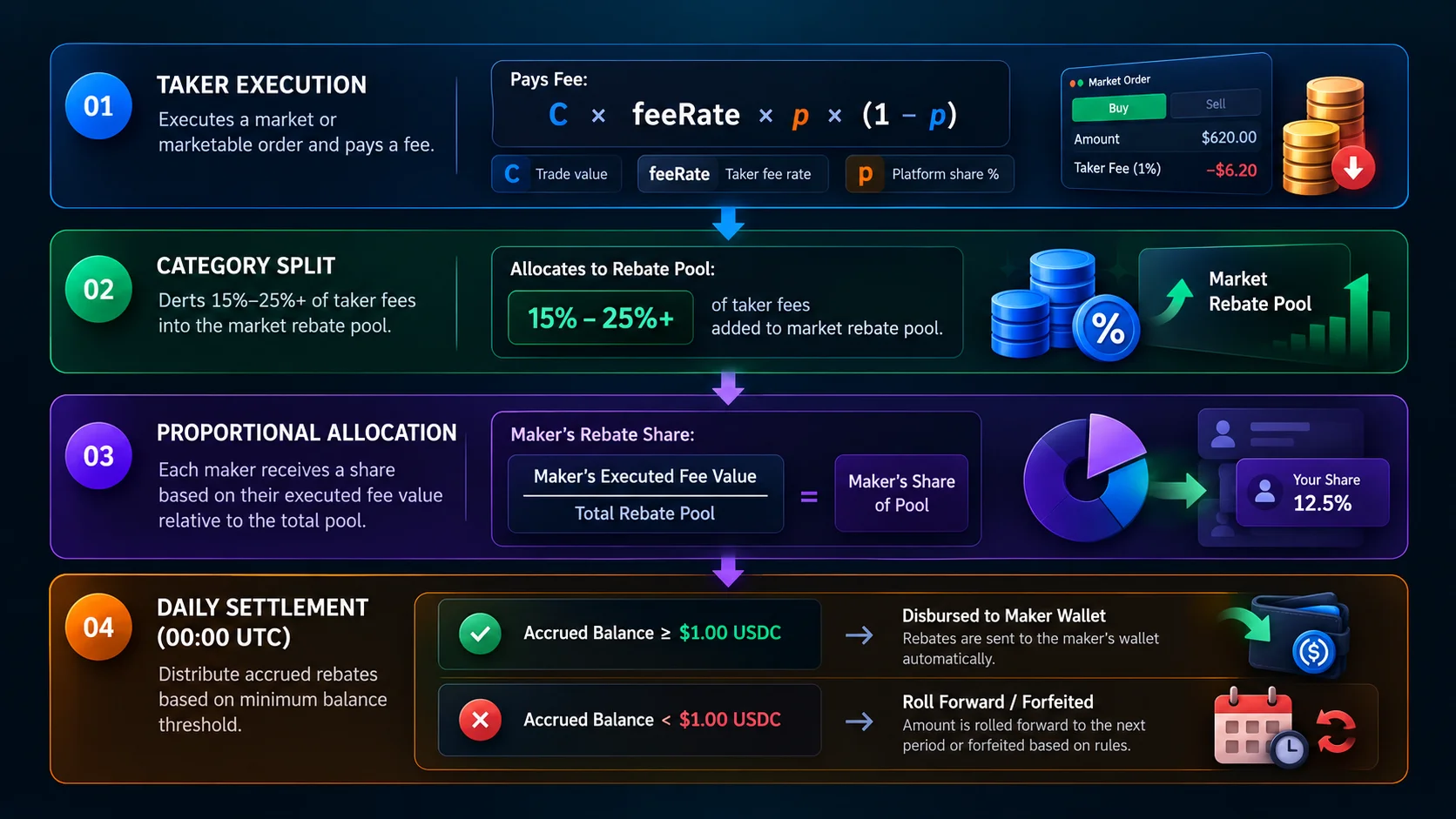
When a taker places an aggressive market order that fills against passive limit orders, a fixed percentage of that taker’s fee is diverted into that market’s daily rebate pool. The platform then redistributes this pool proportionally to the liquidity providers (makers) whose resting orders were executed.
A. Which Executed Maker Orders Qualify for Rebates?
Not all liquidity earns a rebate. Platform rules strictly govern eligibility based on execution state and market classification:
- Passive Execution Requirement: An order must rest on the Central Limit Order Book (CLOB) before execution. Orders that match immediately upon submission (taker orders) incur fees but are excluded from maker rewards.
- Fee-Enabled Market Categories: Rebates are funded entirely by taker fees. Maker orders executed in fee-free categories, such as Geopolitics or promotional markets, earn $0.00 in rebates because no taker-fee pool is available.
- Fee Contribution and Rebate Size: Rebate eligibility is determined by an order’s contributed fee value. Under Polymarket’s parabolic formula: p × (1 – p), fills near a 50% contract price (p = 0.50) yield higher fees and potentially larger rebates than fills near extreme prices (p = 0.05 or 0.95).
B. How Does the Maker Rebate Pool Get Distributed?
The rebate distribution model uses a proportional allocation formula. A maker does not receive a flat percentage of their own trade; instead, they receive a share of the total market pool proportional to their contribution during a 24-hour cycle:

For Example:
- Your Fee Equivalent: $50
- Total Fee Equivalent: $1,000
- Rebate Pool: $200
What this means: If the rebate pool is $10,000, a 5% share would equal $500.
Result: Your daily maker rebate would be $10, based on a 5% share of the rebate pool.
This is a simplified example using the formula; actual rebates depend on the applicable market’s rebate pool and eligible fee-equivalent totals.
1. Category Allocation Multipliers
The size of the pool depends directly on the market domain:
- Politics, Finance, Tech, Economics, Culture, Weather: 25% of all collected taker fees are allocated to the rebate pool.
- Crypto Markets: 20% of collected taker fees are allocated.
- Sports Markets: 15% of collected taker fees are allocated.
2. Numerical Distribution Example
Imagine a daily trading cycle in a Crypto Market (where Rebate Share=20%):
- Total taker fees collected across the market during the day = $1,000 USDC.
- Total Rebate Pool available for distribution = 1,000 X 20% = $200 USDC.
- Maker A provided liquidity that absorbed $300 of the $1,000 total taker fees generated.
- Maker A’s Share: ( 300 / 1,000 ) = 30% of the daily liquidity share.
- Maker A’s Daily Payout: 30% X 200 = $60 USDC.
C. Why Do Unfilled Orders Earn No Execution-Based Rebate?
A critical distinction for platform architects and market makers is the difference between Maker Rebates and Liquidity Rewards:
| Incentive Program | Required Order State | Primary Funding Source | Reward Basis |
| Maker Rebates Program | Executed / Filled limit orders | Percentage of collected Taker Fees | Proportional share of fee-equivalent volume absorbed |
| Liquidity Rewards Program | Resting / Unfilled limit orders near the midpoint | Fixed daily promotional pool allocated by platform | Time-weighted spread tightness and depth scoring |
An unfilled order resting on the book earns zero execution-based rebates because no trade occurred to generate a taker fee. However, if that unfilled order sits close to the order book’s mid-price, it may simultaneously accrue points under the separate Liquidity Rewards Program.
D. How Do Daily USDC Rebate Payments Work?
Polymarket processes rebate settlements through an automated daily distribution pipeline:
- 00:00 UTC Snapshot & Calculation: At midnight UTC, the platform aggregates all order book match events, calculates the total fee pool per market, and determines each qualifying wallet’s proportional share.
- Minimum Payout Condition ($1.00 USDC): To prevent network congestion and micro-dust transaction overhead, Polymarket enforces a strict $1.00 USDC minimum payout threshold. If a maker’s calculated rebate for the 24-hour period is under $1.00, the payout is held in an accrued balance until future executions push the total over the threshold.
- Direct Wallet Disbursal: Once calculated and verified, qualified rebates are credited directly to the user’s connected wallet address in USDC, providing instant liquid capital for continuous market-making operations.
How Do Maker Rebates Improve Market Liquidity?
Liquidity does not appear spontaneously in prediction markets like Polymarket; it is provided by market makers who post passive limit orders on the Central Limit Order Book (CLOB).
Reallocating a portion of taker fees back to liquidity providers acts as a financial catalyst that transforms market microstructure, lowering execution drag for retail participants while deepening order book resiliency.
A. How Do Rebates Encourage Deeper Order Books?
Trading volume follows liquidity depth. Market takers, ranging from casual retail users to systematic algorithms and avoid thin markets where placing a $1,000 trade causes significant price slippage (walking the book to worse execution levels).
- Lowering Capital Overhead: Resting limit orders lock up collateral (e.g., pUSD or USDC) across price tiers. Maker rebates offset this opportunity cost, encouraging deeper orders across consecutive tick levels rather than minimal top-of-book quotes.
- Absorbing Large Trade Flows: The parabolic fee rebate formula: Fee = C X feeRate × p (1 – p), yields higher rebates near a 50% probability (p = 0.50). This encourages deeper limit orders near maximum uncertainty, helping absorb large market orders with minimal price impact.
B. Can Maker Incentives Reduce Bid-Ask Spreads?
The bid-ask spread represents the immediate cost a trader pays to enter or exit a position. Without maker rebates, market makers must quote wide spreads (e.g., Bidding $0.45 / Asking $0.55) to ensure gross spread capture compensates for market risk.
- Subsidized Spread Compression: Maker rebates effectively subsidize the market maker’s margin. A maker who collects a 20% – 25% rebate on executed trades can quote a significantly tighter spread (e.g., Bidding $0.49 / Asking $0.51) and remain profitable.
- Competitive Order Placement: Because Polymarket’s order book evaluates price/time priority, makers aggressively tighten their quotes to capture execution flow. Tightening spreads reduces execution costs for takers, driving higher organic platform volume.
C. What Risks Remain for Prediction Market Makers?
Rebates improve execution quality across the platform, but they do not guarantee maker profitability. Market makers face structural micro-market risks that can easily wipe out days of accumulated rebate yield:
| Market Maker Risk Factor | Microstructure Cause | Financial & Operational Impact |
| Adverse Selection | Informed traders (takers) use faster news feeds or superior event models to execute against stale quotes before prices move. | A news event can move a contract from $0.50 to $0.90, leaving makers with losses on filled “No” positions that exceed accrued rebates. |
| Inventory Risk | Asymmetric buying creates one-sided inventory accumulation such as holding 10,000 “Yes” shares. | Makers become exposed to the event outcome and may lose their entire position value if the contract resolves to $0.00. |
| Low Rebates at Extreme Prices | Limit orders filled at extreme probabilities ((p < 0.05) or (p > 0.95)) generate minimal fee value under the parabolic formula. | Quotes on unlikely or near-certain outcomes earn negligible rebates, leaving makers exposed to tail risks. |
How Do You Build a Maker Taker Fee Engine?
A prediction market-like polymarket maker taker fees engine calculates trading fees based on whether an executed order adds liquidity or removes it. Building prediction market platform requires coordination between order matching, execution events, fee calculation, rebate accounting and financial reconciliation. The backend must classify each fill correctly, apply market-specific fee parameters and ensure every fee deduction or rebate credit is recorded exactly once.
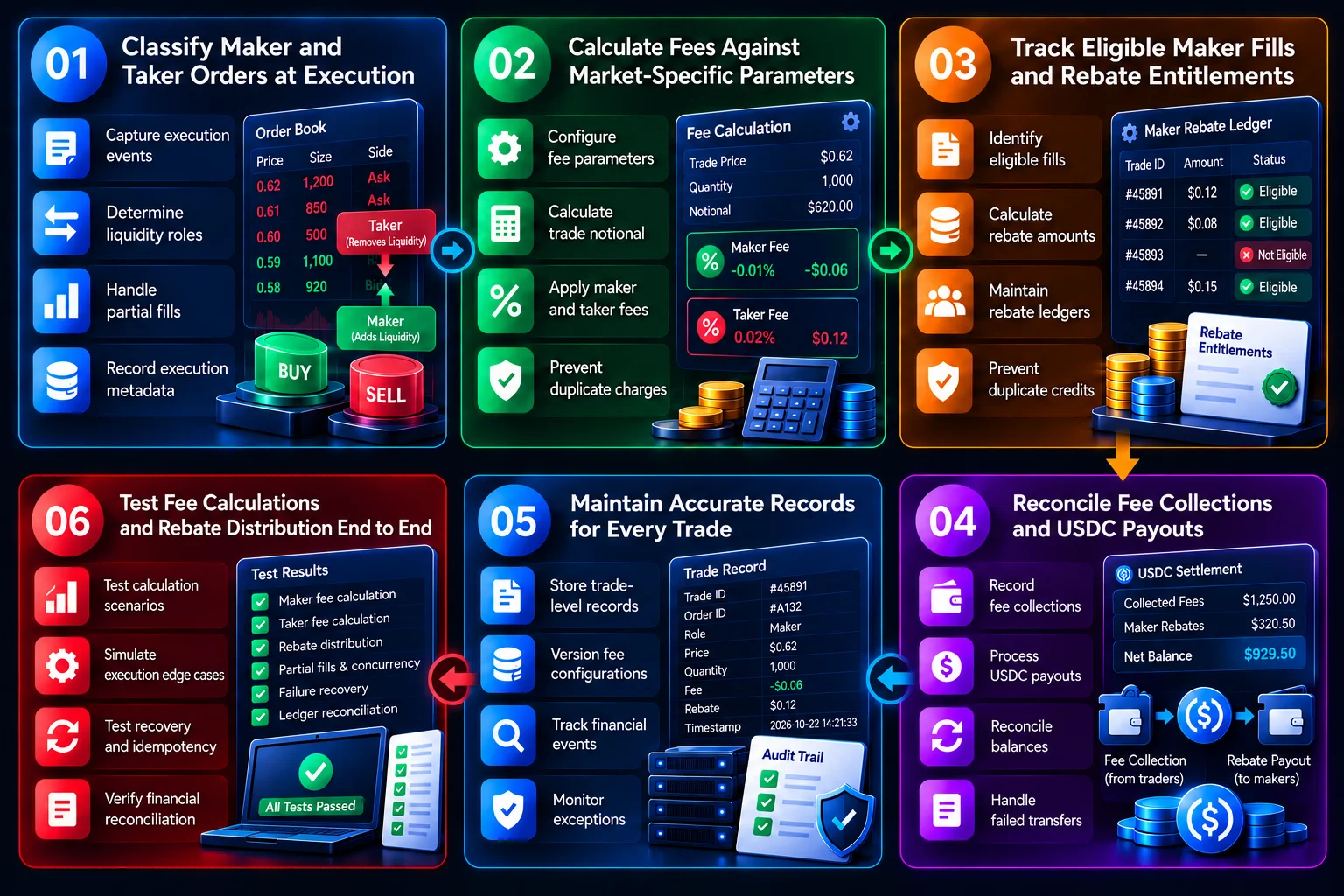
1. Classify Maker and Taker Orders at Execution
The fee engine should classify orders using their actual execution behavior rather than relying solely on how users initially submit them.
- Connect Matching Events: Capture executed orders from the matching engine, including trade IDs, order IDs, participant IDs, execution prices and filled quantities.
- Determine Liquidity Roles: Classify the resting order as maker and the incoming order as taker for each individual execution.
- Handle Partial Fills: Assign maker-taker roles separately to each fill because one order may execute against multiple resting orders.
- Record Execution Metadata: Store liquidity roles with each fill so downstream fee calculations use consistent, execution-level classifications.
An execution event stream containing verified maker-taker classifications and the identifiers required for fee processing.
2. Calculate Fees Against Market-Specific Parameters
Once an execution is classified, calculate its fee using the applicable market configuration, participant eligibility and executed trade value.
- Configure Fee Parameters: Maintain market-specific maker fees, taker fees, rebate rates, eligible assets and effective dates in versioned configurations.
- Calculate Trade Notional: Determine the applicable fee base from executed quantity and price, following the market’s defined calculation and rounding rules.
- Apply Fee Rules: Calculate maker and taker charges independently using the correct rate and participant eligibility for each execution.
- Prevent Duplicate Charges: Use unique execution identifiers and idempotent processing so retries cannot create additional fee deductions.
Deterministic fee calculations tied to individual fills, versioned market parameters and duplicate-safe processing.
3. Track Eligible Maker Fills and Rebate Entitlements
Maker rebates require separate accounting because eligibility may depend on liquidity contribution, market rules, participant status and the applicable rebate schedule.
- Identify Eligible Fills: Evaluate maker executions against market-specific eligibility rules, excluding fills that do not qualify for rebates.
- Calculate Rebate Amounts: Apply the configured rebate rate to eligible execution values while enforcing precision and rounding requirements.
- Maintain Rebate Ledgers: Record each entitlement against its execution ID, beneficiary, amount, asset and processing status.
- Prevent Duplicate Credits: Enforce unique rebate records and idempotent credit operations to avoid repeated payouts during retries or recovery.
An auditable rebate ledger that tracks eligible maker fills, calculated entitlements and credit status.
4. Reconcile Fee Collections and USDC Payouts
The financial layer must ensure collected fees, accrued rebates and USDC movements remain consistent across internal ledgers and payment or settlement systems.
- Record Fee Collections: Post calculated maker and taker fees to the appropriate financial accounts using balanced ledger entries.
- Process USDC Payouts: Credit eligible rebates through the supported settlement mechanism and record transaction references, amounts and confirmation statuses.
- Reconcile Balances: Compare fee records, rebate liabilities, ledger balances and confirmed USDC transfers to identify discrepancies.
- Handle Failed Transfers: Track pending or failed payouts and retry safely without creating duplicate credits or overstating completed settlements.
Reconciled fee collections and rebate payouts with traceable USDC movements and controlled exception handling.
5. Maintain Accurate Records for Every Trade
A reliable prediction-like polymarket maker taker fees engine needs a complete audit trail connecting executions, fee calculations, rebate entitlements and financial postings.
- Store Trade-Level Records: Preserve trade IDs, order IDs, liquidity roles, execution values, applied rates and calculated fees for every fill.
- Version Fee Configurations: Retain the exact fee schedule and eligibility rules applied to each execution for reproducibility and audit reviews.
- Track Financial Events: Link fee deductions, rebate accruals, credits and settlement transactions through unique identifiers and consistent timestamps.
- Monitor Exceptions: Flag missing calculations, unmatched ledger entries, unexpected balances and failed postings for investigation and correction.
A complete, traceable record connecting each execution to its fee calculation, rebate entitlement and financial outcome.
6. Test Fee Calculations and Rebate Distribution End to End
Validate the complete fee lifecycle under normal trading conditions, concurrent executions and recovery scenarios before deploying changes to production.
- Test Calculation Scenarios: Verify maker fees, taker fees, eligible rebates, rounding behavior and market-specific configurations using known execution examples.
- Simulate Execution Edge Cases: Test partial fills, multiple counterparties, cancellations, concurrent trades and repeated execution events to validate classification and calculation accuracy.
- Test Recovery and Idempotency: Simulate service failures, message retries and interrupted processing to confirm fees and rebates are posted exactly once.
- Verify Financial Reconciliation: Compare execution records, fee ledgers, rebate balances and USDC settlement records to confirm consistent final balances.
A validated fee engine that calculates charges accurately, distributes eligible rebates correctly and maintains consistent financial records under failure conditions.
What Does It Cost to Build a Prediction Market Fee Engine?
Designing a prediction market-like polymarket maker taker fees engine requires connecting order matching, category-specific fee logic, maker rebates, and USDC reconciliation. Development costs vary by scope, with available pricing typically reflecting full exchange builds rather than isolated fee modules.
For budgeting, it is important to distinguish a standalone fee module from rebate accounting and a complete prediction exchange. The following figures are Polymarket like prediction market platform development cost estimation.
A. What Drives Maker-Taker Fee Engine Development Costs?
The main cost drivers are the complexity of fee rules, integration with the matching engine, market-specific configurations and the testing needed to maintain accurate trade records.
| Development scope | Estimated cost | Typical inclusions |
| Basic fee calculation module | $5,000 – $15,000 | Fee formulas, configurable rates and basic execution-level calculations |
| Custom maker-taker fee engine | $10,000 – $30,000 | Maker/taker classification, market-specific parameters, execution records and matching-engine integration |
| Advanced fee engine | $30,000 – $60,000+ | Complex fee schedules, partial-fill handling, extensive testing, monitoring and reconciliation |
These scope-based estimates assume custom development rather than verified U.S. industry averages. Ranges may overlap; using existing infrastructure reduces costs, while custom matching engines increase them.
The cost of building a polymarket maker taker fees engine depends on its math complexity, execution latency, and ledger integration level as well:
- Dynamic Formula Architecture ($35,000 – $70,000): Simple flat fees require minimal logic, but a parabolic fee formula based on price (p), share count (C) and category multipliers demands dedicated microservices, six-decimal precision, and edge-case testing.
- Matching Engine Hook-Ins ($45,000 – $95,000): Taker fees must be calculated and deducted atomically when an order matches. Low-latency integration with the Central Limit Order Book (CLOB) prevents bottlenecks for high-frequency market makers.
- Multi-Category Dynamic Configuration ($20,000 – $40,000): Build administrative portals to adjust category fee multipliers (feeRate) across asset classes, such as politics, crypto and fee-free geopolitics, without recompiling code or invalidating builds.
B. How Do Rebate Accounting and USDC Integration Affect Costs?
Rebate accounting requires more than distributing collected fees. The platform must calculate eligible rewards, maintain participant-level balances, execute USDC payouts using crypto wallets and reconcile every transaction. Prediction market platform like polymarket maker taker fees uses execution-based, fee-weighted rebates and distributes rewards in USDC.
The following estimates represent potential custom development and integration costs:
| Component | Estimated Cost | Development Scope |
| Rebate Eligibility & Allocation Engine | $5,000 – $15,000 | Validate eligible maker fills, apply rebate rules and allocate rewards proportionally. |
| USDC Wallet & Payout Integration | $5,000 – $15,000 | Integrate wallets, initiate payouts, track confirmations and handle failed or pending transfers. |
| Participant Rebate Ledger | $5,000 – $12,000 | Track participant balances, credits and debits, linking each entry to its originating trade and rebate calculation. |
| Fee & Rebate Reconciliation | $5,000 – $12,000 | Reconcile taker fees, allocated rebates, ledger balances and payouts to identify discrepancies. |
| Failed Payout & Retry Handling | $3,000 – $8,000 | Implement idempotent requests, status tracking, retry rules and exception handling to prevent duplicate transfers. |
| Monitoring & Payout Reporting | $3,000 – $8,000 | Generate payout reports and flag discrepancies, pending transfers and settlement failures. |
These indicative component estimates vary based on existing wallet, ledger, and settlement infrastructure. Integrating a provider differs significantly from custom development.
Processing taker fees is only half the battle; building a closed-loop liquidity recirculation engine adds operational and architectural complexity:
- Proportional Rebate Pool Accounting ($35,000 – $75,000): Track executed orders, isolate each maker’s fee contribution, aggregate totals by market category and calculate proportional daily rebates.
- Automated USDC Disbursal Engine ($25,000 – $55,000): Automate USDC wallet payouts or fiat ACH transfers with batch processing, minimum payout thresholds (e.g., $1.00 USDC) and retries for failed transfers.
- Sub-Ledger Isolation & Reconciliation ($30,000 – $60,000): Separate platform revenue from undistributed maker rebates in real time, using database state machines to prevent fund commingling and balance discrepancies.
C. When Does a Fee Engine Require Full Exchange Infrastructure?
A standalone fee engine does not require an entire prediction exchange. However, the polymarket maker taker fees engine must connect to reliable order execution and financial records. A complete platform also needs market creation, order-book management, account services, contract resolution, settlement, security and operational monitoring.
| Platform Architecture Model | Scope of Fee Engine Integration | Estimated Total CAPEX | Regulatory & Operational Context |
| Standalone SaaS / Web3 App | Smart contract or non-custodial API overlay on external liquidity pools. | $120,000 – $220,000 | Lower capital burden, but dependent on external infrastructure for matching and clearing. |
| Full Institutional Exchange (CFTC DCM Framework) | Fee engine embedded within CLOB, connected to a Designated Clearing Organization (DCO). | $2.5M – $7M+ | Mandatory for US institutional derivative exchanges. The fee engine must integrate with CFTC Rule 1.20 fund segregation, append-only audit trails, and automated market surveillance platforms. |
Strategic Founder Takeaway
If you are launching a Web3 or offshore prediction market interface, the fee engine can be developed as a modular microservice costing $120,000 to $250,000. However, if your vision is to launch a fully regulated CTFC DCM prediction exchange platform (a Kalshi or Polymarket US competitor), the fee engine represents just one interconnected module within a multi-million-dollar, CFTC-compliant matching, clearing, and surveillance infrastructure.
Which APIs and Data Models Support Fee Integration?
A prediction market-like polymarket maker taker fees engine needs APIs and backend data models that keep fee calculations consistent across order execution, rebate allocation and settlement. The following components help maintain accurate records and prevent discrepancies.
| Component | Implementation requirements | Why it matters |
| Market Configuration APIs | Expose market-specific fee rates, eligibility rules and active fee schedules to clients. | Helps clients display applicable fees before order execution while keeping the backend authoritative. |
| Trade Execution Identifiers | Assign unique identifiers to orders, executions and partial fills, linking each trade to its fee calculation. | Prevents duplicate fee deductions and supports accurate trade-level reconciliation. |
| Fee Schedules and Rebate Ledger | Store versioned fee parameters, collected taker fees, eligible maker fills, rebate allocations and USDC payout records. | Creates a traceable record of how fees are calculated and rebates are distributed. |
| Retry and Partial-Fill Handling | Use idempotent processing, track execution status and apply the correct fee configuration to each fill. | Prevents duplicate charges and incorrect rebate credits when requests are retried or orders execute in multiple parts. |
| Fee Parameter Updates | Version fee configurations and associate each execution with the applicable schedule. | Helps preserve calculation accuracy when market fee rates or eligibility rules change. |
| Reconciliation APIs and Services | Compare execution records, fee entries, rebate allocations and settlement transactions. | Identifies discrepancies between trading activity, internal ledgers and actual USDC payouts. |
These components should work together so that clients can retrieve fee information while backend services calculate and record the authoritative amounts. Testing should cover partial fills, repeated requests, fee schedule changes and payout failures to ensure consistent accounting across the entire trading lifecycle.
What To Know Before Implementing Prediction Market Maker Rebates?
Implementing a polymarket maker taker fees and rebate engine can transform an exchange’s liquidity profile. However, before writing software specifications or deploying capital, founders must evaluate how fee mechanics intersect with trading behavior, platform accounting, and regulatory compliance.
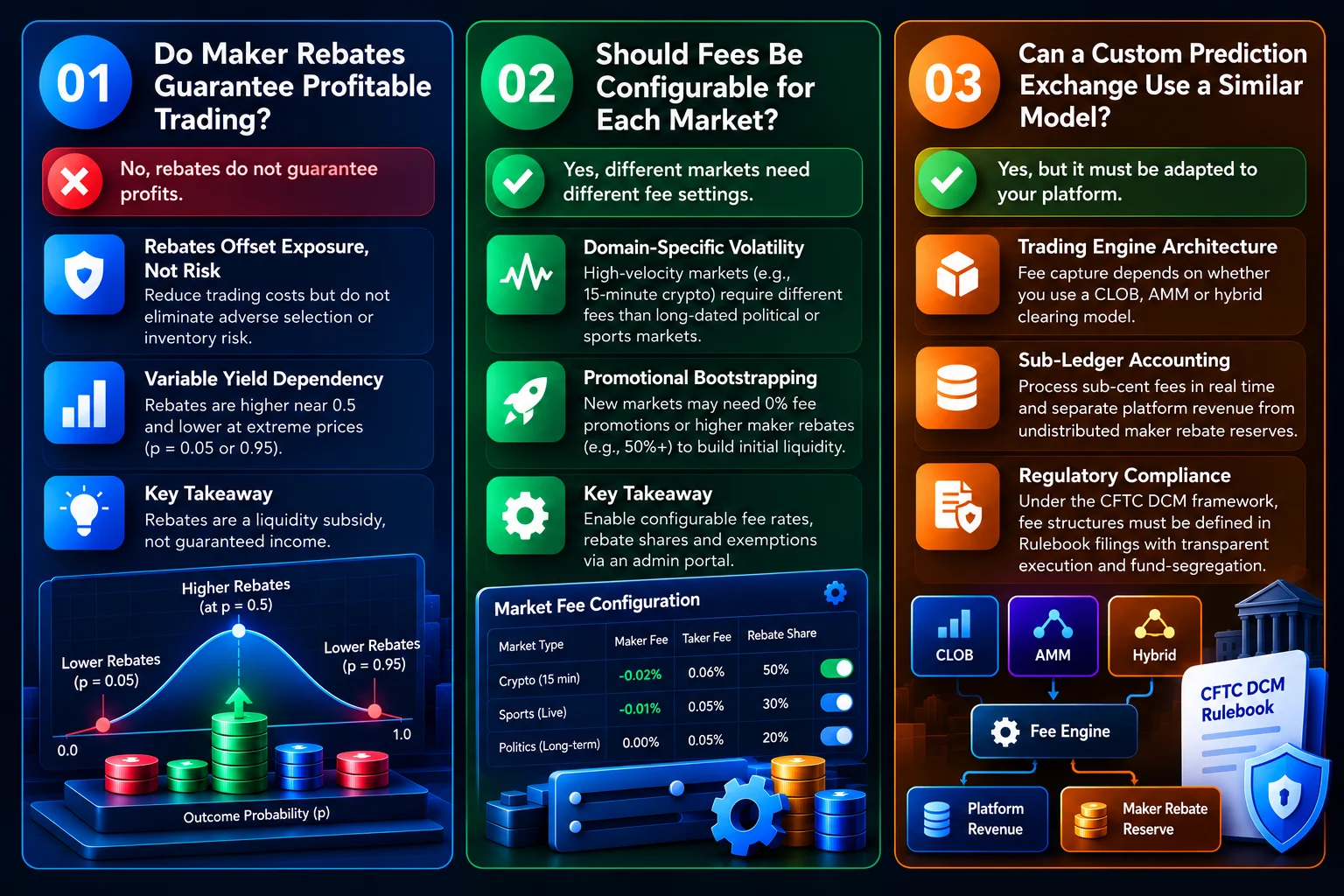
A. Do Maker Rebates Guarantee Profitable Trading?
No, a common misconception among platform creators is that offering rebates guarantees market makers will automatically generate net profits.
- Rebates Offset Exposure, Not Risk: Maker rebates reduce transaction costs but do not eliminate adverse selection (fills on stale quotes before market-moving news) or inventory imbalance (unwanted directional exposure).
- Variable Yield Dependency: Under a parabolic fee structure (Fee = C X feeRate X p X (1 – p)), rebates depend on outcome uncertainty. Fills near extreme prices (p = 0.05 or 0.95) generate minimal fees and offer little rebate protection against tail-risk losses.
- Founder Takeaway: Platform messaging must educate market makers that rebates are a liquidity subsidy, not guaranteed income.
B. Should Fees Be Configurable for Each Market?
Yes, operating a rigid, one-size-fits-all polymarket maker taker fees schedule across diverse asset classes degrades trading volume and discourages liquidity providers.
- Domain-Specific Volatility: High-velocity markets (e.g., 15-minute crypto contracts) need different fee parameters (feeRate) than long-dated political or sports markets.
- Promotional Bootstrapping: New market categories may need temporary 0% fee promotions or higher maker rebate shares (e.g., 50%+ fee redistribution) to build initial order book depth.
- Founder Takeaway: Design back-office systems to adjust category multipliers, minimum rebate thresholds and fee exemptions through administrative portals, without software deployments or recompilation.
C. Can a Custom Prediction Exchange Use a Similar Model?
Yes, but simply copying another platform’s code or fee formula is insufficient. Founders must adapt the underlying mechanism to their specific ecosystem:
- Trading Engine Architecture: Whether the venue uses a Central Limit Order Book (CLOB), an Automated Market Maker (AMM) or a hybrid clearing pool determines how and when fees are captured.
- Sub-Ledger Accounting: The accounting ledger must atomically process sub-cent fees in real time, separating platform net revenue from undistributed maker rebate reserves to prevent balance discrepancies.
- Regulatory Compliance: Under the U.S. CFTC Designated Contract Market (DCM) framework, fee structures and rebate allocations must be clearly defined in formal Rulebook filings, with transparent execution and applicable fund-segregation controls.
What Can Go Wrong With a Prediction Market Rebate System?
A polymarket maker taker fees system can develop accounting errors, inconsistent fee calculations and vulnerabilities that undermine market integrity. Reliable execution records, transaction-level testing, automated reconciliation and investigation workflows help developers identify these problems before they affect users or payouts.
1. Prevent Duplicate Fees During Trade Retries
Network failures and repeated execution requests can trigger duplicate fee deductions when transactions lack reliable identifiers and idempotent processing controls.
Solution: Our developers implement unique execution identifiers, idempotency keys and transaction-level status tracking. These controls ensure retries reuse existing results instead of charging fees twice, while reconciliation checks flag inconsistencies.
2. Avoid Incorrect Rebates After Partial Fills
Partially filled orders can produce incorrect rebate credits when systems calculate rewards against original order quantities instead of eligible executed volumes.
Solution: Our developers track every eligible fill separately, link executions to maker orders and calculate rebates using confirmed quantities. Automated validation then compares rebate entitlements against recorded fills before payout processing.
3. Handle Fee Schedule Changes Without Ledger Errors
Updating market fee rates without preserving the applicable configuration can cause inconsistent calculations, incorrect historical records and discrepancies between execution fees and rebate allocations.
Solution: Our developers maintain versioned fee schedules and associate each execution with its applicable configuration. Historical records remain traceable, while controlled updates and regression tests help prevent calculation errors across existing and new trades.
4. Detect Rebate Abuse and Manipulated Trading Activity
Coordinated orders, artificial trading activity and repeated cancellations can exploit rebate incentives, distort liquidity signals and generate rewards without genuine market-making behavior.
Solution: Our developers integrate configurable surveillance rules, abnormal trading alerts and investigation workflows. Monitoring execution patterns, cancellation rates and rebate concentration helps compliance teams identify suspicious activity, preserve evidence and review potentially abusive accounts.
How Can IdeaUsher Build a Custom Fee Engine for Prediction Market?
Executing high-throughput trading across spot, derivatives or prediction markets demands a monetization layer that operates at the same velocity as the matching core. Generic billing systems cannot handle sub-millisecond execution polymarket maker taker fees, dynamic maker-taker schedules, or complex liquidity rebates.
IdeaUsher operates as an enterprise product engineering partner, backed by 11+ years of software expertise, 250+ specialized technologists and a 4.9/5 Clutch rating across 1,000+ delivered builds.
We architect and integrate custom, deterministic fee calculation engines built to execute in lockstep with institutional exchange infrastructures.
A. Integrate Fee Logic With the Matching Engine
Our developers integrate prediction-exchange-like polymarket maker taker fees calculations directly into the trading lifecycle, ensuring accurate deductions, atomic balance controls and dynamic fee schedules without disrupting high-speed order execution.
- Low-Latency Execution Hooks: Calculate maker fees, taker fees and protocol spreads within the order-matching lifecycle without slowing the continuous double auction (CDA) or AMM core.
- Atomic Balance Reservations: Lock user collateral and maximum fee liabilities together at order creation to prevent negative balances.
- Tiered & Volume-Based Fees: Use Redis or Dragonfly caching to evaluate rolling 30-day volume, staked asset tiers and VIP discounts at trade execution.
B. Build Rebate Accounting and Settlement Workflows
We build reliable rebate accounting and settlement workflows that connect trade execution with fee allocation, liquidity rewards and auditable financial records across the platform.
- Double-Entry Ledger Reconciliation: Record fee deductions, referral splits and platform revenue allocations atomically against executed trades.
- Automated Liquidity Rebates: Calculate, accrue and distribute negative maker fees through instant credits or scheduled batch settlements.
- Audit Trails & Discrepancy Checks: Use event-driven tools such as Kafka and Flink to log timestamped fee calculations and maintain immutable records for reconciliation and regulatory reporting.
C. Develop APIs for Market-Specific Fee Configuration
Our team develops configurable APIs and administrative controls that let operators manage market-specific fee rules, institutional agreements and platform integrations without repeated code deployments.
- Granular Fee Rule Engines: Configure fee schedules by trading pair, asset class or contract market without redeploying code.
- Institutional Fee Overrides: Support negotiated maker-taker rates, temporary zero-fee promotions and custom market-maker agreements through dedicated APIs.
- Clean Code & Platform Ownership: Use modular microservices and auto-scaling Kubernetes infrastructure with full IP ownership, audit-ready documentation and zero vendor lock-in.
Planning to deploy a high-performance fee and rebate engine for your exchange? Connect with Idea Usher’s software architects to evaluate your order book integration points, balance reservation flows, and custom fee model requirements.
Conclusion
Maker rebates and taker fees influence prediction market liquidity by encouraging market makers to provide depth while compensating them for executed orders. Implementing this system requires more than applying a percentage to each trade. Accurate execution-level calculations, market-specific fee schedules, reliable rebate accounting and transparent settlement are essential for maintaining trust and operational accuracy. IdeaUsher helps businesses build custom prediction market platforms like polymarket maker taker fees with tailored fee engines, automated rebate distribution and scalable trading infrastructure.
FAQs
A.1. Polymarket maker taker fees fees apply to eligible markets when orders execute against existing liquidity. Fees depend on share quantity, contract price and market-specific rates, rather than a flat percentage.
A.2. Polymarket allocates a portion of collected taker fees to eligible maker rebates. Qualifying liquidity providers receive a proportional share based on their contribution to executed trading activity.
A.3. No, Polymarket does not charge taker fees across all its markets. Fees apply to eligible markets in fee-enabled categories, while certain geopolitical and world-event markets remain fee-free.
A.4. Maker rebates incentivize liquidity providers to maintain executable limit orders. By redistributing part of eligible taker fees, prediction markets can encourage deeper order books, tighter spreads and improved trading conditions.