


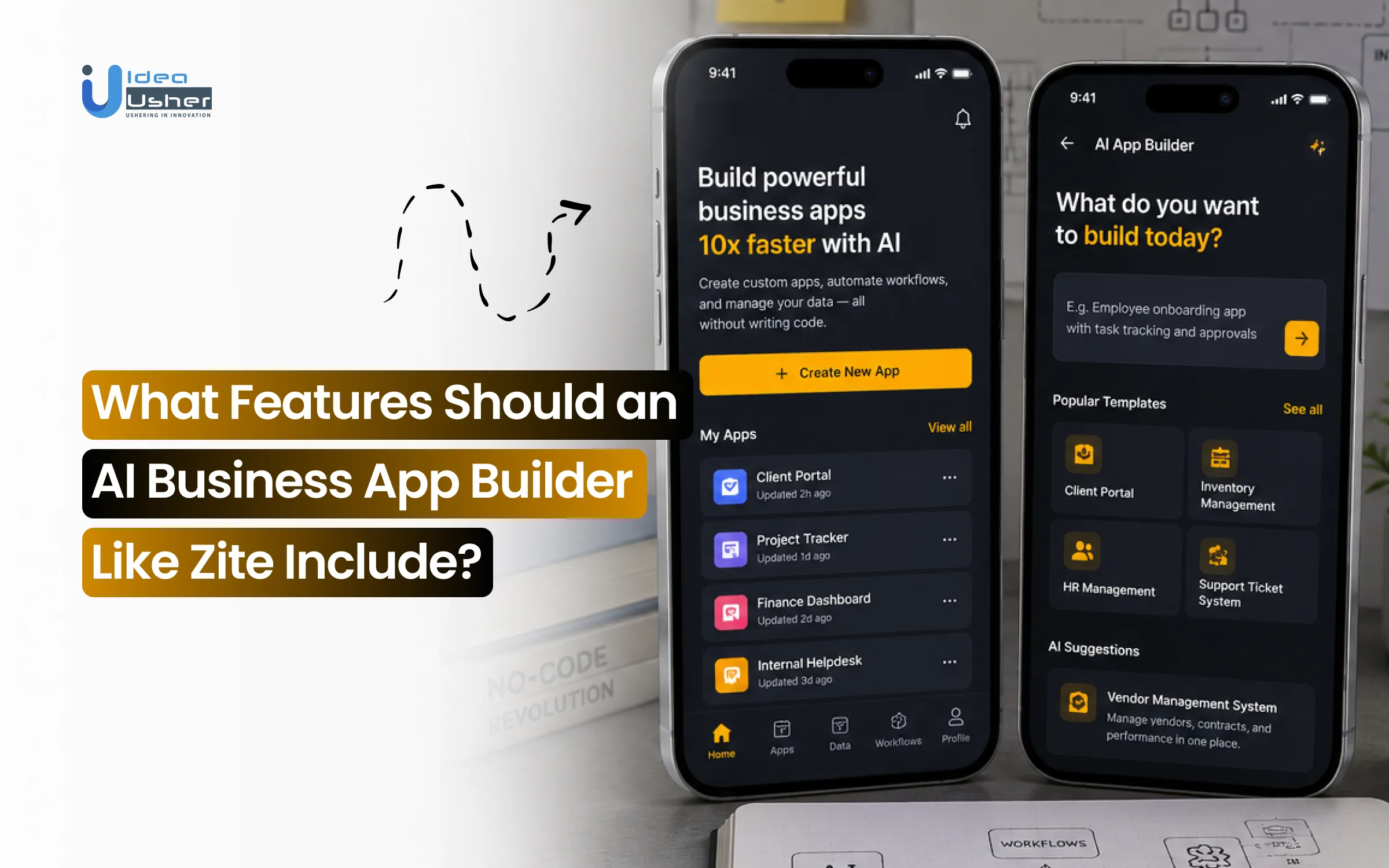
Key Takeaways
- Businesses are adopting AI business app builders to create custom applications faster using natural language and intelligent workflow automation.
- Platforms like Zite combine AI-powered app generation, full-stack automation, secure authentication, and cloud deployment in a single environment.
- Enterprise adoption is driven by workflow automation, third-party integrations, production-ready infrastructure, and governance features that simplify software development.
- Advanced capabilities such as multi-agent AI, Retrieval-Augmented Generation (RAG), enterprise controls, and autonomous automation are shaping the next generation of AI app builders.
- How Idea Usher can help businesses build AI business app builders with LLM integration, intelligent automation, enterprise security, and production-ready AI infrastructure.
Organizations are moving beyond traditional low-code platforms because they need more than just faster development. The popularity of AI business app builders is growing as they make it possible to turn business ideas into working software without long development cycles or large engineering teams. Instead of spending months building internal tools from scratch, companies can quickly create applications that match their workflows and refine them as their needs evolve.
We’ve developed several AI app-building solutions that leverage large language models and workflow automation engines to help businesses build custom applications faster. At Idea Usher, we’ve gained hands-on experience building these solutions, and in this blog, we’ll explore the key features needed to build an AI business app builder like Zite.
Market Potential of AI Business App Builders
According to Mordor Intelligence, the no-code AI platform market is expected to grow from USD 4.88 billion in 2026 to USD 12.25 billion by 2031 at a 20.19% CAGR. The growth is being driven by businesses that want faster and more flexible ways to build software without depending on long development cycles. For founders, this creates an opportunity to launch AI-powered platforms that help companies build custom business applications quickly while reducing development costs and time to market.

Source: Mordor Intelligence
Growing Demand
Modern organizations require software that adapts to their workflows rather than forcing teams to adapt to rigid tools. The demand for intelligent application builders is growing because traditional development cannot keep pace with business reality. Organizations need systems that actively analyze data, automate workflows, and handle customer interactions autonomously.
This gap between corporate needs and available engineering talent is widening. High-net-worth investors can capitalize on this friction by backing development platforms that democratize application creation. By lowering the technical barrier, these platforms allow operational managers to build business tools without relying on backlogged IT departments.
Enterprise Adoption
Enterprise buyers prioritize speed, security, and measurable return on investment. They are investing heavily in AI application builders because buying a robust platform platform is significantly cheaper than building bespoke tools from scratch. A platform approach slashes prototyping timelines from months to afternoons.
- Predictable Budgeting: Eliminates the financial uncertainty of prolonged software research and development.
- Legacy Compatibility: Modern builders integrate smoothly with existing databases and cloud networks.
- Data Privacy: Secure architectures ensure proprietary corporate data remains isolated from public models.
Enterprise contracts offer high customer lifetime value and predictable recurring revenue. Platforms that focus on compliance, private data handling, and clean user permissions quickly become indispensable parts of the corporate tech stack.
Industry Opportunities
While every sector requires digitization, specific industries present massive financial opportunities due to their complex data requirements and high operational friction. Targeting these specific verticals allows platform founders to command premium pricing. By tailoring your platform’s core generation templates to solve these deep industry problems, you create a highly defensible product that legacy development tools cannot easily replicate.
| Target Industry | Core Operational Bottleneck | Platform Monetization Value |
| Healthcare | Patient data intake and compliance documentation. | High-margin premium compliance seats |
| Finance | Manual fraud detection and risk reporting. | Sticky, long-term enterprise retainers |
| Logistics | Complex supply chain routing and invoice matching. | High-volume transactional API revenue |

The Vision Behind Zite’s AI-Native Business App Platform
Zite is an AI-powered software creation platform built specifically to generate production-grade custom business software from plain English descriptions. Unlike legacy tools that focus purely on static visual layouts, the platform automatically provisions full-stack application logic, responsive interfaces, and highly scalable database tables simultaneously.
Operating as a lean startup, Zite has quietly captured significant market momentum with over 100,000 active teams using its infrastructure. The company currently generates an estimated $428,000 in annual recurring revenue with a business model optimized for low overhead and strong software margins.
Production-Ready Apps
Zite is built for businesses that need software ready for real-world use instead of simple demos. Many AI app builders can generate working prototypes in minutes, but those apps often need significant rebuilding before they can support everyday business operations. Zite reduces that gap by creating applications with production-ready infrastructure from the beginning, allowing teams to launch faster with greater confidence.
Enterprise demand is also driving strong investor interest in this category. Companies want AI platforms that produce reliable business software rather than temporary prototypes, creating a valuable market for production-first solutions. This trend is reflected in the funding landscape, where comparable prompt-to-app platforms have raised up to $30 million in venture capital, highlighting the growing demand for enterprise-ready AI development tools.
AI-First Workflows
Traditional business systems are notoriously rigid, forcing operations teams to change their internal workflows to match the limitations of off-the-shelf software. Zite flips this relationship by allowing software to mold directly around unique corporate processes. Users specify their exact data triggers, operational rules, and automated logic blocks inside a conversational chat window.
- Smart Data Processing: Teams use built-in integrations to automatically summarize client intake forms, categorize inbound customer tickets, or flag transaction risks.
- Visual Workflow Flowcharts: The platform translates backend app logic into clear, step-by-step visual flowcharts so non-technical managers can audit the software behavior instantly.
- Zero Per-Seat Friction: By eliminating traditional user seat licenses, organizations can invite suppliers, freelancers, and internal teams into their applications without facing escalating software bills.
This workflow flexibility directly fuels Zite’s commercial strategy. By targeting operational use cases like custom client onboarding portals and custom internal CRMs, the platform secures a highly predictable subscription stream. Paid tiers scale from a $19 monthly professional option to enterprise arrangements, generating high-margin software revenue that scales alongside the customer’s data storage and processing needs.
Bridging the Enterprise Gap
One of the biggest challenges for businesses is the long wait between identifying a problem and getting software built to solve it. Internal IT teams often have long backlogs, so departments end up relying on spreadsheets and manual processes instead. Zite shortens this cycle by turning simple prompts into enterprise applications, helping teams move from an idea to a working solution much faster.
To improve accuracy, Zite uses Plan Mode before generating the application. Instead of building immediately, the AI asks follow-up questions and creates a structured plan for review. This gives businesses a chance to confirm workflows, data structure, and requirements before development begins, reducing revisions and making the final application better suited for real business use.
How Does Zite Turn Natural Language Into Working Business Apps?
Zite simplifies software development by turning a single text prompt into a complete business application. Instead of building the frontend, backend, database, and infrastructure separately, the platform generates the full application stack in one workflow. This helps businesses create production-ready software much faster while reducing the need for large development teams.

The platform also follows a straightforward subscription model that supports long-term growth. Plans start at $19 per month for the Pro tier and $69 per month for the Business tier. With unlimited users included across its plans, Zite makes it easier for entire teams to adopt the platform without worrying about additional per-seat costs.
Prompt-to-App Conversion
Zite starts the app development process through a conversational interface where users describe what they want to build in plain language. The AI understands the business requirements, suggests the right structure, and helps refine workflows before development begins. Once the plan is approved, it generates the application’s database, logic, and core components together, making the transition from idea to a working business app much faster and more reliable.
Full-Stack Automation
Once a blueprint is finalized, the code generation engine takes over. Unlike legacy visual tools that require manual layout alignment and backend wiring, Zite automates the creation of the full software infrastructure out of the box.
- Dynamic Data Modeling: The database layer provisions relational tables, columns, and indexes automatically based on your initial prompt requirements.
- Responsive Visual Frameworks: The engine builds professional frontends with pre-built component layouts that display flawlessly on mobile devices and desktops alike.
- Native Identity Management: Secure user registration paths, role-based permissions, and login infrastructure deploy natively without relying on external security integrations.
Refining and Deploying
The transition from a raw idea to a live production environment requires just a single click. Zite isolates every generated application inside its own secure, managed cloud container. The platform utilizes serverless computing logic, meaning the underlying storage and processing power expand automatically to handle high volumes of transaction data or sudden traffic spikes.
| Operating Capability | How Zite Handles It | Direct Business Value |
| Instant Live Publishing | Deploys tools to secure cloud servers with custom domain options. | Drastically reduces product time to market |
| Conversational Iteration | Modifies existing software elements via simple text requests. | Eliminates long development change orders |
| Visual Logic Auditing | Displays backend app behavior as clear visual flowcharts. | Allows operational teams to verify workflows |
Key Features of an AI Business App Builder Like Zite
Building a competitive software asset requires understanding the technical components that drive enterprise adoption. Zite succeeds because it consolidates the entire development pipeline. Instead of forcing users to stitch together separate frontend tools, database clusters, and hosting platforms, Zite provides an integrated ecosystem designed for rapid deployment.
1. Natural Language Generation
The core entry point of Zite relies on a conversational interface that completely eliminates manual coding. Users type a plain English description of the application they need, such as an internal project tracker, a customer portal, or a vendor dashboard. The underlying AI engine parses this semantic intent and automatically constructs the application frontend, business logic rules, and relational schemas simultaneously.
Operational managers use this feature to turn ideas into functional prototypes in minutes. By bypassing traditional software specification documentation and technical backlogs, teams use Zite to build customized software tools that match their exact internal processes without waiting for engineering availability.
2. Visual App Editor
While natural language handles the heavy lifting of initial development, software refinement requires precision control. Zite includes a visual layout editor that allows users to tweak user interfaces directly. If a layout requires a shifted sidebar, an altered button color, or a resized data grid, creators can modify the presentation layer visually or through targeted text commands.
- Layout Adjustment: Users click and adjust components directly on a canvas to align layouts precisely.
- Branding Synchronization: Creators apply custom design themes, fonts, and corporate colors across every generated page instantly.
- Component Extensibility: Teams drop pre-built tables, kanban boards, and submission forms directly into existing workspaces.
This dual-mode approach keeps development highly flexible. Non-technical users avoid getting stuck when an AI output needs a minor cosmetic tweak, allowing teams to polish interfaces to match corporate branding guidelines exactly.
3. Database and Data Modeling
A major limitation of legacy no-code tools is the complex process of structuring backend data. Zite solves this by auto-generating a built-in relational database based on the initial text prompt. When a user describes a workflow, Zite automatically determines the necessary tables, text columns, and relational links required to run the application safely.
Operations teams use this feature to manage millions of individual records without ever writing a line of SQL. The internal storage engine behaves with the simplicity of a standard spreadsheet but retains the transactional security of an enterprise-grade database. Users can also link the platform directly to their existing external data repositories like Airtable or Google Sheets.
4. AI Workflow Automation
Modern business applications must handle background operations automatically. Zite builds backend workflows as visual, flowchart-style diagrams that mirror the logic of popular automation systems. When an event occurs within the app, such as a client submitting a request, the platform routes that information through an automated execution pipeline.
| Workflow Step Type | Action Performed inside Zite | Operational Outcome |
| Data Synchronization | Automatically populates internal tables upon form submission. | Eliminates manual data entry errors |
| Intelligent Alerting | Triggers instant conditional notifications to messaging platforms. | Keeps internal teams updated instantly |
| AI Processing | Passes raw text inputs to embedded LLMs for summarization. | Speeds up backend content analysis |
Managers use these flowcharts to audit business logic without reading raw code. Because the backend processing order displays visually, users can trace exactly how data moves between steps, locate execution bottlenecks, and adjust operational rules via chat commands.
5. Secure Authentication
Deploying software within an enterprise environment requires institutional-grade security. Zite builds secure login infrastructure and user authentication directly into every application by default. When an application launches, the platform secures the interface with modern login protocols, ensuring sensitive corporate data remains fully protected.
- Flexible Identity Access: Users log into apps using magic links, standard credentials, or corporate single sign-on protocols.
- Granular Role Controls: Administrators restrict specific pages, data columns, and editing permissions based on user groups.
- Data Isolation Safeguards: Security rules ensure external clients only view data records explicitly assigned to their accounts.
Compliance teams use these native security controls to launch public-facing customer portals and internal admin panels side by side. Because the platform includes built-in SOC 2 Type II compliance standards, businesses avoid the risk of misconfigured third-party identity integrations.
6. Third-Party Integrations
No modern business application operates entirely in isolation. Zite features an integration layer that allows generated tools to communicate with an organization’s existing software ecosystem. The platform automatically maps data fields between different services, saving users from managing raw API keys or custom webhooks manually.
Users leverage these connections to extend the utility of their legacy corporate software. For instance, an operations team can build an application on Zite that automatically pulls customer data from Salesforce, processes a payment through Stripe, and sends a transaction confirmation via Gmail without writing integration scripts.
7. Deployment and Cloud Hosting
The transition from a development canvas to a live environment happens instantly inside Zite. When an application is ready for users, a single click publishes the software to a fully managed cloud network. Zite handles the underlying server allocation, SSL certificate configuration, and database indexing automatically behind the scenes.
Advanced Features That Can Improve an AI Business App Builder
Entering the AI-native application market requires a product strategy that goes beyond standard template generation. To capture market share from early incumbents, your platform must offer advanced engineering, deep contextual awareness, and governance controls. Analyzing the unique capabilities of leading platforms reveals exactly where the market is heading.
1. Multi-Agent Collaboration
A key strength of Lovable is its multi-agent AI system, which works like a team of software specialists behind the scenes. Different AI agents handle different parts of the development process, allowing the platform to build complex features more accurately while reducing mistakes.
2. Autonomous Full-Stack Development
Unlike traditional AI coding assistants that only generate code snippets, Replit Agent can manage much of the application development process on its own. It creates the project structure, sets up the required dependencies, prepares the database, and deploys the application in the cloud. The platform also tests its own code and fixes common issues before users review the final application, helping developers and non-technical teams build full-stack apps with less manual effort.
3. AI-Powered Visual Editing
The disconnect between textual code and visual design often slows down product iteration. Cursor solves this friction by providing an AI-native editing workspace where natural language instructions modify live application source files directly while maintaining structural code integrity.
- Targeted Inline Editing: Users highlight specific sections of code or UI elements and issue natural language change requests directly.
- Contextual Code Awareness: The system reads the entire project folder structure to ensure visual changes do not break backend routes.
- Predictive Tabbing: The editor anticipates structural edits based on the developer’s historical layout changes, speeding up manual coding.
This hybrid approach bridges the gap between pure text prompting and precise manual adjustments. Professional developers use Cursor to maintain absolute control over the code syntax, while utilizing AI to eliminate the repetitive boilerplate work associated with building enterprise layouts.
4. Enterprise Governance
Deploying AI-generated software within large organizations requires strict security oversight and compliance guardrails. Microsoft Power Apps addresses this corporate need by building advanced environment management, granular compliance auditing, and role-based access tracking directly into the creation pipeline.
Corporate IT administrators use these governance frameworks to control exactly who can build, modify, and access internal applications. The platform isolates development sandboxes from live production databases, ensuring that a non-technical manager testing an AI prompt cannot accidentally corrupt sensitive corporate records or violate data privacy compliance rules.
5. Business Automation Agents
Modern business apps need to do more than store records, they must execute operations autonomously. Salesforce Agentforce shifts software utility from passive dashboards to active automation by deploying autonomous service and sales agents that handle client interactions natively across interconnected systems.
| Agent Capability | How Agentforce Handles It | Enterprise Value |
| Autonomous Resolution | Analyzes account histories to solve customer support cases directly. | Lowers administrative support queues |
| SDR Outreach | Screens inbound leads and books calendar appointments. | Maximizes pipeline growth 24/7 |
| Trust Layer Guardrails | Screens inputs for data leaks and corporate policy compliance. | Guarantees safe AI execution |
Corporate teams use Agentforce to embed operational intelligence directly into their customer portals. Instead of relying on rigid, pre-scripted conversation trees, these agents use advanced reasoning to break down multi-step workflows, search company knowledge documents, and update core CRM records without human intervention.
6. Retrieval-Augmented AI
Foundation language models lack access to proprietary company records, often leading to generic or inaccurate text outputs. Dify solves this limitation by providing built-in Retrieval-Augmented Generation pipelines that link custom software applications directly to private enterprise knowledge bases.
Operations teams use Dify to build intelligent internal knowledge assistants and customer FAQs. The platform processes raw enterprise documents into semantic vector embeddings automatically. When a user interacts with the generated app, the system retrieves relevant data fragments from the private repository, ensuring that the AI workflows deliver highly accurate context-aware responses without data leaks.
7. One-Click Backend Services
An exceptional front-end interface is useless without a reliable, high-performance data architecture. Supabase accelerates the development loop by automatically provisioning a robust open-source database infrastructure, secure authentication frameworks, file storage containers, and real-time APIs from a single configuration.
Developers use Supabase to instantly deploy scalable backends that sync effortlessly with modern frontend web frameworks. By automating complex database indexing, real-time data streaming listeners, and serverless logic functions, it removes the need for manual DevOps engineering. This enables software platforms to scale their data processing capabilities fluidly as user traffic expands.
Cost to Include Different Features in an AI Business App Builder
Launching a proprietary AI app builder requires a clear understanding of the engineering capital required. Allocation of funds must balance speed to market with long term architectural scalability. As your AI system integrator, we at IdeaUsher map out these costs directly to help you optimize your development budget and build a highly defensible software asset.
MVP Development Costs
Building a minimum viable product focuses entirely on delivering the primary software generation loop. This baseline engine must process a user prompt, synthesize code, and deploy a functional application with working data models and secure login routing. We engineer these essential features using optimized frameworks to keep your initial setup lean and fast.
| Core MVP Feature | Engineering Complexity | Estimated Cost Range (USD) |
| Natural Language Generation Engine | High (Custom prompt parsing and code output) | $25,000 – $45,000 |
| Automated Relational Database Builder | Medium (Dynamic table and schema creation) | $15,000 – $25,000 |
| Secure Authentication & Access Routing | Medium (User logins and role permissions) | $10,000 – $18,000 |
| Visual Canvas Editor | High (Layout adjustment and theme sync) | $20,000 – $35,000 |
| Managed Cloud Deployment Pipeline | Medium (One-click serverless hosting) | $12,000 – $20,000 |
Deploying this baseline infrastructure typically requires an investment ranging from $82,000 to $143,000. By hiring our team to build your MVP, you ensure that these core modules are designed correctly from day one. This provides a clean foundation that can scale seamlessly when you add more complex capabilities later.
Advanced AI Feature Budgets
To capture lucrative enterprise clients, a platform must offer capabilities that go beyond simple template creation. Incorporating automated agents, vector search knowledge networks, and strict corporate governance tools increases the development budget but yields much higher subscription margins.
- Integrating multi-agent networks requires specialized orchestration engineering. This allows distinct AI agents to collaborate on coding, testing, and debugging applications autonomously, adding $30,000 to $55,000 to the timeline.
- Adding Retrieval-Augmented Generation (RAG) pipelines lets applications securely connect to private corporate files using vector databases, costing between $20,000 and $35,000.
- Enterprise compliance tools, including sandboxed environment controls and automated security auditing logs, add another $18,000 to $30,000.
When we handle these complex software layers for your platform, we ensure that your product meets the strict security compliance standards that Fortune 500 companies demand.
Factors Influencing Total Cost
Several operational variables drive the ultimate software invoice up or down. Understanding these drivers helps you control expenses during the active creation cycle.
- UI Engine Intricacies: A basic text-to-app generator costs less than building a highly interactive, real-time visual design canvas.
- LLM Model Strategy: Utilizing open-source models optimized by our engineers drastically reduces long-term operational token fees compared to renting expensive third-party APIs.
- Integration Complexity: Building native custom payment gateways or deep enterprise CRM hooks requires more engineering hours than basic webhook setups.
Continuous maintenance and server infrastructure also affect total costs. AI platforms require constant monitoring to handle prompt drifting, update security patches, and optimize serverless compute clusters during traffic spikes.
Which Industries Are Creating the Highest Demand for AI App Builders?
Corporate demand for rapid software creation tools is expanding across nearly every major vertical market. Organizations face an ongoing shortage of technical talent combined with an urgent need to automate legacy operations. By deploying custom application generators, companies bypass traditional engineering backlogs and build secure, data-driven workspaces tailored to their exact internal requirements.
1. Financial Services and Compliance Automation
Financial organizations are adopting AI app builders to simplify processes such as customer onboarding, compliance checks, and fraud monitoring. These platforms help teams automate routine work and build secure internal tools much faster than traditional development.
The demand for this approach is reflected in Bubble, which powers thousands of custom applications and generates an estimated $100 million in annual recurring revenue (ARR). Its success highlights the growing need for scalable platforms that can support complex business operations.
2. Logistics, Operations, and Enterprise Management
Supply chain and logistics companies use AI app builders to create tools for inventory tracking, procurement management, and shipment monitoring. These applications give operations teams better visibility across the supply chain while helping them respond more quickly to changing business needs.
The growing demand for these solutions is reflected in the success of FlutterFlow, which has surpassed $25 million in annual recurring revenue. Its ability to build mobile and web applications quickly makes it a popular choice for businesses that need field-ready apps connected to existing enterprise systems.
3 HR, Customer Service, and Business Tools
Enterprises use AI app builders to create employee portals, customer support systems, knowledge bases, and internal workflow tools without lengthy development projects. These platforms help teams organize information in one place and make it easier for employees and customers to access the resources they need.
The demand for these solutions has contributed to the growth of Softr, which generates an estimated $1 million to $10 million in annual revenue. Its ability to turn database records into polished web applications shows why businesses are increasingly adopting no-code platforms for internal and customer-facing operations.
Build an AI Business App Builder with Idea Usher
Building an AI app generation platform requires more than integrating language models. It demands scalable architecture, secure cloud infrastructure, and a system that can reliably generate production-ready applications. Idea Usher helps businesses design and develop custom AI app builders with the right technical foundation, enabling them to launch a scalable platform under their own brand and support long-term enterprise growth.
Strategic Goal Alignment
Launching a new software application requires careful planning to ensure maximum return on investment. We collaborate with you directly to define your system architecture, map out core feature requirements, and establish a lean minimum viable product that addresses specific enterprise bottlenecks. This disciplined approach protects your development capital and shortens your overall time to market.
- Targeted MVP Roadmaps: Focus engineering resources purely on high-value generation capabilities that prove immediate market demand.
- Token Cost Optimization: Design model inference pipelines that keep recurring cloud infrastructure overhead low.
- Defensible Tech Assets: Build custom code generation engines that belong entirely to your company, maximizing equity value.
End-to-End Product Development
Developing a multi-tenant AI app builder requires expertise in cloud infrastructure, AI models, databases, and secure user management. Idea Usher manages the complete development process, from backend architecture and workflow automation to deployment, helping you launch a reliable platform that can scale as your user base grows while you focus on expanding your business.
MVP to Enterprise Scaling
Transitioning from an initial software launch to a large-scale corporate environment requires resilient infrastructure that can handle heavy traffic. Idea Usher brings a world-class team of developers, including veteran ex-FAANG engineers who have scaled global software systems for millions of active users.
With over 500,000 hours of combined production coding experience, we eliminate the operational bugs and downtime risks that commonly impact early-stage platforms.
| Scaling Phase | What Our Team Delivers | Business Performance Impact |
| Initial Launch | Fast deployment of the core prompt-to-app code engine. | Validates product utility with target users |
| Enterprise Growth | Integrating sandboxed testing zones and SOC 2 guardrails. | Secures lucrative corporate B2B contracts |
| Global Expansion | Deploying auto-scaling serverless cloud architecture. | Handles high transaction volume effortlessly |
Conclusion
Building an AI business app builder like Zite requires more than a conversational interface. The platform should combine intelligent app generation with secure infrastructure, scalable architecture, workflow automation, and enterprise-ready deployment. Focusing on these core capabilities helps create a product that delivers real business value and can support long-term customer growth as market demand continues to increase.
Things to Know About AI Business App Builders
A1: Traditional no-code platforms rely primarily on drag-and-drop interfaces where users manually configure workflows, databases, and UI components. AI app builders go a step further by automatically generating these elements from natural language prompts, suggesting improvements, writing code when needed, and accelerating the entire development lifecycle through intelligent automation.
A2: Yes, modern AI app builders can generate production-ready applications when equipped with features such as secure authentication, scalable databases, workflow automation, API integrations, cloud deployment, and role-based access control. However, enterprise applications often require additional customization, governance, security enhancements, and performance optimization before deployment.
A3: AI business app builders are widely adopted across industries including healthcare, finance, logistics, manufacturing, retail, education, HR, and professional services. Organizations use them to rapidly develop customer portals, internal business tools, workflow automation systems, CRM platforms, inventory management solutions, employee portals, and industry-specific AI applications without lengthy development cycles.
A4: The development cost depends on the platform’s complexity, AI capabilities, cloud infrastructure, third-party integrations, enterprise security requirements, and scalability goals. A basic MVP with essential AI app generation features typically requires a lower investment, while a full-scale enterprise platform with AI agents, multi-model support, governance controls, and advanced collaboration features demands significantly higher development resources.


