

Key Takeaways
- To build an event contracts platform like FanDuel Predicts, develop secure trading, real-time data, liquidity, settlement, and compliance infrastructure.
- Start by defining the event contracts, trading rules, pricing, and settlement logic.
- Then build the order-matching, liquidity, wallet, and payment infrastructure.
- Integrate reliable data sources for real-time event updates and automated contract resolution.
- See how IdeaUsher can help you build an event contracts platform like FanDuel Predicts with secure and scalable trading infrastructure.
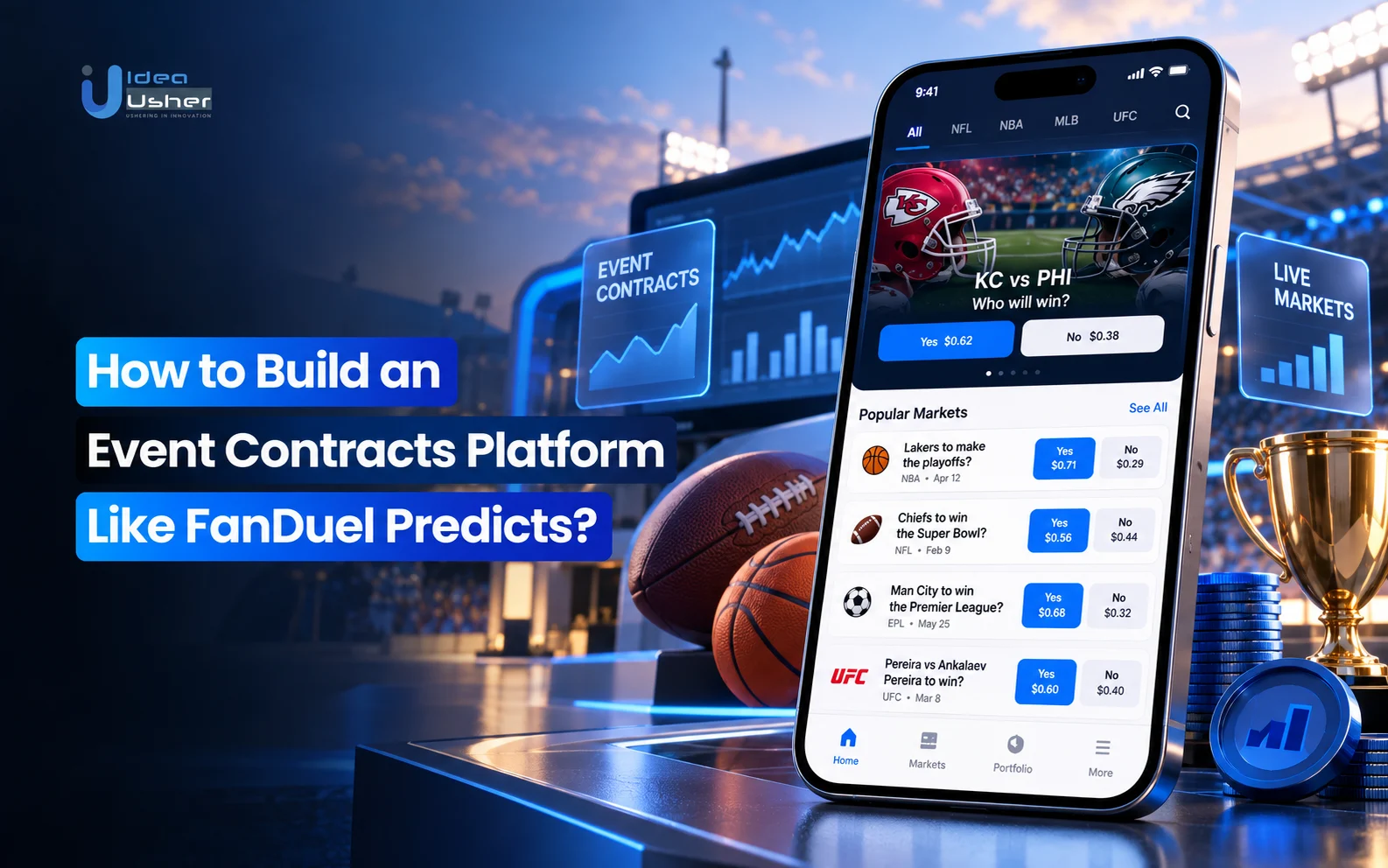
Developing an event contracts platform like FanDuel Predicts involves pairing a powerful trading infrastructure with an intuitive consumer app while meeting complex regulatory requirements. To a user, the experience may feel as easy as picking an outcome and buying a contract. Behind that simple experience, however, sits an entire marketplace built to handle trading, pricing, data, and settlement.
You need the right exchange architecture, reliable event data, liquidity mechanisms, automated resolution, and compliance controls working together from day one. In this blog, we’ll explore what it takes to build an event contracts platform, from core features and technology to development costs, compliance, and the infrastructure needed to scale.
Why Event Contracts Are Becoming a New Market Opportunity?
Event contracts turn real-world outcomes, such as playoff games or Fed rate decisions, into simple yes-or-no contracts. Typically priced between $0.01 and $0.99, they trade on regulated exchanges and give businesses another way to reach users beyond traditional sportsbooks.The opportunity is growing quickly. Zion Market Research values the global sports betting market at $131.1 billion in 2023 and projects it to reach $179.3 billion by 2032, at a CAGR of 8.83%. Bernstein expects prediction-market trading volume to reach $240 billion in 2026 and around $1 trillion by 2030, attracting sportsbooks, brokerages, and fintech companies.
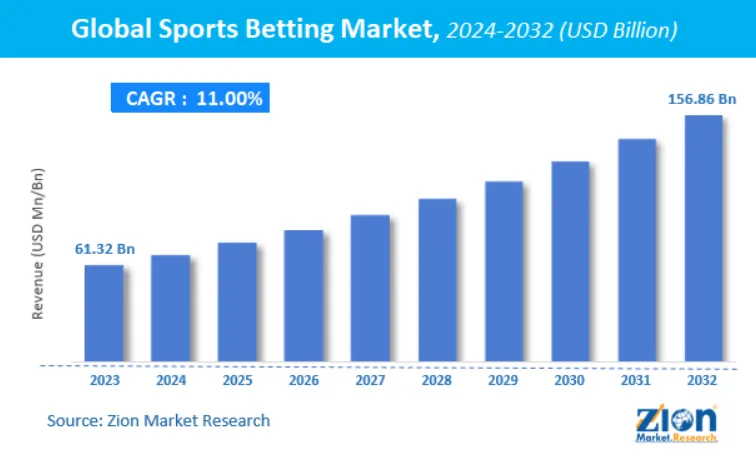
Source: Zion Market Research
Growing Interest in Event-Based Trading
Event-based trading has moved rapidly into the mainstream. Before the 2024 U.S. presidential election, weekly trading volume was around $50 million. It has since surpassed $6 billion per week, representing more than 100x growth in roughly two years. Retail participation is also strong. More than 800,000 unique wallets participate each month, while median trade sizes typically range from $2 to $3. Sports remains the biggest driver, creating significant overlap with traditional sportsbook audiences.
| Indicator | Figure | Why it matters |
| Monthly trading volume | Rose from $1.9B to $23.7B in a year | Shows rapid demand growth |
| Median trade size | 2–3 | Highlights retail participation |
| Sports share of volume | About 85% on the largest platform in June | Shows sports demand |
| Share of legal U.S. sports-betting volume | About 27% during the World Cup | Shows competition with sportsbooks |
| Sports share of overall volume | More than 60% | Sports remains the leading category |
Expansion Beyond Traditional Sportsbooks
Traditional sportsbooks often operate state by state, while prediction-market platforms can operate through federally regulated exchange infrastructure. This difference has encouraged major operators to enter the market.
FanDuel Predicts
FanDuel Predicts, developed with CME Group, offers contracts covering the S&P 500, Nasdaq-100, oil, gold, GDP, and CPI across all 50 states, while sports contracts are offered where online sports betting is not yet legal. The model allows FanDuel to expand its product without relying entirely on its sportsbook licenses.
DraftKings and Railbird
DraftKings took a different approach by acquiring Railbird Technologies and Railbird Exchange, a CFTC-designated exchange. Its initial filings covered contracts for game winners, spreads, props, and head-to-head markets across football, basketball, baseball, hockey, golf, MMA, motorsports, soccer, and tennis.
Fanatics Markets
Fanatics Markets launched an exchange-powered prediction product through Crypto.com | Derivatives North America, a CFTC-registered exchange and clearinghouse. Its offering has continued expanding with features such as:
- Combos: Combines multiple predictions into one contract across sports including football, basketball, baseball, hockey, MMA, soccer, and tennis.
- FanCash rewards: Users can earn up to 10% back in FanCash on eligible trades.
- FanViz: Provides real-time game visualizations, play-by-play data, and statistics.
- Category expansion: Covers sports, finance, economics, and politics, with additional categories planned across crypto, IPOs, climate, pop culture, technology, AI, movies, and music.
New Revenue Opportunities for Businesses
For businesses, event contracts can create a new way to monetize an existing audience. Sportsbooks can reach users in markets where they lack a sportsbook license, brokerages can offer event-based trading alongside financial products, and media or merchandise brands can turn audience engagement into repeat activity.
The major strategic decision is how much of the exchange infrastructure to own.
| Business model | How it works | Example |
| Own the exchange | Build or acquire a CFTC-licensed exchange and control listings, clearing, and product design | DraftKings with Railbird Exchange |
| Partner with an established exchange | Operate the consumer platform while a licensed exchange handles pricing and clearing | FanDuel Predicts with CME Group; Fanatics Markets with Crypto.com |
| Start as a distributor, then build | Launch through a partner before developing or acquiring exchange infrastructure | Robinhood |
Robinhood’s Expansion
Robinhood illustrates the third approach. More than 1 million customers traded about 9 billion event contracts in its first year. The company later created Rothera, a joint venture with Susquehanna International Group, which acquired MIAXdx. After Rothera launched, Robinhood reported nearly 2 million customers trading 13.6 billion event contracts, including 2.1 billion through Rothera. Robinhood has also introduced preset and custom combos and player contracts through its Prediction Markets Hub.
The different approaches show that businesses can enter the market through partnerships, acquisitions, or their own exchange infrastructure, depending on their goals, resources, and regulatory strategy.

How FanDuel Predicts Turns Events Into Contracts?
FanDuel Predicts turns real-world outcomes into Yes/No contracts that users can trade on a regulated exchange. FanDuel provides the consumer experience and identity checks, while CME Group handles the exchange and clearing infrastructure. Each contract pays $1 if the outcome is correct and $0 if it is not, with users able to trade before settlement.
For businesses planning an event contracts or sports prediction exchange, this flow highlights four critical areas: contract design, pricing, position management, and settlement.
1. Turning Events Into Contracts
The process starts with a question that has a clear answer. FanDuel Predicts covers sports outcomes such as game winners, spreads, and totals, alongside financial and economic events involving the S&P 500, Nasdaq-100, oil, gold, GDP, and CPI. The product launched in five states and reached all 50 states in less than four weeks, while sports contracts were offered in 18 states where FanDuel did not operate a sportsbook.
| Event type | Example contract question | Category |
| Game result | Will the Yankees win today? | Sports |
| Point spread | Will the Spurs cover the spread against the Knicks? | Sports |
| Game total | Will Golden Knights vs. Hurricanes go over 4.5? | Sports |
| Benchmark | Will the S&P 500 or Nasdaq-100 close above a set level? | Financial |
| Commodity | Will oil, gas or gold reach a set price? | Commodities |
| Economic data | Will CPI or GDP come in above a set figure? | Economic indicators |
2. Designing Simple Yes/No Markets
FanDuel Predicts keeps contracts simple by presenting users with Yes/No outcomes priced between $0.01 and $0.99. The price also represents the market’s implied probability. For example, a contract priced at $0.70 suggests roughly a 70% probability at that moment. A well-designed contract includes:
- A precise question: The outcome must be clearly defined.
- Two sides: Users can take either the Yes or No position.
- A bounded price: Contracts trade between $0.01 and $0.99.
- Pre-defined resolution rules: The source used to determine the outcome is established before trading.
- A fixed payout: Winning contracts pay $1 while losing contracts pay $0.
3. Managing Prices and Positions
Unlike a sportsbook where the operator sets the odds, contract prices move according to buying and selling activity. Orders are routed through CME Group’s exchange and matched with available orders. If there is not enough liquidity at a desired price, an order may remain unfilled.
Once a trade is completed, the platform tracks buying power, open positions, and pending settlements, giving users a clear view of their exposure.
4. Placing a Contract Position
The user journey can be reduced to five steps:
- Fund the wallet: Users add money to their Predicts wallet.
- Pick a market: Select an available sports or financial contract.
- Choose Yes or No: Select the desired outcome.
- Set the contract count: For example, $20 buys 50 Yes contracts at $0.40 each.
- Review and confirm: The user reviews the expected fill price and transaction fee.
5. Selling Before Event Resolution
Users do not always need to hold a contract until settlement. They can sell their position early, subject to market liquidity. If a team takes an early lead, the Yes price may rise, allowing a trader who bought at a lower price to lock in a gain.
| Choice | What the trader does | What determines the result |
| Hold to settlement | Keeps the contract until resolution | Pays $1 if correct and $0 if not |
| Sell early to lock profit | Sells after the price rises, such as $0.40 to $0.70 | $0.30 price difference per contract |
| Sell early to limit loss | Sells after the price falls | Recovers part of the original stake |
Transaction fees also apply, so traders need to consider the platform’s current fee schedule when exiting early.
6. Settling Contracts After Events
Settlement relies on predefined resolution rules and official data sources. Once the outcome is confirmed, the market closes and contracts settle automatically at $1 or $0. For an NFL game, sources can include the NFL, Genius Sports, and CME Group.
Example Settlement
A trader buys 50 Yes contracts at $0.40, spending $20.
- The team wins.
- Each contract settles at $1.
- Total payout = $50.
- Profit = $30.
For businesses building an event contracts platform, this entire process ultimately depends on four core systems: contract templates, a matching engine, reliable data feeds, and automated settlement infrastructure.
Event Contracts vs Sportsbooks: How Do They Differ?
The biggest difference is who sets the price and who takes the other side. A sportsbook acts as the counterparty, sets the odds, and earns through its margin. An event contract platform operates as a marketplace where users trade Yes/No contracts based on supply and demand.
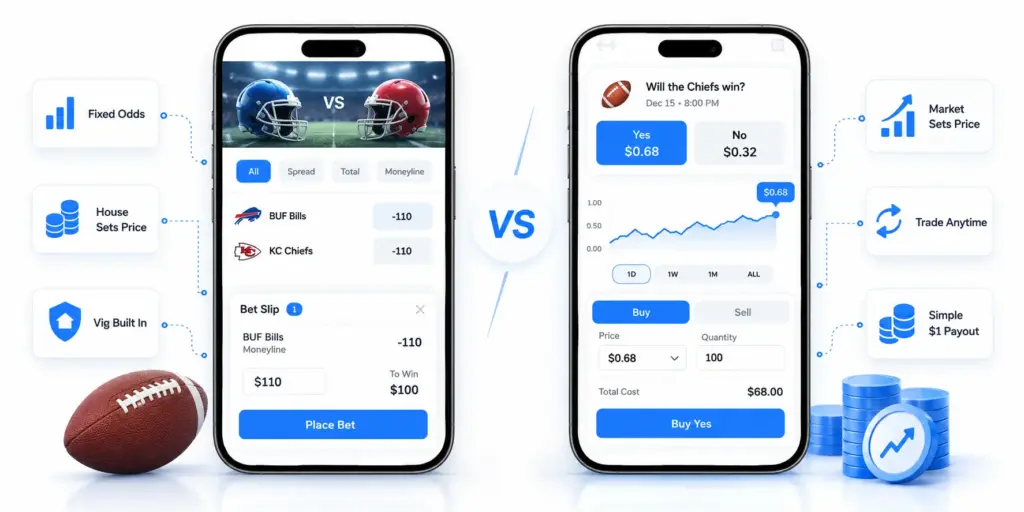
The regulatory models also differ. Sportsbooks are generally licensed state by state, while event contract exchanges operate under federal oversight. FanDuel provides a useful comparison because it operates both FanDuel Sportsbook and FanDuel Predicts.
Who Sets the Price?
At a sportsbook, oddsmakers and risk teams set and adjust the odds while building in a margin known as the vig. On an event contract exchange, prices are discovered through supply and demand in the order book. FanDuel shows the difference clearly: Sportsbook users accept the quoted odds, while Predicts users trade contracts between $0.01 and $0.99. A price around $0.70 represents roughly a 70% implied probability.
| Sportsbook | Event contract platform | |
| Who sets the price | Oddsmakers and risk teams | Supply and demand |
| Price format | Fixed odds | 0.01–0.99 contract price |
| Margin | Built into odds as vig | Separate trading fee |
| Example | FanDuel Sportsbook | FanDuel Predicts |
Where Does Liquidity Come From?
A sportsbook provides liquidity through its own balance sheet. An exchange instead needs buyers and sellers, with professional market makers often providing continuous quotes. Susquehanna became the first dedicated institutional market maker on Kalshi and later joined Robinhood’s Rothera exchange. Jump Trading built a roughly 20-person event-contract team and took equity stakes in Kalshi and Polymarket for providing liquidity.
Liquidity generally comes from:
- Other users: Retail traders take opposite positions.
- Professional market makers: Firms such as Susquehanna and Jump Trading provide continuous quotes.
- Platform-affiliated market makers: Kalshi, Polymarket, DraftKings and FanDuel have market-making operations.
- Launch incentives: New exchanges may bring in liquidity partners, as Robinhood did with Susquehanna.
Sports, politics and crypto account for over 90% of volume on Kalshi and Polymarket, meaning smaller markets can have thinner books and wider spreads.
How Users Exit Positions
Sportsbooks typically expect users to hold a bet until settlement, although some offer operator-priced cash-outs. On an event contract exchange, users can sell their position back into the order book at the current market price. FanDuel Predicts offers “cashing out early,” subject to market availability. For example, a user who buys a Yes contract at $0.40 can sell it at $0.70 and make a $0.30 gain per contract without waiting for the event to finish.
| Sportsbook | Event contract platform | |
| Default behavior | Hold until resolution | Enter and exit in real time |
| Early exit | Operator-priced cash-out | Sell through the order book |
| Exit price | Set by operator | Set by market participants |
| Main limitation | Cash-out terms | Available liquidity |
How Payouts Are Determined
Sportsbooks pay according to the odds set when the bet is placed. For example, a -$110 bet requires $110 to win $100. Event contracts use a simpler structure: contracts settle at $1 if correct and $0 if incorrect. A Yes contract purchased at $0.65 therefore produces a $0.35 profit if the outcome occurs.
Same Game, Two Payouts
- Sportsbook: Bet $110 at -110. If the team wins, the payout is $210, including $100 profit.
- Event contract platform: Buy 100 Yes contracts at $0.55 for $55. If the team wins, you receive $100, producing a $45 profit.
Settlement timing can also differ. Sportsbooks often settle shortly after an event, while exchange settlement can take hours to days, depending on the platform.
How Platforms Make Money
The revenue models are another major difference. Sportsbooks earn through the margin built into their odds, while exchanges generally charge explicit trading fees and do not take a position on the outcome. A standard -110 line carries roughly a 4.5% vig, while parlays and futures can exceed 10%. Event-contract platforms often charge around 1% to 2%, depending on the platform and contract.
For businesses, this choice affects the regulatory model, risk exposure, liquidity requirements, and platform architecture.
| Sportsbook | Event contract platform | |
| Revenue source | Vig built into odds | Trading fees |
| Typical cost | ~4.5% at -110; >10% on some parlays/futures | Often 1%–2% |
| Cost visibility | Built into odds | Shown before trade |
| Stake in outcome | House takes the opposite side | Platform earns fees regardless of outcome |
| Other participants | — | Market makers earn bid-ask spread |
Key Features of an Event Contracts Platform like FanDuel Predicts
An event contracts platform like FanDuel Predicts needs a few core features like event discovery, contract pricing, live market data, order placement, open positions, early exit, portfolio tracking, market alerts, and transaction history. Together, they create a simple trading flow from market discovery to settlement.
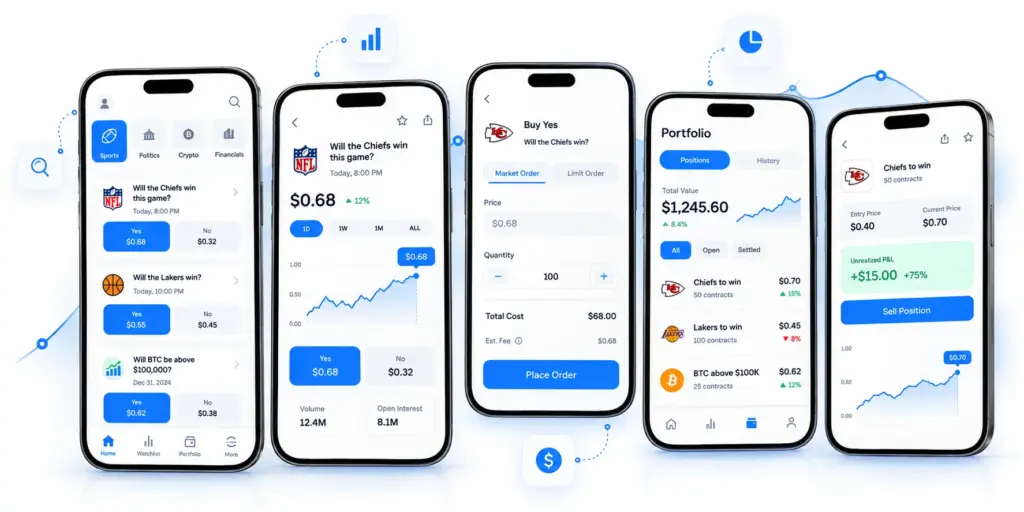
1. Event Discovery
FanDuel Predicts organizes markets into categories such as Sports and Financials and presents them as simple Yes/No questions. Its categories include sports, crypto, commodities, financials, and politics, with sports contracts available in 18 states. A strong discovery layer should include:
- Category navigation: Sports, financials, crypto, commodities, politics, and more.
- Search: Find specific teams, players, or indicators.
- Plain-language cards: Show the question with current Yes and No prices.
- Watchlists: Let users follow markets without trading.
- Onboarding content: Explain contracts through resources like Prediction Markets 101.
2. Contract Pricing
Event contracts typically trade between $0.01 and $0.99, with prices changing according to supply and demand. FanDuel Predicts displays prices as Multiplier, Odds, Cents, or Percent, helping different users understand the same market.
| Display format | $0.65 Yes contract |
| Cents | 65¢ |
| Percent | 65% |
| Multiplier | About 1.54x return if it wins |
| Odds | About -186 American odds |
Each position also has a defined maximum loss equal to the amount paid for the contract.
3. Live Market Data
Real-time data keeps prices aligned with live events and changing market sentiment. FanDuel Predicts supports live trading and enhanced-liquidity markets, allowing users to enter and exit positions during games. Reviews describe its charts as relatively basic, without depth-of-book views or detailed price history. This creates room for platforms to differentiate with deeper charts, volume data, and historical pricing.
Plan for real-time data feeds and scalable infrastructure to handle traffic and price changes during major events.
4. Order Placement
The order flow should remain simple: choose a market, select a side, set the amount, review the price and fee, and confirm. FanDuel Predicts also requires KYC verification, including identity and address checks, and blocks credit cards to prevent users from trading with borrowed funds.
| Order step | What the user sees or does |
| Select a market | Plain-language Yes/No question |
| Choose a side | Yes or No |
| Set the amount | For example, $20 for 50 contracts at $0.40 |
| Review | Estimated fill price and fee |
| Confirm | Order routed for exchange matching |
5. Open Positions
Users need one place to monitor their active trades. FanDuel Predicts tracks buying power, open positions, and pending settlements, while completed activity appears under History. The dashboard should make it easy to see the contract, entry price, current price, and potential payout at a glance. This helps users understand their exposure without having to calculate the position value themselves.
A positions view should show:
- Contract and side: Market name and Yes/No position.
- Entry price and quantity: For example, 50 contracts at $0.40.
- Current price: Shows how the position has moved.
- Potential payout: $1 per winning contract.
- Status: Open, awaiting settlement, or settled.
6. Early Exit
Early exit lets users sell before an event resolves. FanDuel Predicts provides a Cash Out option, with the exit price depending on the current market and available liquidity. This gives users more control over their positions instead of requiring them to wait for the final outcome. A strong platform should also show the expected exit value clearly before the user confirms the sale.
Example
- A user buys 50 Yes contracts at $0.40, spending $20.
- The team takes a lead and the price rises to $0.70.
- The user cashes out for about $35, earning a $15 gain before fees.
- If the team loses, the contracts settle at $0 and the $20 is lost.
7. Portfolio Tracking
Portfolio analytics are an area where FanDuel Predicts has room to improve. One review noted the absence of a portfolio P&L view, win rate, and historical performance summary, while crediting Kalshi with basic portfolio analytics and stronger price-history charts. For new platforms, P&L, win rate, performance history, and deeper analytics can create a stronger trading experience.
8. Market Alerts
Alerts help users respond to price changes and settlement events. Reviews describe FanDuel Predicts’ settlement notifications as reliable but note that price-threshold alerts are missing.
Useful alert types include:
- Price triggers: Alert when a contract reaches a selected price.
- Settlement notifications: Confirm market resolution and payouts.
- Event reminders: Notify users before a tracked game starts.
- Position alerts: Highlight significant price movements.
- Responsible-trading reminders: Surface deposit limits and session reminders.
9. Transaction History
A clear transaction history helps users track their money and gives compliance teams an audit trail. FanDuel Predicts provides a History view, while reported payouts arrive within 24 hours and debit-card withdrawals take under 24 hours after a one- to two-day clearing period.
Prediction markets typically issue 1099 forms for trading gains, making accurate transaction records important.
| Record type | What it should show |
| Deposits | Amount, method, and time |
| Trades | Market, side, quantity, price, and fee |
| Early exits | Sell price and gain or loss |
| Settlements | Outcome, $1 or $0, and credited payout |
| Withdrawals | Amount, method, and status |
Together, these nine features provide a practical foundation for an event contracts platform. Discovery, pricing, and order placement attract users, while positions, exits, analytics, alerts, and transaction history keep the trading experience clear and reliable.
How to Build an Event Contracts Platform Like FanDuel Predicts?
To build an event contracts platform like FanDuel Predicts, develop a secure trading engine with real-time event data, contract pricing, liquidity, wallet and settlement systems, and strong KYC and compliance controls. Define clear Yes/No contracts, integrate reliable data sources for resolution, support order matching and early exits, and launch in phases to ensure the platform can handle high trading volumes.
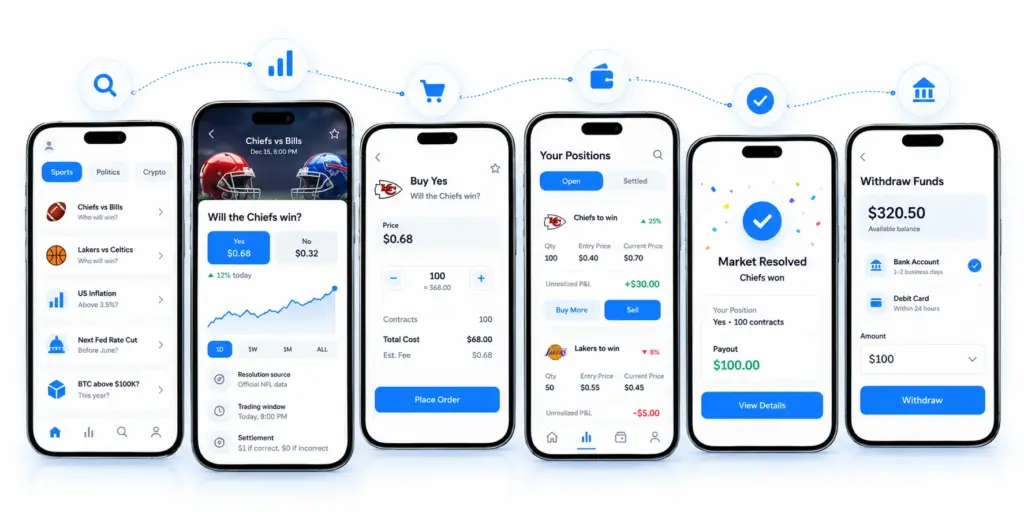
1. Define the Contract Market Model
Every market starts with a precise question, fixed resolution source, and defined trading window. Contracts trade between $0.01 and $0.99 and settle at $1 or $0. On a regulated exchange, each contract must also clear the required regulatory process. A designated contract market can self-certify a contract or seek prior approval, with filings reaching the CFTC at least one business day before listing.
Recent CFTC guidance says broad template filings are not enough because each contract’s terms and settlement design must be reviewable. Railbird’s initial sports filings covered winners, spreads, props, and head-to-head markets, showing the range operators may need to support.
Contract Specification
A contract should define:
- The question: A clear outcome, such as a team winning or data release exceeding a level.
- Resolution source: The official league feed or data source.
- Trading window: When trading opens, closes, and settles.
- Price and payout: 0.01–0.99, with $1 for correct and $0 for incorrect outcomes.
- Edge cases: Rules for postponements, substitutions, and disputed results.
2. Design Trading and Matching Engine
The matching engine is the exchange’s core. Most regulated prediction markets use a central limit order book, similar to stock exchanges. Kalshi uses a centralized order book, while Polymarket matches orders off-chain and records settlement on-chain. A strong engine should support bids, asks, limit orders, partial fills, price-time priority, and self-trade prevention.
Because the two sides total $1, a $0.65 Yes contract pairs with a $0.35 No contract. FanDuel Predicts hides this complexity because orders are routed through CME Group. An alternative is an automated market maker, which is easier to launch but generally better suited to smaller or newer markets.
| Central limit order book | Automated market maker | |
| Price | Best bid matched with best offer | Liquidity-pool formula |
| Launch liquidity | High | Lower |
| Best suited to | High-volume markets | New or niche markets |
| Examples | Kalshi, Polymarket | Polymarket’s early markets |
3. Build Real-Time Event Data Feeds
Data feeds power both live pricing and settlement. The most important requirement is using verified sources rather than relying on operator judgment. Genius Sports supplies official data used by Polymarket and Kalshi for sports settlement. Sportradar has expanded its Polymarket partnership, while Stats Perform works with Rothera. For an NFL contract on FanDuel Predicts, sources can include the NFL, Genius Sports, and CME Group.
4. Create Liquidity and Market Making
Without liquidity, an exchange cannot provide reliable execution. New platforms need a market-making strategy from launch. Susquehanna was the first dedicated institutional market maker on Kalshi and became a day-one liquidity provider for Rothera. Jump Trading built a roughly 20-person event-contract team and took equity stakes in Kalshi and Polymarket for providing liquidity.
Sports, politics, and crypto account for over 90% of volume across Kalshi and Polymarket, making smaller markets more likely to have wider spreads. FanDuel Predicts uses featured markets with enhanced liquidity to concentrate activity.
| Liquidity lever | How it works | Example |
| Institutional market makers | Quote both sides | Susquehanna |
| Incentives | Reduced fees or higher limits | Jump Trading |
| Platform-affiliated makers | Operator or affiliate posts prices | Kalshi, Polymarket, DraftKings, FanDuel |
| Automated market maker | Pool quotes prices | Polymarket’s early markets |
| Featured markets | Concentrate activity | FanDuel Predicts |
5. Develop Wallet and Settlement Systems
The money layer should stay simple for users while remaining strict behind the scenes. Regulated event contracts are fully collateralized, so each Yes/No pair is funded with $1. For example, a $0.65 Yes buyer and $0.35 No buyer together fund $1. The winning side receives that amount at settlement.
Settlement Flow
- Deposit: Funds enter the wallet and become buying power.
- Match: The order fills and collateral is locked.
- Resolve: The official source confirms the outcome.
- Settle: Winners receive $1 per contract; losers receive $0.
- Withdraw: Users move funds to their bank or card.
6. Implement KYC and Compliance Controls
Compliance combines financial-services requirements with gaming-style controls. The platform needs identity verification, sanctions screening, account ownership checks, suspicious activity monitoring, geolocation, and age checks. FanDuel Predicts requires full KYC, including identity and address verification. Sports contracts are limited to 18 states and geolocated out of tribal lands.
Exchanges also need surveillance and audit trails. CFTC enforcement priorities include insider trading, manipulation, market abuse, retail fraud, and AML/KYC violations.
| Control | Purpose |
| KYC | Verify user identity |
| AML screening | Detect suspicious activity |
| Geolocation and age | Enforce location and eligibility rules |
| Market surveillance | Detect manipulation and wash trading |
| Insider trading controls | Flag misuse of nonpublic information |
| Responsible trading tools | Limits, self-exclusion, and support |
7. Test, Launch, and Scale the Platform
Launch in phases because matching or settlement errors can quickly damage trust. Test the trading engine under heavy loads, rehearse settlement across contract types, and validate edge-case rules. One FanDuel Predicts reviewer expected sportsbook-style voids when player situations changed, but the platform’s contract rules worked differently. This shows why clear contract terms matter.
Cost to Build an Event Contracts Platform like FanDuel Predicts
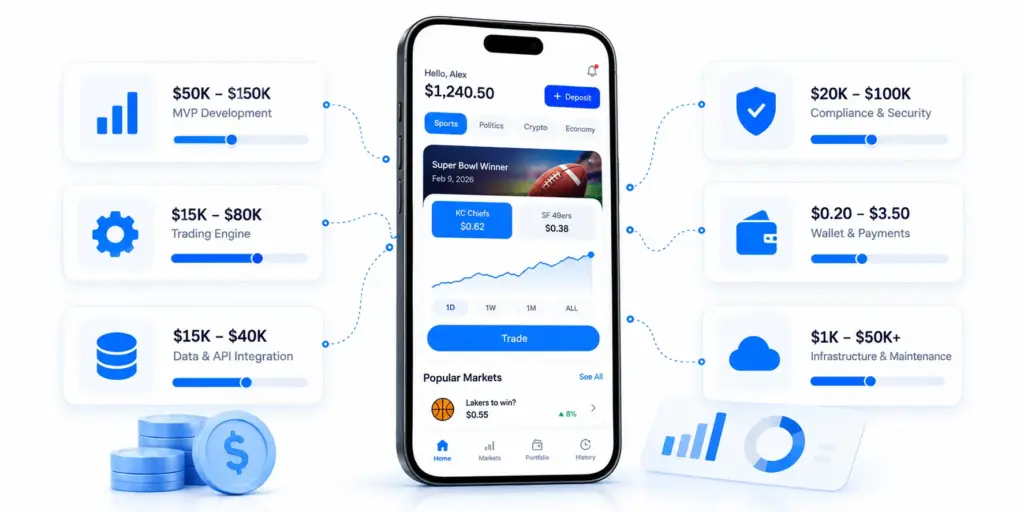
Building an event contracts platform like FanDuel Predicts typically costs $50,000 for a lean MVP to 250,000–400,000+ for a full production platform, plus around 15%–25% of the build cost annually. Estimates vary from 8,000–15,000 for basic MVPs to 250,000–800,000+ for platforms with proprietary markets, integrity tools, and scalable data.
MVP Development Cost
An MVP should let users browse markets, trade, hold funds, and view settlements. A lean MVP with manual oracles can cost 40,000–70,000, while automated feeds and advanced order books can push costs to 80,000–160,000. Enterprise builds with KYC/AML and full compliance can reach 200,000–450,000+.
Another agency estimates custom MVPs at 50,000–100,000 over three to six months, while a crypto-native MVP without KYC or fiat was estimated at 98,700–142,800. For a regulated fiat platform like FanDuel Predicts, a practical planning range is 50,000–150,000.
| Build tier | Typical cost | What it usually includes |
| White-label platform | 10,000–70,000 | Pre-built features with branding |
| Lean MVP | 40,000–70,000 | Manual oracles, basic UI, single niche |
| Custom MVP | 50,000–100,000 | Trading engine, oracle, compliance layer |
| Full production platform | 100,000–250,000 | Wider markets, admin tools, stronger security |
| Enterprise build | 250,000–400,000+ | Institutional scale and full compliance |
Trading Engine Cost
The matching engine is one of the largest technical costs. A custom backend and matching engine can cost 40,000–80,000, while frontend design may add 10,000–30,000. A cheaper option is integrating with an existing exchange through its API, estimated at 15,000–40,000 over four to ten weeks. This is closer to the FanDuel Predicts model, where CME Group handles exchange matching.
Main Development Options
- Custom matching engine: 40,000–80,000 for order types, partial fills, and price-time priority.
- Partner exchange integration: 15,000–40,000 for a product layer over an existing venue.
- Own regulated exchange: A much larger investment. Applicants need resources covering more than 12 months of operating expenses and face a 180-day statutory review. Acquiring an existing licensed exchange can cost tens of millions.
Data and API Costs
Data is both an initial and recurring expense. Official sports data is usually custom-priced. Sportradar has been cited at $1,250/month, while enterprise contracts can reach $10,000+/month or six figures annually.
Oracle and data integration can add 15,000–40,000 upfront. Lower-cost APIs such as SportsDataIO at $25/month and API-Sports at about $19/month can support early testing, but regulated sports contracts generally need verified data for settlement.
| Data item | Estimated cost |
| Oracle and data integration | 15,000–40,000 one-time |
| Official sports data | $1,250/month to $10,000+/month |
| Low-cost APIs | About 19–25/month |
| Backup data provider | Priced separately |
Compliance and Security Costs
Compliance can add 20,000–100,000 for legal, licensing, audits, and documentation. KYC, AML, and surveillance technology can cost 10,000–150,000+. Identity verification typically costs 0.80–5 per check, while enterprise contracts can reach 50,000–200,000 annually. For example, verifying 10,000 users at 2–3 each would cost 20,000–30,000. Smart-contract audits add 15,000–50,000 if the platform uses on-chain components.
| Compliance item | Estimated cost |
| Legal, licensing, documentation | 20,000–100,000 |
| KYC, AML, surveillance | 10,000–150,000+ |
| Identity verification | 0.80–5 per check |
| Enterprise identity contracts | 50,000–200,000/year |
| Smart contract audit | 15,000–50,000 |
Wallet and Payment Costs
Wallets are mainly a transaction expense. ACH transfers typically cost 0.20–1.50 per transaction or 0.5%–1.5%, while cards average 1.5%–3.5% plus 0.10–0.30. Failed ACH payments can add a 2–5 return fee. FanDuel Predicts accepts debit cards and online banking deposits while blocking credit cards.
Example: $100 Deposit
- ACH: About 0.25–1.50.
- Card: About 1.60–3.80.
- Failed ACH: Additional 2–5 return fee.
Infrastructure and Maintenance Costs
Cloud infrastructure can start around 1,000–5,000/month for a small production system and reach 10,000–50,000+/month as the platform grows. DevOps and cloud setup may add 10,000–100,000+. Annual maintenance is commonly around 15%–25% of the build cost, while the first year can reach 40%–50% as the platform stabilizes. Peak events such as the World Cup or NBA Finals can significantly increase infrastructure requirements.
| Initial build cost | Annual maintenance (15%–20%) |
| $50,000 | 7,500–10,000 |
| $100,000 | 15,000–20,000 |
| $250,000 | 37,500–50,000 |
| $500,000 | 75,000–100,000 |
Building the Event Resolution Layer for a Platform Like FanDuel Predicts
Building the event resolution layer means creating a system that verifies real-world outcomes and converts them into accurate payouts. It should define clear resolution rules, use official data sources, validate results, handle delays or disputes, and automate settlement. For FanDuel Predicts, this layer ensures winning contracts pay $1 while losing contracts settle at $0 under the published market rules.
1. Defining the Contract Resolution Rules
Rules should be written before trading begins and clearly define what is measured, how the result is determined, and what happens in unusual situations. Kalshi’s football spread contract, for example, includes overtime scoring, ignores statistical revisions after expiration, and uses a $0.01 minimum tick size. It also defines settlement rules for postponed and abandoned games.
| Rule element | What to define | Example |
| Underlying | Exact quantity measured | Final point differential including overtime |
| Source agency | Official result provider | League governing the game |
| Postponement | When the market stays open or settles | Last fair market price if not resumed that week |
| Abandonment | How partial games settle | Statistics after 55 minutes |
| Corrections | Whether later changes count | Corrections after expiration ignored |
| Forfeits | How forfeits settle | Final score used |
| Price increment | Minimum tick size | $0.01 |
2. Selecting the Official Resolution Source
The platform should use official league, governing-body, or competition data rather than TV graphics or social media reports. Kalshi, for example, ranks sources such as the governing league, ESPN, Fox Sports, NFL.com, NCAA.com, and official broadcasters. Genius Sports supplies official data used by Polymarket and Kalshi for sports settlement.
Stats Perform works with Rothera, while FanDuel Predicts identifies an official governing body or designated source for its markets.
Source Selection Process
- Name a primary source: Usually the governing league or official statistics provider.
- Rank fallback sources: Define secondary sources and their order.
- Secure licensed data: Use official partnerships where possible.
- Publish the source: Show users which source determines the outcome.
- Keep it exchange-agnostic: Rules should work if the listing venue changes.
3. Validating Event Results
A result should be validated before settlement. The platform should confirm the official result, cross-check data, verify the event is final, apply completion rules, and maintain an audit trail. Kalshi’s verification typically takes about three hours after an outcome is known and can take one to two days when data needs cross-checking. Player contracts also need specific rules. Once a player takes at least one snap, settlement uses their accumulated statistics despite injury or ejection.
For an NFL contract on FanDuel Predicts, results can be verified through sources including the NFL, Genius Sports, and CME Group.
| Validation check | Purpose |
| Match result to named source | Confirm official outcome |
| Cross-reference another feed | Catch errors or delays |
| Confirm event is final | Avoid provisional settlement |
| Apply completion rules | Handle overtime and partial games |
| Log source and decision | Maintain audit trails |
| Review unusual markets | Add human oversight |
4. Handling Delayed or Conflicting Data
Rules should cover postponed, abandoned, or conflicting events before trading begins. Kalshi keeps a postponed market open if the game resumes within 48 hours. Otherwise, it settles at the last fair market price without a refund or void. If an official source is delayed, FanDuel Predicts waits for the designated source.
Disputes also need defined procedures. Kalshi can use an Outcome Review Committee or last traded price when an outcome is unresolvable. Polymarket uses a 2-hour challenge window, a $750 proposal bond, and token-holder voting with a 65% majority threshold. These disputes can extend settlement by several days.
| Scenario | Rule | Example |
| Rescheduled within 48 hours | Settle on rescheduled result | Weather delay |
| Not played within 48 hours | Last fair market price | Cancelled fixture |
| Abandoned after 55 minutes | Use accumulated statistics | Late stoppage |
| Abandoned before 55 minutes | Last fair market price | Early cancellation |
| Official source delayed | Wait for confirmation | FanDuel Predicts |
| Post-expiration correction | Ignore correction | Sports contracts |
| Centralized dispute | Review committee or last price | Kalshi |
| Decentralized dispute | Bonded challenge and vote | Polymarket via UMA |
5. Automating Final Settlement
Once the result is verified, settlement should run automatically. Trading closes, the official result is confirmed, rules are applied, and winning contracts become $1.00 while losing contracts become $0. Kalshi typically completes settlement within about three hours of the outcome being known. Polymarket automates payouts after its 2-hour challenge window, with around 99% of assertions going undisputed.
Exception paths should still hold markets affected by delayed data, disputes, or unclear rules for manual review.
Settlement Flow
- Trading closes: No more orders are accepted.
- Result verified: The official result is confirmed and logged.
- Rules applied: Overtime and participation rules are checked.
- Positions settled: Winners receive $1; losers receive $0.
- Balances updated: Funds are credited and recorded in the audit log.
How Event Contracts Platforms Make Money?
Event contracts platforms mainly earn through trading fees, transaction charges, market partnerships, data licensing, and B2B exchange infrastructure rather than taking the opposite side of user trades. Since the platform does not depend on users losing, revenue depends on trading activity, liquidity, and distribution.
1. Trading Fees
Trading fees are a core revenue source. Kalshi charges takers using 0.07 × contracts × price × (1 − price), rounded up to the next cent. At 50 cents, the fee is about $1.75 per 100 contracts. Most Kalshi markets have no maker fee, while roughly 100 series charge a maker fee at one-quarter of the taker rate.
Polymarket charges category-based taker fees from 0.75% for sports to 1.80% for crypto, while geopolitics is free and makers receive rebates. By comparison, sportsbooks build roughly 4.5% into a standard -110 line.
| Platform | Fee model | Example |
| Kalshi | 0.07 × price × (1 − price); mostly no maker fee | $1.75 per 100 contracts at 50¢ |
| Polymarket | Category-based taker fees | 0.75% sports to 1.80% crypto |
| PredictIt | Profit percentage + withdrawal fee | 10% profits + 5% withdrawals |
| Sportsbook | Margin built into odds | About 4.5% at -110 |
2. Transaction Fees
Transaction fees cover deposits and withdrawals separately from trading fees. Kalshi offers free ACH deposits but charges 2% for debit card deposits. A $100 card deposit therefore leaves $98. Polymarket does not charge its own deposit or withdrawal fees, although third-party funding services may charge 2%–3% for debit card purchases. Platforms can also earn interest on customer cash balances.
FanDuel Predicts illustrates why fee transparency matters. Reviews cite a 2% fee tied to potential payout, while another says costs are built into the spread rather than shown as a separate line item.
Common charges include:
- Debit card deposits: Kalshi’s 2% processing fee.
- Withdrawals: Often free for standard bank transfers.
- Settlement: Usually no separate fee.
- Customer balances: Interest earned on held cash.
- Third-party processing: Fees passed on by payment providers.
Example: A $100 debit-card deposit on Kalshi becomes $98, while the same $100 deposited through ACH remains $100.
3. Market Creation Fees
Market creation is usually a platform function rather than a direct paid service on regulated exchanges. Each contract still requires its own regulatory path, creating compliance costs. Kalshi and Polymarket create markets themselves without charging users. Revenue can instead come from branded markets, league partnerships, and sponsorships.
| Model | How it works | Example |
| Per-market fee | Users pay to list markets | Agency-suggested 25–100 |
| Branded markets | Partners choose featured markets | Kalshi’s CNBC page |
| League partnerships | Data and marks exchanged for sponsorship | NHL with Kalshi and Polymarket |
| Market maker programs | Better terms for providing liquidity | Kalshi designated market makers |
4. Data and API Revenue
Exchange prices can become a separate data product. Kalshi licenses data and APIs, while Polymarket has built distribution around its price feeds. ICE committed up to $2 billion to invest in Polymarket and became a distributor of its event data to institutional investors. Dow Jones made Polymarket data available across The Wall Street Journal, Barron’s, MarketWatch, and Investor’s Business Daily, while Yahoo Finance integrated Polymarket data.
Not every partnership is paid licensing. CNN’s exclusive Kalshi partnership does not involve CNN paying for the data, showing that some deals focus on distribution and audience.
Data Partnership Examples
- ICE and Polymarket: Event data distribution to institutional clients.
- Dow Jones and Polymarket: Data across WSJ, Barron’s, MarketWatch, and Investor’s Business Daily.
- CNBC and Kalshi: Live probabilities across TV, digital, and subscription platforms.
- CNN and Kalshi: Exclusive integration without a data licensing payment.
- Yahoo Finance and Polymarket: Market probabilities integrated into its finance platform.
5. B2B Exchange Infrastructure
Selling exchange infrastructure allows brands to access matching, clearing, and regulatory rails without building them from scratch. Kalshi supplies markets to Robinhood, Webull, and Coinbase, while its CEO has discussed more brokers joining. Robinhood users once represented more than half of Kalshi’s trading volume in a single month.
Crypto.com’s exchange supports Fanatics Markets and, after Flutter’s announcement, FanDuel Predicts sports and novelty contracts, while CME continues supplying financial markets. Robinhood also operates its own Rothera exchange, while DraftKings owns Railbird.
| Front-end brand | Exchange supplying contracts |
| FanDuel Predicts | CME Group + Crypto.com |
| Fanatics Markets | Crypto.com |
| Robinhood | Kalshi, ForecastEx, and Rothera |
| Coinbase and Webull | Kalshi |
| DraftKings Predictions | Railbird |
For a new platform, the choice is between owning the exchange or partnering with one. Owning it provides more control over fees, data, and infrastructure revenue, while partnering can reduce development time and share the economics.
Build an Event Contracts Platform With IdeaUsher
Building an event contracts platform requires more than a consumer-facing trading app. You need reliable market infrastructure, high-performance order matching, real-time sports data, automated resolution, secure settlement, and compliance-ready architecture. IdeaUsher brings over 500,000 hours of coding experience and a team of ex-MAANG and FAANG developers to help businesses build scalable event contracts platforms from the ground up or integrate with existing exchanges.
Custom Event Contract Infrastructure
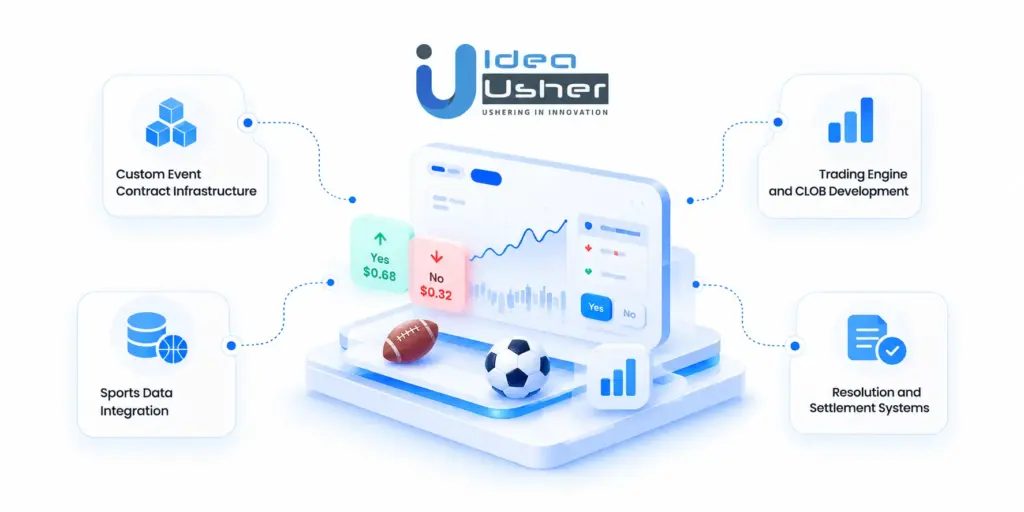
We build the core infrastructure needed to launch and scale event-based markets. This includes contract creation, market management, user accounts, wallets, liquidity systems, trading workflows, and administrative controls. Our team can also design the platform around your chosen exchange or regulatory model.
Trading Engine and CLOB Development
IdeaUsher can develop a Central Limit Order Book or CLOB with order matching, bids and asks, limit orders, partial fills, price-time priority, and self-trade prevention. The architecture can be optimized for high-volume trading and real-time price updates across multiple event markets.
Sports Data Integration
We integrate reliable sports data feeds to power live market updates and contract resolution. Your platform can connect with providers such as Genius Sports, Sportradar, or other licensed data sources to support scores, statistics, game status, and settlement data across supported sports.
Resolution and Settlement Systems
We build automated resolution workflows that verify outcomes against predefined rules and official data sources. Winning contracts can settle at $1 while losing contracts settle at $0, with settlement, wallet balances, transaction records, and audit logs updated automatically.
Conclusion
Building an event contracts platform like FanDuel Predicts is not just about letting people trade on events. The real work happens behind the app. You need a system that can handle trades smoothly and settle contracts correctly. If you get those parts right, you can build a platform that feels simple to users and is ready to grow as more markets are added.
FAQs
A1: An event contracts platform lets users trade contracts based on real-world events. Each contract has a Yes or No outcome and usually trades between $0.01 and $0.99. The winning side receives $1 when the event is settled. These platforms can cover sports as well as financial and other real-world events.
A2: Event contracts turn a real-world question into a tradeable market. Users choose Yes or No and buy contracts at the current market price. They can hold the contract until the event ends or sell it earlier if the market moves in their favor. The contract price can change as new information affects what traders expect.
A3: The price is set by supply and demand in the market. A contract priced at $0.65 can roughly represent a 65% implied probability. Prices can change as new information enters the market and traders buy or sell contracts. The price also shows how much a user pays for each contract before settlement.
A4: Contracts are settled using predefined rules and an official data source. Once the result is confirmed, winning contracts usually pay $1 while losing contracts pay $0. The platform then updates the user’s balance automatically. Clear settlement rules help users understand exactly how each market will be resolved.
A5: Yes. Users can sell their contracts before the event is settled if there is enough market liquidity. For example, a contract bought at $0.40 could be sold at $0.70 for a $0.30 gain per contract before fees. The final selling price depends on what other traders are willing to pay at that time.
A6: Sportsbooks set their own odds and take the opposite side of the bet. Event contract platforms work more like marketplaces where users trade Yes or No contracts with other participants. The contract price changes with supply and demand and the final payout is usually $1 or $0. This makes event contracts closer to trading a market than placing a traditional sportsbook bet.