

Key Takeaways
- Older adults are staying more engaged through VR senior care apps that offer immersive activities, virtual travel, social experiences, and family connections.
- Rendever brings together synchronized group VR, personalized reminiscence experiences, live activities, fitness programs, and caregiver management tools
- A successful VR senior care platform needs senior-friendly interfaces, synchronized headsets, engaging content, family tools, and secure cloud infrastructure.
- These platforms can strengthen resident engagement, social interaction, caregiver efficiency, and participation while helping senior care providers scale their services.
Senior care is becoming more experience-driven as providers look for better ways to keep older adults engaged and socially connected. VR senior care apps can make this possible by bringing immersive experiences into everyday care. Residents can revisit familiar places or discover new ones without leaving their community. A platform like Rendever takes this idea further by creating shared experiences that can bring residents together. For founders, the real challenge is not simply adding VR content. The focus should be on making the experience comfortable and easy to use for older adults while giving care teams a practical way to manage it.
VR is creating new possibilities for senior care by making it easier to deliver immersive activities that support connection and engagement. We’ve worked on VR senior care solutions that combine spatial computing with real-time session management to create experiences that can be used across senior living environments. That’s why we’ve put together this blog to explain the key steps involved in developing a VR senior care app like Rendever.
What Is Driving Demand for VR in Senior Living?
According to Market Research Future, the elderly care app market was valued at $4.583 billion in 2024. It is expected to reach $19.22 billion by 2035 with a 13.92% CAGR from 2025 to 2035. This growth reflects the rising demand for digital solutions that can improve resident engagement and help senior care providers offer more personalized experiences. For operators, the opportunity is not just about adopting new technology. It is about using digital tools to improve participation and stand out in a competitive senior living market.
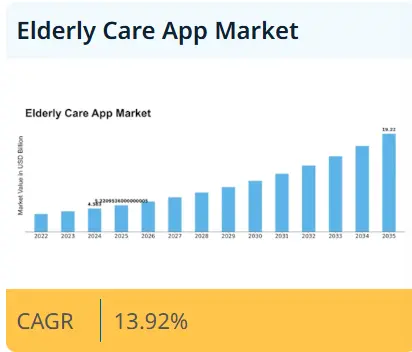
Source: Market Research Future
Investors looking at this sector should recognize that virtual reality is no longer a novelty in eldercare. It is becoming core infrastructure for resident wellness. High-occupancy facilities are actively buying solutions that solve real staffing and engagement challenges.
Demand for Resident Engagement
Senior care communities are moving beyond basic entertainment to offer activities that keep residents mentally and socially engaged. VR makes this easier by giving residents new places to explore and shared experiences to enjoy with others. Platforms like Rendever show how immersive technology can become part of everyday senior programming rather than a one-time activity.
MyndVR has also found a strong business opportunity in this space. It serves senior living communities and veteran care facilities with a growing library of VR experiences. The company generates around $10.4 million in annual revenue and has raised more than $13.7 million in funding. This suggests that providers are willing to invest in VR when it delivers consistent value for residents.
Accessible Social Connection
Social isolation can affect both resident well-being and the overall experience of senior living communities. Distance from family and reduced mobility can make regular social interaction difficult. VR can help by creating shared experiences that residents can enjoy with family members or other residents. The real value comes from giving people something to talk about and experience together rather than simply providing another form of entertainment.
Adoption also becomes easier when the experience is simple and designed around the needs of older adults. Shared VR sessions can encourage residents to return regularly because each activity becomes a social event. For care providers, this creates a stronger case for investing in platforms that support group participation and ongoing engagement.
Flexible Experiences for Care Providers
Senior care providers also need to think about the cost of running activities. Physical outings can require transportation, extra staff, and careful planning. VR offers a simpler option by bringing travel and group experiences into the facility. This gives communities more ways to engage residents without adding the same level of logistical work.
The value of VR can extend to staff development as well. Embodied Labs uses immersive experiences to help caregivers understand what it feels like to live with conditions such as Alzheimer’s disease and macular degeneration. This makes training more practical and memorable. The company has raised more than $7.5 million in funding which reflects the demand for specialized VR solutions across senior and healthcare settings.
How Rendever Uses VR to Improve Senior Engagement?
Rendever operates as a market leader in senior care virtual reality, serving hundreds of care communities across North America. The company has built a high-margin enterprise model, driving estimated annual revenues between $5.9 million and $12.9 million. In addition to enterprise software subscriptions, they have secured over $4.5 million in research grants from the National Institutes of Health to validate their clinical impact.
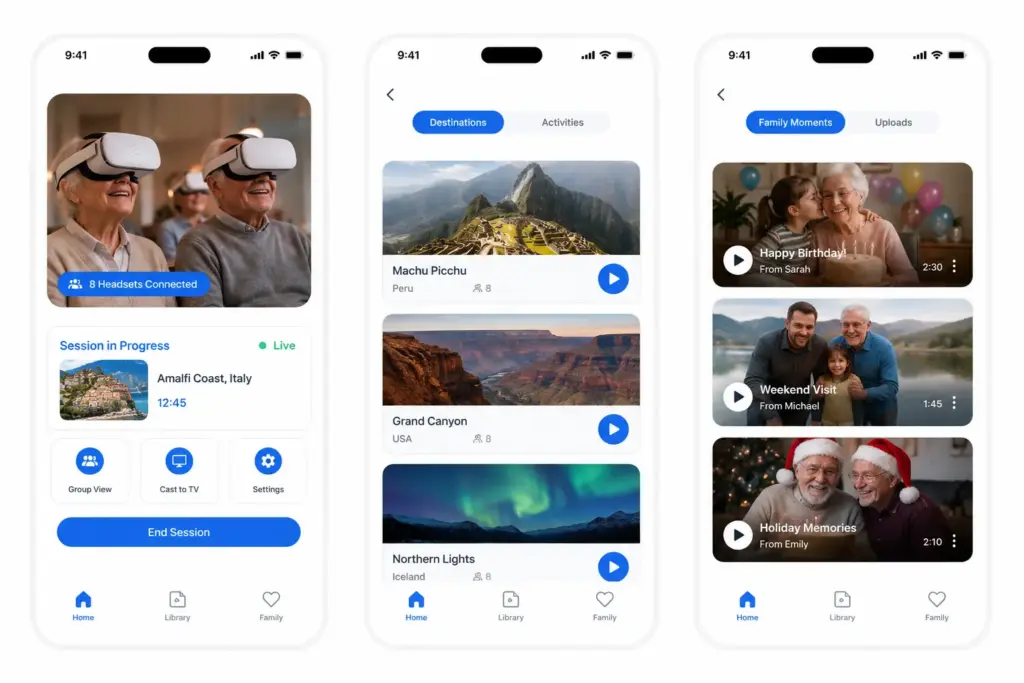
For entrepreneurs looking to enter this space, Rendever offers a clear blueprint. Their success stems from addressing the core operational need of senior living providers, which is keeping residents engaged while reducing the burden on care staff.
1. Shared VR as a Social Event
Isolated VR experiences fail in senior care settings because they separate residents from their surroundings. Rendever solved this by engineering synchronized playback across multiple headsets. When residents put on their headsets, they enter the exact same virtual destination together.
A staff member leads the group from an iPad, guiding residents through virtual tours of world cities, historical landmarks, or natural wonders. This shared presence transforms passive viewing into lively conversation. Residents react to the same sights simultaneously, sparking memories and peer interactions that linger long after the session ends.
Why synchronized VR succeeds in B2B sales:
- Boosts activity participation rates across care facilities
- Creates strong visual marketing assets for prospective family tours
- Delivers immediate social proof during platform sales demos
2. Personalized VR for Deeper Impact
Generic virtual travel gets boring quickly. Long-term platform retention requires deep personal relevance for aging adults. Rendever addresses this by enabling customized content creation through resident reminiscence programs and family uploads. Families can upload 360-degree photos and personal video memories directly into the resident’s profile. A senior can virtually revisit their old childhood neighborhood, stand in their former garden, or attend a grandchild’s wedding across the country.
Customization layers every platform developer should consider:
| Feature Layer | Operational Function | Business Benefit |
| Family Portal | Web app for family photo and video uploads | Increases family satisfaction and app retention |
| Reminiscence Engine | Location-based search using historical street view | High engagement for memory care units |
| Custom Activity Guides | Prompts for staff to spark conversation | Reduces prep time for activity directors |
This personalized approach creates an emotional connection, making the platform an indispensable utility rather than an optional leisure software.
3. Live Content for Easy Staffing
Technology alone rarely succeeds in senior care unless it integrates seamlessly into daily operational routines. Rendever supports facility staff by offering daily live programming and structured event calendars. Their staff does not just sell software; they host live interactive sessions, trivia games, and guided tours broadcast directly into member communities. Activity directors simply log in and hand out headsets, letting Rendever handle content delivery.
Operational advantages for enterprise buyers:
- Solves staffing shortages by outsourcing activity planning to the platform
- Guarantees consistent daily engagement schedules across multi-property networks
- Provides usage analytics so regional directors track facility ROI
Combining hardware management, personalized content, and live hosted programming gives platform creators a defensible moat and strong recurring enterprise contracts.
How Rendever Creates Shared VR Experiences for Seniors?
Single-user virtual reality creates an isolated environment that fails in group care settings. Rendever built its competitive edge around multi-user synchronization, turning headset sessions into interactive community events. From a monetization perspective, Rendever charges communities through an enterprise software model.
Facilities pay an upfront fee for hardware bundles, system setup, and staff onboarding. They also pay a recurring monthly subscription for software updates, content additions, and ongoing support. Their standalone software tiers, like RendeverLive, range from free entry-level access up to $99 per month per location for unlimited group sessions.
1. Networked Headsets in Sync
Most consumer headsets operate independently. Rendever links multiple headsets to a single master tablet using a local network protocol. When an activity leader taps a destination on the tablet, every headset updates instantly. Residents look in different directions within the same 360-degree environment, but they share the exact same location and audio cues in real time.
Technical design choices that drive enterprise sales:
| Technical Feature | Purpose for Care Staff | Enterprise Benefit |
| Central Tablet Control | Allows one staff member to manage up to 10 headsets | Reduces staff labor requirements |
| Local Network Pairing | Syncs visuals without relying on external internet bandwidth | Ensures reliable session performance |
| TV Screen Casting | Mirrors headset views to a main television screen | Includes non-headset users in group sessions |
This synchronized setup takes technical friction away from non-technical care staff, making group sessions simple to start and run.
2. Group Social Interaction
Shared virtual travel gives residents immediate topics for conversation. Instead of staring at a television, residents react together as they tour famous landmarks or revisit historic sites. The real value happens when headsets come off. Residents discuss what they saw, compare past travel memories, and build stronger relationships with peers in their community.
Why social VR outperforms standalone apps:
- Shared sights trigger spontaneous conversations among residents
- Group settings encourage hesitant seniors to try new activities
- Regular scheduled sessions build consistent weekly social habits
- Higher group attendance proves clear return on investment for facility directors
Building a platform around shared group participation ensures higher app usage and lowers customer churn across enterprise accounts.
3. Family Content Layer
VR becomes more valuable when residents can experience something that feels personal. Instead of relying only on a fixed content library, platforms can let families share photos and videos from birthdays, holidays or everyday moments. These experiences can help residents feel closer to family members who cannot visit often.
For senior living providers, family participation can also support long-term engagement. Fresh personal content gives residents a reason to return while reducing the pressure to constantly create new experiences. It can also make the platform more appealing to care directors who want technology that involves families in the resident experience.
Key Features of a VR Senior Care App Like Rendever
Building a competitive product in the senior care space requires a balance between resident enjoyment and staff usability. Rendever built its entire system around solving operational headaches for activity directors while offering rich content for seniors. For software founders, Rendever shows how software modules turn simple VR hardware into an enterprise health solution. Understanding Rendever’s main feature set gives developers a clear roadmap for building a scalable product in eldercare tech.
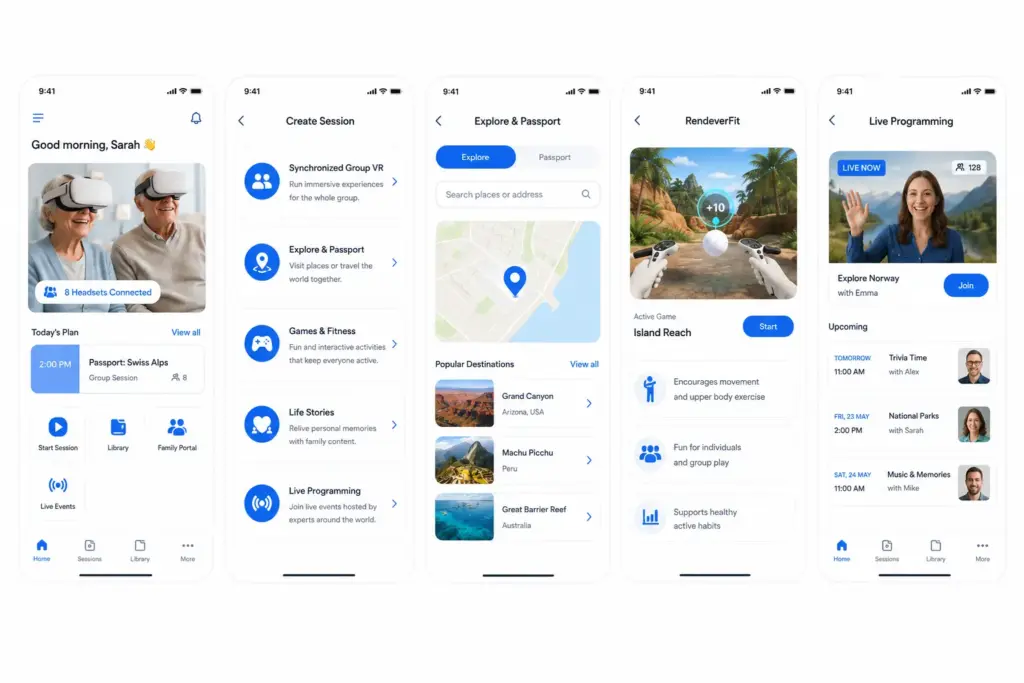
1. Synchronized Group VR
Group VR activities work best when caregivers can manage them without complicated controls. Rendever allows staff to operate multiple headsets from an iPad so residents can share the same experience. Caregivers can guide the session while residents interact with each other. This simple setup can make VR easier to include in regular senior care activities.
2. Travel and Reminiscence
Rendever offers two dedicated tools called Explore and Passport. Explore uses street-view imagery to let seniors visit their childhood homes, schools, or old workplaces. Passport brings pre-recorded 360-degree videos of world landmarks and natural parks directly to users. Seniors type in an address or select a destination on the tablet map. Seconds later, they stand outside their old neighborhood, sharing childhood memories with staff and peers.
Key content features:
| Module Name | Function inside Rendever | Value for Enterprise Buyers |
| Explore | Location search using street imagery | Powerful memory care trigger for dementia patients |
| Passport | 360-degree video tours of global landmarks | High-value travel experiences without transport costs |
| Custom Pinning | Saved geographic locations for quick access | Faster session prep for busy caregivers |
3. Interactive Games and Fitness
RendeverFit adds a more active side to VR by combining movement with simple games. Residents can use hand controllers to play activities that encourage them to move their arms and upper body. The sessions can make exercise feel less like a routine task and more like a group activity. For care providers, this creates an engaging way to support physical activity while encouraging residents to participate regularly.
4. Family Portal and Life Stories
Family-shared memories can make VR sessions feel more meaningful for older adults. Rendever allows relatives to upload personal photos, videos, and voice recordings through its web portal. Residents can revisit these moments during private sessions, which may support memory care and emotional comfort. For senior living providers, this also creates a simple way to keep families involved in everyday resident experiences.
5. Live Hosted Programming
Senior living communities can offer residents more variety without requiring staff to plan every activity themselves. RendeverLive provides live interactive sessions led by professional hosts and gives residents the chance to participate in activities such as travel experiences and trivia. Staff can start a session through the control system while residents interact with the host in real time. This model helps communities keep their activity calendars fresh with less planning effort.
Value delivered by live streaming:
- Cuts activity preparation time for care center staff
- Delivers fresh content daily without extra platform updates
- Connects smaller care homes into a larger global community
6. Caregiver Dashboard
Senior care teams need simple tools to manage VR activities without adding more work to their daily routines. Rendever’s Engage + Empower tier provides a centralized dashboard where staff can manage resident profiles and plan activities. It also helps teams track attendance and use resident preferences to choose more relevant experiences. This makes it easier for facilities to run VR programs consistently across their communities.
Caregiver management tools:
- Individual profiles listing resident hobbies, past jobs, and triggers
- One-click calendar scheduling for weekly group events
- Device management showing battery life and headset status
7. Analytics and Reporting
Usage analytics can help senior care providers understand whether residents are actually using the technology. Rendever tracks headset activity and gives caregivers access to reports on session time and participation. These insights help managers compare engagement across communities and identify which experiences residents prefer. T
How to Develop a VR Senior Care App Like Rendever?
Developing a specialized VR senior care app for eldercare requires software engineers and product managers to solve unique hardware and design challenges. Consumer apps focus on fast movement and complex controllers, but senior living platforms must focus on comfort, stability, and zero friction. Teams building in this space need to design software for two distinct end users: senior residents who experience the content, and busy care staff who operate the tech.
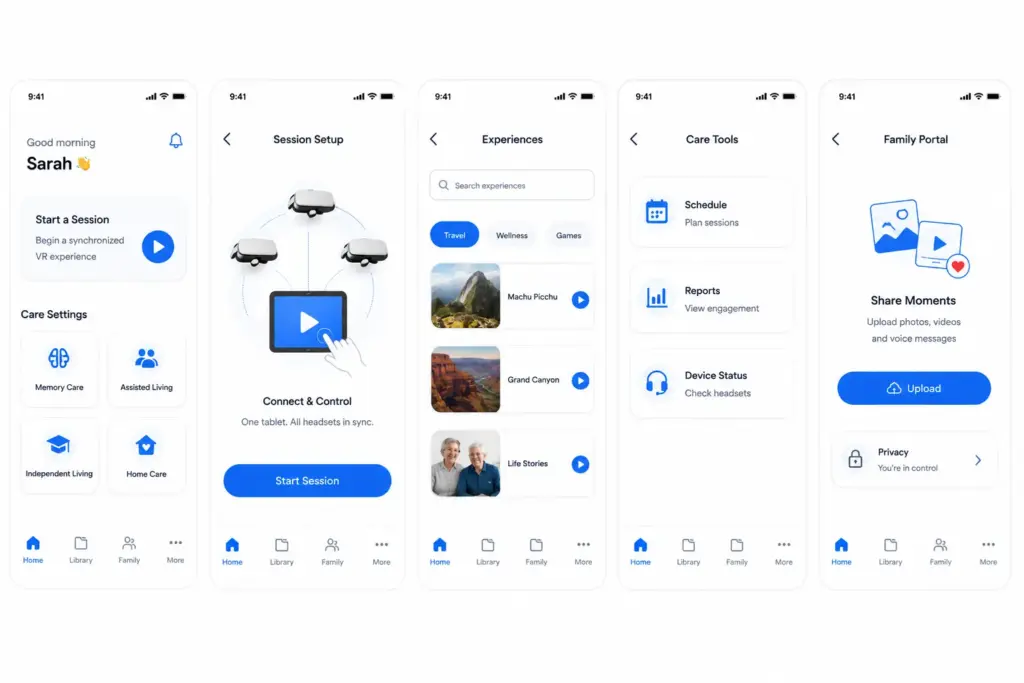
Balancing these technical and operational requirements is essential for building a platform that facilities will buy and use daily.
1. Define Care Settings
Targeting the entire senior living market at once creates bloated software. Designers must decide whether their core platform serves memory care, assisted living, independent living, or home care networks. Memory care facilities need slow-moving reminiscence content that avoids sudden movements or loud sounds. Assisted living communities prefer interactive trivia, group travel, and wellness activities.
Care setting priorities:
- Memory Care: High focus on reminiscence, familiar locations, and simple viewing
- Assisted Living: High focus on social travel, group games, and fitness
- Independent Living: High focus on live streaming, educational lectures, and self-guided exploration
- Home Care: High focus on family connections and remote caregiver monitoring
2. Senior-First System Architecture
Older adults often face motor skill challenges, vision loss, or cognitive decline. Forcing seniors to navigate complex 3D virtual menus with hand controllers leads to instant frustration and abandoned sessions. Platform developers should eliminate hand controllers for residents entirely. Head-gaze selection, auto-playing scenes, and tablet-guided controls allow seniors to enjoy the experience without worrying about buttons.
Essential senior-friendly design specs:
| Component | Consumer VR Standard | Senior Care VR Requirement |
| Navigation | Dual hand controllers with joysticks | Master tablet control or head-gaze targeting |
| Motion | Fast free-roam artificial locomotion | Stationary 360-degree views or smooth teleportation |
| Visuals | High-contrast rapid gaming UI | High-brightness, large font text overlay |
| Weight | Standard consumer straps | Balanced top-straps with easy-clean sanitizing facial pads |
3. Synchronized Multi-Headset Infrastructure
The core technical hurdle when recreating Rendever’s model is local device synchronization. Multiple headsets must play video, sync audio, and change scenes simultaneously over local Wi-Fi networks. Engineers usually build this system using a client-server local network architecture. A master tablet running a native control application sends commands over WebSockets or local UDP protocols to receiving client headsets.
Key development steps for synchronized sessions:
- Establish a local peer-to-peer connection between the tablet and headsets to bypass poor facility internet.
- Build an automated device pairing system using simple QR codes scanned by the headset camera.
- Implement low-latency state synchronization so audio and video stay frame-locked across all devices.
- Add real-time status pinging so staff see headset battery levels and connectivity status on the main dashboard.
4. Content and Management Layer
A reliable VR platform needs to deliver large media files without creating delays during sessions. Rendever can use cloud storage with local caching so frequently used experiences are ready on the headset while live events can be streamed when needed. Content can also be organized around care goals such as memory recall or relaxation. This approach helps staff find suitable experiences quickly and keeps the system responsive for everyday use.
5. Caregiver and Family Tools
A senior care VR platform needs useful tools for people who manage and support residents too. Rendever can connect caregivers and families through a web-based system where staff schedule activities and relatives share personal media. Privacy controls help protect sensitive family content while simple session tools reduce the preparation required from caregivers. This makes the platform more useful beyond the VR headset itself.
6. In-Community Usability Testing
Testing VR software in a developer sandbox tells you very little about how it performs inside a busy care facility. Early beta builds must undergo real-world testing with residents and staff inside actual senior living communities. Developers need to track physical comfort, motion sickness triggers, and session length limits. Most seniors prefer sessions lasting between 15 and 30 minutes.
Usability metrics to measure during pilot programs:
- Time required for staff to set up and launch a 4-headset session
- Resident neck fatigue and hardware comfort levels over 20-minute periods
- Frequency of network disconnects across different facility Wi-Fi setups
- Staff adoption rates after initial onboarding training sessions
7. Scaling to Enterprise Readiness
Transitioning from a working product build to an enterprise-ready platform requires institutional security, remote device management, and enterprise analytics. Senior living networks operating dozens of properties require centralized admin portals. Enterprise buyers want single sign-on access, multi-facility performance dashboards, and automated compliance tracking.
Key architectural steps for enterprise expansion:
- Implement mobile device management protocols for remote headset software updates
- Integrate single sign-on systems for enterprise staff account access
- Build regional data dashboards showing device usage and resident participation across multiple properties
- Secure health data compliance standards to safeguard resident records and family uploads
Cost to Develop a VR Senior Care App Like Rendever
Developing a VR senior care app involves more than building an app for a headset. Rendever brings together VR experiences with caregiver tools and cloud services to create a connected system. The development cost can therefore be higher than a typical consumer VR app because the platform must support different users and devices while remaining reliable for daily use.
Cost Breakdown Across Platform Components
Software budgets split across several major modules. Rendever succeeds because it connects multi-device synchronization with backend family portals and staff tools, making every component essential to the product ecosystem.
| Platform Component | Scope and Engineering Focus | Estimated Cost (USD) |
| Headset VR Client App | Head-gaze UI, 360-degree video playback engine, senior-friendly interfaces | $35,000 – $75,000 |
| Master Controller App | Tablet interface, device management, session controls, casting protocols | $25,000 – $50,000 |
| Multi-Headset Sync Engine | Local UDP/WebSocket networking, frame-lock playback across 4–10 headsets | $30,000 – $60,000 |
| Family Portal & CMS | Web upload system for 360 media, resident profiles, cloud storage setup | $20,000 – $45,000 |
| Caregiver Dashboard & Analytics | Attendance logs, usage tracking, facility scheduling, ROI dashboards | $20,000 – $40,000 |
| QA, Security & Testing | HIPAA compliance checks, usability testing in care homes, network optimization | $20,000 – $40,000 |
| Total Estimated Investment | Full-featured platform development | $150,000 – $310,000 |
Key Drivers Increasing VR Development Budgets
Certain advanced technical requirements push initial development expenses into higher brackets. The National Institute on Aging highlighted Rendever’s synchronized group networking as a primary product differentiator, but building reliable low-latency synchronization requires specialized senior software engineers.
Major financial drivers to budget for:
- Multi-headset local synchronization: Adding $30,000 to $60,000 for seamless local networking that functions reliably on poor facility Wi-Fi.
- Healthcare integrations and HIPAA compliance: Adding $15,000 to $35,000 to secure resident profiles, family uploads, and medical records.
- Custom 3D environments and interactivity: Adding $20,000 to $80,000 if you build custom gamified wellness modules like RendeverFit instead of using 360-degree video streams.
- AI personalization and voice control: Adding $25,000 to $50,000 for smart content recommendations based on resident mood or memory triggers.
- Enterprise security and remote device management: Adding $15,000 to $40,000 for single sign-on access and automated remote headset updates across multiple care locations.
MVP vs Enterprise Platform Investment
Choosing between an initial Minimum Viable Product or MVP and a full enterprise ecosystem depends on your go-to-market strategy and early funding levels. An MVP lets product teams validate local facility interest quickly, while an enterprise platform targets multi-property care networks that require deep administrative controls.
Investment path breakdown:
| Phase | Estimated Cost | Core Scope | Best For |
| Phase 1: Basic MVP | $80,000–$150,000 | 4-headset sync, tablet control, basic VR library, and head-gaze UI. | 3–5 community pilots |
| Phase 2: Commercial Product | $150,000–$280,000 | Family uploads, resident profiles, live sessions, and cloud sync. | Single-property deployments |
| Phase 3: Enterprise System | $280,000–$500,000+ | Corporate dashboards, analytics, fitness, integrations, and multi-facility management. | Regional and national operators |
How Scalable Is a VR Senior Care Business Model?
Eldercare technology presents massive scaling opportunities for software developers and investors. The core product relies on software rather than physical real estate. This digital foundation means the business can scale infinitely across the globe. Once a senior living operator trusts your system in one local building they naturally want to replicate that success in every facility they own.
A highly scalable platform converts single local pilots into national corporate contracts. This transition transforms a simple application into a highly valued enterprise asset.
1. Multi-Site Operator Expansion
Winning a single care facility can validate the product. The bigger opportunity comes from selling to large senior living networks that need one system across many locations. Rendever follows this approach by supporting centralized management and ready-to-use hardware. This makes it easier for corporate teams to roll out VR programs without placing extra pressure on local staff.
SilVR Adventures follows a similar enterprise-focused model. Its shared VR experiences are designed for older adults across multiple markets and generate around $2.4 million in annual revenue. For developers, this shows why features such as centralized billing and remote device management can be important when targeting large care networks.
2. Tiered Recurring Revenue Models
Recurring subscriptions can make senior care VR platforms more predictable and easier to scale. Providers can start with essential features and upgrade as they need more capabilities such as family engagement tools and analytics. XRHealth shows the potential of this approach.
The company generates around $18.5 million in annual revenue through VR-based therapy and cognitive training. A tiered model also lets developers serve smaller facilities while creating higher-value plans for larger care networks.
3. Scaling Content and Enterprise Support
Adding new enterprise customers is only half the battle. Your platform infrastructure must easily handle that massive user growth. Large corporate clients demand fresh daily content and reliable performance data to justify their ongoing subscription costs. Rendever maintains its market dominance by constantly expanding its travel libraries and managing daily live programming.
Their enterprise offering combines this steady stream of fresh experiences with centralized reporting tools. Regional directors can log into a dashboard and see exactly how often their staff run group activities. Scaling platform infrastructure requires targeted investments:
- Expandable cloud storage for growing high-resolution video libraries
- Live broadcasting capabilities for interactive daily community events
- Automated usage reports delivered straight to facility executives
- Responsive technical support teams dedicated to hardware troubleshooting
Build a VR Senior Care App with IdeaUsher
Taking a virtual reality concept from raw vision to market deployment requires an engineering partner that understands enterprise software and eldercare usability. IdeaUsher delivers full-cycle software development tailored specifically to healthcare founders and senior care providers. With over 500,000 hours of coding experience, our team of ex-MAANG/FAANG developers designs high-performance VR platforms that solve operational headaches and scale smoothly across enterprise networks.
Turn Ideas into Scalable VR Products
A great healthcare product starts with a clear market focus. IdeaUsher works alongside your leadership team to define your ideal care settings, mapping out custom user journeys for residents, caregivers, and family members. We refine your initial concept into a lean Minimum Viable Product to get your platform into senior living communities quickly. This approach validates your software in real care settings while keeping early development budgets under control.
Product creation phases:
- Discovery and Product Strategy: Target audience mapping, competitor research, and technical feasibility checks.
- Experience Design: Senior-first interface design, head-gaze UI prototyping, and master tablet wireframing.
- MVP Engineering: Focused build of local headset sync, travel content playback, and basic staff session controls.
- Pilot Testing: In-community testing, physical comfort monitoring, and immediate feedback integration.
Connected Experiences for Residents and Teams
IdeaUsher builds complete software ecosystems rather than isolated VR applications. We construct every connected piece of the platform so your product functions smoothly in busy care settings. Our engineering team builds local multi-headset synchronization, allowing one caregiver to control multiple devices from a central tablet. We also create custom family portals, resident profile engines, and live-streaming infrastructure.
Ecosystem modules engineered by IdeaUsher:
| Module | Core Functionality | Strategic Value |
| Master Control Tablet | Syncs playback, manages battery status, starts group sessions | Minimizes caregiver work |
| Headset VR Client | Plays 360 videos, renders 3D spaces, tracks gaze movement | Ensures comfort for seniors |
| Family Web Portal | Accepts photos, videos, and personalized life stories | Increases long-term retention |
| Care Dashboard | Logs activity attendance, schedules events, tracks progress | Quantifies value for executives |
Scale with Healthcare-Ready Tech
A senior care VR platform needs to remain secure and reliable as it expands to more facilities. IdeaUsher can build the backend with scalable cloud infrastructure and healthcare-focused security practices. AI can also help personalize activity recommendations based on resident engagement. With remote device management and ongoing maintenance, the platform can support growing care networks without becoming difficult to manage.
Conclusion
Developing a VR senior care app like Rendever starts with understanding how the platform will be used by residents and caregivers. The process then moves into VR experience design, synchronized group sessions, family engagement tools and a reliable backend. A strong development plan should also focus on ease of use so staff can manage sessions without extensive training.
Things to Know About VR Senior Care Apps
A1: VR senior care apps use immersive experiences to support activities such as virtual travel, reminiscence, wellness, social interaction, and family engagement. Platforms like Rendever also use shared VR sessions to help residents participate in experiences together rather than using VR in isolation. This can give senior living communities more options for resident activities while creating opportunities for conversation and connection.
A2: VR can give older adults opportunities to explore places, participate in group activities, and share experiences with other residents or family members. Shared VR platforms synchronize participants so they can experience the same virtual environment at the same time. This social-first approach can help create conversations and shared memories while addressing isolation.
A3: A well-designed platform can include synchronized multi-user VR, virtual travel, reminiscence experiences, family engagement, caregiver controls, content management, live programming, and engagement analytics. The exact feature set should depend on the target care setting and business model. Rendever, for example, combines shared VR with family tools, live programming, fitness experiences, and analytics in its broader platform.
A4: VR can be particularly useful for seniors who have difficulty traveling or participating in certain physical activities. Immersive experiences can allow them to explore destinations and participate in activities without physically leaving the care environment. However, the product should be designed around accessibility, comfort, simple interactions, and appropriate supervision rather than assuming every resident will use VR in the same way.